
Life, 1920-05-20 · page 27 of 48
Life — May 20, 1920 — page 27: what you’re looking at
What you’re looking at
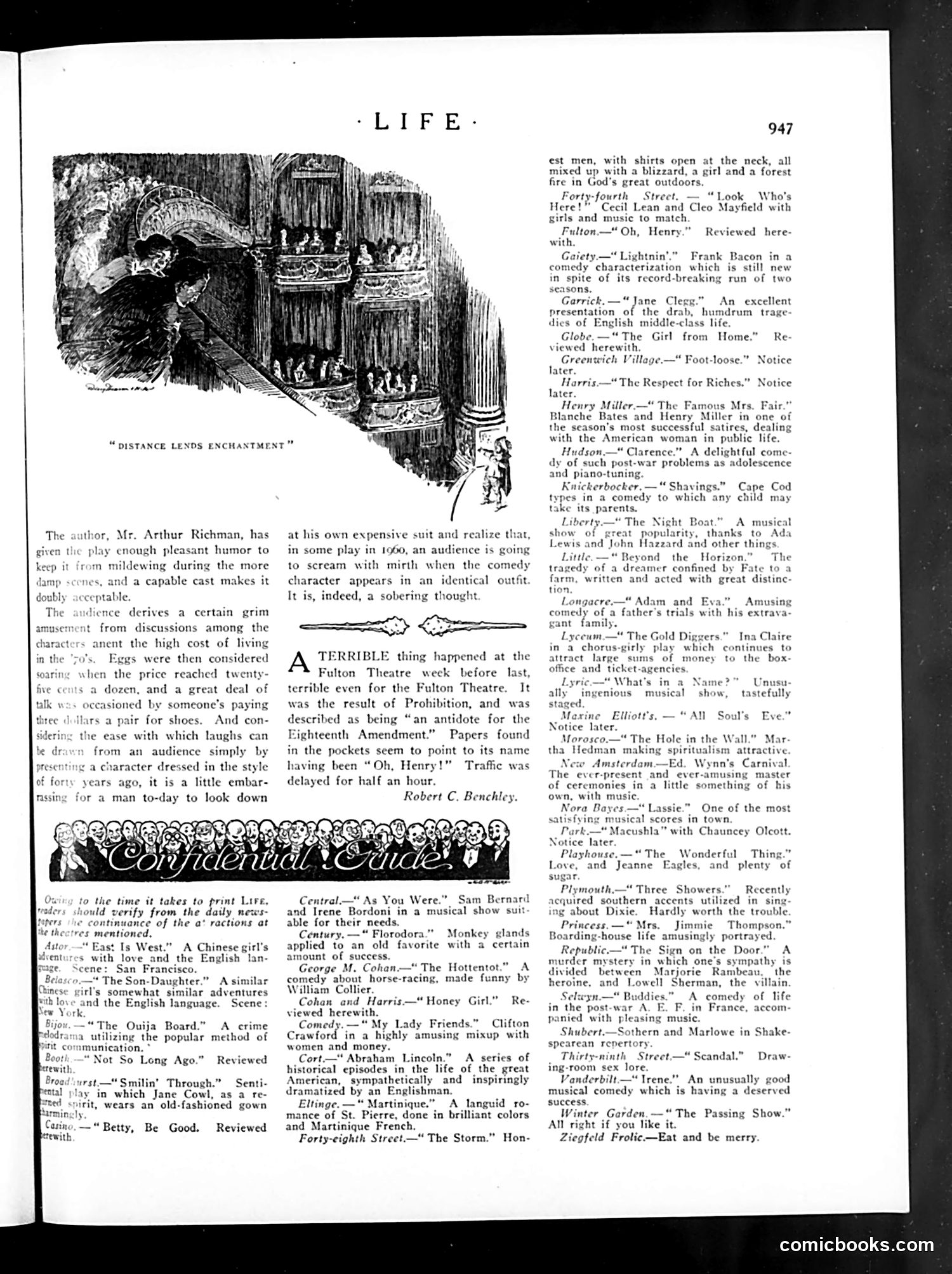
This page contains theatre reviews by Robert C. Benchley, with a cartoon illustrating his opening anecdote about the Fulton Theatre. **The Cartoon's Joke:** The sketch shows a man in formal evening wear from decades past, captioned "Distance Lends Enchantment." Benchley's accompanying text explains the satire: an actor at the Fulton Theatre wore an identical outfit to one from plays performed in 1960s—a costume so absurdly outdated that audiences laugh thinking it's intentional comedy rather than historical dress. The point is that theatrical fashion changes so dramatically that what once seemed normal becomes unintentionally funny. Benchley notes this is "a sobering thought"—meaning it's troubling to realize how quickly styles become ridiculous-looking. The cartoon also references a minor scandal: papers found at the theatre (apparently from an intoxicated incident during Prohibition era) bore the name "Oh, Henry!"—likely alluding to both the popular candy bar and contemporary plays with that title.
📄 Transcribed text from this page (OCR, searchable)
Machine-transcribed from the original scan — historical spelling and the odd misread are preserved.
“ DISTANCE LENDS ENCHANTMENT” Mr. has thor, Arthur Richman, the play enough pleasant humor to it from mildewing during the more and a capable cast makes it ceeptable, d doubly ence derives a certain grim discussions among the ters anent the high cost of living from iggs were then considered shen the price reached twenty- a dozen, and a great deal of occasioned by someone's paying pair for shoes. And con- ease with which laughs can from ai soarir five cents talk y audience simply by © a character dressed in the style years ago, it is a little embar- for a man to-day to look down rassit to the time it takes to print Lire, hould verify from the daily news- © continuance of the a’ ractions at res mentioned. st Is West.” A Chinese girl's $ ith love ae the English lan- 7 A similar irl’s somewhat similar adventures ind the English language. Scene: The Ouija Board.” A crime 1 utilizing the popular method of nunication, ~ Not So Long Ago.” Reviewed {\urst-— Smilin’ Through.” Senti- , in which Jane Cowl, as a re- , wears an old-fashioned gown y Casino. —“ Betty, Be Good. erewith: Reviewed eae) BO Sa8 } ek sa at his own expensive suit and realize in some play in 1960, an audience is going to scream with mirth when the comedy character appears in an identical outfit It is, indeed, a sobering thought TERRIBLE thing happened at the Fulton Theatre week before last, terrible even for the Fulton Theatre. It was the result of Prohibition, and was described as being “an antidote for the Eighteenth Amendment.” Papers found in the pockets seem to point to its name raving been “Oh, Henry!” Traffic was delayed for half an hour. Robert C. Benchley. ‘' BS Sg ‘. weet Sam Bernard al show suit Central—* As You Were.” and Irene Bordoni in a music able for their needs. Century, —“ Florodora.”. Monkey glands applied to an old favorite with a certain amount of success. George M. Cohan.—" The Hottentot.” A comedy about horse-racing, made funny by William Collier Cohan and Harris viewed herewith. Comedy. —“ My Lady Friends.” Clifton Crawford in a highly amusing mixup with women and money. Cort— Abraham Lincoln.” A series of historical episodes in the life of the great American, sympathetically and inspiringly dramatized by an Englishman, Eltinge. —“ Martinique.” A languid ro- mance of St. Pierre, done in brilliant colors and Martinique French. Forty-eighth Street.—" The Storm.” Honey Girl.” Re- Hon- 947 est men, with shirts open at the neck, all mixed up with a blizzard, a girl and a forest fire in God’s great outdoors. fourth Street. — “Look Who's Cecil Lean and Cleo Mayfield with girls and music to match Fulton.—“ Oh, Henry.” with, Gaiety, htnin Frank Bacon in a comedy characterization which is still new in spite of its record-breaking run of two seasons, Garrick. —“ Jane An excellent presentation of the humdrum trage dies of English middle-class life. Globe.—“ The Girl from viewed herewith. Greenwich Villa: later. Harris.—“ The Respect for Riches.” later Henry Miller —“ The Fa s Mrs. Fair.” Blanche Bates and Henry Miller in one the season's most successful satires, dealing with the American woman in public life. Hudson.— Clarence.” A delightful come- dy of such post-war problems as adolescence and piano-tuning. Reviewed here- Home.” Re- Foot-loose.” Notice Notice Knickerbocker. —" Shavings.” Cape Cod types in a comedy to which any child may take its parents. Liberty.—" The Night Boat.” A musical show of popularity, thanks to Ada Lewis and J. Little. — 1 Hazzard and other things ‘Beyond the Horizon.” a dreamer confined by written and acted with great distine- Adam and Eva.” Amusing ther’s trials with his extrava- “Lye um.— The Gold Diggers.” Ina Claire in a chorus-girly play which continues attract large sums of money to the box- ticket-agencies “What's in a >” Unusu nious musical show, tastefully Maxine Elliott's; —“ AN Soul's Eve.” Notice later. Morosco.— The Hole in the Wall.” Mar tha Hedman making spiritualism attractive Amsterdam. Wynn's Carnival The ever-present and ever-amusing master of ceremonies in a little something of his own, with musi Nora Bay fc." One of the most satisfying musical scores in town Park.— Macushla” with Chauncey Ole atice later Playhouse. — “The Wonderfe Thing.” Love, and Jeanne Eagles, and plenty of sugar Plymouth." Three Showers.” Recently required southern accents utilized in si ing about Dixie. Hardly worth the trouble. Princess. —“ Mrs. Jimmie Thompson. Boarding-house life amusingly portrayed. Republic— The Sign on the Door.” A murder mystery in which one’s sympathy is divided between Marjorie Rambeau, the heroine, and Lowell Sherman, the villain Selwyn.—" Buddies.”_ A comedy of life in the post-war A. E. F, in France, accom- panied with pleasing music. Shubert.—Sothern and Marlowe in Shake- spearean repertory Thirty-ninth Street.—* Scandal.” Draw- ing-room sex lore. nderbilt— Irene.” An unusually good musical comedy which is having a deserved success. Winter Garden All right if you like Ziegfeld Frolic—Eat and be merry “The Passing Show.” comicbooks.com