
A complete issue · 44 pages · 1920
Life — April 15, 1920
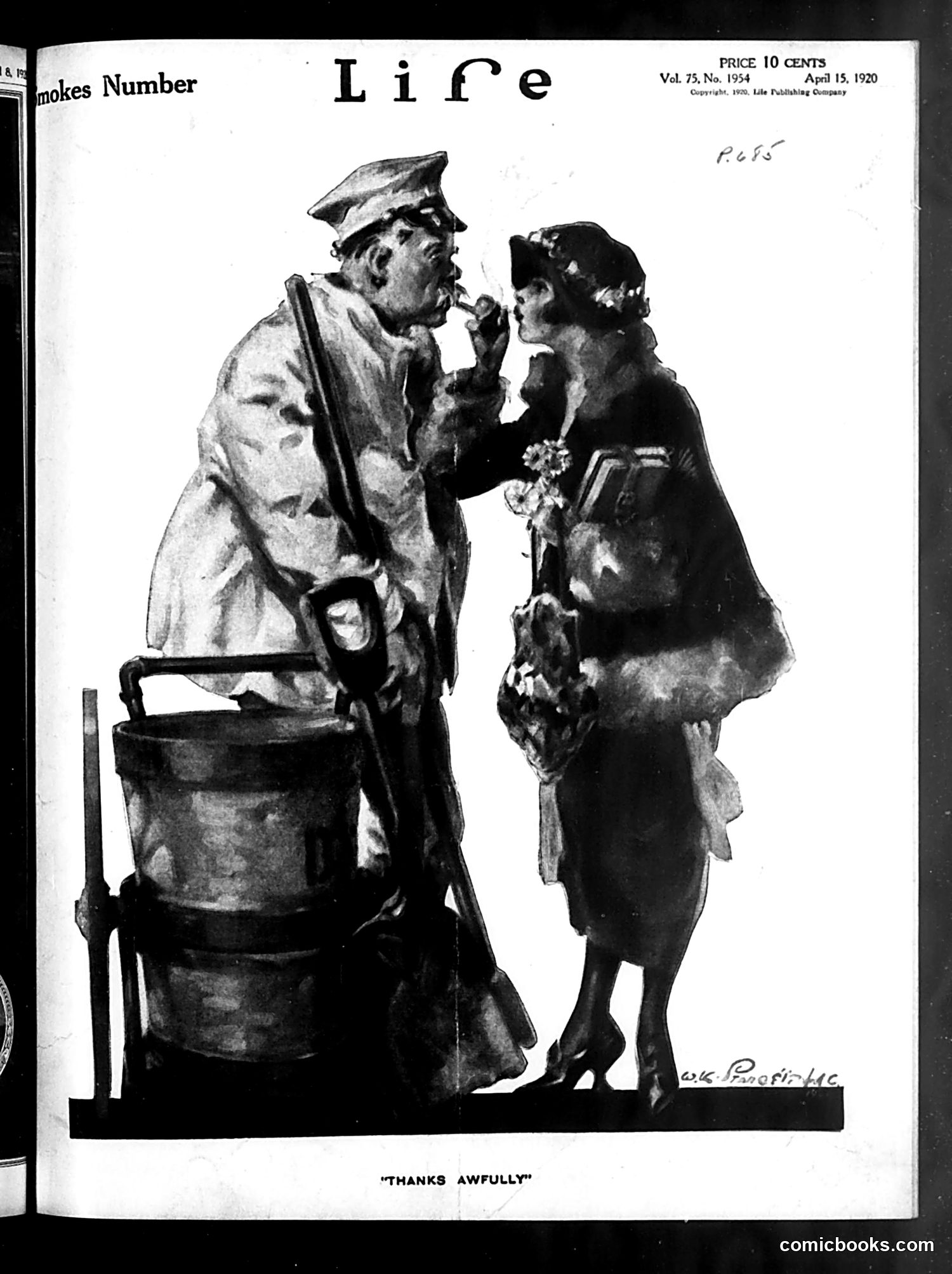
This 1920 *Life* magazine cover depicts a satirical scene titled "Thanks Awfully." A uniformed serviceman (likely a soldier or sailor from World War I, which ended in 1918) stands with a large pot or container, apparently collecting donations or relief supplies. A well-dressed woman in fashionable clothing approaches him, seemingly offering assistance or gratitude. The satire likely critiques the disconnect between wealthy civilians and returning servicemen—either mocking excessive gratitude from the privileged classes, or conversely, suggesting inadequate post-war support and charity. The woman's stylish dress contrasts with the serviceman's utilitarian uniform, emphasizing class differences. The title's ironic tone ("Thanks Awfully") suggests the cartoon questions the sincerity or sufficiency of civilian appreciation for military sacrifice during the post-WWI period.
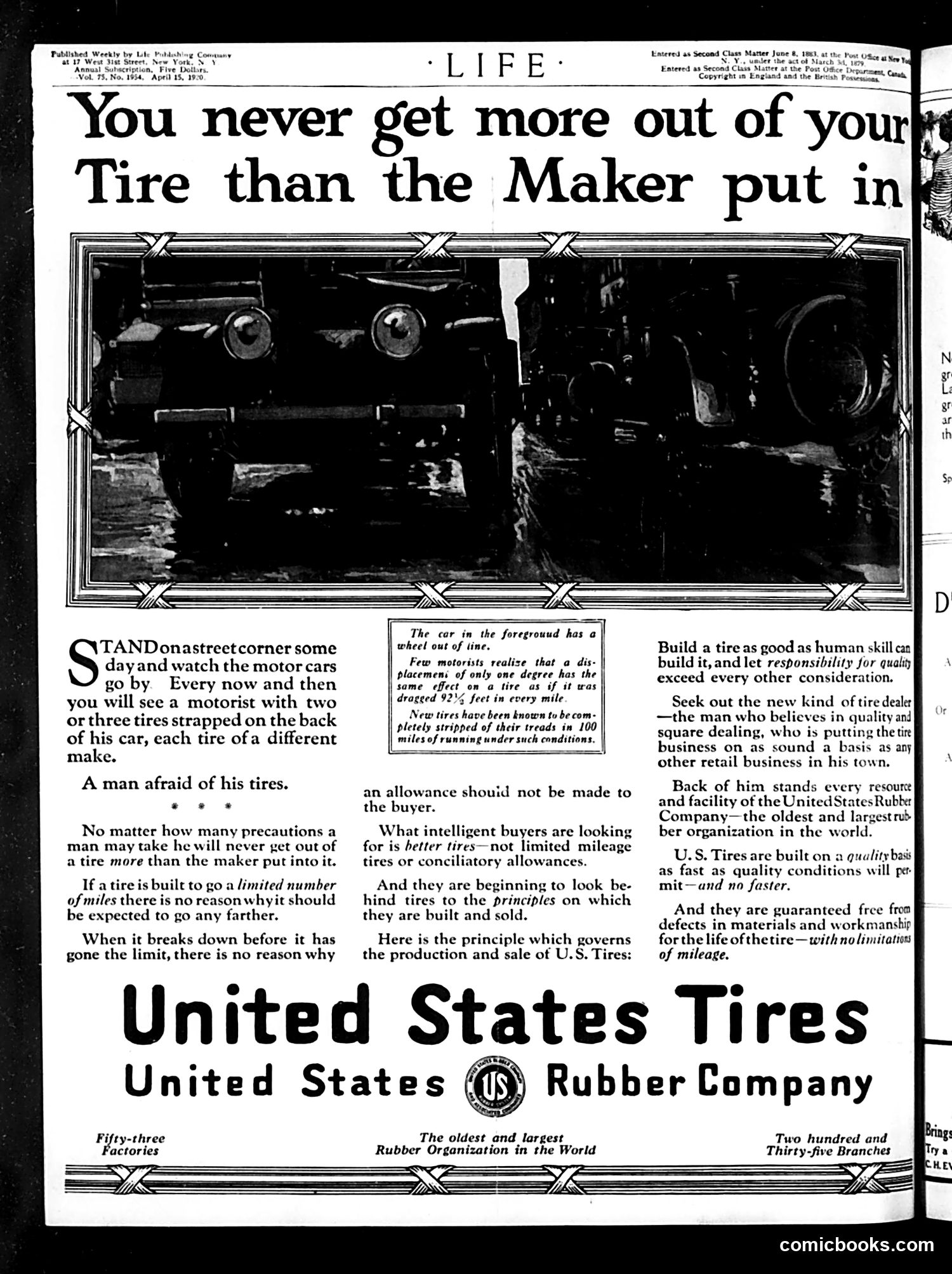
This page is **primarily a United States Rubber Company advertisement** for U.S. Tires, not satire or political commentary. The headline's message is straightforward product marketing: tire quality depends entirely on the manufacturer's standards, not the driver's care. The accompanying photograph shows multiple cars with different tire brands, illustrating the central claim that "you never get more out of your tire than the Maker put in." The body text emphasizes U.S. Tires' superiority through claims of quality construction, extensive factories (53), and broad distribution (235 branches). The company positions itself as the "oldest and largest" rubber organization, implying reliability and trustworthiness. There is no identifiable satire, political commentary, or caricature. This is a straightforward early-twentieth-century commercial advertisement emphasizing manufacturing quality and brand reputation.
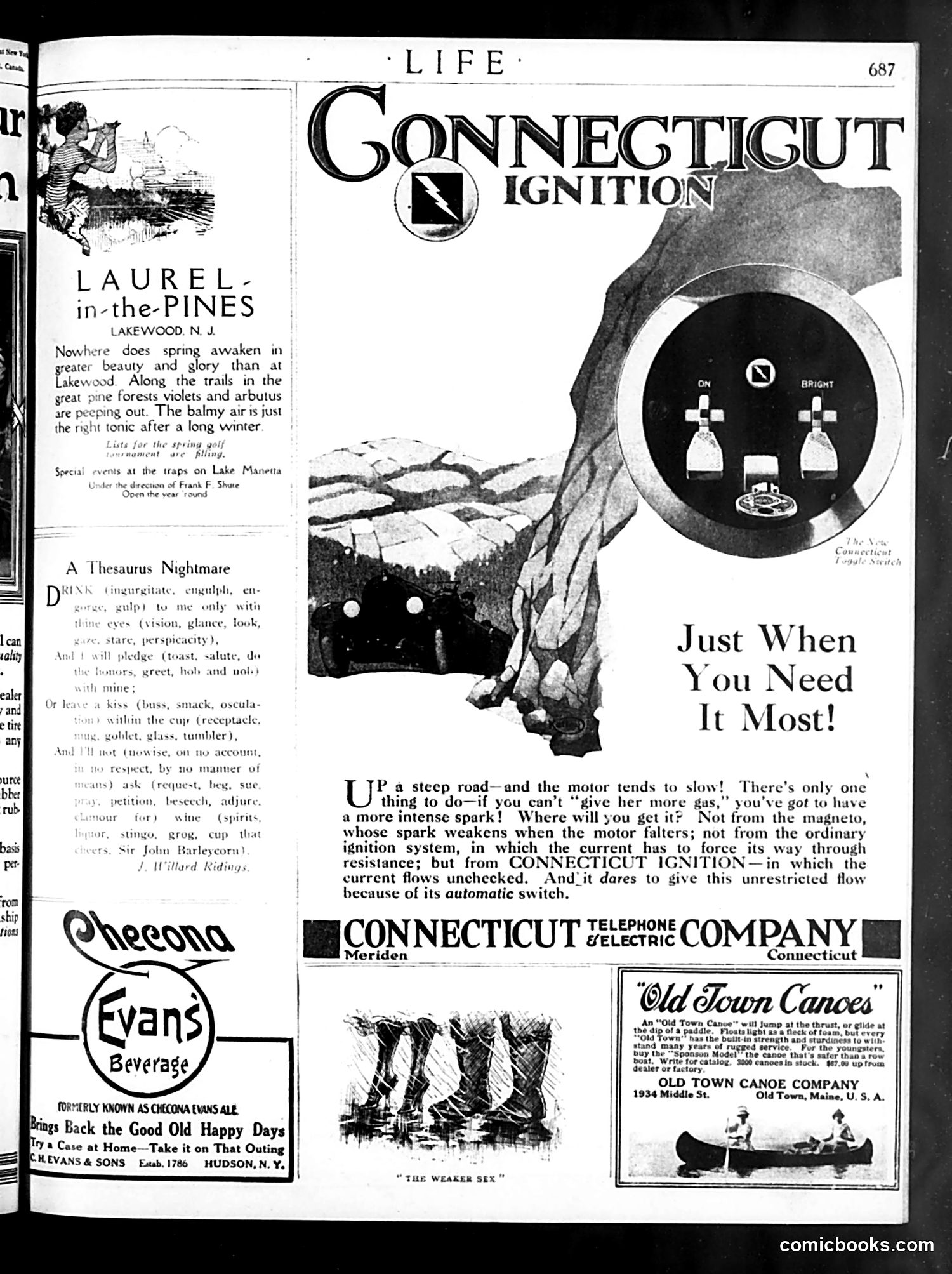
This page is **primarily advertising**, not political satire. The dominant content is a Connecticut Ignition Company advertisement showing an automobile ignition switch with the tagline "Just When You Need It Most!" The ad's pitch addresses a practical automotive problem: car engines that fail to start reliably in cold weather. It argues that Connecticut's ignition system, with its "automatic switch," provides superior spark compared to conventional magnetos. The surrounding smaller ads promote Chicora Evans Beverage and Old Town Canoes—standard consumer products of the era. The left column contains a brief travel piece about Laurel-in-the-Pines in New Jersey and poetic musings about synonyms for drunkenness, unrelated to the advertisements. This represents typical 1920s-era Life magazine content: advertising mixed with lifestyle features.
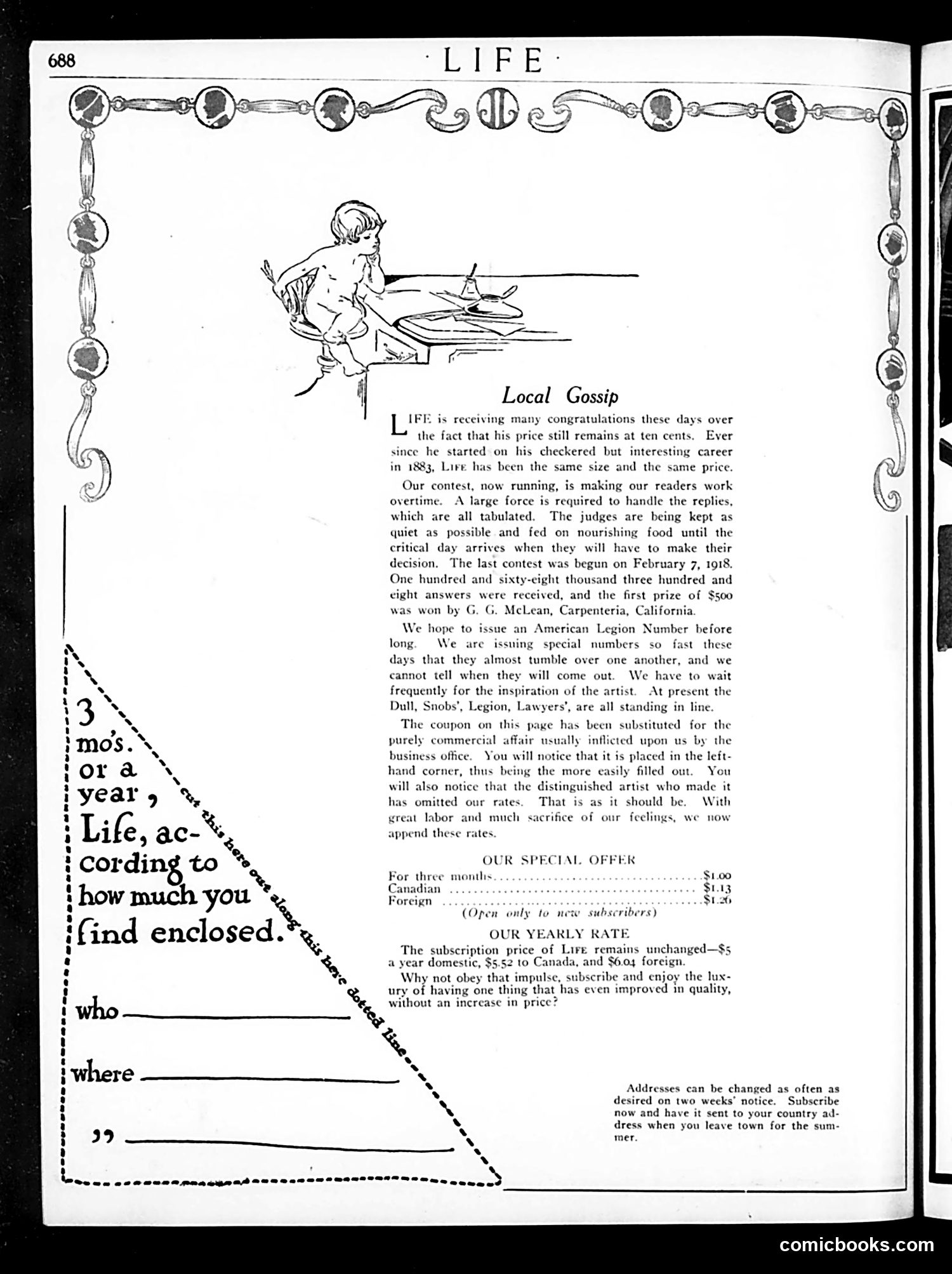
This page is primarily **subscription advertising** for Life magazine, not political satire. The illustration shows a cherub or cupid figure at a desk, likely representing Life's editorial operations. The "Local Gossip" section announces Life's ongoing contest (begun February 7, 1918), which received 168,368 entries with a $500 first prize won by G.C. McLean of Carpinteria, California. The text notes the magazine is overwhelmed processing responses and judges are deliberating. The page also advertises Life's subscription rates: $1.00 for three months domestic, $1.43 Canadian, $1.50 foreign, and $5 yearly. A tear-off subscription form appears on the left margin. This is largely **house advertising** rather than satirical content.
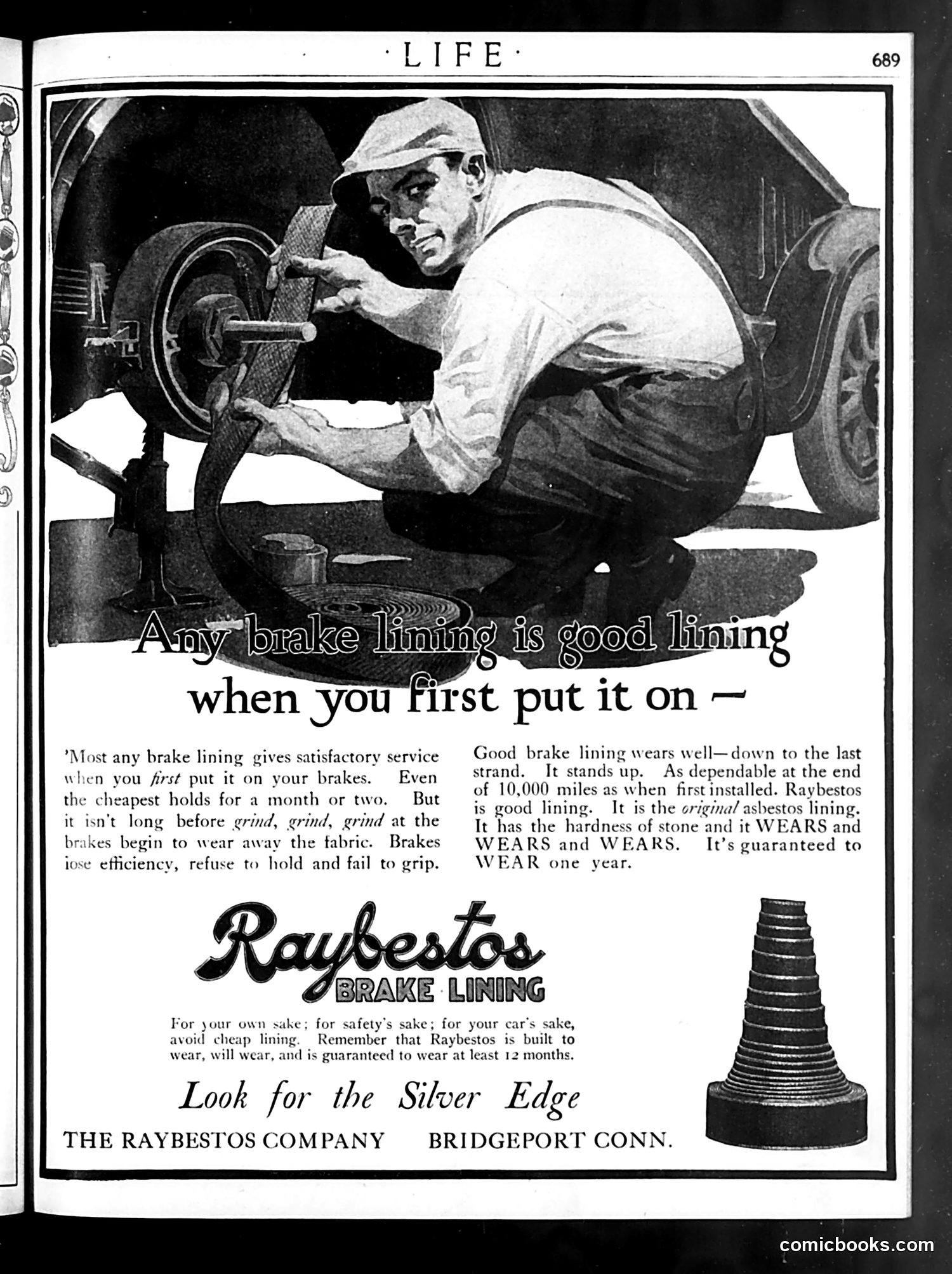
This page is **not a cartoon or satirical content** — it's a straightforward **automobile advertisement** for Raybestos brake lining, published in *Life* magazine. The image shows a mechanic inspecting brake linings under a vehicle. The ad's message is practical: while cheap brake linings may seem economical initially, Raybestos brand linings last longer (guaranteed one year minimum, wearing to 10,000 miles) and provide superior safety and performance. The copy emphasizes durability and reliability over false economy. The "Silver Edge" branding and product illustration (cone-shaped brake lining) identify the specific Raybestos product. This represents typical early-to-mid 20th century automotive advertising emphasizing product longevity and safety as selling points to consumers.
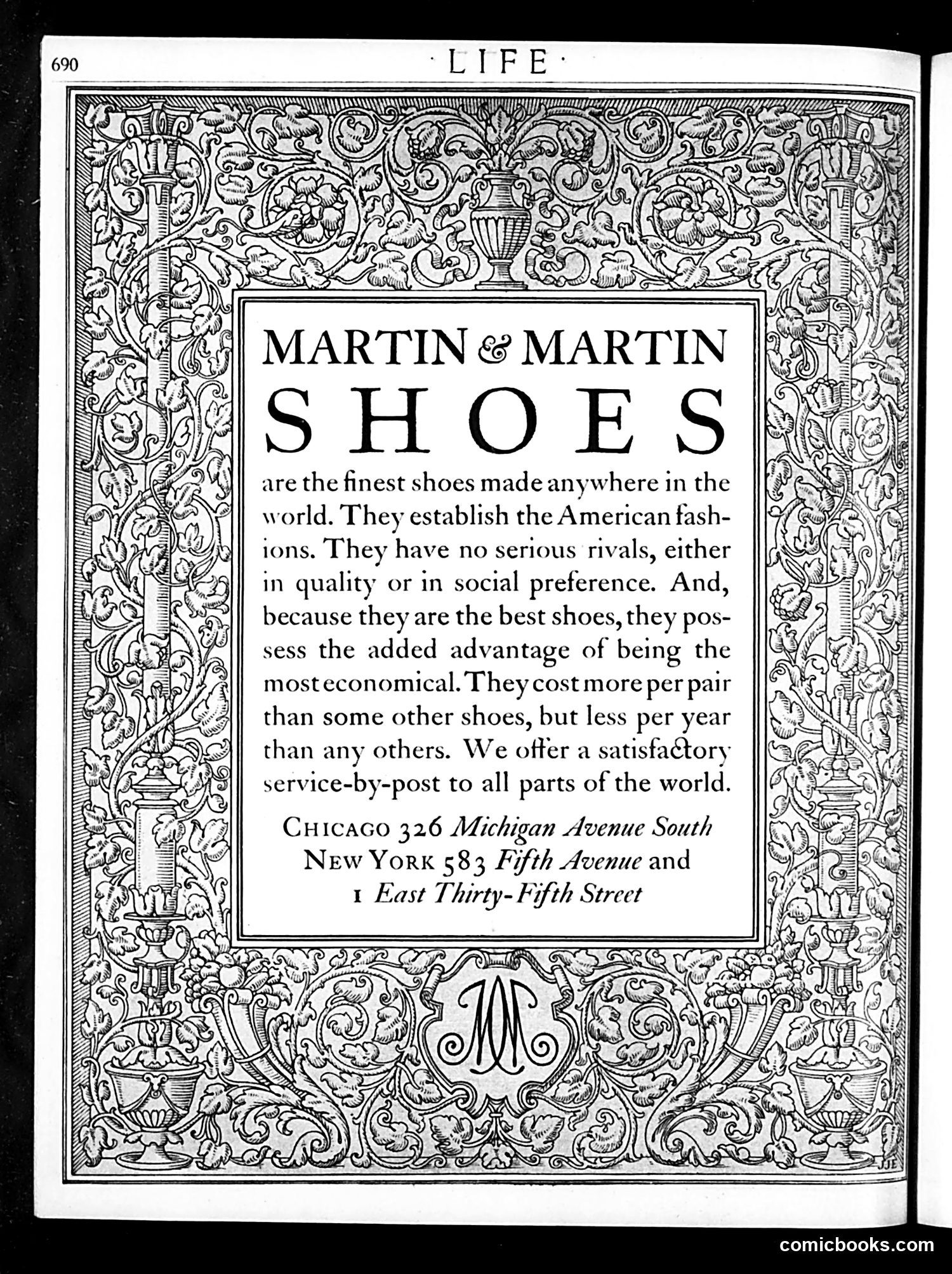
This page is **not a cartoon or satirical content**—it's a straightforward advertisement for Martin & Martin Shoes, placed in Life magazine (page 690). The ad makes marketing claims typical of early 20th-century advertising: that Martin & Martin shoes are "the finest shoes made anywhere in the world," establish "American fashions," have "no serious rivals," and offer the best value over time despite higher per-pair cost. The ornate decorative border and prestigious magazine placement are designed to convey luxury and quality to readers. The addresses listed (Chicago and New York) establish the company's prominence. This represents vintage advertising rhetoric rather than satire or political commentary—Life's pages mixed editorial cartoons with paid advertisements.
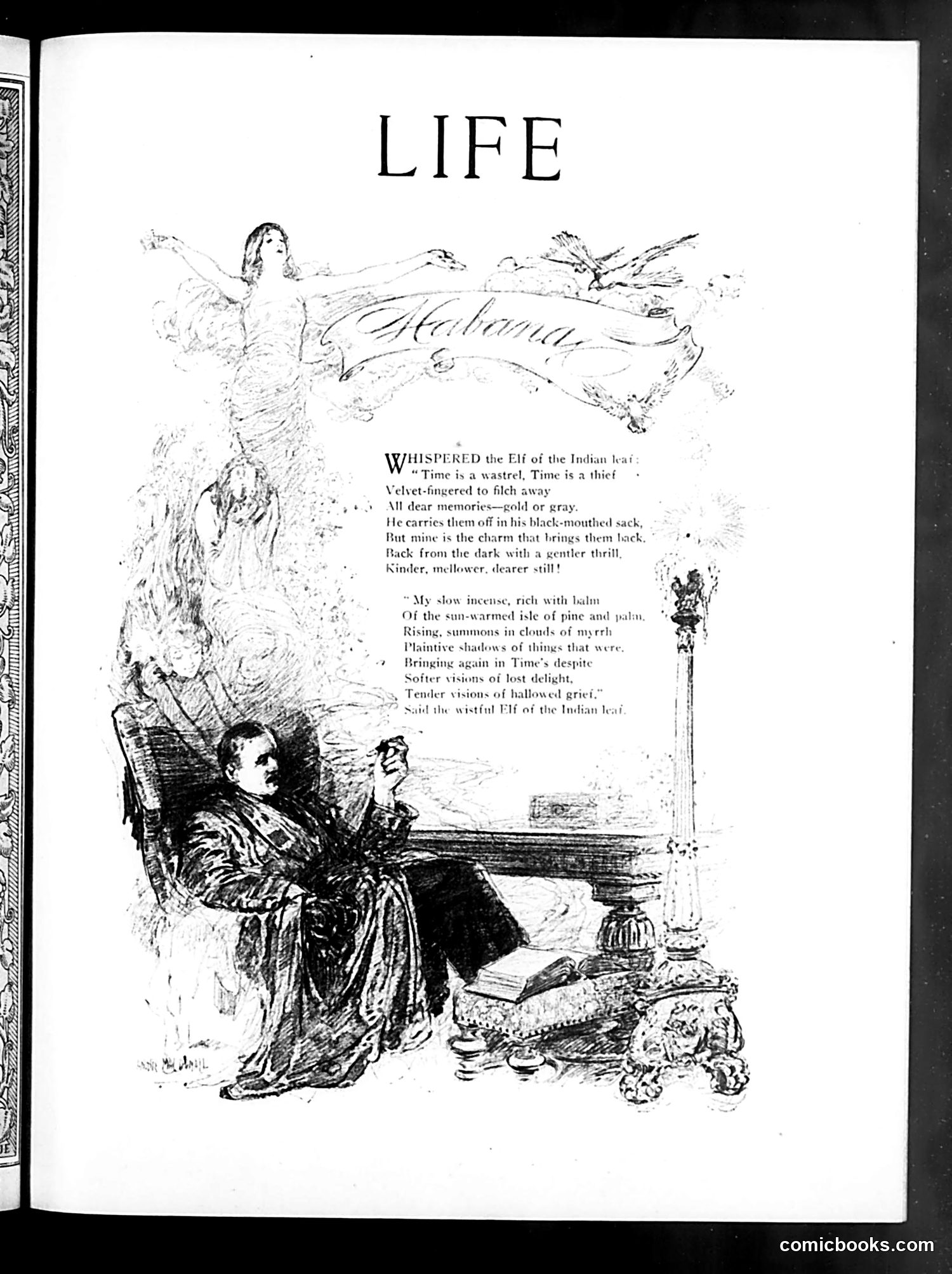
This is a title page for a piece called "Life" featuring an illustrated poem about an "Elf of the Indian leaf"—a personification of tobacco smoke. The poem's speaker, seated at a desk in period clothing, receives visions summoned by burning incense made from tobacco and other aromatic plants. The satire appears to target the romantic, mystical associations people projected onto tobacco use in the 19th century. The "wistful Elf" brings forth pleasant memories and visions, but the speaker's charm lies in summoning comforting illusions rather than truth. The cartoon gently mocks the escapism tobacco provided to its users, presenting it as a pleasurable but ultimately deceptive habit that conjures "plaintive shadows" and "softer visions" rather than reality.
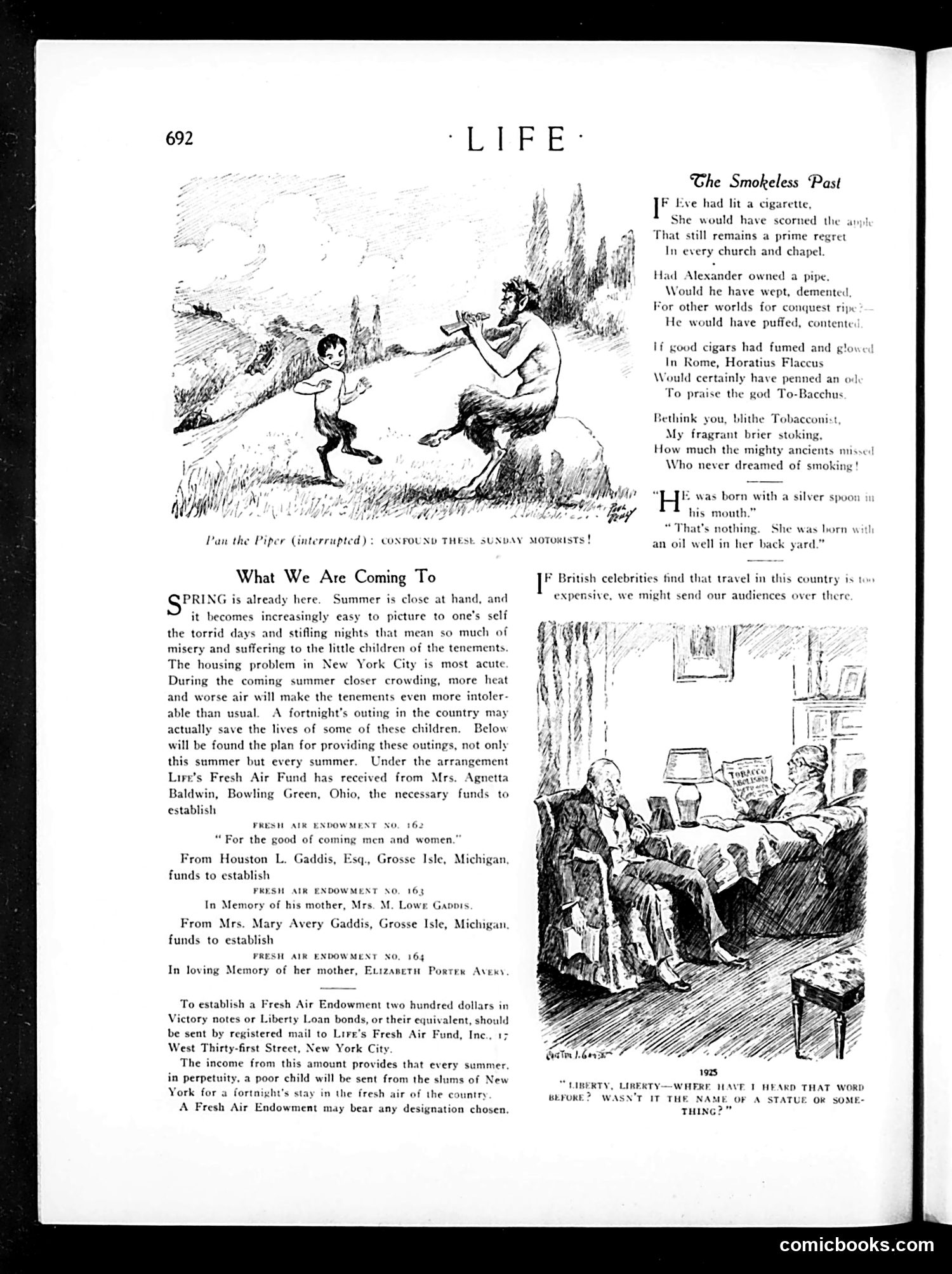
This cartoon depicts **Pan** (the Greek god of nature, identifiable by his goat legs and pipes) being interrupted while playing his pipes to a young child in a pastoral landscape. The caption explains the joke: Pan's enchanting music is being disrupted by **Sunday motorists**—weekend drivers who disturb the countryside. The satire targets early 20th-century automobile culture. As cars became accessible to middle-class Americans, Sunday driving became a popular leisure activity. The cartoon mocks how these motorists' noisy vehicles destroyed the peace and natural beauty of rural areas, literally interrupting an ancient symbol of pastoral harmony. It's a commentary on progress intruding upon nature and tradition.
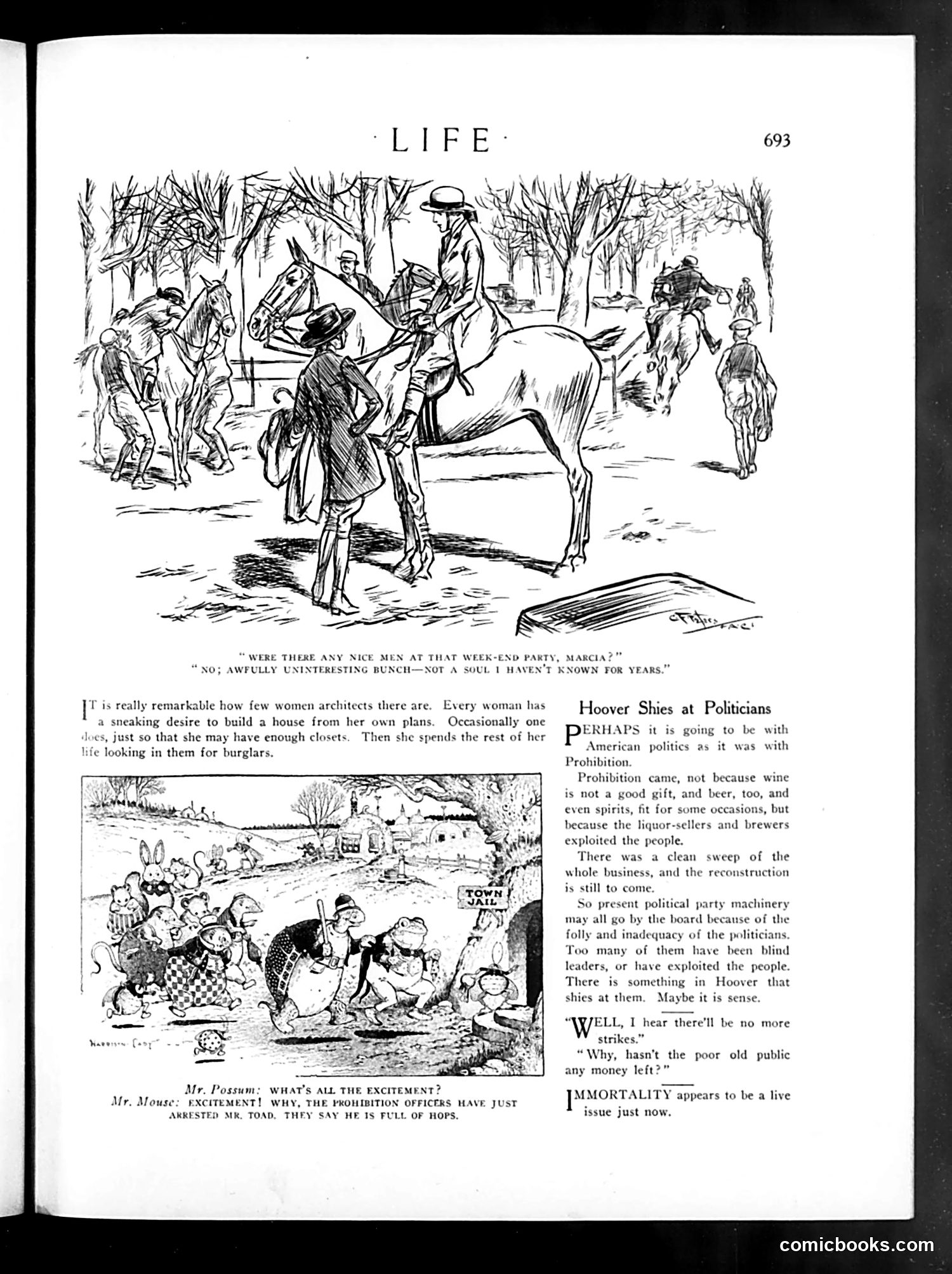
This page contains two main satirical pieces: **Top Cartoon**: A society scene depicting an equestrian party. The caption mocks the attendees as "awfully uninteresting bunch—not a soul I haven't known for years," satirizing the repetitive, insular nature of wealthy social circles. **Bottom Cartoon**: Features Mr. Mouse (a character, likely recurring) alongside what appears to be Mr. Toad being arrested. The caption references "Prohibition officers" who have arrested Mr. Toad for being "full of hops"—a pun playing on alcohol (hops in beer) and the animal nature of a toad. **Context**: The page addresses Prohibition's enforcement and its ineffectiveness, criticizing politicians' inability to control bootleggers and brewers. The accompanying text discusses how Prohibition, like other policies, has been poorly managed by politicians who "shies at" those exploiting loopholes.
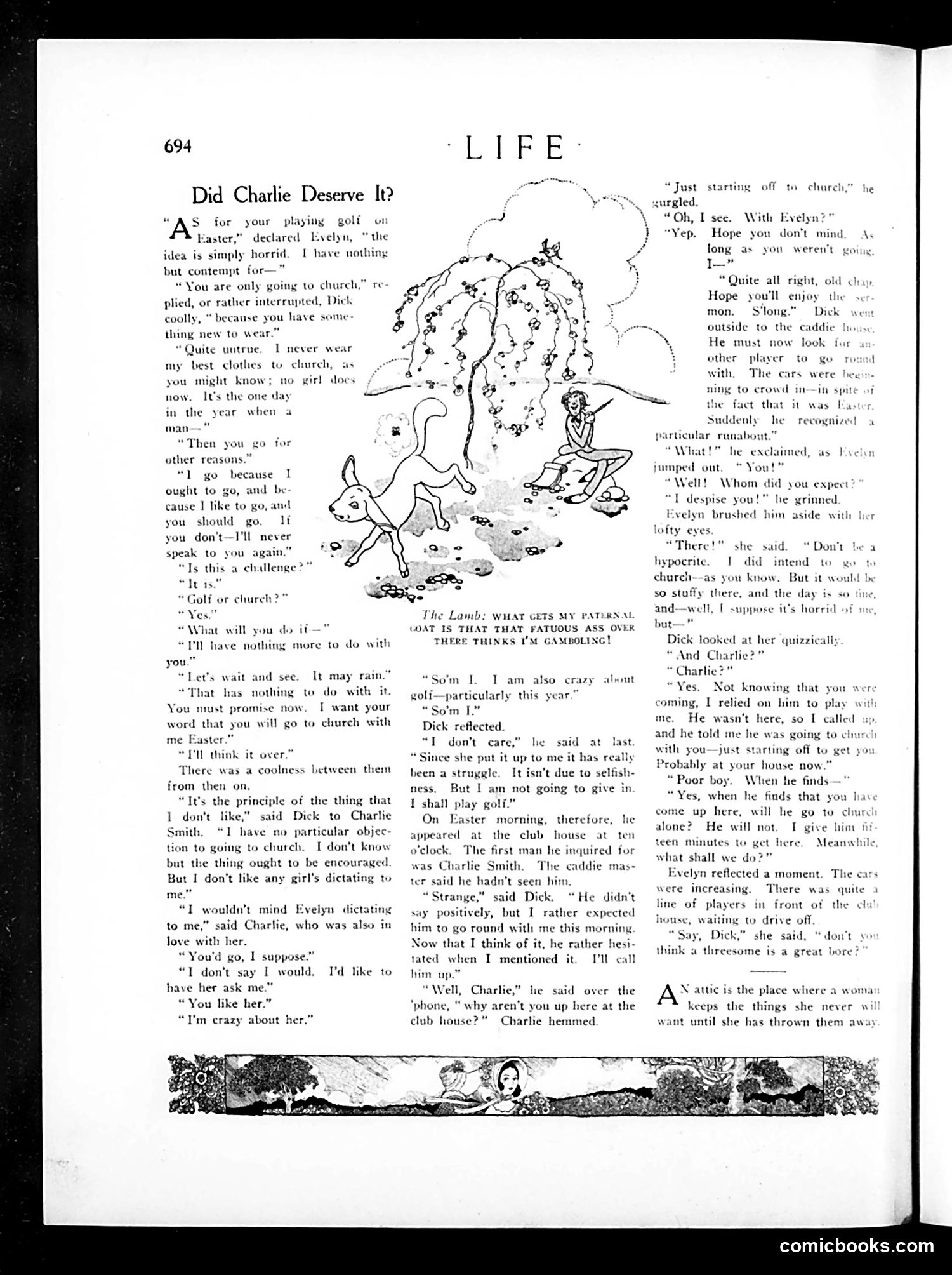
This page contains a humorous dialogue between Dick and Charlie about whether Charlie should play golf on Easter morning instead of attending church with his girlfriend Evelyn. The cartoon illustrates the social tension between leisure activities and religious observance—a common satirical topic in early 20th-century Life magazine. Charlie prioritizes golf, while Dick argues he should accompany Evelyn to church. The illustration shows a dog under an umbrella, humorously depicting the absurdity of the situation. The joke reflects period social expectations: men were expected to attend church on Easter, particularly when escorting female companions. Charlie's rationalization that he can't refuse Evelyn ("I don't like any girl's dictating to me") while simultaneously ditching her for golf satirizes masculine hypocrisy and the era's dating customs.
This page presents an illustration for "Act I" of what appears to be a theatrical work titled "Esther: The Lovers." The sketch depicts a dramatic garden or courtyard scene featuring a tall chimney or tower structure, overgrown vegetation, a figure in the background (possibly holding something), and a decorative circular basin or fountain in the foreground. The etching style and theatrical attribution suggest this is a scene illustration rather than a political cartoon. Without additional context about the theatrical production referenced, the specific satirical or dramatic intent cannot be definitively determined from this image alone. The artistic rendering emphasizes mood and setting rather than social commentary.
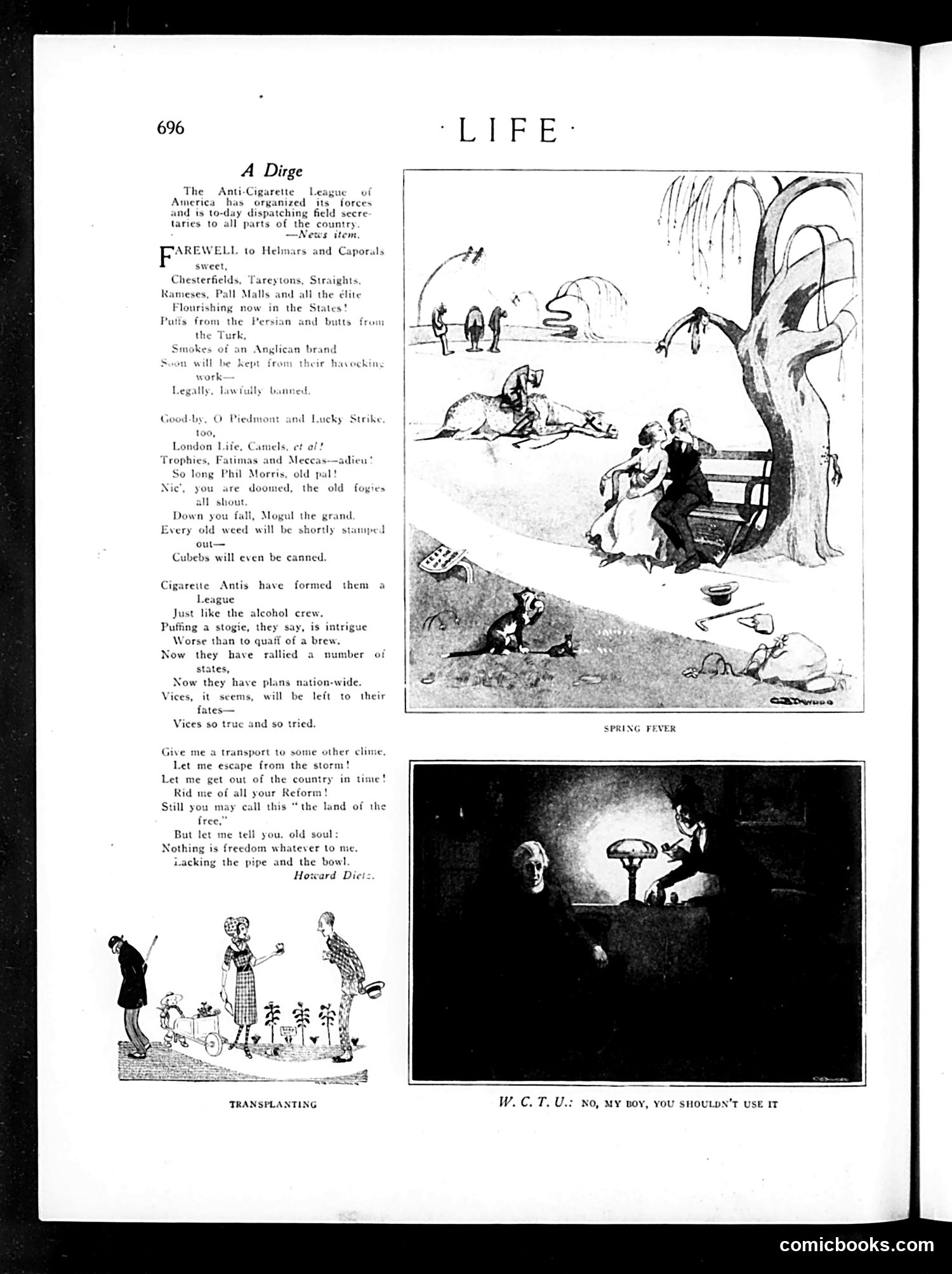
This page contains three satirical cartoons commenting on post-WWI American society: **"A Dirge"** (left): A poem mocking various American institutions—Chesterfields, Tareytons, and elite social venues—suggesting they will disappear. It references the Anti-Cigarette League's activism and implies sweeping social reform ("old weeds will be shortly stamped out"). **"Spring Fever"** (top right): A sketch depicting leisure activities, likely satirizing idle recreation during a period of social change. **"W.C.T.U.: No, My Boy, You Shouldn't Use It"** (bottom right): References the Women's Christian Temperance Union, which championed Prohibition. The dramatic lighting and cautionary caption suggest satire of anti-alcohol activism that was gaining legislative force in the 1920s. The overall page reflects Life's satirical stance on American reform movements, particularly Prohibition and cigarette restrictions.
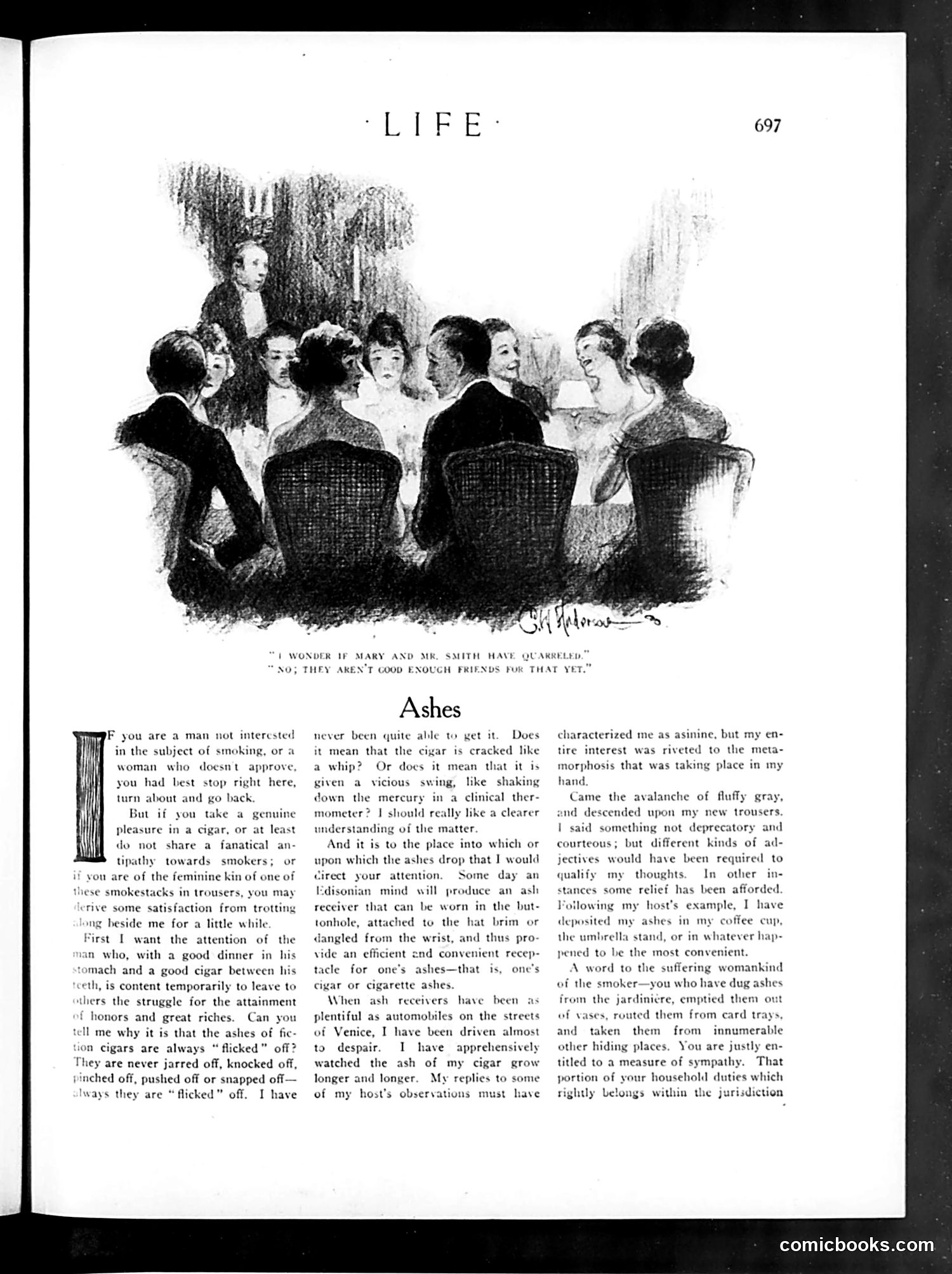
The cartoon at top shows a social gathering where someone asks: "I wonder if Mary and Mr. Smith have quarreled." Response: "No; they aren't good enough friends for that yet." The article below discusses cigar ash etiquette—a humorous treatise on where gentlemen deposit cigarette and cigar ashes in polite society. The author satirizes the obsession with proper ash disposal, noting that ash receivers exist "as plentiful as automobiles on the streets of Venice," yet people still deposit ashes in vases, teacups, and improper places. The satire targets upper-class social pretension: the meticulous concern with trivial manners reveals anxious social climbing. By treating ash placement as consequential to social standing, the piece mocks the arbitrary rules governing "good enough friends" and genteel behavior among the aspiring classes.
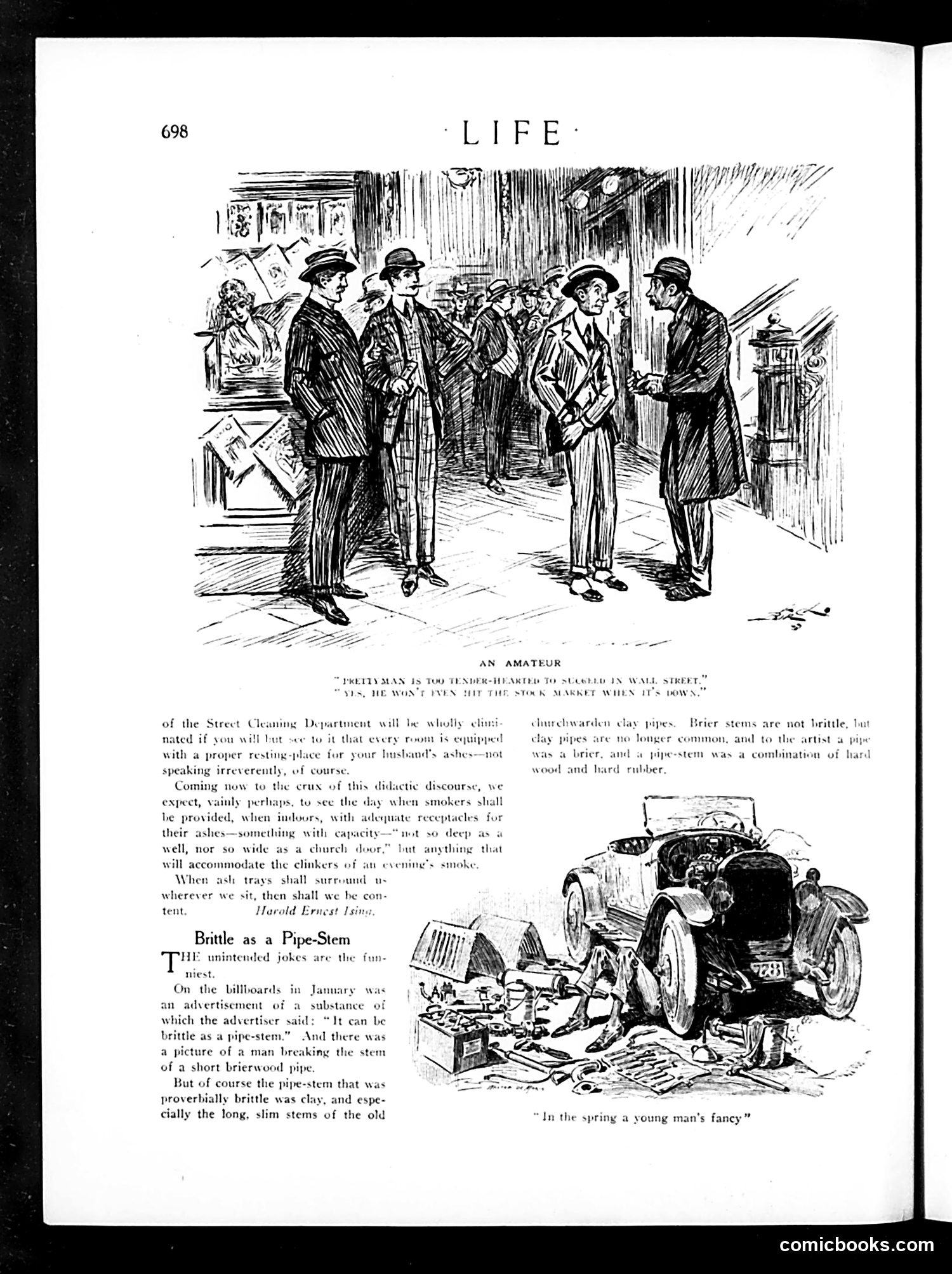
**Top Cartoon**: Depicts several men in suits and bowler hats in what appears to be a professional or government office setting. The caption reads: "An Amateur: 'Every man is too tender-hearted to succeed in Wall Street.' 'Yes, he won't even bet the stock market when it's down.'" This satirizes an inexperienced person's naïve views about Wall Street ruthlessness, mocking the idea that sentiment has any place in financial markets. **"Brittle as a Pipe-Stem" Section**: Discusses an advertisement about pipe-stems, noting that old clay pipe-stems were proverbially brittle. The accompanying illustration shows a broken automobile, humorously comparing automotive fragility to fragile pipe-stems with the caption "In the spring a young man's fancy." The page mocks both naive financial attitudes and automobile reliability through gentle satire.
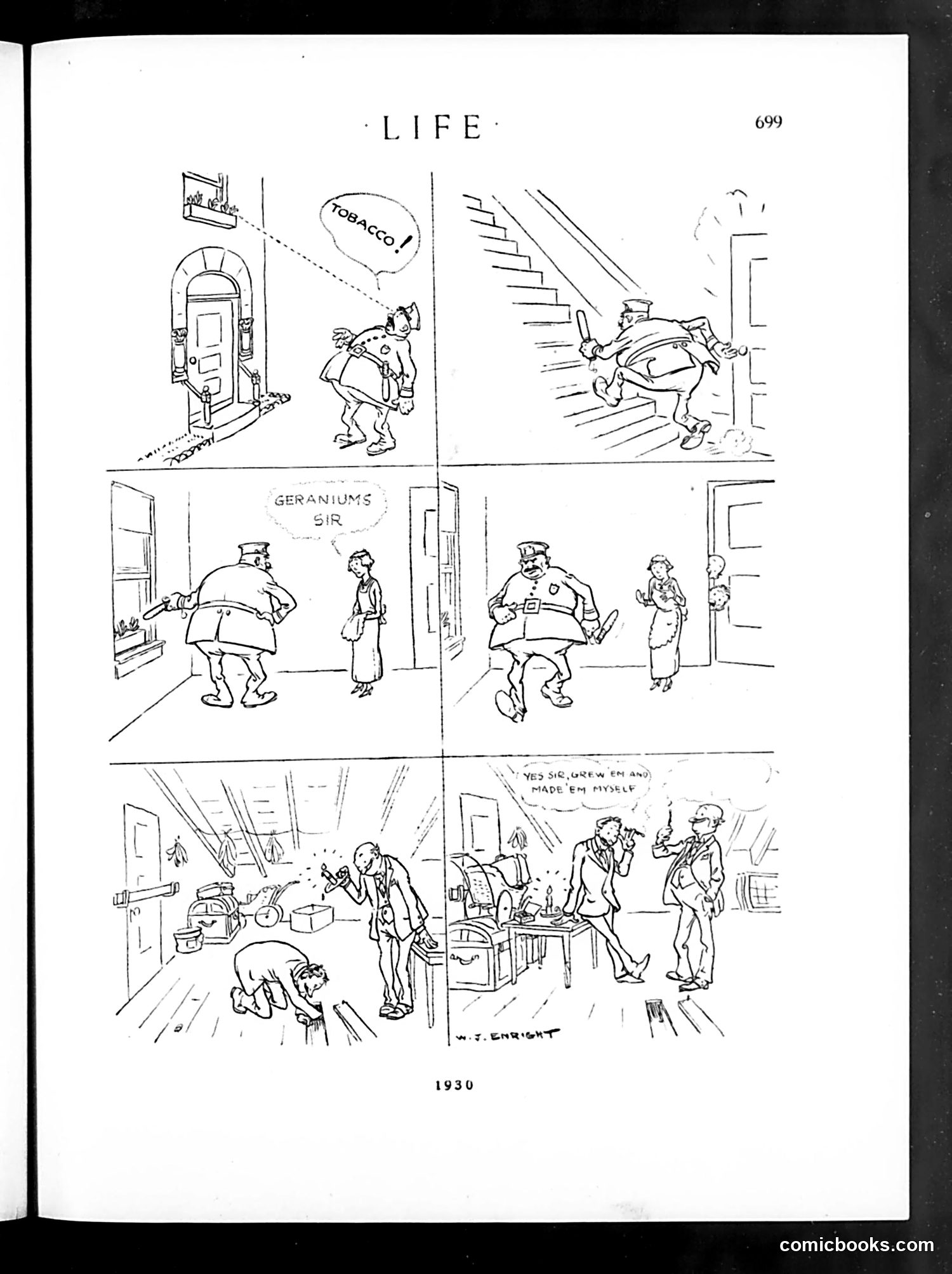
This page contains a multi-panel comic strip by W.Z. Enwright satirizing domestic life and horticulture. The narrative follows a portly gentleman who: 1. Smuggles tobacco into his home 2. Receives geraniums as a gift ("Geraniums, Sir") 3. Attempts to cultivate them indoors with various containers and equipment The final panel shows the man's wife confronting him about his homemade geranium-growing operation, with the caption "Yes sir, grew 'em and made 'em myself." The satire appears to mock men's domestic incompetence and over-engineering simple gardening tasks, while also playing on Prohibition-era anxieties about illicit home production (the tobacco smuggling reference strengthens this). The humor relies on visual absurdity and the contrast between the man's elaborate efforts and the mundane task of growing flowers indoors.
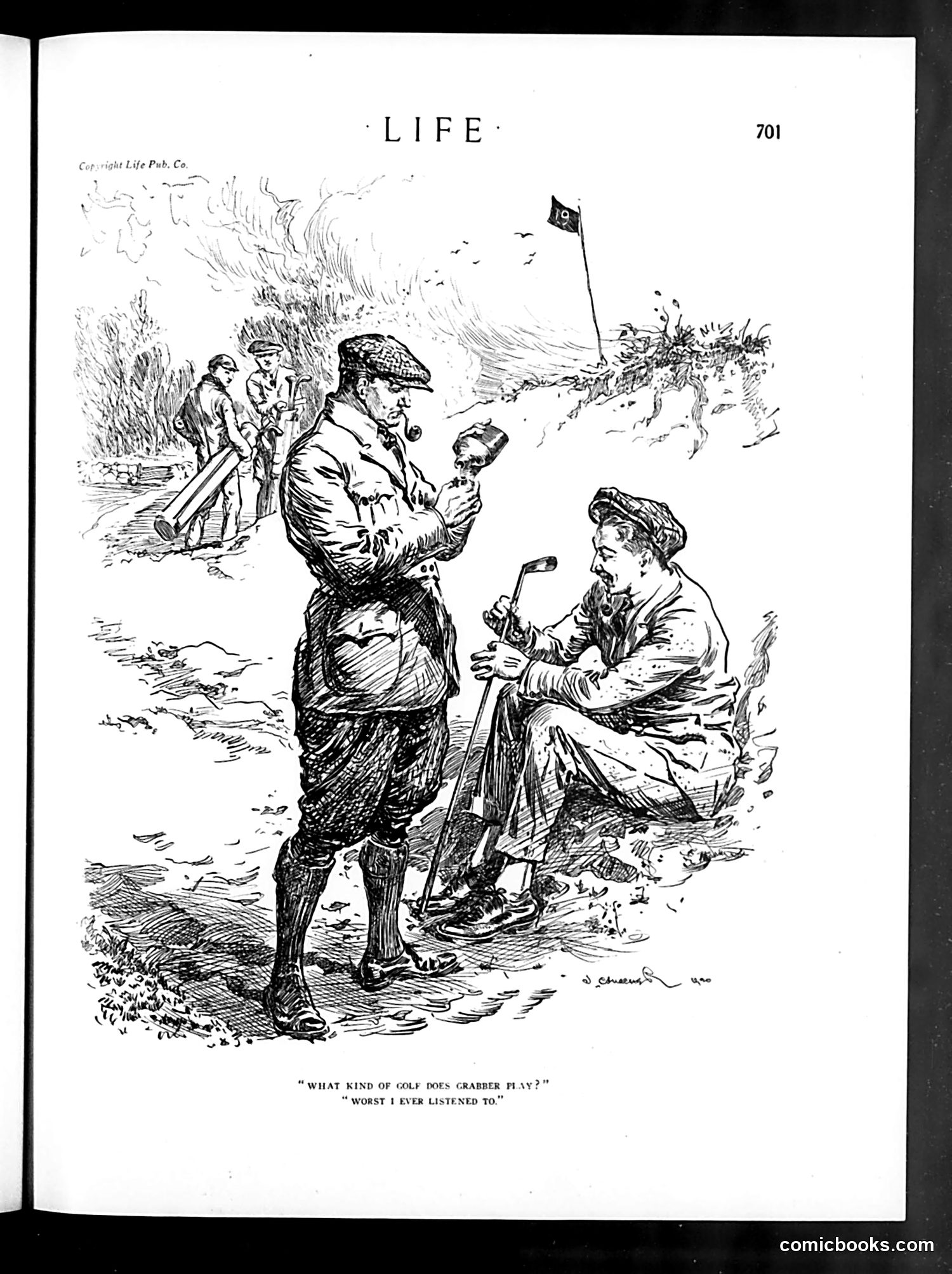
This single-panel cartoon satirizes a golfer nicknamed "Grabber" for his poor golf etiquette or behavior on the course. Two men discuss the golfer: one asks what kind of golf "Grabber" plays, and the other responds it's "the worst I ever listened to"—a joke implying the man complains, curses, or makes excessive noise while golfing rather than playing skillfully. The cartoon uses golf as a vehicle for social commentary about manners and behavior. Without additional context, "Grabber" likely refers to either a known public figure or a generic type of ill-mannered golfer common to Life magazine's readership. The humor targets wealthy leisure activities and the character flaws that emerge during recreation. The sketch style is typical of early-to-mid 20th century satirical illustration.
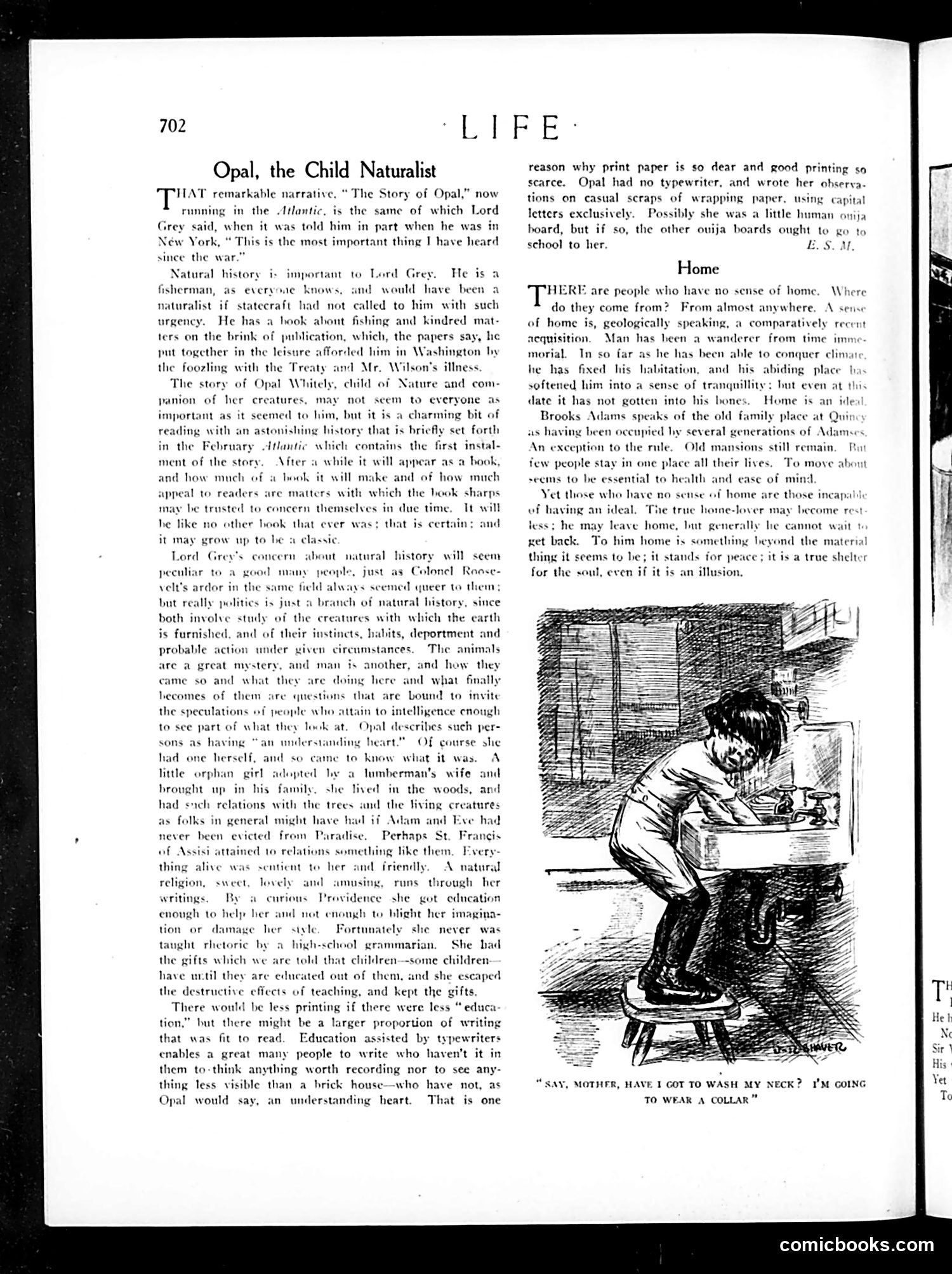
This is not a political cartoon but an essay praising "The Story of Opal," a serialized narrative appearing in *The Atlantic Monthly*. The piece celebrates Opal Whiteley, a young orphan girl raised in logging camps who kept nature observations on scrap paper using only capital letters. The essay contrasts Opal favorably with over-educated writers, arguing that formal education damages authentic observation and writing ability. It compares her to naturalists like Lord Grey (Britain's Foreign Secretary) and Theodore Roosevelt, suggesting that understanding nature and human behavior requires what Opal possessed: an "understanding heart." The illustration shows a child at a window, likely representing Opal observing nature. The caption's dialogue about washing one's neck and wearing a collar suggests the essay's broader point: natural simplicity trumps artificial propriety.
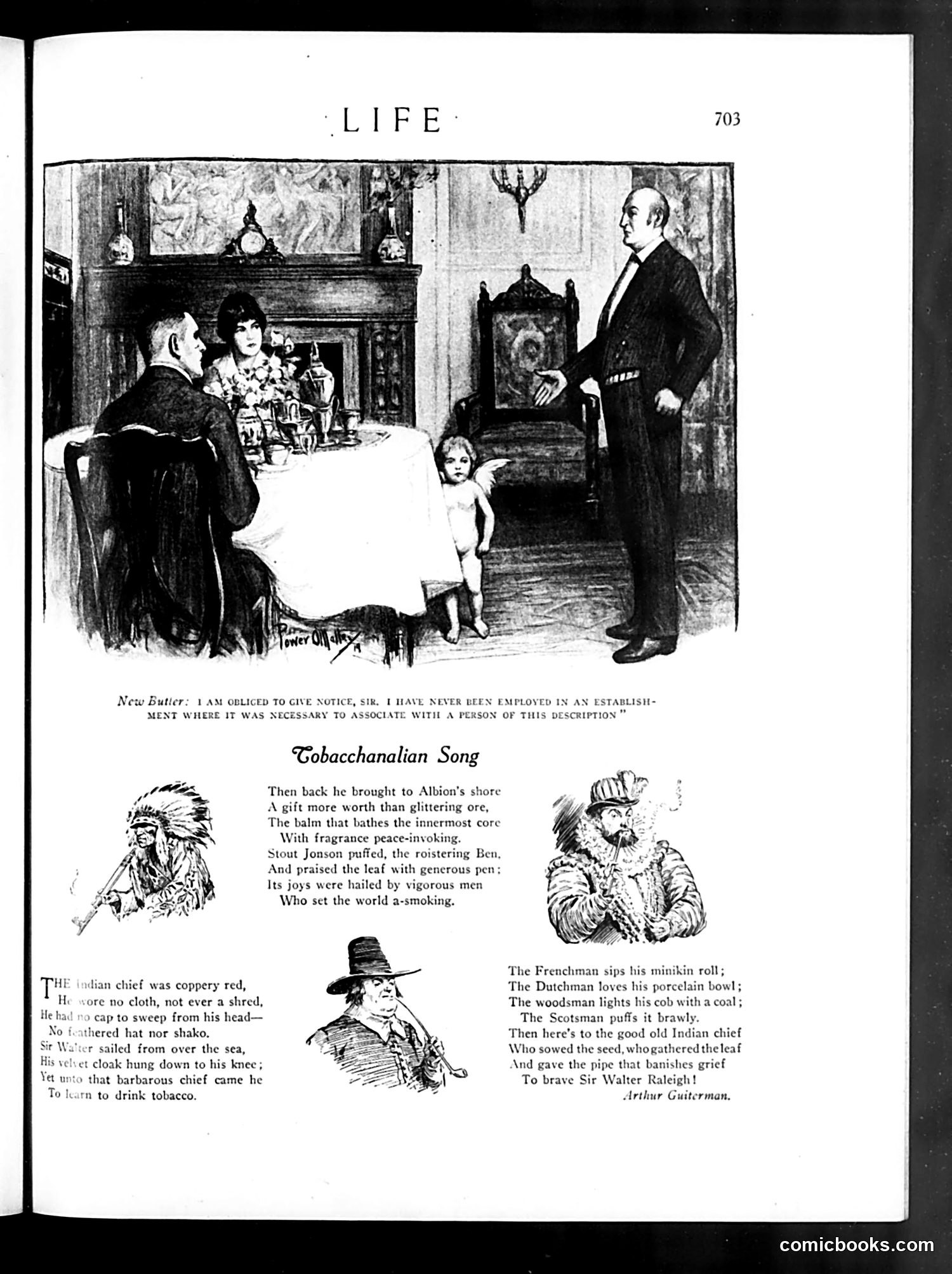
The top cartoon depicts a domestic scene where a new butler is giving notice to his employer, offended at having to associate with someone of unspecified (but clearly lower) social status. This satirizes rigid Victorian class consciousness and the absurd hierarchies of domestic service. The poem below, "Tobacchanalian Song," celebrates tobacco's introduction to England by Sir Walter Raleigh from the New World via Native Americans. It's presented as a humorous, heroic narrative: the "barbarous" Indian chief taught refined European gentlemen—including poet Ben Jonson—to smoke. The irony is clear: Raleigh, the "civilized" explorer, actually learned from indigenous people he would have considered primitive. The poem mocks both colonial attitudes and the European embrace of tobacco despite its "savage" origins, while celebrating tobacco's appeal across social classes (Frenchmen, Dutchmen, woodsmen, Scotsmen). The accompanying illustrations show the Indian chief and various smoking gentlemen, emphasizing this cross-cultural exchange with gentle ridicule.
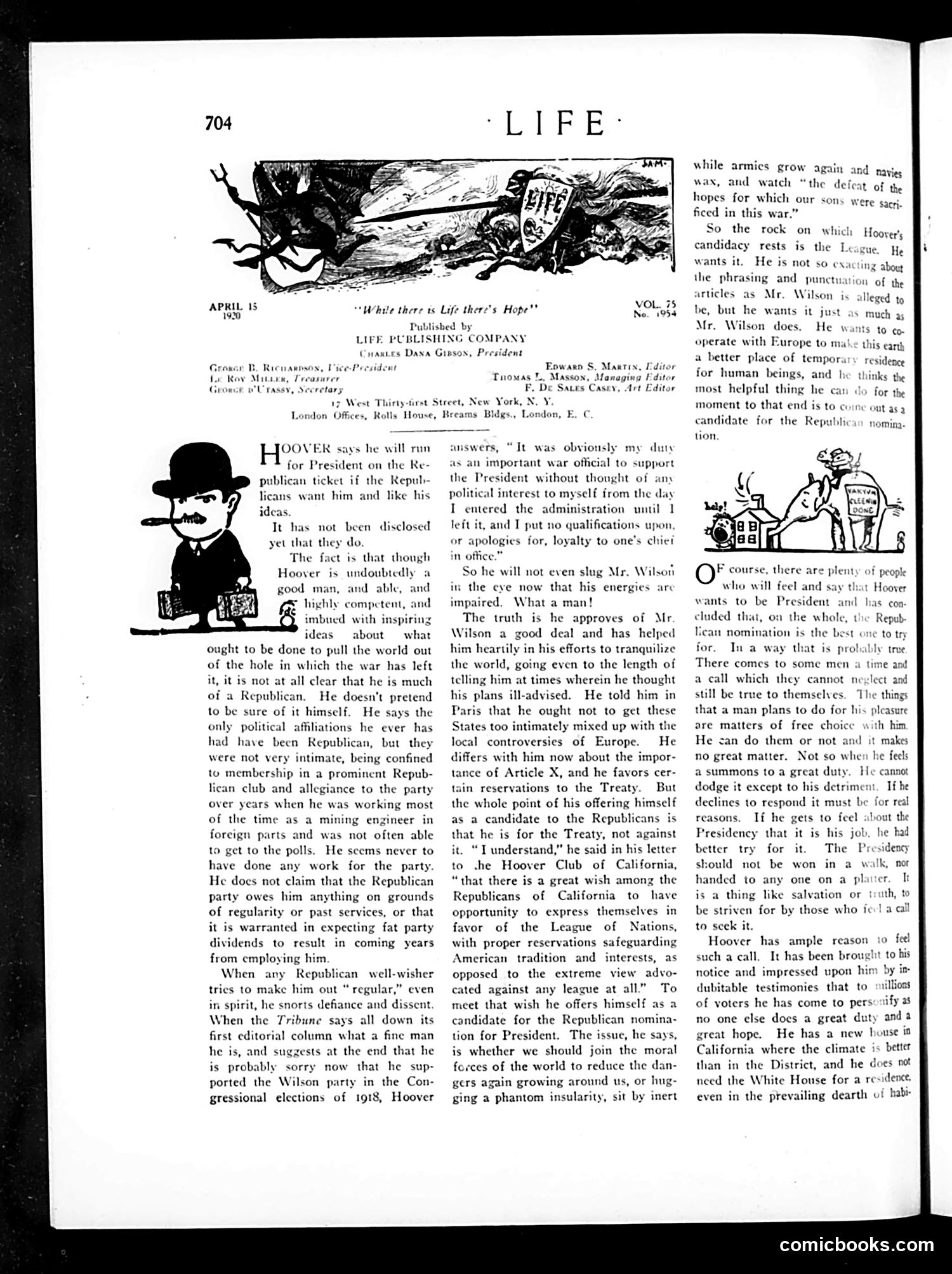
This page satirizes Herbert Hoover's potential candidacy for the Republican presidential nomination. The cartoon depicts Hoover as somewhat of a political outsider—a competent administrator and "good man," but lacking genuine Republican credentials. The satire highlights Hoover's awkward position: he supported President Wilson during WWI on patriotic grounds rather than party loyalty, and now seeks the Republican nomination primarily to advance the League of Nations—Wilson's signature foreign policy initiative. Life mocks this contradiction: Hoover wants Republican support for a fundamentally *Democratic* policy goal. The editorial notes Hoover barely participated in Republican party machinery, never worked for the party, and maintains only loose historical affiliation. He even refuses to attack Wilson personally despite political opportunity. The piece suggests Hoover's candidacy is fundamentally confused—he's essentially asking Republicans to nominate him to support a Democratic president's vision, making him neither reliably Republican nor genuinely his own man.
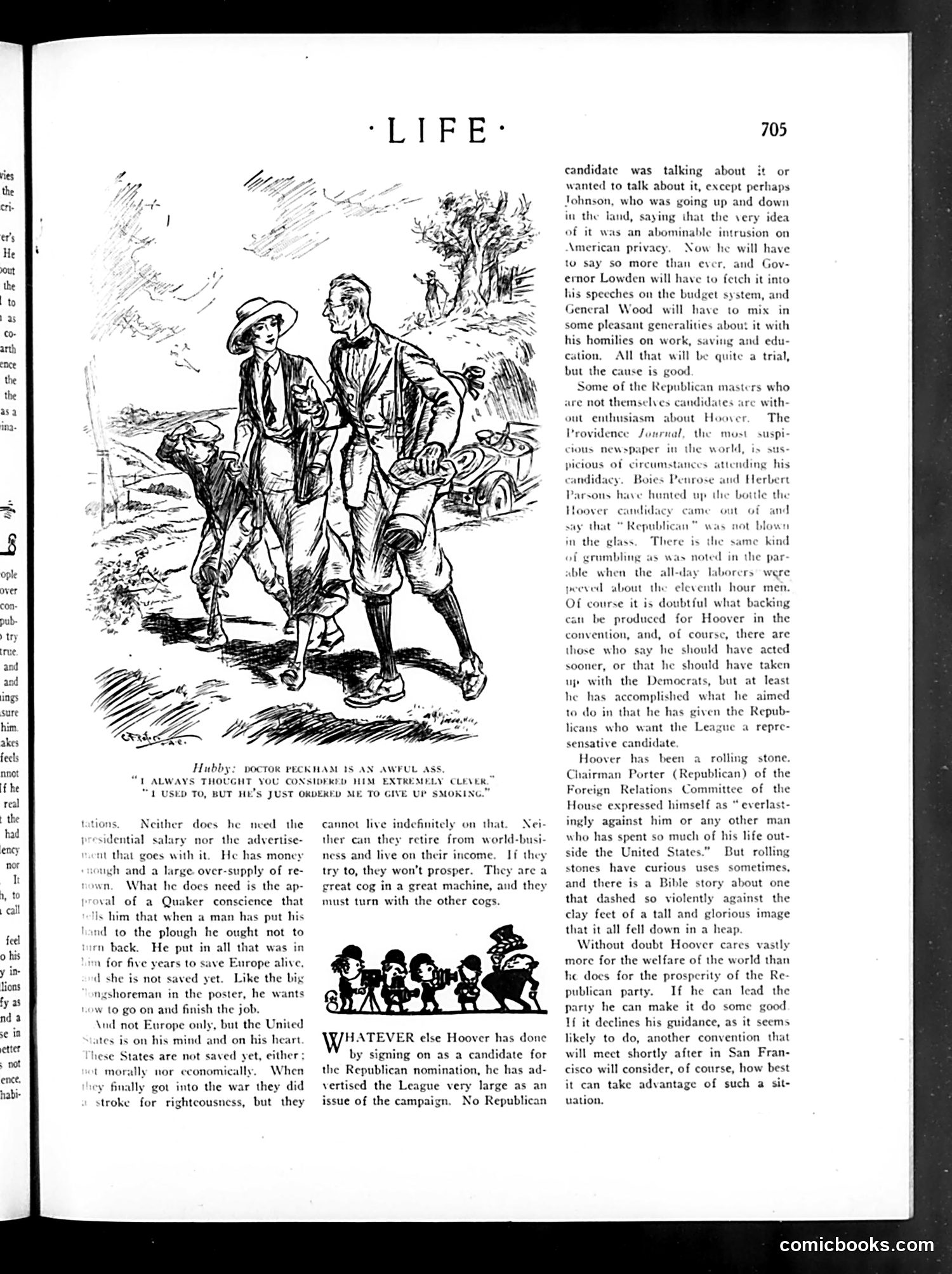
This Life magazine page discusses Herbert Hoover's candidacy for the Republican presidential nomination in 1920. The cartoon shows two men discussing "Doctor Feckham"—apparently a figure who demands others adopt his moral positions (here, giving up smoking). **Key satirical points:** The text argues Hoover, a Quaker with strong moral conviction, has entered politics despite reluctance. Republicans uncomfortable with him note he spent years abroad (World War I relief work) rather than building American business interests. The comparison to laborers upset about "eleventh hour" workers suggests resentment of his late entry into the race. The article's main joke: Hoover has inadvertently made the League of Nations—which Republicans opposed—a central campaign issue simply by being their candidate, forcing other candidates to address it. He's compared to a "rolling stone" with unexpected consequences, ultimately helping the League's cause despite party resistance.
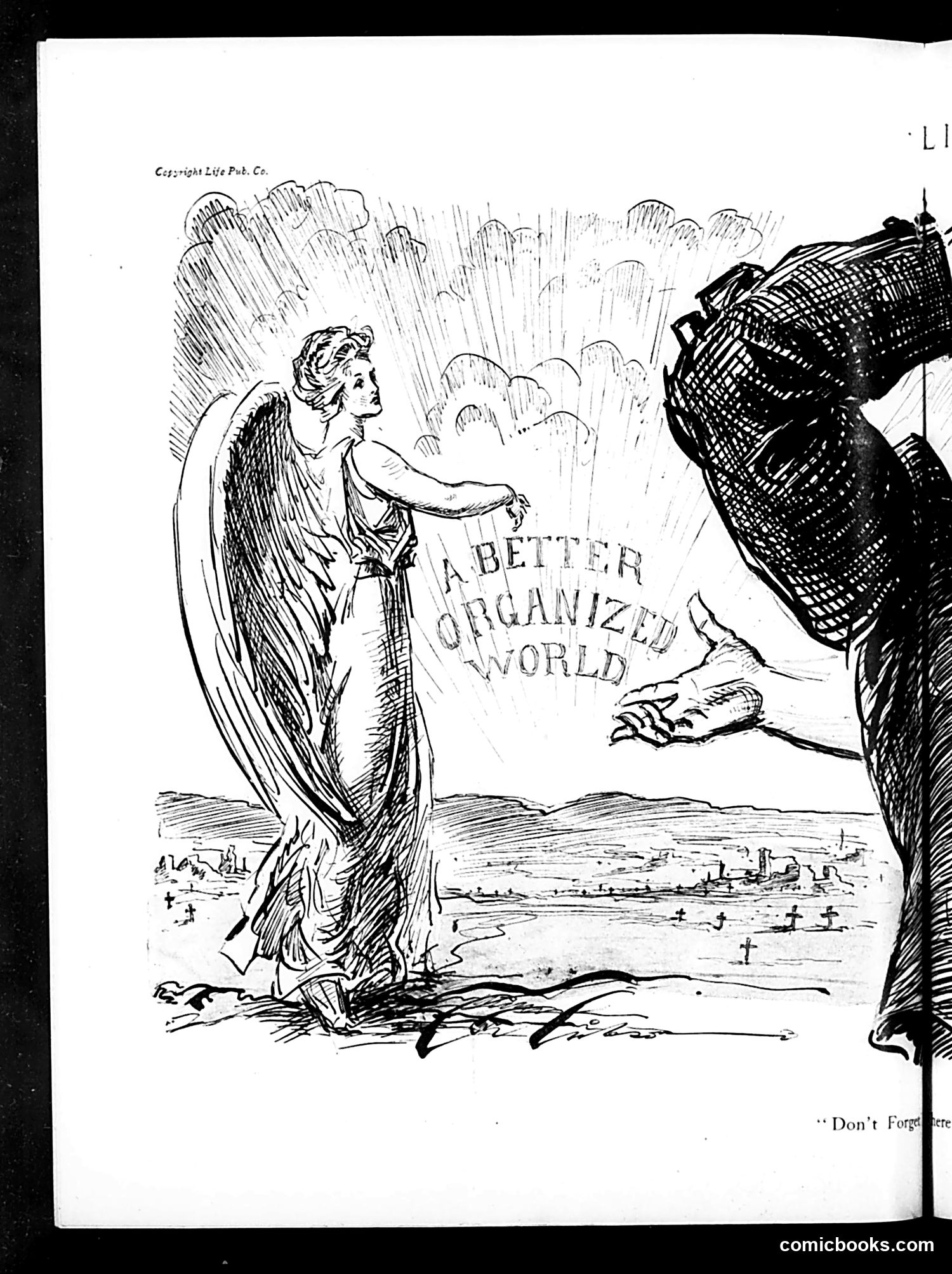
This cartoon depicts an angel holding a scroll reading "A BETTER ORGANIZED WORLD" addressing a dark, demonic or war-like figure on the right. The background shows a battlefield with crosses marking graves and a city in the distance, suggesting post-war devastation. The satire contrasts idealistic aspirations for global improvement with the brutal reality of warfare and death. The angel represents hopeful visions of a reorganized, peaceful world order, while the opposing dark figure appears to embody destructive forces or resistance to such ideals. The incomplete caption "Don't Forge[t]..." likely urges remembrance of war's costs. Given the graveyard setting and imagery, this likely comments on post-World War I hopes for lasting peace—a recurring Life magazine theme from the 1920s-30s.
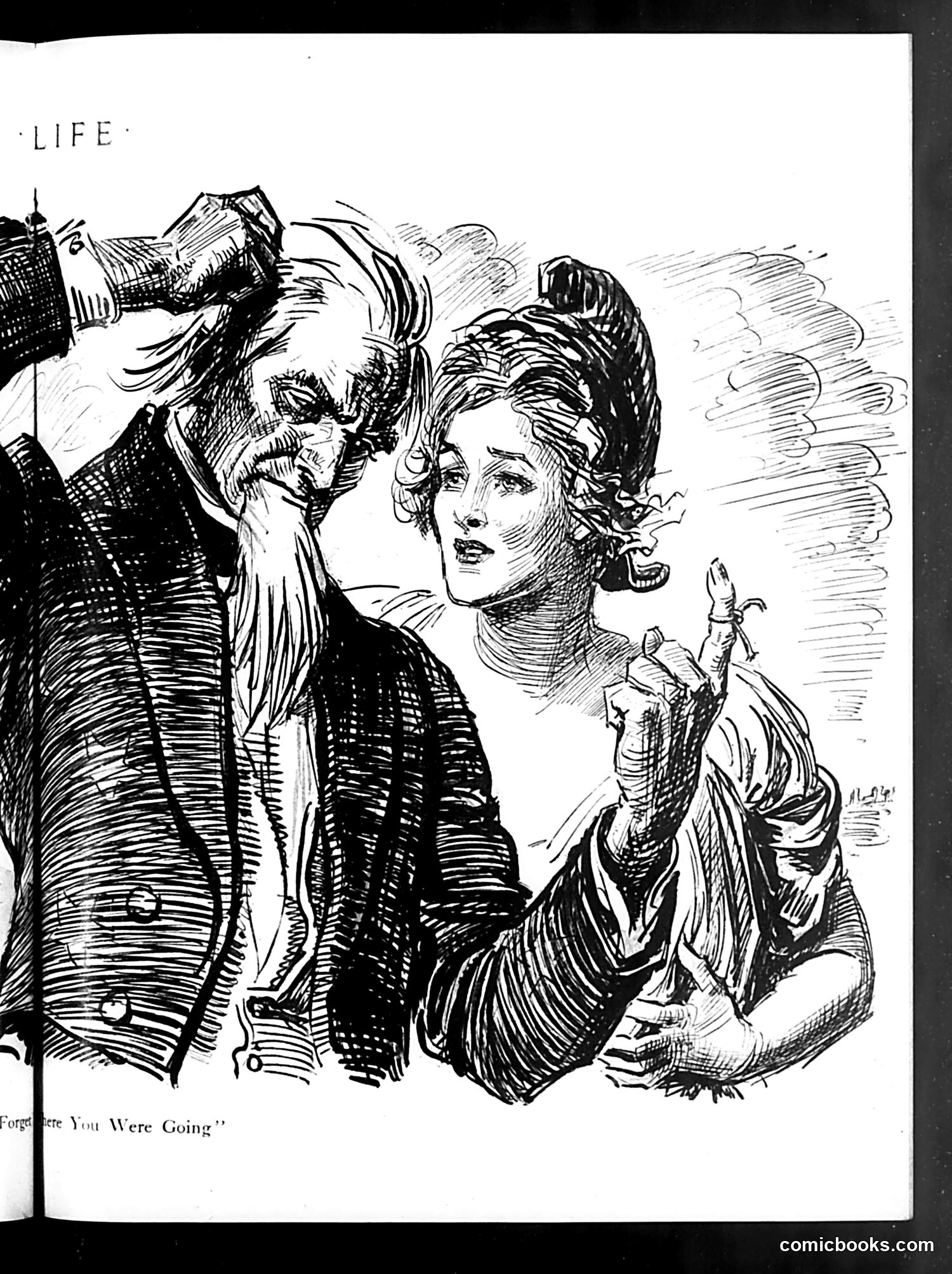
This is a satirical illustration from *Life* magazine depicting what appears to be a social interaction between elegantly dressed figures. The caption reads "Forget Where You Were Going," suggesting the cartoon jokes about distraction or interrupted plans. The sketch shows a well-dressed man in formal attire (left) alongside a fashionably dressed woman, rendered in ink with characteristic early 20th-century illustrative style. The humor likely plays on social dynamics of the era—possibly commenting on how romantic or social encounters cause people to lose their original purpose or direction. Without additional context or visible date information, the specific satirical target remains unclear, though the refined style and subject matter suggest commentary on upper-class social customs or romantic entanglements typical of *Life* magazine's satirical coverage.
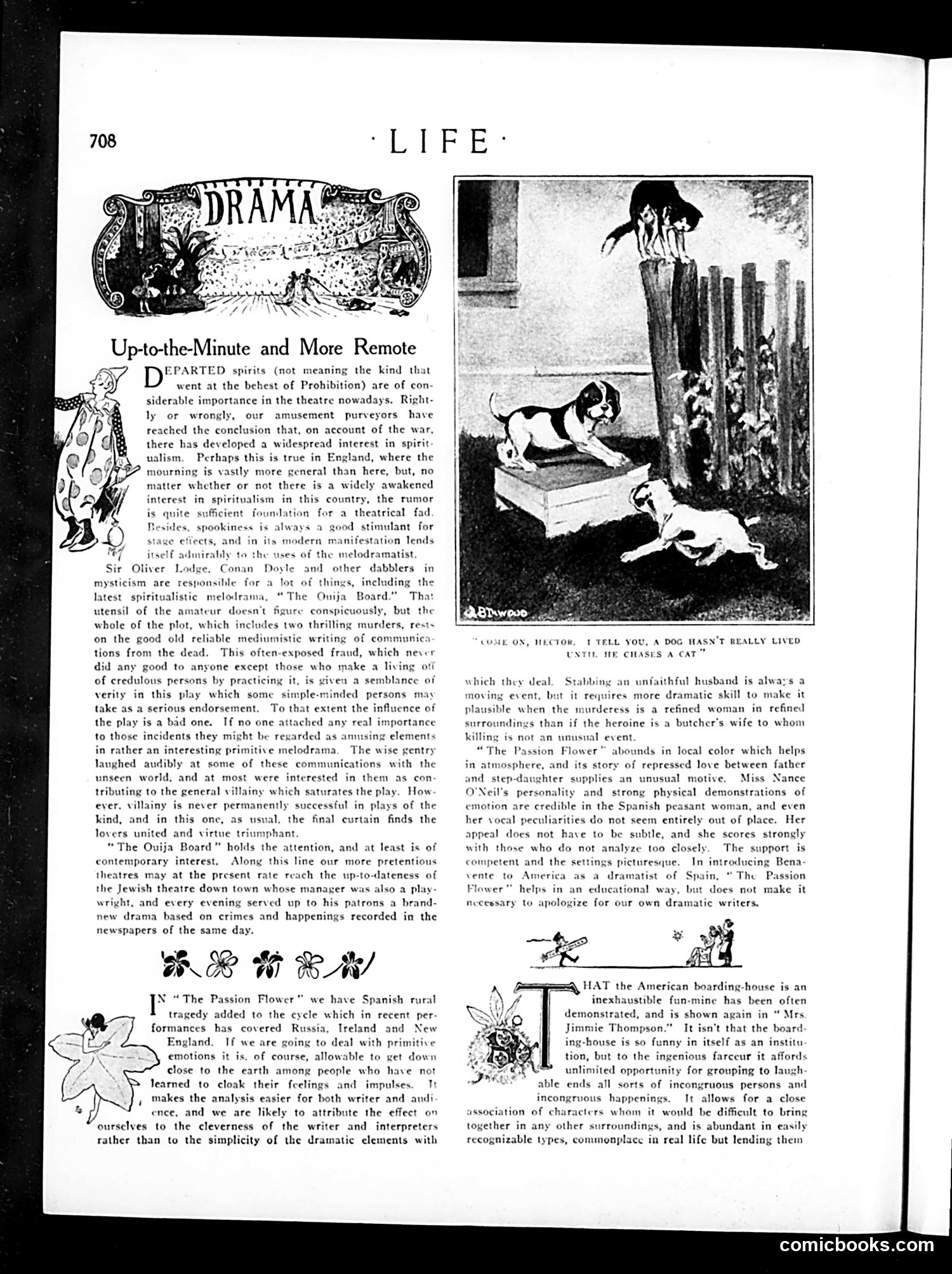
This page reviews contemporary theatrical productions, focusing on spiritualistic melodramas gaining popularity during World War I. The critic notes that wartime mourning has created audience interest in spiritualism, which playwrights exploit. The main productions discussed are: 1. **"The Ouija Board"** — criticized as capitalizing on spiritualist fad, using séance fraud and mediumistic writing as plot devices. The reviewer condemns it as bad influence despite acknowledging audiences laugh at the absurdity. 2. **"The Passion Flower"** — a Spanish rural drama praised for its authentic emotion and Nance O'Neil's physical performance, though her vocal delivery is questioned. The cartoon showing a man and dog illustrates contemporary humor about pet loyalty. The critic advocates for theatrical sophistication, arguing that depicting primitive emotions among rural/working-class characters requires less dramatic skill than portraying similar passions in refined society—a classist assumption typical of the era's theatrical criticism.
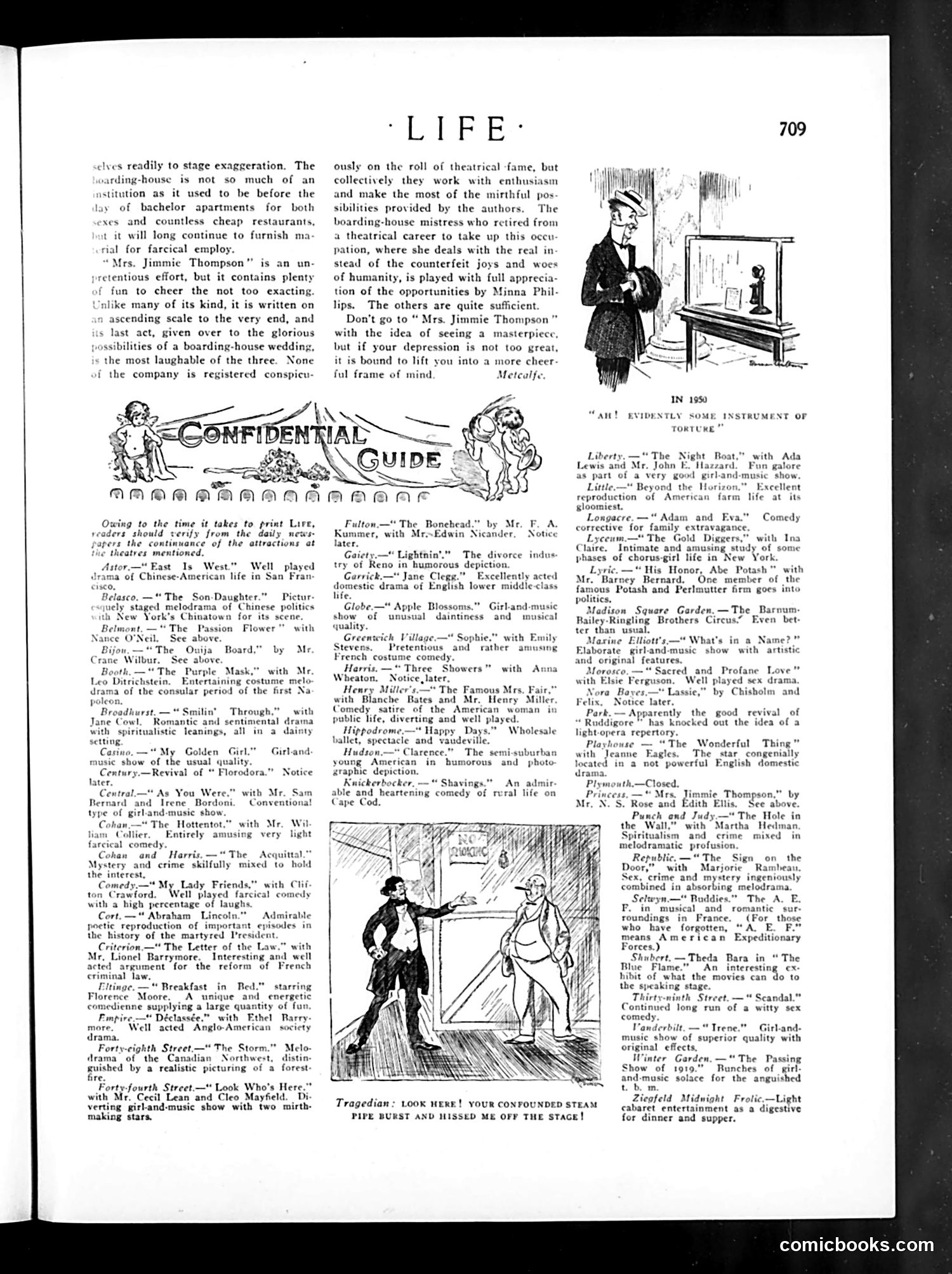
This page is primarily a **theater review and listings section** from Life magazine (circa 1920, based on the "In 1920" header visible). The OCR'd text consists of brief critical reviews of Broadway productions. The two **cartoons** illustrate theatrical humor: 1. **"Confidential Guide"** (top): A decorative header with cherubs, presenting the theater listings as "confidential" advice—a humorous framing device. 2. **Main cartoon** (center): Shows a well-dressed man confronting another man on stage, with the caption "LOOK HERE! YOUR CONFOUNDED STEAM PIPE BURST AND HISSED ME OFF THE STAGE!" This depicts a backstage mishap where literal stage machinery (a steam pipe) literally interrupted a performance—satirizing the chaos of theatrical production and the gap between dramatic illusion and mechanical reality. The reviews themselves are brief assessments of contemporary plays, noting whether they're comedies, dramas, or musical shows. The page reflects early 20th-century theater culture and Life's role as cultural arbiter.
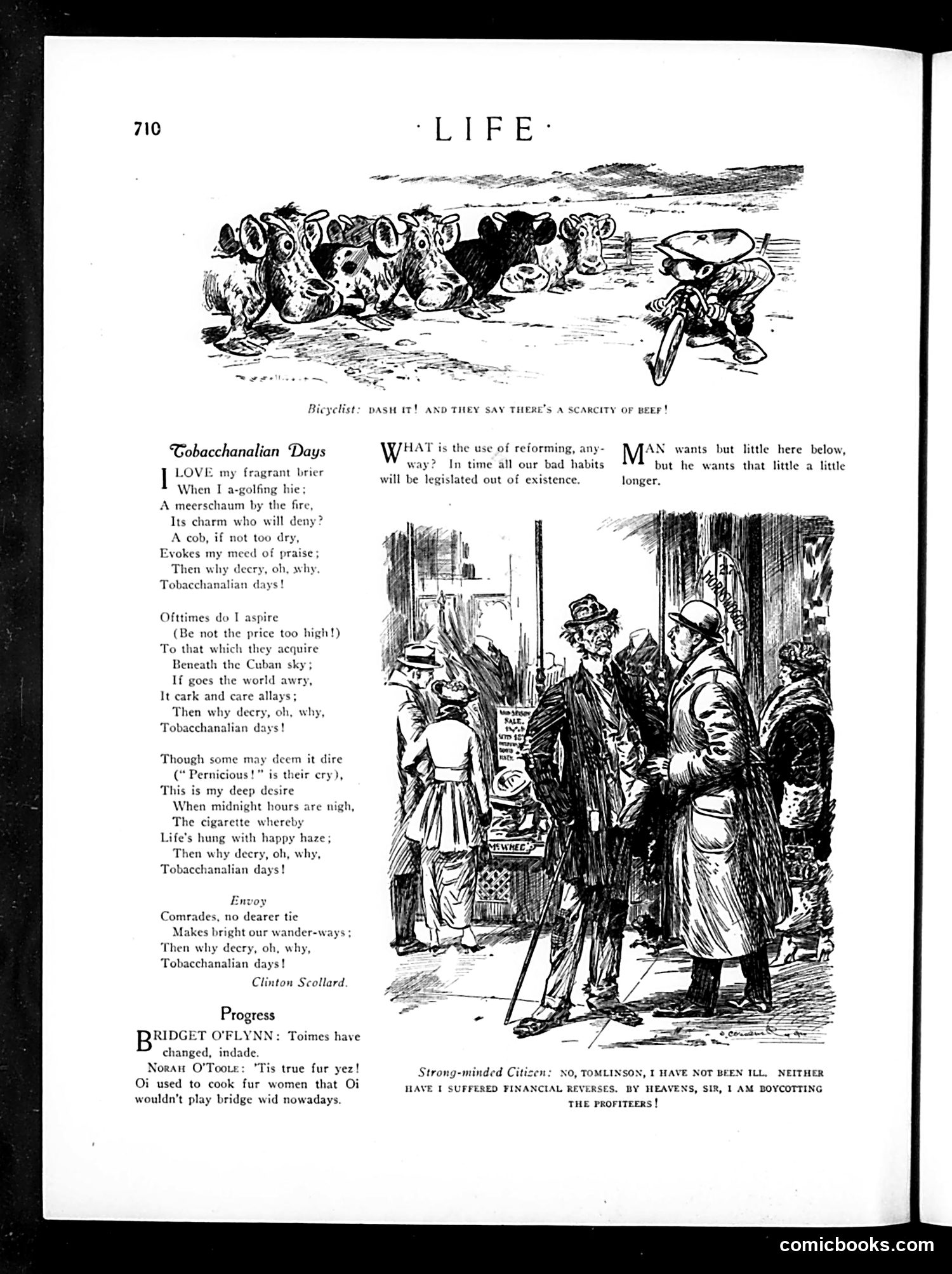
This page contains three distinct satirical pieces: 1. **Top cartoon**: A bicyclist passes a herd of cattle with the caption "Dash it! And they say there's a scarcity of beef!" This mocks wartime or post-war rationing claims—suggesting abundance exists despite official scarcity narratives. 2. **"Tobacchanalian Days" poem**: A lighthearted defense of tobacco smoking, celebrating pipes, cigars, and cigarettes as life's simple pleasures. The speaker dismisses moral reformers who call smoking "pernicious." 3. **Bottom dialogue and cartoon**: Two Irish-accented characters (Bridget O'Flynn and Norah O'Toole) discuss social mobility—women once their employers now won't associate with them socially. The final panel shows a "Strong-minded Citizen" boycotting "profiteers," likely referencing wartime price-gouging and the moral/economic activism surrounding it. **Context**: The page reflects early 20th-century tensions between reformism, consumer culture, class mobility, and wartime/postwar economic anxieties.
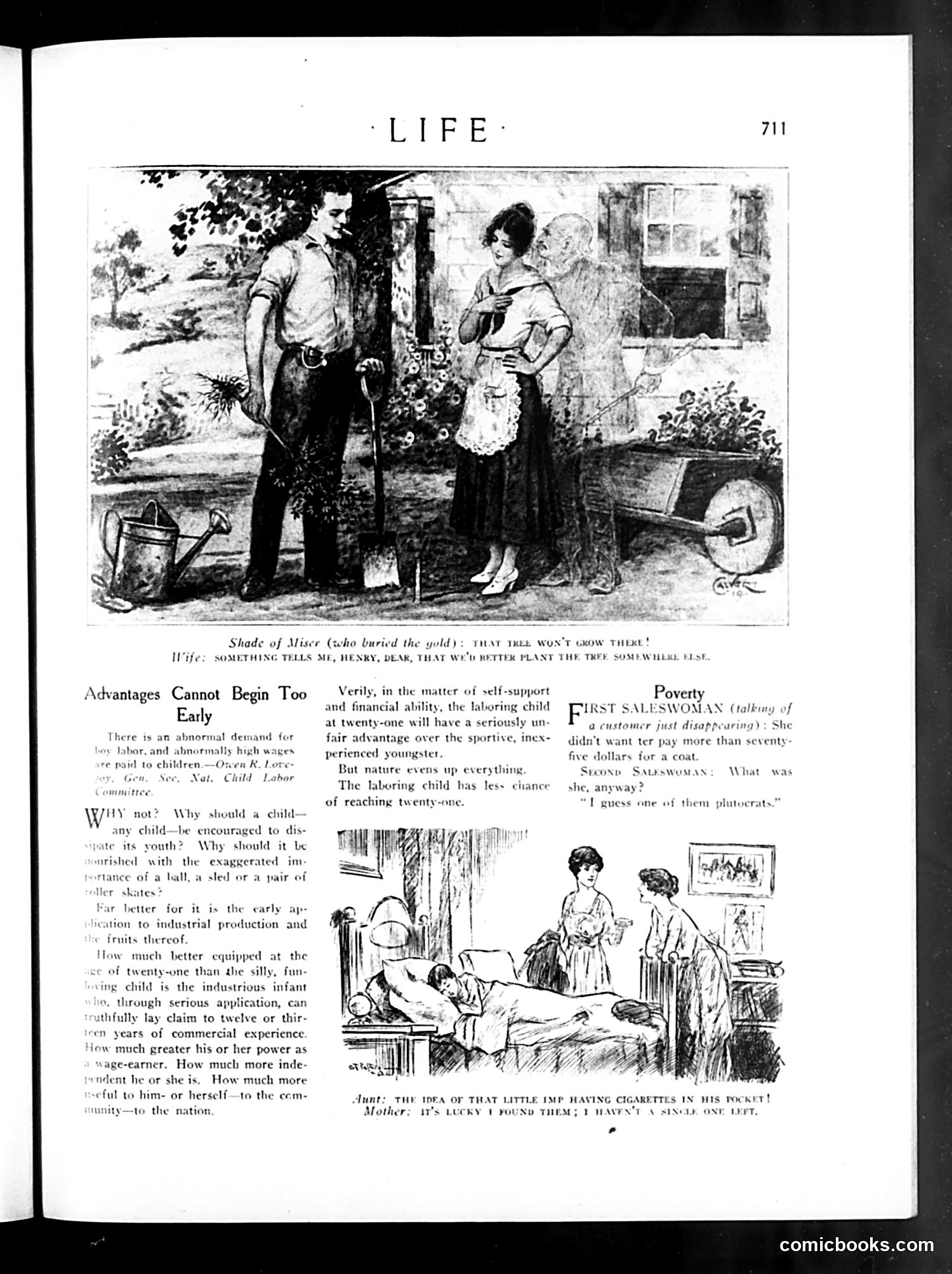
This page uses **ironic satire** to attack arguments supporting child labor—a contentious policy issue of the early 20th century. The main text mockingly presents pro-child-labor arguments: children gain "commercial experience," become financially independent, and benefit industry. The satire's punch line: "But nature evens up everything. The laboring child has less chance of reaching twenty-one"—exposing that child labor causes early death, negating all supposed advantages. The top cartoon shows a woman telling a man not to plant a tree where a "miser who buried gold" once died, warning it won't grow there—**likely allegory** for how child labor poisons society's future growth. The lower cartoon depicts a woman finding cigarettes in a child's pocket, sarcastically calling it "lucky"—**criticizing parental negligence and child welfare concerns**. The "poverty" section mocks wealthy women dismissing affordable coats as "plutocrats' " concerns, highlighting class disconnect from actual need. **Overall message**: The page condemns child labor exploitation and the wealthy's indifference to working-class suffering.
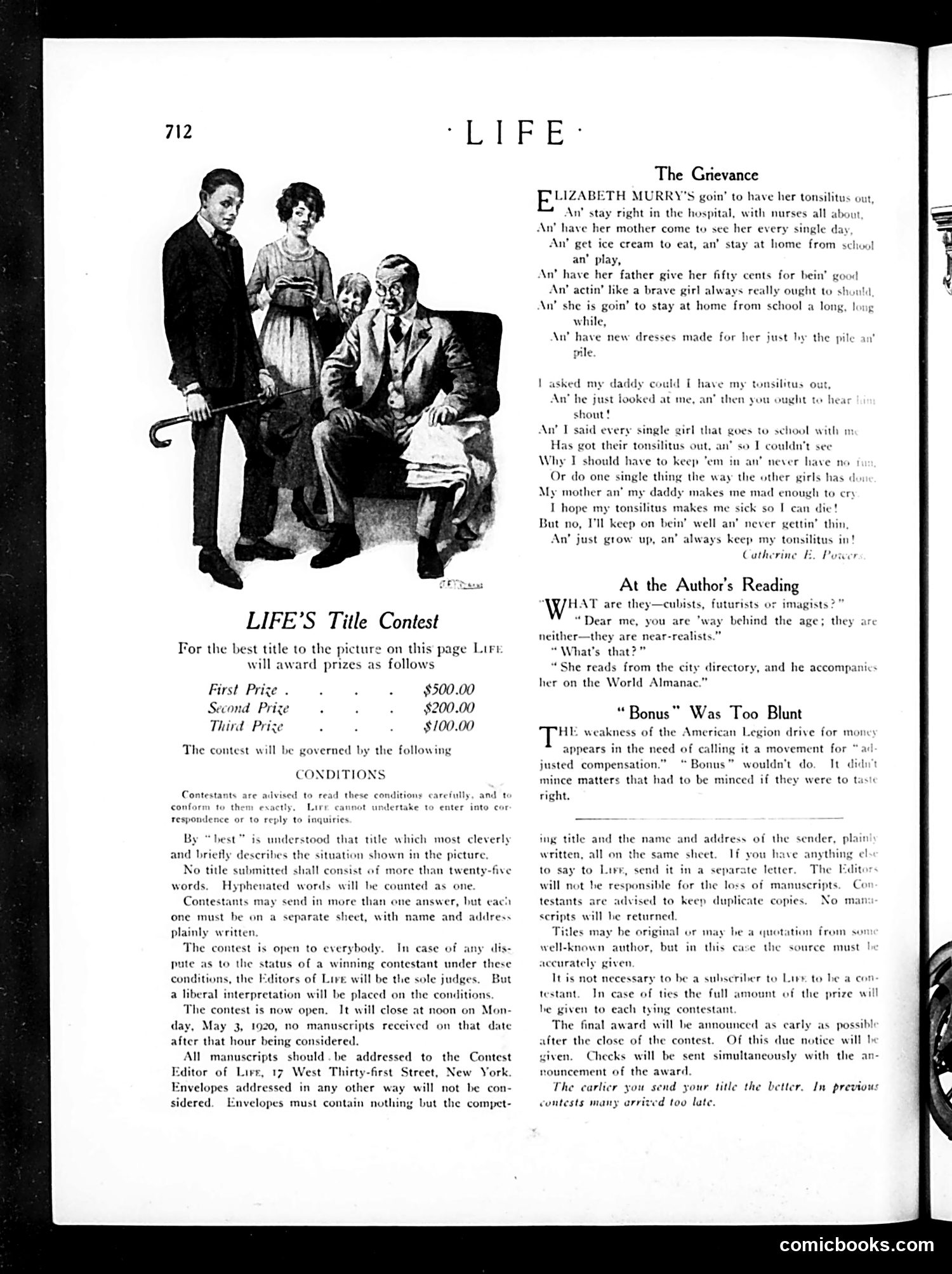
This page contains three distinct pieces of satire: 1. **"Life's Title Contest"**: A contest asking readers to title the illustration showing what appears to be a family doctor's visit—likely discussing a child's medical procedure. This was a common Life feature inviting reader participation. 2. **"The Grievance"** (poem by Catherine E. Power): Social satire about childhood inequity. A girl named Elizabeth gets her tonsils removed and receives sympathy, ice cream, new dresses, and time off school—while the narrator, denied the same "privilege," resents that other girls get this special treatment. The poem mocks how children view medical procedures as enviable advantages rather than health concerns. 3. **"At the Author's Reading"** and **"'Bonus' Was Too Blunt"**: Brief satirical commentary. The first jokes about modernist literary movements (cubism, futurism, imagism) as pretentious. The second criticizes how the American Legion euphemistically called veteran compensation a "movement for adjusted compensation" rather than plainly calling it a "bonus"—satirizing political language-softening. The page captures early 1920s American social commentary and humor.
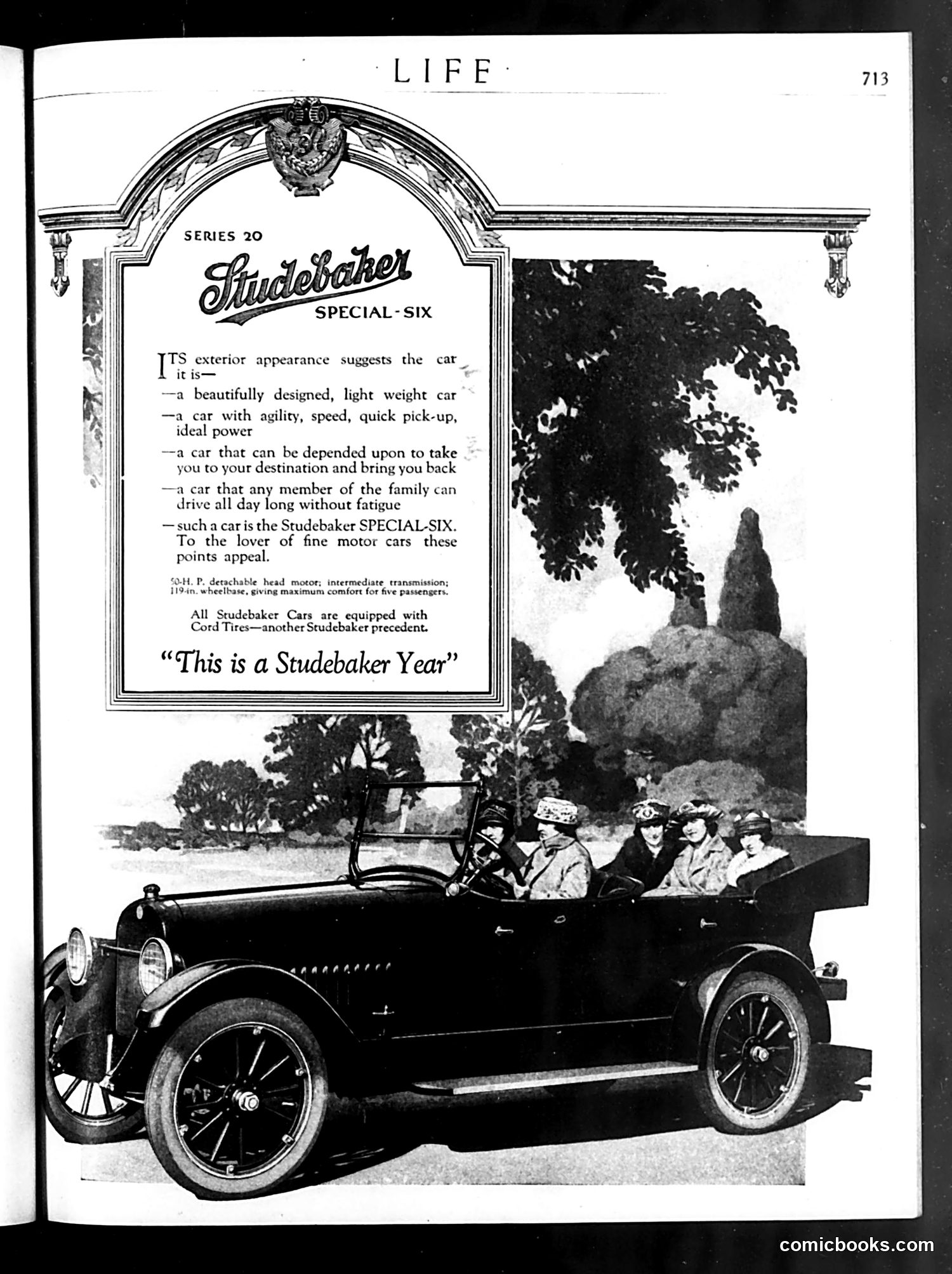
This is a **Studebaker automobile advertisement**, not a political cartoon. The page features Series 20 of the Studebaker Special-Six car, shown as an open-air touring vehicle carrying five passengers in period dress through a scenic landscape. The ad emphasizes the car's practical virtues: light weight, speed, reliability, and ease of operation for family members. Technical specifications highlight the 50-horsepower engine, detachable head motor, and intermediate transmission with 119-inch wheelbase. The tagline "This is a Studebaker Year" is a marketing claim suggesting the brand's prominence. The image and text work together to position the Special-Six as an accessible, dependable family vehicle—appealing to early-20th-century consumers seeking modern automotive convenience without luxury pretension.
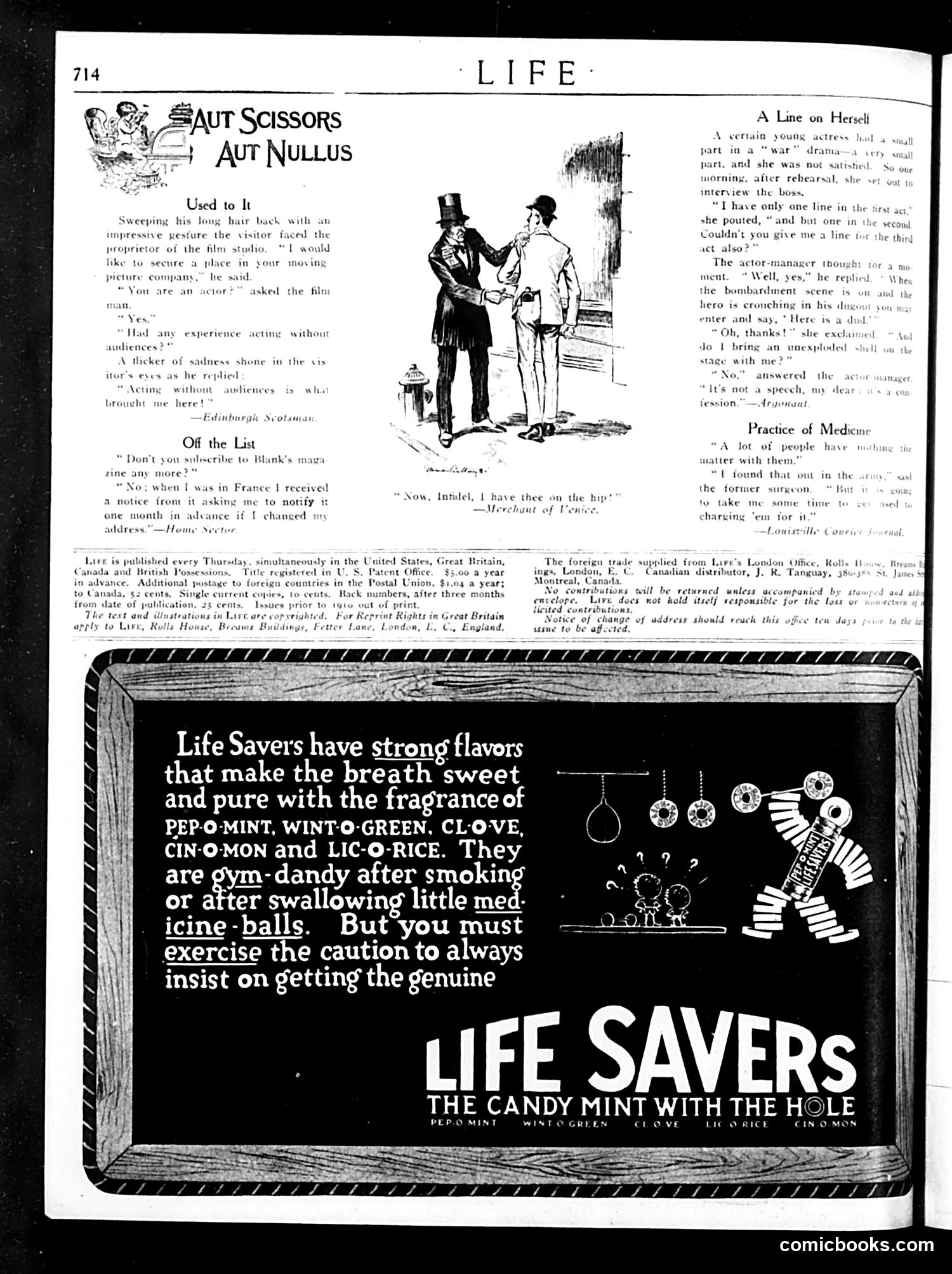
This page contains three distinct items: 1. **"Aut Scissors / Aut Nullus"**: A brief humorous exchange (unclear context without fuller text) about theater acting. 2. **"A Line on Herself"** and **"Practice of Medicine"**: Short anecdotal humor pieces—typical of Life magazine's satirical format—poking fun at social situations and professions, though the OCR text is too fragmentary to extract clear meaning. 3. **Life Savers Advertisement**: The dominant feature is a full-page ad for Life Savers candy, emphasizing the product's minty flavors and medicinal qualities ("after smoking or swallowing medicine-balls"). The ad warns consumers to buy only genuine Life Savers, suggesting counterfeit products existed—a common concern in early 20th-century consumer goods. The page reflects Life's business model: mixing light satire with advertising revenue.
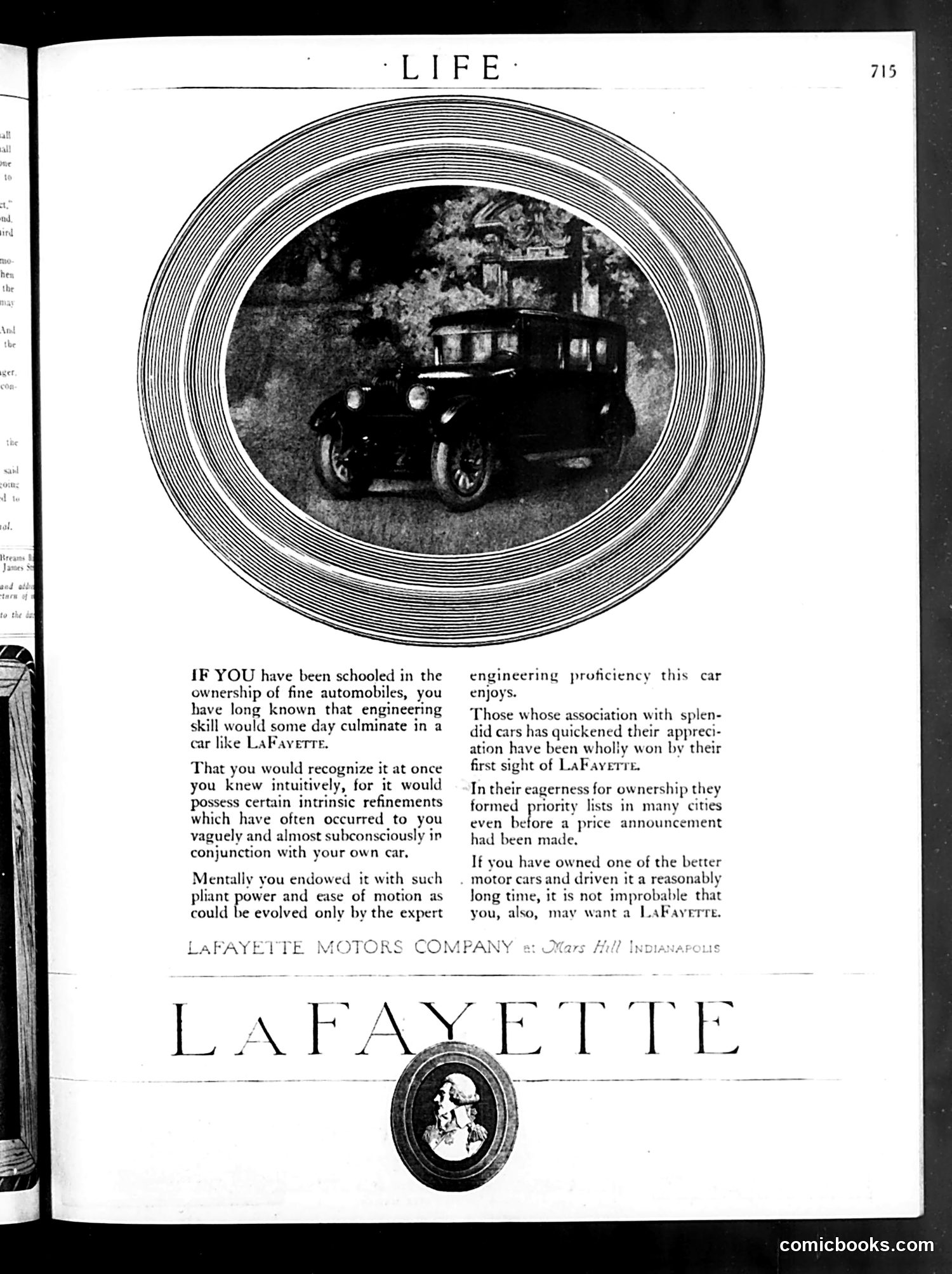
This is **primarily an automobile advertisement**, not a political cartoon. It's a full-page ad for the Lafayette Motors Company (located in Mars Hill, Indianapolis) from what appears to be an early 20th-century issue of Life magazine. The ad uses aspirational marketing language, suggesting that owning a Lafayette represents the culmination of "engineering skill" and refinement. It appeals to readers who've owned "fine automobiles" or "better motor cars," implying Lafayette ownership marks arrival in an elite automotive circle. The circular photograph shows a Lafayette automobile in an outdoor setting. The portrait medallion at bottom depicts the Marquis de Lafayette—the ad uses the historical French Revolutionary figure's name and prestige to brand the car as sophisticated and distinguished. There is no satire or political commentary present. This is straightforward luxury-car advertising from the early automotive era, targeting wealthy, educated consumers.
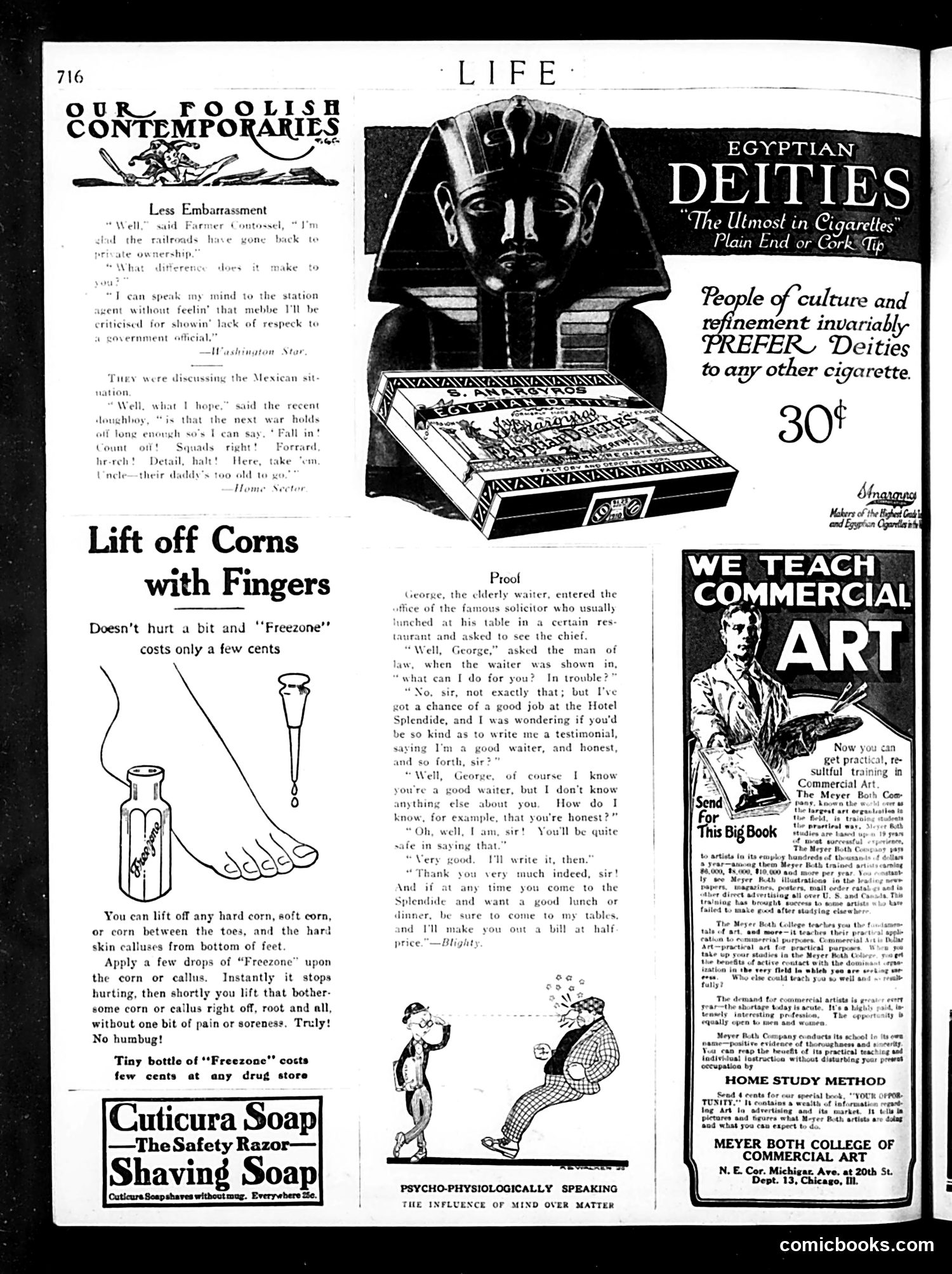
This page from *Life* magazine contains satirical commentary and period advertisements typical of early 20th-century American humor publications. **"Our Foolish Contemporaries"** section mocks contemporary attitudes: a farmer dismisses railroad concerns, and a recent doughboy expresses naive optimism about the next war ("Fall in! Count off!"), satirizing public complacency about military conflict—likely referencing post-WWI attitudes. **"Proof"** presents a humorous anecdote about an elderly waiter seeking a character reference from a solicitor. The joke rests on the lawyer's logical trap: he cannot vouch for the waiter's honesty without personal knowledge, yet the waiter expects him to write it anyway—satirizing both bureaucratic absurdity and the gap between what testimonials claim versus verify. The page is otherwise dominated by period advertisements: **Freezone** (corn remover), **Egyptian Deities** cigarettes (appealing to "culture"), **Cuticura Soap**, and **Meyer Rath College** correspondence courses in commercial art—typical consumer products marketed through aspirational appeals.
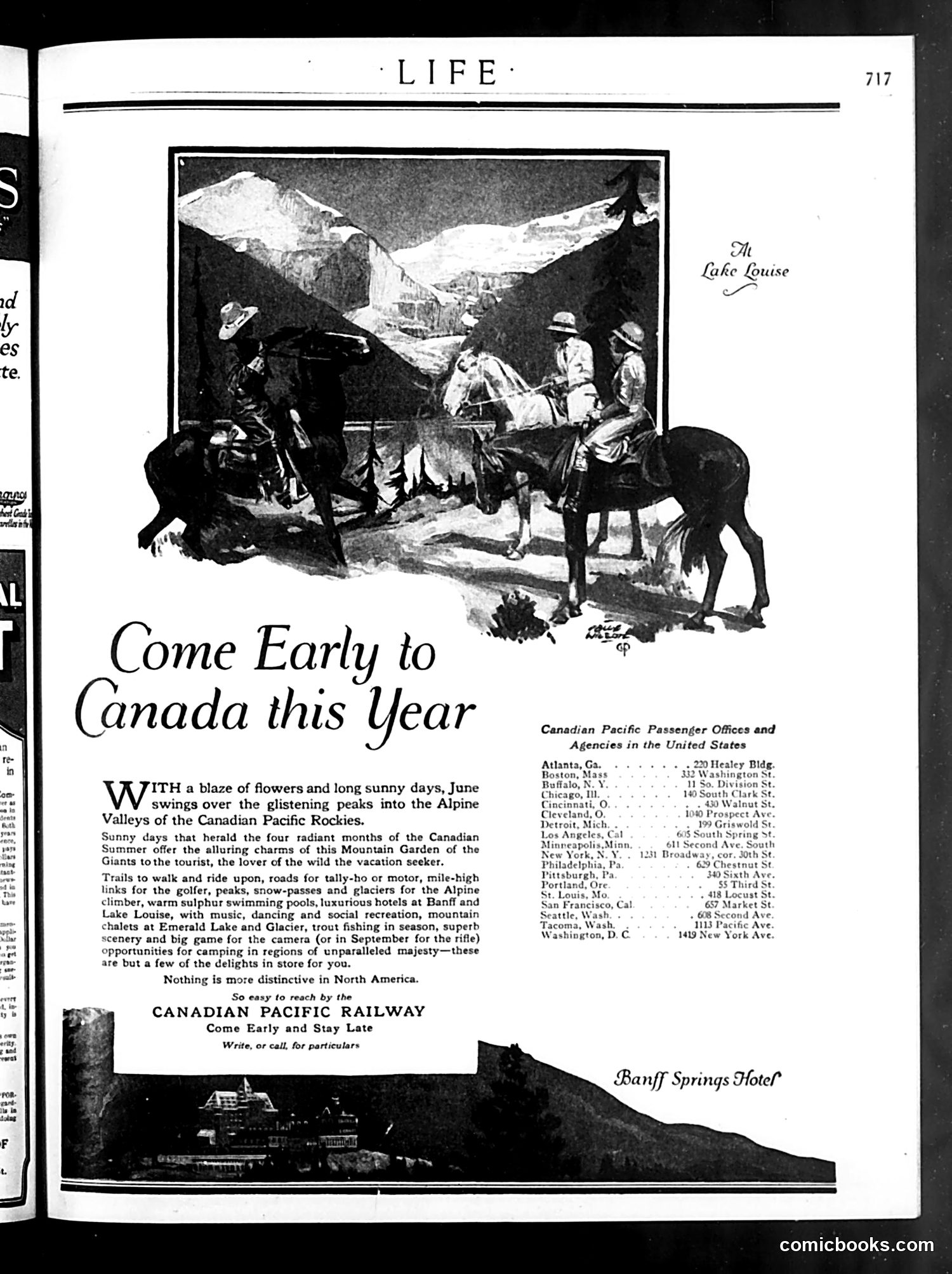
This is **not a cartoon or satire**, but rather a **travel advertisement** from Life magazine (page 717). The page promotes Canadian Pacific Railway tourism, specifically encouraging American visitors to travel to the Canadian Rockies—Lake Louise, Banff, and surrounding areas—during the summer season. The illustration depicts tourists at a mountain lodge with snow-capped peaks in the background. The advertising copy emphasizes recreational activities: hiking, golfing, swimming in hot springs, fishing, and camping. A notable line mentions "big game for the camera (or in September for the rifle)"—reflecting early 20th-century hunting tourism. The lower section lists Canadian Pacific Railway passenger offices across American cities (Atlanta, Boston, Buffalo, etc.), making it easy for U.S. travelers to book trips. This represents straightforward commercial promotion rather than political commentary or humor.
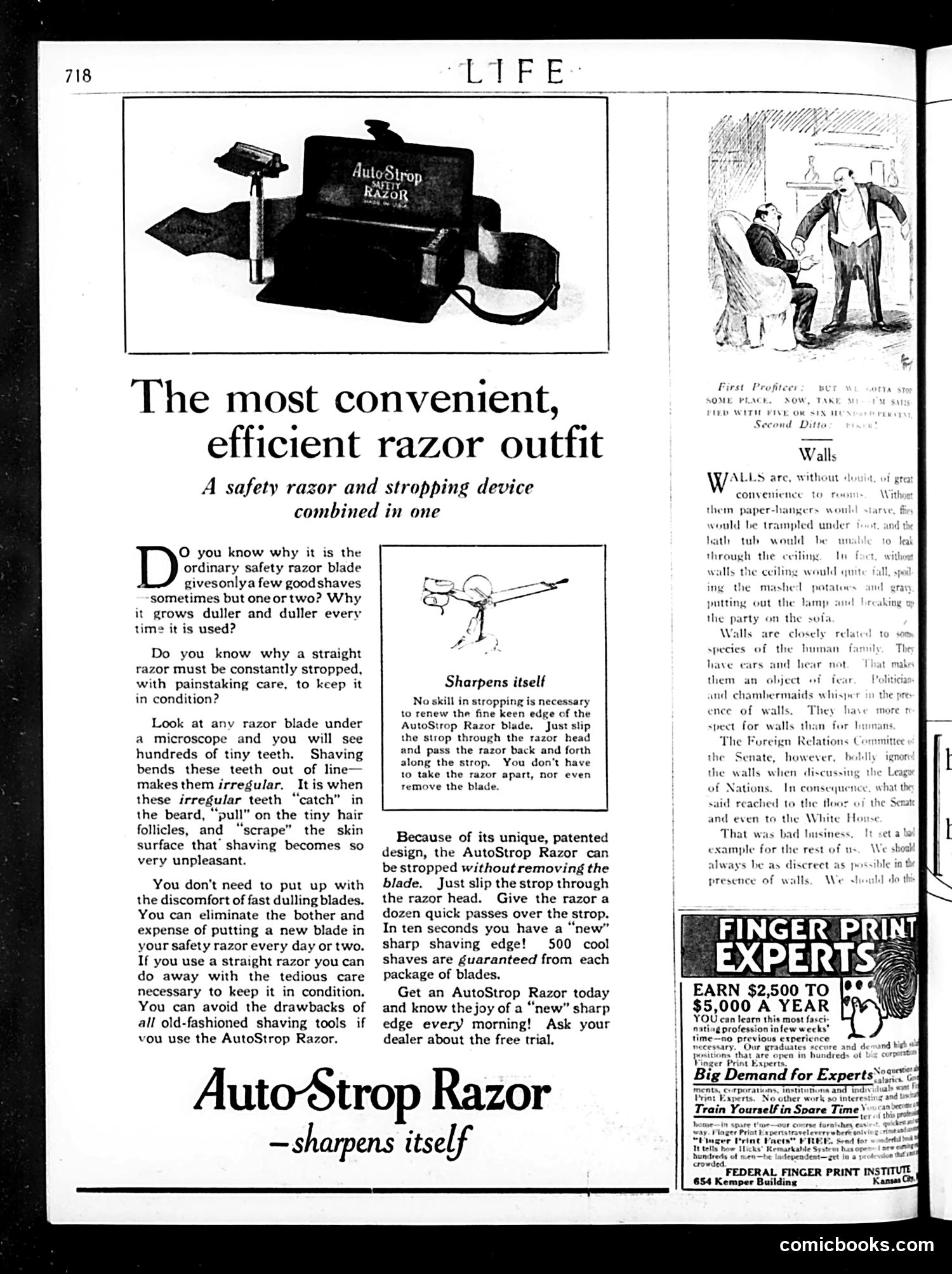
This page is primarily a **product advertisement** for the AutoStrop Razor, not political satire. The ad addresses a practical consumer problem: safety razor blades dull quickly, requiring frequent replacement, while straight razors demand tedious manual stropping. The AutoStrop promises a solution—a razor with a built-in stropping mechanism that automatically sharpens the blade without removal. The small cartoon in the upper right (titled "Walls") is unrelated humor about the inconvenience of walls in domestic spaces—a lighthearted joke about how walls impede movement and eavesdropping during parties. The bottom of the page includes a separate "Fingerprint Experts" job-training advertisement. This reflects early 20th-century *Life* magazine's mix of satirical content with conventional advertising. There is **no political commentary** here—just commercial marketing and domestic humor typical of the era.
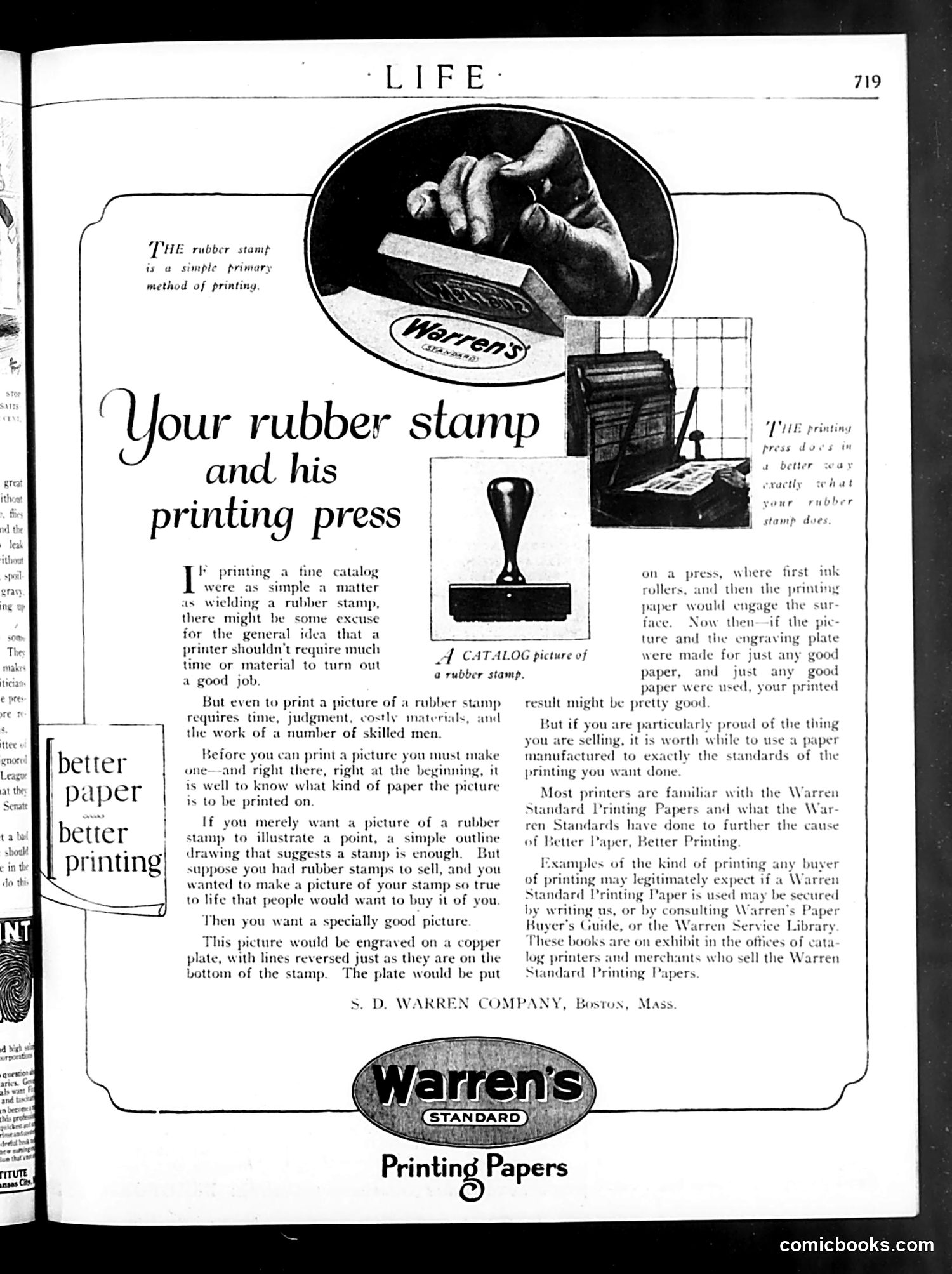
This is primarily **advertising, not satire or political commentary**. It's a Warren Standard Printing Papers company advertisement appearing in *Life* magazine (page 719). The ad uses instructional content about printing rubber stamps to promote Warren's paper products. The key message: printing quality depends not just on the design or engraving, but critically on using the *right paper*. The visual shows a rubber stamp being used, a printing press in operation, and examples of stamp impressions. The accompanying text explains that while simple rubber-stamp printing is straightforward, creating a *professional* image of a rubber stamp for sales purposes requires skilled craftspeople, careful engraving, and—crucially—properly manufactured paper. The sidebar slogan "better paper / better printing" emphasizes Warren's core marketing claim: their standardized papers produce superior results, which any printer or merchant would recognize and seek out. This represents typical early-20th-century *Life* advertising: educational content designed to appear as editorial material while subtly promoting the advertiser's products to business buyers.
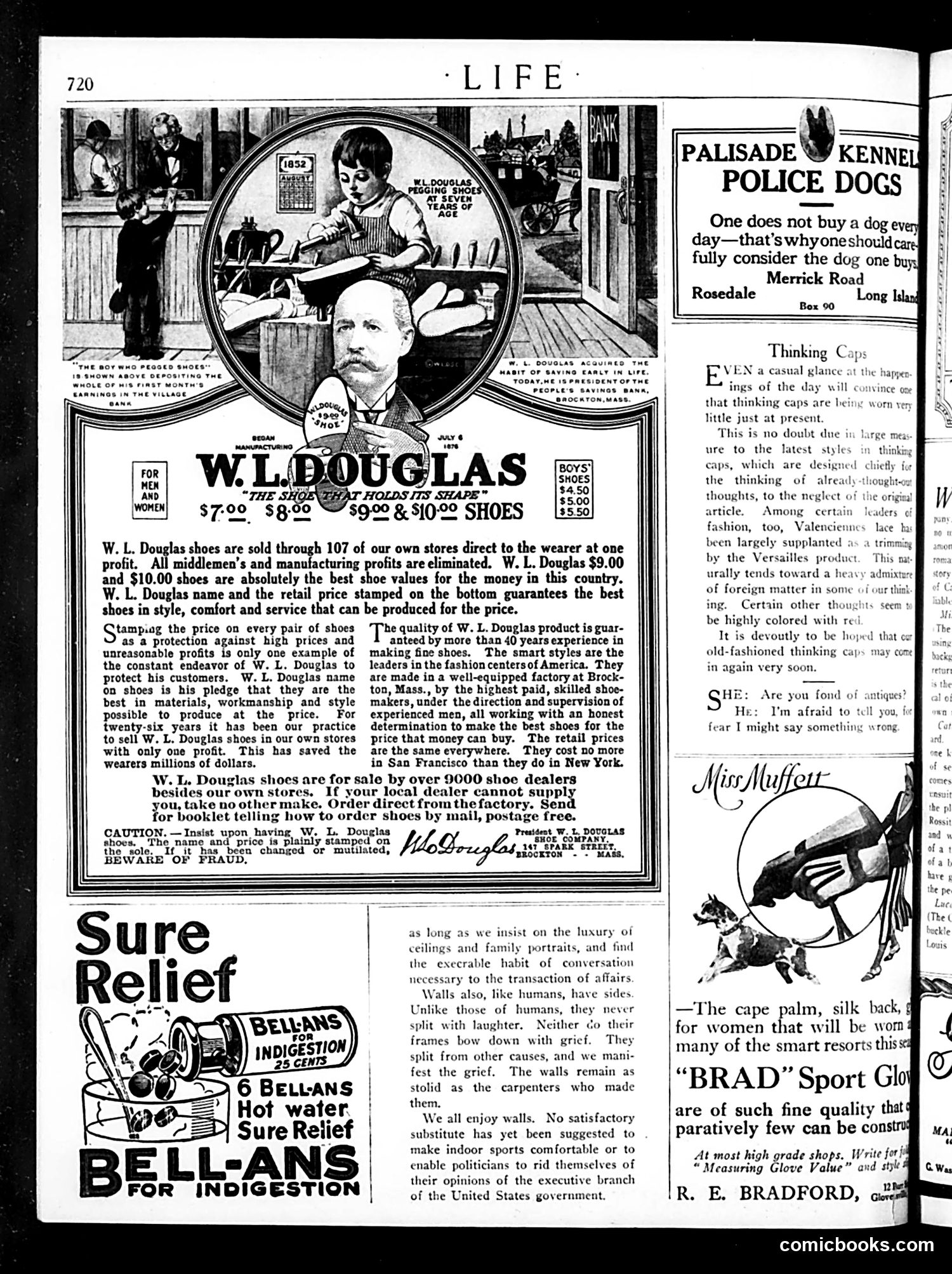
This is primarily an **advertising page** from Life magazine, dominated by a large W.L. Douglas shoe advertisement featuring a portrait of the company president with vignettes of shoe manufacturing and family life. The only substantial editorial content appears to be brief pieces on "Thinking Caps" (discussing fashion trends in women's headwear, specifically the decline of "thinking caps" in favor of Versailles-style designs) and a philosophical segment about walls and conversation. The remaining space contains advertisements for Bell-ans indigestion remedy and "Brad" sport gloves. **No political cartoons or caricatures appear on this page.** The Douglas shoe ad includes illustrative scenes but these are commercial imagery rather than satire. The page reflects early 20th-century Life magazine's mixed editorial-advertising format, with the philosophical wall commentary being the closest to the magazine's typical satirical voice, though it's quite mild and abstract rather than pointed social commentary.
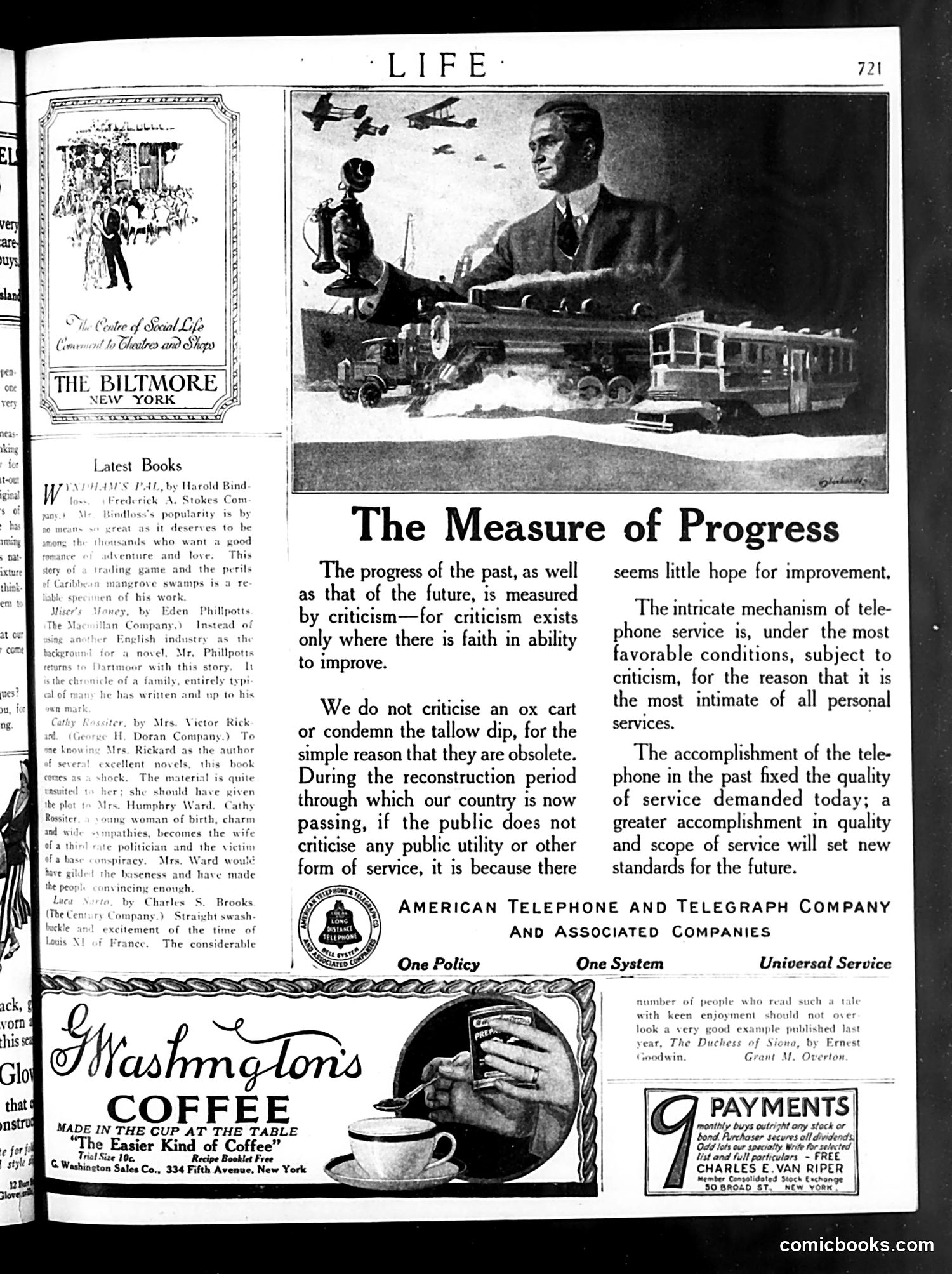
This page features a full-page advertisement for American Telephone and Telegraph Company disguised as editorial content. The illustration shows a man at a desk displaying model trains, ships, and airplanes—symbols of modern technological progress—with aircraft flying overhead. The text argues that progress should be measured by public *criticism*, not praise. The logic: we don't criticize obsolete technologies (ox carts, tallow dips), so ongoing criticism of telephone service actually proves faith in its improvability. This cleverly reframes complaints about phone service as validation rather than complaint—a form of corporate spin that discourages negative feedback by defining it as complimentary. The surrounding "Latest Books" section and Washington's Coffee advertisement appear genuine editorial content, lending credibility to the promotional essay. This blending of advertising with editorial matter was common in early-20th-century magazines.
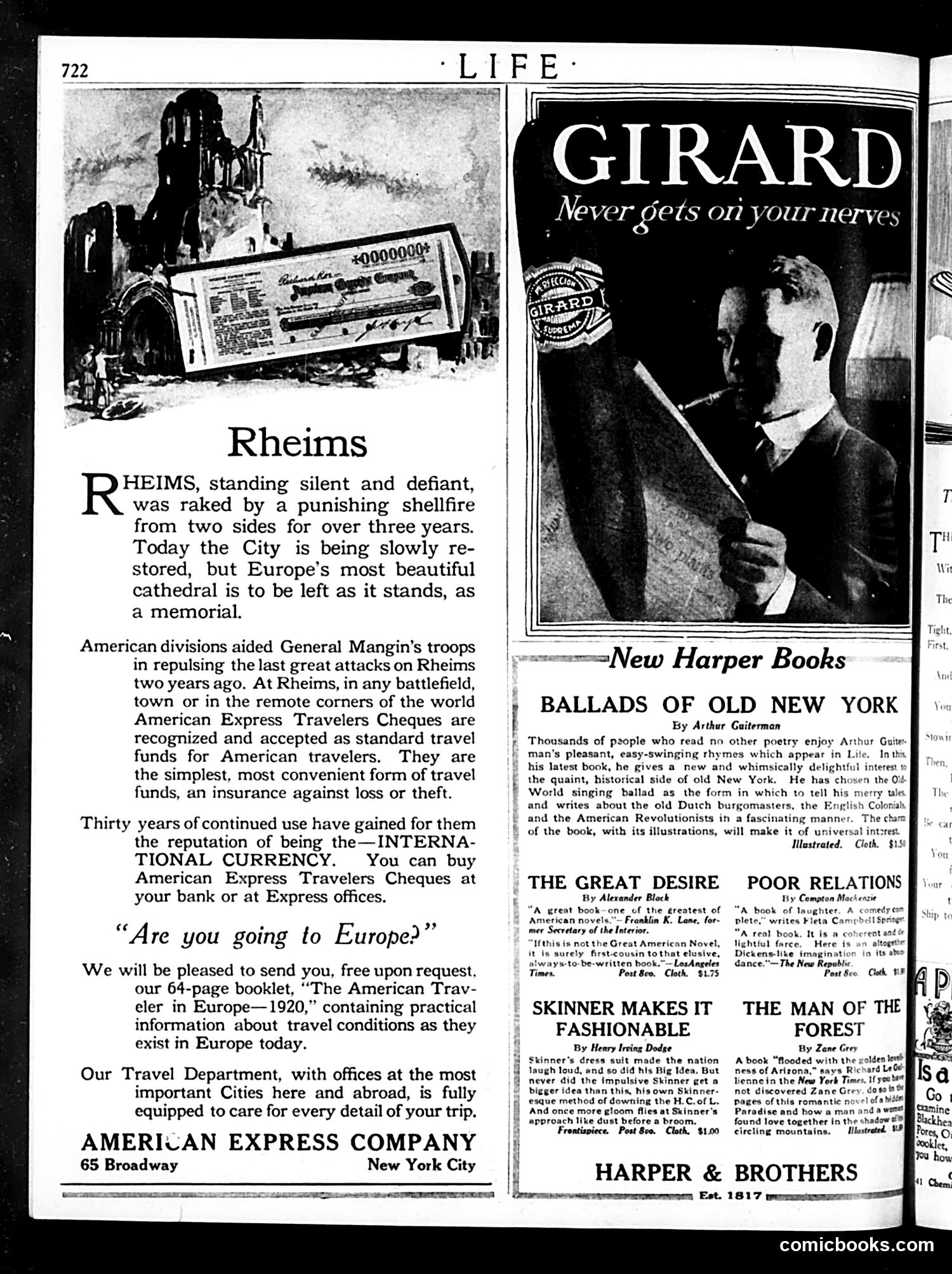
This page combines editorial content with advertising. The main article concerns **Rheims (Reims), France**, which was heavily damaged during World War I (the text references three years of shellfire and notes American divisions aided French General Mangin two years prior—placing this around 1920). The point: Rheims's cathedral will be left in ruins as a war memorial rather than fully restored. This serves as a segue for **American Express advertising**, which leverages post-WWI travel sentiment. The ad emphasizes that American Express Travelers Cheques are recognized globally and positions them as the practical choice for Americans visiting war-damaged Europe. The phrase "International Currency" sells both financial security and American confidence during the interwar period. The right page is book advertising from Harper & Brothers, unrelated to the war commentary. The satire is implicit: juxtaposing a solemn war memorial with a cheerful advertisement that capitalizes on American tourist interest in visiting devastated European sites.
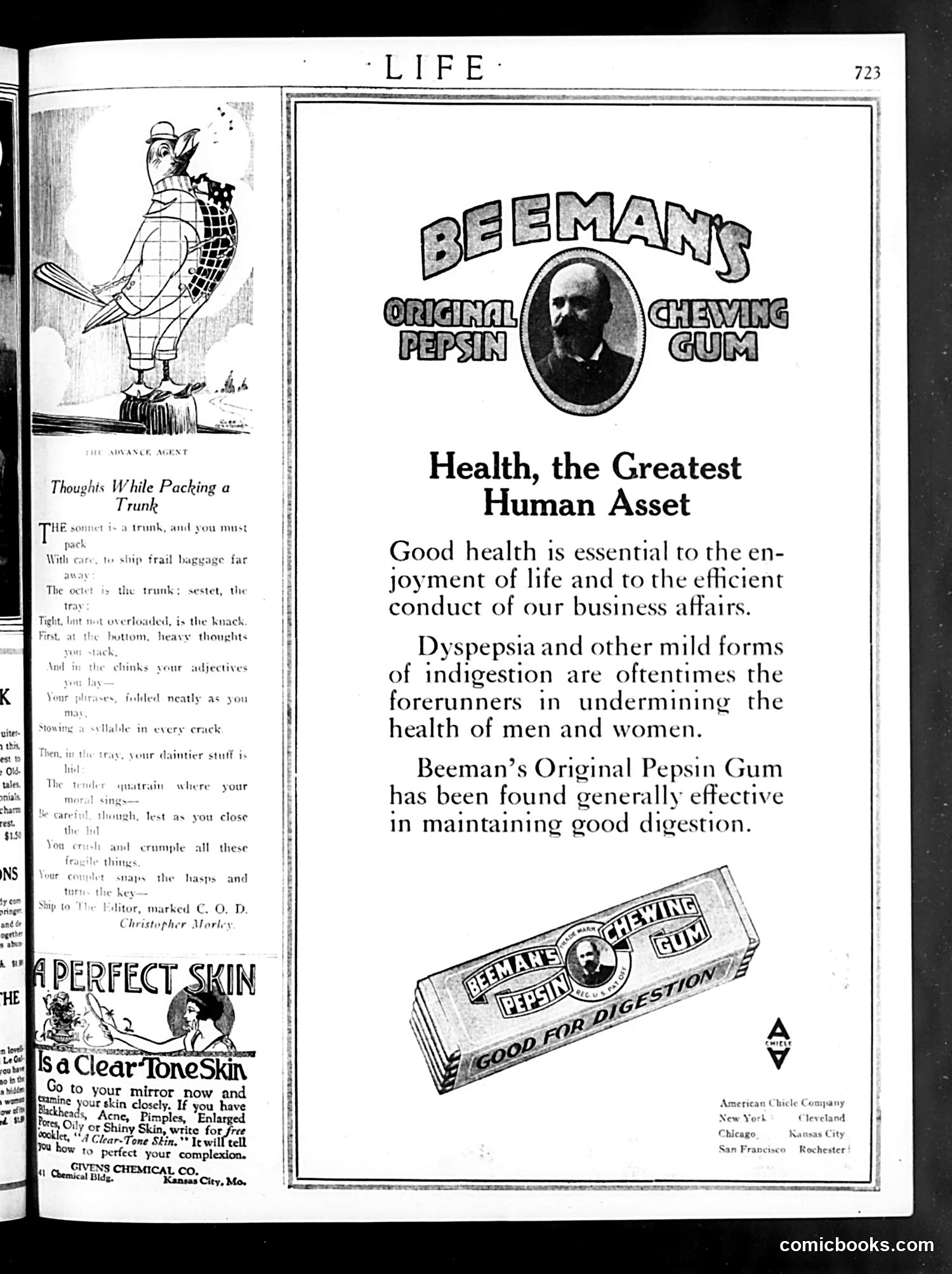
This page contains mixed content: a humorous essay, advertisements, and a product ad. **Left side:** Christopher Morley's poem "Thoughts While Packing a Trunk" is satirical domestic advice about carefully packing luggage—using metaphors of poetry forms (sonnet, sestet, quatrain) to describe trunk-packing technique. It's gentle humor about travel preparation. **Right side:** A Beeman's Original Pepsin Gum advertisement claims the product aids digestion. The ad features a bearded man's portrait and positions chewing gum as a health remedy for dyspepsia and indigestion—common complaints in the early 20th century when digestive aids were widely marketed. **Bottom left:** A Clear-Tone Skin advertisement promises complexion improvement for acne and oily skin. These ads exemplify early 1900s patent-medicine marketing, when digestive tonics and skin treatments were heavily advertised in magazines with broad health claims now considered unsubstantiated. The juxtaposition of Morley's witty poem with earnest health advertisements is characteristic of *Life*'s satirical format.
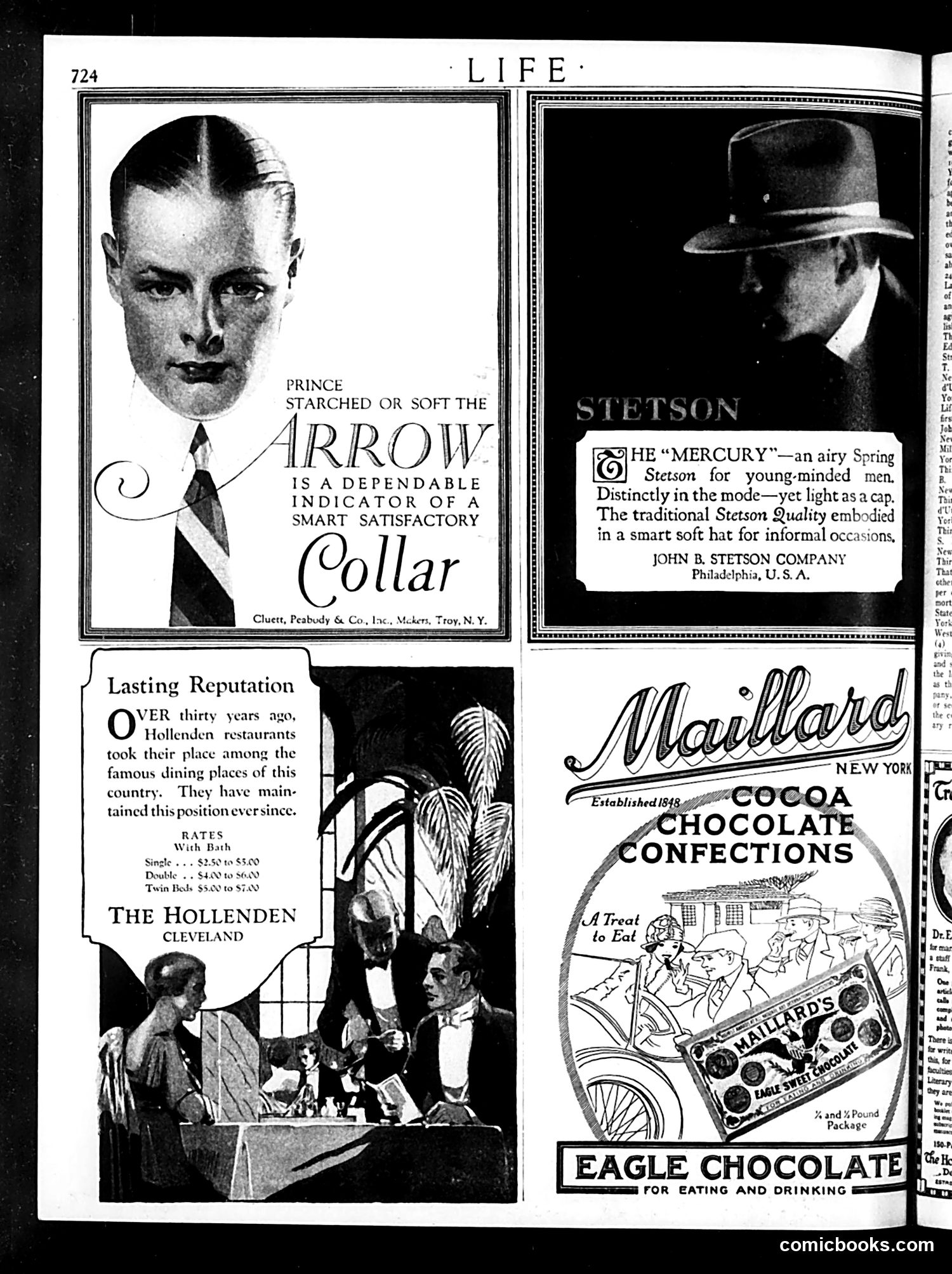
This page is primarily **advertising**, not political satire. It contains four commercial advertisements from the 1910s-1920s era: 1. **Arrow Collar** (top left): Promotes the brand's starched collars as markers of sophistication and good taste for well-dressed men. 2. **Stetson Hat** (top right): Markets the "Mercury" model as a lightweight, fashionable soft hat for young men. 3. **Hollenden Restaurant** (bottom left): Emphasizes the Cleveland establishment's thirty-year reputation for fine dining. 4. **Maillard and Eagle Chocolate** (bottom right): Two separate candy/chocolate advertisements targeting consumers seeking quality confections. The page reflects early 20th-century consumer culture, where men's fashion (collars, hats) and luxury goods (fine dining, chocolates) were heavily marketed through lifestyle imagery. No political figures or satire are present—this is straightforward product advertising typical of *Life*'s revenue model during this period.
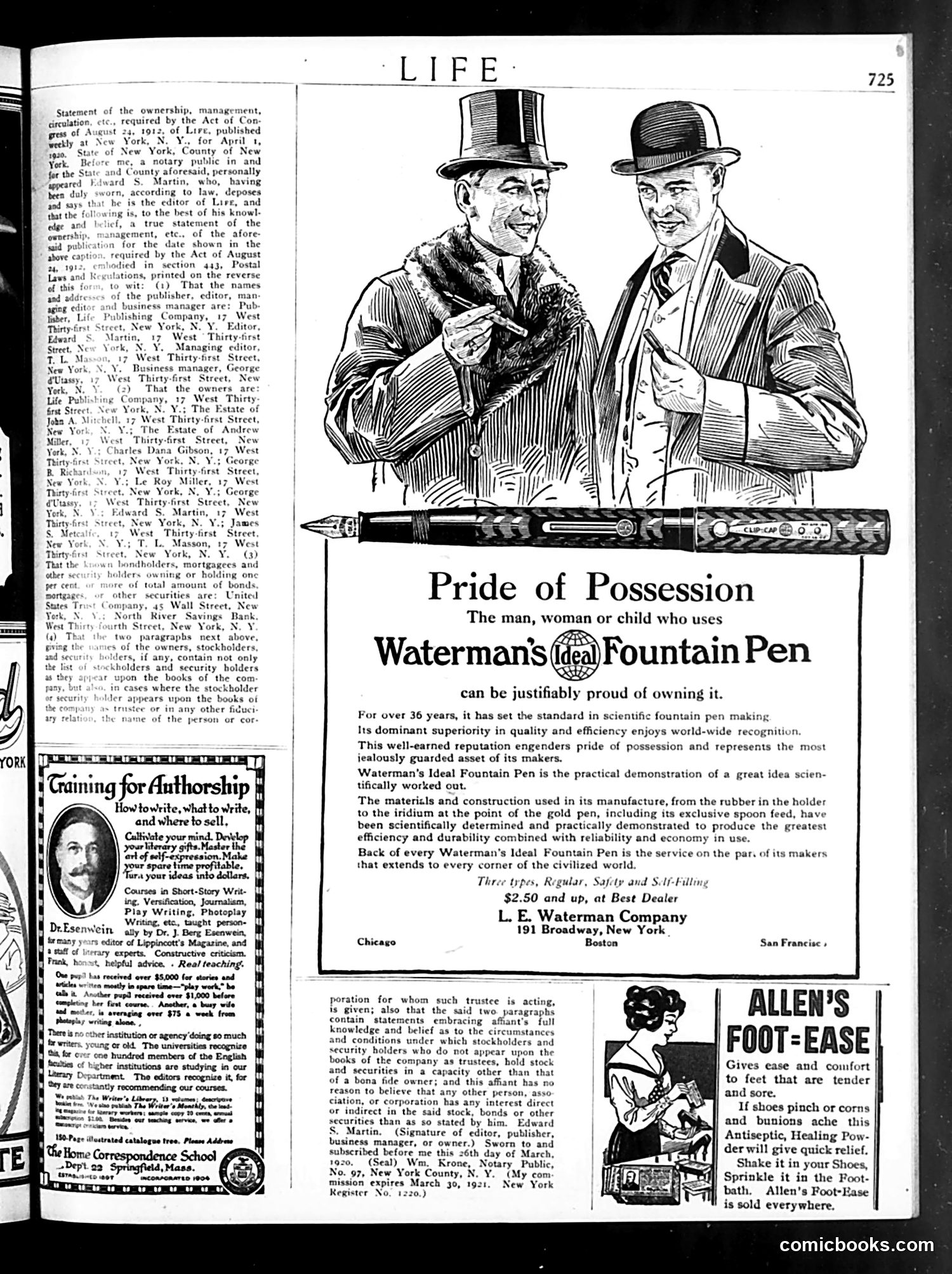
This page is primarily **advertising and legal notices**, not political satire. The main content is a full-page advertisement for **Waterman's Ideal Fountain Pen**, featuring two well-dressed men in top hats examining the product. The illustration celebrates the pen as a status symbol of "Pride of Possession"—emphasizing that owning this particular fountain pen signals refinement and success. The ad claims 36 years of superiority and promotes it as "the practical demonstration of a great idea scientifically worked out." The left column contains standard **ownership/masthead statements** required by postal law for the magazine itself, listing editors and publishers. Below the Waterman's ad is a separate **Allen's Foot-Ease advertisement** promoting a foot powder remedy. **There is no political cartoon or satire on this page.** It represents routine early-20th-century magazine content: legal disclosures and luxury goods marketing targeting affluent readers.
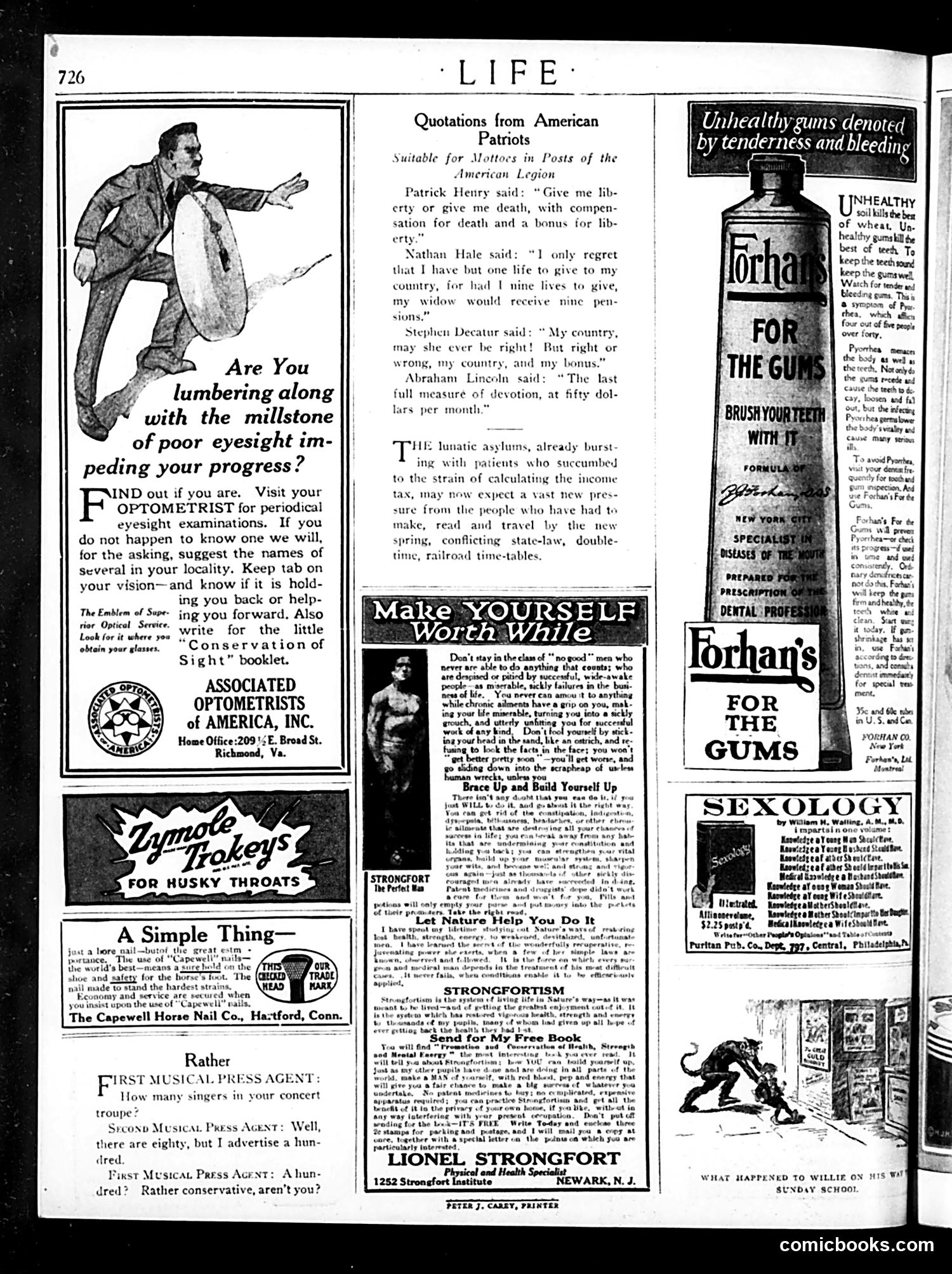
This page satirizes American patriotism and self-improvement culture circa the 1920s-30s. **The Patriotic Quotations Section** mockingly rewrites famous Revolutionary and Civil War quotes by inserting mercenary references. Patrick Henry's "Give me liberty or give me death" becomes about demanding a "bonus for liberty." Lincoln's devotion statement specifies "fifty dollars per month." The satire targets post-WWI veterans' demands for bonuses and the commercialization of patriotic rhetoric by the American Legion. **Other Content:** The page features earnest advertisements for eyesight examinations, horse nails, and self-improvement programs—typical of the era's self-help marketing. A joke about musical press agents padding their numbers appears at bottom. **The Overall Point:** The magazine contrasts high-minded patriotic language with actual material concerns (bonuses, income taxes, railroad schedules). It suggests Americans are reducing noble ideals to mercenary calculations while being sold dubious self-improvement schemes. The tone is cynical, post-war skepticism about both patriotism and consumer culture.
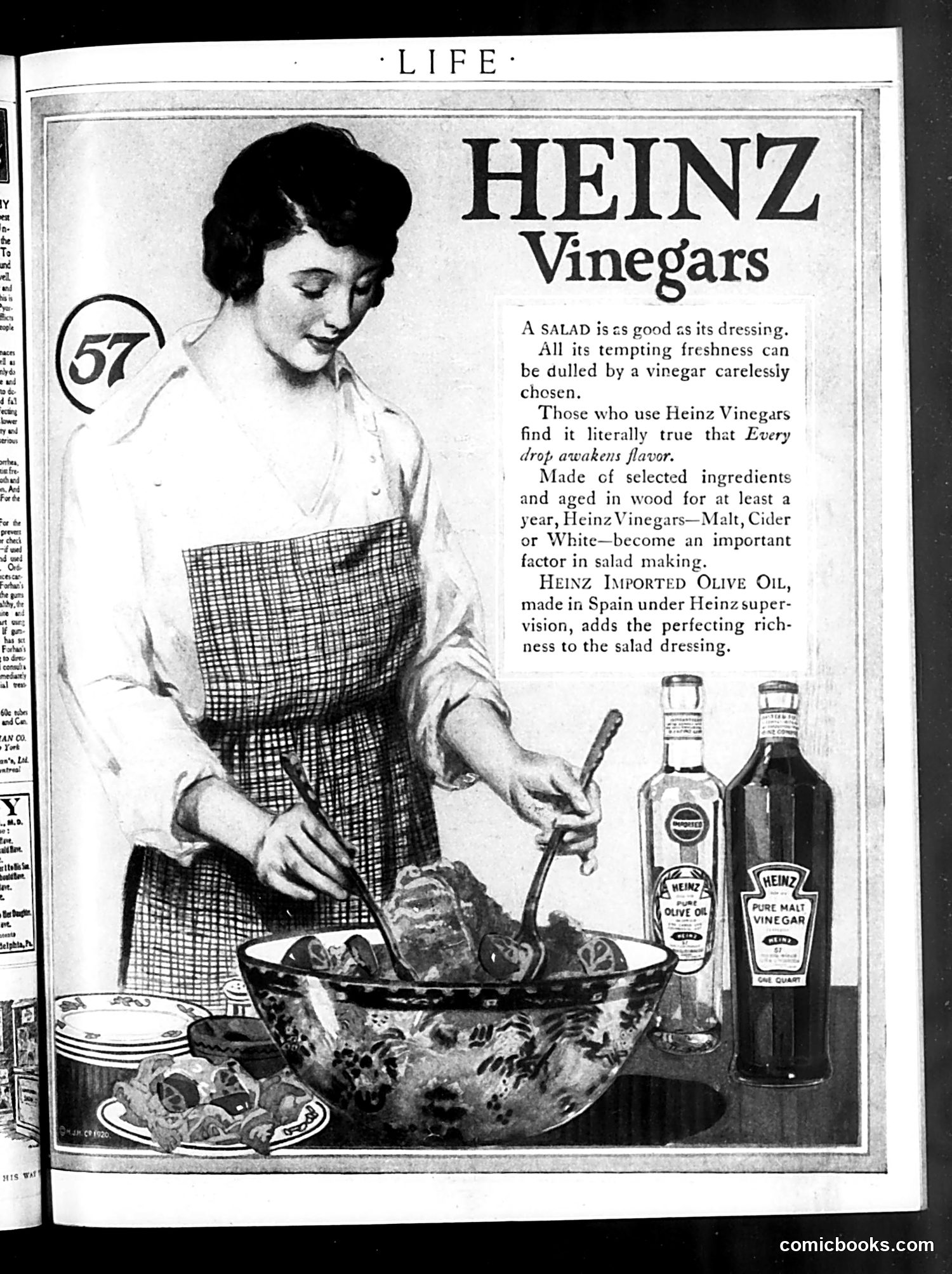
This is a **Heinz Vinegars advertisement**, not political satire. The page features a vintage ad from *Life* magazine showing a woman in an apron preparing a salad. The ad uses conventional early-20th-century marketing rhetoric, emphasizing that quality vinegar is essential to salad-making. The copywriting employs the slogan "Every drop awakens flavor" and highlights that Heinz vinegars are aged in wood for at least a year, available in three varieties (Malt, Cider, White). The ad also promotes Heinz Imported Olive Oil from Spain, positioning it as a complementary product for dressing. There is no cartoon, political commentary, or satire present—this is straightforward product advertising typical of *Life* magazine's commercial content from this period.
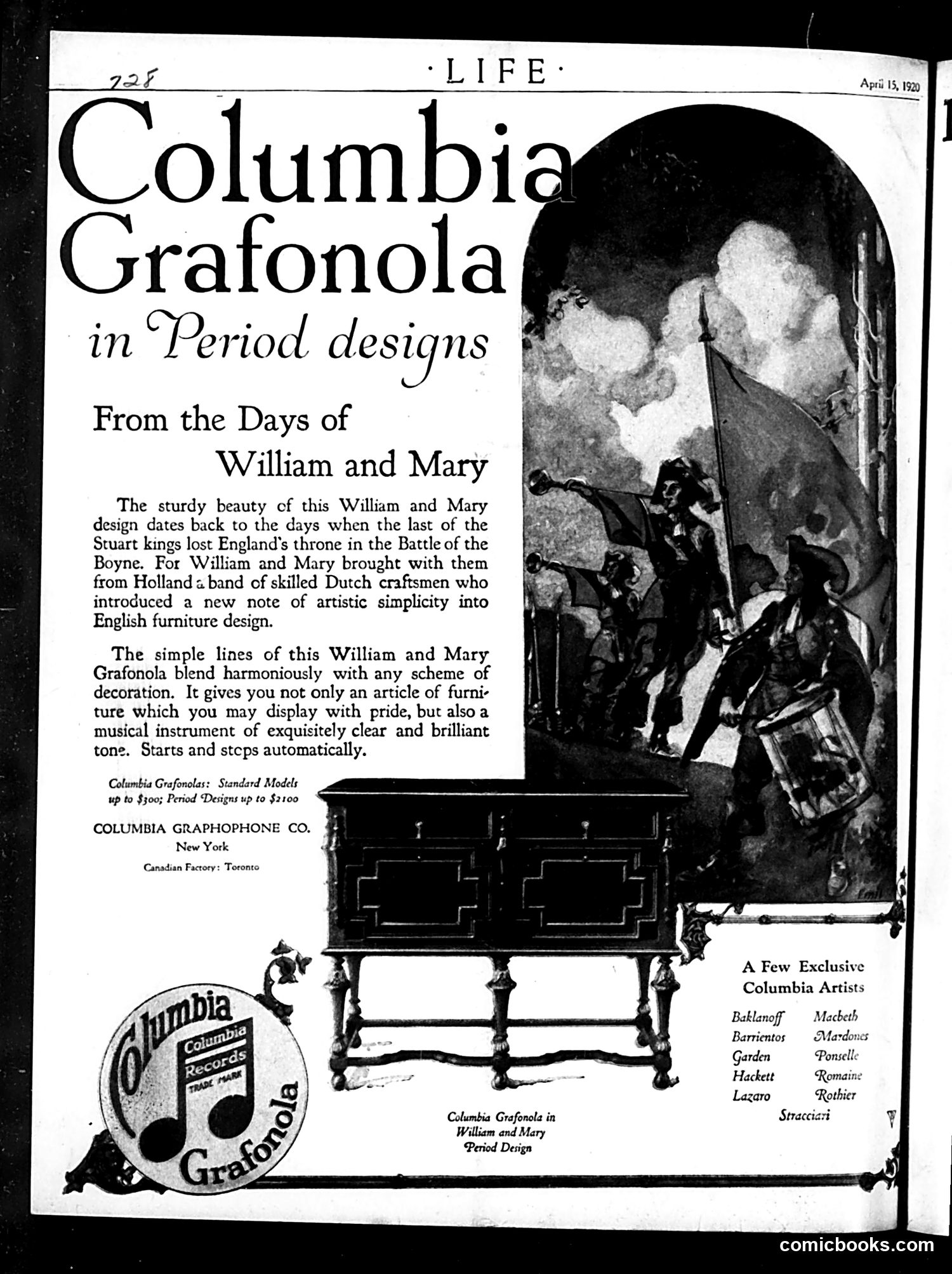
This is **not a cartoon or satire**—it's a straightforward advertisement for Columbia Grafonola phonographs, appearing in *Life* magazine on April 15, 1929. The ad promotes a "William and Mary" period-design model, referencing the English monarchs (1688-1702) and their introduction of Dutch craftmanship that brought "artistic simplicity" to English furniture. The manufacturer links this historical pedigree to the gramophone's elegant design. The image shows the wooden cabinet-style phonograph in period styling, alongside a photograph of what appears to be classical musicians performing. The ad emphasizes both aesthetic appeal ("display with pride") and sound quality ("exquisitely clear and brilliant tone"), while listing exclusive Columbia recording artists to suggest prestige. This represents 1920s marketing strategy: combining furniture design aspiration with entertainment technology—selling not just a machine, but refined taste and access to classical music.