
Life, 1920-04-15 · page 18 of 44
Life — April 15, 1920 — page 18: what you’re looking at
What you’re looking at
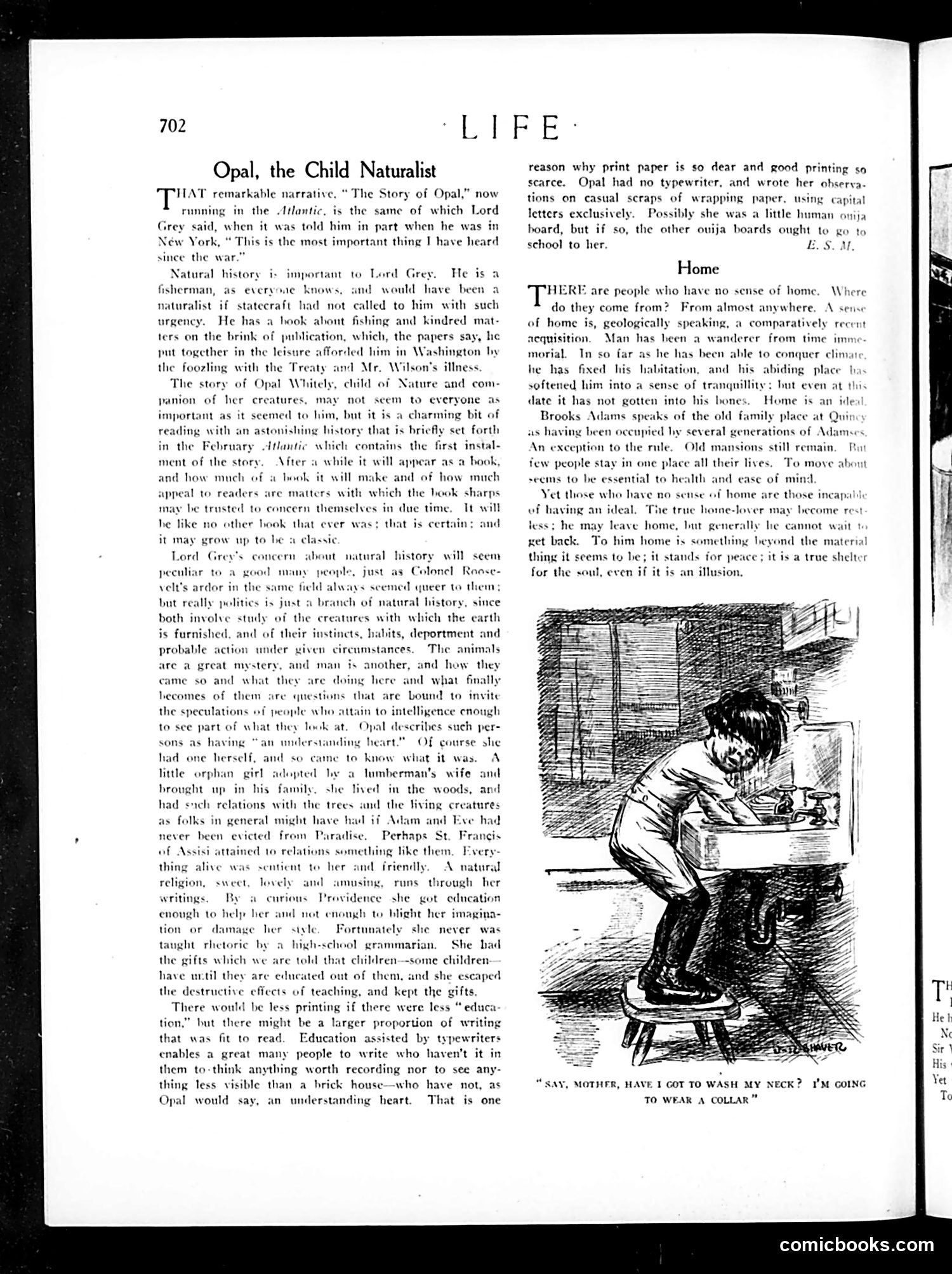
This is not a political cartoon but an essay praising "The Story of Opal," a serialized narrative appearing in *The Atlantic Monthly*. The piece celebrates Opal Whiteley, a young orphan girl raised in logging camps who kept nature observations on scrap paper using only capital letters. The essay contrasts Opal favorably with over-educated writers, arguing that formal education damages authentic observation and writing ability. It compares her to naturalists like Lord Grey (Britain's Foreign Secretary) and Theodore Roosevelt, suggesting that understanding nature and human behavior requires what Opal possessed: an "understanding heart." The illustration shows a child at a window, likely representing Opal observing nature. The caption's dialogue about washing one's neck and wearing a collar suggests the essay's broader point: natural simplicity trumps artificial propriety.
📄 Transcribed text from this page (OCR, searchable)
Machine-transcribed from the original scan — historical spelling and the odd misread are preserved.
702 ‘LTFE: Opal, the Child Naturalist TIAT remarkable narrativ The Story of Opal,” now running in the .Itlantic, is the same of which Lord Grey said, when it was told him in part when he was in New York, “ This is the most important thing I have heard since the war.” He is a fisherman, as everyone knows, and would have been a naturalist if statecraft had not called to him with such urgency, He has a hook abont fishing and kindred mat- ters on the brink of publication, which, the papers say, he put together in the leisure afforded him in Washington by the foozling with the Treaty and Mr. Wilson's illness. The story of Opal Whitels of Nature and com- tural history is important to Lord Gre panion of her creatures, may not seem to everyone as important as it seemed to him, but it is a charming bit of reading with an astonishing history that is briefly set forth in the February Atlantic which contains the first instal- ment of the story, After a while it will appear as a book, and how much of a book it will make and of how much appeal to readers are matters with which the hook sharps It will that is certain: and may be trusted to concern themselves in due time he like no other hook that ever was; it may grow up to be a classic. Lord Grey's concern about natural history will seem peculiar to a people, just_as Colonel Roose- velt's ardor in the same field always seemed queer to them: but really polities is just.a branch of natural history, since both involve study of the creatures with which the earth is furnished, and of their instincts, habits, deportment and probable action ut The animals are a great mystery, and man is another, and how they ame so and what they are doing here and what finally becomes of them are questions that are Lound to invite rf uiven circumstances, the speculations of people who attain to intelligence enough to see part of what they look at. Opal describes such per- sons as having “an understanding heart.” Of course she had one herself, and so came to know what it was. A little orphan girl adopted hy a lumberman’s wife and Drought up in his family, she lived in the woods, and had such relations with the trees and the living creatures as folks in general might have had if Adam and Eve had never been evicted from Paradise. Perhaps St. Francis of Assisi attained to relations something like them. Every- A natural lovely and amusing, runs through ber thing alive was sentient to her and friendly religion, sweet writings. By a curious Providence she got educa enough to hel her and not enough to blight her imagina- tion or damage her style, Fortunately she never was high-school grammarian. She had the gifts which we are told that children—some children taught rhetoric by have until they are educated out of them, and she escaped the destructive effects of teaching, and kept the gifts. There would be less printing if there were less “educa tion,” but there might be a larger proportion of writing that was fit to read. Education assisted by typewriters enables a great many people to write who haven't it in them to-think anything worth recording nor to see any- thing less visible than a brick house—who have not, as Opal would say, an understanding heart. That is one reason why print paper is so dear and good printing so scarce. Opal had no typewriter, and wrote her ohserva- tions on casual scraps of wrapping paper. using capital letters exclusively. hoard, but if so, the other ouija hoards ought to go to school to her. L M. Possibly she was a little human ouija Home HERE are people who have no sense of home. Where do they come from? From almost anywhere. A sensi of home is, geologically speaking, a comparatively re acquisition morial. In so far as he has heen able to conquer elias he has fixed his habitation, Man has heen a wanderer from ne imme nd his abiding place b softened him into a sense of tranquillity: but even at this date it has not gotten into his bones. Home is an ide Brooks Adams speaks of the old family place at Qui as having been occupied hy several generations of A An exception to the rule. Old mansions still remain. Ru few people stay in one place all their lives. To move ab seems to be essential to health and ease of mind Yet those who have no sense of home are those incapal of having an ideal. less; he may leave home, but generally he cannot wait + truc home-lover may become re xet back. To him home is something beyond the material thing it seems to be; it stands for peace; it is a true shelter for the soul, even if it is an illusion, “SAY, MOTHER, HAVE I GOT TO WASH MY NECK? I'M GOING TO WEAR A COLLAR” comicbooks.com