
Life, 1920-04-15 · page 24 of 44
Life — April 15, 1920 — page 24: what you’re looking at
What you’re looking at
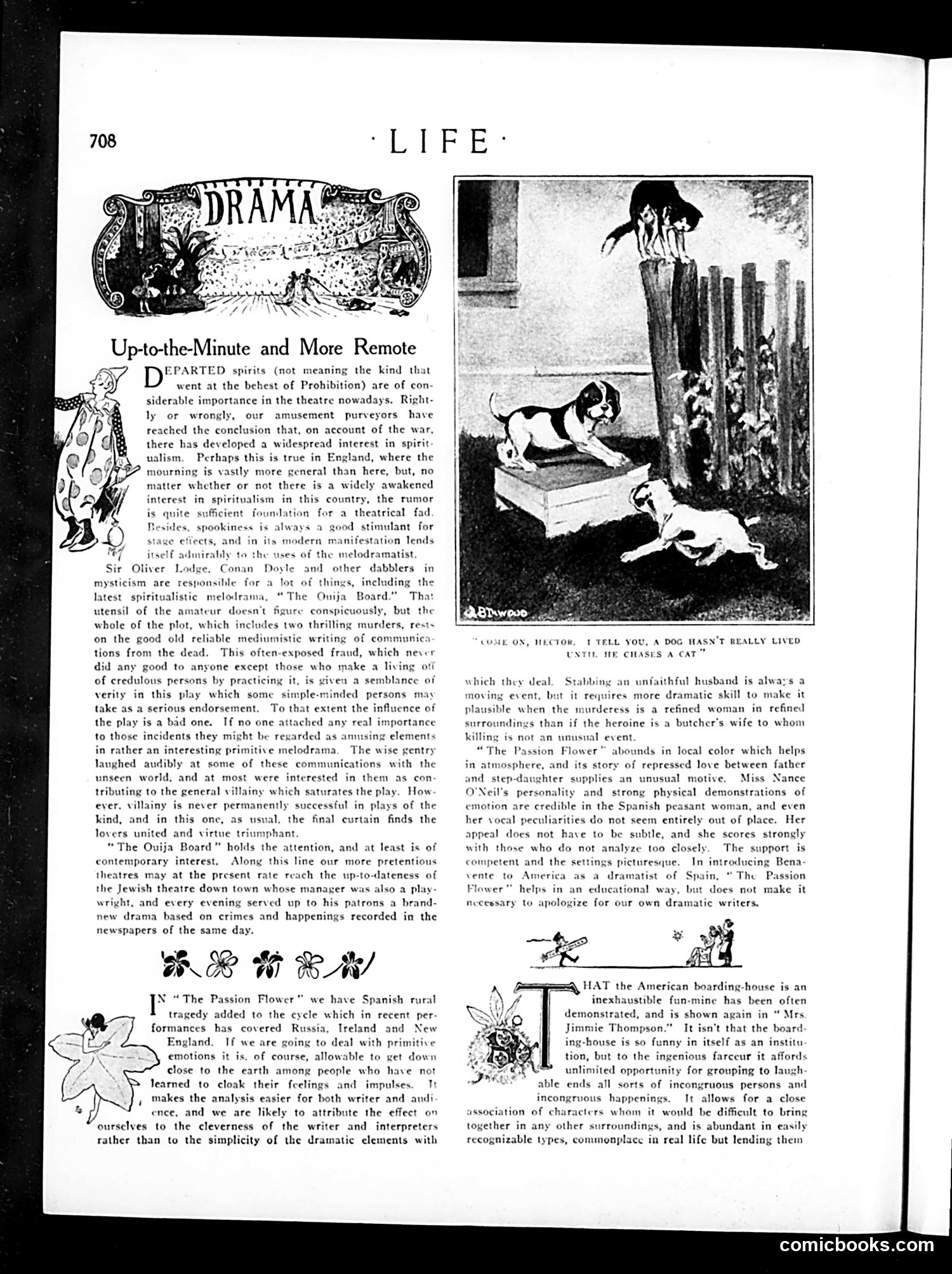
This page reviews contemporary theatrical productions, focusing on spiritualistic melodramas gaining popularity during World War I. The critic notes that wartime mourning has created audience interest in spiritualism, which playwrights exploit. The main productions discussed are: 1. **"The Ouija Board"** — criticized as capitalizing on spiritualist fad, using séance fraud and mediumistic writing as plot devices. The reviewer condemns it as bad influence despite acknowledging audiences laugh at the absurdity. 2. **"The Passion Flower"** — a Spanish rural drama praised for its authentic emotion and Nance O'Neil's physical performance, though her vocal delivery is questioned. The cartoon showing a man and dog illustrates contemporary humor about pet loyalty. The critic advocates for theatrical sophistication, arguing that depicting primitive emotions among rural/working-class characters requires less dramatic skill than portraying similar passions in refined society—a classist assumption typical of the era's theatrical criticism.
📄 Transcribed text from this page (OCR, searchable)
Machine-transcribed from the original scan — historical spelling and the odd misread are preserved.
the-Minute and More Remote EPART ind that went at the behest of Prohibition) are of con- siderable importance in the theatre nowadays. Right- amusement purveyors have spirits (not meaning the ly or wrongly, reached the conclusion that, on account of the war, there has developed a widespread interest in spirit ualism. Perhaps this is true in England, where the mourning is vastly more general than here, but, no matter whether or not there is a widely awakened interest in spiritualism in this country, the rumor e sufficient fi for a theatrical fad vod stimulant for festation lends dramatist dabblers in our undation is a Resides, okiness is always a stage effects, and in its modern man the the Doyle and other of things, including the Board.” That conspicuously, but the itself admirably t Sir Oliver mysticism are responsible for a lo latest spiritualistic melodrama, stensil of the ama whole of the plot, which includes two thrilling murders, rest~ on the good old reliable mediumistic writing of communica tions from the dead. This often-exposed fraud, which never did any good to anyone except those who make a living otf of credulous persons by practicing it, is given a semblance of verity in this play which some simple-minded persons take as a serious endorsement. To that extent the influence of the play is a bad one. If no one a any real importance to those incidents they might be regarded as amusing elements in rather an interesting primitive melodrama. The wise gentry laughed audibly at some of these communications with the unseen world, and at most were interested in them as con tributing to the general villainy which saturates the play. How ever, villainy is never permanently successful in plays of the kind, and in this one, as usual, the final curtain finds the lovers united and virtue triumphant. The Ouija Board” holds the attention, and at least is of contemporary interest. Along this line our more pretentious theatres may at the present rate reach the up-to-dateness of the Jewish theatre down town whose manager was also a play- wright, and every evening served up to his patrons a brand- new drama based on crimes and happenings recorded in the newspapers of the same day. OR WBA “The Passion Flower” we have Spanish ni Lodge, Conan he Ouija ur doesn't: figure may ache al | tragedy added to the cycle which in recent per. formances covered Russia, Ireland and New England. If we are going to deal with primitive emotions it is. of course, allowable to get down close to the earth among people who have not learned to cloak their feelings and impulses. Tt makes the analysis easier for both writer and audi ence, and we are likely to attribute the effect on ourselves to the cleverness of the writer and interpreters rather than to the simplicity of the dramatic elements with 1 TELL YOU, A DOG HASN'T REALLY LIVED HE CHASES A CAT” COME ON, HECTOR untin in unfaithful husband is alw a Stabbin moving event, but it requires more dramatic skill to make it n the murderess is a refined woman in refined 1's wife to whom ich they deal. plausible wi surroundings than if the heroine is a butch killing is not an unusual event “The Passion Flower” abounds in local color which helps of repressed love between father Miss Nance in atmosphere, and its st and plies an unusual motive. O'Neil’s personality and strong physical demonstrations of emotion are credible in the Spanish peasant woman, and even her vocal peculiarities do not seem entirely out of place. Her appeal does not have to be subtle, and she scores strongly hose who do not analyze too closely. The support is competent and the settings picturesque. In introducing Bena America as a dramatist of Spain, The Passion Flower” helps in an educational way, but does not make it necessary to apologize for our own dramatic writers. step-daughter su with vente to HAT the American boarding-house is an inexhaustible fun-mine has been often demonstrated, and is shown again in “ Mrs. Jimmie Thompson.” It isn’t that the board ing-house is so funny in itself as an institu tion, but to the ingenious farceur it affords unlimited opportunity for grouping to laugh able ends all sorts of incongruous persons and incongruous happenings. It allows for a close association of characters whom it would be difficult to bring together in any other surroundings, and is abundant in easily recognizable types, commonplace in real life but lending then comicbooks.com