
Life, 1920-04-15 · page 27 of 44
Life — April 15, 1920 — page 27: what you’re looking at
What you’re looking at
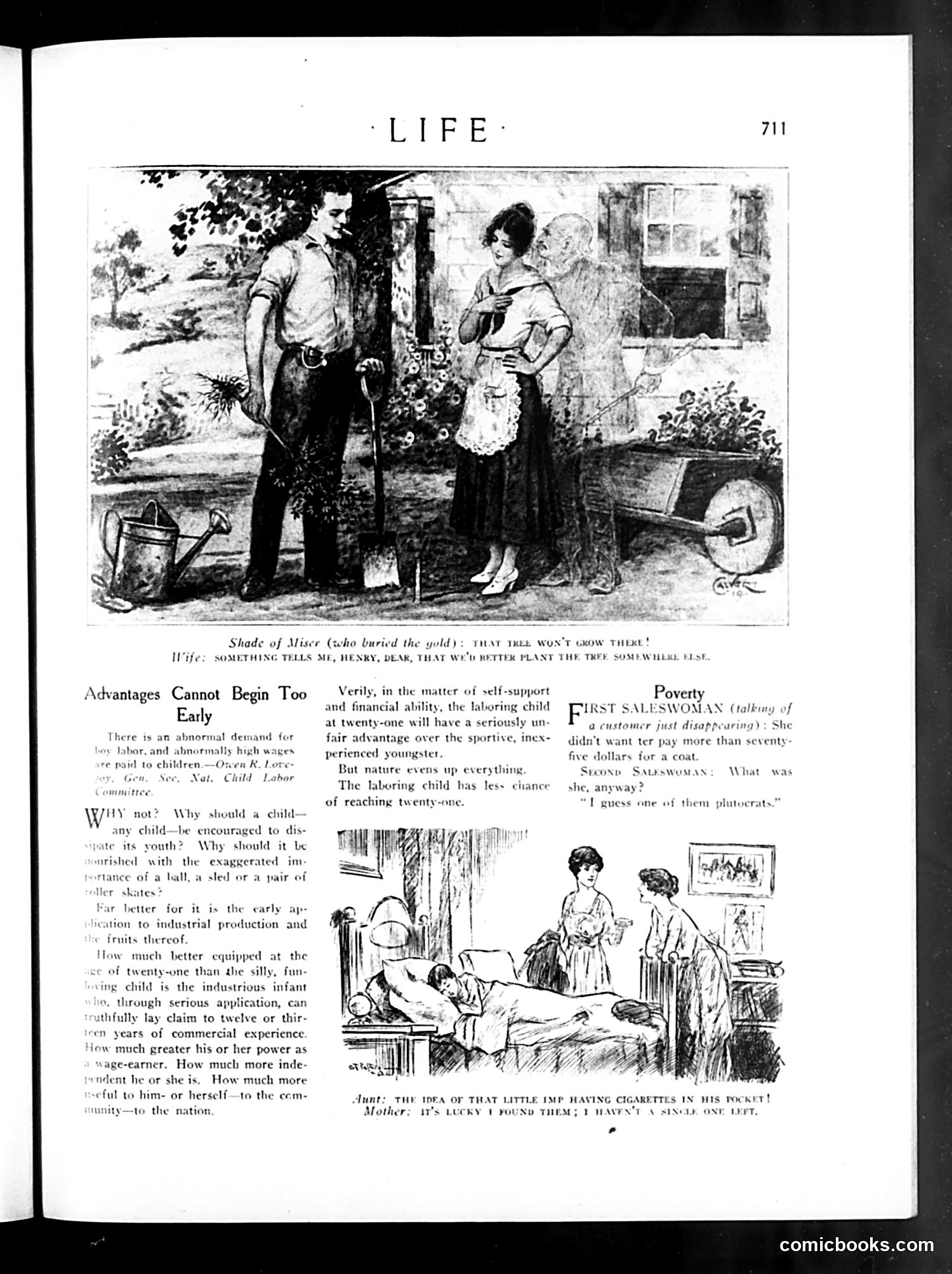
This page uses **ironic satire** to attack arguments supporting child labor—a contentious policy issue of the early 20th century. The main text mockingly presents pro-child-labor arguments: children gain "commercial experience," become financially independent, and benefit industry. The satire's punch line: "But nature evens up everything. The laboring child has less chance of reaching twenty-one"—exposing that child labor causes early death, negating all supposed advantages. The top cartoon shows a woman telling a man not to plant a tree where a "miser who buried gold" once died, warning it won't grow there—**likely allegory** for how child labor poisons society's future growth. The lower cartoon depicts a woman finding cigarettes in a child's pocket, sarcastically calling it "lucky"—**criticizing parental negligence and child welfare concerns**. The "poverty" section mocks wealthy women dismissing affordable coats as "plutocrats' " concerns, highlighting class disconnect from actual need. **Overall message**: The page condemns child labor exploitation and the wealthy's indifference to working-class suffering.
📄 Transcribed text from this page (OCR, searchable)
Machine-transcribed from the original scan — historical spelling and the odd misread are preserved.
Shade of Miser (who buric Wife: Advantages Cannot Begin Too Early There is an abnormal demand for y Jabor, and abnormally high wages Owen R. Love Child Labor re paid to children Gen, See, Nat. mimittee. wy not? Why should a child— any child ute its youth? with the riance of a hall, a sled er a pair of skates? be encouraged to dis- Why should it be urished exaggerated im Far better for it is the cation to industrial production and fruits thereof, carly ap How much better equipped at the ce of twenty-one than ahe silly, fun- ing child is the industrious infant 0. through serious application, can athfully lay claim to twelve or thir- en years of commercial experience. iow much greater his or her power as age-earner. How much more inde- nt he or she is. How much more eful to him- or herself—to the cem- tunity—to the nation, the gold): Veril and financial ability, the laboring child at twenty-one will have a seriously un- fair advantage over the sportive, inex- in the matter of self-support perienced youngster. But nature evens up everything The laboring child has less chance of reaching twenty-one. Aunt: Mother: THAT TKER WON'T GROW THERE SOMETHING TELLS ME, HENRY, DEAR, THAT Wr'D RETTER PLANT THE TRER SUMPWHEKE ELSE Poverty IRST SALESWOMAN (talking of a customer just disappearing) : She didn’t want ter pay more than seventy- five dollars for a coat. Stoonp Sateswoman What) was she, anyway? “T guess one of them plutucrats.” THE IDEA OF THAT LITTLE IMP HAVING CIGARETTES IN HIS PocKET! It’s LUCKY 1 FOUND THEM; 1 HAVEN'T A SINGLE ONE LEPT. . comicbooks.com