
A complete issue · 52 pages · 1920
Life — February 5, 1920
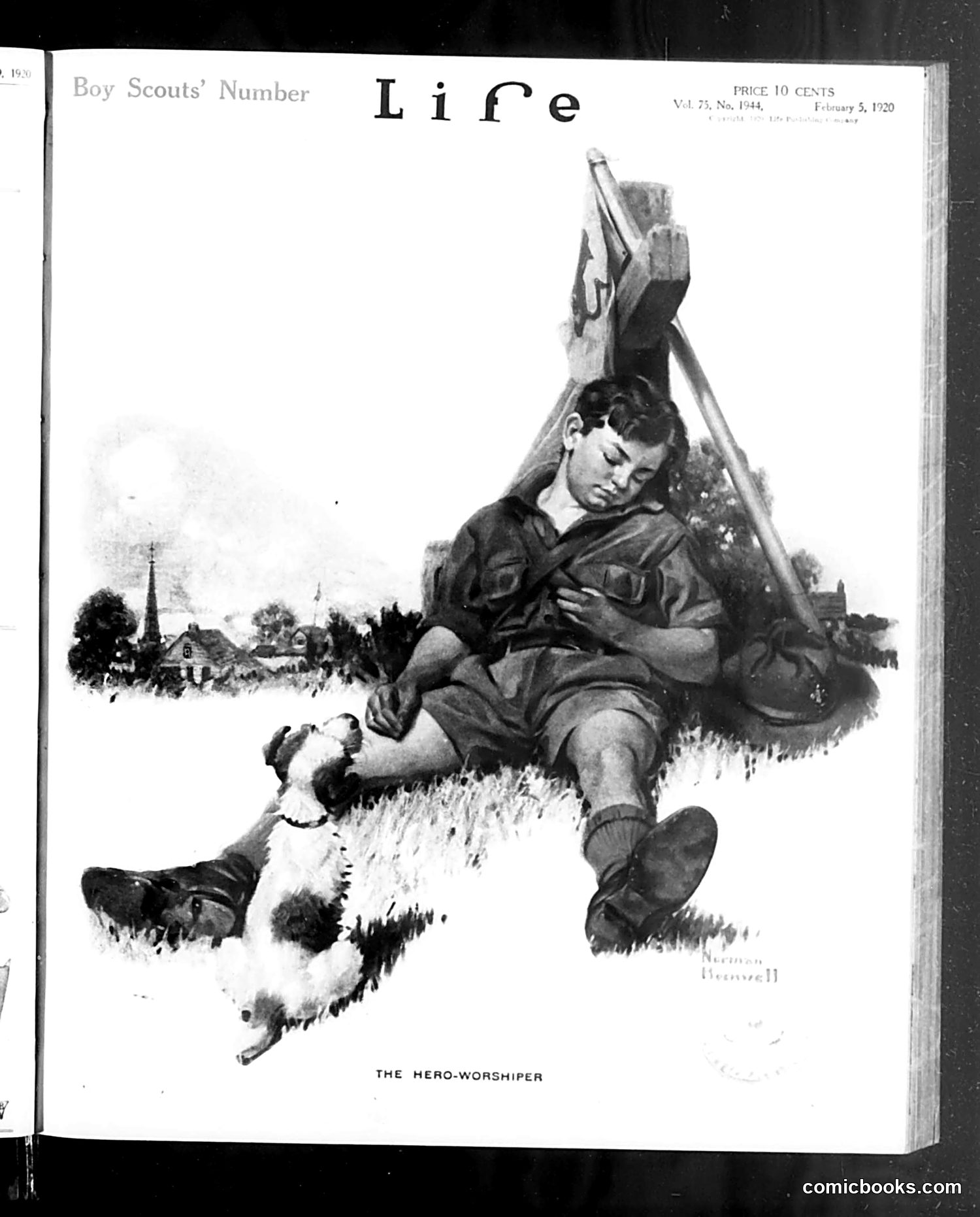
This illustration from Life magazine (February 5, 1920) depicts a young Boy Scout gazing admiringly upward while holding a rifle, with a small dog at his feet. The title "The Hero-Worshiper" suggests the cartoon critiques the romanticization of military service and warfare among youth. Given the 1920 date—just after World War I's conclusion—this likely satirizes how boys were encouraged to admire soldiers and martial values through organizations like the Boy Scouts. The upward gaze and reverent posture suggest uncritical hero-worship, while the juxtaposition of the child with weaponry implies concern about militaristic indoctrination of young people in the post-war period. The point appears to be social commentary on how institutions shaped boys' values toward warfare.
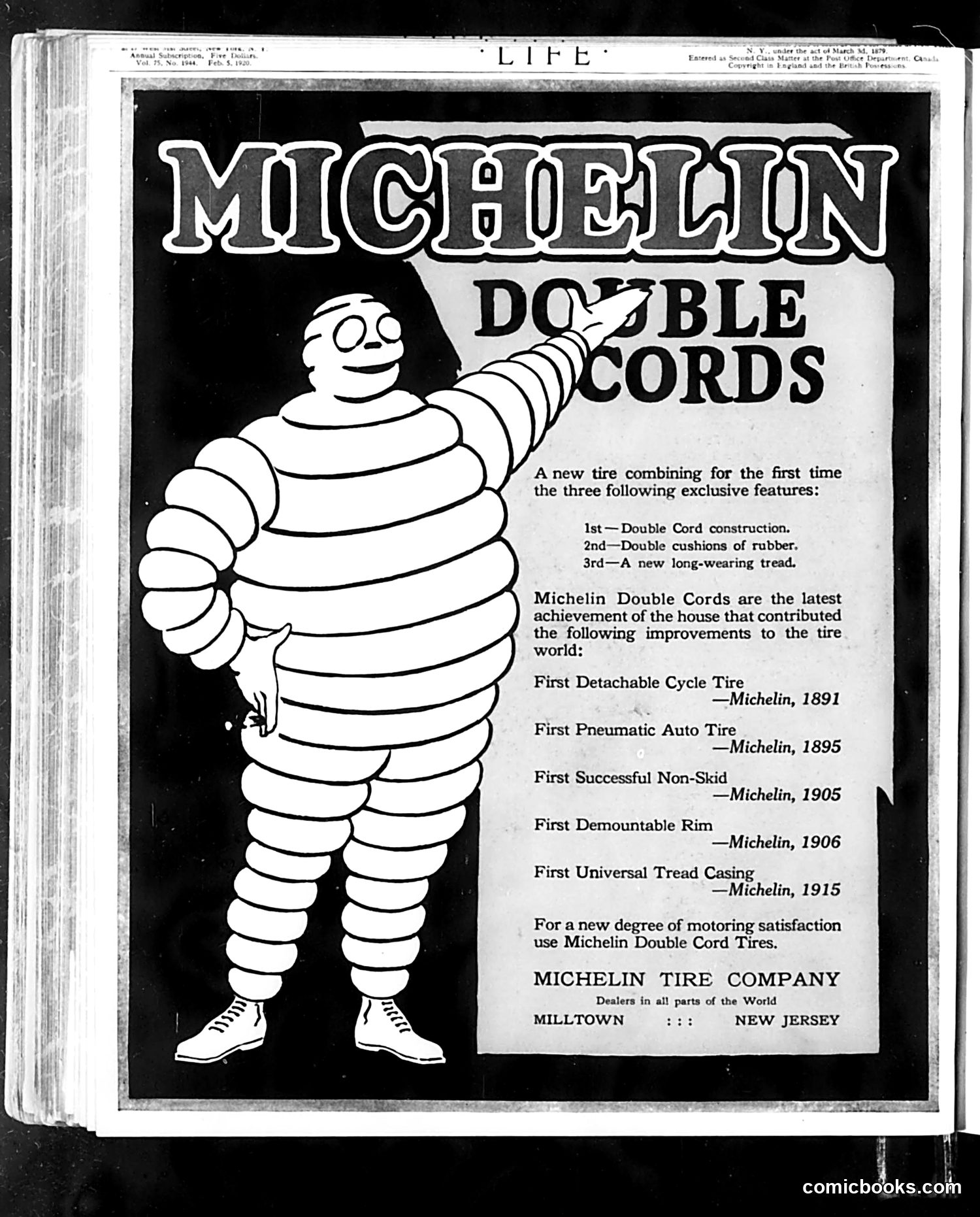
This page is primarily a **Michelin Tire Company advertisement**, not political satire. It features the famous Michelin Man ("Bibendum"), the brand's iconic mascot—a rotund, anthropomorphic figure made of stacked tire rings with a cheerful face. The ad promotes Michelin's "Double Cords" tires, highlighting three innovative features: double cord construction, double rubber cushions, and a new long-wearing tread. Text emphasizes Michelin's historical tire innovations from 1891-1915, culminating in this latest product. The Michelin Man's jovial thumbs-up gesture and exaggerated proportions serve as straightforward advertising imagery rather than satire. This appears to be a standard commercial advertisement in *Life* magazine's pages, not political or social commentary.
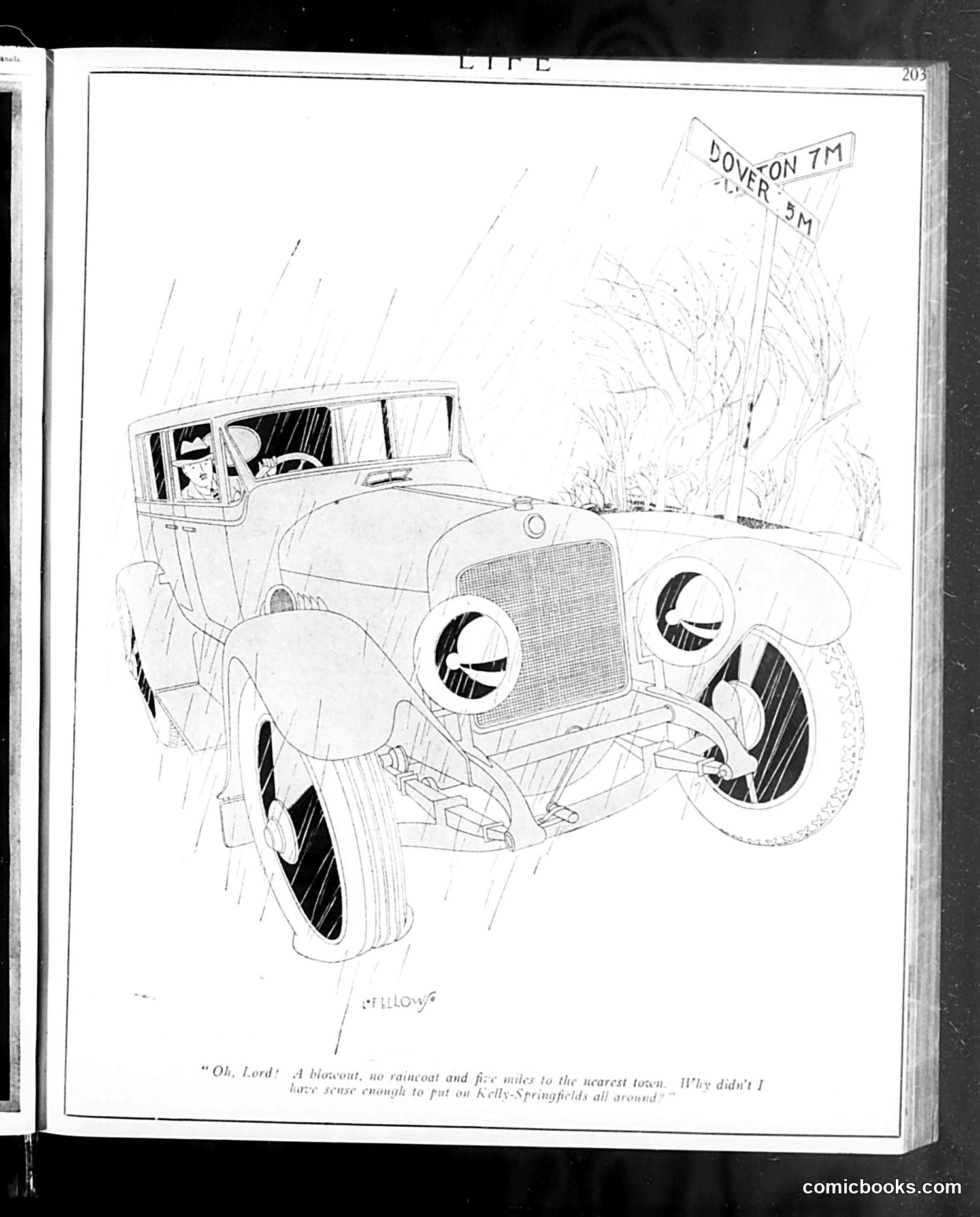
This cartoon depicts a motorist stranded in heavy rain near a "Doveton" road sign, stuck five miles from the nearest town. The caption reads: "Oh, Lord! A biocoat, no raincoat and five miles to the nearest town. Why didn't I have sense enough to put on Kelly-Springfields all around?" The humor is a **product advertisement disguised as comedy**. The stranded driver's predicament—caused by presumably poor tire traction in wet conditions—serves as a setup to promote Kelly-Springfield tires as the sensible solution. This was common in early Life magazine: satirical humor paired with advertising where the "joke's punchline" effectively endorses a commercial product. The cartoon targets drivers' foolishness while implicitly suggesting Kelly-Springfields provide safety and reliability.
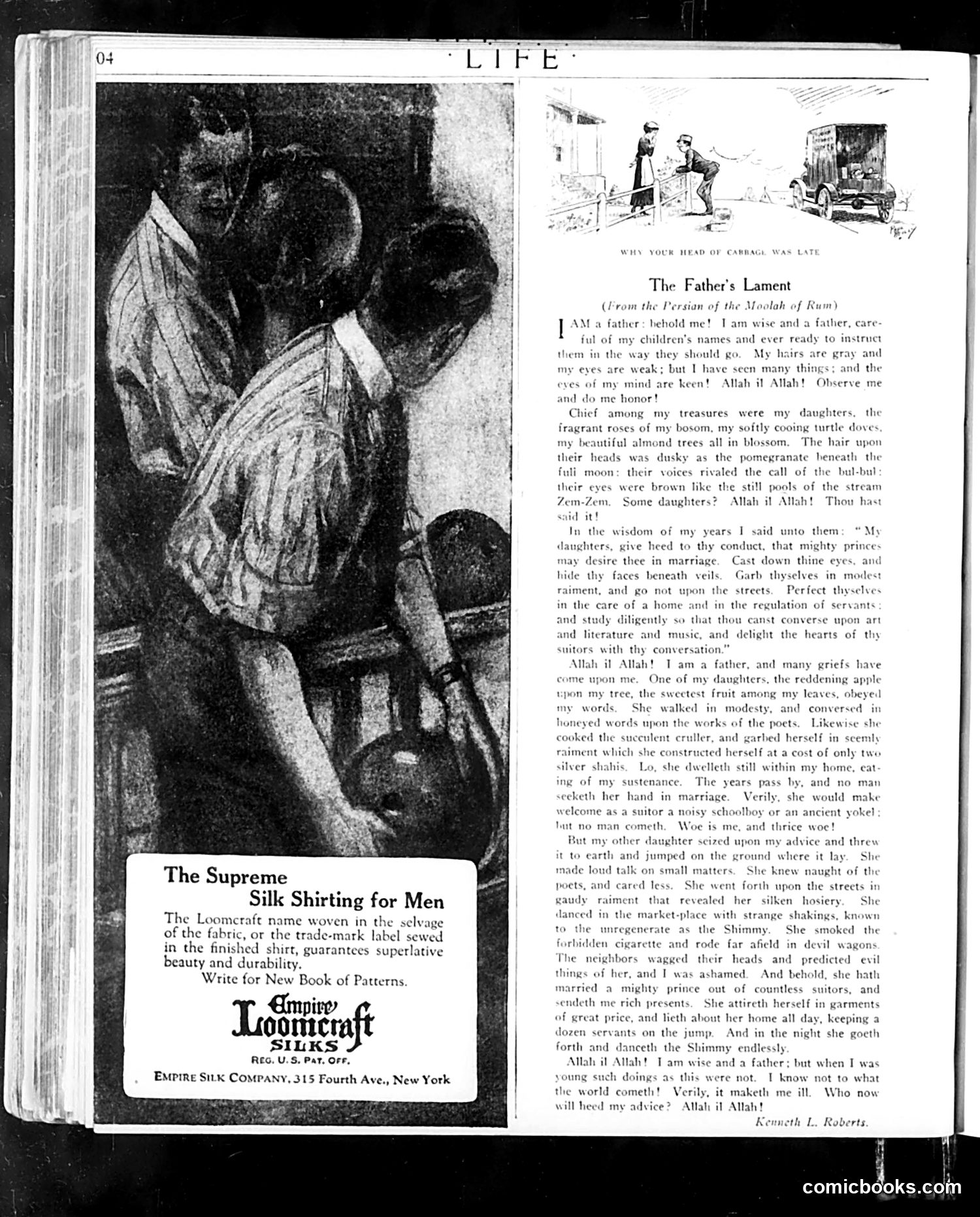
This page contains primarily literary and advertising content rather than political satire. The main feature is "The Father's Lament," a literary piece attributed to Kenneth L. Roberts, presented as a translation from Persian poetry (the Mesnab of Rumi). It's a moral tale where a father expresses wisdom about raising daughters—emphasizing modest behavior, education in arts and literature, and proper domestic conduct. The narrative describes his disappointment when his daughters ignore his advice, pursuing instead fashionable but morally questionable behaviors like smoking and dancing. The cartoon at top right appears to be a humorous sketch about late cabbage delivery—seemingly unrelated commentary. The bottom half features an advertisement for Empire Lockcraft silk shirting for men, emphasizing fabric quality and durability. This page reflects early 20th-century anxieties about changing social norms, particularly women's increasing independence and rejection of traditional values.
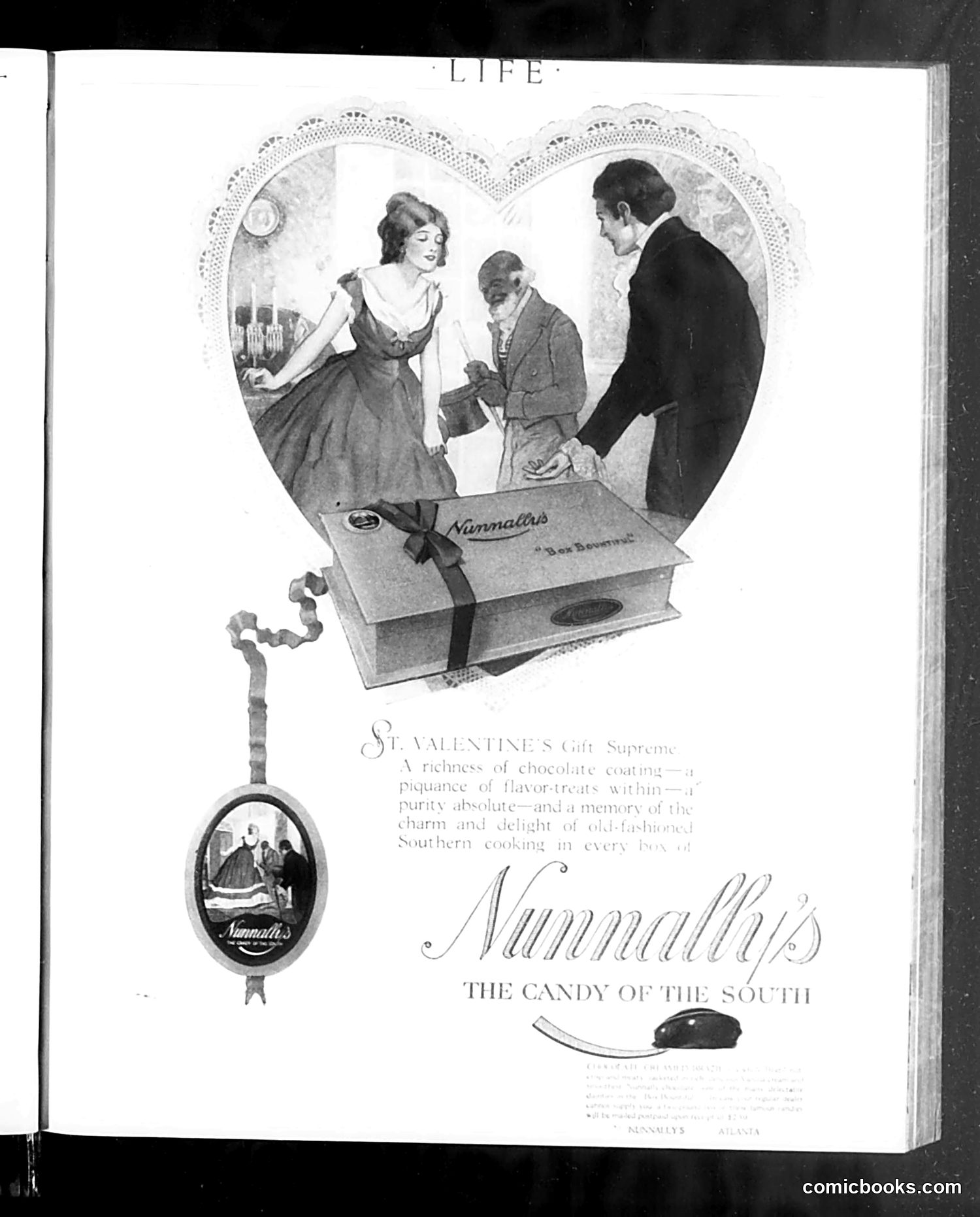
This page is primarily **advertising, not satire or editorial content**. It's a Nunnally's candy advertisement from *Life* magazine, featuring a Valentine's Day promotion. The image shows three well-dressed figures (a woman in an evening gown and two men) examining an elegant chocolate box tied with ribbon. The heart-shaped frame and Valentine's theme are romantic appeals typical of early 20th-century luxury advertising. The text describes Nunnally's chocolates as "The Candy of the South," emphasizing chocolate coating, flavor variety, and "old-fashioned Southern cooking." The small oval medallion at bottom left shows the company's branding. This is straightforward commercial messaging using period conventions of sophistication and refinement to market confectionery products—no political or social satire is evident.
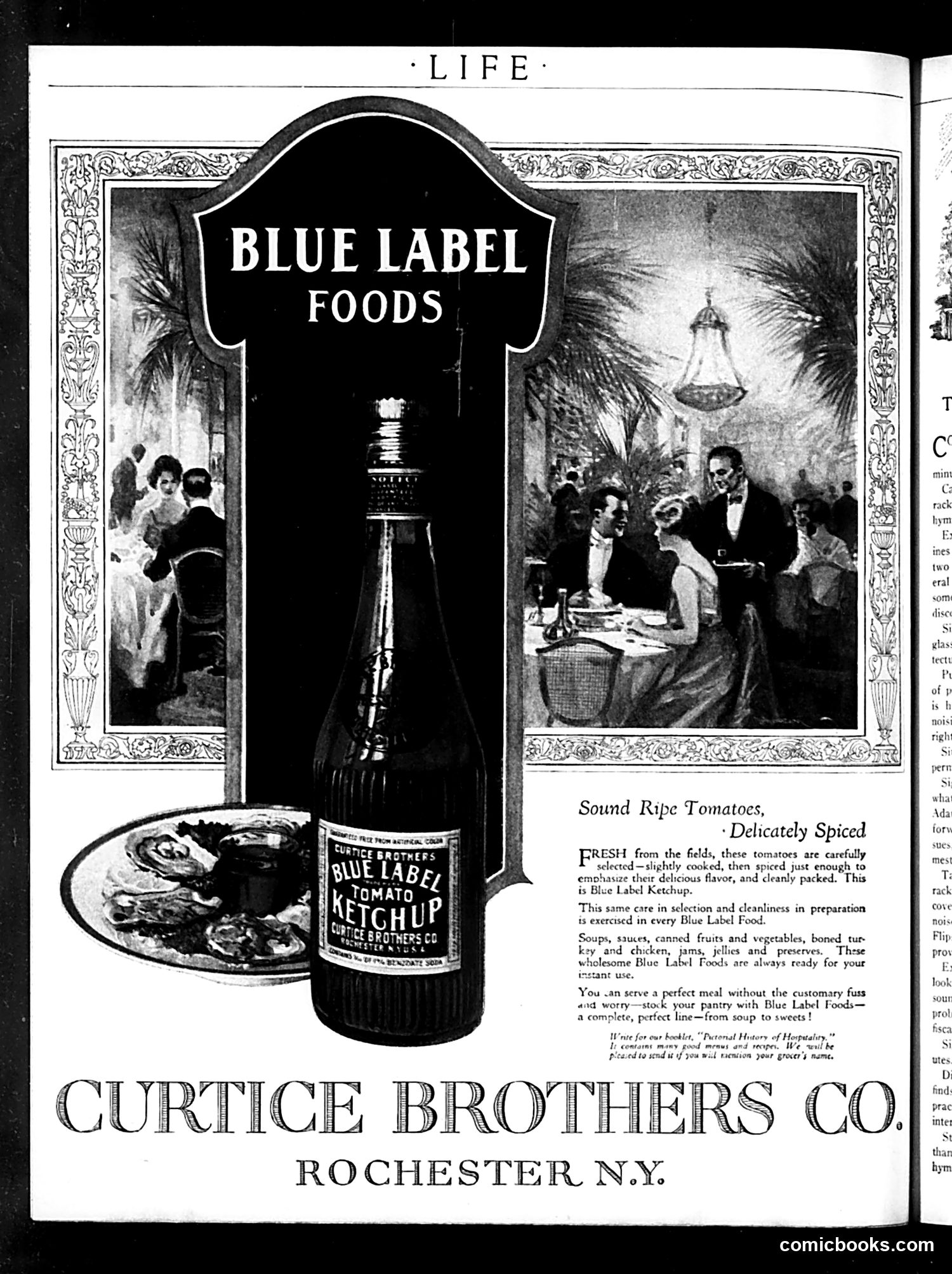
This page is **primarily an advertisement**, not satire or editorial content. It promotes Blue Label Foods—specifically Blue Label Tomato Ketchup by Curtice Brothers Co. of Rochester, New York. The ad features two illustrated scenes of elegant social gatherings (dinner parties or receptions) flanking a bottle of ketchup and a plate of food. The text emphasizes the product's quality: tomatoes are "sound ripe," "delicately spiced," and "carefully selected and packed." The advertisement suggests that Blue Label Foods enables hosts to serve impressive meals effortlessly—"a complete, perfect line—from soup to sweet"—positioning the product as essential for maintaining social status and entertaining. The formal dinner scenes reinforce this aspirational marketing approach targeting middle and upper-class consumers.
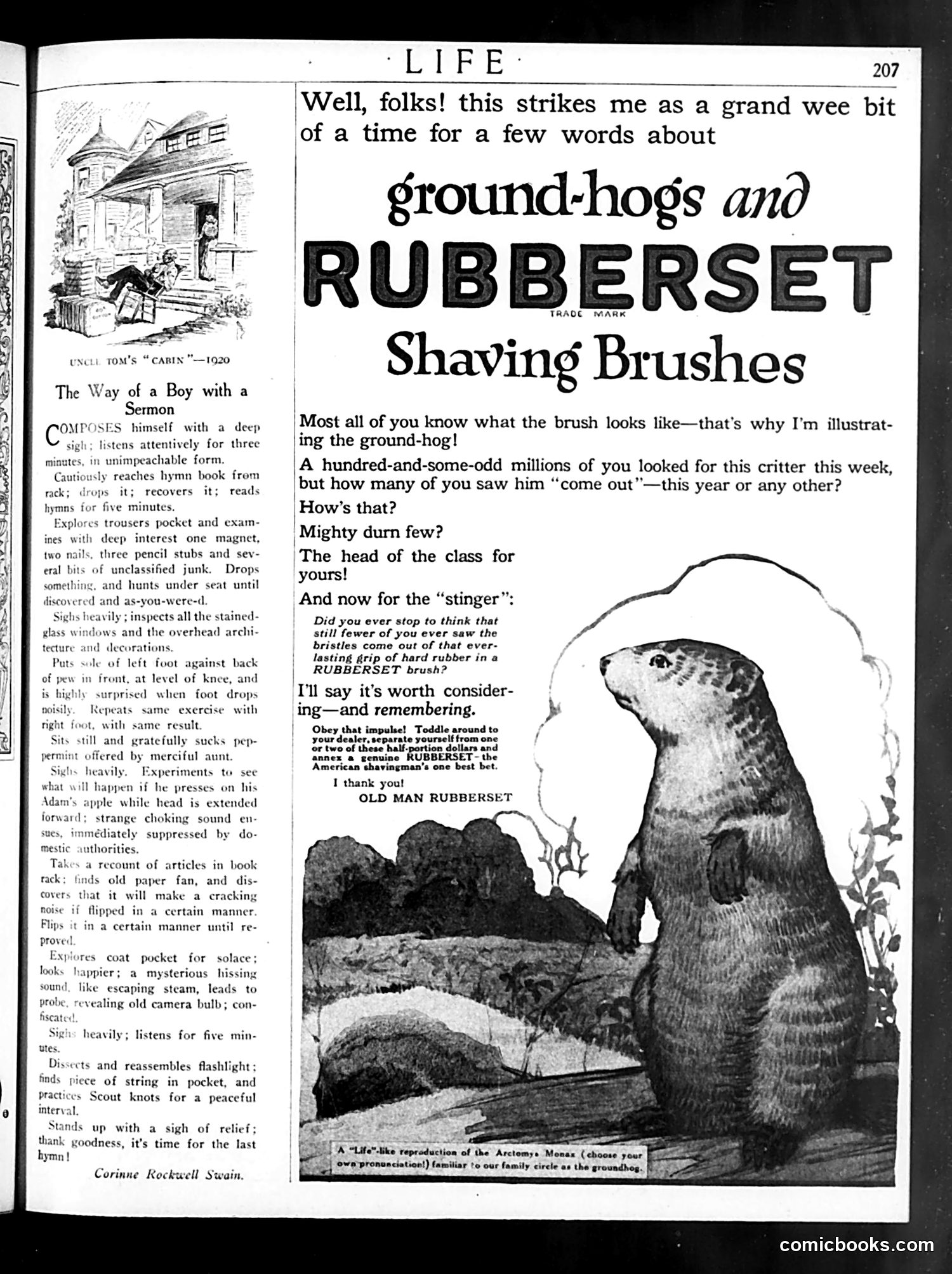
This page is primarily **advertising** for Rubberset shaving brushes, disguised as editorial content. The left column contains "The Way of a Boy with a Sermon" by Corinne Rockwell Swain—a humorous observation piece about a boy's fidgeting behavior during church services (described in anatomically detailed, comedic fashion). The right side features the main advertisement: a large illustration of a **groundhog** emerging from its burrow. The ad plays on Groundhog Day folklore, using this as a hook to discuss Rubberset brushes' durability. The copywriter personifies "Old Man Rubberset," asking readers to consider how few groundhogs actually emerge each year—a gimmick to emphasize the product's lasting quality and value proposition to consumers. The groundhog serves as a memorable mascot and natural tie-in to seasonal American tradition.
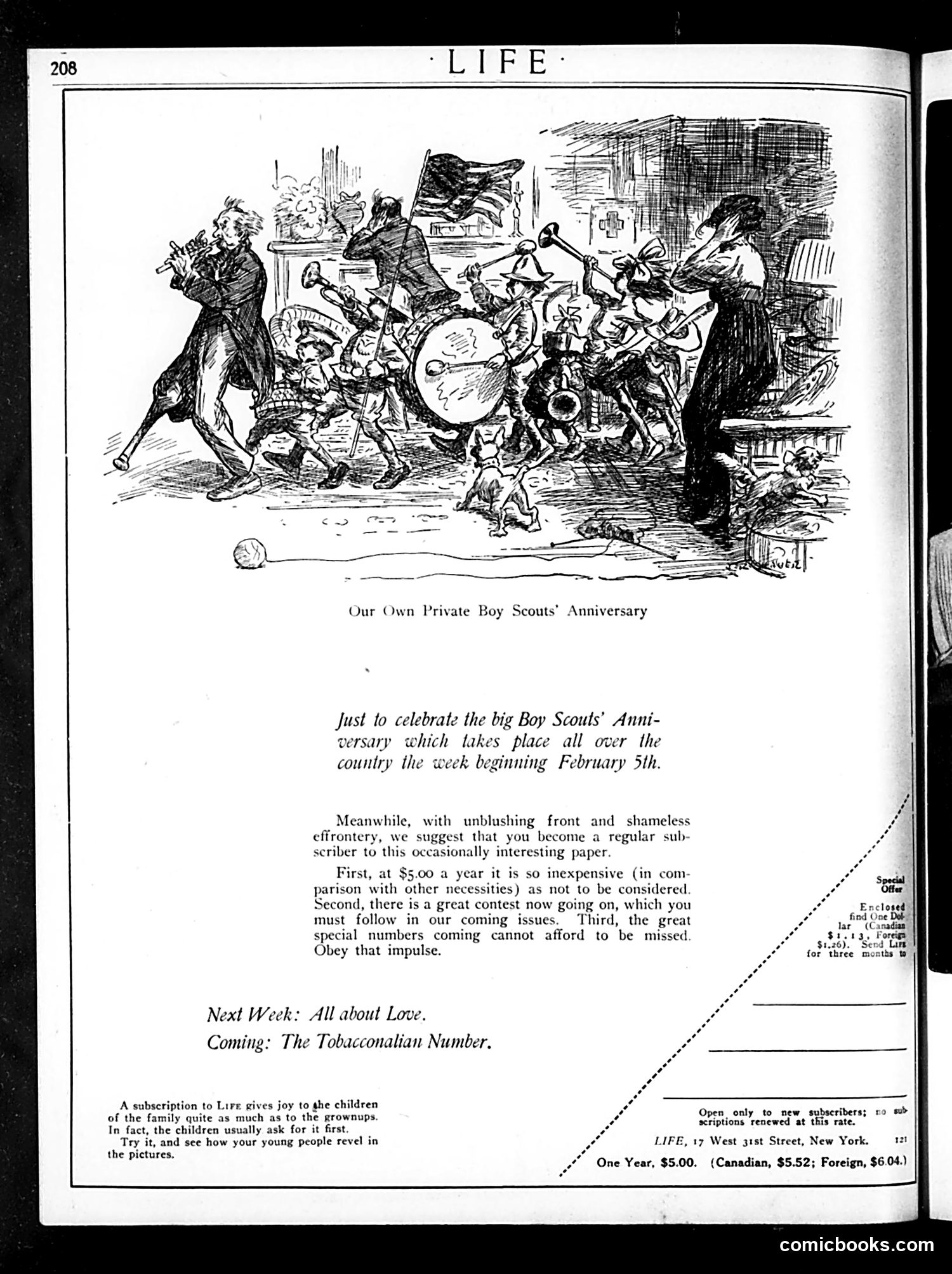
This satirical cartoon mocks a private celebration of the Boy Scouts' anniversary (occurring February 5th nationwide). The illustration depicts chaotic revelry featuring small figures engaged in boisterous, undisciplined conduct—playing instruments poorly, fighting, or acting wildly—contrasted with formally dressed adult observers on either side. The satire likely critiques either: (1) the gap between Boy Scouts' stated disciplinary ideals and actual boy behavior, or (2) wealthy families' private, self-indulgent versions of supposedly character-building youth organizations. The "shameless effrontery" mentioned in text suggests the cartoonist views something about this celebration as absurdly presumptuous or hypocritical. The overall tone is comedic mockery of institutional pretension.
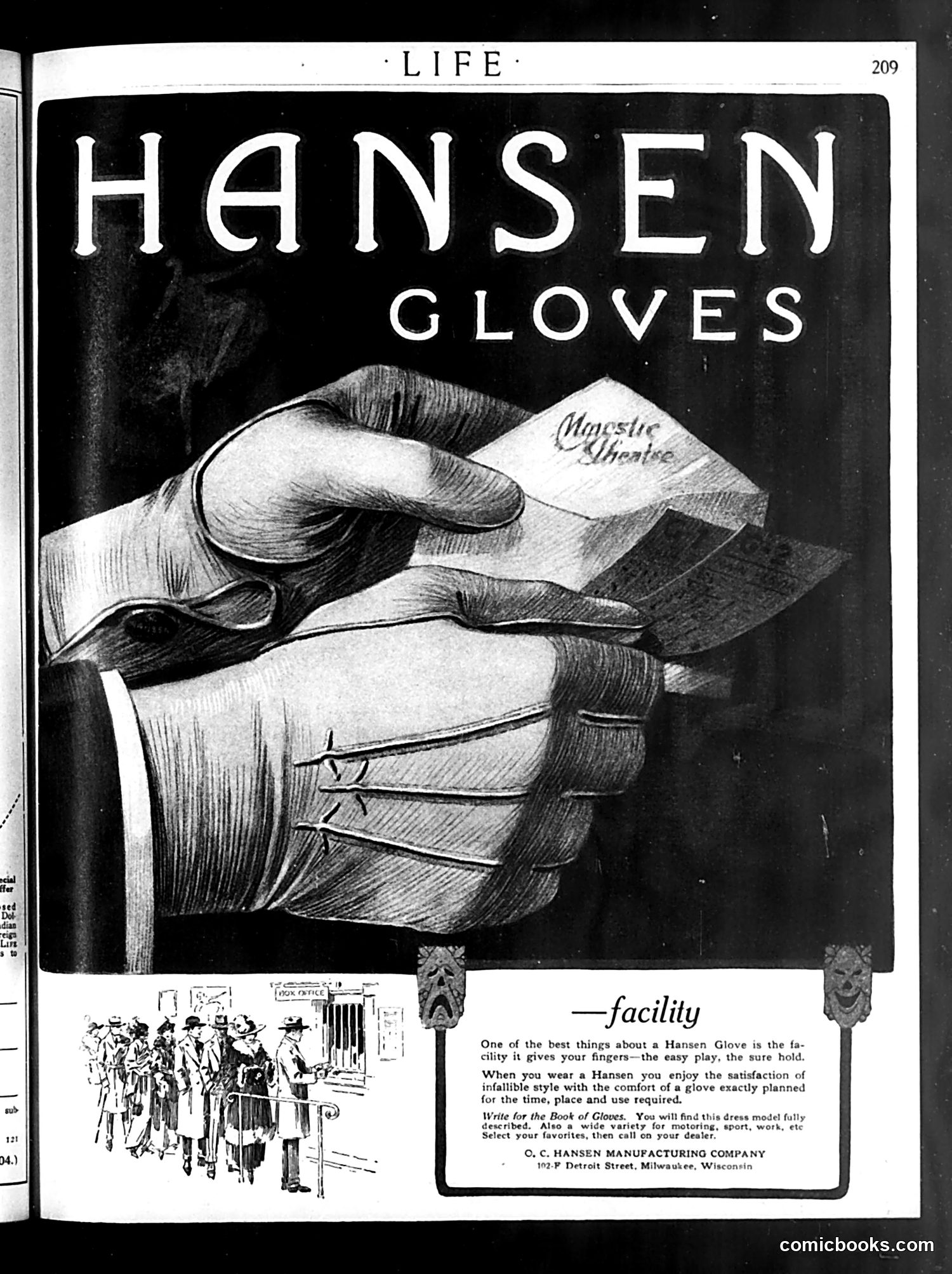
This is primarily a **commercial advertisement**, not political satire. The page shows a Hansen Gloves ad from the C.C. Hansen Manufacturing Company (Milwaukee, Wisconsin). The image depicts a detailed illustration of a gloved hand holding product samples, emphasizing the "facility" (comfort and ease) of wearing Hansen gloves. The accompanying text promotes that Hansen gloves offer satisfactory fit and comfort for various activities—motoring, sport, work, etc. A small illustration at bottom left shows people in period dress, likely meant to suggest the product's broad appeal across social situations. This is straightforward early 20th-century product advertising emphasizing quality and versatility rather than satire or political commentary.
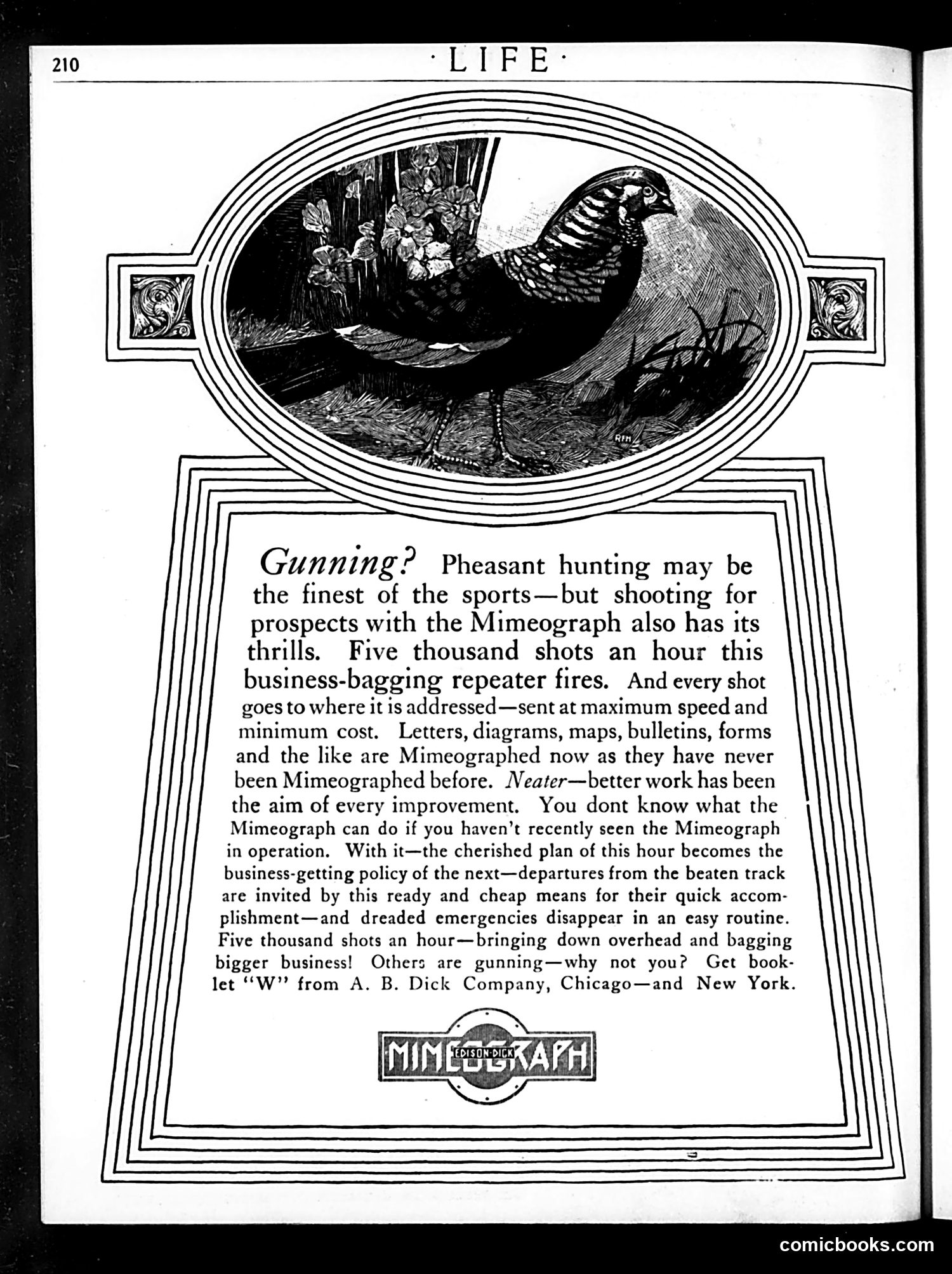
This is a **Mimeograph machine advertisement**, not a political cartoon. The page features an illustration of a pheasant (the hunting reference in the headline) and promotes the Mimeograph as a business tool. The ad uses a playful analogy: just as pheasant hunting is "the finest of sports," the Mimeograph offers "thrills" for business users. The pitch emphasizes the machine's speed (5,000 shots per hour) and efficiency for reproducing letters, diagrams, maps, and forms—departing from "beaten track" business practices. The pheasant image is purely metaphorical, linking the sport's excitement to the device's capability. This is straightforward product advertising targeting business owners seeking modern, economical reproduction technology, with promotional booklet offered by A.B. Dick Company.
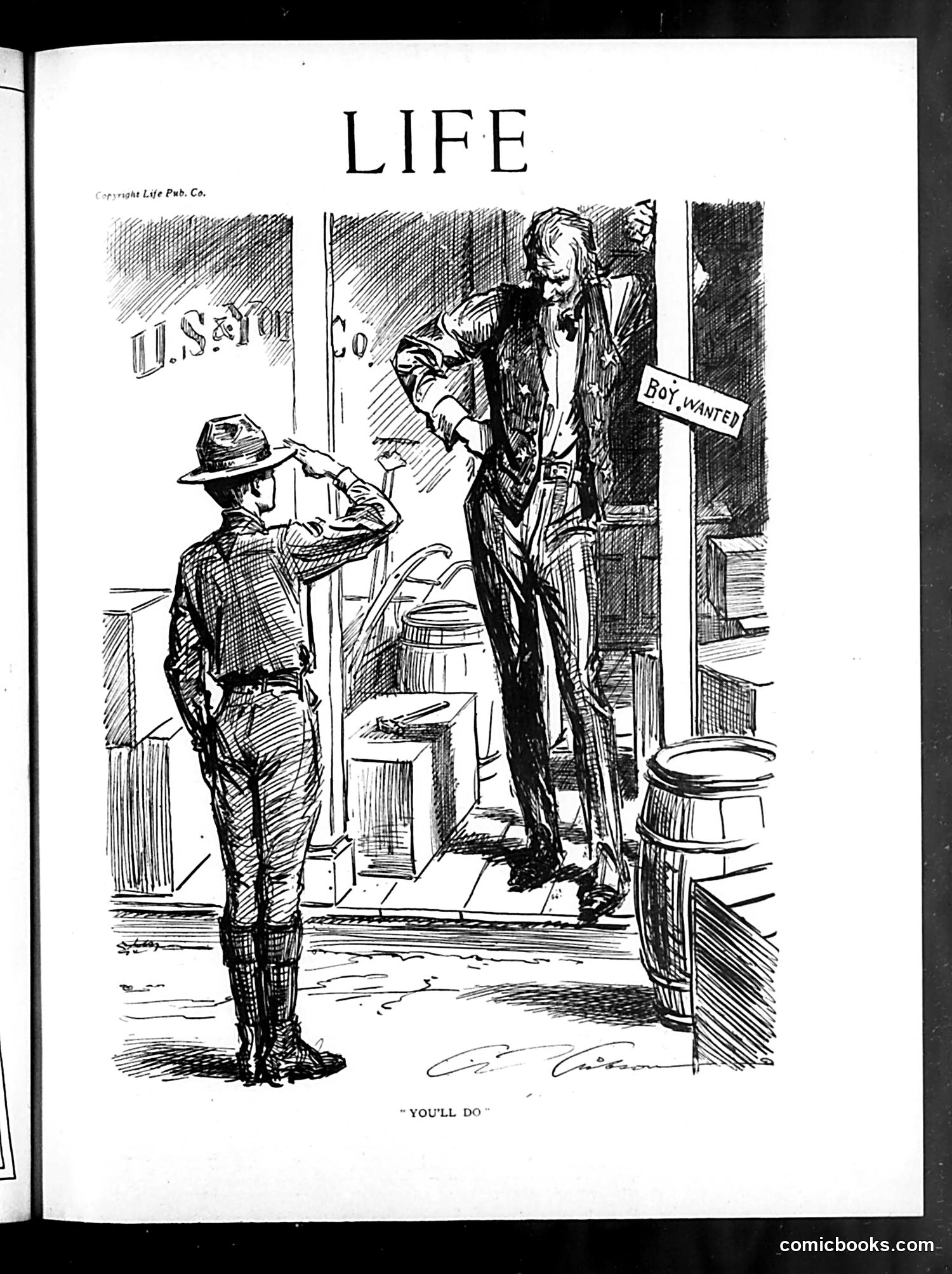
This cartoon depicts a U.S. military recruiter (identifiable by his uniform and the "U.S." and "Co." signs visible in the storefront) examining a young boy who has responded to a "Boy Wanted" sign. The recruiter appears to be inspecting the boy with a magnifying glass or similar tool, seemingly assessing his suitability. The satire likely critiques either military recruitment practices of the era or commentary on child labor and exploitation. The title "You'll Do" suggests the recruiter will accept whoever applies, regardless of qualifications or age—implying either desperation for recruits or cynical indifference to standards. The cartoon reflects early 20th-century concerns about who the military was enlisting and under what circumstances.
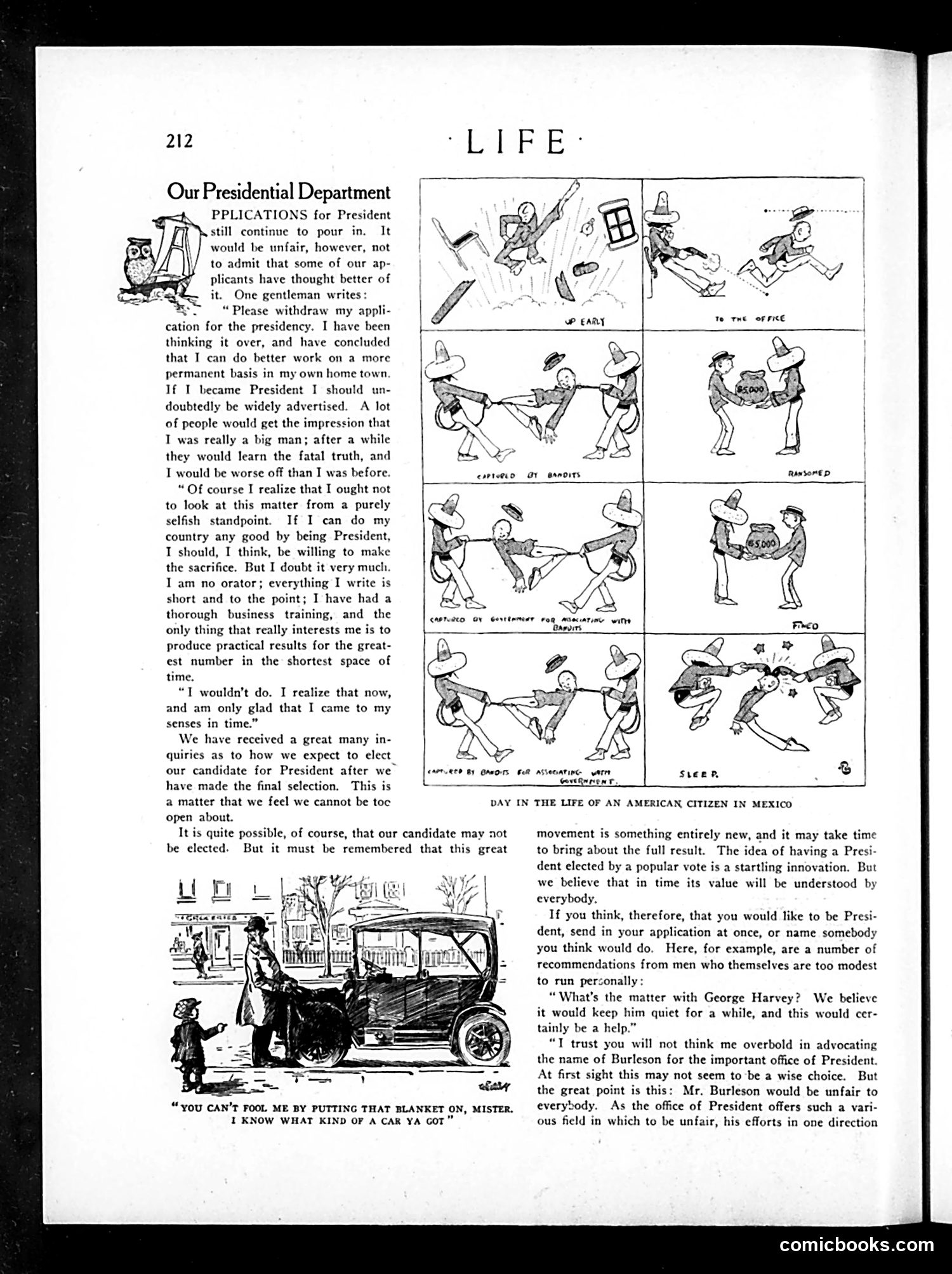
This page satirizes American presidential ambitions through two main elements: **Left side:** A rejected presidential applicant withdraws, admitting he'd be a poor choice—satirizing the vanity of candidates who overestimate their fitness for office. **Right side:** A comic strip titled "Day in the Life of an American Citizen in Mexico" depicts slapstick scenes of an American tourist being repeatedly knocked around—suggesting Americans abroad are undignified or prone to comic mishaps. **Bottom cartoon:** Shows a car accident with the caption "You can't fool me by putting that blanket on, mister—I know what kind of car ya got," mocking someone attempting to disguise their vehicle's shabby condition. The overall theme satirizes American pretension: candidates overestimating themselves, tourists abroad making fools of themselves, and people deceiving themselves about reality.
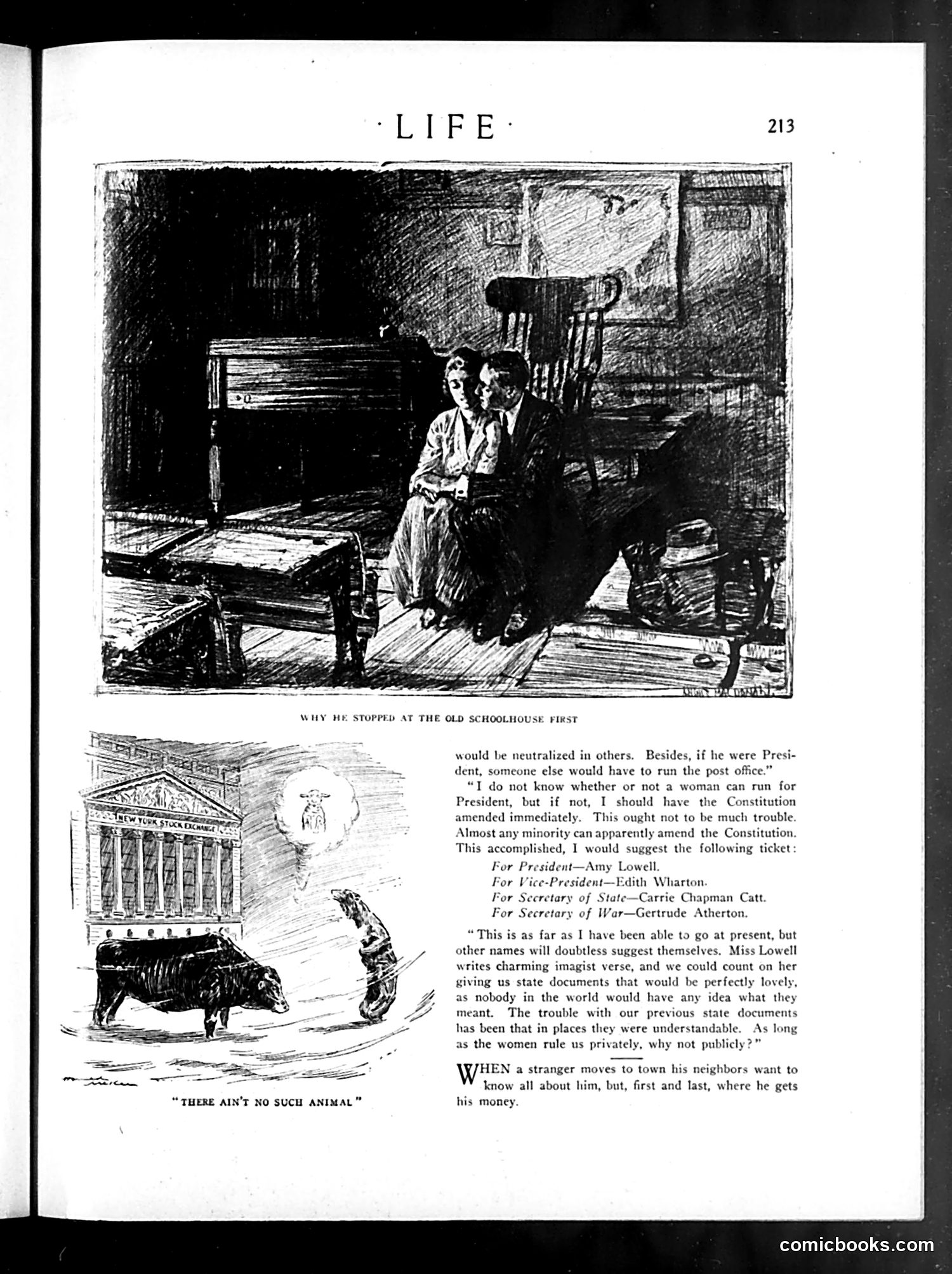
This page satirizes women's political participation, likely from the early 1900s. The upper illustration shows a domestic scene; the lower cartoon depicts a bull labeled "There Ain't No Such Animal" near the New York Stock Exchange. The text proposes a female presidential ticket: Amy Lowell for President, Edith Wharton for Vice-President, and female Secretaries of State and War. The accompanying commentary sarcastically suggests women should handle state documents privately rather than publicly, reflecting contemporary anxieties about female political authority. The bull cartoon appears to mock the idea of women in finance/politics as impossible or absurd—"there ain't no such animal." The overall piece ridicules the notion of women holding high political office, presenting it as fantastical rather than viable.
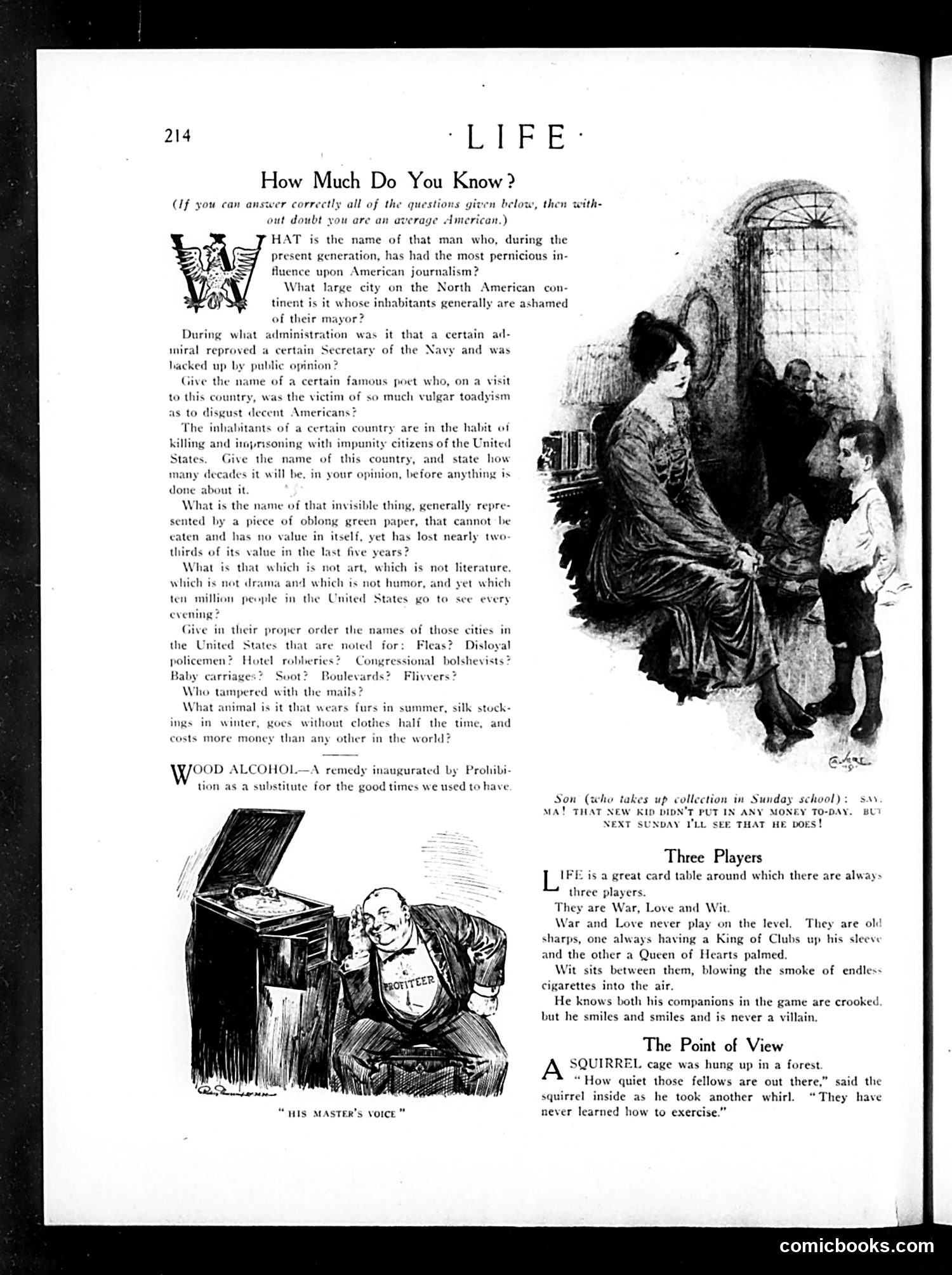
This page features a trivia quiz mocking American knowledge and culture. The questions target contemporary blindspots: a journalist's harmful influence on American public opinion, a major city's corrupt mayor, a country's hostility toward the U.S., the value of paper currency during economic decline, and ten million Americans' nightly entertainment choice. The "Wood Alcohol" section satirizes Prohibition's unintended consequence—people drinking toxic substitutes. "Three Players" uses a card game metaphor for life's forces: War, Love, and Wit, with Wit as the clever mediator. "The Point of View" presents a squirrel's observation about exercise—a gentle philosophical joke about perspective and learned behavior. The illustrations by G. Axe accompany these satirical pieces criticizing contemporary American society and values.
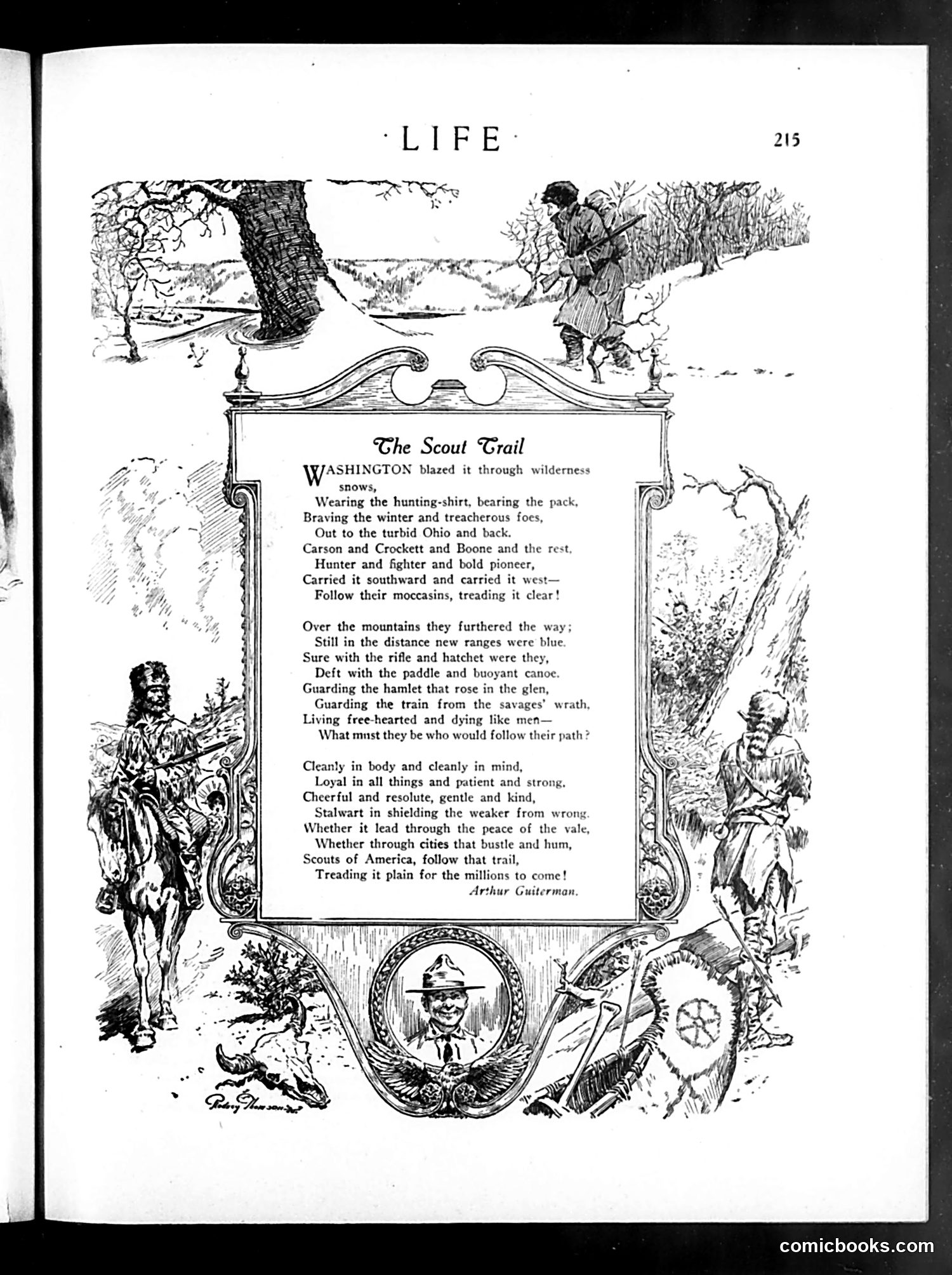
This is a poem celebrating the Boy Scout movement, illustrated with period wilderness imagery. The text praises scouts for embodying ideals like loyalty, cleanliness, moral strength, and pioneering spirit—referencing historical figures (Washington, Carson, Crockett, Boone) who blazed trails westward. The decorative border features scouts in various outdoor activities: hiking, paddling canoes, and woodcraft. A central medallion shows a scout in uniform. The poem's message is straightforward rather than satirical: scouts represent American virtue and will "tread it plain for the millions to come." This reflects early-20th-century enthusiasm for the Boy Scout organization as character-building and patriotic. The artwork romanticizes wilderness exploration and American frontier mythology as models for youth development.
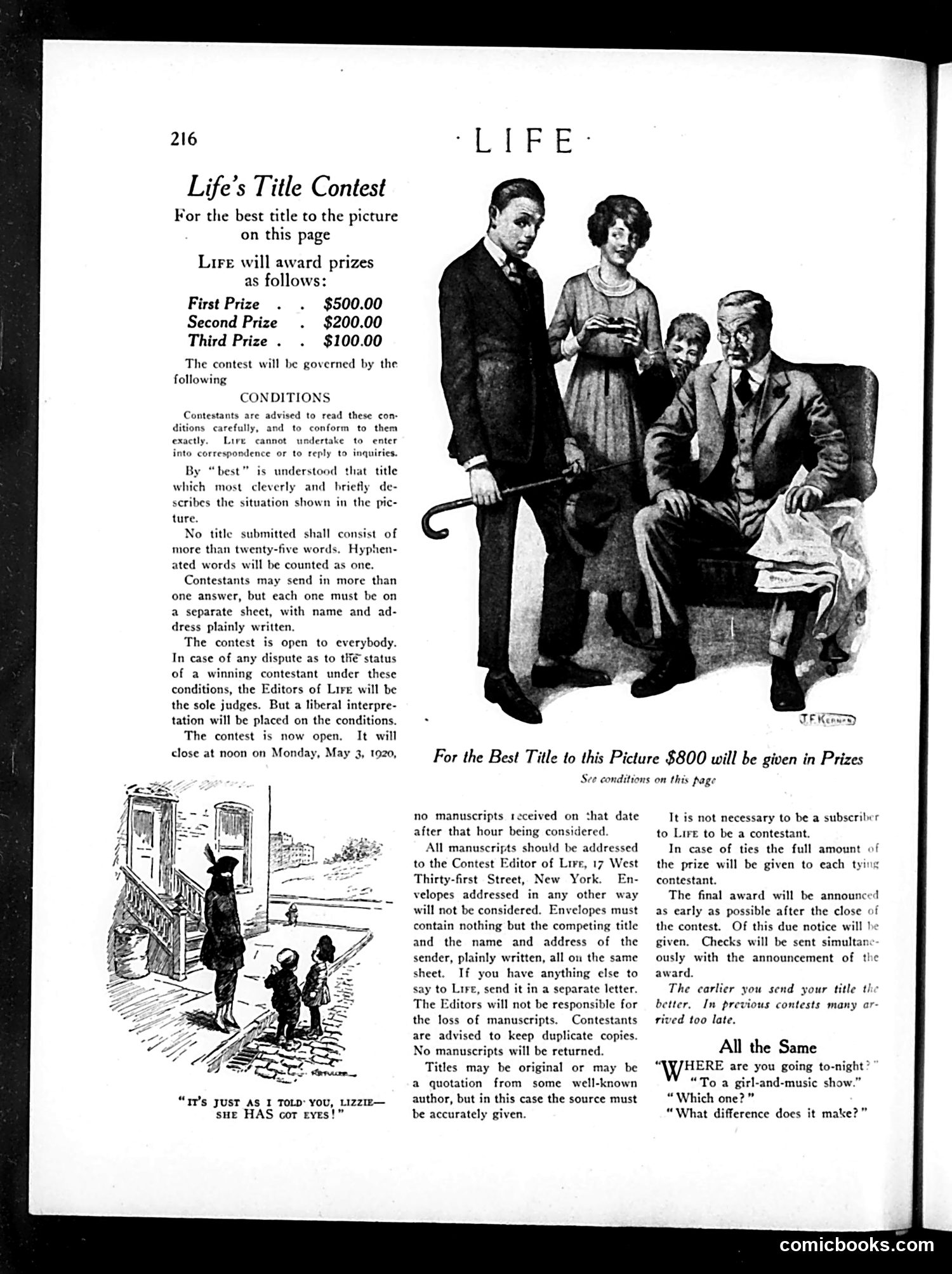
This page announces a **title-writing contest** where readers submit captions for the main illustration: a well-dressed man showing what appears to be a young woman to a seated couple. The small cartoon below ("It's just as I told you, Lizzie—she has got eyes!") suggests the humor involves appearance or romantic interest. The contest offers substantial prizes ($500-$100), closing May 3, 1920. Detailed conditions specify entries must be under 25 words, submitted separately with the contestant's name and address. The final item, "All the Same," is a brief dialogue joke: a man asks another where he's going ("girl-and-music show"), then asks "which one?"—implying all such entertainment venues are interchangeable. This reflects satirical commentary on standardized commercial entertainment of the Jazz Age era. The page is primarily advertising the contest itself rather than delivering political satire.
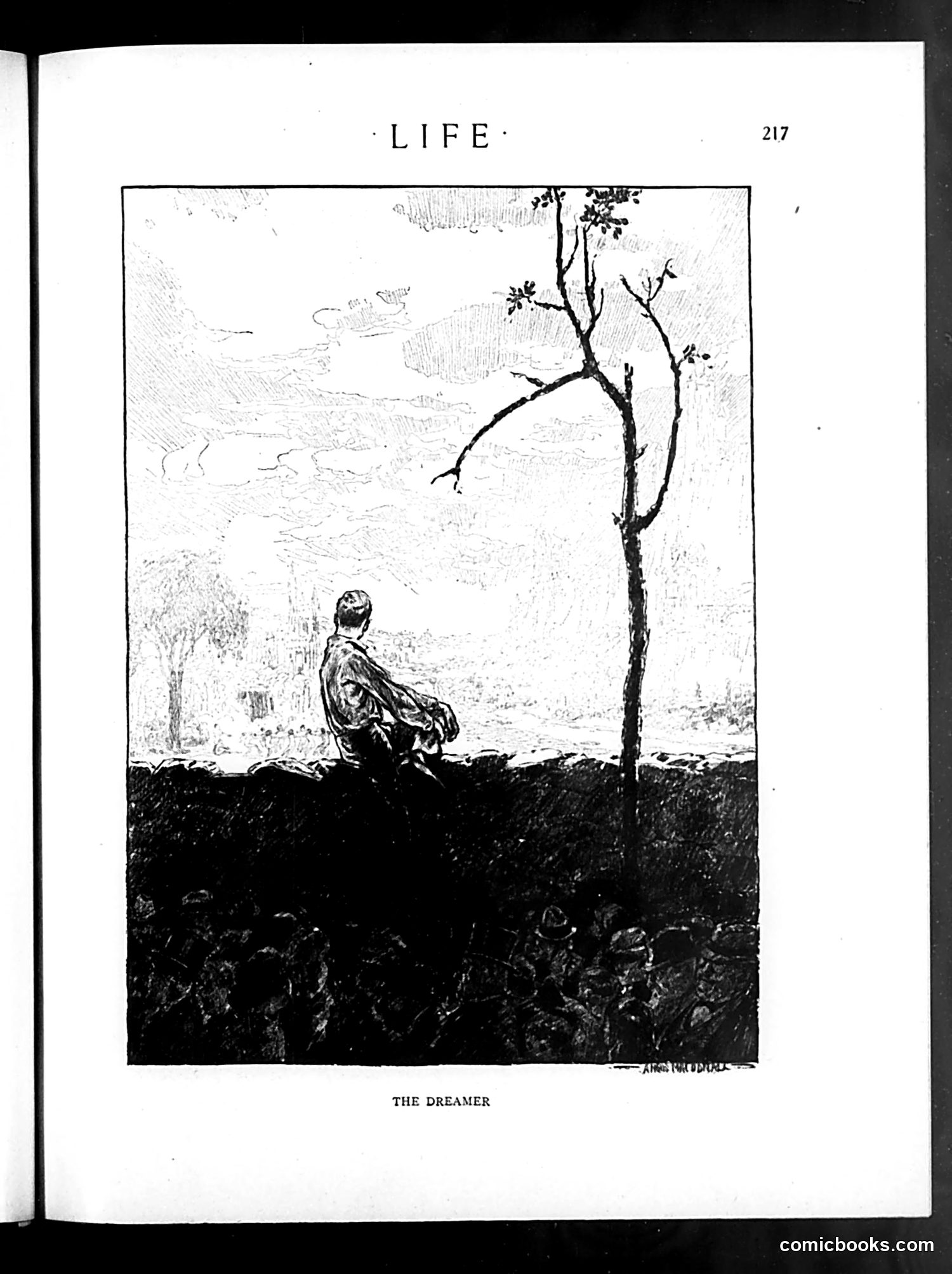
This illustration depicts a solitary figure sitting on dark ground, gazing upward at a sparse, bare tree against a cloudy sky. The person wears what appears to be a cape or cloak, suggesting idealism or aspirational thinking. The title "The Dreamer" and the romantic, contemplative composition suggest social commentary on idealistic individuals disconnected from harsh reality. The barren landscape and leafless tree contrast with the figure's apparent hope or reverie, likely satirizing impractical optimists, reformers, or political idealists of the era who held elevated visions disconnected from material circumstances. Without additional context, the specific target remains unclear, but the image critiques the gap between romantic idealism and practical reality—a common Life magazine theme.
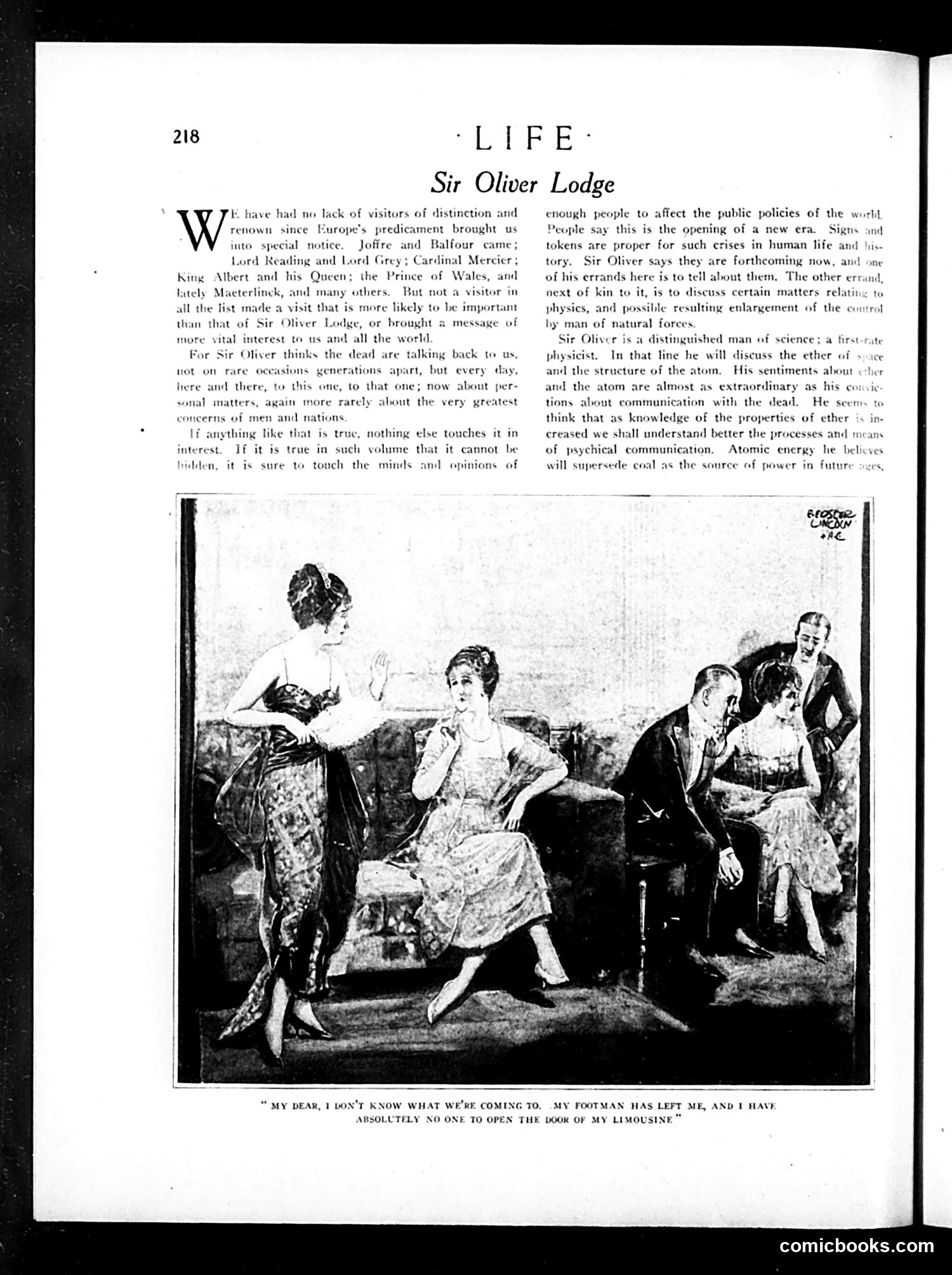
This page satirizes **Sir Oliver Lodge**, a real British physicist and spiritualist who visited America during World War I. The article criticizes his claims about communicating with the dead—suggesting he believes the deceased are "talking back to us" daily, not just occasionally across generations. The cartoon below depicts a wealthy woman at a social gathering, distressed that her footman has abandoned her, leaving no one to open her limousine door. The satire connects Lodge's grand metaphysical theories to the mundane concerns of the upper class: while Lodge discusses atomic energy and psychical communication with the dead, the elite are preoccupied with servant shortages and social inconvenience. The joke mocks both Lodge's spiritualist pretensions and the self-absorbed priorities of the wealthy during wartime—trivial domestic crises versus genuine human concerns.
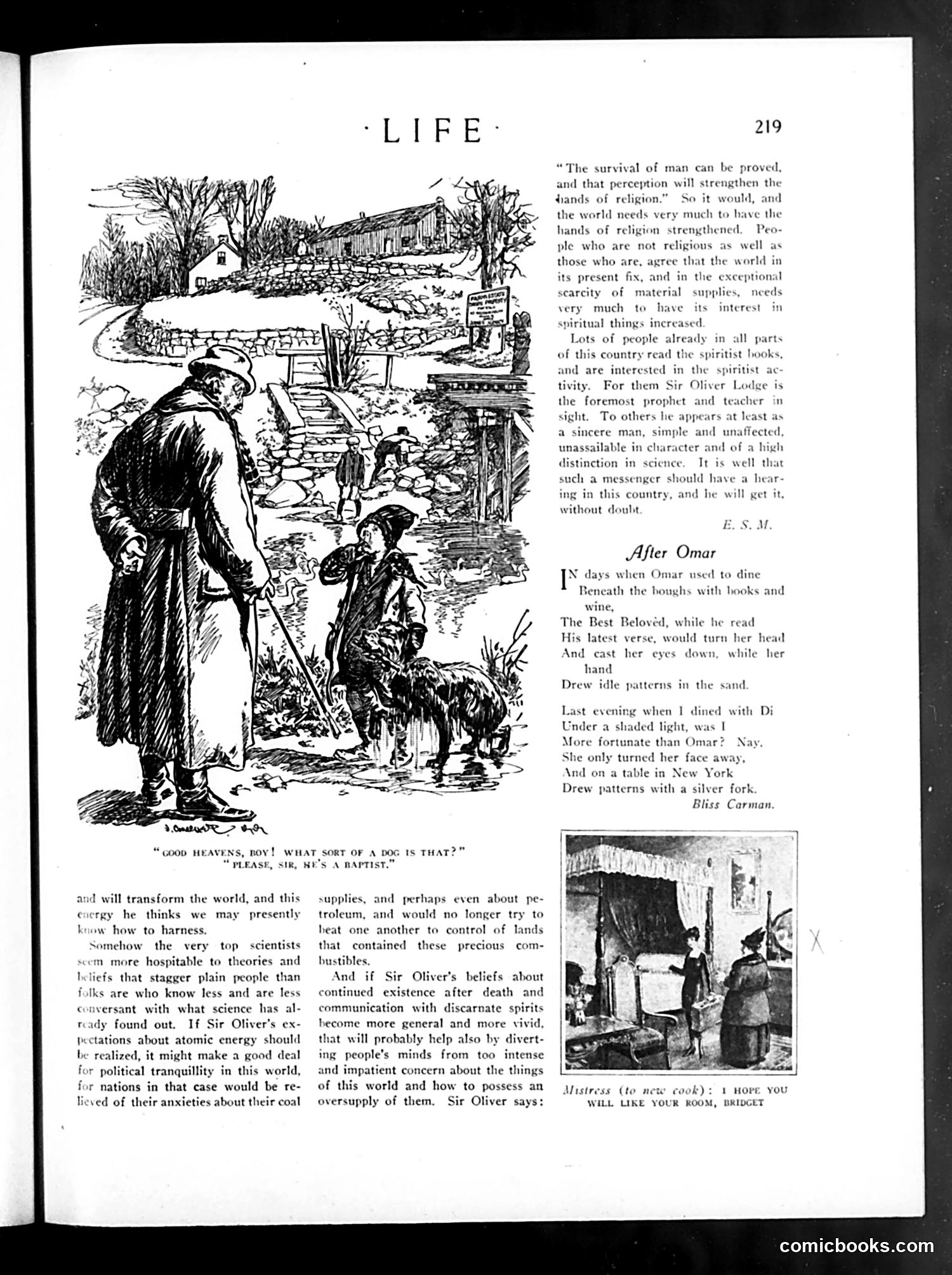
The main cartoon depicts an elderly man (appears to be Sir Oliver Lodge, a real physicist and spiritualist) with a child and dog. The caption "'Good heavens, boy! What sort of dog is that?' 'Please, sir, he's a Baptist'" is a nonsensical joke playing on the absurdity of describing a dog's religion—likely satirizing Lodge's own beliefs in spiritualism and communication with the dead as equally absurd. The surrounding text discusses Lodge's ideas about atomic energy and life after death, suggesting these theories will distract nations from material conflicts and strengthen religious faith. The satire mocks how pseudoscientific spiritualism appeals to people seeking spiritual meaning, while the dog-religion joke undercuts the seriousness of his claims through deliberate illogic. The page's secondary poem and photograph appear unrelated to the main satire.
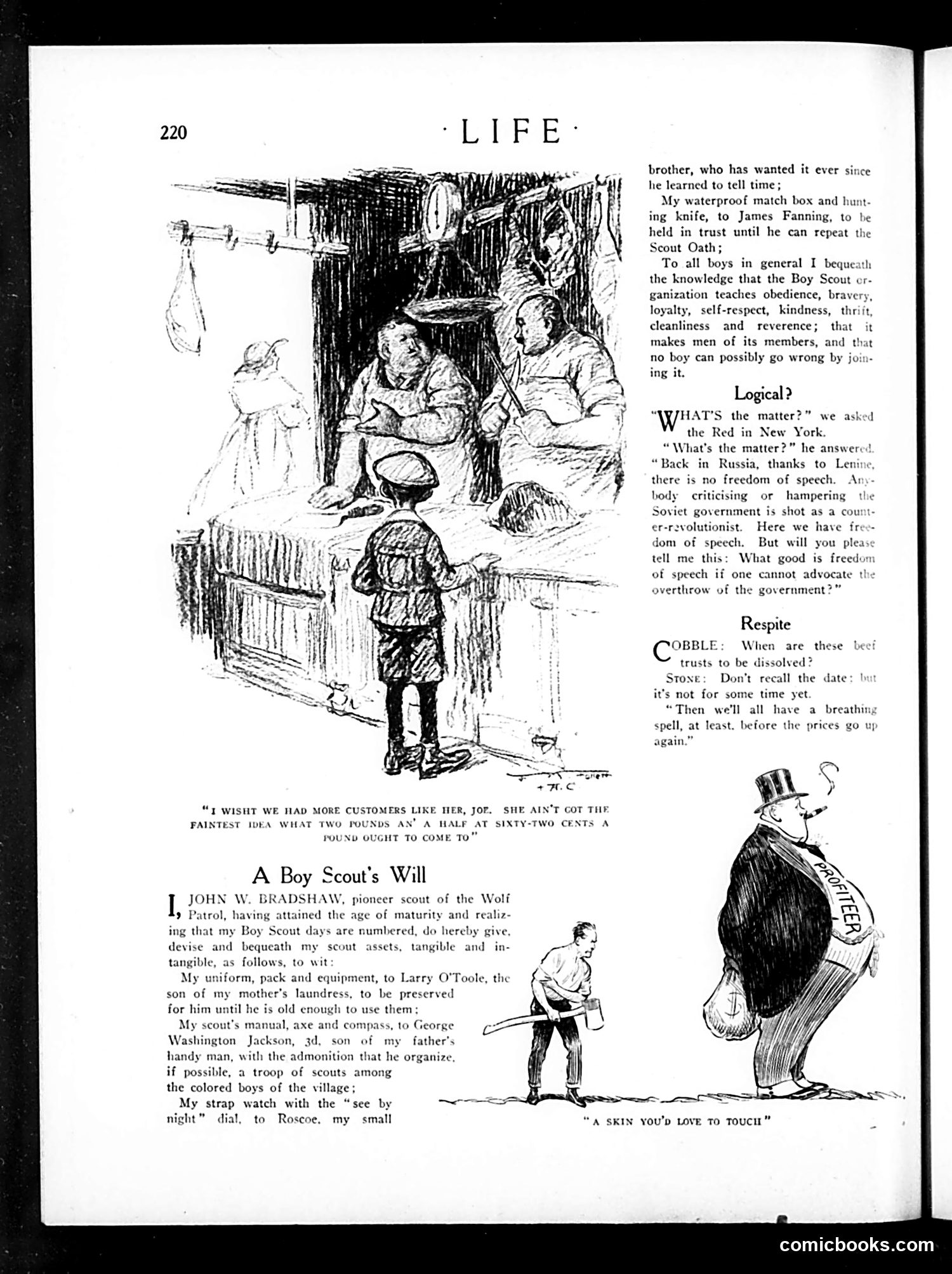
This page contains three satirical pieces from an early 20th-century American humor magazine: 1. **"A Boy Scout's Will"**: A humorous mock will where a young scout bequeaths his possessions to working-class and Black children. The satire lies in treating Boy Scout equipment as valuable inheritances and in the casual mention of organizing a scout troop "among the colored boys"—likely mocking both the earnestness of scouting ideals and period racial attitudes. 2. **"Logical?" cartoon**: Satirizes a "Red" (communist sympathizer) in New York who argues that while Soviet Russia has no freedom of speech, America's freedom of speech is worthless if one cannot advocate overthrowing the government. The joke mocks the logical inconsistency of criticizing America's freedoms while praising a totalitarian system. 3. **"Respite" cartoon**: Two men discuss when beef trusts will be dissolved, concluding they'll get "breathing spell" before prices rise again—satirizing business monopolies and inflation. The "skin you'd love to touch" advertisement appears unrelated to the satirical content.
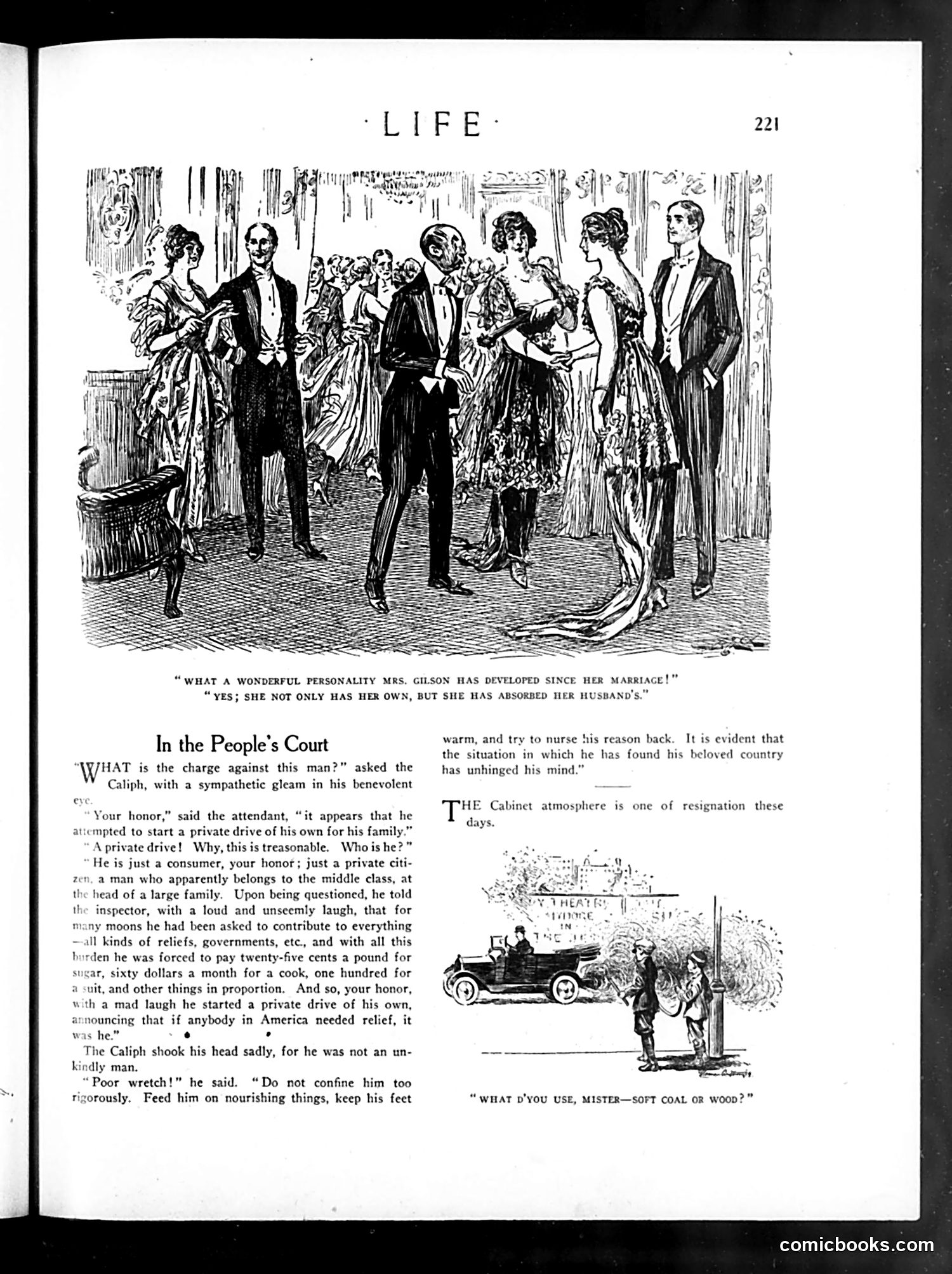
This page contains two satirical pieces from Life magazine (likely 1920s-era based on style): **Top cartoon:** A social commentary on marriage, suggesting that wives absorb their husbands' personalities after marriage—implying a loss of individual identity for women. **"In the People's Court":** A political satire depicting a middle-class man tried for starting his own "private drive" (fundraising effort) after being pressured to contribute to government relief, charities, and wars. The judge—called "the Caliph" (suggesting autocratic rule)—treats the man's financial frustrations as madness. The satire critiques: - Excessive taxation and mandatory contributions - A government that demands sacrifice from ordinary citizens while offering little relief - The absurdity of penalizing individual initiative **Bottom cartoon:** Shows a car owner asking someone about fuel choice, likely satirizing wartime or postwar fuel rationing/shortages. The page overall mocks government overreach, heavy taxation, and the squeeze on middle-class families—common Life magazine themes during periods of economic strain or wartime.
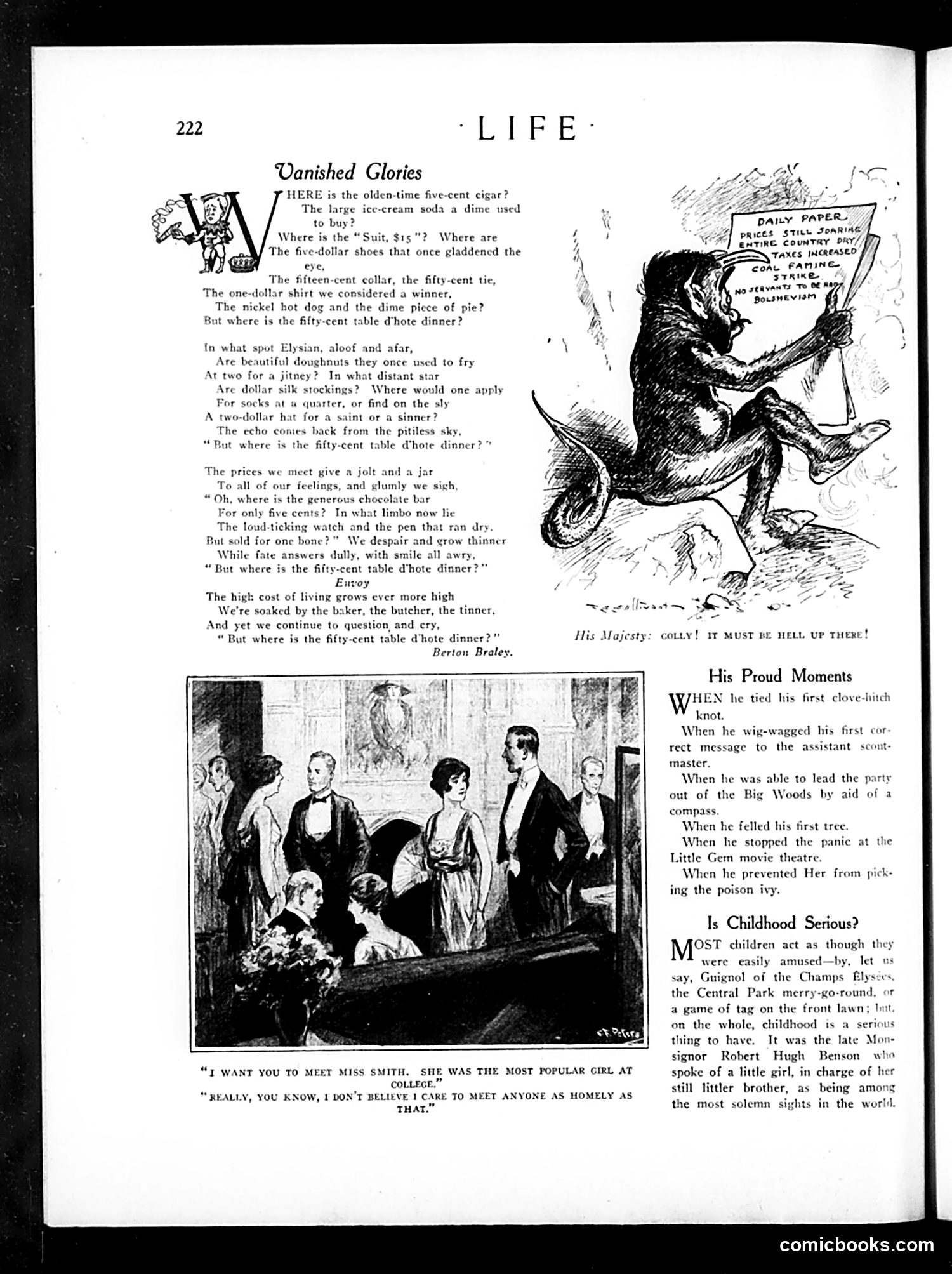
**"Vanished Glories"** is a satirical poem by Berton Braley lamenting inflation and the disappearance of affordable goods. It nostalgically catalogs cheap items from an earlier era—five-cent cigars, dime sodas, fifteen-cent collars, and especially the fifty-cent table d'hote (fixed-price) dinner—contrasting them with current high prices. The repeated refrain "But where is the fifty-cent table d'hote dinner?" emphasizes how purchasing power has collapsed. This appears to reference post-WWI inflation (likely early 1920s), when prices rose sharply. The accompanying cartoon shows a disheveled monkey reading a newspaper listing economic catastrophes: "prices still soaring," "famine," "strikes," "no servants to be had," and "Bolshevism." The monkey's frustrated cry captures public anxiety about economic chaos and social upheaval during this period of uncertainty. Together, the poem and cartoon mock the widespread sense that ordinary comfort and stability have vanished—replaced by chaos and unaffordable living.
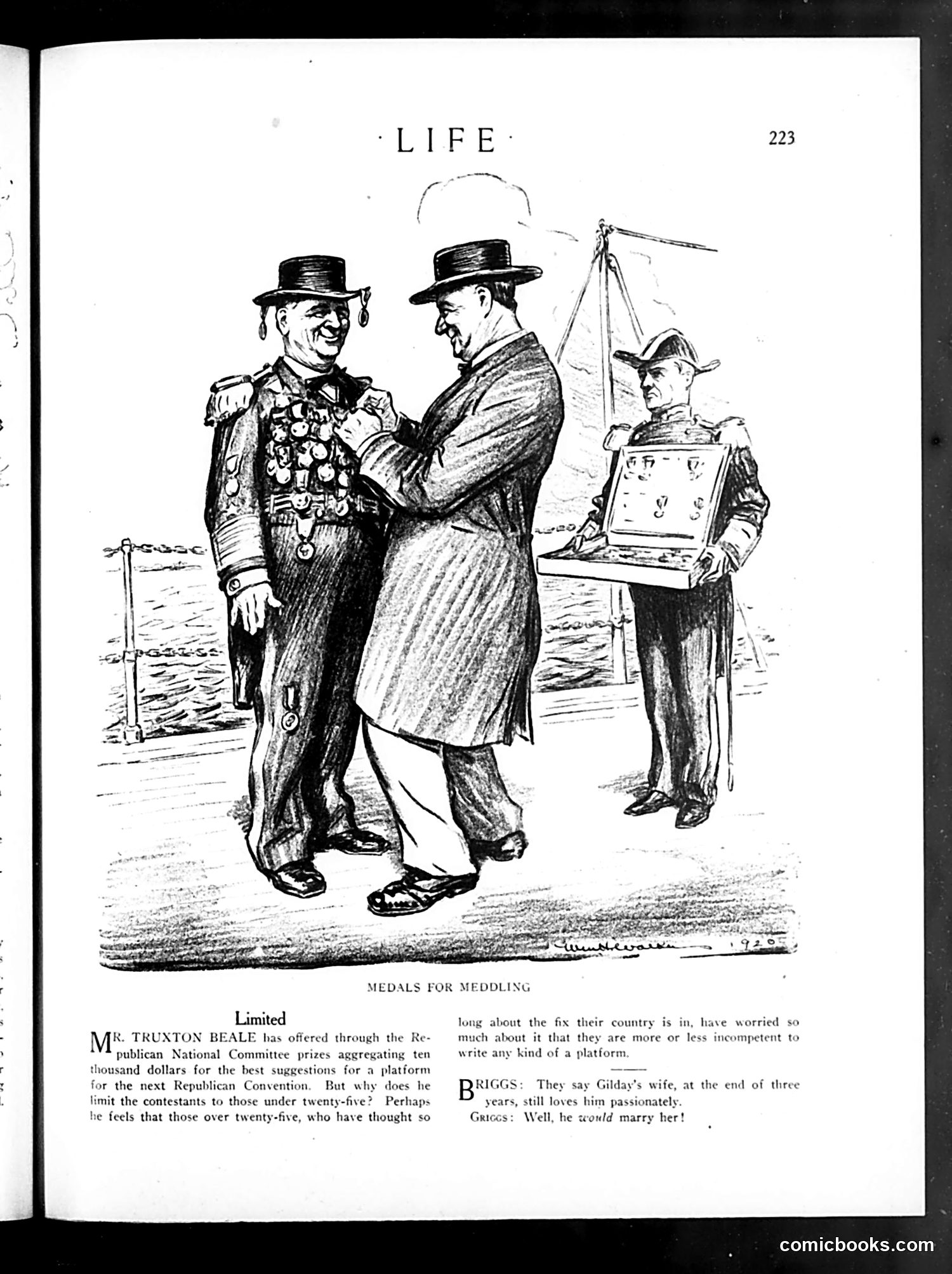
This cartoon satirizes Republican Party efforts to crowdsource platform ideas. R. Truxton Beale, a Republican, offered $10,000 in prizes for convention platform suggestions—but restricted entries to people under 25. The cartoon's joke: the age restriction is absurd. Life's caption sarcastically suggests Beale believes older Americans, who've "thought so long" and "worried so much" about the country's problems, are too mentally exhausted to write coherently. Only the young, presumably less worn down by reality, remain competent. The lower dialogue appears unrelated—a brief joke about a woman marrying someone foolishly. The overall satire mocks both the Republican Party's platform-building process and the notion that youth equals better judgment on serious political matters.
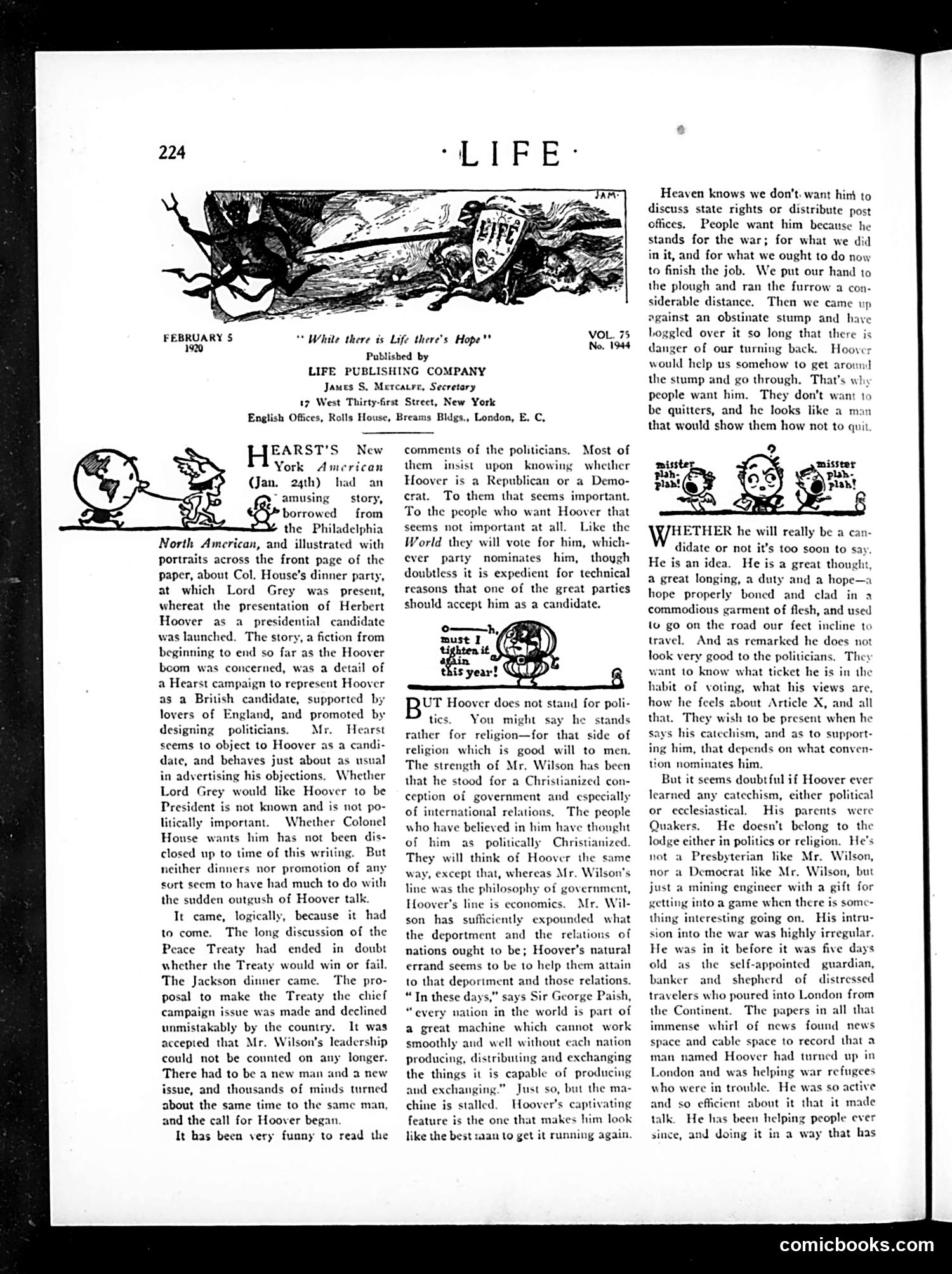
This *Life* magazine piece addresses the sudden emergence of Herbert Hoover as a potential 1920 presidential candidate. The article dismisses publisher William Randolph Hearst's claim that Hoover was a British-backed "candidate," attributing instead Hoover's popularity to practical circumstances: Wilson's leadership had become politically untenable following Peace Treaty debates, forcing politicians and voters to seek a new figure. The satire mocks politicians obsessing over whether Hoover is Republican or Democrat—missing the point entirely. Voters support Hoover not for partisan reasons but for his association with war efforts and economic competence. The piece frames Hoover as representing "Christianized" practical governance (economics and "good will") rather than political philosophy, positioning him as the figure to "get the machine running again" after wartime disruption. The cartoon's imagery (unclear without clearer detail) likely accompanies this argument about Hoover's unexpected political ascendancy.
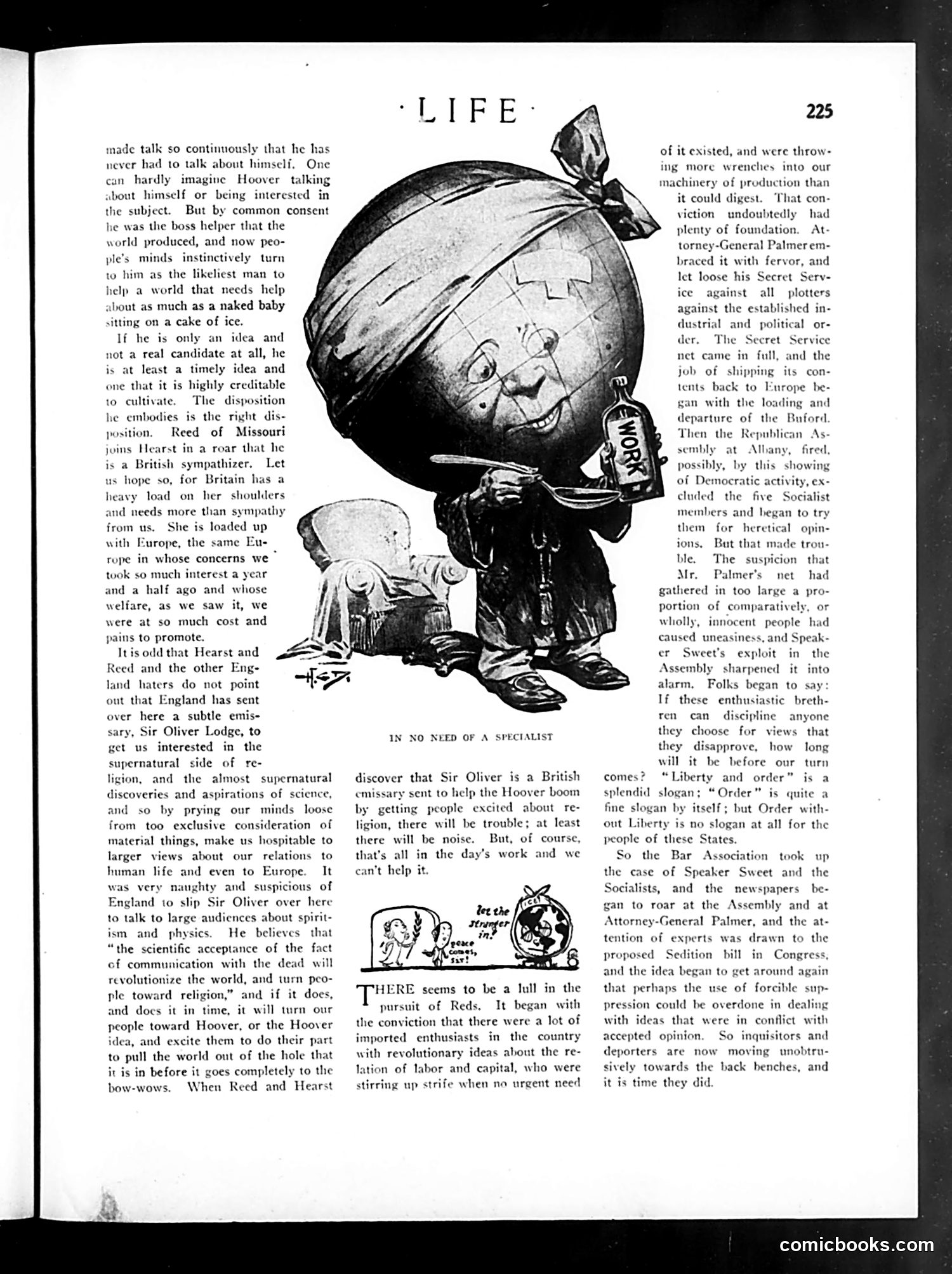
The main illustration depicts a bloated, overstuffed figure labeled "HOOVER" (Herbert Hoover, then Secretary of Commerce), captioned "IN NO NEED OF A SPECIALIST." The satire mocks Hoover as so self-satisfied and inflated with his own importance that he needs no expert guidance. The accompanying text discusses broader political tensions circa 1920: Attorney General Palmer's aggressive "Red Scare" campaign against suspected communists and radicals, which the author suggests has become excessive and counterproductive. The article criticizes both Palmer's zealotry and Republican efforts (Speaker Sweet's actions in Albany's Assembly) to expel Socialist members, warning these overreactions threaten civil liberties. The satire also mocks isolationist politicians like William Randolph Hearst and Senator Reed of Missouri for opposing British interests while remaining blind to subtler British influence (Sir Oliver Lodge's spiritualism lectures). The overall point: excessive government suppression of dissent and political persecution are dangerous to American democracy, even when targeting genuinely radical movements.
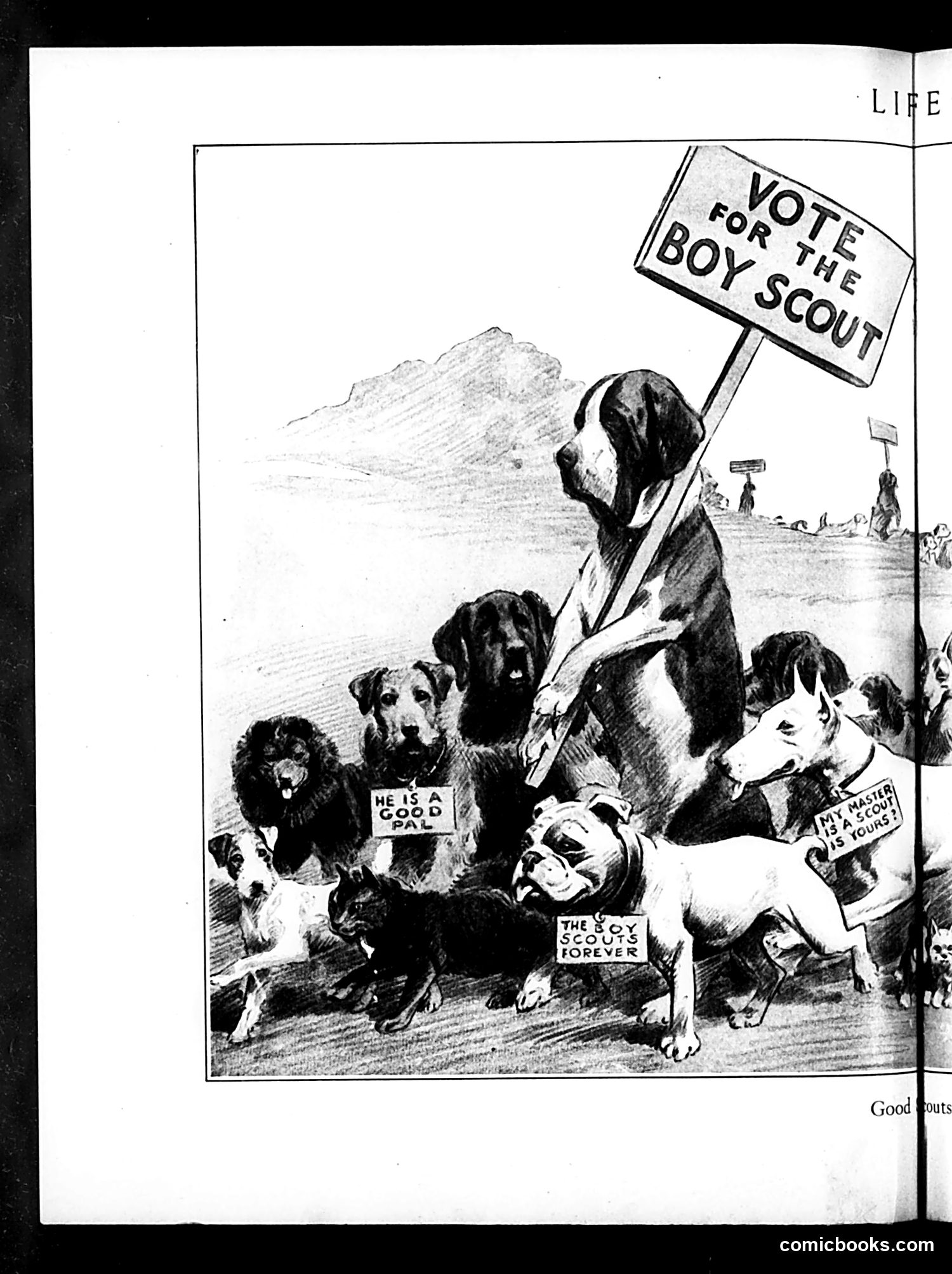
This is a satirical cartoon promoting the Boy Scouts organization. A man holds a "Vote for the Boy Scout" sign while surrounded by dogs wearing supportive signs ("He is a good pal," "The Boy Scouts Forever," "Master, a scout's course!"). The satire appears to be **pro-Boy Scouts advocacy**, using dogs as surrogates for voters. The dogs' testimonials suggest the Boy Scouts create loyal, obedient citizens—a common pitch for youth organizations of the early-to-mid 20th century. The "vote" framing humorously positions Boy Scout support as a civic choice, while the dogs' devoted expressions reinforce messaging about loyalty and character-building that the organization promoted. The exact historical moment is unclear without dating information, but this reflects when Boy Scouts were considered a patriotic institution deserving public endorsement.
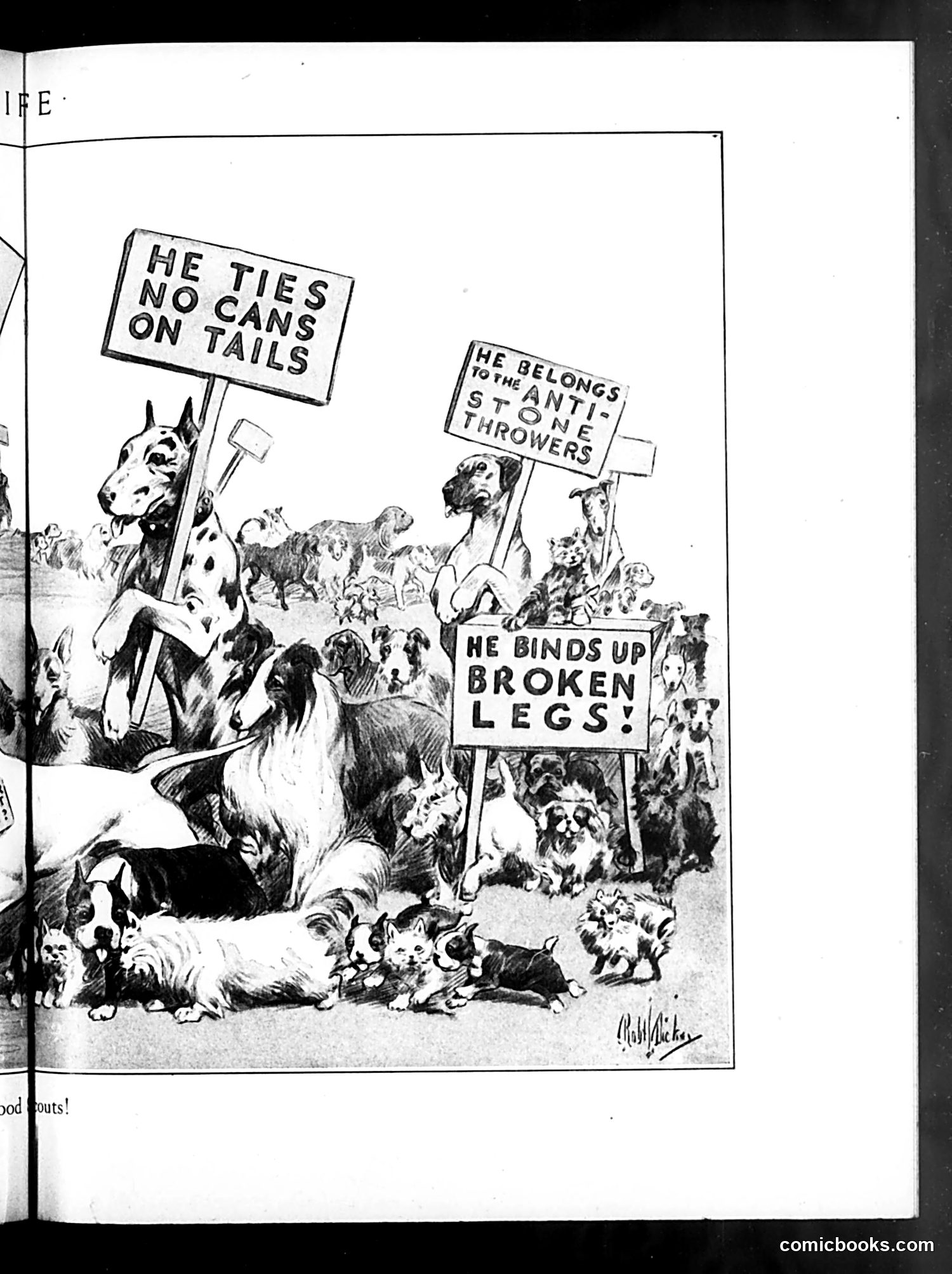
This satirical cartoon depicts a group of dogs holding protest signs with competing claims about their virtues: "He ties no cans on tails," "He belongs to the anti-stone throwers," and "He binds up broken legs!" The cartoon appears to be political satire comparing candidates or public figures to dogs making self-promotional claims. Each sign represents a different virtue or policy position the subject supposedly embodies. The crowded scene of dogs with signs suggests a campaign or election context where multiple figures make competing promises to voters. The humor lies in the absurdity of dogs advocating for animal welfare policies—likely mocking politicians who make grandiose claims about their humanitarian credentials while their actual records may tell a different story. The specific historical context and figures referenced remain unclear without additional publication information.
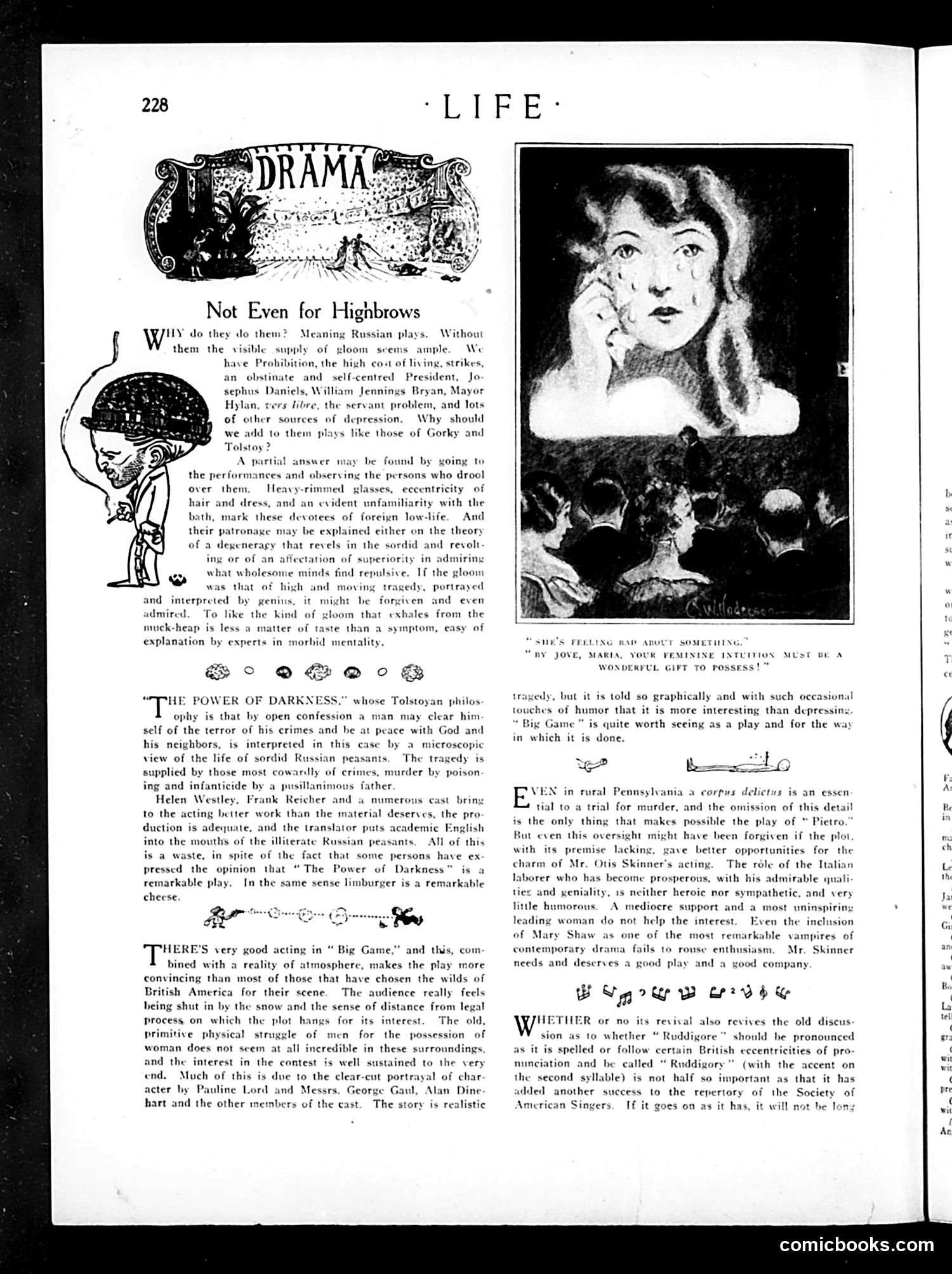
This page critiques the American fascination with Russian plays—particularly works by Tolstoy and Gorky—as pretentious and morbid. **The Main Cartoon**: The small caricature depicts a typical Russian-play enthusiast: someone with heavy glasses, eccentric hair/dress, and poor hygiene. The satire mocks their supposed degeneracy or affectation of superiority in admiring "foreign low-life." **The Social Context**: The article lists contemporary American miseries (Prohibition, high living costs, strikes, unpopular President) as sufficient gloom without importing Russian tragedies. It dismisses patrons of these plays as either morbidly fascinated by sordid peasant life or pretending intellectual sophistication. **The Reviews**: The page then covers actual theater productions—"The Power of Darkness" and "Big Game"—acknowledging their effective staging while maintaining skepticism about their artistic value. **The Satire's Point**: Life mocks both the plays themselves (as unnecessarily depressing) and their American admirers (as either psychologically troubled or pretentious snobs). The humor derives from 1920s American exceptionalism and suspicion of European cultural imports.
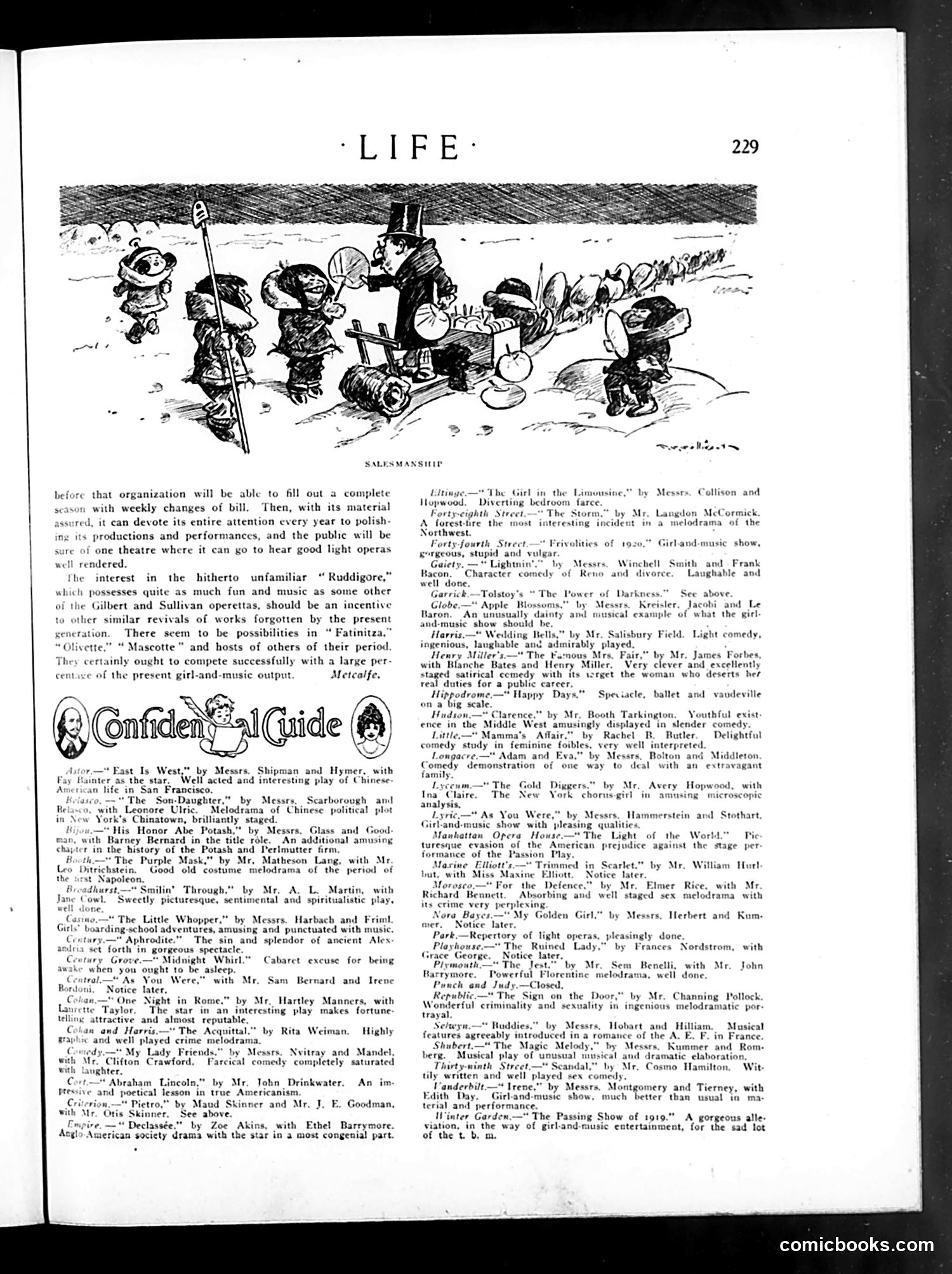
This cartoon satirizes aggressive sales tactics in early 20th-century America. The central figure—a well-dressed man in a top hat—represents an overbearing salesman who has surrounded himself with potential customers (depicted as smaller figures holding various goods and containers). The joke appears to be about relentless, invasive selling methods: the salesman literally corners his prospects, leaving them no escape. His exaggerated gesture and confident posture contrast with the trapped or overwhelmed expressions of those around him. The caption "SALESMANSHIP" identifies this as commentary on contemporary business culture. Given the page's theatrical review context, this likely critiques not just commercial sales but also the aggressive marketing of entertainment and consumer goods that characterized the era—when promoters pushed new shows and products with similar persistence. The satire mocks both the pushy salesman's shamelessness and perhaps American consumer culture's willing susceptibility to such tactics.
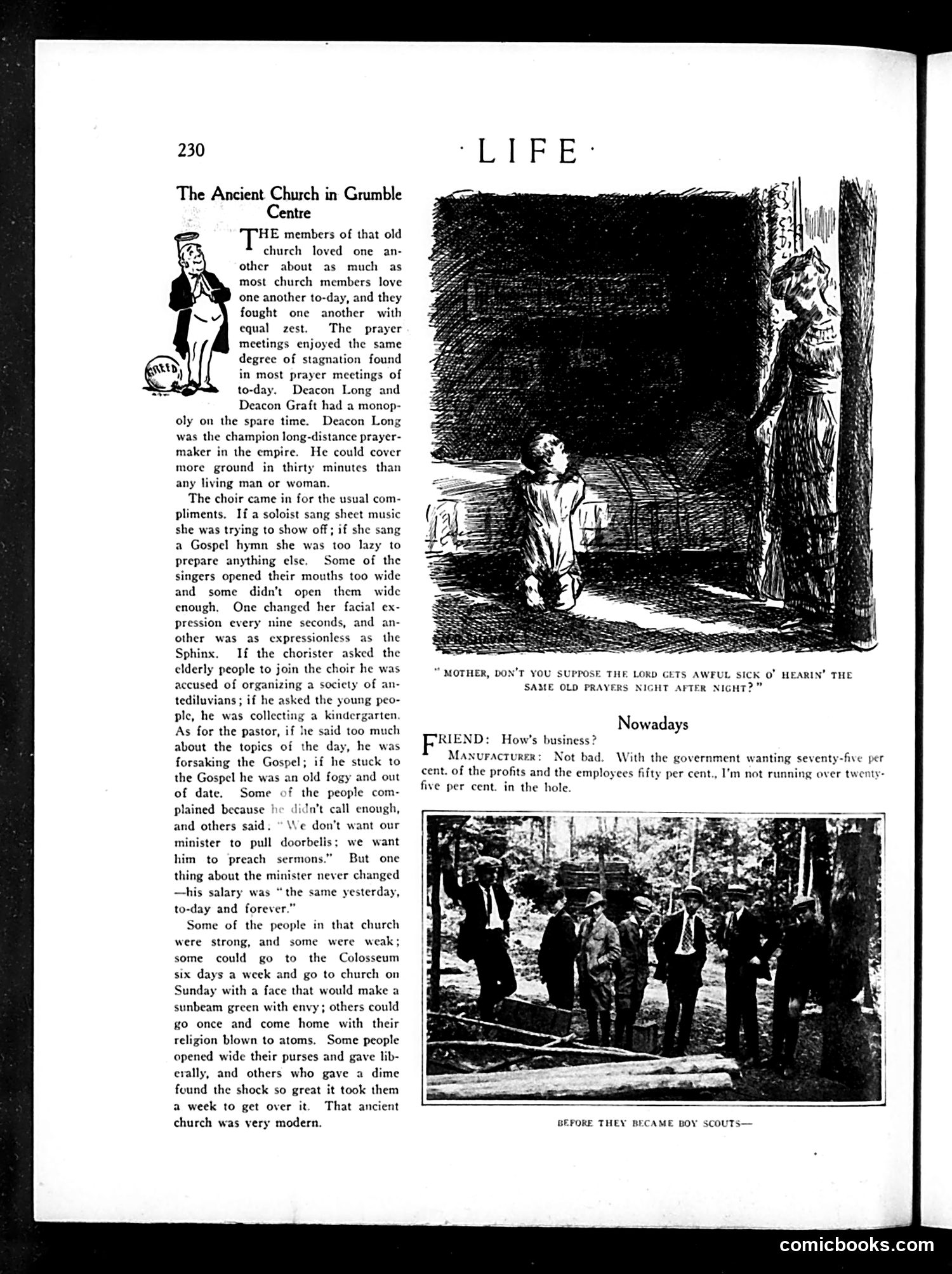
This page contains two satirical pieces mocking contemporary American institutions circa early 1900s. **"The Ancient Church in Grumble Centre"** is a scathing critique of church hypocrisy disguised as historical narrative. The text describes a supposedly ancient church whose members bicker, gossip, and contradict themselves—yet concludes "That ancient church was very modern." The satire reveals that modern churches replicate these same petty conflicts: deacons monopolizing prayer time, choirs facing impossible criticism, pastors condemned whether they address current events or stick to scripture, and congregants' generosity fluctuating wildly. The accompanying illustration shows a child asking whether God tires of repetitive prayers—the innocent question exposing institutional staleness. **"Nowadays"** jokes darkly about a manufacturer squeezed between government taxation (75%) and employee demands (50%), leaving him "twenty-five per cent. in the hole"—mathematically impossible but capturing the era's anxiety about competing demands on business profits during labor activism and increased taxation. Both pieces employ deadpan humor to critique institutional rigidity and economic pressures of the period.
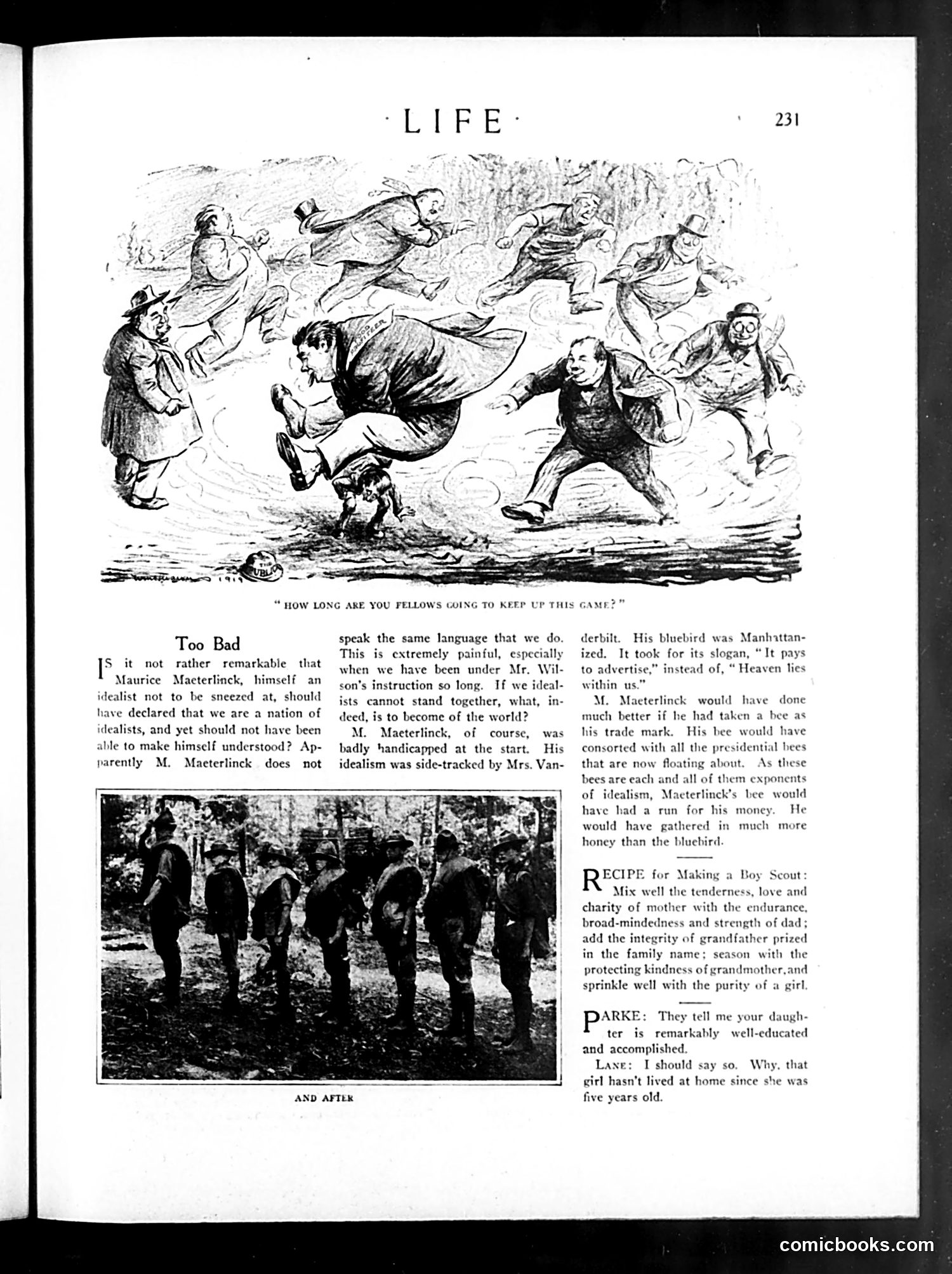
The cartoon depicts men chasing each other chaotically, captioned "How long are you fellows going to keep up this game?" — satirizing American idealists' inability to unite despite shared values. The accompanying text critiques Belgian playwright Maurice Maeterlinck, who declared Americans are a nation of idealists yet couldn't organize themselves. The satire notes Maeterlinck's own idealism was "side-tracked" — likely referring to commercialization of his work (his famous bluebird symbolism had been commercialized with slogans like "It pays to advertise"). The piece sarcastically suggests Maeterlinck should have used a bee instead of a bluebird as his symbol, since American "presidential bees" (appearing to reference politicians or business leaders) already embodied idealism better than his bluebird. The humor targets the gap between America's self-image as idealistic and its chaotic, self-interested actual behavior — with elite European thinkers being naive about American unity.
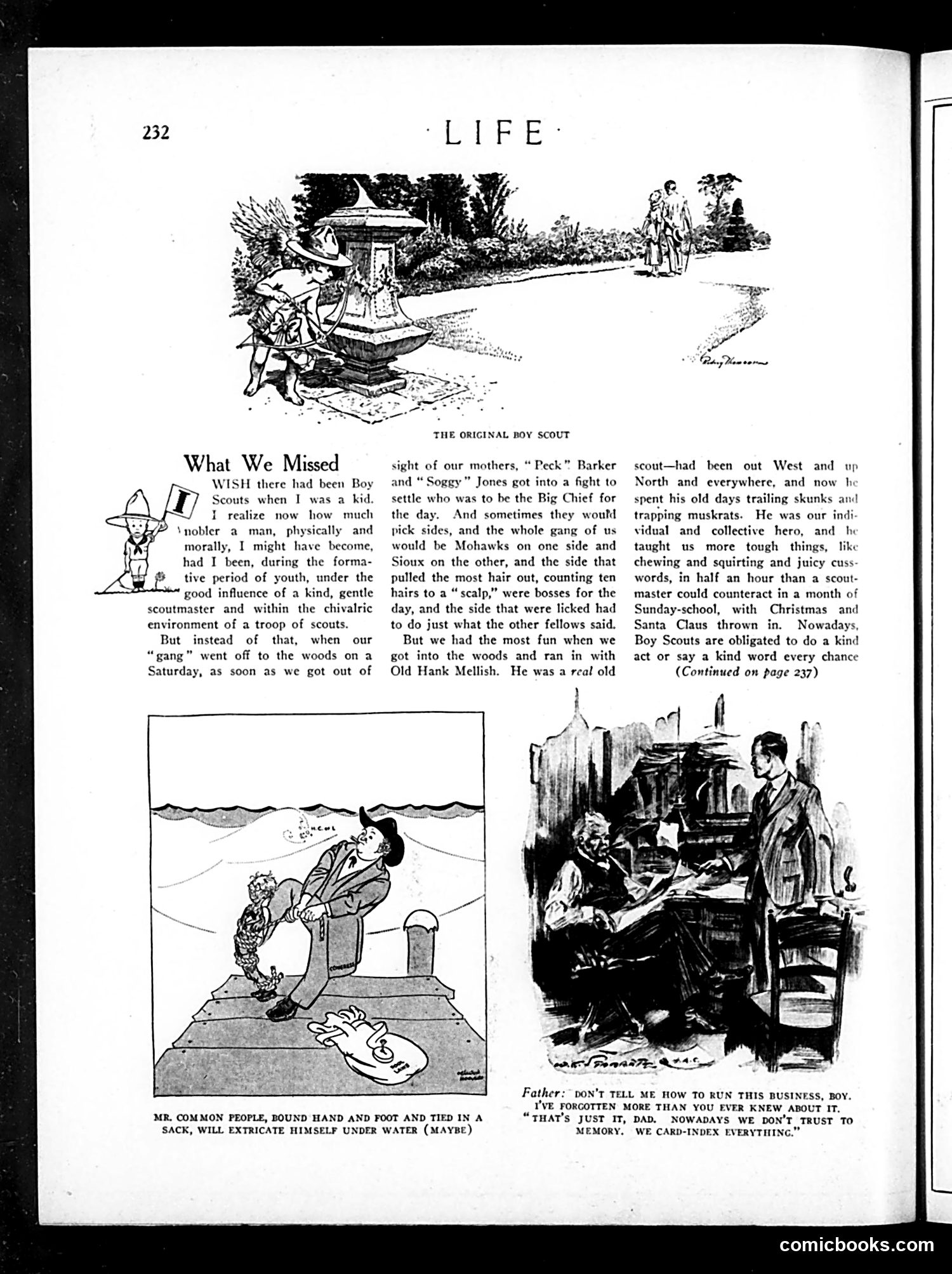
This nostalgic piece contrasts pre-Boy Scout boyhood with modern scouting. The author laments that his generation lacked structured youth organizations, instead roaming unsupervised with rough companions like "Peck" Barker and "Soggy" Jones. Their "gangs" engaged in mock-violent play (fighting over leadership, pulling hair). Their true hero was "Old Hank Mellish," a hardened frontiersman who taught them cursing and tough street wisdom—the opposite of the genteel values Boy Scouts promote. The accompanying cartoons underscore the satire: one depicts boys engaged in rough, dangerous play; another shows a father dismissing his son's modern business methods, saying he trusts memory over filing systems. The joke is that modern Boy Scouts' emphasis on "kind acts" and discipline represents an over-civilized, unnecessarily regimented alternative to authentic boyhood roughness—yet the author simultaneously regrets missing scouting's "noble" influence. The satire cuts both ways, mocking both nostalgic roughness and modern institutional sentimentality.
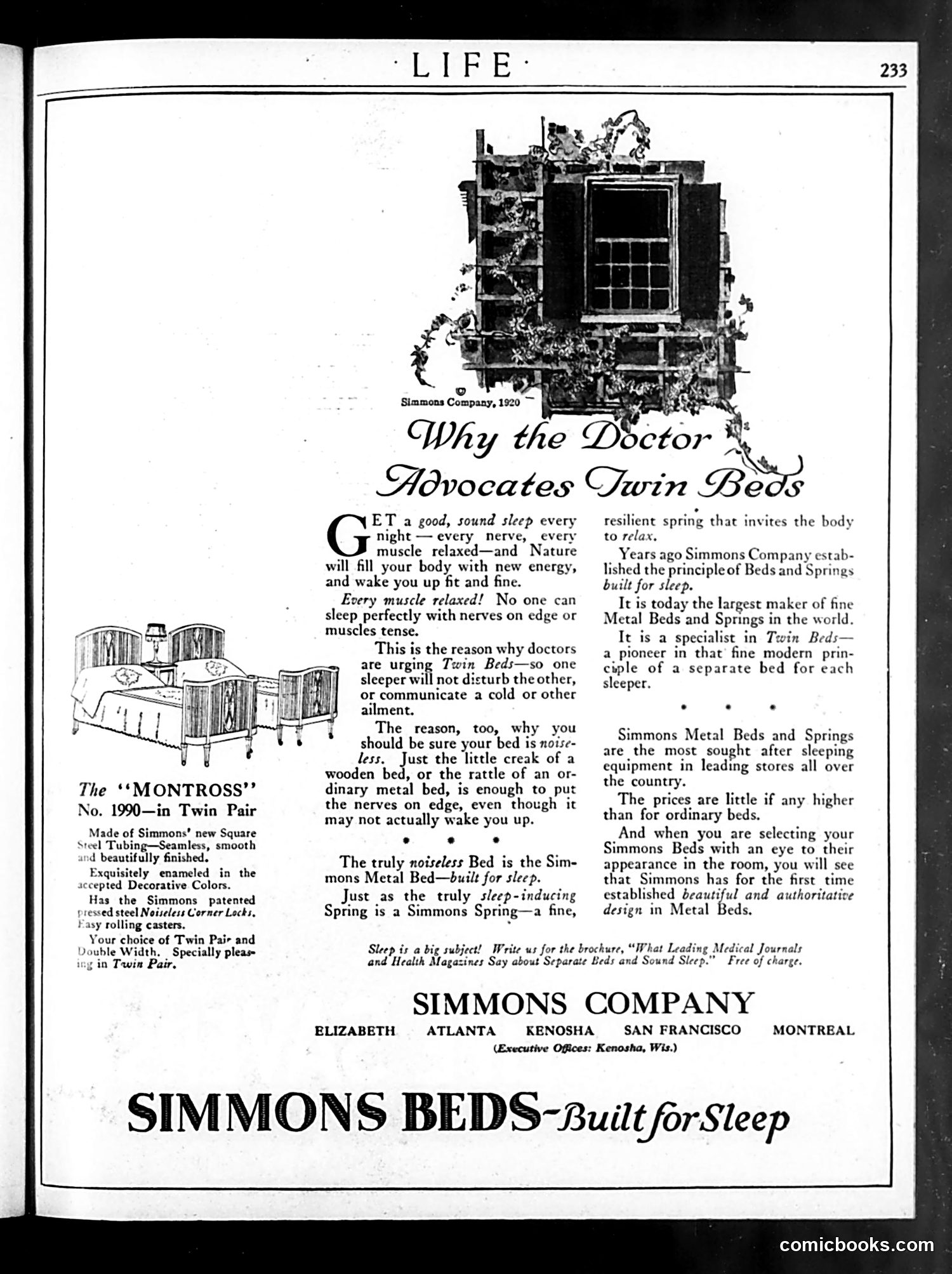
This is a full-page advertisement, not political satire. The "cartoon" element is minimal—just an illustration of twin beds positioned under a window with ivy. The ad promotes Simmons Company's metal twin beds by framing separate sleeping as medically endorsed. The text claims doctors advocate twin beds because one sleeper won't disturb the other with movement, noise, or illness transmission. This reflects 1920s health anxieties and early-century marriage advice emphasizing hygiene and rest. The "Montross" model is highlighted as featuring "noiseless" steel construction and easy-rolling casters. Notably, the ad appeals to both practical concerns (sleep quality) and modern aspirations (design, status as the "largest maker of fine Metal Beds"). There's no political message—this is straightforward commercial persuasion using pseudo-medical authority to market a then-novel concept: separate beds for married couples.
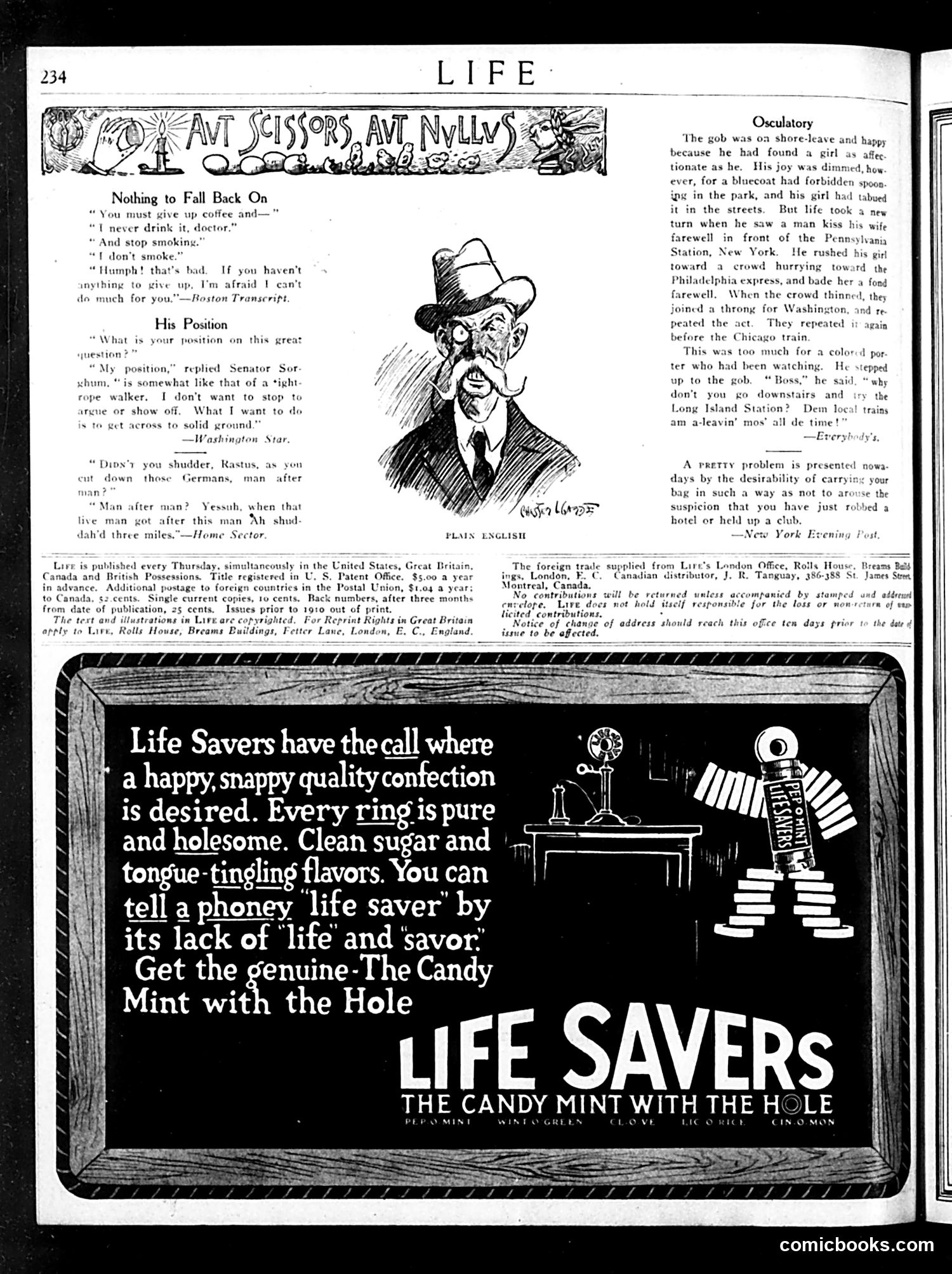
This page from *Life* contains three brief satirical jokes typical of the magazine's humor column, plus a Life Savers candy advertisement. **"Nothing to Fall Back On"** mocks a doctor whose patient has nothing to sacrifice—the joke being that without vices (coffee, smoking) to renounce, medical advice becomes useless. **"His Position"** quotes Senator Sorbum comparing himself to a tightrope walker who wants only to "get across to solid ground"—satirizing political evasiveness and refusal to take clear stances on issues. **"Osculatory"** uses a racial stereotype (a Black porter speaking in exaggerated dialect) to humorously describe a sailor and girl kissing across multiple train stations to avoid park/street prohibitions on public affection. The page is primarily advertising-driven, with Life Savers taking up substantial space, marketing their distinctive hole-in-the-middle mint candy as superior to inferior competitors.
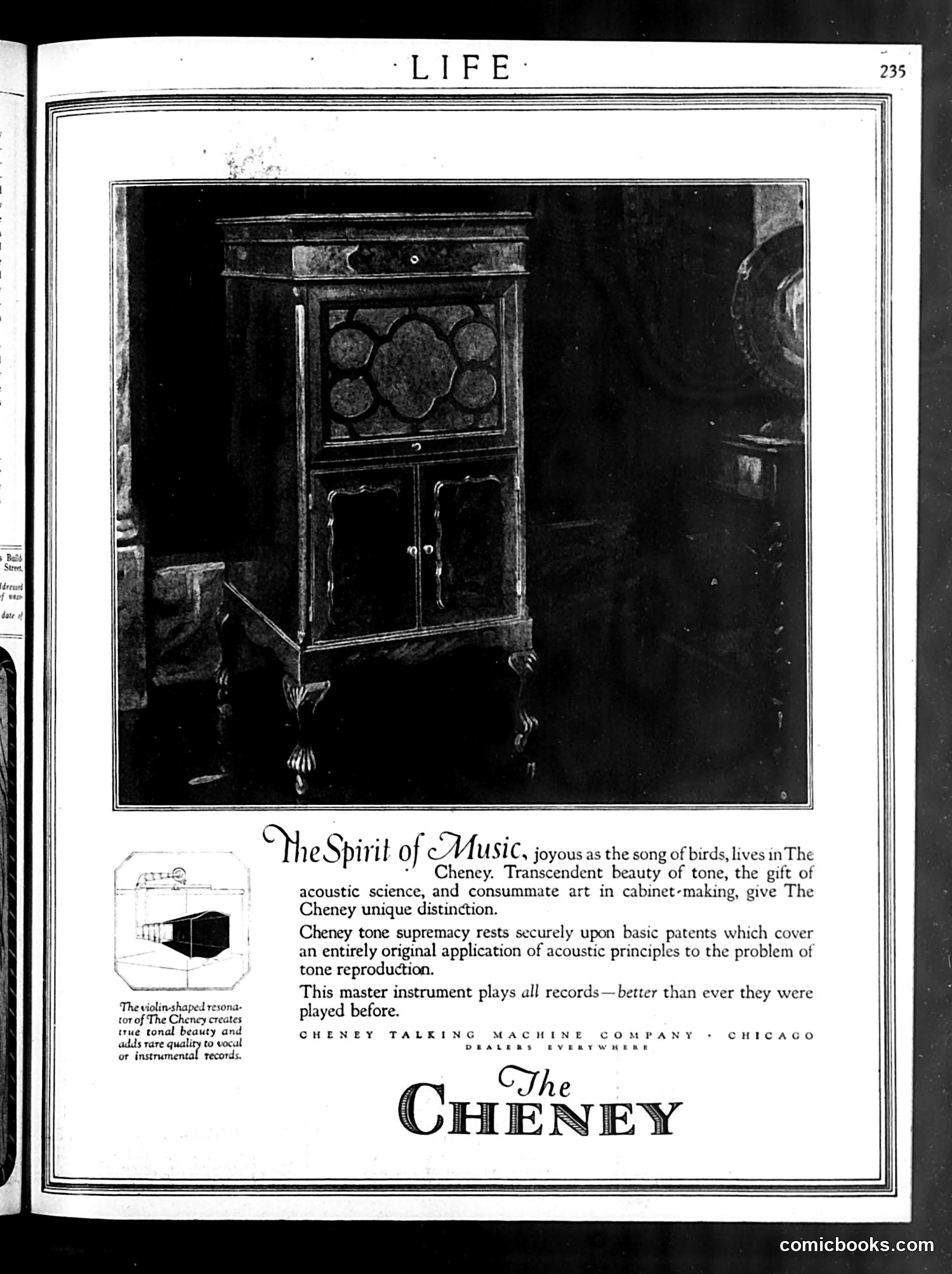
This is **not a cartoon or satire** — it's a full-page advertisement for The Cheney, a phonograph (record player) manufactured by the Cheney Talking Machine Company of Chicago. The ad promotes the machine's superior sound quality, emphasizing "acoustic science" and "cabinet-making" as sources of distinction. The central image shows an ornate wooden cabinet phonograph with decorative details and claw feet, typical of 1920s-era design. The copy claims The Cheney plays all records "better than ever they were played before" and boasts proprietary patents for tone reproduction. A small diagram in the lower left shows "the violin-shaped resonator" — the acoustic innovation supposedly responsible for superior sound. This represents early 20th-century consumer marketing: appealing to aspirational buyers seeking both quality sound technology and attractive home furniture.
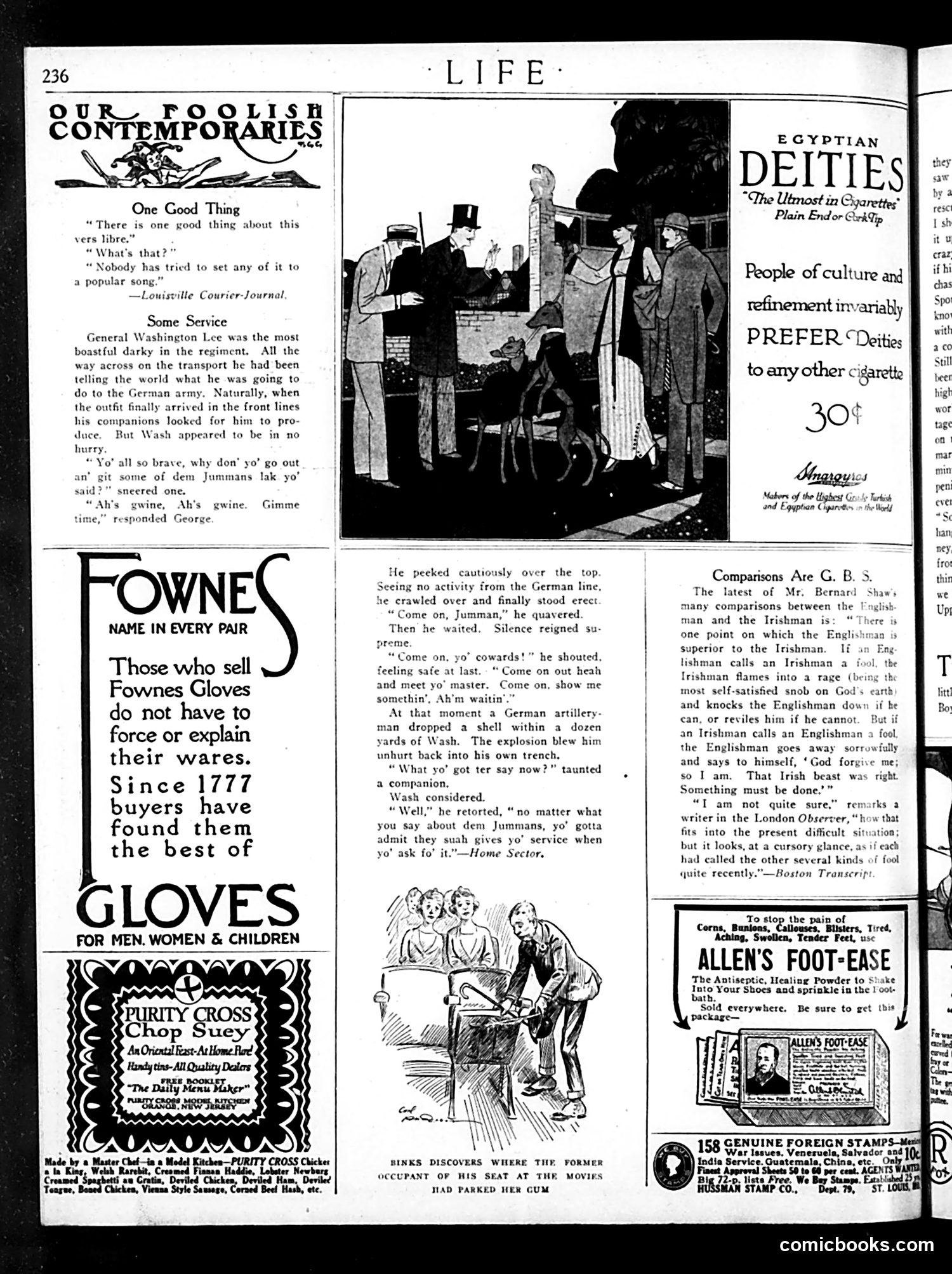
This Life magazine page contains several satirical pieces reflecting WWI-era attitudes: **"Some Service"** cartoon mocks racial stereotypes through a dialect-heavy story about "General Washington Lee," a Black soldier. The joke relies on period racist caricature: he boasts about fighting Germans but cowers when shelled, then praises German efficiency. The satire targets both false bravado and, implicitly, the contradiction of Black soldiers fighting for a country denying them rights. **"Our Foolish Contemporaries"** critiques modernist free verse poetry as unmemorable—"Nobody has tried to set any of it to a popular song." **"Comparisons Are G.B.S."** references playwright George Bernard Shaw's observations comparing English and Irish national character, treating ethnic generalizations as witty philosophy. The remaining content is advertising (Fownes Gloves, Egyptian Deities cigarettes, Allen's Foot-Ease, stamps)—typical for Life magazine's revenue model. The page reflects 1910s-20s popular humor: crude racial stereotyping presented as entertainment, literary modernism dismissed as pretentious, and ethnic stereotyping treated as sophisticated social commentary.
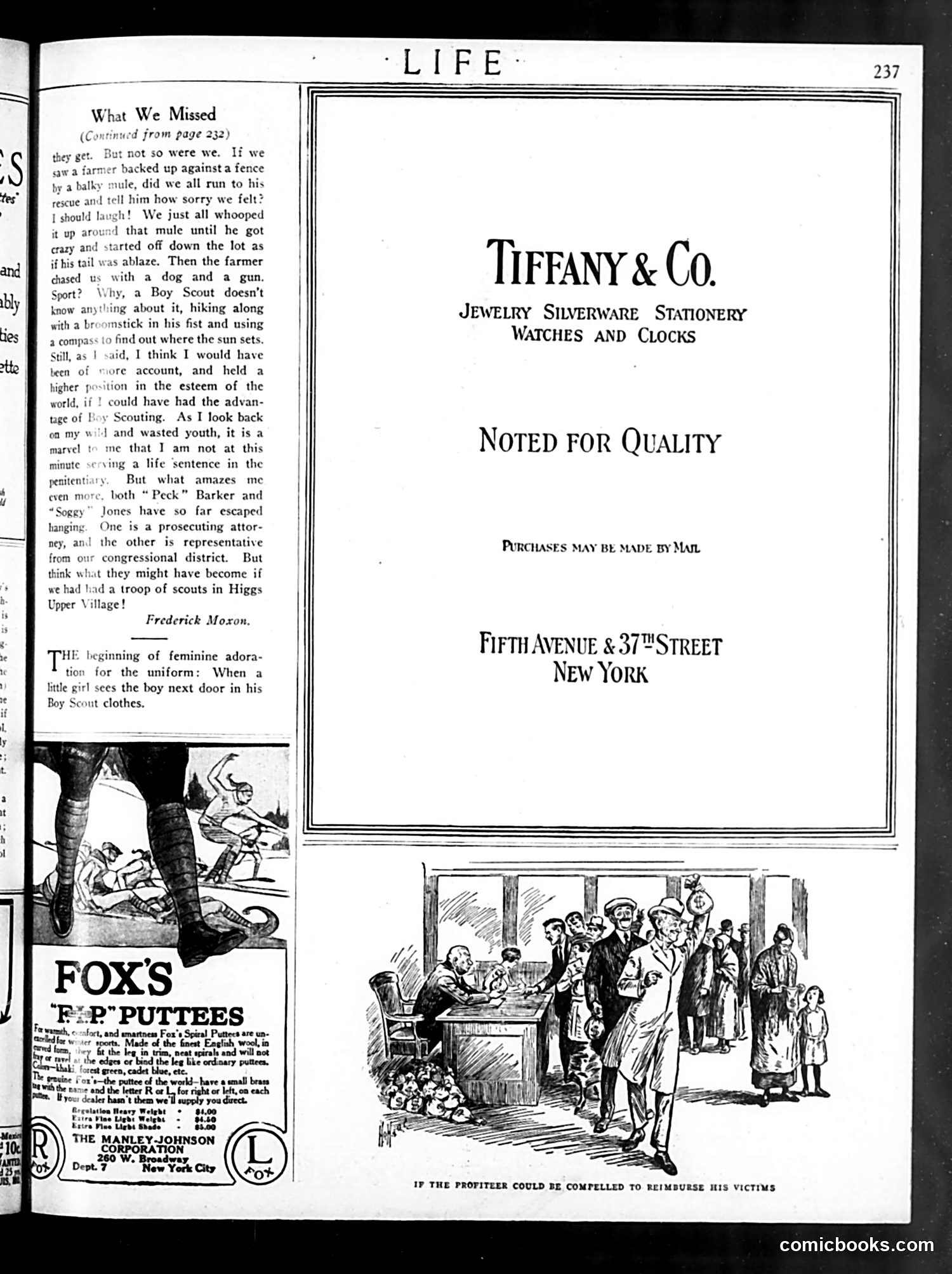
This is primarily an **advertisement page** for Tiffany & Co. luxury goods, with supporting editorial content. The main cartoon at bottom depicts a **wartime profiteering scene**: a crowd of ordinary citizens (appearing to be poor or working-class) confronts what seems to be a profiteer or war-profiteer at a counter. The caption reads: "IF THE PROFITEER COULD BE COMPELLED TO REIMBURSE HIS VICTIMS." This references **WWI-era concerns** about merchants exploiting civilians through price-gouging and unfair wartime commerce. The cartoon satirizes how profiteers enriched themselves while ordinary people suffered economically. The left column contains a nostalgic essay by Frederick Moxon praising Boy Scouts, contrasting his own misspent youth with the character-building benefits scouting provides. A smaller illustration shows a girl admiring a Boy Scout uniform—captioned as the "beginning of feminine adoration for the uniform."
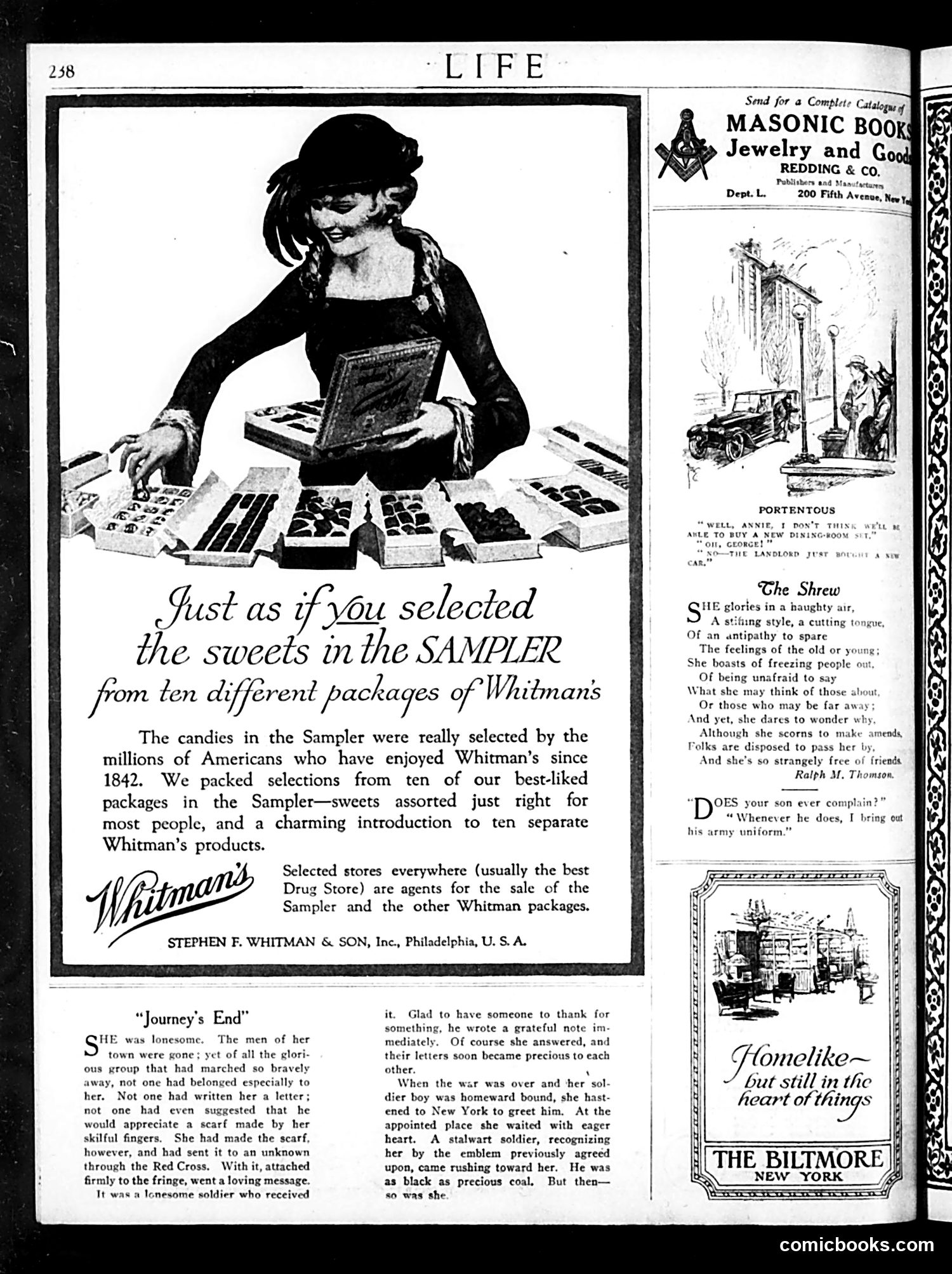
This page is primarily **advertising** rather than political satire. The dominant content is a Whitman's candy sampler advertisement featuring an illustrated woman selecting chocolates, with marketing copy explaining the product's appeal. The page also contains two brief **fictional vignettes**: 1. **"Journey's End"**: A wartime romance story where a lonely woman sends a Red Cross scarf to an unknown soldier. They correspond, fall in love, and meet in New York—revealing both are Black. The story's point appears to be presenting an unconventional wartime romance, though the ending line ("as black as precious coal") suggests contemporary racial attitudes. 2. **"The Shrew"**: A satirical poem about a disagreeable woman whose cutting manner drives away friendships, mocking her surprise at social isolation. The page includes smaller advertisements for Masonic books, The Biltmore hotel, and a humorous exchange about a son's complaints. The overall content reflects early 20th-century magazine format: mixed advertising, light fiction, and social commentary without overt political satire.
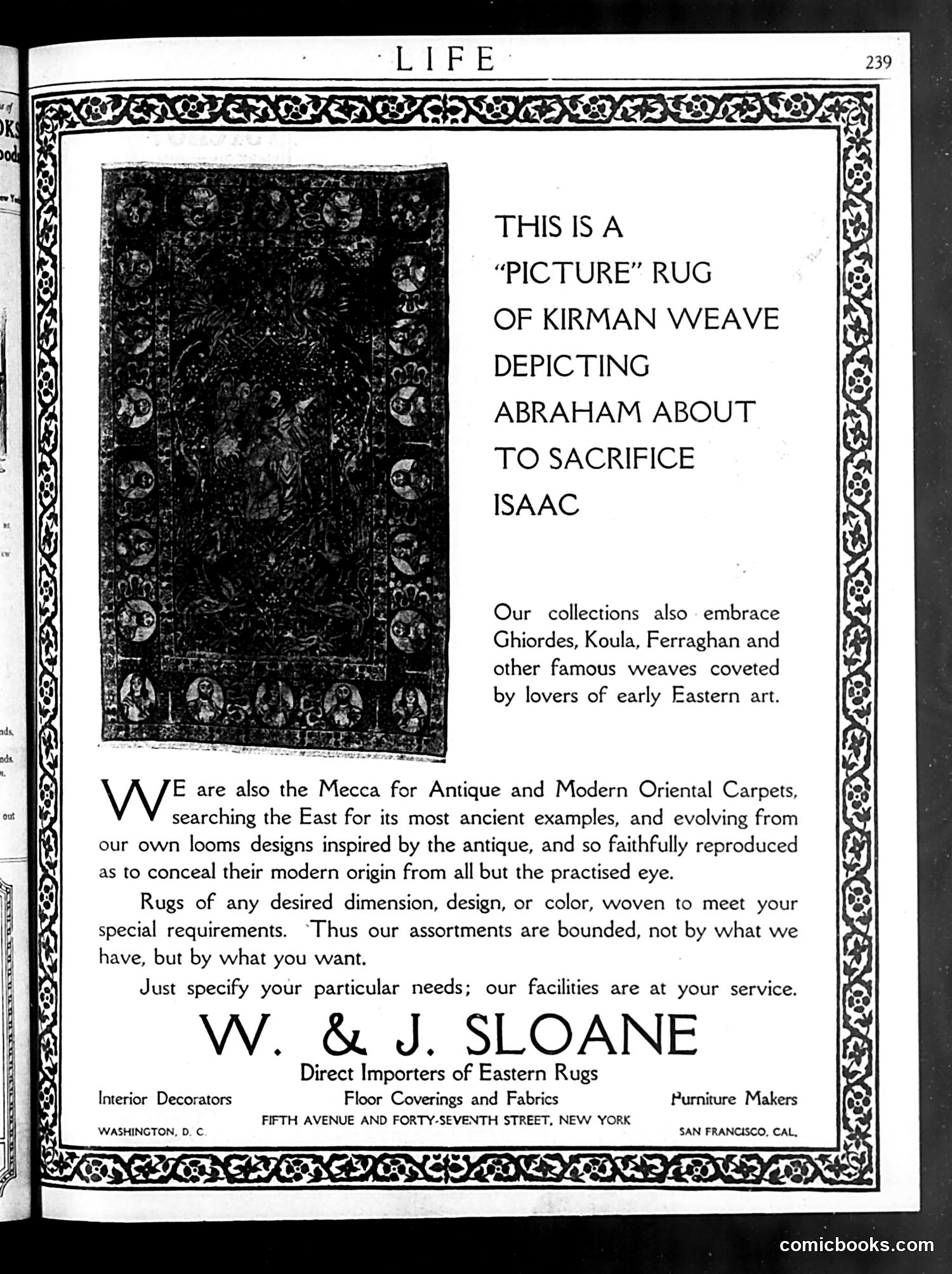
This is primarily a **luxury advertisement**, not political satire. W. & J. Sloane, a high-end furniture and rug company, is advertising ornamental Kirman rugs featuring biblical imagery. The page displays a decorative "picture rug" depicting Abraham's near-sacrifice of Isaac—a famous Old Testament scene. The advertisement emphasizes the rug's Eastern origin and authentic craftsmanship, marketing it to wealthy interior decorators and collectors of antique Eastern art. The copy's tone is aspirational and exclusive, promising custom rugs "of any desired dimension, design, or color" and boasting of the company's ability to reproduce antique designs so convincingly that only experts can distinguish modern from authentic pieces. This last detail—the admission they can deceive buyers—is presented as a selling point rather than criticized, reflecting early 20th-century attitudes toward luxury goods and consumer sophistication. There is no political cartoon or satire present on this page.
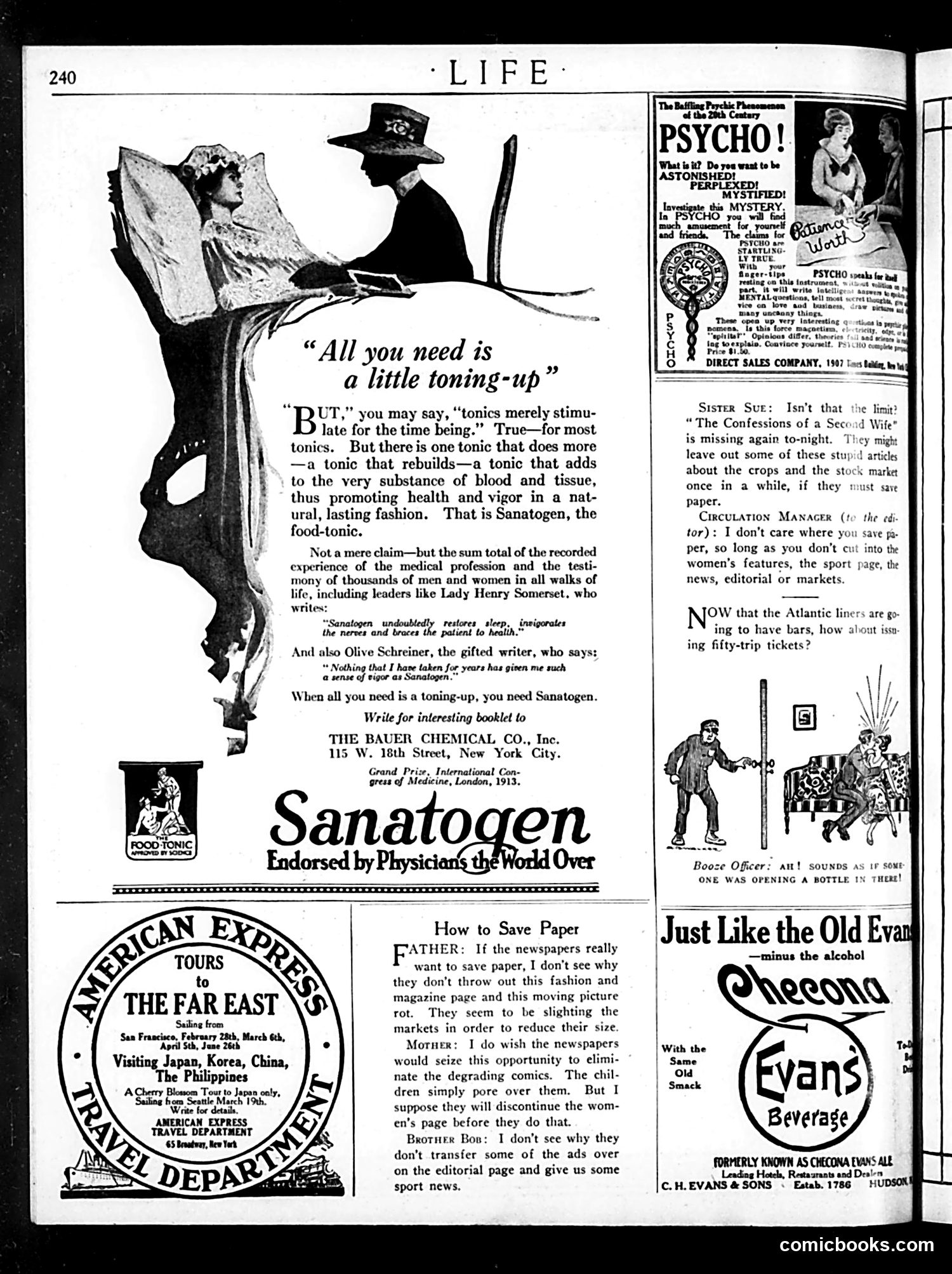
This page combines advertisements with satirical commentary on newspaper priorities during a paper-conservation effort (likely WWI-era rationing). **Main Cartoon/Commentary:** The illustrated dialogue ("How to Save Paper") features a family debating what newspapers should cut to conserve resources. Each family member prioritizes differently—father suggests eliminating fashion and entertainment sections, mother wants to remove comics, brother wants sports preserved. The circulation manager's final response reveals the satirical point: newspapers won't actually cut meaningful content because advertising and popular features (women's sections, sports, news) drive circulation and revenue. The satire mocks newspapers' claimed commitment to paper-saving while protecting profitable content. **Advertisements:** The page also features Sanatogen (a "food tonic"), American Express Far East tours, and Cocoana beverage—period marketing using testimonials and health claims typical of early 20th-century advertising. The cartoon's humor relies on readers recognizing newspaper economics and the gap between stated conservation goals and actual business priorities.
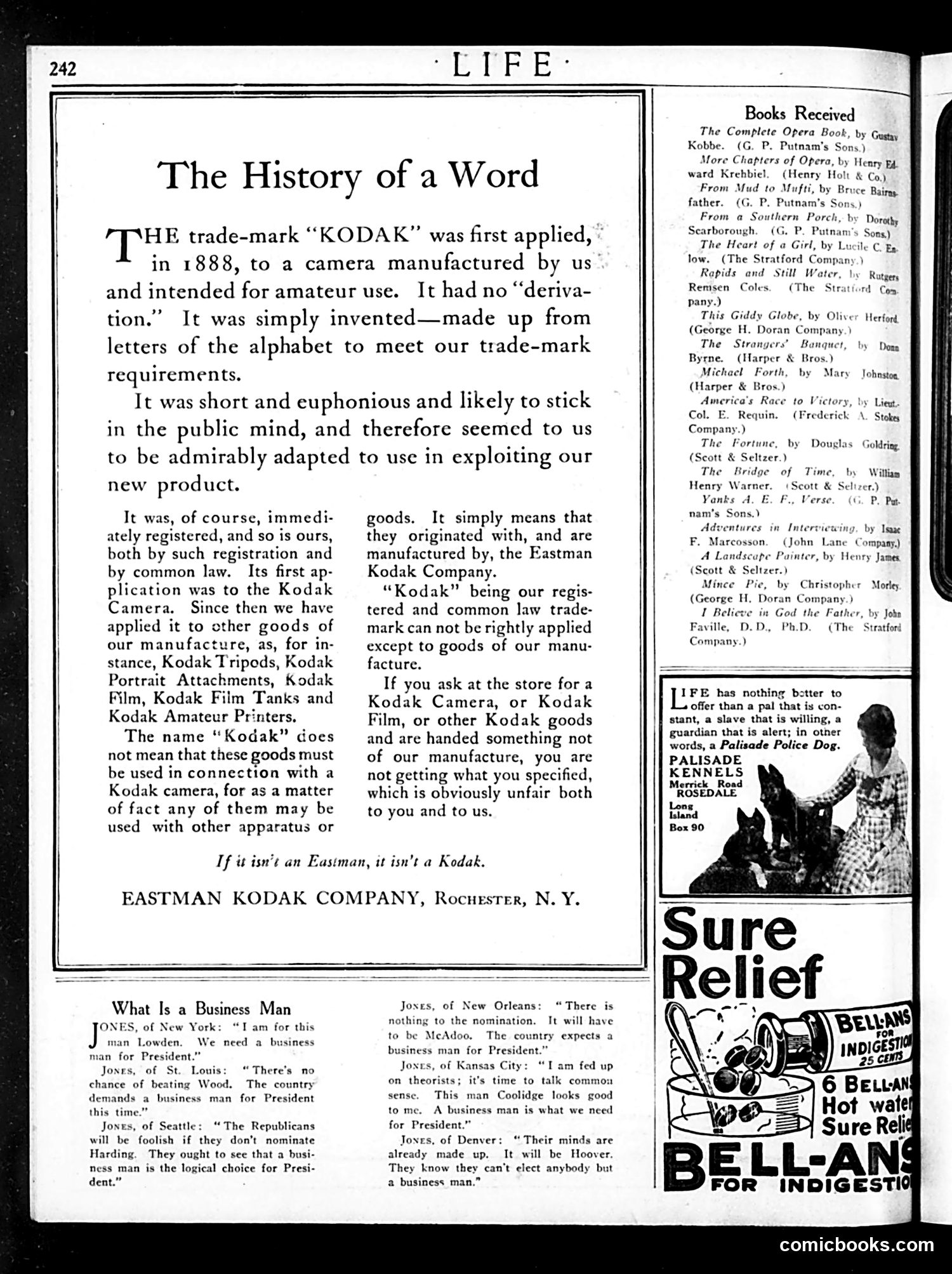
This is primarily **corporate advertising and editorial content**, not political satire. The main feature is Eastman Kodak Company's explanation of their trademarked "Kodak" name—explaining it was invented in 1888 purely for marketing purposes and cannot legally be applied to non-Kodak products. The right page contains book advertisements and a brief satirical section titled "What Is a Business Man," featuring quotes from various "Jones" figures across American cities (New Orleans, St. Louis, Seattle, Kansas City, Denver). Each expresses different political preferences for the upcoming presidential election, yet all conclude that a "business man" is needed—the joke being that despite disagreeing on *who*, they all agree on the *type*. This likely reflects post-WWI American sentiment favoring business-minded leadership over politicians. The page also advertises Palisade Police Dogs and Bell-Ans indigestion remedy.
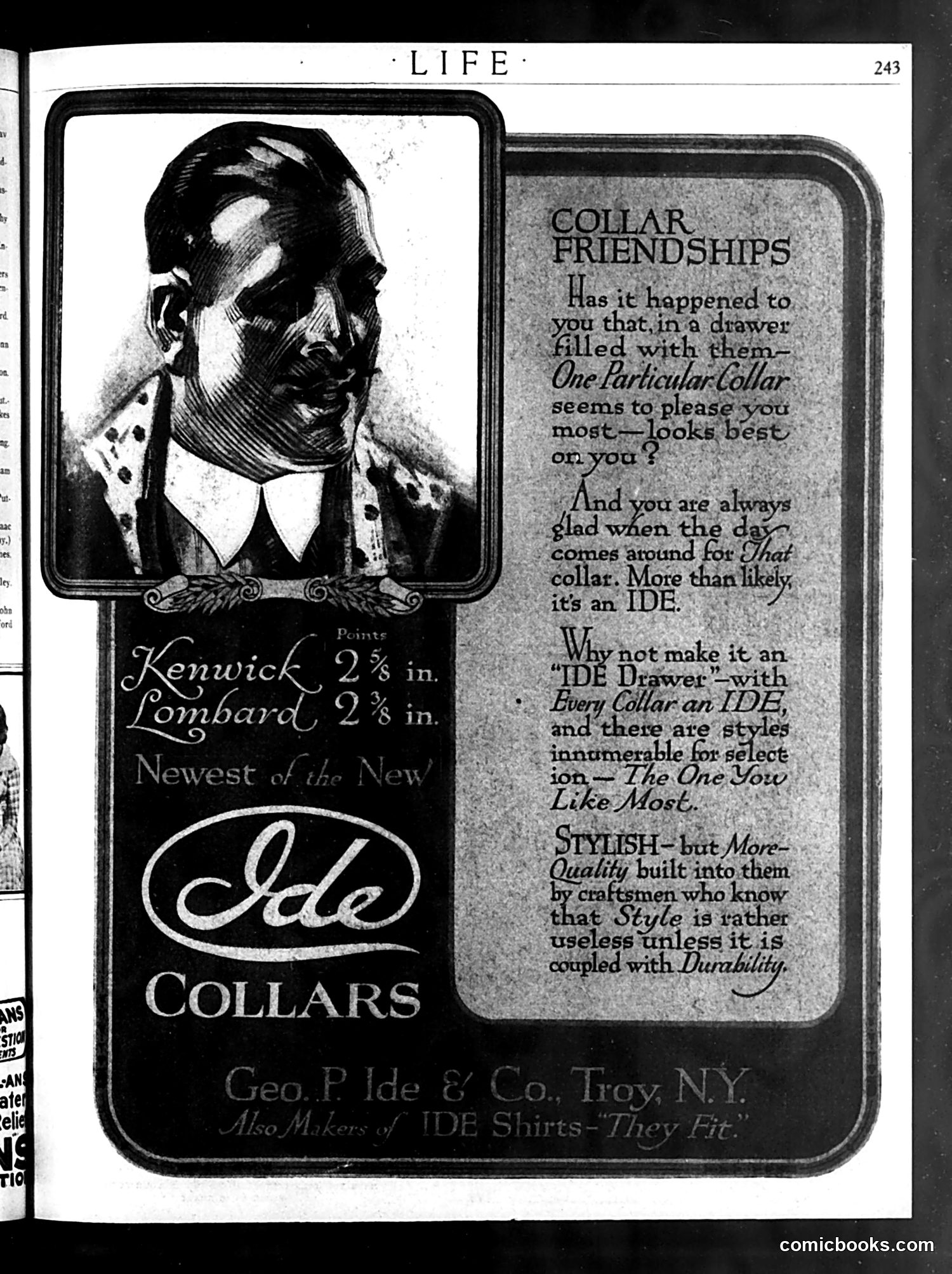
This page is primarily a **product advertisement** for Ide Collars, not a political cartoon or satirical content. The left side shows a **portrait illustration** of a man's face labeled "Kenwick 2⅜ in. Lombard 2⅜ in." — these appear to be collar style names. The right side is advertising copy titled "Collar Friendships," using genteel language to market collar products. The ad's humor is gentle and commercial rather than satirical: it playfully suggests that men develop attachments to particular collar styles and keep a "drawer" of favorites. The copywriting emphasizes quality, durability, and style—positioning Ide Collars as the sophisticated choice for discerning men. This reflects early 20th-century men's fashion marketing, when detachable collars were standard business wear. There is **no political satire** evident on this page.
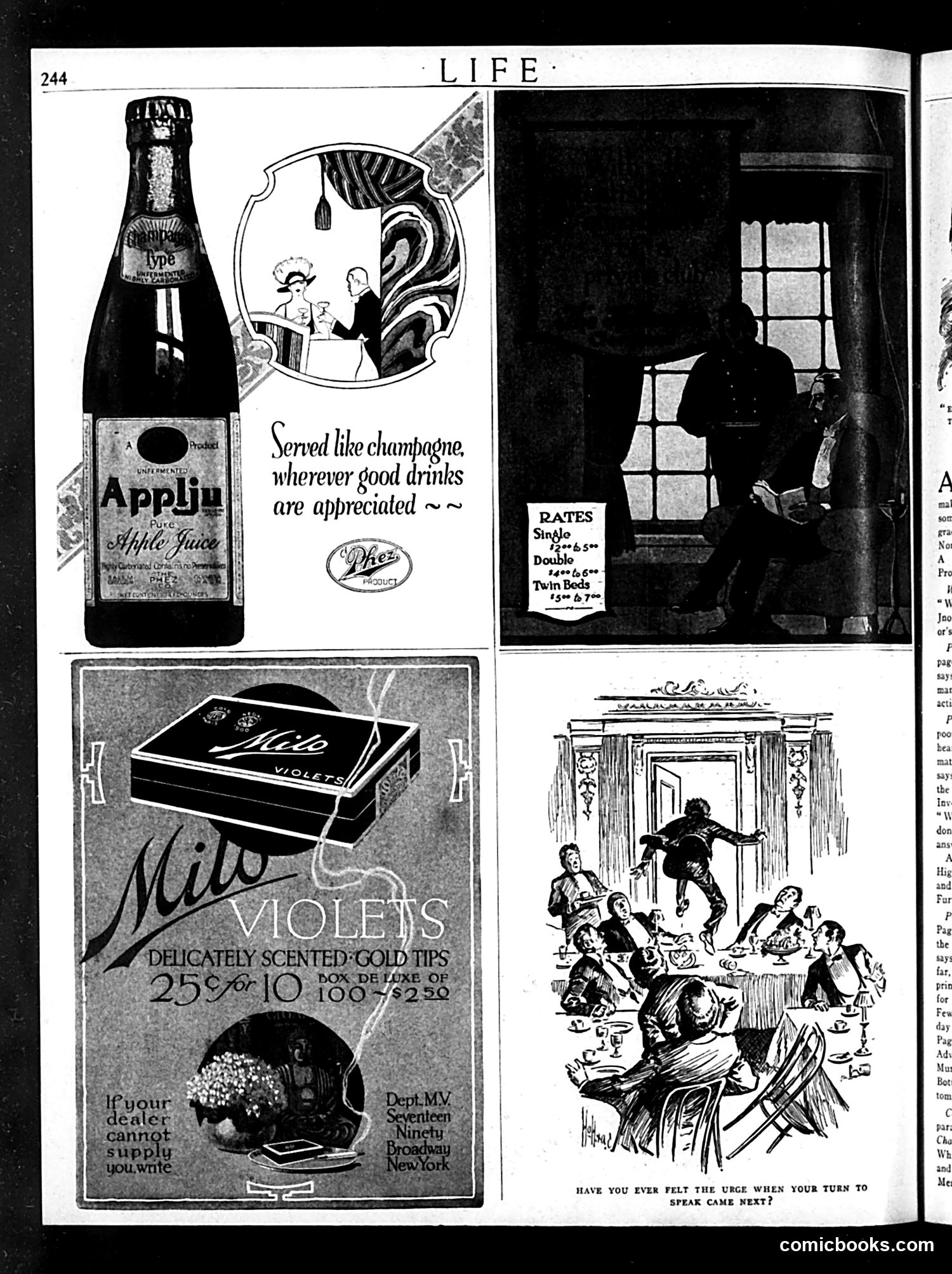
This page contains three advertisements and one cartoon. The top left advertises Applin Apple Juice as a champagne substitute. Below that, Milo Violets candy is promoted as "delicately scented gold tips" at 25¢ for a box of 100. The cartoon (bottom right) depicts a formal dinner scene where a man appears to be jumping or lunging across a table toward other diners. The caption asks: "Have you ever felt the urge when your turn to speak came next?" This satirizes social anxiety about public speaking—the joke being that the man's nervousness about giving a speech manifests as an uncontrollable urge to physically flee or act out, rather than calmly address the group. It's a humorous commentary on the discomfort many feel when required to speak publicly at formal gatherings.
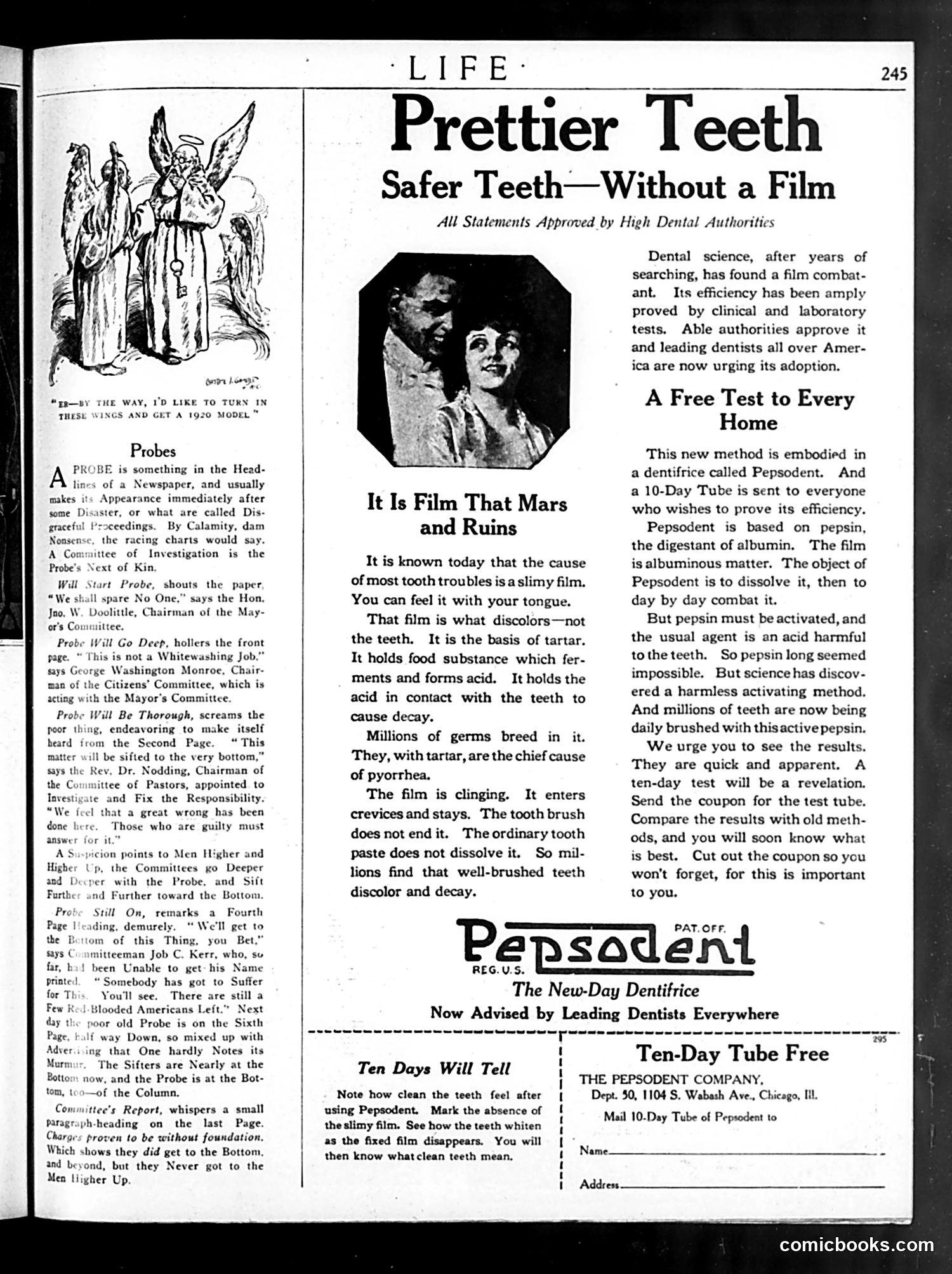
**The Cartoon (Upper Left):** An angel figure holds wings, saying "By the way, I'd like to turn in these wings and get a 1920 model." This is a satirical commentary on the era's obsession with modern technology and consumer goods—even in heaven, one wants the latest model. It reflects 1920s American materialism and the cult of "newness." **"Probes" Column (Left):** This satirizes government investigation committees formed after scandals or disasters. Life mocks how these "Probes" start with grand promises ("We shall spare no one"), descend deeper through layers of committees, then ultimately disappear into obscurity at the bottom of newspaper pages—never actually reaching the "Men Higher Up" responsible. It's political satire about institutional ineffectiveness and how investigations protect the powerful. **Right Side:** The majority of the page is a **Pepsodent toothpaste advertisement**, not editorial content. This was common in Life magazine—advertisements occupied substantial space.
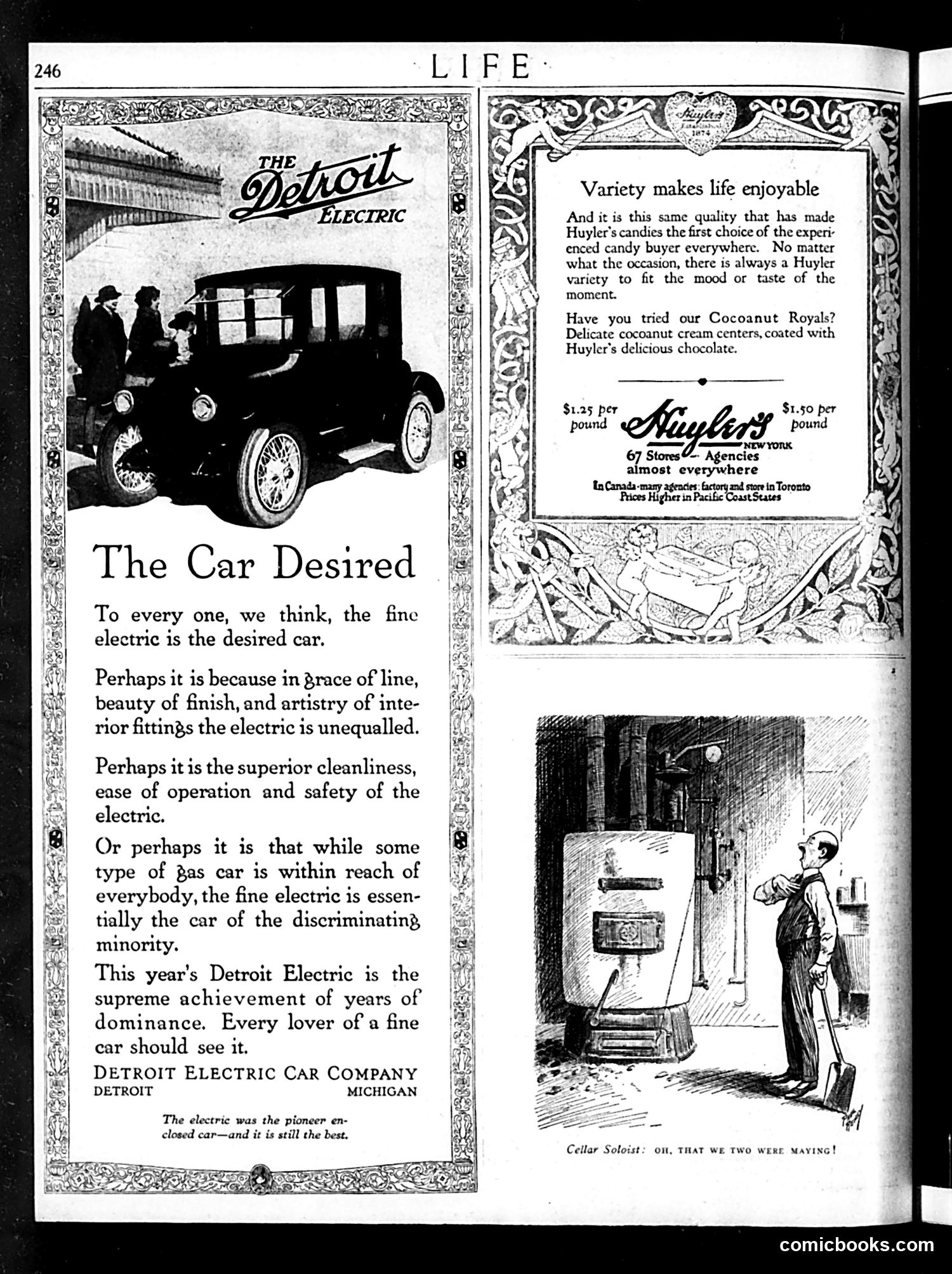
This page contains two unrelated advertisements with no political cartoon. **Left side:** Detroit Electric Car Company promotes their electric automobile as a luxury vehicle for the "discriminating minority"—positioning it as superior in aesthetics, cleanliness, and safety compared to gas cars accessible to "everybody." The ad reflects early 1900s class distinctions and the brief period when electric cars competed with gasoline engines before gas cars dominated the market. **Right side:** Huyler's candies advertisement emphasizes product variety to suit different occasions and tastes. **Bottom:** A small cartoon labeled "Cellar Soloist" shows a man in a cellar singing, with the caption "Oh, that we two were maying!"—a lighthearted joke about romantic sentiment expressed in an awkward location rather than outdoors during springtime ("maying").
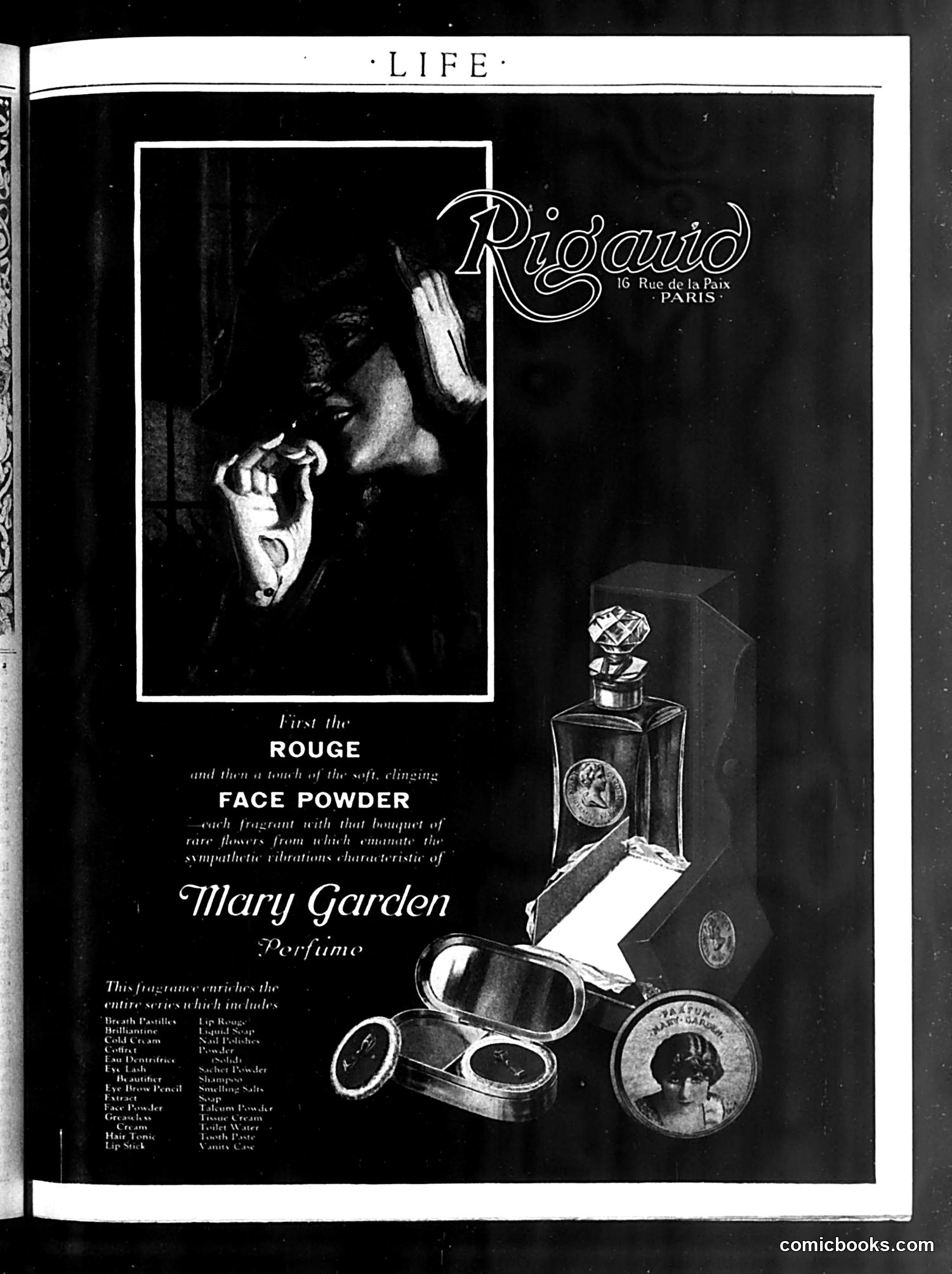
This is an advertisement, not a cartoon. It promotes Rigaud perfume and cosmetics from a Paris address (16 Rue de la Paix). The ad features a stylized photograph of a woman applying makeup—specifically rouge and face powder—presented as part of the "Mary Garden Perfume" line. The copy uses flowery, pseudo-scientific language typical of 1920s beauty marketing, claiming the products contain "rare flowers" with special "sympathetic vibrations." For modern readers, this reflects the era's aggressive marketing of cosmetics to women, combining luxury branding with pseudoscientific claims about fragrance and beauty products that would likely face regulatory scrutiny today.
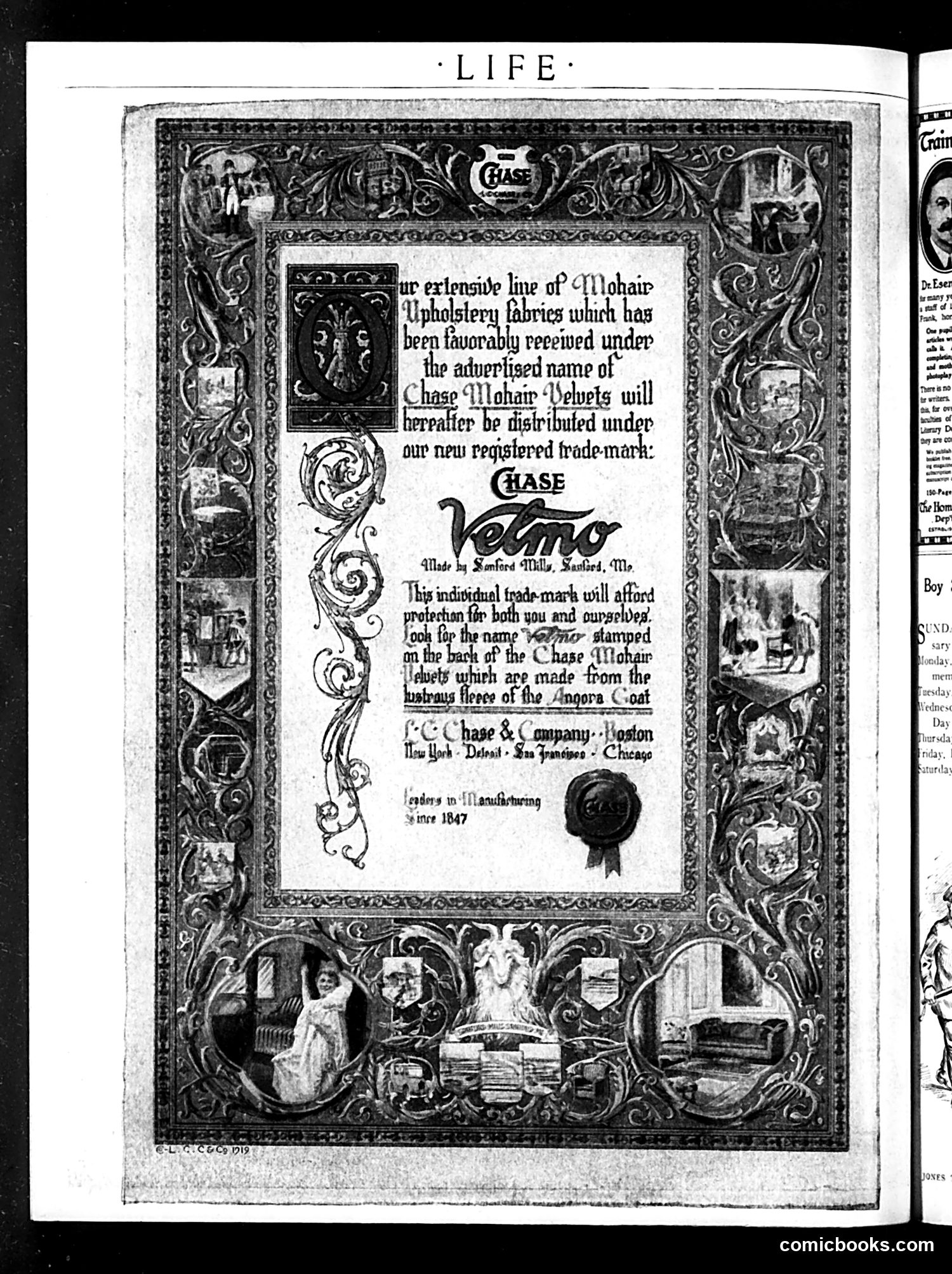
This page is **primarily an advertisement**, not a political cartoon. It promotes Chase Velmo, a trademarked upholstery fabric line made by Chase & Company (Boston, New York, Detroit, San Francisco, Chicago). The ad announces a rebranding: Chase Mohair Velvets—previously sold under that name—will now be distributed under the new trademark "Chase Velmo." The ornate border and decorative design are typical of early 20th-century luxury goods advertising. The key selling point is that the fabric is made from "the lustrous fleece of the Angora Coat," emphasizing quality materials. The ad promises the trademark will "afford protection for both you and ourselves," suggesting brand authentication against counterfeits. The company claims to have been "in manufacturing since 1847," establishing legitimacy and longevity in the upholstery business. This is commercial messaging rather than satire or political commentary.
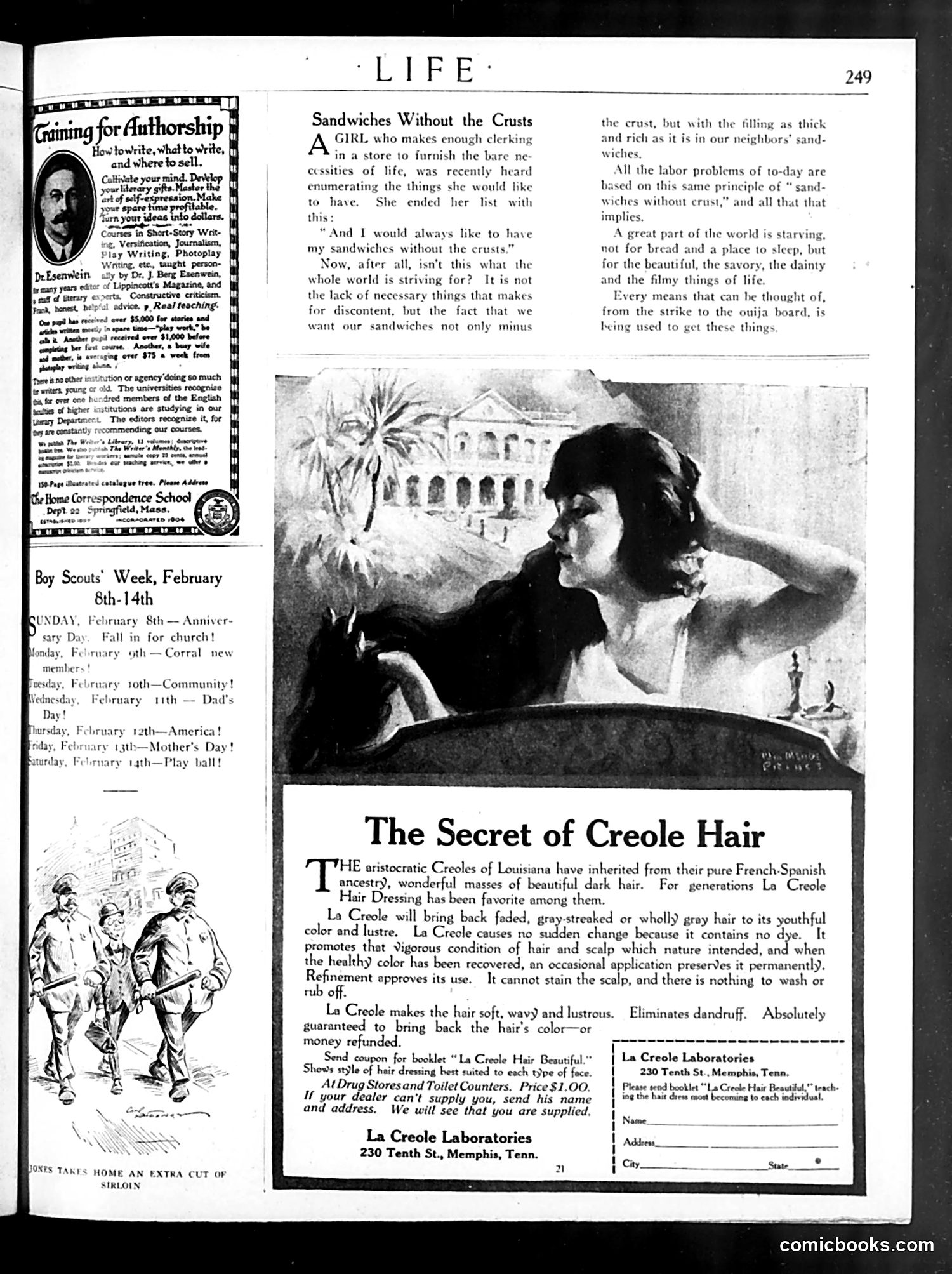
This satirical piece uses a working girl's humble wish—sandwiches without crusts—as a metaphor for human discontent. The article argues that widespread labor unrest isn't caused by actual poverty or lack of necessities, but by wanting *nicer* versions of what others have. The girl doesn't need more food; she wants the *refined* version her wealthier neighbors enjoy. The satire critiques both workers and the wealthy: workers are portrayed as envious of luxuries rather than fighting genuine deprivation, while implicitly, the rich enjoy these "better" sandwiches as their due. By February 1914 (likely the publication date), labor strikes and social unrest were escalating in America—this piece dismisses such movements as mere envy of comfort rather than legitimate grievance over wages or conditions. The piece reflects early 20th-century paternalistic attitudes toward labor organizing, treating workers' desires for dignity and comfort as petty vanity rather than justified demands.
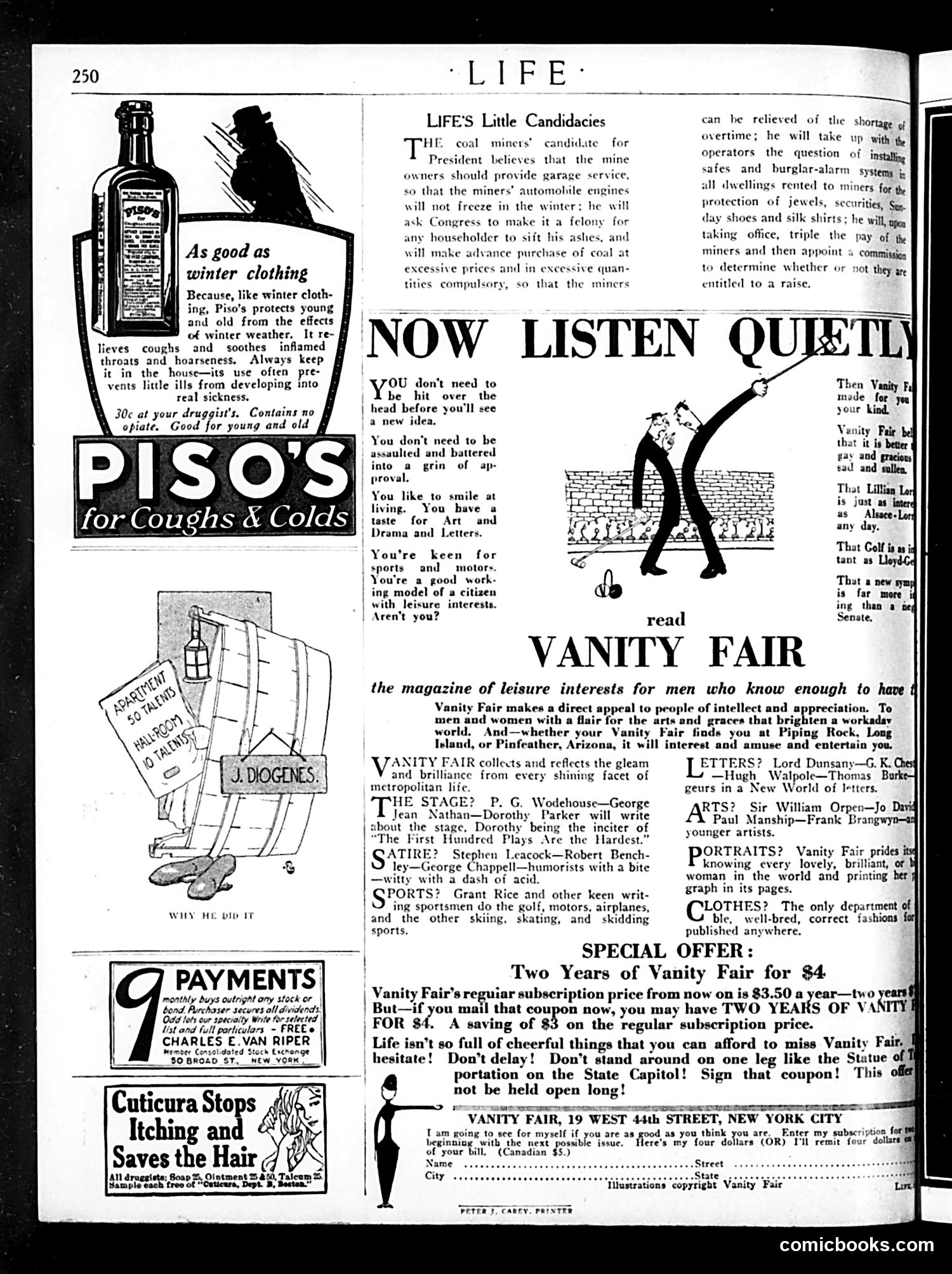
The main cartoon, "LIFE's Little Candidacies," satirizes a fictional coal miners' presidential candidate by listing absurdly paternalistic campaign promises. The satirist mocks both the candidate's naïveté and mining-industry labor relations of the era. The candidate proposes that mine owners provide garage service so miners' engines won't freeze, make sifting ashes a felony, and mandate advance coal purchases at inflated prices—proposals so ridiculous they highlight the real inadequacy of protections for miners. The piece critiques how politicians offer trivial gestures while avoiding genuine labor reforms. It appears to reference actual Progressive-era debates about mining safety and workers' rights, though no specific candidate is named. The page is primarily **advertising** (Piso's cough remedy, Vanity Fair magazine subscriptions, Cuticura products), with satirical content supporting the publication's leisured, intellectual readership.
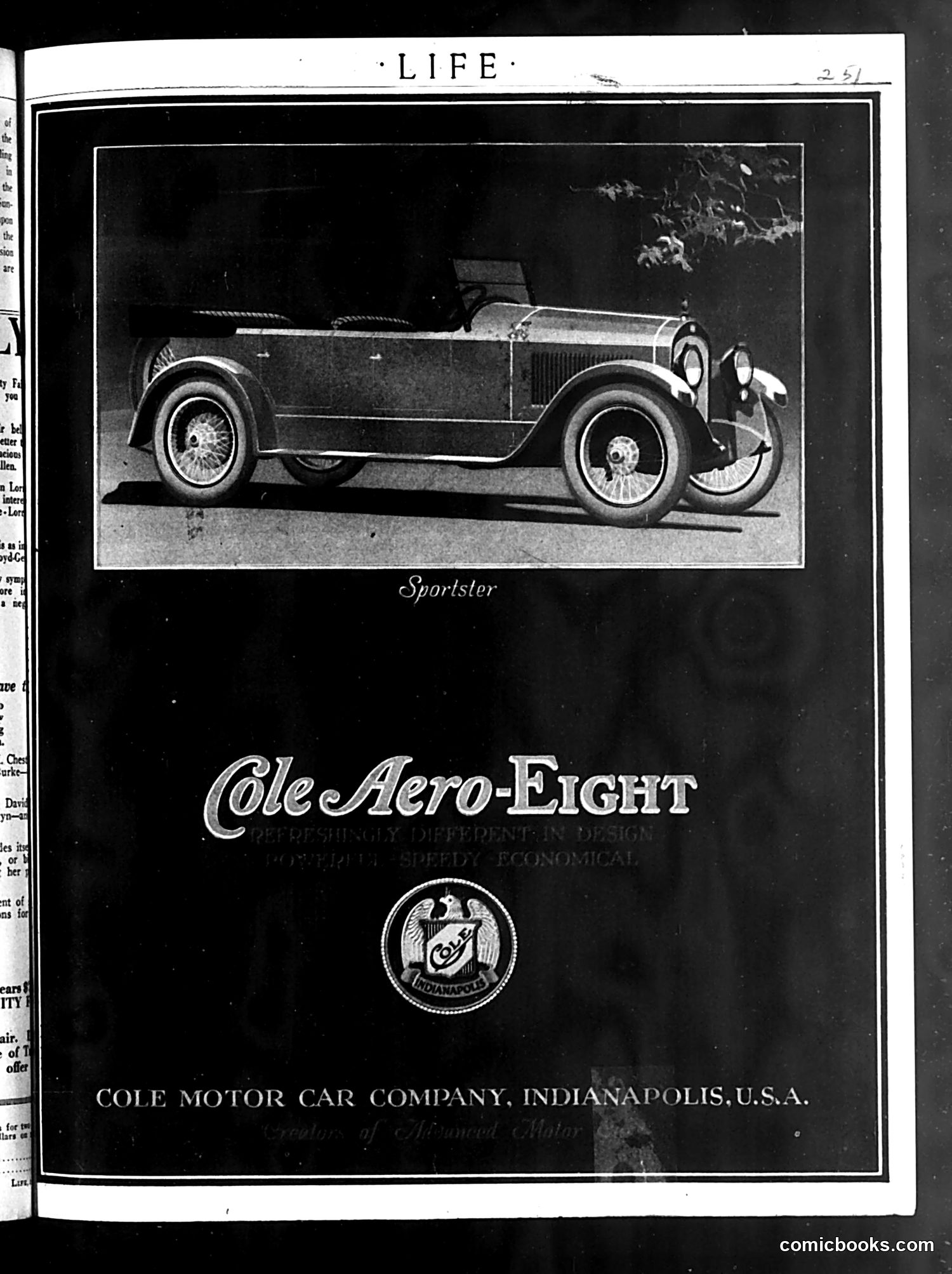
This is **not a cartoon or satire page** — it's a **full-page advertisement** for the Cole Aero-Eight automobile, manufactured by the Cole Motor Car Company of Indianapolis. The ad features a photograph of a "Sportster" model vehicle shown in profile, emphasizing its open-air convertible design with spoke wheels and period styling. Below the vehicle image appears the product name in decorative script lettering, a company logo, and manufacturer information. The tagline (partially visible in OCR) references the car as "speedy" and "economical" — typical early automotive advertising claims. This represents straightforward product promotion rather than political satire or social commentary. It's simply how manufacturers advertised automobiles in this era of Life magazine.
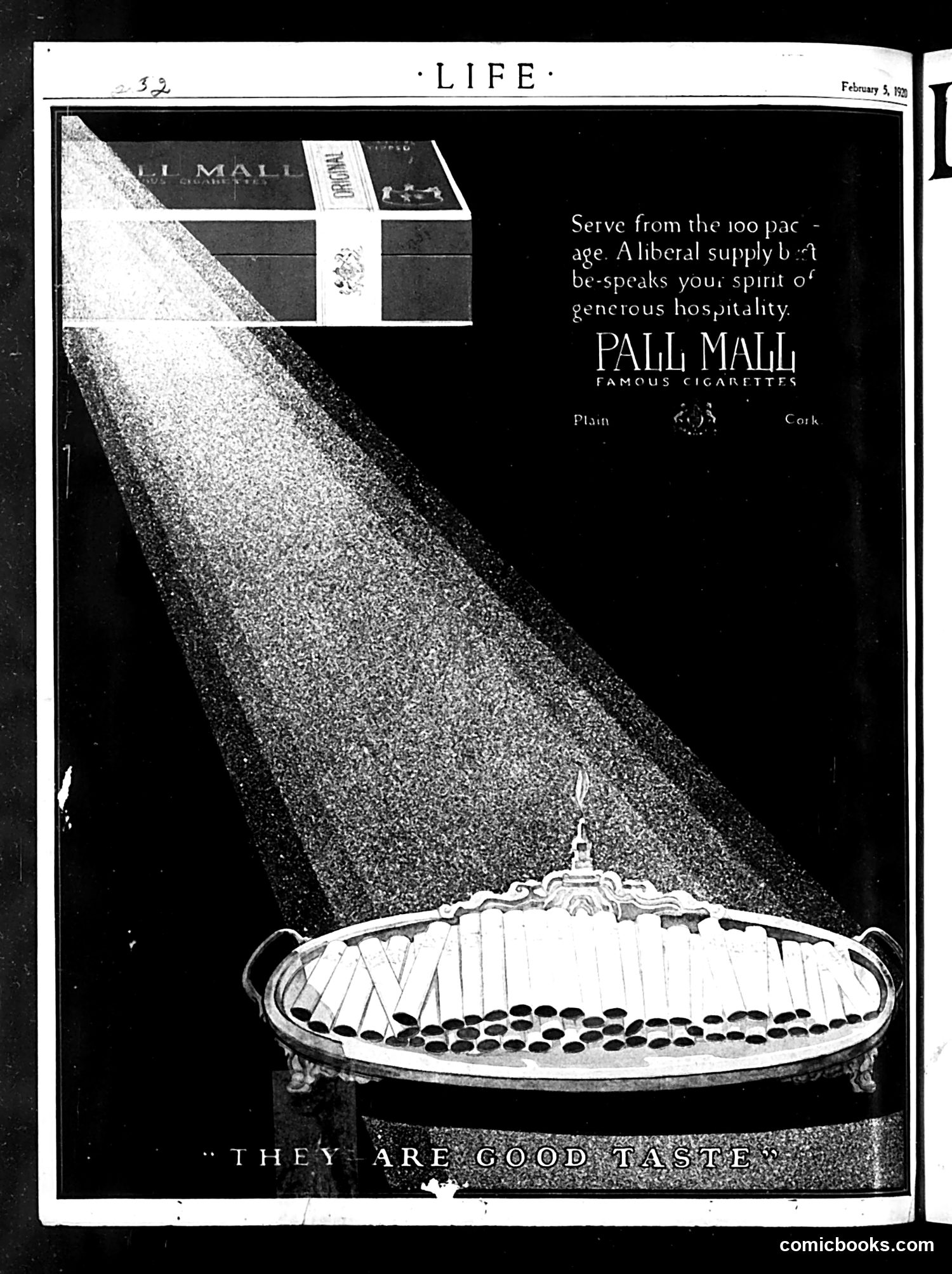
This is a full-page advertisement for Pall Mall cigarettes from Life magazine (February 5, 1928). The image shows an elegant serving tray filled with cigarettes arranged like food or refreshments, illuminated by dramatic spotlight. The ad frames cigarettes as items for hospitality—suggesting hosts should serve them to guests from the "100 package" to demonstrate generosity and good taste. The tagline "They are good taste" emphasizes social status. This reflects early 20th-century advertising that normalized smoking as sophisticated social behavior. The elegant presentation and hospitality angle were common marketing strategies before health warnings existed. The ad assumes cigarettes were desirable gift items and status symbols worthy of formal serving presentations.