
Life, 1920-02-05 · page 28 of 52
Life — February 5, 1920 — page 28: what you’re looking at
What you’re looking at
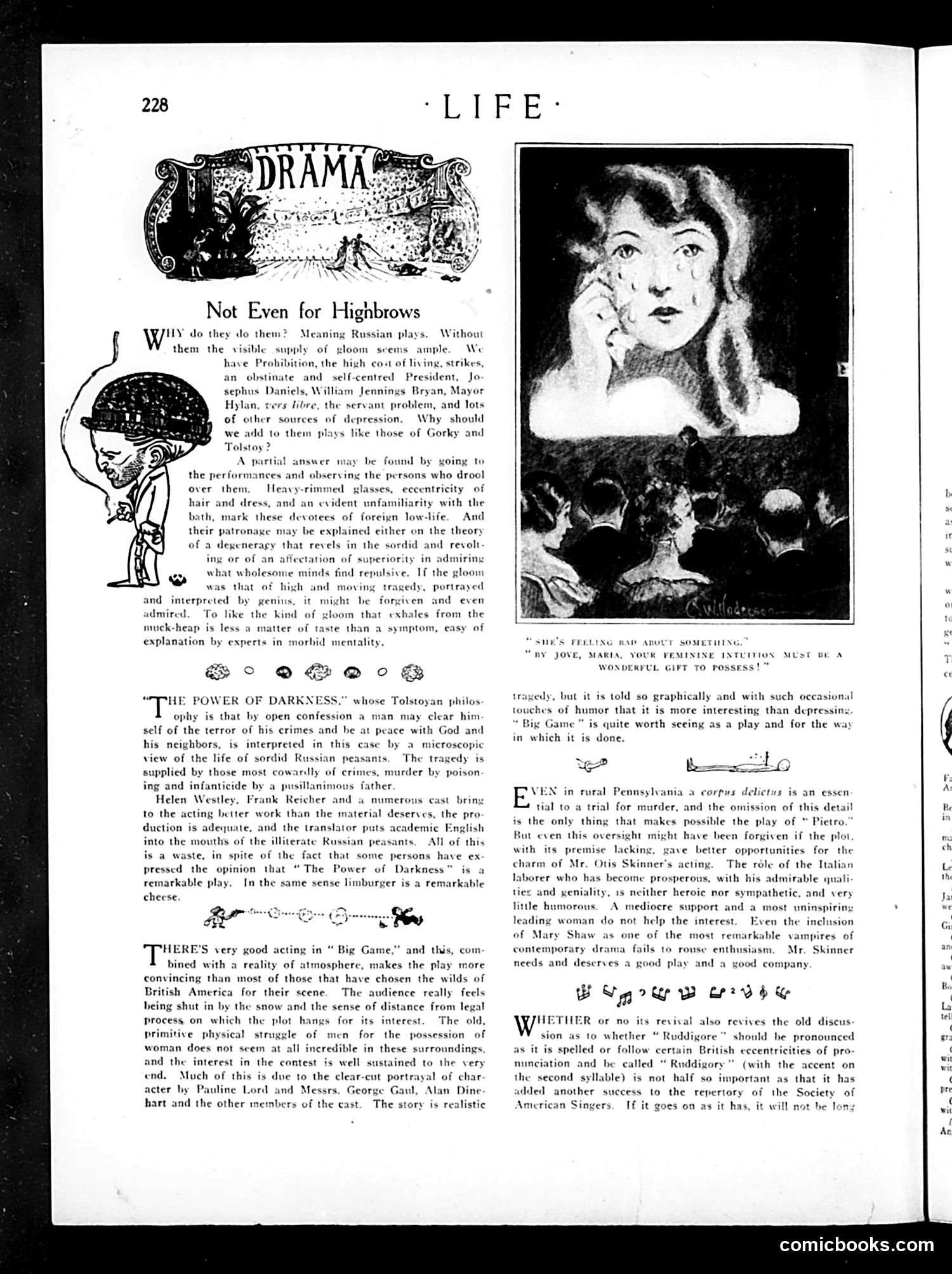
This page critiques the American fascination with Russian plays—particularly works by Tolstoy and Gorky—as pretentious and morbid. **The Main Cartoon**: The small caricature depicts a typical Russian-play enthusiast: someone with heavy glasses, eccentric hair/dress, and poor hygiene. The satire mocks their supposed degeneracy or affectation of superiority in admiring "foreign low-life." **The Social Context**: The article lists contemporary American miseries (Prohibition, high living costs, strikes, unpopular President) as sufficient gloom without importing Russian tragedies. It dismisses patrons of these plays as either morbidly fascinated by sordid peasant life or pretending intellectual sophistication. **The Reviews**: The page then covers actual theater productions—"The Power of Darkness" and "Big Game"—acknowledging their effective staging while maintaining skepticism about their artistic value. **The Satire's Point**: Life mocks both the plays themselves (as unnecessarily depressing) and their American admirers (as either psychologically troubled or pretentious snobs). The humor derives from 1920s American exceptionalism and suspicion of European cultural imports.
📄 Transcribed text from this page (OCR, searchable)
Machine-transcribed from the original scan — historical spelling and the odd misread are preserved.
Not Even for Highbrows HY do they do them? Meaning Russian plays. Without them the visible supply of gloom seems ample. We have Prohibition, the high cost of living, strikes, an obstinate and self-centred President, sephus Daniels, William Jennings Bryan, Mayo! Hylan, ¢ nd lots of other sources of depression. Why should we add to them plays like those of Gorky and Tolstoy? 's libre, the servant problem, A partial answer may be found by going to the performances and observing the persons who drool over them. Heavy-rimmed glasses, eccentricity of hair and dress, and an evident unfamiliarity with the bath, mark these devotees of foreign low-life. And their patronage may be explained either on the theory of a dexeneragy that revels in the sordid and revolt ing or of an affectation of superiority in admiring what wholesome minds find repulsive. If the g was that of xh and moving tragedy, portrayed might be fe loom that exhales fr ven and even the and interpreted by genius, 1. To like the kind of muck-heap is less a matter of taste than a symptom, explanation by experts in morbid mentality. admir. > o @ @ oo B HE POWER OF DARKN ophy is that by open confession a man may clear him self of the terror of his crimes and be at peace with God and his neighbors, is interpreted in this case by a microscopic view of the life of sordid Russian peasants. The tragedy is supplied by those most cowardly of crimes, murder by poison ing and infanticide by a pusillanimous father. Helen Westley, Frank Reicher and a numerous cast. bring to the acting better work than the material deserves, the pro duction i into the mouths of the illiterate Russian peasants. All of this is a waste, in spite of the fact that some persons have ex pressed the opinion that “The Power of Darkness” is a remarkable play. In the same sense limburger is a remarkable cheese whose Tolstoyan philos adequate, and the translator puts academic English HERE'S very good acting in me,” and this, com bined with a reality of atmosphere, makes the play more convincing than most of those that have chosen the wilds of British America for their scene. The audience really feels being shut in by the snow and the sense of distance from legal Process on which the plot hangs for its interest. The old, primitive physical struggle of men for the possession of woman does not seem at a Big l incredible in these surroundings and the interest in the contest is well sustained to the very end, Much of this is due to the clear-cut portrayal of char acter by Pauline Lord and Messrs. George Gaul, Alan Dine hart and the other members of the cast. The story is realistic SME'S PEELING BAP ABOUT SOMETHING “RY JOVE, MARIA, YOUR FEMININE INTUITION MUST UE A WONDERFUL GIFT TO Possess!” trayedy, but it is told so graphically and with such occasional touches of humor that it is more interesting than depressing “Big Game” is quite worth seeing as a play and for the way in which it is done. Sad VEN in rural Pennsylvania a corpus delictus is an essen tial to a trial for murder, and the omission of this detail is the only thing that makes possible the play of “ Pietro But even this oversight might have been forgiven if the plot with its premise lacking. gave better opportunities for the charm of Mr. Otis Skinner's acting. The rdle of the Italian laborer who has become prosperous, with his admirable quali ti < and geniality, 1s neither heroic nor sympathetic, and very little humorous. A mediocre support and a most uninspiriny leading woman do ni help the interest. Even the inclusion of Mary Shaw as one of the most remarkable vampires of contemporary drama fails to rouse enthusiasm, Mr. Skinner needs and deserves a good play and a good com Bg ew ove HETHER or no its revival also revives the old discus sion as to whether “R ddigore” should be pronounced as it is spelled or follow certain British eccentricities of pro nunciation and be called “ Ruddigory ” (with the accent on the second syllable) is not half so important as that it has udded another success to the repertory of the Society of American Singers, If it goes on as it has, it will not be lony comicbooks.com