
Life, 1920-02-05 · page 24 of 52
Life — February 5, 1920 — page 24: what you’re looking at
What you’re looking at
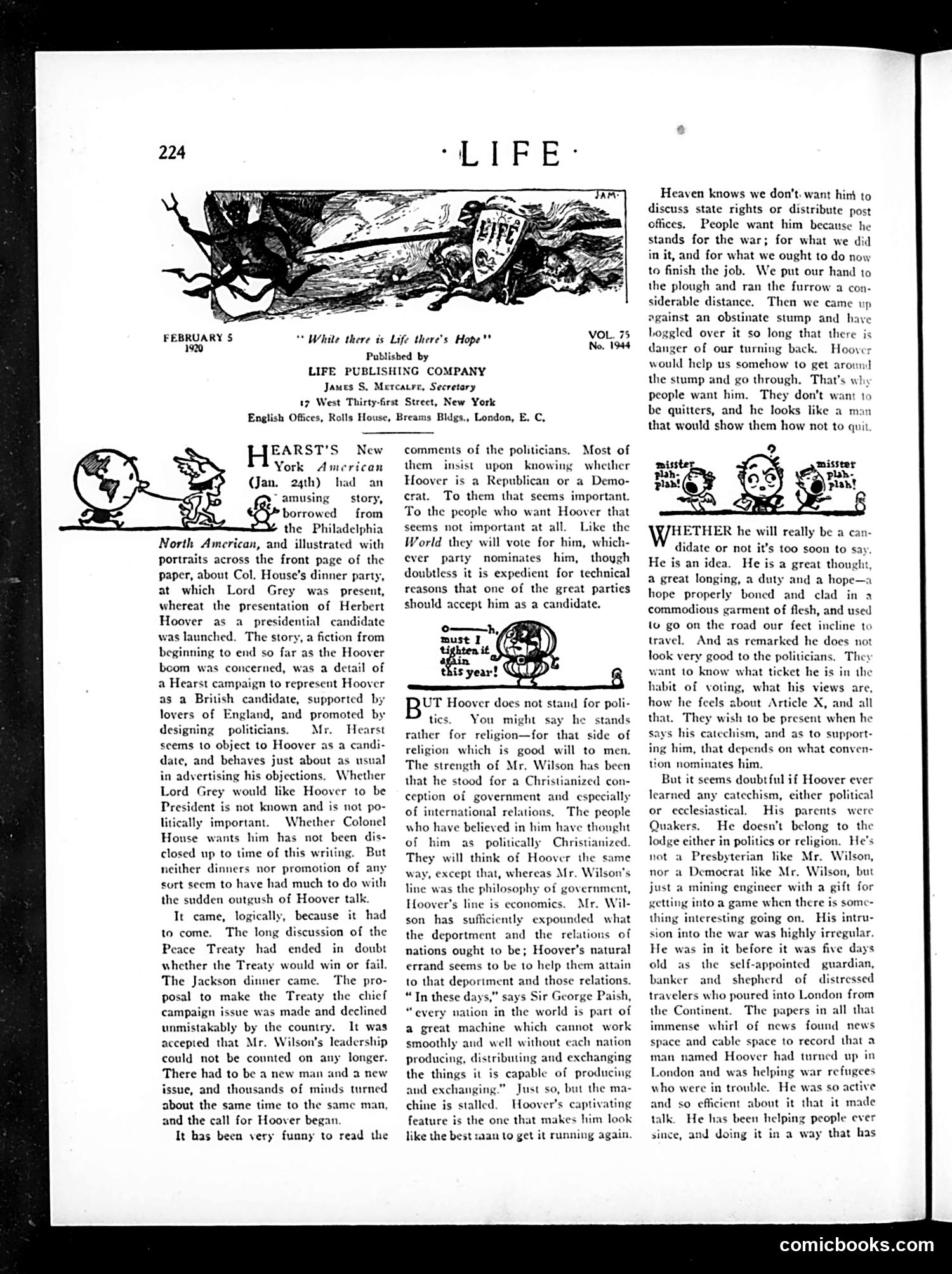
This *Life* magazine piece addresses the sudden emergence of Herbert Hoover as a potential 1920 presidential candidate. The article dismisses publisher William Randolph Hearst's claim that Hoover was a British-backed "candidate," attributing instead Hoover's popularity to practical circumstances: Wilson's leadership had become politically untenable following Peace Treaty debates, forcing politicians and voters to seek a new figure. The satire mocks politicians obsessing over whether Hoover is Republican or Democrat—missing the point entirely. Voters support Hoover not for partisan reasons but for his association with war efforts and economic competence. The piece frames Hoover as representing "Christianized" practical governance (economics and "good will") rather than political philosophy, positioning him as the figure to "get the machine running again" after wartime disruption. The cartoon's imagery (unclear without clearer detail) likely accompanies this argument about Hoover's unexpected political ascendancy.
📄 Transcribed text from this page (OCR, searchable)
Machine-transcribed from the original scan — historical spelling and the odd misread are preserved.
FEBRUARY 5 1920 ‘* While there is Life there's Hope"* Published by LIFE PUBLISHING COMPANY Janes 17 West TI Mercatrr, Secretary y-first Street, New York English Offices, Rolls House, Breams Bldgs., London, E. C, EARST’S New York American (Jan. 24th) had an “amusing story, borrowed — from the Philadelphia North American, and illustrated with portraits across the front page of the paper, about Col. House’s dinner party, at which Lord Grey was present, whereat the presentation of Herbert Hoover as a presidential candidate was launched. The story, a fiction from beginning to end so far as the Hoover boom was concerned, was a detail of a Hearst campaign to represent Hoover as a British candidate, supported by lovers of England, and promoted by designing politicians. Mr. Hearst seems to object to Hoover as a candi- date, and behaves just about as usual in advertising his objections, Whether Lord Grey would like Hoover to be President is not known and is not po- litically important. Whether Colonel House wants him has not been dis- closed up to time of this writing. But neither dinners nor promotion of any sort seem to have had much to do with the sudden outgush of Hoover talk. It came, logically, because it had to come. The long discussion of the Peace Treaty had ended in doubt whether the Treaty would win or fail. The son dinner ne. The pro- posal to make the Treaty the chief campaign issue was made and declined unmistakably by the country. It was accepted that Mr. Wilson's leadership could not be counted on any longer. There had to be a new man and a new issue, and thousands of minds turned about the same time to the same man, and the call for Hoover began. It bas been very funny to read the comments of the politicians, them insist Most of upon knowing whether Hoover a Republican or a Demo- crat. To them that seems important. To the people who want Hoover that seems not important at all. Like the World they will vote for him, which- ever party nominates him, thoygh doubtless it is expedient for technical reasons that one of the great parties should accept him as a candidate. BUT Hoover does not stand for poli- tics. You might say he stands rather for religion—for that side of religion which is good will to men. The strength of Mr. Wilson has been that he stood for a Christianized con- ception of government and especially of international relations. The people who have believed in him have thought of him as politically Christianized. They will think of Hoover the same way, except that, whereas Mr. Wilson's line was the philosophy of government, Hoover's line is economics. Mr. Wil- son has sufficiently expounded what the deportment and the relations of nations ought to be; Hoover’s natural errand seems to be to help them attain to that deportment and those relations. “Tn these days,” says Sir George Paish, “every nation in the world is part of a great machine which cannot work smoothly and well without each nation producing, distributing and exchanging the things it is capable of producing and exchanging.” Just so, but the ma- chine is stalled. Hoover's captivating feature is the one that makes him look like the best man to get it running again. Heaven knows we don’t. want hint to discuss state rights or distribute post offices. People want him because he stands for the war; for what we did in it, and for what we ought to do now to finish the job. We put our hand to the plough and ran the furrow a con- siderable distance. Then we came up against an obstinate stump and have Loggled over it so long that there is danger of our turning back. Hoover would help us somehow to get around the stump and go through, That's why people want him. They don’t want to be quitters, and he looks like a man that would show them how not to quit \WHETHER he will really be a ca didate or not it’s too soon to say, He is an idea. He is a great thoug! a great longing, a duty and a hope—a hope properly boned and clad in a commodious garment of flesh, and used to go on the road our fect incline to travel. And as remarked he does not look very good to the politicians. They want to know what ticket he is in the habit of voting, what his views are, how he feels about Article X, and all that. They wish to be present when he says his catechism, and as to support- ing him, that depends on what conven- tion nominates him, But it seems doubtful if Hoover ever learned any catechism, either political or ecclesiastical, His parents were Quakers. He doesn’t belong to the lodge cither in politics or religion. He's not a Presbyterian like Mr. Wilson, nor a Democrat like Mr. Wilson, but just a mining engineer with a gift for getting into a game when there is some- thing interesting going on, His intru- sion into the war was highly irregular. He was in it before it was five days old as the self-appointed guardian, banker and shepherd of distressed travelers who poured into London from the Continent. The papers in all that immense whirl of news found news space and cable space to record that a man named Hoover had turned up in London and was helping war refugees who were in trouble. He was so active and so efficient about it that it made talk. He has been helping people ever since, and doing it in a way that has comicbooks.com