
Life, 1920-02-05 · page 25 of 52
Life — February 5, 1920 — page 25: what you’re looking at
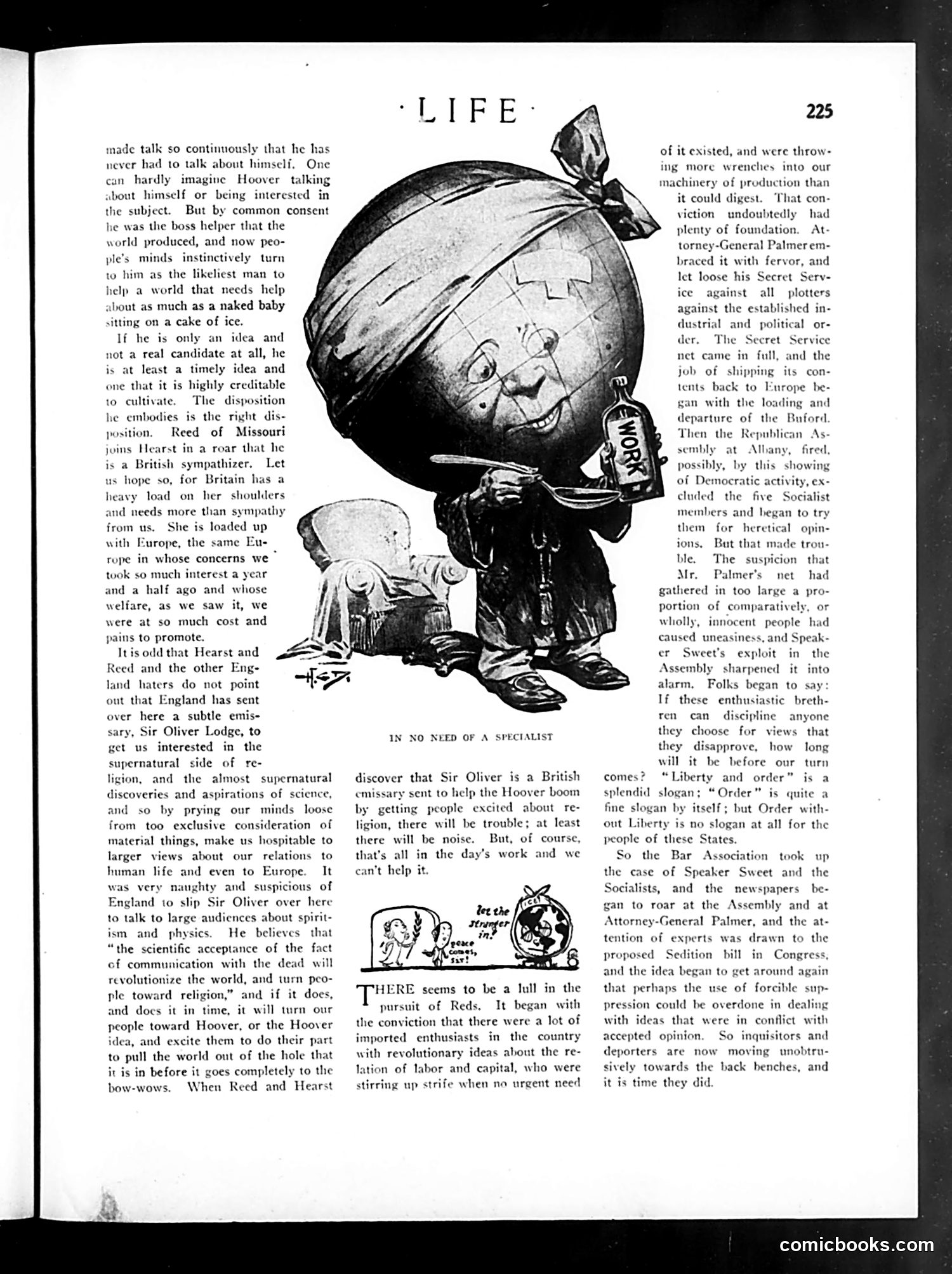
What you’re looking at
The main illustration depicts a bloated, overstuffed figure labeled "HOOVER" (Herbert Hoover, then Secretary of Commerce), captioned "IN NO NEED OF A SPECIALIST." The satire mocks Hoover as so self-satisfied and inflated with his own importance that he needs no expert guidance. The accompanying text discusses broader political tensions circa 1920: Attorney General Palmer's aggressive "Red Scare" campaign against suspected communists and radicals, which the author suggests has become excessive and counterproductive. The article criticizes both Palmer's zealotry and Republican efforts (Speaker Sweet's actions in Albany's Assembly) to expel Socialist members, warning these overreactions threaten civil liberties. The satire also mocks isolationist politicians like William Randolph Hearst and Senator Reed of Missouri for opposing British interests while remaining blind to subtler British influence (Sir Oliver Lodge's spiritualism lectures). The overall point: excessive government suppression of dissent and political persecution are dangerous to American democracy, even when targeting genuinely radical movements.
📄 Transcribed text from this page (OCR, searchable)
Machine-transcribed from the original scan — historical spelling and the odd misread are preserved.
made talk so continuously that he has never had to talk about himself, One can hardly imagine Hoover talking about himself or being interested in the subject. But by common consent he was the boss helper that the world produced, and now peo- ple’s minds instinctively turn to him as the likeliest man to help a world that needs help about as much as a naked baby sitting on a cake of ice. If he is only an idea and not a real candidate at all, he is at least a timely idea and one that it is highly creditable The disposition he embodies is the right dis- Reed of Missouri joins Hearst in a roar that he is a British sympathizer, Let for Britain has a heavy load on her shoulders to cultivate. position. us hope so, and needs more than sympathy from us. She is loaded up with Europe, the same Eue rope in whose concerns we took so much interest a year and a half ago and whose welfare, as we saw it, we were so much cost and pains to promote. It is odd that Hearst and Reed and the other Eng- Jand haters do not point out that England has sent over here a subtle emis- sary, Sir Oliver Lodge, to get us interested in the supernatural side of re- ligion, and the almost supernatural discoveries and aspirations of science, and so by prying our minds loose from too exclusive consideration of material things, make us hospitable to larger views about our relations to human life and even to Europe. It was very naughty and suspicious of England to slip Sir Oliver over here to talk to large audiences about spirit- ism and physics. He believes that “the scientific acceptance of the fact of communication with the dead will revolutionize the world, and turn peo- ple toward religion,” and if it does, and docs it in time, it will turn our people toward Hoover, or the Hoover idea, and excite them to do their part to pull the world out of the hole that it is in before it goes completely to the bow-wows. When Reed and Hearst IN NO NEED OF A SPECIALIST discover that Sir Oliver is a British emissary sent to help the Hoover boom by getting people excited about re- ligion, there will be trouble; at least there will be noise. But, of course, that’s all in the day’s work and we can’t help it. HERE seems to be a lull in the pursuit of Reds. It began with the conviction that there were a lot of imported enthusiasts in the country with revolutionary ideas about the re- lation of labor and capital, who were stirring up strife when no urgent need 225 of it existed, and were throw- ing more wrenches into our machinery of production than it could digest. That con- viction undoubtedly had plenty of foundation. At- torney-General Palmer em- braced it with fervor, and let loose his Secret Serv- ice against all plotters against the established in- dustrial and political or- der. The Secret Service net came in full, and the job of shipping its con- tents back to Europe be- gan with the loading and departure of the Buford. Then the Republican As- sembly at Albany, fired, possibly, by this showing of Democratic activity, ex- cluded the five Socialist members and began to try them for heretical ions. But that made trou- ble. The suspicion that Mr. Palmer’s net had gathered in too large a pro- opin- portion of comparatively, or wholly, innocent people had caused uneasiness, and Speak- er Sweet's exploit in the Assembly sharpened it into Folks be If these enthusiastic ren can discipline anyone they choose for views that they disapprove, how larm, an to say: breth- long will it be before our turn “Liberty and splendid slogan; “Order” is quite a fine slogan by itself; but Order with- out Liberty is no slogan at all for the people of these States. So the Bar the case of Speaker Sweet and the Socialists, and the newspapers be- gan to roar at the Assembly and at Attorney-General Palmer, and the at- tention of experts was d comes? order" is a Association took up wn to the Congress, and the idea began to get around again that perhaps the use of forcible sup- pression could be overdone in dea with ideas that were in conflict with accepted opinion. So inquisitors and proposed Sedition bill in deporters are now moving unobtru- sively towards the back benches, and it is time they did. comicbooks.com