
Life, 1920-02-05 · page 38 of 52
Life — February 5, 1920 — page 38: what you’re looking at
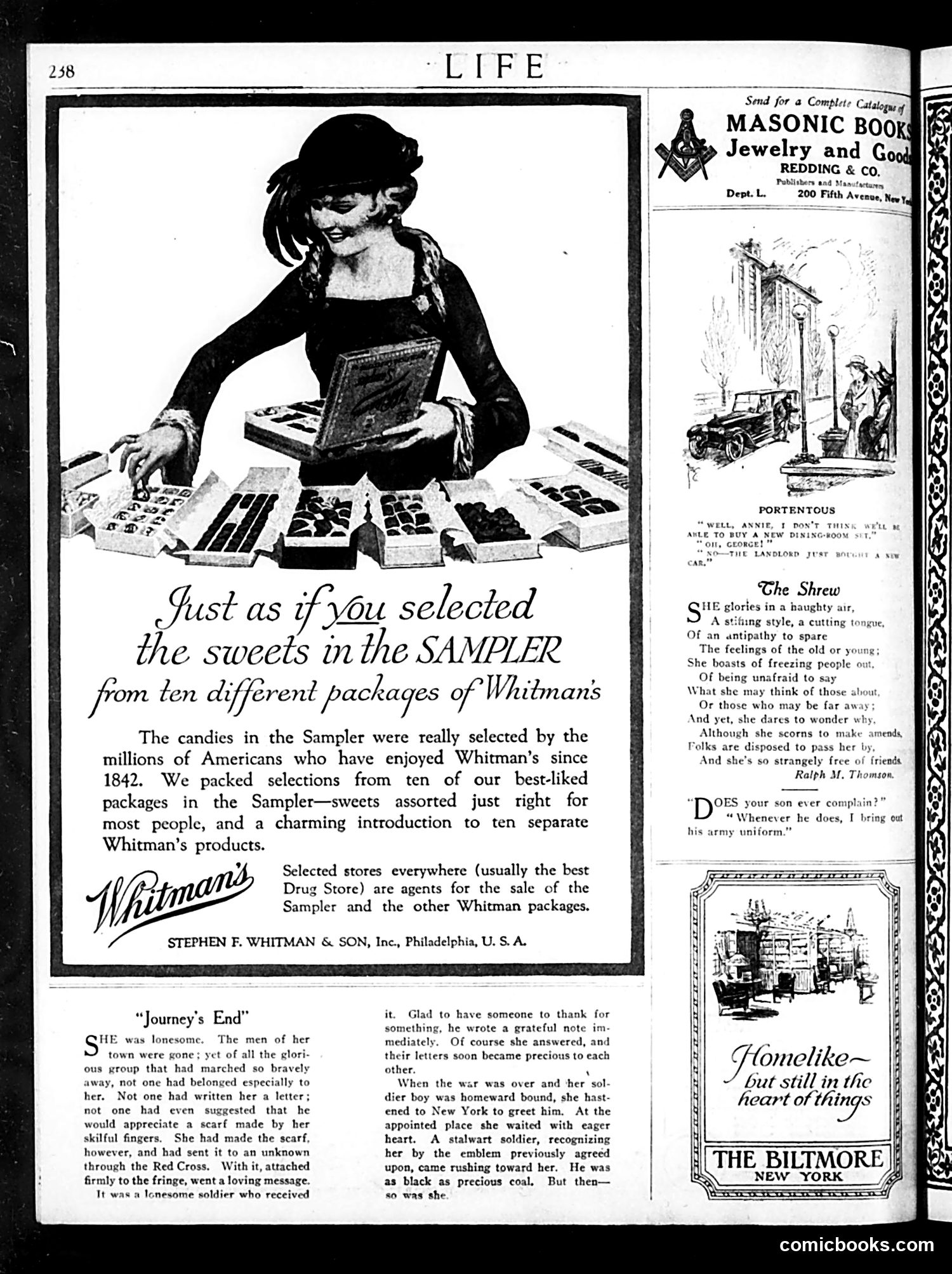
What you’re looking at
This page is primarily **advertising** rather than political satire. The dominant content is a Whitman's candy sampler advertisement featuring an illustrated woman selecting chocolates, with marketing copy explaining the product's appeal. The page also contains two brief **fictional vignettes**: 1. **"Journey's End"**: A wartime romance story where a lonely woman sends a Red Cross scarf to an unknown soldier. They correspond, fall in love, and meet in New York—revealing both are Black. The story's point appears to be presenting an unconventional wartime romance, though the ending line ("as black as precious coal") suggests contemporary racial attitudes. 2. **"The Shrew"**: A satirical poem about a disagreeable woman whose cutting manner drives away friendships, mocking her surprise at social isolation. The page includes smaller advertisements for Masonic books, The Biltmore hotel, and a humorous exchange about a son's complaints. The overall content reflects early 20th-century magazine format: mixed advertising, light fiction, and social commentary without overt political satire.
📄 Transcribed text from this page (OCR, searchable)
Machine-transcribed from the original scan — historical spelling and the odd misread are preserved.
Just as if) ‘vou selected the sweets in the SAMPLER jrom ten different packages of Whitmans The candies in the Sampler were really selected by the millions of Americans who have enjoyed Whitman’s since 1842. We packed selections from ten of our best-liked packages in the Sampler—sweets assorted just right for most people, and a charming introduction to ten separate Whitman’s products. y Selected stores everywhere (usually the best 6 Drug Store) are agents for the sale of the Sampler and the other Whitman packages. STEPHEN F. WHITMAN & SON, Inc., Philadelphia, U. S. A. “Journey's End” HE was lonesome. The men of her town were gone; yet of all the glori- ous group that had marched so bravely away, not one had belonged especially to her. Not one had written her a letter; not one had even suggested that he would appreciate a scarf made by her skilful fingers. She had made the scarf, however, and had sent it to an unknown through the Red Cross, With it, attached firmly to the fringe, went a loving message. It was a lonesome soldier who received it. Glad to have someone to thank for something, he wrote a grateful note im- mediately. Of course she answered, and their letters soon became precious to each other. " When the war was over and ‘her sol- dier boy was homeward bound, she hast- ened to New York to greet him. At the appointed place she waited with eager heart. A stalwart soldier, recognizing her by the emblem previously agreed upon, came rushing toward her. He was as black as precious coal, But then— so was she. REDDING & co, Pobiiobery and Manctertaren Dept.L. 200 Fifth Av, PORTENTOUS “WELL, ANNIE, 1 DON'T THINK 0 BUY A NEW DINING-ROOM 5 rorce!" The Shrew HE glories in a haughty air, A stifiing style, a cutting tongue, Of an antipathy to spare The feelings of the old or young; She boasts of freezing people out Of being unafraid to say What she may think of those Or those who may be far And yet, she dares to wonder why, Although she scorns to make amends, Folks are disposed to pass her by, And she’s so strangely free of friends Ralph M. Thomson. “DOES your son ever complain?” Whenever he does, I bring out his army uniform.” onelike~ but still in the heart orthings ea THE BILTMORE Ry NEW YoRK _/ comicbooks.com