
A complete issue · 36 pages · 1920
Life — January 15, 1920
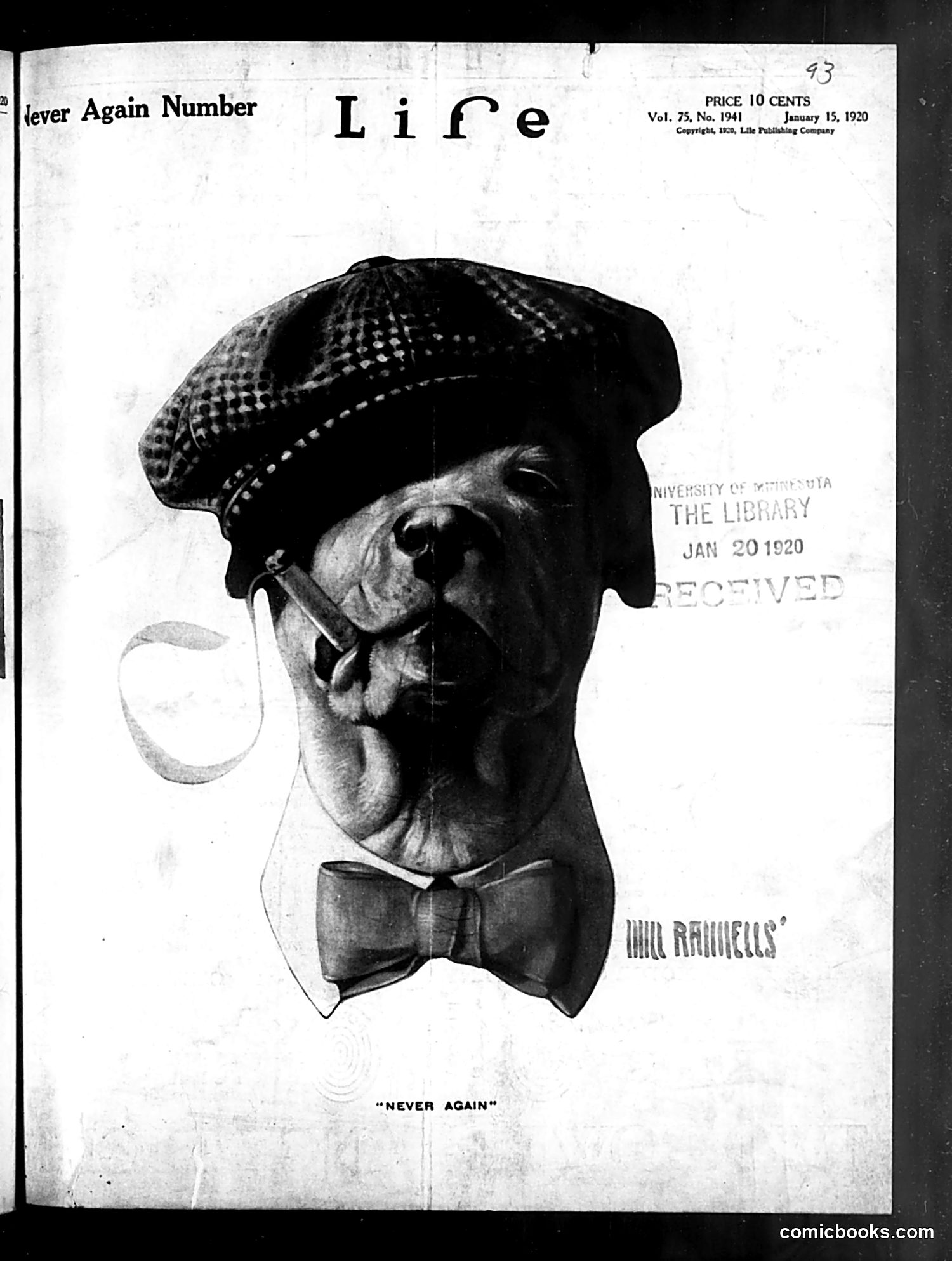
This is the cover of Life magazine's "Never Again Number." The illustration shows a anthropomorphized dog wearing a flat cap and bow tie, with a somewhat dejected expression. The dog appears to be a caricature—possibly representing a specific public figure or type familiar to 1920s readers, though the identity isn't entirely clear from the image alone. The title "Never Again" suggests commentary on post-World War I sentiment—likely reflecting American determination to avoid future wars or repeating past mistakes. The dog's weary demeanor may satirize political or social attitudes of that era. Without additional context about Life's specific editorial stance in January 1920, the precise target of this satire remains somewhat ambiguous, though it clearly engages contemporary concerns.
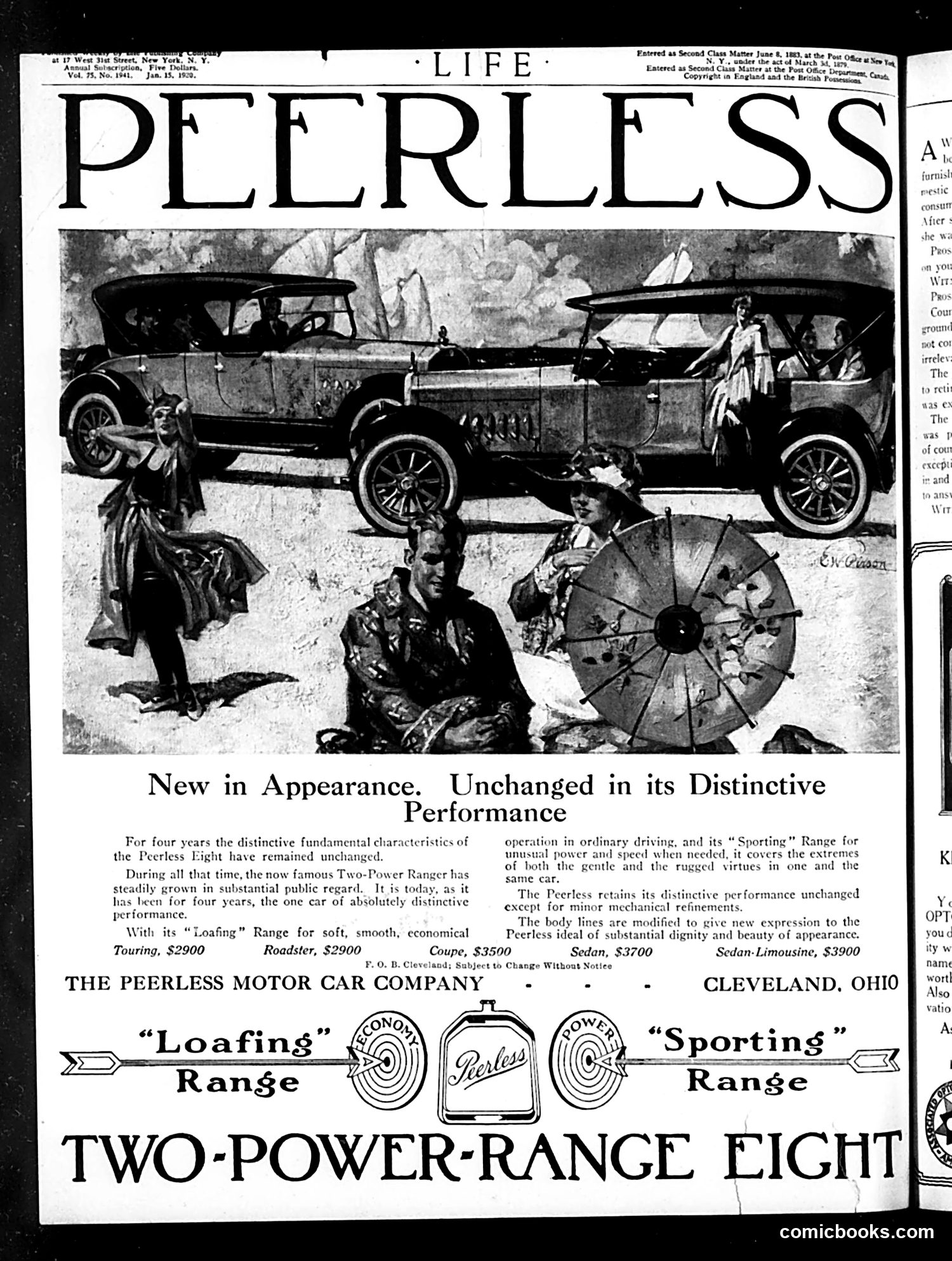
This page is **primarily advertising**, not satire or political commentary. It's a full-page advertisement for the Peerless Motor Car Company of Cleveland, Ohio, promoting their "Two-Power-Range Eight" automobile. The headline reads "New in Appearance, Unchanged in its Distinctive Performance," and the ad emphasizes that while the car's body styling has been updated, its mechanical performance remains consistent. The illustration shows period-appropriate figures (women in 1920s dress with parasols and men) posed with two Peerless vehicles, highlighting the car's appeal to affluent buyers. The ad lists five model variants with prices ranging from $2,900 to $3,900. There is no political or social satire present—this is straightforward automotive marketing from the early 1920s era.
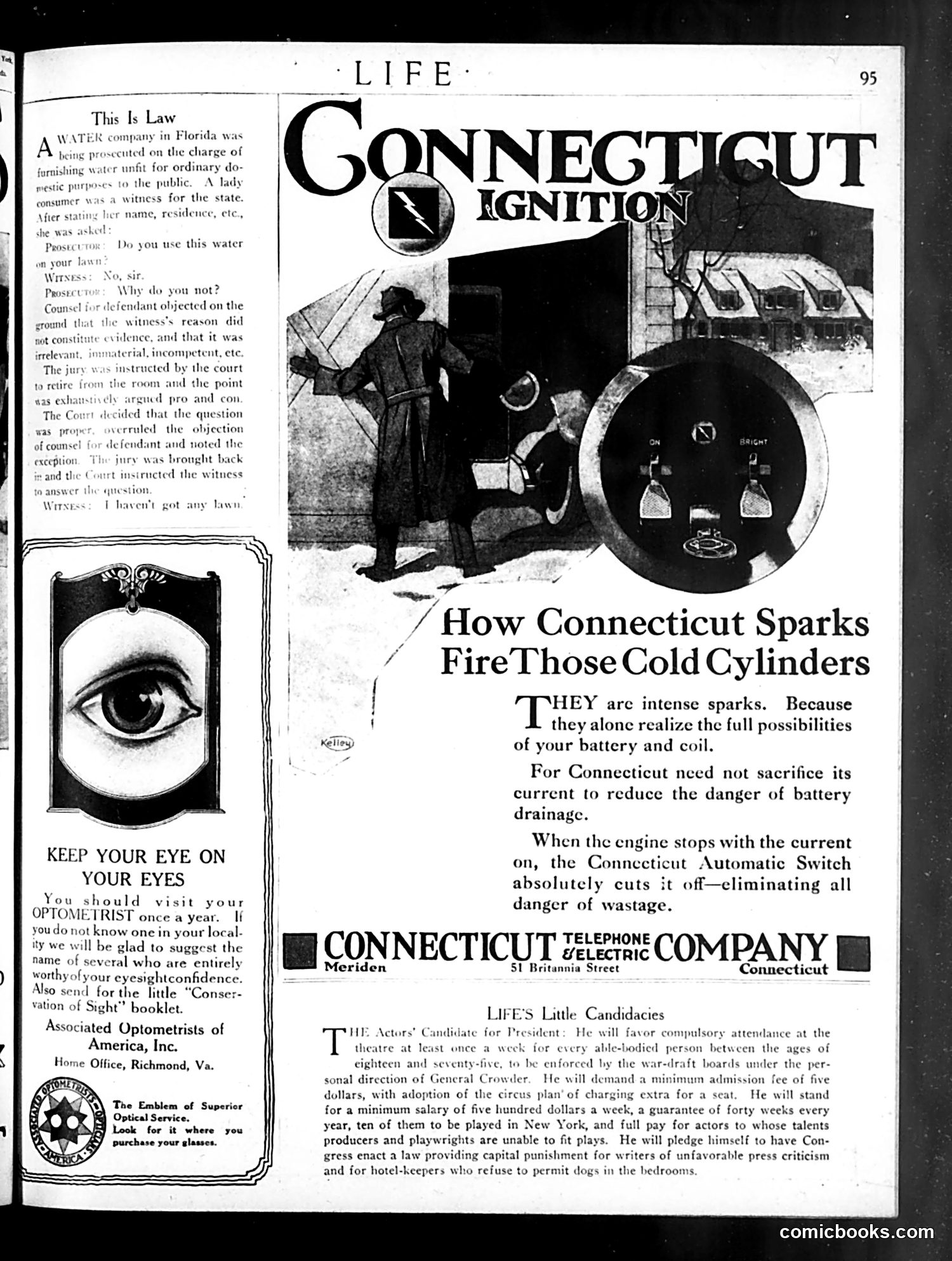
This page contains two distinct elements: **Left column ("This Is Law")**: A courtroom satire depicting a woman testifying about using water on her lawn. The humor lies in the lawyer's objections being sustained on technical grounds (the witness's testimony being "irrelevant, immaterial, incompetent"), while the actual substantive point—whether she used the water—remains unaddressed. This satirizes legal pedantry and procedural obstruction obscuring basic truth. **Right side**: A Connecticut Telephone & Electric Company advertisement for ignition systems, claiming their spark plugs are superior. The product photo and technical claims occupy most space. **Bottom ("Life's Little Candidacies")**: A brief satirical item about theatrical ticket requirements and enforcement, poking fun at entertainment industry regulations. The page mixes legal satire with period advertising.
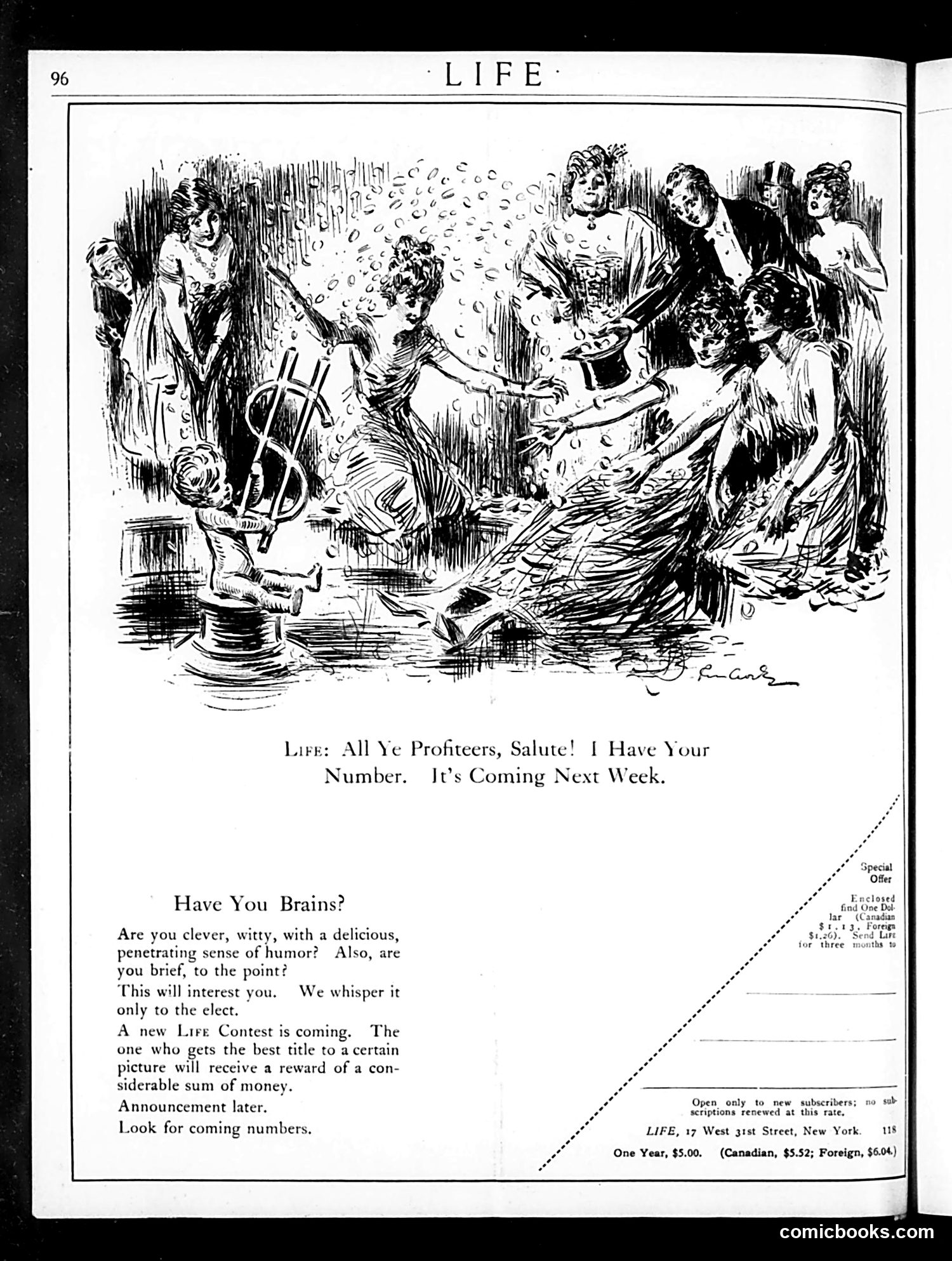
This page from *Life* magazine contains a satirical cartoon about financial profiteering, paired with a contest announcement. The main cartoon depicts a winged figure (representing "Lady Luck" or Fortune, identifiable by the dollar sign) showering money onto a group of well-dressed women and men who eagerly collect it. The caption reads: "All Ye Profiteers, Salute! I Have Your Number. It's Coming Next Week." The satire targets wartime profiteers—businesspeople who accumulated wealth through speculation or exploitation during (likely) World War I. The cartoon suggests their financial scheming is transparent and will be exposed in an upcoming *Life* issue. Below is a contest announcement inviting clever readers to submit humorous captions for pictures, with monetary prizes offered.
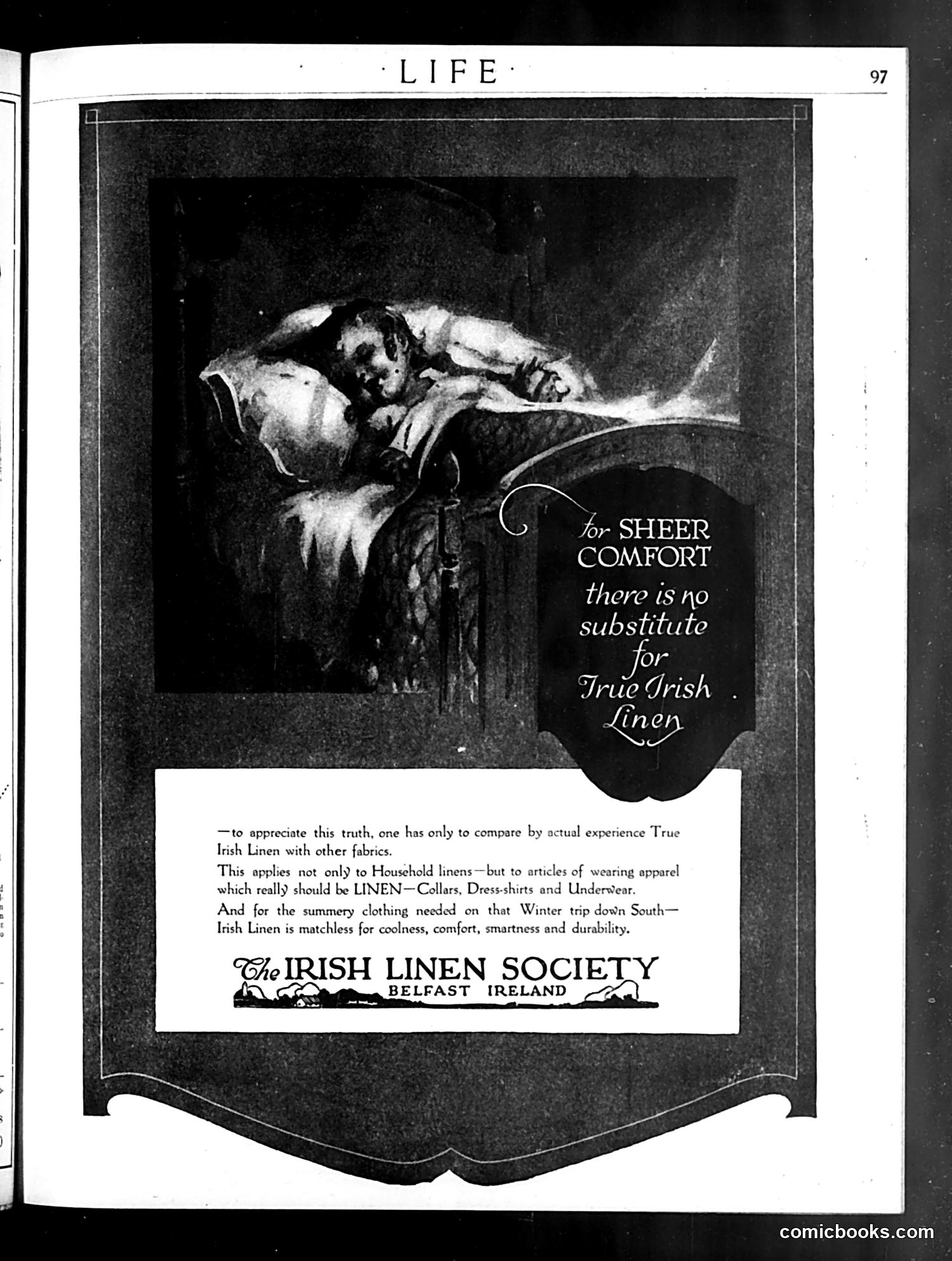
This page is primarily **advertising, not satire or political commentary**. It's a full-page advertisement for The Irish Linen Society of Belfast, Ireland. The ad features a classical or romantic painting of a reclining figure on draped fabric, illustrating luxury and comfort. The accompanying text promotes True Irish Linen as superior for household use and clothing, claiming it offers "coolness, comfort, smartness and durability" compared to substitute fabrics. The advertisement targets American consumers (Life's audience) by appealing to quality consciousness and practical benefits. The ornate visual presentation and eloquent copy reflect early 20th-century advertising style, emphasizing craftsmanship and material superiority rather than employing humor or political messaging.

This page is **primarily advertising, not satire or political content**. It's a straightforward commercial advertisement for White Heavy Duty Trucks manufactured by The White Company of Cleveland. The image shows a vintage truck (appears to be from the 1910s-1920s era based on the style) with cargo loaded on its bed, alongside a small figure for scale. The ad emphasizes practical business benefits: economy of operation, low costs for heavy hauling, and fuel savings. The "Double Reduction Gear Drive" was a technical feature highlighting the truck's efficiency. This represents early 20th-century trade advertising in *Life* magazine, which contained both humor and commercial content aimed at business owners and fleet operators interested in commercial vehicles.
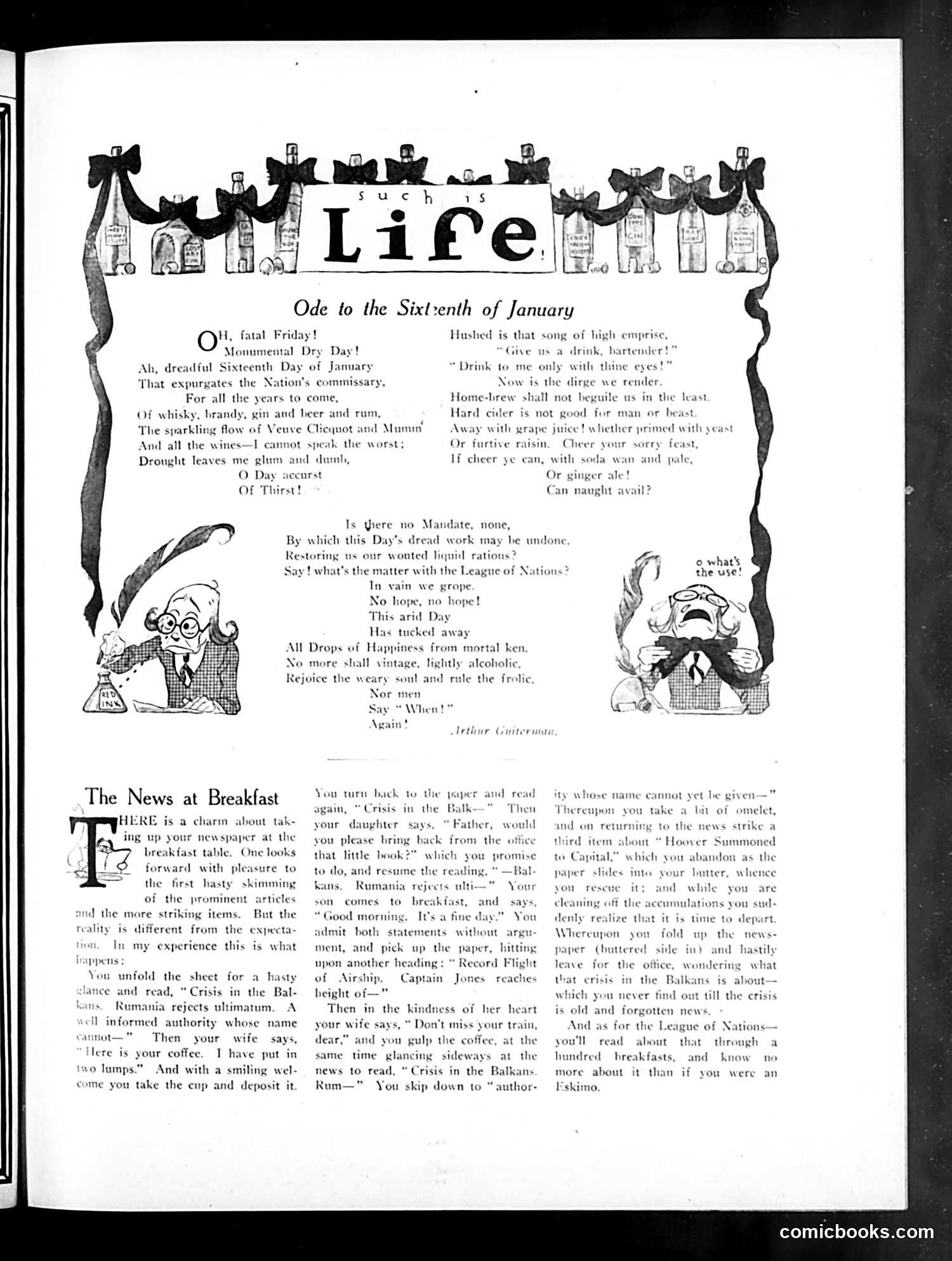
This page features a satirical poem by Arthur Guiterman celebrating January 16th, apparently a day devoted to drinking despite Prohibition. The verses mock the era's alcohol ban through ironic celebration of various drinks—"Hushed is that song of high empire, / 'Give us a drink, bartender!'"—and lament that this "dread" day has stripped away all happiness from life. The accompanying illustrations show exaggerated, distressed figures representing the public's despair over Prohibition's enforcement. "The News at Breakfast" column discusses mundane domestic irritations during the Prohibition era, suggesting how people's lives were consumed by this contentious policy. The satire targets Prohibition's unpopularity and the League of Nations' ineffectiveness, portraying both as sources of national gloom.
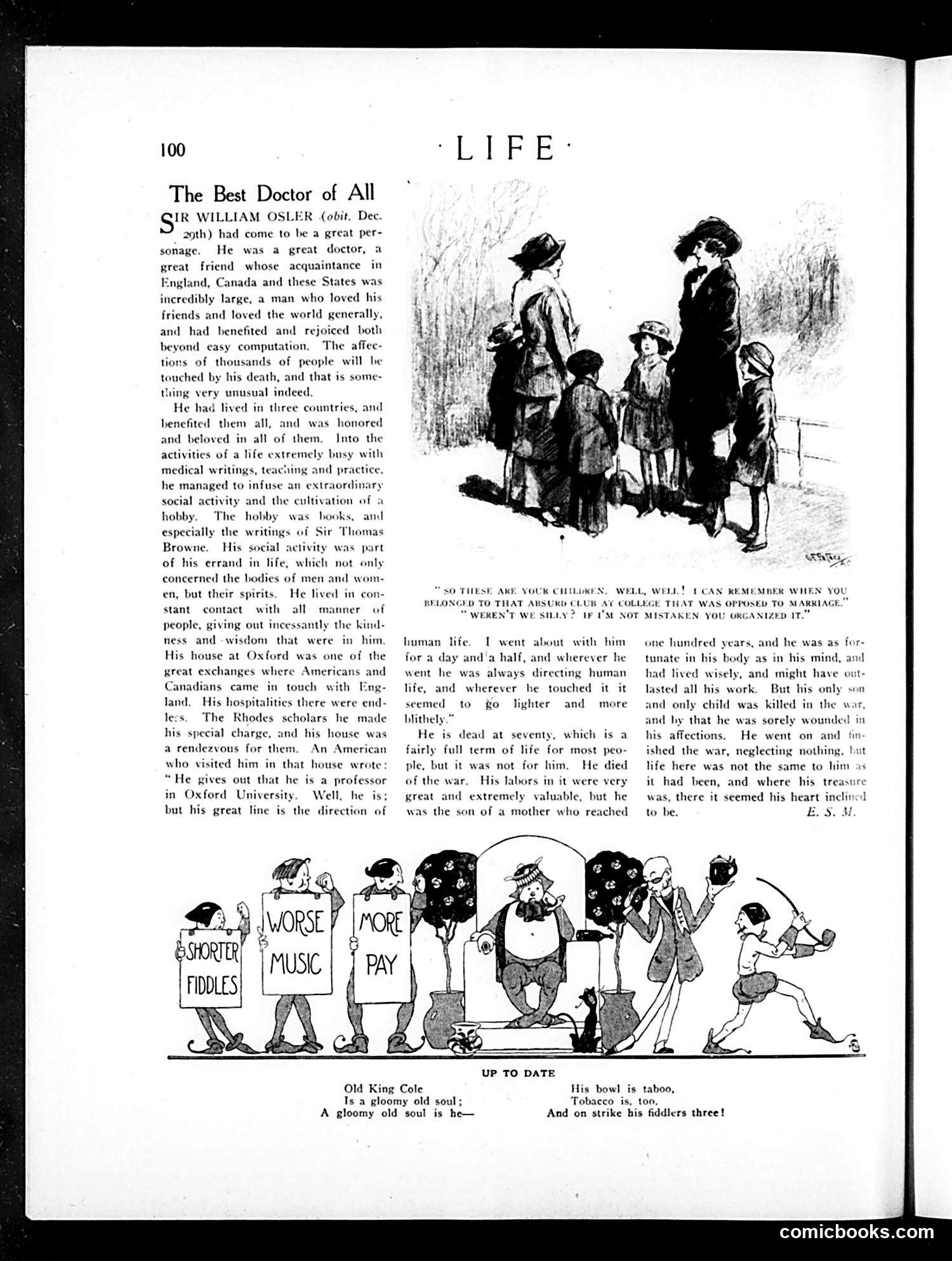
This page commemorates **Sir William Osler** (1849-1929), a renowned physician and medical educator. The upper illustration depicts Osler as a beneficent doctor visiting patients. The bottom cartoon, titled "**Up to Date**," satirizes modern labor complaints through the nursery rhyme "Old King Cole." Workers carry protest signs demanding "Shorter Fiddles," "More Music," and "More Pay"—a humorous critique of contemporary labor strikes and unionization efforts. The figure in the center represents an employer dealing with multiple worker grievances simultaneously. The satire suggests that modern workers' demands are as absurd as asking King Cole's fiddlers for better instruments while maintaining productivity—implying labor movements of the era were viewed as unreasonable by *Life* magazine's middle-class readership.
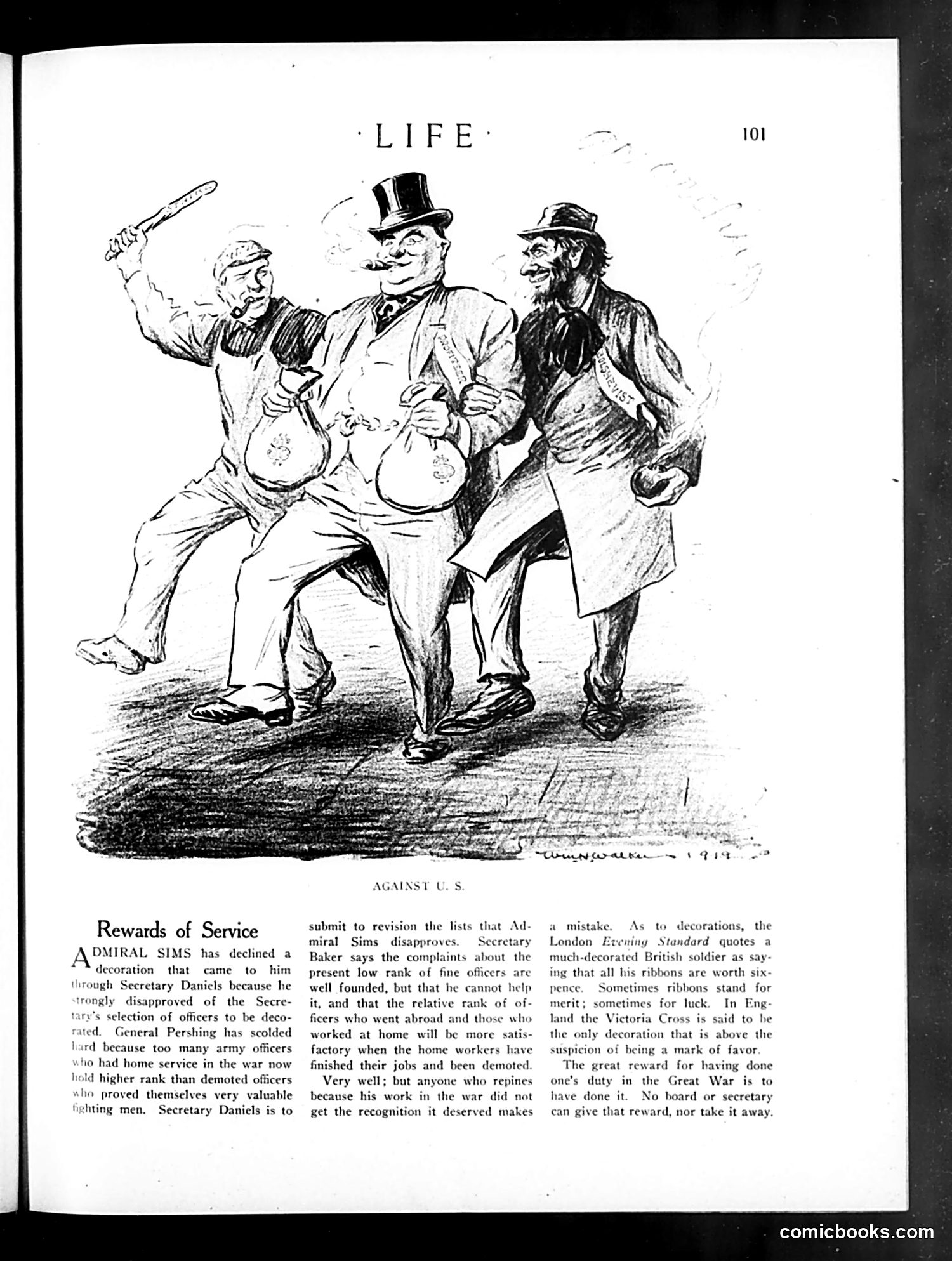
This satirical cartoon critiques the U.S. military's decoration and promotion system following World War I. Three caricatured military officers—likely representing different branches or ranks—are depicted in exaggerated poses, seemingly celebrating or posturing. The accompanying article discusses Admiral Sims's complaint that Secretary Daniels denied him a decoration. The text criticizes the inconsistent rewarding of war service: officers who worked abroad received fewer honors than those who remained home, while some decorated soldiers received recognition for minor contributions. The satire suggests the military's honors system is arbitrary and unfair, rewarding connections or luck rather than actual merit or sacrifice. The cartoon visually reinforces this critique through the officers' theatrical, somewhat undignified poses.
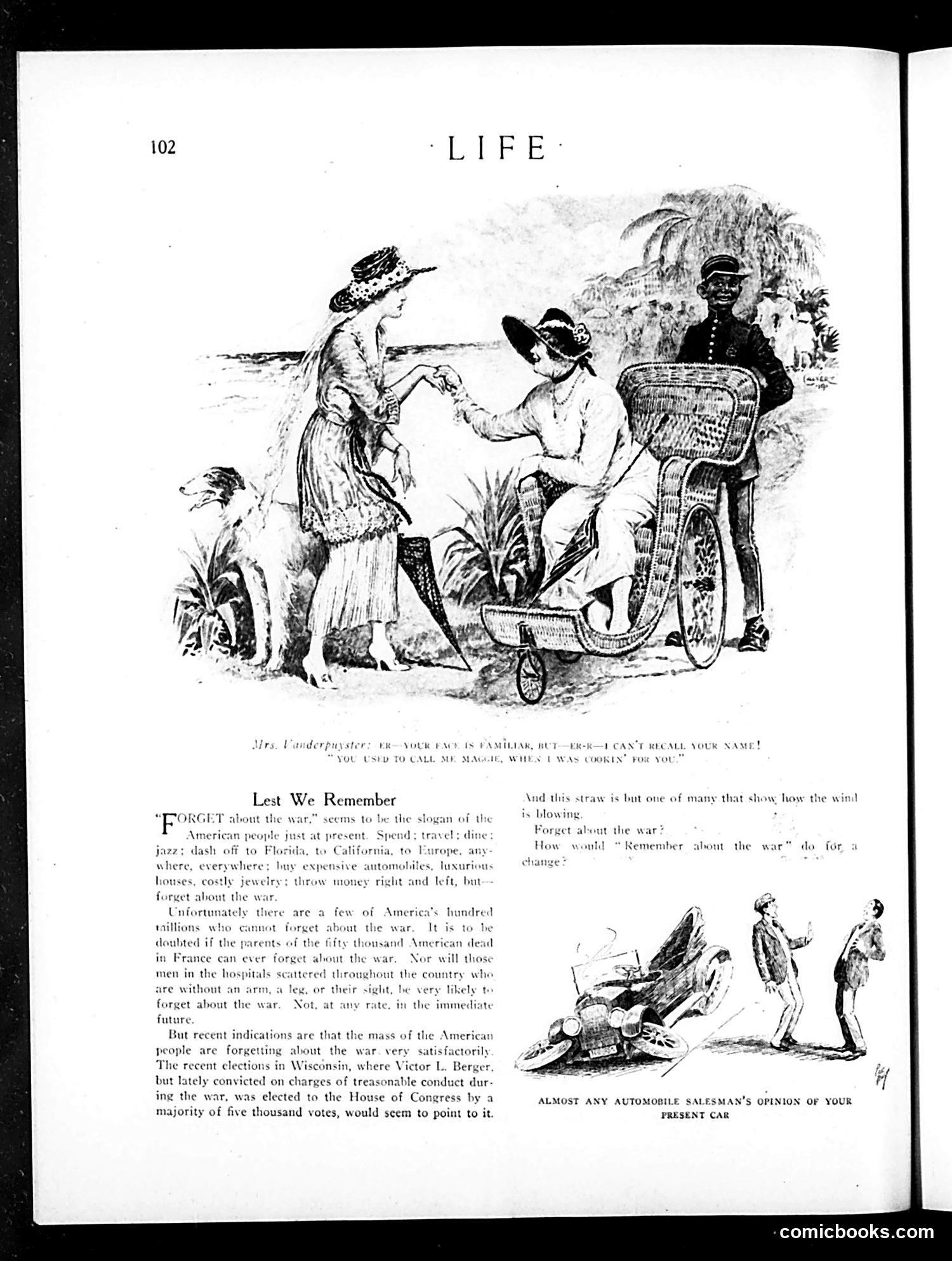
This page critiques post-WWI American forgetfulness about the war's costs. The main illustration shows a woman encountering someone she once knew, unable to recall his name—a pointed reference to amnesia about wartime sacrifice. The article "Lest We Remember" argues that while Americans pursue leisure (travel, luxury goods, automobiles), they're ignoring the war's human toll: disabled veterans and grieving families throughout the country. The bottom cartoon shows an automobile salesman dismissing a potential customer—suggesting even commerce trivializes war suffering. The page references Victor Berger, a congressman convicted of "treasonable conduct during the war," implying the public has moved on from accountability. The satire warns that prosperity and distraction enable collective forgetting of sacrifice.
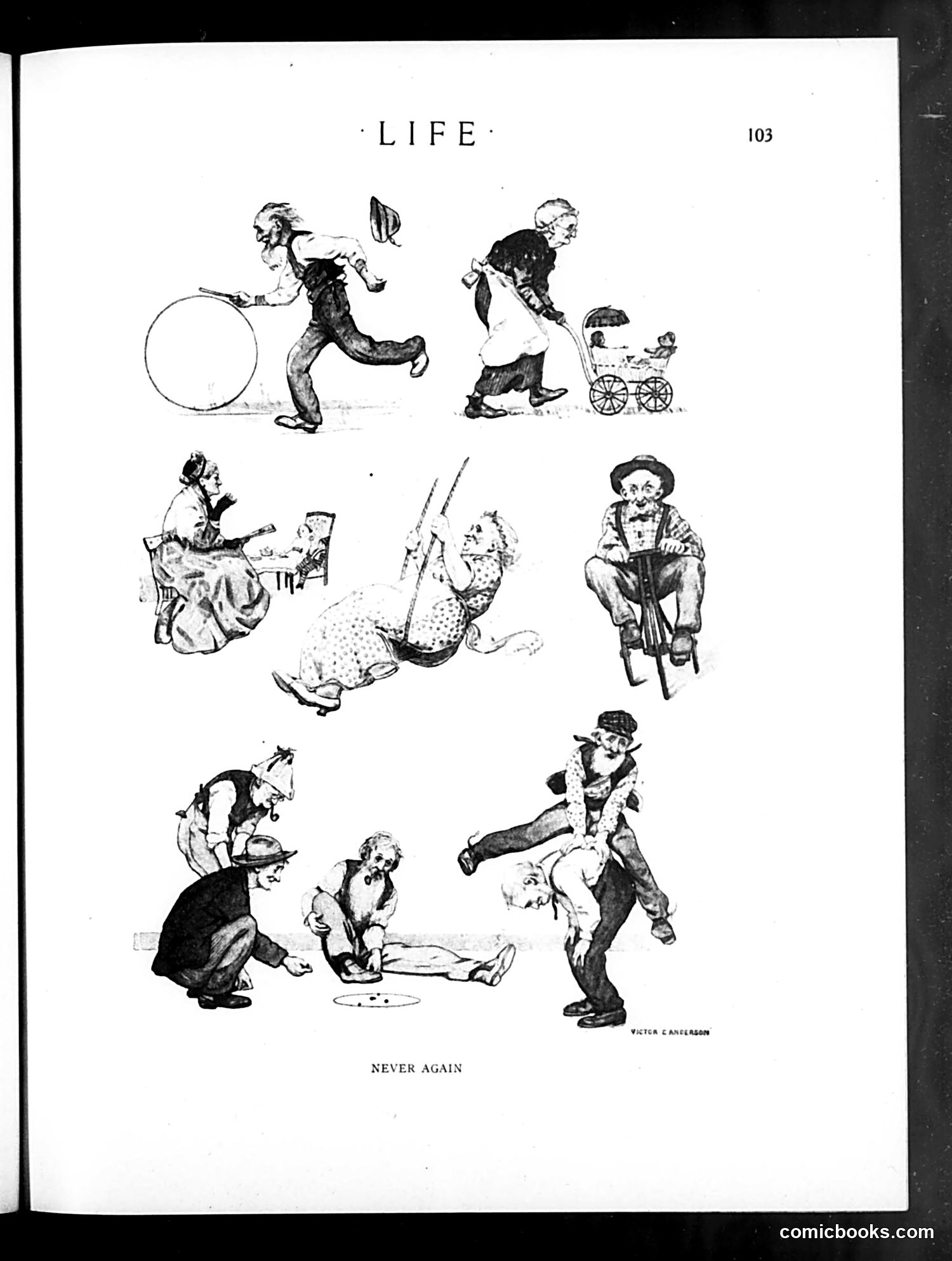
This page from *Life* magazine presents a series of domestic scenes illustrating childhood mishaps and dangers, all captioned "NEVER AGAIN." The cartoons show parents and caregivers learning hard lessons through various accidents: a child with a hula hoop, a baby carriage mishap, children on a seesaw, a child near a fireplace, and a young boy being kicked by an older child. The satire targets parental complacency and the gap between intention and reality in child supervision. Each vignette depicts the moment parents realize they must prevent specific hazards—suggesting that even well-meaning guardians cannot anticipate all dangers. The repeated caption emphasizes how one dangerous incident teaches what should never happen again, poking gentle fun at the reactive rather than proactive nature of parenting.
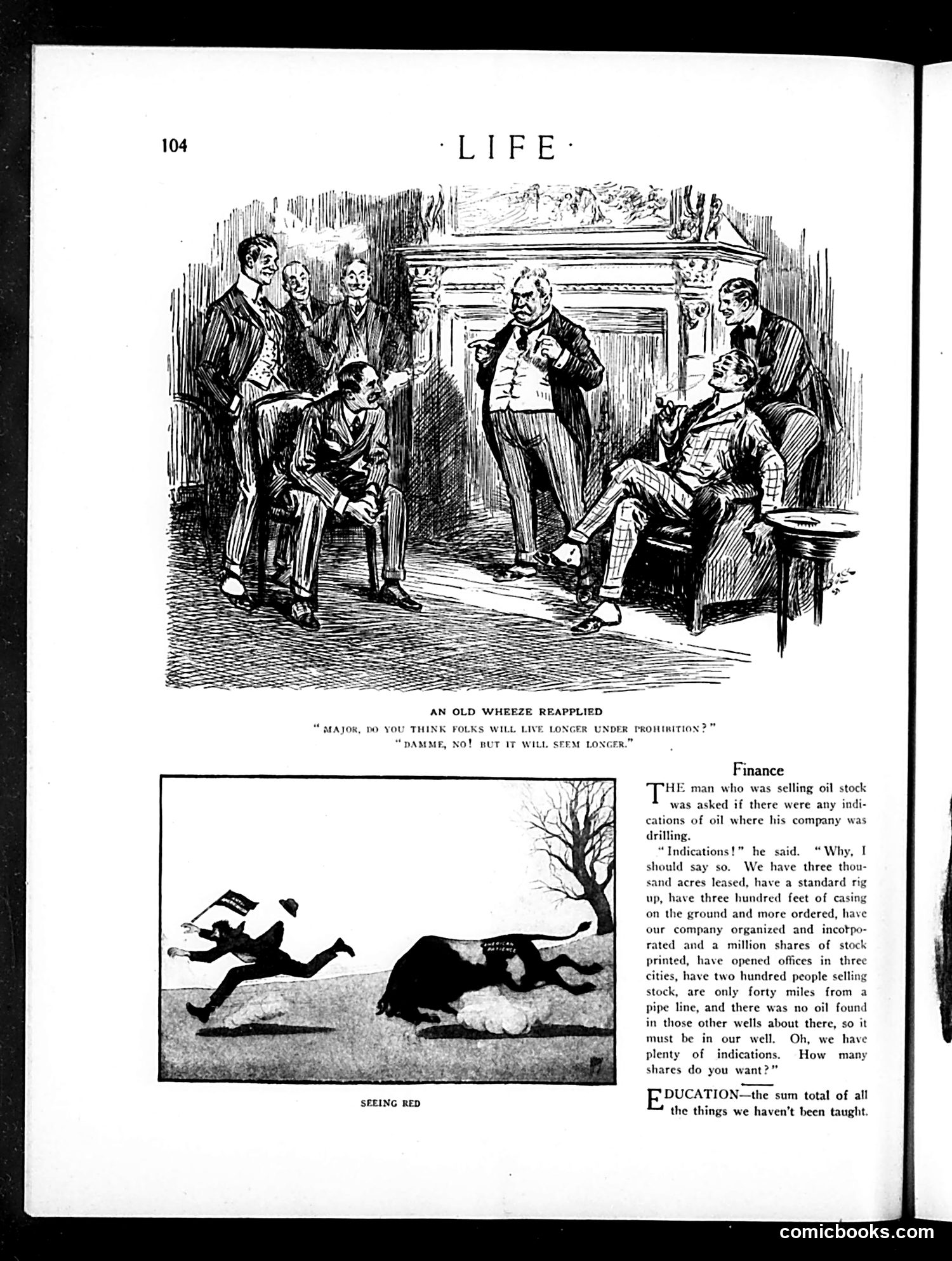
**Top Cartoon: "An Old Wheeze Reapplied"** A Major asks gentlemen whether prohibition will make people live longer. The response—"Damne, no! But it will *seem* longer"—satirizes the unpopular Prohibition era (1920-1933). The joke mocks how strict alcohol bans made life feel tediously prolonged for those who enjoyed drinking. **Bottom Cartoon: "Seeing Red"** A man appears to be hallucinating or panicking, chased by what looks like a bull or dark shape. This likely references "seeing red" as an expression of anger or Communist fear during the Red Scare period. **Finance Section** Text describes an oil-stock salesman using misleading claims about drilling operations to sell shares—satirizing fraudulent investment schemes and financial deception common in the era.
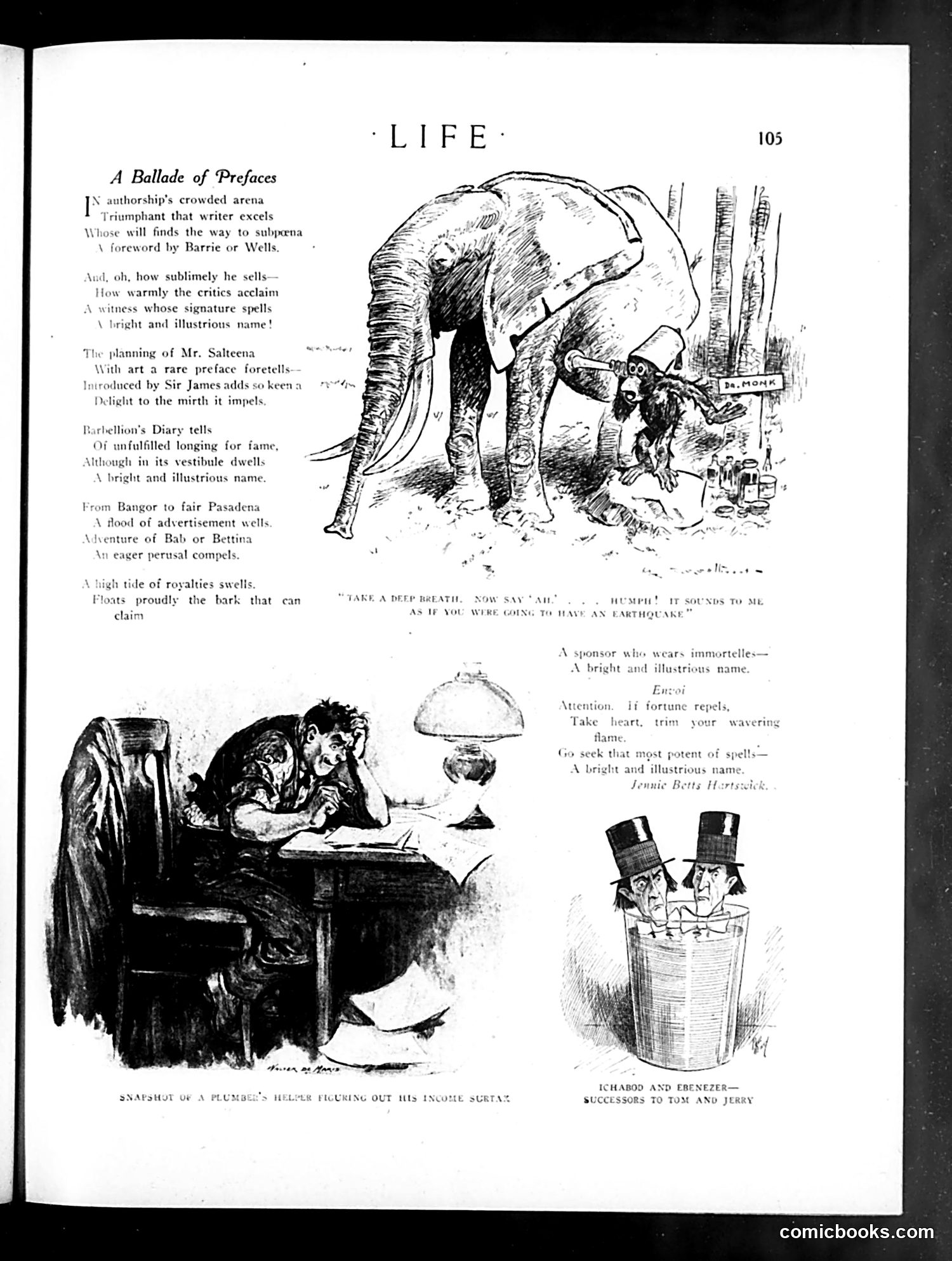
This page satirizes the publishing world's obsession with celebrity endorsements and famous prefaces. The verse mocks how authors sought prominent names (like James Barrie) to write introductions, believing a "bright and illustrious name" would boost sales. The illustrations support this theme: the top cartoon shows an elephant straining to write, while below, a plumber struggles with income taxes at his desk. The bottom illustration depicts Ichabod and Ebenezer—seemingly obscure characters—presented as "successors to Tom and Jerry," likely mocking publishers' desperate attempts to capitalize on established names. The satire targets how the publishing industry relied on celebrity associations rather than literary merit to sell books to the reading public.
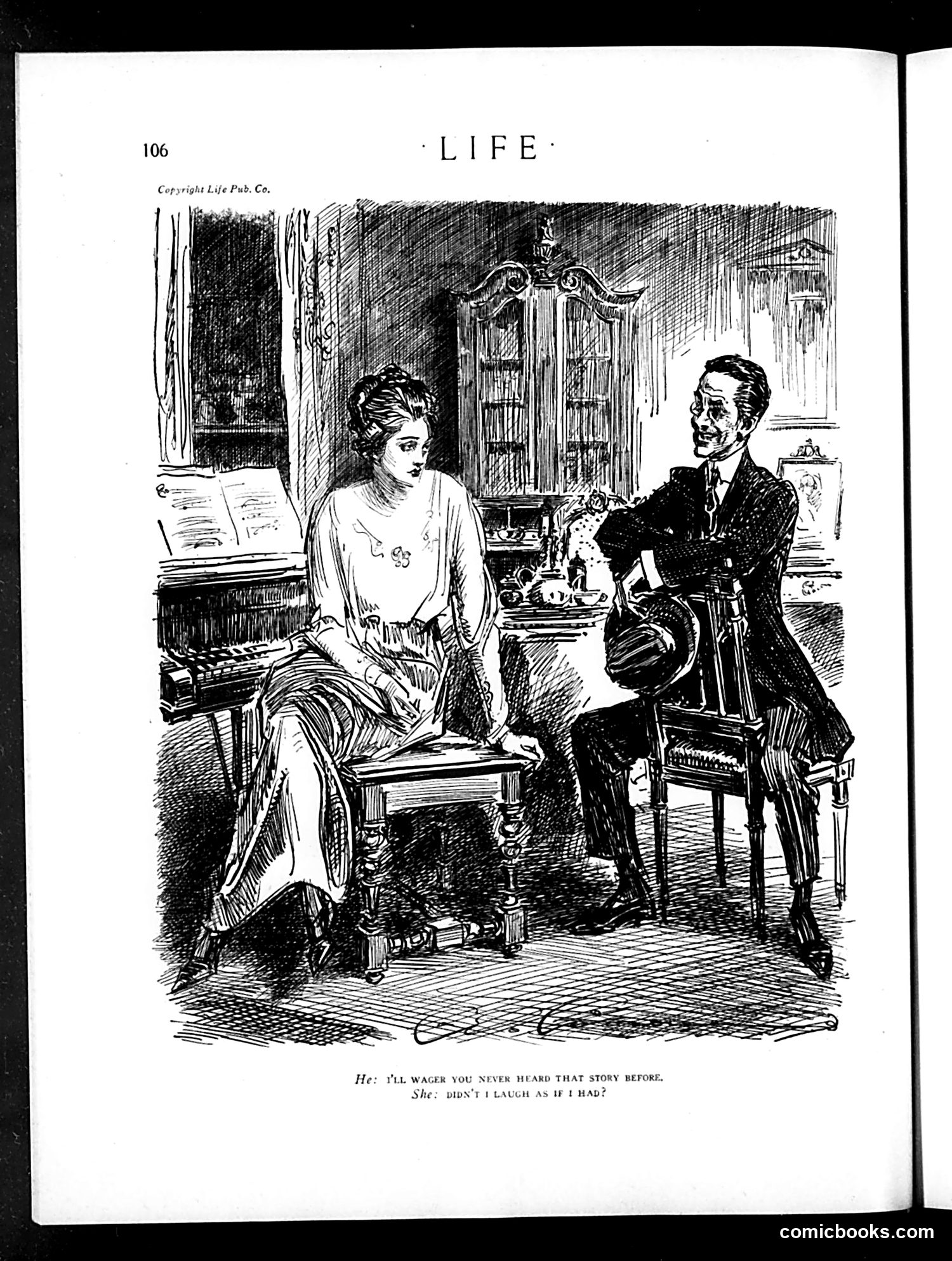
This is a single-panel cartoon depicting a domestic scene between a man and woman in an elegant interior. The man, dressed formally, is about to tell the woman a story, saying "I'll wager you never heard that story before." The woman responds skeptically: "Didn't I laugh as if I had?" The satire targets marital dynamics and masculine behavior—specifically, a husband's apparent habit of repeatedly telling the same anecdotes, apparently unaware or indifferent to his wife's boredom. Her response suggests weary resignation: she laughs politely despite having heard the story before, implying she performs enthusiasm to humor him. The joke critiques both husbandly obliviousness and wifely performative patience in early 20th-century relationships.
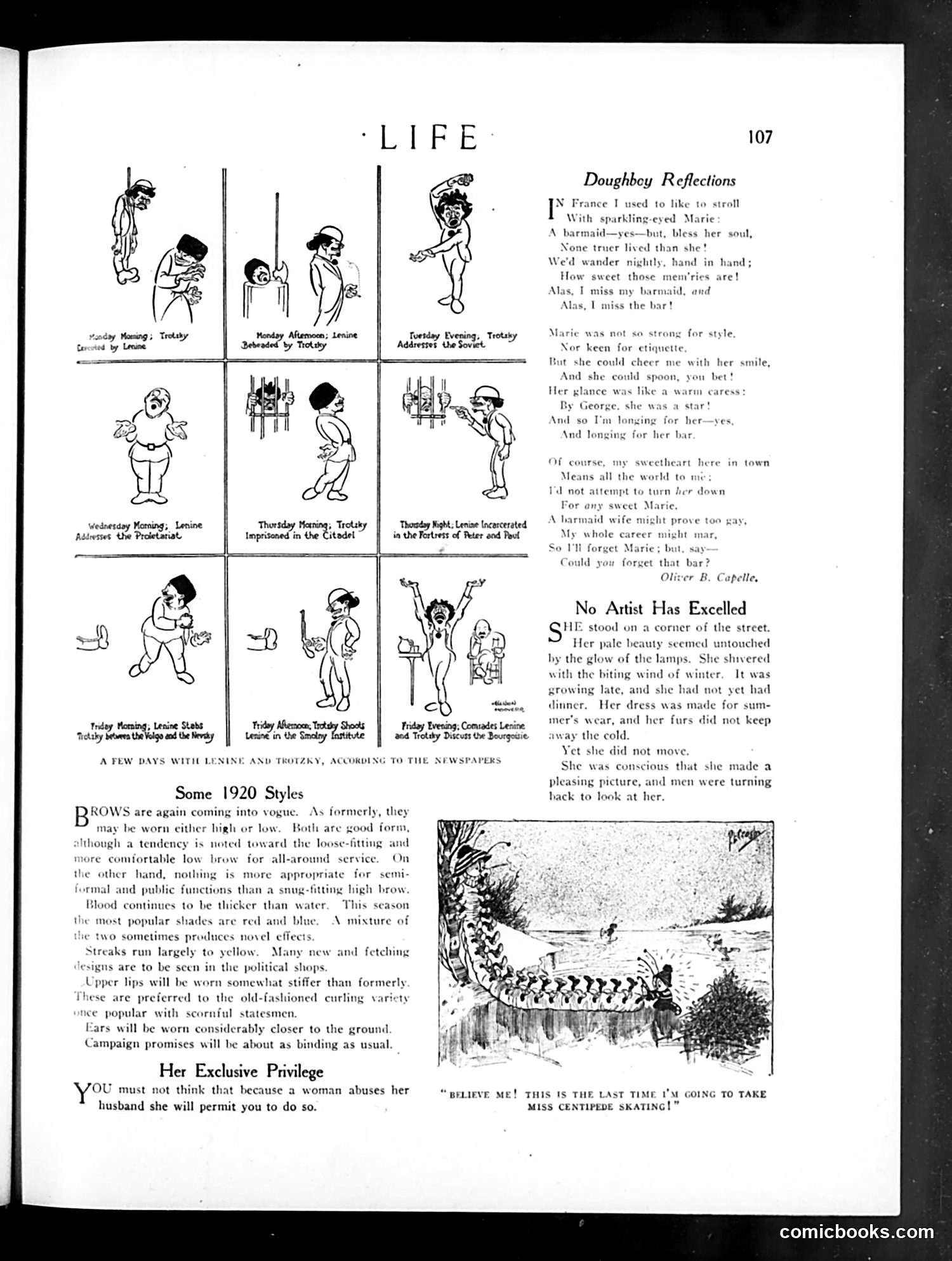
This page contains two distinct sections: **Top: Comic Strip Series** A nine-panel strip titled "A Few Days with Lusine and Trotzky, According to the Newspapers" depicts daily activities of what appears to be Lenin and Trotsky (Russian Bolshevik leaders). Each panel shows mundane or absurd activities—exercising, adjusting uniforms, getting incarcerated—with captions indicating the day of the week. The satire mocks Soviet leadership by portraying them engaged in trivial, contradictory, or undignified behavior, reflecting American skepticism toward the recent Russian Revolution (1917). **Bottom: Fashion and Social Commentary** Text sections discuss 1920 hairstyle trends ("Some 1920 Styles") and eyebrow fashion ("Her Exclusive Privilege"), alongside a narrative piece titled "No Artist Has Excelled" about a street artist, and a separate brief section called "Her Exclusive Privilege" making a sardonic observation about domestic abuse.
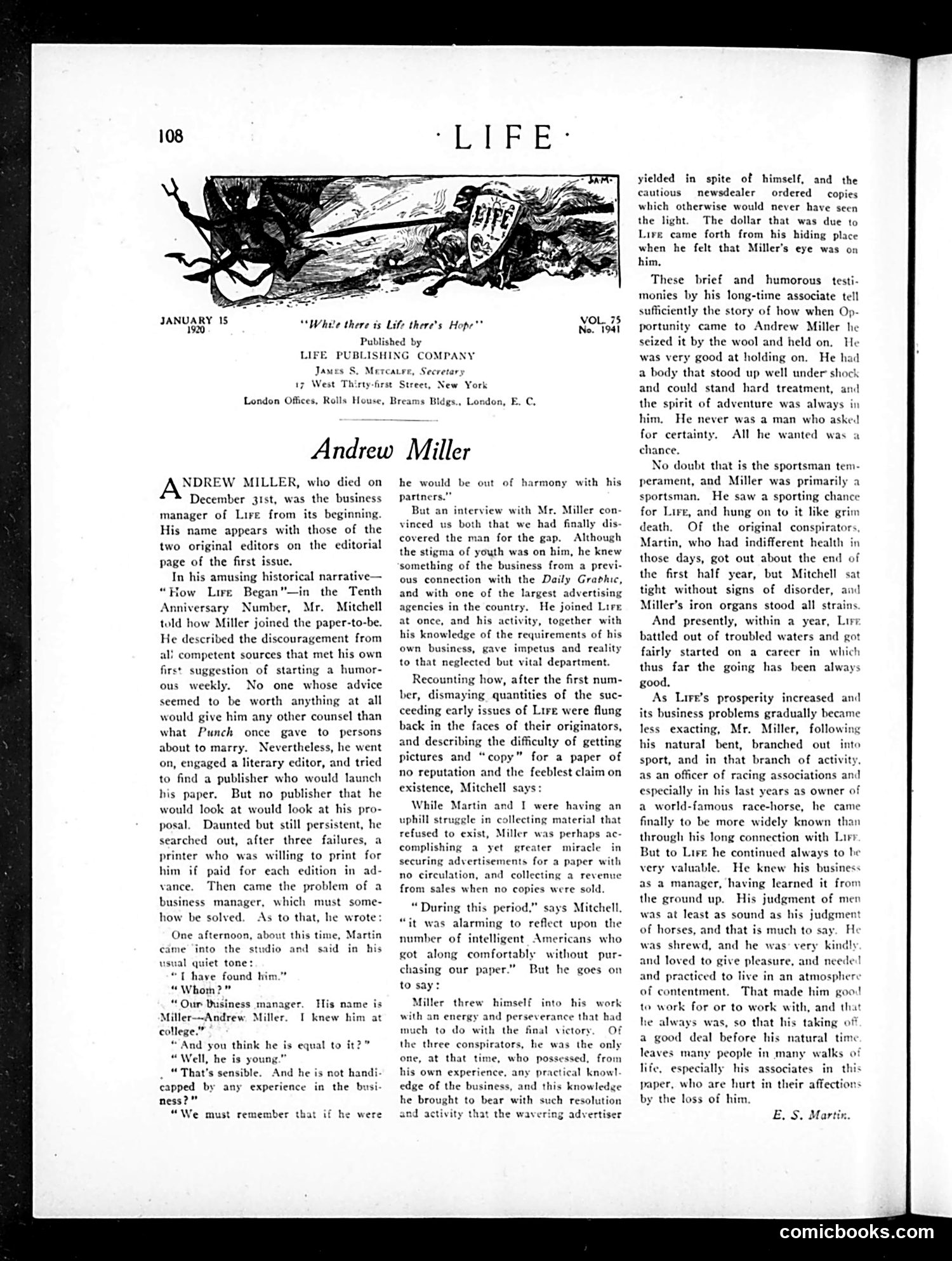
This is a memorial tribute to Andrew Miller, who died December 31st, 1919. Miller was the business manager of *Life* magazine since its founding—a significant position for the satirical weekly. The text recounts how Miller was recruited to manage the struggling new publication when no experienced businessman would touch it. Despite his youth and lack of business experience, Miller possessed practical knowledge from working at the *Daily Graphic* and an advertising agency. He proved instrumental in securing advertisements and revenue for a publication with no circulation or reputation. The piece emphasizes Miller's perseverance in accomplishing what seemed impossible: selling ads and copies of a non-existent periodical. His success was crucial to *Life's* eventual viability. The anecdote about the "newsdealer" suggests Miller's determination was so effective that even reluctant retailers stocked the magazine. This is essentially an in-house eulogy celebrating a colleague's business acumen and dedication.
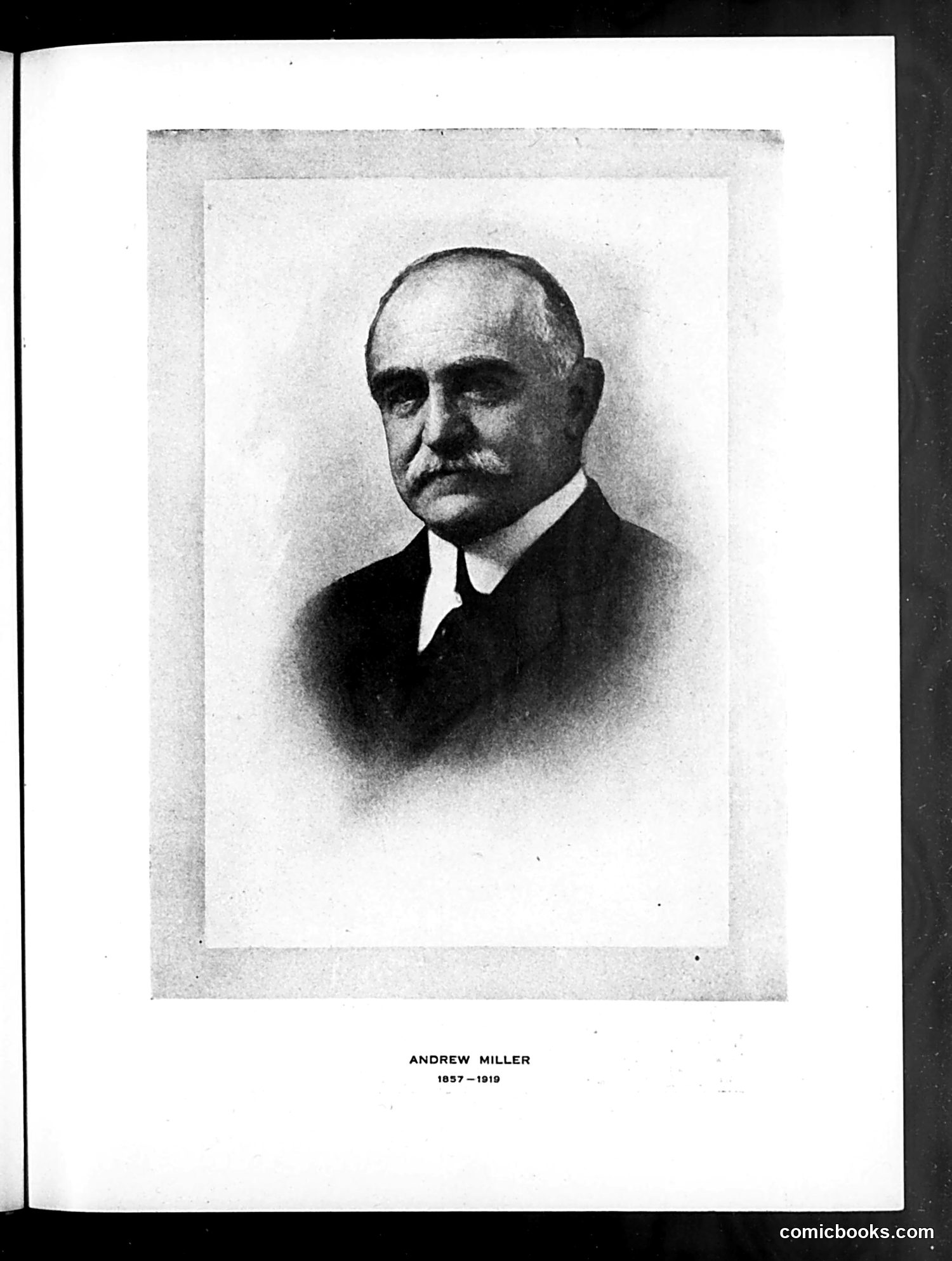
This is a **memorial portrait page** rather than a cartoon or satirical content. It presents a formal black-and-white photograph of Andrew Miller, a man in formal business attire with a distinctive mustache, identified by the caption below giving his birth and death years. Without additional context on this page, I cannot determine Miller's profession, prominence, or why *Life* magazine featured his memorial portrait. He may have been a notable businessman, artist, politician, or cultural figure of the early 20th century, but the image alone—a dignified portrait—provides no satire or commentary. The page appears to be a straightforward tribute or obituary notice rather than humorous or political content.
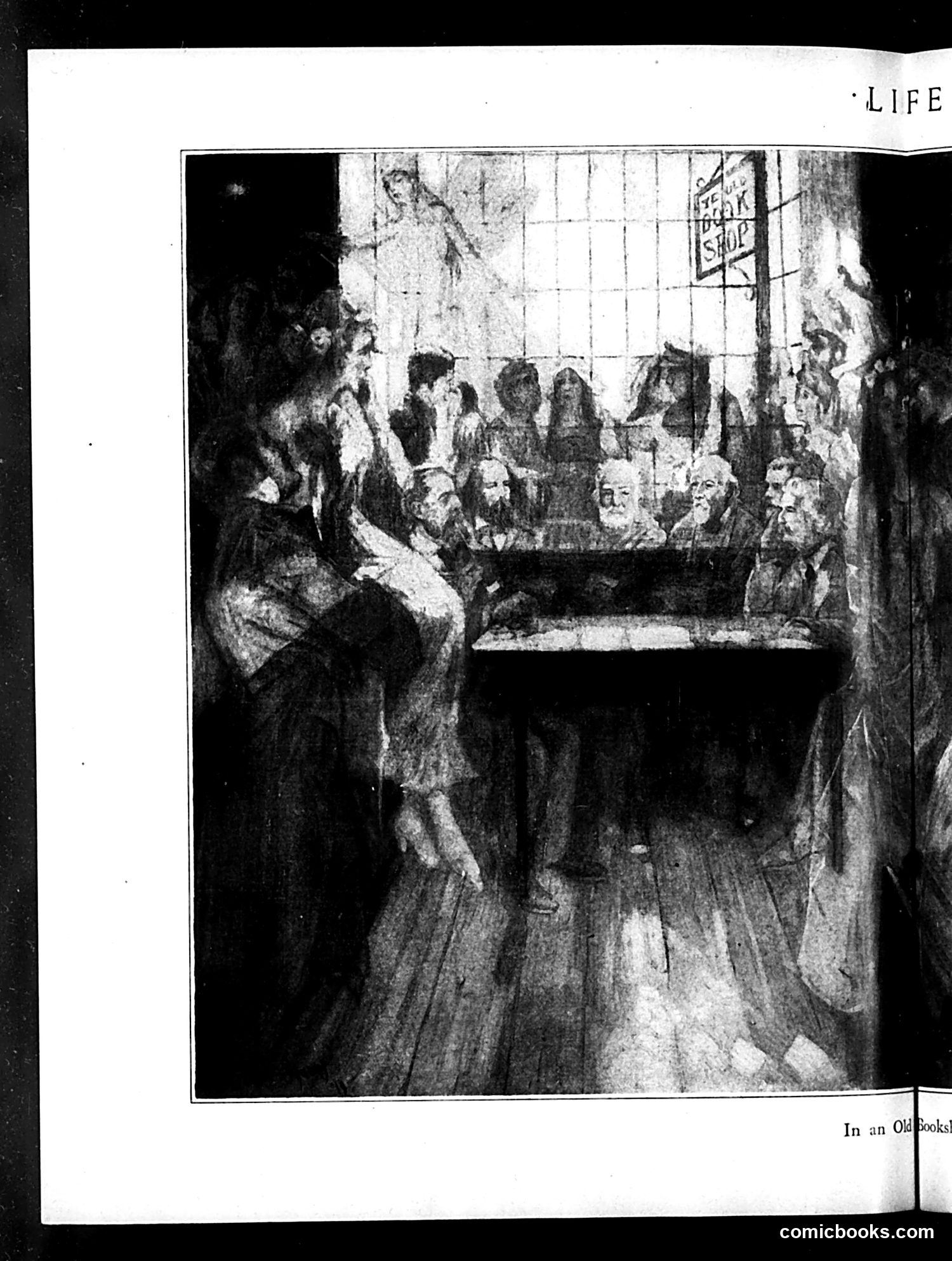
This appears to be a satirical illustration from *Life* magazine depicting a bookshop scene. The image shows customers gathered around a shop counter while a shopkeeper displays wares behind a window with a "BOOK SHOP" sign visible. The caption reads "In an Old Books..." (text cut off), suggesting this satirizes the secondhand or antiquarian book trade. The illustration's style and crowded composition suggest commentary on either the commercialization of literature, the types of people drawn to used bookshops, or perhaps changing literary tastes of the era. However, without the complete caption and additional context about the magazine's publication date, I cannot definitively identify the specific social or political critique intended. The image quality and partial text limit precise interpretation of the satire's target.
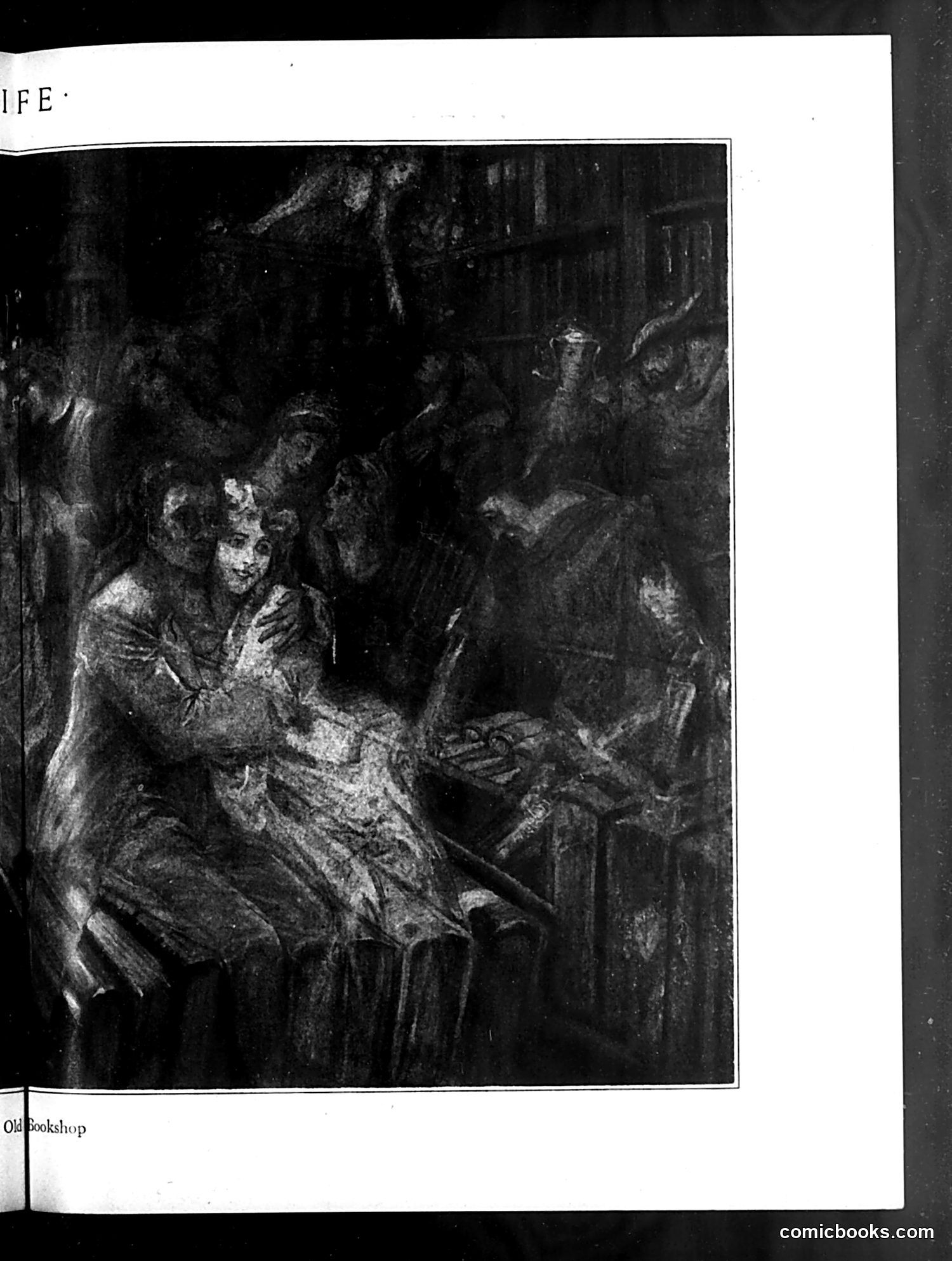
This appears to be a darkly dramatic illustration rather than a political cartoon. The image shows a chaotic indoor scene with multiple figures in period clothing (possibly 18th or 19th century based on the style) in what seems to be a violent or distressing moment. A central female figure appears distressed or endangered, surrounded by other figures in shadowy, threatening poses. The caption reads "Old Bookshop," suggesting this may illustrate a literary scene or historical event. Without additional context about which Life magazine issue this is from or what text accompanied it, I cannot definitively identify the specific story, characters, or satirical point being made. The dramatic, dark tone suggests it may be illustrating a tragic or sensational narrative from literature or history.
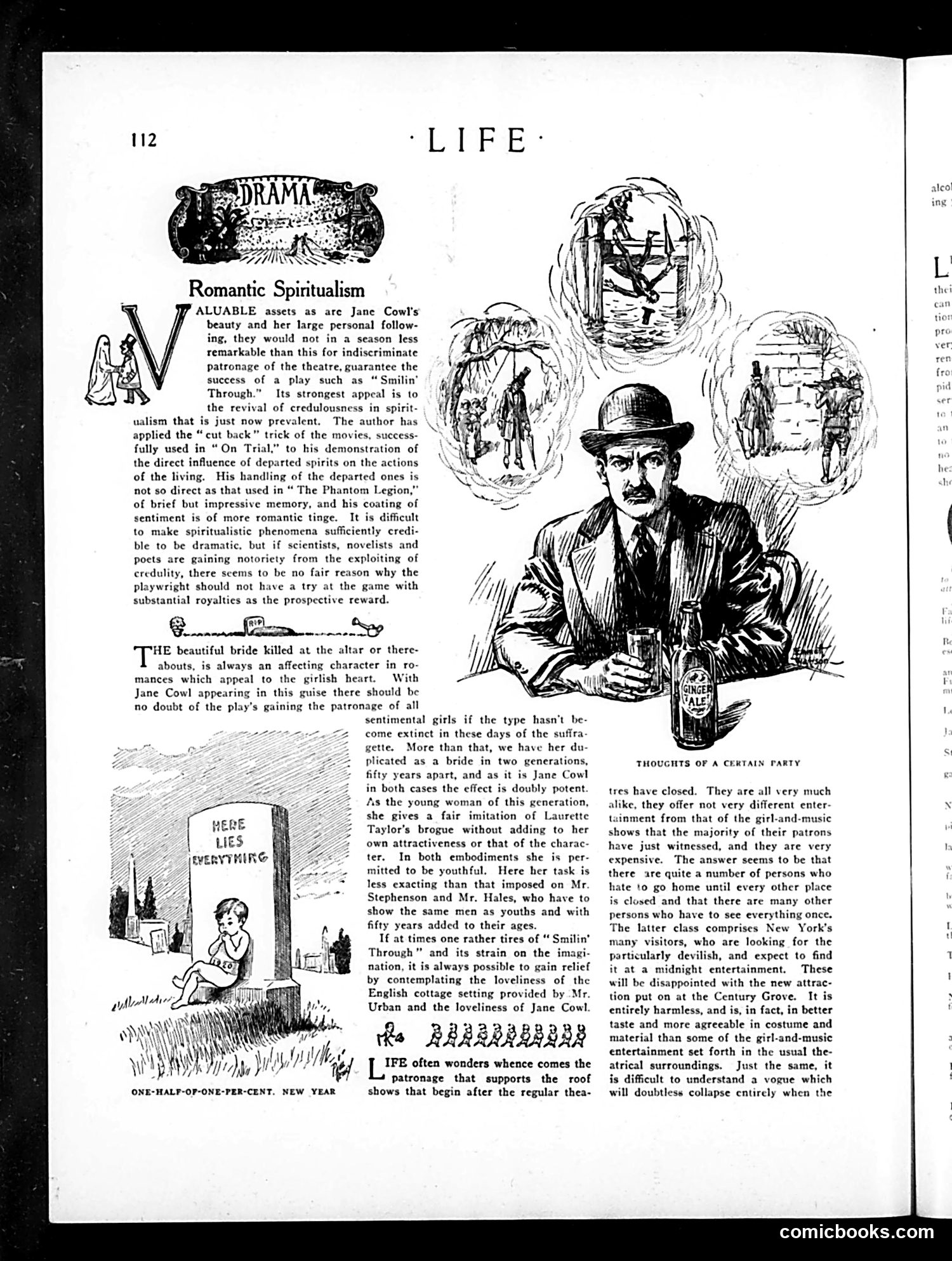
This page reviews the play "Smilin' Through," starring actress Jane Cowl. The critic acknowledges Cowl's beauty and popularity would normally guarantee success, but credits the play's appeal primarily to a contemporary **craze for spiritualism**—the belief in communicating with the dead. The review critiques the playwright for exploiting public credulity about the supernatural, comparing it to how "scientists, novelists and poets are gaining notoriety" from spiritualism. The plot involves a bride killed at the altar whose spirit influences the living across two generations (both played by Cowl). The critic finds the spiritualist premise difficult to make dramatically credible, but notes Cowl's appeal to "sentimental girls." The accompanying illustration labeled "Thoughts of a Certain Party" shows a well-dressed man contemplating the play—likely representing the theatergoer swayed by both Cowl's charm and spiritualist fascination rather than dramatic merit. The piece reflects early 20th-century skepticism toward the spiritualist movement's theatrical exploitation.
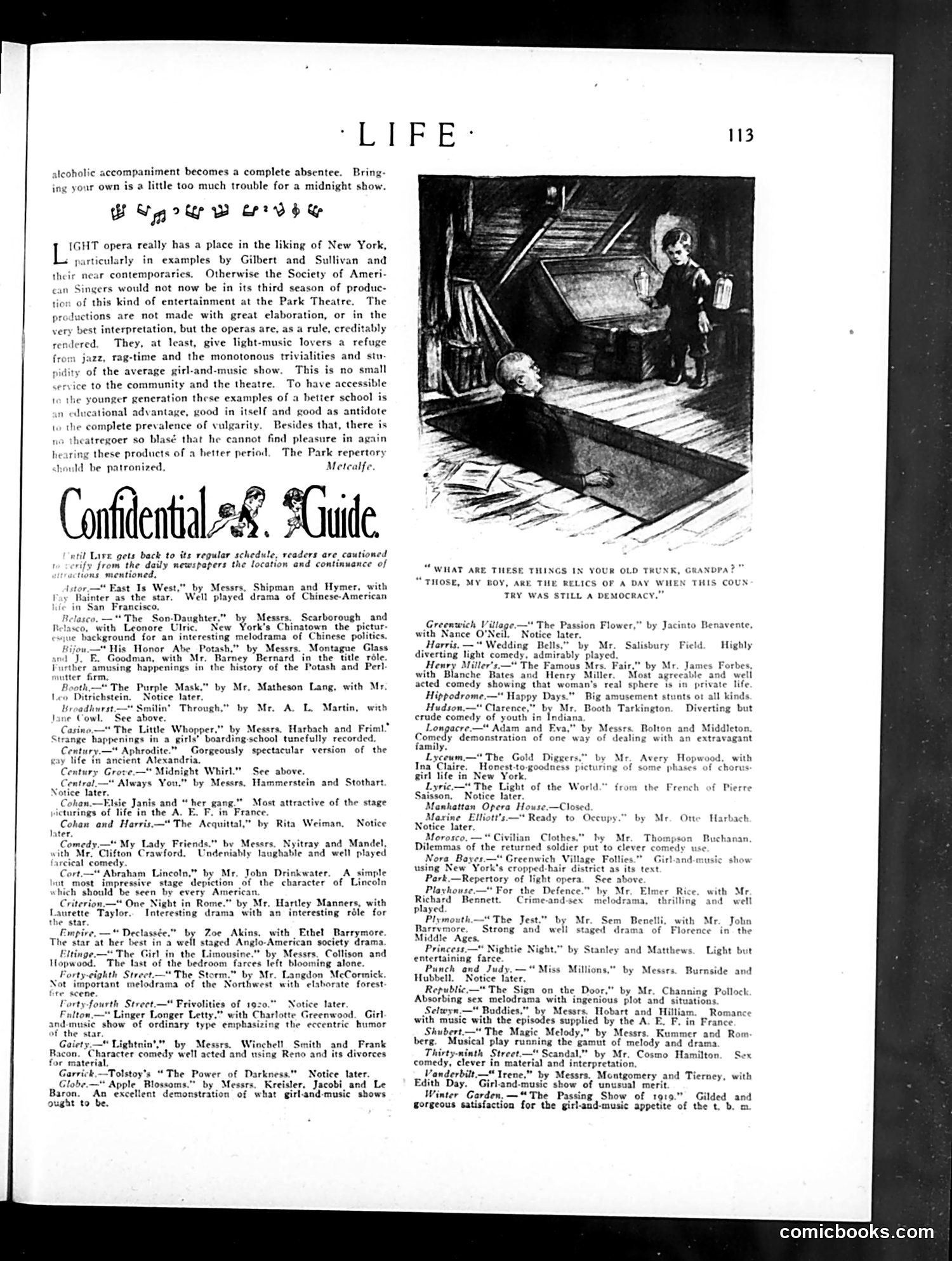
This page contains a theater criticism column and an illustration, not a political cartoon. The image shows an elderly man and young boy examining what appears to be old military relics or antiques, with the caption: "What are these things in your old trunk, grandpa? Those, my boy, are the relics of a war when this country try was still a democracy." The satire is subtle: it suggests that post-WWI America has abandoned democratic principles. The "relics" reference implies democracy itself has become a relic of the past. This reflects post-war disillusionment—the Great War was supposedly fought "to make the world safe for democracy," yet many Americans felt betrayed by the subsequent political landscape, economic turmoil, and labor unrest of the era. The accompanying text promotes light opera (Gilbert and Sullivan) as cultural refuge from lowbrow entertainment like jazz and ragtime shows—a reflection of period cultural anxieties about modernism versus tradition.
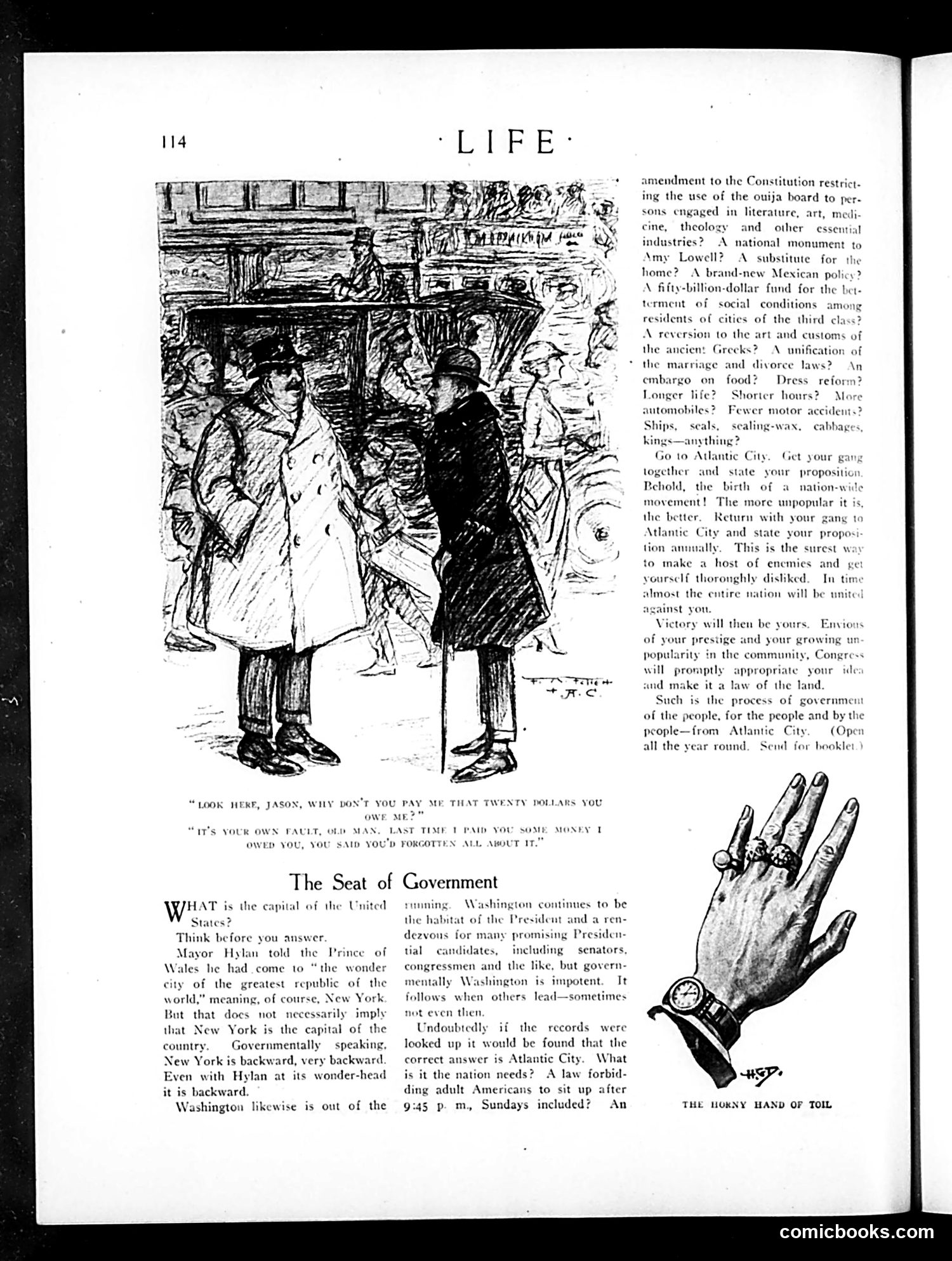
This Life magazine piece satirizes American political dysfunction through absurdist humor. The cartoon shows two men debating a debt—a domestic squabble mirroring governmental incompetence. The article mock-seriously argues that **Atlantic City**, not Washington D.C. or New York, is America's true capital because it's where actual policy gets made. The satire suggests the real power lies with pressure groups and lobbyists meeting in Atlantic City, who then return to Congress to push their agendas into law. The piece ridicules reform movements (ouija board restrictions, Amy Lowell monuments, Mexican policy) as inevitably unpopular—yet paradoxically, this unpopularity is presented as the *secret to success*: make enough enemies and Congress will eventually pass your proposal out of spite or competitive pressure. The illustration "The Horny Hand of Toil" (a working hand) reinforces the irony: while labor is glorified rhetorically, actual governance happens elsewhere, shaped by special interests rather than democratic process. **Key context**: This reflects post-WWI cynicism about American democracy and lobbying influence.
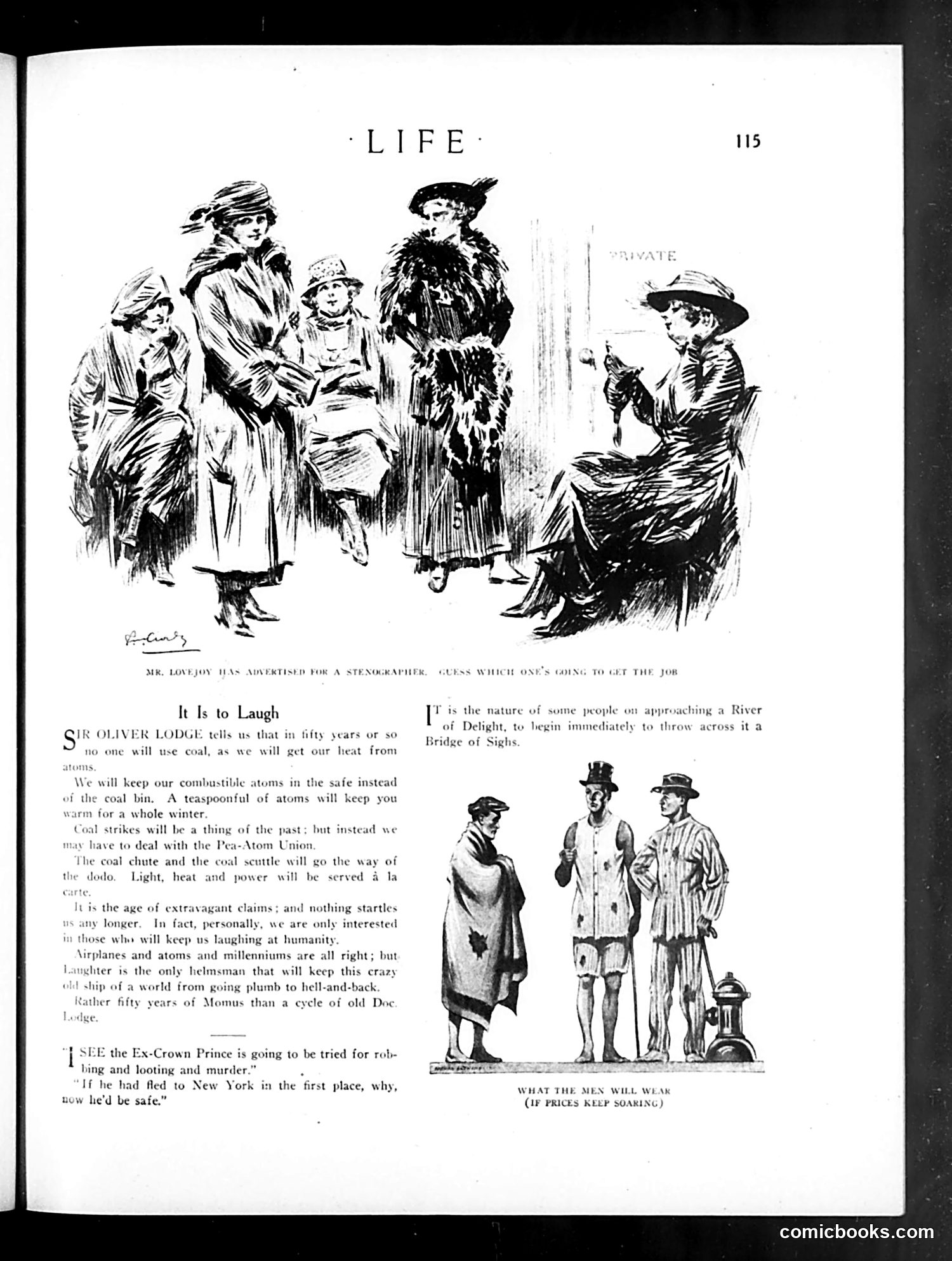
**Top Cartoon**: A man advertises for a stenographer while a woman (labeled "Private") sits nearby. The joke: he'll hire her, then she won't get the job—satirizing gender discrimination in hiring. **"It Is to Laugh"** column mocks Sir Oliver Lodge's prediction that atomic energy will replace coal in fifty years. The satire: such grandiose futuristic claims are absurd. Instead of coal strikes ending, there'll be a "Pea-Atom Union." The piece cynically suggests only humor keeps humanity from self-destruction. **Bottom snippet**: Dark political humor about an ex-Crown Prince (likely German royalty post-WWI) being tried for robbery, looting, and murder. The joke: if he'd fled to New York instead, he'd be "safe"—suggesting New York provides refuge from justice, or that wealthy/powerful criminals escape prosecution there. **Bottom cartoon**: Three working-class men dressed in increasingly minimal clothing, captioned "What the Men Will Wear (If Prices Keep Soaring)"—economic satire about inflation forcing people into poverty and rags.
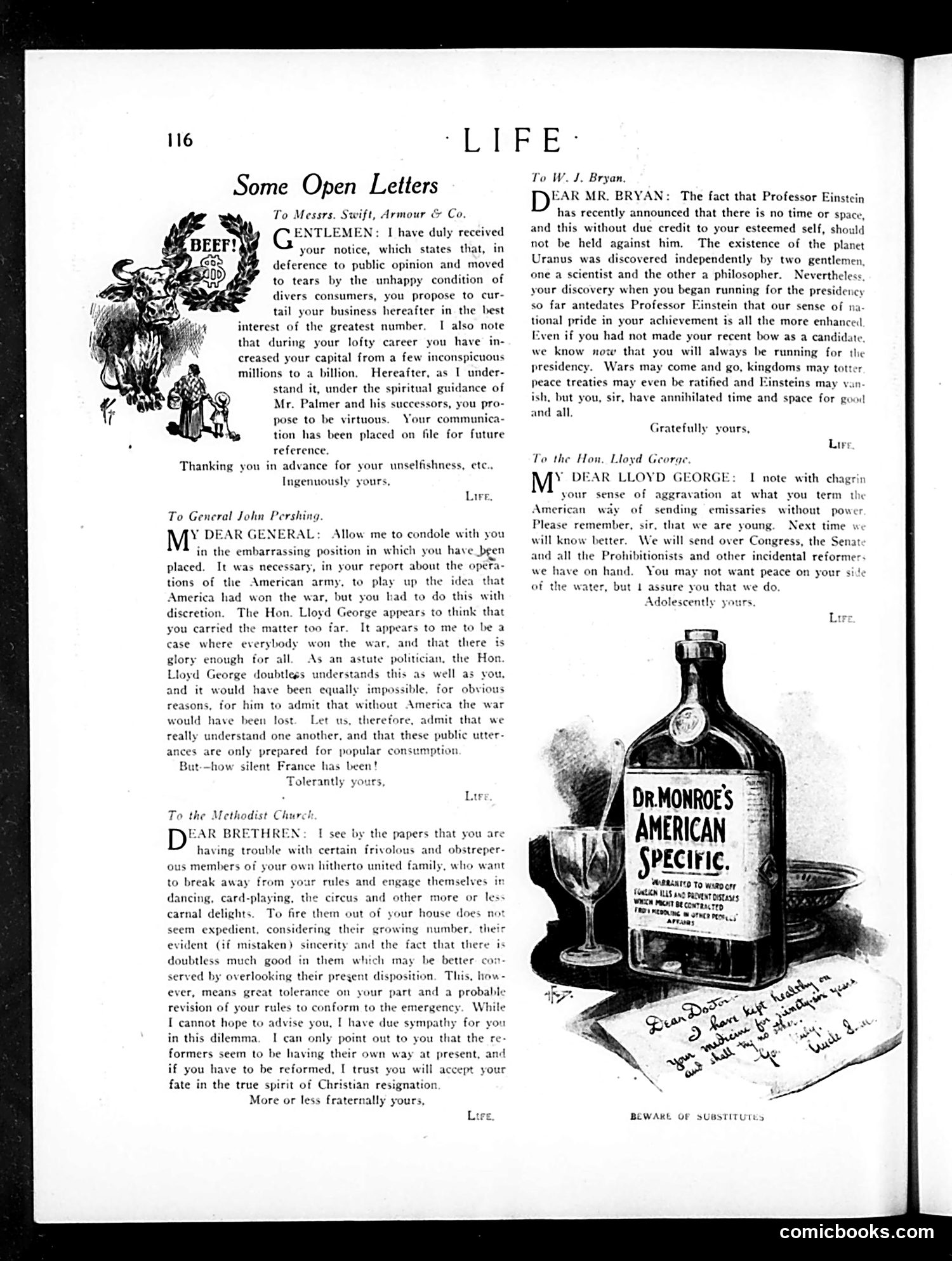
This page contains satirical "open letters" mocking prominent figures of the era (approximately 1920s, based on references to post-WWI diplomacy). **Key targets and satire:** 1. **Swift & Armour (meatpacking companies)**: Mocked for suddenly claiming ethical reform after decades of profiting from consumers' suffering—Life suggests their virtue is performative. 2. **General Pershing**: Gently ribbed for diplomatically crediting Allied victory while subtly implying American dominance, navigating the delicate politics between America, Britain (Lloyd George), and France post-WWI. 3. **Methodist Church**: Criticized for rigidly enforcing outdated rules against dancing and card-playing while membership revolts; urged toward tolerance. 4. **William Jennings Bryan**: A lengthy joke suggesting Bryan, famous for three failed presidential campaigns, has effectively "annihilated time and space" through his perpetual candidacy—mocking his endless political ambitions. 5. **Advertisement**: A Dr. Monroe's American Specific bottle appears—likely a patent medicine, itself satirized by the "Beware of Substitutes" caption. The overall tone is witty political commentary on hypocrisy, vanity, and social change.
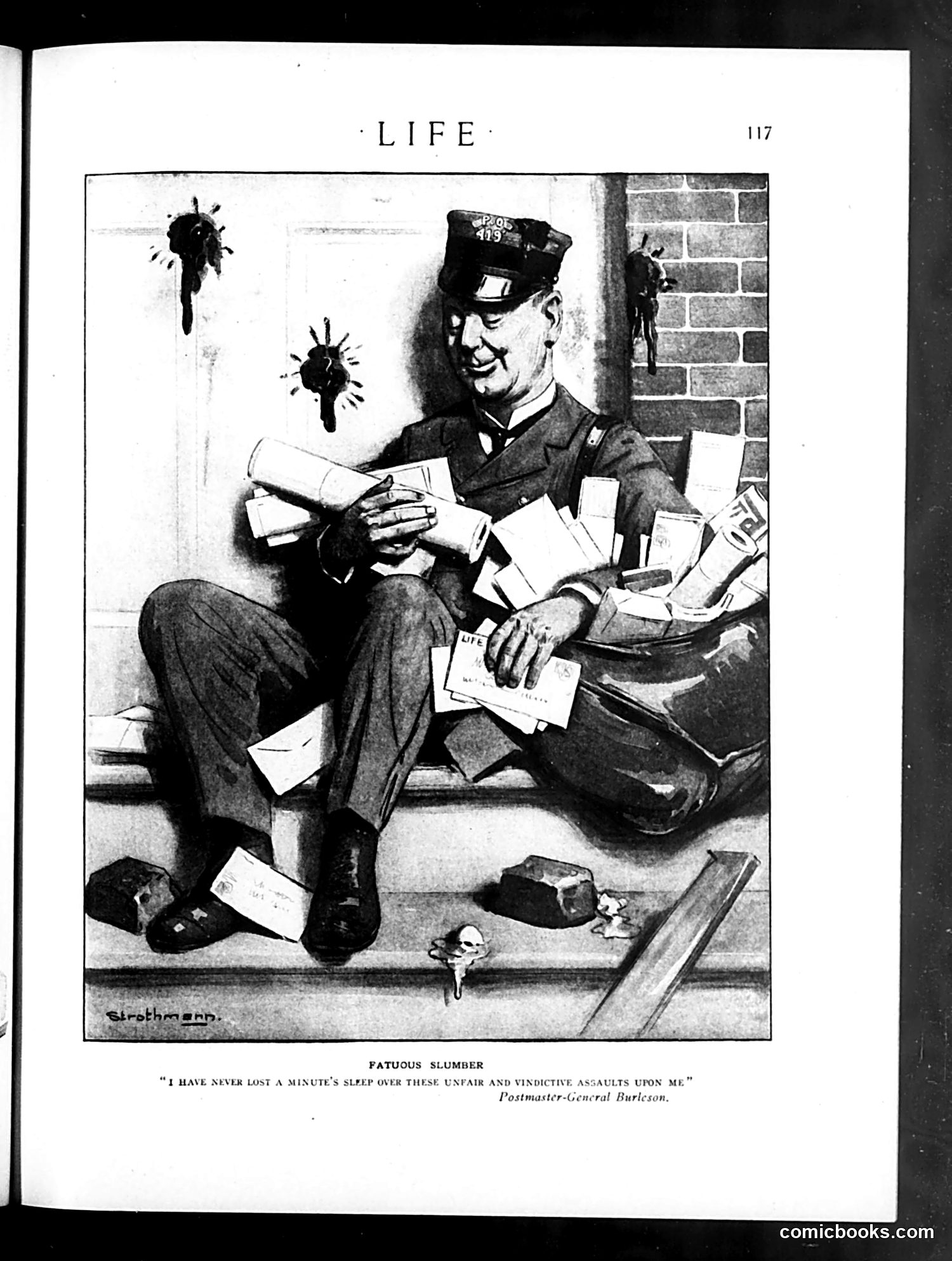
This political cartoon satirizes Postmaster-General Burleson's claimed indifference to criticism. The image shows him sleeping peacefully despite being pelted with letters and envelopes—a visual contradiction of his boast that unfair attacks don't disturb him. The cartoon's title, "Fatuous Slumber" (foolish sleep), mocks his statement as naive or self-deceptive. The letters covering him suggest the mounting complaints or "assaults" he dismisses. The small figure at bottom left appears to represent the public or press. The satire works through irony: his peaceful slumber contradicts his defensive quote, implying he's either lying about his composure or genuinely oblivious to serious criticism—neither flattering. This likely references controversies during Burleson's tenure as Postmaster-General under President Wilson.
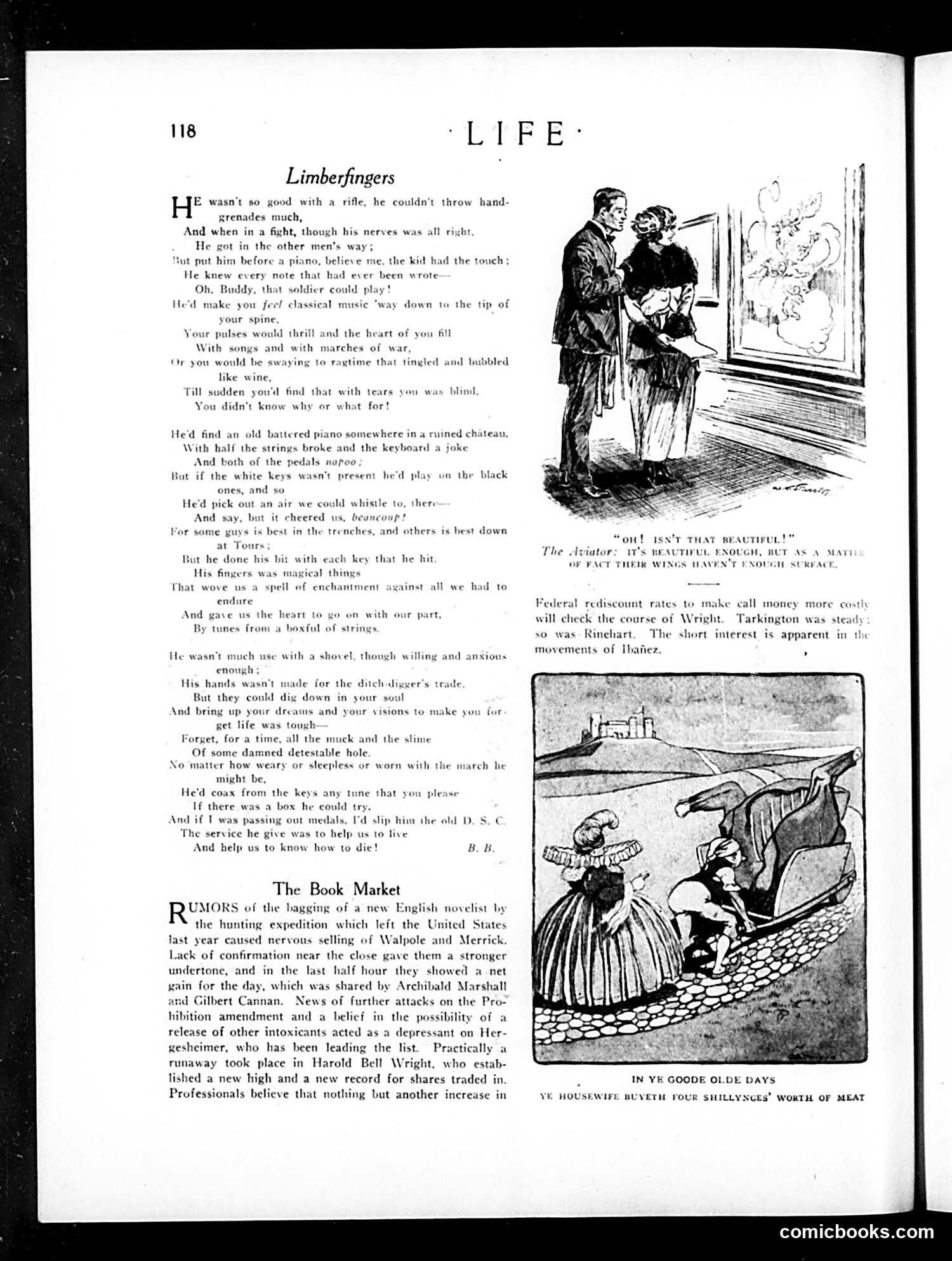
**"Limberfingers"** is a WWI-era poem celebrating a soldier unsuited for combat but invaluable for morale. Despite being clumsy with rifles and grenades, he possessed magical piano skills that emotionally sustained troops in trenches and ruined chateaux. The satire contrasts military utility (where he's useless) with human utility (where his music provides spiritual sustenance). The poem argues that not all wartime contributions are measured by combat effectiveness—this soldier's real service was helping men "know how to die" through art. **"The Book Market"** section uses financial market language to satirize novel sales, treating popular authors like commodities. It references rumors about English novelist Hugh Walpole, reports on stock-like trading in Harold Bell Wright's works, and notes how Prohibition-related news affects author sales. This treats literature as a speculative market where gossip, regulations, and trader sentiment move "shares" rather than actual securities—mocking both publishing and the financial sector simultaneously.
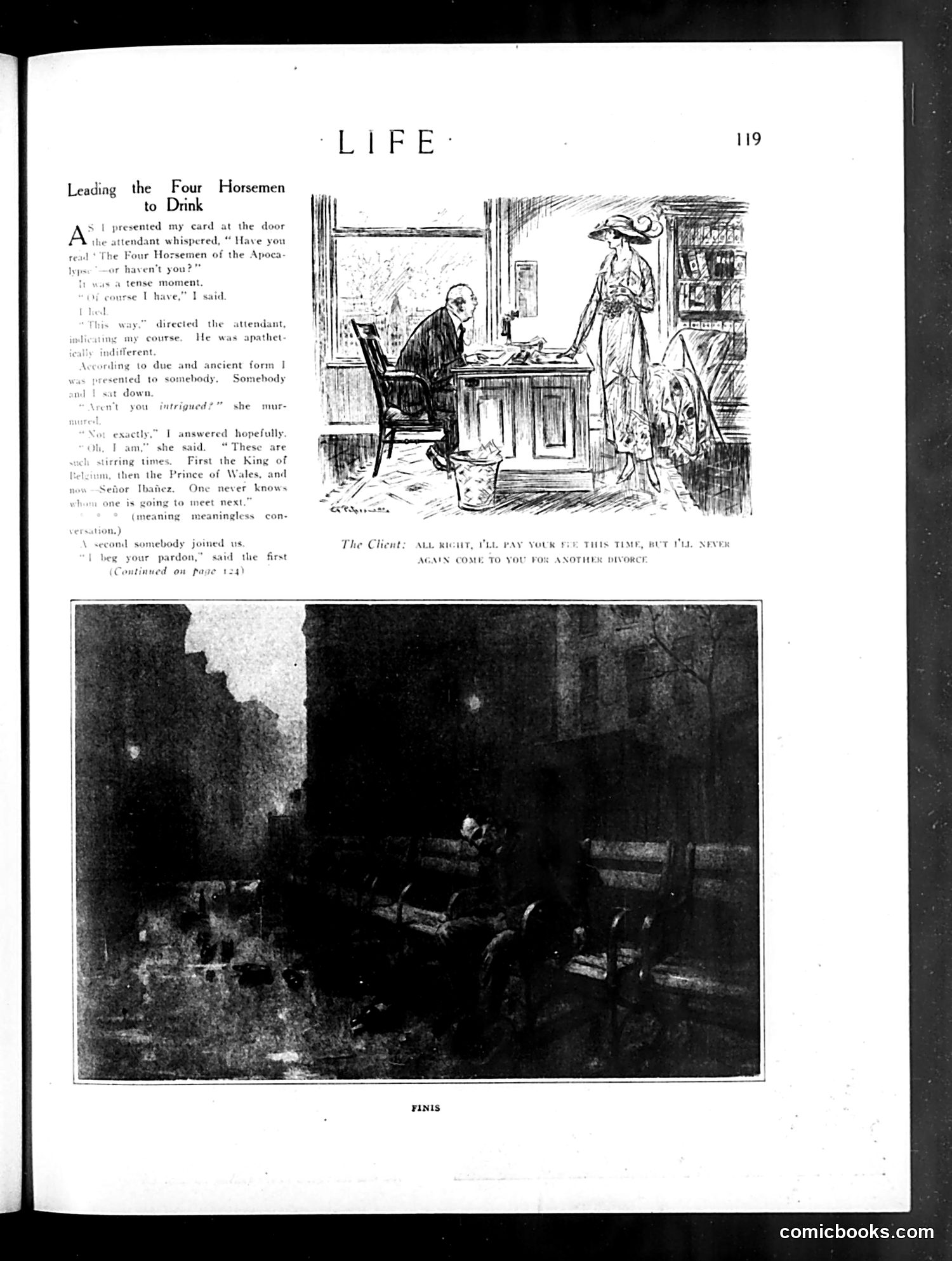
This satirical piece from *Life* magazine references **"The Four Horsemen of the Apocalypse"** — a biblical concept representing War, Pestilence, Famine, and Death. The joke plays on a social/legal scenario involving divorce. The cartoon depicts a lawyer's office where a client arrives, seemingly comparing prominent figures to the biblical horsemen. The caption mentions "the King of Belgium, then the Prince of Wales, and now—Senor Ibanez"—likely referring to **high-profile divorce cases** of the era that dominated society gossip. The punchline is the client's resignation: he'll pay this divorce fee but "never again come to you for another divorce," sarcastically suggesting his marital troubles are as catastrophic and inevitable as the apocalyptic horsemen themselves. The satire mocks the prevalence of divorce among wealthy, prominent figures and the lawyer's casual acceptance of serial divorces as routine business—treating personal relationship collapse as casually as one might discuss biblical catastrophe.
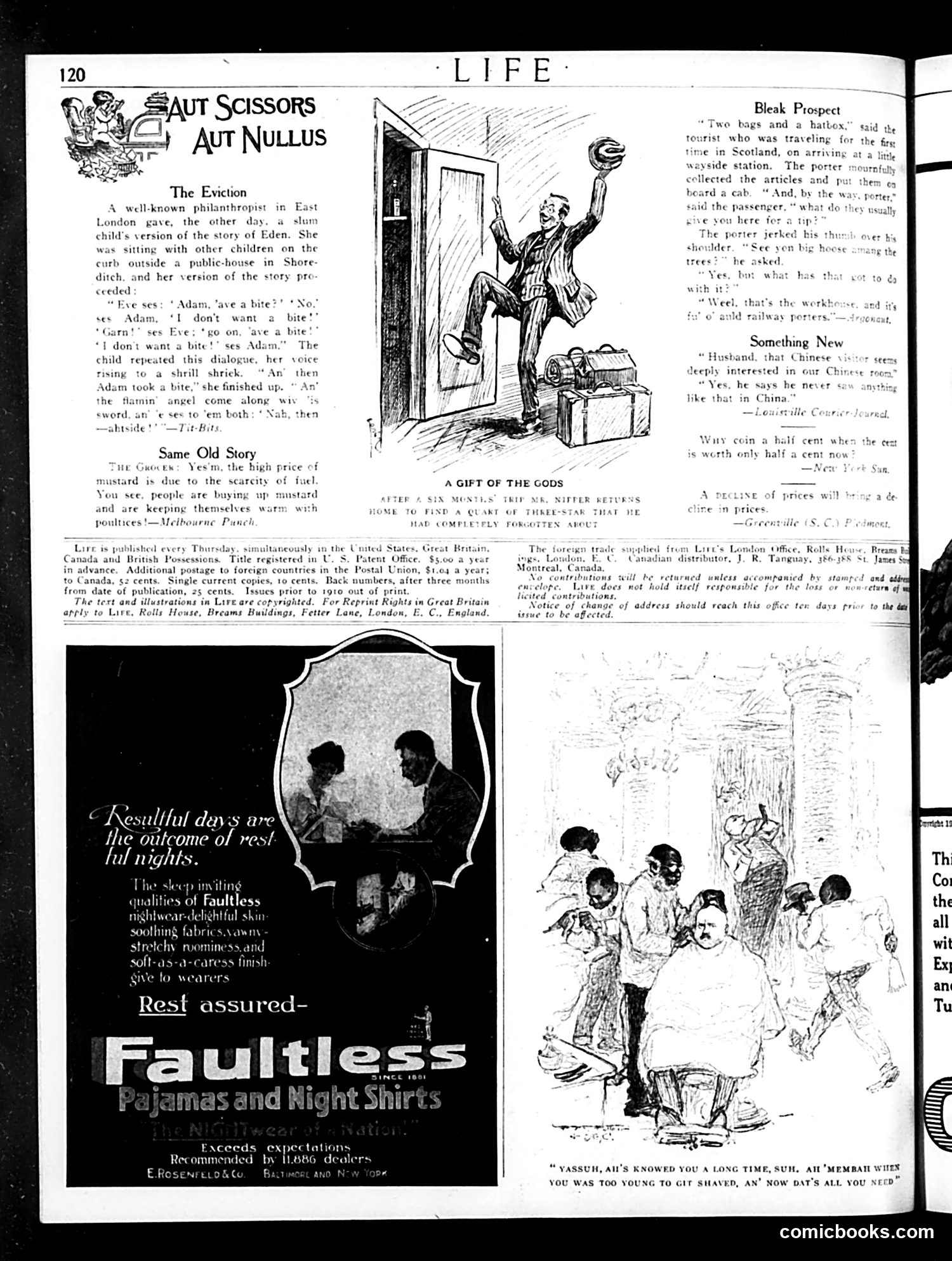
This page contains **humor pieces and advertisements** rather than political cartoons. The main content includes: **"The Eviction"** — A philanthropist recounts a working-class child's irreverent retelling of the Adam and Eve story, using Cockney dialect. The joke satirizes how poverty-stricken East London children understand scripture through their own rough, secular experience. **"Same Old Story"** — A brief joke about inflation: a grocer blames mustard scarcity on people hoarding it to stay warm with poultices, mocking illogical economic excuses. **"Bleak Prospect"** and **"Something New"** — Short anecdotes about a Scottish porter and a Chinese guest, respectively. **"A Gift of the Gods"** — A man returns from a trip having forgotten about liquor entirely. The **bottom cartoon** shows a barber and customer in apparent racial dialect humor (marked "YASSUH"), typical of early 20th-century American publications. The page also features a **Faultless Pajamas advertisement** promoting restful sleep. Overall, this is a typical Life magazine miscellany of light social satire and advertising.
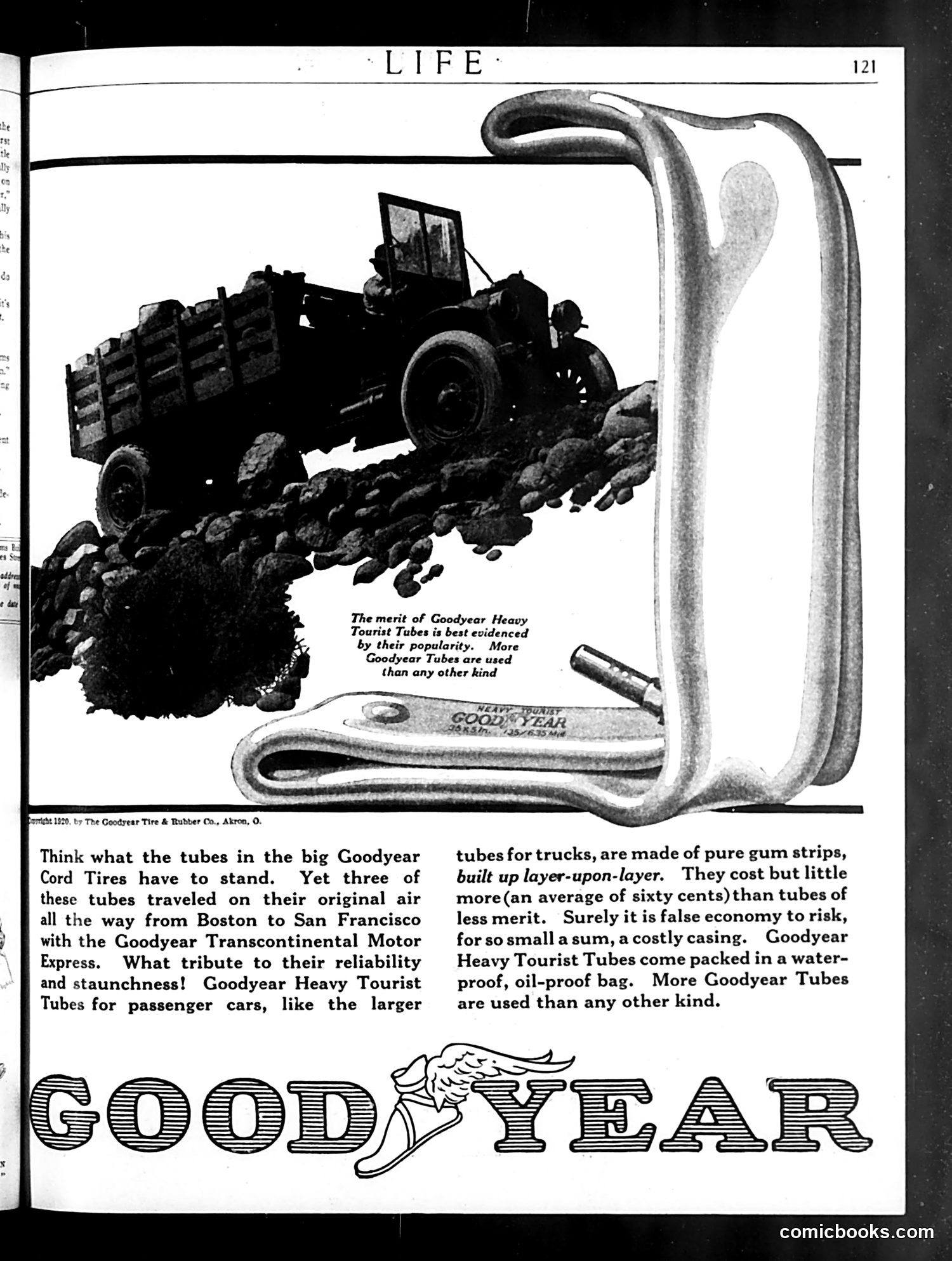
This is primarily a **Goodyear tire tube advertisement**, not political satire. Published in 1920 (per the copyright), it promotes Goodyear's "Heavy Tourist Tubes" for automobiles. The advertisement's central claim is reliability demonstrated through a transcontinental journey: three tubes traveled from Boston to San Francisco in a Goodyear Motor Express vehicle on their original air, allegedly proving product durability. The accompanying image shows a heavily loaded truck climbing a rocky hill, visually emphasizing the stress these tubes endure. The sales pitch emphasizes value: at approximately sixty cents more than inferior tubes, they represent smart economy for protecting expensive tire casings. The ad notes Goodyear tubes' superiority through market dominance—"more Goodyear Tubes are used than any other kind." For modern readers, this reflects early automotive culture when tire tubes were separate, replaceable components (unlike today's tubeless tires) and when cross-country motor trips were novel enough to serve as marketing testimonials.
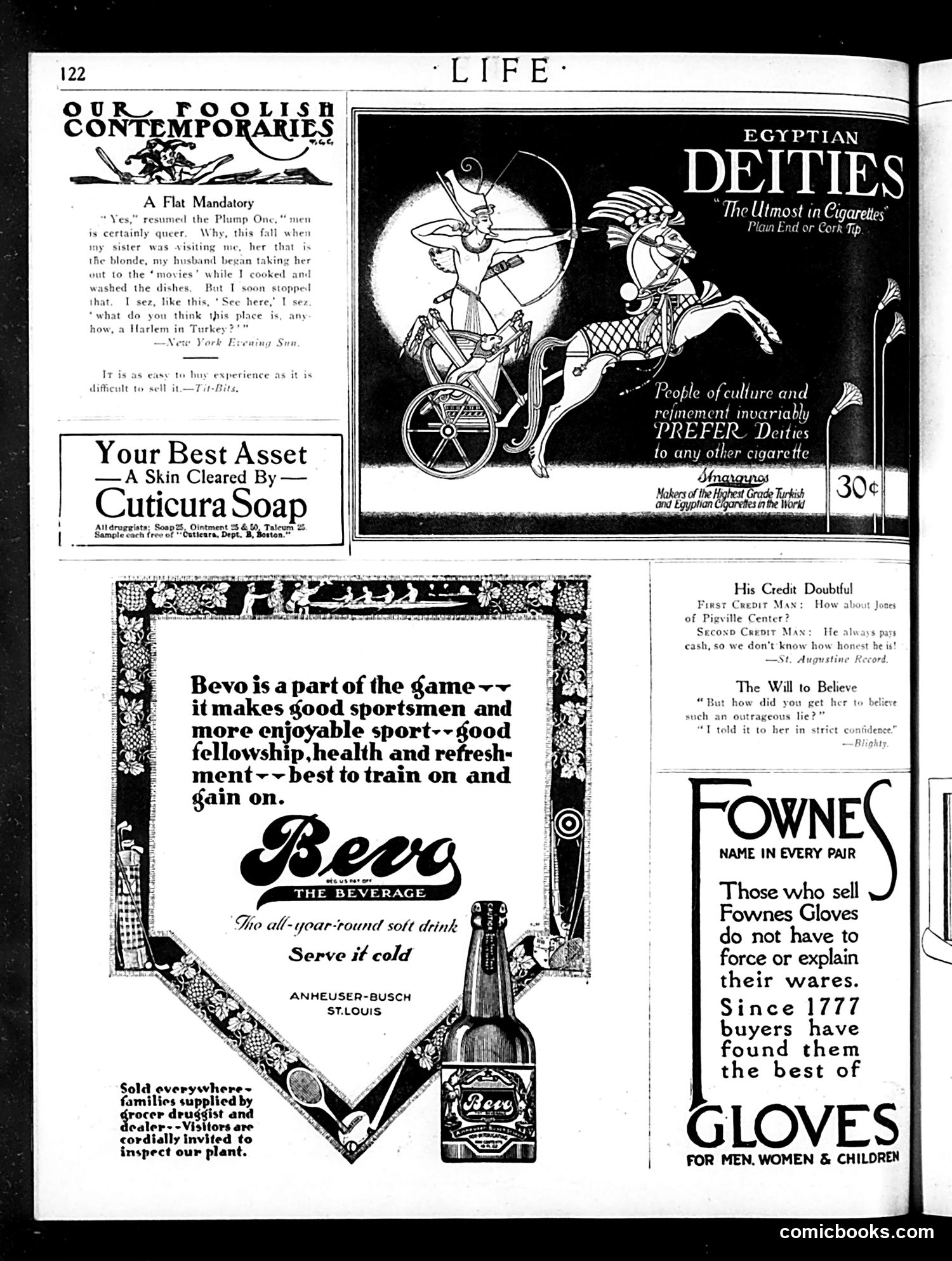
This page is primarily **advertising**, typical of 1920s Life magazine. The only editorial content is two brief humor snippets: **"His Credit Doubtful"** jokes about credit assessment—two credit managers discussing a man from "Pigville Center" whose creditworthiness is unknown because he always pays cash, making him impossible to evaluate through credit history. **"The Will to Believe"** satirizes how people accept absurd lies when told in confidence, suggesting that delivery and tone matter more than plausibility. The remainder features product advertisements: Cuticura Soap, Egyptian Deities cigarettes (marketed as sophisticated), Bevo soft drink (Anheuser-Busch), and Fownes Gloves. These ads reflect early-20th-century consumer culture and marketing strategies, with Egyptian imagery used to suggest luxury and exoticism in the cigarette advertisement.
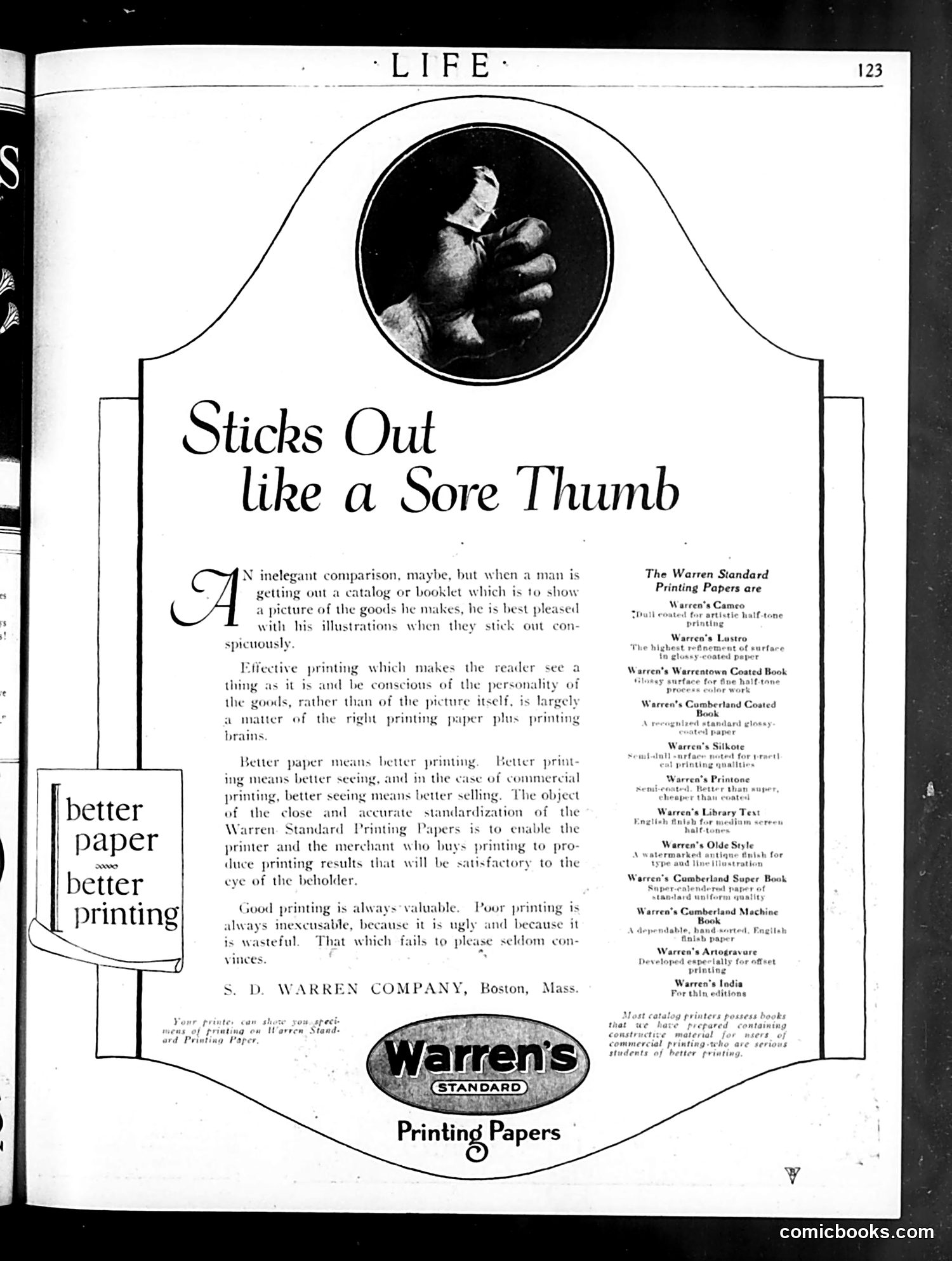
This is **not a cartoon or satire page**, but rather a **product advertisement** for Warren Standard Printing Papers, disguised within editorial content in *Life* magazine (page 123). The "sore thumb" metaphor is literal advertising copy: the page argues that good printing paper makes catalogs and commercial materials "stick out" visibly—stand out conspicuously from competitors. The circular image at top shows a thumb, literalizing the metaphor. The left sidebar emphasizes "better paper / better printing," while the right column lists Warren's various paper products (Lasito, Cumberland Coated, Silverite, etc.) with technical specifications. **No political or social satire is present.** This is straightforward early-20th-century advertising, positioned as editorial advice about printing quality. The S. D. Warren Company (Boston) used *Life*'s credibility to market papers to commercial printers and merchants.
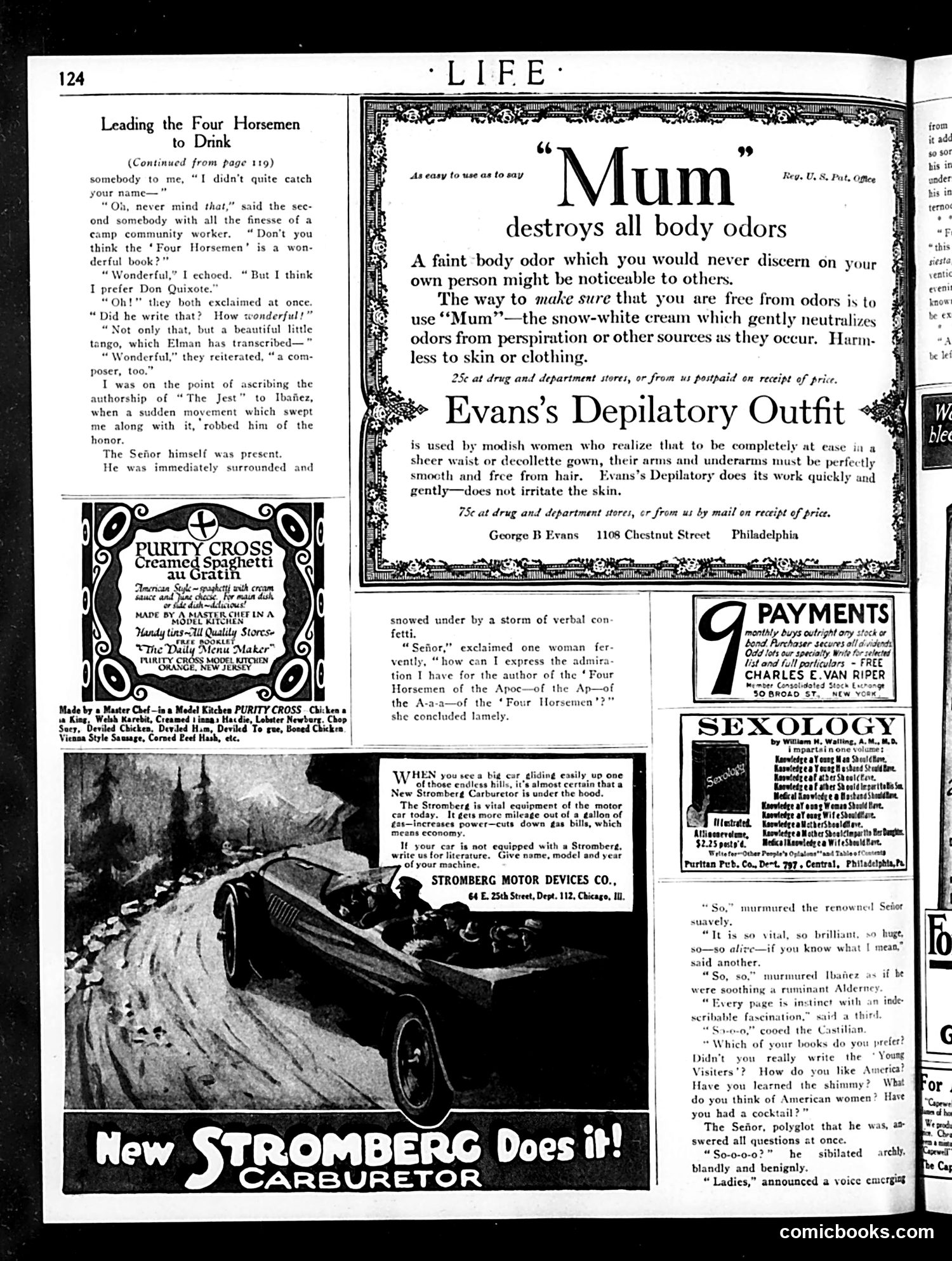
This page is primarily **advertisements interspersed with a literary anecdote**, not political satire. The text "Leading the Four Horsemen to Drink" continues a humorous story (from page 119) about a social encounter with a Spanish gentleman ("the Señor"). The narrator is mistakenly credited with writing famous literary works—"The Four Horsemen," *Don Quixote*, and pieces by Ibáñez—through a comedy of confusion. When the actual Señor arrives, admirers mobbing him offer absurdly effusive praise about his (fictional) authorship, with comedic emphasis on their inability to complete his name ("the A-a-a—"). The joke satirizes **pretentious literary society**—how people praise books without truly understanding them, and how they fawn over supposed celebrity authors with superficial flattery. The page is dominated by contemporary **product advertisements** (Mum deodorant, Evans's Depilatory, Purity Cross Spaghetti, Stromberg Carburetors, and Sexology books), typical of Life's 1920s era publishing model.
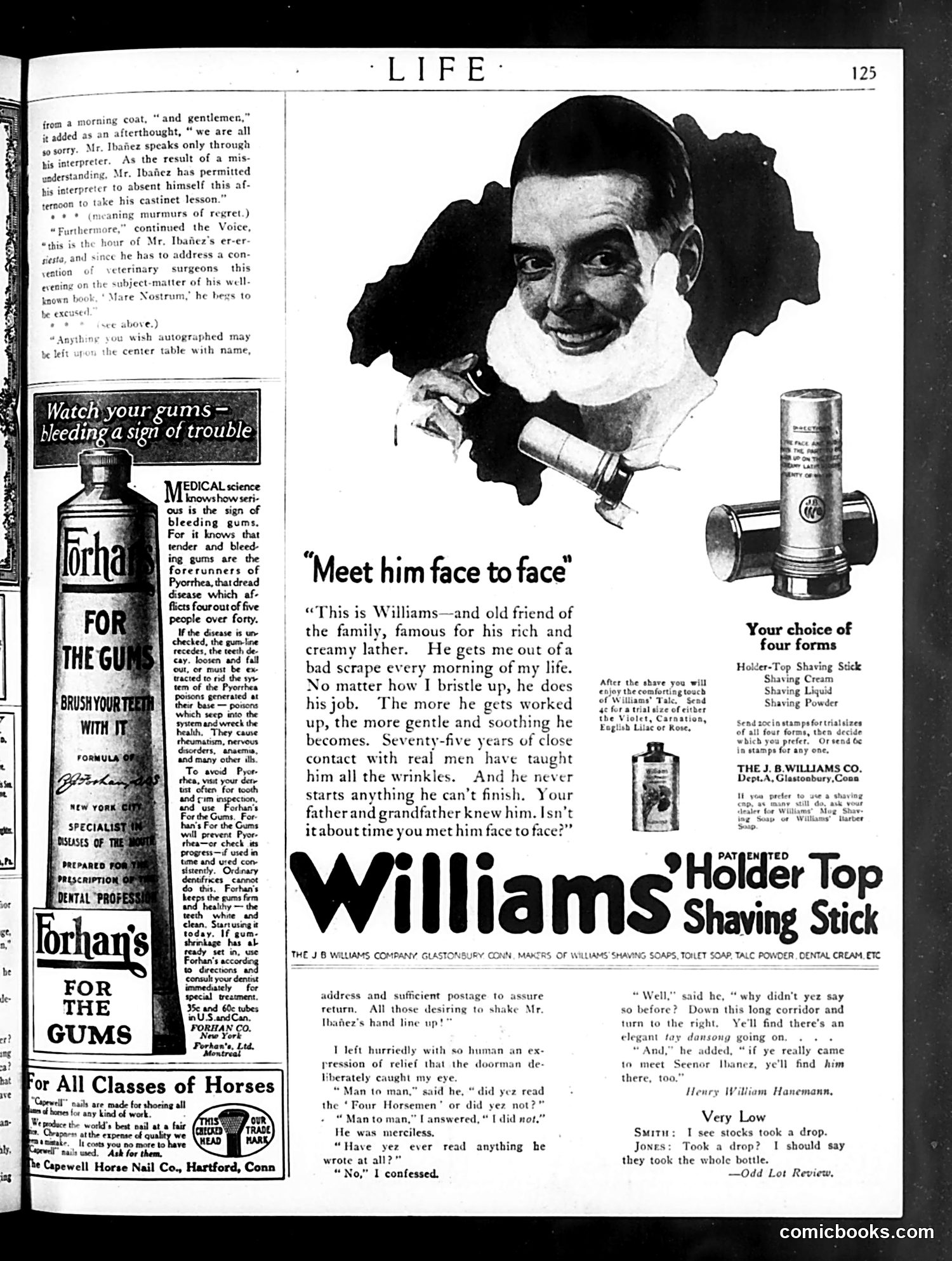
This page is primarily **advertising**, dominated by a Williams Shaving Stick advertisement featuring a photograph labeled "Meet him face to face"—a personified shaving product presented as "Williams," described as a family friend famous for his "rich and creamy lather." The page includes a brief humorous narrative (top left) referencing "Mr. Ibáñez," who appears to be a notable figure requiring an interpreter, though his specific identity isn't clear from context. The dialogue suggests he's about to address veterinary surgeons on his book "Mare Nostrum." Below the main ad are smaller advertisements for Forhan's gum treatment and Capewell horse nails, plus a joke labeled "Odd Lot Review" about stock market losses. The satire is gentle product personification rather than political commentary—typical of 1920s-era Life magazine advertising, which frequently anthropomorphized consumer goods. The page reflects period marketing strategies and demonstrates Life's blend of light social humor with commercial content.
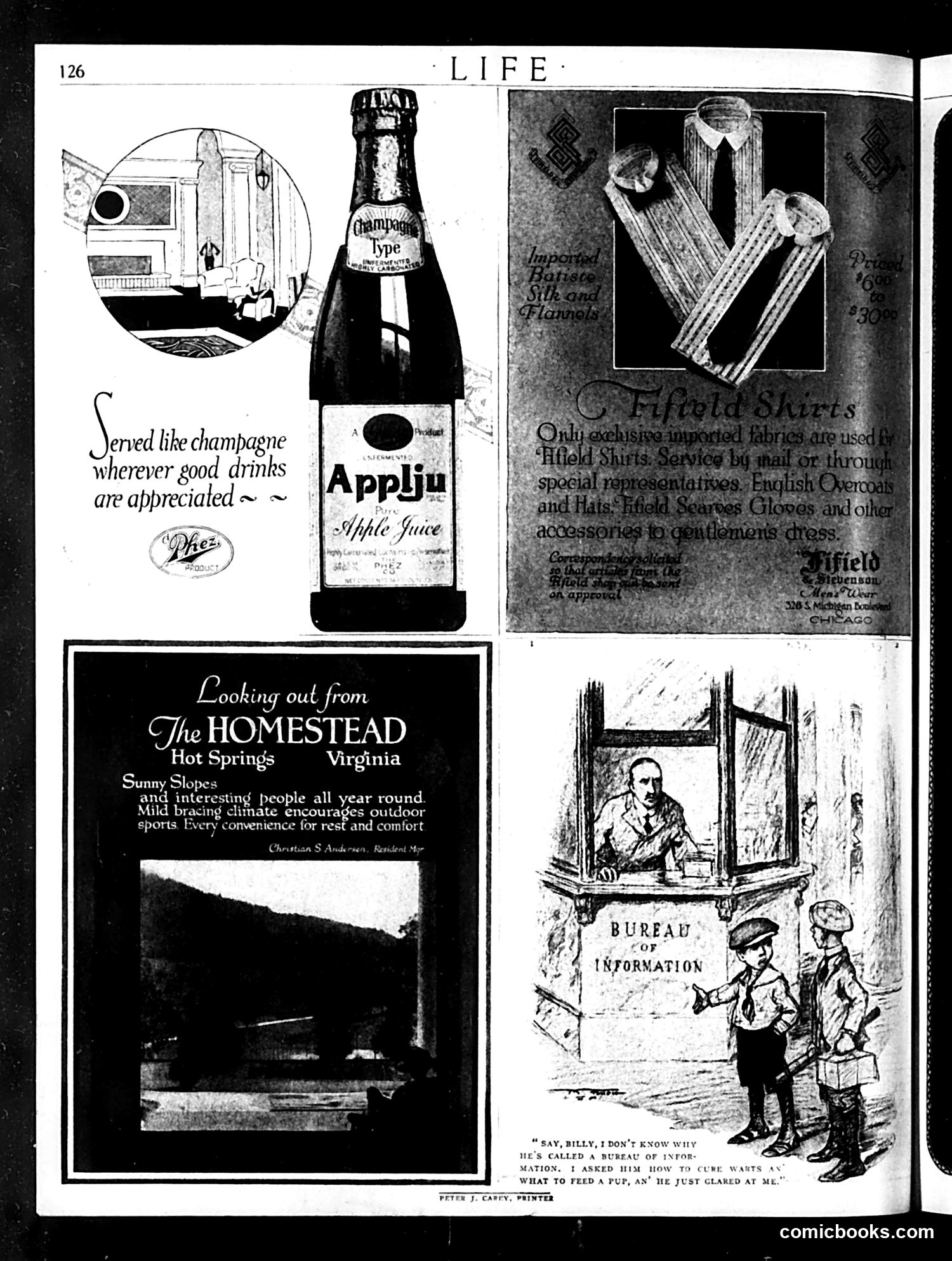
This page is primarily **advertising** rather than political satire. It contains three distinct ads: 1. **Appljia Apple Juice** (top center): A champagne bottle-shaped advertisement claiming the product should be "served like champagne wherever good drinks are appreciated"—a humorous pitch equating apple juice with fine wine. 2. **Hifield Shirts** (top right): Advertises exclusive imported fabrics for men's formal wear, offering mail-order service. 3. **The Homestead resort** (bottom left): Promotes Hot Springs, Virginia as a vacation destination with outdoor sports and mild climate. 4. **Bureau of Information cartoon** (bottom right): A small comic strip showing a man at a "Bureau of Information" window. The joke involves wordplay: someone asked about curing warts on a puppy, but the bureau official misunderstands "what to feed a pup." The page reflects early 20th-century consumer culture and light humor typical of LIFE's satirical-advertising format.
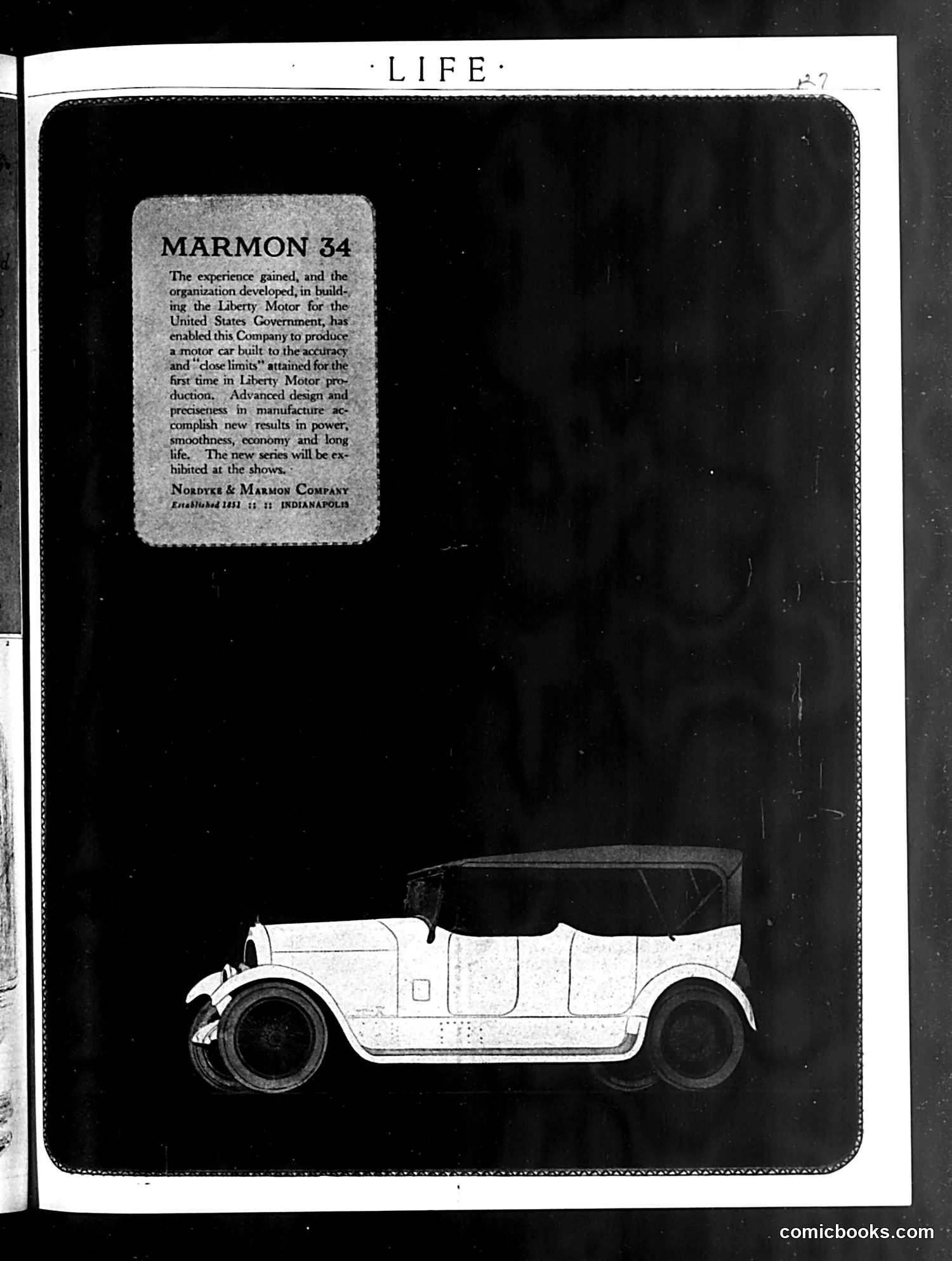
This page is primarily an **advertisement**, not political satire. It promotes the "Marmon 34" automobile by Nordyke & Marmon Company (Indianapolis). The ad claims the company's experience building the "Liberty Motor" for the U.S. Government enabled them to manufacture a car with unprecedented precision and quality. The text emphasizes advanced design resulting in superior power, smoothness, economy, and longevity. The image shows a side-profile illustration of the Marmon 34 vehicle. The advertisement promises the new model will be exhibited at automotive shows. This is essentially a **corporate boast** leveraging government military contracts to establish credibility and prestige for a consumer product—a common advertising strategy of the early automotive era.
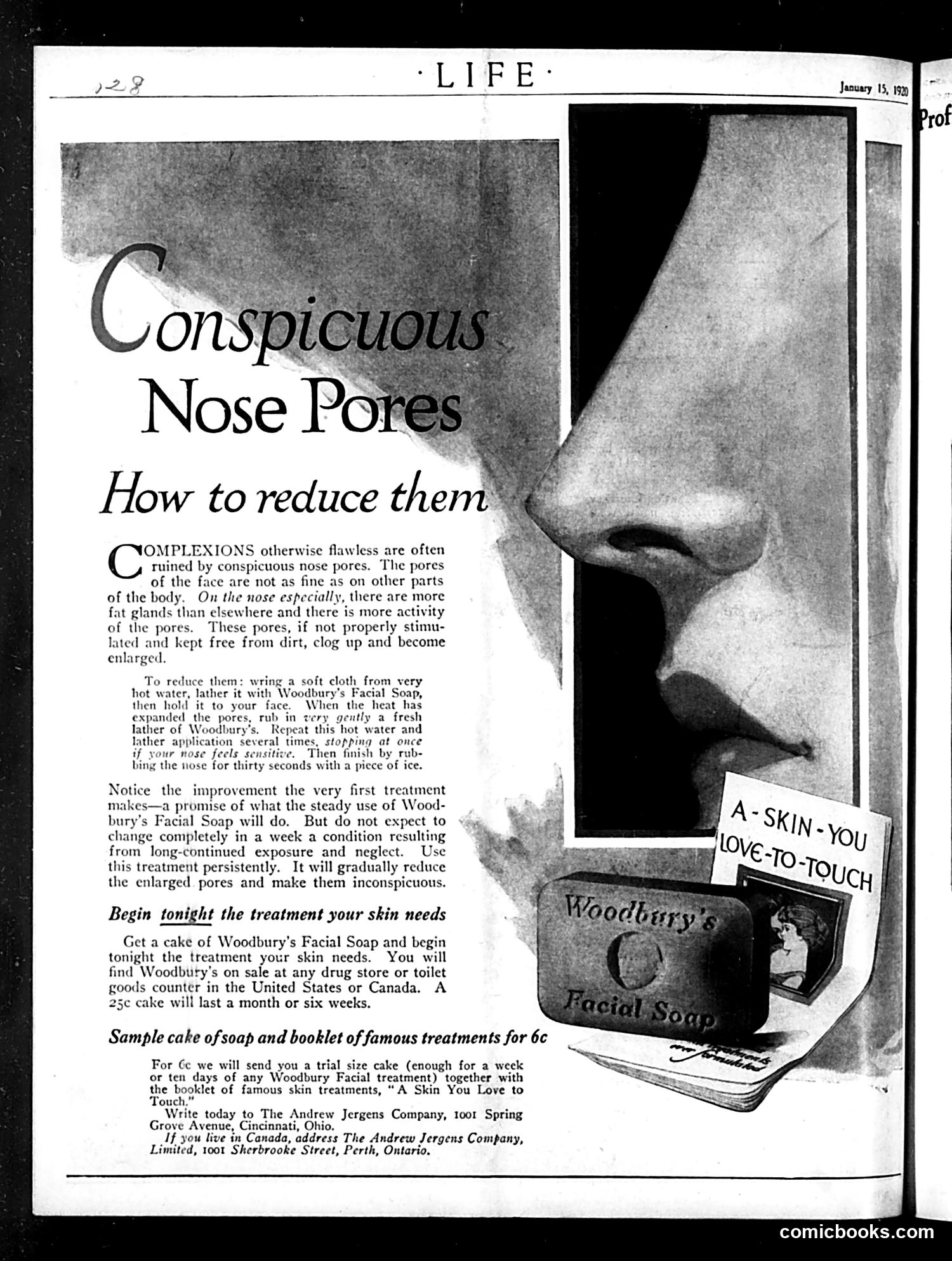
This is a **beauty product advertisement**, not political satire. The page promotes Woodbury's Facial Soap with a how-to guide for reducing enlarged nose pores—a common cosmetic concern for the era. The large photograph shows a woman's face in profile, highlighting the nose to visually demonstrate the problem being addressed. The advertisement explains that nose pores enlarge due to excess oil glands and poor maintenance, then provides a detailed treatment regimen using hot water, soap, and ice. The pitch emphasizes that results improve gradually with persistent use, discouraging unrealistic expectations of quick fixes. A sample cake and booklet titled "A Skin You Love to Touch" are offered for 6 cents—a common direct-mail marketing technique of the 1920s period. This reflects early-20th-century advertising's focus on women's beauty standards and skincare as a purchasable solution to perceived flaws.