
Life, 1920-01-15 · page 21 of 36
Life — January 15, 1920 — page 21: what you’re looking at
What you’re looking at
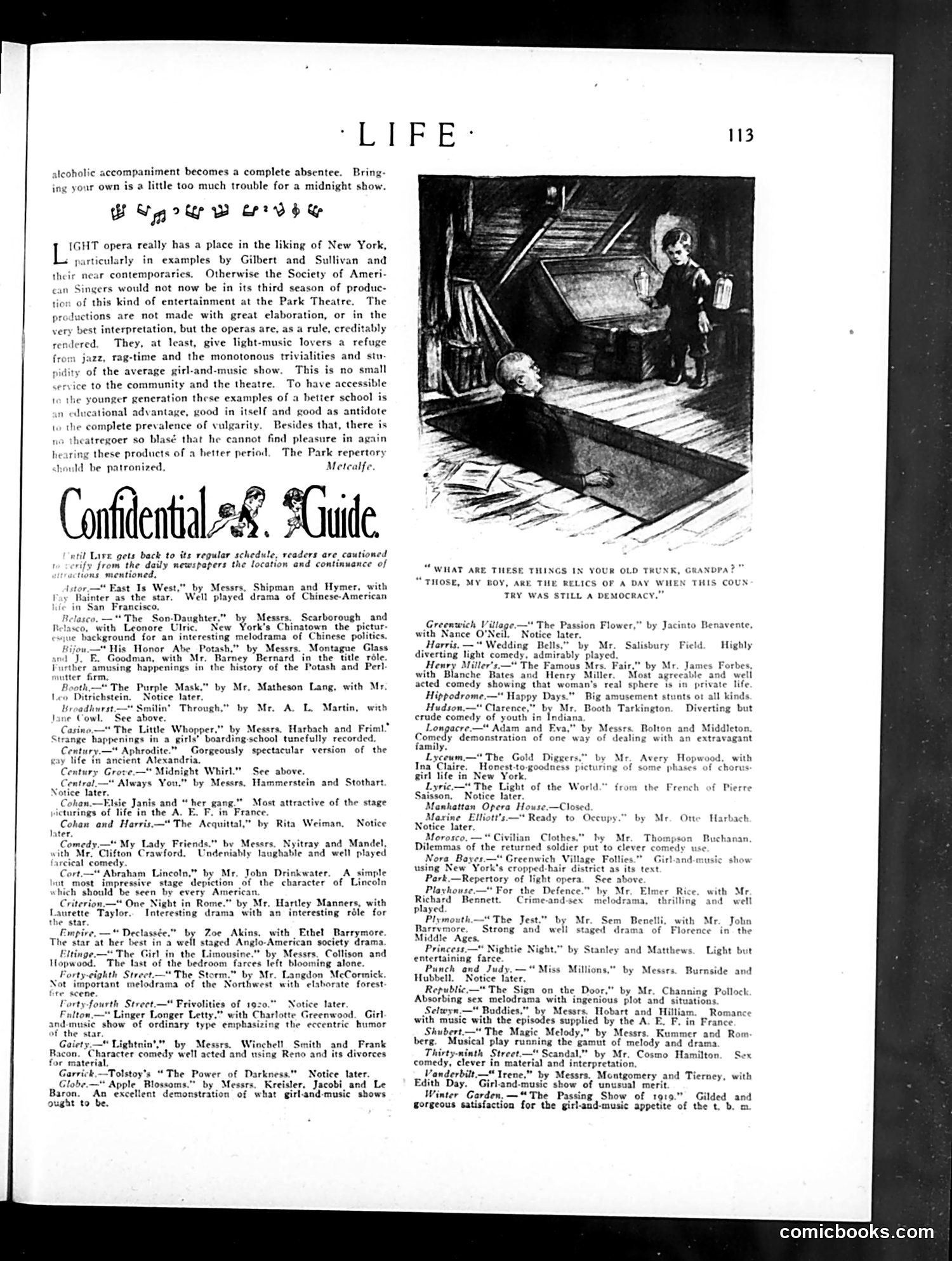
This page contains a theater criticism column and an illustration, not a political cartoon. The image shows an elderly man and young boy examining what appears to be old military relics or antiques, with the caption: "What are these things in your old trunk, grandpa? Those, my boy, are the relics of a war when this country try was still a democracy." The satire is subtle: it suggests that post-WWI America has abandoned democratic principles. The "relics" reference implies democracy itself has become a relic of the past. This reflects post-war disillusionment—the Great War was supposedly fought "to make the world safe for democracy," yet many Americans felt betrayed by the subsequent political landscape, economic turmoil, and labor unrest of the era. The accompanying text promotes light opera (Gilbert and Sullivan) as cultural refuge from lowbrow entertainment like jazz and ragtime shows—a reflection of period cultural anxieties about modernism versus tradition.
📄 Transcribed text from this page (OCR, searchable)
Machine-transcribed from the original scan — historical spelling and the odd misread are preserved.
‘LIBRE alcoholic accompaniment becomes a complete absentee. Bring- ing your own is a little too much trouble for a midnight show. Eg ww oeyoe IGHT opera really has a place in the liking of New York, particularly in examples by Gilbert and Sullivan and their near contemporaries. Otherwise the Society of Ameri- can Singers would not now be in its third season of produc- tion of this kind of entertainment at the Park Theatre. The productions are not made with great elaboration, or in the very best interpretation, but the operas are, as a rule, creditably rendered. They, at least, give light-music lovers a refuge from jazz, rag-time and the monotonous trivialities and stu- tity of the average girl-and-music show. This is no small service to the community and the theatre. To have accessible to the younger generation these examples of a better school is ational advantage, good in itself and good as antidote to the complete prevalence of vulgarity. Besides that, there is atregoer so blasé that he cannot find pleasure in again hearing these products of a better period. The Park repertory hould be patronized, Metcalfe Confidential.28, SGuide ntil Live gets back to its regular schedule, readers are cautioned to verify from the daily newspapers the location and continuance of ns mentioned, st Is West," by Messrs, Shipman and Hymer, with Well played drama of Chinese-American Istor,— Vay Bainter as the star. in San Francisco, Ielasco. —“* The Son-Daughter.” by Messrs, Scarborough and neo. with Leonore Ulric. New York's Chinatown. the. pictur- sue background for an interesting melodrama of Chinese politics. —" His Honor Abe Potash,” by Messrs. Montague Glass J. FE. Goodman, with Mr. Barney Bernard in the title réle. ier amusing happenings in the history of the Potash and Perl: utter firm, . Booth.—" The Purple Mask.” by Mr, Matheson Lang, with Mr. Leo Ditrichstein, Notice later, Broadhurst.—"* Smilin’ Through.” by Mr. A. LE, Martin, with © Cowl, See above. Casino.—" The Little Whopper,” by Messrs. Harbach and Friml” Strange happenings in a girls’ boarding-school tunefully recorded, Century.—" Aphrodite.” Gorgeously spectacular version of the gay life in ancient Alexandria, Century Grove.—" Midnight Whirl.” See above. Central.—" Always You.” by Messrs, Hammerstein and Stothart Notice later. Cohan.—Flsie Janis and “her gang." Most attractive of the stage cturings of life in the A. E. F. in France. Cohan and Harris.—“ The Acquittal,” by Rita Weiman, later. Comedy.— My Lady Friends." by Messrs, Nyitray and Mandel, vith Mr. Clifton Crawford, Undeniably laughable and well played reical comedy. Cort." Abraham Lincoln,” by Mr. John Drinkwater. A’ simple ut most impressive stage depiction of the character of Lincoln hich should be seen by every American. Criterion.—* One Night in Rome.” by Mr. Hartley Manners, with Laurette Taylor. Interesting drama with an interesting réle for the. star. Empire, —“ Declassée.” by Zoe Akins. with Ethel Barrymore. The star at her best in a well staged Anglo-American society drama Eltinge—* The Girl in the Limou by Messrs. Collison and Hopwood. The tast of the bedroom farces left blooming alone. Forty-eighth St The Storm.” by Mr. Langdon McCormick. Not important melodrama of the Northwest with elaborate forest fire scene. Fortyfourth Street—* Frivolities of 1920." Notice later. Fulton, —" Linger Longer Letty.” with Charlotte Greenwood. Girl and:music show of ordinary type emphasizing the eccentric humor of the star, Gaiety.—" Lightnin’,” by Messrs, Winchell Smith and Frank Racon. Character comedy well acted and using Reno and its divorces for material, Garrick.—Tolstoy’s “The Power of Darkness.” Notice later. Globe.—" Apple Blossoms.” by Messrs, Kreisler, Jacobi and Le Baron. An excellent demonstration of what girl-and-music shows ought to be. ‘otice 113 “WHAT ARE THESE THINGS IN YOUR OLD TRUNK, GRANDPA?” “THOSE, MY BOY, ARE THE RELICS OF A DAY WHEN THIS COUN TRY WAS STILL A DEMOCRACY eenwich Village.— The Passion Flower,” by Jacinto Benavente, with Nance O'Neil. | Notice later. Harris. —“* Wedding Bells,” by Mr diverting light comedy, admirably played. Henry Miller’s.—" The Famous Mrs. Fair,” by Mr. James Forbes. with Blanche Bates and Henry Miller. Most agreeable and well acted comedy showing that woman's real sphere ts in private life Hippodrome.— Happy Days.” Big amusement stunts ot all kinds Hudson.—" Clarence,” by Mr. Booth Tarkington. Diverting but crude comedy of youth in Indiana. _ Longacre.—" Adam and Eva,” by Messrs. Bolton and Middleton. Comedy demonstration of one way of dealing with an extravagant family. Lyceum.—" The Gold Diggers,” by Mr Ina Claire. Honest-to-goodness picturing of girl life in New York. Lyric.—" The Light of the World.” from the French of Pierre Saisson, Notice later. Manhattan Opera House.—Closed. Salisbury F’ Highly Marine Elliott’s—" Ready to Occupy.” by Mr. Otte Harback otice later. Morosco.—* Civilian Clothes.” by Mr. Thom Buchanan Dilemmas of the returned soldier put to clever comedy use Nora Bayes.—" Greenwich Village Follies.” Girl-and-music show using New York's cropped-hair district as its text Park.—Repertory of light opera. See above Playhouse.—" For the Defence.” hy Mr. Elmer Rice. with Mr Richard Bennett. Crime-and-sex melodrama, thrilling and. well played. Plymouth.—* The Jest.” by Mr. Sem Benelli, with Mr Rarrvmore. Strong ‘and well staged drama of Florence Middle Ages. Princess—" Nightie Night.” by Stanley and Matthews entertaining farce Punch ond Judy.—“ Miss Millions,” by Messrs. B side and Hubbell. “Notice later. ? aia Republic.—" The Sign on the Door,” by Mr. Channing Pollock Absorbing sex melodrama with ingenious plot and situations. Selwyn. —" Buddies.” by Messrs. Hobart and Hilliam. Romance Light but with music with the episodes supplied by the A. E. F. in France. Shubert. “The Magic Melody,” by Messrs. Kummer and Rom 1 play running the gamut of melody and drama. yninth Street—" Scandal.” by Mr. Cosmo Hamilton. Sex comedy, clever in material and interpretation. Vanderbilt. —" Irene,” by Messrs. y and Ti i Edith Day. Girland-musi¢ show of pone ila adi Winter Garden. —“ The Passing Show of 1919." Gilded and gorgeous satisfaction for the girl-and-music appetite of the t. b. m comicbooks.com