
Life, 1920-01-15 · page 16 of 36
Life — January 15, 1920 — page 16: what you’re looking at
What you’re looking at
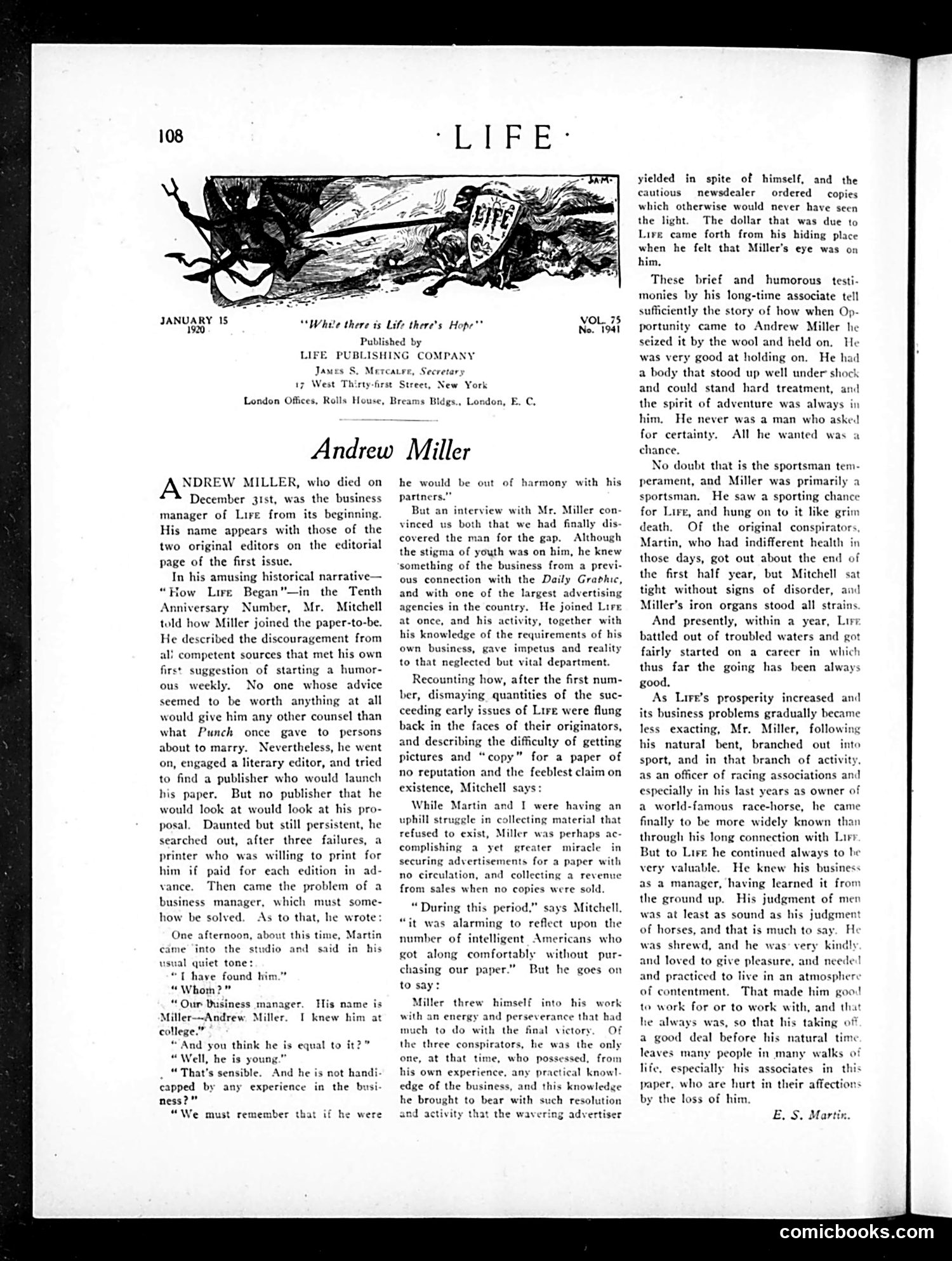
This is a memorial tribute to Andrew Miller, who died December 31st, 1919. Miller was the business manager of *Life* magazine since its founding—a significant position for the satirical weekly. The text recounts how Miller was recruited to manage the struggling new publication when no experienced businessman would touch it. Despite his youth and lack of business experience, Miller possessed practical knowledge from working at the *Daily Graphic* and an advertising agency. He proved instrumental in securing advertisements and revenue for a publication with no circulation or reputation. The piece emphasizes Miller's perseverance in accomplishing what seemed impossible: selling ads and copies of a non-existent periodical. His success was crucial to *Life's* eventual viability. The anecdote about the "newsdealer" suggests Miller's determination was so effective that even reluctant retailers stocked the magazine. This is essentially an in-house eulogy celebrating a colleague's business acumen and dedication.
📄 Transcribed text from this page (OCR, searchable)
Machine-transcribed from the original scan — historical spelling and the odd misread are preserved.
JANUARY 15 1920 “While there ts Life there's Hope"* Published by LIFE PUBLISHING COMPANY James S, Mercatre, Sec 17 West Thirty-first Street, London Offices, Rolls House, Breams BI ew York s., London, E. C, Andrew Miller NDREW MILLER, who died on December 31st, was the business manager of Lire from its beginning. His name appears with those of the two original editors on the editorial page of the first issue, In his amusing historical narrative— “How Lire Began"—in the Tenth Anniversary Number, Mr. Mitchell told how Miller joined the paper-to-be. He described the discouragement from ali competent sources that met his own first suggestion of starting a humor- ous weekly. No one whose advice seemed to be worth anything at all would give him any other counsel than what Punch once gave to about to marry. Nevertheless, he went on, engaged a literary editor, and tried to find a publisher who would launch his paper. But no publisher that he would look at would look at his pro- posal. Daunted but still persistent, he searched out, after three failures, a printer who was willing to print for him if paid for each edition in ad- Then came the problem of a business manager, which must some- how be solved, As to that, he wrote: persons vance. One afternoon, about this time, Martin me into and said in his usual quiet tone: 1 have found him.” “ Whom?" “ Our Business manager. Miller—Andrew Miller. college.” “And you think he is equal to it?” “Well, he is young.” | “That's sensible. And he is not handi- capped by any experience in the busi- ness?" “We must remember that i the studio His name is I knew him at he would be out of harmony with his partners.” But an interview with Mr, Miller con- vinced us both that we had finally dis- covered the man for the gap. Although the stigma of youth was on him, he knew something of the business from a previ- ous connection with the Daily Graphic, and with one of the largest advertising agencies in the country, He joined Lire at once, and his activity, together with his knowledge of the requirements of his own business, gave impetus and reality to that neglected but vital department. Recounting how, after the first num- ber, dismaying quantities of the suc- ceeding early issues of Lire were flung back in the faces of their originators, and describing the difficulty of getting pictures and “copy” for a paper of no reputation and the feeblest claim on existence, Mitchell says: While Martin and I were ha uphill struggle in collecting material that refused to exist, Miller was perhaps ac- complishing a yet greater miracle in securing advertisements for a paper with no circulation, and collecting a revenue from sales when no copies were sold. “During this period,” says Mitchell, “it was alarming to reflect upon the number of intelligent Americans who got along comfortably without pur- chasing our paper.” But he goes on to say: Miller threw himself into his work with an energy and perseverance that had much to do with the final victory, Of the three conspirators, he was the only one, at that time, who possessed, from his own experience, any practical know! edge of the business, and this knowledge he brought to bear with such resolution and activity that the wave yielded in spite of himself, and the newsdealer ordered copies which otherwise would never have seen the light. The dollar that was due to Lire came forth from his hiding place when he felt that Miller’s eye was on him, These brief and humorous. testi- monies by his long-time associate tell sufficiently the story of how when Op- portunity came to Andrew Miller he seized it by the wool and held on. He was very good at holding on. He had a body that stood up well under shock and could stand hard treatment, and the spirit of adventure was always in him, cautious He never was a man who asked for certainty, All he wanted was a chance, No doubt that is the sportsman tem- perament, and Miller was primarily a sportsman. He saw a sporting chance for Lire, and hung on to it like grim death. Of the original conspirators, Martin, who had indifferent health in those days, got out about the end of the first half year, but Mitchell sat tight without signs of disorder, Miller’s iron organs stood all strains And presently, within a year, Lirr battled out of troubled waters and got fairly started on a career in which thus far the going has been always good, As Lire’s prosperity increased and its business problems gradually became less exacting, Mr. Miller, following his natural bent, branched out into sport, and in that branch of activity, as an officer of racing associations and especially in his last years as owner of a world-famous race-horse, he came finally to be more widely known than through his long connection with Lirr But to Lire he continued always to be very valuable. He knew his business as a manager, having learned it from the ground up. His judgment of men was at least as sound as his judgment of horses, and that is much to say. He was shrewd, and he was: very kindly and loved to give pleasure, and 1 a and practiced to live in an atmospher: of contentment. That made him goo! to work for or to work with, and that he always was, so that his taking of a good deal before his natural time leaves many people in many walks of life, ally his associates in this paper, who are hurt in their affections by the loss of him. espe E, S. Mart comicbooks.com