
Life, 1920-01-15 · page 20 of 36
Life — January 15, 1920 — page 20: what you’re looking at
What you’re looking at
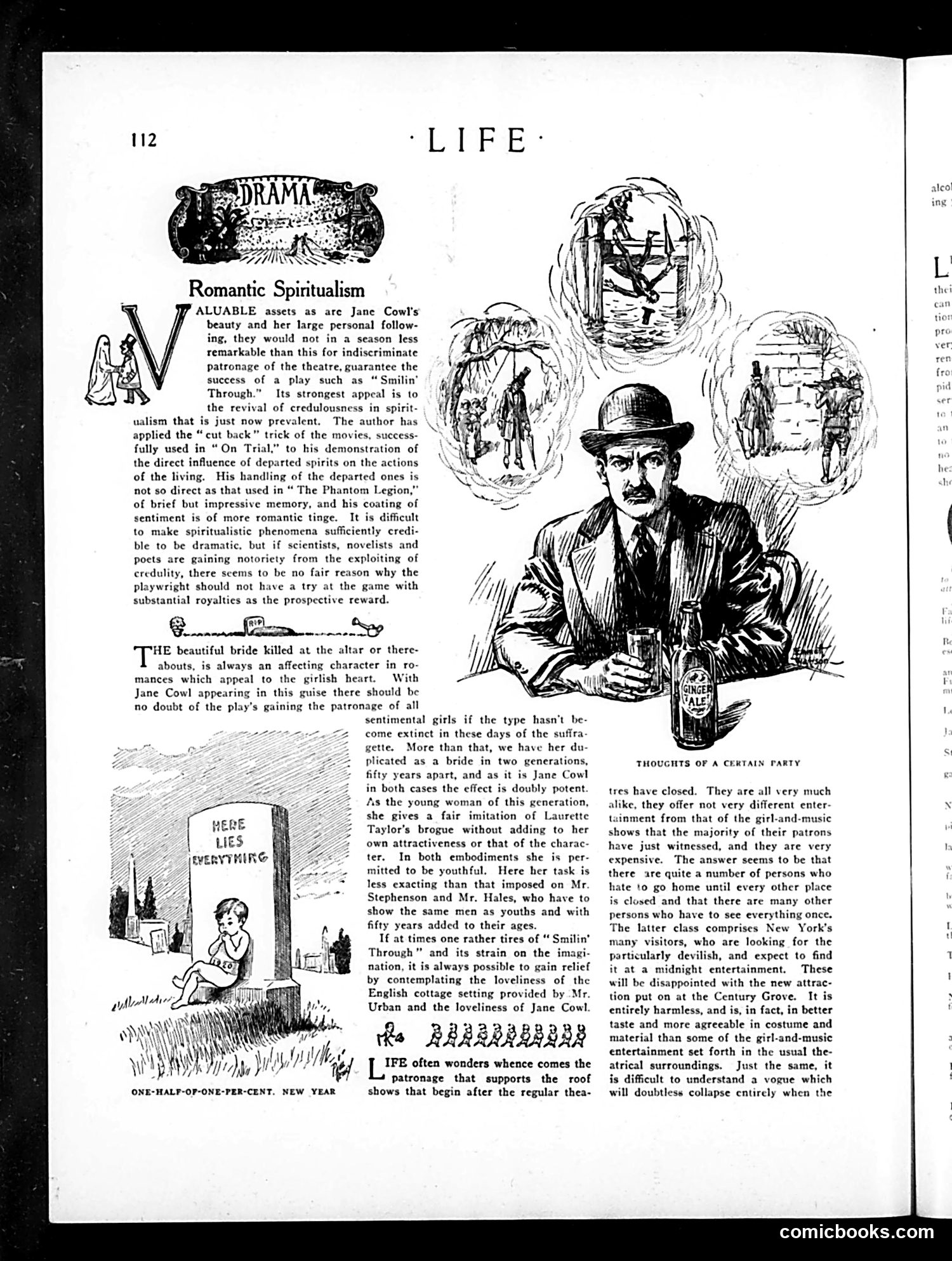
This page reviews the play "Smilin' Through," starring actress Jane Cowl. The critic acknowledges Cowl's beauty and popularity would normally guarantee success, but credits the play's appeal primarily to a contemporary **craze for spiritualism**—the belief in communicating with the dead. The review critiques the playwright for exploiting public credulity about the supernatural, comparing it to how "scientists, novelists and poets are gaining notoriety" from spiritualism. The plot involves a bride killed at the altar whose spirit influences the living across two generations (both played by Cowl). The critic finds the spiritualist premise difficult to make dramatically credible, but notes Cowl's appeal to "sentimental girls." The accompanying illustration labeled "Thoughts of a Certain Party" shows a well-dressed man contemplating the play—likely representing the theatergoer swayed by both Cowl's charm and spiritualist fascination rather than dramatic merit. The piece reflects early 20th-century skepticism toward the spiritualist movement's theatrical exploitation.
📄 Transcribed text from this page (OCR, searchable)
Machine-transcribed from the original scan — historical spelling and the odd misread are preserved.
ALUABLE assets as are Jane Cowl's beauty and her large personal follow- ing, they would not in a season less remarkable than this for indiscriminate patronage of the theatre, guarantee the success of a play such as “ Smilin’ Through.” Its strongest appeal is to the revival of credulousness in spirit- ualism that is just now prevalent. The author has applied the “cut back” trick of the movies, success- fully used in “On Trial,” to his demonstration of the direct influence of departed spirits on the actions of the living. His handling of the departed ones is not so direct as that used in “ The Phantom Legion,” of brief but impressive memory, and his coating of sentiment is of more romantic tinge. It is difficult to make spiritualistic phenomena sufficiently credi- ble to be dramatic, but if scientists, novelists and poets are gaining notoriety from the exploiting of credulity, there seems to be no fair reason why the playwright should not have a try at the game with substantial royalties as the prospective reward. a es HE beautiful bride killed at the altar or there- is always an affecting character in ro- h appeal to the girlish heart. With Jane Cowl appearing in this guise there should be no doubt of the play’s gaining the patronage of all sentimental girls if the type hasn't be- ete to ZZ come extinct in these days of the suffra- Oe gette. More than that, we have her du- plicated as a bride in two generations, fifty years apart, and as it is Jane Cowl in both cases the effect is doubly potent. oss Z As the young woman of this generation, Lie she gives a fair imitation of Laurette Z Taylor's brogue without adding to her {LIES Z own attractiveness or that of the charac- rHIRG § Lie ter. In both embodiments she is per- EVERYT MER Z P mitted to be youthful. Here her task is less exacting than that imposed on Mr. Stephenson and Mr. Hales, who have to show the same men as youths and with fifty years added to their ages. If at times one rather tires of “ Smilin’ Through” and its strain on the imag nation, it is always possible to gain relief by contemplating the loveliness of the English cottage setting provided by Mr. Urban and the loveliness of Jane Cowl. tee BBZSBRERRRS Patronage that supports the roof shows that begin after the regular thea- ONE-HALF-OP-ONE-PER-CENT, NEW YEAR THOUGHTS OF A CERTAIN PARTY tres have closed. They are all very much alike, they offer not very different enter- tainment from that of the girl-and-music shows that the majority of their patrons have just witnessed, and they are very expensive. The answer seems to be that there are quite a number of persons who hate to go home until every other place is closed and that there are many other persons who have to see everything once. The latter class comprises New York's many visitors, who are looking for the particularly devilish, and expect to find it at a midnight entertainment. These will be disappointed with the new attrac- tion put on at the Century Grove. It is entirely harmless, and is, in fact, in better taste and more agreeable in costume and material than some of the girl-and-music entertainment set forth in the usual the- atrical surroundings. Just the same, it is difficult to understand a vogue which will doubtless collapse entirely when the comicbooks.com