
A complete issue · 56 pages · 1919
Life — December 18, 1919
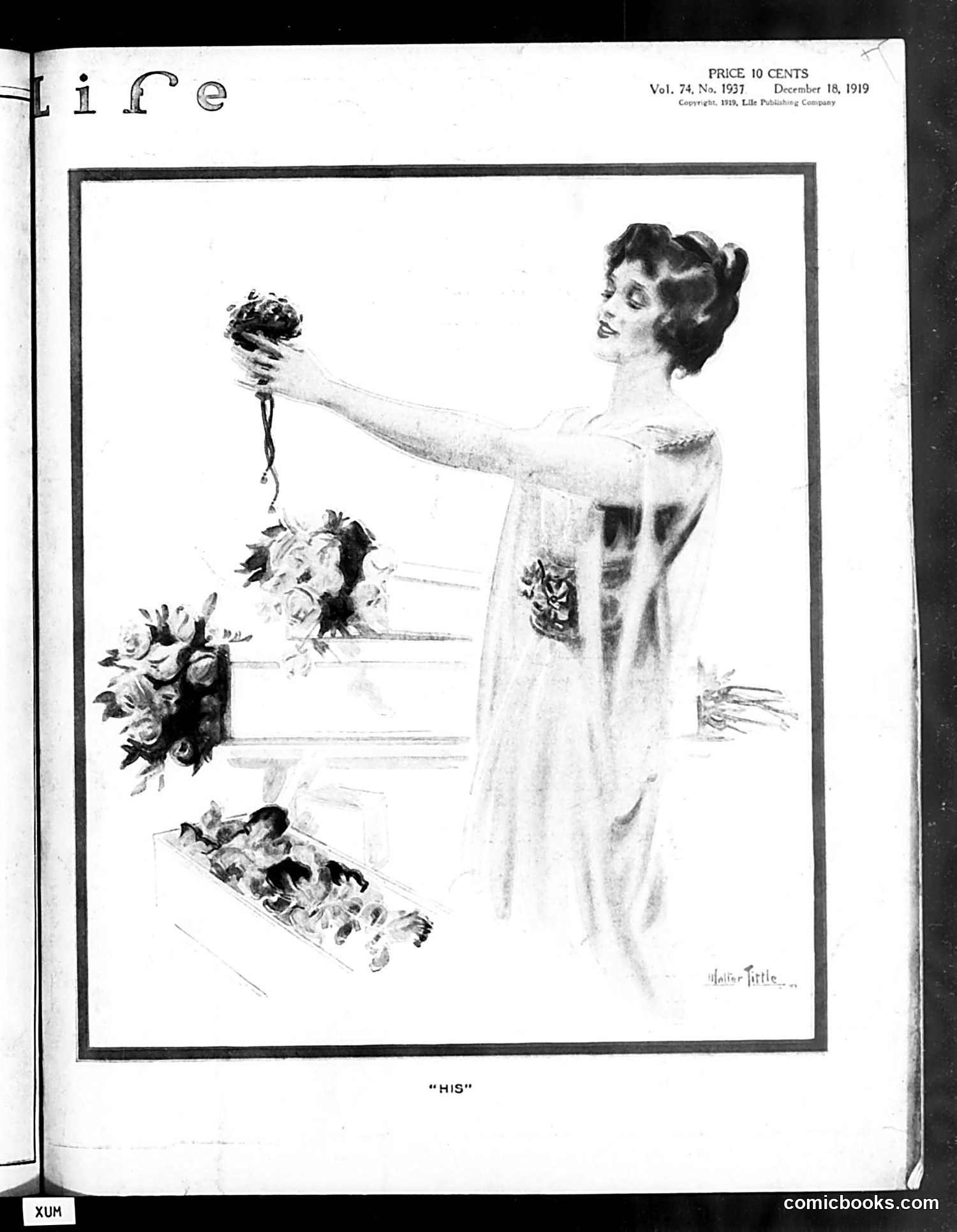
This is a Walter Tittle illustration titled "His," depicting a woman in an elegant white gown holding up various floral arrangements at different heights, as if displaying them like goods for selection or comparison. The satire likely comments on **courtship and marriage proposals** during the 1910s-1920s era. The woman appears to be evaluating or "shopping" among multiple suitors' offerings (the flowers presumably represent different male admirers). The title "His" suggests the joke is about which man—and his gifts—she will ultimately choose. This reflects early 20th-century gender commentary: women gaining more autonomy in mate selection, while also poking fun at the competitive display rituals surrounding courtship and romantic pursuit during this period.
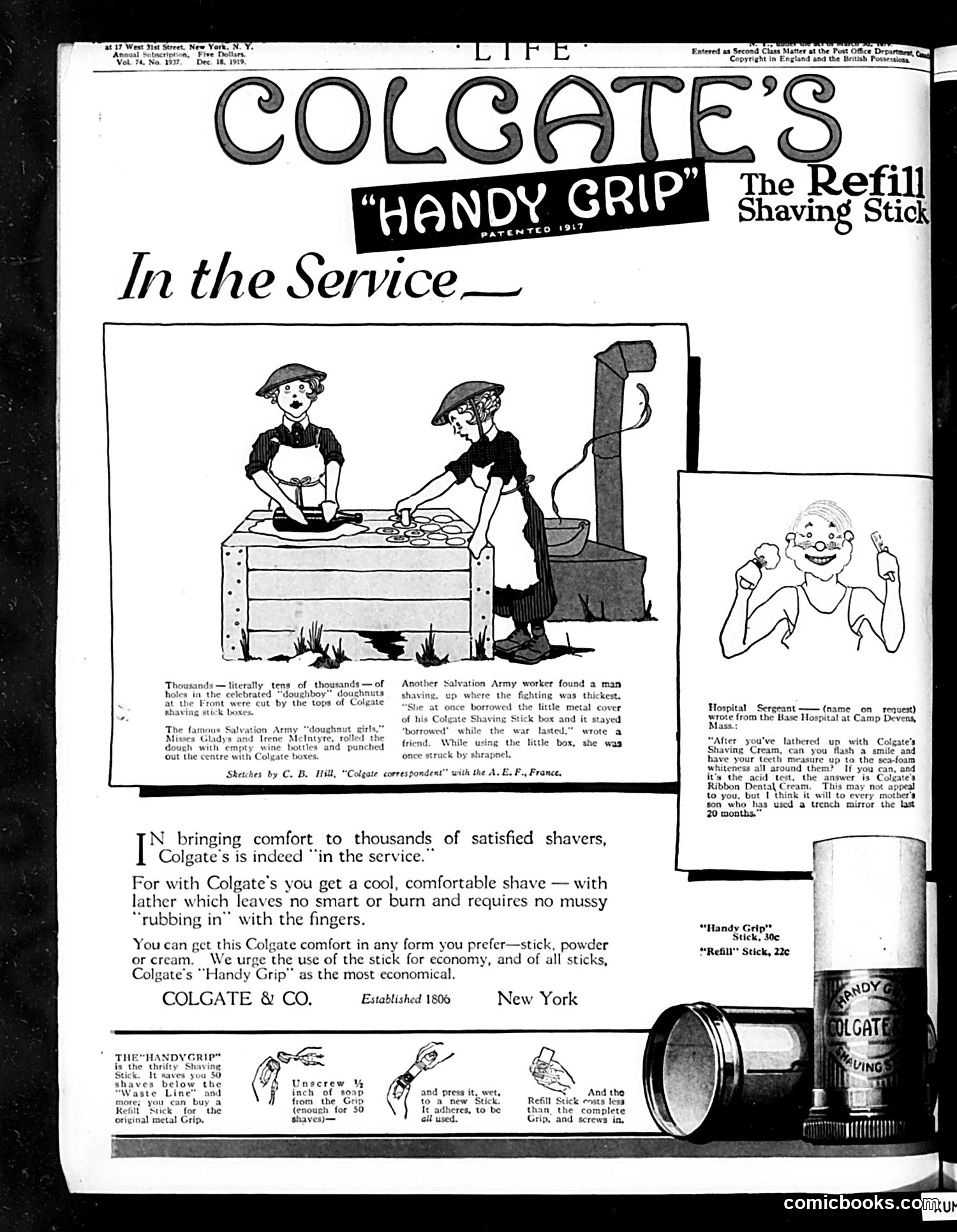
This is primarily a **product advertisement**, not political satire. The page promotes Colgate's refillable shaving stick, patented in 1917. The cartoon illustrates wartime applications: soldiers and Salvation Army workers using the product in field conditions during WWI. One sketch shows a Salvation Army doughnut maker using it; another depicts a soldier shaving near combat. A hospital sergeant testimonial praises the product's convenience for troops. The "service" angle emphasizes how the compact, practical design serves military personnel—a marketing strategy tying consumer goods to patriotic wartime support. The bottom section shows the mechanical grip mechanism and refill system. This reflects how American companies marketed products through patriotic association during the First World War.
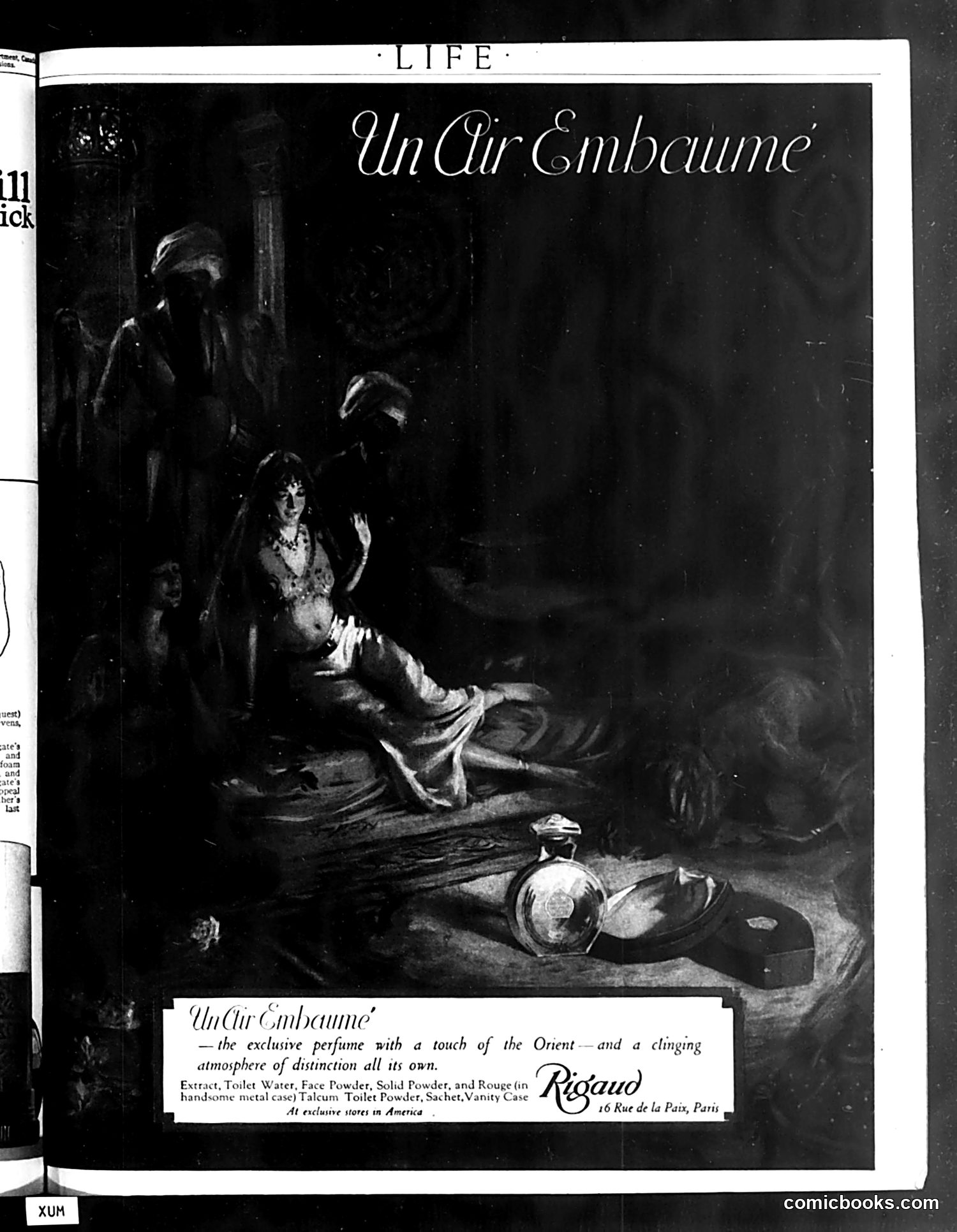
This is not a political cartoon or satirical content—it's a **perfume advertisement** for "Un Clair Embaумe" by Rigaud, a Parisian fragrance house (16 Rue de la Paix, Paris). The theatrical black-and-white image depicts an orientalist scene: a reclining woman in exotic dress surrounded by attendants in what appears to be an opulent interior, with a perfume bottle and accessories displayed prominently in the foreground. The ad copy promises "the exclusive perfume with a touch of the Orient—and a clinging atmosphere of distinction all its own." It lists available products: extract, toilet water, face powder, solid powder, rouge, talcum powder, sachet, and vanity case. This represents early 20th-century luxury marketing that exploited orientalist fantasies to sell high-end cosmetics to wealthy Western consumers.
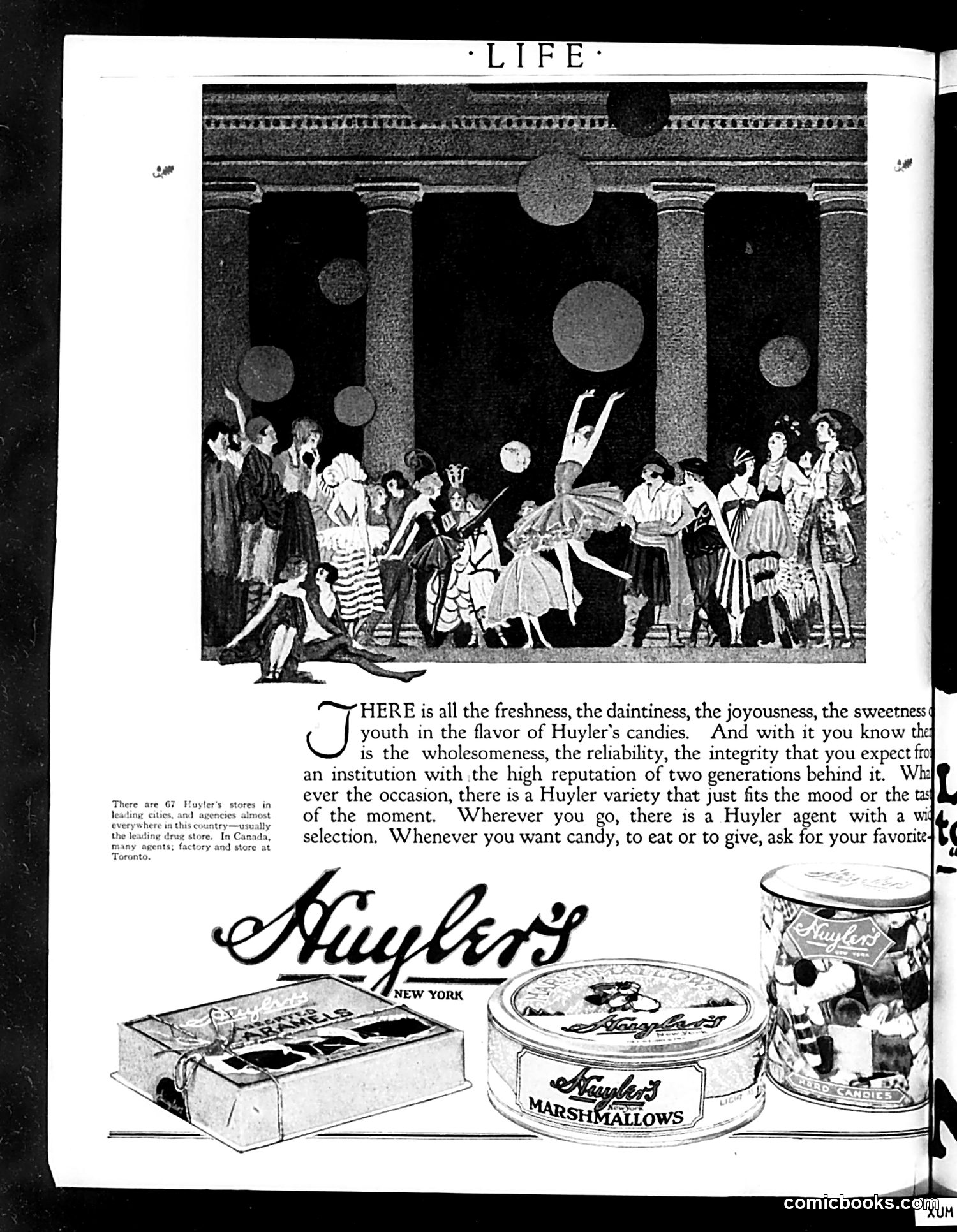
This page is primarily **advertising copy for Huyler's candies**, not political satire. The illustration shows an elegant 1920s-era party or social gathering beneath classical columns—figures in formal dress dancing, socializing, and enjoying themselves. This imagery serves to associate Huyler's products with sophistication, youth, and pleasurable social occasions. The accompanying text emphasizes Huyler's as a quality brand with "freshness," "daintiness," and "wholesomeness," promising variety ("a Huyler variety that just fits the mood") and ubiquitous availability through their store network. The lower section displays product boxes: chocolates and marshmallows packaged in decorated tins. There is no political cartoon or social satire present—this is straightforward luxury consumer advertising typical of Life magazine's commercial content during the 1920s-1930s era.
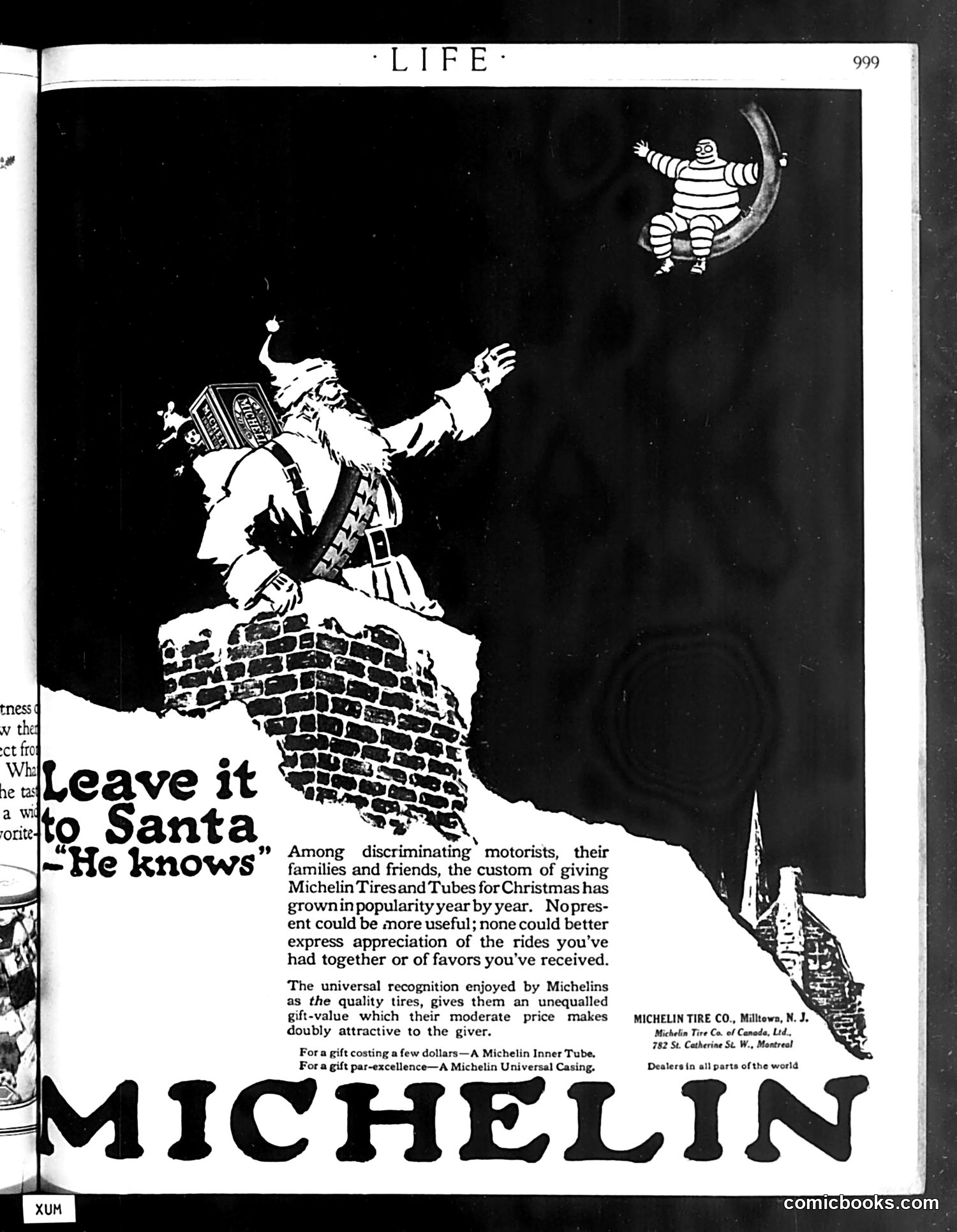
This is primarily a **Michelin Tire advertisement**, not political satire. The page features the Michelin Man (Bibendum), the company's mascot—a rotund figure made of stacked tire tubes—standing on a chimney in a Santa Claus-like pose. The ad's headline "Leave it to Santa—He knows" positions Michelin tires as ideal Christmas gifts. The accompanying text argues that among "discriminating motorists," gifting Michelin products shows appreciation for quality and reliability at moderate prices. The imagery humorously depicts the Michelin Man as Santa, complete with a bag of tires, while another character rides in a crescent moon above—referencing classic Christmas iconography. This was a common early 20th-century advertising approach: associating branded products with holiday generosity and thoughtfulness.
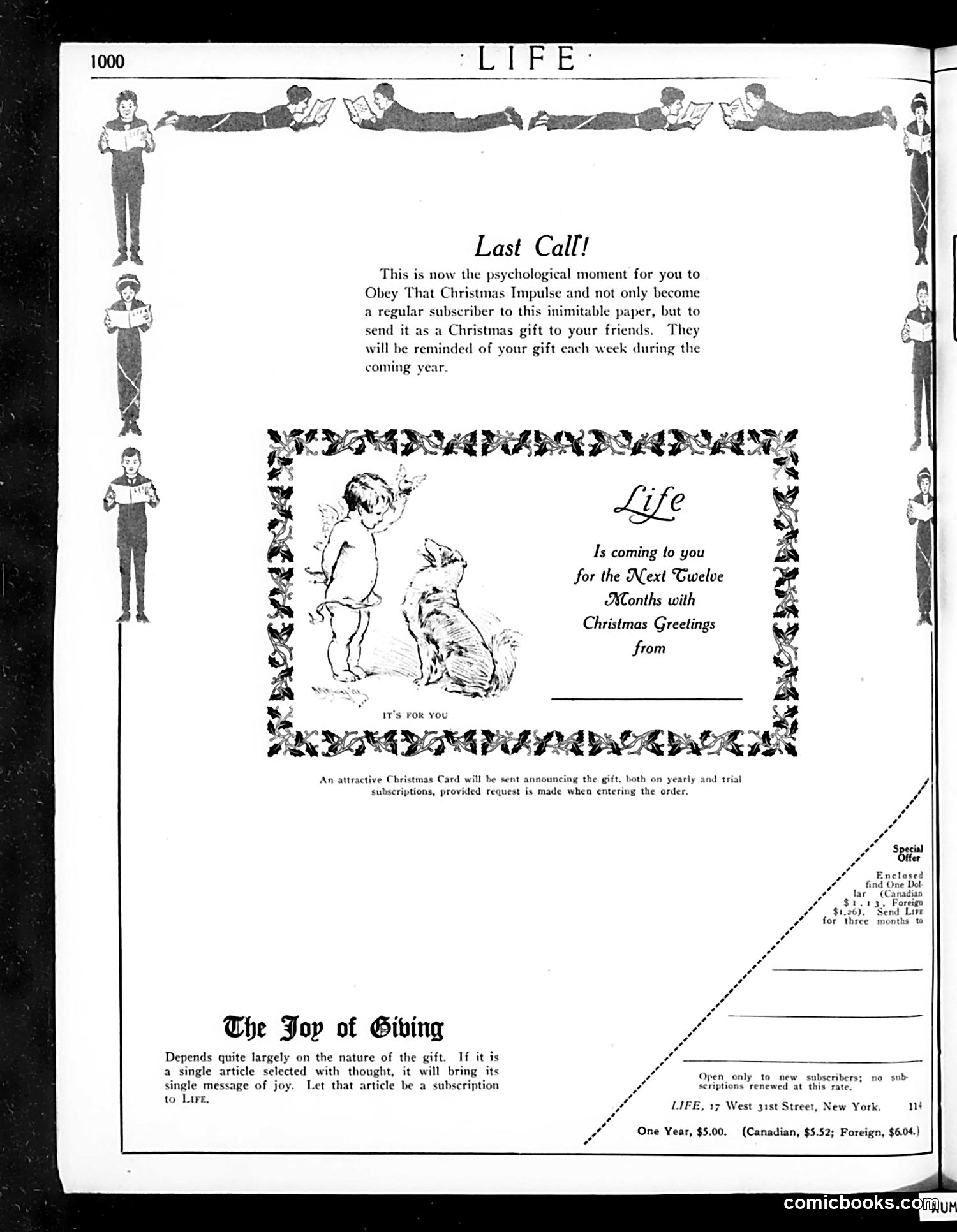
This page is primarily a **Christmas gift advertisement** for Life magazine subscriptions, not political satire. The content shows: 1. **Decorative elements**: Men in formal attire stretching horizontally across the top (common Art Deco-style design flourish), and a child with a dog in a holly-bordered frame—holiday imagery meant to appeal to gift-givers. 2. **The pitch**: "Last Call!" urges readers to subscribe or gift subscriptions, promising weekly reminders of their generosity throughout the year. 3. **Pricing**: One year costs $5.00 (or $5.52 in Canada, $6.04 foreign). The small text notes that attractive Christmas cards would announce gifts. This is straightforward commercial messaging, typical of magazine advertising from the early 20th century, not satirical commentary on politics or society.
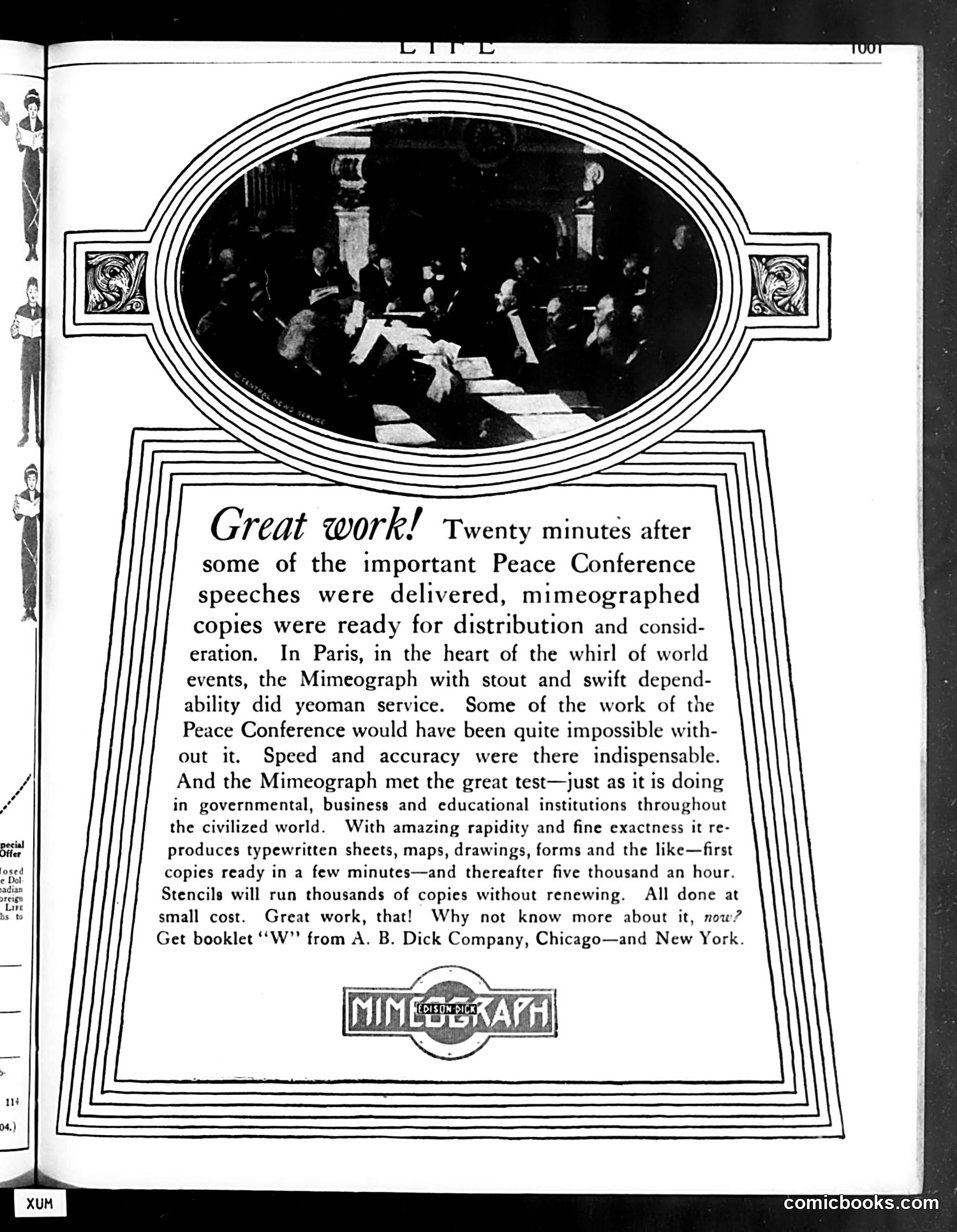
This is a **product advertisement**, not a political cartoon. It promotes the Mimeograph machine by A.B. Dick Company, highlighting its use during the Peace Conference (likely the Paris Peace Conference following World War I). The ad emphasizes the machine's speed and reliability: copies could be produced within minutes of speeches being delivered, enabling rapid distribution of important documents during negotiations. The image shows what appears to be a conference room with officials conducting business. The advertisement targets government, business, and educational institutions by stressing the machine's efficiency—producing 5,000 copies per hour at minimal cost. The appeal is practical rather than satirical: the Mimeograph proved indispensable for handling large-volume document reproduction during major diplomatic events.
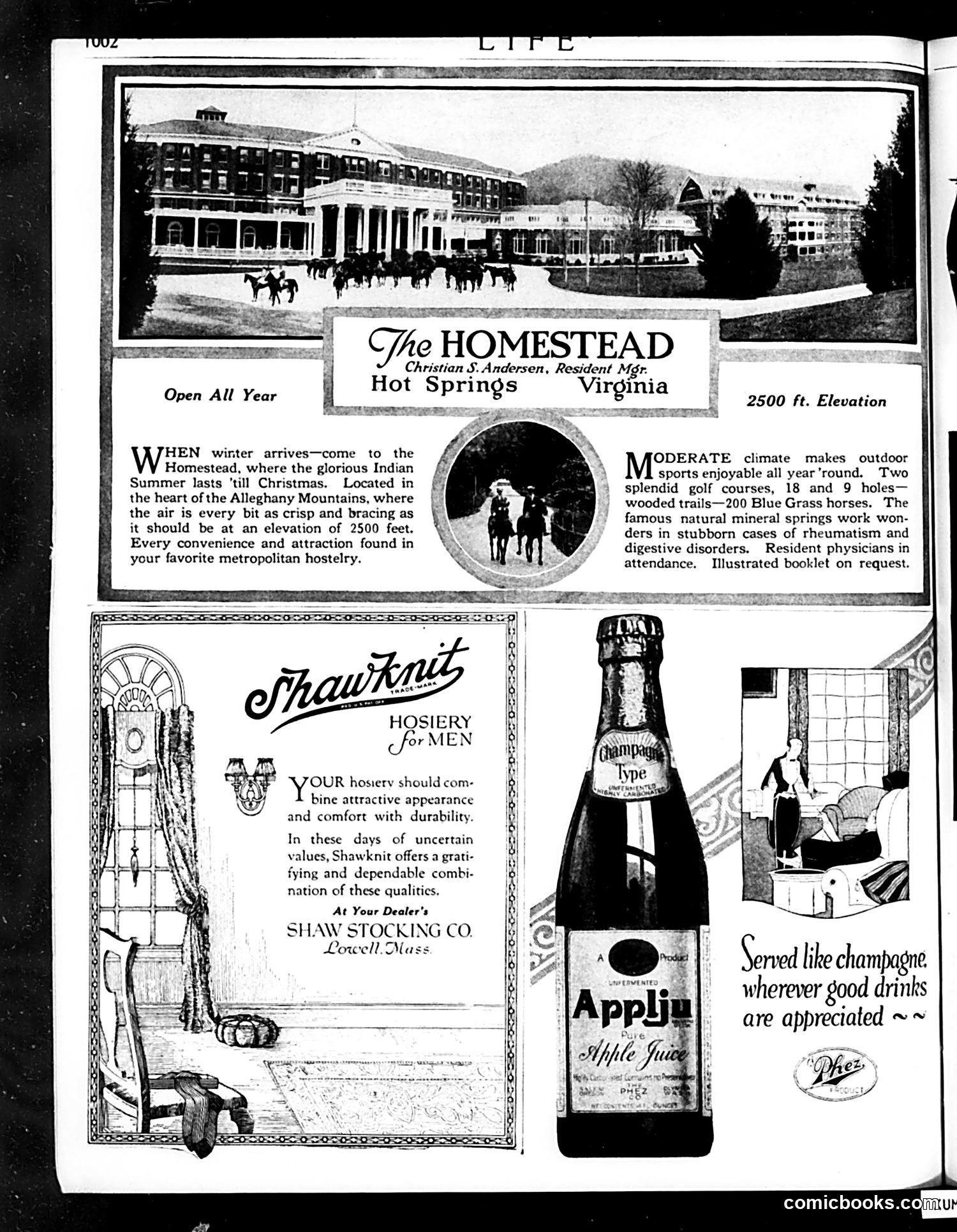
This page is primarily **advertising**, not satirical content. It contains three distinct advertisements: 1. **The Homestead** (Hot Springs, Virginia) — a resort hotel advertisement emphasizing year-round operation, outdoor sports (golf, horseback riding), and mineral springs claimed to treat rheumatism and digestive disorders. The 2500-foot elevation is highlighted for "crisp and bracing" air. 2. **Shawknit Hosiery for Men** — promoting socks combining "appearance and comfort with durability," marketed during economically uncertain times. 3. **Applin Apple Juice** — positioned as a premium beverage ("served like champagne") by Phez brand. No political satire or caricature appears on this page. It represents typical early-20th-century lifestyle and consumer marketing.
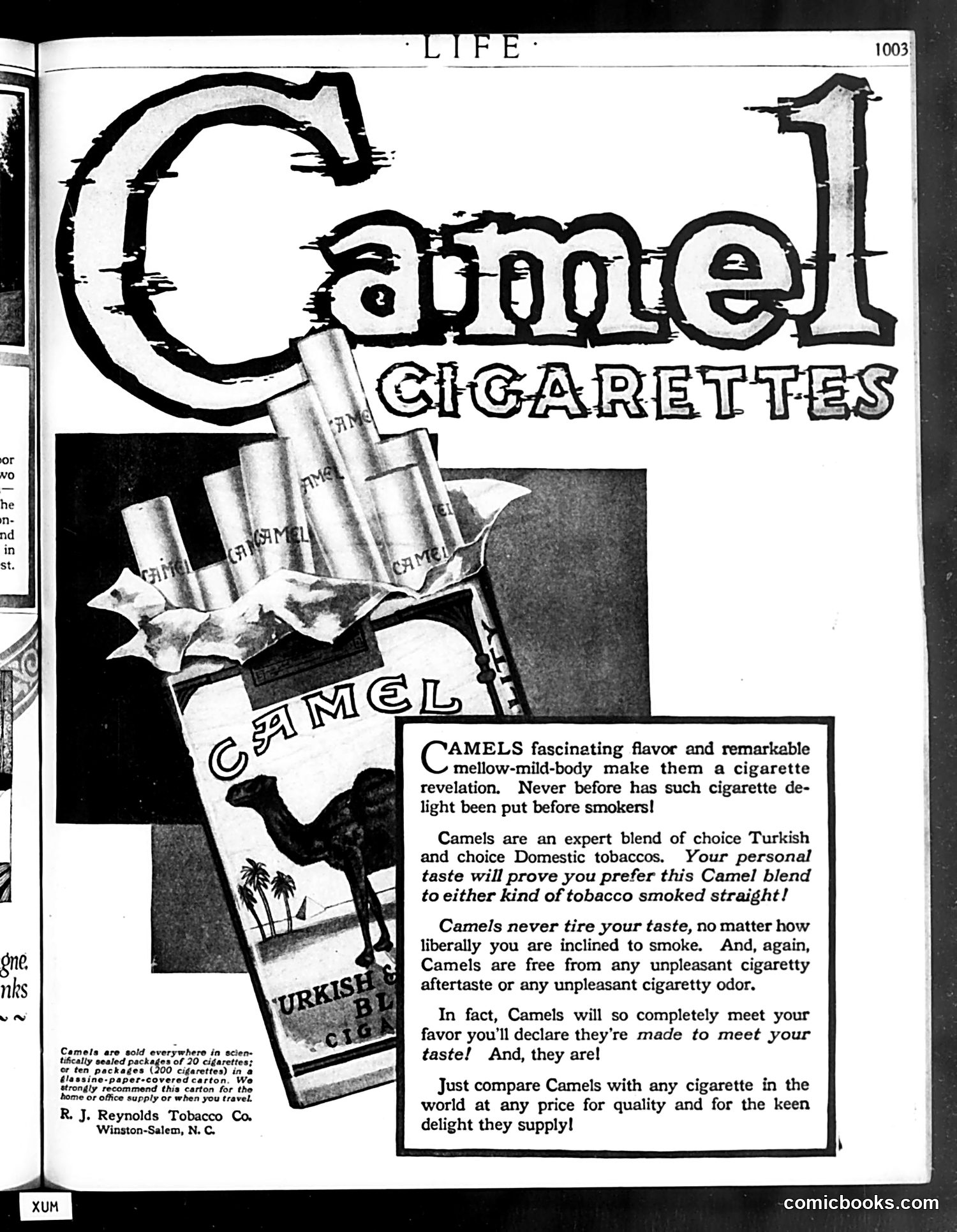
This is a **Camel Cigarettes advertisement**, not satirical content. The page shows a large product display featuring Camel cigarette packages with the brand's iconic camel logo. The accompanying text promotes Camels as a premium blend of Turkish and domestic tobaccos, emphasizing their smooth flavor, lack of aftertaste, and superiority over other brands. The advertisement includes distribution information from R.J. Reynolds Tobacco Co. (Winston-Salem, N.C.). **For modern readers**: This represents an era when tobacco companies advertised openly in mainstream publications with health claims that would be illegal today. The casual promotion of cigarettes as a "revelation" and "delight" reflects pre-1960s attitudes before widespread awareness of smoking's health dangers.
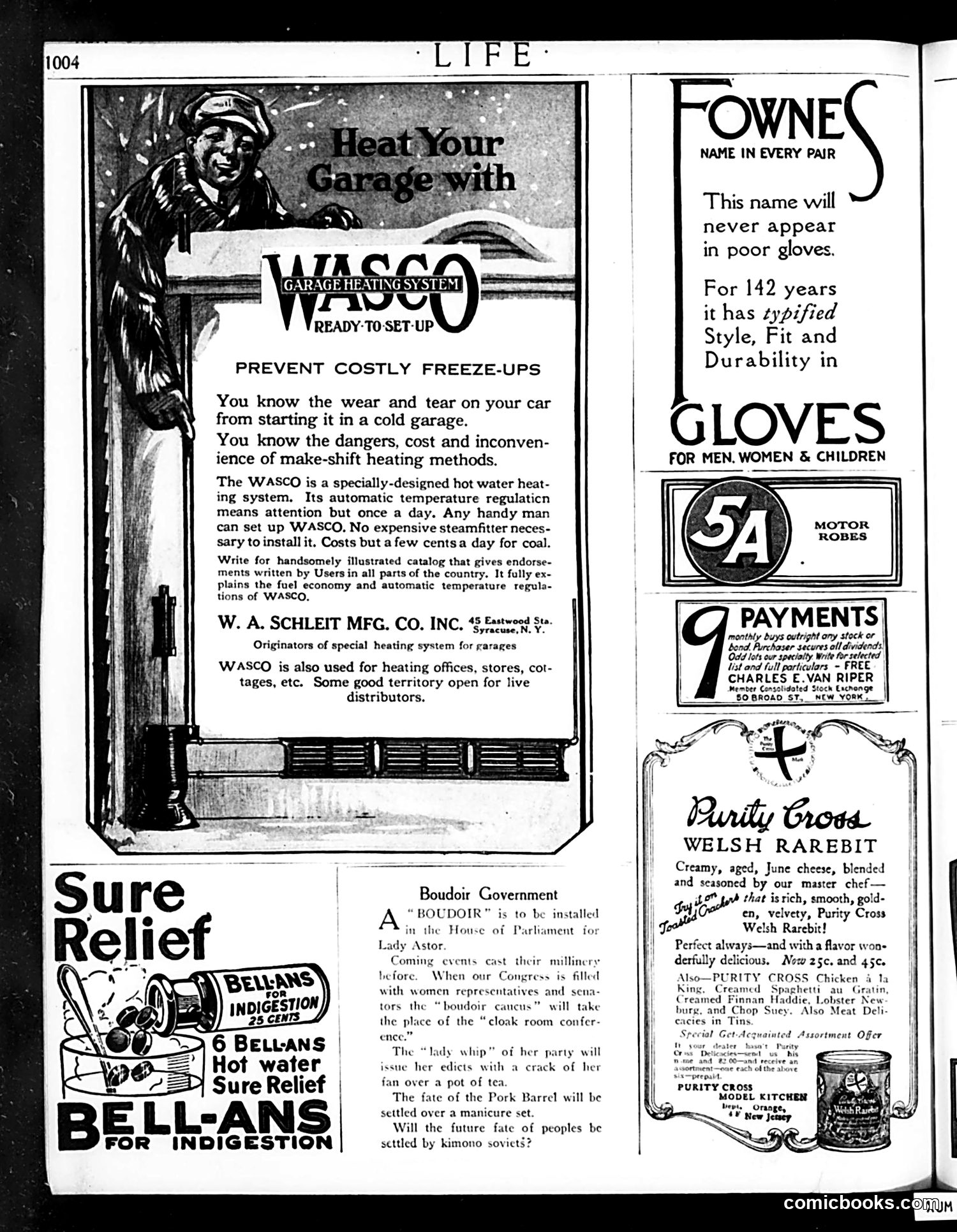
This page consists primarily of **period advertisements** from approximately the 1920s, not political cartoons or satire. The ads include: - **WASCO** garage heating system (preventing car freeze-ups in winter) - **Fownes** gloves, emphasizing 142 years of quality - **Bellans** indigestion remedy - **Purity Cross** Welsh Rarebit (cheese dish) The only non-advertising content is a brief article titled "Boudoir Government" discussing a "hot-button" debate in the House of Parliament regarding Lady Astor's upcoming events and the "Pork Barrel" issue, likely concerning political favors or spending. This is primarily a **commercial page** with minimal satirical content. The historical value lies in the advertised products and their marketing approaches to early 20th-century consumers.
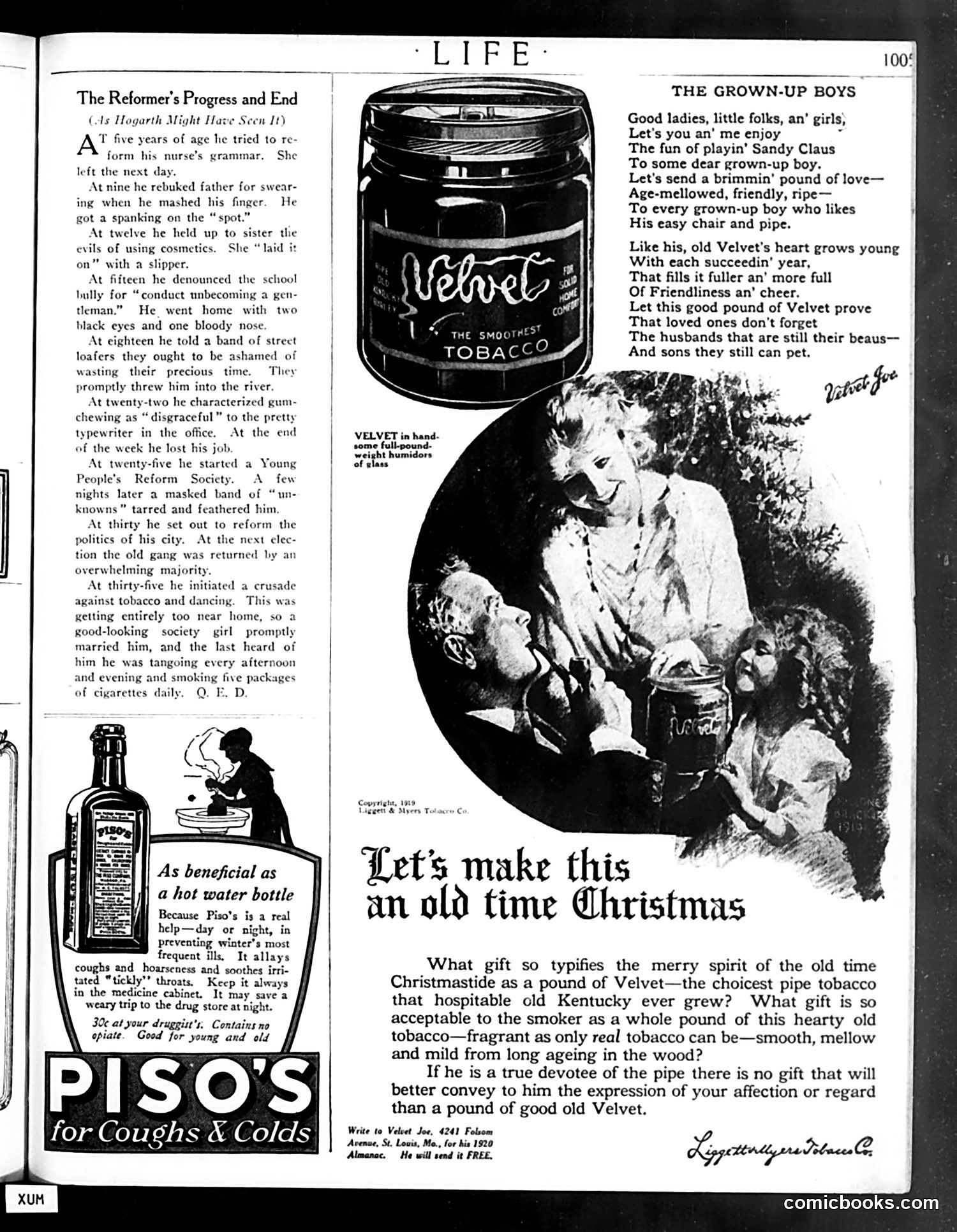
This page contains two distinct pieces: **Left side:** "The Reformer's Progress and End" is a satirical narrative poem mocking a self-righteous crusader. The subject attempts moral reform at age five (correcting grammar), escalates through various causes (censoring swearing, school bullying, street gambling), and peaks at thirty-five by launching an anti-tobacco campaign. The satire culminates when he loses his job—suggesting his self-righteousness and meddling isolate him socially. The poem critiques sanctimonious reformers as hypocritical busybodies whose zeal for controlling others' behavior backfires. **Right side:** A Velvet tobacco advertisement disguised as a sentimental Christmas poem ("The Grown-Up Boys"), featuring a woman and children. Below, copy promotes Velvet pipe tobacco as the ideal gift for pipe smokers. **Bottom left:** A Piso's cough remedy advertisement. The page juxtaposes anti-reform satire with commercial advertisements celebrating indulgence (tobacco, patent medicines).
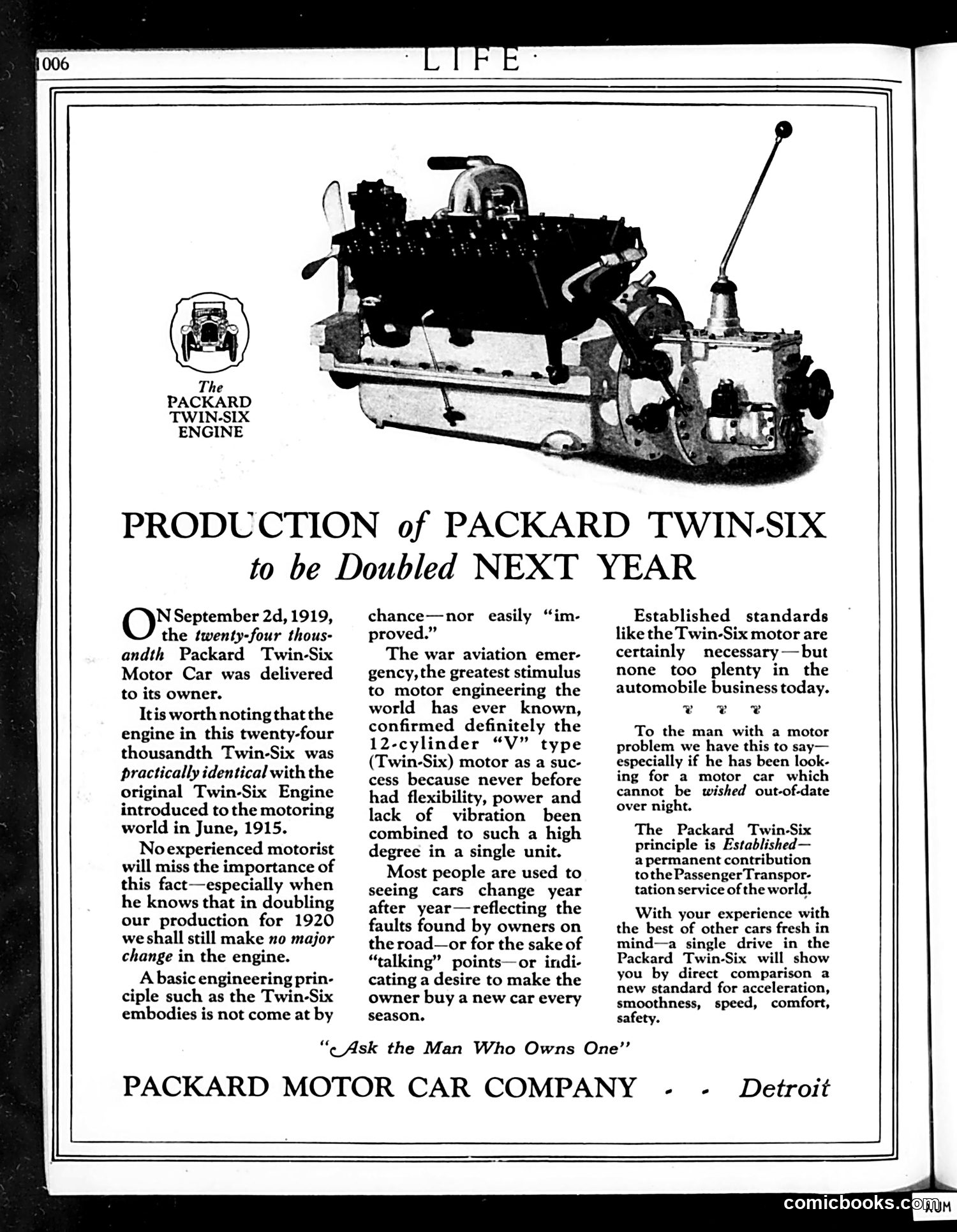
This is a **commercial advertisement**, not political satire. It announces that the Packard Motor Car Company will double production of its Twin-Six engine model in 1920. The ad emphasizes that the engine design is **established and proven** — no changes planned despite competitive pressure to innovate yearly. This was a selling point: reliability over constant redesign. The text references **World War I aviation** as validation; the Twin-Six engine proved itself dependable during wartime aviation emergencies, establishing its reputation. The slogan "Ask the Man Who Owns One" was Packard's actual marketing catchphrase, appealing to owner testimonials rather than manufacturer claims. The illustration shows a cutaway view of the engine mounted on a chassis—typical advertising imagery for the era.
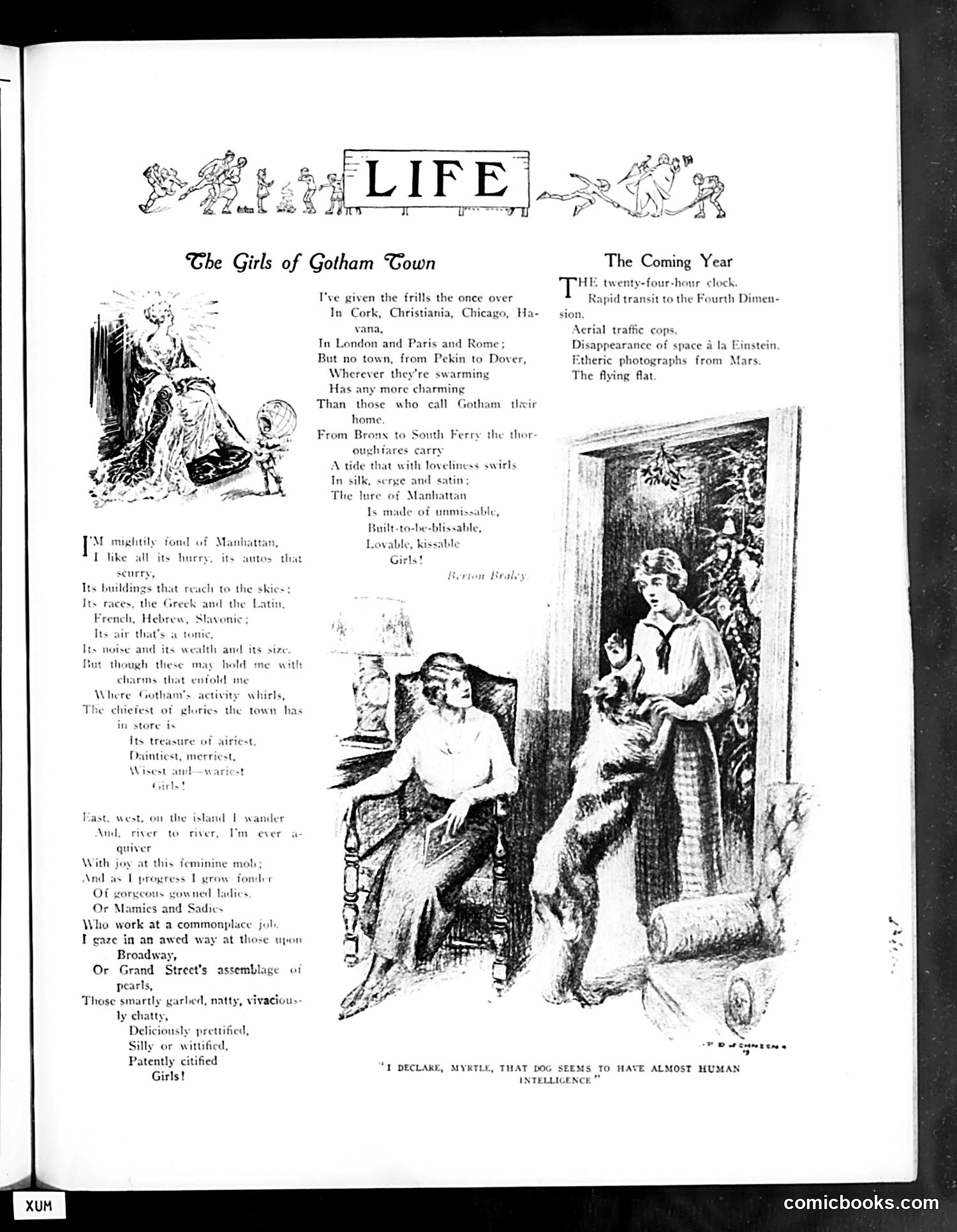
This page features a poem by Byron Drake celebrating New York City women ("Gotham" being a traditional nickname for NYC). The text praises Manhattan girls as superior to women from other cities—they're described as "daintiest, merriest, wisest and smartest." The accompanying illustration shows two well-dressed women in what appears to be an interior setting, with a caption about a dog appearing intelligent. The satirical point is unclear from the image alone, but the poem's exaggerated praise of NYC women's sophistication and charm suggests gentle mockery of local pride and urban pretension. "The Coming Year" section on the right lists technological predictions (Einstein, Mars, etc.), providing context for the magazine's 1920s publication date.
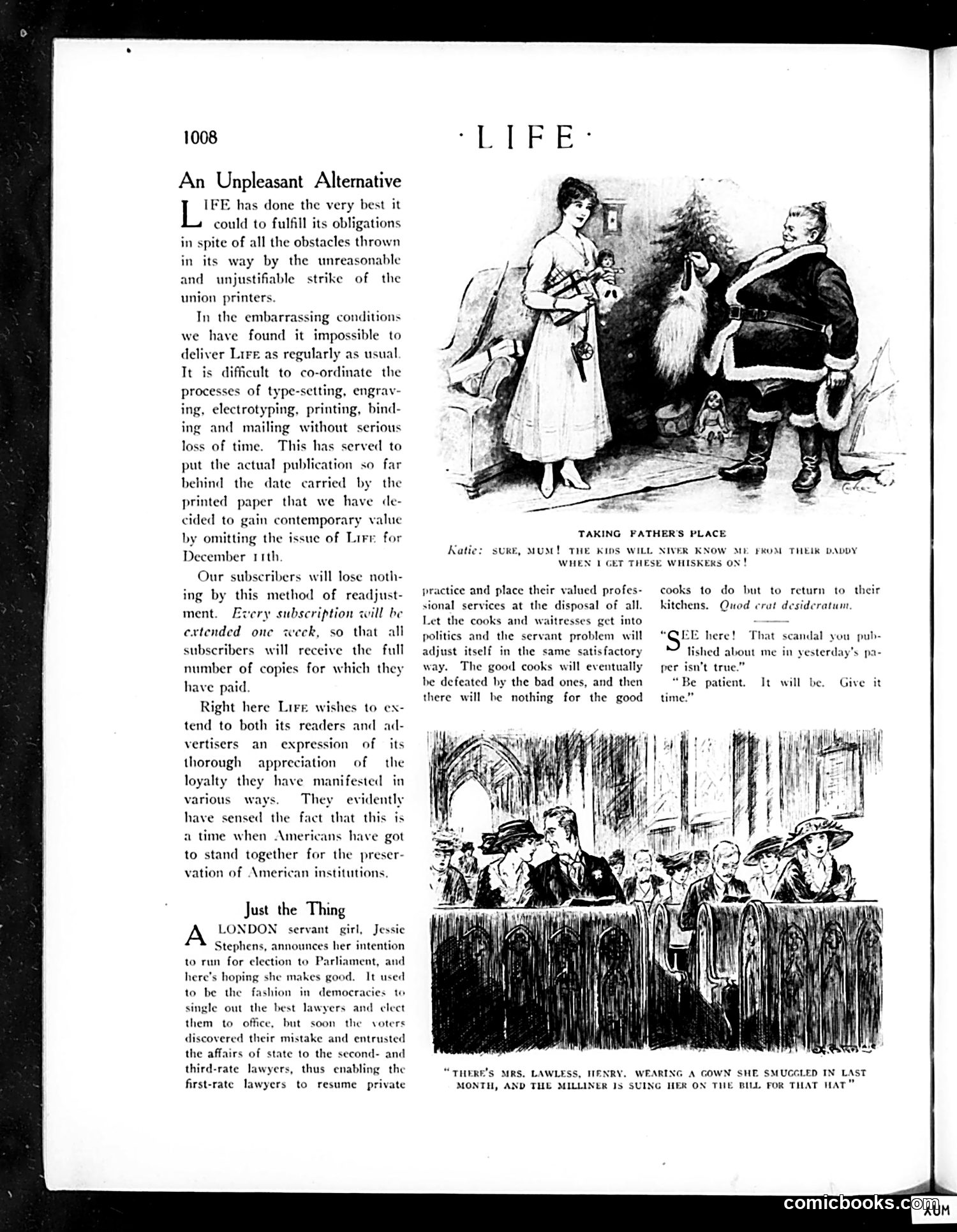
This page contains two distinct pieces: **"An Unpleasant Alternative"** (left column): A publisher's note explaining why *Life* magazine is omitting its December 11th issue due to a printers' union strike. The text assures subscribers they'll receive full compensation—every subscription will be extended one week. **Two cartoon illustrations with accompanying text:** 1. **"Taking Father's Place"**: Shows a man with facial hair (possibly a caricature) meeting children, with dialogue about whiskers. The joke appears to satirize masculine appearance or paternity concerns. 2. **Lower cartoon**: Depicts a courtroom scene titled about "Mrs. Lawless, Henry" and a milliner suing over a bill for a gown. This is social satire about petty legal disputes and household economics—likely mocking frivolous lawsuits or marital financial conflicts. The page reflects early 20th-century class tensions, gender dynamics, and labor disputes.
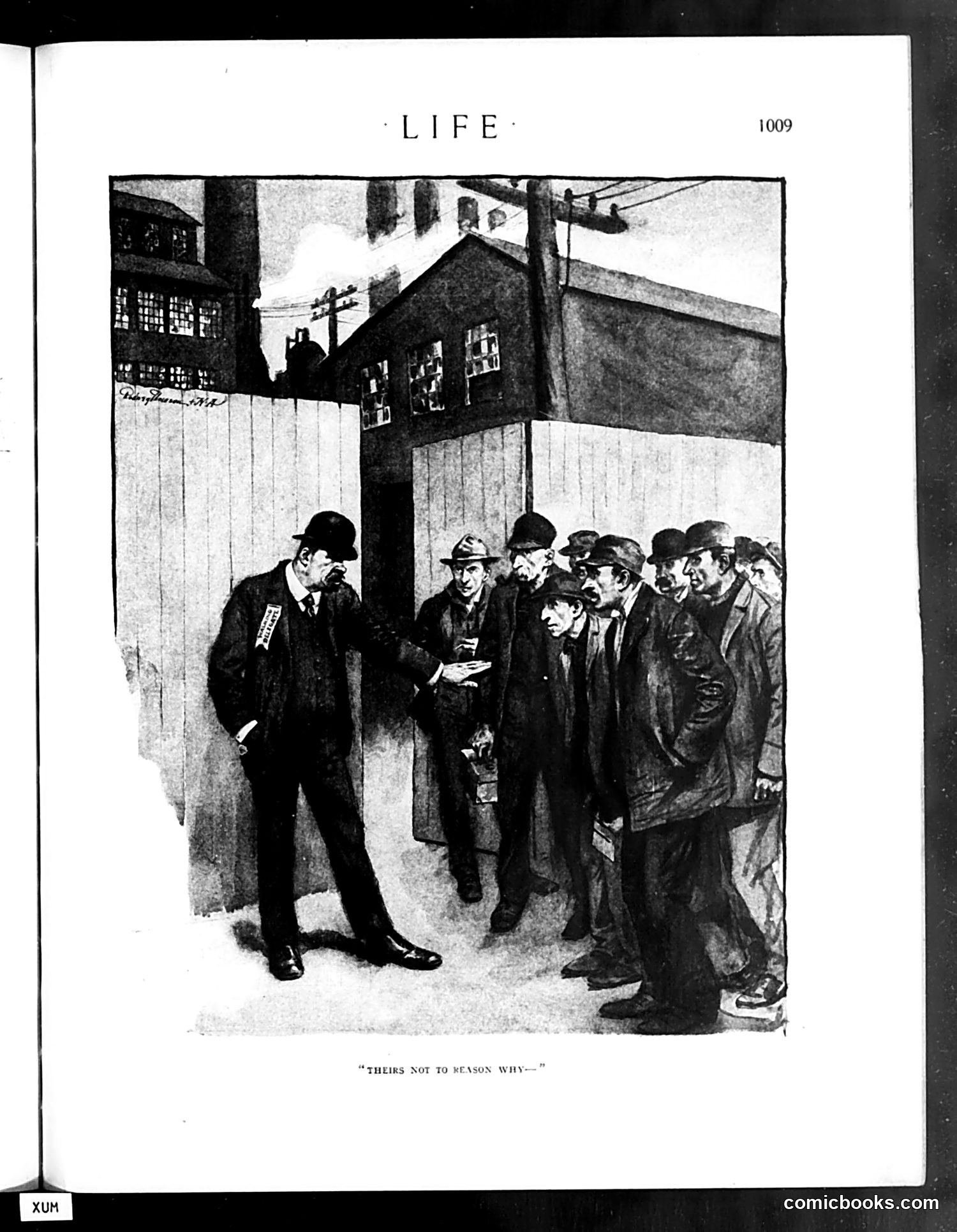
This is a satirical cartoon from *Life* magazine (page 1009) titled "Theirs Not to Reason Why—" The image depicts a formal official or authority figure (left) addressing a group of working-class men wearing hats and coats, gathered in what appears to be an industrial or urban alleyway. The title references the famous line from Tennyson's "Charge of the Light Brigade" about soldiers following orders without question. The satire appears to criticize blind obedience to authority—the official delivers instructions to the assembled workers who accept them without debate or resistance. The cartoon likely comments on labor conditions, workplace hierarchy, or government directives that working people must follow regardless of personal consequence or understanding of the reasoning behind them. The specific historical context remains unclear without additional dating or captioning.
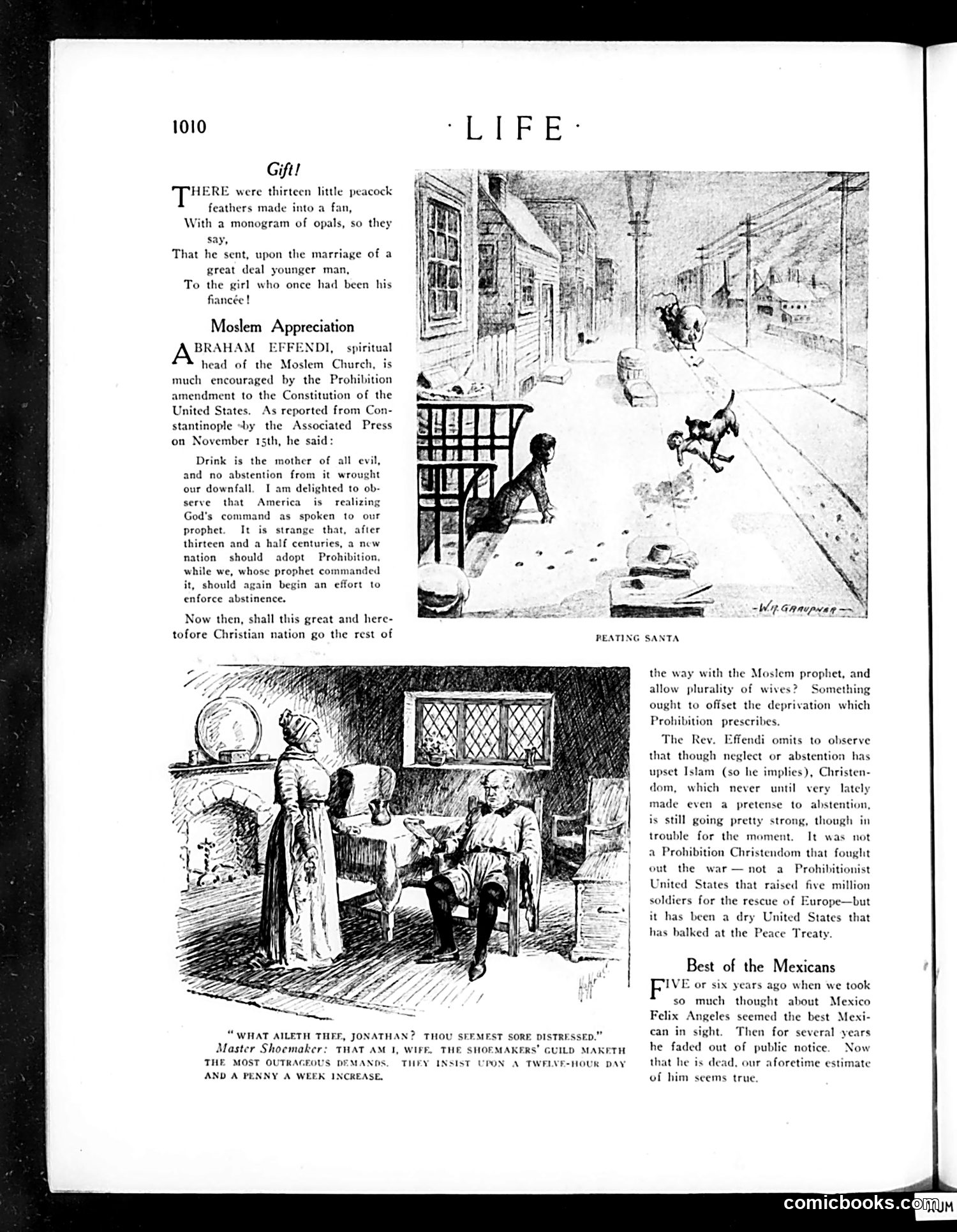
This page contains three satirical pieces from Life magazine: **"Gift!"** — A poem mocking a man who sends an ex-fiancée a peacock-feather fan as a wedding gift to another man. The satire lies in the inadequacy and awkwardness of this gesture. **"Moslem Appreciation"** — The main piece. An Islamic religious leader (Abraham Effendi) reportedly praised America's Prohibition amendment, noting Islam has advocated alcohol abstention for centuries. Life's satire: if America follows Muslim doctrine on drinking, should it also adopt polygamy ("plurality of wives")? The editorial commentary undercuts Effendi's argument, noting that Christian societies thrived without abstinence, and that Prohibition-era America is now blocking the Peace Treaty—revealing hypocrisy. **"Best of the Mexicans"** — A brief note on Mexican general Felix Angeles, once newsworthy during America's Mexico interventions, now dead and forgotten. The satire suggests he was overestimated during his prominence. The shoemaker cartoon below illustrates labor disputes, unrelated to the main content.
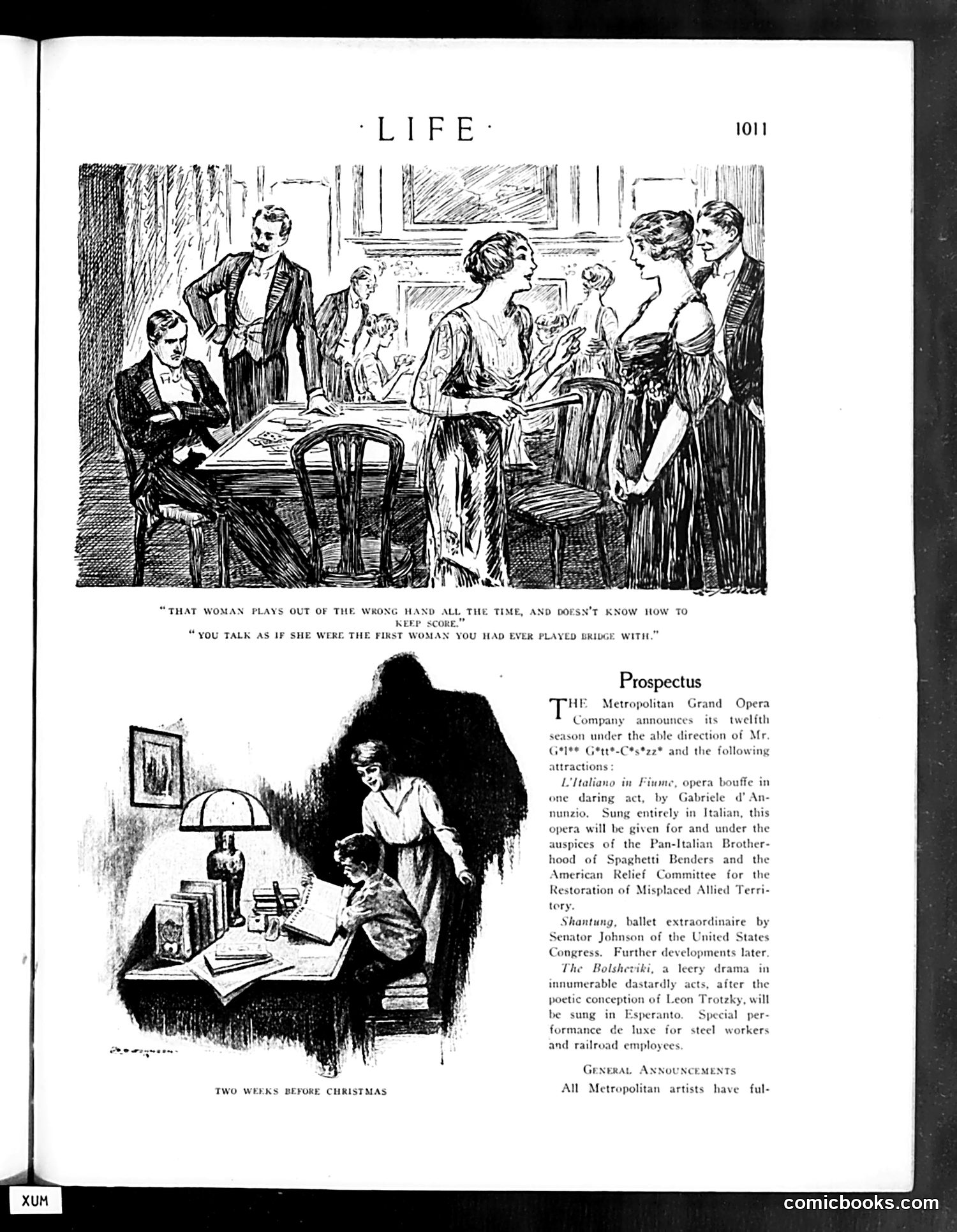
**Top Cartoon:** A social comedy about bridge playing. A man criticizes a woman player for using her wrong hand and poor scoring, while another man deflates his complaint by noting he shouldn't act as if women playing bridge is unprecedented. The joke mocks male condescension toward women in games—suggesting the critic's complaints are exaggerated or hypocritical. **Bottom Section:** Faux opera announcements satirizing contemporary politics and ethnic stereotypes. The "Prospectus" mock-advertises absurd operatic productions: an Italian opera by Gabriele d'Annunzio sponsored by the "Spaghetti Benders" (ethnic caricature), a ballet supposedly composed by Senator Johnson, and "The Bolsheviki" sung in Esperanto—mocking post-WWI anti-communist anxiety and contemporary ethnic anxieties. The satire targets both highbrow cultural pretension and contemporary political tensions.
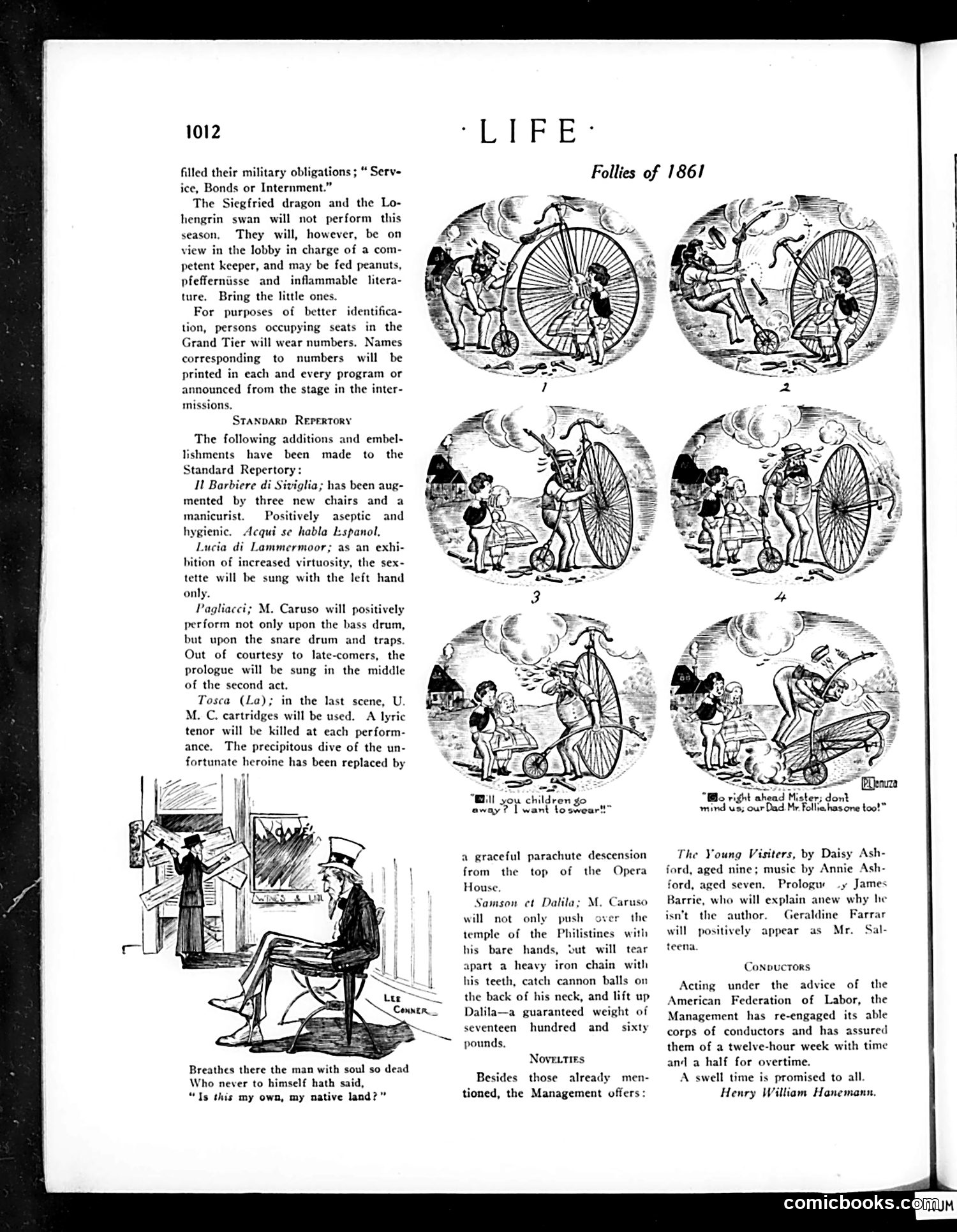
This page satirizes the Metropolitan Opera's 1861 season announcements with absurdist humor. The left column mocks German opera's patriotic fervor (references to "Siegfried dragon" and "Lohengrin swan") during wartime, suggesting even opera mascots should "serve" or face internment—a jab at anti-German sentiment. The "Standard Repertory" section ridicules opera productions through exaggerated "improvements": adding chairs to *Barbiere*, performing *Lucia*'s sextette left-handed only, having Caruso perform percussion during *Pagliacci*, and culminating in absurd physical stunts during *Samson et Dalila* (catching cannonballs, lifting a 1,760-pound woman). The cartoons at right show children misbehaving at performances—one wanting to swear, another mentioning "Dad Mr Folliehasone too"—satirizing both audience conduct and wealthy patrons' indulgences. The final section mocks labor relations, joking that conductors are now guaranteed twelve-hour weeks with overtime pay—likely reflecting actual labor negotiations of the era. Overall: sophisticated satire targeting opera's pretensions, wartime anxieties, and working-class dignity.
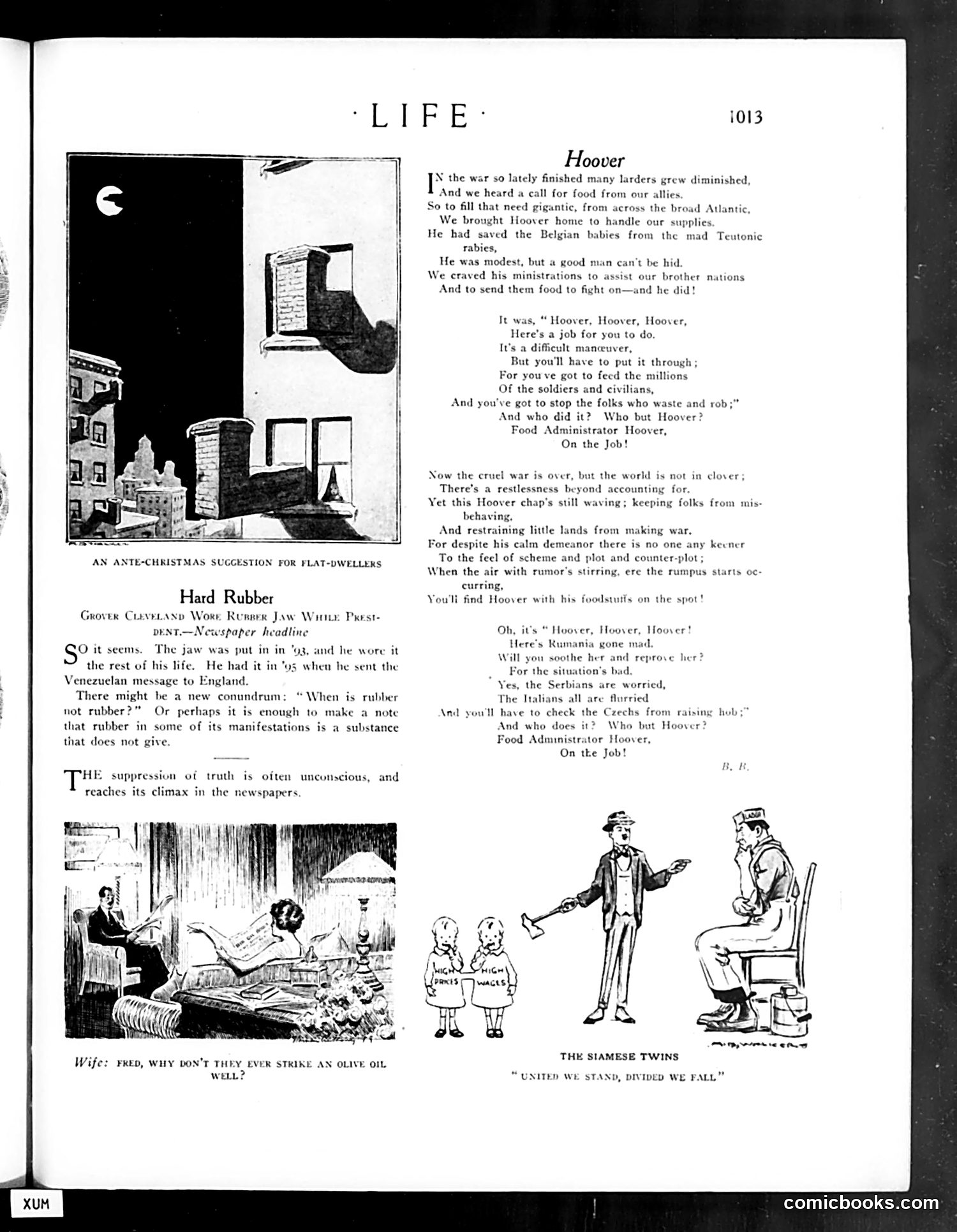
This page contains post-WWI political satire centered on **Herbert Hoover**, the U.S. Food Administrator during and after World War I. The main poem praises Hoover's work feeding Allied nations during the war and his continued efforts maintaining global stability afterward. However, the satire appears critical: it portrays Hoover as perpetually intervening—"keeping folks from misbehaving"—suggesting he wields excessive influence over international affairs through food distribution as a control mechanism. The cartoons reinforce this: "The Siamese Twins" depicts two figures labeled "United We Stand, Divided We Fall," likely representing European nations dependent on American food aid for stability. The "Hard Rubber" section critiques press manipulation, suggesting newspapers suppress truths about political figures (possibly referencing Hoover's expanding power). The "Wife" cartoon jokes about olive oil, unrelated to the main content. Overall, the page satirizes how Hoover leveraged humanitarian food aid as a tool of geopolitical control during reconstruction.
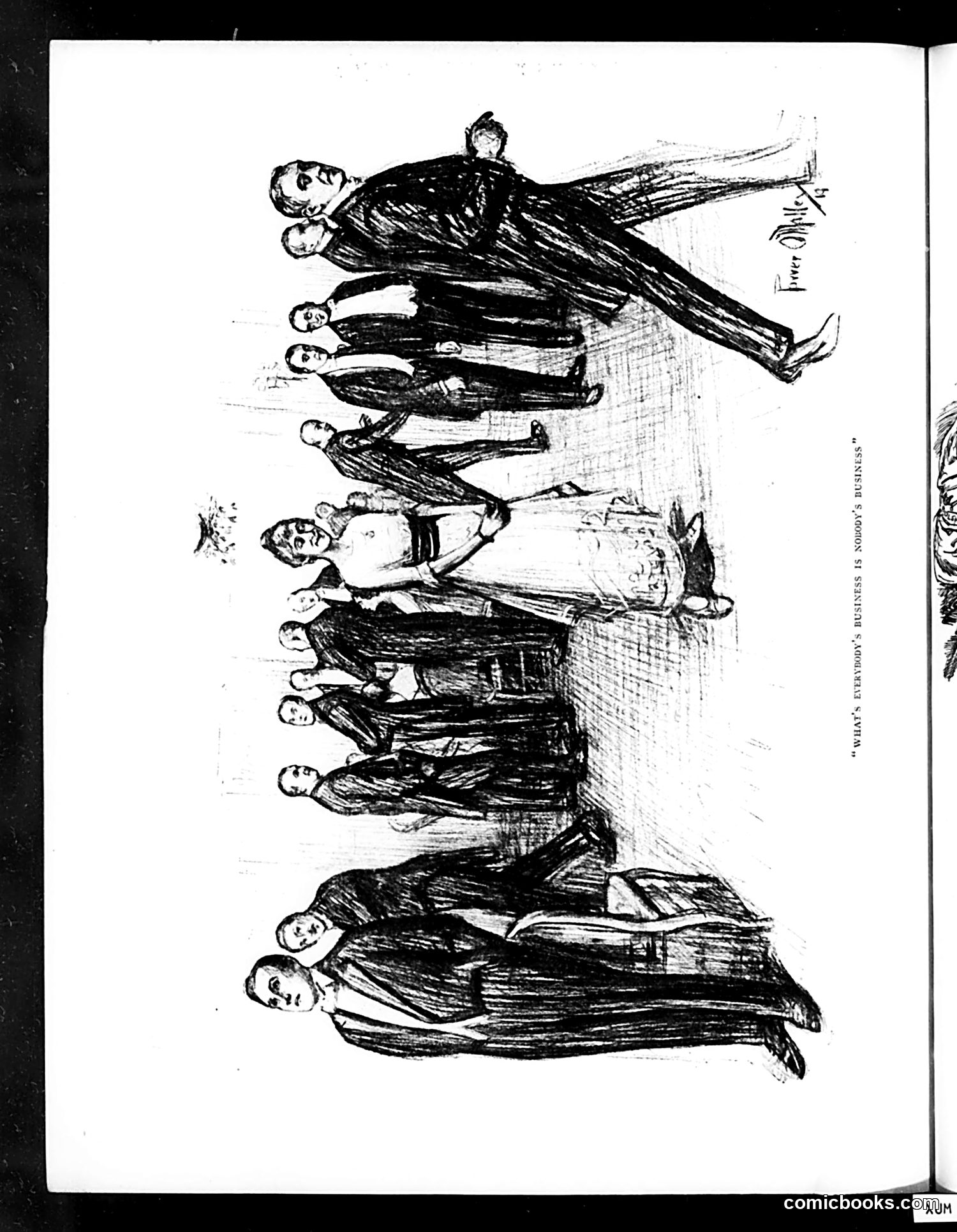
The OCR text is too corrupted to read meaningfully. However, the image shows a satirical illustration oriented sideways (requiring rotation to view properly), depicting approximately 10-12 figures in formal Victorian-era dress arranged in a line or procession. Without legible text identifying the figures or the cartoon's subject, I cannot reliably determine: - Who these individuals represent - What political or social event is being satirized - The specific point of the satire The artistic style and clothing suggest late 19th-century American political commentary, but identifying the specific figures, date, or referenced events would require either clearer OCR text or additional context. The illustration appears satirical in nature based on its exaggerated characterization, but the exact meaning remains unclear from this source alone.
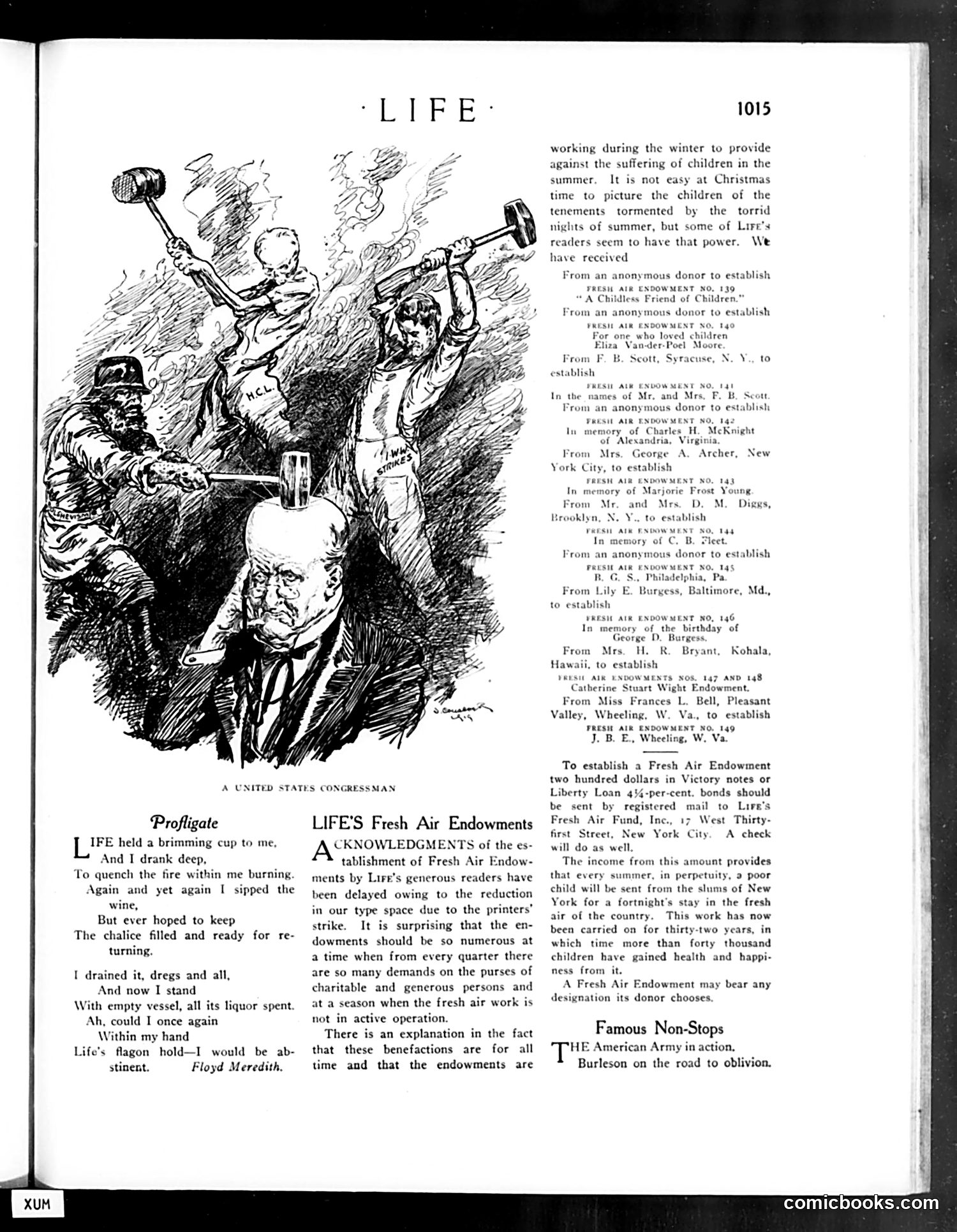
## The Cartoon The illustration labeled "A United States Congressman" depicts a bloated, intoxicated politician being carried by workers/laborers. He clutches a hammer and appears drunk or incapacitated, while those beneath him struggle under his weight. This satirizes congressional excess and corruption during a period of national sacrifice (likely WWI era, given Liberty Loan references on the page). ## The Poem "Profligate" Floyd Meredith's accompanying verse reinforces the message: a man who greedily consumed life's pleasures ("drained it, dregs and all") now stands empty-handed, regretting his lack of restraint. This moralizing poem directly parallels the congressman's image—critiquing wasteful indulgence when the nation requires sacrifice. ## Context The juxtaposition with "Fresh Air Endowments" (charitable giving for poor children) emphasizes the contrast between selfish politicians and civic responsibility. The final line mocking "Burleson on the road to oblivion" likely references Postmaster General Albert Burleson, a controversial Wilson administration figure.
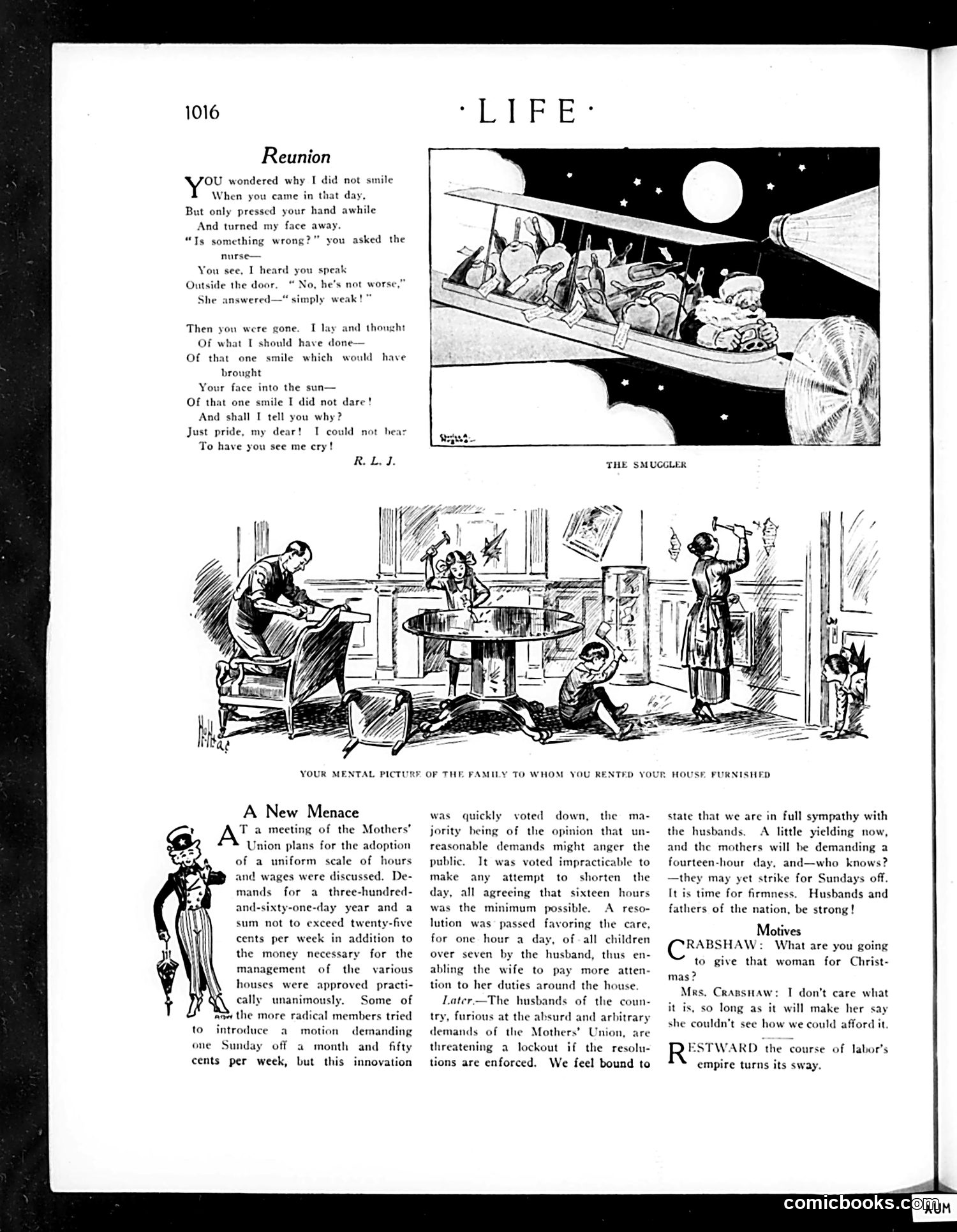
This Life magazine page satirizes early 20th-century labor and domestic disputes through three distinct pieces: **"Reunion"** (top left): A sentimental poem about emotional distance between lovers, unrelated to politics. **"The Smuggler"** (top right): An illustration depicting contraband being transported by boat at night—likely referencing Prohibition-era smuggling, a major social issue of the 1920s-30s. **"A New Menace"** (bottom): The main satire. The Mothers' Union demands housewives receive formal pay and limited work hours (16-hour days, minimal wages). The magazine mockingly opposes this, warning husbands that giving mothers "a little yielding now" will lead to escalating demands—even Sunday strikes. The satire cuts both ways: it ridicules both the absurdly exploitative conditions presented as reasonable ("sixteen hours minimum") and the wives' modest demands, implying that even basic labor protections for domestic workers seem threatening to men. The closing cartoon mocks gift-giving: a husband should give his wife something that makes her grateful for his financial support—reinforcing wives' economic dependence.
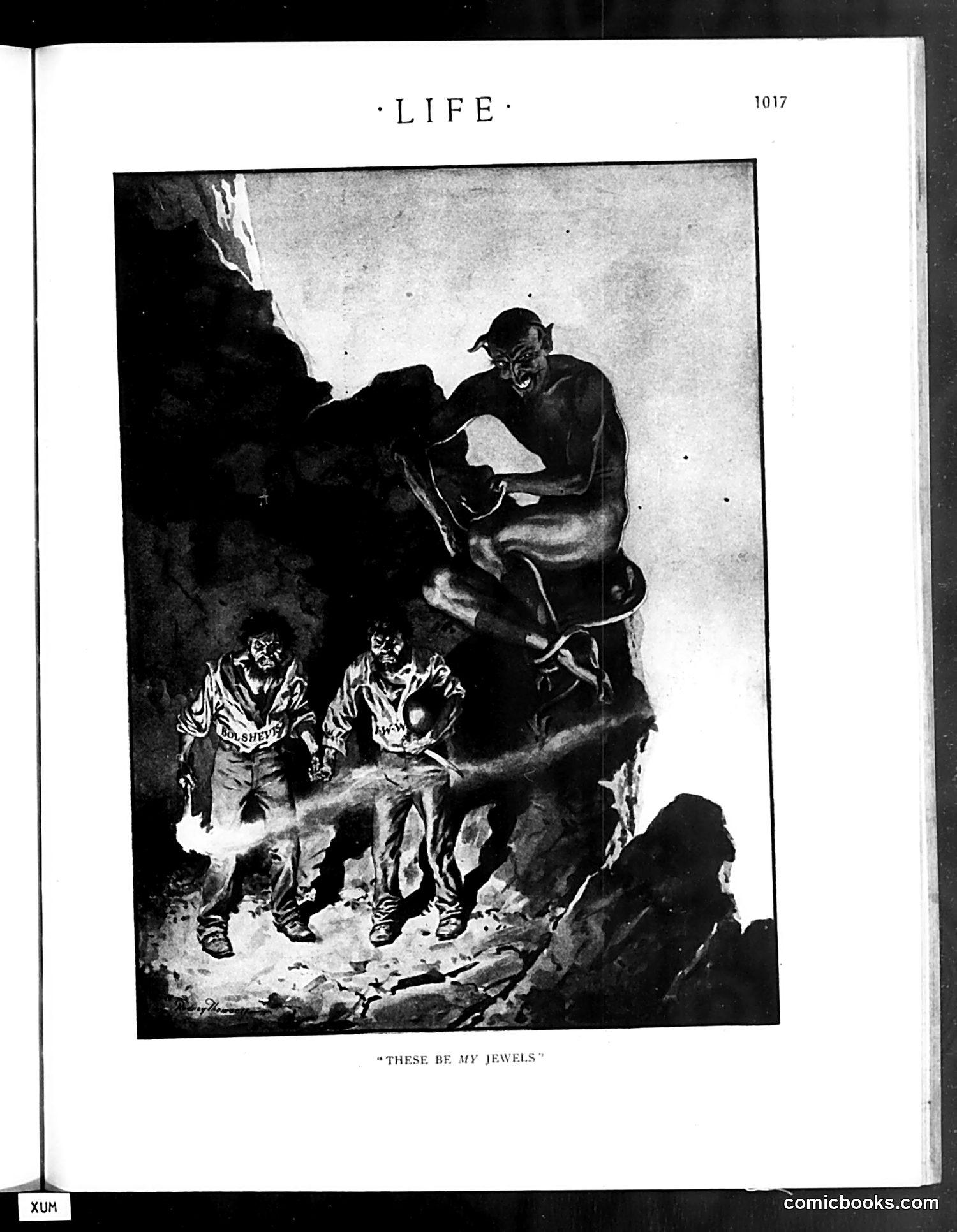
This illustration depicts a demonic or grotesque figure on an elevated rocky perch, gesturing downward at two figures below labeled "SHERIFF" (visible on their clothing). The caption "THESE BE MY JEWELS" suggests the demon views the lawmen as prized possessions or trophies. The satire likely criticizes **corruption of law enforcement**—implying sheriffs have become tools or "jewels" controlled by dark or criminal forces rather than serving justice. The dramatic, theatrical composition emphasizes the inversion of power: legitimate authority figures are depicted as subordinates to an evil force. Without additional context about the specific date and events, the precise target remains unclear, though it appears to critique systemic corruption within local law enforcement during this period of *Life* magazine's publication.
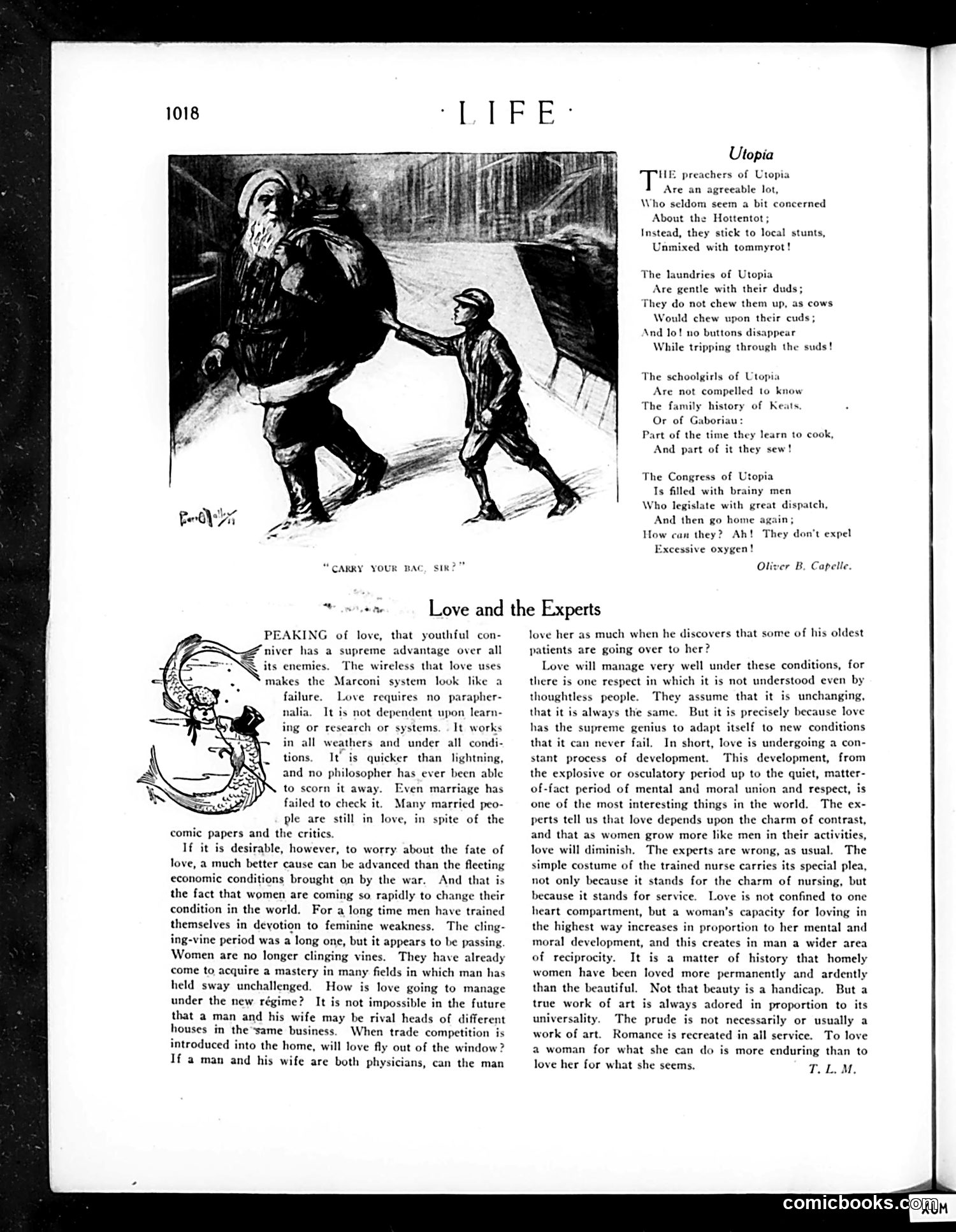
**"Utopia" poem** satirizes idealistic social reformers who champion grand causes while ignoring practical problems. It mocks preachers focused on distant concerns (the "Hottentot") rather than local issues, and imagines a fantasy world where laundries don't lose buttons, schoolgirls learn practical skills instead of classical literature, and Congress actually functions efficiently. The satire suggests such perfection is impossible—a critique of naive utopianism. **"Love and the Experts" essay** addresses wartime concerns about women's changing roles. It argues that love will survive women's increasing economic and professional independence (becoming physicians, business rivals). The author counters "experts" who claim love depends on gender contrast, asserting instead that love adapts and deepens through intellectual and moral development. The piece defends romantic relationships against anxieties about women's emancipation. Both pieces reflect early 20th-century debates over feminism, social progress, and traditional gender roles.
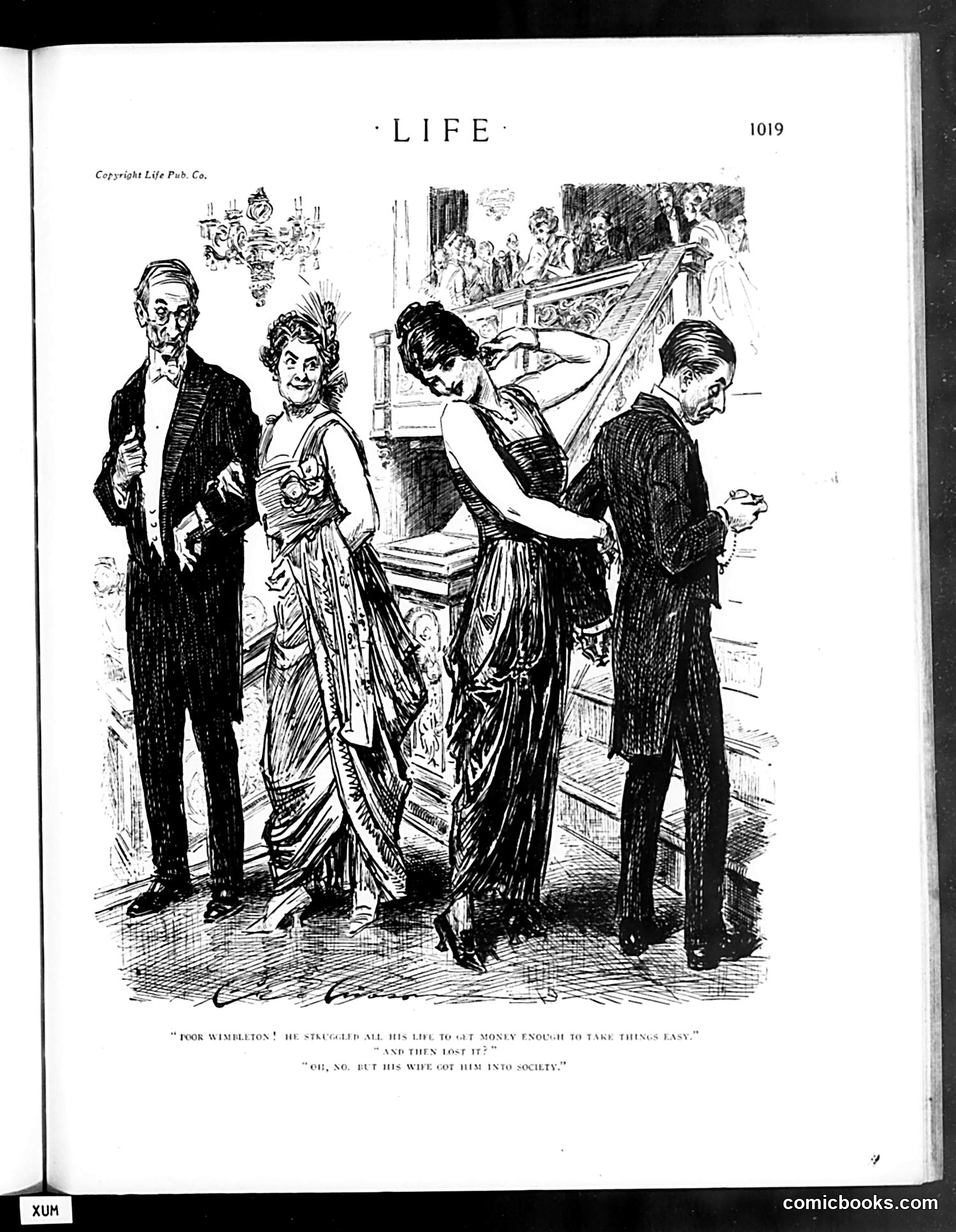
This satirical cartoon depicts a funeral scene mocking the social ambitions of wealthy wives. The setup presents a dark joke: a man named Wimbleton spent his life accumulating wealth to retire comfortably, but "lost" his ease not through financial ruin but because his wife used their money to enter high society. The cartoon satirizes early 20th-century social climbing—specifically how newly wealthy families pursued membership in exclusive social circles, which involved constant entertaining, formal events, and social obligations (visible in the background gathering). The joke suggests that a wife's social ambitions proved more exhausting and demanding than financial struggle itself. This reflects period anxieties about conspicuous consumption and the social pressures facing the nouveau riche.
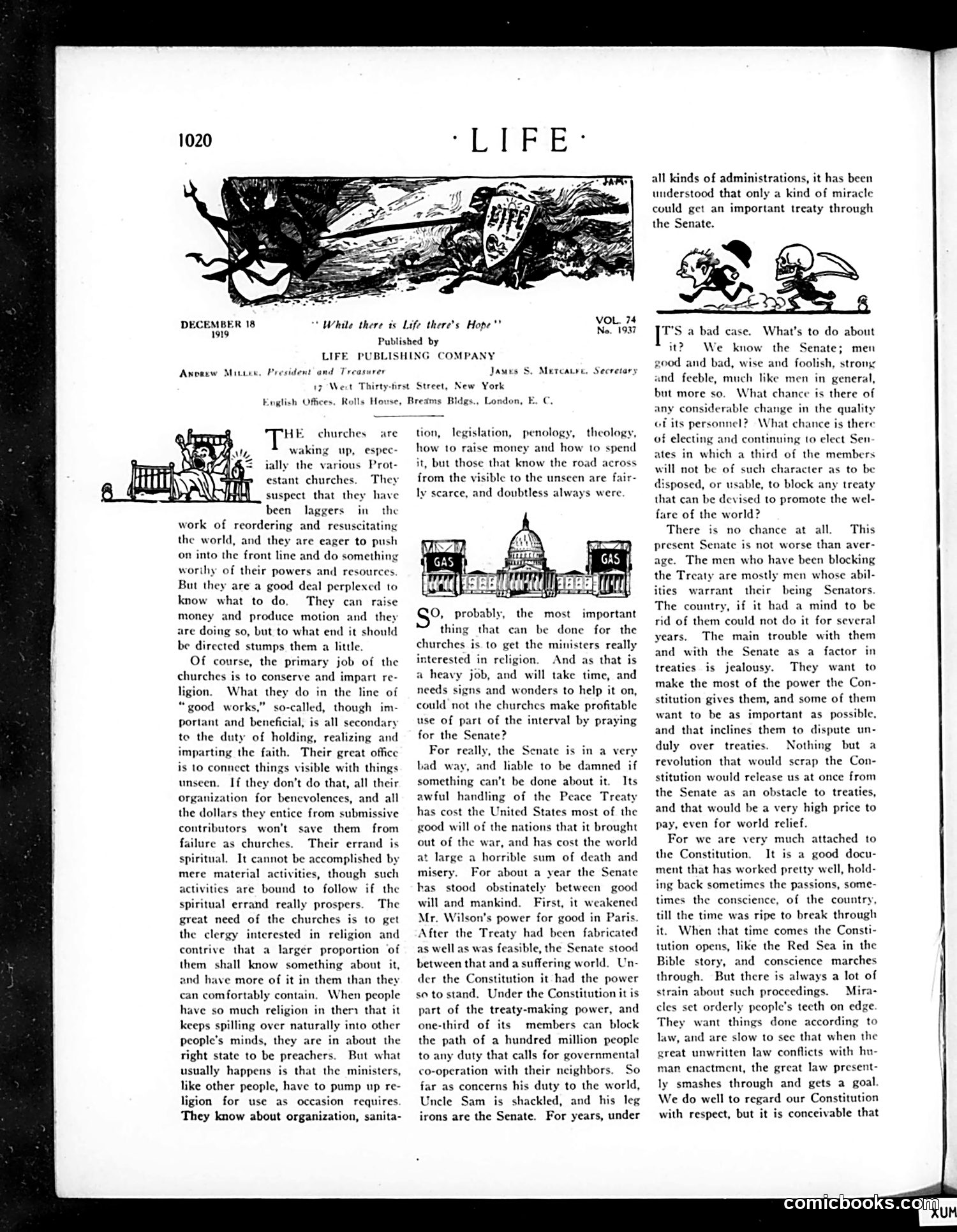
This editorial page attacks the U.S. Senate's obstruction of the League of Nations treaty following World War I. The author argues that churches should pray for the Senate because it has become an obstacle to peace and international cooperation. The central complaint: President Wilson negotiated the peace treaty, but the Senate—where one-third of members can block ratification—refused to approve it. This damaged American credibility abroad and prevented the nation from helping a war-ravaged world recover. The Senate is depicted as "shackled" America with "leg irons." The satirical suggestion that churches pray for the Senate reflects frustration that normal political channels have failed. Only divine intervention, the author implies sarcastically, could overcome the Senate's constitutional power to block treaties and its apparent unwillingness to support international cooperation for the common good.
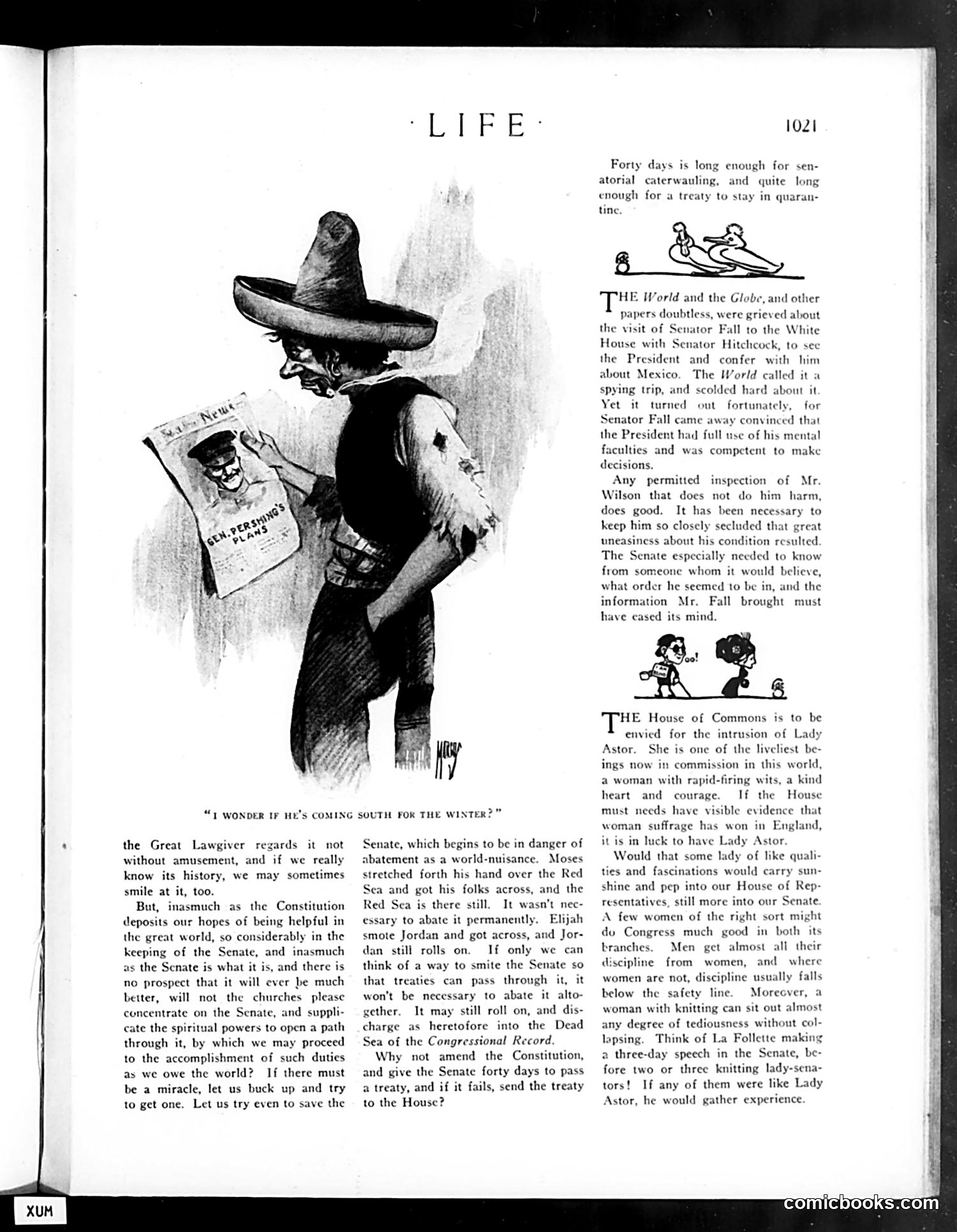
The main cartoon satirizes President Woodrow Wilson's health and accessibility. A figure in a Mexican sombrero—caricaturing Senator Fall—holds a newspaper while wondering if Wilson is "coming south for the winter," a mocking reference to Wilson's reported physical decline and seclusion following his 1919 stroke. The accompanying text discusses Fall and Senator Hitchcock's White House visit to assess Wilson's mental fitness regarding Mexico policy. Life praises Fall's report that Wilson retained his faculties, noting the Senate needed this reassurance given his enforced isolation. The secondary commentary addresses the Senate's obstruction of treaties (likely the League of Nations), sarcastically suggesting divine intervention or constitutional amendment to expedite passage. A third section praises Lady Astor's entry into Britain's House of Commons as evidence of women's suffrage success, expressing hope that American women might similarly invigorate Congress with "discipline" and wit.
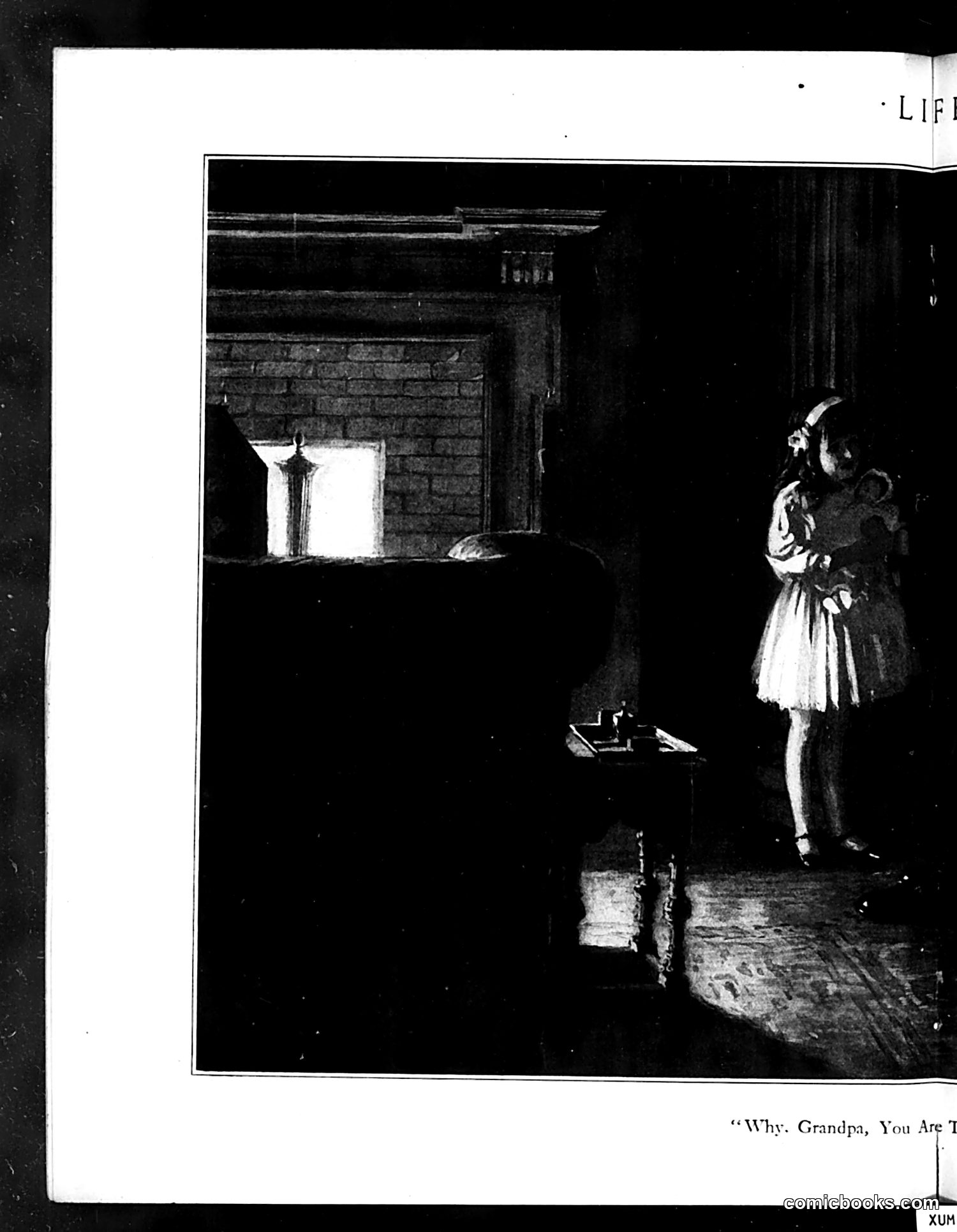
This appears to be an illustration from Life magazine depicting a scene between two figures in what looks like a modest interior space. A child in light-colored clothing stands on the right, addressing an elderly man (suggested by the caption's "Grandpa") who is visible through or near a window or opening on the left side of the image. The incomplete caption "Why, Grandpa, You Are T..." suggests a humorous or ironic observation the child is making about the grandfather. Without the full text, the specific joke is unclear, but the visual contrast between the child's innocence and whatever characteristic or situation the caption references likely creates the satirical point—possibly commenting on age, modernity versus tradition, or generational differences typical of Life's humor.
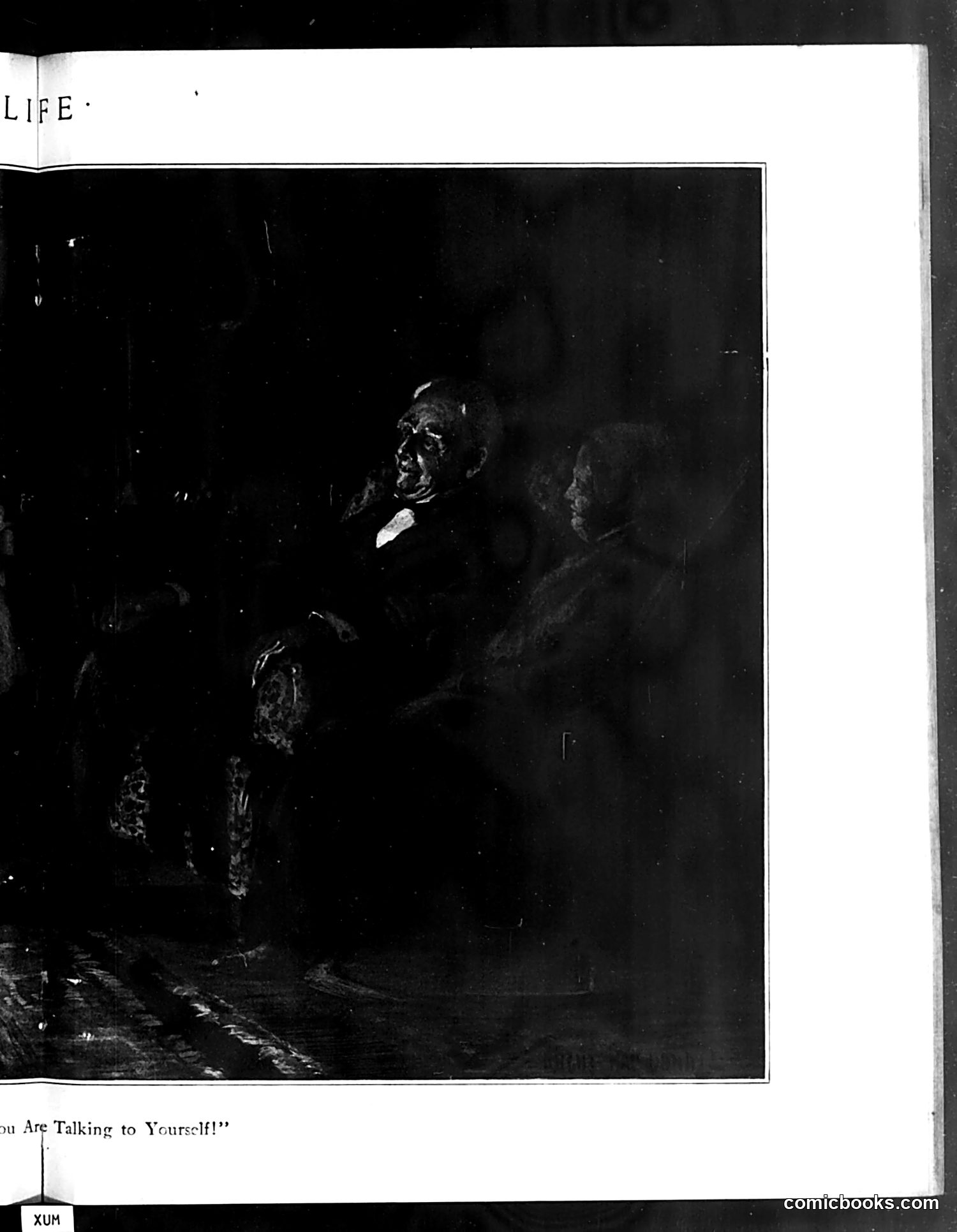
This appears to be a satirical cartoon from Life magazine depicting a scene where one figure is accusing another of "talking to yourself." The image shows two figures in dark clothing against a shadowy background—one appears more prominent in the foreground while another is visible in the background. The satirical point seems to be social commentary on self-absorption or self-delusion, likely mocking someone for being so isolated or disconnected that they've resorted to conversing with themselves. Without additional context about the specific date or political figures of the era, the precise target of the satire remains unclear, though it appears to critique individual vanity or social disconnection prevalent in the period when Life magazine was published.
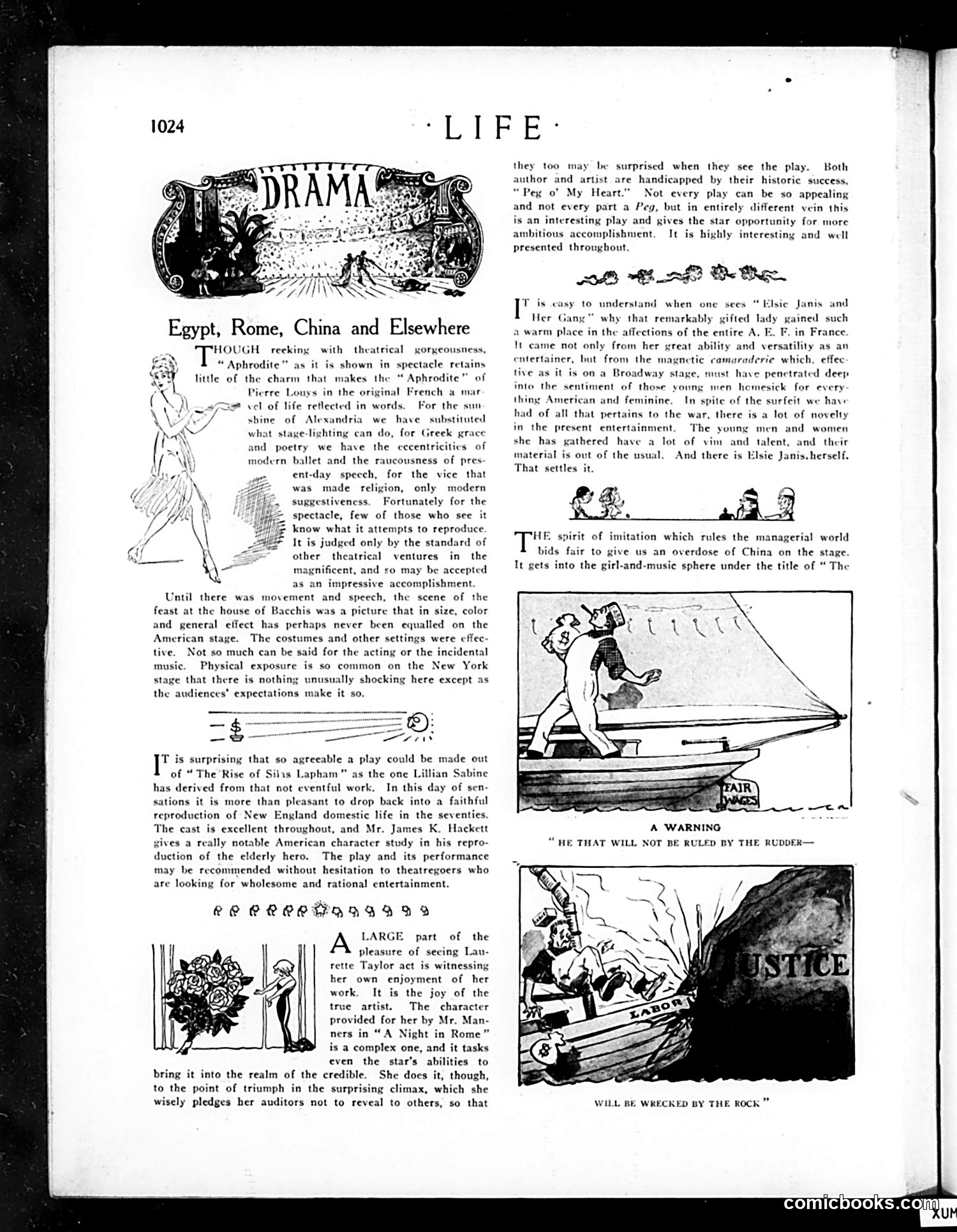
This page from *Life* magazine reviews several Broadway productions. The main theatrical reviews discuss "Aphrodite" (a spectacle adaptation of Pierre Louys's novel), "Elsie Janis and Her Gang" (a wartime entertainment featuring a popular female entertainer who performed for American troops in France during WWI), "The Rise of Silas Lapham," and "A Night in Rome." The two cartoons on the right—titled "A Warning" and depicting a boat labeled "Justice"—appear to be political commentary warning that those refusing to follow proper governance ("ruled by the rudder") will be "wrecked by the rock." This likely references post-WWI anxieties about social order and governance. The reviews praise spectacle and star performances while noting that modern Broadway increasingly relies on physical exposure rather than substantive drama. The page reflects 1920s theatrical tastes and wartime cultural nostalgia.
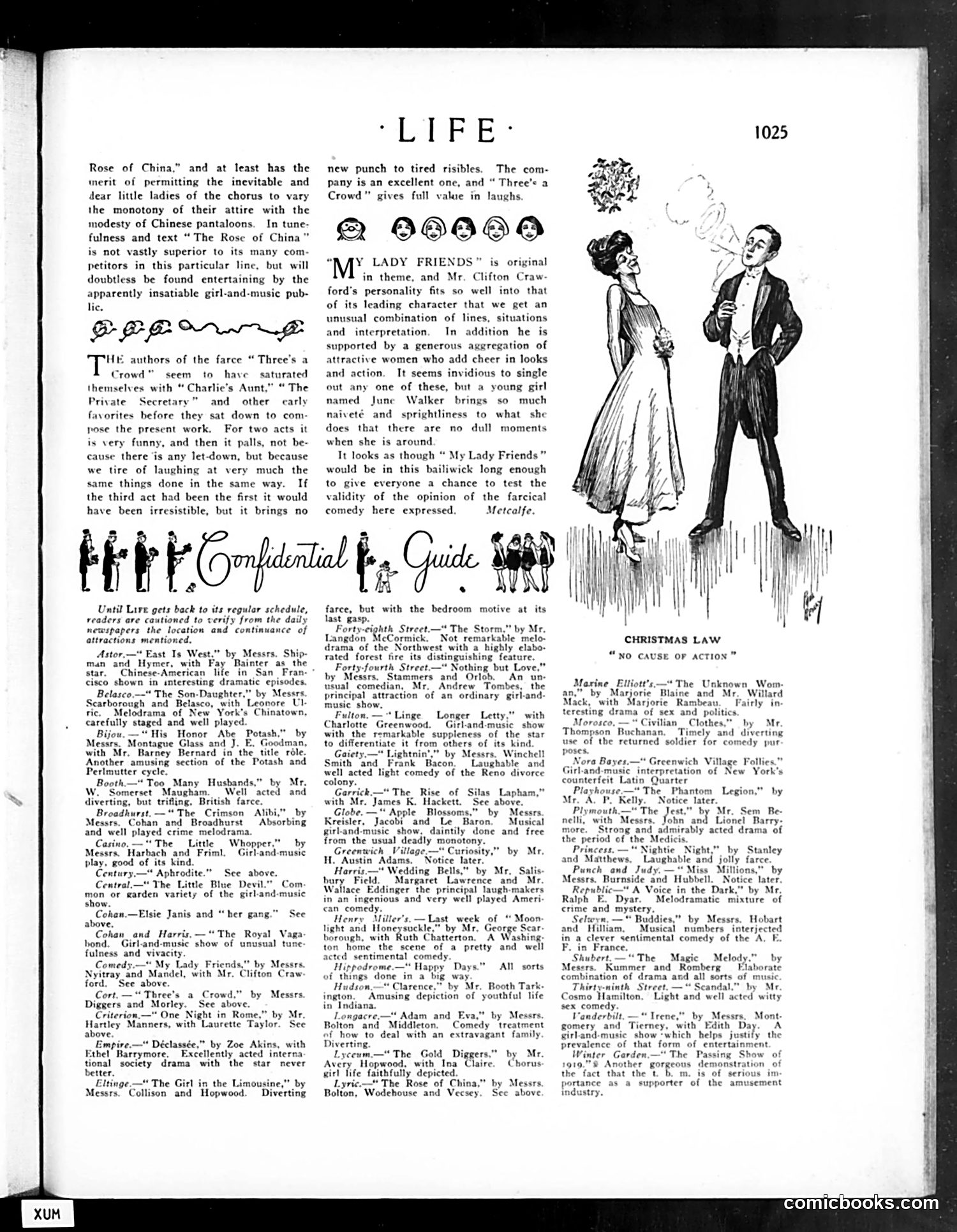
This page contains **theater reviews** for Broadway productions, not political satire. The illustration shows a couple in formal evening wear, depicting a typical scene from one of the reviewed farces. The reviews discuss comedies and musicals popular in that era, including "Three's a Crowd" and "My Lady Friends" (both bedroom farces). The critic praises "My Lady Friends" for its original theme and particularly notes actress **June Walker's** performance, calling her "naiveté and sprightliness" charming. The "Confidential Guide" section briefly lists other Broadway attractions—mostly girl-and-music shows, melodramas, and light comedies reflecting post-WWI entertainment tastes. **Key context for modern readers:** This represents Life's serious theater criticism section, before the magazine shifted toward pure humor and satire. The repeated dismissal of "girl-and-music" shows as formulaic indicates contemporary frustration with repetitive musical theater, much like modern critiques of franchise entertainment.
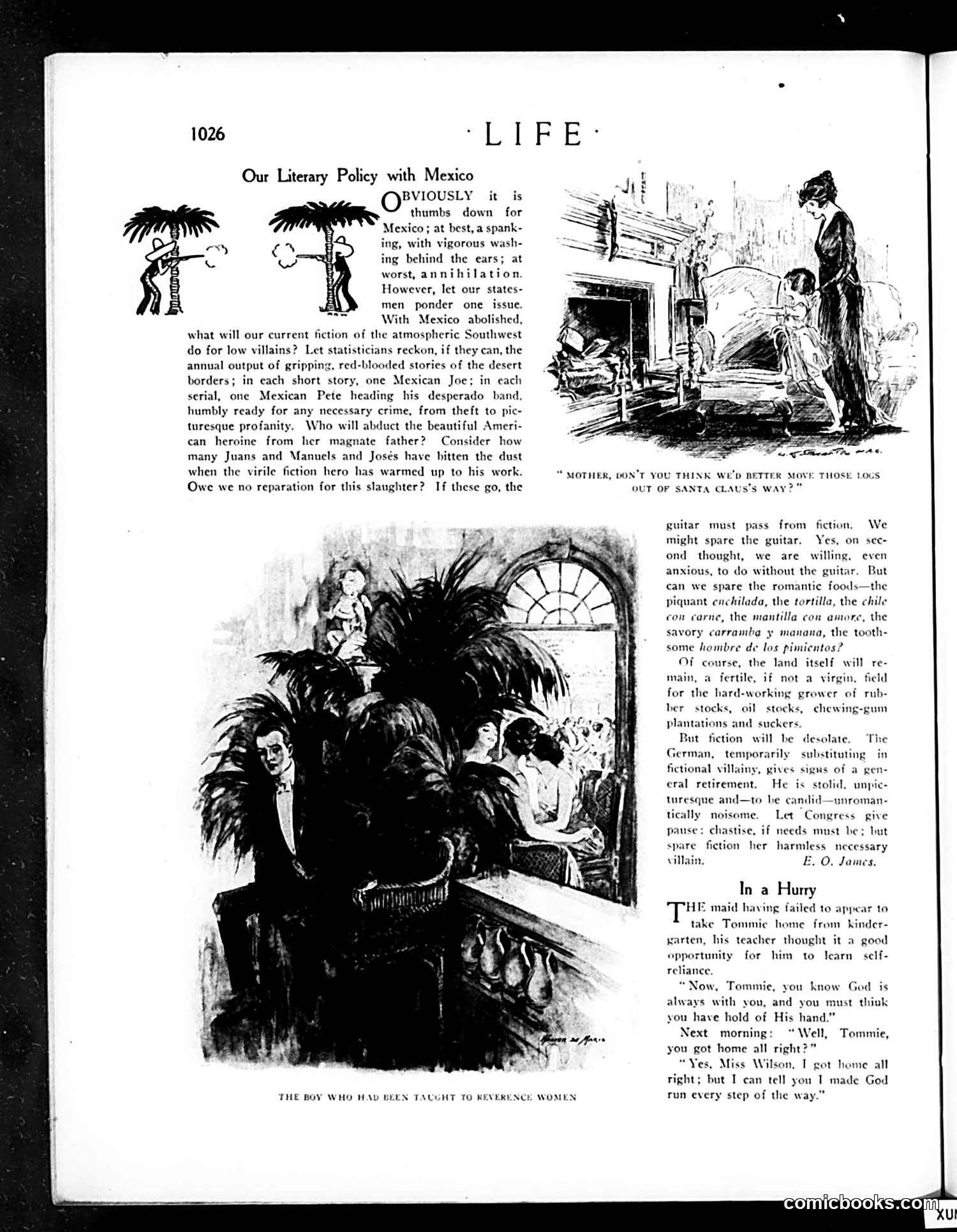
This Life magazine page satirizes American attitudes toward Mexico through two distinct pieces: **"Our Literary Policy with Mexico"** (top): The essay mocks the entertainment industry's reliance on Mexican villains in popular fiction. It notes that American Southwest stories depend on stock characters—Mexican Joes and Petes as desperados and abductors—to provide villainous plots. The satire points out that if Mexico were eliminated (a contemporary political suggestion), American fiction would lose its convenient racial villains, romantic tropes (enchiladas, guitars), and the entire genre would collapse. The author ironically argues Congress should "spare" Mexico—not for moral reasons, but because American storytelling needs Mexican stereotypes as plot devices. **"In a Hurry"** (bottom): A humor piece about a kindergarten teacher telling young Tommie that God will guide him home. The joke: the boy reports he made "God run every step of the way"—reversing the metaphor to suggest divine exhaustion keeping pace with a energetic child. The cartoons at top show caricatured Mexican figures with exaggerated features typical of period racism.
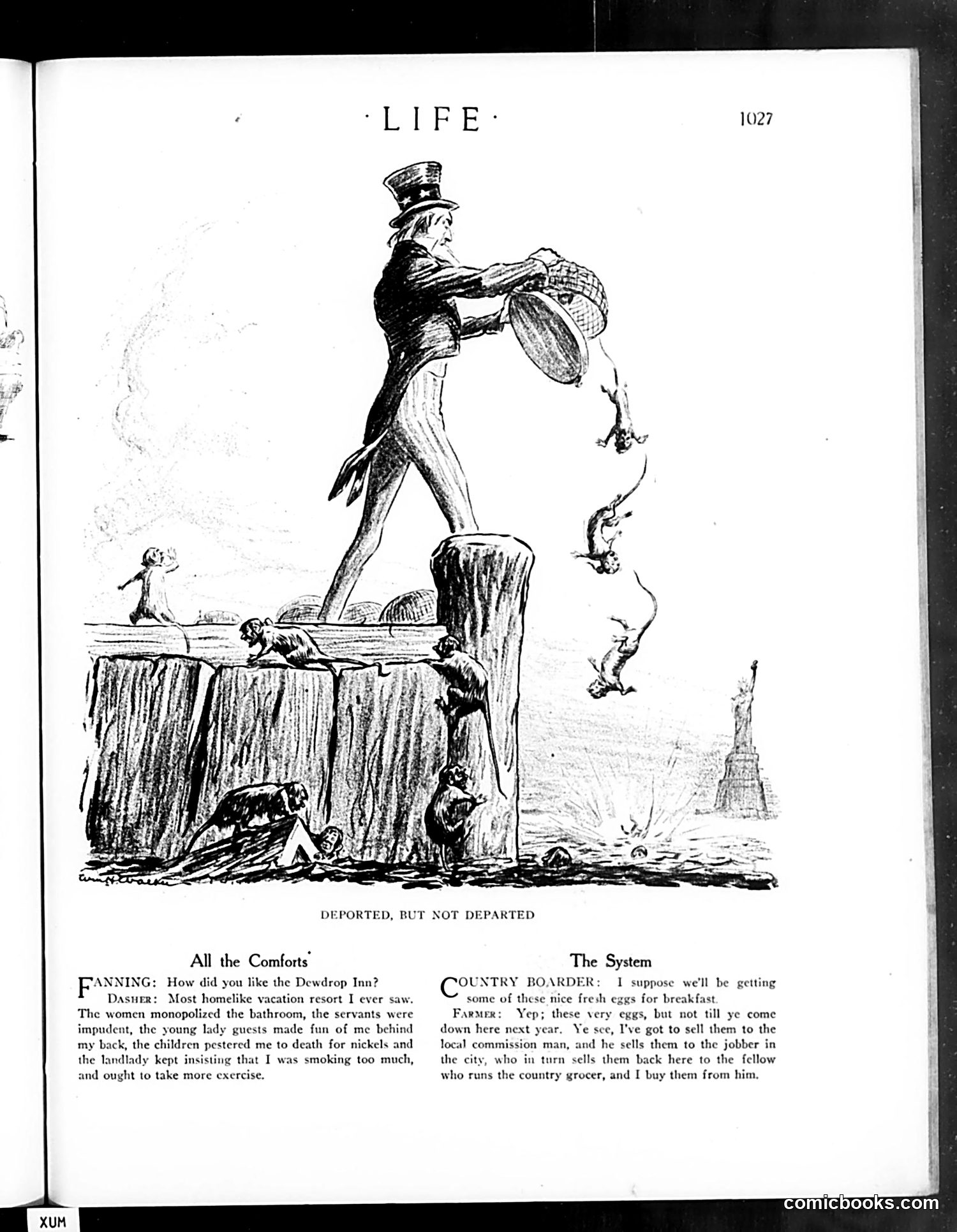
This Life magazine page contains two satirical pieces critiquing American life circa early 20th century. **"Deported, But Not Departed"** (main illustration): A tall figure with a butterfly net stands atop a wooden stump, catching flying figures—likely immigrants or undesirable people—suggesting failed deportation policies. The phrase implies people targeted for removal remain present regardless. **"All the Comforts"**: Mocks the false "homelike" appeal of vacation boarding houses, where guests endure bathroom monopolization, rude servants, and mocking—ironic "comforts." **"The System"**: Satirizes agricultural inefficiency. A farmer grows eggs but cannot sell them directly to consumers. Instead, eggs pass through a chain: farmer → commission agent → jobber → city wholesaler → country grocer → back to the farmer himself. This criticizes middlemen profiteering and circular, wasteful distribution systems that inflated costs while producers received minimal benefit. The page targets institutional dysfunction, immigration policy, and capitalist inefficiency.
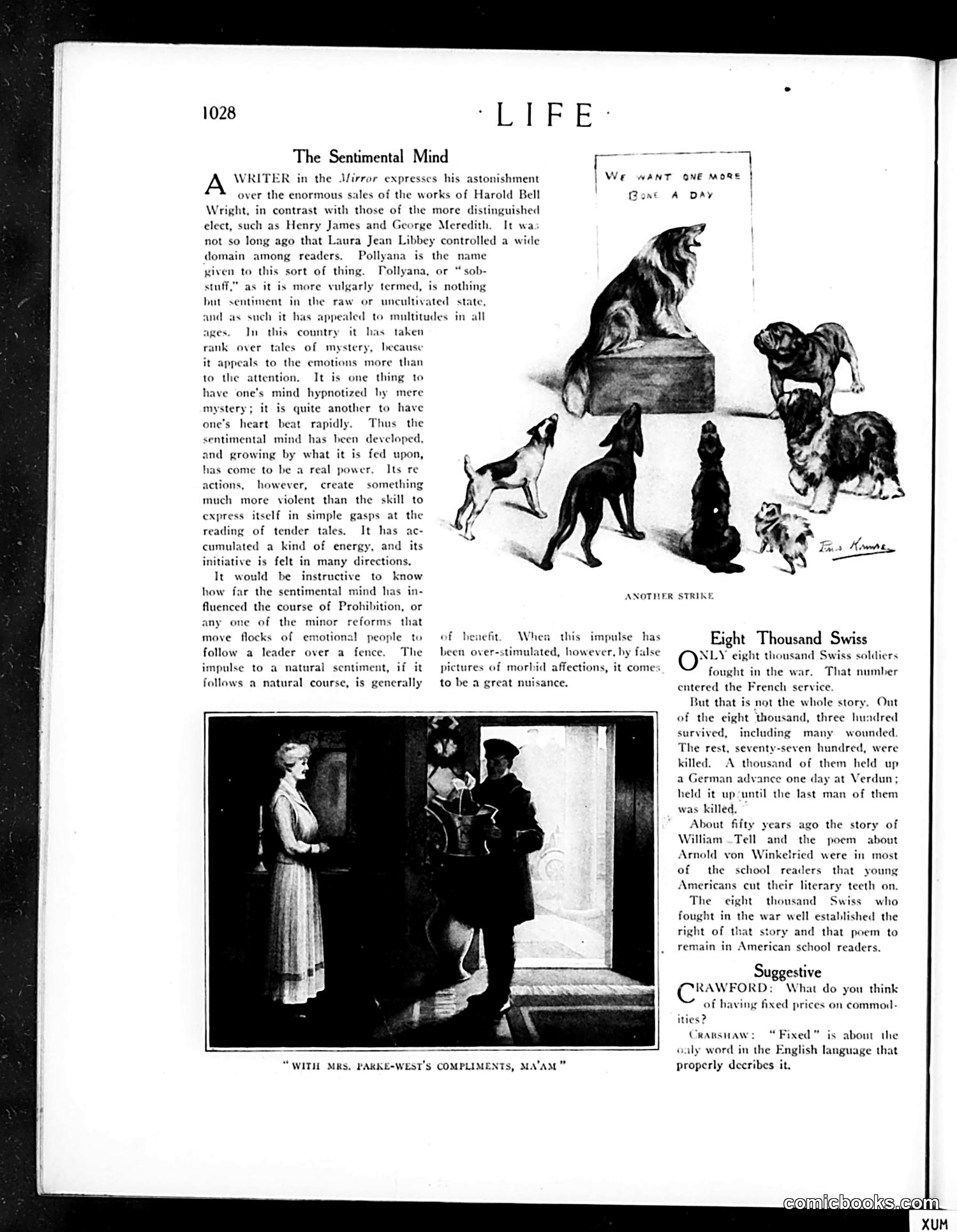
**"The Sentimental Mind"** essay critiques popular literature's emotional appeal. The writer notes that Harold Bell Wright's bestselling novels outsell more "distinguished" authors like Henry James. The piece argues that sentimentality—"sob-stuff"—appeals to raw emotion rather than intellect, and warns that when artificially stimulated through "morbid affections," it becomes a "nuisance." The author questions whether sentimental impulses have driven social movements like Prohibition. **"Another Strike"** cartoon (dogs refusing more food) satirizes labor disputes or workers' demands during the post-WWI era, likely referencing the wave of strikes occurring in America at this time. **"Eight Thousand Swiss"** praises Swiss soldiers who fought for France in WWI, noting that 7,700 were killed. It references William Tell and Arnold von Winkelried (Swiss historical/legendary figures) as validating Swiss martial tradition and heroism. **"Suggestive"** joke plays on the word "fixed"—Crawford and Crabshaw debate price controls, with Crabshaw quipping that "fixed" accurately describes commodities because prices are artificially manipulated or rigged.
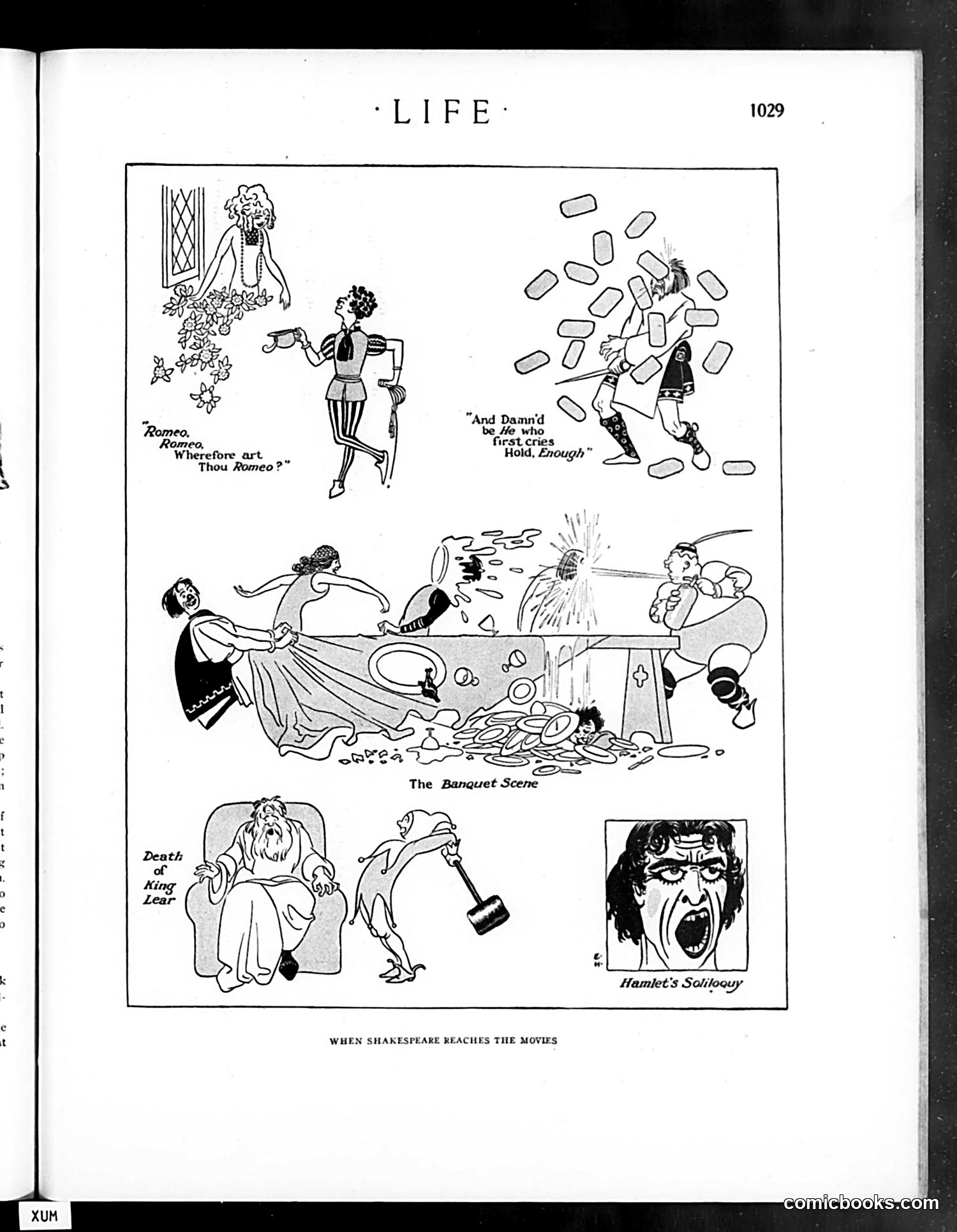
This Life magazine page satirizes how Hollywood adapts Shakespeare for film. Each panel reimagines famous scenes in contemporary 1920s-30s style: - **Romeo and Juliet**: A woman in modern dress drops flowers from a window while a man in military uniform poses below, captioned with Shakespeare's famous line. - **The Banquet Scene**: A slapstick sequence showing characters in formal attire creating chaos with flying dishes and water. - **King Lear**: Depicted as an elderly man in a chair, simplified for modern audiences. - **Hamlet's Soliloquy**: A close-up of an actor's exaggerated, anguished expression. The joke mocks Hollywood's tendency to modernize and sensationalize Shakespeare—stripping classical drama of its depth while emphasizing visual spectacle and comedy over the text's emotional complexity.
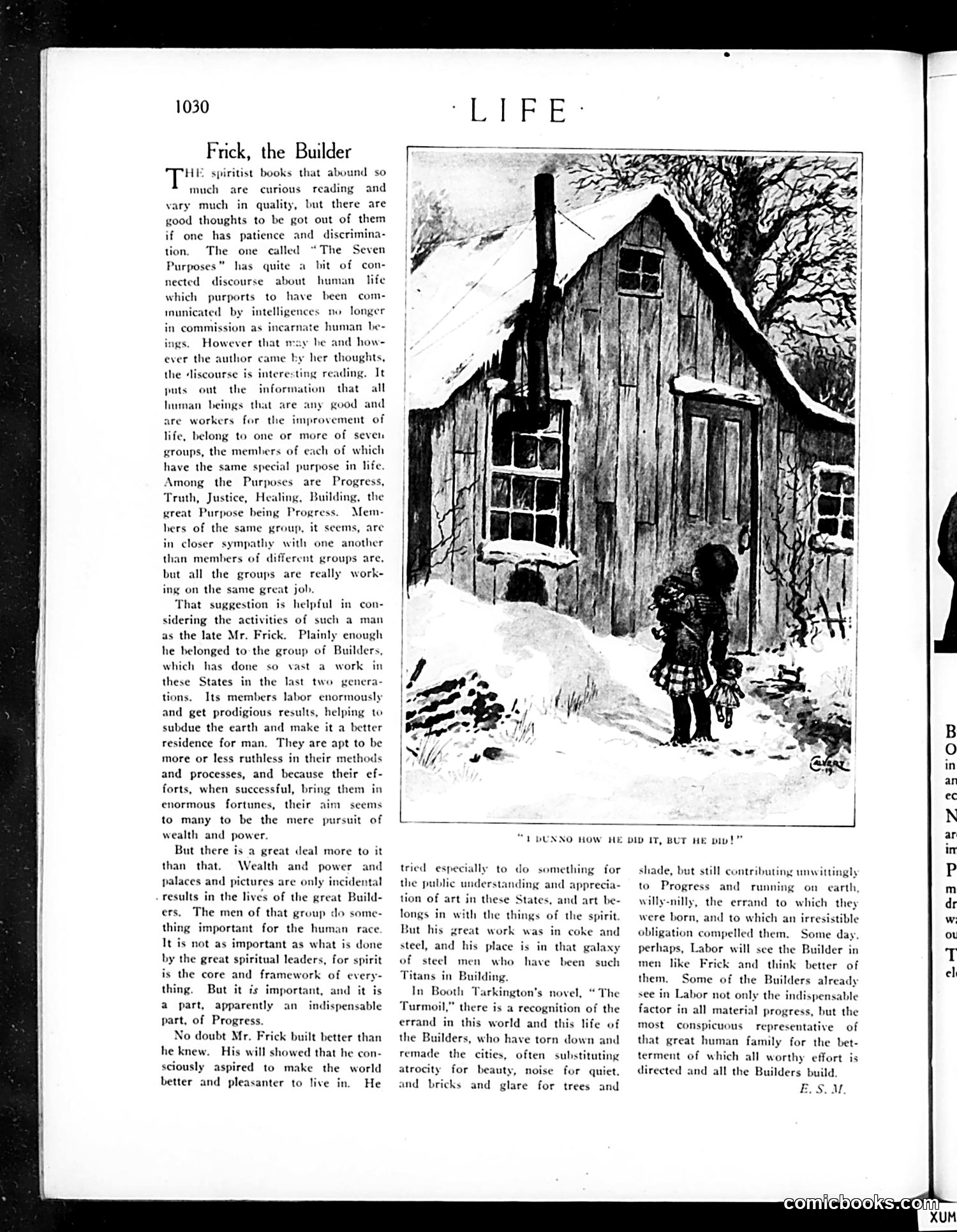
This article celebrates Henry Clay Frick (1849-1919), the steel magnate and art collector, as exemplifying the "Builder" archetype—one of seven human purposes outlined in spiritualist philosophy. The accompanying illustration shows a modest cottage, contrasting with Frick's actual industrial empire. The piece argues that despite Builders' reputation for ruthlessness and wealth-accumulation, they perform essential work improving civilization. Frick's contributions included industrializing America via coke and steel production, and advancing public art appreciation through his collection. The author acknowledges the contradiction: Builders replace natural beauty with industrial progress ("noise for quiet, bricks and glare for trees"), yet serve Progress itself. A final note suggests Labor should recognize Builders as fellow human contributors to collective betterment—a somewhat reconciliatory gesture toward worker-industrialist tensions of the era.
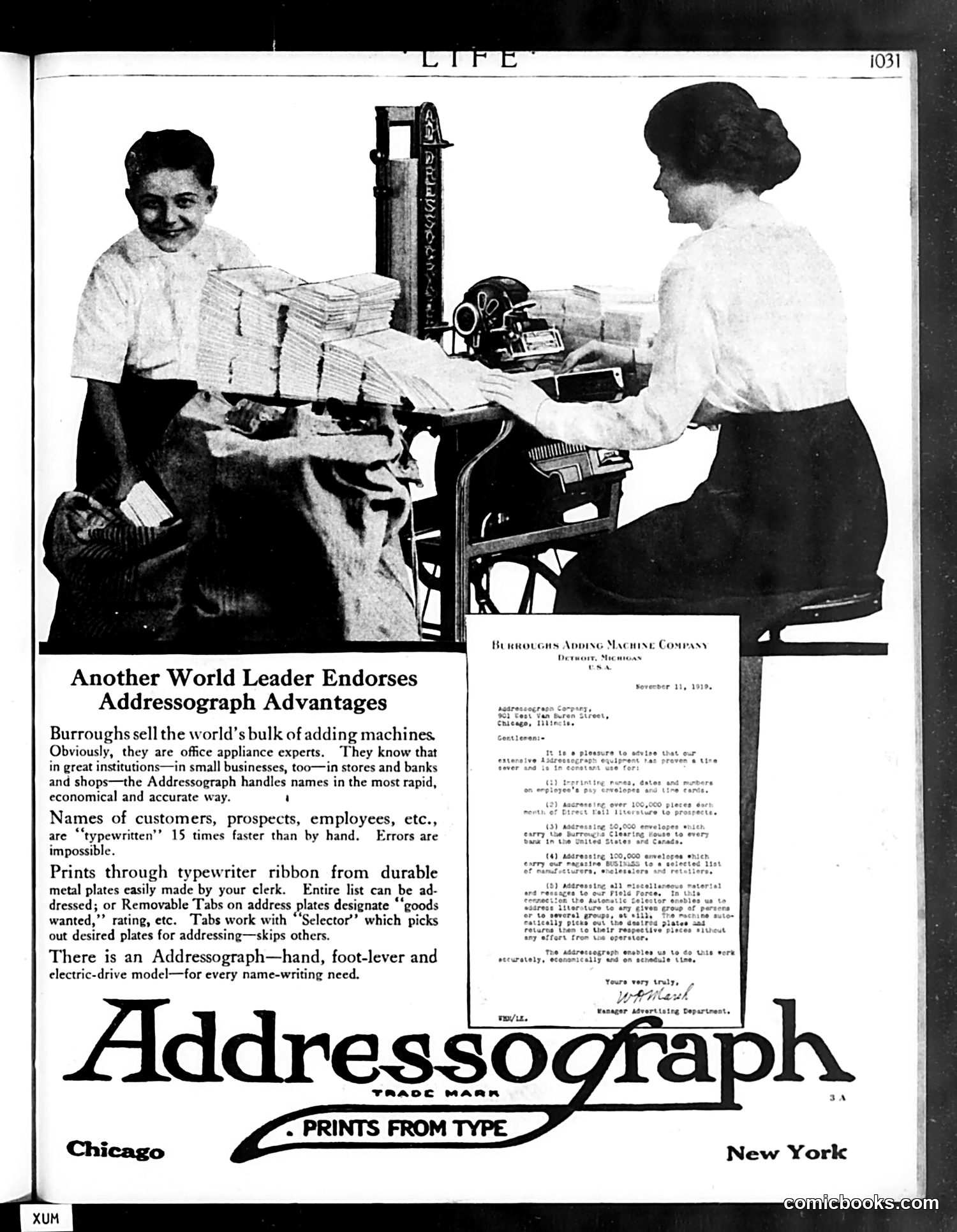
This is primarily a **product advertisement** for the Addressograph, a mechanical addressing machine, rather than political satire. The headline "Another World Leader Endorses Addressograph Advantages" appears designed to suggest important endorsement, though the specific "world leader" referenced in the photograph isn't clearly identified by caption. The image shows office workers (likely a man and woman) operating the machine with stacks of addressed materials. The advertisement emphasizes practical business benefits: the machine types addresses 15 times faster than hand-writing, eliminates errors, and saves labor costs for businesses of all sizes—shops, banks, and institutions. A letter from the Burroughs Adding Machine Company is visible as supporting documentation. This reflects early 20th-century advertising strategy: pairing a machine with an endorsement (real or implied) to build credibility among business buyers. The humor, if any, is gentle—the "world leader" framing inflates the importance of a clerical tool, but this was standard advertising hyperbole of the era, not sharp satire.
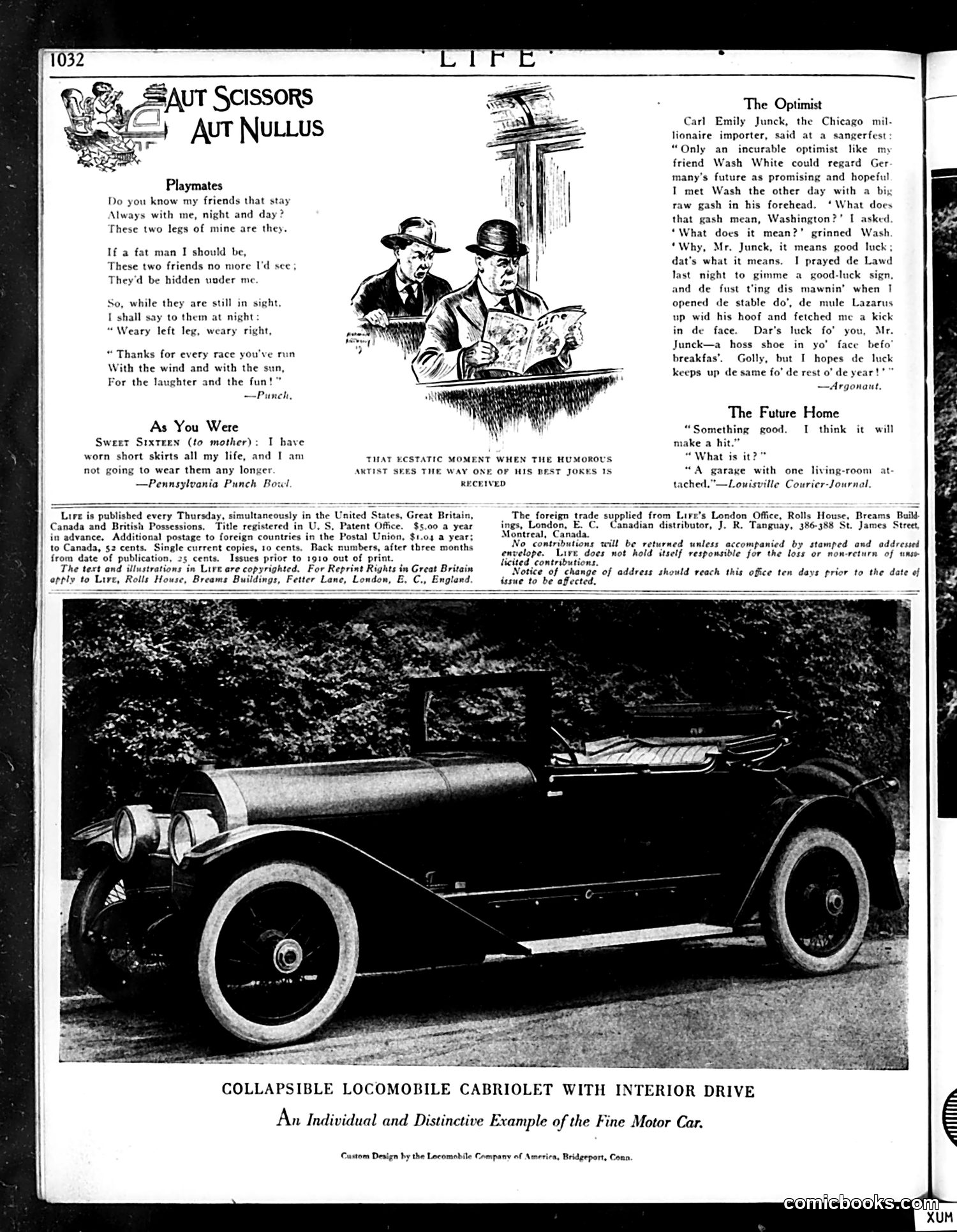
This page contains humorous short pieces typical of *Life* magazine's satirical format: **"Aut Scissors / Aut Nullus"** ("Scissors or Nothing"): A poem celebrating one's legs while young and visible, with gratitude for their service. The humor lies in the implicit warning about aging and weight gain making legs disappear from sight—a gentle jab at vanity and mortality. **"As You Were"**: A brief joke about a young woman refusing to lengthen her skirts despite her mother's wishes, referencing ongoing debates about female dress codes and hemlines in the early 20th century. **"The Optimist"**: An anecdote where a wealthy Chicago businessman's friend interprets a mule's kick to the face as "good luck"—satire on naive, blind optimism that finds silver linings in obviously bad situations. **"The Future Home"**: A one-liner mocking modern architectural trends, where a "garage with one living-room attached" represents misplaced priorities—homes built around automobiles rather than human living. The page also advertises a Locomobile automobile, the magazine's publishing details, and includes an illustration of two men reading a newspaper.
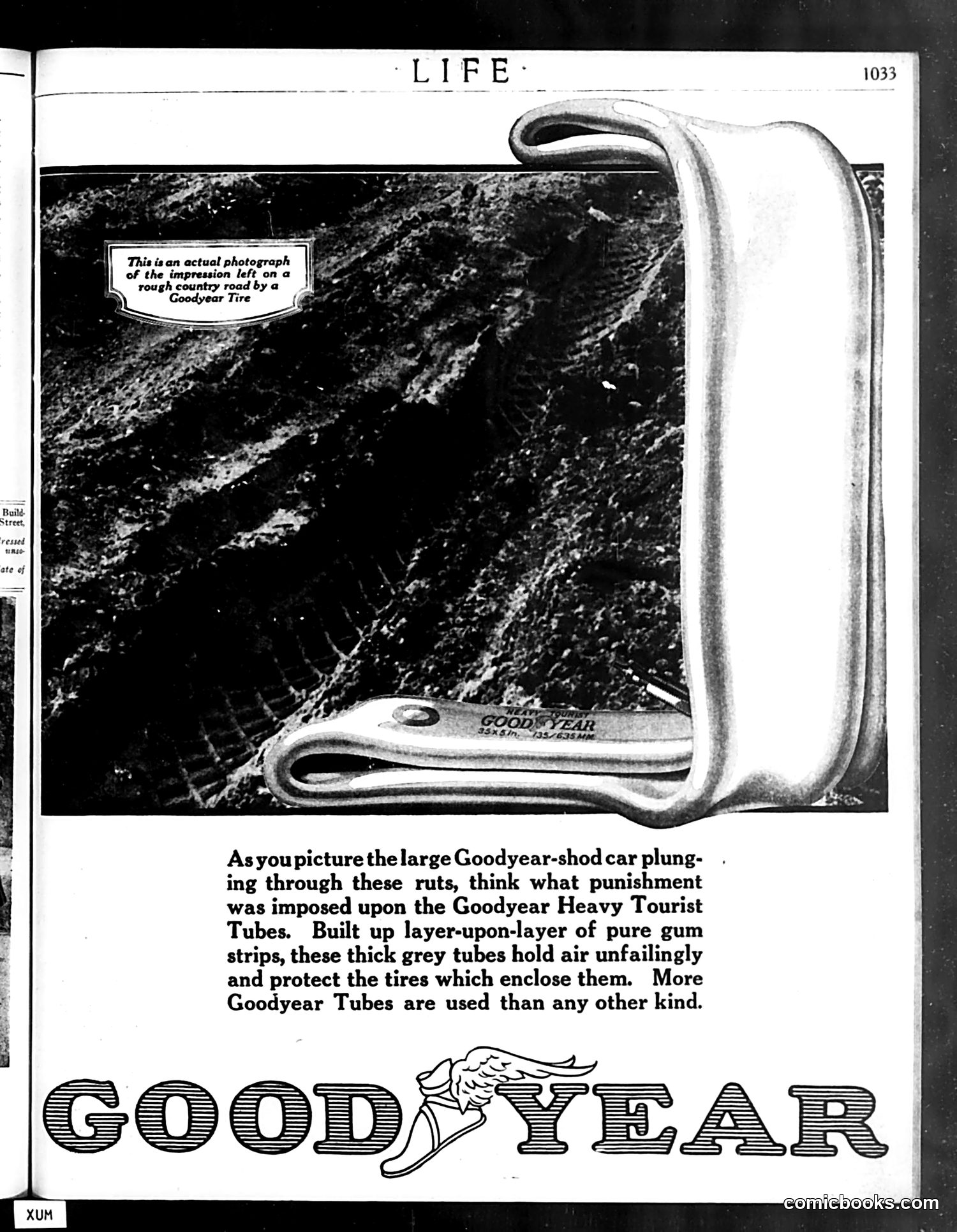
This is a **Goodyear tire advertisement**, not a political cartoon. It uses a dramatic visual demonstration to market inner tubes. The page shows a photograph of deep ruts in a rough country road, claiming these are actual impressions made by a Goodyear-equipped car. The advertisement argues that if tires can withstand such brutal terrain, imagine the punishment the inner tubes inside must endure. The copy emphasizes that Goodyear's "Heavy Tourist Tubes" are built from "layer-upon-layer of pure gum strips" and reliably hold air despite harsh conditions. The pitch concludes that more Goodyear tubes are used than competitors' products—a claim meant to signal market dominance and consumer trust. This is early-20th-century product advertising using durability and real-world evidence (the road photograph) as selling points to automobile owners.
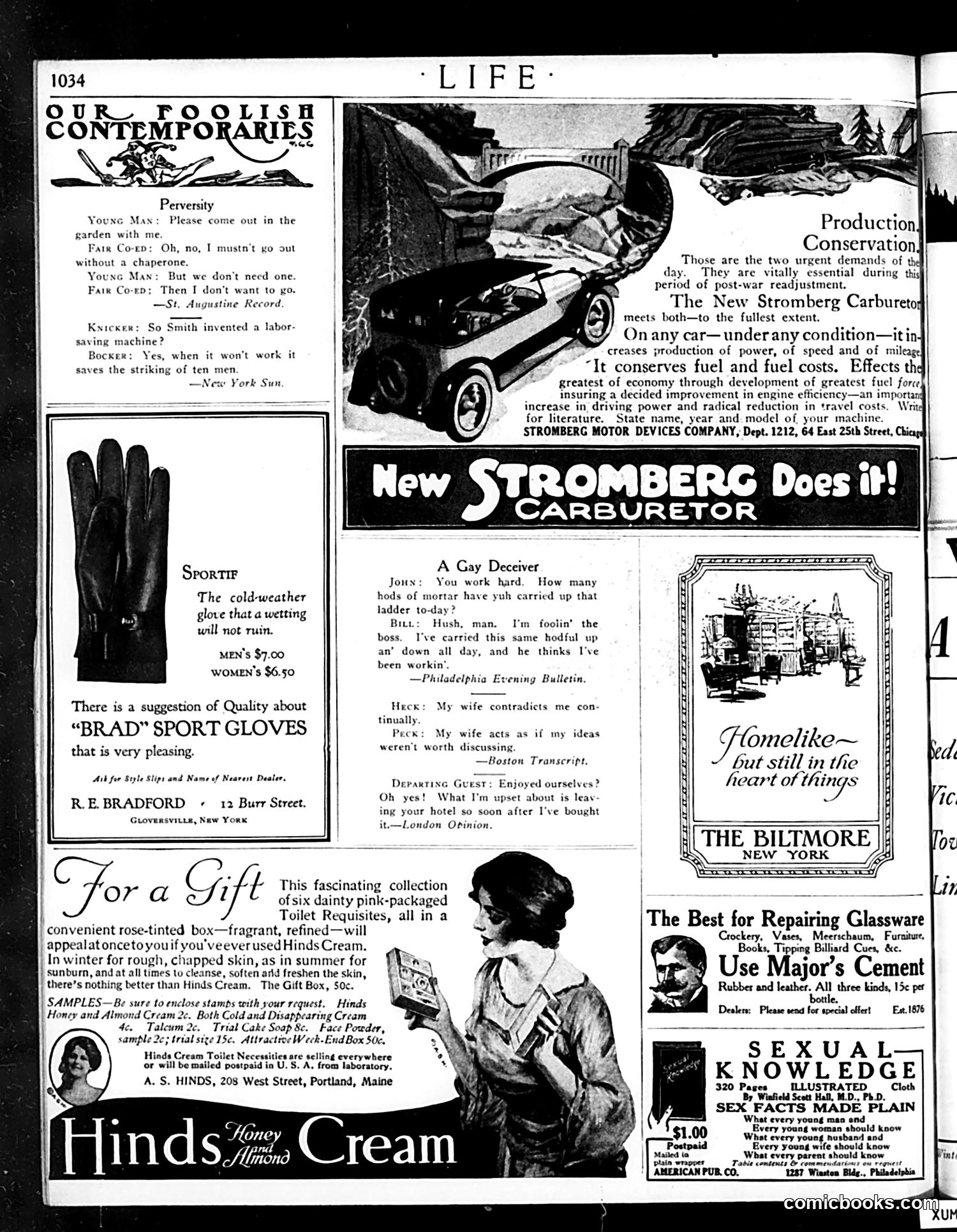
This is primarily an **advertising page** with minimal editorial content. The few jokes present satirize social conventions: The "Perversity" cartoon mocks dating etiquette—a young woman refuses to go to the garden *with* a chaperone (proper), but also refuses *without* one (improper), creating an absurd double-bind. The humor targets the rigid, contradictory expectations placed on women's behavior. A second short joke ridicules a laborer's deception: he carries a hod of mortar up and down repeatedly to fool his boss into thinking he's working hard. This satirizes workplace dishonesty and worker-management relations. The page is dominated by period advertisements for **Stromberg carburetors, Brad sport gloves, Hinds Cream, Major's Cement, and a "Sexual Knowledge" book**—typical early 20th-century commercial offerings. No identifiable political cartoons or caricatures appear.
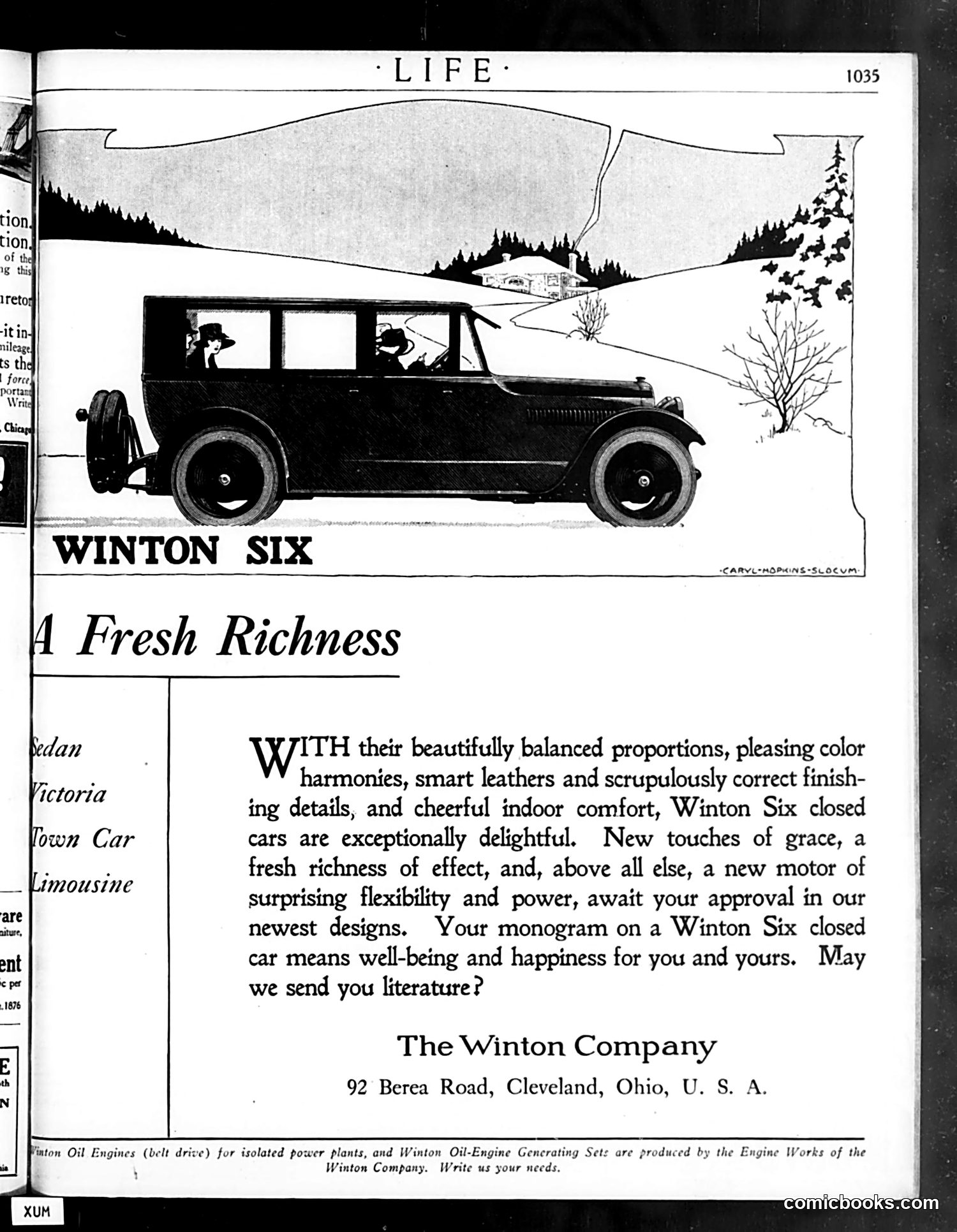
This is primarily an **automobile advertisement**, not a political cartoon. It promotes the Winton Six, a closed-body car manufactured in Cleveland, Ohio. The illustration by Caryl Forsythe Slocum shows a side-profile drawing of the vehicle in a winter landscape, with two passengers visible through the windows. The ad emphasizes luxury features: "beautifully balanced proportions," smart leather interiors, and a powerful motor with "surprising flexibility." The phrase about a "monogram on a Winton Six" references the affluent buyer's desire for personalization and status signaling—owning this car signals "well-being and happiness." The sidebar lists body styles: Sedan, Victoria, Town Car, and Limousine—indicating this was a line of high-end vehicles targeting wealthy consumers. **There is no satire here.** This is a straightforward commercial pitch from the pre-1930s automotive era, when closed cars (as opposed to open touring cars) were still considered luxuries and status symbols.
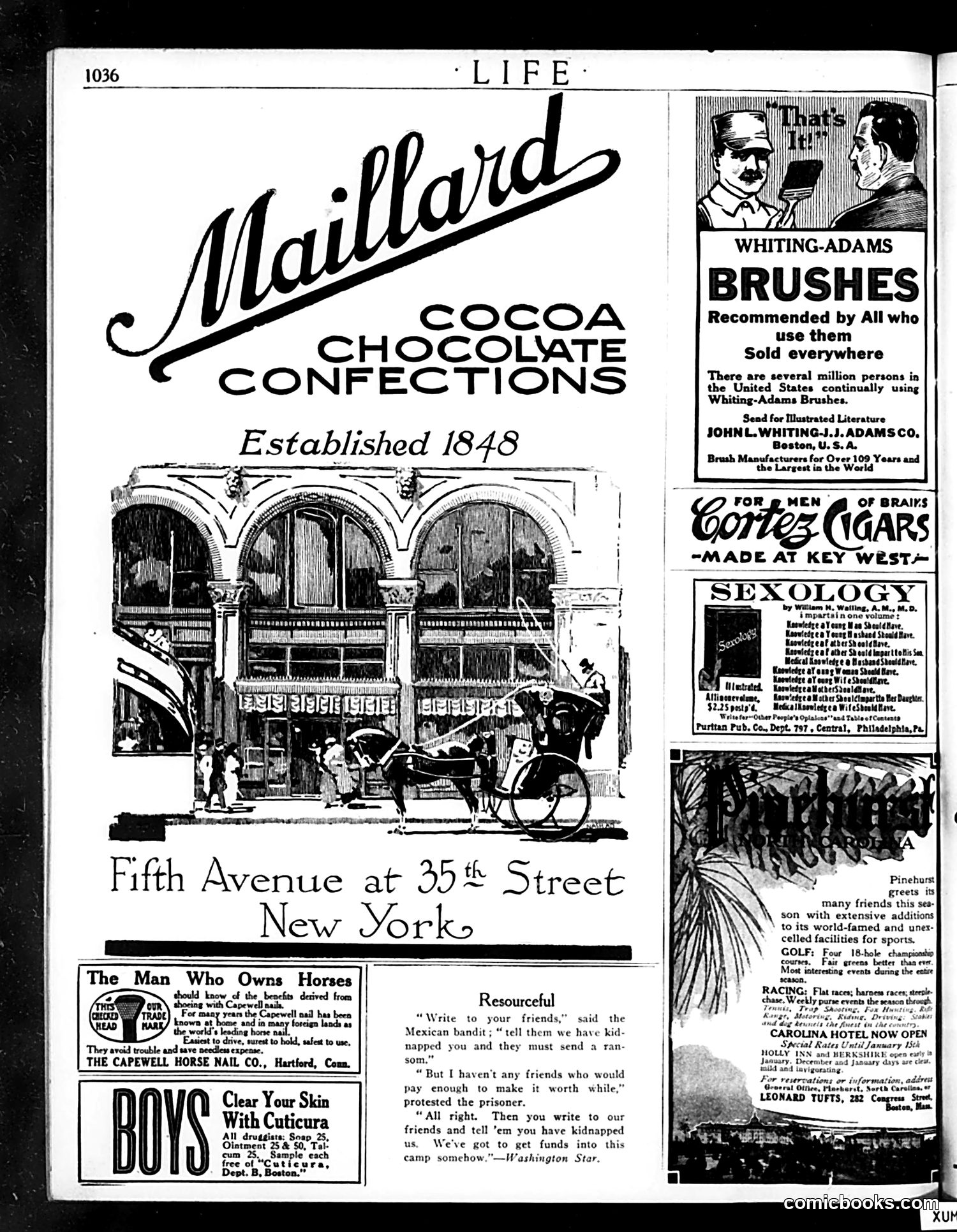
This page is primarily **advertising and filler content** rather than political satire. The dominant feature is a Maillard chocolate confections advertisement showing an elegant storefront at Fifth Avenue and 35th Street in New York, established 1848. The only substantial editorial content is a brief **humorous anecdote** titled "Resourceful" from the Washington Star. It depicts a Mexican bandit's predicament: unable to ransom a kidnapped prisoner who claims to have no wealthy friends, the bandit proposes the prisoner write to *his* friends claiming *they* have been kidnapped, to extract funds. The joke trades on absurdist logic and the prisoner's resourcefulness in turning the tables through deception. The surrounding advertisements cover horses, skincare, brushes, cigars, and a sexology book—typical early 20th-century magazine copy with no apparent political messaging.
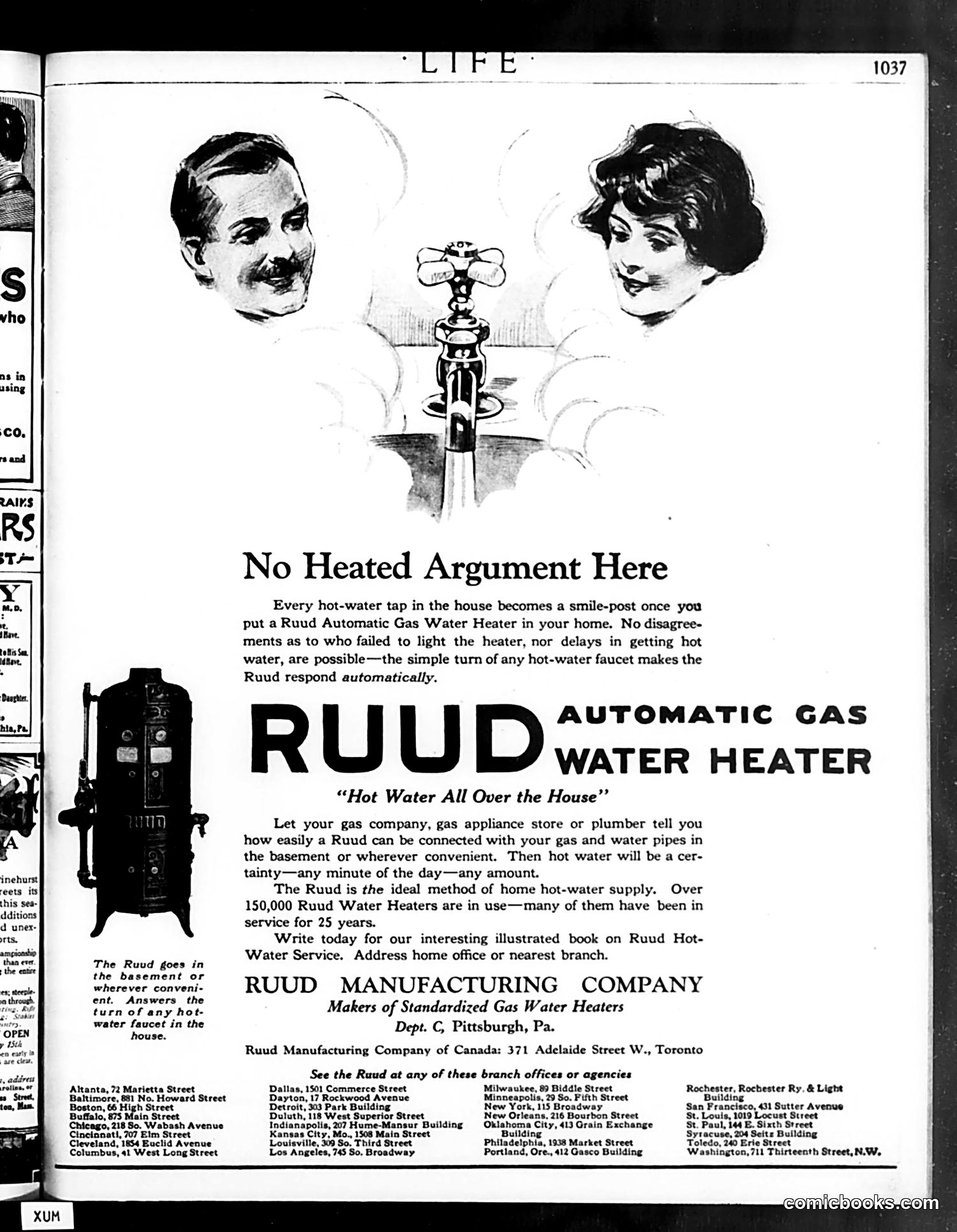
This is primarily a **product advertisement** for Ruud Automatic Gas Water Heaters, not political satire. The cartoon at top uses humor to sell the product: two illustrated faces (a man with a mustache and a woman) flank a gas water heater with steam rising from it. The caption "No Heated Argument Here" is a pun—it promises that installing a Ruud eliminates domestic disputes over who forgot to light the water heater or complaints about waiting for hot water. The joke relies on period assumptions about household friction: apparently, families commonly argued about heating water manually. The ad promises automatic operation eliminates these quarrels, making everyone "smile." The remainder is standard advertising copy claiming 150,000 units in use, ease of installation, and listing branch offices nationwide. This appears to be from an era (likely early 20th century based on typography and technology) when such appliances were luxury conveniences requiring explanation to consumers.
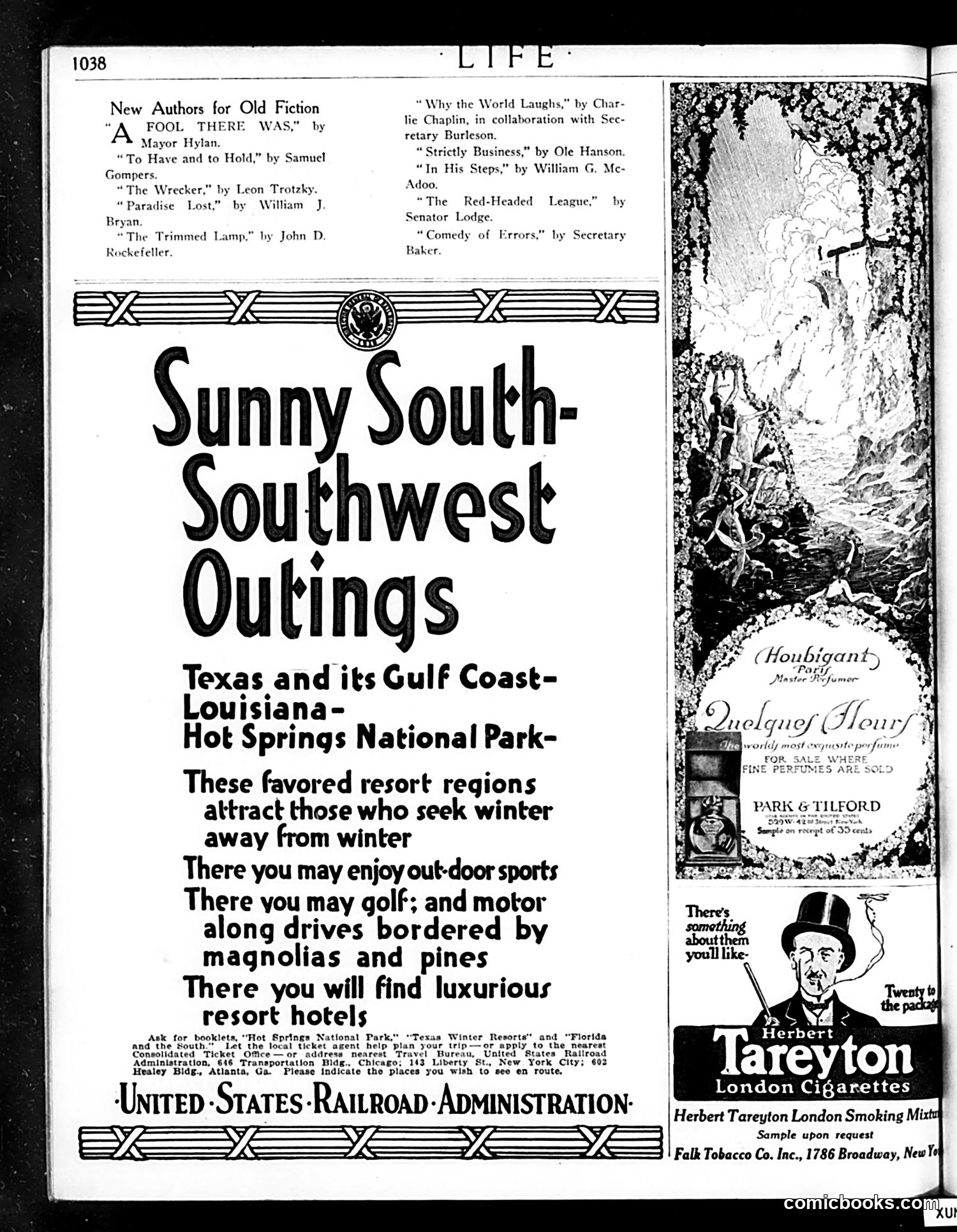
This 1920s *Life* magazine feature satirizes prominent political and labor figures by assigning them famous literary titles—a joke about their public personas matching fictional archetypes. **The targets include:** - **Mayor Hylan** ("A Fool There Was")—New York's mayor, mocked as foolish - **Samuel Gompers** ("To Have and to Hold")—labor leader - **Leon Trotsky** ("The Wrecker")—the Russian revolutionary, sarcastically labeled a destructive force - **William Jennings Bryan** ("Paradise Lost")—three-time failed presidential candidate - **John D. Rockefeller** ("The Trimmed Lamp")—the oil magnate The joke equates these public figures with literary character types, suggesting their real-world actions mirror fictional narratives. The satire is particularly sharp regarding Trotsky, reflecting American anti-Bolshevik sentiment during the Red Scare period. The rest of the page contains standard travel advertising for Southern resort destinations—unrelated to the satire.
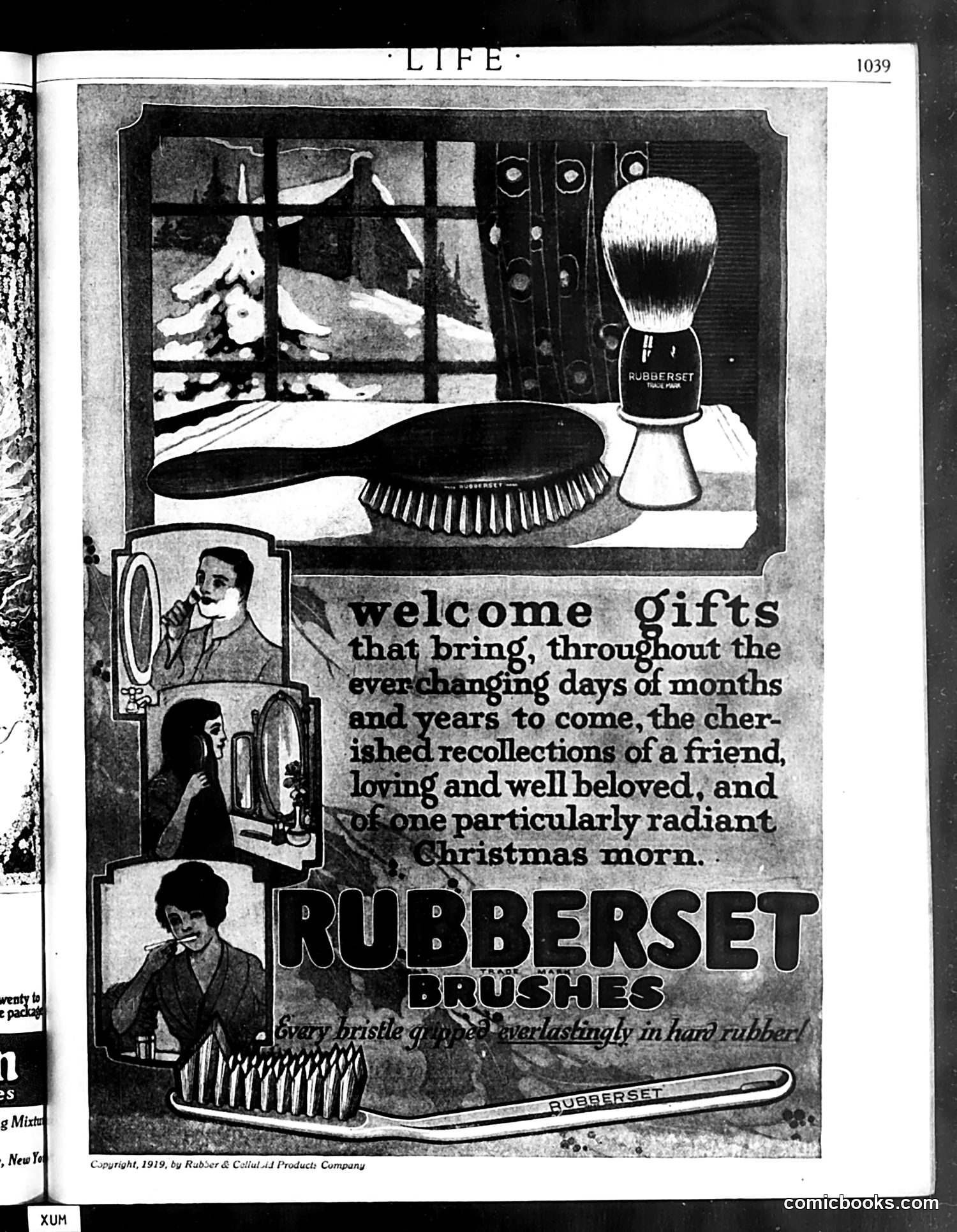
This is a 1919 advertisement for Rubberset Brushes, not political satire. The ad frames grooming tools as ideal gifts—positioning a shaving brush and hair brush as items that create "cherished recollections of a friend, loving and well beloved" over time. The imagery shows a domestic morning scene with someone at a mirror, establishing brushes as intimate, daily-use items. The copy emphasizes durability ("everlastingly in hard rubber"), suggesting these practical gifts endure like fond memories. This reflects early 20th-century marketing strategy: transforming utilitarian objects into sentimental gifts by appealing to emotion and nostalgia. The "radiant Christmas morn" reference targets holiday shopping, a growing consumer practice of the era.
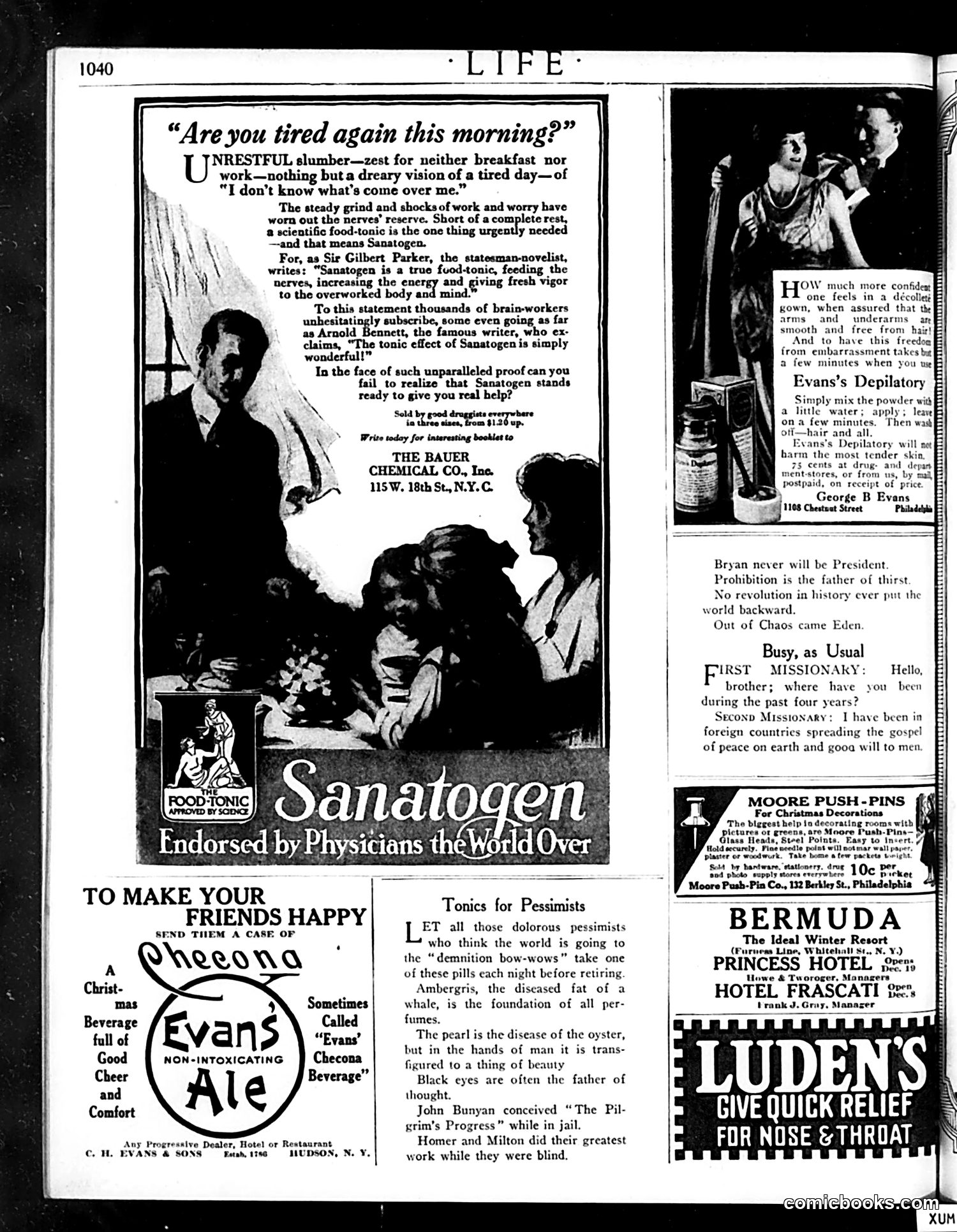
This page primarily consists of **advertisements**, not political cartoons. The dominant image advertises **Sanatogen**, a patent medicine marketed as a nerve tonic for fatigue and overwork. It features testimonials from Sir Gilbert Parker and Arnold Bennett claiming the product restores vigor—typical pseudoscientific marketing of the era. The small text snippets labeled "Tonics for Pessimists" and "Busy, as Usual" are humorous aphorisms rather than satirical cartoons. They offer cynical observations (e.g., "Prohibition is the father of thirst") and joke exchanges between missionaries—light humor reflecting post-WWI social commentary. Other ads promote Evans's Depilatory (hair removal), Hecona Ale, Moore Push-Pins, and Luden's throat lozenges—all period consumer products. **For modern readers**: This illustrates how early 20th-century magazines mixed editorial content with dubious health claims, predating FDA regulation of pharmaceuticals.
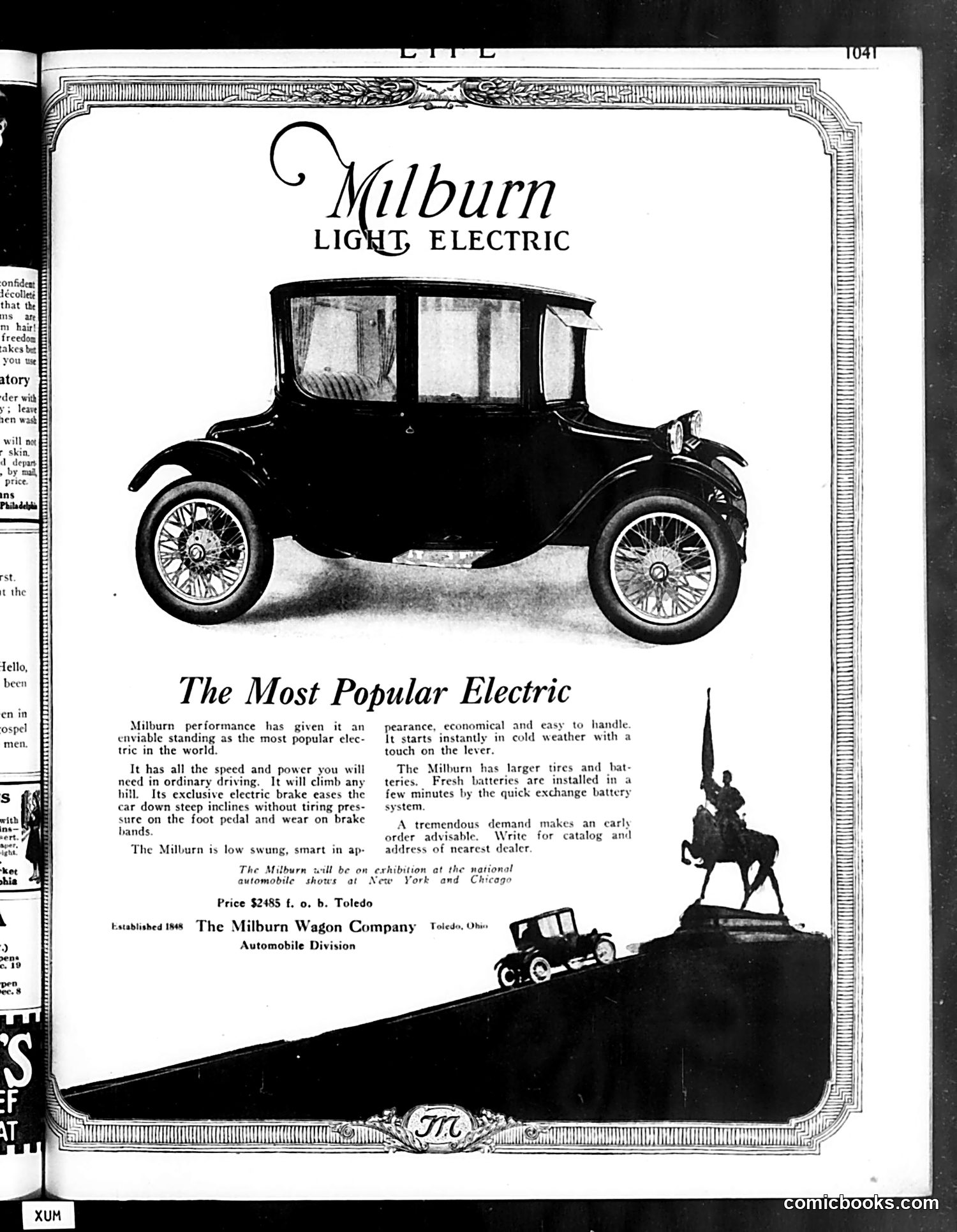
This is a **straightforward automobile advertisement**, not political satire or a cartoon. It promotes the Milburn Light Electric car, manufactured by the Milburn Wagon Company of Toledo, Ohio. **Key content for modern readers:** - Electric vehicles were a viable commercial product in this era (pre-1920s), competing with gasoline automobiles - The ad emphasizes practical advantages: instant cold-weather starting, hill-climbing ability, electric brakes, and a battery-exchange system for convenience - Price of $2,485 (substantial for the period) - The decorative imagery—a small Milburn car and equestrian statue on a hill—suggests technological progress replacing traditional horse transportation - This represents a historical moment when electric cars were mainstream options before gasoline engines dominated the market The page is primarily **advertising copy with no satirical intent**. It's a genuine promotional document from Life magazine's commercial section, illustrating that electric vehicles were once a serious automotive alternative.
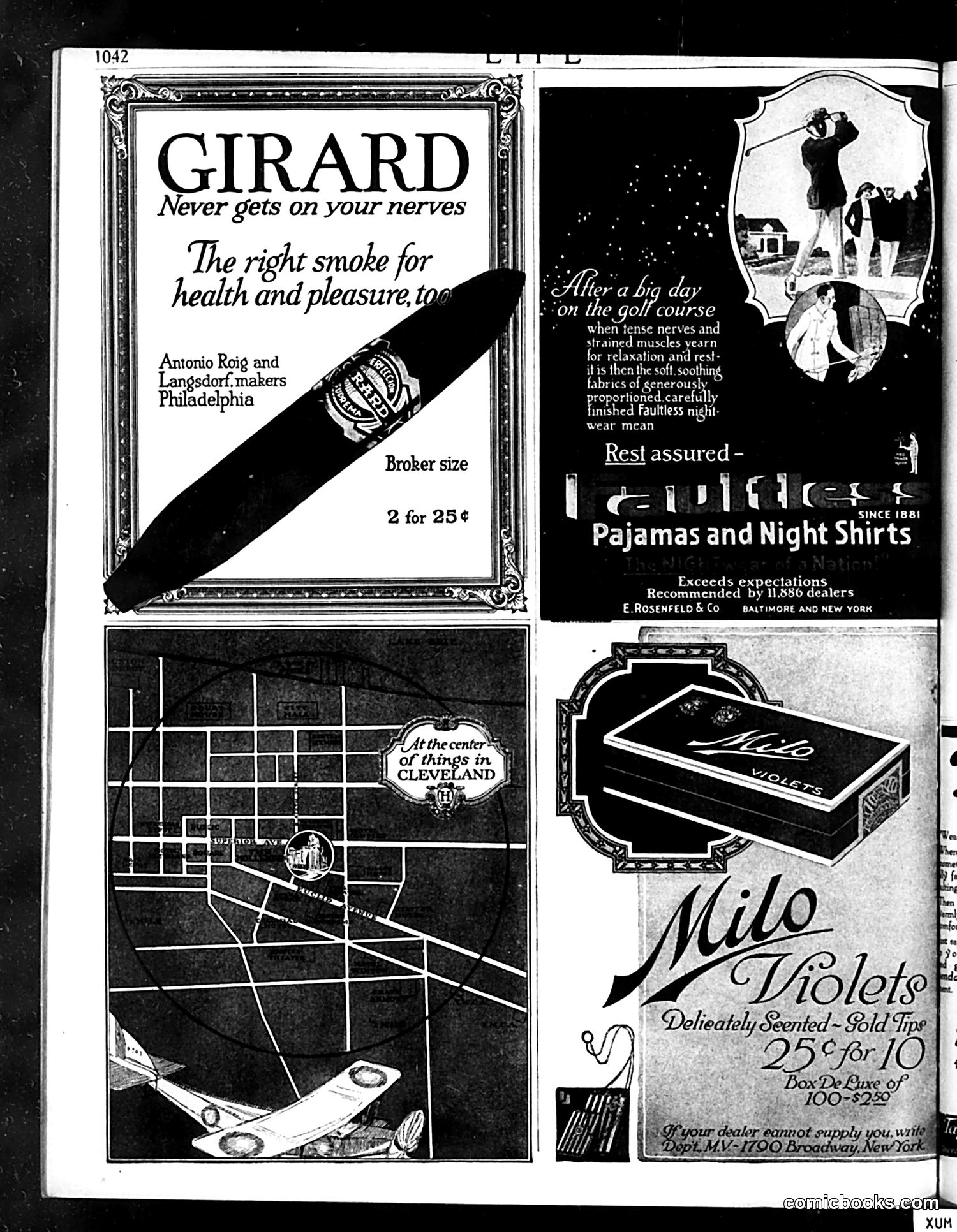
This page is **primarily advertisements**, not political satire or editorial cartoons. The visible ads include: 1. **Girard cigars** (top left): Claims the smoke "never gets on your nerves" and is "the right smoke for health and pleasure"—typical early 20th-century health claims for tobacco products that would be illegal today. 2. **Ividies pajamas** (top right): Markets sleepwear for "rest assured" after a tiring day, with illustrations of golfers relaxing. 3. **Milo Violets** (bottom right): Scented cigarettes/cigars at 25¢. 4. **A Cleveland map** (bottom left): Appears to be a location advertisement. The page reflects early 1900s consumer culture and marketing conventions—notably the now-shocking health claims made for tobacco products. There is no discernible political cartoon or satire present on this page.
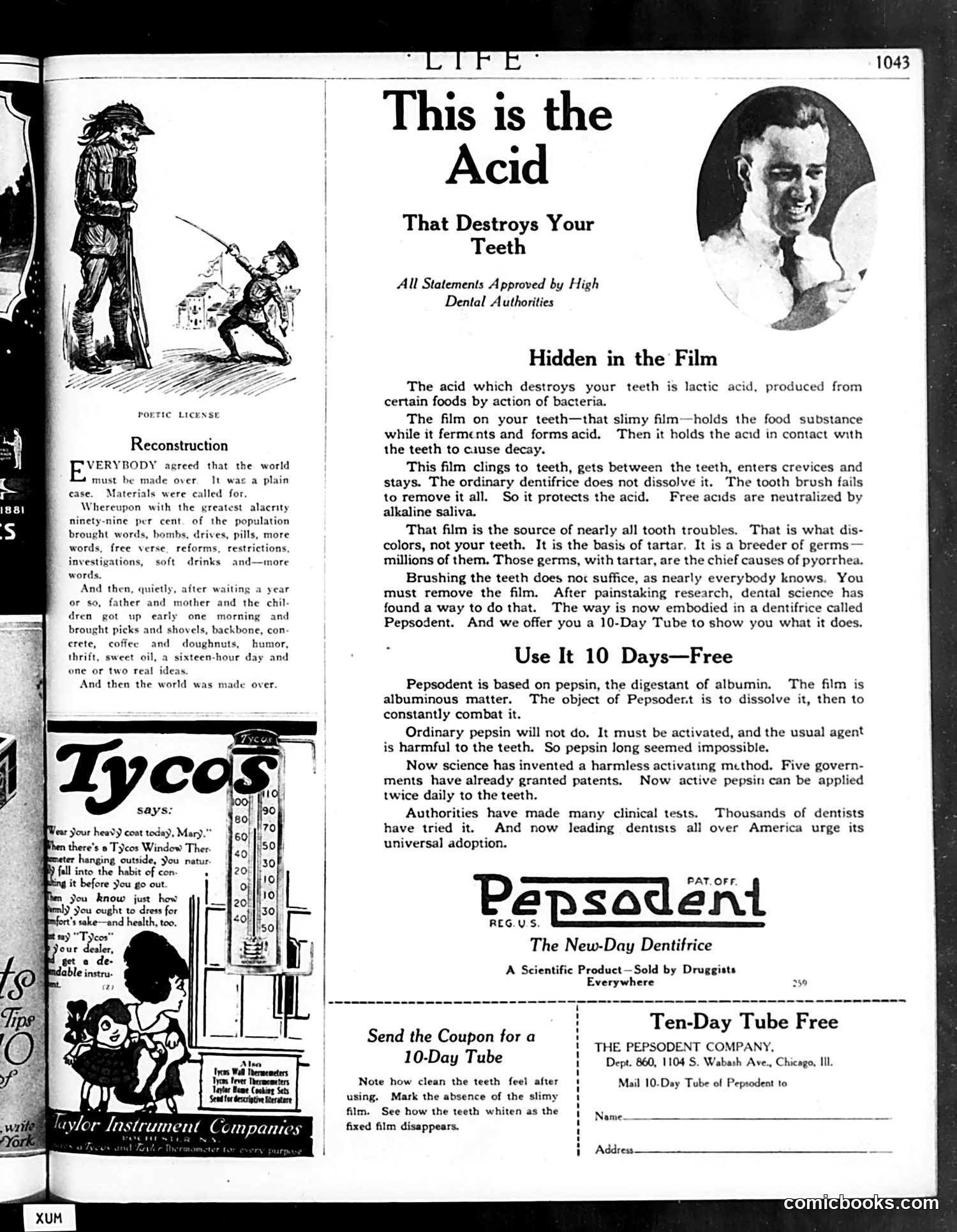
**The Cartoon "Poetic License: Reconstruction"** (left side) satirizes post-WWI idealism. It depicts a tall figure (likely representing politicians or intellectuals) speaking grandly while a small child listens. The poem contrasts empty rhetoric—ninety-nine percent of people offering "words, bombs, drives, pills...reforms...investigations"—with actual progress requiring humble, concrete labor: "picks and shovels, backbone...coffee and doughnuts, humor, thrift." The satire targets the disconnect between grand post-war talk of remaking the world and the unglamorous practical work actually needed for reconstruction. It's a cynical jab at idealists promising transformation through words alone. **The rest of the page** is primarily a Pepsodent toothpaste advertisement claiming scientific validation for removing tooth film through pepsin-based dentifrice. While advertising dominates, the "Poetic License" cartoon remains the editorial content offering social commentary on post-war American culture and politics.
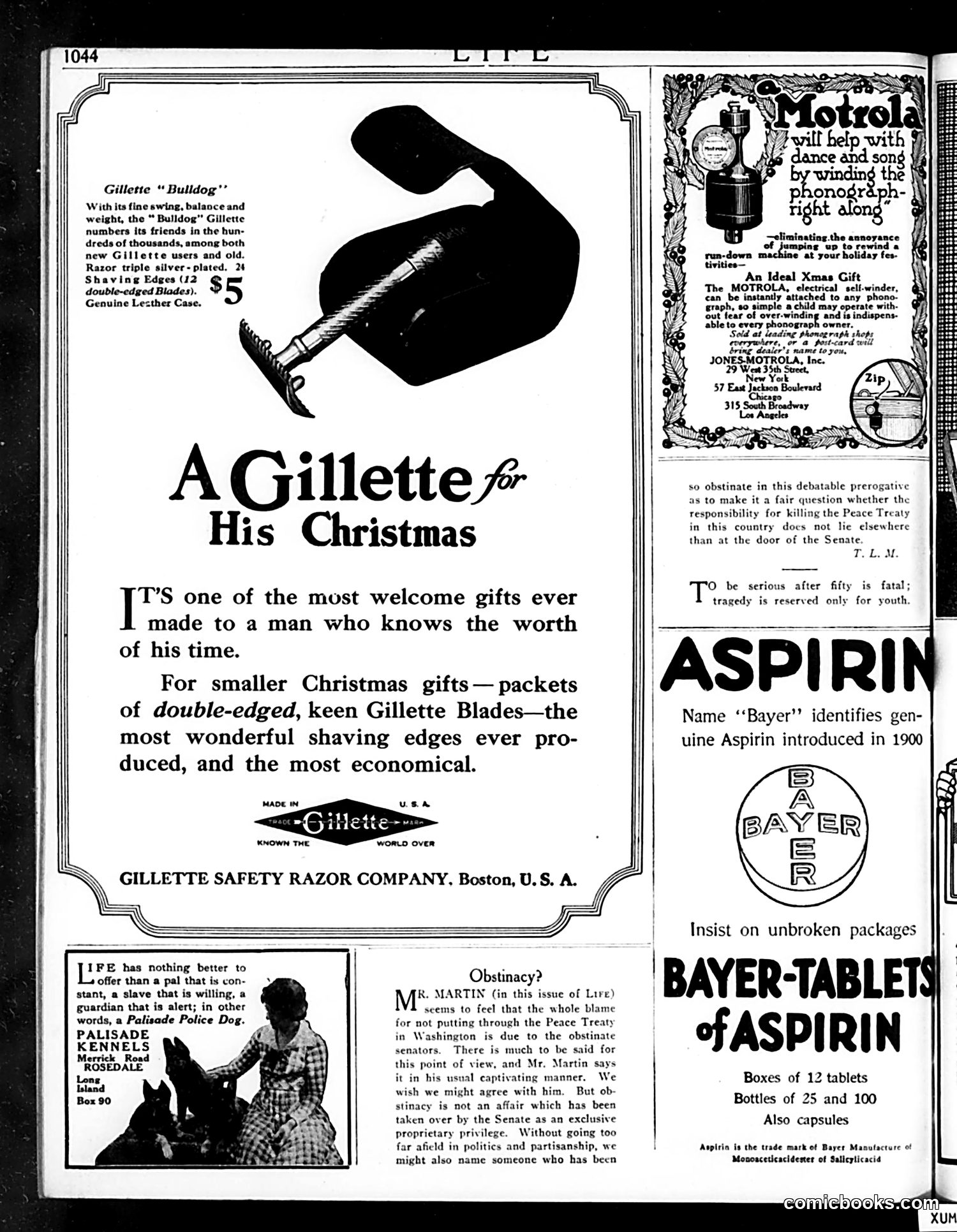
This page is primarily advertisements, but includes editorial commentary on a contemporary political controversy. The text by "T.L.M." responds to an article by Mr. Martin about obstruction of the Peace Treaty (likely the Treaty of Versailles following World War I). Martin apparently blamed obstructionist **senators** for blocking ratification. The editor counters that obstinacy isn't the Senate's exclusive problem—**someone else** has been equally stubborn about the treaty. The phrasing suggests this refers to **President Woodrow Wilson**, who famously refused compromises with Senate Republicans led by Henry Cabot Lodge, ultimately causing the treaty's defeat in the Senate. The subtle jab: both sides bear responsibility for killing the treaty, not just Senate "obstinacy" as Martin claimed. The remainder consists of Christmas gift advertisements for Gillette razors, dog kennels, a phonograph winder (Motrola), and Bayer Aspirin—typical 1920s commercial content.
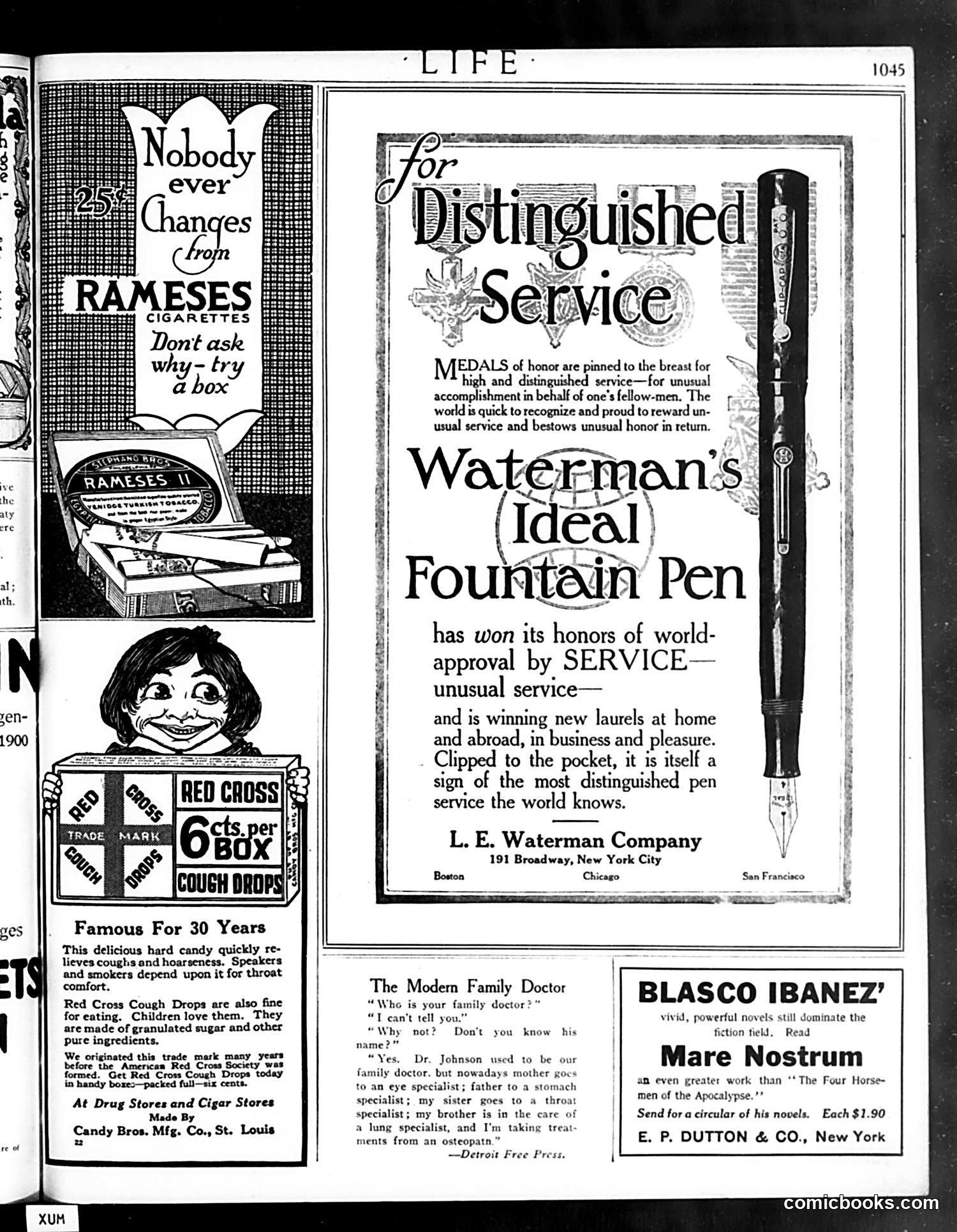
This is primarily an **advertising page** from Life magazine, circa 1900s-1910s, containing four commercial advertisements with minimal satirical content. The page features ads for: 1. **Rameses Cigarettes** — emphasizing brand consistency ("Nobody ever changes") 2. **Red Cross Cough Drops** — marketed for throat relief, candy consumption, and children 3. **Waterman's Ideal Fountain Pen** — using military medal imagery to suggest the pen's "distinguished service" 4. **Blasco Ibáñez novels** — promoting his literary work The only humor appears in **"The Modern Family Doctor"** anecdote (center), which satirizes **medical specialization**. The joke: rather than having one family doctor, modern Americans now consult separate specialists (eye, stomach, throat, lung doctors, and an osteopath) for different ailments—suggesting contemporary over-specialization had fragmented traditional healthcare. The page reflects early 20th-century consumer culture and advertising trends rather than political satire.
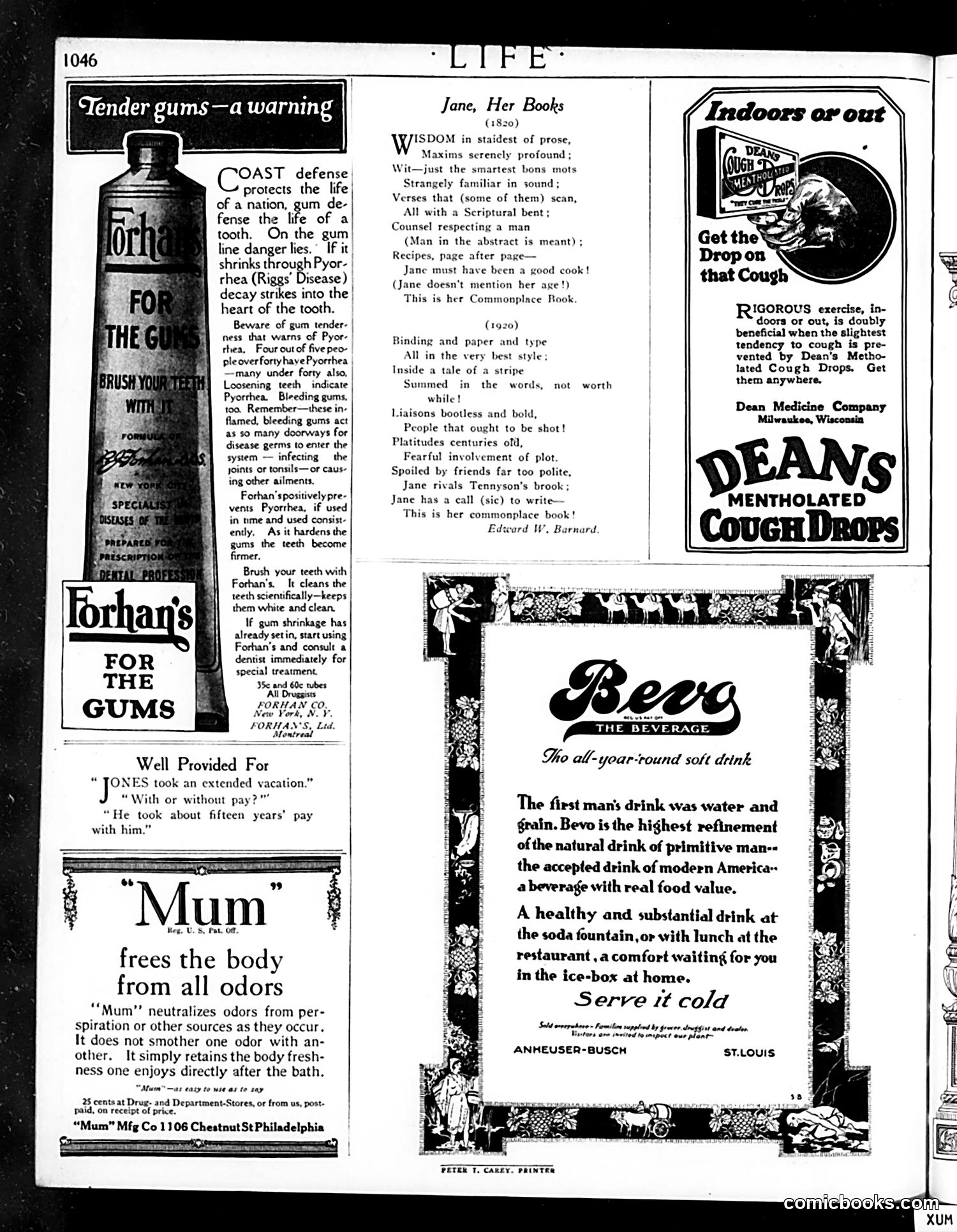
This page is primarily **advertisements and light verse**, not political satire. **Main content:** - A poem titled "Jane, Her Books" by Edward W. Barnard contrasts Jane Austen's 1820 commonplace book (filled with wisdom, recipes, and counsel) with a 1920s equivalent (modern, frivolous, populated by unworthy people and plots). The satire gently mocks contemporary literature's decline in substance. **Advertisements include:** - **Forhan's** toothpaste (warns of pyorrhea/gum disease—a genuine health concern of the era) - **"Mum"** deodorant (neutralizes body odor) - **Dean's Mentholated Cough Drops** and **Bevo** (a non-alcoholic beverage, likely promoted due to Prohibition) The page reflects 1920s anxieties about modern culture's superficiality and period-appropriate health and hygiene marketing.
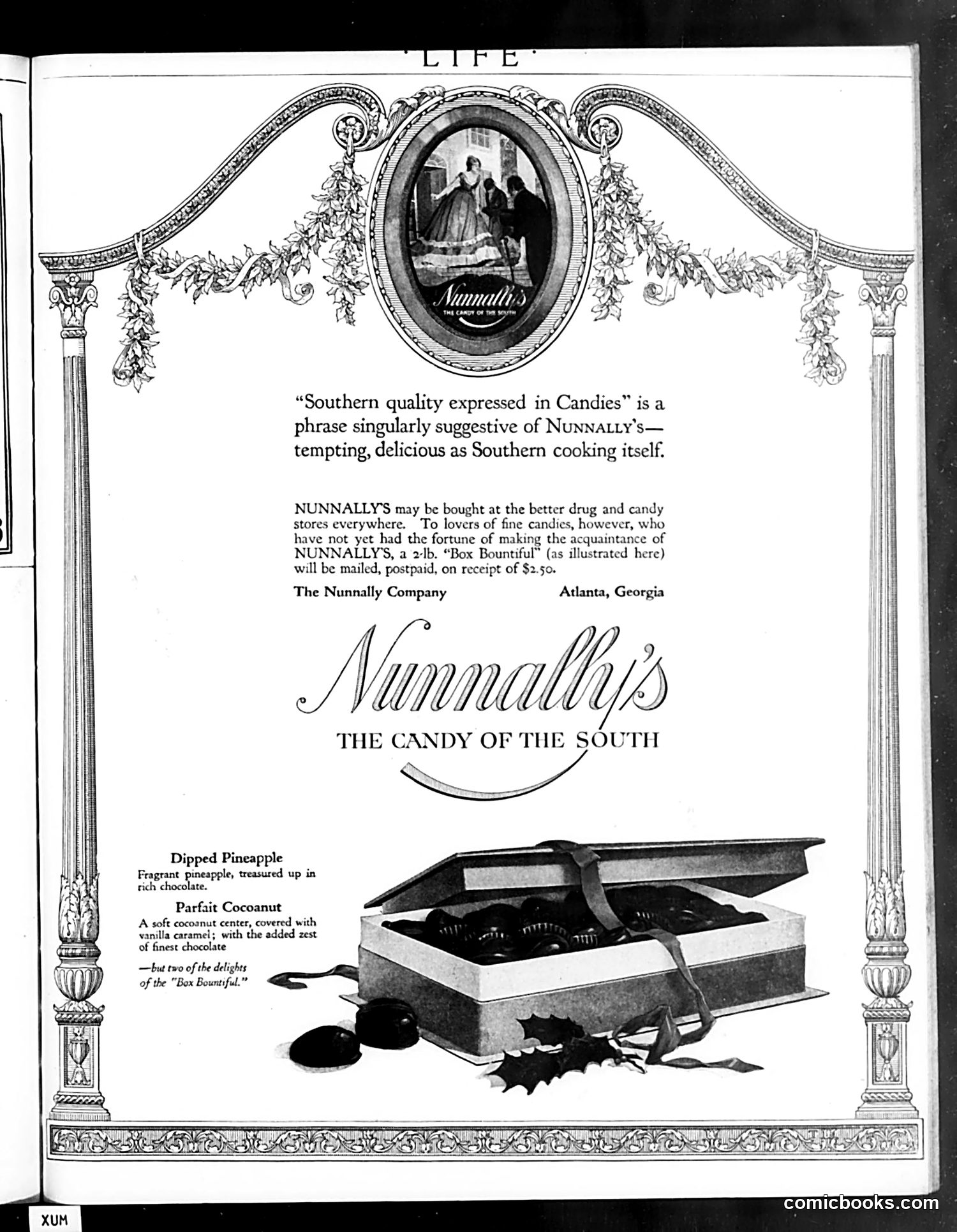
This is a **product advertisement**, not political satire. It promotes Nunnally's candies, a Southern confectionery brand from Atlanta, Georgia. The page uses decorative classical framing (ornamental columns, garlands) to suggest elegance and quality. The central oval vignette depicts what appears to be a Southern domestic or social scene, reinforcing the brand's "Southern quality" positioning. The ad emphasizes two specific candies: Dipped Pineapple and Parfait Cocoanut, describing them in luxurious language ("treasured," "finest chocolate"). The "$2.50 'Box Bountiful'" mail-order offer targets affluent consumers who can afford premium confections. This reflects early 20th-century marketing that leveraged Southern regionalism as a marker of refinement and tradition—positioning Southern-made goods as desirable luxury items to a national audience.
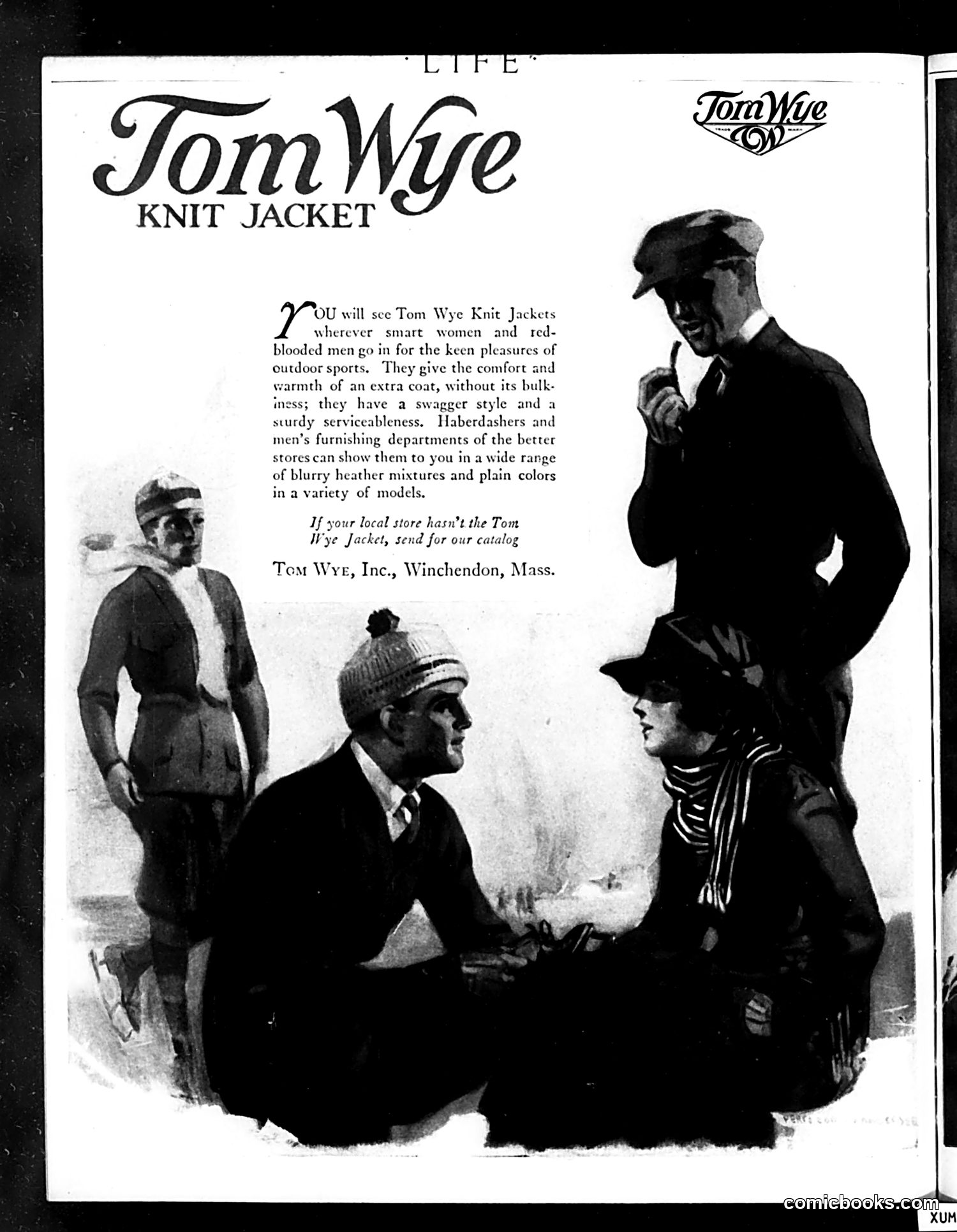
This is a straightforward **product advertisement**, not political satire. It promotes Tom Wye brand knit jackets manufactured in Winchendon, Massachusetts. The page features four illustrated figures wearing the jacket in outdoor/sporting contexts—reflecting the product's marketing as suitable for "smart women and red-blooded men" engaged in outdoor activities. The ad emphasizes practical benefits: warmth without bulk, stylish appearance ("swagger style"), and durability ("sturdy serviceableness"). The language and imagery are typical of early 20th-century advertising, using aspirational appeals to attract consumers. There is no satirical commentary or political content visible on this page—it's purely commercial promotion appearing in Life magazine's advertising section.
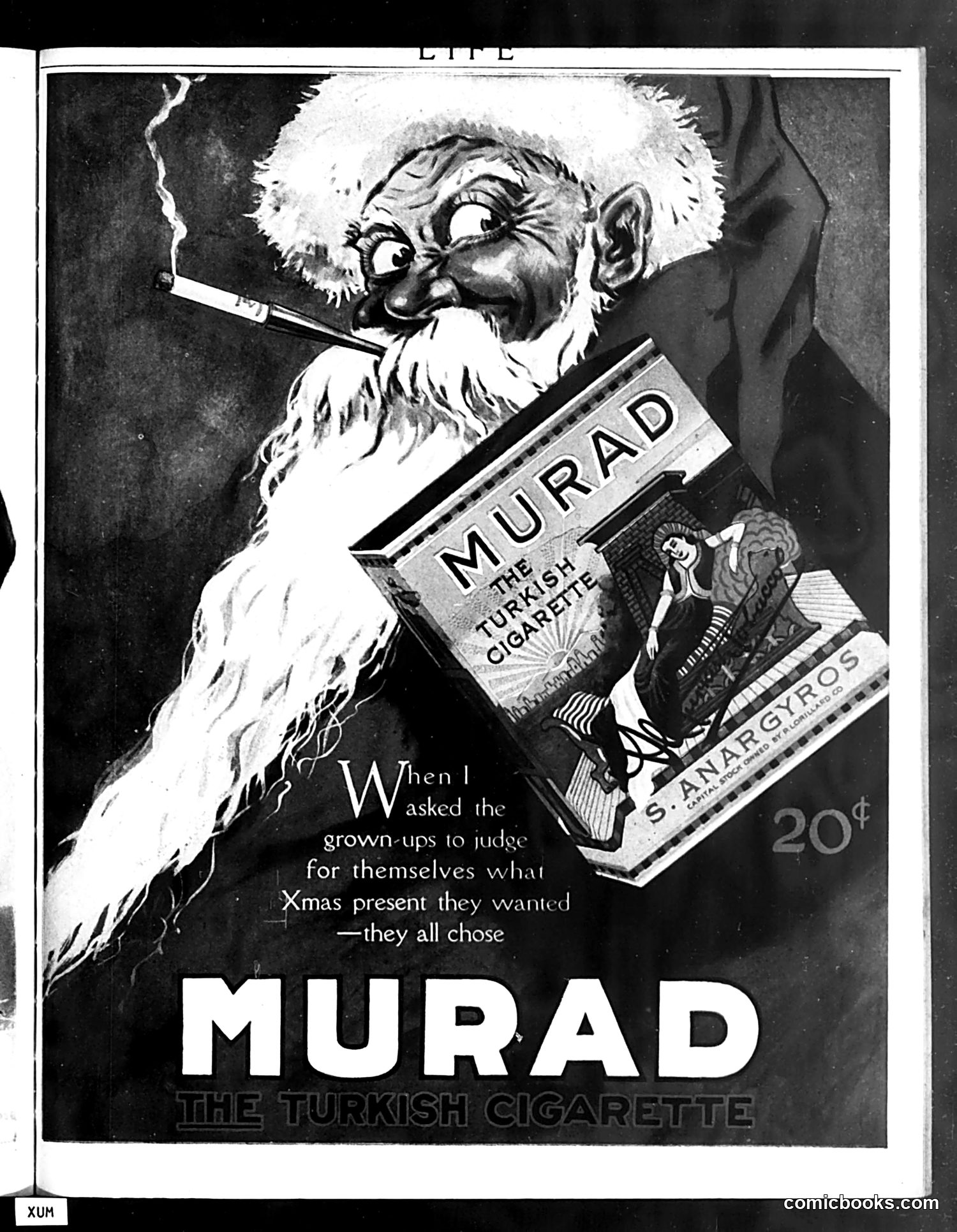
This is a **cigarette advertisement**, not political satire. It depicts Santa Claus holding Murad Turkish cigarettes and S. Anargyros brand cigarettes, smoking a cigar. The tagline claims that when adults were asked what Christmas present they wanted, "they all chose MURAD." The joke relies on the appeal of luxury cigarettes as an aspirational gift for grown men during the early 20th century. The exaggerated, grotesque Santa face and the explicit mention of "grown-ups" framing cigarettes as desirable gifts reflects an era when tobacco advertising directly targeted adults without the health warnings or restrictions that would later emerge. This represents a now-obsolete marketing approach to luxury consumer goods.
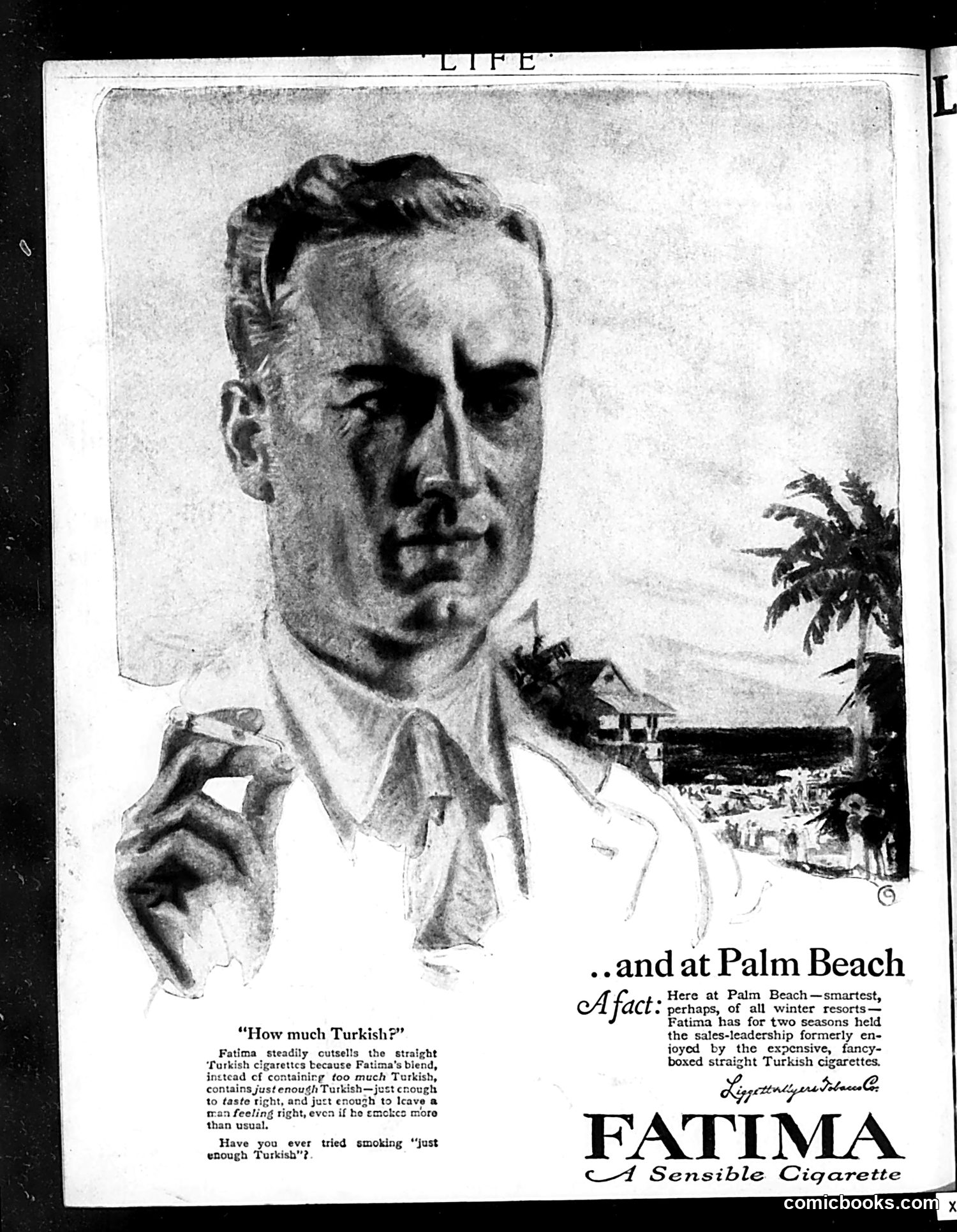
This is a **cigarette advertisement** for Fatima brand, not political satire. The page uses a portrait of an unnamed man in formal attire alongside advertising copy. The ad's central claim is about product differentiation: Fatima cigarettes contain "just enough Turkish" tobacco—not too much—to provide flavor without excess. This targets consumers skeptical of heavily Turkish-blended cigarettes, positioning Fatima as a "sensible" middle option. The secondary pitch emphasizes that Fatima achieved top sales at Palm Beach (a luxury resort) for two consecutive seasons, beating more expensive competitors with fancy packaging. The message: quality and value triumph over pretension. The phrase "How much Turkish?" appears rhetorical—implying savvy smokers ask this question when choosing cigarettes. The overall approach uses pseudo-scientific marketing language typical of early 20th-century tobacco advertising to suggest rational consumer choice.