
Life, 1919-12-18 · page 32 of 56
Life — December 18, 1919 — page 32: what you’re looking at
What you’re looking at
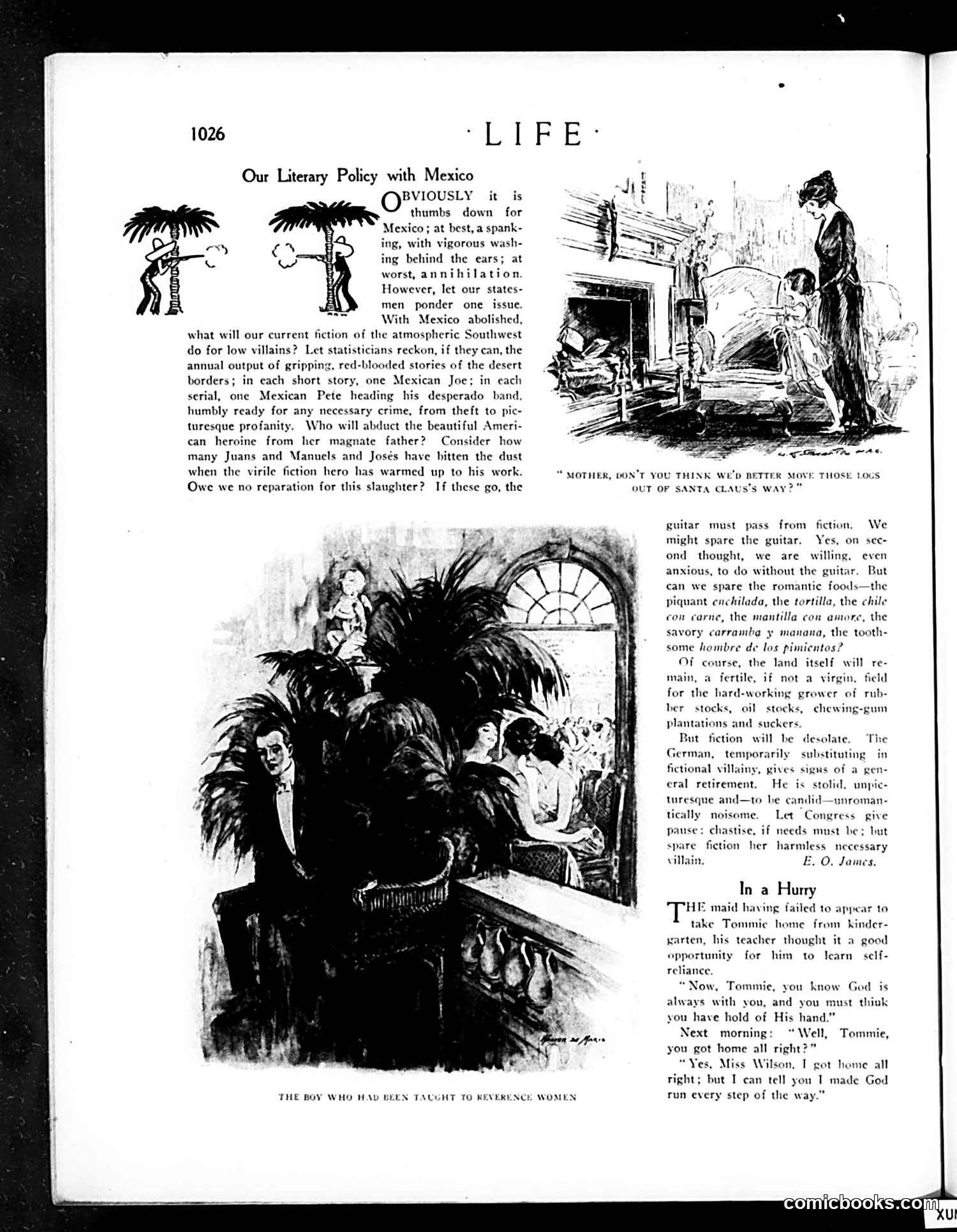
This Life magazine page satirizes American attitudes toward Mexico through two distinct pieces: **"Our Literary Policy with Mexico"** (top): The essay mocks the entertainment industry's reliance on Mexican villains in popular fiction. It notes that American Southwest stories depend on stock characters—Mexican Joes and Petes as desperados and abductors—to provide villainous plots. The satire points out that if Mexico were eliminated (a contemporary political suggestion), American fiction would lose its convenient racial villains, romantic tropes (enchiladas, guitars), and the entire genre would collapse. The author ironically argues Congress should "spare" Mexico—not for moral reasons, but because American storytelling needs Mexican stereotypes as plot devices. **"In a Hurry"** (bottom): A humor piece about a kindergarten teacher telling young Tommie that God will guide him home. The joke: the boy reports he made "God run every step of the way"—reversing the metaphor to suggest divine exhaustion keeping pace with a energetic child. The cartoons at top show caricatured Mexican figures with exaggerated features typical of period racism.
📄 Transcribed text from this page (OCR, searchable)
Machine-transcribed from the original scan — historical spelling and the odd misread are preserved.
“LIF E° Our Literary Policy with Mexico BVIOUSLY it is thumbs down for Mexico; at best, a spank- cy ing, with vigorous wash- Seas ing behind the ears; at worst, annihilation. However, let our states- men ponder one issue. One With Mexico abolished, what will our current fiction of the atmospheric Southwest do for low villains? Let statisticians reckon, if they can, the annual output of gripping, red-blooded stories of the desert borders; in each short story, one Mexican Joe; in each serial, one Mexican Pete heading his desperado band, humbly ready for any necessary crime, from theft to pic turesque profanity. Who will abduct the beautiful Ameri- can heroine from her magnate father? Consider how many Juans and Manuels and Josés have bitten the dust when the virile fiction hero has warmed up to his work. Owe we no reparation for this slaughter? If these go, the guitar must pass from fiction. We might spare the guitar. Yes, on sec- ond thought, we are willing, even anxious, to do without the guitar. But can we spare the romantic foods—the piquant enchilada, the tortilla, the chile con carne, the mantilla con amore, the savory carramba y manana, the tooth- some hombre de los pimientos? OF course, the land itself will re- ma a fertile, if not a virgin, field for the hard-working grower of rub- her stocks, oil stocks, chewing-gum plantations and suckers. But fiction will be desolate. The German, temporarily substituting in fictional villainy, gives signs of a gen- eral retirement. He is stolid, unpic- turesque and—to be candid—unroman- tically noisome. Let Congress give pause: chastise, if needs must be; but spare fiction her harmless necessary villain, E. O. James. In a Hurry HE maid having failed to appear to take Tommie home from kinder- xarten, his teacher thought it a good opportunity for him to learn self- reliance. “Now, Tommie, you know God is always with you, and you must think you have hold of His hand.” Next morning: “Well, Tommie, you got home all right?” “Yes, Miss Wilson, I got home all right; but I can tell you I made God THE BOY WHO HAD BEEN TAUGHT TO REVERENCE WOMEN run every step of the way.”