
Life, 1919-12-18 · page 30 of 56
Life — December 18, 1919 — page 30: what you’re looking at
What you’re looking at
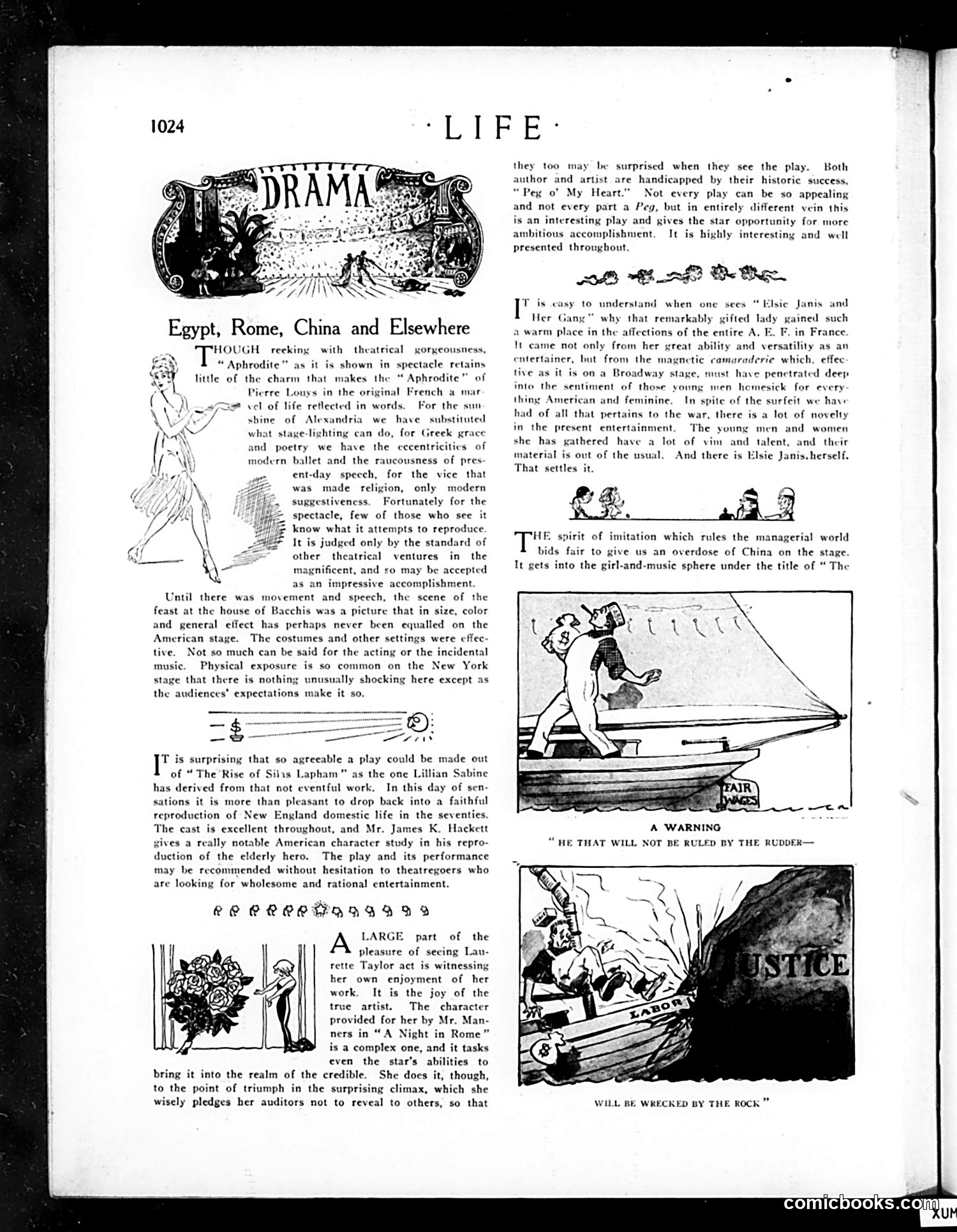
This page from *Life* magazine reviews several Broadway productions. The main theatrical reviews discuss "Aphrodite" (a spectacle adaptation of Pierre Louys's novel), "Elsie Janis and Her Gang" (a wartime entertainment featuring a popular female entertainer who performed for American troops in France during WWI), "The Rise of Silas Lapham," and "A Night in Rome." The two cartoons on the right—titled "A Warning" and depicting a boat labeled "Justice"—appear to be political commentary warning that those refusing to follow proper governance ("ruled by the rudder") will be "wrecked by the rock." This likely references post-WWI anxieties about social order and governance. The reviews praise spectacle and star performances while noting that modern Broadway increasingly relies on physical exposure rather than substantive drama. The page reflects 1920s theatrical tastes and wartime cultural nostalgia.
📄 Transcribed text from this page (OCR, searchable)
Machine-transcribed from the original scan — historical spelling and the odd misread are preserved.
“LIFE™ they too may be surprised when they see the play. Both author and artist are handicapped by their historic success, “Pex o' My Heart.” Not every play can be so appealing and not every part a Peg, but in entirely different vein this is an interesting play and gives the star opportunity for more ambitious omplishment. It is highly interesting and well presented throughout. 0 ESS Be Shee [7 it s97 $2, understand when one sces “Elsie Janis and . Her Gang" why that remarkably gifted lady gained such Egypt, Rome, China and Elsewhere a warm place in the affections of the entire A. E. F. in France HOUGH reeking with theatrical gorgeousness, It €ame not only from her great ability and versatility as an “Aphrodite” as it is shown in spectacle retains (MEFtainer, but from the magnetic camaraderie which, effec little of the charm that makes the “Aphrodite” of — {8¢ as it is on a Broadway stage, must have penetrated dev into the sentiment of those young men homesick for every thing American and feminine, In spite of the surfeit we have had of all that pertains to the war, there is a lot of novelty in the present entertainment, The young men and women she has gathered have a lot of vim and talent, and their Pierre Louys in the original French a mar = vel of life reflected in words. For the sun shine of Alexandria we have substituted what stage-lighting can do, for eek race and poetry we have the eccentricities of ; i modern ballet and the raucousness of pres: material is out of the usual. And there is Elsie J, herself. ent-day specch, for the vice that That settles it. was made religion, only modern suggestivencss. Fortunately for the spectacle, few of those who see it know what it attempts to reproduce. It is judged only by the standard of . Sthee theatHiGl veatares in, the s fair to give us an overdose of China on the stage anificent, and £o may be accepted It £¢tS into the girl-and-music sphere under the title of “ The as an impressive accomplishment. Until there was movement and speech, the scene of the feast at the house of Bacchis was a picture that in size, color and general effect has perhaps never been equalled on the American stage. The costumes and other settings were effec- tive. Not so much can be said for the acting or the incidental music. Physical exposure is so common on the New York stage that there is nothing unusually shocking here except as the audiences’ expectations make it so. rit of imitation which rules the managerial world T is surprising that so agreeable a play could be made out of “ The Rise of Silas Lapham” as the one Lillian Sabine has derived from that not eventful work, In this day of sen- sations it is more than pleasant to drop back into a faithful reproduction of New England domestic life in the seventies. The cast is excellent throughout, and Mr. James K. Hackett A WARNING gives a really notable American character study in his repro- “We THAT WILL NOT BE RULED BY THE RUDDER— duction of the elderly hero. The play and its performance may be recommended without hesitation to theatregoers who are looking for wholesome and rational entertainment. RE RRROHEZI9999 A LARGE part of the pleasure of seeing Lau- rette Taylor act is witnessing her own enjoyment of her work. It is the joy of the true artist. The character provided for her by Mr. Man- ners in “A Night in Rome” is a complex one, and it tasks even the star’s abilities to bring it into the realm of the credible, She does it, though, to the point of triumph in the surprising climax, which she wisely pledges her auditors not to reveal to others, so that WILL BE WRECKED BY THE ROCK Ccomicbooks.com|