
Life, 1919-12-18 · page 22 of 56
Life — December 18, 1919 — page 22: what you’re looking at
What you’re looking at
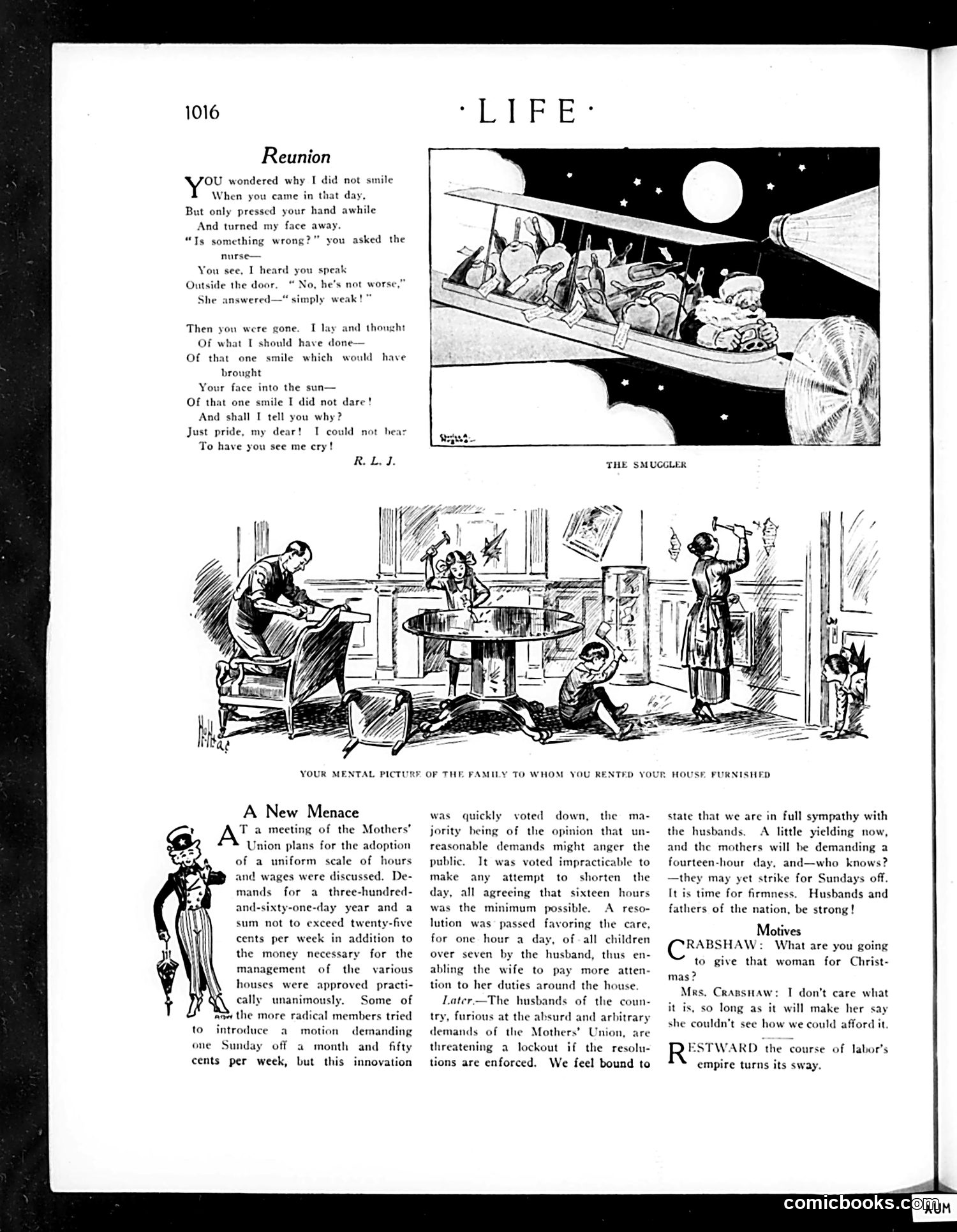
This Life magazine page satirizes early 20th-century labor and domestic disputes through three distinct pieces: **"Reunion"** (top left): A sentimental poem about emotional distance between lovers, unrelated to politics. **"The Smuggler"** (top right): An illustration depicting contraband being transported by boat at night—likely referencing Prohibition-era smuggling, a major social issue of the 1920s-30s. **"A New Menace"** (bottom): The main satire. The Mothers' Union demands housewives receive formal pay and limited work hours (16-hour days, minimal wages). The magazine mockingly opposes this, warning husbands that giving mothers "a little yielding now" will lead to escalating demands—even Sunday strikes. The satire cuts both ways: it ridicules both the absurdly exploitative conditions presented as reasonable ("sixteen hours minimum") and the wives' modest demands, implying that even basic labor protections for domestic workers seem threatening to men. The closing cartoon mocks gift-giving: a husband should give his wife something that makes her grateful for his financial support—reinforcing wives' economic dependence.
📄 Transcribed text from this page (OCR, searchable)
Machine-transcribed from the original scan — historical spelling and the odd misread are preserved.
1016 Reunion ‘OU wondered why I did not smile When you came in that day, But only pressed your hand awhile And turned my face away. “Is something wrong?" you asked the nurse— You see, I heard you spe: Outside the door, “ No, he’s not worse,” She answered— simply weak!” 1 were gone. I lay and thought tT should have done— Of that which would have brought Your face into the sun— Of that one smile I did not dare! And shall I tell you why? Just pride, my dear! one smile I could not bear To have you see me cry! THE SMUGGLER YOUR MENTAL PICTURF OF THE FAMILY TO WHOM YOU RENTED YOUR HOUSE FURNISHED A New Menace T a meeting of the Mothers’ Union plans for the adoption of a uniform scale of hours and wages were discussed. De- mands for a three-hundred- and-sixty-one-day year and a sum not to exceed twenty-five cents per week in addition to the money necessary for the management of the various houses were approved practi- rN cally unanimously. Some of ave the more radical members tried to introduce a motion demanding one Sunday off a month and fifty cents per week, but this innovation was quickly voted down, the jority being of the opinion that un- reasonable demands might anger the public. make ma- It was voted impracticable to any attempt to shorten the day, all agreeing that sixteen hours was the minimum possible. A reso- lution was passed favoring the care, for one hour a day, of all children over seven by the husband, thus en- abling the wife to pay more atten- tion to her duties around the house. Later—The husbands of the coun- try, furious at the a demands of the psurd and arbitrary Mothers’ Union, are threatening a lockout if the resolu- tions are enforced. We feel bound to state that we are in full sympathy with the husbands. A little yielding now, and the mothers will be demanding 2 fourteen-hour day, and—who knows? —they may yet strike for Sundays off. Husbands and fathers of the nation, be strong! It is time for firmness. Motives RABSHAW: What are you going to give that woman for Christ- mas? Mrs. Cransitaw: I don’t care what it is, so long as it will make her say she couldn't see how we could afford it R TWARD the course of labor's empire turns its sway. comicbooks.cOmyy