
Life, 1919-12-18 · page 26 of 56
Life — December 18, 1919 — page 26: what you’re looking at
What you’re looking at
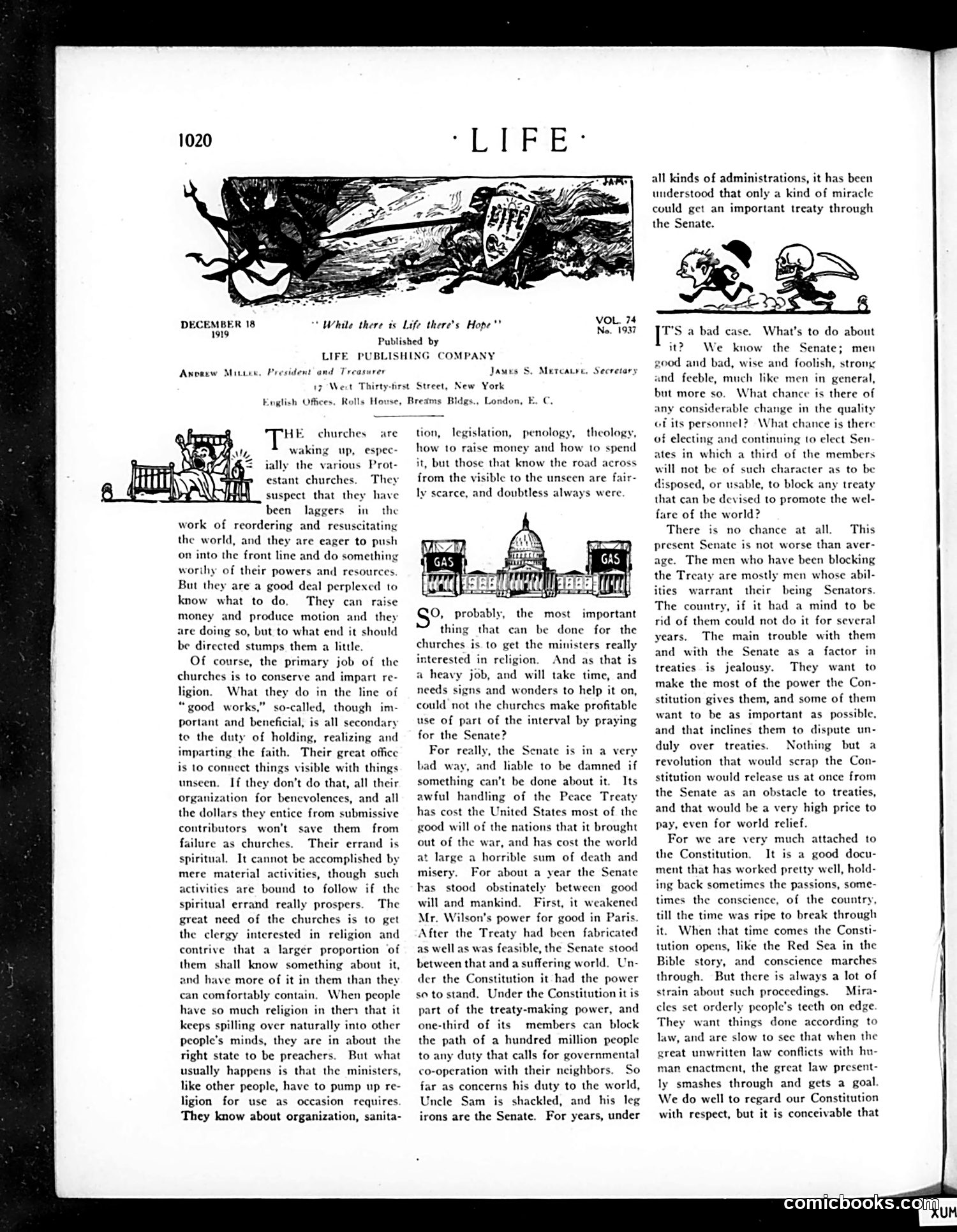
This editorial page attacks the U.S. Senate's obstruction of the League of Nations treaty following World War I. The author argues that churches should pray for the Senate because it has become an obstacle to peace and international cooperation. The central complaint: President Wilson negotiated the peace treaty, but the Senate—where one-third of members can block ratification—refused to approve it. This damaged American credibility abroad and prevented the nation from helping a war-ravaged world recover. The Senate is depicted as "shackled" America with "leg irons." The satirical suggestion that churches pray for the Senate reflects frustration that normal political channels have failed. Only divine intervention, the author implies sarcastically, could overcome the Senate's constitutional power to block treaties and its apparent unwillingness to support international cooperation for the common good.
📄 Transcribed text from this page (OCR, searchable)
Machine-transcribed from the original scan — historical spelling and the odd misread are preserved.
DECEMBER 18 1919 ‘While there ts Life there's Hope"" Published by LIFE Anprew Mittex, President and Treasurer PUBLISHING COMPANY James S. Mercaure, Secretary 17 West Thirty-tirst Street, New York English Offices, Rolls House HE waking up, ially the various Prot- stant churches. They suspect that they have been laggers in work of reordering and resuscitating the world, and they are eager to push on into the front line and do something worthy of their powers and resources. But they are a good deal perplexed to know what to do. churches are espec- They can raise money and produce motion and they are doing so, but to what end it should be directed stumps them a little. Of course, the primary job of the churches is to conserve and impart re- ligion. What they do in the line of “good works,” so-called, though im- portant and beneficial, is all secondary te the duty of holding, realizing and imparting the faith, Their great office is to connect things visible with things unseen. If they don’t do that, all their organization for benevolences, and all the dollars they entice from submissive contributors won't save them from failure as churches. Their errand is spiritual, It cannot be accomplished by mere material activities, though such activities are bound to follow if the spiritual errand really prospers. The great need of the churches is to get the clergy interested in religion and contrive that a larger proportion of them shall know something about it, nd have more of it in them than they ‘an comfortably contain. When people have so much religion in ther: that it keeps spilling over naturally into other people's minds, they are in about the right state to be preachers. But what usually happens is that the ministers, like other people, have to pump up re- ligion for use as occasion requires They know about organization, sanita- Breams Bldgs., Lond: tion, legislation, penology, theology, how to raise money and how to spend it, but those that know the road across from the visible to the unseen are fai ly scarce, and doubtless alw; O, probably, the most important thing that can be done for the churches is to get the ministers really interested in religion. And as that is a heavy job, and will take time, and needs signs and wonders to help it on, could not the churches make profitable use of part of the interval by praying for the Senate? For r bad way, Hy, the Senate is in a very and liable to be damned if something can’t be done about it. Its awful handling of the Peace Treaty has cost the United States most of the good will of the nations that it brought out of the war, and has cost the world at large a horrible sum of death and misery, For about a year the Senate bas stood obstinately between good will and mankind. First, it weakened Mr. Wilson’s power for good in Paris After the Treaty had been fabricated as well as was feasible, the Senate stood between that and a suffering world. Un- der the Constitution it had the power so to stand. Under the Constitution it is part of the treaty-making power, and one-third of its members can block the path of a hundred million people to any duty that calls for governmental co-operation with their neighbors. So ar as concerns his duty to the world, Uncle Sam is shackled, and his leg irons are the Senate. For years, under all kinds of administrations, it has been understood that only a kind of miracle could get an important treaty through the Senate. P2325) T'S a bad Wha it? We the Senate; men good and bad, wise and foolish, strony and feeble, much like men in general, but more so. What chance is there of any considerable change in the quality Gi its personnel? What chance is there of electing and continuing to elect Sen ates in which a third of the members will not be of such character as to be disposed, or usable, to block any treaty that can be devised to promote the wel- fare of the world? There is no chance at all. This present Senate is not worse than aver- age. The men who have been blocking the Treaty are mostly men whose abil- ities warrant their being Senators. The country, if it had a mind to be rid of them could not do it for several years. The main trouble with them and with the Senate as a factor in treaties is jealousy. They want to make the most of the power the Con- case, "'s to do about know stitution gives them, and some of them want to be as important as possible, and that inclines them to dispute un- duly over treaties. Nothing but a revolution that would scrap the Con- stitution would release us at once from the Senate as an obstacle to treaties, and that would be a very high price to pay, even for world relief. For we are very much attached to the Constitution, It is a good docu- ment that has worked pretty well, hold- ing back sometimes the passions, some- times the conscience, of the country, till the time was ripe to break through it. When that time comes the Consti- tution opens, like the Red Sea in the Bible story, and conscience marches through. But there is always a lot of strain about such proceedings. Mir: cles set orderly people’s tecth on edg They want things done according to law, and are slow to see that when the great unwritten law conflicts with hu- man enactment, the great law present- ly smashes through and gets a goal We do well to regard our Constitution with respect, but it is conceivable that