
Life, 1919-12-18 · page 36 of 56
Life — December 18, 1919 — page 36: what you’re looking at
What you’re looking at
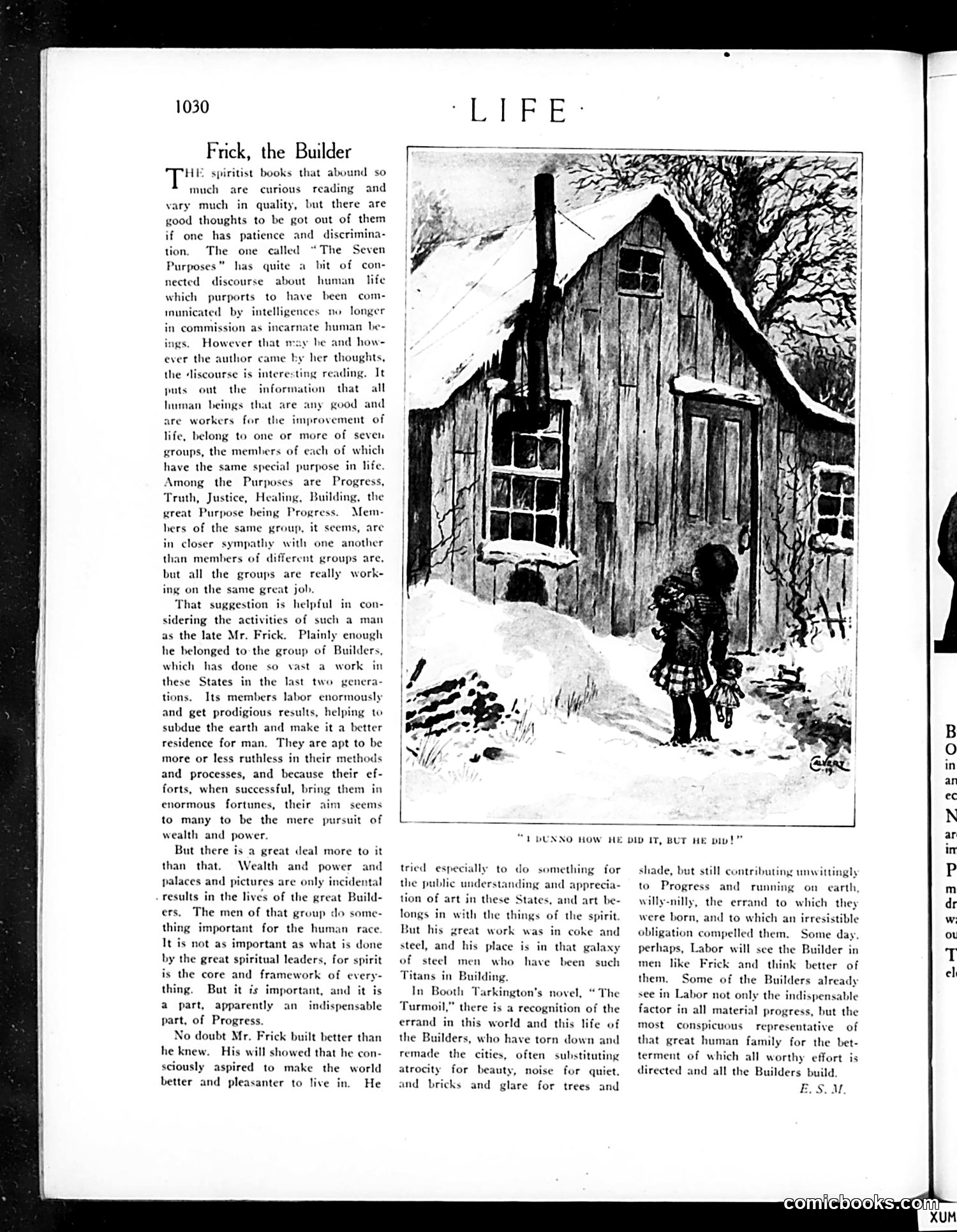
This article celebrates Henry Clay Frick (1849-1919), the steel magnate and art collector, as exemplifying the "Builder" archetype—one of seven human purposes outlined in spiritualist philosophy. The accompanying illustration shows a modest cottage, contrasting with Frick's actual industrial empire. The piece argues that despite Builders' reputation for ruthlessness and wealth-accumulation, they perform essential work improving civilization. Frick's contributions included industrializing America via coke and steel production, and advancing public art appreciation through his collection. The author acknowledges the contradiction: Builders replace natural beauty with industrial progress ("noise for quiet, bricks and glare for trees"), yet serve Progress itself. A final note suggests Labor should recognize Builders as fellow human contributors to collective betterment—a somewhat reconciliatory gesture toward worker-industrialist tensions of the era.
📄 Transcribed text from this page (OCR, searchable)
Machine-transcribed from the original scan — historical spelling and the odd misread are preserved.
1030 Frick, the Builder HE. spiritist books that abound so much are curious reading and vary much in quality, but there are good thoughts to be got out of them if one has patience and discrimina- one called “The Seven has quite a bit of con- human life com- tion, The Purposes” nected discourse about which purports to inunicated by intelligences no longer nate human be- y he and how- have been in commission as in However that ame by her thoughts, ings. ever the author ng reading. It that all the ‘liscourse is intere puts out the information luman beings that are any good and are workers for the improvement of life, belong to one or more of sever groups, the members of each of which have the same special purpose in life. Among the Purposes are Progress, Truth, Justice, Healing, Building, the great Purpose being Progress. Mem- hers of the same group, it seems, are in closer sympathy than members of di but all the group ing on the same great job. That suggestion is helpful in con- sidering the activities of such a man as the late Mr. Frick. Plainly enough he belonged to the group of Builders, work in with one another erent groups are, © really work- which has done so vast a these States in the last two genera- tions. Its members labor enormously and get prodigious results, helping to subdue the earth and make it a better residence for man. They are apt to be more or less ruthless in their methods and processes, and because their ef- forts, when successful, bring them in enormous fortunes, their ain to many to be the mere pursuit of wealth and power. But there is a great deal more to it than that. Wealth and palaces and pictures are only incidental results in the lives of the great Build- ers. The men of that group do some- thing important for the human race. It is not as important as what is done by the great spiritual leaders, for spirit is the core and framework of every- thing. But it is important, and it is a part, apparently an indispensable part, of Progress. No doubt Mr. Frick built better than he knew. sciously aspired to make the world better and pleasanter to live in. He seems power and His will showed that he con- “1 BUNNO HOW HE vip IT, BUT HE pip!” tried especially to do something for the public understanding and apprecia- tion of art in these States, and art be- longs in with the things of the spirit Sut his great work was in coke and steel, and his place is in that g: of steel who Titans in Building. laxy men have been such In Booth Tarkington's novel, “ The Turmoil,” there is a recognition of the errand in this world and this life of the Builders, who have torn down and remade the cities, often substituting atrocity for beauty, noise for quiet. and bricks and glare for trees and shade, but still contributing unwittingly to Progress and willy-nilly, the errand to which they running on earth, were born, and to which an irresistible obligation compelled them. Some day, perhaps, Labor will sce the Builder in men like Frick and think better of Some of the Builders already see in Labor not only the indispensable factor in all material progress, but the most conspicuous representative of that great human family for the bet- terment of which all worthy effort is directed and all the Builders build. E.S.M them,