
Life, 1919-12-18 · page 24 of 56
Life — December 18, 1919 — page 24: what you’re looking at
What you’re looking at
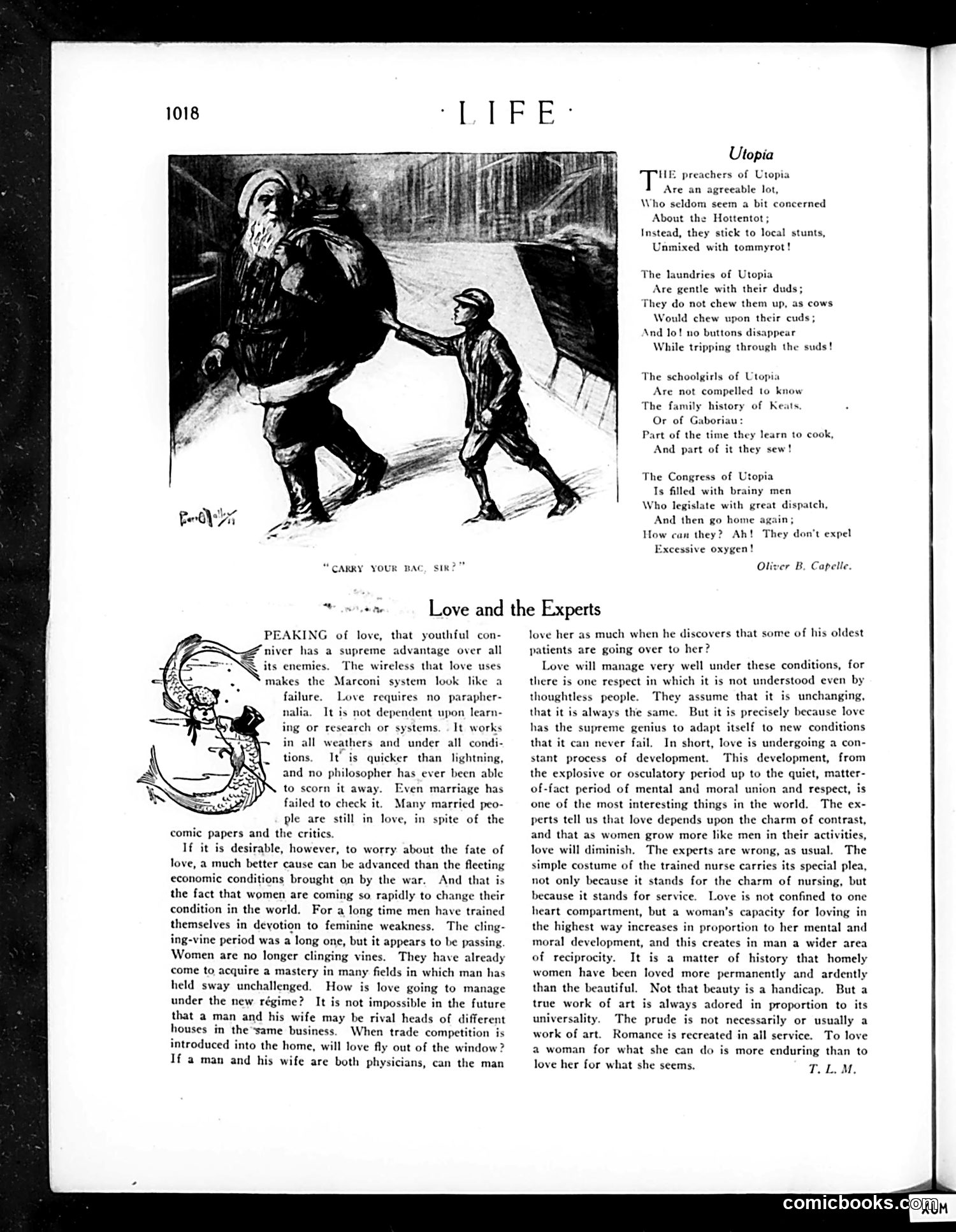
**"Utopia" poem** satirizes idealistic social reformers who champion grand causes while ignoring practical problems. It mocks preachers focused on distant concerns (the "Hottentot") rather than local issues, and imagines a fantasy world where laundries don't lose buttons, schoolgirls learn practical skills instead of classical literature, and Congress actually functions efficiently. The satire suggests such perfection is impossible—a critique of naive utopianism. **"Love and the Experts" essay** addresses wartime concerns about women's changing roles. It argues that love will survive women's increasing economic and professional independence (becoming physicians, business rivals). The author counters "experts" who claim love depends on gender contrast, asserting instead that love adapts and deepens through intellectual and moral development. The piece defends romantic relationships against anxieties about women's emancipation. Both pieces reflect early 20th-century debates over feminism, social progress, and traditional gender roles.
📄 Transcribed text from this page (OCR, searchable)
Machine-transcribed from the original scan — historical spelling and the odd misread are preserved.
ARRY YOUR BAC, SU Utopia IIE. preachers of Utopia Are an agreeable lot, Who seldom seem a bit concerned About the Hottentot; Instead, they stick to local stunts, Unmixed with tommyrot! The laundries of Utopia Are gentle with their duds; They do not chew them up, as cows Would chew upon their cuds; And lo! no buttons disappear While tripping through the suds! The schoolgirls of Utopia Are not compelled to know The family history of Keats. Or of Gaboriau: Part of the time they learn to cook, And part of it they sew! The Congress of Utopia Is filled with brainy men Who legislate with great dispatch, And then go home again; How can they? Ah! They don’t expel cessive oxygen! Oliver B. Capelle. Love and the Experts PEAKING of love, that youthful con- The wireless that love uses makes the Marconi system look like a failure. nalia. It is not dependent upon learn- ing or research or systems. . It works in all weathers and under all condi- tions. It’ is quicker than lightning, and no philosopher has ever been able to scorn it away. Even marriage has failed to check it. Many married peo- ple are still in love, in spite of the comic papers and the critics. If it is desirable, however, to worry about the fate of love, a much better cause can be advanced than the fleeting economic conditions brought on by the war. And that is the fact that women are coming so rapidly to change their condition in the world. For a long time men have trained themselves in devotion to feminine weakness. The cling- ing-vine period was a long one, but it appears to be passing Women are no longer clinging vines. They have already come to acquire a mastery in many fields in which man has held sway unchallenged. How is love going to manage under the new régime? It is not impossible in the future that a man and his wife may be rival heads of different houses in the same business. When trade competition is introduced into the home, will love fly out of the window? If a man and his wife are both physicians, can the man Love requires no parapher- love her as much when he discovers that some of his oldest patients are going over to her? Love will manage very well under these conditions, for there is one respect in which it is not understood even by thoughtless people. They assume that it is unchanging, that it is always the same. But it is precisely because love has the supreme genius to adapt itself to new conditions that it can never fail. In short, love is undergoing a con- stant process of development. This development, from the explosive or osculatory period up to the quict, matter- of-fact period of mental and moral union and respect, is one of the most interesting things in the world. The ex- perts tell us that love depends upon the charm of contrast, and that as women grow more like men in their activities, will diminish. The experts are wrong, as usual. The simple costume of the trained nurse carries its special plea, not only because it stands for the charm of nursing, but because it stands for service. Love is not confined to one heart compartment, but a woman's capacity for loving the highest way increases in proportion to her mental and moral development, and this creates in man a wider area of reciprocity. It is a matter of history that homely women have been loved more permanently and ardently than the beautiful. Not that beauty is a handicap. But a true work of art is always adored in proportion to its universality. The prude is not necessarily or usually a work of art. Romance is recreated in all service. To love a woman for what she can do is more enduring than to love her for what she seems. T.LM. comicbooks. ORM