
Life, 1919-12-18 · page 34 of 56
Life — December 18, 1919 — page 34: what you’re looking at
What you’re looking at
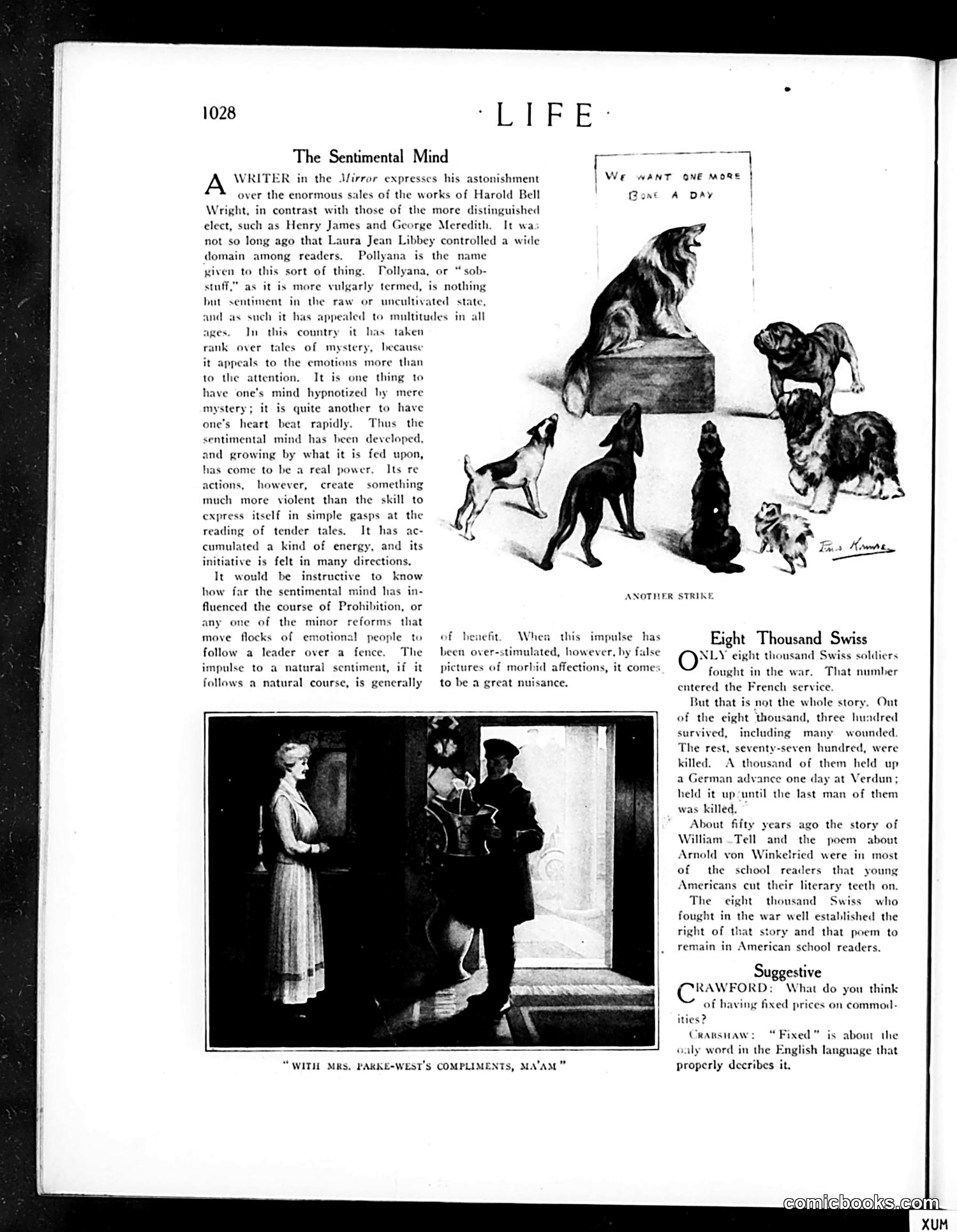
**"The Sentimental Mind"** essay critiques popular literature's emotional appeal. The writer notes that Harold Bell Wright's bestselling novels outsell more "distinguished" authors like Henry James. The piece argues that sentimentality—"sob-stuff"—appeals to raw emotion rather than intellect, and warns that when artificially stimulated through "morbid affections," it becomes a "nuisance." The author questions whether sentimental impulses have driven social movements like Prohibition. **"Another Strike"** cartoon (dogs refusing more food) satirizes labor disputes or workers' demands during the post-WWI era, likely referencing the wave of strikes occurring in America at this time. **"Eight Thousand Swiss"** praises Swiss soldiers who fought for France in WWI, noting that 7,700 were killed. It references William Tell and Arnold von Winkelried (Swiss historical/legendary figures) as validating Swiss martial tradition and heroism. **"Suggestive"** joke plays on the word "fixed"—Crawford and Crabshaw debate price controls, with Crabshaw quipping that "fixed" accurately describes commodities because prices are artificially manipulated or rigged.
📄 Transcribed text from this page (OCR, searchable)
Machine-transcribed from the original scan — historical spelling and the odd misread are preserved.
“LIFE: The Sentimental Mind 3 WRITER in the Mirror expresses his astonishment over the enormous sales of the works of Harold Bell Bone Wright, in contrast with those of the more distinguished elect, such as Henry James and George Meredith. It wa not so long ago that Laura Jean Libbey controlled a wide domain among readers. xiven to this sort of thing. Pollyana is the name Pollyana, or “sob- stuff," as it is more vulgarly termed, is nothing but sentiment in the raw or uncultivated state, and as such it has appealed to multitudes in all In this country it has taken rank over tales of ecause it appeals to the emotions more than It is one thing to mystery, to the attention. have one’s mind hypnotized by mere mystery; it is quite another to have Thus the mind has been developed, one’s heart beat rapidly. sentimen and growing by what it is fed upon, has come to be a real power. Its re actions, something much more violent than the skill to express itself in simple gasps at the reading of tender tales, It has ac- cumulated a kind of energy, and its initiative is felt in many directions, It would be instructive to know how far the sentimental nd has in- fluenced the course of Prohibition, or the minor reforms that move flocks of emotional people to follow a leader over a fence. The impulse to a natural sentiment, if it follows a natural course, is generally however, create any one of a & WANT ONE MORE | A DAY ANOTHER STRIKE of benefit. When this impulse has been over-stimulated, however, hy false pictures of morhid affections, it come to be a great nuisance, “WITH MRS. PAKKE-WEST'’S COMPLIMENTS, MA'AM" Eight Thousand Swiss LY eight thousand Swiss soldiers fought in the war. That number entered the French service. But that is not the whole story. Out of the eight thousand, three hundred including many wounded. The rest, seventy-seven hundred, were killed. A thousand of them held up a German advance one day at Verdun; held it up-until the last man of them was killed. About fifty years ago the story of William Tell and the poem about Arnold von Winkelried were in most of the school r that young Americans cut their literary teeth on. The eight’ thousand Swiss who fought in the war well established the right of that story and that poem to in in American school readers. O° survived, aders Suggestive RAWFORD: What do you think of having fixed prices on commod ities? Cransuaw: “Fixed” is about the oualy word in the English language that properly decribes it.