
A complete issue · 48 pages · 1919
Life — September 18, 1919
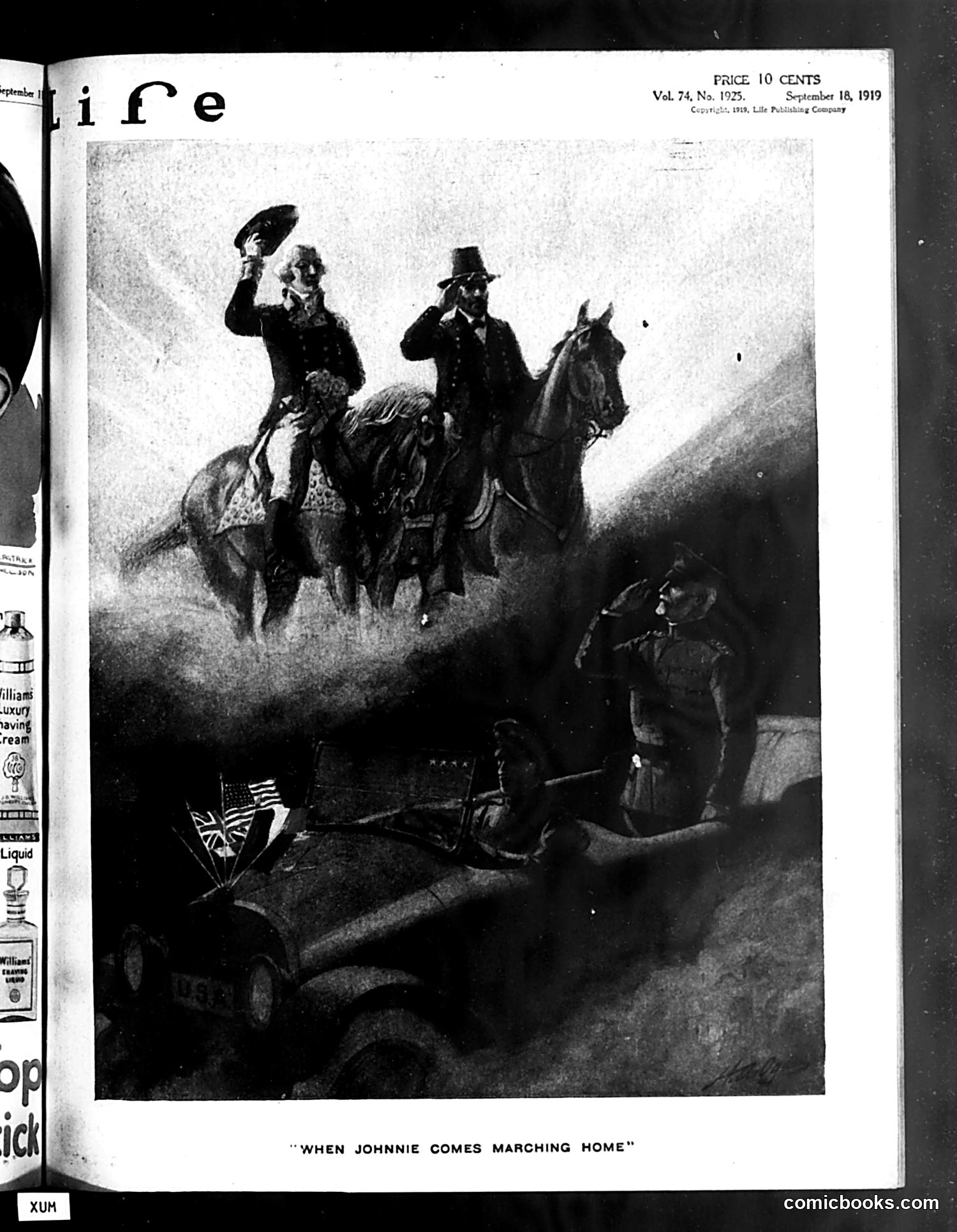
This *Life* magazine cover from September 18, 1919, depicts a triumphant homecoming scene. Two uniformed officers on horseback raise their hats in celebration while viewing what appears to be a damaged or disabled soldier in a military vehicle below them. The title references the Civil War-era song "When Johnny Comes Marching Home," evoking patriotic homecoming imagery. However, the satire appears dark: the contrast between the celebrating officers and the wounded soldier below suggests criticism of military leadership's disconnect from soldiers' actual suffering and sacrifice. The British flag visible suggests WWI context—the war had ended only months prior (November 1918), and the magazine likely critiques how disabled veterans were being overlooked amid celebrations.
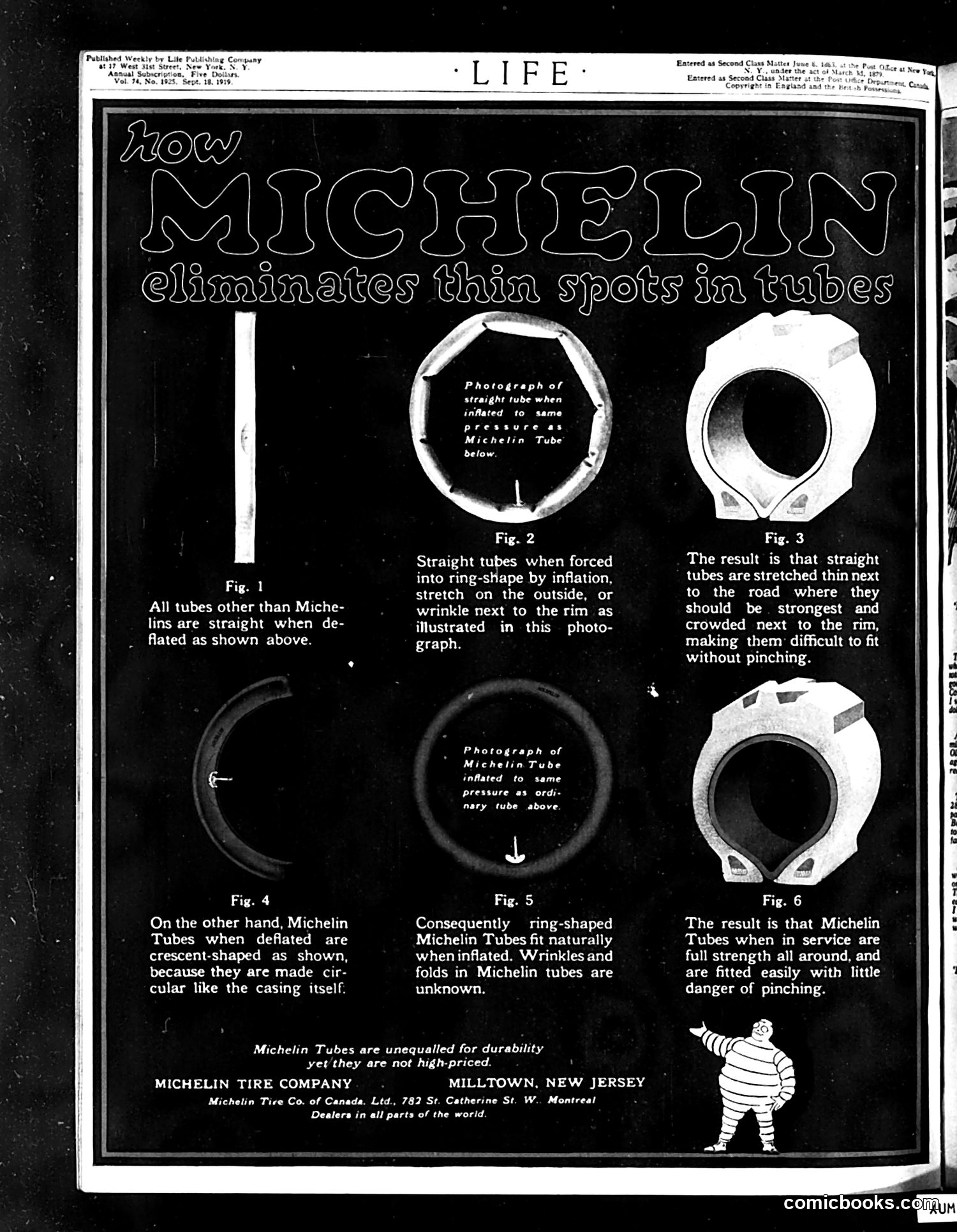
This is a **product advertisement**, not political satire. It promotes Michelin brand inner tubes by explaining a technical superiority over competitors. The ad compares two tube designs when deflated: - **Other brands** (Figs. 1-3): Become ring-shaped, creating wrinkles and folds that are "difficult to fit without pinching" - **Michelin tubes** (Figs. 4-6): Maintain a crescent shape matching the tire casing, fitting smoothly without pinching danger The advertisement emphasizes durability and ease of installation as selling points. The Michelin Man mascot appears at bottom right. This appears in *Life* magazine's advertising section rather than editorial content, promoting Michelin Tire Company products available from dealers worldwide.

This page is primarily a **advertisement for United States Tires**, not political satire or cartoon content. The ad features a stylized illustration of a bus navigating mountainous terrain (the Cascade Range near Tacoma, Washington). It includes testimonials from Tacoma stage drivers praising "Royal Cord" tires for durability under harsh conditions—mountain routes with steep grades and rough roads. The visual strategy emphasizes the tire's reliability through: - A dramatic image of the bus on treacherous terrain - A US Rubber Company seal certifying quality - Multiple tire models displayed ("Royal Cord," "Nobby," "Chain," "Usco," "Plain") - Real driver endorsements This is a straightforward commercial advertisement leveraging local expertise and extreme-use testimonials to build consumer confidence in the product's quality and endurance.
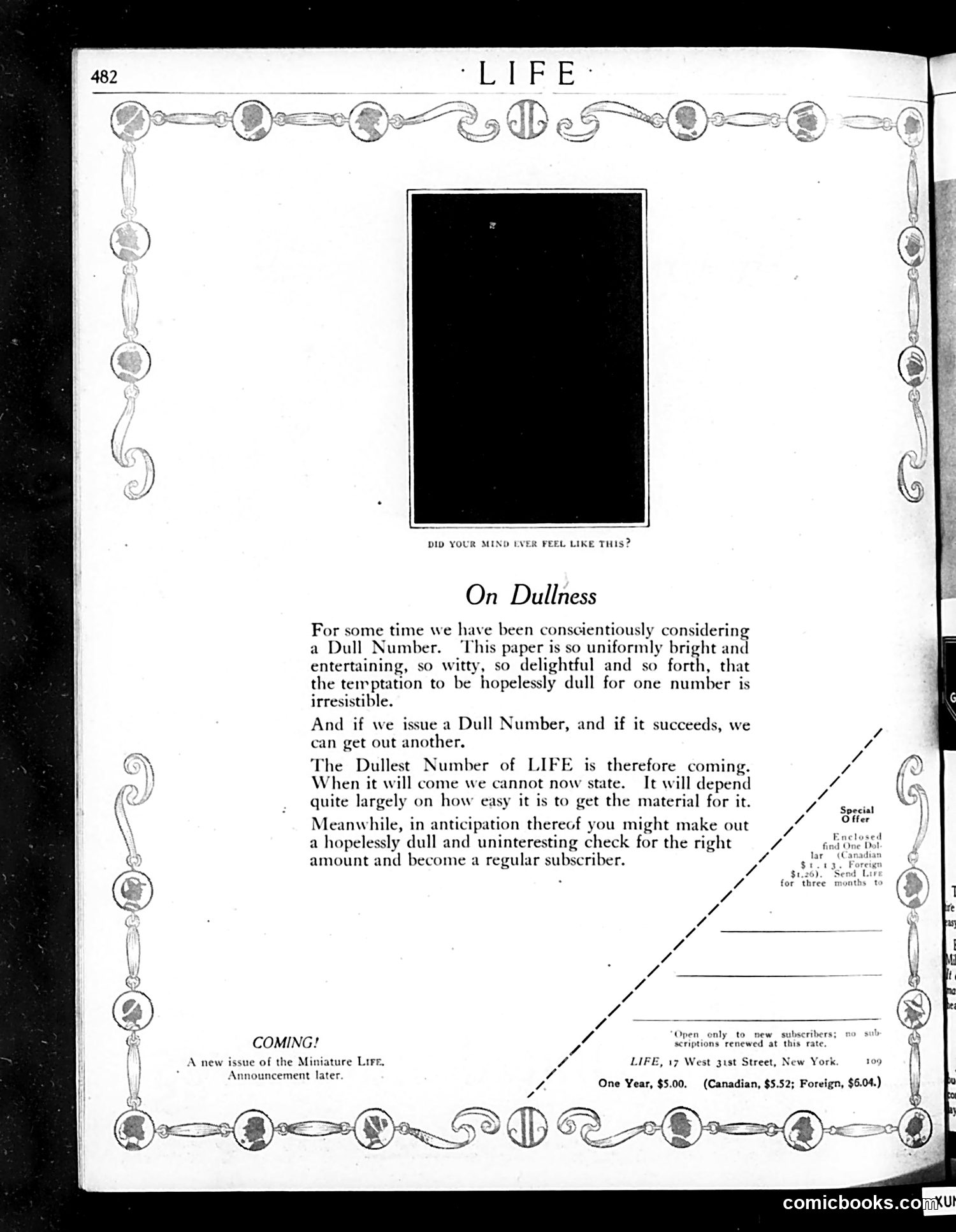
This page announces an upcoming "Dull Number" of Life magazine. The text humorously acknowledges the paradox: Life is normally "uniformly bright and entertaining," making it nearly impossible to produce a deliberately dull issue. However, the editors have decided to attempt one anyway. The large black rectangle captioned "DID YOUR MIND EVER FEEL LIKE THIS?" is the joke itself—representing mental blankness or emptiness. This visual gag illustrates what "dullness" feels like. The page is primarily self-promotional advertising rather than political commentary. It encourages readers to subscribe or renew subscriptions in anticipation of this novelty issue. The decorative border with portrait medallions is typical of Life's aesthetic design during this era.
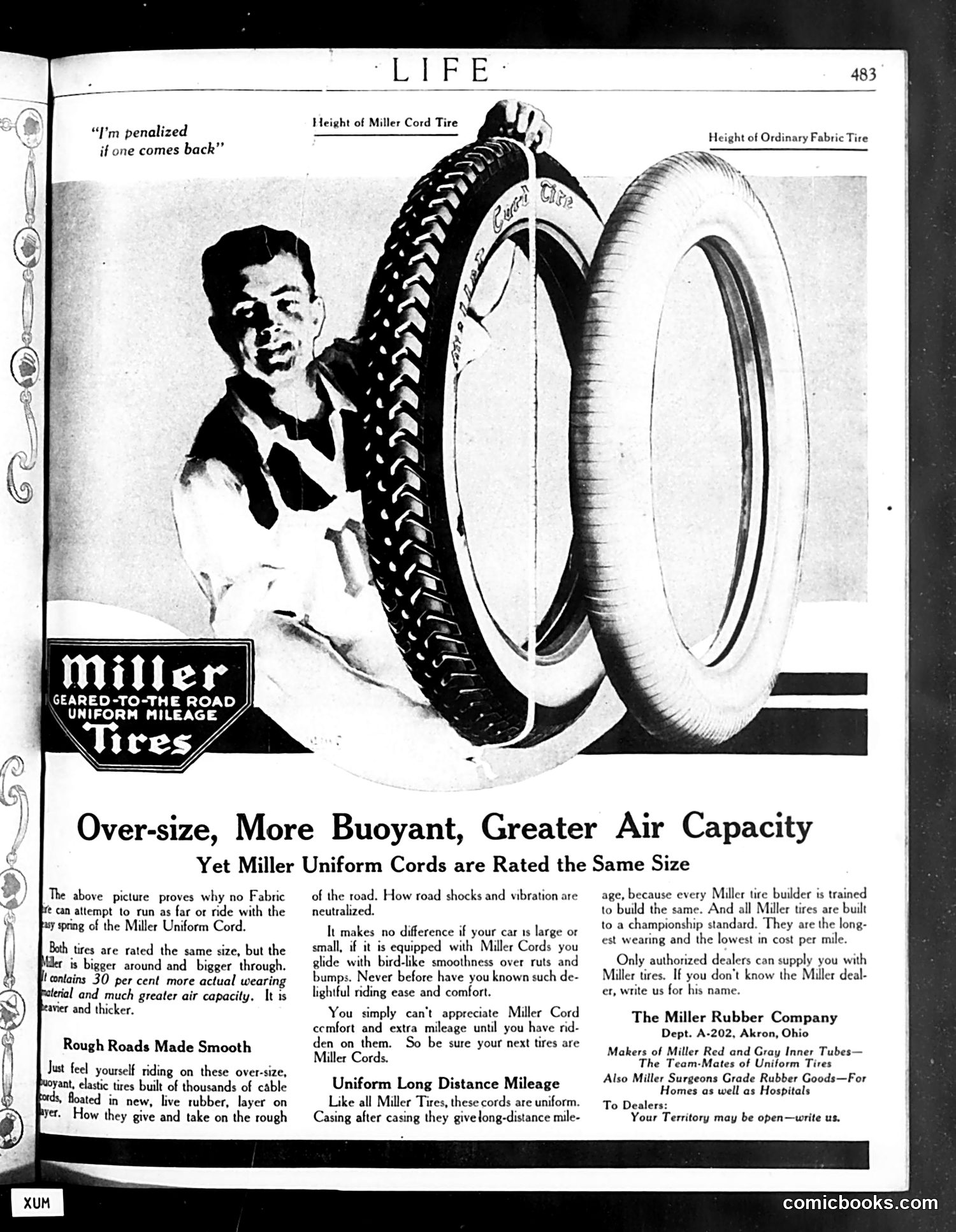
This is primarily a **product advertisement**, not satire or political commentary. The page promotes Miller brand automobile tires, specifically their "Uniform Cord" design. The ad uses comparative imagery to demonstrate product superiority: a man displays a Miller tire (left, with deep treads) alongside an ordinary fabric tire (right), emphasizing Miller's greater size and air capacity despite identical size ratings. The opening quote—"I'm penalized if one comes back"—appears to reference a dealer's warranty obligation, suggesting Miller's reliability. The "Rough Roads Made Smooth" section describes the tire's comfort features for early-20th-century automobiles navigating poor roads. This reflects the era's competitive tire market and the marketing strategy of emphasizing technical innovation to consumers still relatively new to automobile ownership.
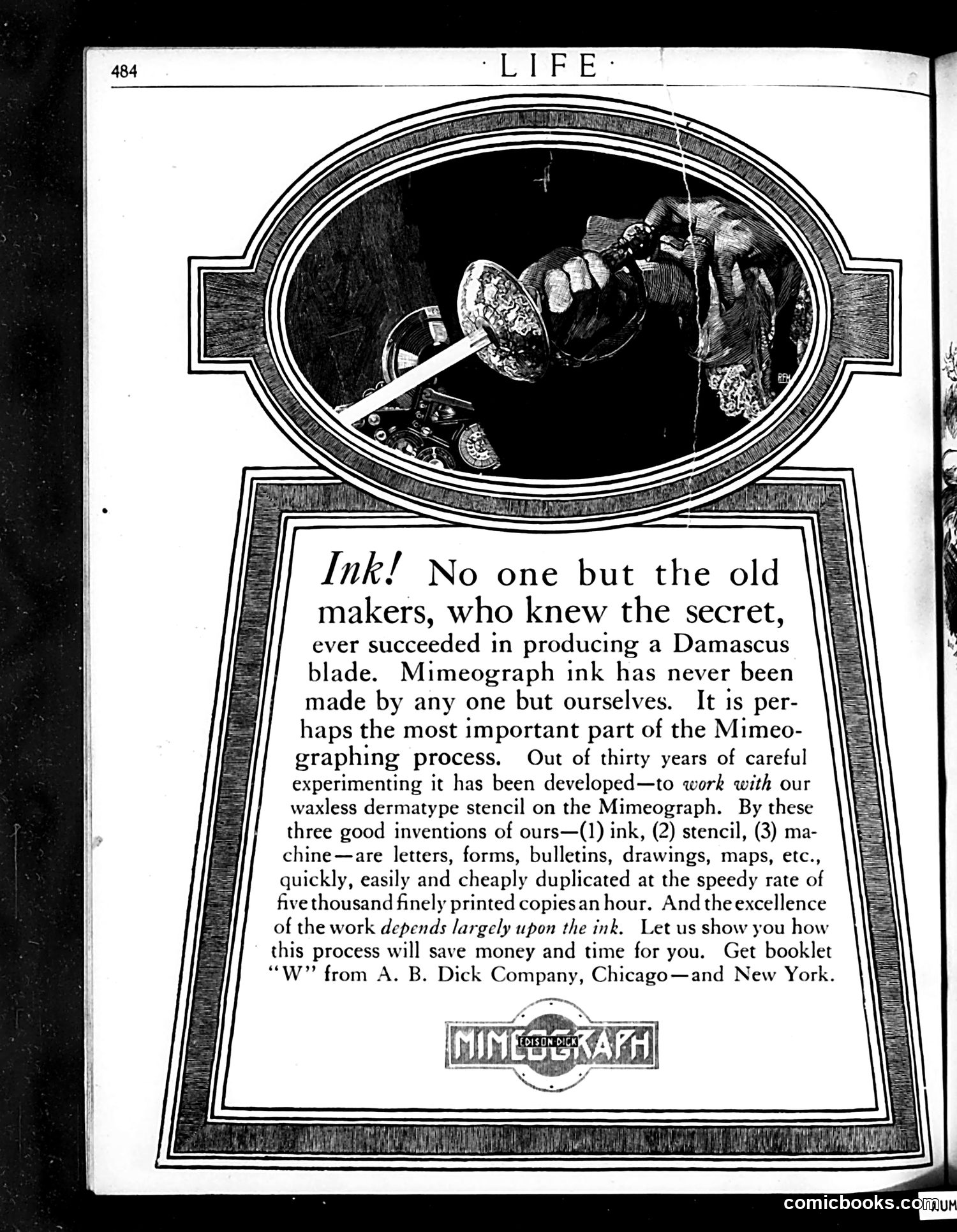
This page is primarily an advertisement for the Mimeograph machine and its proprietary ink, published by A.B. Dick Company of Chicago and New York. The ad uses an "Ink!" headline and compares mimeograph ink to the carefully guarded secrets of Damascus blade-making—implying exclusivity and superiority. The circular illustration shows the mimeographic process in action. The text claims their ink took "thirty years" to develop and is essential to the mimeographing process, which could duplicate documents at "five thousand finely printed copies an hour." The ad emphasizes that excellence "depends largely upon the ink" and urges readers to request booklet "W." This is a straightforward business advertisement rather than political satire. It appeared in Life magazine, which mixed editorial content with advertising.
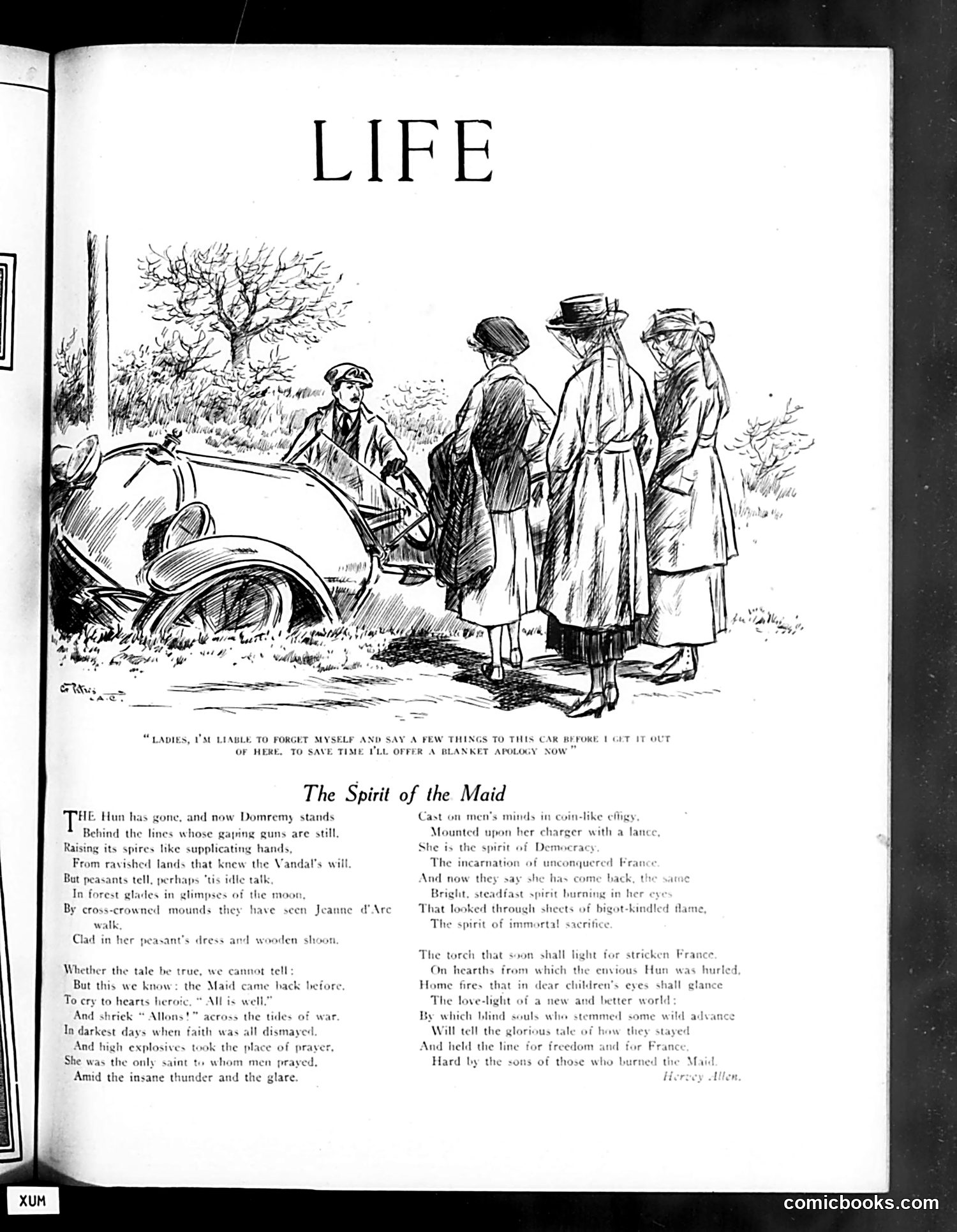
This page features a cartoon and poem about Joan of Arc, the French military figure burned at the stake in 1431. The illustration shows a broken-down automobile surrounded by well-dressed figures—likely representing Allied nations or leaders during World War I. The poem interprets Joan's legend as a metaphor for France's suffering and resilience during the war. References to "the Maid came back before" and "the spirit of Democracy" suggest the author sees Joan as embodying French resistance and sacrifice. The automobile wreckage symbolizes the devastation of war. The caption's self-deprecating humor about offering "a blanket apology" frames this as satirical commentary on how nations invoke historical symbols to sustain wartime morale and justify continued sacrifice.
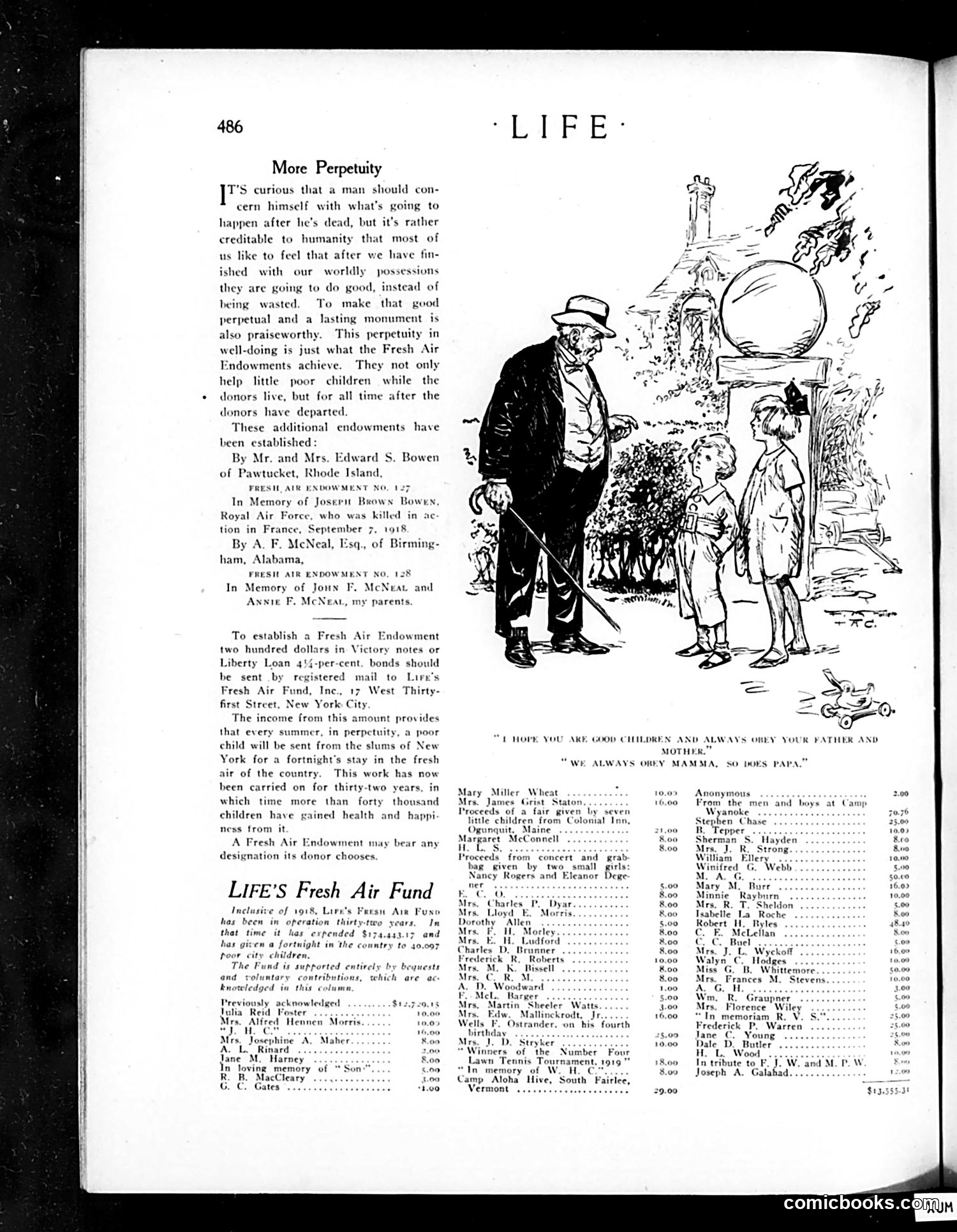
This page contains **two main elements**: a brief essay titled "More Perpetuity" on the left, and an illustration on the right. The **illustration** depicts an older gentleman (appearing to be a wealthy benefactor) speaking with two children outdoors. The caption reads: "I hope you are good children's and always obey your father and mother" / "We always oby mamma, so does papa." The joke appears to be gentle irony about children's obedience—they claim to obey "mamma," implying Papa may be less strictly obeyed, or perhaps suggesting children's selective compliance with parental authority. Below is **Life's Fresh Air Fund** section, listing donors and amounts for a charitable program sending poor children to the countryside for summer stays. This was a genuine Progressive-era initiative providing urban poor children respite in fresh air—a major public health concern of that period.
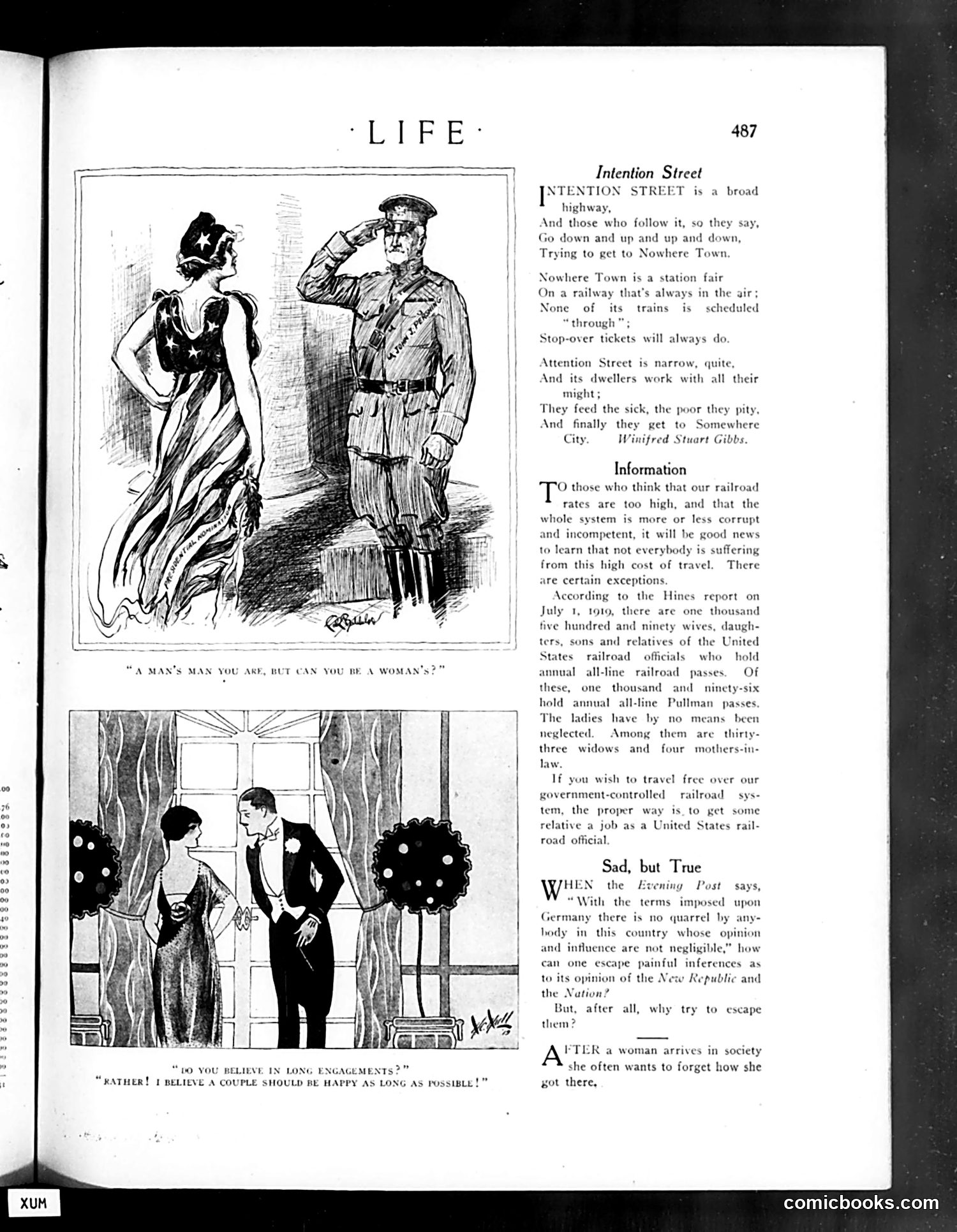
This page contains two cartoons and an article titled "Information" about railroad passes for government officials. The **top cartoon** depicts a man in military uniform (likely a railroad official) speaking to a fashionably dressed woman. The caption reads "A man's a man, you are, but can you be a woman's?" This appears to satirize gender dynamics and possibly questions the man's authority or masculine credibility. The **bottom cartoon** shows a couple in an elegant train car interior. The caption states "Do you believe in long engagements?" with the response "Rather! I believe a couple should be happy as long as possible!" This is a standard romantic humor joke about long engagements delaying marriage. The accompanying article discusses that railroad officials and their families receive free passes, questioning whether this constitutes unfair privilege—a typical Progressive Era critique of corporate corruption and government entanglement.
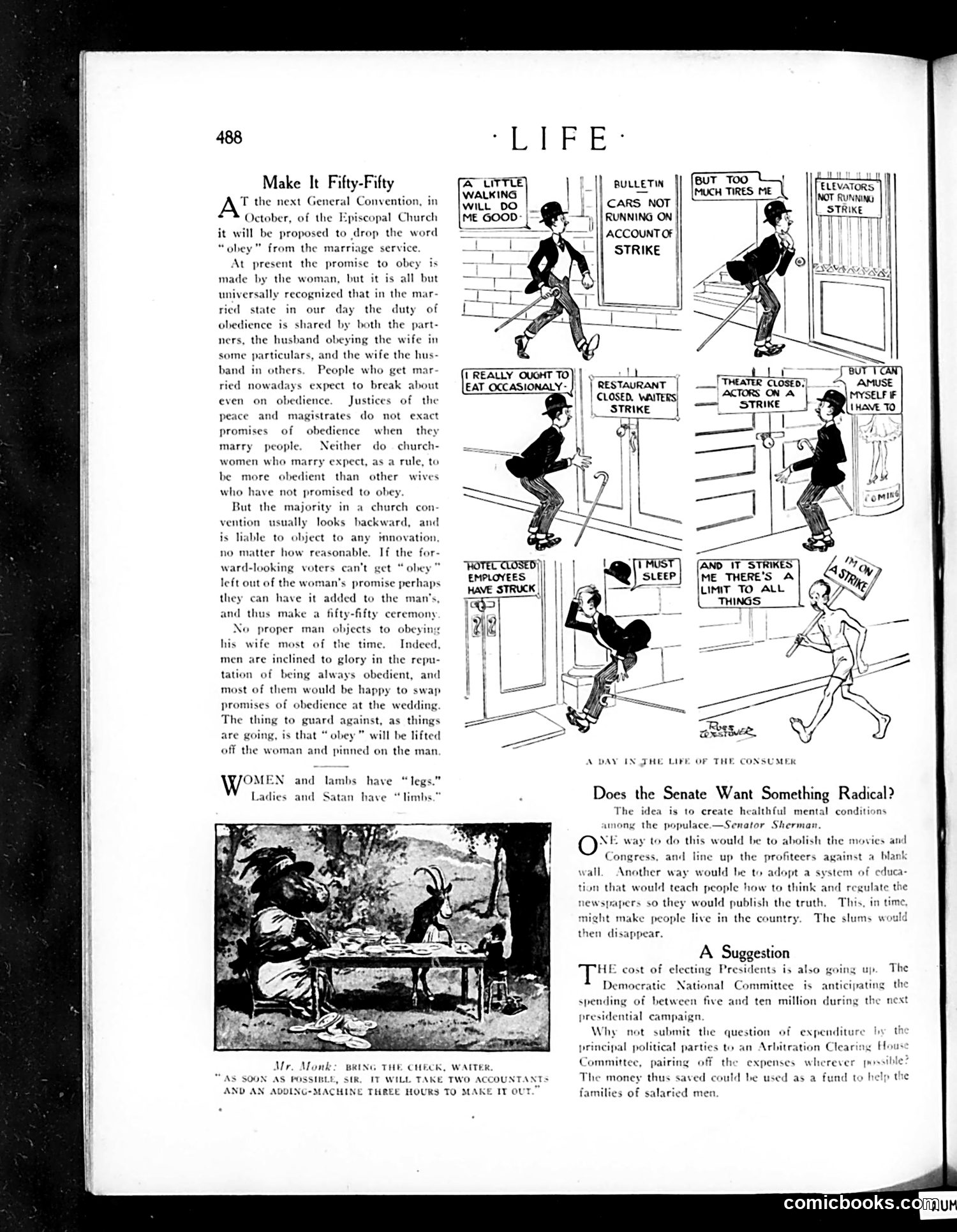
This multi-panel cartoon satirizes the widespread strikes affecting 1920s America. A man encounters closed businesses throughout his day—elevators, trolleys, restaurants, theaters, hotels—all shuttered due to labor strikes. Each panel shows him frustrated by a different service disruption, with workers' strike notices visible. The satire targets both labor organizers and the ripple effects of strikes on ordinary citizens. The "consumer" (ordinary person) becomes collateral damage, unable to access basic services. The cartoon suggests strikes, while perhaps justified, cause hardship for the working public who depend on these services. The accompanying articles discuss marriage obedience and Senate proposals for social reform, linking labor unrest to broader Progressive-era social anxieties about social order and change.
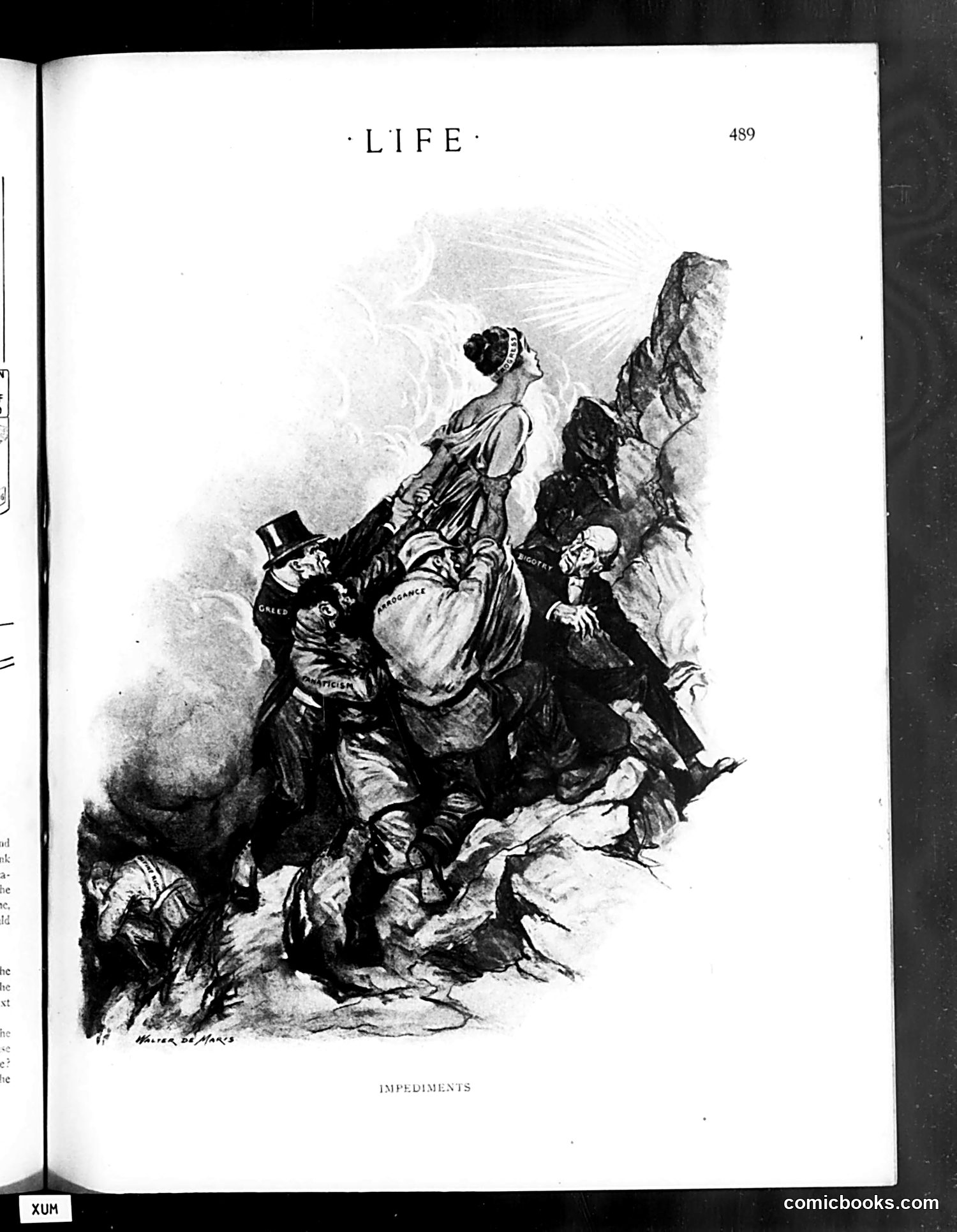
This cartoon depicts **Lady Liberty** (the classical female figure in flowing robes, pointing upward) being physically obstructed by three well-dressed men in top hats labeled with text that appears to reference political or social obstacles (the labels are partially legible as "GREED," "IGNORANCE," and what may be "PREJUDICE" or similar impediments). The satire suggests that **progress and American ideals are being blocked by corruption, ignorance, and other vices** embodied by wealthy or powerful men of the era. This is typical of Life magazine's turn-of-the-century social criticism, attacking special interests and entrenched power that prevented democratic or moral advancement. The artist is **Henry de Kock** (visible signature).
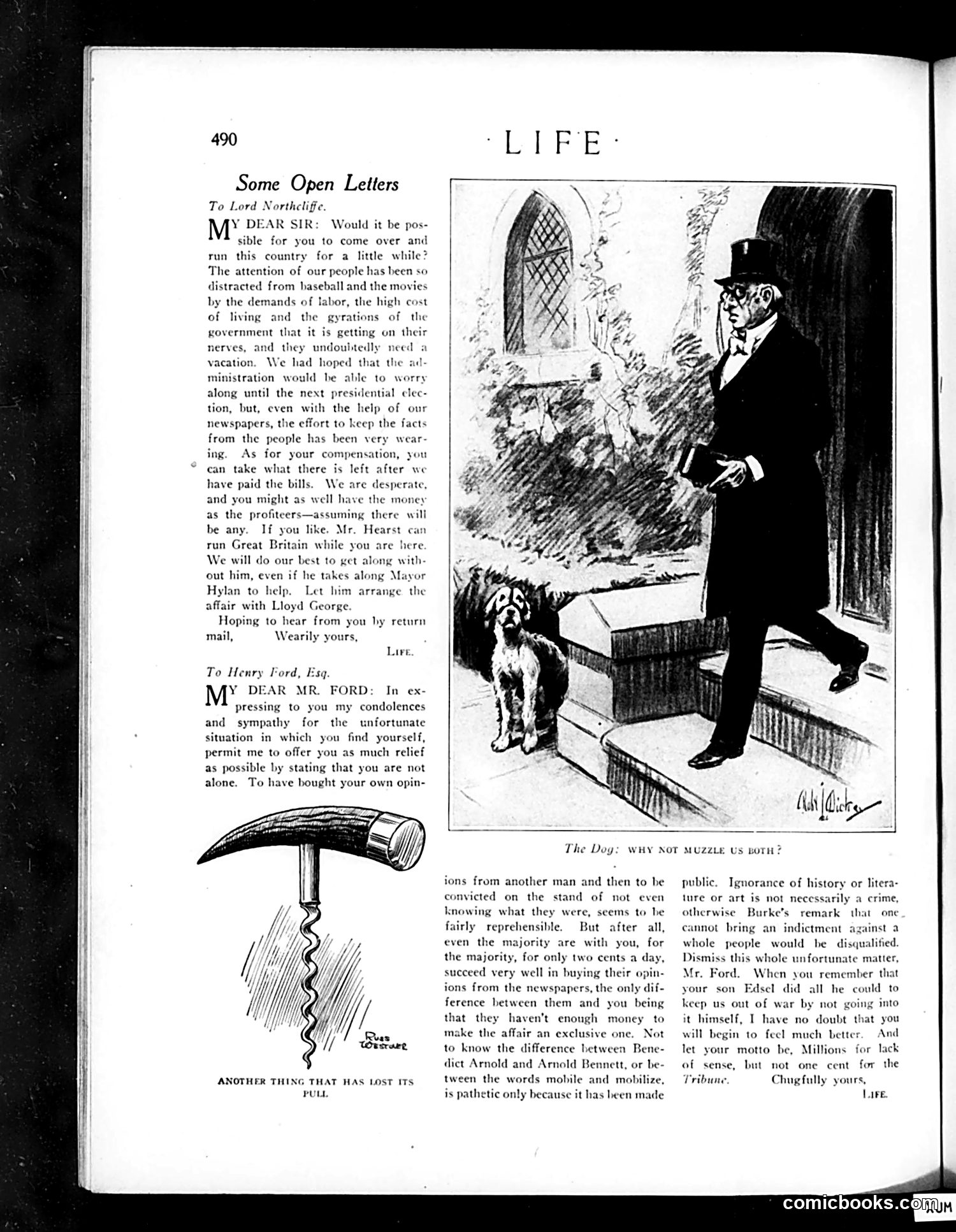
**The Main Cartoon ("The Dog: Why Not Muzzle Us Both?")** This sketch shows a well-dressed man in a top hat confronting a scruffy dog near a church window. The caption's cynical question suggests the artist is satirizing hypocrisy—specifically that humans are as uncontrolled or dangerous as animals, yet only the dog gets muzzled. The implied criticism likely targets social regulations or government restrictions that target lower classes while leaving the wealthy (represented by the gentleman) unaccountable. **"Another Thing That Has Lost Its Pull"** A corkscrew illustration with no visible cork attached appears to mock something that's become useless or ineffective—the caption suggests this may reference a failed social tool or abandoned practice, though the specific reference remains unclear without additional historical context.
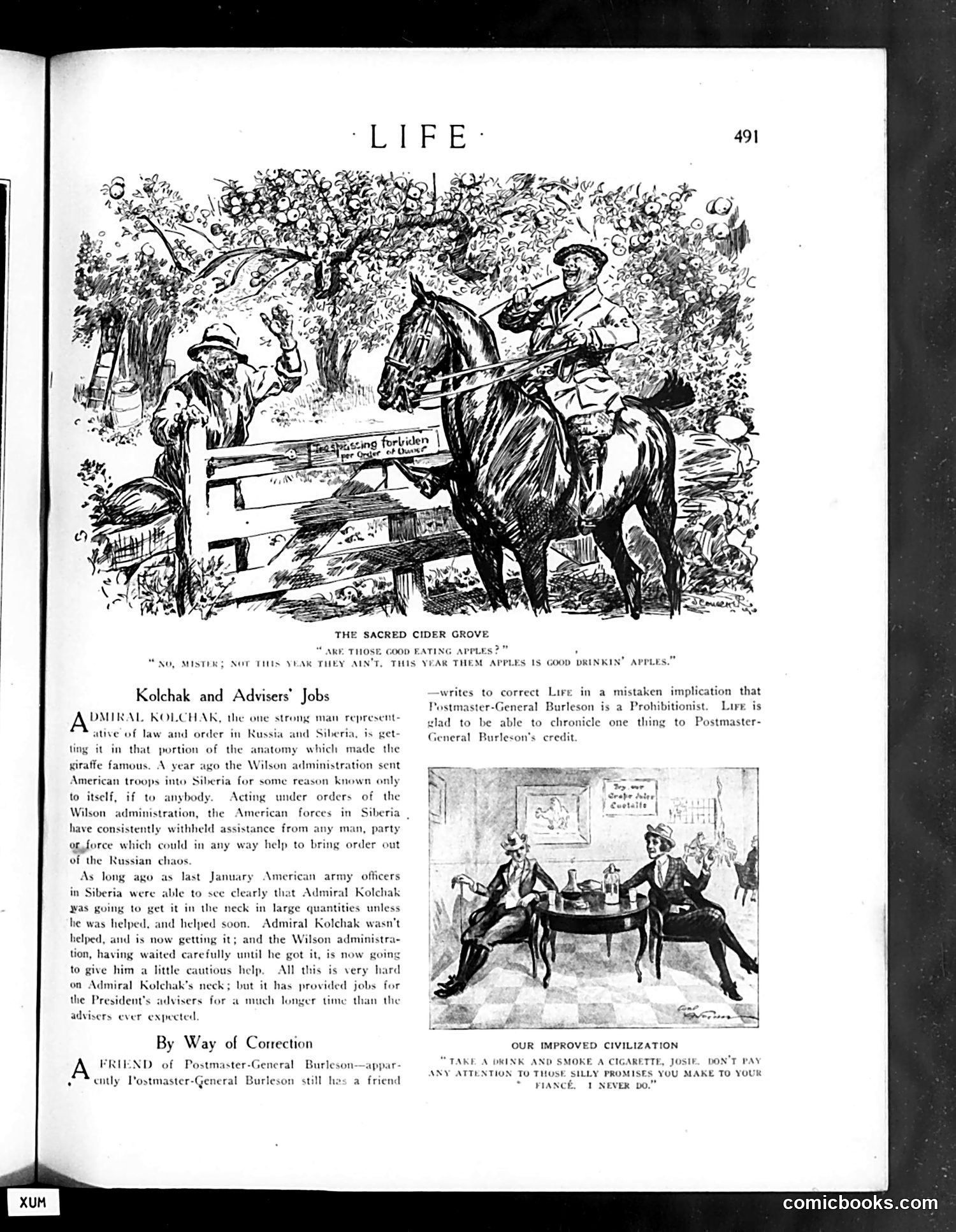
**"The Sacred Cider Grove"** cartoon depicts a man on horseback at a fence marked "Trespassing Forbidden" speaking with a farmer. The horseman claims apples are "good drinkin' apples"—a reference to prohibition-era apple cider production. Farmers often produced cider as a legal loophole during Prohibition, though cider could ferment into alcoholic beverages. The cartoon satirizes this gray area: farmers and outsiders exploiting the technicality that apple cider production wasn't explicitly illegal under Prohibition laws. The text below discusses Admiral Kolchak's military position in Siberia and includes a "Correction" about Postmaster-General Burleson. A second cartoon, "Our Improved Civilization," mocks men ignoring their fiancées while smoking cigarettes—commentary on changing social manners.
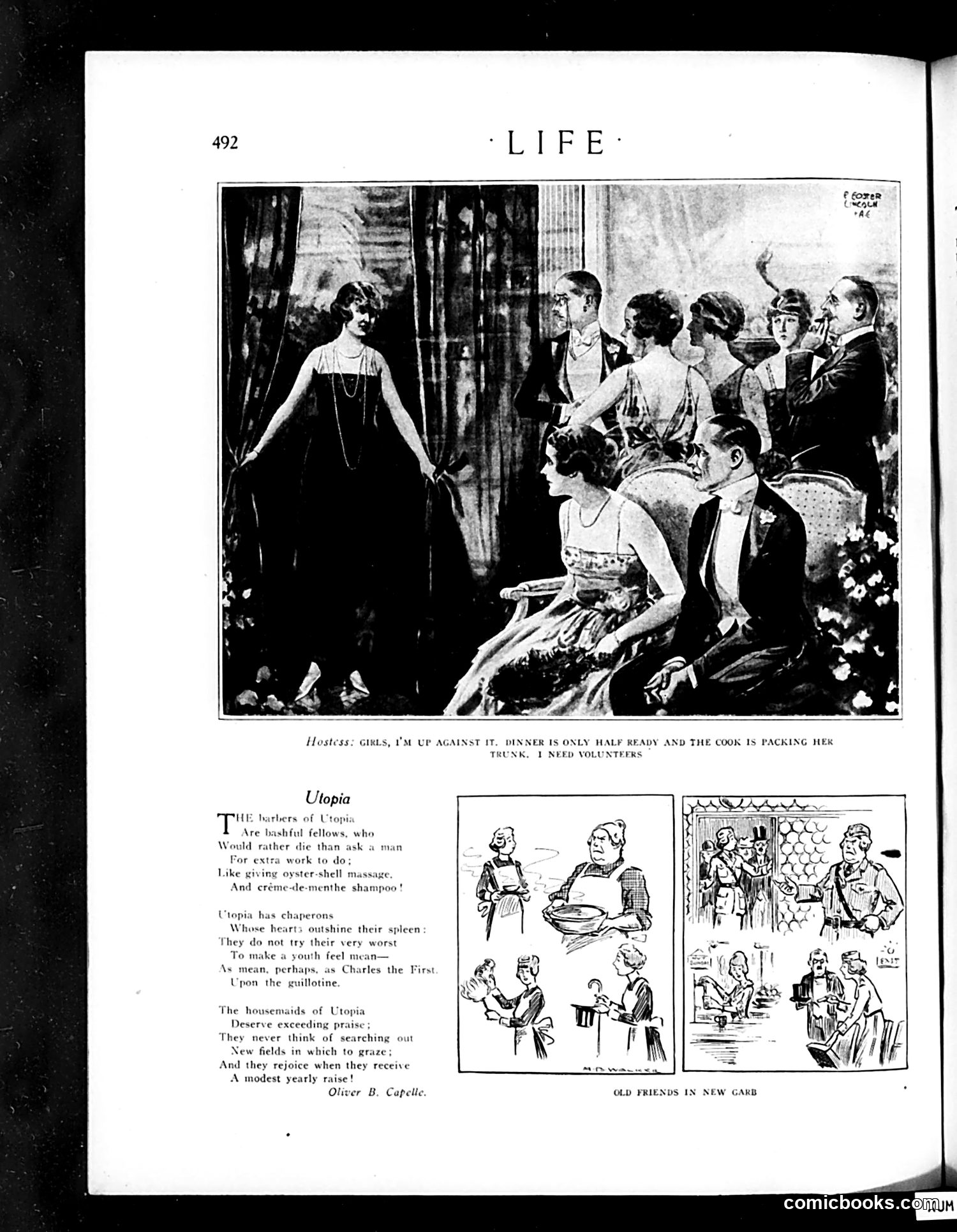
This Life magazine page contains two distinct pieces: **Top illustration**: A domestic comedy scene depicting a hostess struggling to organize a dinner party. The caption reads: "Girls, I'm up against it. Dinner is only half ready and the cook is packing her trunk. I need volunteers." This satirizes the common early 20th-century problem of domestic servants leaving employment suddenly, forcing middle-class housewives to manage without household help—a real social anxiety of the period. **Bottom section**: A poem titled "Utopia" by Oliver B. Capelle, accompanied by cartoon vignettes labeled "Old Friends in New Garb." The poem praises idealized working-class domestics with virtues like loyalty and contentment. The accompanying cartoons appear to humorously contrast this fantasy version with the reality of servants' actual behavior and demands. Together, the page satirizes the gap between employers' expectations of obedient servants and workers' actual independence.
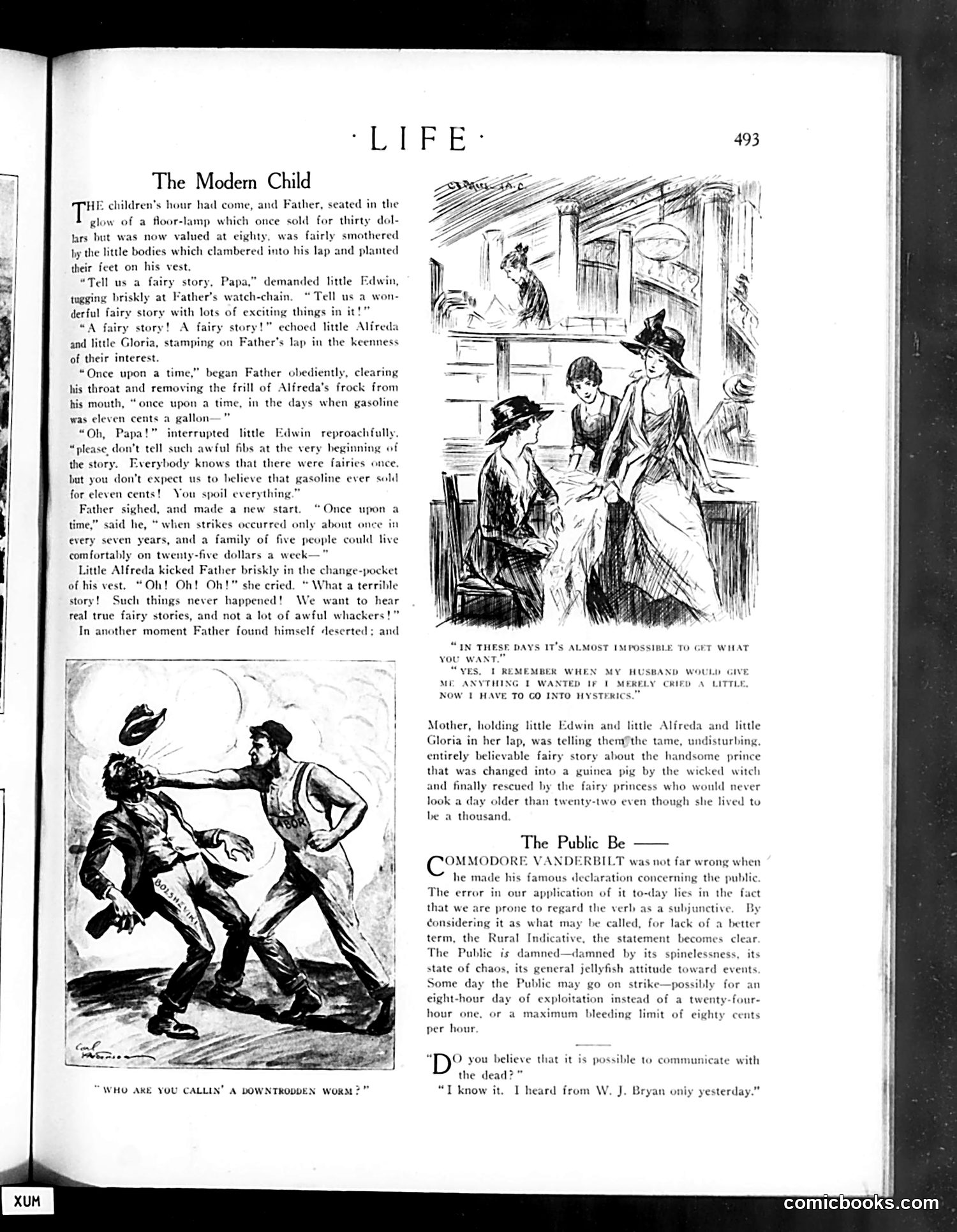
**"The Modern Child"** section satirizes how fathers tell sanitized fairy tales to children. The father begins "Once upon a time" but is interrupted by his son Edwin, who demands he not lie—pointing out that gasoline costs eleven cents a gallon, not the "once every seven years" the father claimed. The satire mocks how modern children, exposed to real economic facts, reject their parents' outdated storytelling methods. **"The Public Be"** section, referencing Commodore Vanderbilt's famous declaration about the public, discusses public indifference to societal issues. The accompanying cartoon depicts a confrontation between two men, likely representing labor or class conflict. The phrase "who are you callin' a downtrodden worm?" suggests mockery of workers' complaints about exploitation.
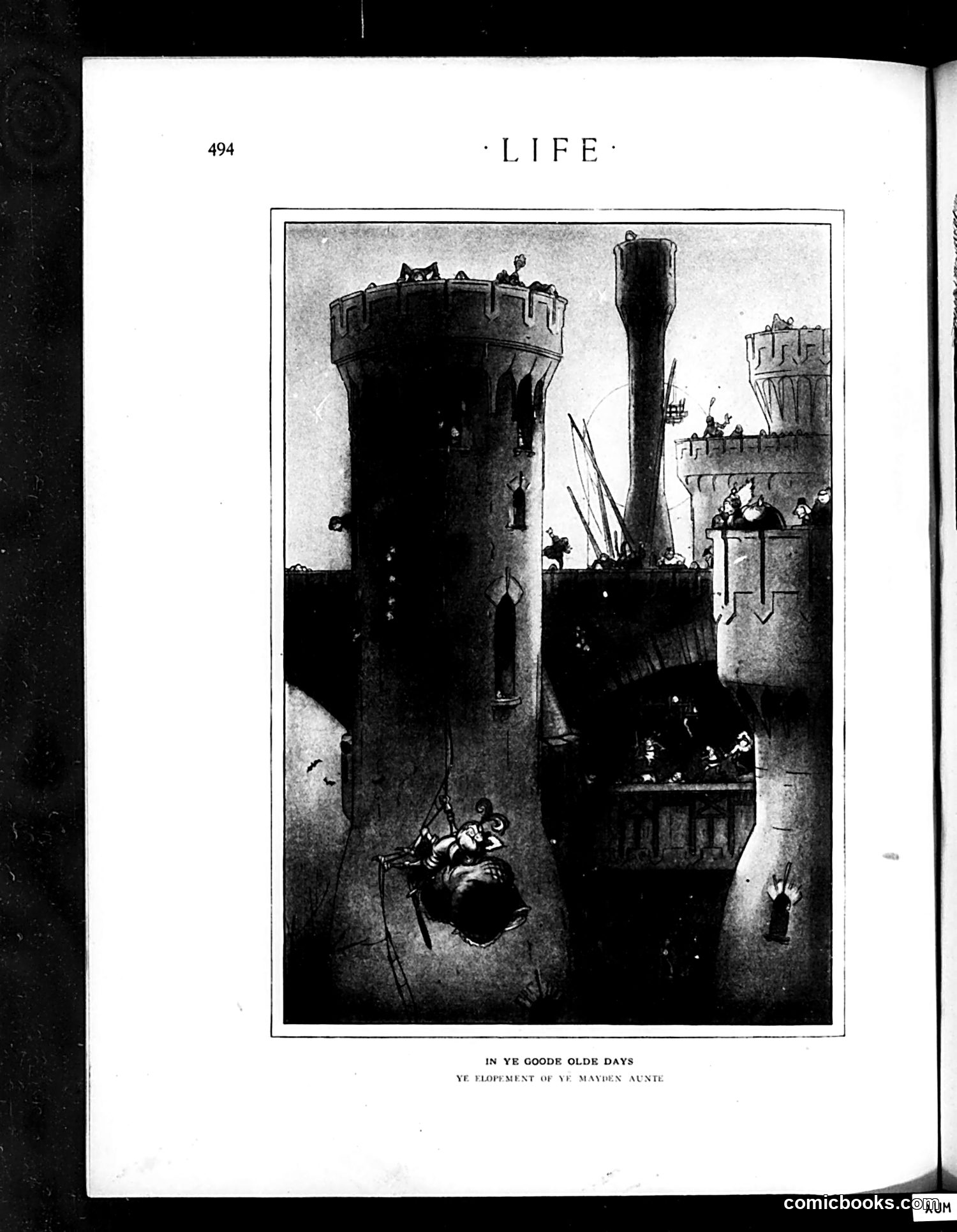
This is a satirical illustration titled "In Ye Goode Olde Days: Ye Elopement of Ye Mayden Aunte," using pseudo-archaic language to mock medieval or historical romanticism. The image depicts a dramatic castle siege scene with a young woman being lowered from a tower on a rope while soldiers and armed figures watch from fortifications. The satire appears to target sentimental, romanticized versions of history—particularly the popular trope of maiden elopements from castles during medieval times. The joke likely ridicules how such dramatic "elopement" scenarios were depicted in contemporary literature and entertainment as thrilling romance, when the reality would involve dangerous, undignified escapes. The archaic spelling and language ("Ye Goode Olde Days") enhances the satirical tone by exaggerating nostalgic historical fetishization common in early 20th-century popular culture.
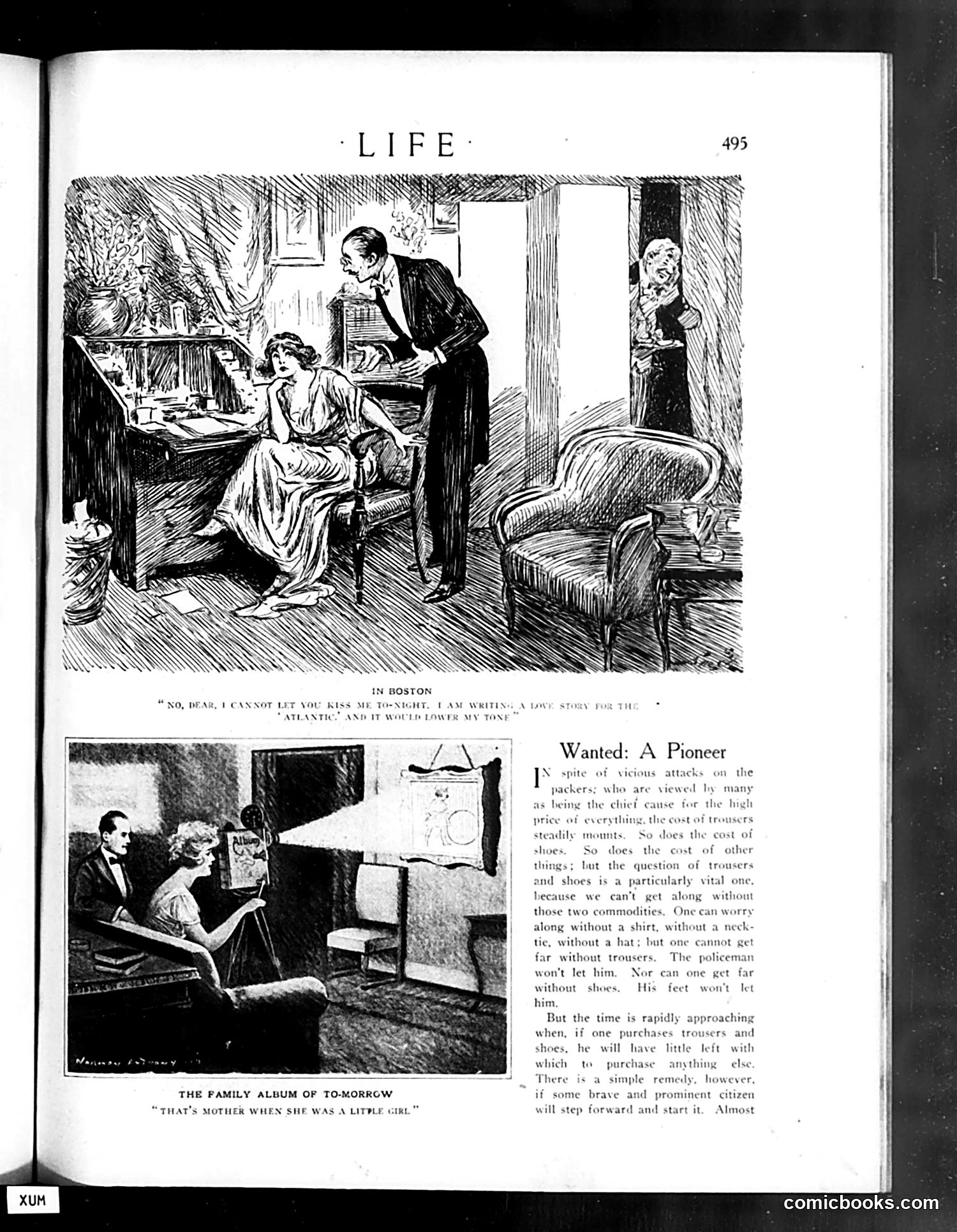
**Top Cartoon ("In Boston"):** A domestic scene satirizing artistic pretension. A woman sits at a desk refusing her suitor's kiss, claiming she's writing "a love story for the Atlantic" and cannot lower her "tone." The joke mocks self-important writers who adopt exaggerated seriousness about their work, prioritizing artistic dignity over romance. **Bottom Cartoon ("The Family Album of To-Morrow"):** Shows a man viewing a photograph labeled as his mother as a child. The implied joke appears to be about photography or image manipulation—likely satirizing either the unreliability of old photographs or changing standards of childhood appearance. **Article ("Wanted: A Pioneer"):** Commentary on inflation and the cost of living. The text argues that trousers and shoes are essential expenses that are consuming wages, leaving nothing for other purchases. It calls for someone to address this economic problem, likely referencing early 20th-century debates about rising prices and consumer costs.
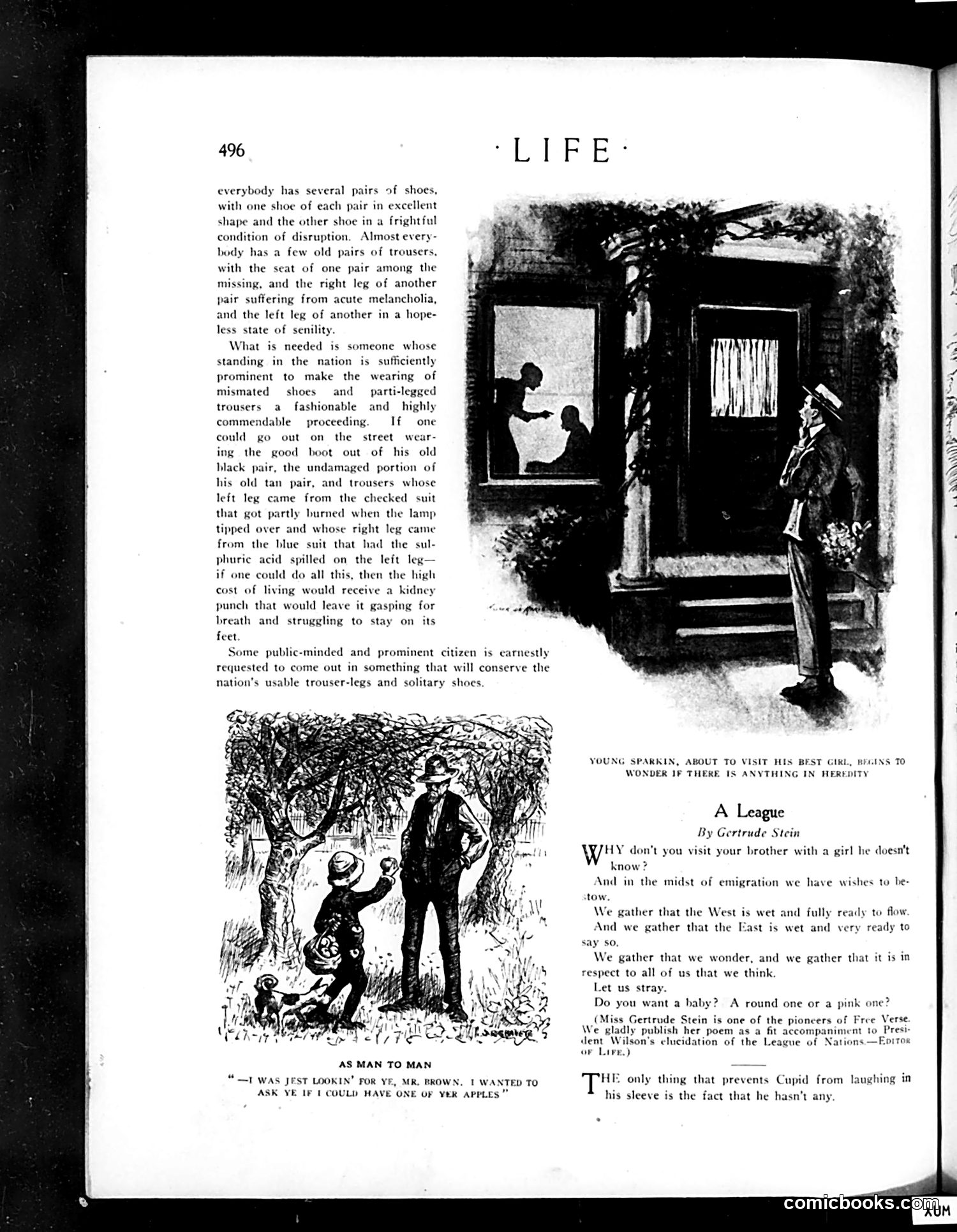
**Top Article & Cartoon ("As Man to Man"):** A satirical proposal that some prominent public figure should wear mismatched shoes and patched trousers to make thrift fashionable during economic hardship (likely post-WWI). This would reduce waste and help citizens afford living expenses. The accompanying cartoon shows a man asking Mr. Brown for apples, illustrating the general economic strain. **Lower Section ("A League"):** Gertrude Stein's experimental free-verse poem about emigration and uncertainty, published alongside a young man's anxious visit to his girlfriend—he worries about heredity ("anything in heredity" caption). The poem's abstract language reflects Modernist style. Life's editorial note links it to President Wilson's League of Nations proposal, suggesting contemporary political preoccupations. **Overall Context:** This page reflects post-WWI America's economic concerns, cultural modernism, and debates over international cooperation and national identity.
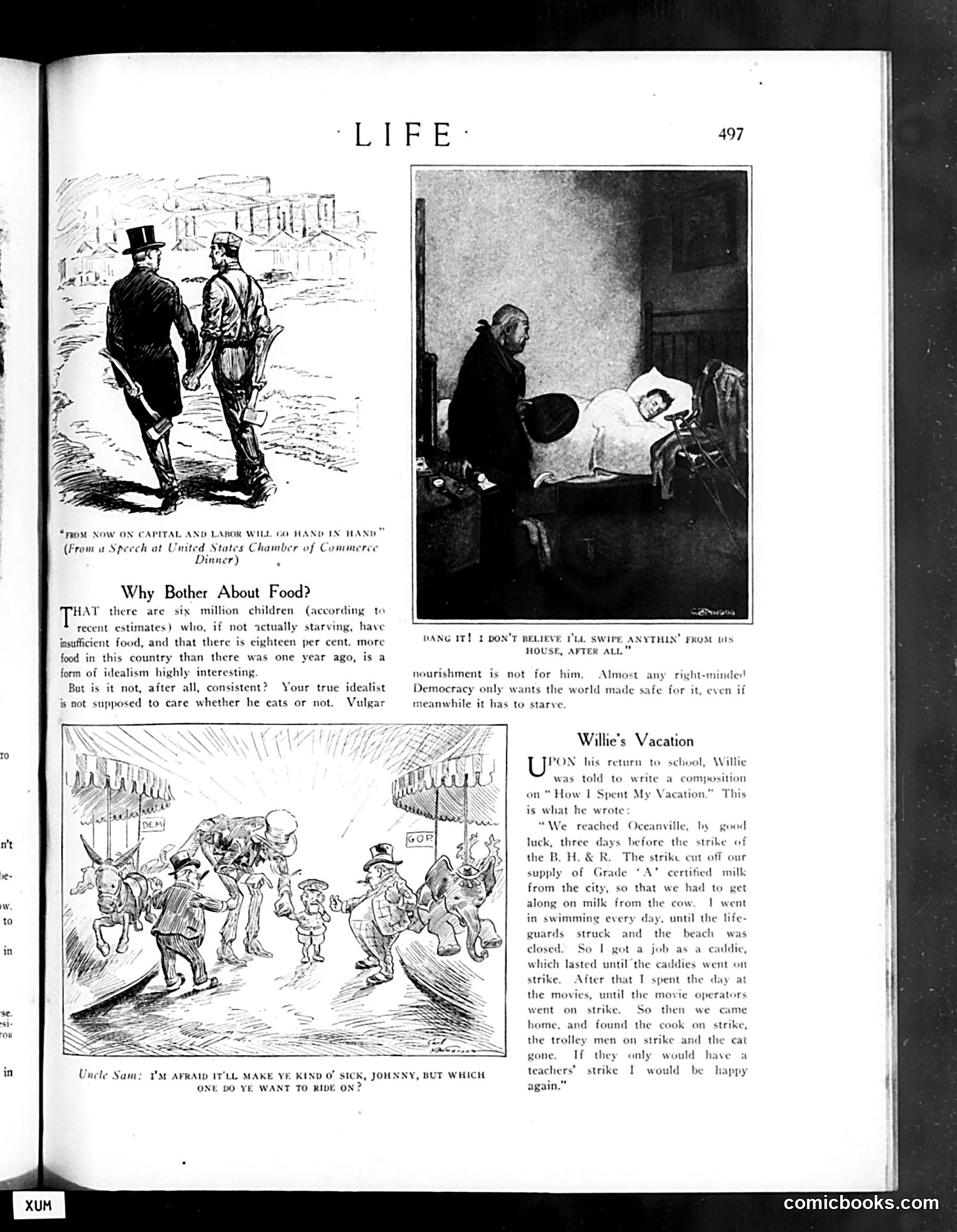
This page satirizes the wave of strikes affecting American society. The top cartoon mocks a Chamber of Commerce speech about "capital and labor" cooperation by contrasting it with the reality of widespread labor unrest. The middle section ("Why Bother About Food?") criticizes idealists who advocate for workers' rights while ignoring actual hunger—six million children lack sufficient food despite food abundance. The main feature, "Willie's Vacation," is a child's composition listing every service disrupted by strikes: milk delivery, lifeguards, caddies, movie operators, trolleymen, household staff. The joke's bitter punchline: Willie wishes teachers would strike too, so he wouldn't have to return to school. The bottom cartoon shows Uncle Sam offering Johnny a choice between two strike situations—implying no good options exist. Collectively, the page suggests strikes have become so pervasive they've paralyzed normal life, while those advocating worker causes seem disconnected from practical consequences.
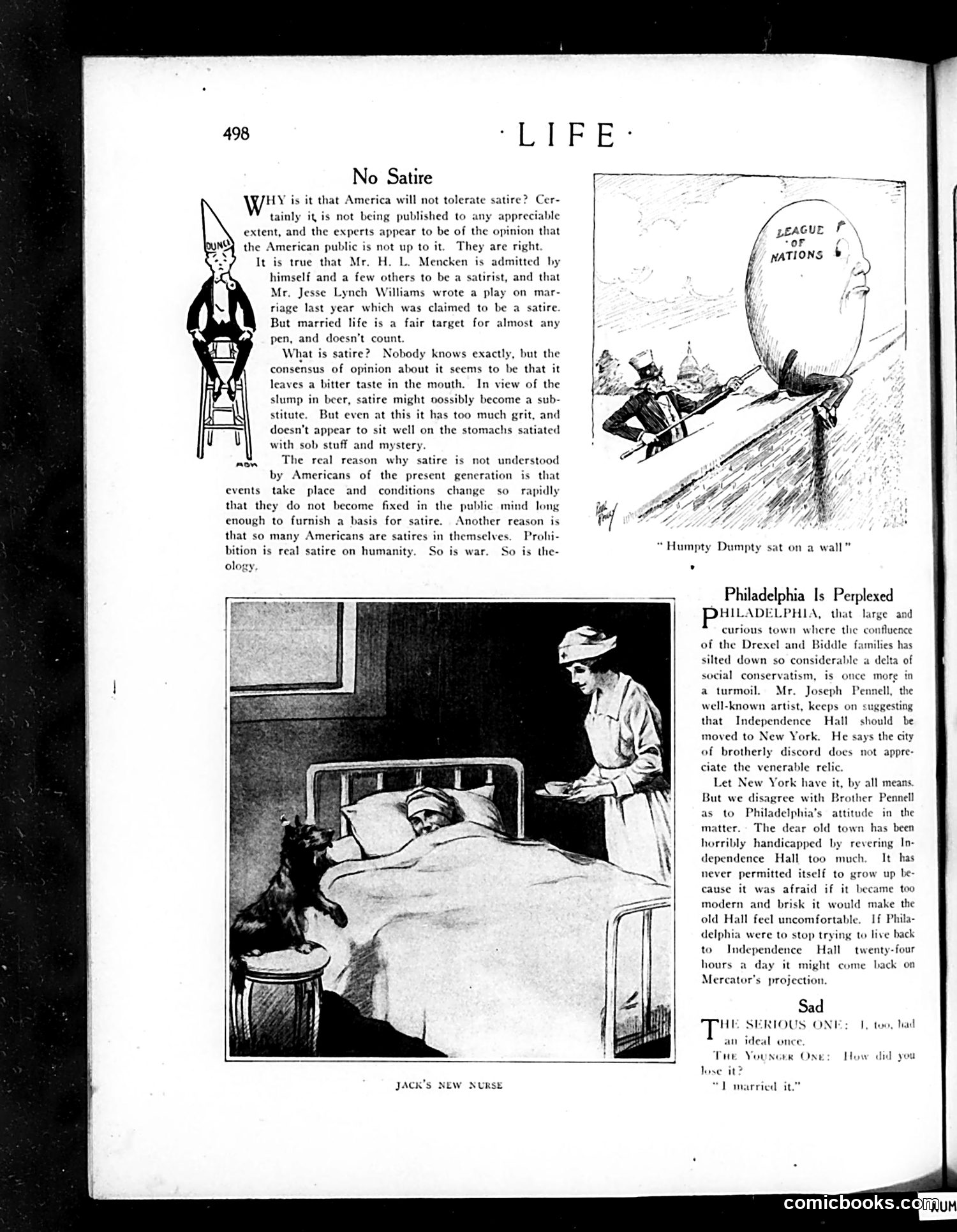
This page critiques American attitudes toward satire and contains two separate pieces: **"No Satire"** argues that Americans reject satirical content because rapid social change prevents ideas from becoming fixed in public consciousness long enough for satire to take hold. The essay notes that H.L. Mencken and Jesse Lynch Williams attempted satire, but claims prohibition and war themselves function as unintentional satire on humanity—suggesting American reality has become too absurd to satirize effectively. **"Philadelphia Is Perplexed"** responds to artist Joseph Pennell's (real person) suggestion that Independence Hall be relocated to New York. The piece mockingly agrees, arguing Philadelphia has stunted its own growth by over-reverencing the Revolutionary site, treating it as too sacred to modernize nearby. The accompanying illustrations are generic: a nurse tending a patient ("Jack's New Nurse"), a silhouette labeled "League of Nations," and "Humpty Dumpty sat on a wall" (likely referencing post-WWI instability). The satirical thrust throughout questions whether American culture can sustain meaningful critique when reality itself seems increasingly contradictory.
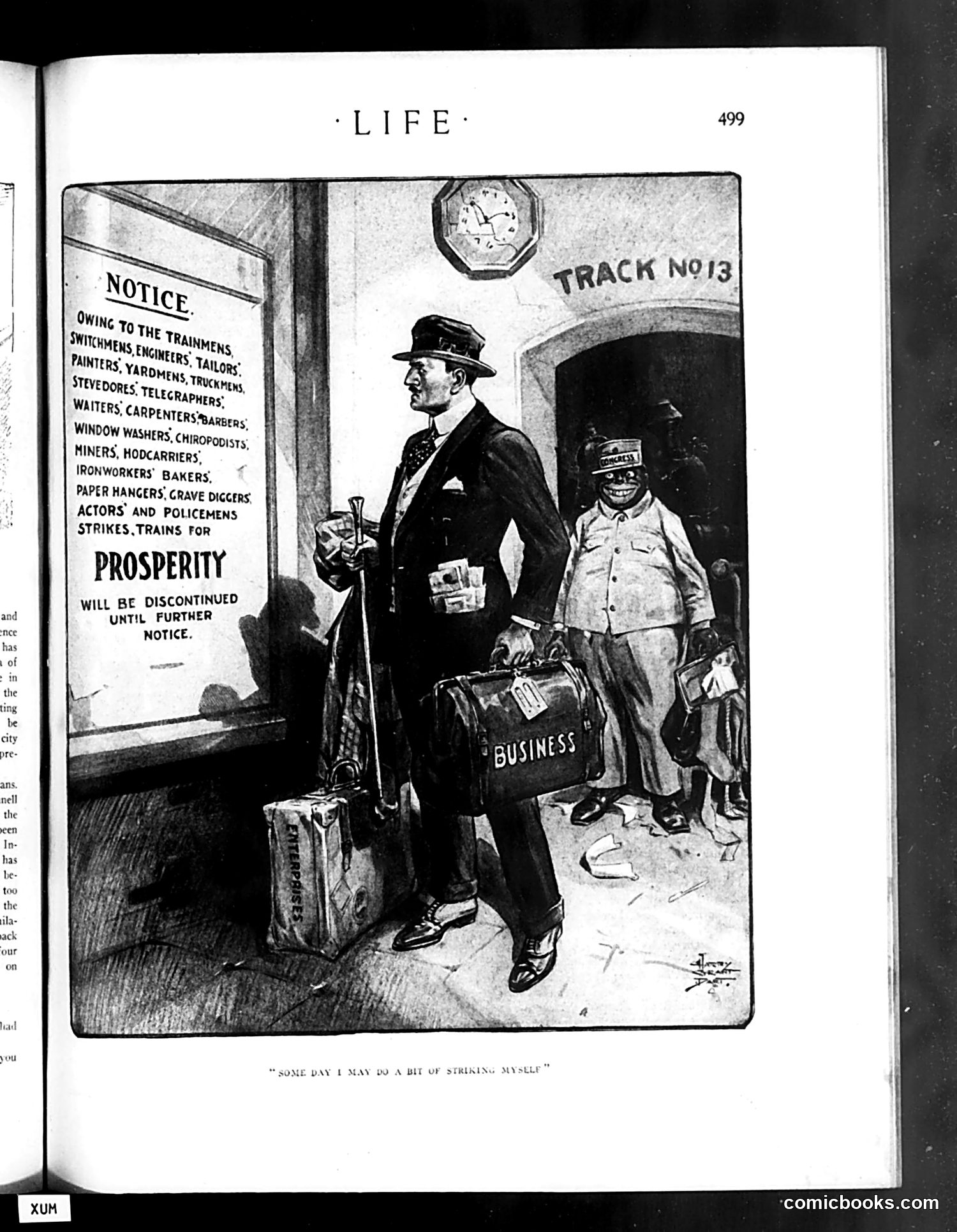
This satirical cartoon from *Life* magazine depicts labor unrest during an era of widespread strikes (likely early 20th century). A well-dressed businessman with a cane—representing capital/management—stands beside a small child labeled "Business," who carries a suitcase. The notice posted behind them sarcastically lists numerous worker categories (switchmen, painters, tailors, miners, actors, policemen, etc.) whose strikes supposedly aim for "prosperity," while announcing these strikes will continue "until further notice." The cartoon's satire mocks management's claim that worker strikes harm "Business" itself. The caption "Some day I may do a bit of striking myself" suggests the businessman cynically considers joining strikes—implying he views the labor movement as self-serving rather than genuinely beneficial. The overall message critiques how business interests blamed workers for economic disruption rather than examining systemic labor disputes.
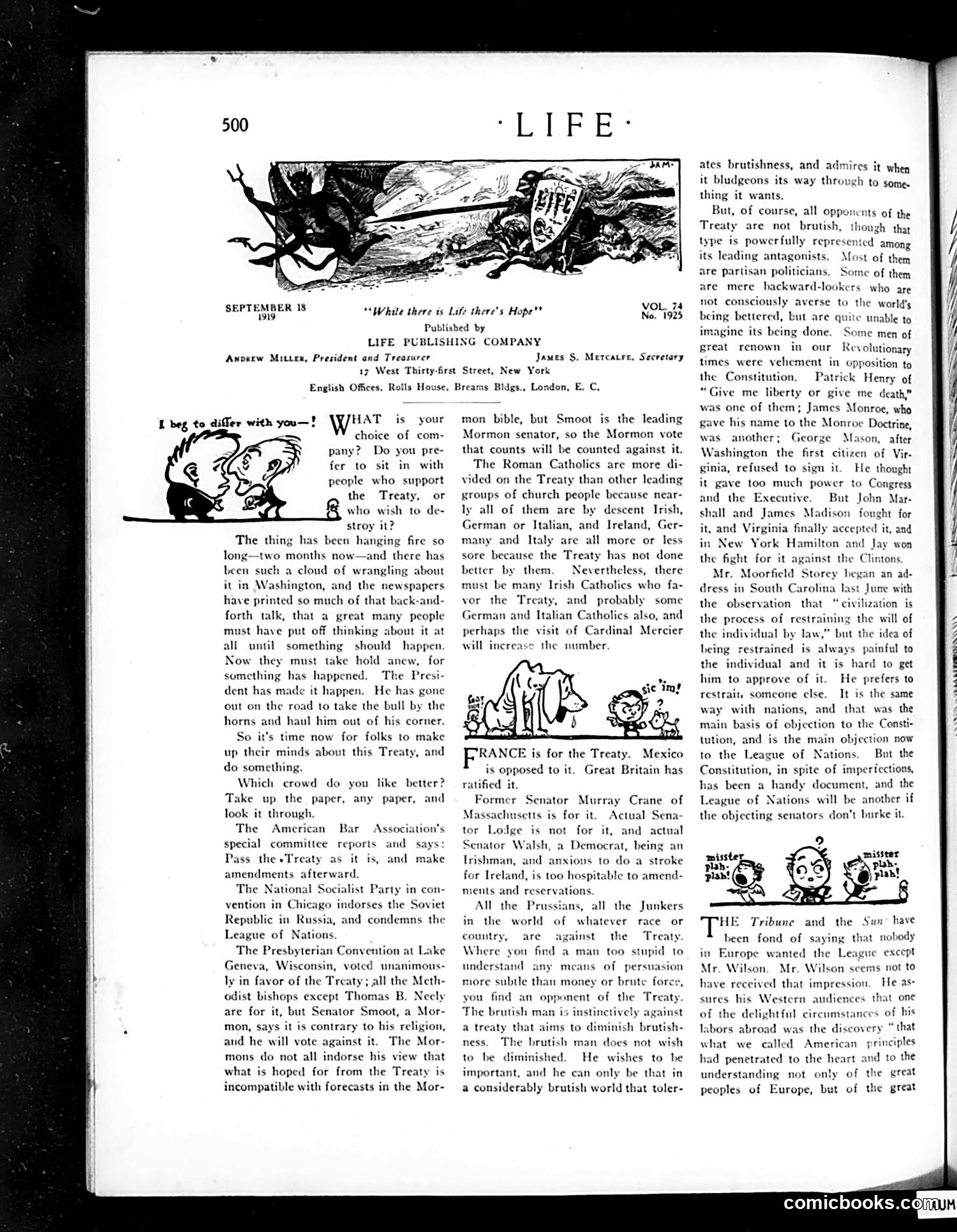
This page debates the League of Nations Treaty ratification, a central post-WWI political issue. The opening cartoon shows two figures arguing—likely representing Treaty supporters versus opponents. The article catalogs diverse positions: the American Bar Association supports ratification; the Socialist Party opposes the League; Presbyterian and Methodist conventions favor it; Senator Smoot (a Mormon) opposes it despite his church's support. Irish, German, and Italian Catholics are divided because their home countries' interests conflict with League membership. The satire's thrust appears in the closing argument: the author claims brutal men instinctively oppose the Treaty because it aims to diminish brutishness, suggesting opponents are either stupid, partisan politicians, or "backward-lookers" unable to imagine progress. This is sharp editorial advocacy disguised as analysis—using characterization to delegitimize Treaty opponents rather than engaging their arguments seriously. The context: this reflects 1920s American isolationism debates.
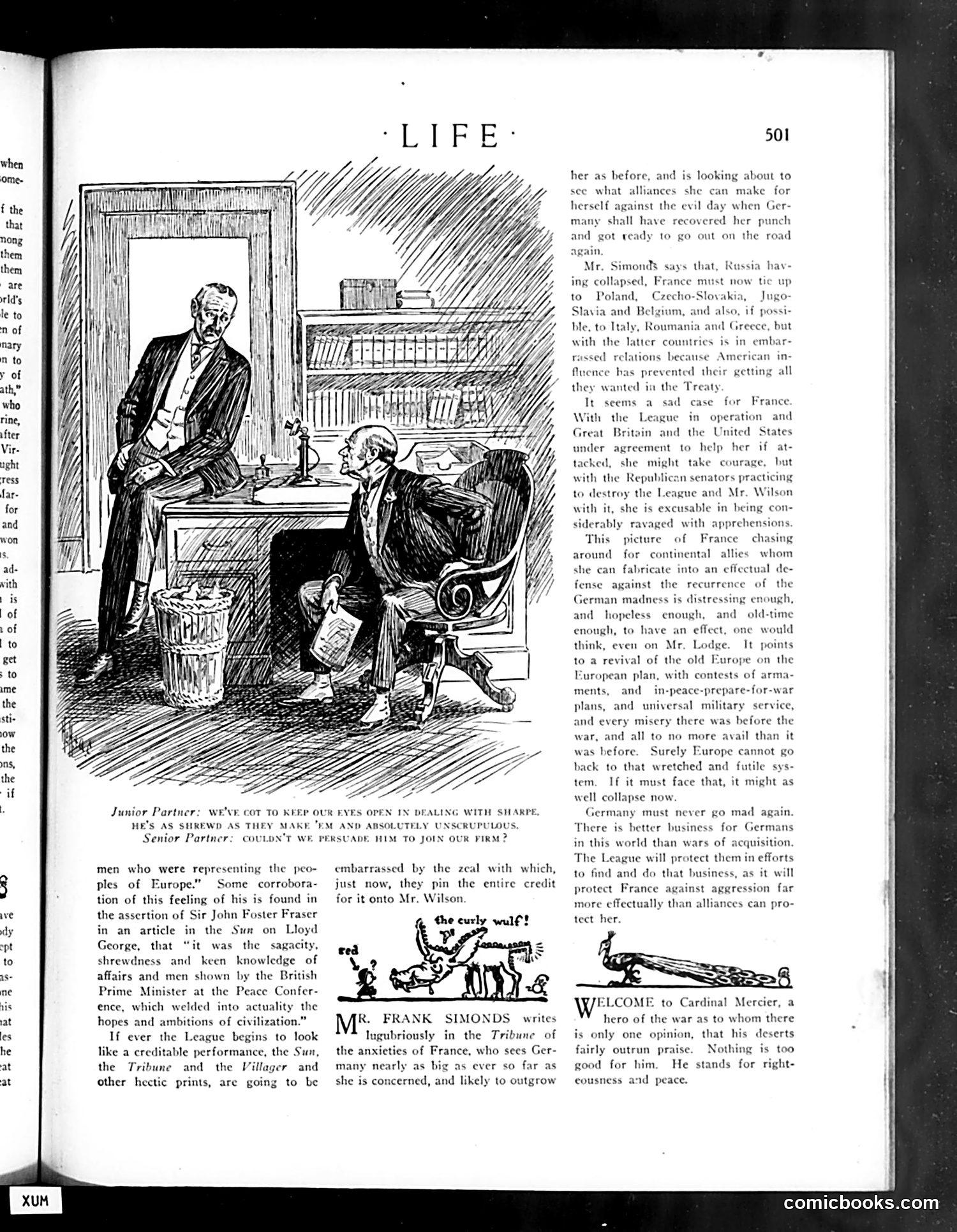
This page contains a business-themed cartoon and post-WWI political commentary. **The Main Cartoon** depicts two businessmen (labeled "Junior Partner" and "Senior Partner") discussing a shrewd, unscrupulous dealer named Sharpe. The junior partner warns they must watch him carefully; the senior asks why they couldn't recruit him instead. The satire targets post-war diplomacy—specifically suggesting that cunning, amoral negotiators like those at the Peace Conference operate like untrustworthy business dealers. **The Political Commentary** addresses France's vulnerability after WWI. Frank Simonds argues France, with Russia collapsed and Germany still potentially dangerous, desperately seeks alliances with Poland, Czechoslovakia, Yugoslavia, Italy, Romania, and Greece. However, Republican senators opposing the League of Nations (likely Senator Lodge, mentioned by name) undermine France's security. The author criticizes this as potentially forcing Europe back into pre-war arms races and militarism—a bleak outcome. He advocates the League as superior protection, and concludes with praise for Belgian Cardinal Mercier as embodying post-war righteousness.
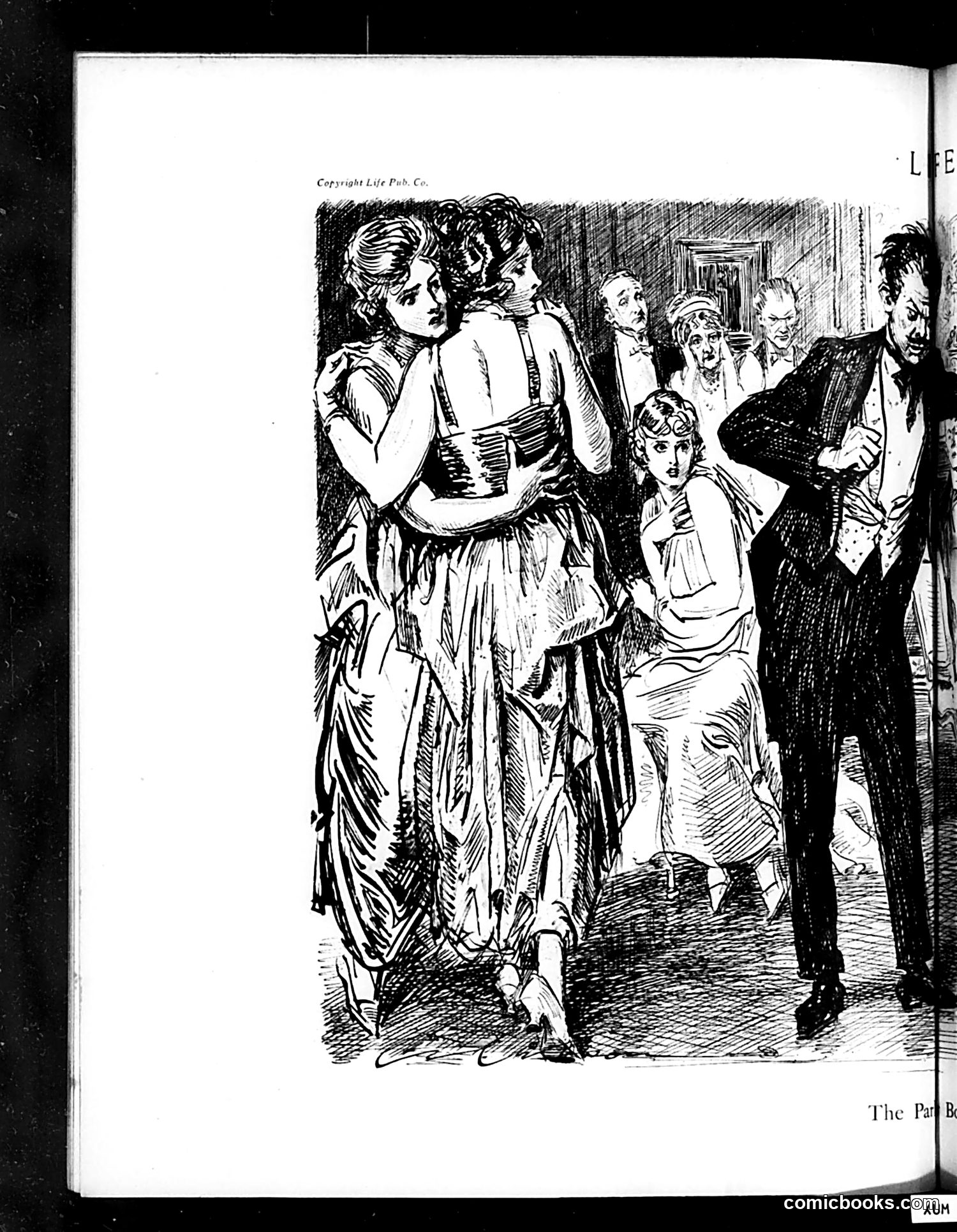
The OCR text is too corrupted to provide meaningful context. However, the image shows a black ink sketch depicting what appears to be a social scene at an elegant indoor gathering. A woman in an evening gown is the central figure, surrounded by men in formal dress and at least one other woman. The drawing style and composition suggest this is satirizing upper-class social dynamics or etiquette. Without legible text identifying the specific figures, events, or social commentary being referenced, I cannot confidently explain the satire's particular target or meaning to a modern reader. The partial title visible ("The Par B...") is insufficient to determine the cartoon's subject matter or satirical intent.
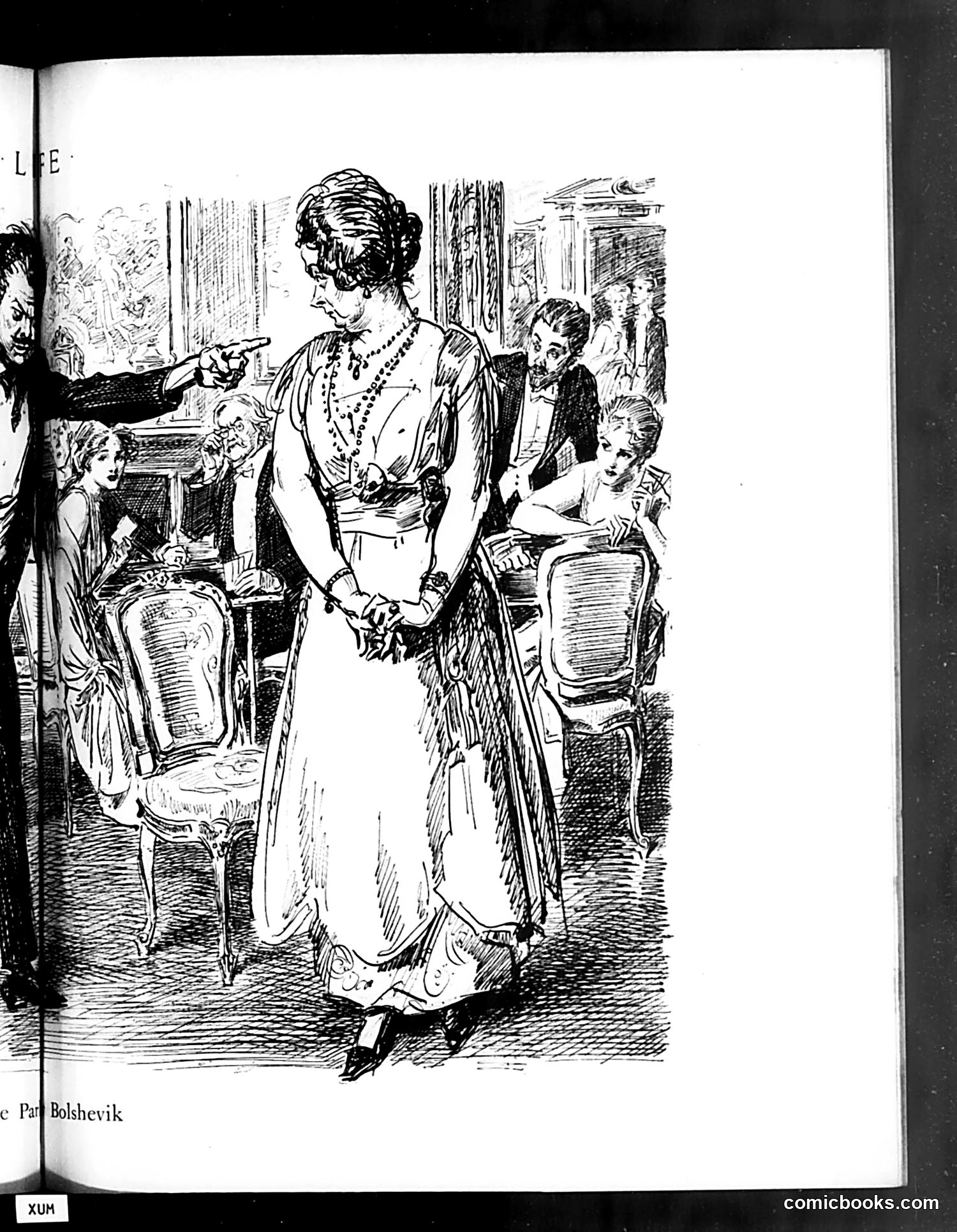
This is an illustration by an artist named Bolshevik (or signed "Patt Bolshevik"). The drawing depicts an elegant woman in an Edwardian-era dress standing among seated figures in what appears to be a formal drawing room or social gathering. The woman wears a pearl necklace and is the clear focal point. Without additional OCR text explaining the cartoon's caption or context, the specific satirical point remains unclear. However, the formal setting and prominent positioning of the central female figure suggests this may comment on high society, social pretension, or women's roles in that era. The presence of "Bolshevik" in the attribution is notable—possibly ironic—given Life magazine's general anti-communist stance during the early 20th century. The actual satirical subject or joke cannot be determined from the image alone.
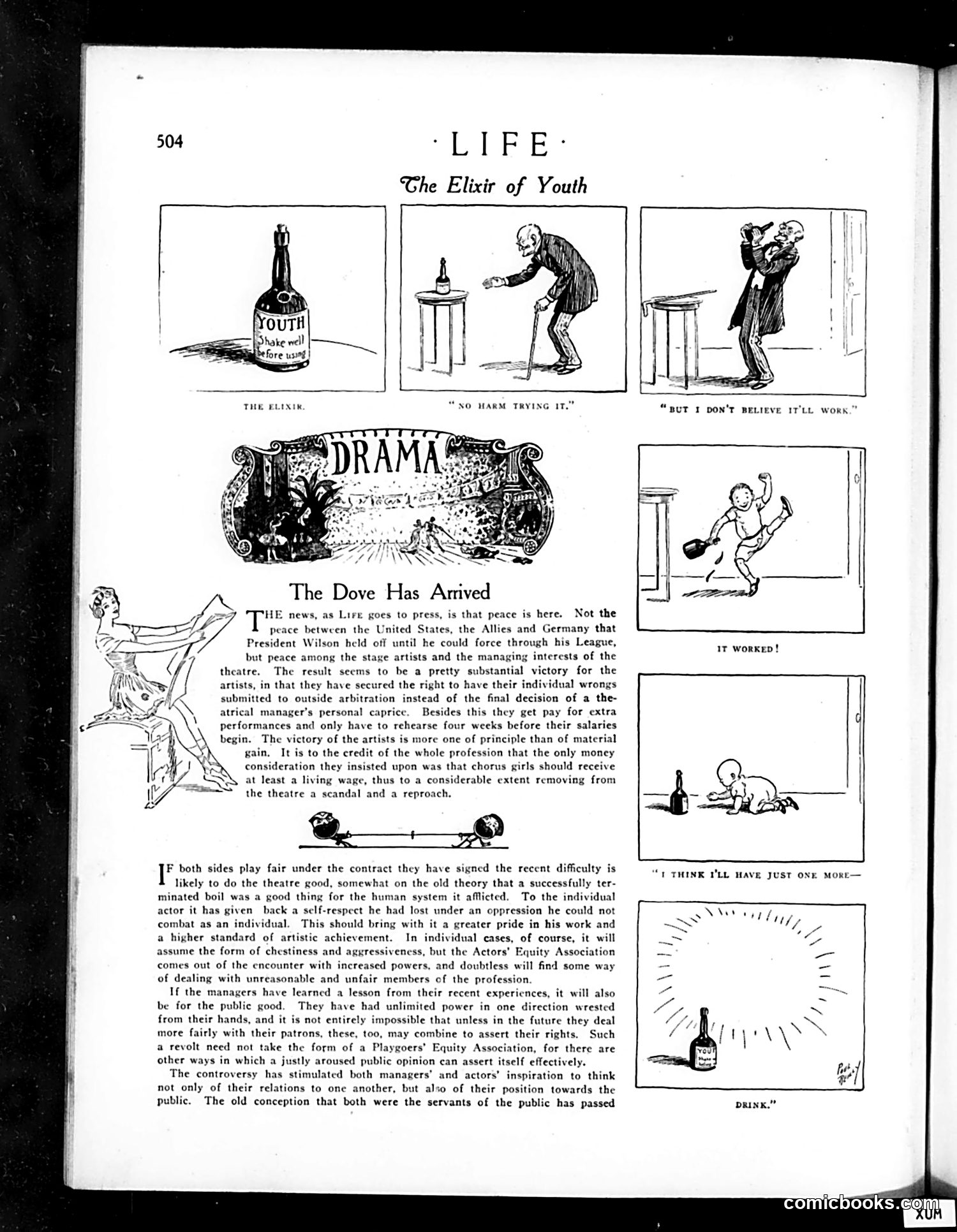
The top comic strip satirizes the "Elixir of Youth"—a bottle labeled literally "YOUTH"—showing a man attempting to use it, with captions expressing skepticism about its efficacy. This mocks false promises of rejuvenation products. The main article celebrates a recent labor peace in American theatre. The Actors' Equity Association apparently won a significant strike or dispute against theatrical managers, securing arbitration rights, extra-performance pay, and four-week rehearsal minimums. Notably, actors prioritized ensuring chorus girls earned living wages—framed as removing "a scandal and a reproach." The accompanying small cartoons (right side) show the elixir "working"—depicting a cherub becoming progressively more intoxicated, ending with the bottle emptied. This darkly suggests the "youth elixir" is actually alcohol, satirizing both false anti-aging remedies and possibly post-Prohibition drinking culture. The editorial praises both labor and management for seeking mutual respect and considering public welfare—a surprisingly optimistic post-strike assessment.
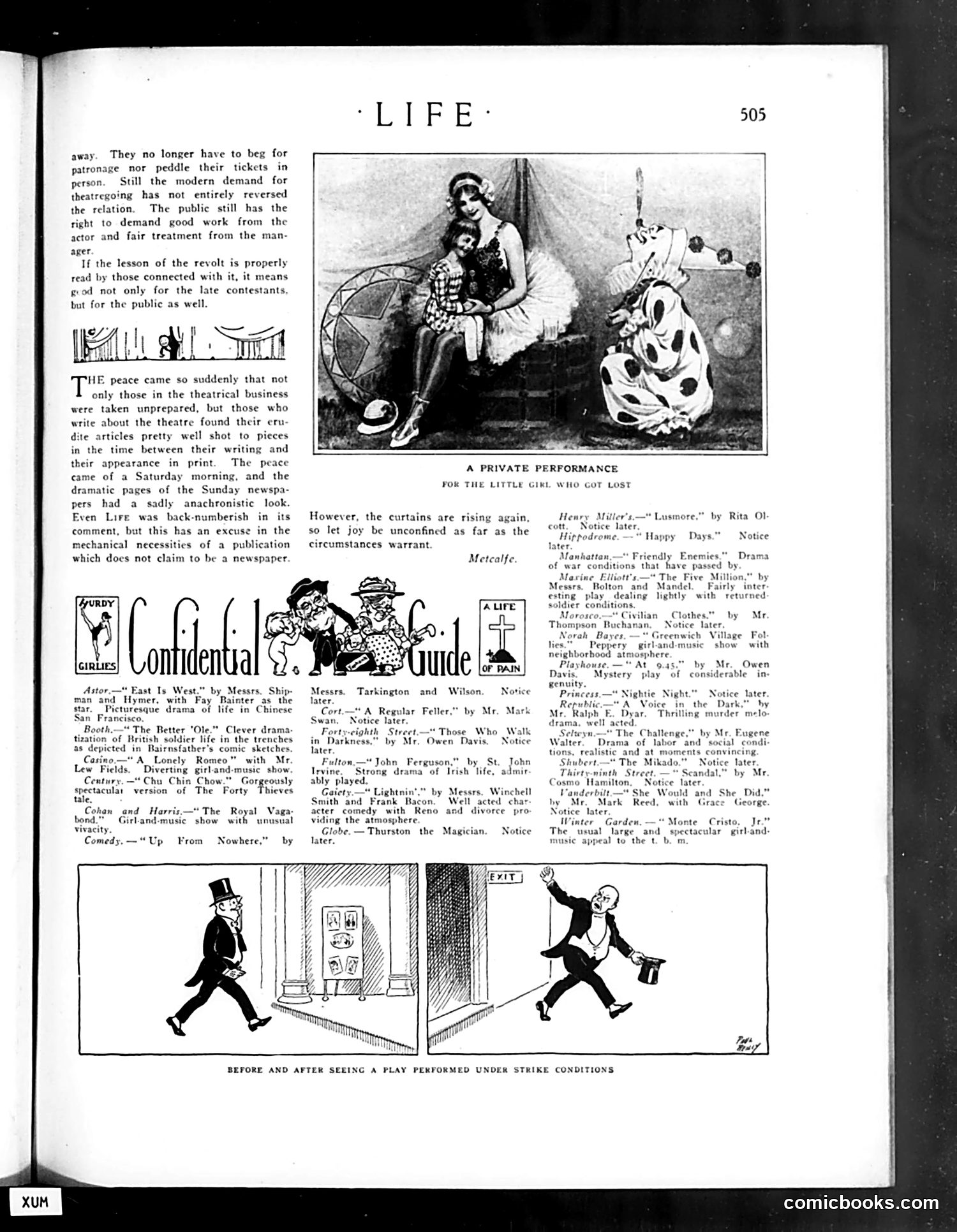
This page reflects the recent end of a **Broadway actors' strike**, likely the 1919 Equity strike that secured union recognition and better working conditions. The text celebrates how the conflict benefited both performers and audiences—actors no longer need to solicit patronage, while the public gained leverage to demand quality. The bottom cartoon titled "Before and After Seeing a Play Performed Under Strike Conditions" uses visual humor to mock the strike's impact: a man enters a theater normally (left panel), then exits in frantic, disheveled distress (right), suggesting the poor quality of hastily-assembled performances during the labor dispute. The page also includes theater reviews and advertisements, reflecting Life's coverage of contemporary entertainment. The overall message: the strike's resolution is good for everyone, though its disruption temporarily affected theatrical quality and even magazine publication schedules.
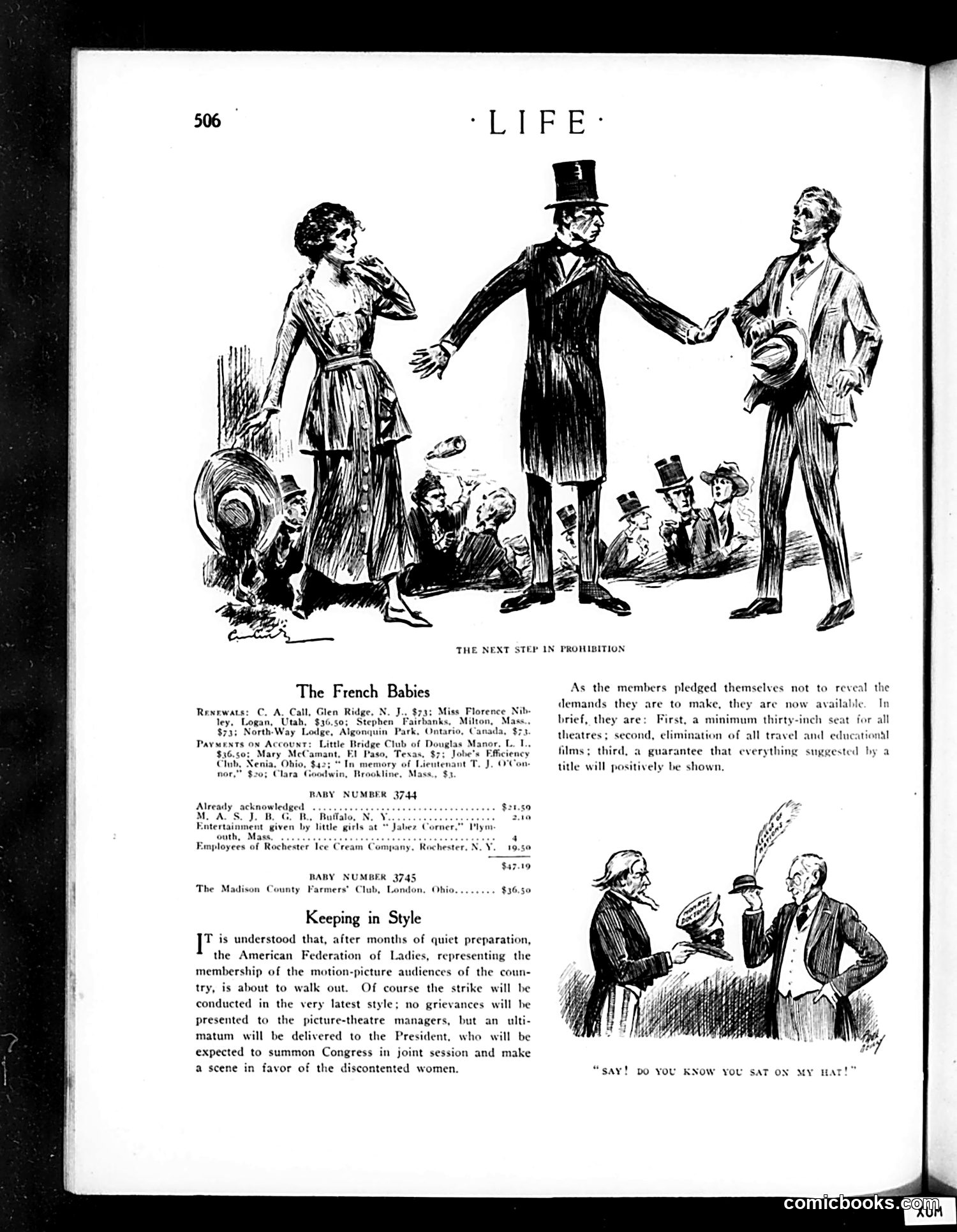
**Top Cartoon - "The Next Step in Prohibition":** This satirizes the women's suffrage/prohibition movement. The central male figure (appears to be a politician or authority figure) is flanked by a woman and man, with smaller figures below representing various groups. The caption suggests the cartoon mocks what comes after prohibition passes—implying women's activism will continue escalating with new, increasingly absurd demands. **Bottom Section - "Keeping in Style":** This article satirizes the "American Federation of Ladies," a fictional women's movie-theater lobby threatening to strike. The satire is that these women won't present reasonable demands to theater managers; instead, they'll demand Congress convene. Their three demands are humorously trivial: wider theater seats (30 inches minimum), eliminating educational films, and ensuring movie titles match actual content. **Overall Point:** The page mocks organized women's activism as frivolous and attention-seeking, using exaggeration to suggest women's demands—whether about prohibition or cinema—are unreasonable and designed primarily for theatrical effect rather than genuine reform.
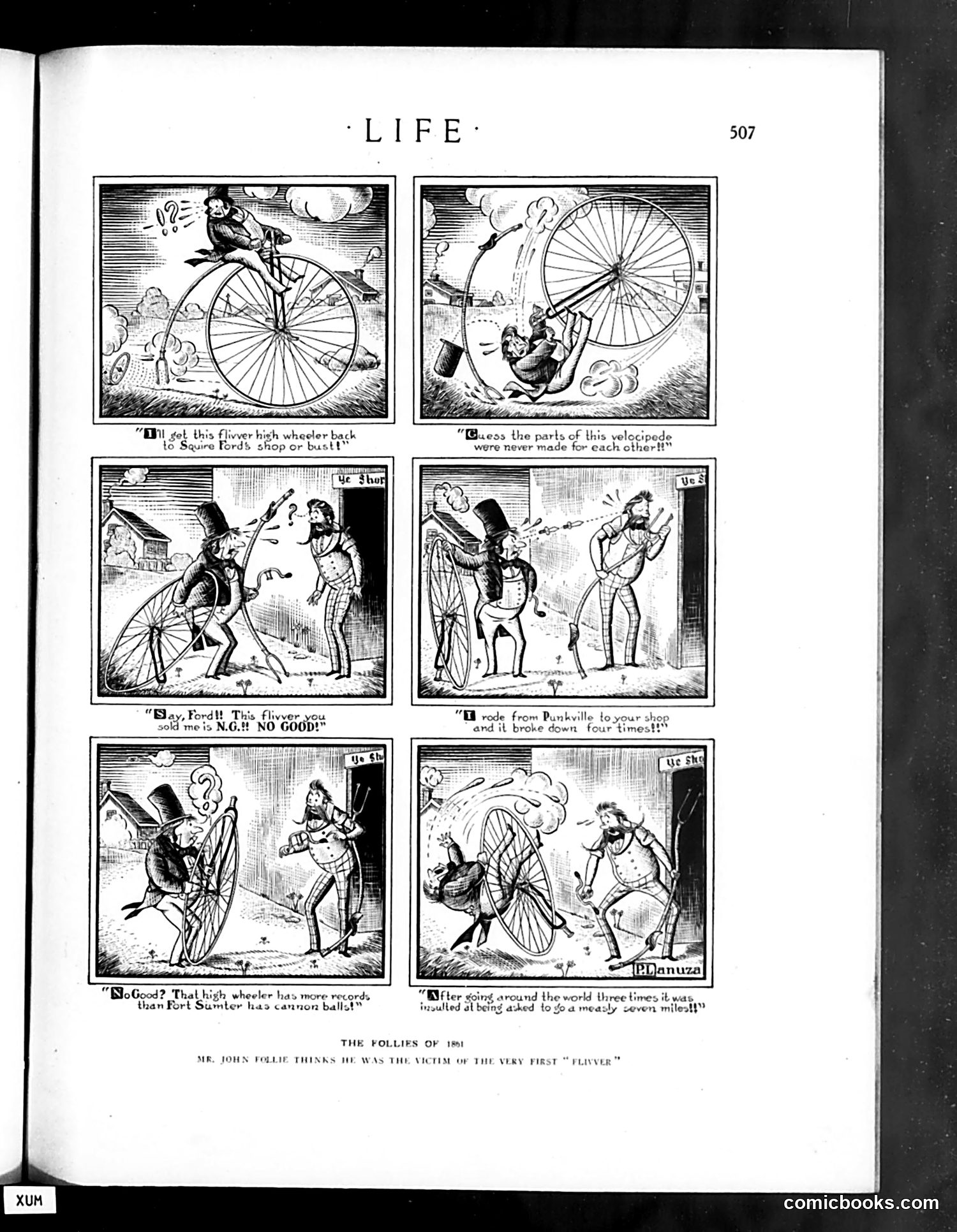
This six-panel comic satirizes the unreliability of early automobiles (called "flivvers"), specifically Henry Ford's Model T. The protagonist, Mr. John Follie, attempts to ride a high-wheeled velocipede/early automobile, which repeatedly breaks down and malfunctions across multiple trips. The humor derives from the contrast between Ford's commercial promises and the vehicle's actual performance—it "broke down four times" on a short journey from Punkville. The reference to "Fort Sumter" (the Civil War's opening battle in 1861) is a historical comparison suggesting this automobile is as outdated and problematic as 1861 technology. The satire targets early automotive manufacturing's quality issues and the gap between advertising claims and reality. The title suggests this mechanical failure represents one of the era's notable "follies"—foolish pursuits or mistakes.
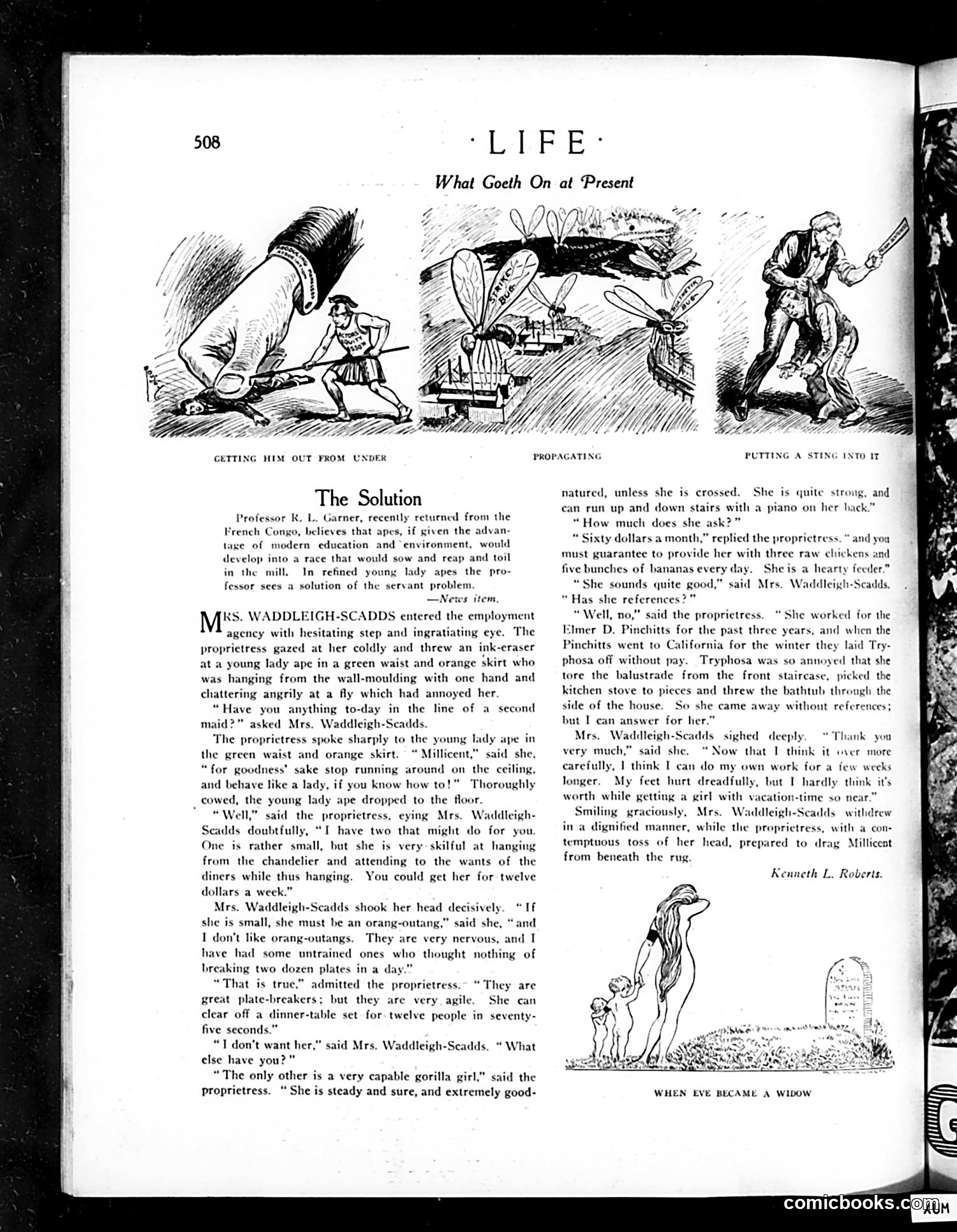
This 1910s satirical piece mocks Professor R.L. Garner's actual scientific proposal that educated apes could solve the "servant problem"—the era's widespread domestic labor shortage caused by working-class women seeking better employment. The cartoon depicts an employment agency interview where Mrs. Waddleigh-Scadds seeks household help. The proprietress offers different ape "candidates": a small orangutan (nervous, breaks dishes), and a gorilla girl (strong but destructive, demanding three raw chickens and five banana bunches daily). **The satire's targets:** - Pseudo-scientific racism linking apes to human labor classes - The desperation of wealthy employers facing servant shortages as women gained independence - The absurdity of treating workers as animals rather than humans deserving wages and dignity The joke lands when Mrs. Waddleigh-Scadds—faced with either nervous, destructive servants or unreasonable demands—decides to do her own work rather than hire at all, undercutting the "solution" premise entirely. It's biting social commentary wrapped in apparent absurdism.
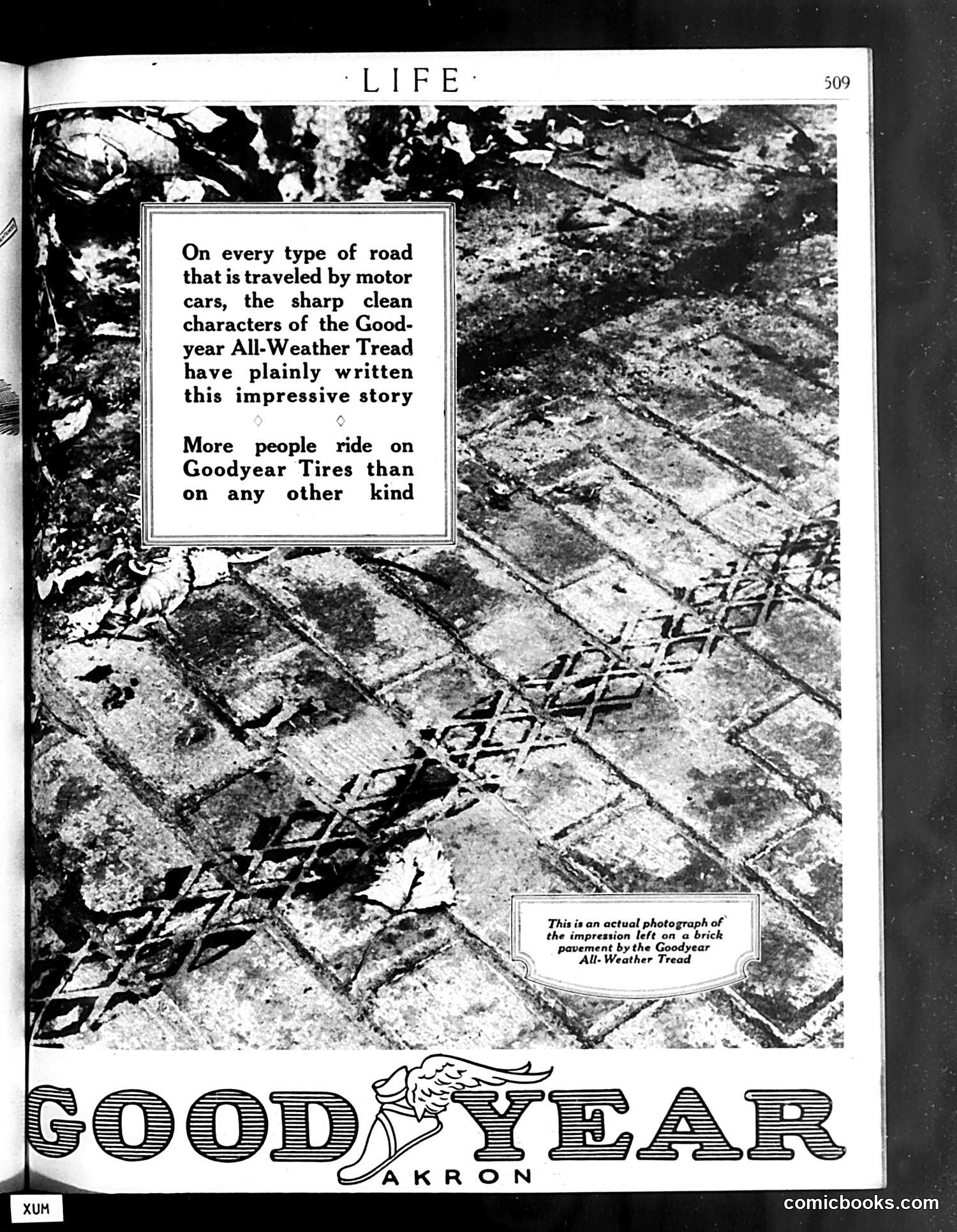
This is a **Goodyear Tires advertisement**, not political satire. The page shows an actual photograph of a tire tread impression left on a brick surface. The ad claims that Goodyear's "All-Weather Tread" design leaves distinctive, visible marks on various road surfaces—presented as evidence of superior grip and performance. The marketing argument: the tread pattern's clarity demonstrates effectiveness; more drivers choose Goodyear than competitors. The photograph serves as proof of the product's distinctive engineering. This represents early 20th-century advertising strategy: using technical/scientific imagery to suggest product superiority and reliability to automobile owners.
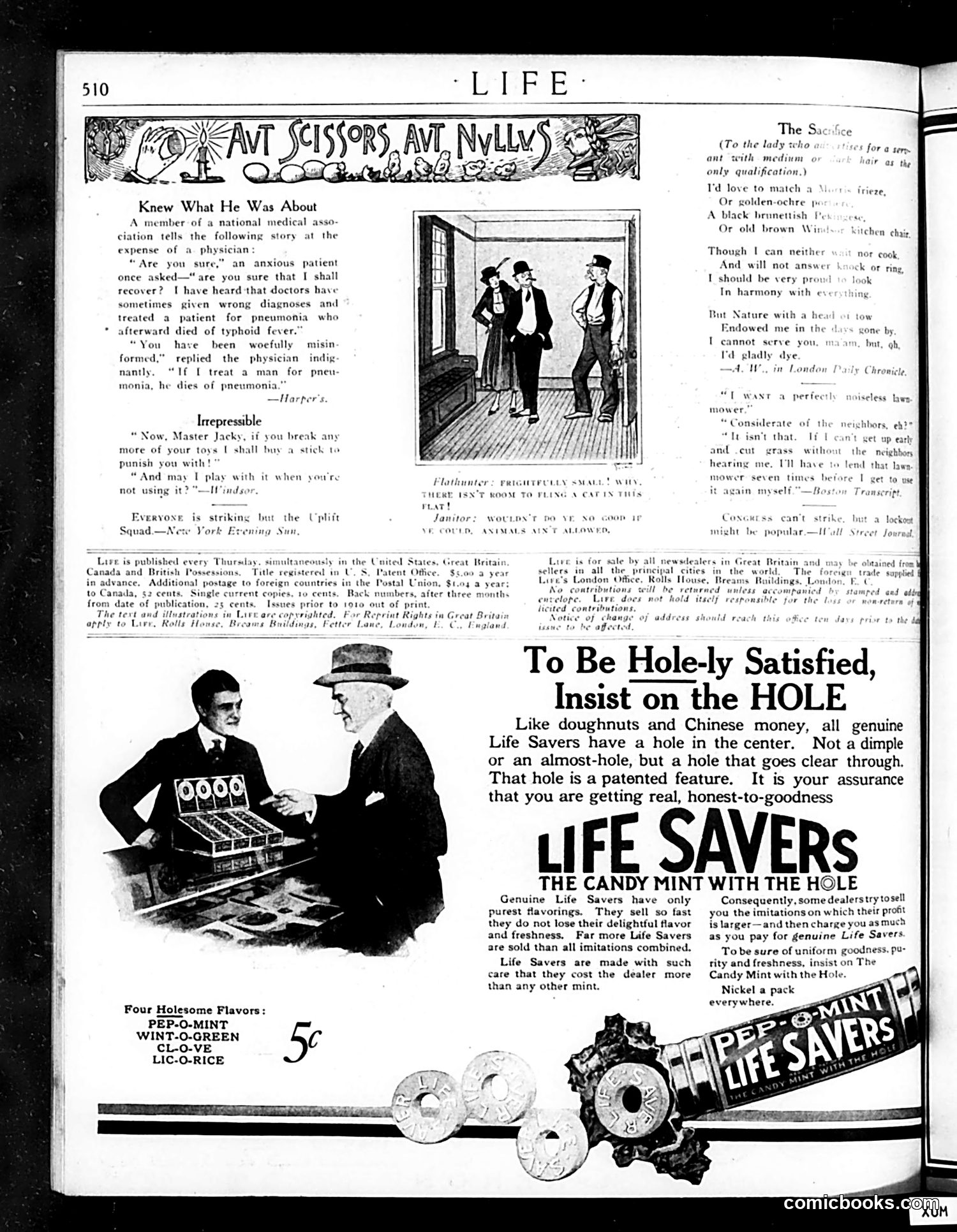
This page contains mostly **advertising and humorous anecdotes** rather than political cartoons. The top section features three brief jokes from *Harper's* magazine: one about a doctor's confident diagnosis, one about a child's cheeky logic regarding punishment, and one about an "uplift squad" and animals. These are gentle domestic humor pieces without clear political intent. The dominant content is a **Life Savers candy advertisement** (lower half). It emphasizes the trademark hole through the center as proof of authenticity, warning consumers against imitations that dealers might substitute to increase profit margins. The ad lists four flavors and costs a nickel. The page's satirical content is minimal—mostly lighthearted observations about everyday life rather than commentary on specific historical events or political figures. The "Ait Scissors, Ait Nullus" header suggests general satirical commentary, but specific references are unclear from this excerpt.
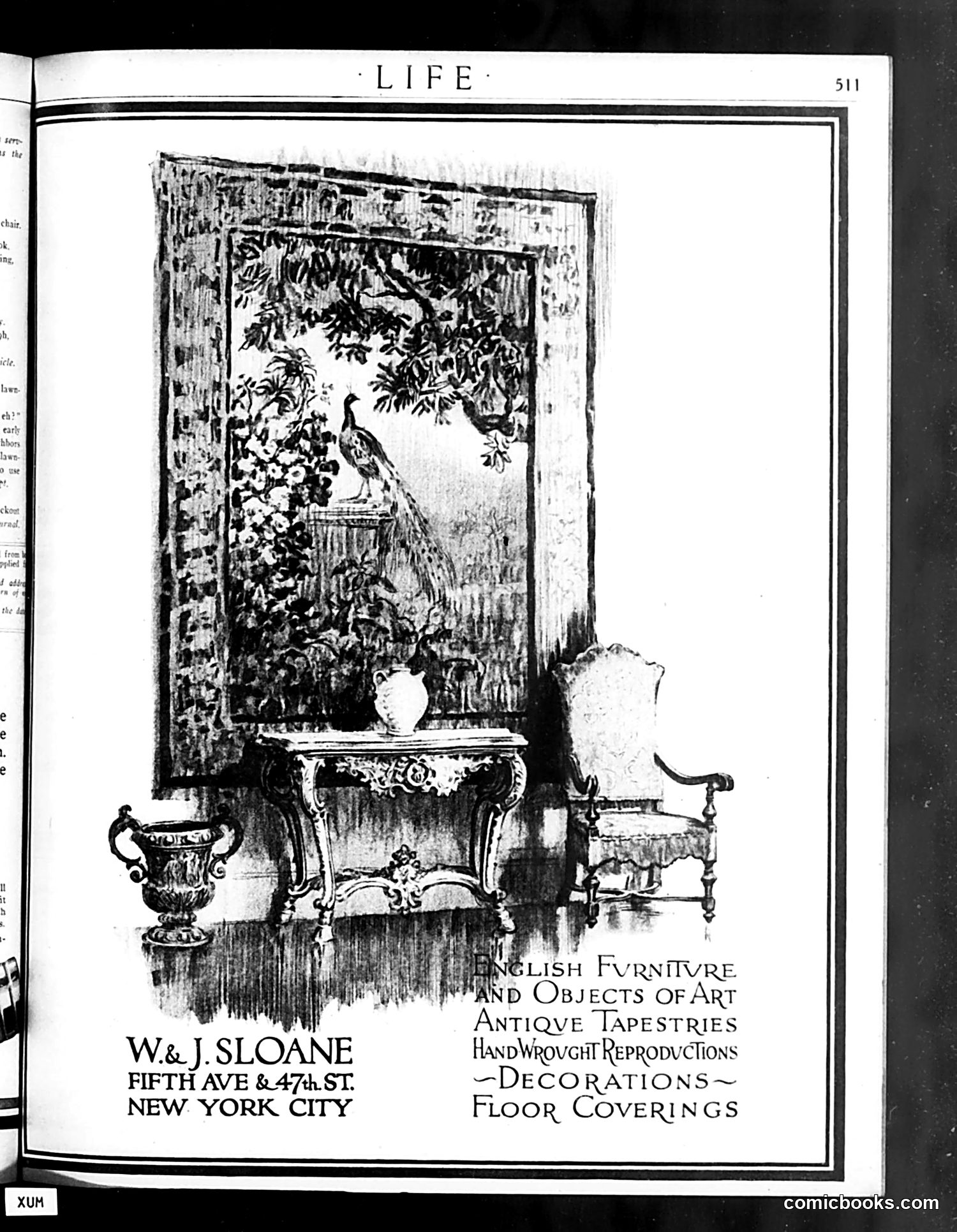
This is a full-page advertisement, not a cartoon or satirical content. It promotes W. & J. Sloane, a New York City furniture and decorative arts retailer located at Fifth Avenue and 47th Street. The ad showcases their merchandise through an illustrated interior scene featuring English furniture, antique tapestries, hand-wrought reproductions, decorative objects, and floor coverings. A peacock adorns a framed tapestry above a console table, flanked by a classical urn and chair, emphasizing the luxury and refined aesthetic of their wares. There is no political satire or commentary present—this is straightforward period advertising aimed at wealthy consumers seeking high-end furnishings and decorative items.
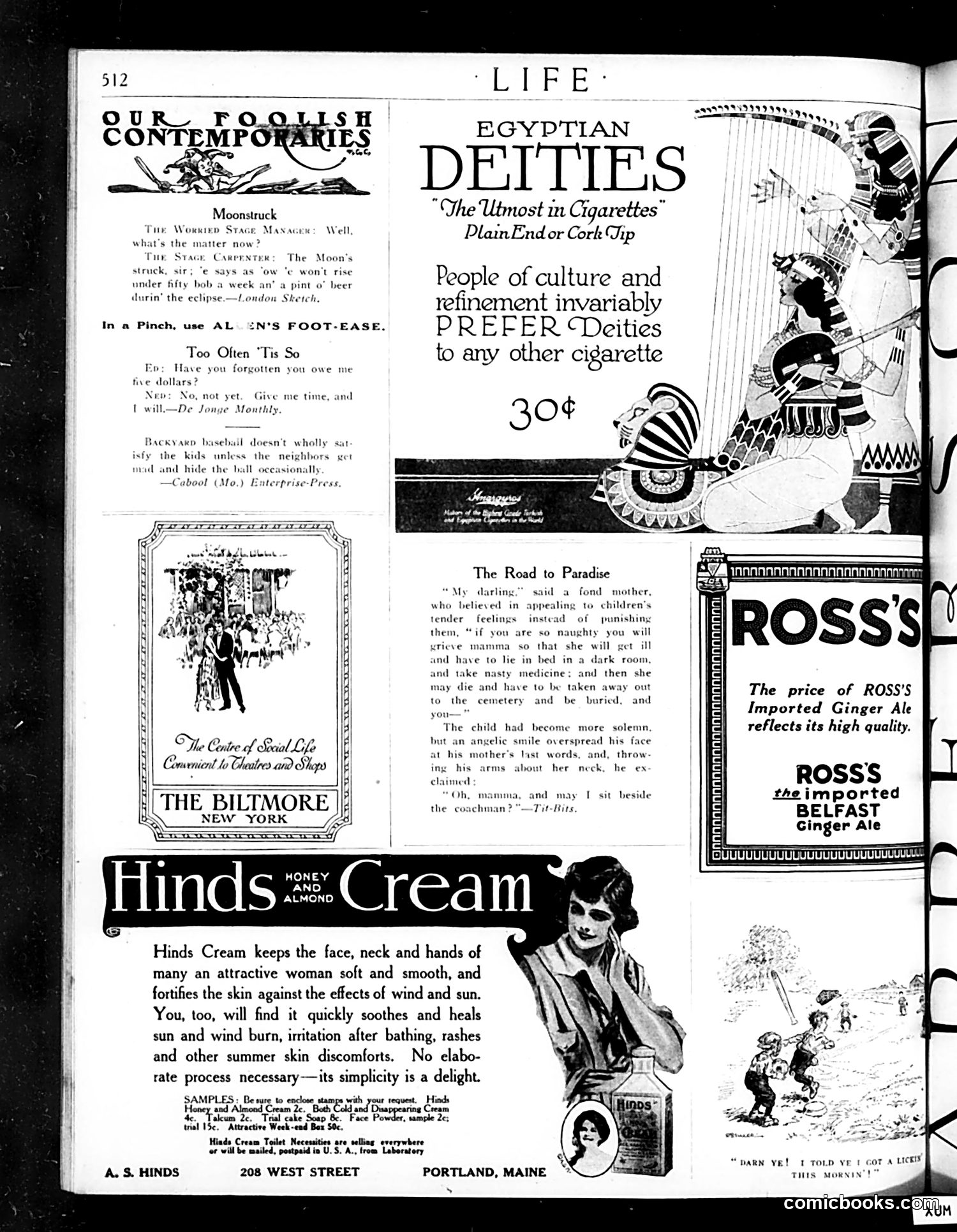
This page is primarily **advertising**, not political satire. The dominant content consists of commercial advertisements interspersed with brief humorous anecdotes. The main humor pieces are mild workplace and domestic jokes: a stage carpenter complains the moon "won't rise" without payment; a debtor stalls a creditor; neighbors hide a baseball so backyard play won't disturb them; and a mother guilt-trips her naughty child by describing her own death and burial. The advertisements include **Egyptian Deities cigarettes** (featuring stylized Egyptian imagery), **Hinds Honey and Almond Cream** (a skin care product), **Ross's Imported Belfast Ginger Ale**, and **The Biltmore hotel** in New York. The small cartoon at bottom-right shows a child saying "Darn ye! I told ye I got a lickin' this mornin'!"—likely commenting on corporal punishment attitudes of the era. No significant political content or identifiable caricatures appear on this page.
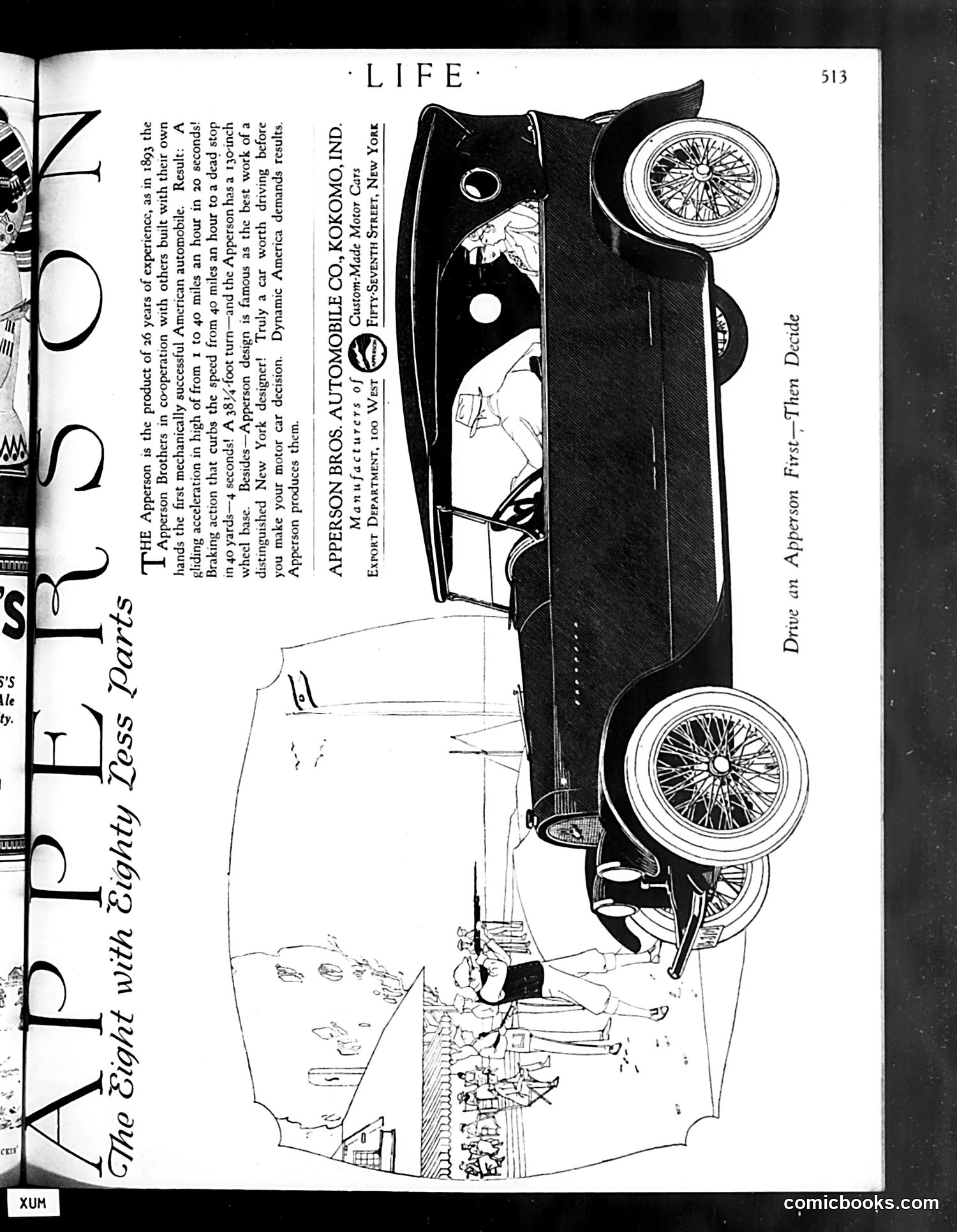
The OCR text is severely corrupted and largely illegible, making it impossible to read the article's content accurately. However, the **image** shows an advertisement for an **Apperson Bros. Automobile**. The illustration depicts a vintage car (appears to be from the 1910s-1920s era) shown from the side, with detailed drawings of its wheels, body, and mechanical features. The heading reads "APPERSON BROS. AUTOMOBILE CO." with text about it being "Custom Made Motor Car" and "Finest Seventy-Horse Power Watt." The caption states: "Drive an Apperson First—Then Decide" This is **product advertising**, not political satire. It promotes a luxury automobile brand by suggesting potential buyers test-drive their vehicle before choosing competitors. The sophisticated illustration and confident marketing language reflect early-20th-century automobile advertising aimed at affluent consumers. Without legible OCR text, I cannot identify additional satirical content on this page.
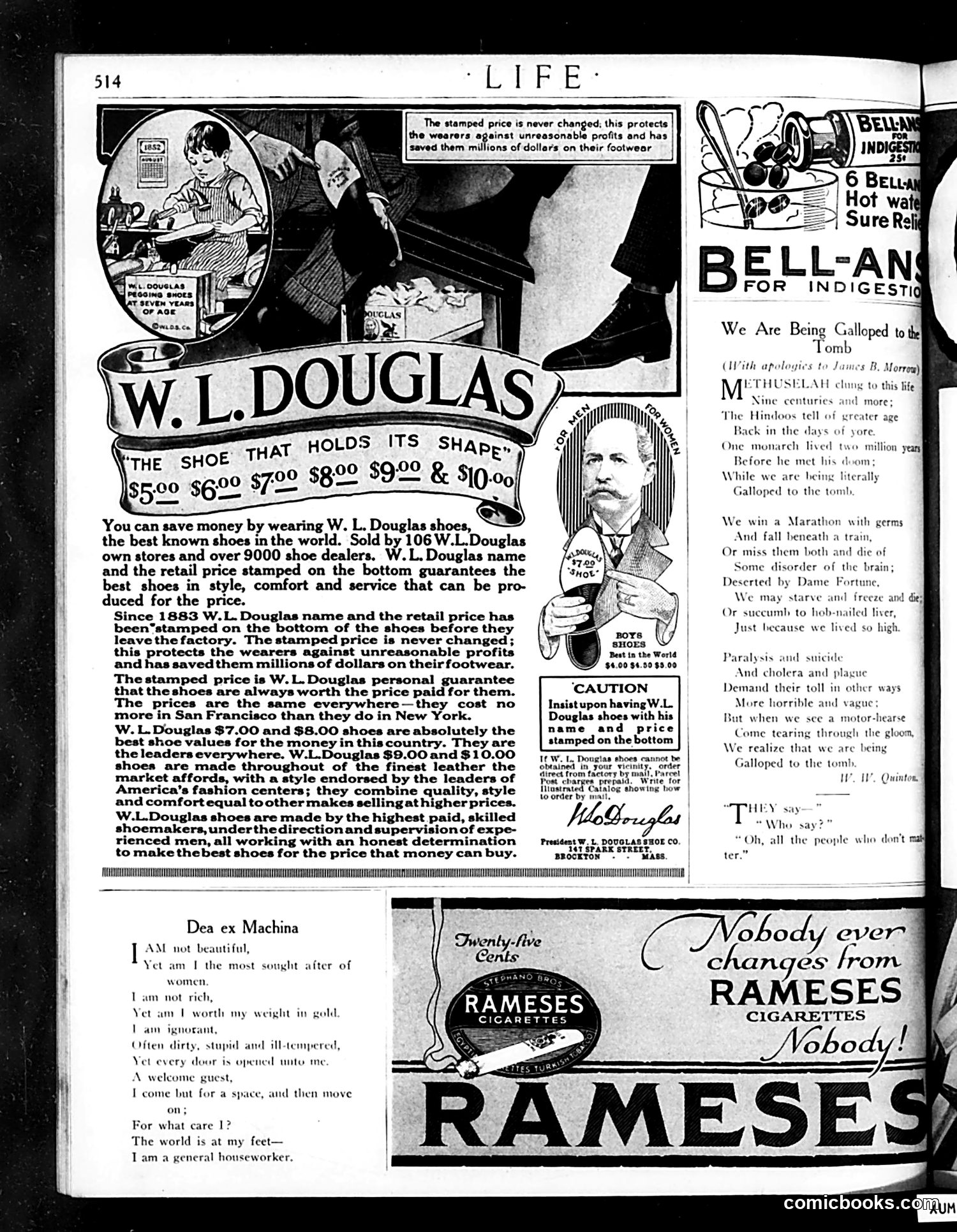
This page contains primarily **advertising** rather than political satire, though it includes some social commentary through poetry. The dominant content is a large **W.L. Douglas shoe advertisement** emphasizing the brand's price-stamping guarantee—a consumer protection measure ensuring shoes cost the same nationwide and preventing retailers from inflating prices. The ad highlights Douglas's status as a quality shoe manufacturer since 1883. To the right is a **poem titled "We Are Being Galloped to the Tomb"** (credited to James B. Morrea) that satirizes modern life's hazards—disease, accidents, poverty—suggesting humans rush toward death despite efforts to survive. It's sardonic social commentary on mortality and misfortune. Below is a brief poem called **"Dea ex Machina"** (literally "goddess from the machine"), personifying Money as an unwelcome guest who opens all doors despite being dirty and ignorant—a critique of money's corrupting social power. At bottom right is a **Rameses Cigarettes advertisement** promising consistent quality. The page reflects early 20th-century consumer culture and anxieties about modern life's dangers.
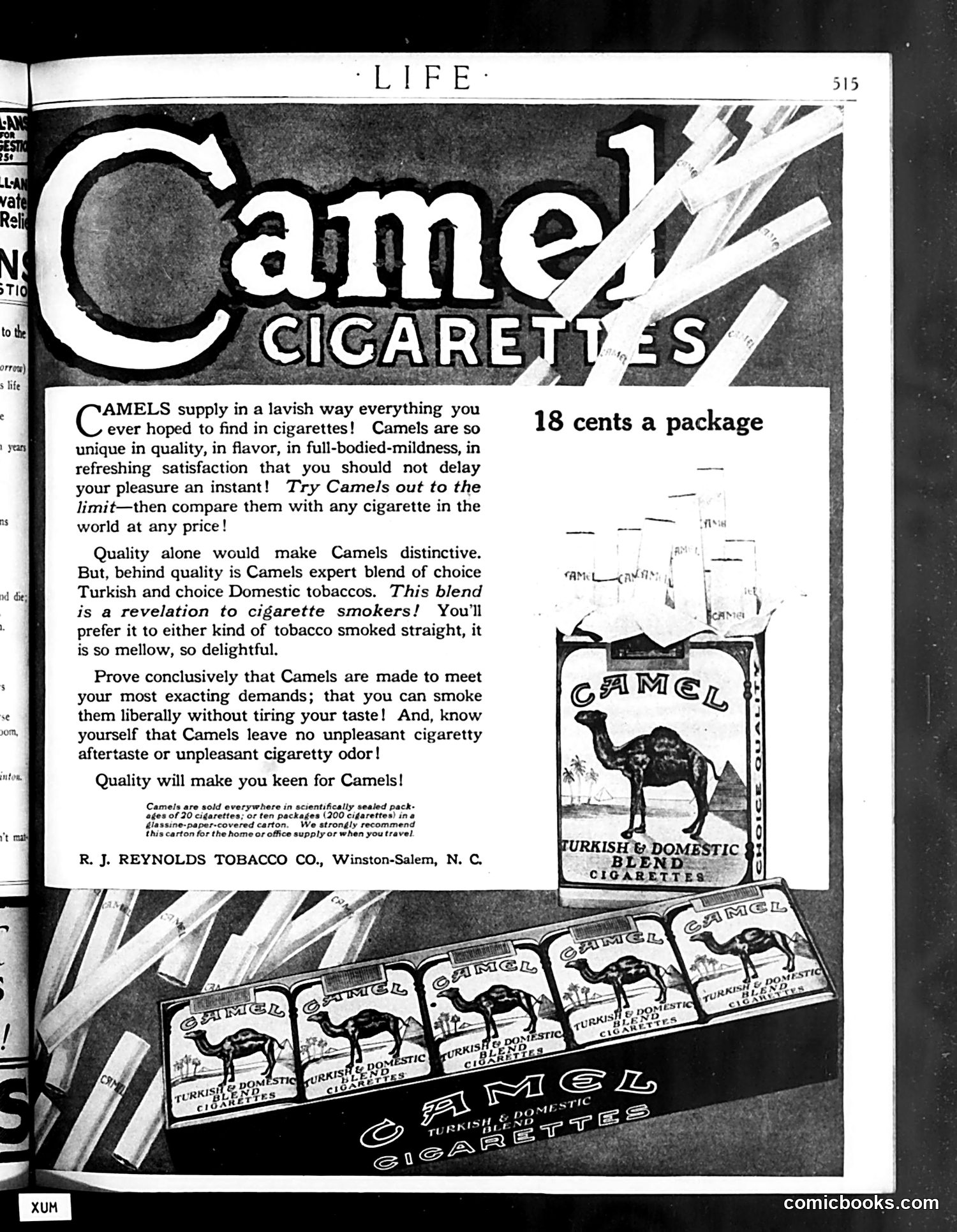
This is a **Camel cigarette advertisement**, not satire or political commentary. It appears in *Life* magazine (page 515) and promotes R.J. Reynolds Tobacco Company's product. The ad uses standard early-20th-century marketing claims: Camels are "unique in quality," made from a "blend of choice Turkish and choice Domestic tobaccos," and notably leave "no unpleasant cigaretty aftertaste or odor"—suggesting competitors did. The iconic camel logo and packaging are prominently displayed. The price is listed as **18 cents per package**. **For modern readers:** This represents an era when cigarette advertising was legal in mainstream magazines and made explicit health claims (no unpleasant smell/aftertaste) we'd now recognize as misleading. The casual, trusted tone reflects the pre-1960s period before surgeon general warnings and advertising restrictions.
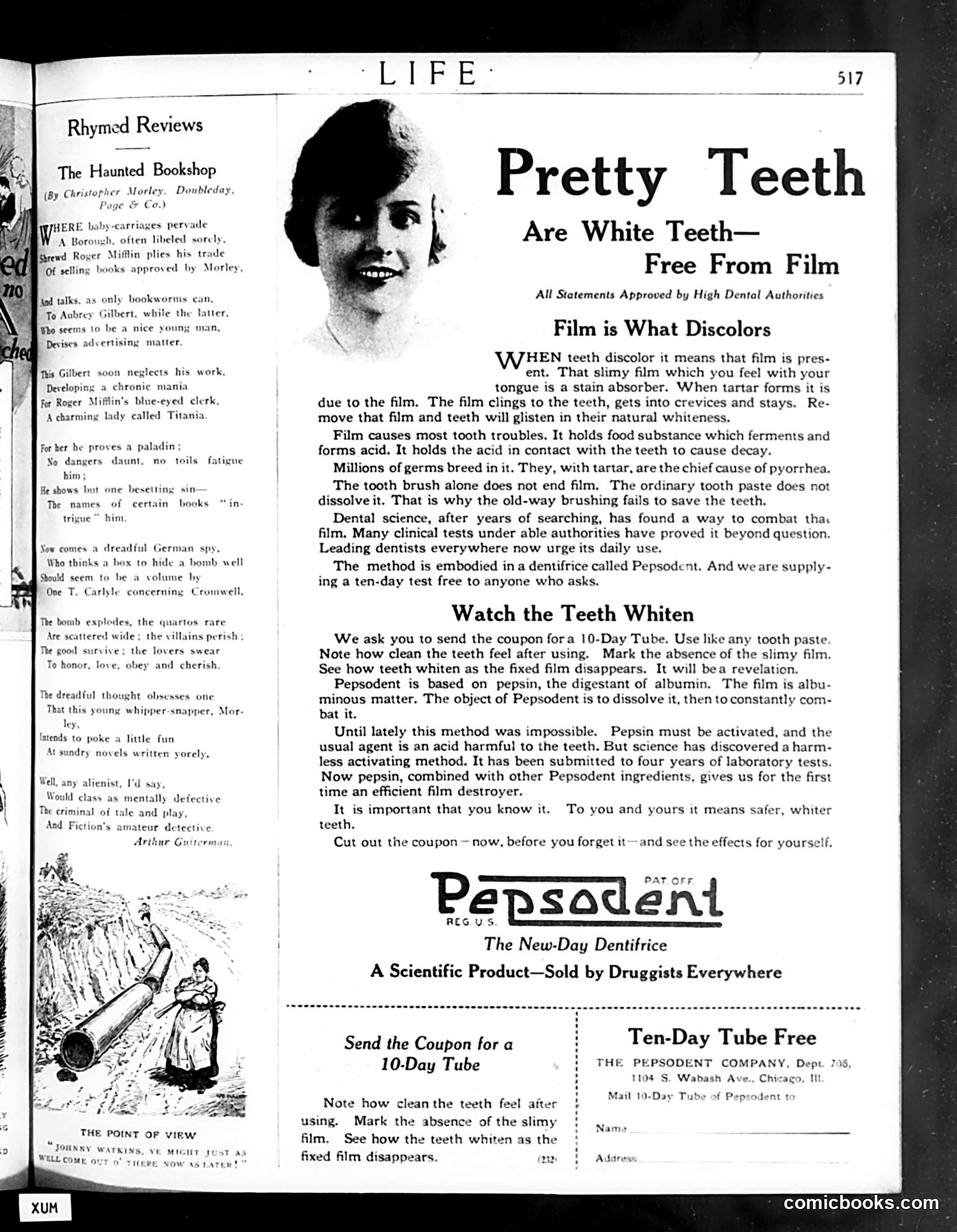
This page contains two distinct sections: **Left side:** A book review in verse of "The Haunted Bookshop" by Christopher Morley. The reviewer satirizes the plot—a spy hiding a bomb in a Carlyle book, romance between characters, and implied criticism of Morley's gentle mockery of literary conventions. The tone is playfully dismissive of the novel's contrivances. **Right side:** A Pepsodent toothpaste advertisement claiming scientific superiority. The ad emphasizes that teeth discolor due to "film" (plaque buildup), and that Pepsodent—uniquely formulated with pepsin—dissolves this film better than ordinary toothpaste. The copy appeals to modern dental science, citing laboratory tests and endorsement by dental authorities. A coupon offers a free 10-day sample tube. The advertisement reflects early 20th-century marketing strategies: pseudo-scientific language, claims of breakthrough discovery, and appeals to professional authority to build consumer confidence in a mass-market product.
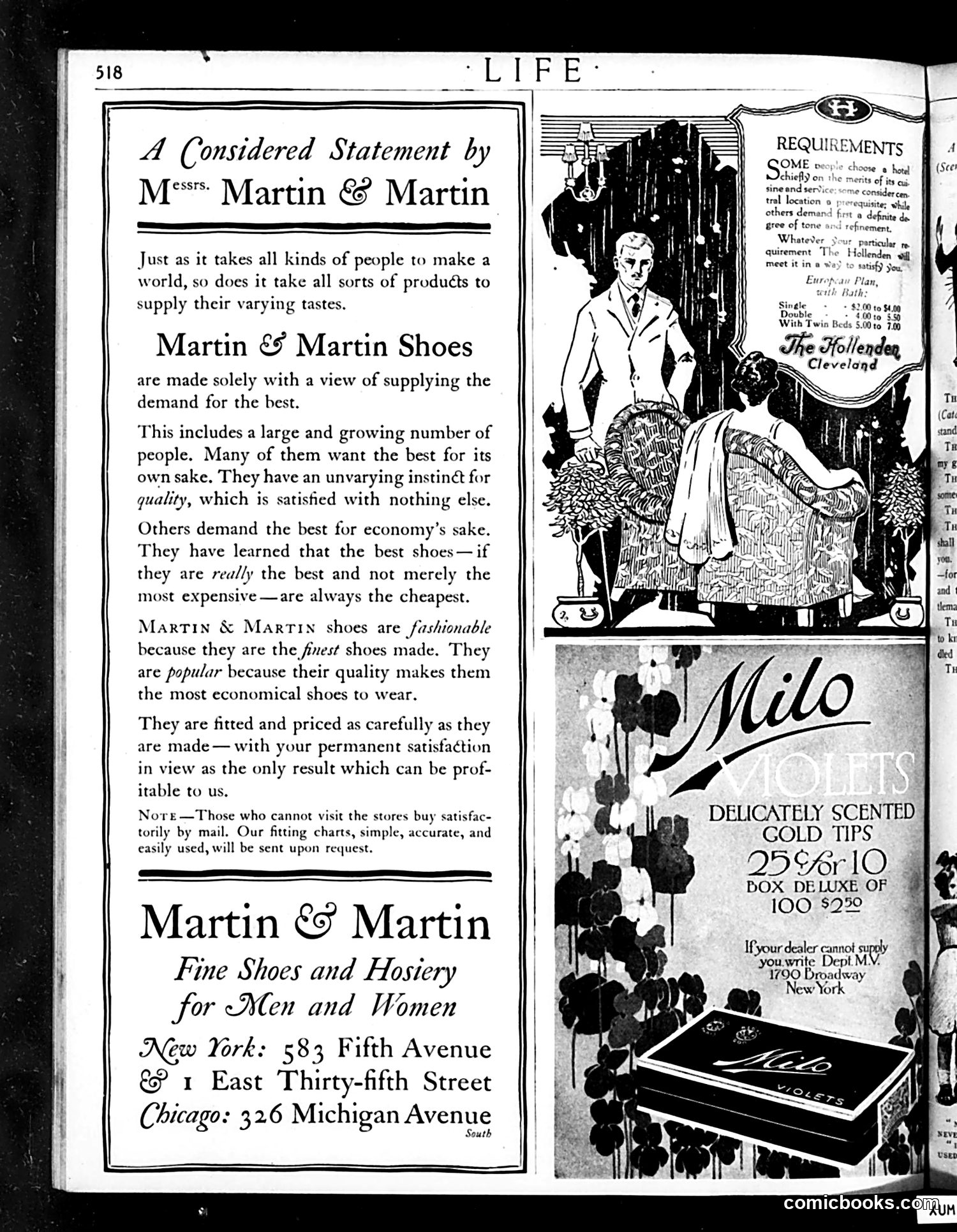
This page is **primarily advertising**, not political satire. It contains two unrelated ads: **Left side:** Martin & Martin Shoes advertisement. This is a straightforward product pitch emphasizing that quality shoes are economical long-term investments. The rhetoric appeals to consumers wanting "the best"—whether for prestige or thrift. The accompanying illustration shows a well-dressed man and woman, likely representing the shoe brand's target market. No satire or caricature is evident. **Right side:** Milo Violets advertisement—a delicately scented gold-tipped product (likely breath mints or similar) in a luxury box for $2.50. The decorative floral illustration is purely ornamental marketing. Neither ad contains recognizable political figures, social commentary, or satirical humor. This appears to be a standard magazine page from Life's commercial content, not an editorial cartoon section. The "Considered Statement" framing is merely formal advertising copy typical of early 20th-century product promotion.
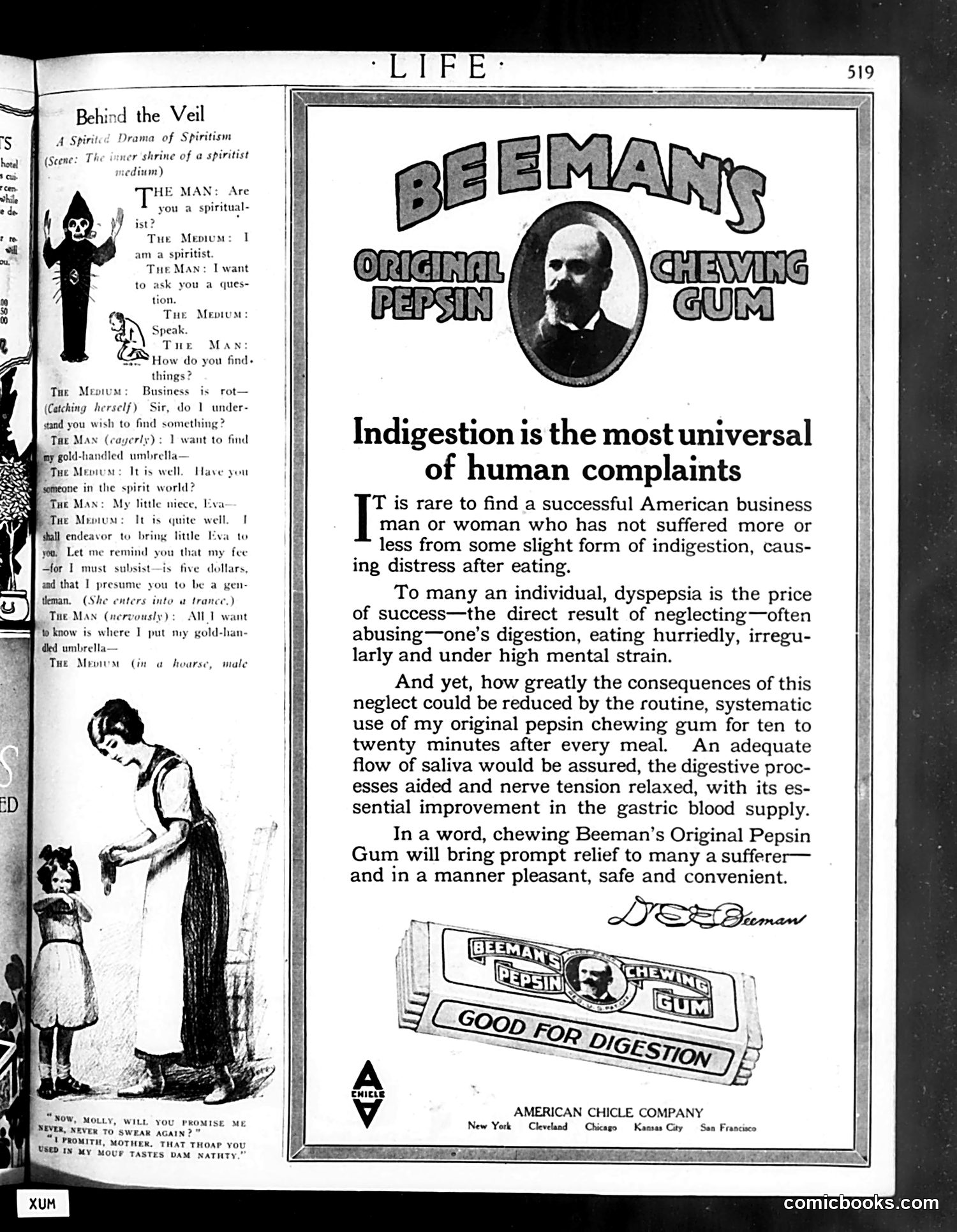
This page contains two distinct elements: **Left side ("Behind the Veil"):** A satirical sketch mocking spiritualism and séances. A man visits a fraudulent medium seeking help finding his lost umbrella. The medium claims to contact his deceased niece "Eva" but demands a five-dollar fee. The joke targets the obvious con: the "spiritist" is transparently fake—she catches herself admitting "business is rotten" before pivoting to mystical language. Below, a second comic depicts a child swearing, lampooning domestic hypocrisy. **Right side:** A full-page advertisement for Beeman's Original Pepsin Chewing Gum. The ad claims chewing gum aids digestion and relieves indigestion—framed as a remedy for the stress-induced dyspepsia afflicting successful American businesspeople. It's signed by "Dr. Beeman" and marketed as a convenient digestive aid. The contrast is striking: sharp satire exposing fraud on one side, credulous health claims on the other—arguably equally dubious by modern standards.
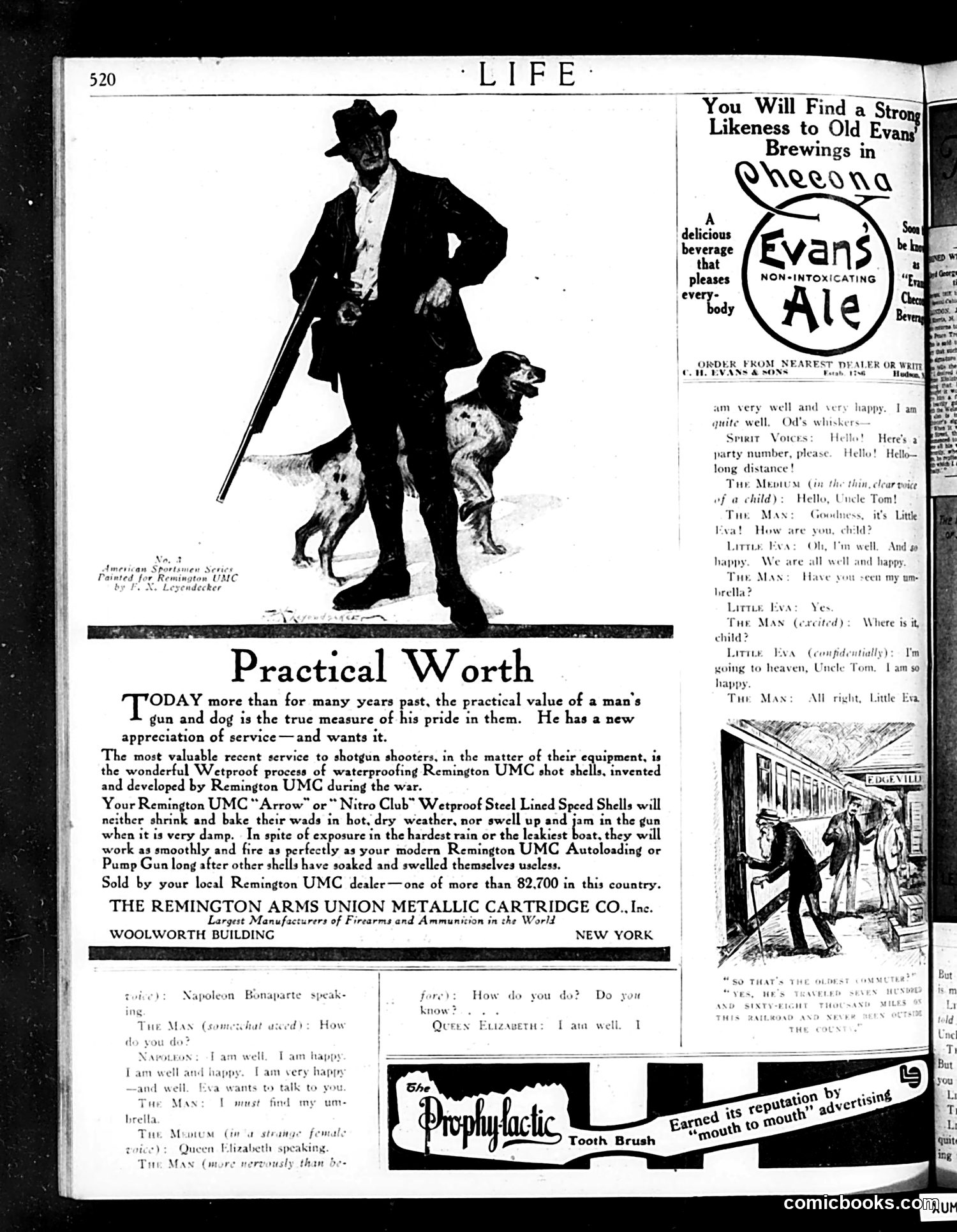
This page contains a large advertisement for Remington ammunition disguised as editorial content, plus unrelated advertising for Evans Ale and Prophylactic toothbrushes. The main illustration shows a hunter with a shotgun and hunting dog, accompanying text titled "Practical Worth." The ad emphasizes that Remington's UMC ammunition features "Wetproof" waterproofing technology developed during WWI, making shells reliable in wet conditions—a practical selling point for sportsmen. The dialogue snippets at bottom appear to be from a separate theatrical or literary piece involving characters named Napoleon Bonaparte, Queen Elizabeth, Uncle Tom, and Little Eva, though their context and purpose on this page are unclear and seem disconnected from the ammunition advertisement. The page is primarily commercial rather than satirical. The juxtaposition of serious hunting equipment marketing with unrelated dialogue suggests this is a typical early 20th-century magazine layout mixing disparate content.
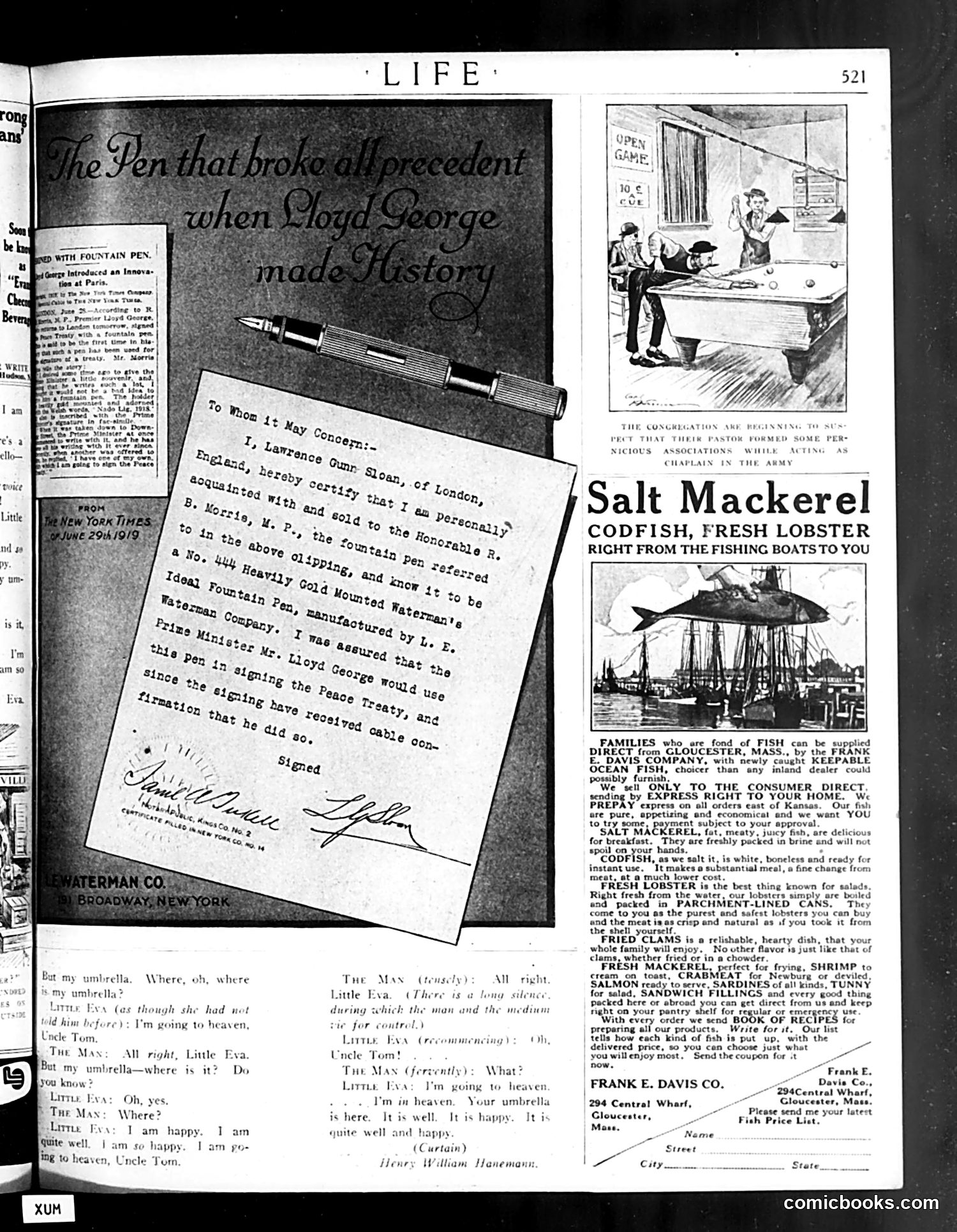
This page contains **two distinct elements**: an advertisement disguised as editorial content, and a theatrical scene. The **upper left** features "The Pen that broke all precedent when Lloyd George made History"—a fountain pen advertisement leveraging Prime Minister Lloyd George's prestige. An accompanying letter (dated June 29, 1919) from Lawrence Gumm Coan claims the pen was used to sign the Peace Treaty, asserting it as historically significant. This is **advertising dressed as news**, exploiting post-WWI patriotism and the recent Paris Peace Conference. The **lower section** appears to be a dramatic scene—possibly from a play—featuring dialogue between characters (Uncle Tom, Little Eva, "The Man"). The umbrella references and heaven dialogue suggest this is **likely from "Uncle Tom's Cabin,"** indicating Life published theatrical content or reviews. The **right page** contains straightforward **fish market advertising** from Frank E. Davis Company in Gloucester, Massachusetts—direct consumer sales of fresh seafood. The page blends commercial promotion with entertainment content typical of early 20th-century American magazines.
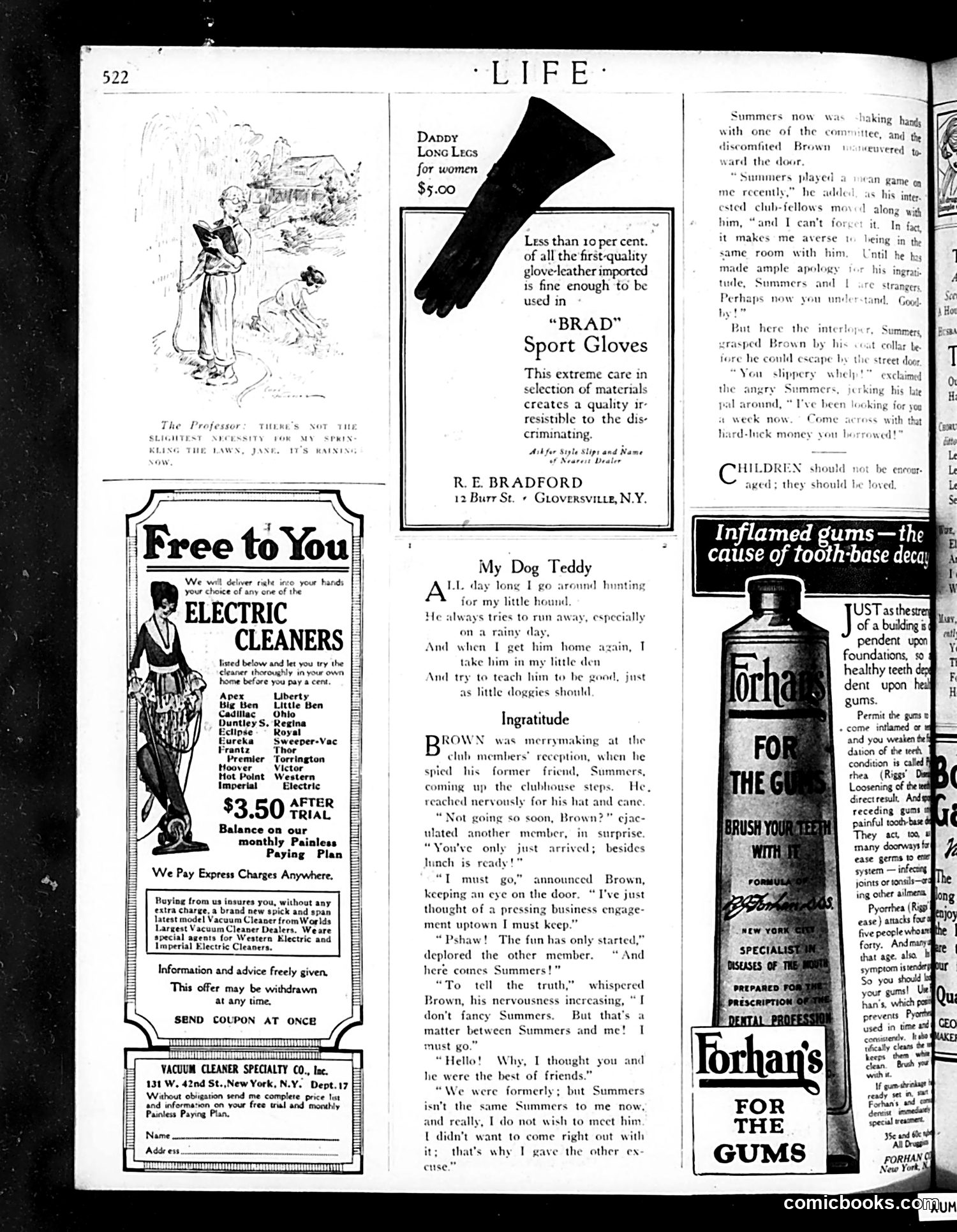
This page contains a short story titled "Ingratitude" that illustrates a social awkwardness of the period. Brown, a club member, attempts to avoid his former friend Summers at a club reception because Summers has offended him in a recent business dealings—specifically, Summers played what Brown considers an unfair card game. Brown is so bothered by this breach of friendship that he can't bring himself to be in the same room, though he's too polite to state this directly, instead claiming a pressing business matter. The humor lies in Brown's discomfort and transparent excuse-making. When Summers arrives and actually *grabs* Brown to talk, Brown is forced into an awkward confrontation. The story's moral concerns social etiquette and the difficulty of managing friendships when trust has been broken—a genteel concern typical of early 20th-century Life magazine satire. The page is otherwise filled with period advertisements for vacuum cleaners, women's gloves, and dental products.
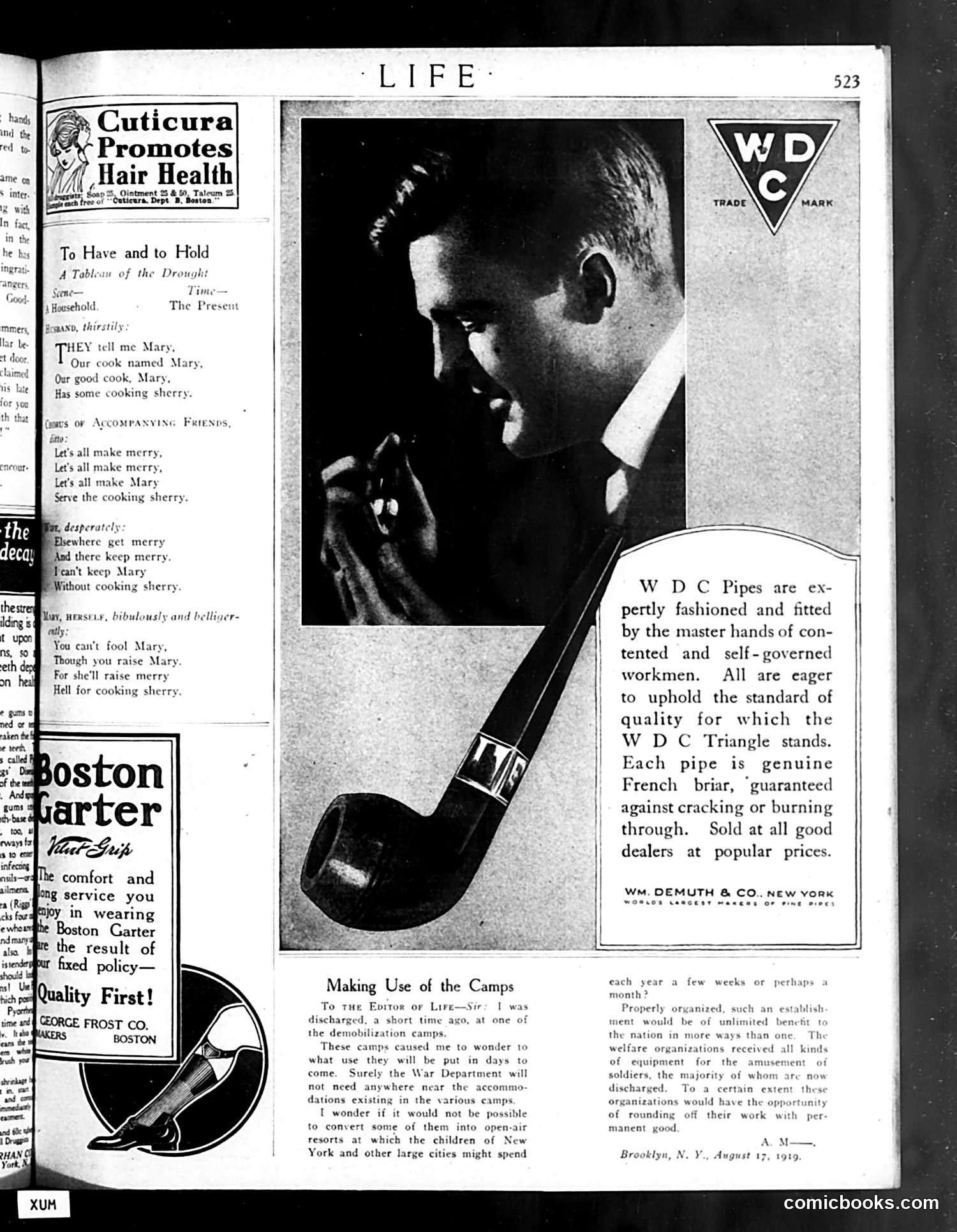
This is satirical verse about Prohibition, which began in January 1919. The poem depicts a household desperately seeking alcohol during the new ban. The humor centers on a cook named Mary who possesses "cooking sherry"—a common loophole people exploited, as cooking ingredients containing alcohol weren't technically prohibited. The household staff conspires to get Mary drunk so she'll provide the sherry, with increasingly desperate pleas ("Let's all make merry / Let's all make Mary / Serve the cooking sherry"). The final section shows the absurdity: Mary refuses to be fooled, and they face consequences ("Hell for cooking sherry"). This captures the public's immediate defiance of Prohibition through creative workarounds and the social chaos the policy created. The satire mocks both the law's ineffectiveness and people's determination to circumvent it.
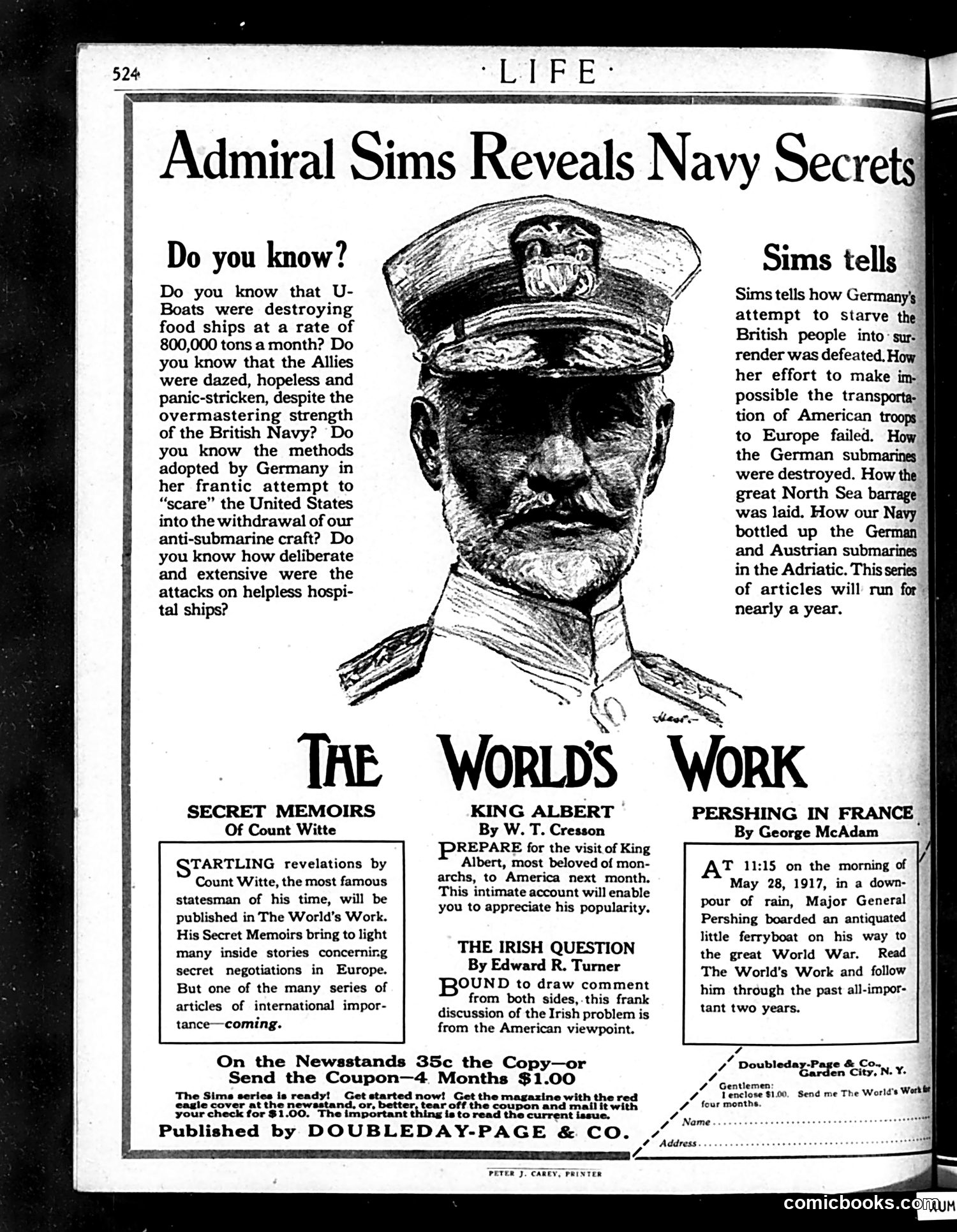
This is a **promotional advertisement** for *The World's Work* magazine, not a political cartoon. The page advertises a serialized article by Admiral William S. Sims about American naval operations during World War I. The central portrait is **Admiral Sims**, a real U.S. Navy officer. The accompanying text highlights sensational claims about German U-boat attacks destroying 800,000 tons of food ships monthly, attacks on hospital ships, and Germany's attempt to "scare" America into withdrawing anti-submarine support. The ad promotes Sims's forthcoming articles describing how the Navy defeated German submarines, established the North Sea barrage, and bottled up enemy vessels in the Adriatic. The page also advertises related articles: Count Witte's secret memoirs on European diplomacy, King Albert's American visit, the Irish Question, and General Pershing's WWI service. This is **wartime propaganda advertising**, using patriotic themes and military authority to boost magazine subscriptions during America's involvement in World War I.
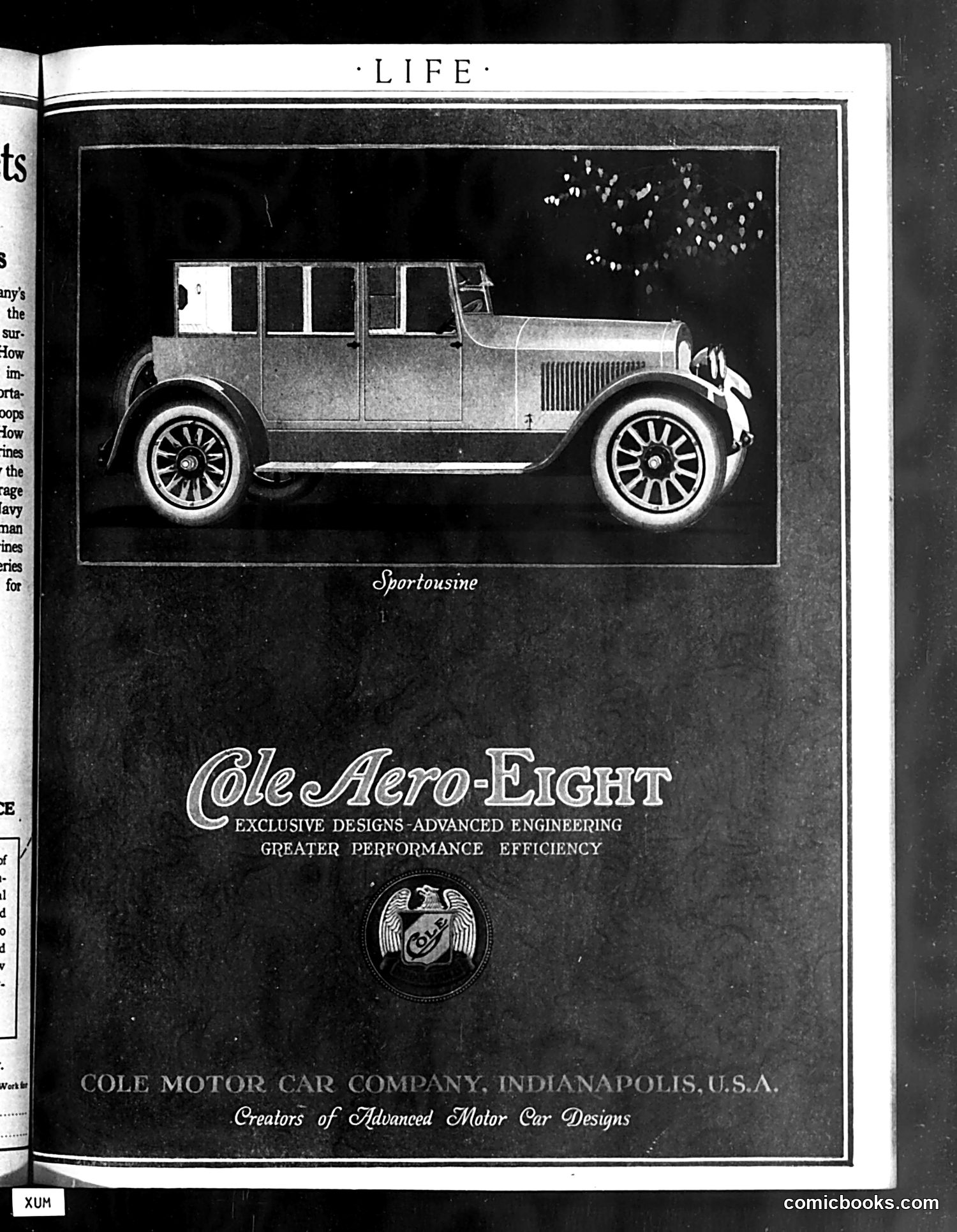
This is not a cartoon or satire—it's a **full-page advertisement** from *Life* magazine for the Cole Aero-Eight automobile, manufactured by Cole Motor Car Company in Indianapolis. The ad features a technical illustration of a "Sportousine" (an open-air touring car) shown in profile against a dark background. The design emphasizes the vehicle's modern engineering with phrases like "Exclusive Designs," "Advanced Engineering," "Greater Performance," and "Efficiency." The winged emblem and formal typography suggest prestige and innovation. This represents early 20th-century automotive advertising, targeting affluent readers interested in cutting-edge motor car technology. There is no political satire or social commentary—merely product promotion typical of *Life* magazine's mixed editorial and advertising content during this era.
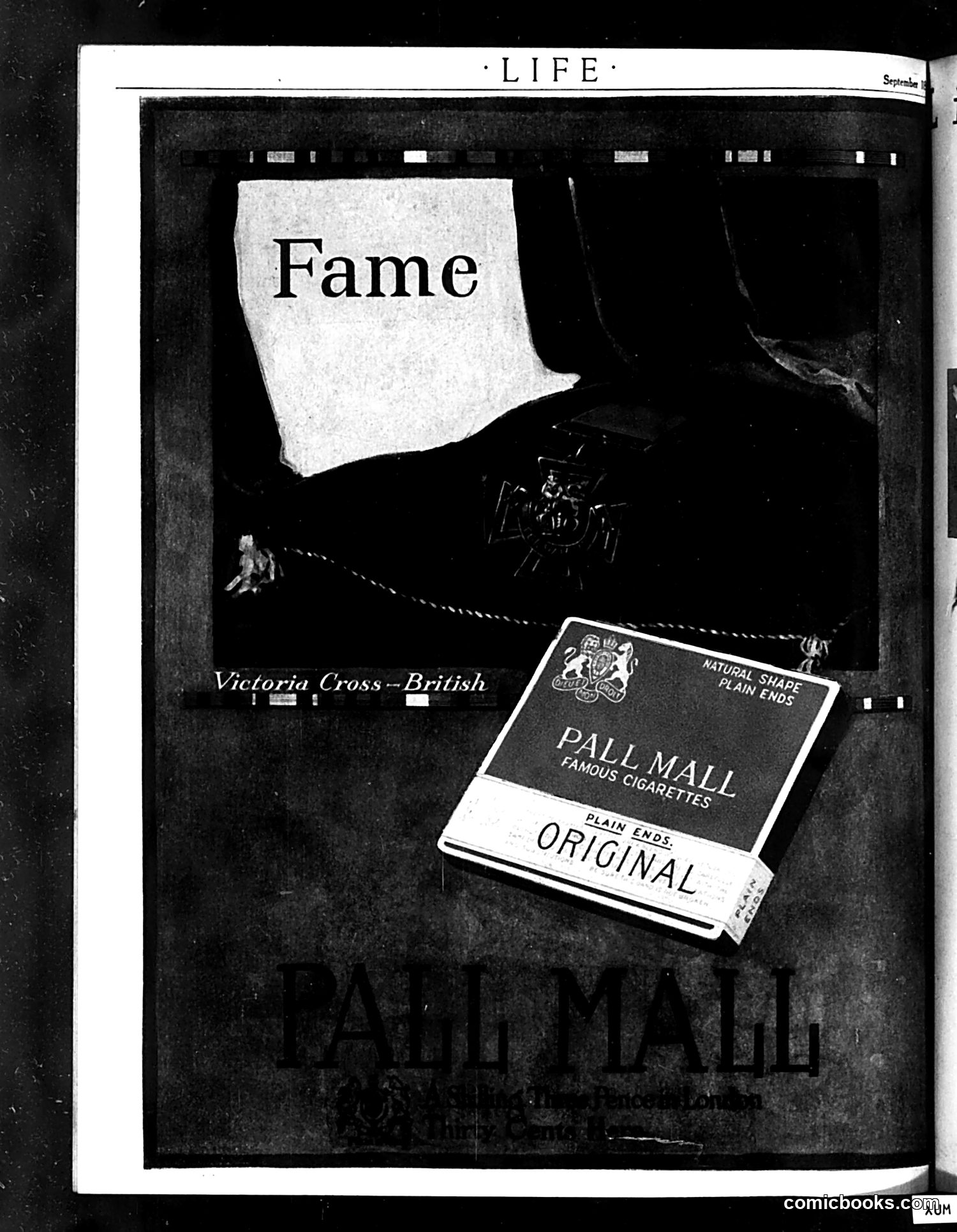
This appears to be a **Life magazine advertisement page** rather than political satire. The headline "Fame" dominates the composition, featuring what looks like a silhouetted figure wearing or holding a mask—a visual metaphor for the contrast between public appearance and private identity. Below sits a **Pall Mall cigarette package** labeled "Original," prominently displayed. The ad appears to satirize celebrity culture by suggesting that fame is illusory or mask-like, while positioning the cigarette brand as something "original" and presumably authentic by comparison. The reference to "Victoria Cross—British" remains unclear from context alone, though it may relate to the silhouetted figure's identity. This is fundamentally **commercial advertising using conceptual imagery** about fame and authenticity rather than political commentary.