
Life, 1919-09-18 · page 15 of 48
Life — September 18, 1919 — page 15: what you’re looking at
What you’re looking at
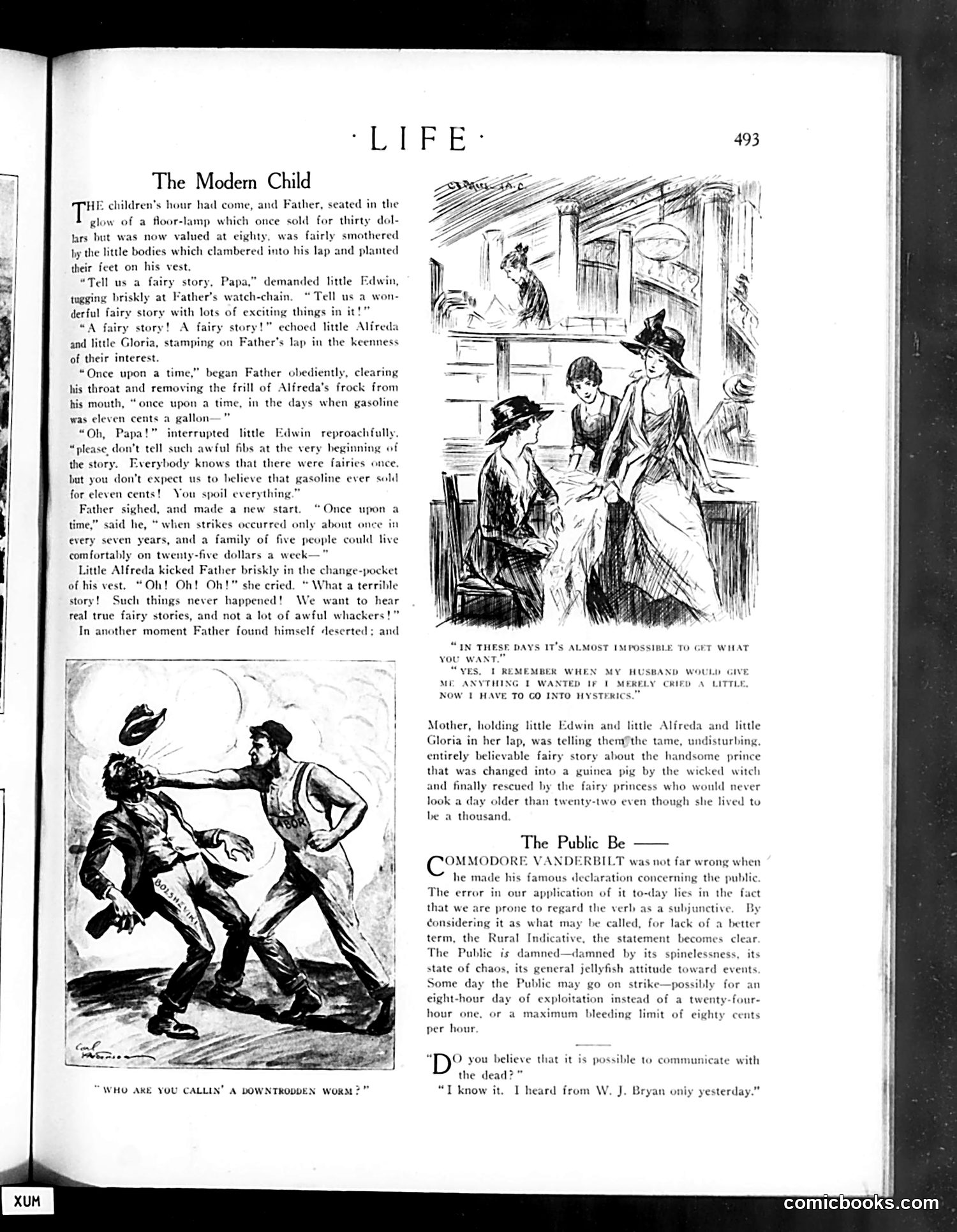
**"The Modern Child"** section satirizes how fathers tell sanitized fairy tales to children. The father begins "Once upon a time" but is interrupted by his son Edwin, who demands he not lie—pointing out that gasoline costs eleven cents a gallon, not the "once every seven years" the father claimed. The satire mocks how modern children, exposed to real economic facts, reject their parents' outdated storytelling methods. **"The Public Be"** section, referencing Commodore Vanderbilt's famous declaration about the public, discusses public indifference to societal issues. The accompanying cartoon depicts a confrontation between two men, likely representing labor or class conflict. The phrase "who are you callin' a downtrodden worm?" suggests mockery of workers' complaints about exploitation.
📄 Transcribed text from this page (OCR, searchable)
Machine-transcribed from the original scan — historical spelling and the odd misread are preserved.
The Modem Child HE children’s hour had come, and Father, seated in the glow of a floor-lamp which once sold for thirty dol- lars but was now valued at eighty, was fairly smothered by the little bodies which clambered into his lap and planted their feet on his vest. “Tell us a fairy story, Papa,” demanded litle Edwin, tugging briskly at Father’s watch-chain. “Tell us a won- h lots of exciting things in it!” ! y! A fairy story!" echoed little Alfreda and little Gloria, stamping on Father's lap in the keenness of their interest. “Once upon a time,” began Father obediently, clearing his throat and removing the frill of Alfreda’s frock from his mouth, “once upon a time, in the days when gasoline derful fairy story w was eleven cents a gallon “Oh, Papa interrupted little Edwin reproachfully, “please, don’t tell such awful fibs at the very beginning the story. Everybody knows that there were fairies once, but you don’t expect us to believe that gasoline ever sold for eleven cents! You spoil everything.” Father sighed, and made a new start. time,” said he, “when strikes occurred only about once in every seven years, and a family of five people could live comfortably on twenty-five dollars a week—" Little Alfreda kicked Father briskly in the change-pocket of his vest. “Oh! Oh! Oh!” she cried. “ What a terrible never happened! We want to hear and not a lot of awful whackers!” “Once upon a story! Such thing: real true fairy stori In another moment Father found himself deserted; and “WHO AKE YOU CALLIN’ A DOWNTRODDEN WORM ? “IN THESE DAYS IT’S ALMOST IMPOSSIBLE ceT WHAT 1 WANT." “YES. I REMEMBER WHEN MY HUSBAND WOULD GIVE ME ANYTHING IT WANTED IF 1 MERELY CRIED A LITTLE NOW L HAVE TO GO INTO HYSTERICS.” Mother, holding little Edwin and little Alfreda and little Gloria in her lap, was telling themfthe tame, undisturbing. entirely believable fairy story about the handsome prince that was changed into a guinea pig by the wicked witch and finally rescued by the fairy princess who would never look a day older than twenty-two even though she lived to be a thousand The Public Be OMMODORE VANDERBILT was not far wrong when he made his famous declaration concerning the public. The error in our application of it to-day lies in the fact that we are prone to regard the verb a subjunctive. By considering it as what may be called, for lack a better term, the Rural Indicative, the statement becomes clear The Public is damned—damned by its spinelessness, its chaos, its general jellyfish attitude toward events. Some day the Public may go on strike—possibly for an state of eight-hour day of exploitation instead of a twenty-four- hour one, or a maximum bleeding limit of eighty cents per hour “L)O you believe that it is possible to communicate with the dead?” “I know it. I heard from W, J. Bryan oniy yesterday.” comicbooks.com