
Life, 1919-09-18 · page 22 of 48
Life — September 18, 1919 — page 22: what you’re looking at
What you’re looking at
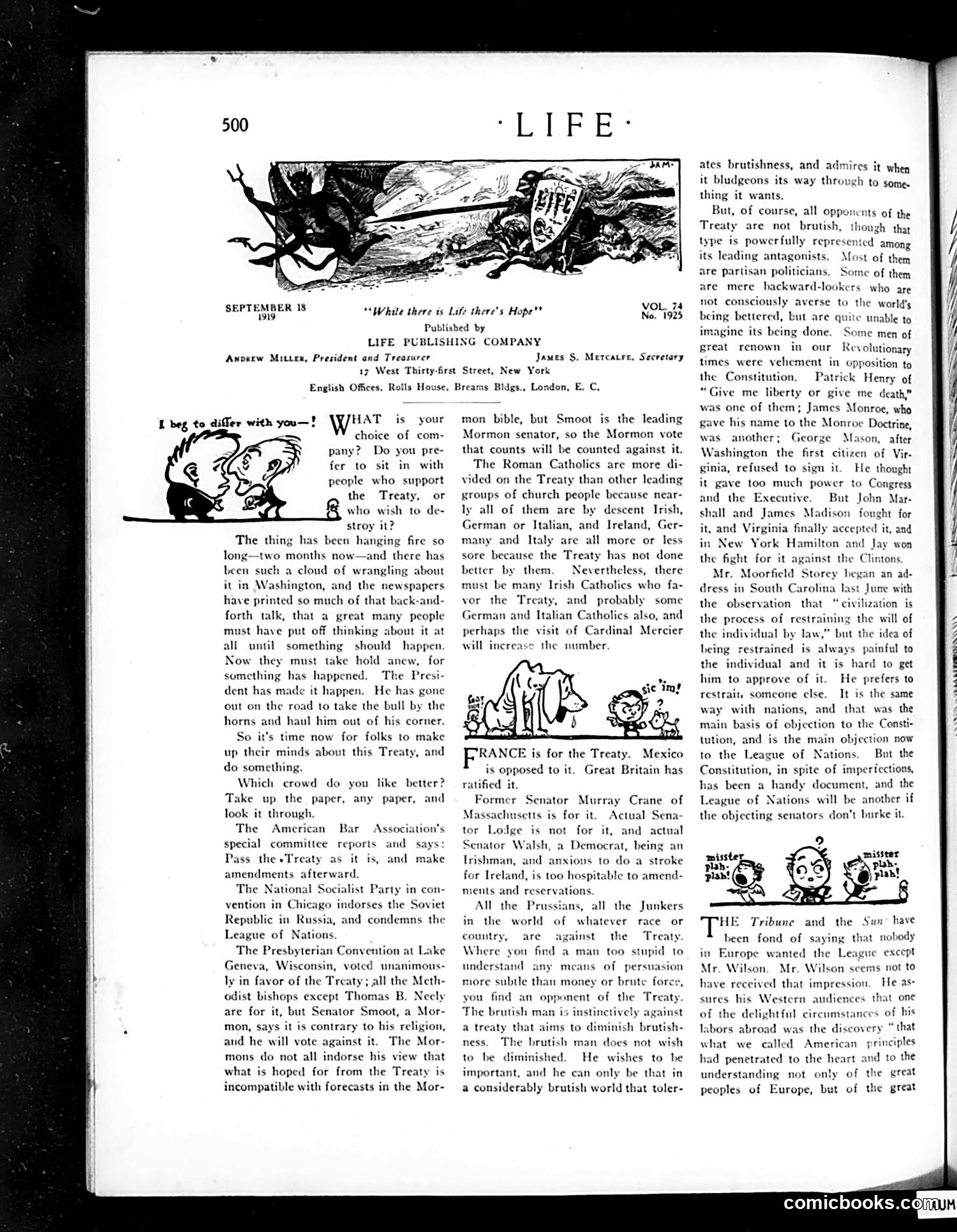
This page debates the League of Nations Treaty ratification, a central post-WWI political issue. The opening cartoon shows two figures arguing—likely representing Treaty supporters versus opponents. The article catalogs diverse positions: the American Bar Association supports ratification; the Socialist Party opposes the League; Presbyterian and Methodist conventions favor it; Senator Smoot (a Mormon) opposes it despite his church's support. Irish, German, and Italian Catholics are divided because their home countries' interests conflict with League membership. The satire's thrust appears in the closing argument: the author claims brutal men instinctively oppose the Treaty because it aims to diminish brutishness, suggesting opponents are either stupid, partisan politicians, or "backward-lookers" unable to imagine progress. This is sharp editorial advocacy disguised as analysis—using characterization to delegitimize Treaty opponents rather than engaging their arguments seriously. The context: this reflects 1920s American isolationism debates.
📄 Transcribed text from this page (OCR, searchable)
Machine-transcribed from the original scan — historical spelling and the odd misread are preserved.
I beg to differ with you—! SEPTEMBER 18 id “While there is Life there's Hope" VOL. 74 No. 1925 Published by LIFE PUBLISHING COMPANY Anonew Mittee, President and Treasurer James S. Mercatre, Secretary 17 West Thirty-first Street, New York English Offices, Rolls House, Breams Bldgs, London, E. C. HAT is <n, choice of com- pany? Do you pre- fer to sit in people who support the Treaty, or who wish to de- stroy it? The thing has been hanging fire so long—two months now—and there has been such a cloud of wrangling about it in Washington, and the newspapers have printed so much of that back-and- forth talk, that a great many people must have put off thinking about it at all until something should happen Now they must take hold anew, for something has happened. The Presi- dent has made it happen. He has gone out on the road to take the bull by the horns and haul him out of his corner. your with So time now for folks to make up their minds about this Treaty, and do something. Which crowd do you like better? Take up the paper, any paper, and look it through. The American Bar special committee reports and says: Association's Pass the eTreaty as it is, and x amendments afterward The National Socialist Party in con- vention in Chicago indorses the Soviet Republic in Russia, and condemns the League of Nations. n Convention at Lake Geneva, Wisconsin, voted unanimous- ly in favor of the Treaty ; all the Meth- odist bishops except Thomas B. Neely are for it, but Senator Smoot, a Mor- mon, says it is contrary to his religion, and he will vote against it. The Mor- mons do not all indorse his view that what is hoped for from the Treaty is incompatible with forecasts in the Mor- The Presbyteri mon bible, but Smoot is the leading Mormon senator, so the Mormon vote that counts will be counted against it. The Roman Catholics are more di- vided on the Treaty than other leading groups of church people because near- ly all of them are by descent Irish, German or Italian, and Ireland, Ger- many and Italy are use the Treaty better by them must be many Irish Catholics who fa- vor the Tre and probably German and Italian Catholics also, and perhaps the visit of Cardinal Mercier will increase the number. all more or less not done Nevertheless, there sore be some Mexico RANCE is for the Treaty. is opposed to it. Great Britain has ratified it. Former Senator Murray Crane of Actual Sena- tor Lodge is not for it, and actual Senator Walsh, Irishman, and anxious to do a stroke for Ireland, is too hospitable to amend- Massachusetts is for it a Democrat, being an ments and reservations All the Prussians, all the Junkers in the world of whatever race or country, are Treaty. Where you find a man too stupid to understand against the y means of persuasion more subtle than money or brute force, you find an opponent of the Treaty. The brutish man is instinctively against a treaty that aims to diminish brutish- ness. The brutish man does not wish to be diminished. He wishes to be important, and he can only be that in a considerably brutish world that toler- ates brutishness, and admires it when it bludgeons its way through to some- thing it wants, But, of course, all opponents of the Treaty are not brutish, though that type is powerfully represe its leading antagonists. Most of them are partisan politicians. Some of them are mere hackward-lookers who are not consciously averse to the world’s being bettered, but are quite unable to imagine its being done. Some men of great renown in our Revolutionary times were veliement in opposition to the Constitution, Patrick Henry of “Give me liberty or give me death” was one of them; James Monroe, who gave his name to the Monroe Doctrine, was another; Geor: Mason, after Washington the first citizen of Vir- ginia, refused to He thought it ye too much power to Congress and the Executive. But John Mar- shall and James Madison fought for it, and Virginia finally accepted it, and in New York Hamilton and Jay won the fight for it against the Clintons. Mr. Moorfield Storey began an ad- dress in South Carolina last Jure with the observation that “civilization is the process of restraining the will of the individual by law,” but the idea of being restrained is always painful to the individual and it is hard to get him to approve of it. He prefers to restraits someone else. It is the same way with nations, and that was the main basis of objection to the Consti- tution, and is the main objection now to the League of tions, But the Constitution, in spite of impericctions, has been a handy document, and the League of Nations will be another if the objecting senators don’t burke it. ted among sign it HE Tribune and the Sun’ have been fond of saying that nobody in Europe wanted the League except Mr. Wilson. Mr. Wilson scems not to have received that impression. He as- sures his Western audiences that one of the delightful circumstances of his labors abroad was the discovery “that what we called American principles had penetrated to the heart and to the understanding not onty of the great peoples of Europe, but of the great EEE, ee ee es ena 8 ReneS comicbooks.com™