
Life, 1919-09-18 · page 26 of 48
Life — September 18, 1919 — page 26: what you’re looking at
What you’re looking at
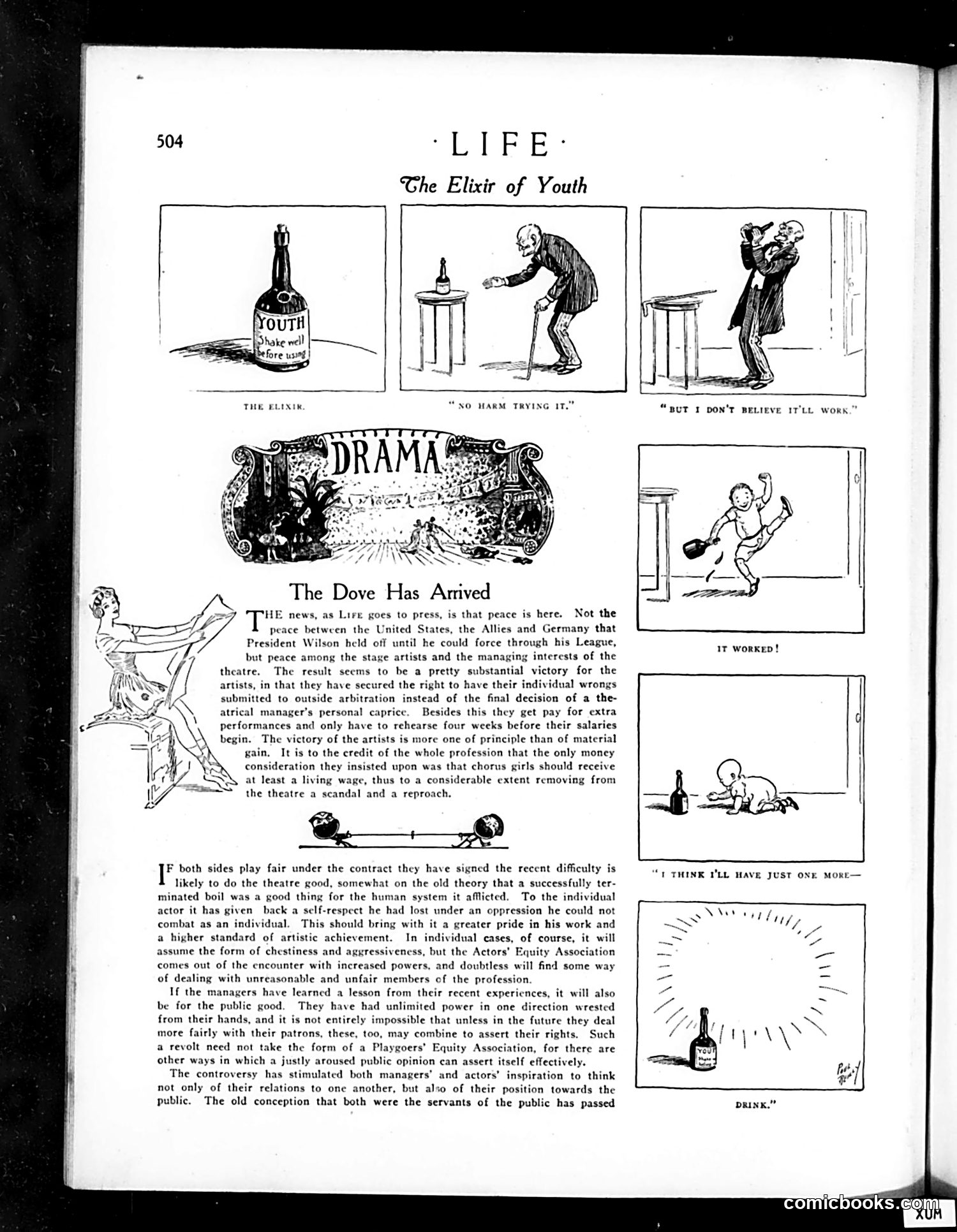
The top comic strip satirizes the "Elixir of Youth"—a bottle labeled literally "YOUTH"—showing a man attempting to use it, with captions expressing skepticism about its efficacy. This mocks false promises of rejuvenation products. The main article celebrates a recent labor peace in American theatre. The Actors' Equity Association apparently won a significant strike or dispute against theatrical managers, securing arbitration rights, extra-performance pay, and four-week rehearsal minimums. Notably, actors prioritized ensuring chorus girls earned living wages—framed as removing "a scandal and a reproach." The accompanying small cartoons (right side) show the elixir "working"—depicting a cherub becoming progressively more intoxicated, ending with the bottle emptied. This darkly suggests the "youth elixir" is actually alcohol, satirizing both false anti-aging remedies and possibly post-Prohibition drinking culture. The editorial praises both labor and management for seeking mutual respect and considering public welfare—a surprisingly optimistic post-strike assessment.
📄 Transcribed text from this page (OCR, searchable)
Machine-transcribed from the original scan — historical spelling and the odd misread are preserved.
‘LIFE: Che Elixir of Youth YouTH — Shake well Before used} THE ELIXIK The Dove Has Arrived HE news, as Lire goes to press, is that peace is here. Not the peace between the United States, the Allies and Germany that President Wilson held off until he could force through his League, but peace among the stage artists and the managing interests of the theatre. The result seems to be a pretty substantial victory for the artists, in that they have secured the right to have their individual wrongs submitted to outside arbitration instead of the final decision of a the- atrical manager’s personal caprice. Besides this they get pay for extra performances and only have to rehearse four weeks before their salaries begin. The victory of the artists is more one of principle than of material gain, It is to the credit of the whole profession that the only money consideration they insisted upon was that chorus girls should receive at least a living wage, thus to a considerable extent removing from the theatre a scandal and a reproach. aE as F both sides play fair under the contract they have signed the recent difficulty is likely to do the theatre good, somewhat on the old theory that a successfully ter- minated boil was a good thing for the human system it afflicted. To the individual actor it has given back a self-respect he had lost under an oppression he could not combat as an individual. This should bring with it a greater pride in his work and a higher standard of artistic achievement. In individual cases, of course, it will assume the form of chestiness and aggressiveness, but the Actors’ Equity Association comes out of the encounter with increased powers, and doubtless will find some way of dealing with unreasonable and unfair members of the profession If the managers have learned a lesson from their recent experiences, it will also be for the public good, They have had unlimited power in one direction wrested from their hands, and it is not entirely impossible that unless in the future they deal more fairly with their patrons, these, too, may combine to assert their rights. Such a revolt need not take the form of a Playgoers’ Equity Association, for there are other ways in which a justly aroused public opinion can assert itself effectively. The controversy has stimulated both managers’ and actors’ inspiration to think not only of their relations to one another, but also of their position towards the public. The old conception that both were the servants of the public has passed 1T workep! “1 THINK I'LL HAVE JUST ONE MoxE—