
A complete issue · 44 pages · 1919
Life — August 14, 1919
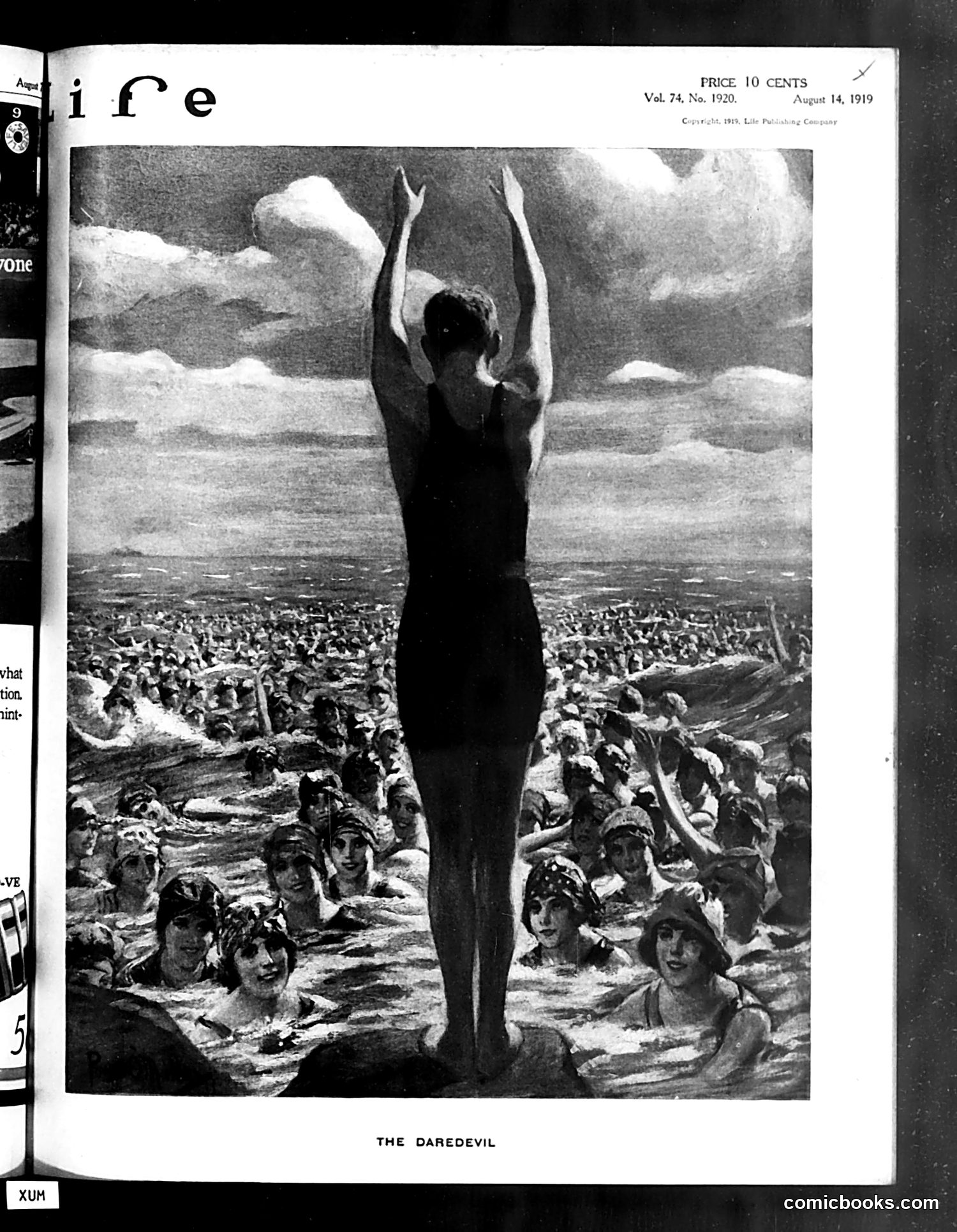
This Life magazine cover from August 14, 1919 shows a silhouetted acrobat or diver performing a dramatic pose—arms raised skyward—standing on what appears to be a platform above a crowded beach or swimming area filled with onlookers. The caption "THE DAREDEVIL" suggests this depicts a popular public stunt performer, likely a famous acrobat or high-diver of the era. Such performers were common entertainment attractions at American beaches and public venues during the early 20th century, drawing large crowds. The image celebrates the showmanship and physical daring of these performers while also satirizing the public's appetite for dangerous spectacles and risky entertainment. The dramatic composition emphasizes both the performer's courage and the massive audience's fascination with potentially fatal feats.
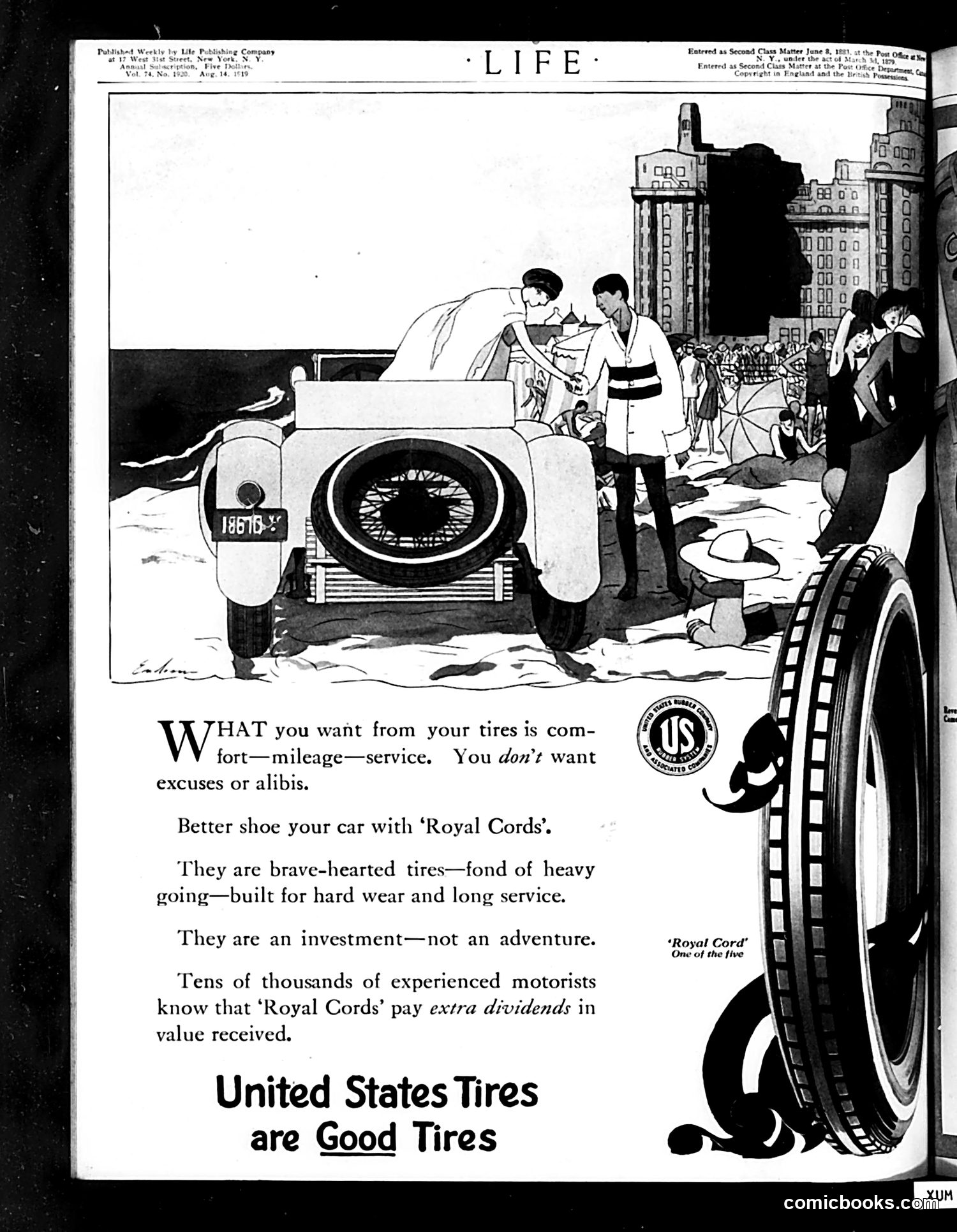
This is primarily a **United States Tires advertisement** for "Royal Cord" branded tires, appearing in *Life* magazine. The illustration shows a beach scene with a broken-down car surrounded by well-dressed onlookers, establishing a narrative about tire failure. The ad's satire is subtle: it mocks motorists who make excuses for mechanical problems rather than investing in quality tires. The copy emphasizes that Royal Cords are "brave-hearted tires" built for durability, contrasting them implicitly with cheaper alternatives that fail. The beach setting and fashionable spectators suggest this targets middle-class car owners concerned with maintaining appearances—the broken vehicle becomes embarrassing social evidence of poor purchasing decisions. The message: good tires are practical investments, not frivolous expenses.
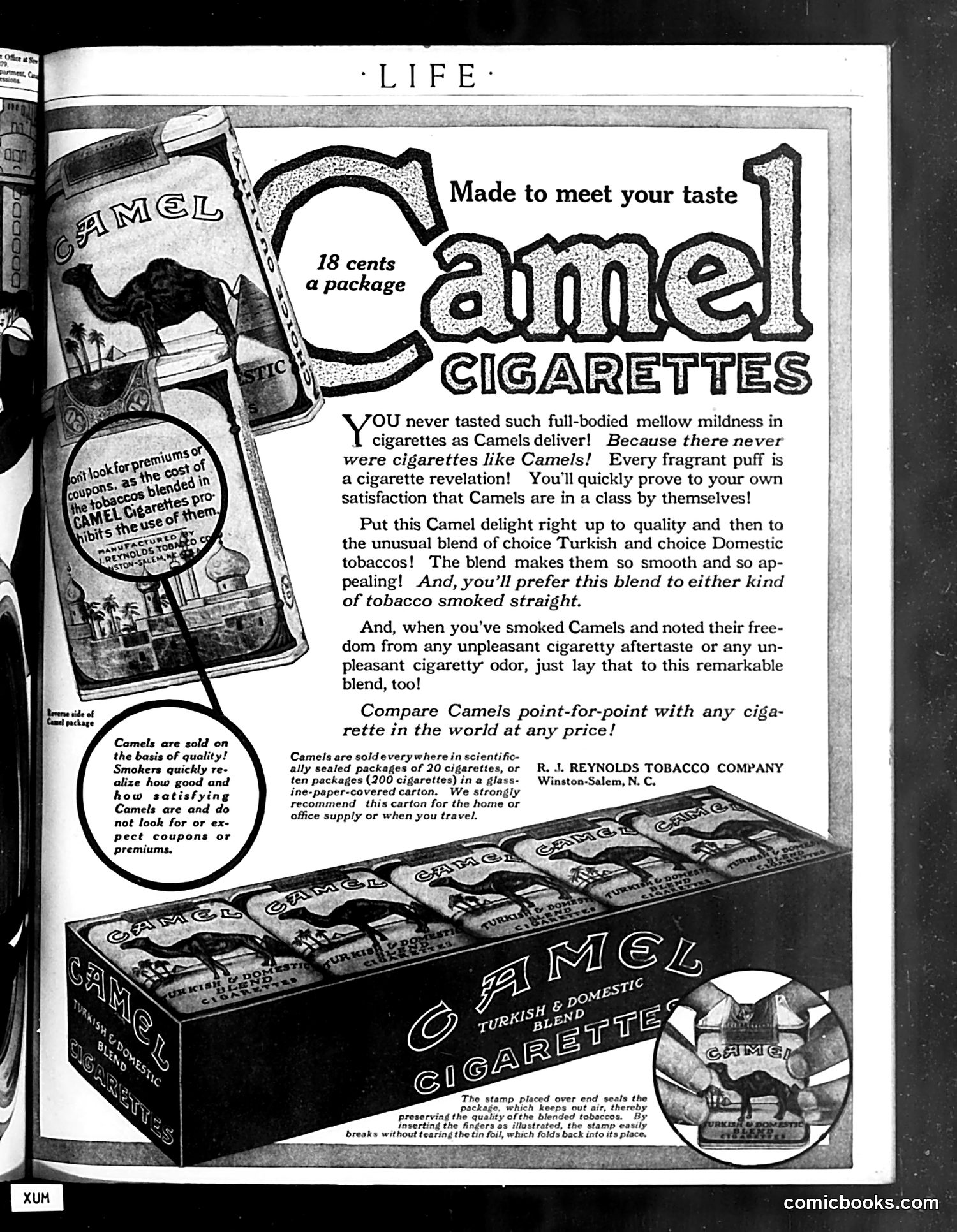
This is not satire or a political cartoon—it's a straightforward **cigarette advertisement** for Camel brand cigarettes, published in *Life* magazine. The ad promotes Camels at 18 cents per package, emphasizing their "full-bodied mellow mildness" and unique blend of Turkish and domestic tobacco. It claims smokers will notice freedom from "unpleasant cigaretty aftertaste or any unpleasant cigaretty odor." The page includes product packaging images and a circular detail showing the cigarette's internal structure. The manufacturer is R.J. Reynolds Tobacco Company of Winston-Salem, North Carolina. By modern standards, the health claims are remarkable—no mention of health risks exists. This reflects the pre-1960s era when tobacco advertising freely promoted cigarettes without warning labels or restrictions.
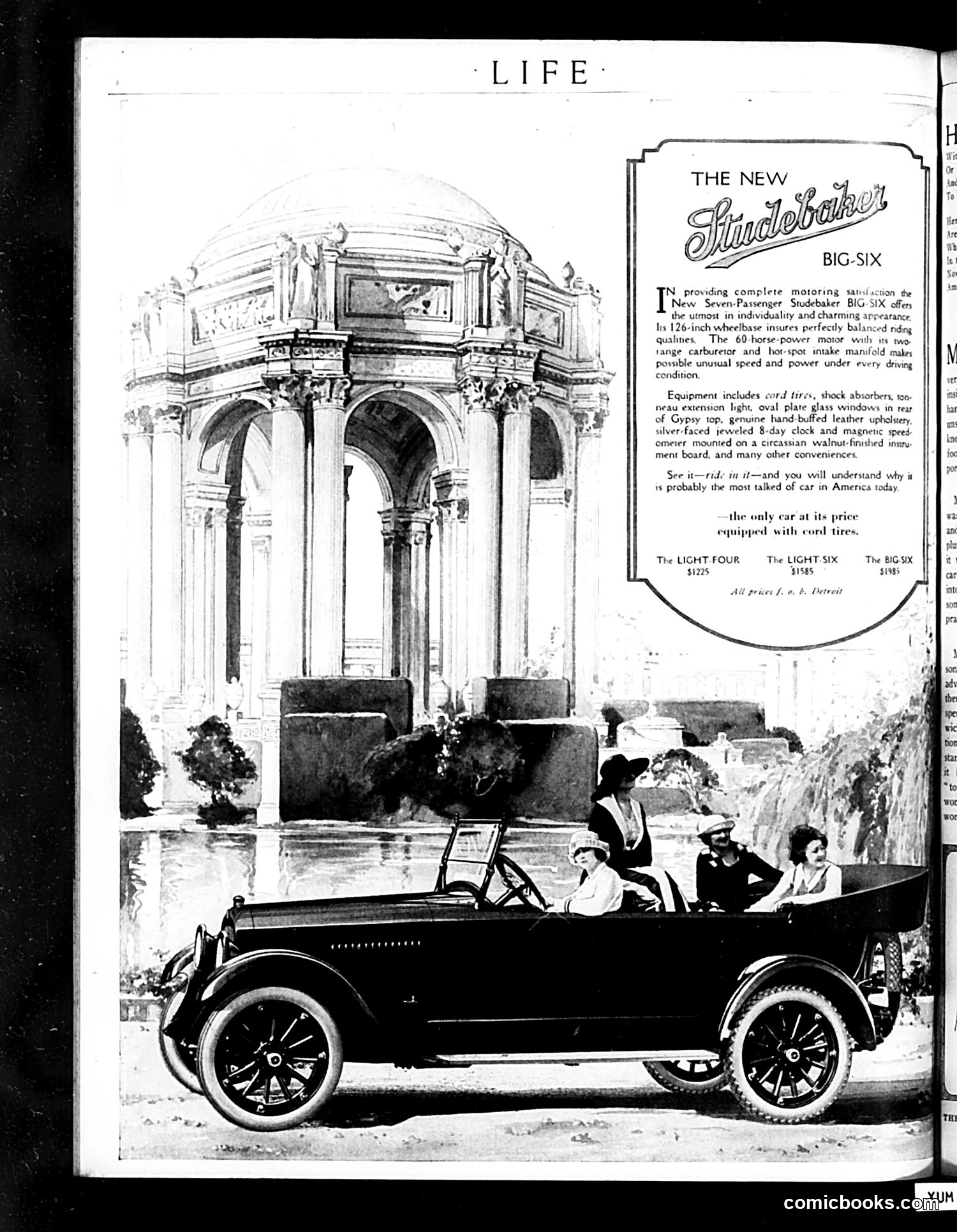
This page is **primarily advertising**, not satirical content. It features a full-page advertisement for the Studebaker "Big-Six" automobile, positioned against an architectural backdrop (appears to be a classical building or monument). The ad emphasizes the car's luxury features: 60-horsepower motor, cord tires, shock absorbers, and other modern conveniences. A key selling point is that it's "the only car at its price equipped with cord tires"—suggesting this was a premium feature distinguishing the Studebaker from competitors. The illustration shows four passengers (fashionably dressed) enjoying a leisurely drive, reinforcing the car's appeal as a status symbol and leisure vehicle for the affluent. This represents typical 1920s automobile advertising emphasizing technological advancement and social prestige.
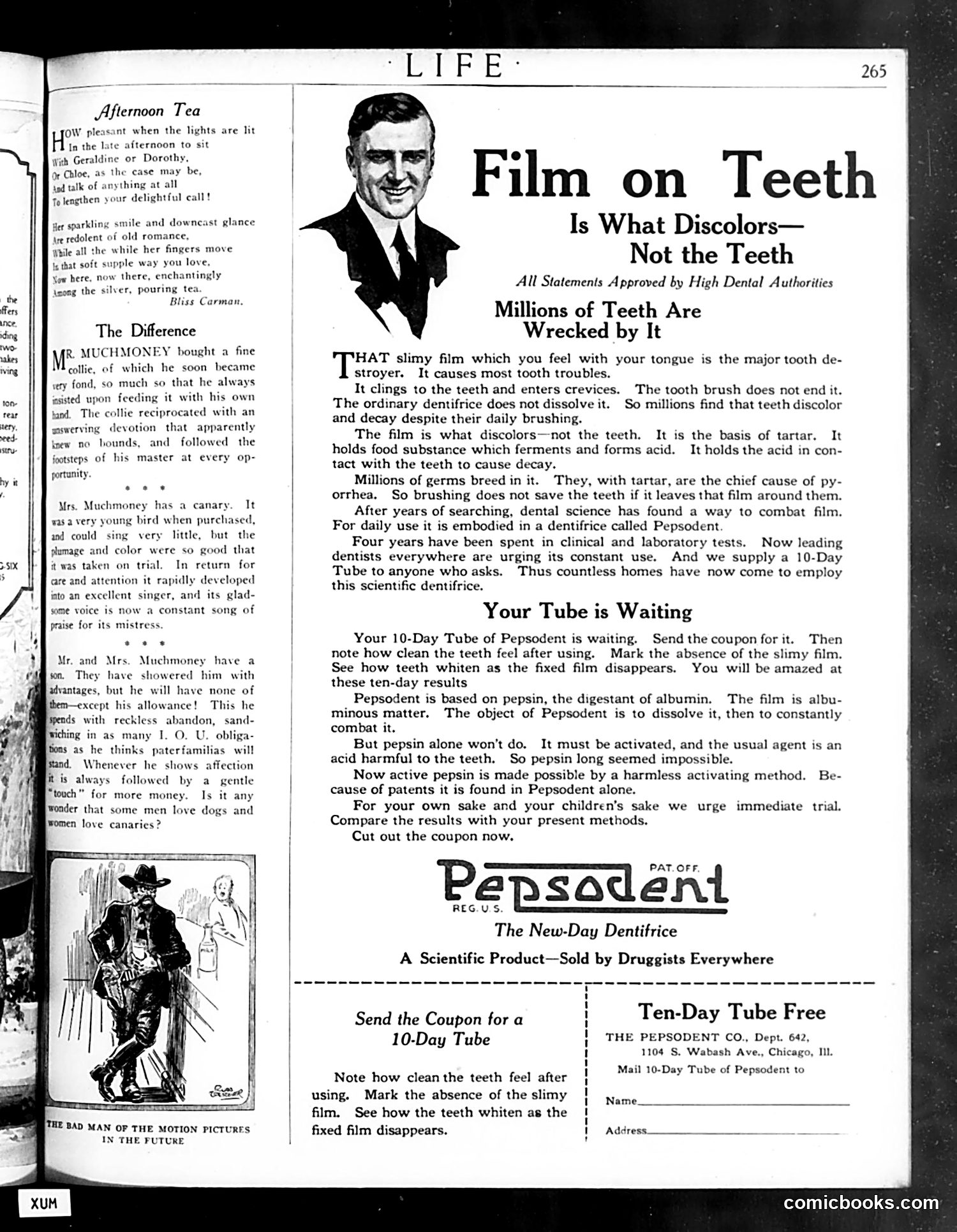
This page is **primarily advertising**, not political satire. The dominant content is a Pepsodent toothpaste advertisement claiming to remove "film on teeth" through a special ingredient (pepsin). The ad employs pseudo-scientific language ("All Statements Approved by High Dental Authorities") typical of early 20th-century patent medicine marketing. The left column contains three brief social humor pieces about afternoon tea etiquette and a couple named Muchmoney, displaying typical Light magazine comedic observations about upper-class behavior. Below is an illustration captioned "The Bad Man of the Motion Pictures in the Future"—a cowboy figure—appearing to be satirical commentary on Western film stereotypes, though context is limited. The page reflects period attitudes toward advertising claims and social class humor rather than political commentary.
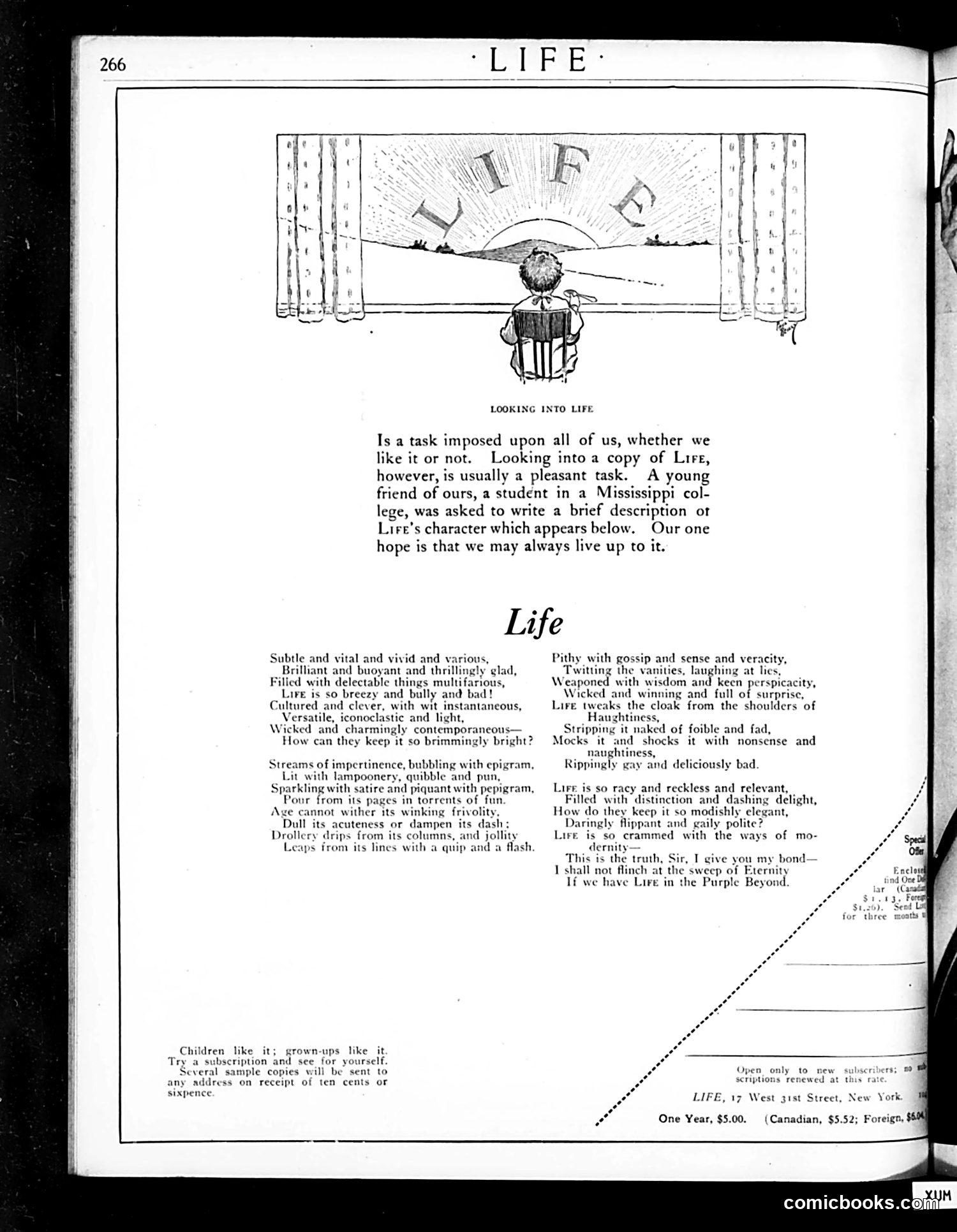
This page from *Life* magazine presents a character description of "Life" itself, personified as a spirited, multifaceted entity. The accompanying illustration shows a figure gazing out a window at a sunrise or landscape labeled "LIFE." The poem characterizes Life as paradoxical—simultaneously "subtle and vital," "cultured and clever," yet "wicked and charming." It's described as gossipy, witty, and irreverent, capable of both delicate elegance and crude impudence. This appears to be *Life* magazine's self-promotional material, written by a Mississippi college student. Rather than satirizing external targets, it's a playful self-description of the magazine's own editorial voice and values—positioning *Life* as sophisticated yet irreverent social commentary. The piece essentially defines the magazine's brand identity for readers.
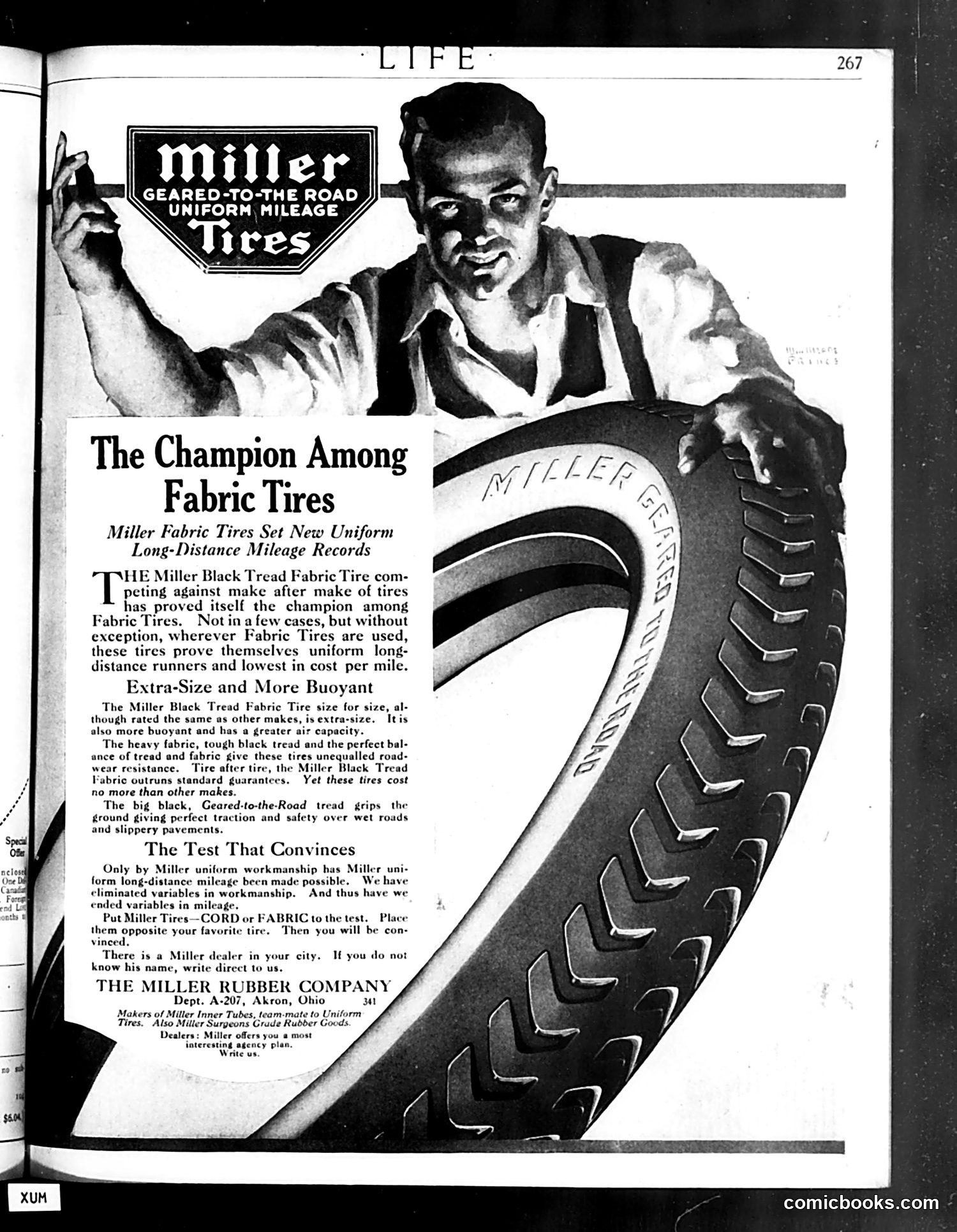
This is **not a cartoon or satire**, but a **straightforward advertisement** for Miller Fabric Tires, placed in Life magazine (page 267). The image shows a mechanic or workman displaying a Miller tire, emphasizing its superiority through "uniform long-distance mileage" and "geared-to-the-road" tread design. The ad claims Miller tires are "the champion among fabric tires" and boasts they're extra-sized and more buoyant than competitors. The copy encourages readers to test Miller tires against other brands, suggesting confidence in their product quality. Contact information directs consumers to The Miller Rubber Company in Akron, Ohio. This represents typical early-20th-century tire advertising, appealing to practical motorists concerned with durability and performance—not satirical content.
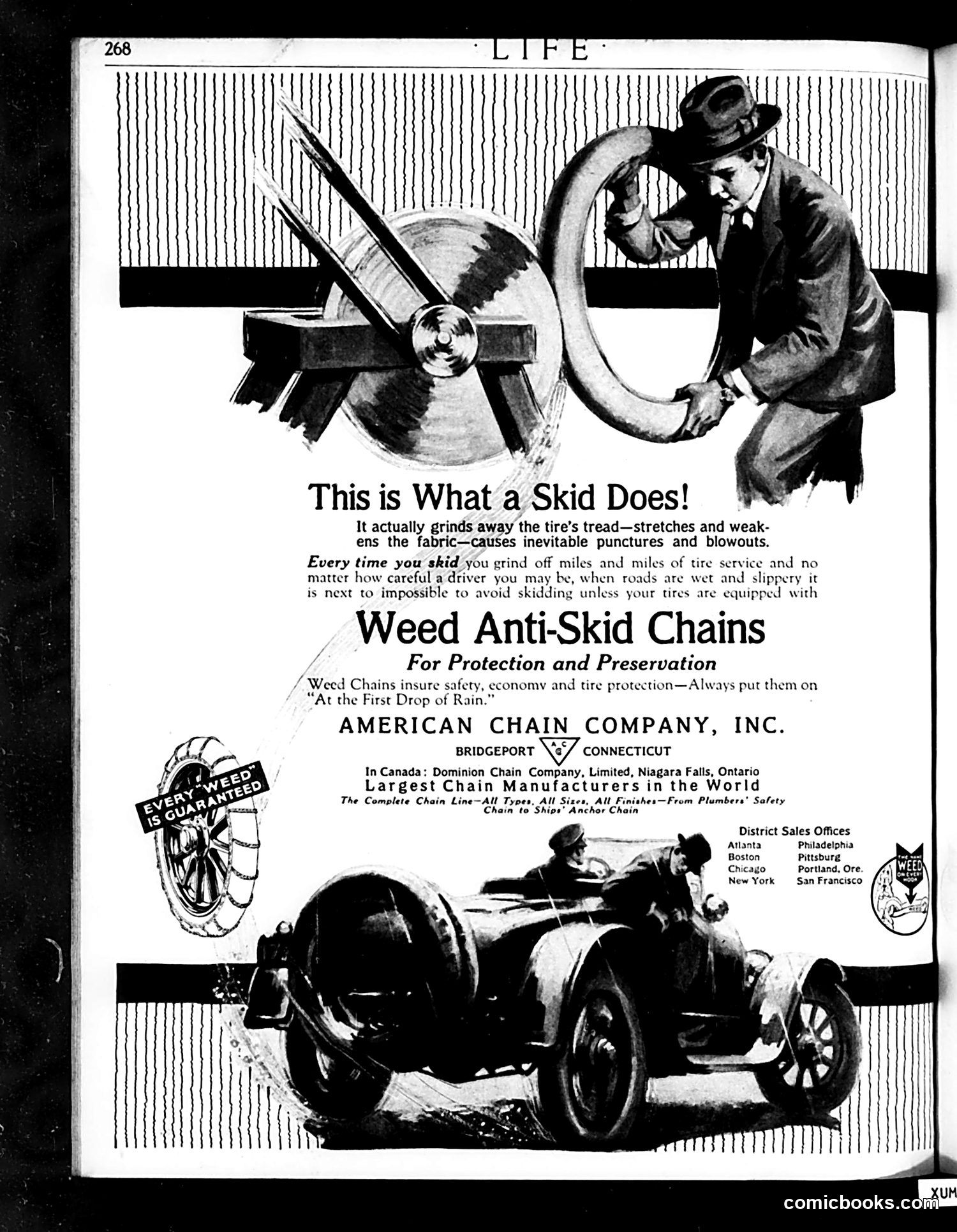
This is a **Weed Anti-Skid Chains advertisement**, not satire. The page uses dramatic illustration to promote tire chains for winter driving safety. The top illustration shows two men demonstrating what happens during a "skid"—a tire spinning uselessly and losing traction. The text explains that skidding damages tires and causes inevitable punctures and blowouts. The bottom shows a car that has skidded or crashed, reinforcing the danger message. The advertisement argues that Weed Anti-Skid Chains prevent this by improving traction, especially on wet and slippery roads. The tagline "Every time you skid" emphasizes frequency and danger. **American Chain Company, Inc.** (based in Bridgeport, Connecticut) marketed these chains as essential winter safety equipment, urging customers to install them "at the first drop of rain."
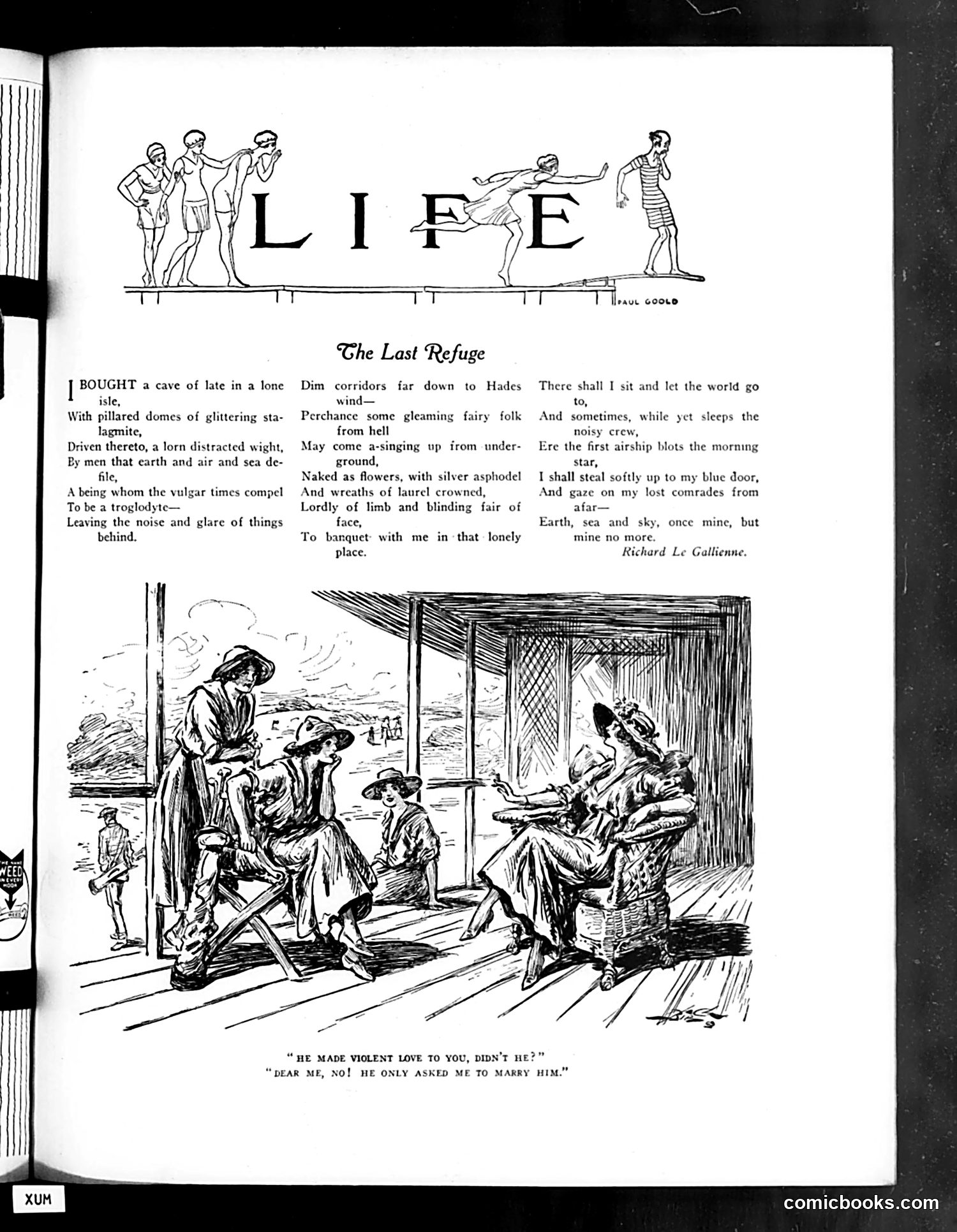
This page features a poem by Richard Le Gallienne titled "The Last Refuge," depicting a speaker seeking solitude in a cave on a remote island to escape modern life's noise and chaos. The illustration shows a domestic interior scene with the caption: "He made violent love to you, didn't he?" / "Dear me, no! He only asked me to marry him." The humor appears satirical about romantic/marital proposals—suggesting that asking someone to marry represents an aggressive or presumptuous act. The contrast between "violent love" and a simple marriage proposal critiques either courtship conventions of the era or, possibly, changing attitudes toward what constitutes acceptable romantic behavior. The juxtaposition with the escapist poem suggests commentary on modern social complications driving people to seek refuge.
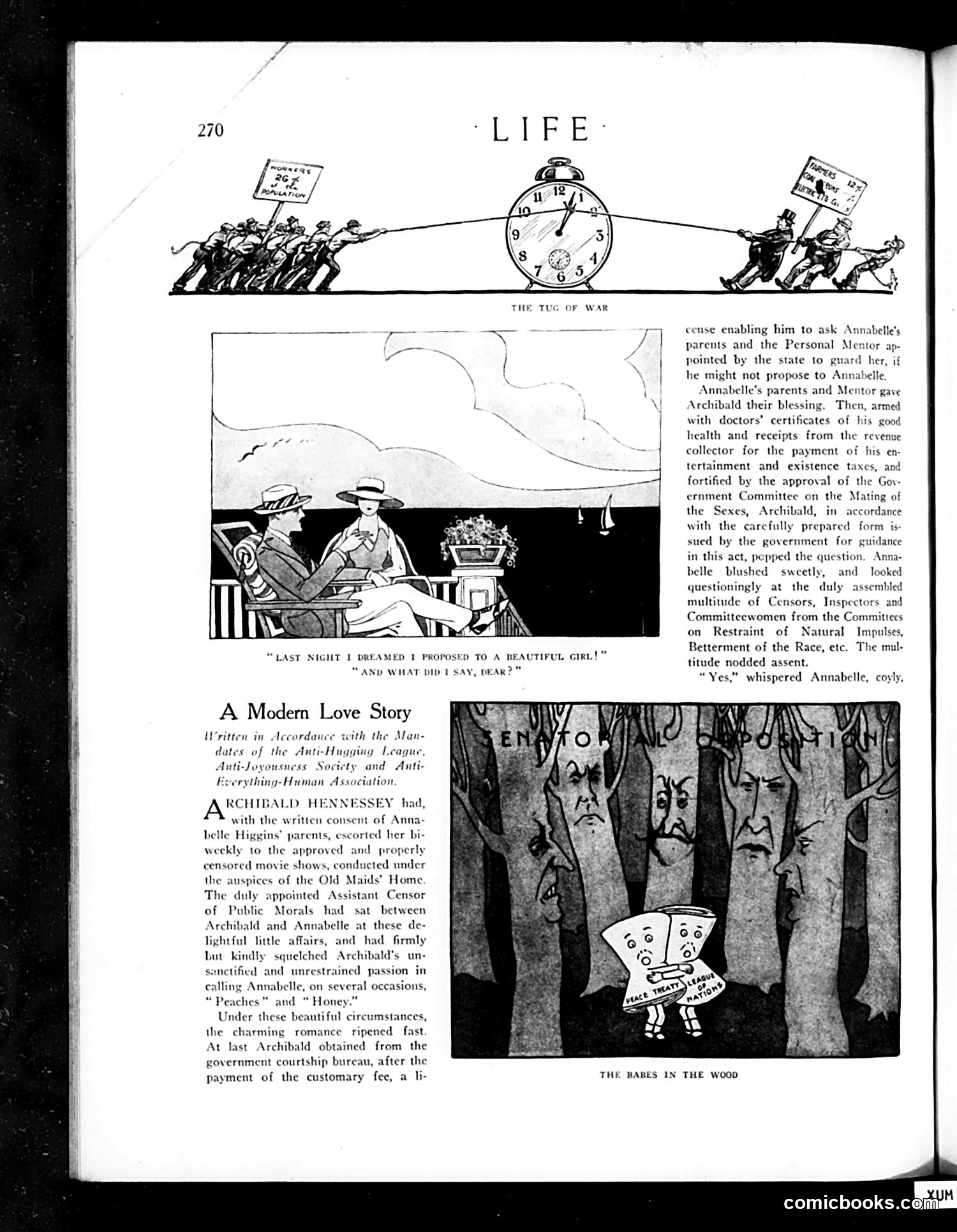
This page satirizes government censorship of entertainment and morality regulation. The top cartoon ("The Tug of War") depicts competing forces pulling on a clock, representing the tension between different regulatory bodies controlling romantic content. The story below mocks the bureaucratic apparatus surrounding courtship: Archibald Hennessey must obtain government approval to propose to Annabelle, navigating multiple "Committees on Restraint of Natural Impulses" and other absurd censorship bodies. He needs doctor's certificates, tax receipts, and official permission slips. The satire targets the anti-obscenity and "purity" movements of the early 20th century, which sought to regulate human behavior through governmental oversight. The elaborate bureaucratic machinery makes romantic love impossibly complicated, ridiculing these movements' invasive control over private life and natural human impulses.
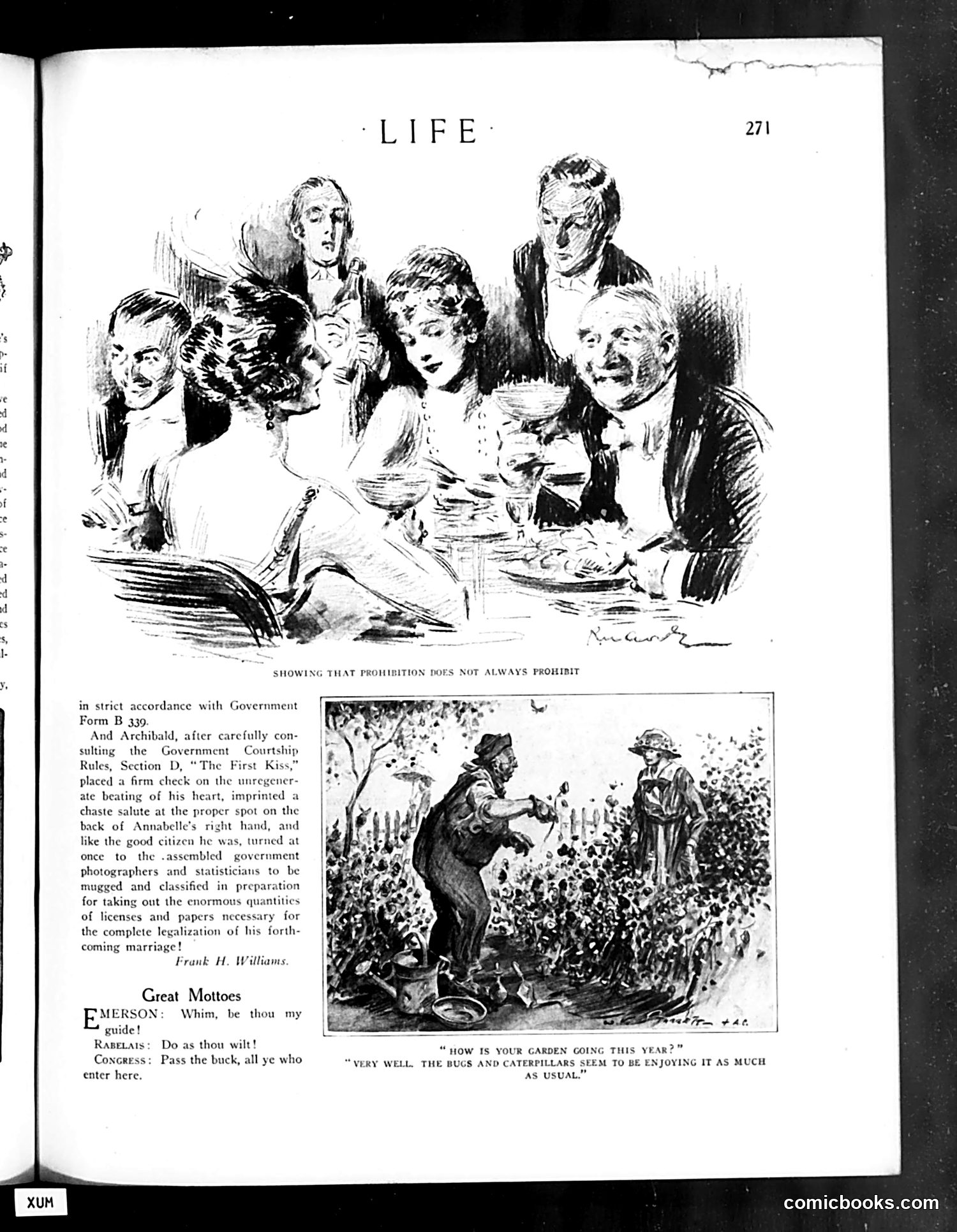
**Top Cartoon:** "Showing That Prohibition Does Not Always Prohibit" This sketch depicts a social gathering where well-dressed men and women are drinking cocktails, directly mocking Prohibition enforcement. The title's irony suggests that despite the legal ban on alcohol (likely referring to the 18th Amendment era), wealthy people continued drinking openly. The cartoon satirizes the hypocrisy and selective enforcement of Prohibition laws—rules applied to common citizens while the privileged class flouted them. **Bottom Illustration:** Shows a farmer and gardener discussing crop pests, with the caption referencing garden bugs and caterpillars. This appears to be a separate humorous piece about agriculture, unrelated to the prohibition satire above. The page critiques class-based justice and Prohibition's ineffectiveness among the elite.
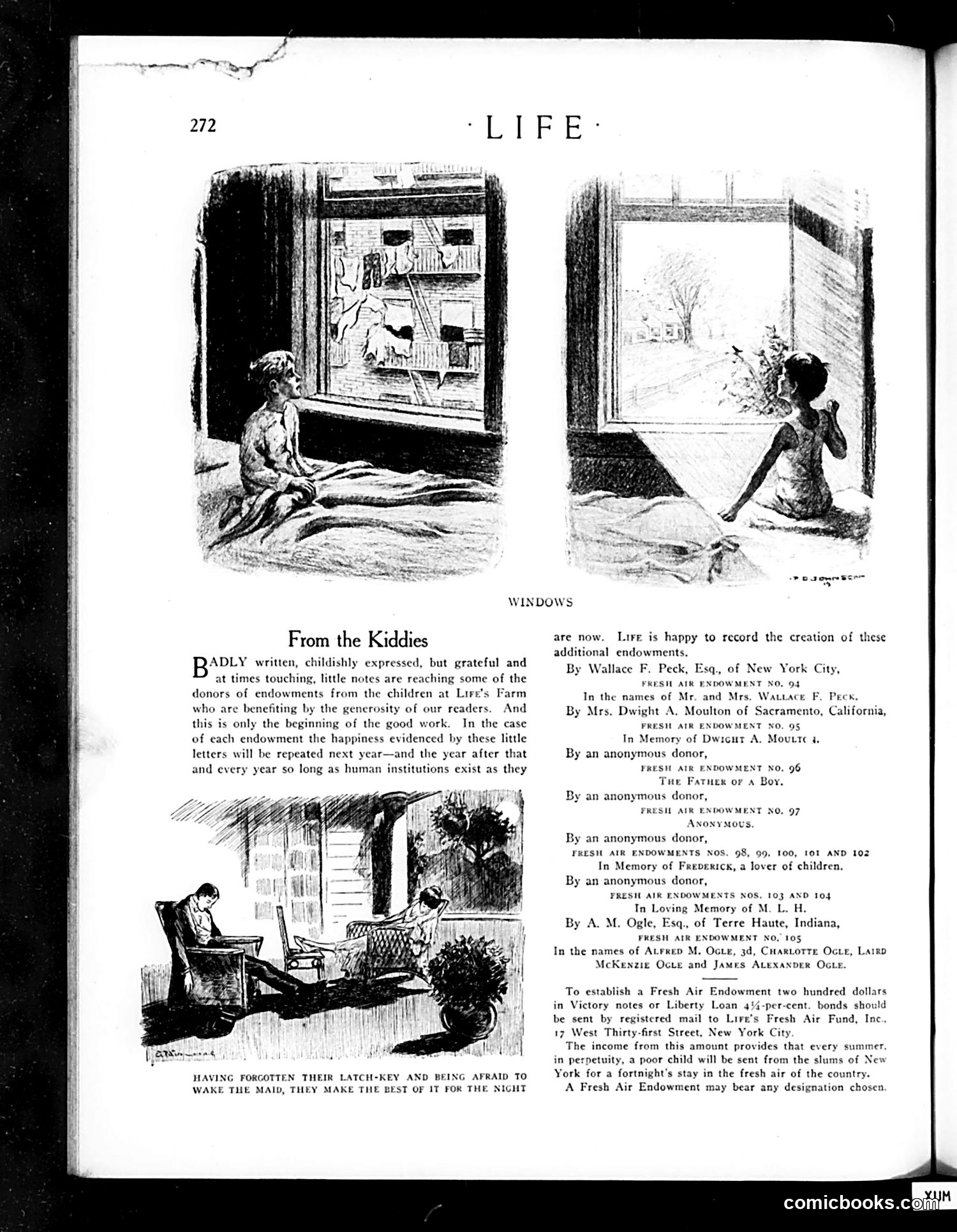
This page solicits donations to Life's Fresh Air Endowment, which sends poor children from New York City slums to the countryside for summer stays. The three sketches illustrate the program's appeal: children gazing longingly out windows at urban scenes, daydreaming of open air, and one child who locked themselves out and improvised indoor entertainment. The text emphasizes emotional appeal—these donations provide "happiness" for disadvantaged urban children. Multiple named donors and memorial gifts are listed, along with instructions that a $200 donation establishes a perpetual endowment funding one child's annual trip. This reflects Progressive Era philanthropy: affluent readers supporting child welfare through magazine-mediated charity. The artwork sentimentalizes poor children's deprivation to motivate middle-class generosity.
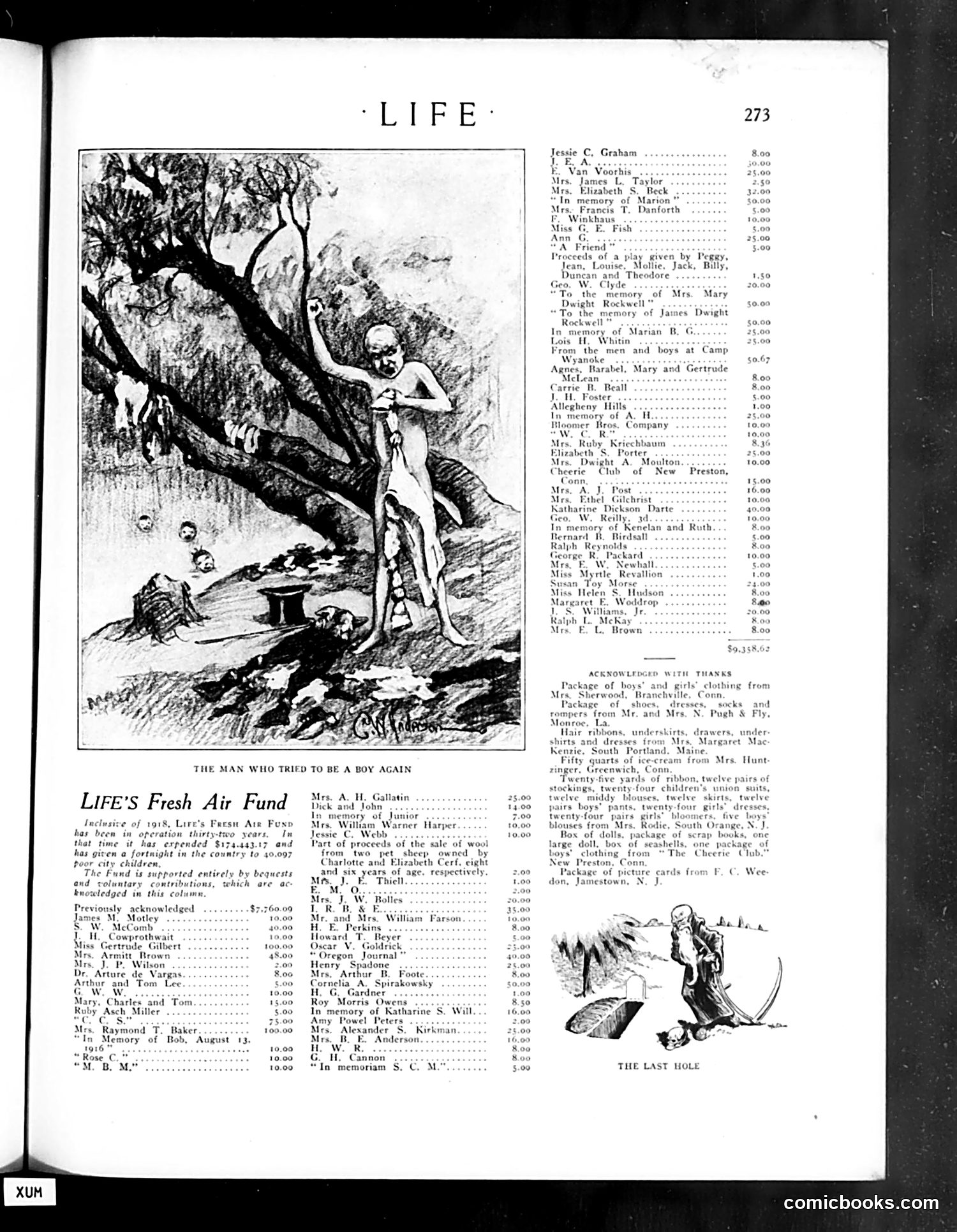
This page features two editorial cartoons and fundraising notices for "Life's Fresh Air Fund." **"The Man Who Tried to Be a Boy Again"** (left): The illustration shows an adult male figure suspended awkwardly from a tree branch while children play below. The satirical commentary appears to critique adults attempting to recapture youth through undignified behavior—a social observation on the gap between adult pretension and actual capability. The phrase "tried to be a boy again" suggests ridicule of middle-aged or elderly men adopting youthful mannerisms. **"The Last Hole"** (right): This golf-themed cartoon depicts a figure at what appears to be a golf green, likely satirizing golfers' obsessive pursuit of the game or a specific golf-related social trend. The bulk of the page consists of donation acknowledgments for the Fresh Air Fund, a charitable initiative providing outdoor experiences for urban children—indicating this was a fundraising issue.
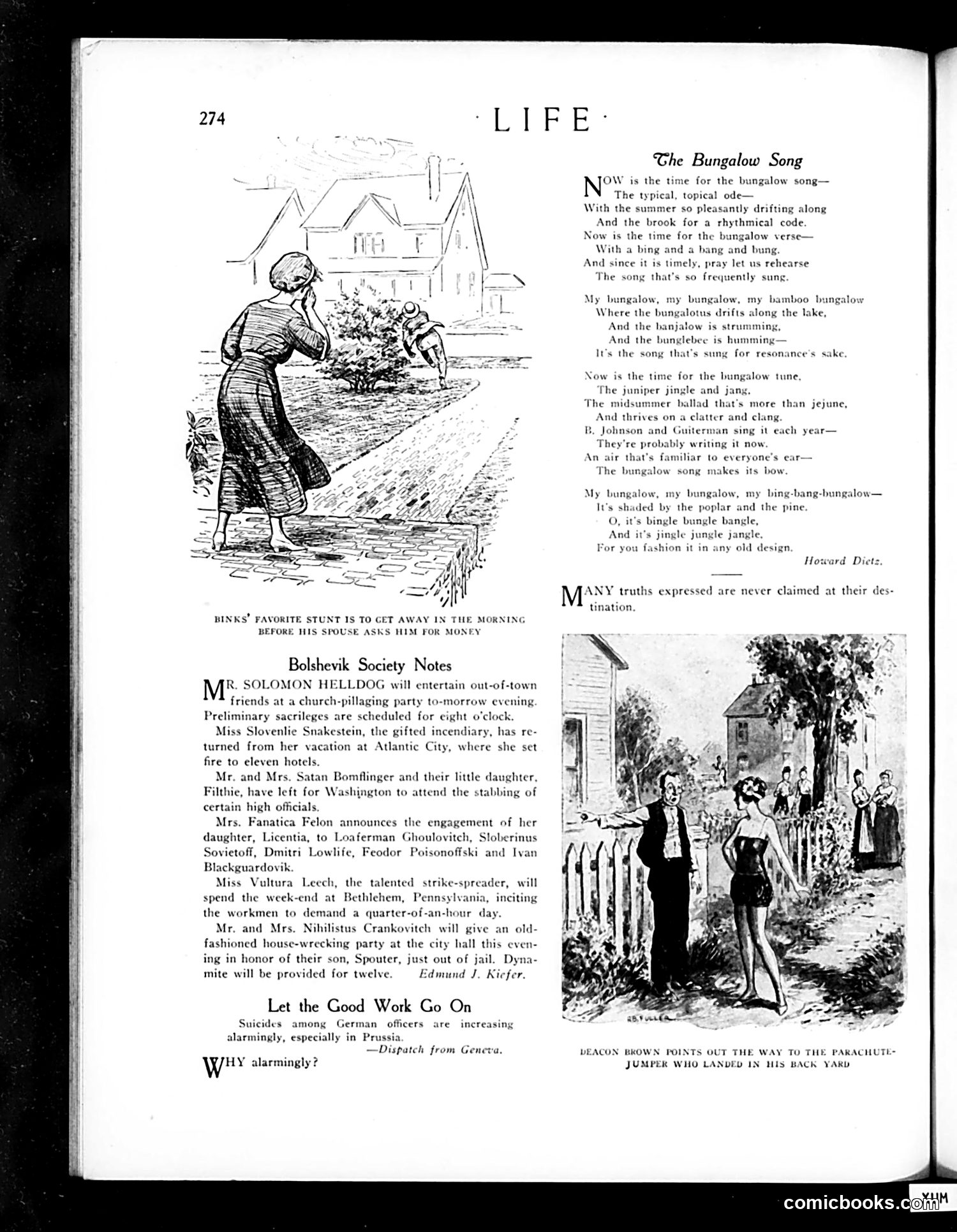
This page from *Life* magazine (page 274) contains three distinct elements: 1. **"The Bungalow Song"** — A poem by Heward Dietz celebrating summer bungalow living, with nostalgic imagery of lakeside retreats and popular songs. 2. **Left illustration** — Captioned "BINKS' FAVORITE STUNT IS TO GET AWAY IN THE MORNING BEFORE HIS SPOUSE ASKS HIM FOR MONEY" — A humorous domestic cartoon depicting a common marital dynamic where husbands escape household financial requests. 3. **"Bolshevik Society Notes"** — A satirical gossip column mocking upper-class social announcements, likely referencing anxieties about Russian revolutionary influence among wealthy Americans during the Red Scare period. 4. **Right illustration** — Shows "DEACON BROWN POINTS OUT THE WAY TO THE PARACHUTIST-JUMPER WHO LANDED IN HIS BACK YARD," depicting an absurdist encounter. The page reflects typical *Life* magazine humor: domestic comedy, social satire, and topical reference.
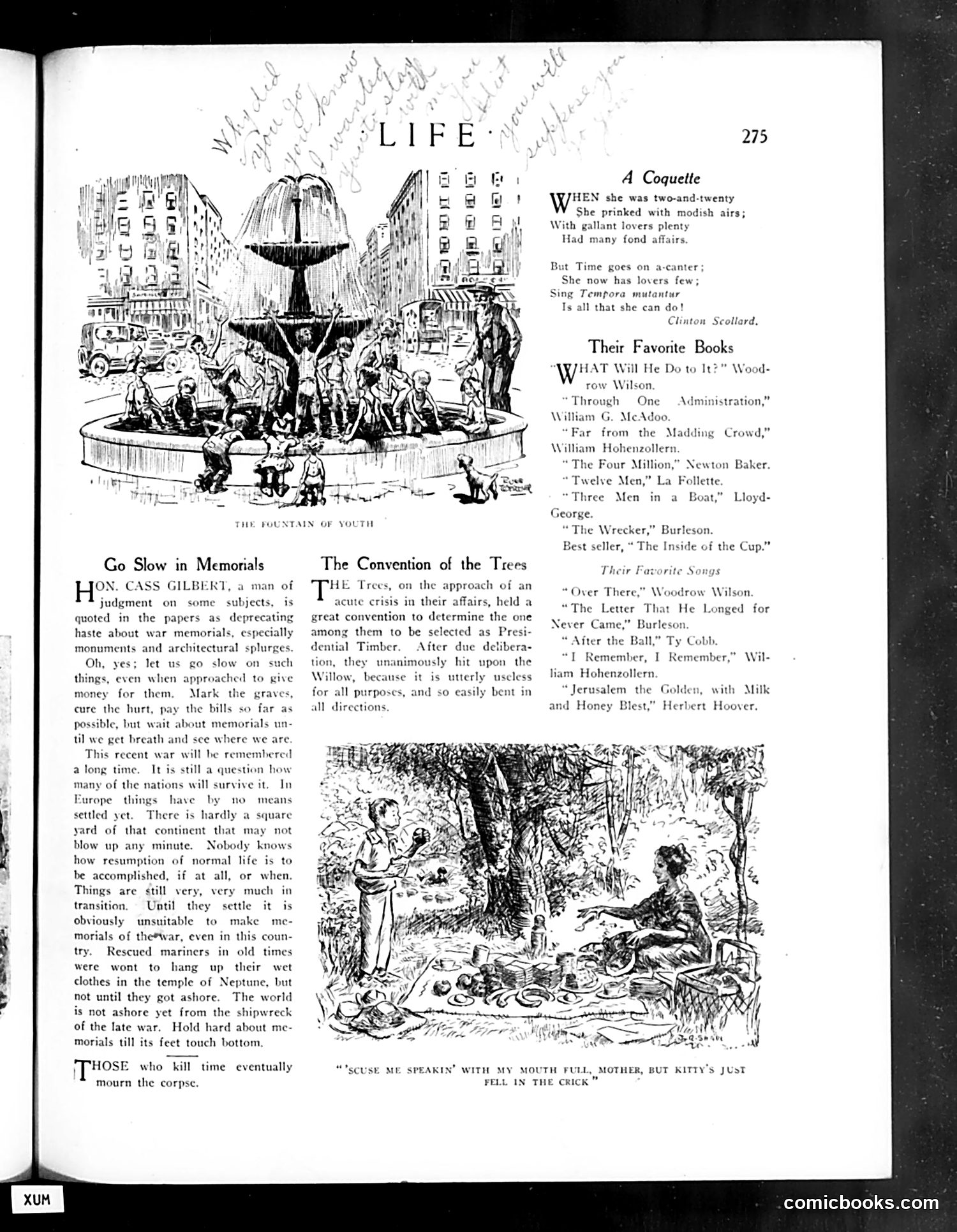
This page contains three distinct sections: 1. **"The Fountain of Youth"** illustration depicts a public fountain surrounded by crowds in an urban setting, likely satirizing the appeal of youth-oriented culture or products marketed to aging populations. 2. **"Go Slow in Memorials"** is an editorial piece by Hon. Cass Gilbert criticizing hasty war memorials and architectural decisions made during post-WWI transition. Gilbert advocates patience and careful planning before permanent monuments are erected. 3. **"The Convention of the Trees"** appears to be a satirical story about trees voting on selecting "Presidential Timber"—a pun on both forestry and political leadership selection during an unspecified political crisis. The page also includes "Their Favorite Books" and "Their Favorite Songs" sections listing contemporary popular culture from the early 20th century.
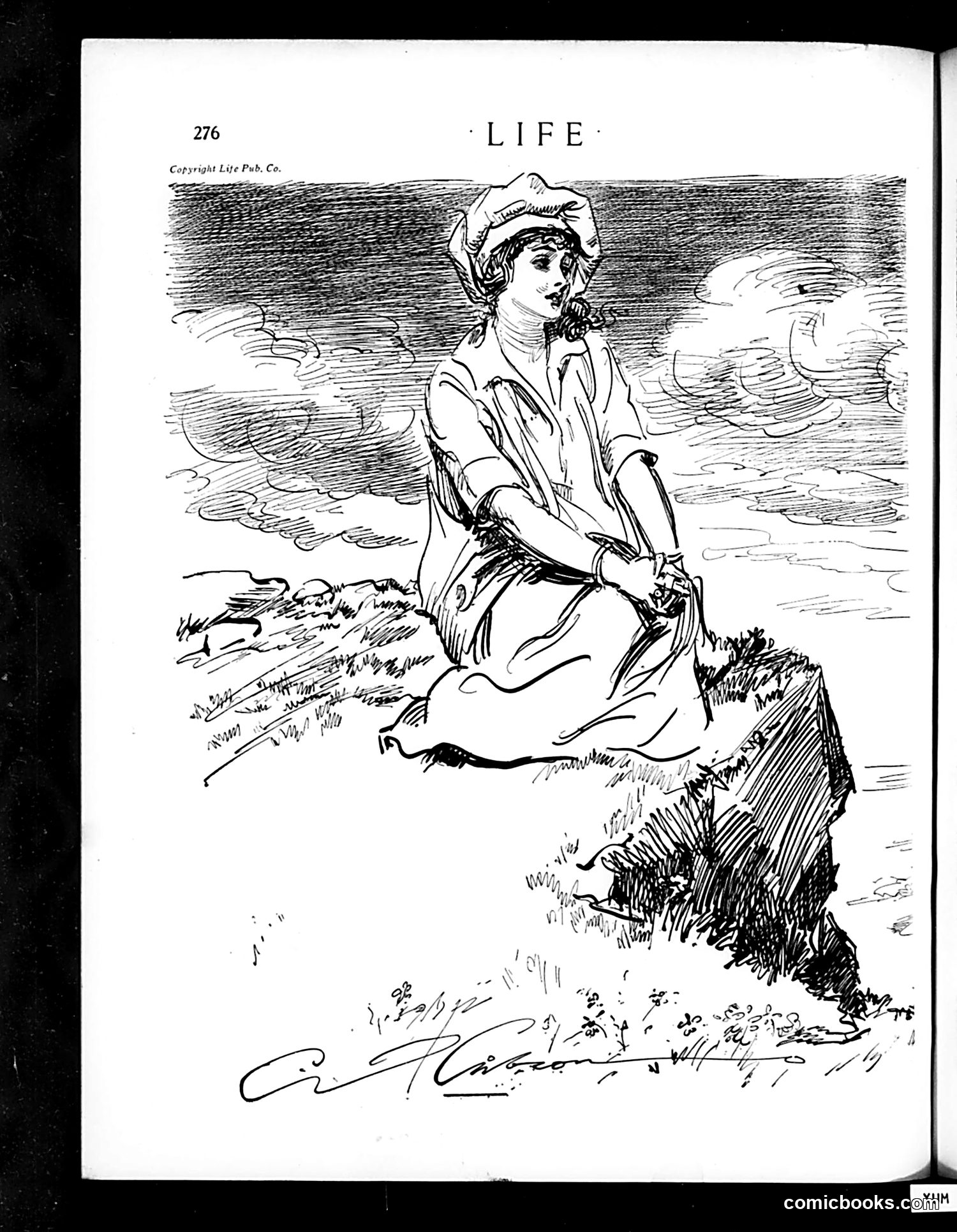
This is a page from *Life* magazine (page 276) featuring a pen-and-ink illustration of a young woman in early 20th-century dress, seated by the seaside. She wears a white blouse, hat, and skirt, gazing pensively toward the water. The artist's signature appears at bottom. **What this depicts:** This appears to be a romantic or sentimental illustration rather than political satire. It likely represents leisure-class femininity of the period—a woman enjoying seaside recreation. Without accompanying text or captions visible, the specific satirical meaning is unclear. The composition suggests commentary on courtship, romance, or women's social life, but the precise joke or reference cannot be determined from the image alone.
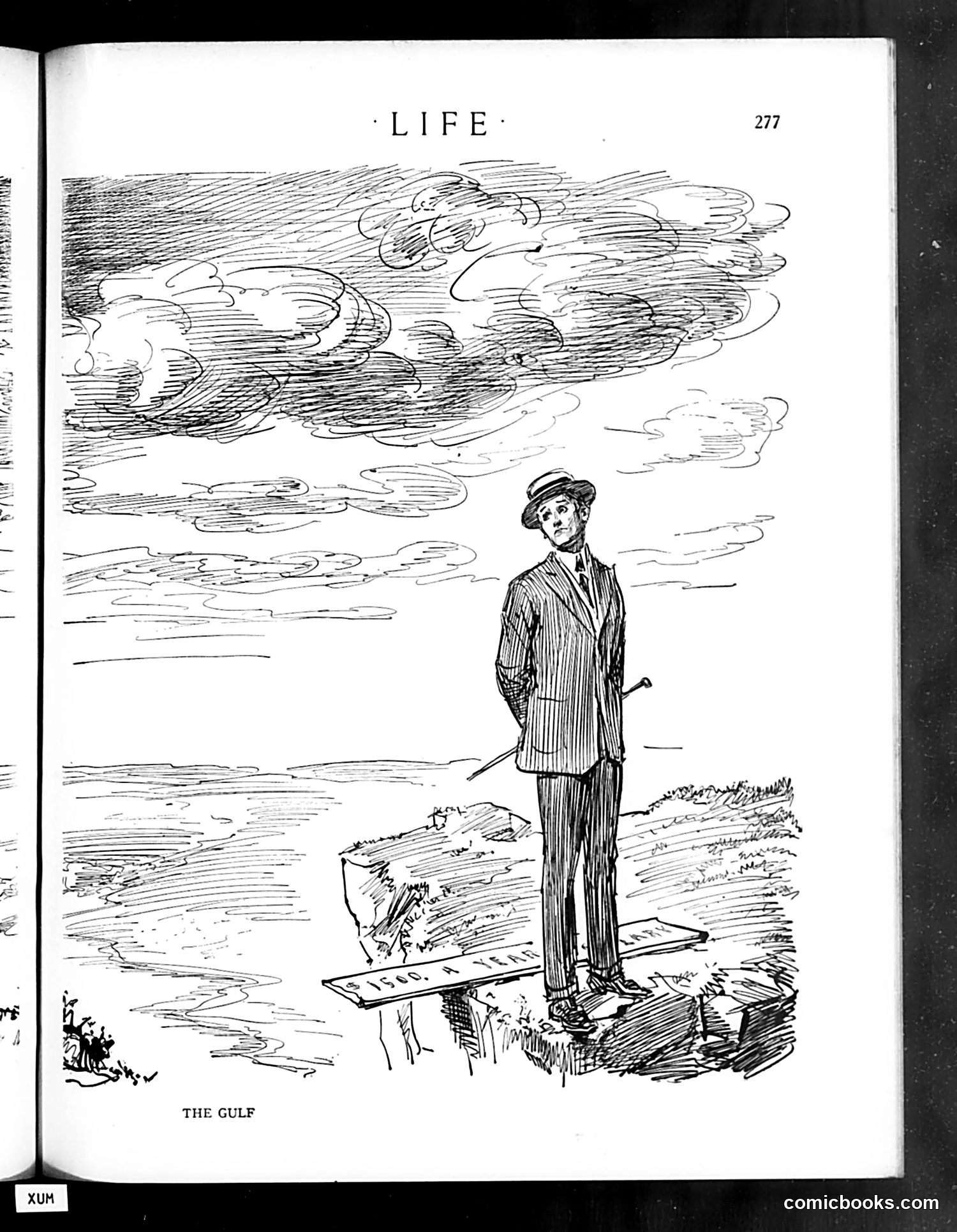
This ink-sketch cartoon depicts a solitary man in business attire standing on barren ground, gazing toward a vast, stormy gulf or chasm. The title "The Gulf" suggests a metaphorical divide—likely representing social, economic, or political separation. The figure's isolated posture and contemplative stance suggest he faces an insurmountable obstacle or uncertain future. The turbulent sky and empty landscape reinforce themes of isolation, hardship, or existential uncertainty. Without additional context or captions visible in the OCR text, the specific reference remains unclear—this could address class division, unemployment, failed opportunities, or another contemporary American concern from the magazine's publication era. The stark, expressionistic style emphasizes emotional weight rather than literal narrative.
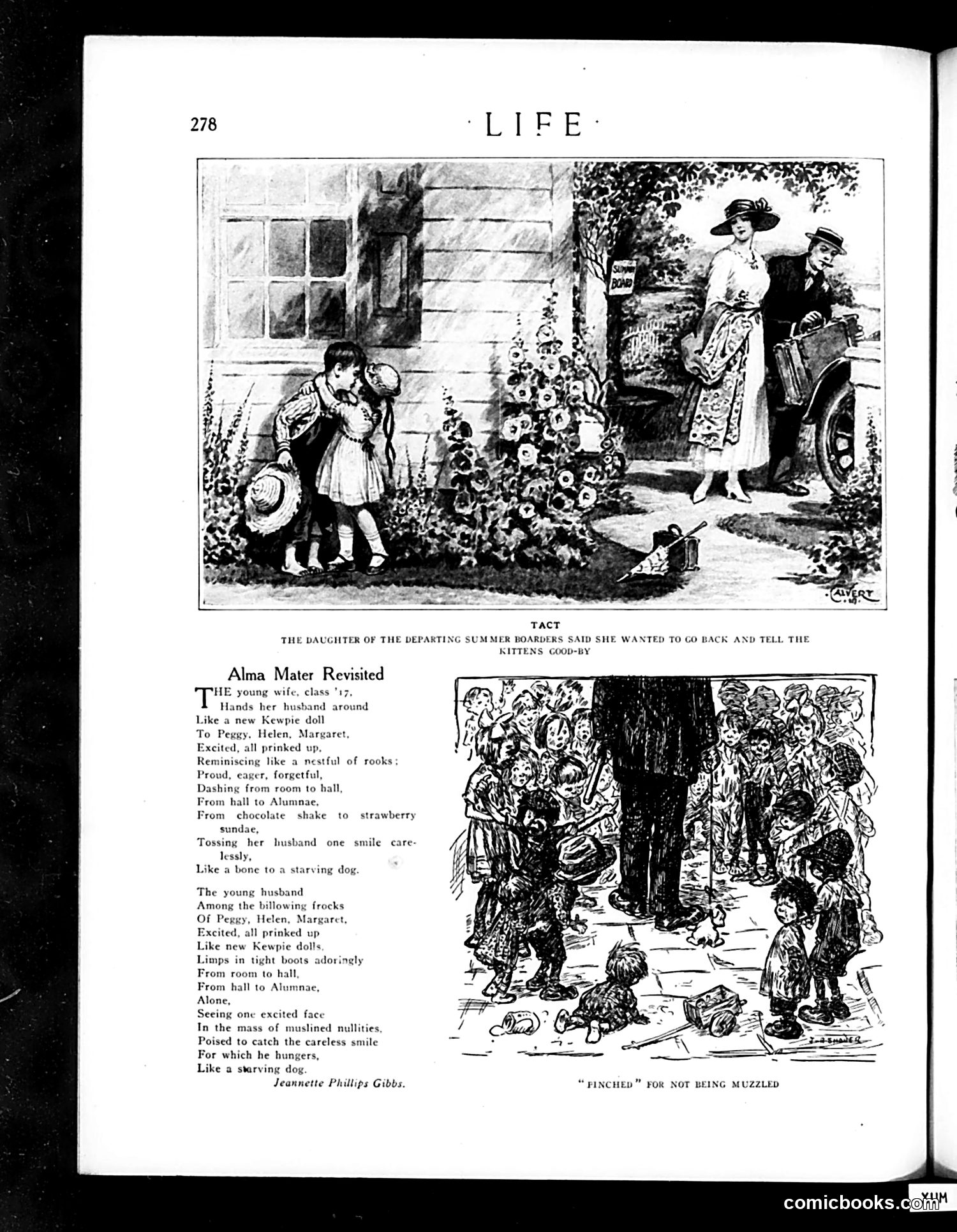
**"Tact"** depicts summer boarders departing a home, with a young daughter saying goodbye to kittens—a sentimental, domestic scene illustrating polite social behavior. **"Alma Mater Revisited"** satirizes a college reunion. A young wife (class of 1917) shows off her new husband to her female classmates like a trophy ("new Kewpie doll"). The poem reveals the husband's emotional neglect: his wife treats him carelessly, "tossing" him attention "like a bone to a starving dog," while he desperately seeks her approval among her gossiping friends. The satire critiques both the wife's superficiality and the husband's pathetic neediness in marriage. **"Pinched for Not Being Muzzled"** (right panel) appears to show a chaotic street scene with children or figures being disciplined, likely commenting on social regulation or parental control. The page mocks early 20th-century domestic life and gender dynamics—particularly women's power over men and the hollowness of social performance at reunions.
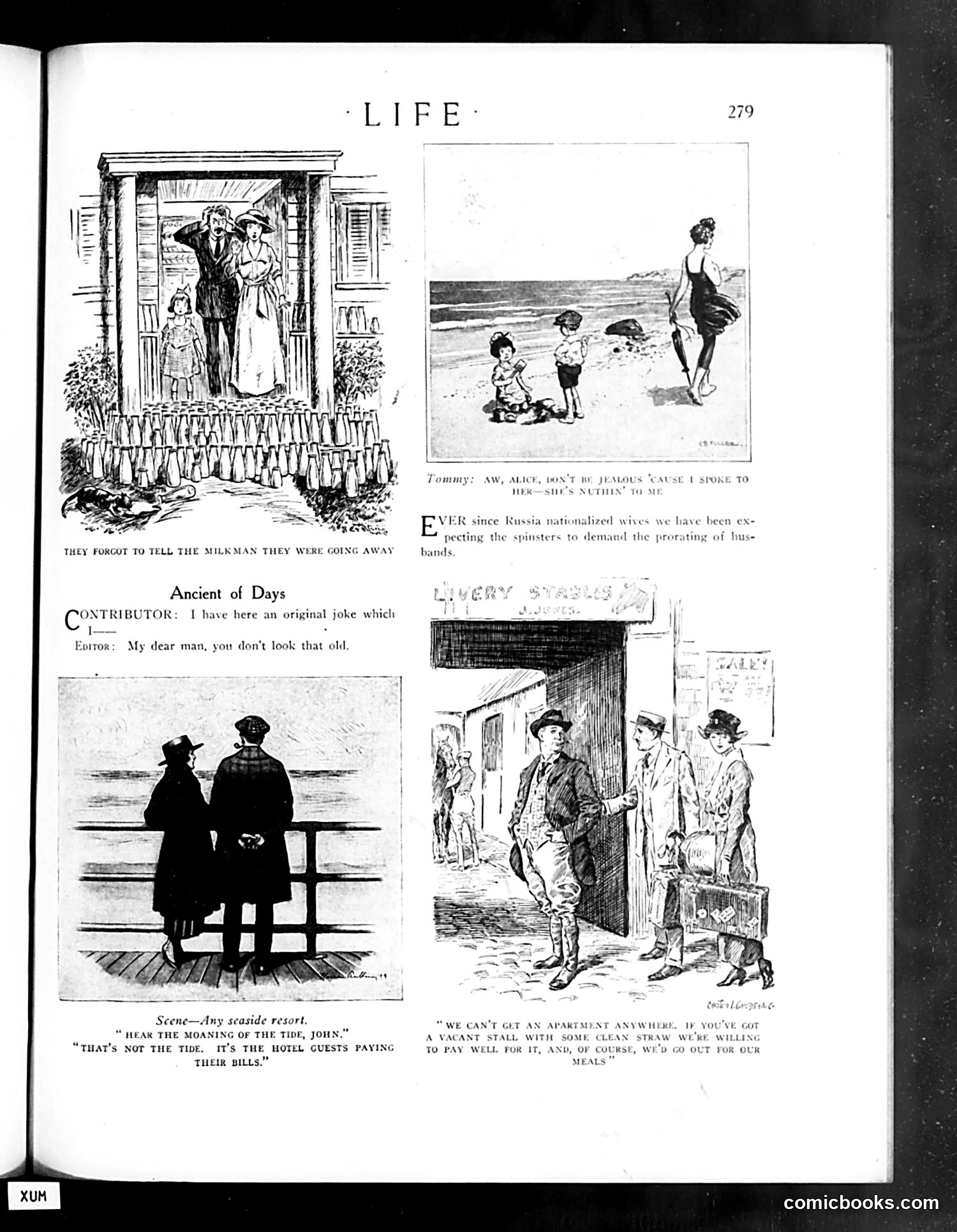
This satirical page contains three distinct jokes reflecting post-WWI anxieties: 1. **Top cartoon**: A domestic dispute about jealousy, with Tommy dismissing Alice's concerns over his interaction with another woman as trivial. 2. **"Ancient of Days"**: A meta-joke where a contributor pitches an "original" joke to the editor, who dismissively notes the contributor appears elderly—suggesting the joke itself is as dated as its teller. 3. **Bottom cartoons**: Two separate jokes about housing scarcity and financial hardship. One depicts hotel guests' complaints about bills; another shows a couple so desperate for housing they're willing to rent a horse stall, willing to eat out to make ends meet. The overarching theme addresses post-war economic strain, housing shortages, and domestic tensions. The Russia reference appears to satirize anxieties about Bolshevism and radical social reorganization affecting traditional marriage and family structures.
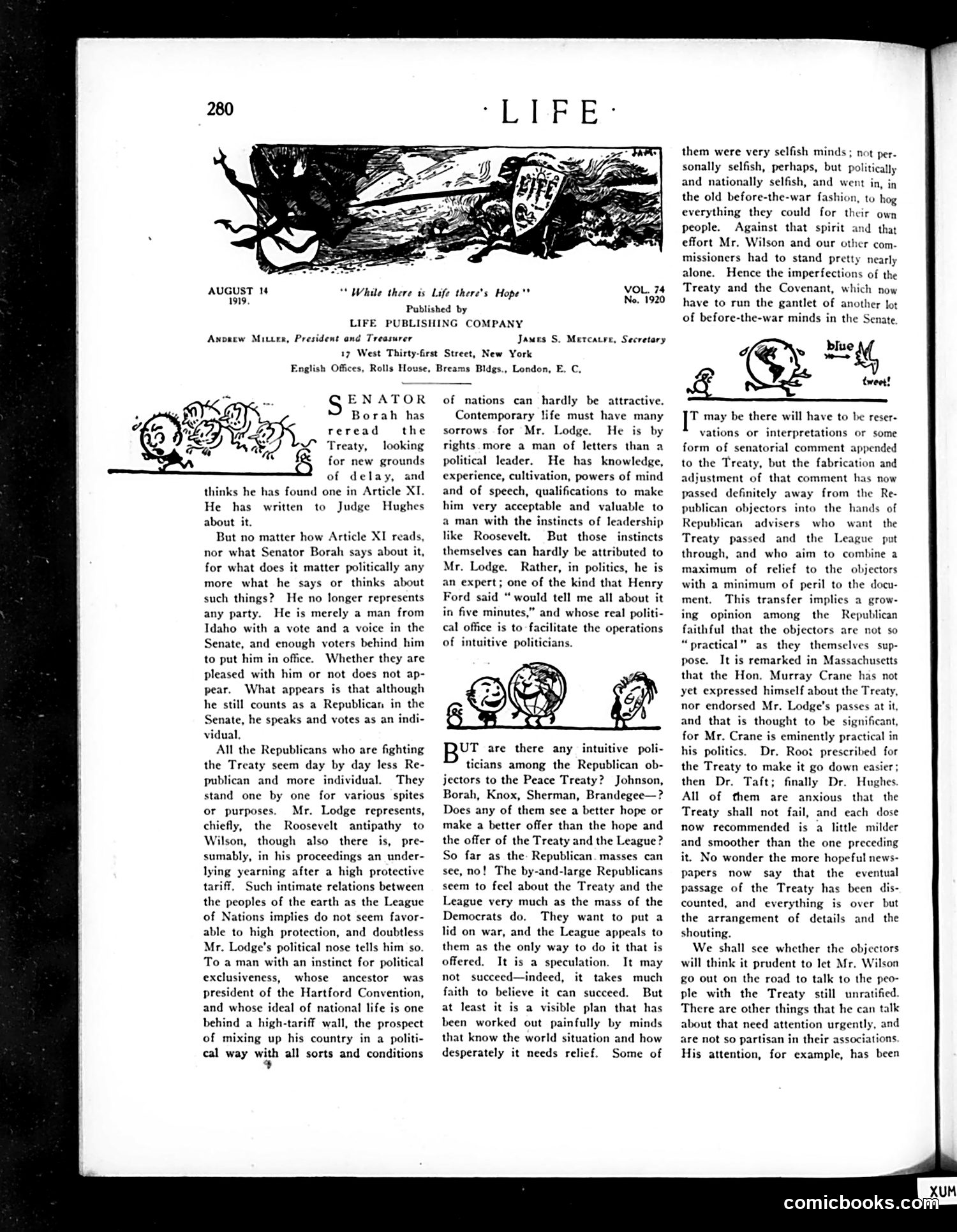
This editorial cartoon and accompanying text satirize Republican senators opposing the League of Nations Treaty. The piece critiques Senator William E. Borah (shown rereading the Treaty) and other GOP objectors—including Henry Cabot Lodge, Hiram Johnson, and Philander Knox—for abandoning party unity to pursue individual agendas. The satire's central point: these senators are no longer truly Republican; they're self-interested individuals. Lodge represents Roosevelt's anti-Wilson vendetta and protectionist tariff interests. The article argues Republican voters actually support the League as a mechanism to prevent war, but their senators oppose it for partisan or personal reasons rather than offering better alternatives. The cartoon's caption—"While there is Life there's Hope"—suggests the Treaty still has a fighting chance despite Senate obstruction. The piece lambasts the senators' hypocrisy and self-serving politics.
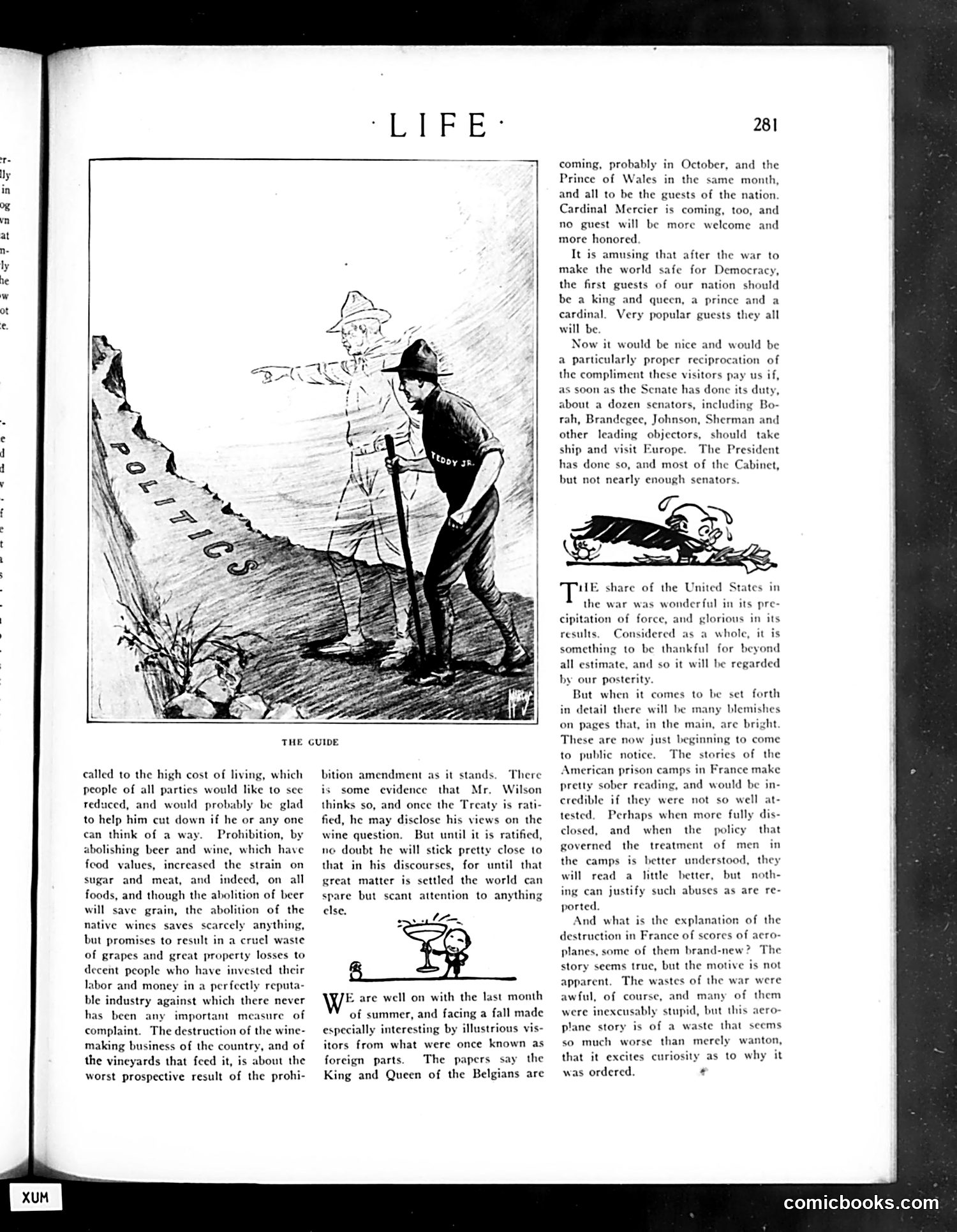
**The Cartoon "The Guide":** The illustration depicts a soldier in WWI uniform pointing the way to a civilian in a hat. The caption reads "THE GUIDE," suggesting post-war guidance or direction for the nation. **Main Content - Political Satire:** The text satirizes President Wilson's silence on Prohibition. The author argues that Wilson likely opposes the wine industry's destruction (a real concern post-war) but stays quiet until the Treaty of Versailles is ratified, as other matters dominate attention. **Foreign Dignitaries Section:** The piece mocks the irony that after fighting "to make the world safe for Democracy," America's first distinguished guests are royalty and clergy—a King and Queen of Belgium, the Prince of Wales, and Cardinal Mercier. The author sarcastically notes how "popular" they'll be, then suggests U.S. Senators (naming Republican Treaty opponents like Borah and Brandegee) should reciprocate by visiting Europe, implying they should see war's actual consequences. **War Accountability:** The closing section criticizes emerging reports of American misconduct: mismanagement of French prison camps and unexplained destruction of new military aircraft—"a waste that seems so much worse than merely wanton."
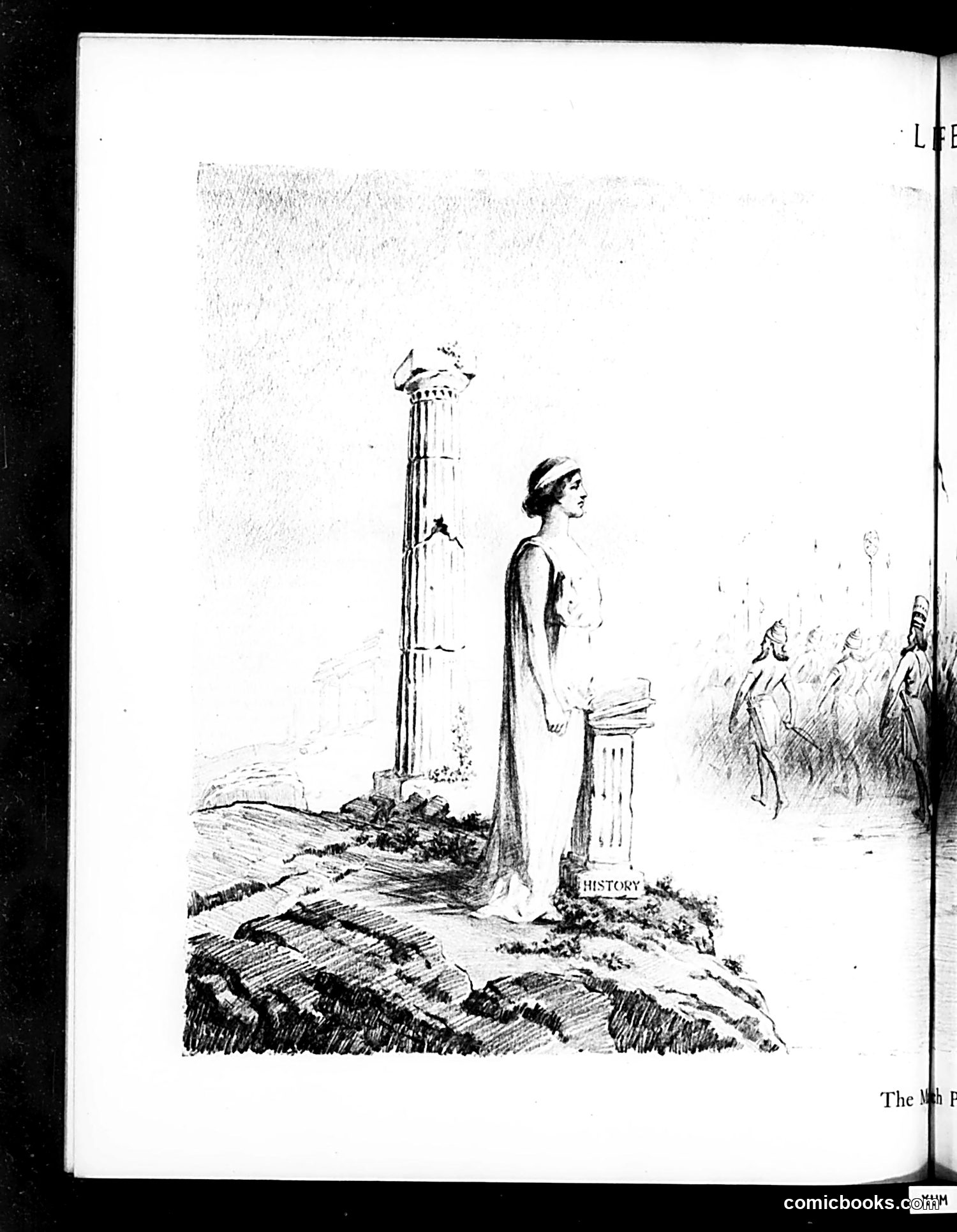
This is a satirical illustration showing a classical female figure (appearing to represent "History") standing among ruins. She gazes at deteriorating classical columns and architectural remnants while figures in the background appear to be fleeing or dispersing. The visible text "HISTORY" on one column anchor suggests the cartoon's theme: the decay or destruction of historical monuments and classical civilization. The scattered figures in the distance may represent abandonment of these values. This likely satirizes early 20th-century concerns about the erosion of classical education, Western cultural heritage, or historical preservation—common themes in *Life* magazine's social commentary. The melancholic personification of History witnessing the ruin of the past suggests anxiety about civilization's decline or neglect of cultural traditions. Without publication date or byline visible, the exact historical reference remains unclear.
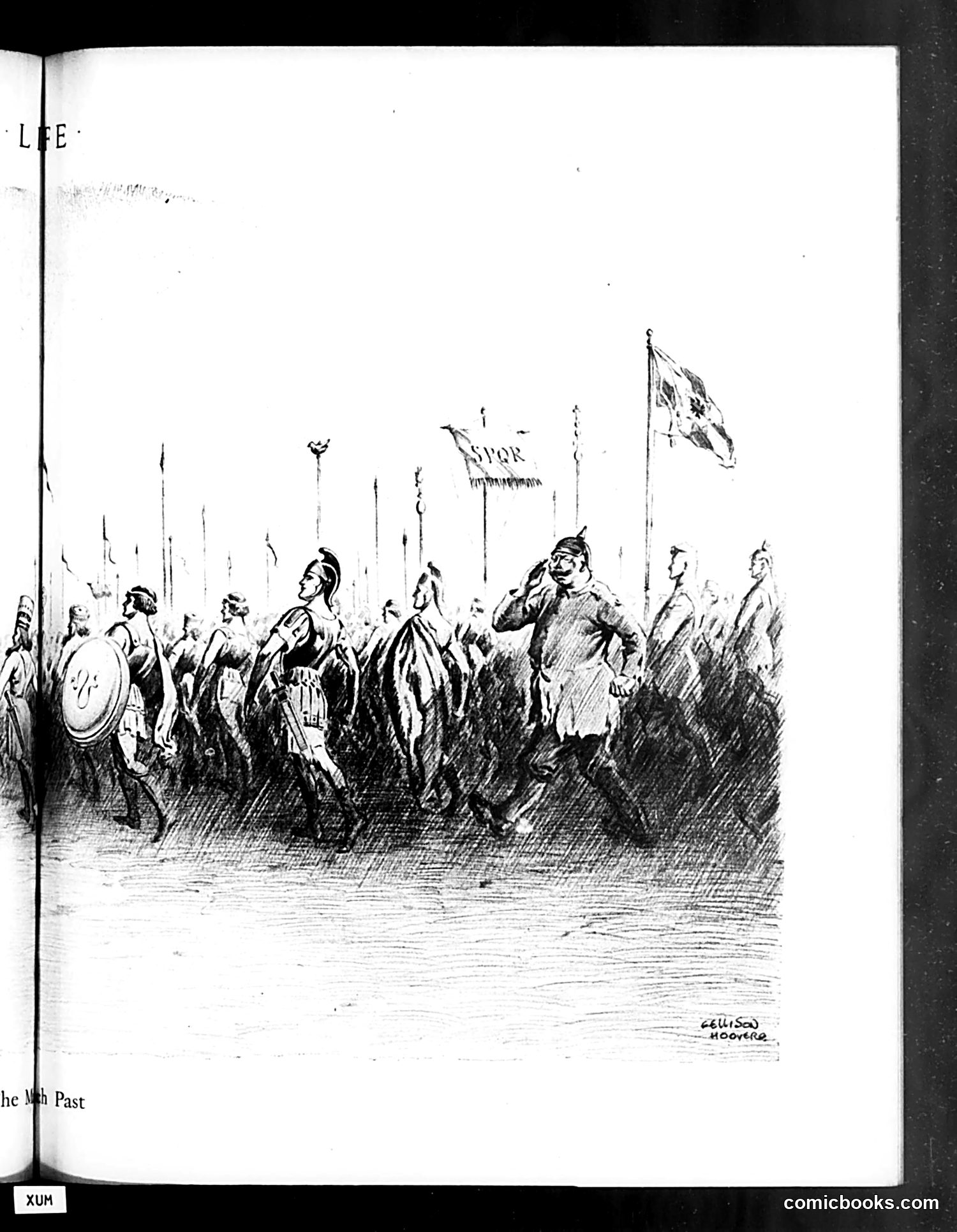
This appears to be a satirical sketch from *Life* magazine showing a military or political procession. The image depicts uniformed figures carrying spears and flags, with one prominent central character gesturing dramatically. The style suggests early 20th-century editorial cartooning (signed by what appears to be "Cesare Maccari" or similar). Without clearer OCR text or visible caption, the specific historical reference remains unclear. However, the composition—with its emphasis on marching troops, flags, and theatrical posturing—likely satirizes militarism, imperialism, or a particular political leader's aggressive foreign policy or domestic power-building. The exaggerated body language and caricature style suggest mockery of authoritarian pageantry. The exact context requires additional publication information to identify definitively.
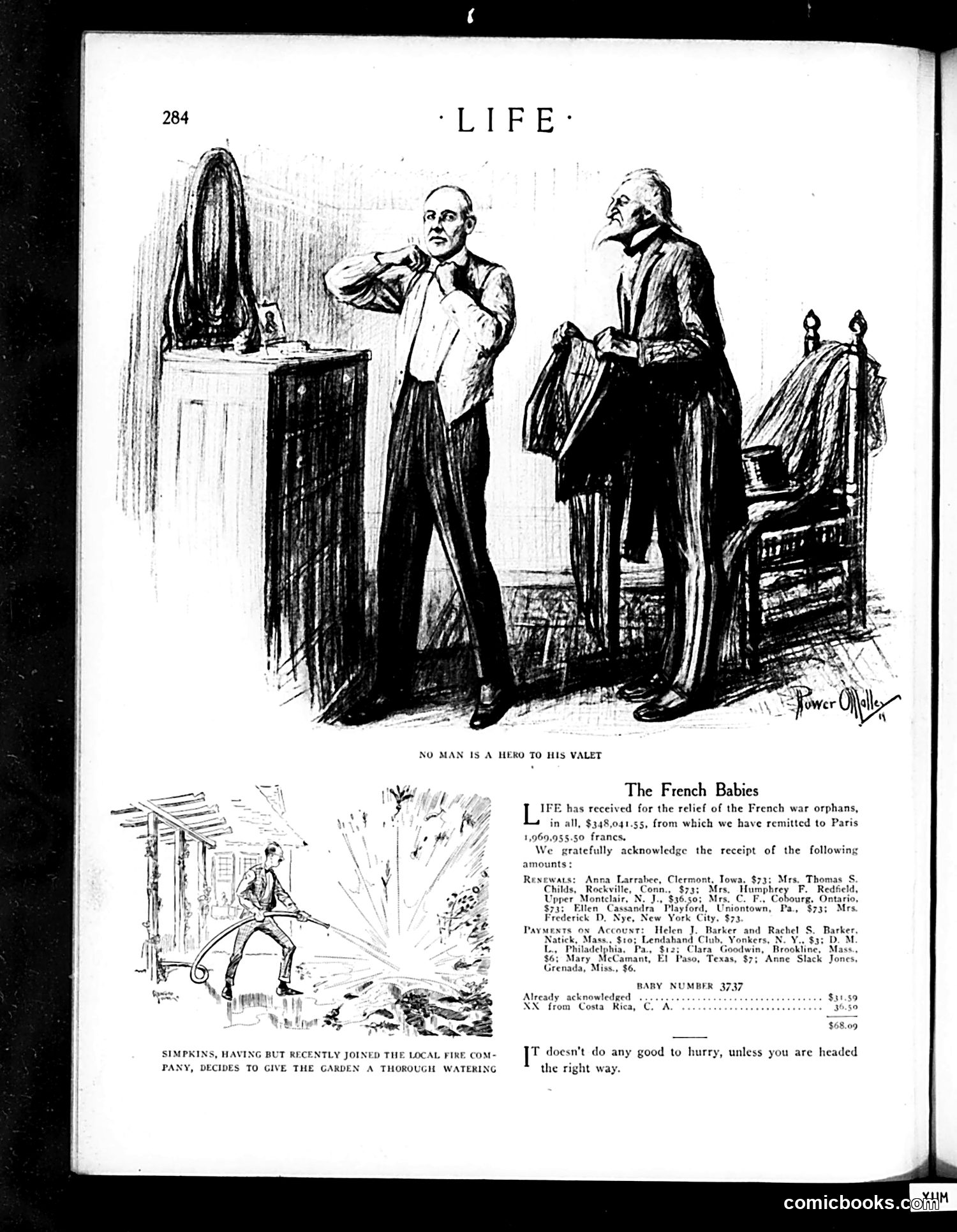
This page contains two distinct items: **Top cartoon**: A humorous domestic scene titled "No Man Is a Hero to His Valet." A man adjusts his clothing while two other men observe—likely satirizing pretension or the gap between public persona and private reality. The specific reference is unclear without additional context. **Main content**: "The French Babies" announces a *Life* magazine fundraising campaign for French war orphans (context suggests WWI era). The magazine has collected $348,041.55 and remitted funds to Paris. It lists donor names and amounts, then acknowledges receipt with a tally showing $31.59 already acknowledged and $68.09 in new donations. **Bottom cartoon**: A comic about "Simpkins" joining the fire company and over-enthusiastically watering a garden with a fire hose—gentle satire of an amateur's overzealousness. The closing aphorism—"It doesn't do any good to hurry, unless you are headed the right way"—appears unrelated to the other content.
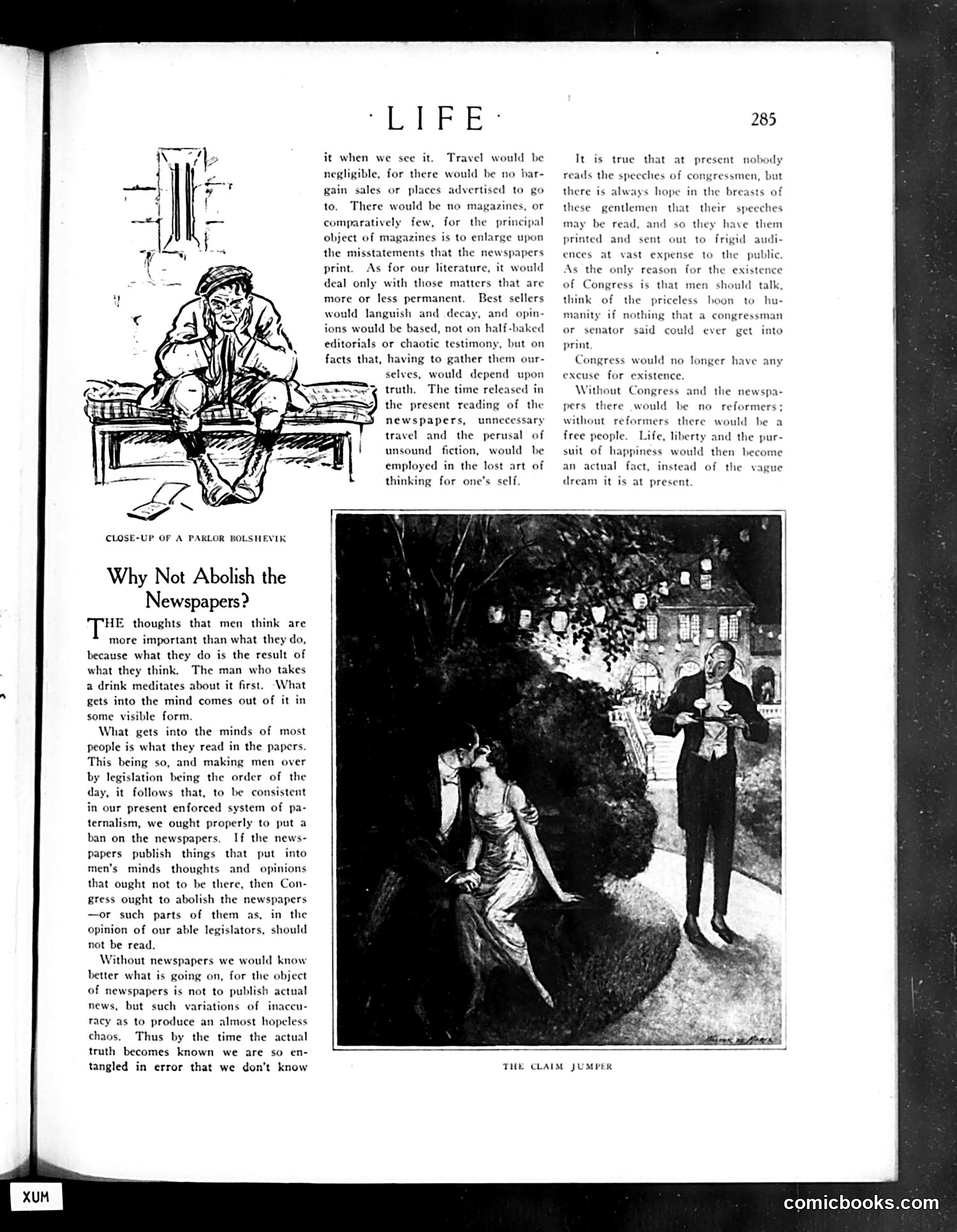
This piece satirizes government censorship and paternalism through **ironic argument**. The author pretends to seriously advocate abolishing newspapers—a proposal that would logically follow if the government controls what citizens think (the unstated premise being mocked). The "parlor Bolshevik" cartoon depicts a radical intellectual spreading dangerous ideas in a comfortable living room, representing the essay's implicit target: those advocating government control over public discourse. The satire argues that **newspapers, despite their inaccuracies, are essential to freedom**. By proposing absurd consequences of abolition (Congress loses excuse for existing, citizens might think independently), the author defends press freedom against censorship advocates. "The Claim Jumper" photograph below appears unrelated or illustrates another point about deception/fraud. The piece reflects post-WWI American concerns about Bolshevism, government overreach, and media's role in democracy—defending newspapers and independent thought against totalitarian impulses.
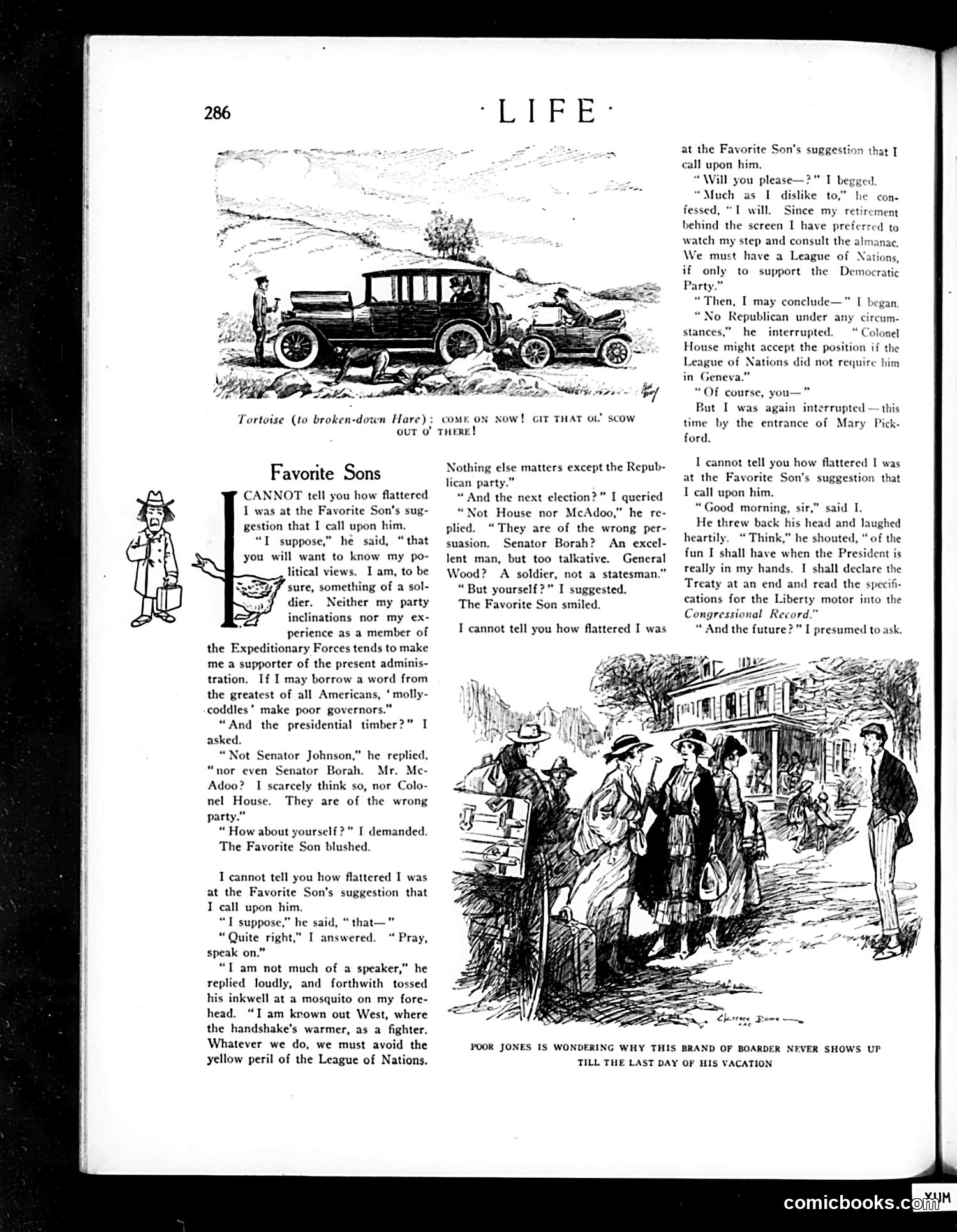
This satirical piece mocks Republican politicians who position themselves as potential presidential candidates while carefully avoiding commitment. The "Favorite Son" repeatedly claims flattery at being consulted, then contradicts himself—opposing the League of Nations as a "yellow peril," then later supporting it; rejecting various candidates (McAdoo, Borah, Wood, House) while hinting at his own ambitions. The joke intensifies when Mary Pickford appears: the "Favorite Son" reveals his true motives—not governance but seizing power to control policy and use Congress for personal gain (declaring treaties void, controlling military contracts). The top cartoon shows a tortoise (slow, steady) passing a broken-down hare (overextended, exhausted), likely referencing how cautious political calculation outlasts flashy ambition. The bottom illustration depicts Poor Jones's perpetual boarder—appearing only at vacation's end—paralleling how these "favorite sons" emerge only when political opportunity beckons, disappearing when actual work awaits.
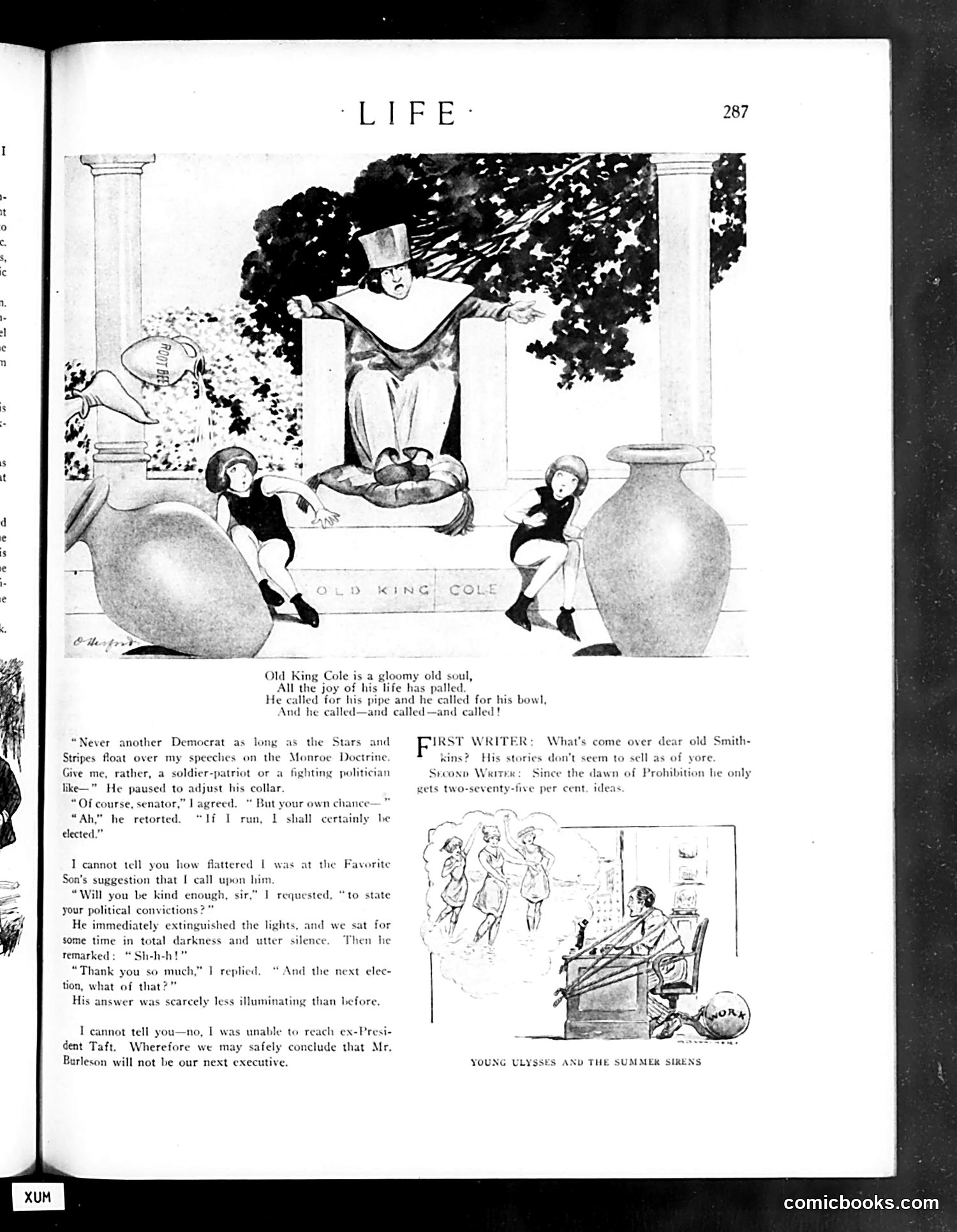
This page satirizes early 1920s American politics, particularly Democratic Party dysfunction and Prohibition-era cultural shifts. **Top Cartoon:** "Old King Cole" reimagines the nursery rhyme as a disillusioned Democrat. The gloomy figure represents the Democratic Party itself, which had lost electoral appeal. The text mocks a politician's empty patriotic rhetoric about the Monroe Doctrine while offering no real vision—he can't even articulate why he should run for office. **Middle Section:** The author recounts attempting to interview various political figures (a "Favorite Son," likely a presidential aspirant). One refuses to discuss politics in darkness—a joke about the party's lack of clarity or vision. **Reference to Burleson:** Albert Burleson was Postmaster General under Wilson; the text sarcastically concludes he won't be the next president (obvious political commentary). **Bottom Right Cartoon:** "Young Ulysses and the Summer Sirens" likely references Prohibition's social impact, with the title invoking Homer's *Odyssey*—suggesting young men are being lured by temptations in the post-Prohibition landscape. The overall theme: Democratic Party confusion and cultural upheaval in the early 1920s.
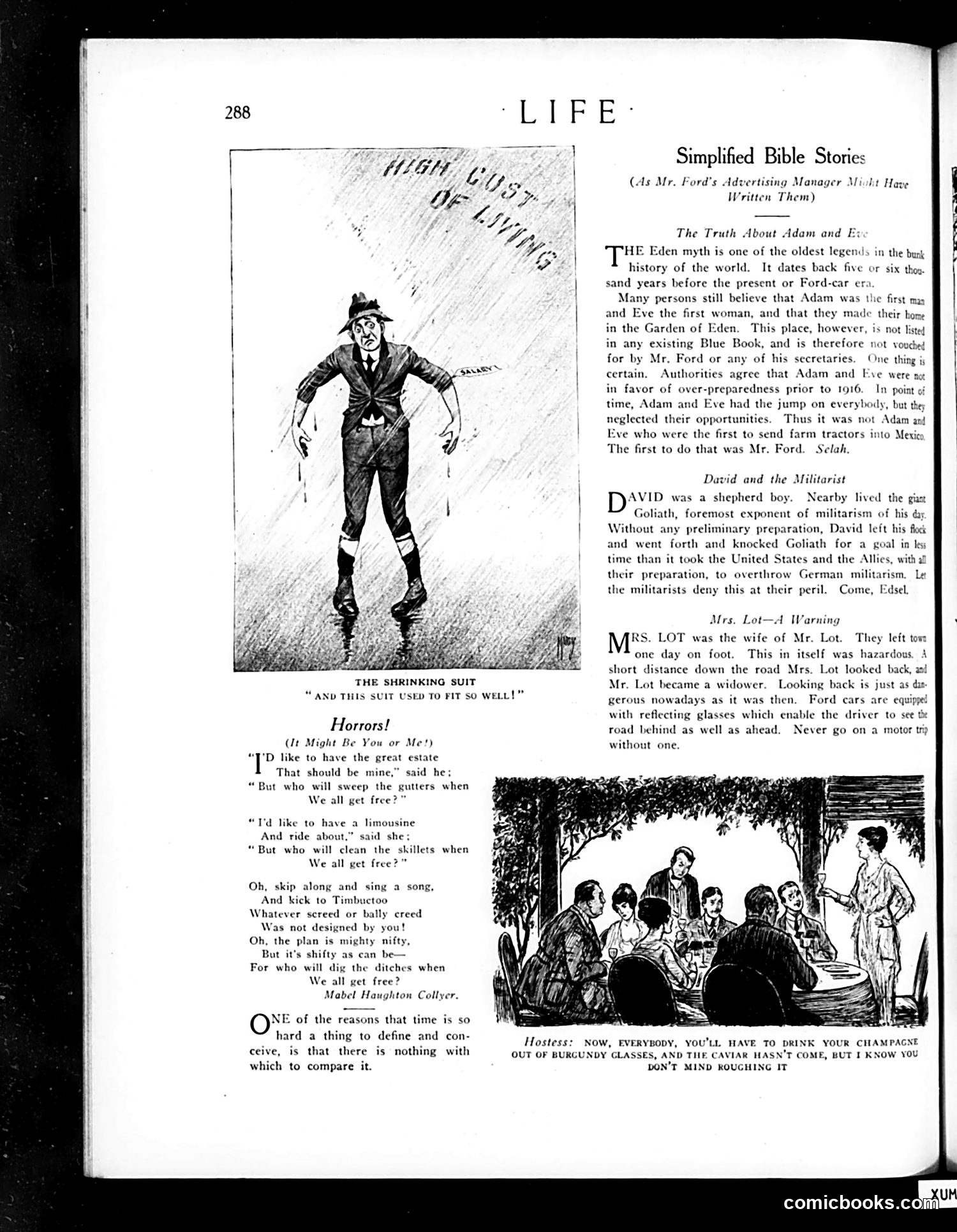
The main cartoon satirizes socialist or communist ideals of wealth redistribution. A man in an oversized suit that's shrinking depicts the contradiction in egalitarian rhetoric: people demand equality and freedom from class hierarchy, yet no one volunteers for menial labor. The poem asks repeatedly, "who will dig the ditches when we all get free?"—mocking the impracticality of utopian schemes. The "Simplified Bible Stories" section parodies Henry Ford's famous advertising and public pronouncements. It absurdly rewrites scripture through a Ford-centric lens, crediting Ford (not Adam, Eve, or David) with humanity's achievements. This satirizes Ford's self-aggrandizing business philosophy and his tendency to insert himself into everything. The final cartoon jokes about wealthy hosts serving champagne in cheap glasses due to supply shortages—likely WWI-related rationing—and emphasizing "roughing it." This mocks the affectations of the rich during hardship.
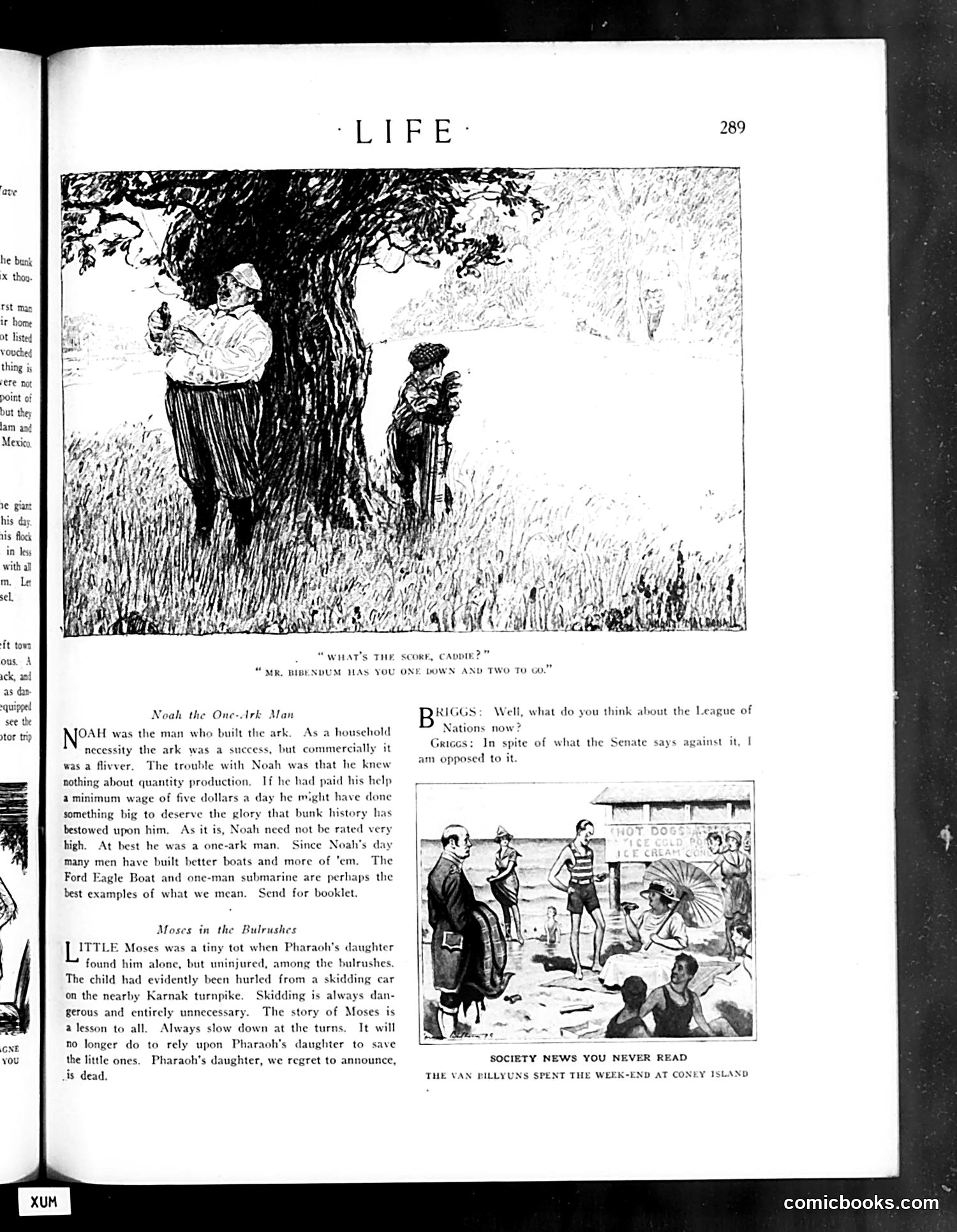
This page contains two distinct satirical pieces: **Top cartoon** ("What's the Score, Caddie?"): A golf joke where the caddie references "Mr. Birendum" being "one down and two to go." Birendum appears to be a caricatured figure, likely representing a political or public figure of the era, though his specific identity isn't clear from the image alone. **Text sections** mock biblical figures through modern American safety lens: - **Noah**: Satirizes him as a failed businessman—a "one-ark man" with poor labor practices. The piece contrasts Noah's historical reputation with contemporary industrial efficiency (Ford Motor Company's mass production methods), suggesting outdated methods deserve no credit. - **Moses**: Darkly jokes that baby Moses was found after a "skidding car" accident on a modern "Karnak turnpike." The satire criticizes reckless driving and warns readers can no longer rely on miraculous rescues—"Pharaoh's daughter...is dead." This is traffic safety propaganda disguised as humor. The page blends religious irreverence with Progressive Era messaging about industrial efficiency and public safety.
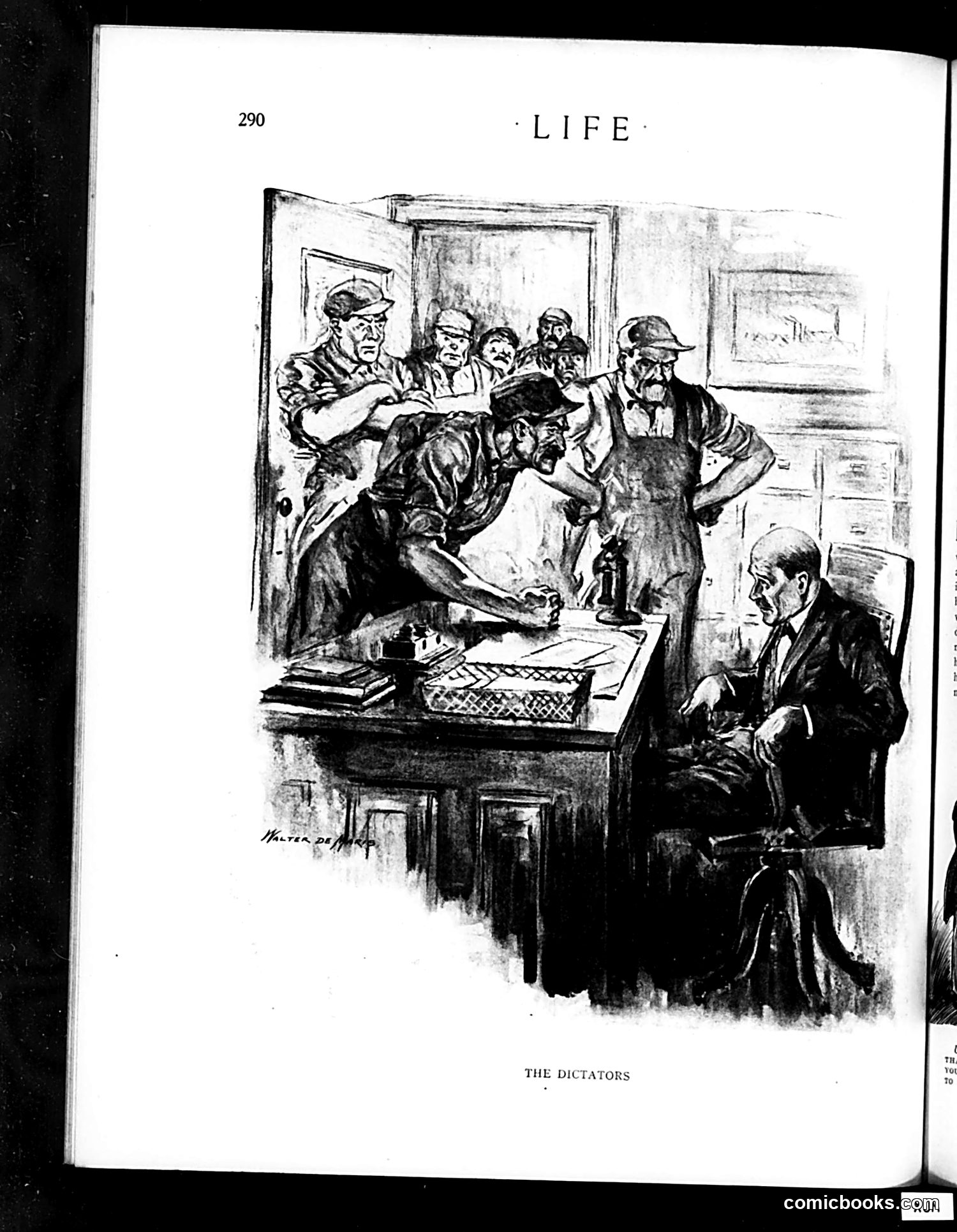
This cartoon satirizes authoritarian military leaders through a courtroom or official office scene. A bald, suited official sits at a desk while a group of roughly-dressed men in military caps and work clothes stand before him in aggressive, confrontational postures. Their body language—leaning forward, gesturing threateningly—suggests they are intimidating or bullying the seated figure. The title "The Dictators" indicates satire of dictatorial rule, likely referencing early-to-mid 20th century political upheaval. The cartoon suggests how brutal, working-class military strongmen wielded power through intimidation and force rather than legitimate authority. The contrast between the formal office setting and the rough military thugs underscores the illegitimate nature of their rule.
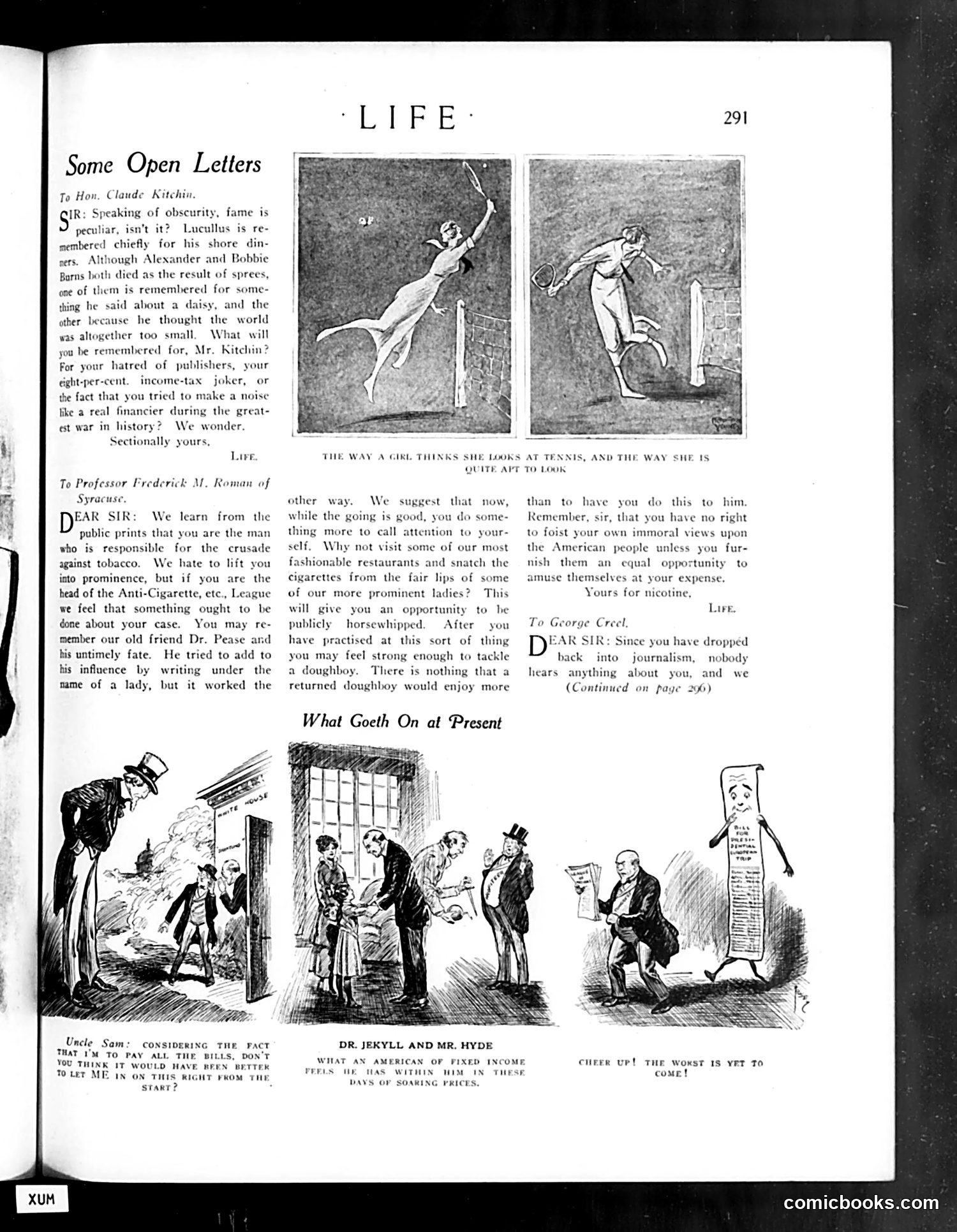
This page contains satirical "open letters" mocking prominent figures of the era (likely WWI period, given references to "the greatest war in history" and "doughboys"). **The letters target:** - **Claude Kitchin**: A congressman criticized for his anti-publisher stance and tax positions; the writer sarcastically questions what he'll be remembered for - **Professor Frederick M. Roman**: Leading an anti-tobacco crusade; Life mockingly suggests he should physically assault women smoking in restaurants to gain attention, then face "horsewhipping"—absurdist satire of moral crusaders **The cartoon section "What Goeth On at Present"** shows three panels depicting American economic hardship during wartime inflation, with figures labeled "Dr. Jekyll and Mr. Hyde," "Uncle Sam," and references to "soaking prices"—visualizing how ordinary Americans' finances are being torn apart by rising costs. The humor relies on readers recognizing these public figures and understanding contemporary debates over taxation, moral reform movements, and wartime economic strain.
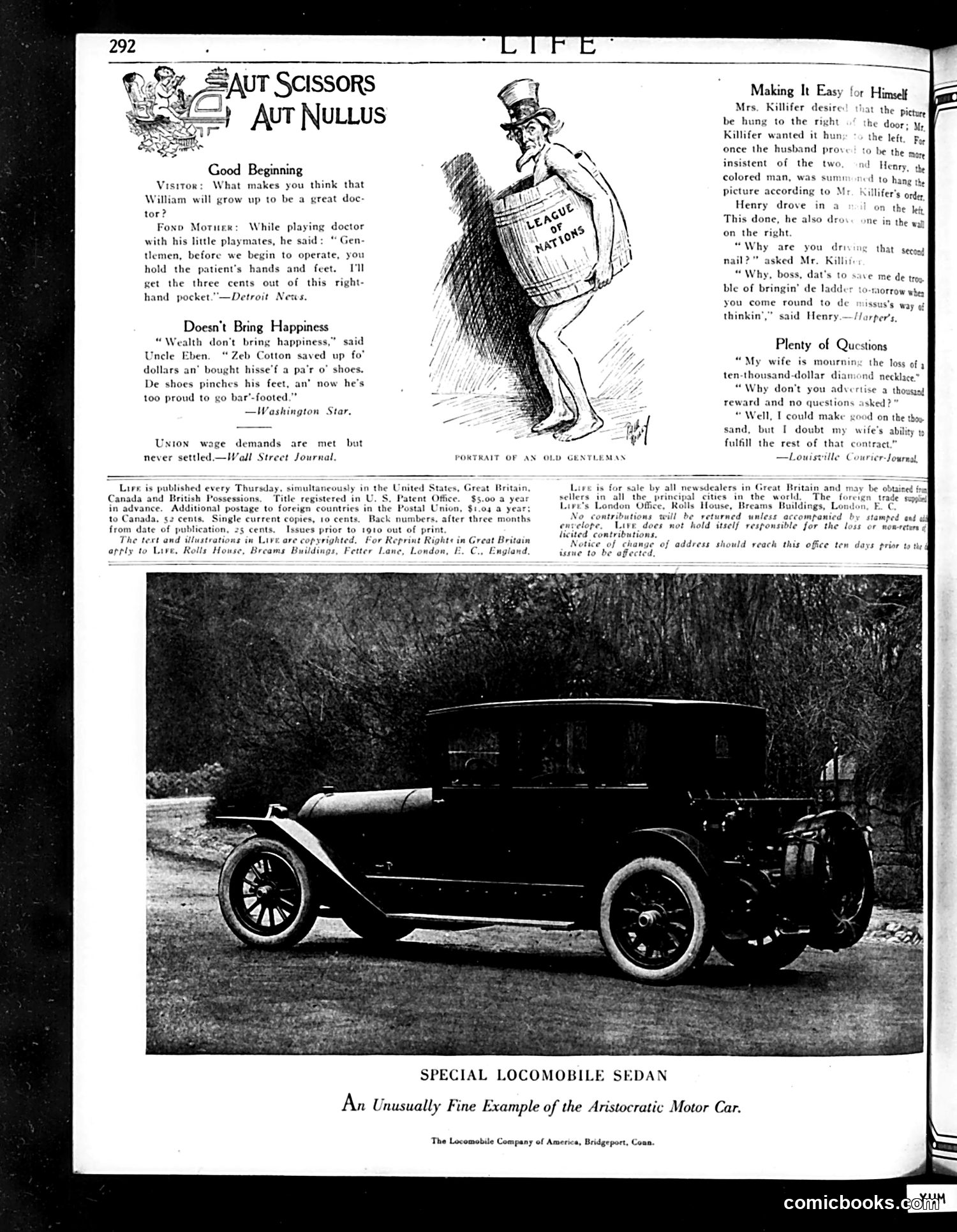
This page contains three brief satirical pieces typical of early 20th-century Life magazine humor: **"Good Beginning"**: A joke about a boy playing doctor who demands payment ("three cents") before treating patients—satirizing mercenary medical practice. **"Doesn't Bring Happiness"**: An Uncle Remus-style dialect piece mocking vanity: a man buys shoes he's too proud to wear, preferring to go barefoot rather than admit they hurt. **"Making It Easy for Himself"**: A racial stereotype humor piece depicting a Black worker driving a nail at a specific angle to avoid fetching a ladder repeatedly—playing on lazy-worker tropes common in the era. The page also includes a portrait cartoon of an elderly gentleman and automobile advertisement. The humor reflects period attitudes: cynicism about professional ethics, rural/folk wisdom about materialism, and unfortunately, racist caricature presented as comedy. Modern readers should recognize these as products of their time, not timeless humor.
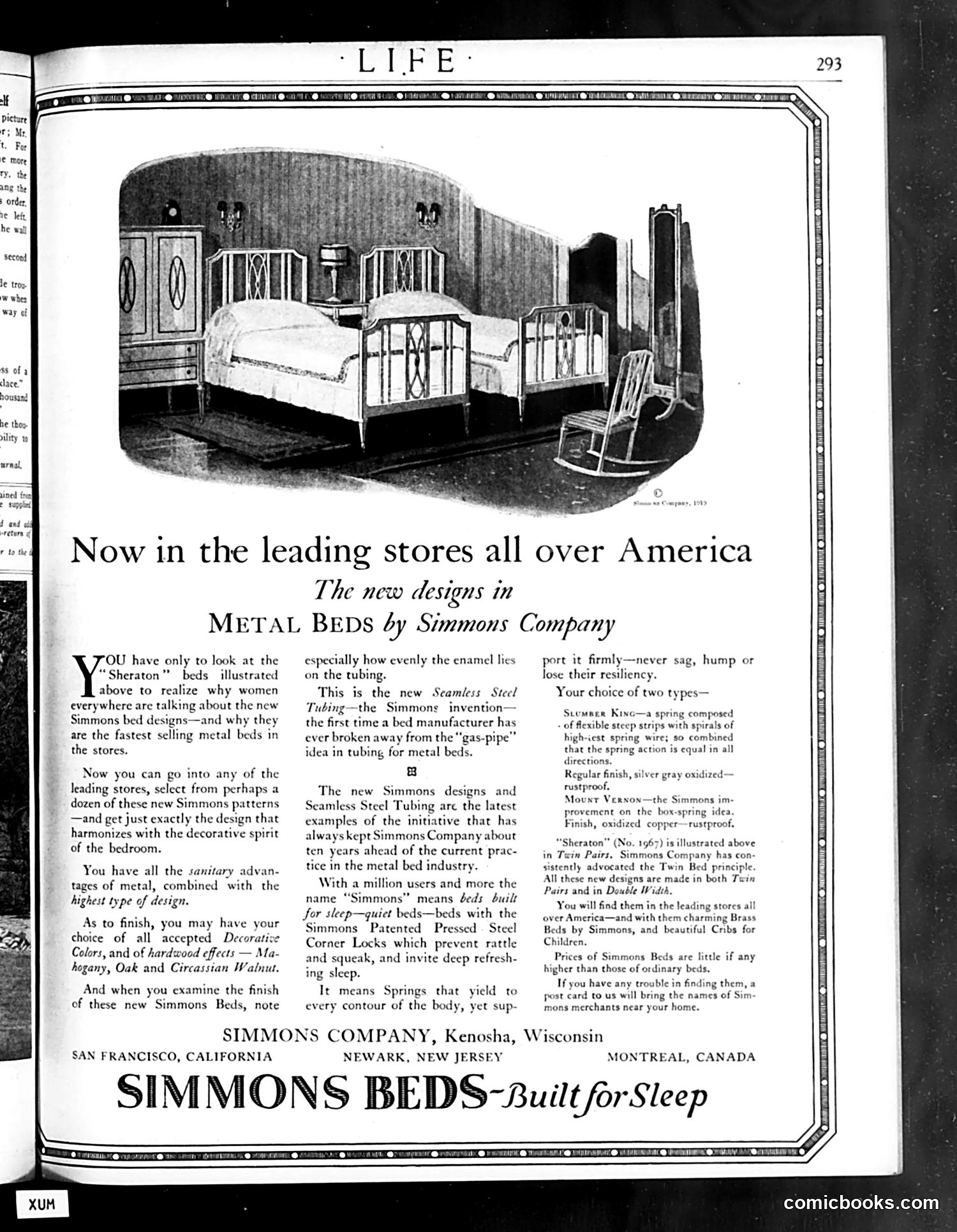
This is **not a political cartoon or satire**, but rather a **straightforward advertisement** for Simmons Company metal beds. The page shows a bedroom interior illustration featuring the "Sheraton" metal bed design, positioned as the centerpiece of aspirational home furnishing. The accompanying text promotes Simmons' innovations: seamless steel tubing (replacing older "gas-pipe" tubing), patented corner locks preventing rattle, and two spring options (Summer King and Mount Vernon models). The ad emphasizes **sanitary advantages of metal over wood**, fashionable decorative finishes in period colors, and the company's claim to be "ten years ahead" in the industry. It also notably advocates for **twin beds** as a modern bedroom standard. This reflects early 20th-century consumer culture and domestic design trends, where innovative manufacturing and stylish home goods were marketed to aspirational middle-class Americans seeking modern, hygienic living spaces.
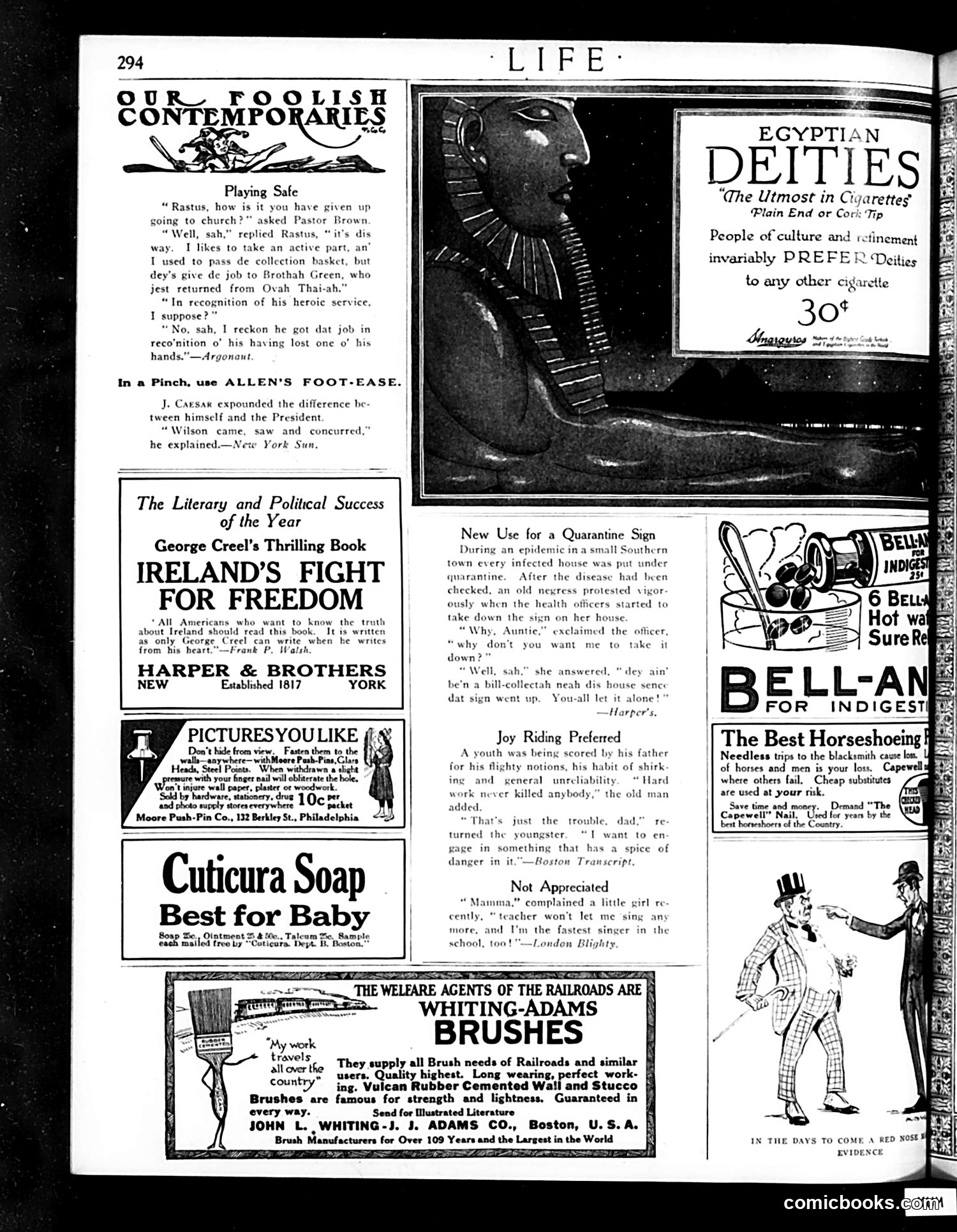
This page from *Life* magazine contains several satirical humor pieces typical of early 20th-century American comic journalism. **"Playing Safe"** depicts a Black church worker ("Rastus") who quit his position passing the collection basket—not out of piety, but because a disabled veteran (who lost a hand in service, likely WWI) received the job instead. The joke satirizes selective charity: the church honors the veteran's "heroic service" while the original worker leaves, highlighting how public recognition of sacrifice can displace others. **"Joy Riding Preferred"** mocks a youth who rejects his father's work ethic because he wants excitement with "spice of danger"—a generational jab at young people prioritizing thrills over responsibility. **"Not Appreciated"** shows a girl complaining she's the "fastest singer" in school yet her teacher won't let her sing—absurdist humor suggesting her speed (not talent) was the issue. The remaining content is vintage advertising (Egyptian Deities cigarettes, Cuticura soap, brushes, foot powder) typical of the era. No major political figures are caricatured on this particular page.
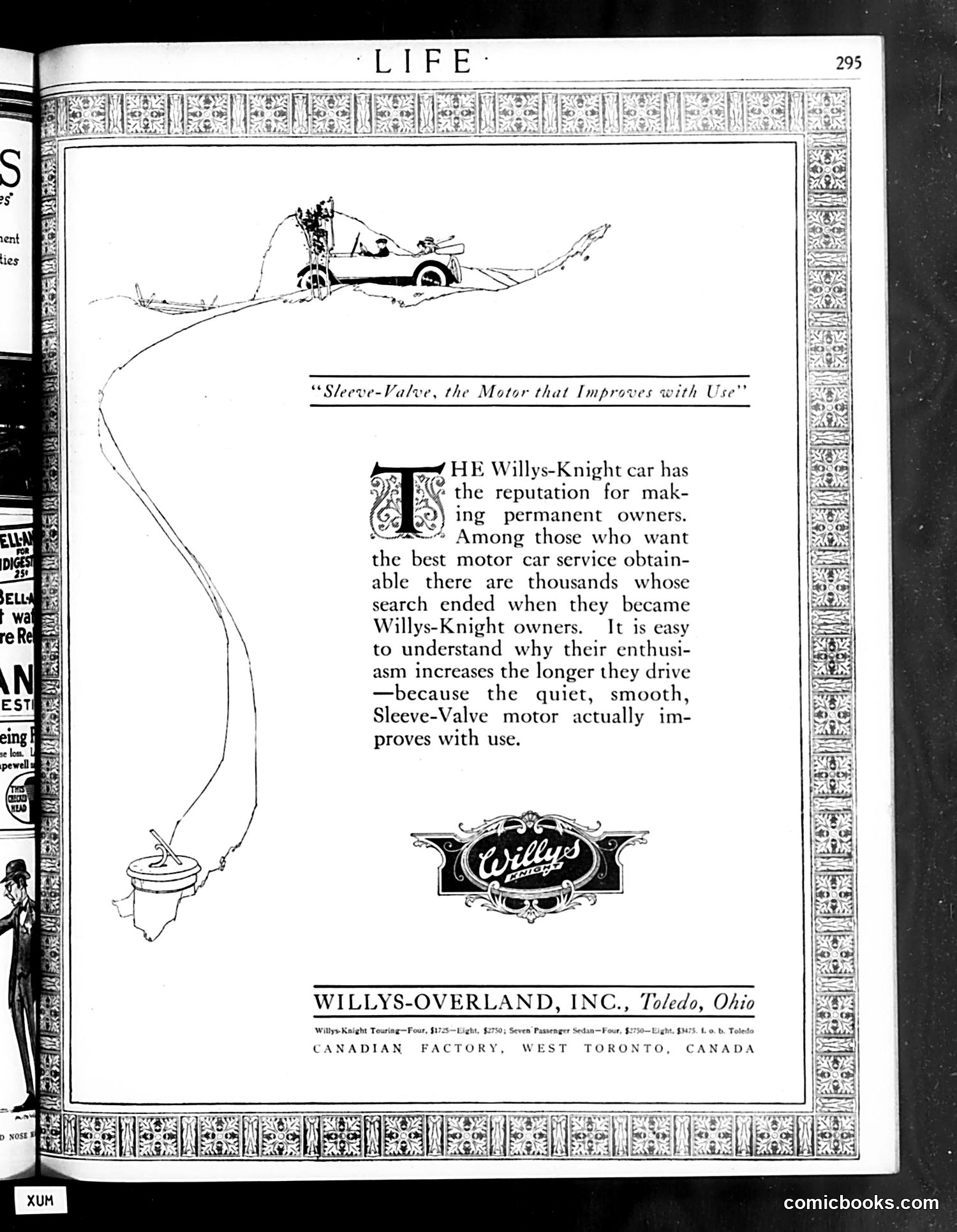
This page is primarily a **Willys-Knight automobile advertisement**, not political satire. The illustration at top shows a car navigating a winding mountain road, captioned "Sleeve-Valve, the Motor that Improves with Use"—the advertisement's central claim. The text promotes the Willys-Knight brand's reputation for reliability and long-term ownership satisfaction. It emphasizes that the car's "Sleeve-Valve motor actually improves with use," contrasting with typical engines that deteriorate over time. This was a genuine technical feature Willys-Knight marketed as superior. The ornate decorative border and classical typography reflect early 1920s magazine design standards. The company information lists Toledo, Ohio as headquarters and West Toronto as the Canadian factory. **This is commercial advertising, not editorial commentary or satire.** It targets affluent car buyers seeking prestige and durability.
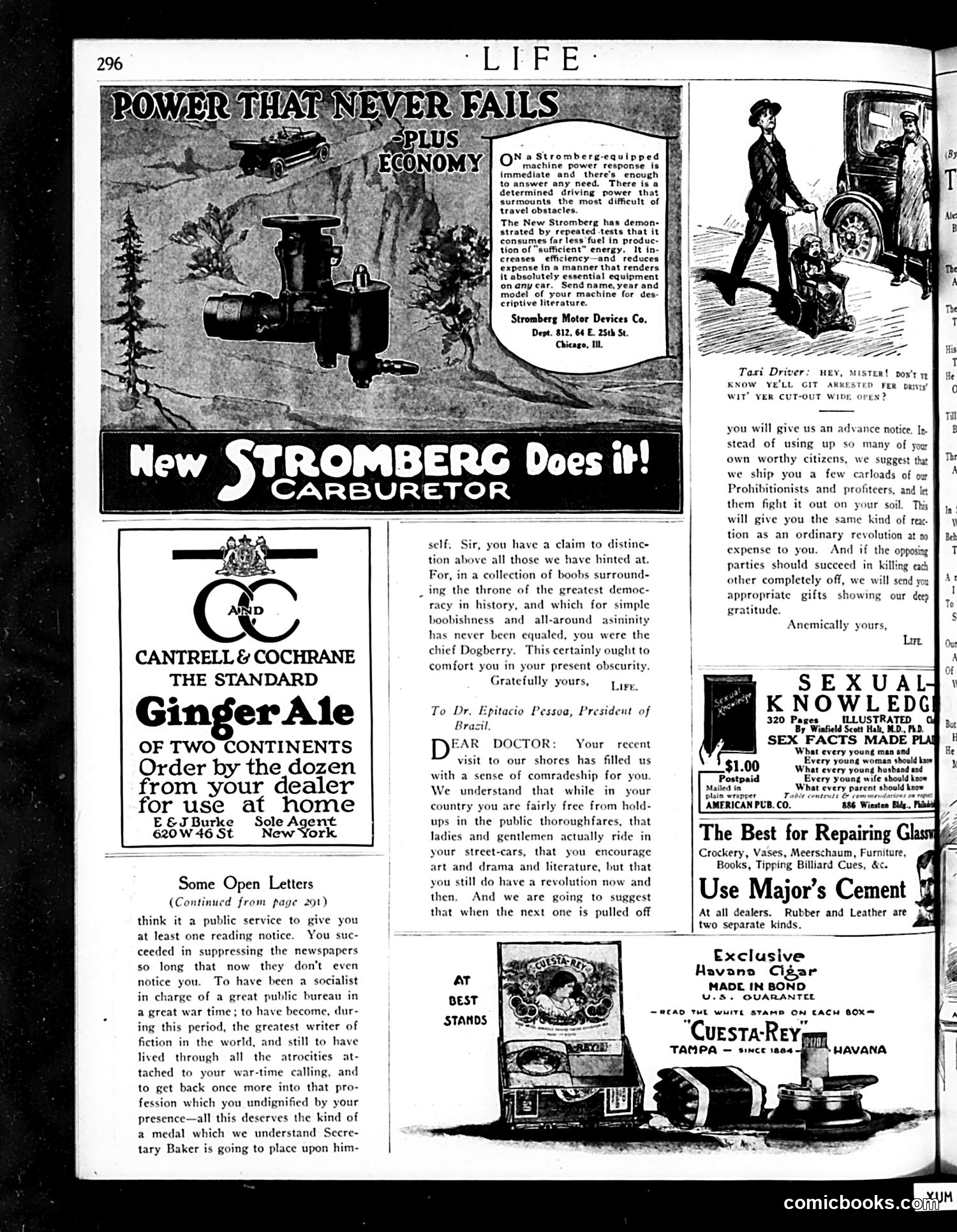
This page from *Life* magazine consists primarily of **advertisements and satirical letters to the editor**, rather than political cartoons. The main satirical content appears in the "Open Letters" section. One letter addresses Dr. Epitacio Pessoa, Brazil's president, congratulating him on his visit while sarcastically suggesting that when Brazil's next revolution occurs, America should "ship you a few carloads of our Prohibitionists and profiteers" to fight it out instead—a jab at American political dysfunction and unpopular policies (Prohibition was enacted in 1920). Another letter praises an unnamed former socialist who became "the greatest writer of fiction in the world" during wartime service, calling him the "chief Dogberry" (a bumbling character reference) of the government—likely a veiled critique of a public figure's WWI-era role. The page is dominated by product advertisements for carburetors, ginger ale, cigars, and other goods typical of 1920s consumer culture.
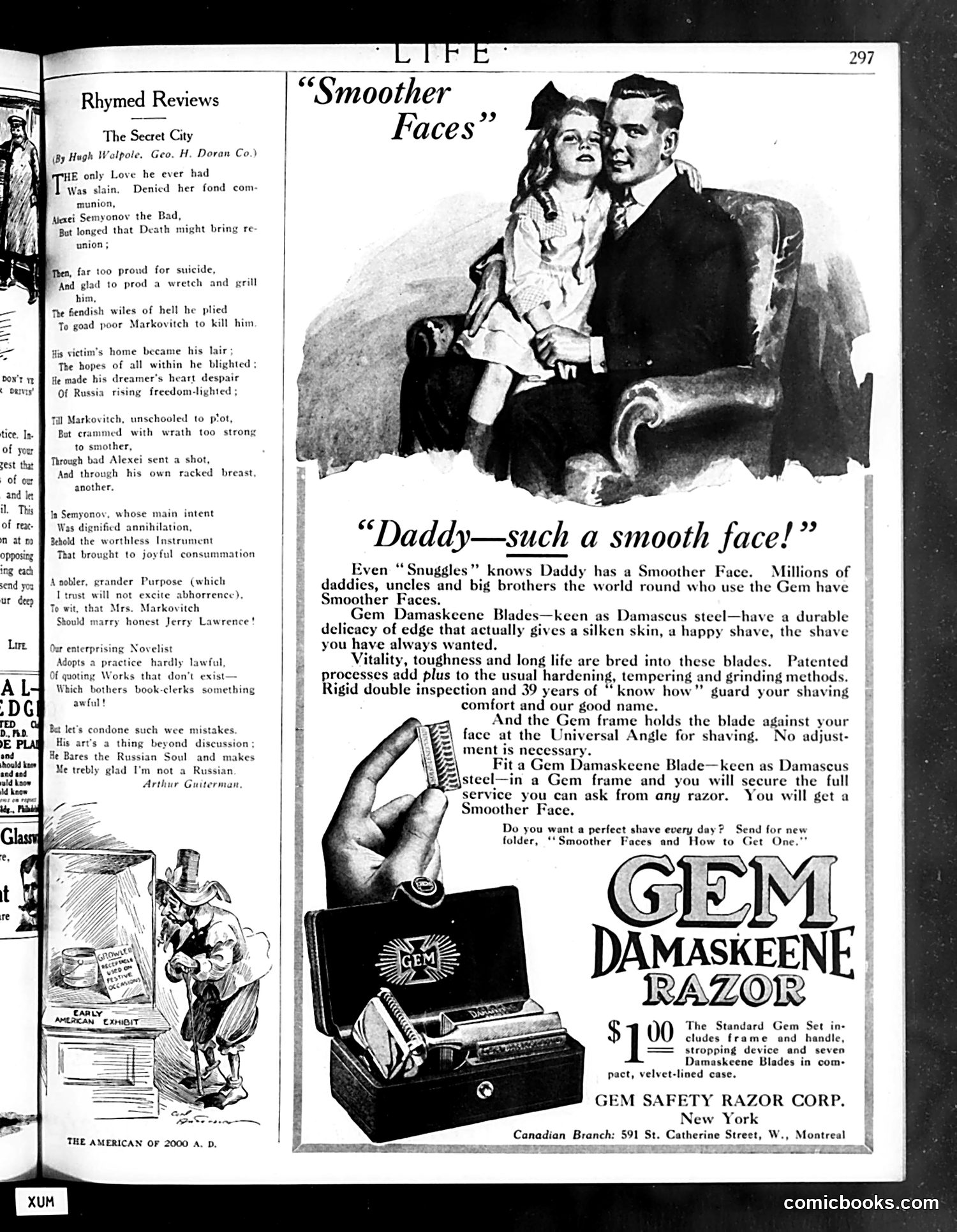
This page is primarily a **commercial advertisement** for Gem Damaskeene razor blades, occupying most of the right side. The left column contains a book review of Hugh Walpole's *The Secret City* in verse form. The advertisement uses **domestic sentimentality** as its sales pitch. It depicts a father with a young child, with the child praising "Daddy—such a smooth face!" This appeals to masculine vanity and family values—suggesting that using quality razors makes men more presentable and admirable to their loved ones. The copy emphasizes the blade's durability and superior edge, claiming "39 years of 'know how'" supports quality. The product costs $1.00 and includes a frame, handle, stropping device, and seven blades. The approach reflects **early 20th-century advertising strategy**: appealing to male pride through domestic approval rather than purely functional benefits. The "Smoother Face" slogan equates product use with self-improvement and family respect.
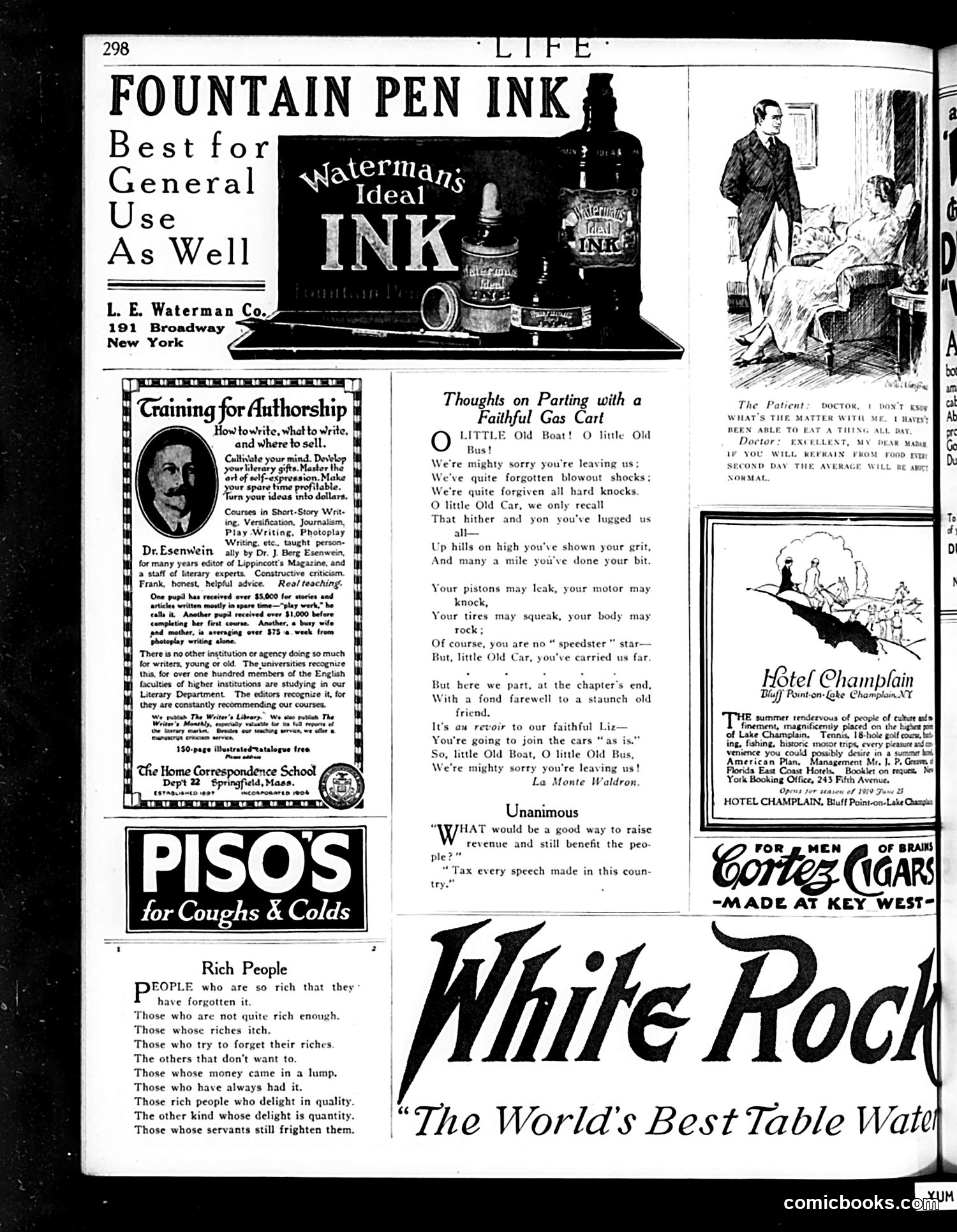
This page is primarily **advertisements and light humor**, not political satire. The main content includes: **"Thoughts on Parting with a Faithful Gas Cart"** — A sentimental poem bidding farewell to an old automobile, personified as a loyal companion. The joke reflects post-WWI nostalgia; the "gas cart" has served faithfully through wear and tear. This resonates with readers who anthropomorphized their early automobiles. **"The Patient"** — A brief comic dialogue where a doctor prescribes fasting as treatment, implying the patient will recover after abstaining from food for a day. **"Rich People"** — A satirical categorization listing different types of wealthy individuals (those who forget their wealth, those trying to forget it, servants who frighten them, etc.), gently mocking various attitudes toward money. The remaining content is **advertising**: Waterman's fountain pen ink, The Home Correspondence School writing courses, Pisos cough medicine, Hotel Champlain resort, Cortez Cigars, and White Rock table water. The page reflects **early 20th-century consumer culture** rather than deep political commentary.
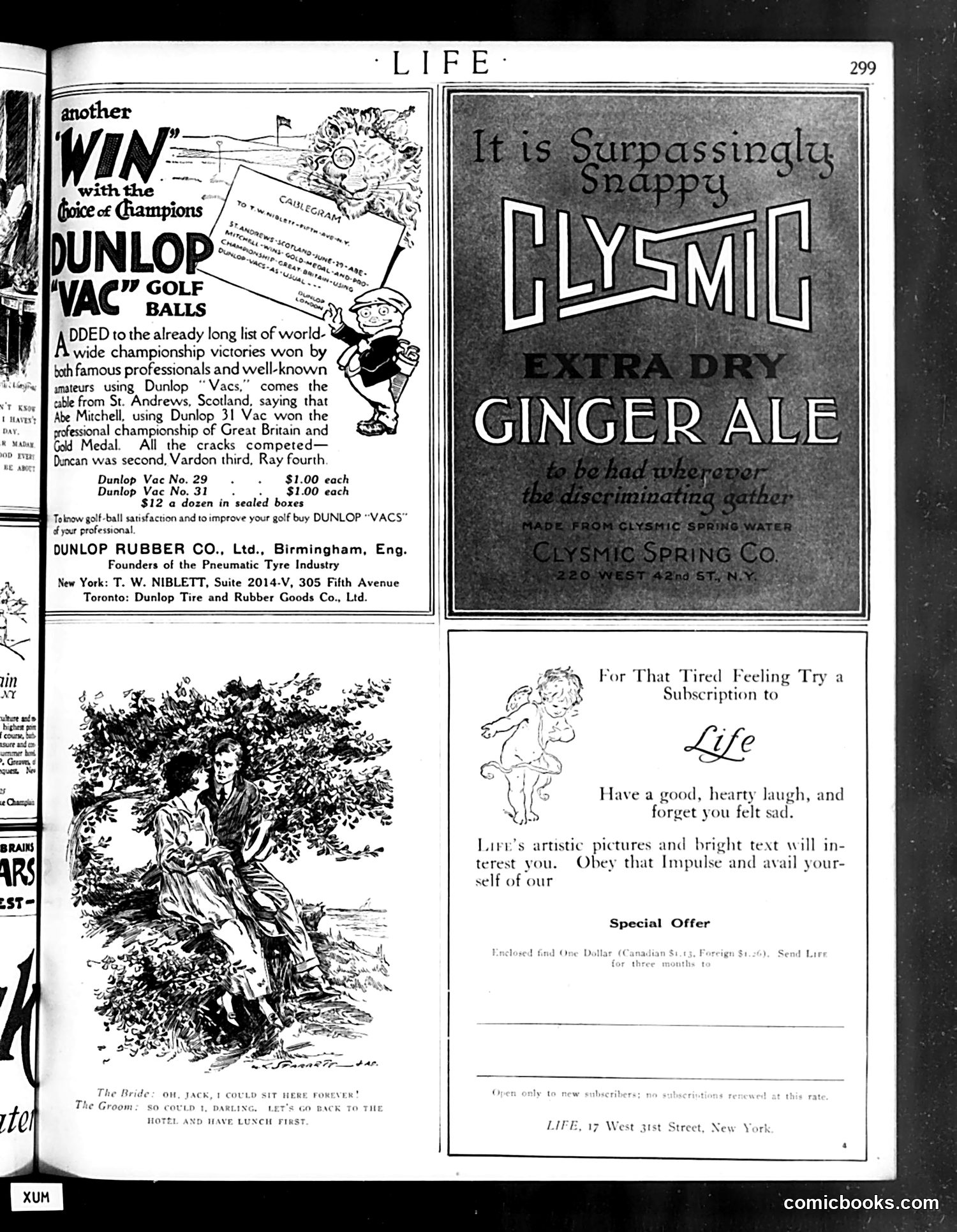
This page is primarily **advertising and promotional material** rather than political satire or editorial comics. **Left side:** A Dunlop golf ball advertisement emphasizing championship endorsements. It claims famous golfers—including Abe Mitchell, who won the professional championship of Great Britain—used Dunlop "Vacs" balls. The ad targets both professionals and amateurs. **Center/Bottom:** A small romantic illustration showing a bride and groom, with the groom suggesting they skip their honeymoon lunch to stay put. This appears to be a light humor piece about newlywed romance rather than satire. **Right side:** An advertisement for Clysmic Ginger Ale, promoting it as a remedy for tiredness. Below that is **Life magazine's own subscription promotion**, offering a discounted subscription rate and encouraging readers to enjoy the magazine's "artistic pictures and bright text" as a cure for sadness. The page reflects early 20th-century advertising conventions and consumer culture rather than political commentary.
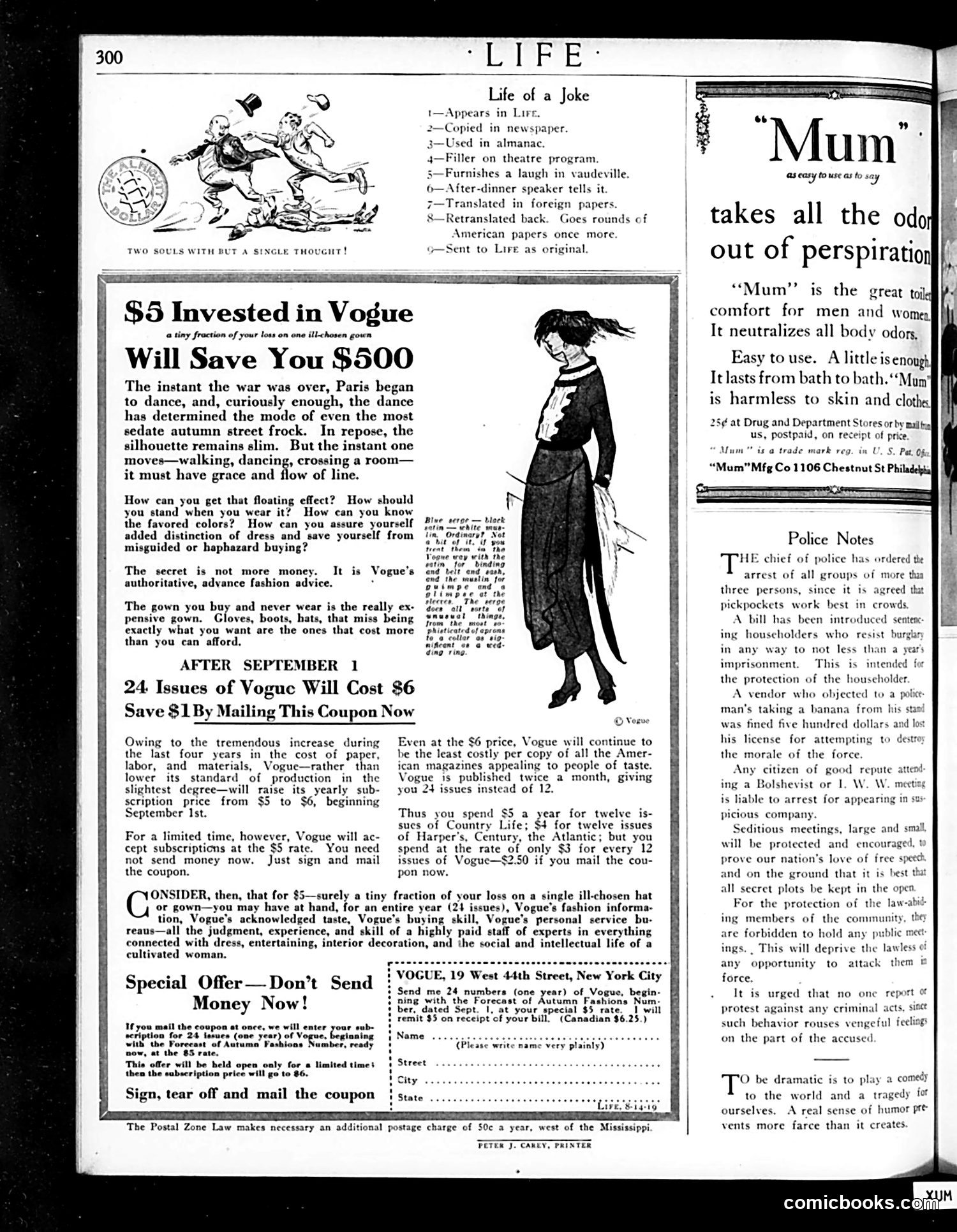
This page contains two distinct pieces of satire: **Top cartoon ("Two Souls with but a Single Thought"):** Depicts two figures in frantic motion—likely a couple dancing—illustrating the post-WWI fashion craze. The reference is to post-war Paris dance culture that supposedly influenced even conservative American street fashion. **"Life of a Joke" diagram:** A meta-commentary on how jokes circulate through American culture. It humorously traces a joke's journey from Life magazine through newspapers, almanacs, theater programs, vaudeville, after-dinner speeches, foreign translation, retranslation back to American papers, and finally returning to Life as supposedly "original." This satirizes how content gets recycled and repackaged across media without attribution—a timeless problem. **Vogue advertisement:** The bulk of the page is a Vogue subscription pitch capitalizing on post-war fashion anxiety, claiming $5 subscriptions save money by preventing wasteful clothing purchases. The satire is implicit: Life is advertising a luxury fashion magazine to readers while simultaneously mocking how ideas (and jokes) get endlessly recycled in print culture.
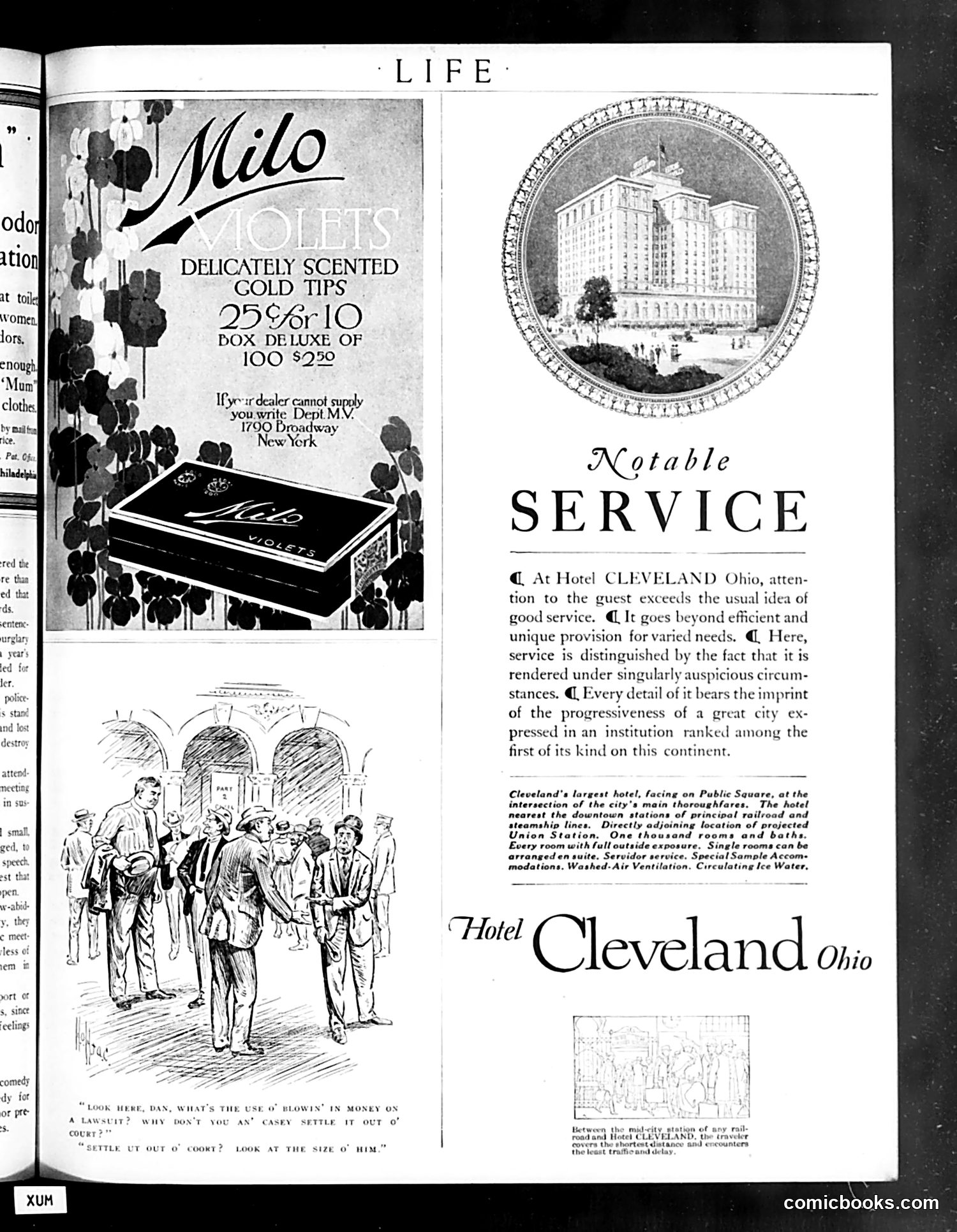
This page contains two distinct elements: a Milo Violets cigarette advertisement (top left) and a Hotel Cleveland advertisement (right), with a small cartoon at the bottom left. **The cartoon** depicts two men in conversation about a legal dispute. One man suggests settling "out of court," but the other refuses, pointing to a large third man (presumably "Casey"), saying "Look at the size of him." The joke is a common one from this era: the speaker won't settle because he's confident he can win in an actual fight—suggesting he's relying on physical strength rather than legal merit. The humor plays on class stereotypes of working-class men (the casual dialect reinforces this) resolving disputes through intimidation or violence rather than proper legal channels. The cartoons and advertisements occupy most of the page; there's no significant political content visible. This appears to be standard early-20th-century magazine filler combining commerce with light humor aimed at working-class readers.
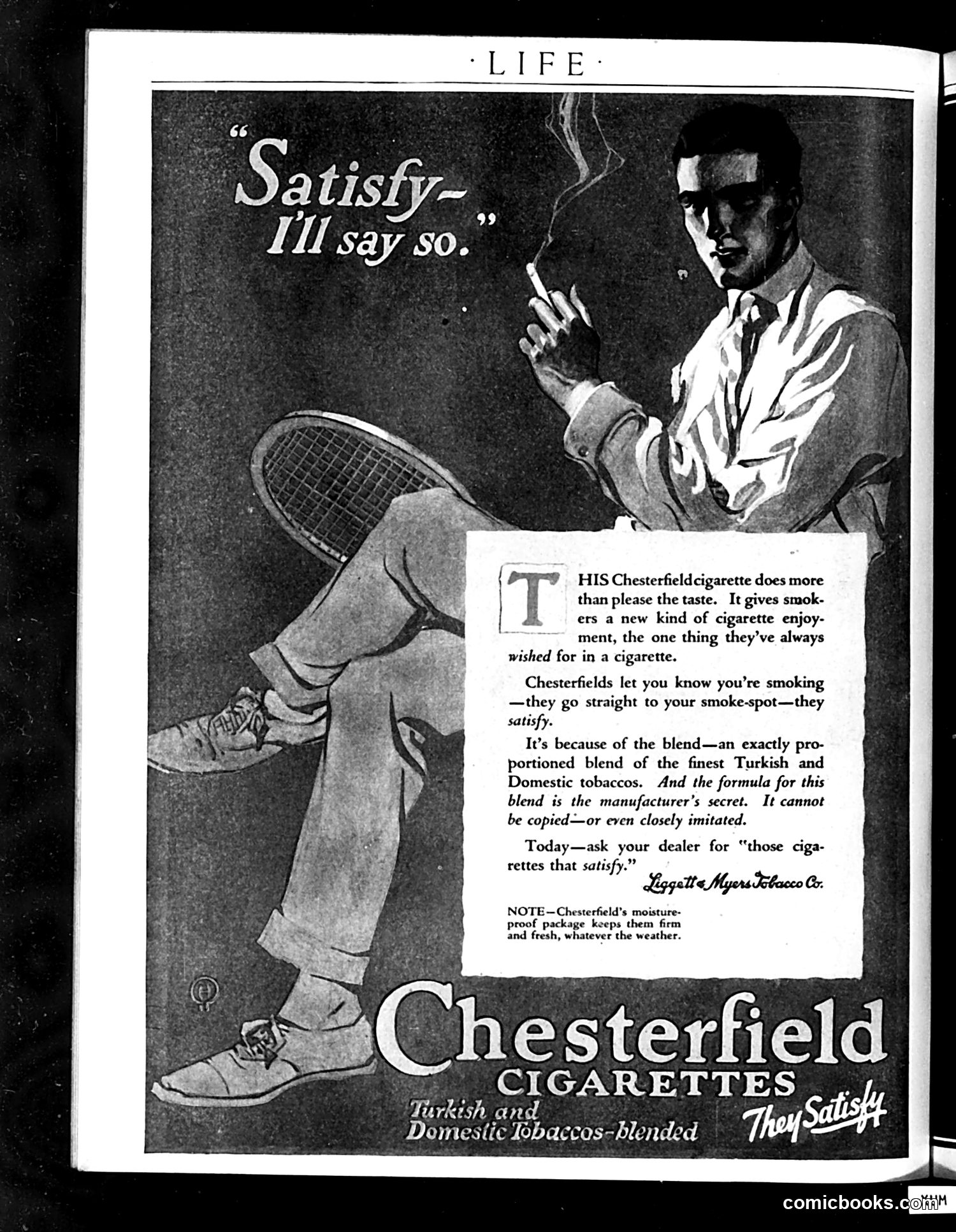
This is primarily **a cigarette advertisement**, not political satire. It appeared in *Life* magazine during the early-to-mid 20th century when tobacco advertising was legal and common in mainstream publications. The image shows a man in tennis attire holding a racket and cigarette, with the tagline "Satisfy—I'll say so." The advertisement positions Chesterfield cigarettes as satisfying to smokers, emphasizing their unique blend of Turkish and domestic tobacco. **Key context for modern readers:** - This represents an era when cigarettes were openly advertised as desirable consumer goods - The athletic imagery (tennis player) was typical marketing strategy—associating smoking with health, vigor, and leisure - The "secret formula" claim was common advertising language - This would be illegal advertising today due to health regulations and tobacco marketing restrictions The page is essentially a vintage commercial document, not social commentary or political cartoon.
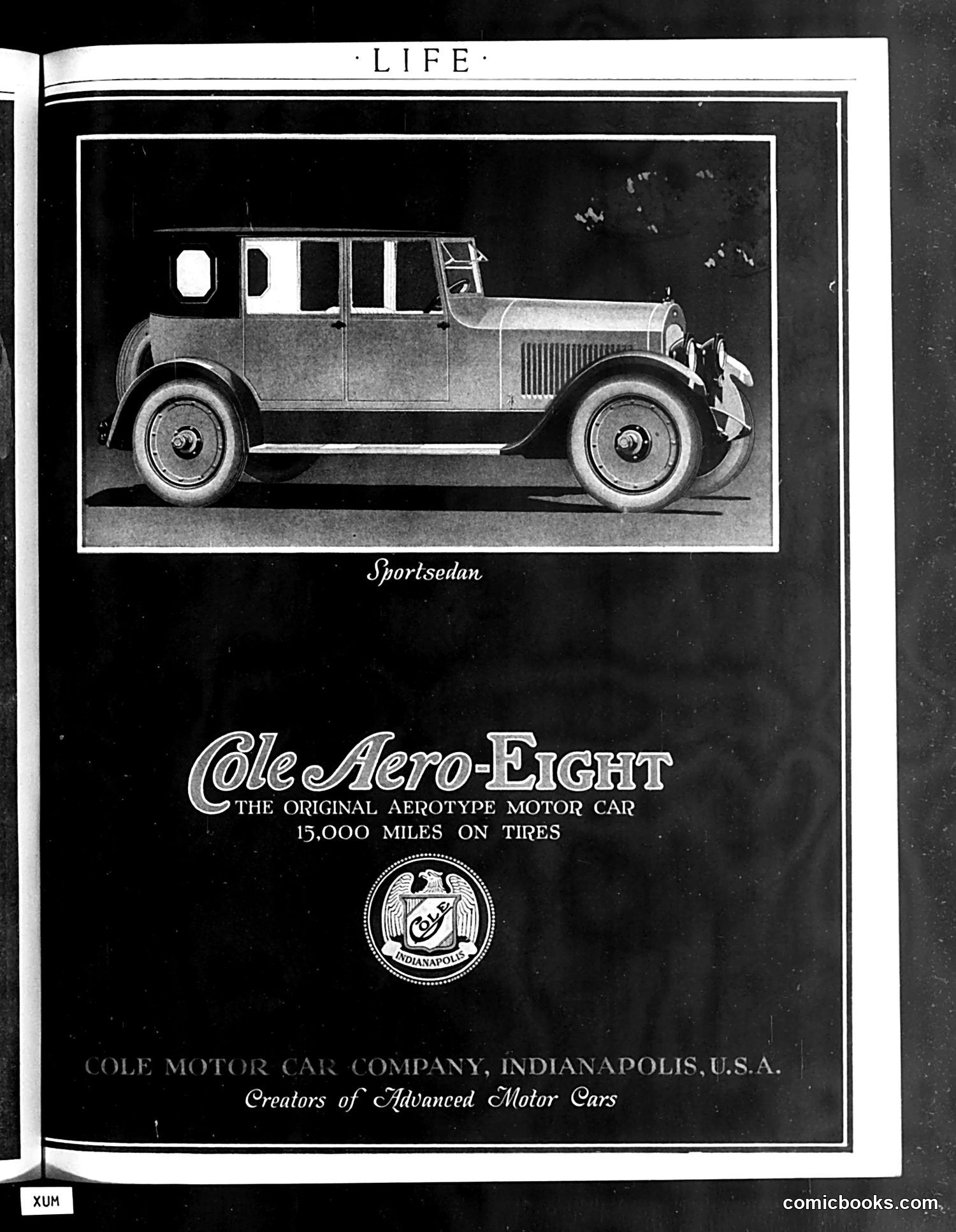
This is an **advertisement, not a cartoon or satire**. It promotes the Cole Aero-Eight automobile, manufactured by the Cole Motor Car Company in Indianapolis. The page features a side-view photograph of a "Sportsedan" model with the tagline "The Original Aerotype Motor Car" and claims "15,000 Miles on Tires." The company describes itself as "Creators of Advanced Motor Cars," suggesting this was positioned as a premium or innovative vehicle. The circular Indianapolis company seal appears as branding. This appears from an era when automobiles were luxury goods, and manufacturers competed on durability and technological claims. There is no political commentary or satire present—this is straightforward commercial advertising in *Life* magazine.
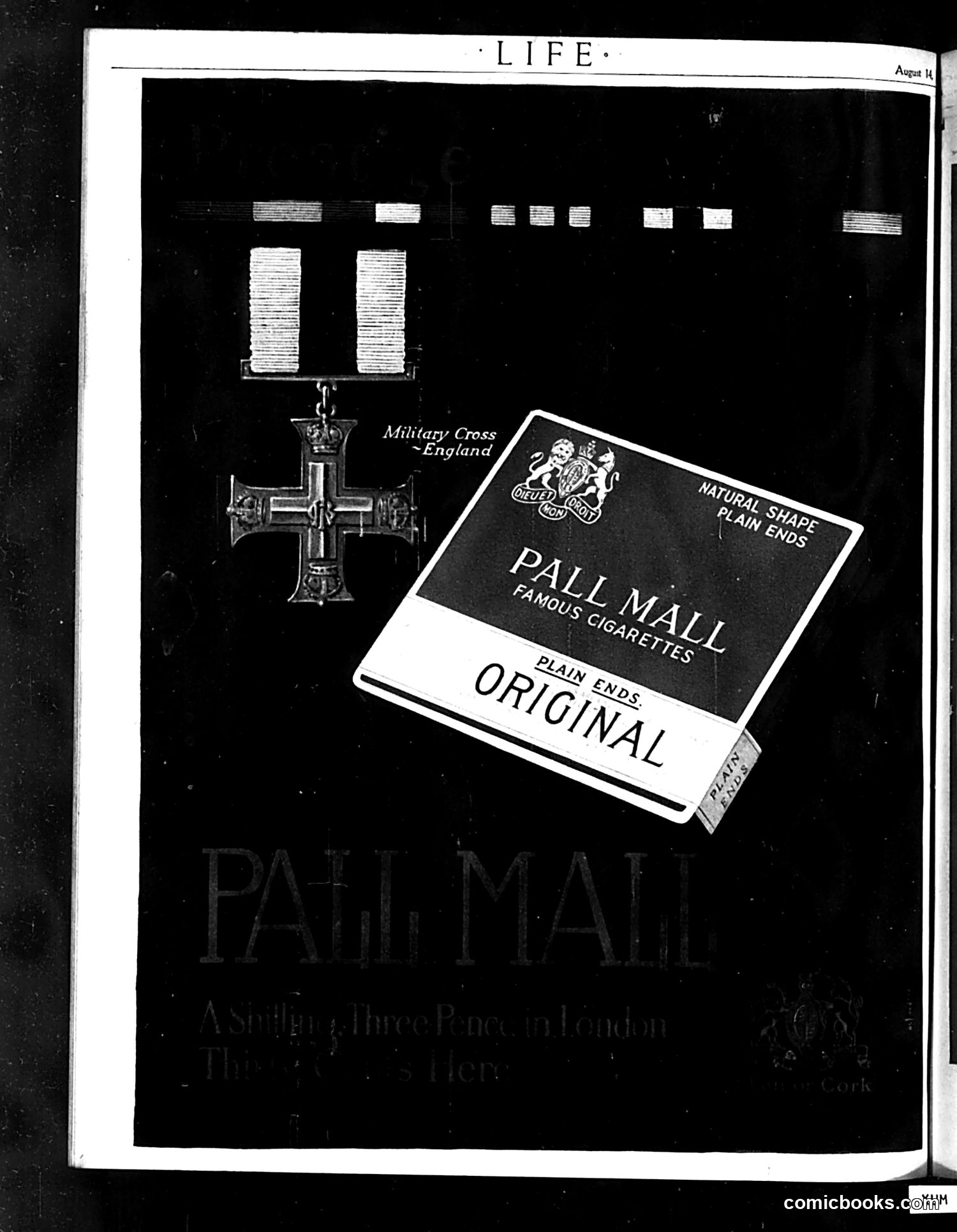
This is a LIFE magazine advertisement page (dated August 14, visible in header). The image shows a Pall Mall cigarette package positioned next to a Military Cross—England's distinguished military decoration awarded for valor. The ad's implicit message connects smoking Pall Mall cigarettes with military prestige and courage. The juxtaposition suggests that smoking this brand is associated with the honor and bravery represented by the Military Cross medal. The text emphasizes "Natural Shape Plain Ends" and "Original," marketing features of the cigarettes. This appears to be a straightforward product advertisement rather than political satire, using patriotic imagery to enhance the brand's appeal to post-war British and American audiences during a period when such military associations were commercially valued.