
Life, 1919-08-14 · page 25 of 44
Life — August 14, 1919 — page 25: what you’re looking at
What you’re looking at
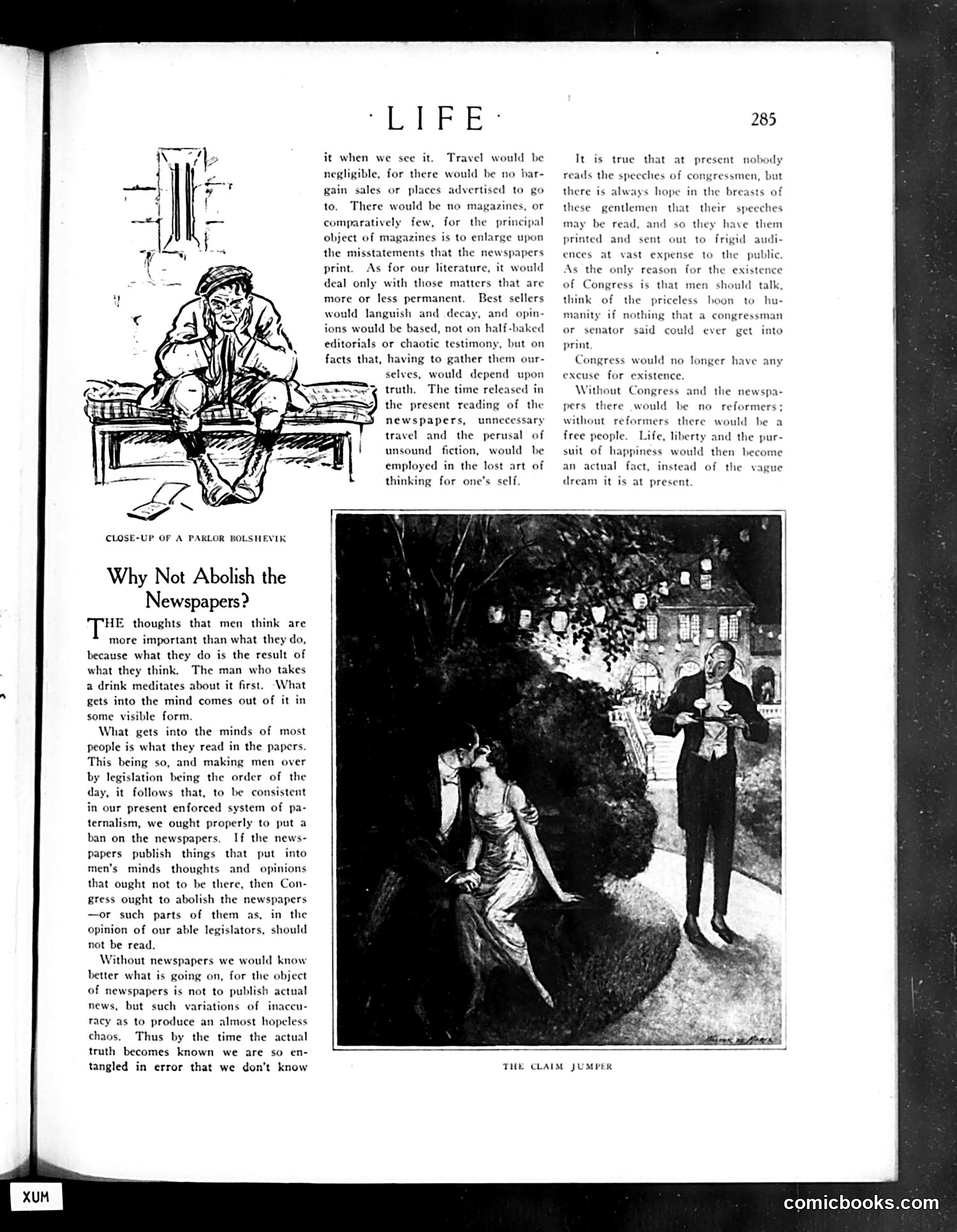
This piece satirizes government censorship and paternalism through **ironic argument**. The author pretends to seriously advocate abolishing newspapers—a proposal that would logically follow if the government controls what citizens think (the unstated premise being mocked). The "parlor Bolshevik" cartoon depicts a radical intellectual spreading dangerous ideas in a comfortable living room, representing the essay's implicit target: those advocating government control over public discourse. The satire argues that **newspapers, despite their inaccuracies, are essential to freedom**. By proposing absurd consequences of abolition (Congress loses excuse for existing, citizens might think independently), the author defends press freedom against censorship advocates. "The Claim Jumper" photograph below appears unrelated or illustrates another point about deception/fraud. The piece reflects post-WWI American concerns about Bolshevism, government overreach, and media's role in democracy—defending newspapers and independent thought against totalitarian impulses.
📄 Transcribed text from this page (OCR, searchable)
Machine-transcribed from the original scan — historical spelling and the odd misread are preserved.
CLOSE-UP OF A PARLOR BOLSHEVIK Why Not Abolish the Newspapers? HE thoughts that men think are more important than what they do, because what they do is the result of what they think. The man who takes a drink meditates about it first. ‘What gets into the mind comes out of it in some visible form. What gets into the minds of most people is what they read in the papers. This being so, and making men over by legislation being the order of the day, it follows that, to be consistent in our present enforced system of pa- ternalism, we ought properly to put a ban on the newspapers. If the news- Papers publish things that put into men’s minds thoughts and opinions that ought not to be there, then Con- Bress ought to abolish the newspapers —or such parts of them as, in the opinion of our able le; not be read. Without newspapers we would know better what is going on, for th of newspapers is not to publish actual news, but such variations of inaccu- racy as to produce an almost hopeless chaos. Thus by the time the actual truth becomes known we are so en- tangled in error that we don’t know slators, should object ‘LIFE it when we see it. Travel would be negligible, for there would be no bar- gain sales or places advertised to go to. There would be no magazines, or comparatively few, for the principal object of magazines is to enlarge upon the misstatements that the newspapers. print. As for our literature, it would deal only with those matters that are more or less permanent. Best sellers would languish and decay, and opin- ions would be based, not on half-baked editorials or chaotic testimony, but on facts that, having to gather them our- selves, would depend upon truth. The time released in the present reading of the newspapers, travel and the perusal of unsound fiction, employed in the lost art of thinking for one's self. unnecessary would be 285 It is true that at present nobody reads the speeches of congressmen, but there is always hope in the breasts of gentlemen that their these speeches may be read, and so they have them printed and sent out to frigid audi ences at vast expense to the public As the only reason for the existence of Congress is that men should talk, think of the to | manity if nothing that a congressman priceless hoon or senator said could into print ever get Congress would no longer have any excuse for existence Without Congress and the newspa- would be no reformers pers there reformers; without there would be a free people. Life, liberty and the pur- suit of happiness would then become an actual fact, instead of the dream it is at present vague THE CLAIM JUMPER comicbooks.com