
Life, 1919-08-14 · page 21 of 44
Life — August 14, 1919 — page 21: what you’re looking at
What you’re looking at
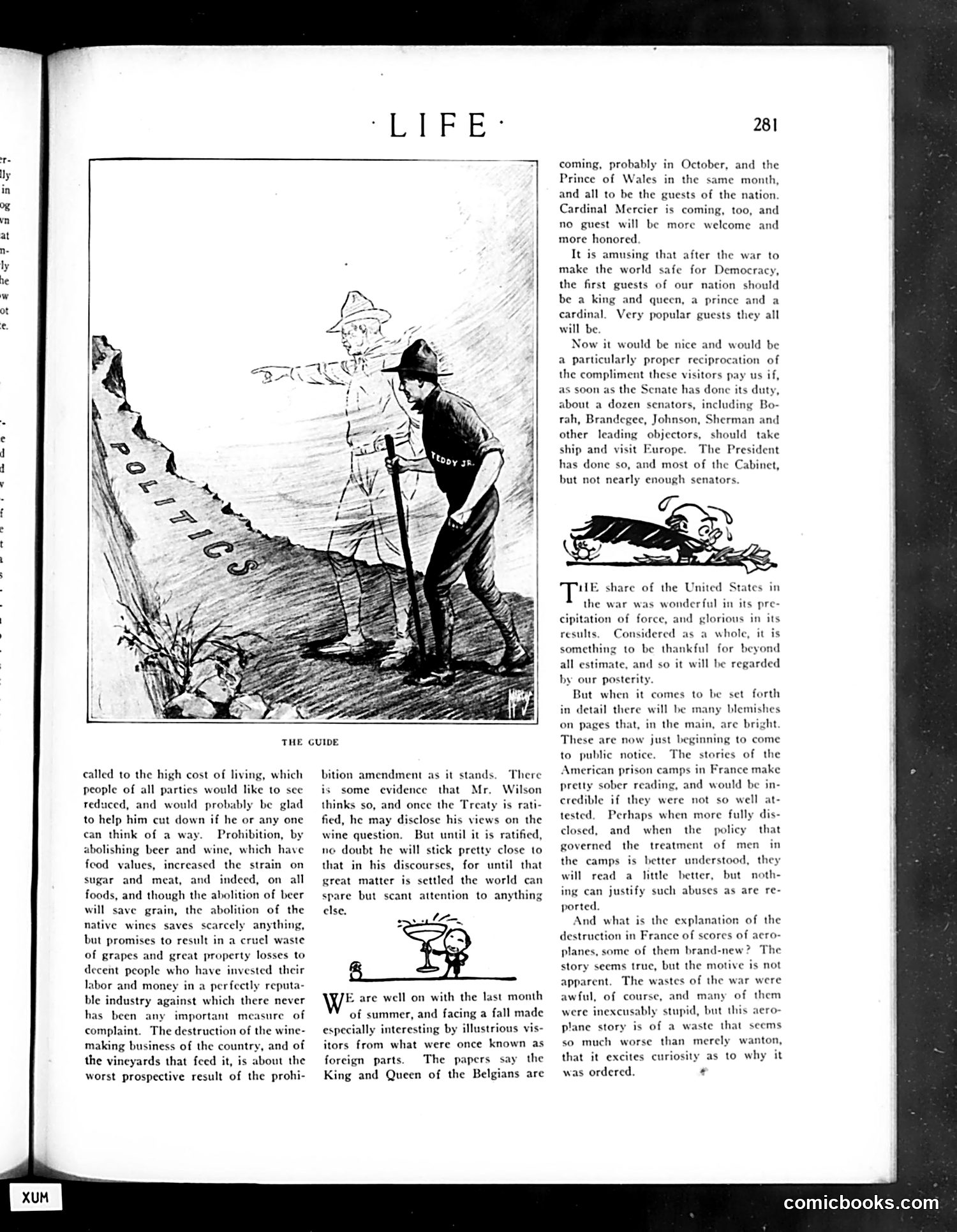
**The Cartoon "The Guide":** The illustration depicts a soldier in WWI uniform pointing the way to a civilian in a hat. The caption reads "THE GUIDE," suggesting post-war guidance or direction for the nation. **Main Content - Political Satire:** The text satirizes President Wilson's silence on Prohibition. The author argues that Wilson likely opposes the wine industry's destruction (a real concern post-war) but stays quiet until the Treaty of Versailles is ratified, as other matters dominate attention. **Foreign Dignitaries Section:** The piece mocks the irony that after fighting "to make the world safe for Democracy," America's first distinguished guests are royalty and clergy—a King and Queen of Belgium, the Prince of Wales, and Cardinal Mercier. The author sarcastically notes how "popular" they'll be, then suggests U.S. Senators (naming Republican Treaty opponents like Borah and Brandegee) should reciprocate by visiting Europe, implying they should see war's actual consequences. **War Accountability:** The closing section criticizes emerging reports of American misconduct: mismanagement of French prison camps and unexplained destruction of new military aircraft—"a waste that seems so much worse than merely wanton."
📄 Transcribed text from this page (OCR, searchable)
Machine-transcribed from the original scan — historical spelling and the odd misread are preserved.
¢ J d called to the high cost of living, which people of all partics would like to see reduced, and would probably be glad to help him cut down if he or any one can think of a way. Prohibition, by abolishing beer and wine, which have food values, increased the strain on sugar and meat, and indeed, on all foods, and though the abolition of beer will save grain, the abolition of the native wines saves scarcely anything, but promises to result in a cruel waste of grapes and great property losses to decent people who have invested their labor and money in a perfectly reputa- ble industry against which there never has been any important complaint. The destruction of the wine- making business of the country, and of the vineyards that feed it, is about the worst prospective result of the prohi- measure of THE GUIDE bition amendment as it stands. There is some evidence that Mr, Wilson thinks so, and once the Treaty is rati- fied, he may disclose his views on the wine question. But until it is ratified, ne doubt he will stick pretty close to that in his discourses, for until that great matter is settled the world can spare but scant attention to anything else, lS E are well on with the last month of summer, and facing a fall made especially interesting by illustrious vis- itors from what were once known as foreign parts. The papers the King and Queen of the Belgians are say 281 coming, probably in October, and the Prince of Wales in the same month, and all to be the guests of the nation. Cardinal Mercier is coming, too, and no guest will be more welcome and more honored It is amusing that after the war to make the world safe for Democra the first guests of our nation should be a king and queen, a prince and a cardinal. Very popular guests they all will be Now it would be nice and would be a particularly proper reciprocation of the compliment these visitors pay us if, as soon as the Senate has done its duty, about a dozen senators, including Bo- rah, Brandegee, Johnson, Sherman and other leading objectors, should take ship and visit Europe. The President has done so, and most of the Cabinet, but not nearly enough senators. THe share of the United States in the war was wonderful in its pre- cipitation of force, and glorious in its Considered as a whole, it is something to be thankful for beyond results. all estimate, and so it will be regarded by our posterity. But when it comes to be set forth in detail there will be many blemishes on pages that, in the main, are bright. These are now just beginning to come to public notice. the American prison camps in France make The stories of pretty sober reading, and would be in- credible if they were not so well at- tested, Perhaps when more fully dis- and when the that governed the treatment of men in the camps is better understood, they will read a little better, but noth- ing can justify such abuses as are re- closed, policy ported. And what is the explanation of the destruction in France of scores of acro- planes, some of them brand-new? The story seems true, but the motive is not apparent. The wastes of the war were wful, of course, and many of them ably stupid, but this aero- were inexcus: plane story is of a waste that seems so much worse than merely wanton, that it excites curiosity as to why it was ordered. ¢ comicbooks.com