
Life, 1919-08-14 · page 20 of 44
Life — August 14, 1919 — page 20: what you’re looking at
What you’re looking at
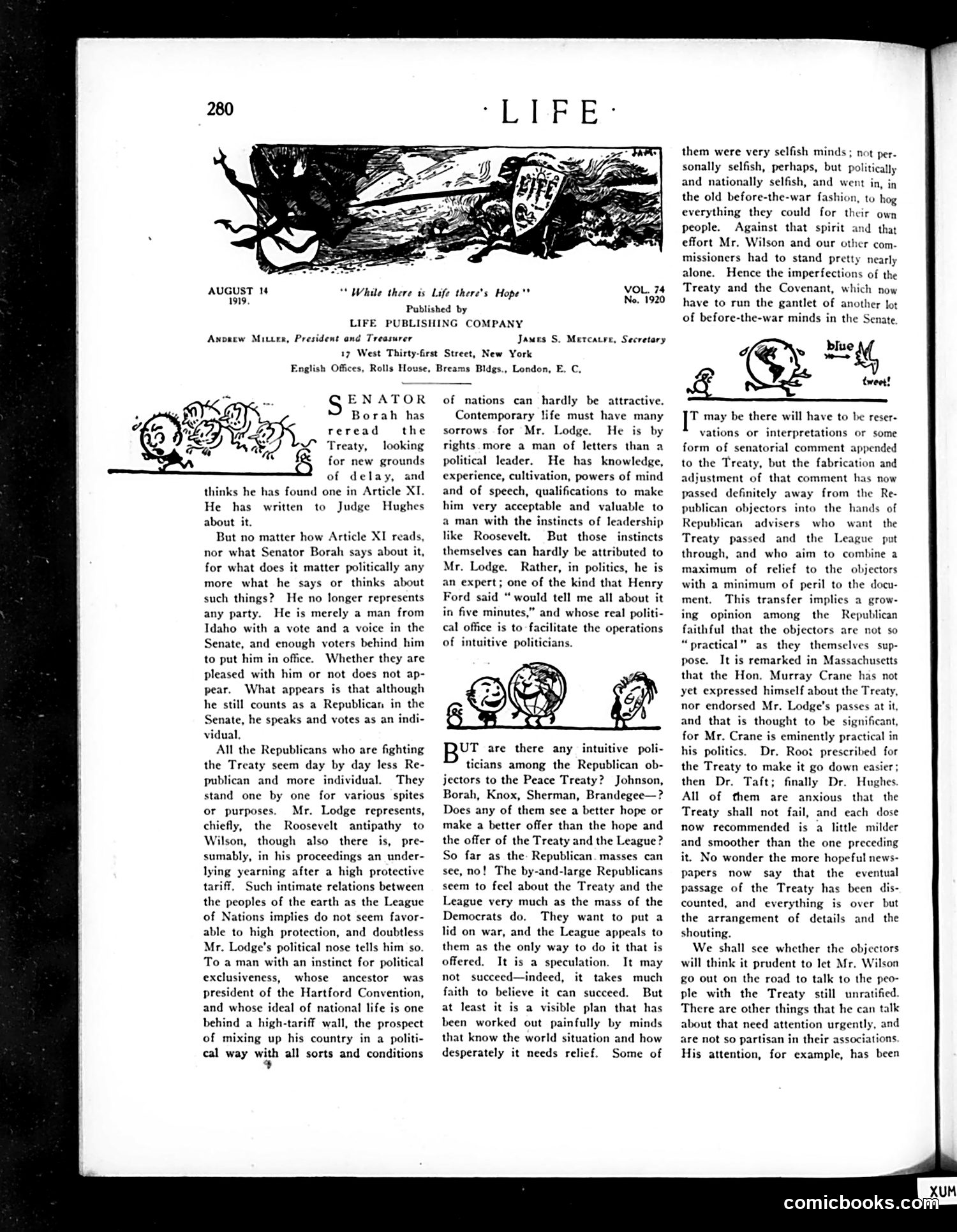
This editorial cartoon and accompanying text satirize Republican senators opposing the League of Nations Treaty. The piece critiques Senator William E. Borah (shown rereading the Treaty) and other GOP objectors—including Henry Cabot Lodge, Hiram Johnson, and Philander Knox—for abandoning party unity to pursue individual agendas. The satire's central point: these senators are no longer truly Republican; they're self-interested individuals. Lodge represents Roosevelt's anti-Wilson vendetta and protectionist tariff interests. The article argues Republican voters actually support the League as a mechanism to prevent war, but their senators oppose it for partisan or personal reasons rather than offering better alternatives. The cartoon's caption—"While there is Life there's Hope"—suggests the Treaty still has a fighting chance despite Senate obstruction. The piece lambasts the senators' hypocrisy and self-serving politics.
📄 Transcribed text from this page (OCR, searchable)
Machine-transcribed from the original scan — historical spelling and the odd misread are preserved.
AUGUST 14 1919. “* While there ts Life there's Hope"* Published by LIFE PUBLISHING Anparw Miture, President and Treasurer COMPANY James S. Metcatyr, Secretary 17 West Thirty-first Street, New York English Offices, Rolls House, Breams Bldgs., London, E. C. ENATOR Borah has reread the <> Treaty, looking $& for new grounds of delay, and thinks he has found one in Article XT. He has written to Judge Hughes about it. But no matter how Article XI reads, nor what Senator Borah says about it, for what does it matter politically any more what he says or thinks about such things? He no longer represents any party. He is merely a man from Idaho with a vote and a voice in the Senate, and enough voters behind him to put him in office. Whether they are pleased with him or not does not ap- pear. What appears is that although he still counts as a Republican in the Senate, he speaks and votes as an indi- vidual, All the Republicans who are fighting the Treaty seem day by day less Re- publican and more individual. They stand one by one for various spites or purposes. Mr. Lodge represents, chiefly, the Roosevelt antipathy to Wilson, though also there is, pre- sumably, in his proceedings an under- lying yearning after a high protective tariff. Such intimate relations between the peoples of the earth as the League of Nations implies do not seem favor- able to high protection, and doubtless Mr. Lodge's political nose tells him so. To a man with an instinct for political exclusiveness, whose ancestor was president of the Hartford Convention, and whose ideal of national life is one behind a high-tariff wall, the prospect of mixing up his country in a politi- cal way a all sorts and conditions of nations can hardly be attractive. Contemporary life must have many sorrows for Mr. Lodge. He is by rights. more a man of letters than a political leader. He has knowledge, experience, cultivation, powers of mind and of speech, qualifications to make him very acceptable and valuable to a man with the instincts of leadership like Roosevelt. But those instincts themselves can hardly be attributed to Mr. Lodge. Rather, in politics, he is an expert; one of the kind that Henry Ford said “ would tell me all about it in five minutes,” and whose real politi- cal office is to facilitate the operations of intuitive politicians. Bu are there any intuitive poli- ticlans among the Republican ob- jectors to the Peace Treaty? Johnson, Borah, Knox, Sherman, Brandegee—? Does any of them see a better hope or make a better offer than the hope and the offer of the Treaty and the League? So far as the: Republican. masses can see, no! The by-and-large Republicans seem to feel about the Treaty and the League very much as the mass of the Democrats do. They want to put a lid on war, and the League appeals to them as the only way to do it that is offered. It is a speculation. It may not succeed—indeed, it takes much faith to believe it can succeed. But at least it is a visible plan that has been worked out painfully by minds that know the world situation and how desperately it needs relief. Some of them were very selfish minds ; not per- sonally selfish, perhaps, but politically and nationally selfish, and went in, in the old before-the-war fashion, to hog everything they could for their own people. Against that spirit and that effort Mr. Wilson and our other com- missioners had to stand pretty nearly alone. Hence the imperfections of the Treaty and the Covenant, which now have to run the gantlet of another lot of before-the-war minds in the Senate. LEY AC fe tw T may be there will have to be reser- vations or interpretations or some form of senatorial comment appended to the Treaty, but the fabrication and adjustment of that comment has now passed definitely away from the Re- publican objectors into the hands of Republican advisers who want the Treaty passed and the League put through, and who aim to combine a maximum of relief to the objectors with a minimum of peril to the docu- ment. This transfer implies a grow- ing opinion among the Republican faithful that the objectors are not so “practical” as they themselves sup- pose. It is remarked in Massachusetts that the Hon. Murray Crane has not yet expressed himself about the Treaty, nor endorsed Mr. Lodge’s passes at it, and that is thought to be significant, for Mr. Crane is eminently practical in his politics. Dr. Root prescribed for the Treaty to make it go down easier; then Dr. Taft; finally Dr. Hughes All of them are anxious that the Treaty shall not fail, and each dose now recommended is a little milder and smoother than the one preceding it. No wonder the more hopeful news- papers now say that the eventual passage of the Treaty has been dis- counted, and everything is over but the arrangement of details and the shouting. We shall see whether the objectors will think it prudent to let Mr. Wilson go out on the road to talk to the peo- ple with the Treaty still unratified. There are other things that he can talk about that need attention urgently, and are not so partisan in their associations. His attention, for example, has been comicbooks.con