
A complete issue · 40 pages · 1919
Life — July 24, 1919
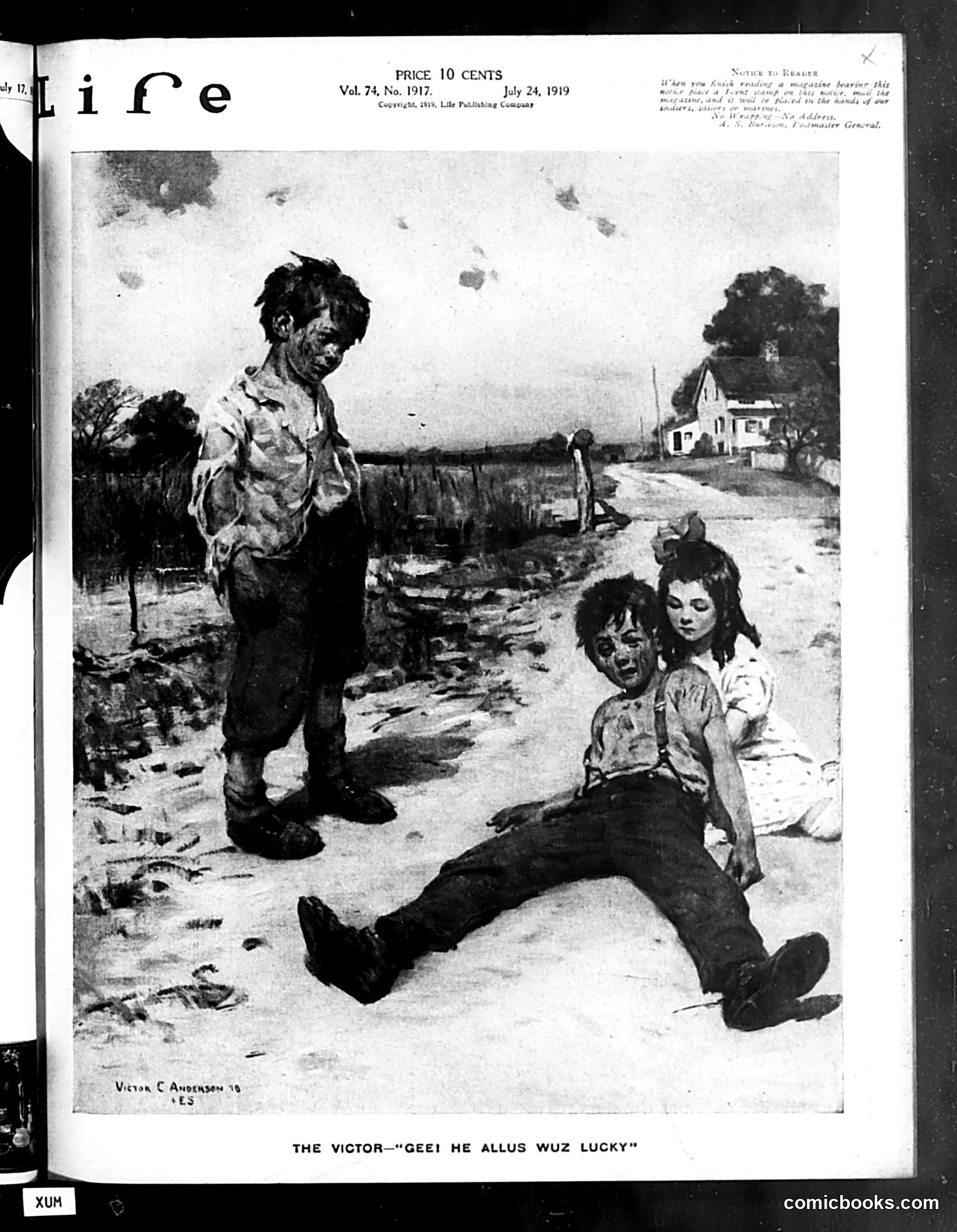
This appears to be a humorous scene rather than political satire. The caption reads "THE VICTOR—'GEE! HE ALLUS WUZ LUCKY'" and depicts what seems to be a rural or working-class setting with a man standing over two seated children in a dusty road, with a farmhouse visible in the background. The joke likely plays on the word "victor" (winner) combined with the dialectal speech ("allus wuz"), suggesting the man has won some kind of competition or game against the children, and they're attributing his victory to luck rather than skill. The rural setting and casual dress reinforce a working-class or country humor. The specific context of the "victory" remains unclear from the image alone.
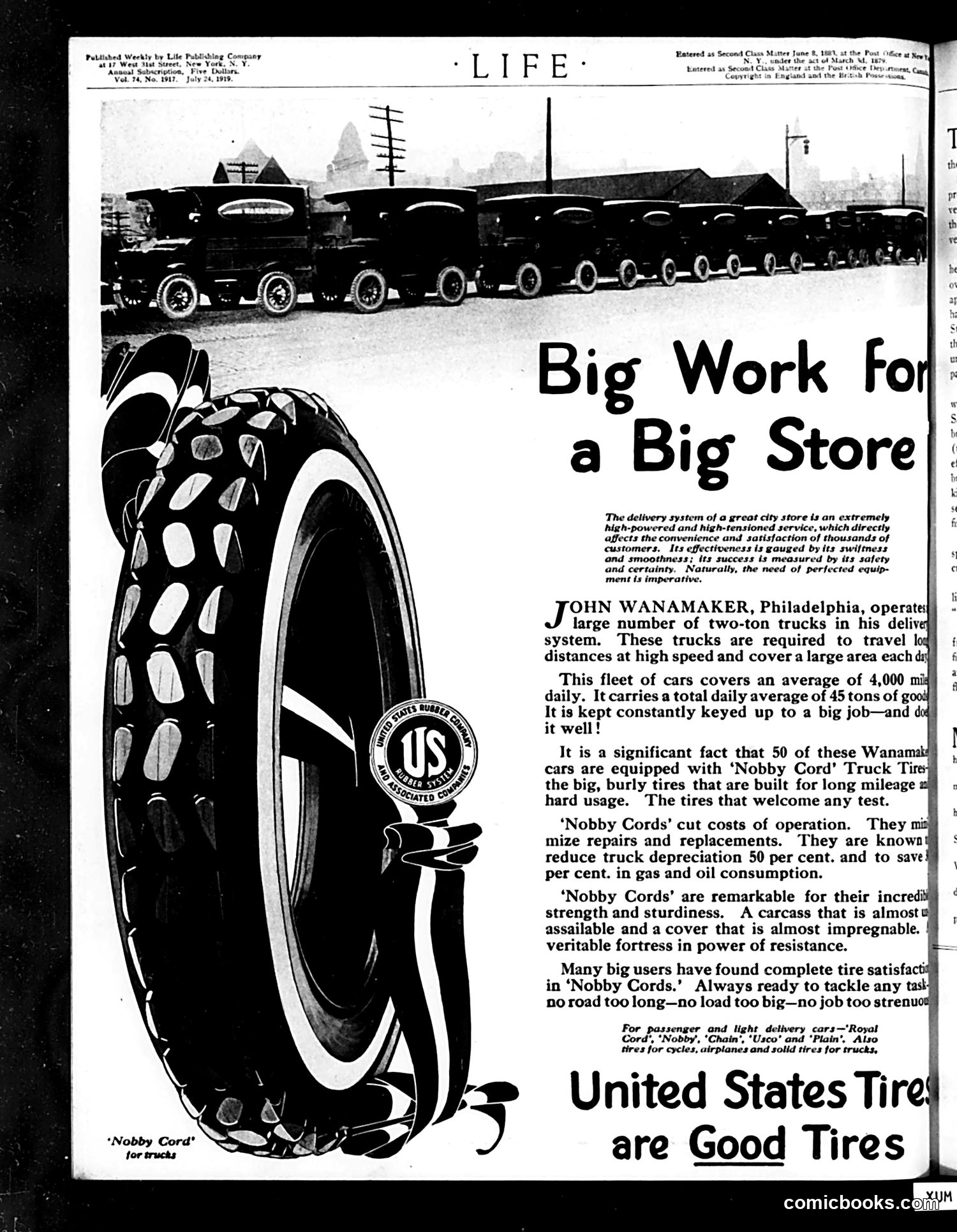
This page is primarily **advertising, not satire or political commentary**. It's a United States Tires company advertisement from Life magazine. The ad promotes "Nobby Cord" truck tires through a case study: John Wanamaker, a Philadelphia department store operator, uses 50 two-ton trucks in his delivery fleet. The advertisement emphasizes that Nobby Cords reduce operational costs, decrease fuel consumption by 30 percent, and minimize repair expenses. The large tire image on the left serves as product display. The fleet photo at top shows the actual trucks Wanamaker uses. **There is no political cartoon or satire here.** This is straightforward commercial advertising highlighting the durability and economic benefits of the tire brand for commercial fleet operations—typical content for early 20th-century magazines.
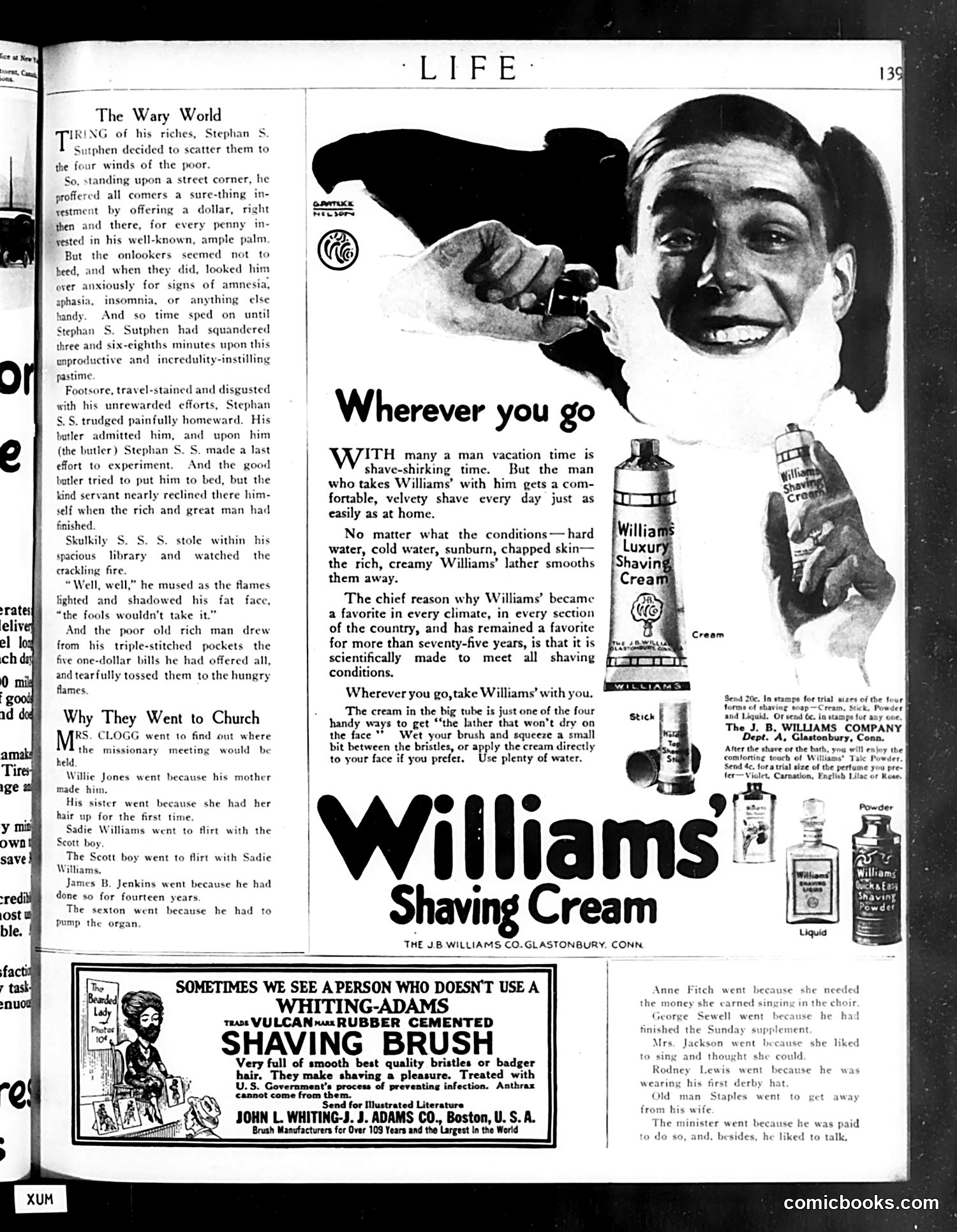
This page is primarily **advertising**, not satire or political commentary. The main content features a Williams' Shaving Cream advertisement with a photograph of a man's face demonstrating the product. The ad's humor is genteel rather than satirical—it portrays shaving as a comfort for travelers ("Wherever you go"). Below is a smaller advertisement for Vulcan Rubber Cemented Shaving Brush by John L. Whiting-J.J. Adams Co., also using mild humor about men who neglect proper grooming tools. The left column contains unrelated fiction ("The Wary World") and a humorous list titled "Why They Went to Church," which gently mocks various parishioners' actual motivations for attending services. No political figures or events are referenced.
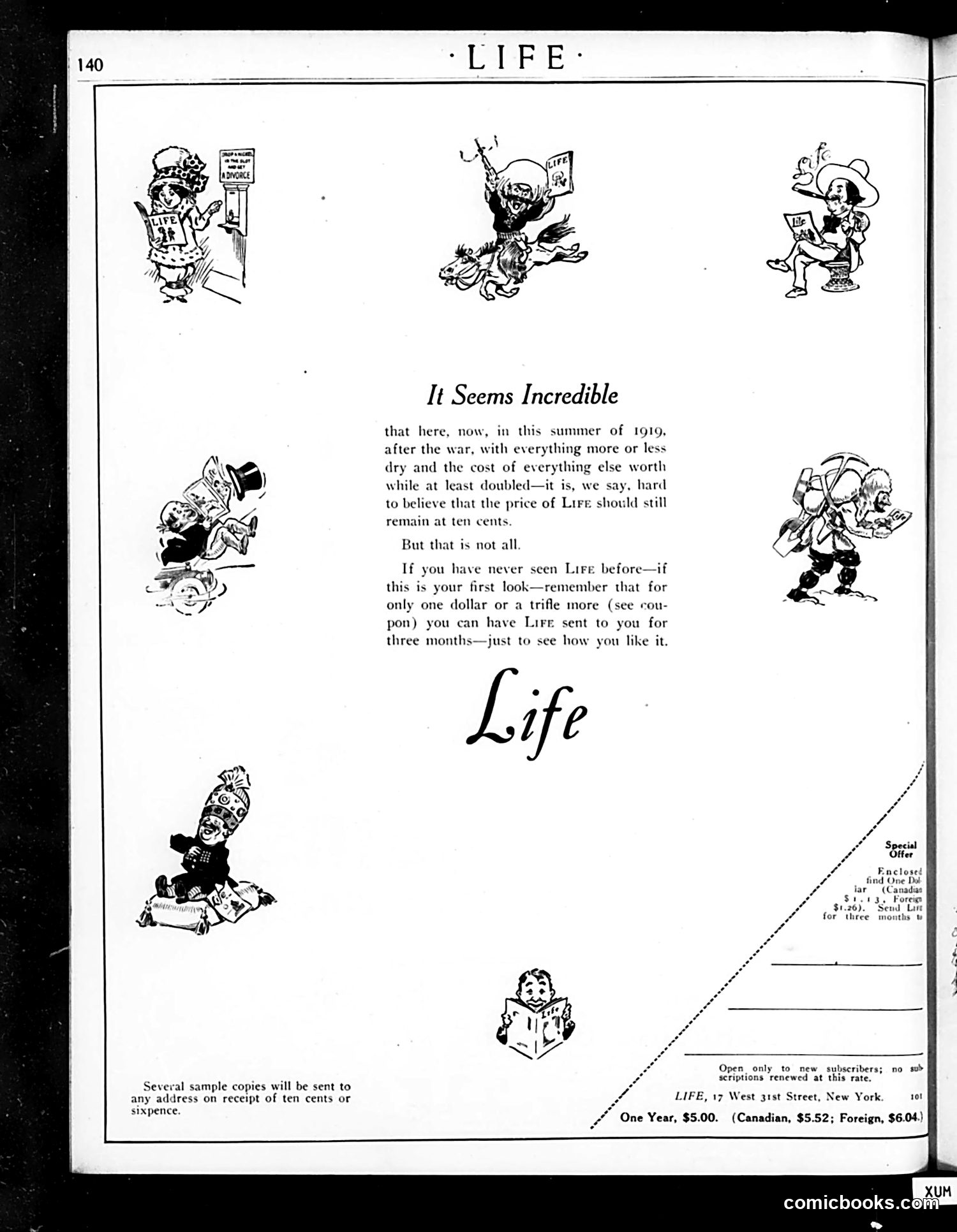
This is a subscription advertisement for *Life* magazine from summer 1919, just after World War I. The page emphasizes the magazine's affordability—ten cents per issue despite post-war inflation that had doubled most prices. The six cartoon vignettes surrounding the text feature whimsical, exaggerated characters in humorous situations, typical of *Life*'s satirical style. These appear designed to convey the magazine's comedic appeal rather than reference specific political figures or events. The advertisement highlights a special introductory offer: new subscribers could receive *Life* for three months at a dollar (or slightly more for international subscribers) to sample the publication before committing to a full year subscription at $5.00.
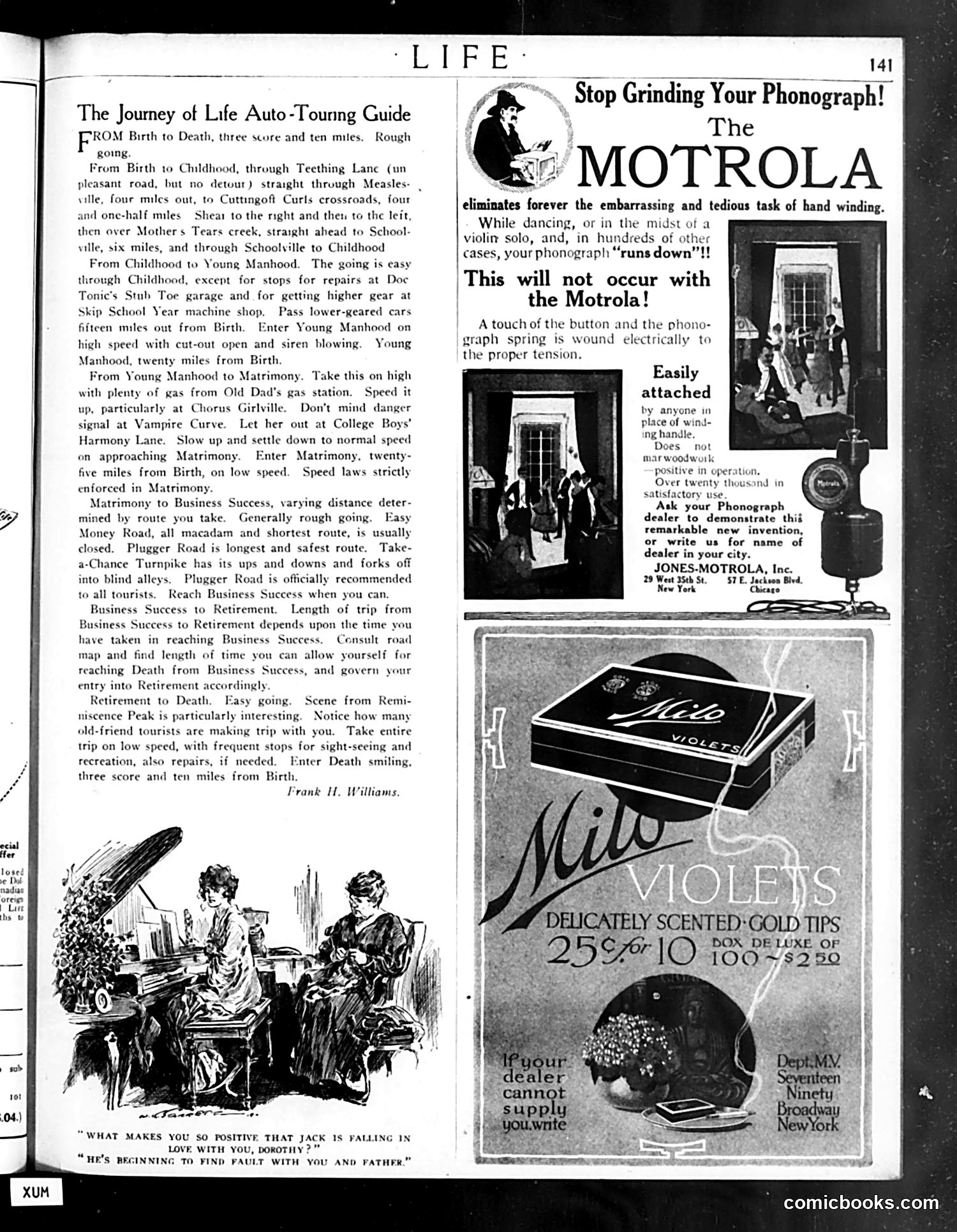
This page is primarily **advertising**, not satire or political commentary. The left column contains "The Journey of Life Auto-Touring Guide," a humorous narrative essay by Frank H. Williams describing life stages as a cross-country road trip—from birth through childhood, young adulthood, marriage, business success, and retirement to death. It's lighthearted social commentary on life's progression, illustrated with a sketch of people at a piano. The right side features two product advertisements: the **Motrola phonograph** (emphasizing automatic winding to prevent records from "running down") and **Milo Violets** (scented candy). There is **no political cartoon** on this page. The modest sketch illustrating Williams's essay is decorative, not satirical. The page reflects 1920s consumer culture and product marketing.
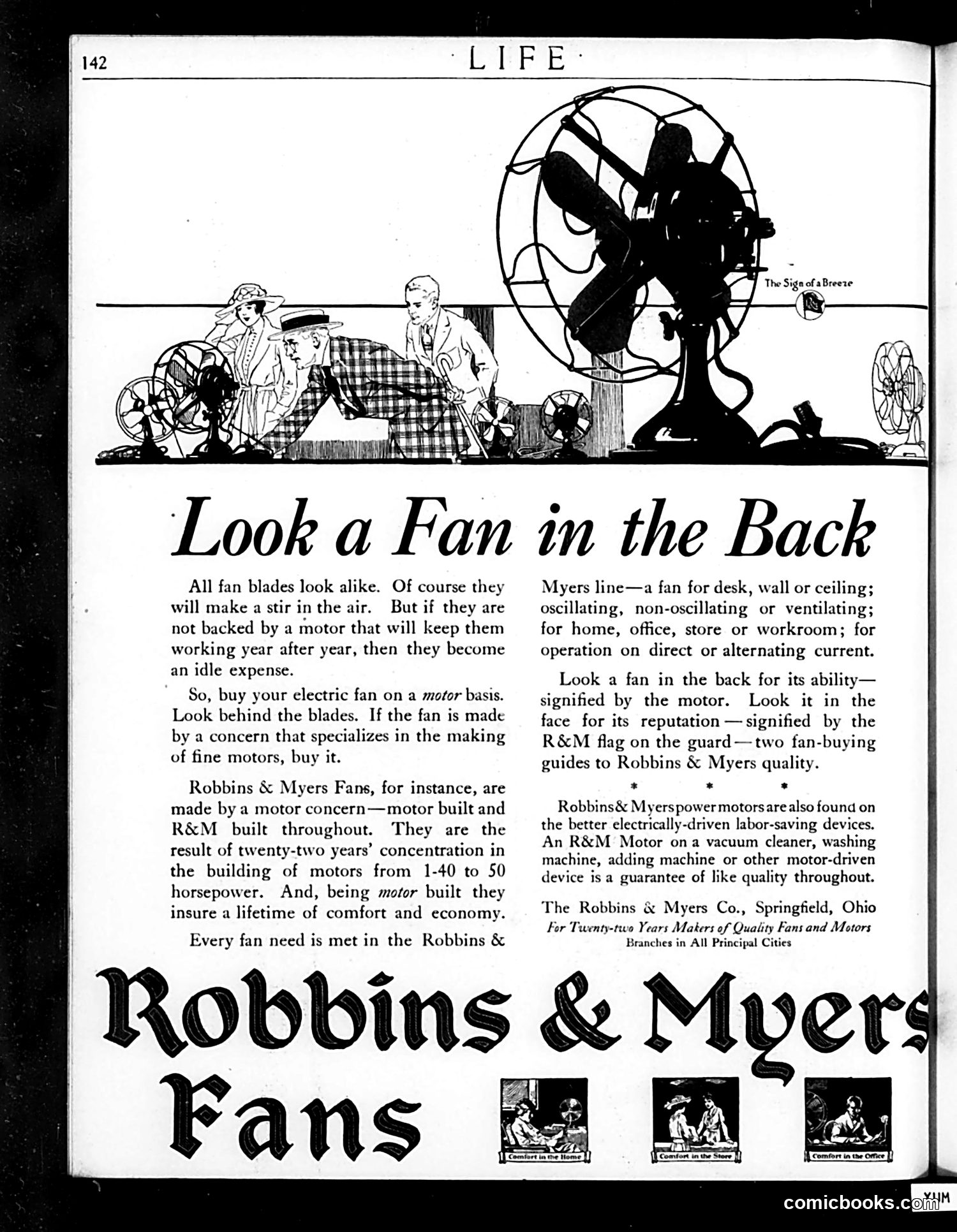
This is primarily a **Robbins & Myers advertisement** for electric fans, not political satire. The page appears from *Life* magazine's advertising section (page 142). The illustration shows a silhouetted figure operating a large fan, with people in period dress (appearing early 20th century) observing it. The ad's message is straightforward: consumers should examine the **motor mechanism** behind fan blades when purchasing, not just the visible blades themselves. The ad argues that Robbins & Myers fans, made by a motor-specializing company with twenty-two years' experience, guarantee quality through superior engineering. The tagline emphasizes looking "in the back" — literally examining the motor — as proof of reliability and value. This reflects early consumer advertising strategy: teaching buyers to evaluate product durability through internal construction rather than appearance alone.
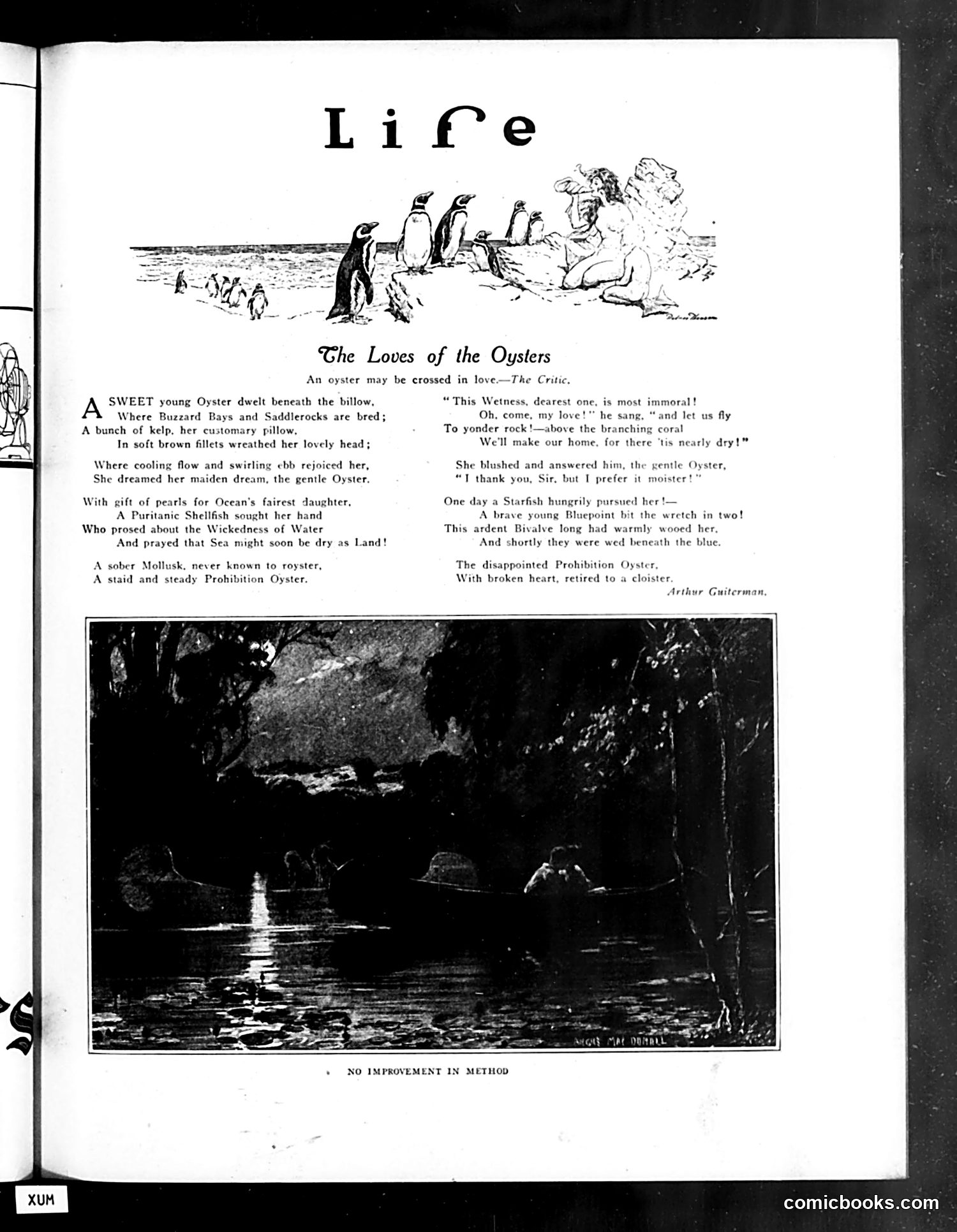
This is a humorous poem by Arthur Guiterman satirizing romantic complications among oysters. The narrative follows a young female oyster who dreams of a "gentle Oyster" suitor, but becomes entangled with other oyster characters including a "Puritanic Shellfish" and a "brave young Blueprint" who dies in conflict. The satire gently mocks human romantic melodrama by transposing it onto sea creatures. The subtitle notes "An oyster may be crossed in love—*The Critic*," suggesting this parodies overly sentimental Victorian romance narratives. The whimsical illustration at top shows penguins and cherubs observing the underwater scene, emphasizing the absurdist humor of treating oyster relationships with serious dramatic weight.
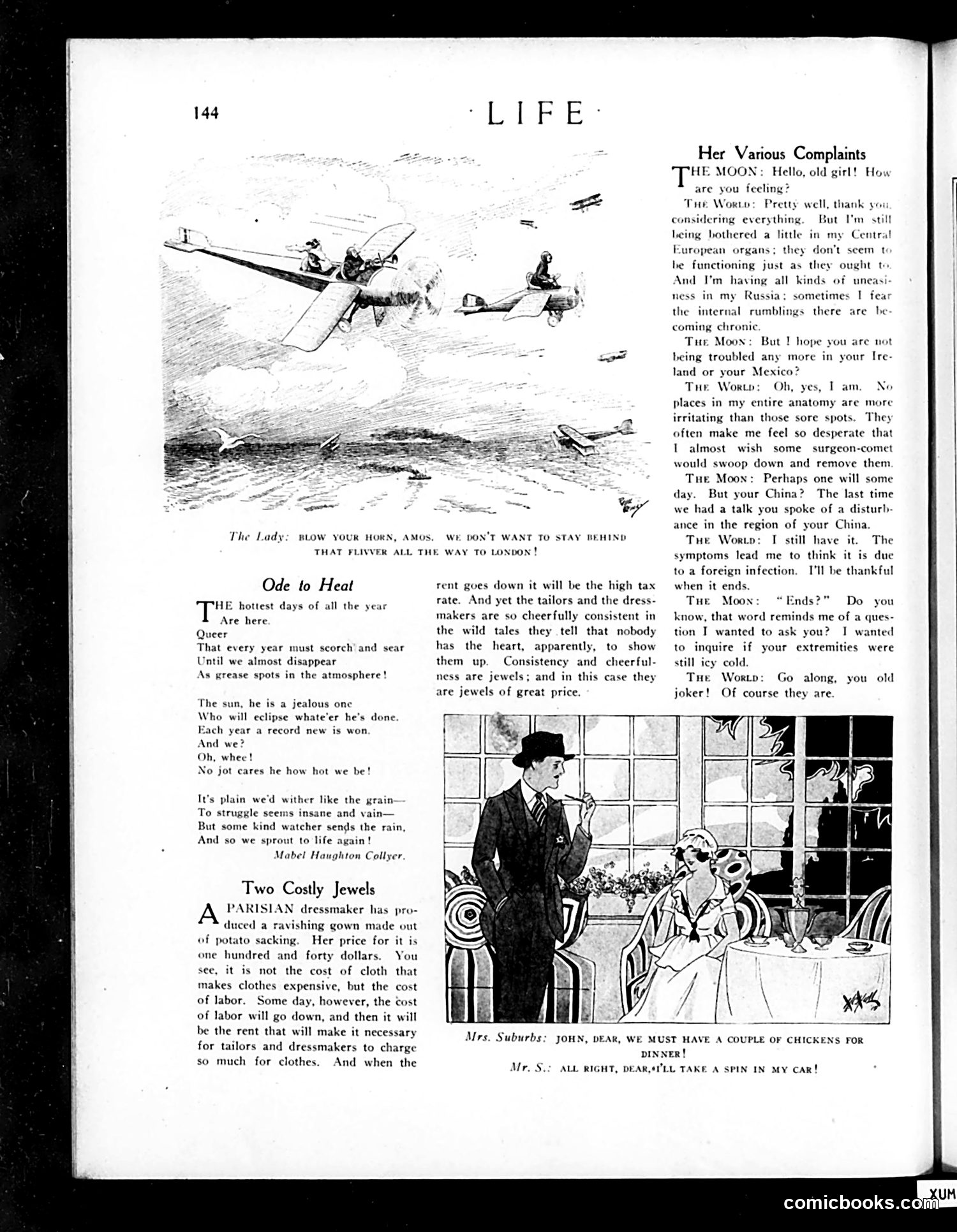
This page contains satirical poetry and social commentary typical of early 20th-century Life magazine. **"Ode to Heat"** mocks summer's brutal temperatures, personifying the sun as a "jealous one" competing with records. The poem complaints about atmospheric heat spots—likely referencing pollution or urban conditions—and suggests rain as relief. **"Two Costly Jewels"** critiques labor economics: a Parisian dressmaker charges $140 for a potato-sack gown. The satirist argues that while fabric costs are low, *labor* is expensive. The point: as workers' wages rise, clothing prices will inevitably increase—a commentary on post-war labor negotiations and inflation concerns. **"Her Various Complaints"** (right panel) is a humorous dialogue between the Moon and World, with the World listing bodily ailments (digestive issues, sore spots, possible foreign infection). The joke equates Earth's problems to human physical complaints.
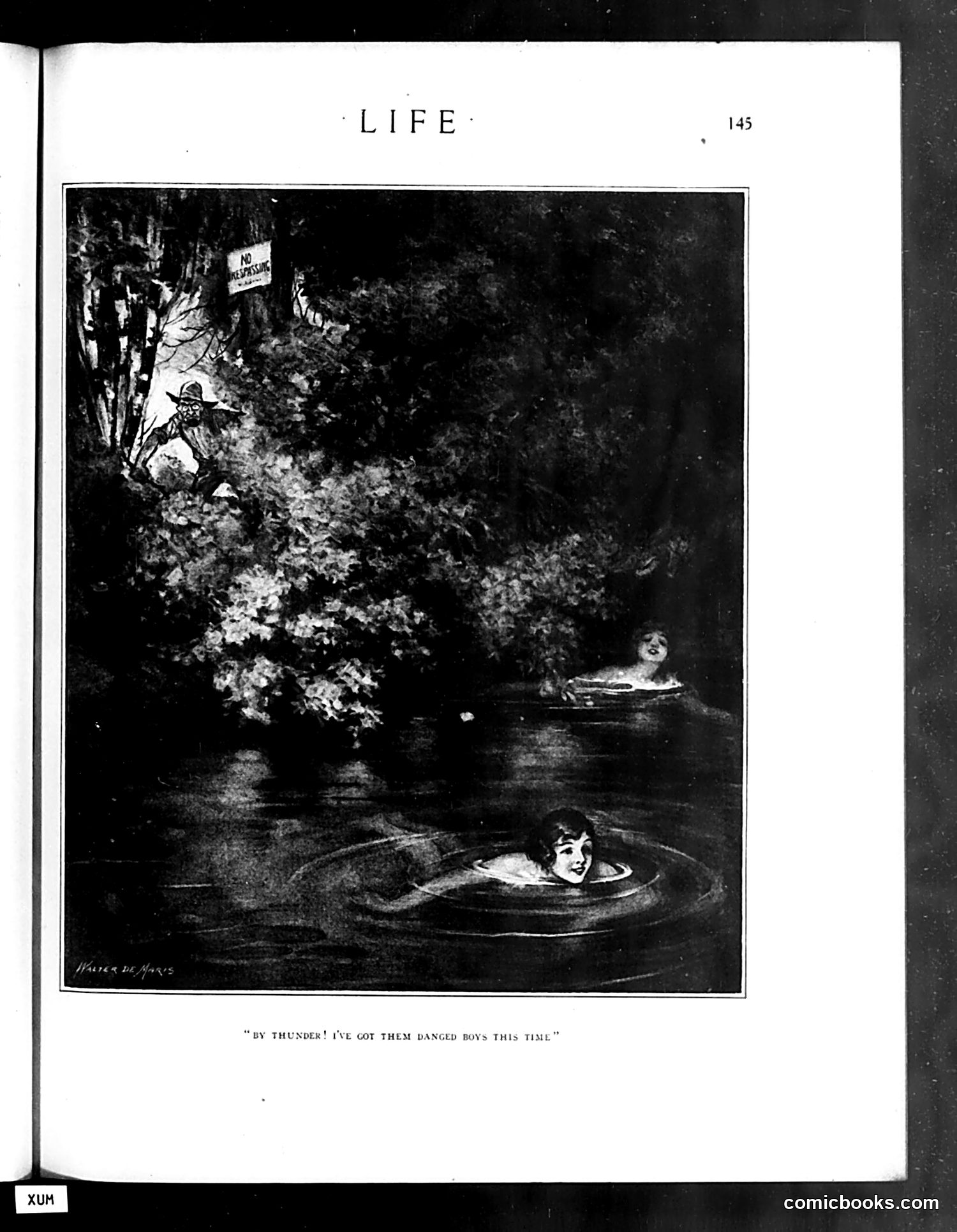
This is a humorous illustration by Halsey de Vaux depicting what appears to be young women swimming in a pond or pool at night. Two figures are immersed in the water while a third stands on the bank wearing a hat, with a "No Trespassing" sign visible in a tree above. The caption reads: "By thunder! I've got them danged boys this time." The joke plays on a classic scenario: an authority figure (likely a property owner or caretaker) catching trespassers, but the twist is that the "danged boys" expected to be caught are actually young women—creating humor from the surprise reversal of expectations and the implied impropriety of the situation.
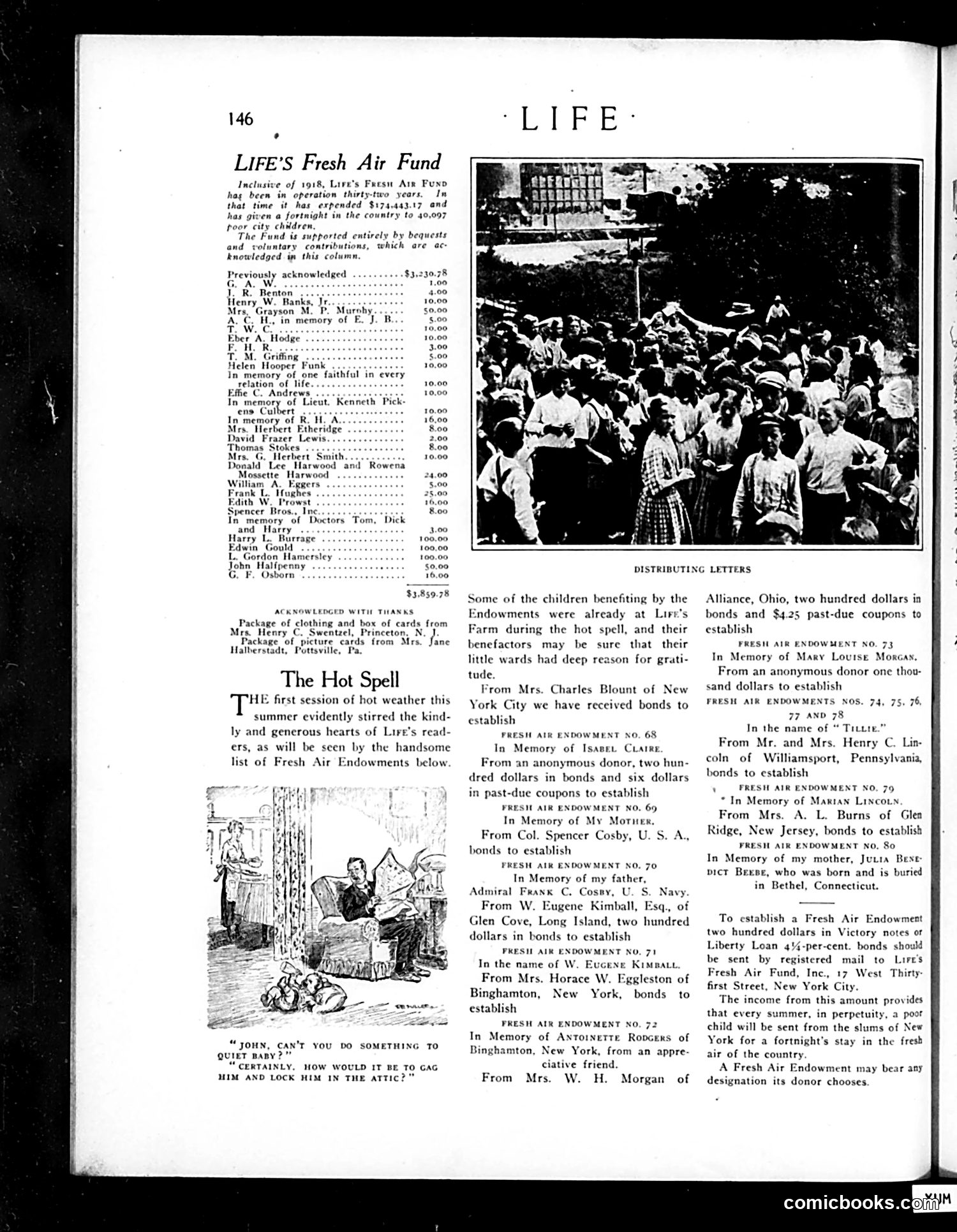
This page contains a **charitable fundraising article** titled "The Hot Spell" rather than political satire. The small cartoon at bottom left depicts a domestic scene with what appears to be a father and child during hot weather, with the caption: "JOHN, CAN'T YOU DO SOMETHING TO QUIET BABY?" / "CERTAINLY. HOW WOULD IT BE TO GAG HIM AND LOCK HIM IN THE ATTIC?" This is **dark domestic humor** playing on parental frustration during oppressive summer heat—the joke being the absurdly extreme "solution" offered. The cartoon illustrates why Life's Fresh Air Fund matters: poor city children suffered terribly in hot tenements without ventilation or escape, making country retreats essential for their health. The main content documents donations establishing endowments to send underprivileged children to fresh air camps, reflecting Progressive Era charitable concerns about urban poverty.
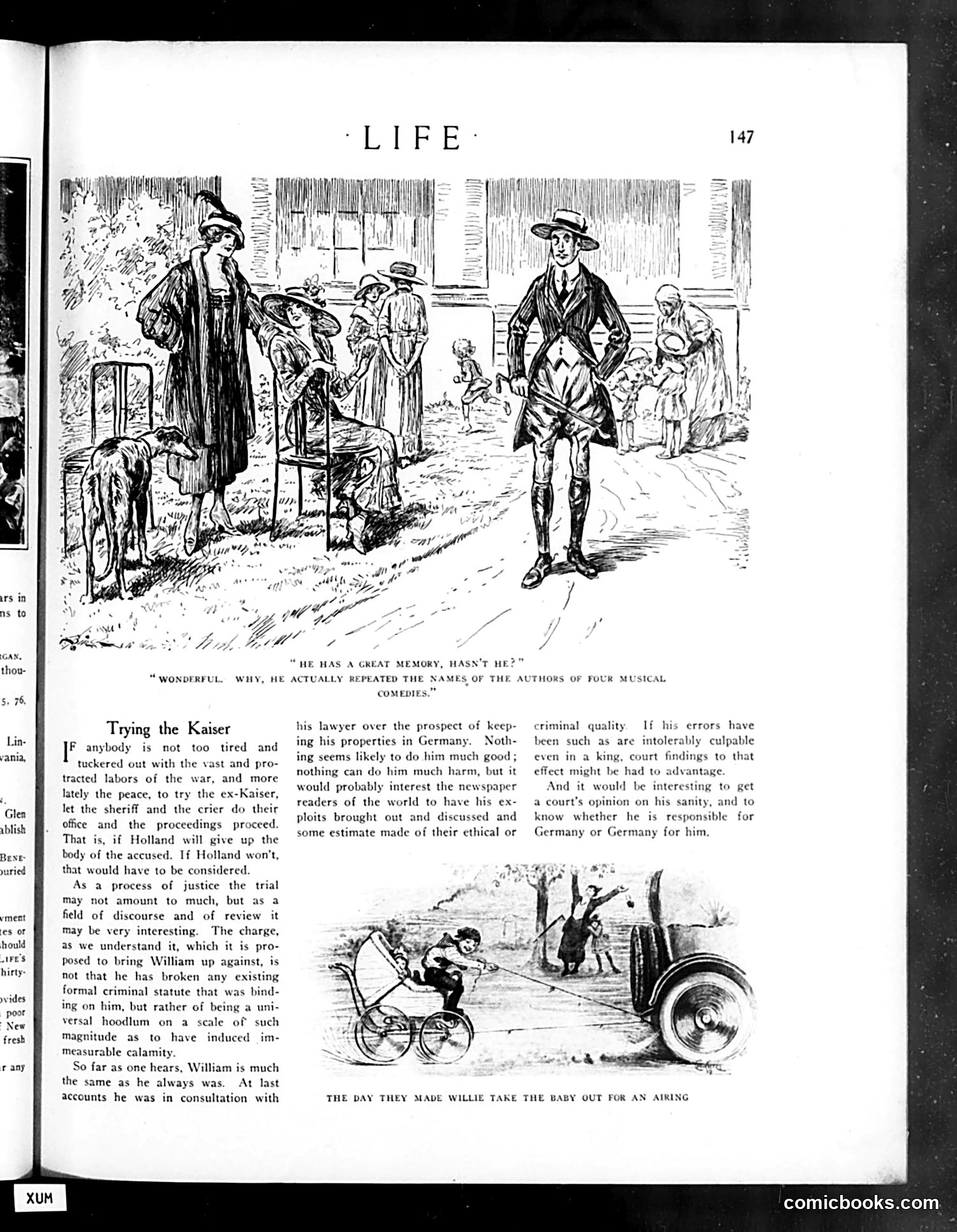
**Top Cartoon**: Shows a well-dressed man (center) in a street scene with various onlookers. The caption quotes someone having "a great memory" who "actually repeated the names of the authors of four musical comedies." This appears to be satirizing someone's pretentiousness—implying it's noteworthy (and thus mockable) that this person could merely recite four composers' names. **Article "Tying the Kaiser"**: Discusses a potential trial of Kaiser Wilhelm after WWI, exploring whether he could be held legally responsible for Germany's actions. The text questions jurisdiction and what charges might apply. **Bottom Cartoon**: Shows a baby carriage with large wheels next to what appears to be an airplane, captioned "The Day They Made Willie Take the Baby Out for an Airing"—likely a humorous reference to aviation safety or novelty.
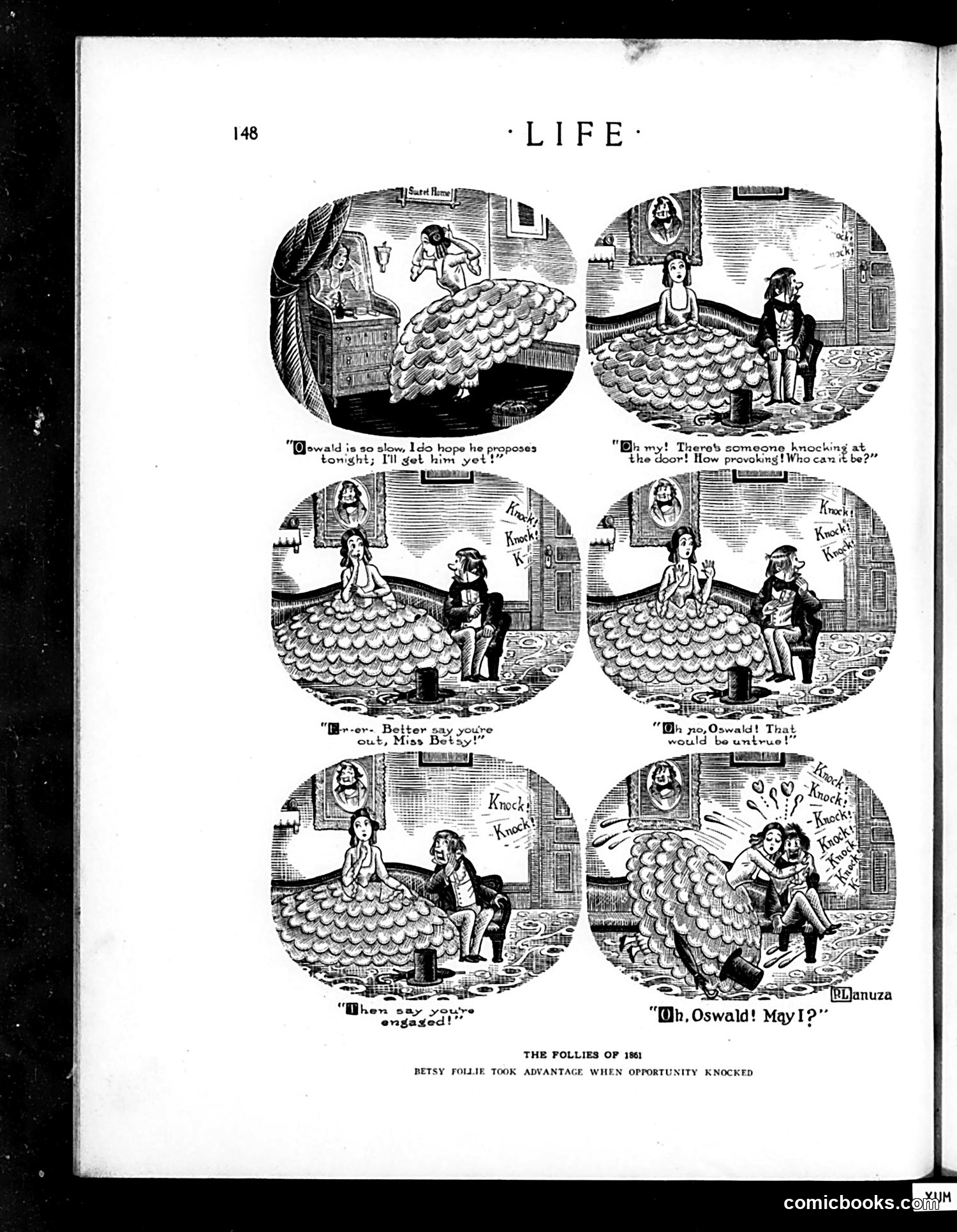
This six-panel comic strip from *Life* magazine satirizes the "Follies of 1861"—a reference to the American Civil War era. The caption states "Betsy Follie took advantage when opportunity knocked." The comic depicts a woman (Betsy) in an enormous hoop skirt sitting on a bed with a man named Oswald. The humor revolves around: 1. **The hoop skirt as obstacle**: The exaggerated, massive skirt physically prevents normal interaction—a visual gag about the impracticality of 1860s women's fashion. 2. **Social propriety humor**: The repeated knock at the door interrupts the couple's private moment, forcing Betsy to manipulate the situation by pretending to be engaged to Oswald, exploiting social conventions of the era. The satire mocks both the absurd fashion silhouettes and the rigid Victorian social codes governing courtship.
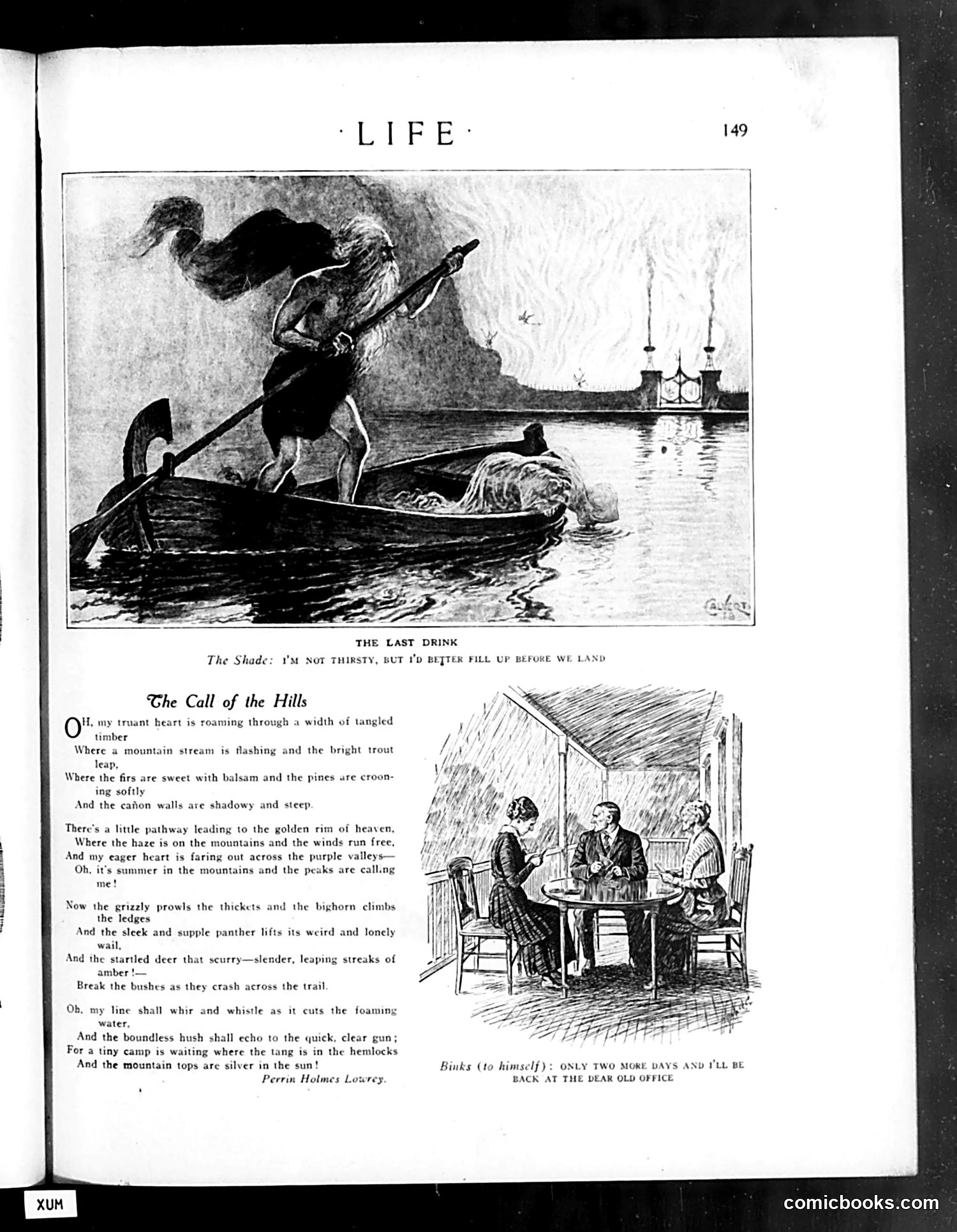
**"The Last Drink" (top cartoon):** A figure in a boat offers a drink to a reclining person, with the caption "I'm not thirsty, but I'd better fill up before we land." The illustration suggests a satirical comment on excess or indulgence before some impending change or restriction—possibly referencing Prohibition or a similar social policy limiting alcohol consumption. **"The Call of the Hills" (bottom):** A poem by Perrin Holmes Lovekey celebrating mountain wilderness and outdoor adventure. The accompanying illustration shows an office worker daydreaming of escape to nature while at his desk, with the caption indicating he'll return in "only two more days." This reflects common early-20th-century satirical themes: the tension between urban work life and romantic notions of wilderness freedom.
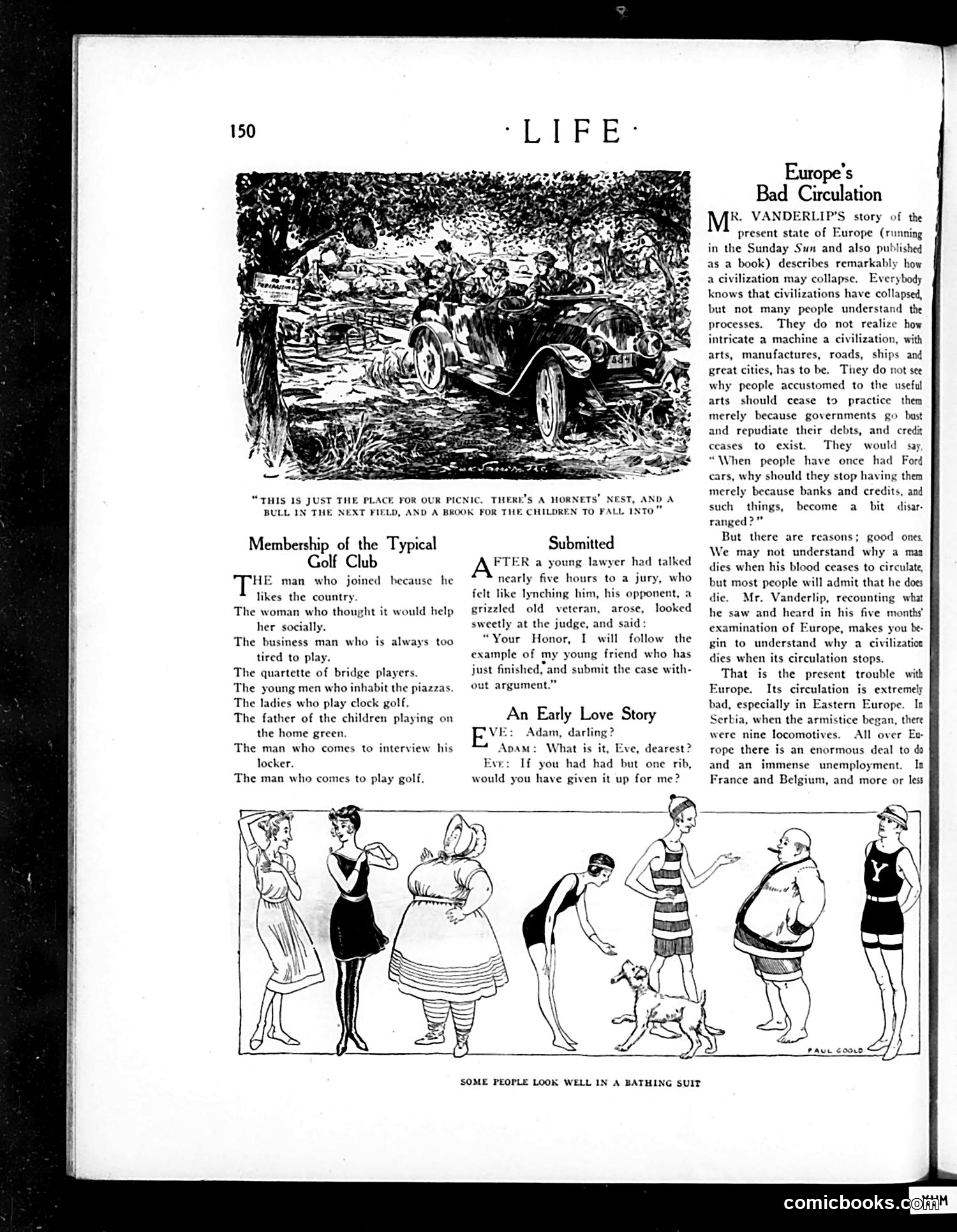
**Top Section - "Europe's Bad Circulation":** This discusses Mrs. Vanderlip's book about Europe's post-war collapse, using a metaphor of civilization as a machine requiring "circulation" (credit and economic flow). The satire critiques those who don't understand that economic systems are interdependent—people expect cultural arts to continue while governments default on debts, which is portrayed as naive. **Middle Sections:** - "Membership of the Typical Golf Club" is a humorous list of stereotypical club members - "Submitted" contains a brief anecdote about courtroom behavior - "An Early Love Story" depicts a humorous exchange between Adam and Eve about rib-giving **Bottom Cartoon:** "Some People Look Well in a Bathing Suit" shows seven figures in various body types wearing swimwear, satirizing 1920s beach fashion and body consciousness.
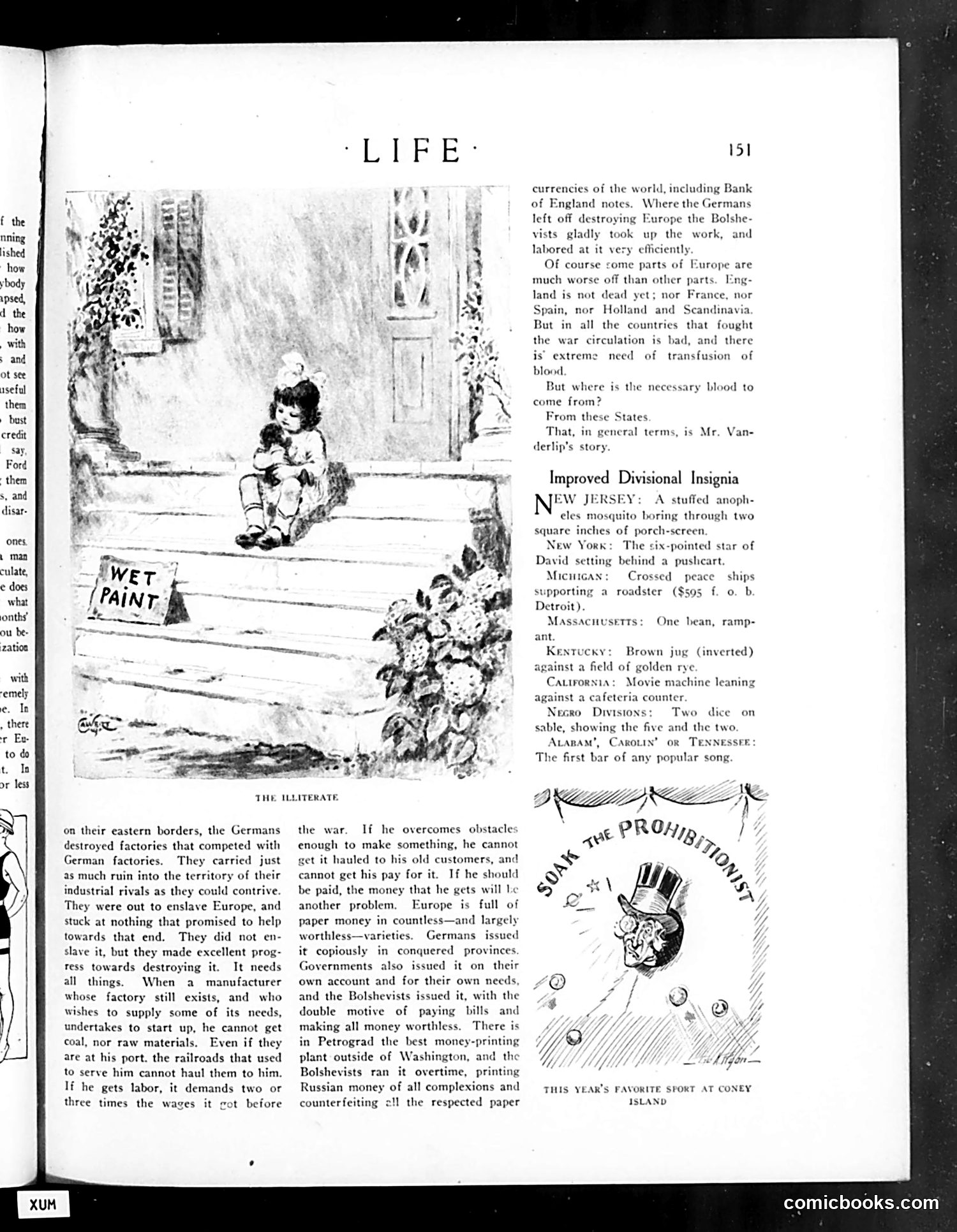
The main illustration shows a child sitting on steps marked "WET PAINT," appearing to be illiterate or unable to read the warning sign. This cartoon satirizes illiteracy in America—the inability of some citizens to read basic written warnings or instructions. The surrounding text discusses post-WWI Europe's economic chaos: destroyed factories, worthless paper currencies, counterfeiting, and wage inflation. The "Improved Divisional Insignia" section lists absurd military unit identifications (mosquitoes, pusscarts, roadsters, etc.). The "Soak the Prohibitions" illustration mocks Prohibition-era bootlegging with a caricatured Uncle Sam figure surrounded by bottles, satirizing the difficulty of enforcing alcohol bans. Together, these pieces critique American social problems—illiteracy, economic disruption, and failed legislation—during the post-war period.
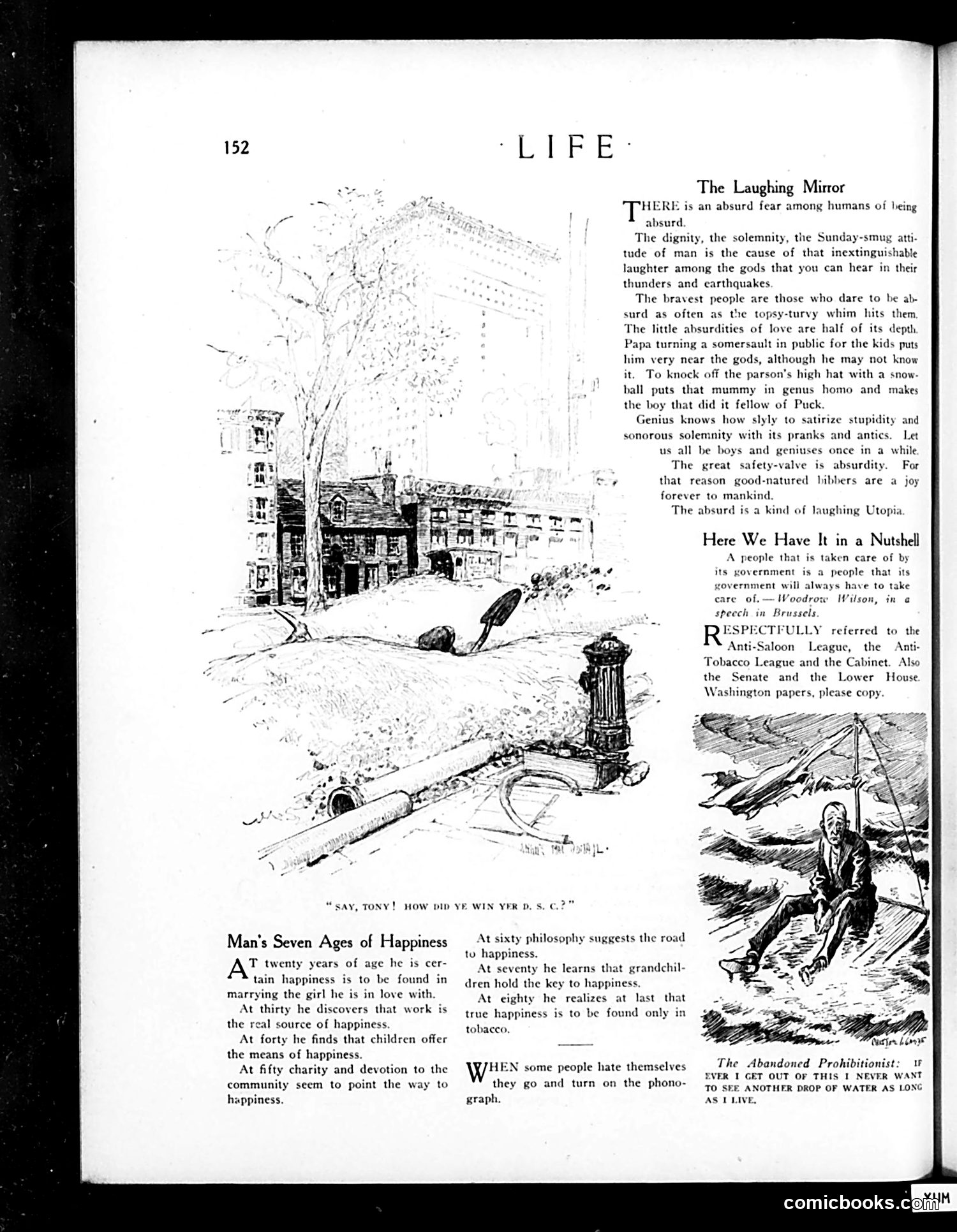
This page satirizes American social attitudes and government policy, circa early 20th century. **"The Laughing Mirror"** argues that humans' fear of appearing absurd stifles joy. The piece mocks excessive dignity and solemnity, suggesting that playful absurdity—a child knocking off a parson's hat, a father doing somersaults—connects us to our humanity and the gods. **"Here We Have It in a Nutshell"** quotes Woodrow Wilson criticizing government overreach: a populace dependent on government becomes permanently dependent. This is a jab at expanding federal paternalism. **"Man's Seven Ages of Happiness"** is a humorous life trajectory, culminating in the punchline that true happiness at eighty comes only from tobacco—mocking how priorities shift with age. **"The Abandoned Prohibitionist"** cartoon (bottom right) depicts someone who swore off water after Prohibition, likely mocking the absurdity of the Prohibition movement and those who supported such government restrictions on personal choice. The page consistently satirizes government intrusion into private life and celebrates human absurdity over rigid propriety.
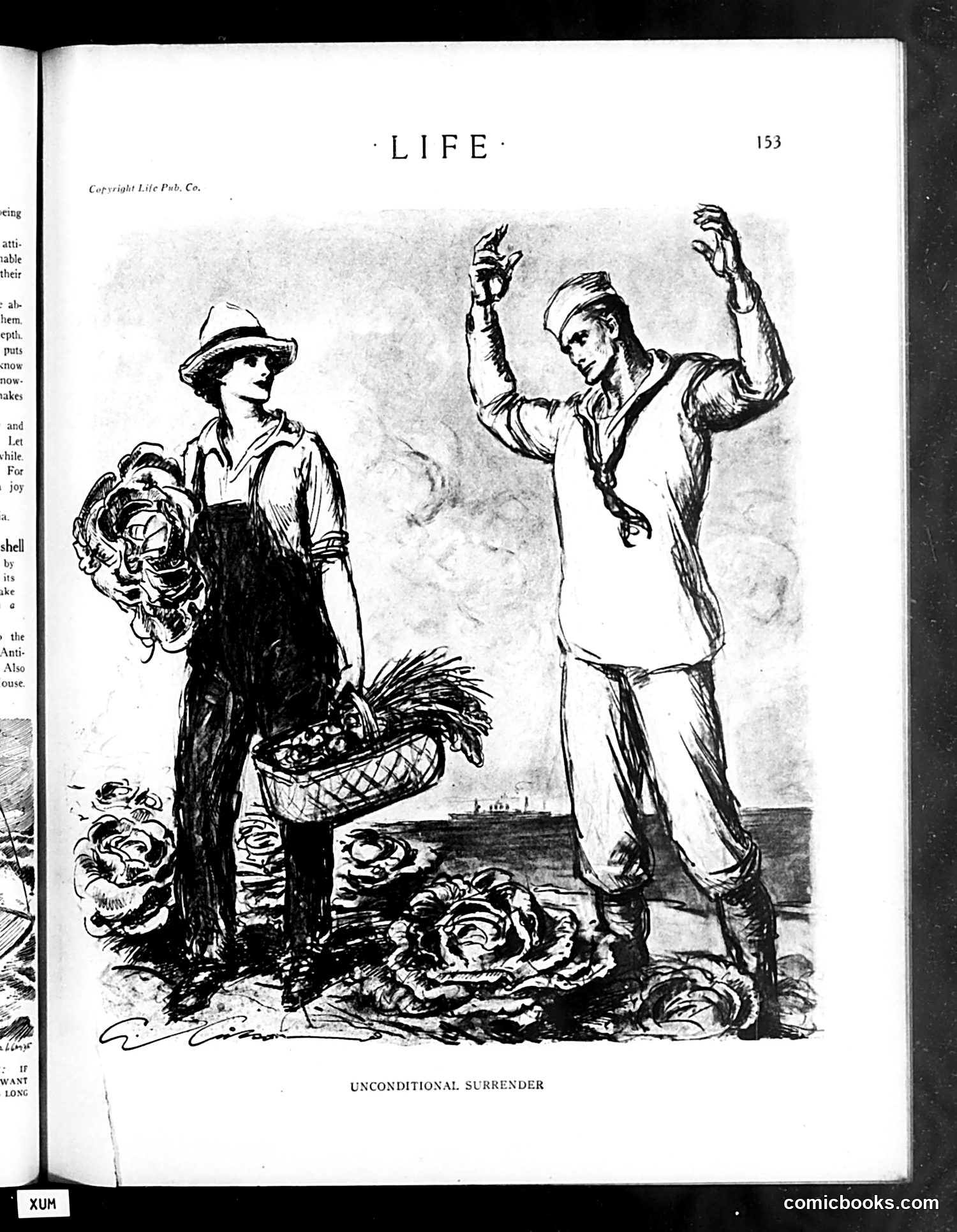
This cartoon depicts two figures: a woman farmer holding vegetables and produce on the left, and a man (appearing to be a chef or cook) on the right with raised arms in a gesture of surrender. The caption "Unconditional Surrender" suggests this is wartime satire, likely from World War I or II. The joke appears to be that the male cook/chef is surrendering unconditionally to the female farmer—a humorous reversal of typical gender roles and wartime expectations. The woman's confident stance with her abundant harvest contrasts with the man's theatrical surrender pose, suggesting that food producers (particularly women taking on agricultural work during wartime) held significant power or leverage. This likely mocks either food rationing policies, domestic labor dynamics during wartime, or male chefs' dependence on available ingredients.
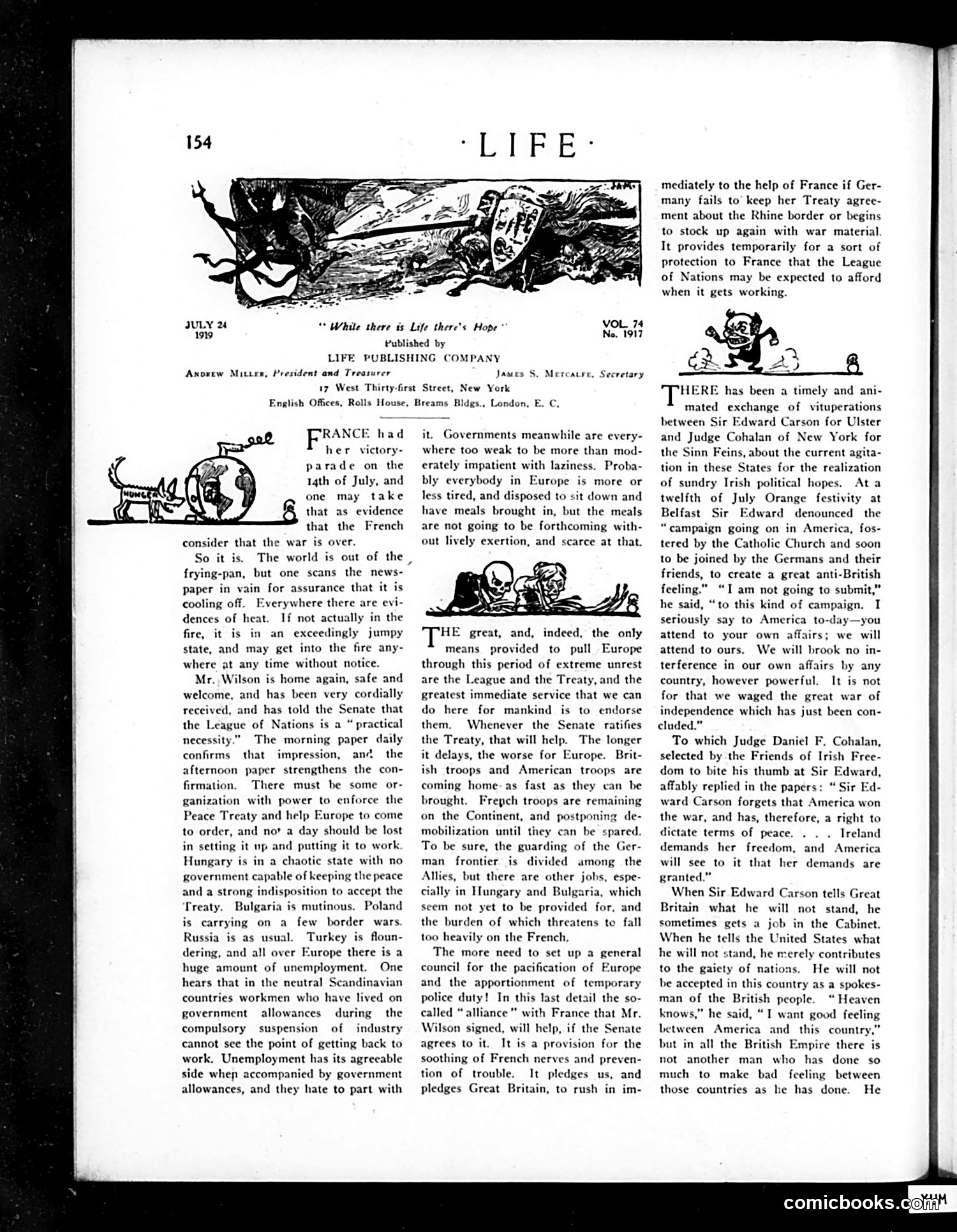
This July 1919 *Life* magazine editorial addresses post-WWI instability. The cartoons (small decorative illustrations with figures) appear to be generic satirical vignettes rather than identifiable caricatures of specific political figures. The article's main argument: Europe remains chaotic despite France's victory parade on Bastille Day. The writer warns that while the war officially ended, genuine peace hasn't arrived—Hungary is unstable, Poland and Russia are fighting, Bulgaria is rebellious, and unemployment is widespread. The solution, the author argues, is ratification of the League of Nations Treaty and a U.S.-France military alliance that President Wilson negotiated. Without swift Senate approval and enforcement mechanisms, Europe will descend further into disorder. The piece essentially urges American political action to stabilize a fragile, exhausted continent.
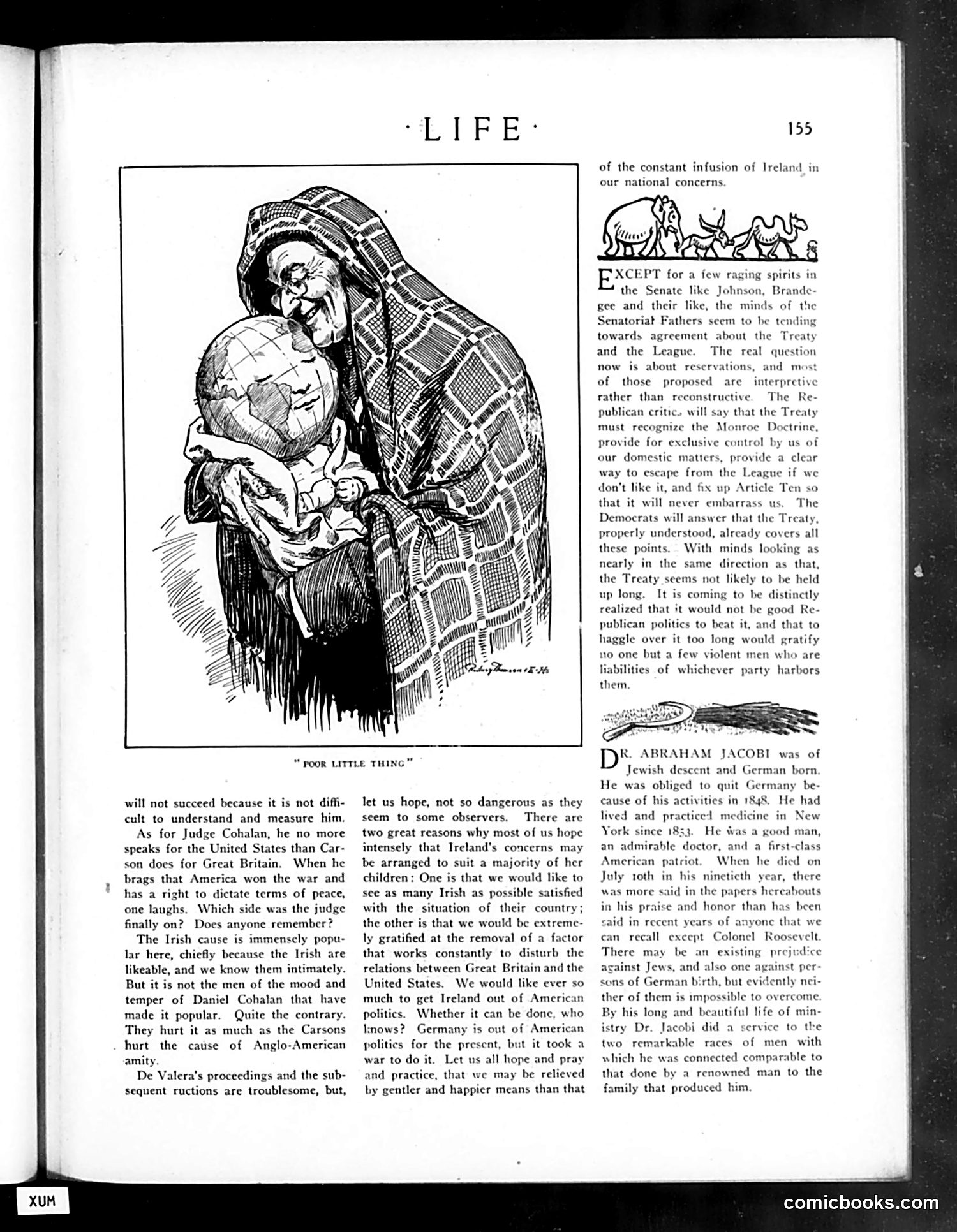
The cartoon depicts an old woman (representing Ireland) cradling a globe, satirizing American political interference in Irish independence. The accompanying text criticizes Judge Daniel Cohalan and Irish-American politicians who invoke Ireland in American politics to gain leverage, similar to how Carson uses Irish issues for British purposes. The article argues that while Irish people are sympathetic figures in America, opportunistic politicians like Cohalan harm rather than help Ireland's cause by making it a domestic political football. The writer advocates removing Ireland from American political calculations, comparing it to how Germany was extracted from American politics—but warning that Ireland's constant presence in U.S. debates threatens Anglo-American relations. The satire targets American politicians exploiting Irish nationalism for partisan gain, portraying Ireland itself as a vulnerable casualty of this manipulation.
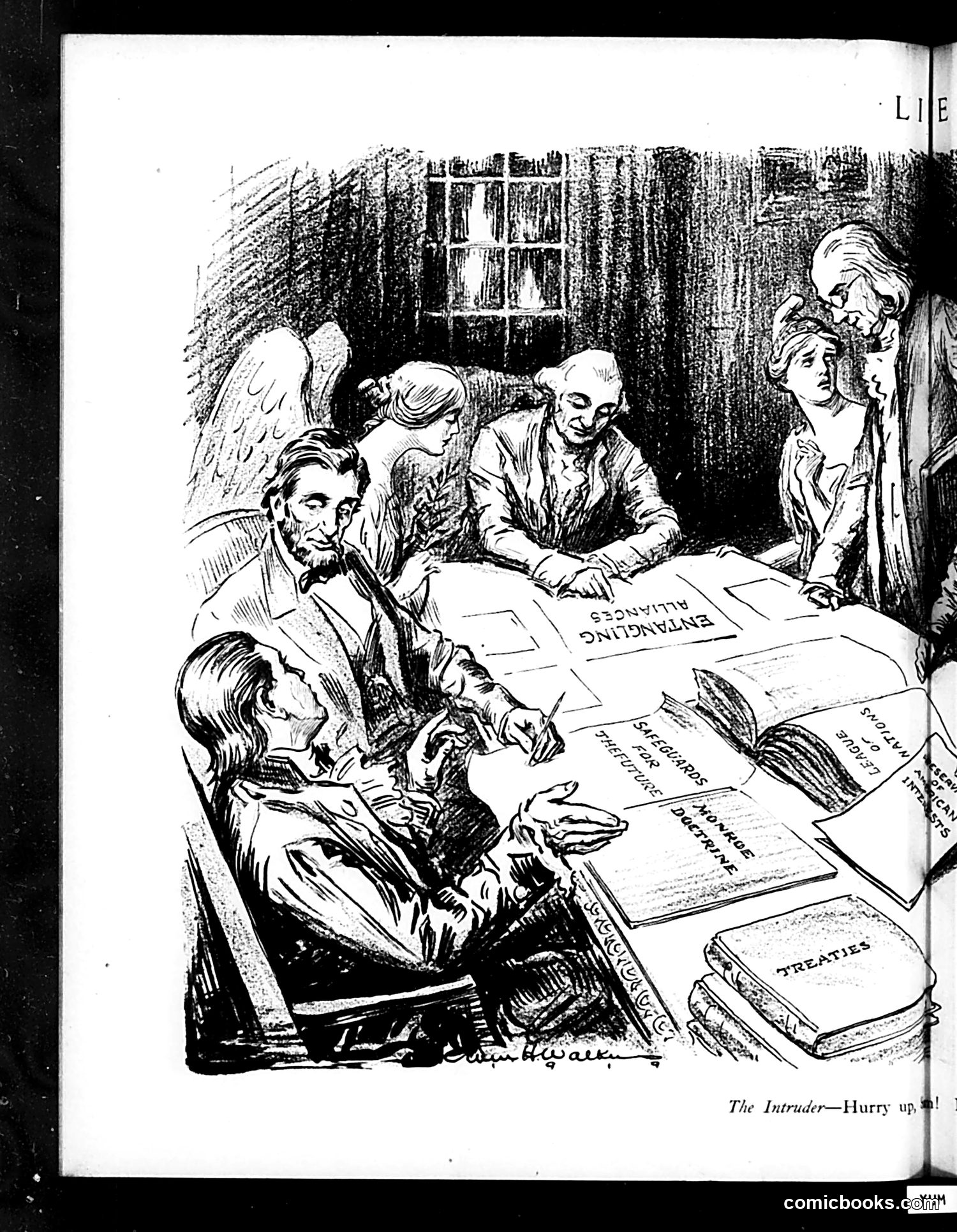
This cartoon depicts an angel interrupting a group of men examining documents at a table. The visible text on papers includes words like "TREATIES" and what appears to be official diplomatic documents. The satire appears to criticize diplomatic or political negotiations, with the angel serving as a moral or spiritual reminder—suggesting these officials are conducting business that lacks ethical consideration. The angel's urgent command "Hurry up!" implies time pressure or that conscience/morality is being rushed or ignored in favor of completing deals. Without specific dates or identified figures visible, the exact political context remains unclear, though the cartoon likely references early 20th-century treaty negotiations or diplomatic proceedings that Life's editors considered ethically questionable. The "intruder" (the angel) represents an unwelcome moral perspective interrupting practical political business.
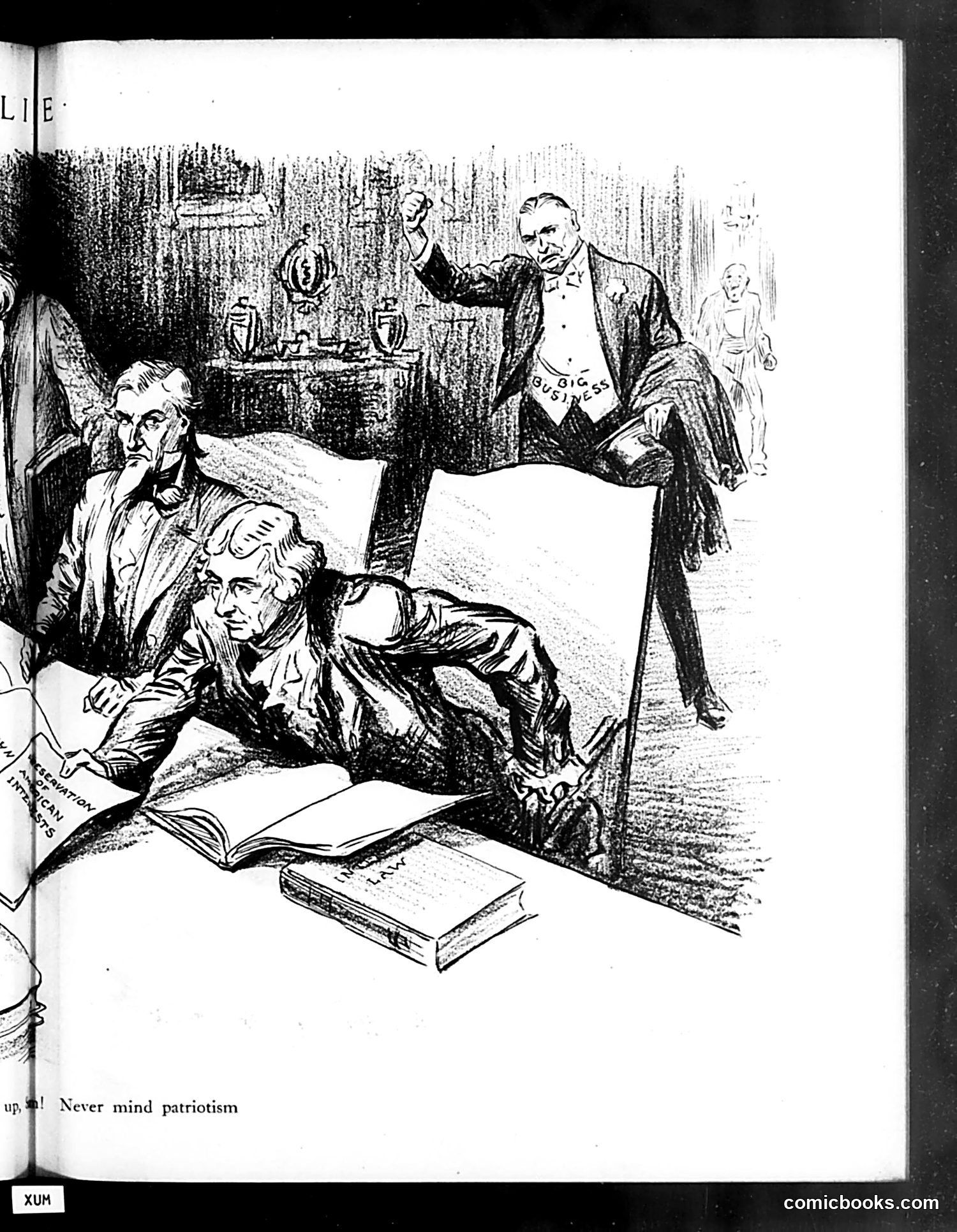
This Life magazine cartoon depicts a bedroom scene with satirical commentary on patriotism and military service. A well-dressed man (appearing to be a wealthy or upper-class figure) reclines on a bed while addressing two other men, one seated and one standing. Papers and books are scattered on the floor. The caption reads: "Never mind patriotism"—suggesting the speaker is dismissing patriotic duty or military obligation. The contrast between the reclining figure's comfort and apparent refusal of service, set against formal furnishings, indicates satire of wealthy individuals avoiding military responsibility during what appears to be a wartime period. The cartoon critiques class-based exemptions from military service, mocking those who prioritized personal comfort over national duty. The specific historical context—likely relating to WWI or WWII era draft policies—remains unclear from the image alone.
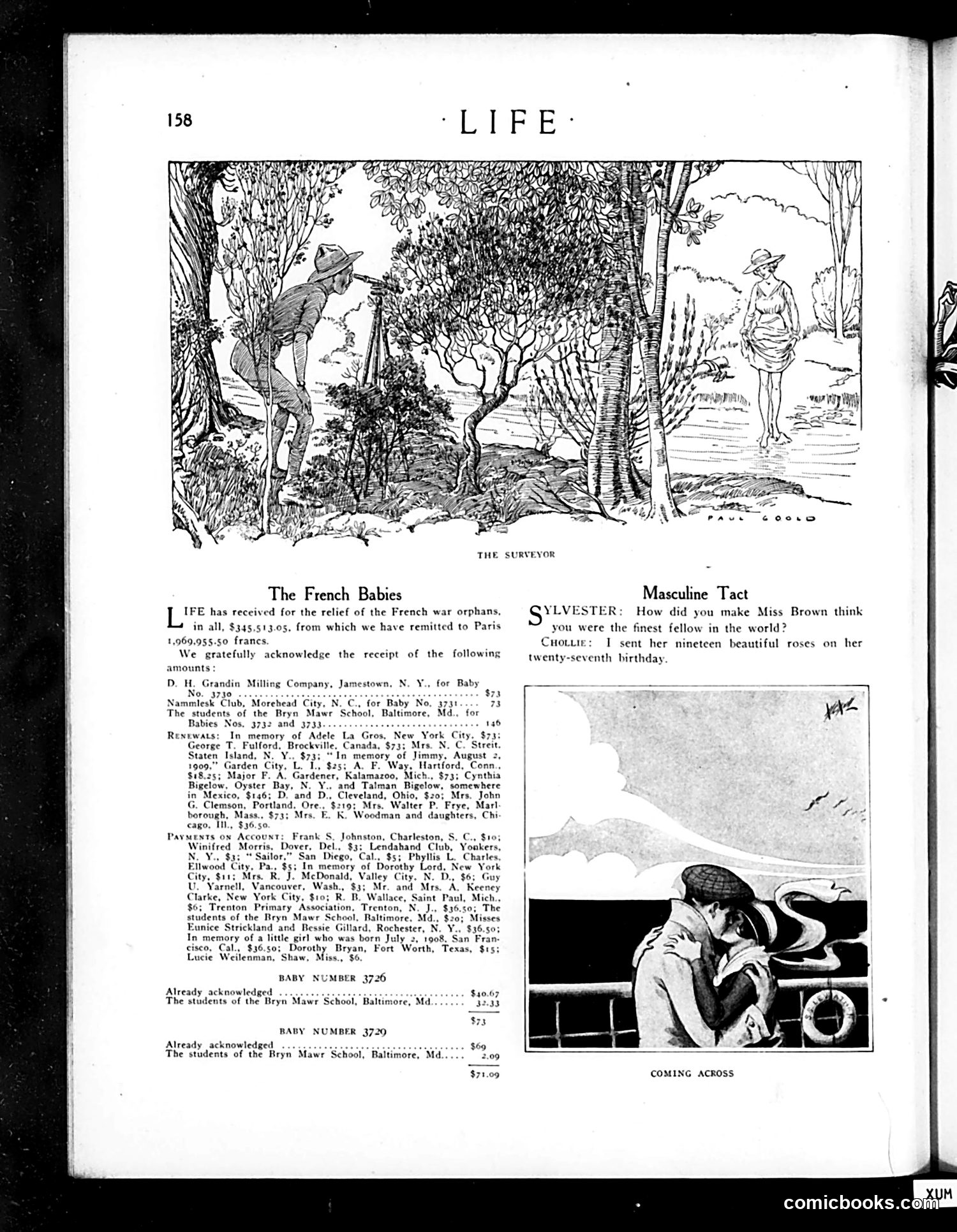
**"The French Babies"** section documents Life magazine's fundraising campaign for French war orphans (likely WWI-related). It lists donor names and amounts contributed, showing how Americans supported European relief efforts. The total raised was substantial ($345,513.05), with funds remitted to Paris. This reflects early 20th-century philanthropic culture and American engagement with European humanitarian crises. **"The Surveyor"** illustration depicts a man in outdoor clothing surveying land near a river, while a woman approaches. The image's connection to the text below is unclear from the page. **"Masculine Tact"** is a brief humorous anecdote about a man (Sylvester) complimenting a woman (Miss Brown) by sending nineteen roses on her twenty-seventh birthday—a joke about flattery through romantic gestures. "Tact" here means strategic charm or manipulation. The page primarily documents charitable work rather than political satire.
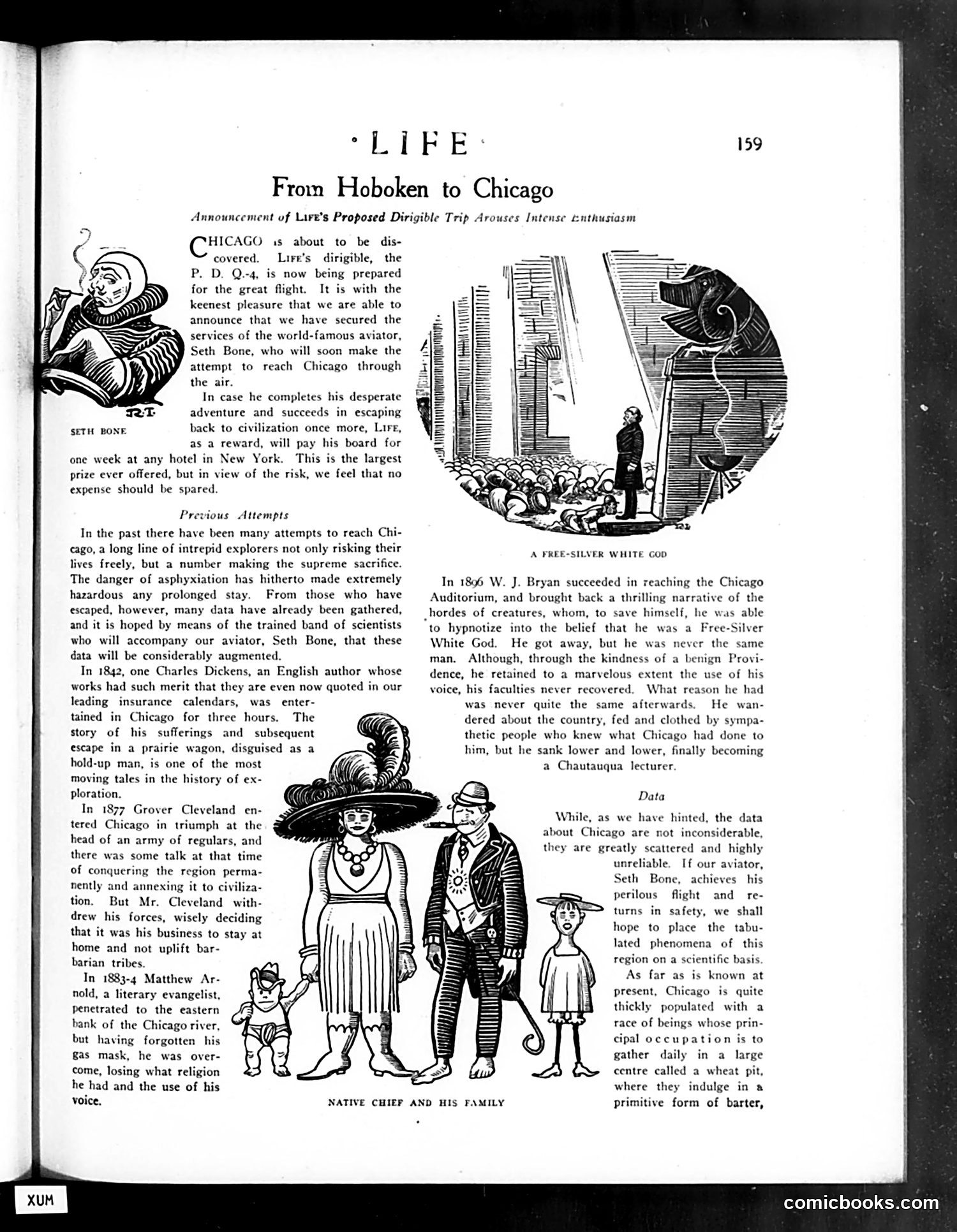
This *Life* magazine piece satirizes Chicago as a remote, dangerous frontier requiring "exploration" like Africa or the Arctic. The joke treats the city as uncivilized and hostile to distinguished visitors. The cartoons mock famous figures who attempted Chicago visits: **Charles Dickens** (1842), who supposedly fled in a prairie wagon; **Grover Cleveland** (1877), who "wisely" retreated rather than "civilize" it; and **Matthew Arnold** (1883-4), a literary critic who allegedly lost his sanity there. The sharpest jab targets **W.J. Bryan** (1896), the populist presidential candidate. The illustration labels him a "Free-Silver White God"—mocking his free-silver advocacy and suggesting Chicago residents were so unsophisticated they'd worship him. The text claims he "hypnotized" them, then deteriorated into a Chautauqua lecturer. The "Native Chief and His Family" illustration presents Chicagoans as primitive inhabitants. The final section describes them as a backward race engaged in primitive bartering at "the wheat pit." The satire reflects coastal intellectual condescension toward the Midwest and middle America.
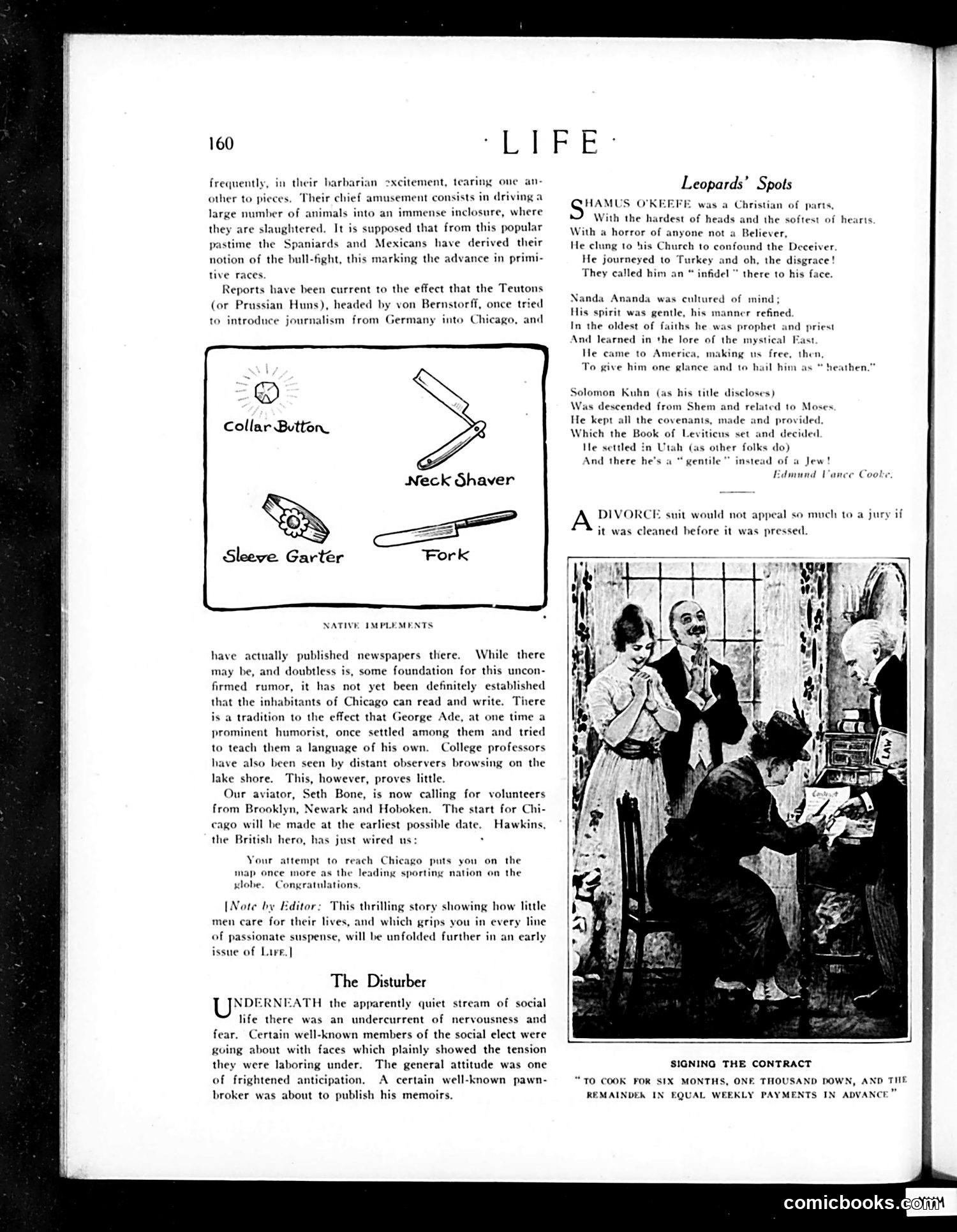
This page contains satirical content typical of early 20th-century Life magazine: **"Native Implements" diagram**: A humorous illustration labeling common items (collar button, neck shaver, sleeve garter, fork) as "native implements," mocking Chicago residents as primitive or uncivilized—a common theme of East Coast urban satire toward the Midwest. **"Leopards' Spots" poem**: Appears to satirize religious conversion and identity. It describes "Siamus O'Keeffe," a Christian convert, journeying to Turkey as a missionary, and "Solomon Kuhn," a Jewish man who settles in Utah where he becomes ironically labeled a "gentile" rather than remaining identified with his heritage—suggesting the absurdity of identity shifts. **"The Disturber"**: Brief satirical piece about a pawnbroker threatening to publish memoirs, creating social anxiety among the wealthy elite—poking fun at class anxiety. **"Signing the Contract" illustration**: Shows a domestic service arrangement, likely mocking employment contracts or servant relationships of the era. The overall tone is satirical commentary on American social pretensions, regional differences, and class anxieties.
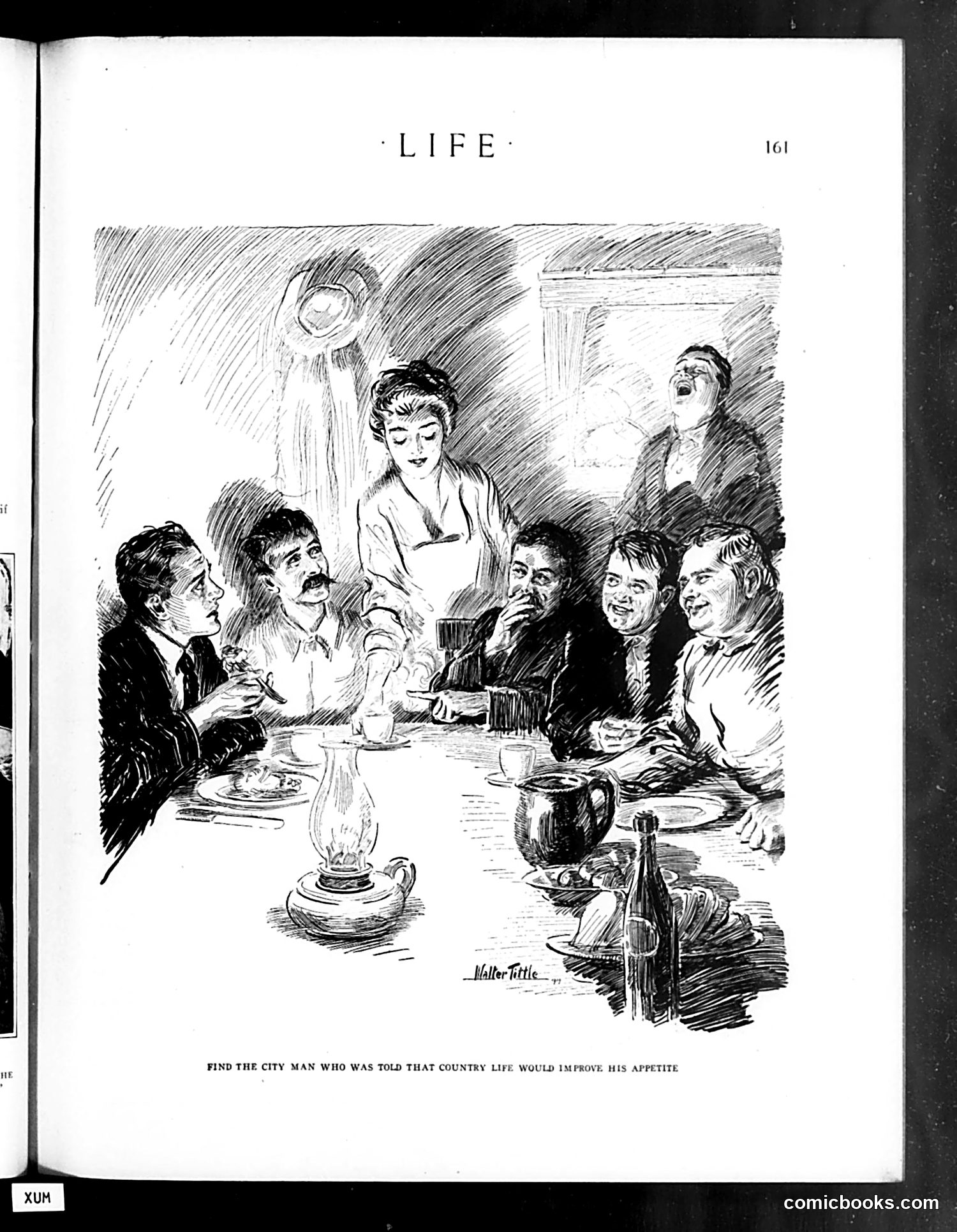
This single-panel cartoon satirizes urban-rural stereotypes. A well-dressed woman serves dinner to six men seated around a table lit by an oil lamp, suggesting a rural setting. The caption reads: "FIND THE CITY MAN WHO WAS TOLD THAT COUNTRY LIFE WOULD IMPROVE HIS APPETITE." The joke targets a common belief that fresh air and farm living would enhance one's appetite. The cartoon suggests the opposite—the city man (unclear which figure) appears unimpressed or uncomfortable with the rustic dining experience, implying that country life fails to deliver the promised benefits. The satire mocks both the myth of rural virtue and possibly the pretension of city dwellers seeking improvement through pastoral living, a theme common in early 20th-century American humor.
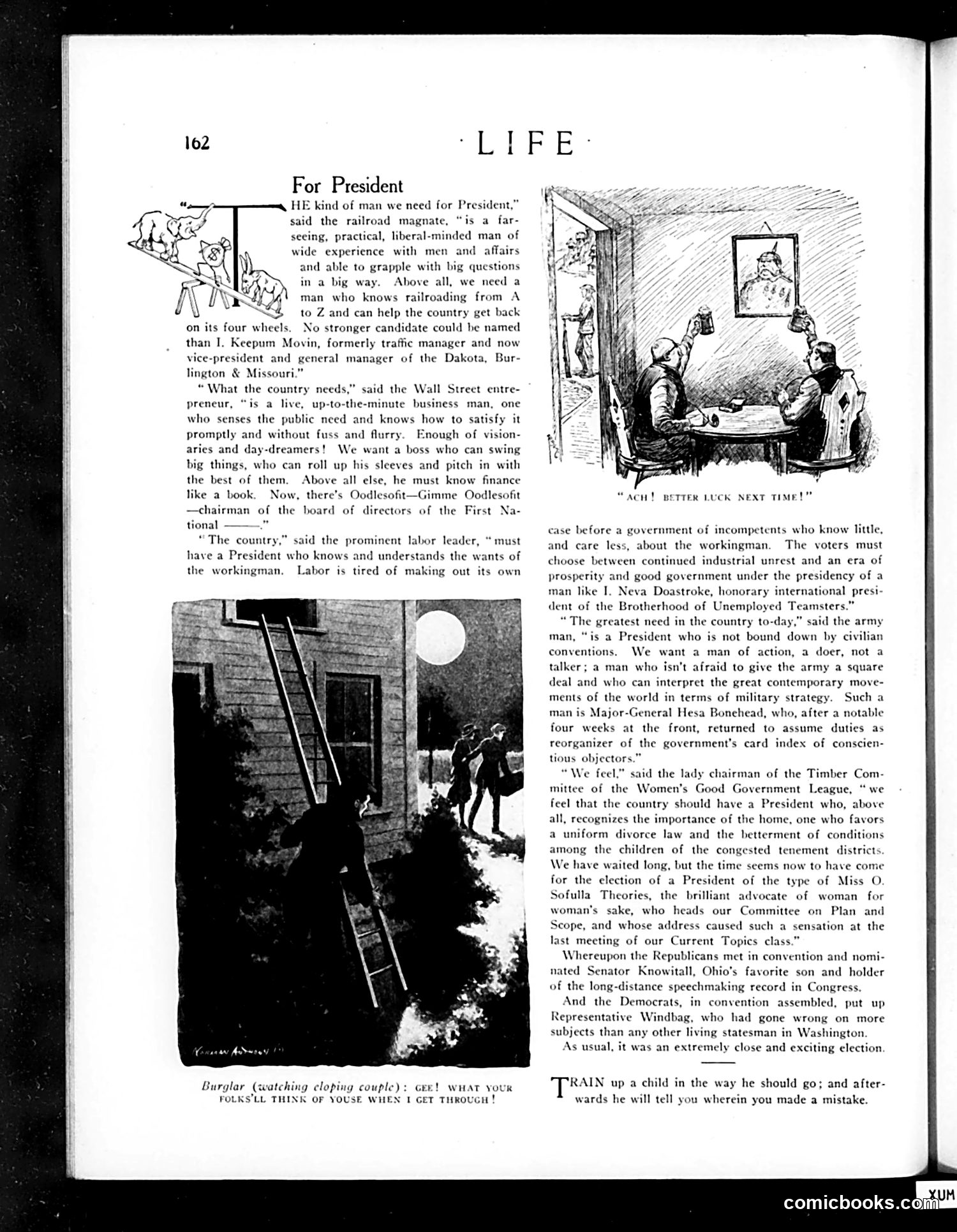
This page satirizes the 1920 presidential election through competing interest groups each nominating their ideal candidate—all versions of themselves. The satire works by having a **railroad magnate** (Keepum Movin), **Wall Street financier** (Gimme Oodlesofit), **labor leader** (Neva Doastroke), **army officer** (Hesa Bonehead), and **women's activist** (Miss O. Sofulla Theories) each describe what the country needs in a president, then immediately propose themselves as the solution. The joke: each group frames self-serving interests as national necessity. The railroad man wants someone who understands "railroading"; the financier wants a "business man"; labor wants someone pro-worker; the military man wants someone unconstrained by civilian oversight. The final paragraphs reveal the punchline—Republicans and Democrats nominate equally vapid candidates: "Senator Knowitall" and "Representative Windbag," making an "extremely close and exciting election" between two incompetents. The cartoon mocks how special interests rationalize their own advancement as patriotic necessity.
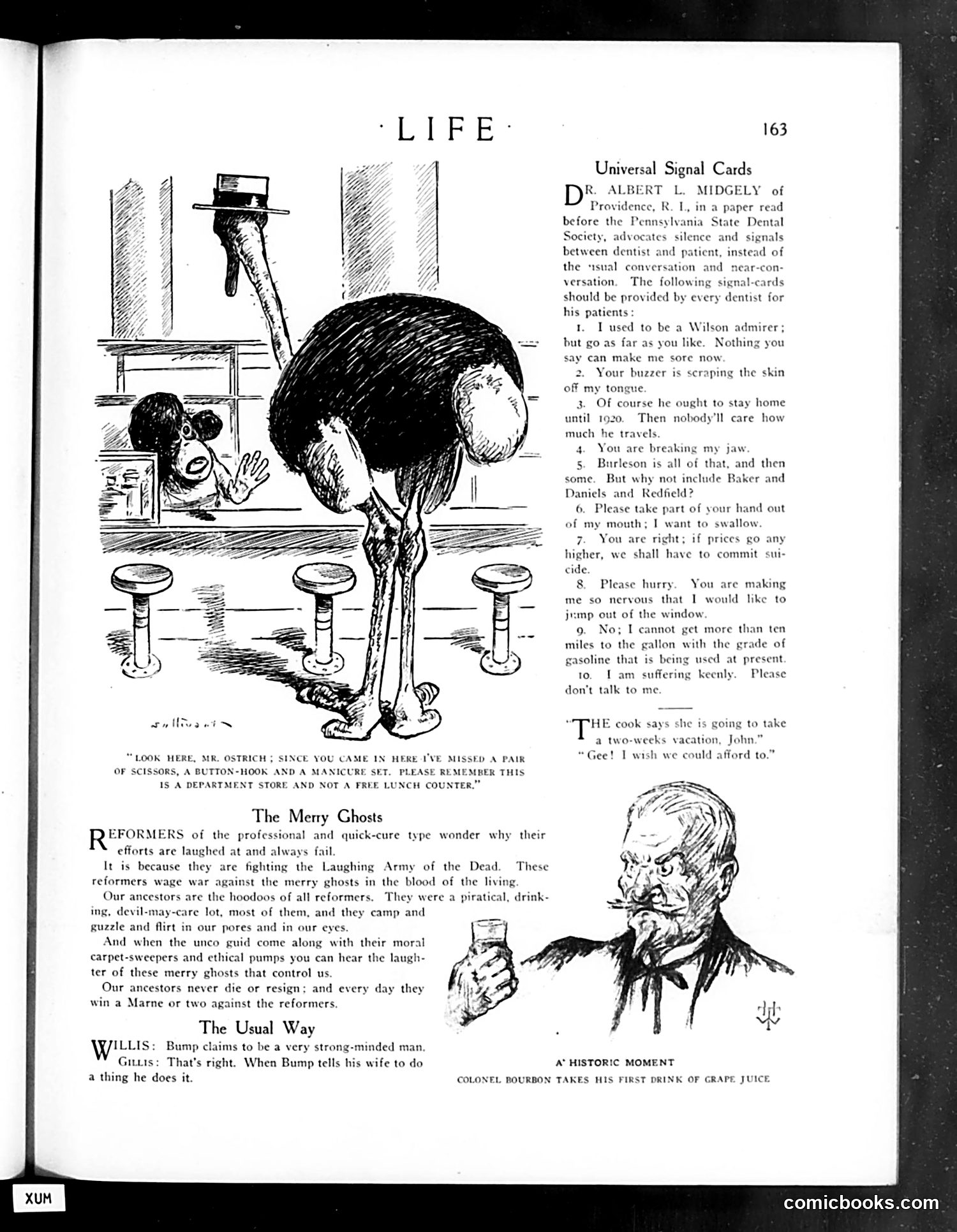
This page contains multiple satirical pieces from Life magazine (likely WWI era, based on references to 1920, Burleson, Baker, Daniels, and Redfield—all Wilson administration figures). **Top cartoon**: Shows an ostrich dentist being scolded by a patient for stealing items—scissors, button-hook, manicure set—turning the dentist's office into a "free lunch counter." The joke plays on the "ostrich" stereotype (head-in-sand denial) and criticizes petty theft disguised as professional services. **"Universal Signal Cards"**: A satire on a real dental proposal to use silent signals instead of conversation. The "cards" mock both wartime anxieties (Wilson admirers, Burleson's postal policies) and domestic complaints (high prices, rationing, servant problems), suggesting patients would need pre-printed excuses to avoid talking politics or economics with dentists. **Lower section**: "The Merry Ghosts" satirizes moral reformers as powerless against human nature's ancestral vices. The final joke about "Colonel Bourbon" taking grape juice likely mocks Prohibition advocates or temperance hypocrisy.
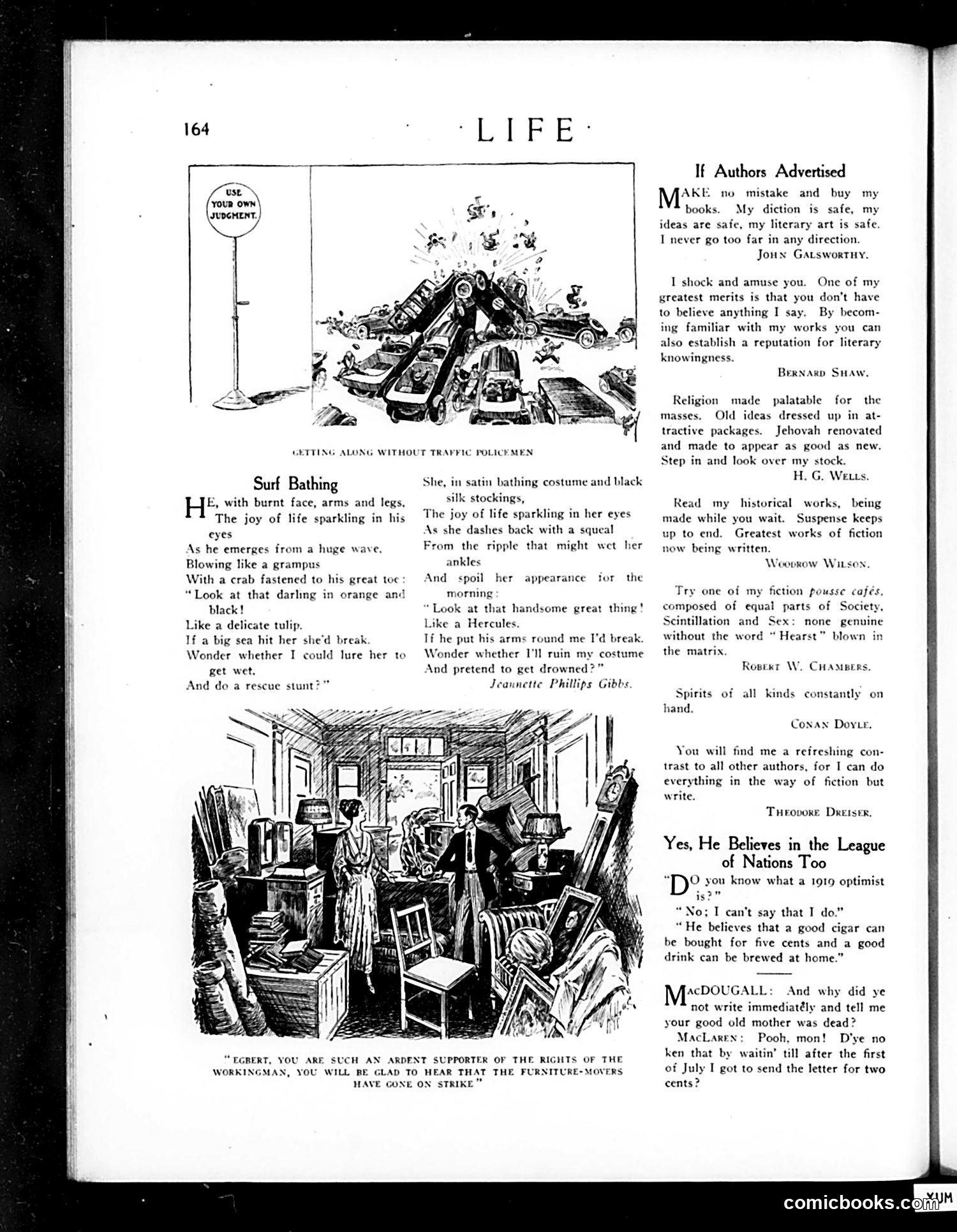
This page contains two distinct satirical pieces: **"Surf Bathing"** — A humorous poem contrasting male and female beachgoers. A muscular man emerges from the ocean fantasizing about rescuing an attractive woman, while she simultaneously fantasizes about him rescuing her—yet both are preoccupied with vanity (he notices a crab on his toe; she worries about ruining her costume). The satire mocks romantic delusion and gender stereotypes of the era. **"If Authors Advertised"** — Mock self-advertisements from famous writers (Shaw, Wells, Wilson, Chambers, Doyle, Dreiser) where each satirizes their own literary reputation. For example, Galsworthy claims absolute safety and never pushing boundaries; Shaw boasts of shocking readers; Wells packages old religious ideas as new. This mocks authorial pretension and how writers market themselves. The bottom cartoon about "League of Nations" jokes about post-WWI optimism being unrealistic, and a final Scottish dialect joke about postal rate changes (July 1st postal increase).
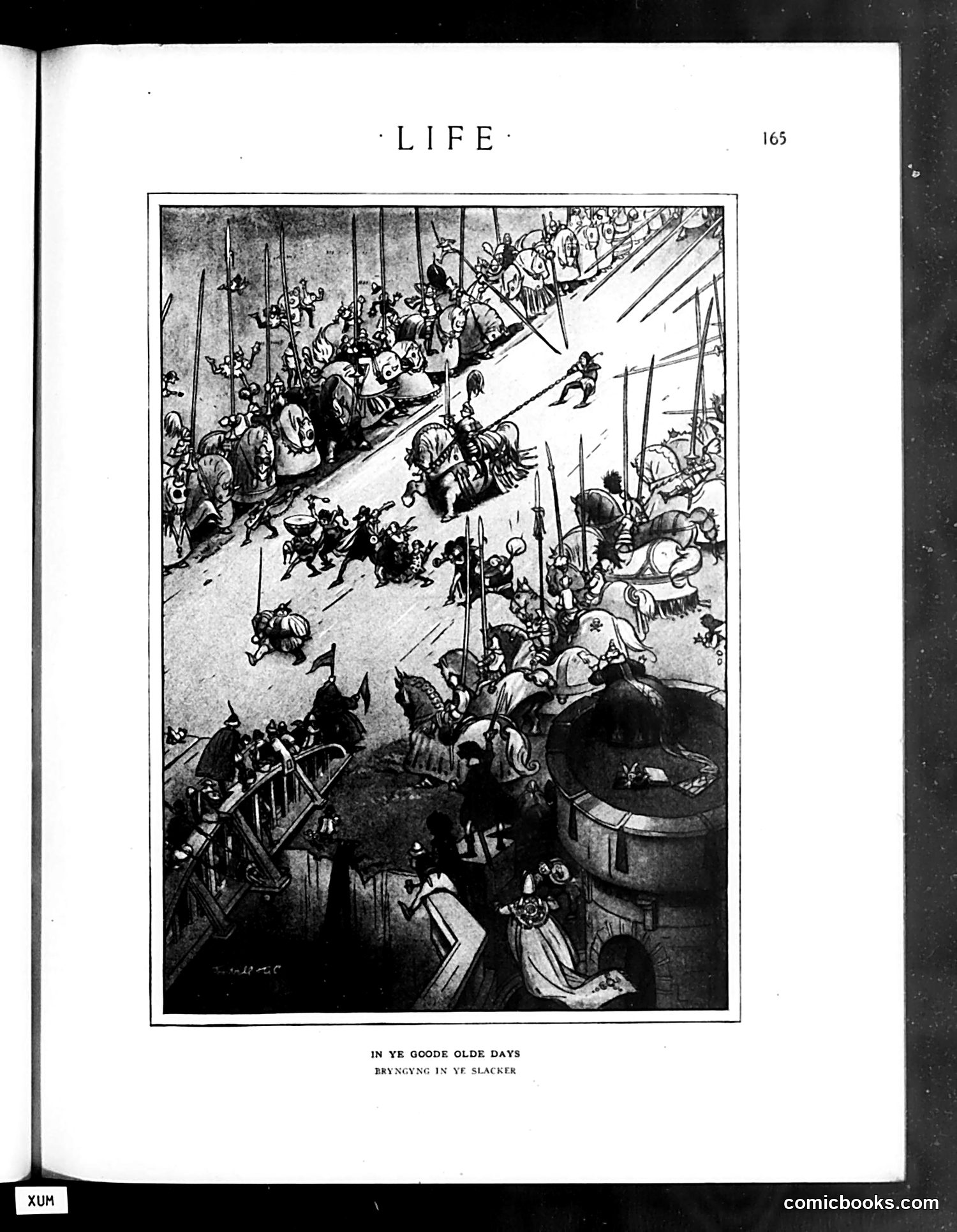
This illustration depicts a medieval or historical scene titled "In Ye Goode Olde Days: Bringing in Ye Slacker." The satirical point appears to be a commentary on "slackers"—likely referring to men who avoided military service or shirked civic duties, a concern during World War I era when Life magazine was active. The scene shows armed soldiers or authorities forcibly bringing a reluctant figure (the "slacker") before what appears to be a ruler or judge, while crowds watch from fortified positions. The archaic language ("Ye Goode Olde Days") suggests this is using historical precedent to shame contemporary shirkers—implying that in the past, such dereliction would face swift, public consequences. The satire condemns draft-dodgers by humorously suggesting they'd face harsher penalties in less civilized times.
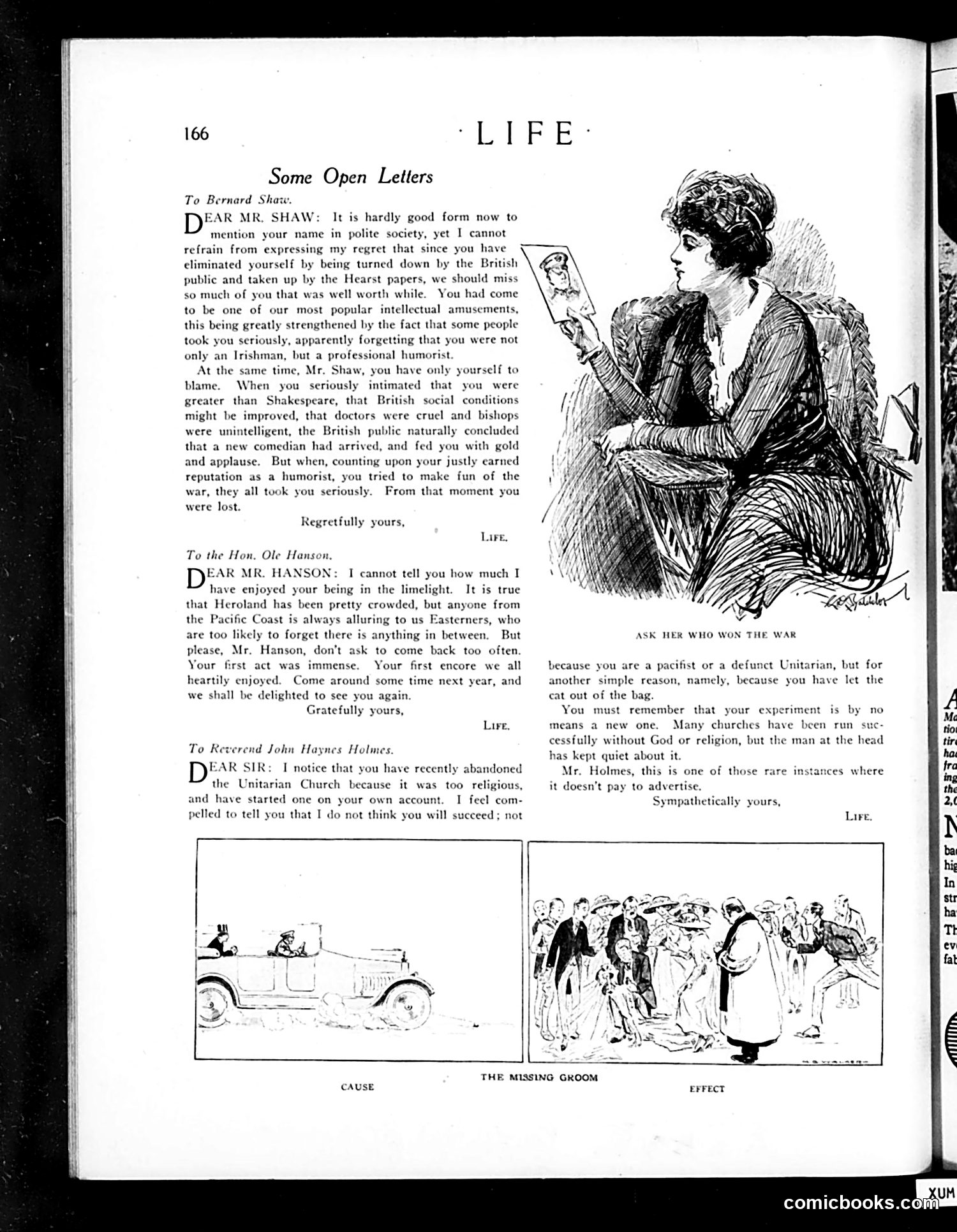
This page contains three mock "open letters" from Life's editor satirizing prominent figures of the era: **Bernard Shaw**: The letter chides the Irish playwright for claiming superiority to Shakespeare and criticizing British social institutions. The satire suggests Shaw was tolerated as an entertainer until he made serious anti-war statements—then the public stopped finding him amusing and abandoned him. **Ole Hanson**: A Pacific Coast politician praised for his entertainment value but cautioned not to overstay his welcome. **Reverend John Haynes Holmes**: Criticized for publicly abandoning the Unitarian Church to start his own congregation based on secular principles. Life mocks that other churches have operated without God quietly—Holmes's mistake was advertising it openly. The bottom cartoons—"The Missing Groom" (Cause and Effect)—show a car speeding away causing a wedding disruption, likely referencing wartime bride-and-groom separations. The overall tone suggests Life was skeptical of public figures who abandoned convention or spoke radical truths aloud.
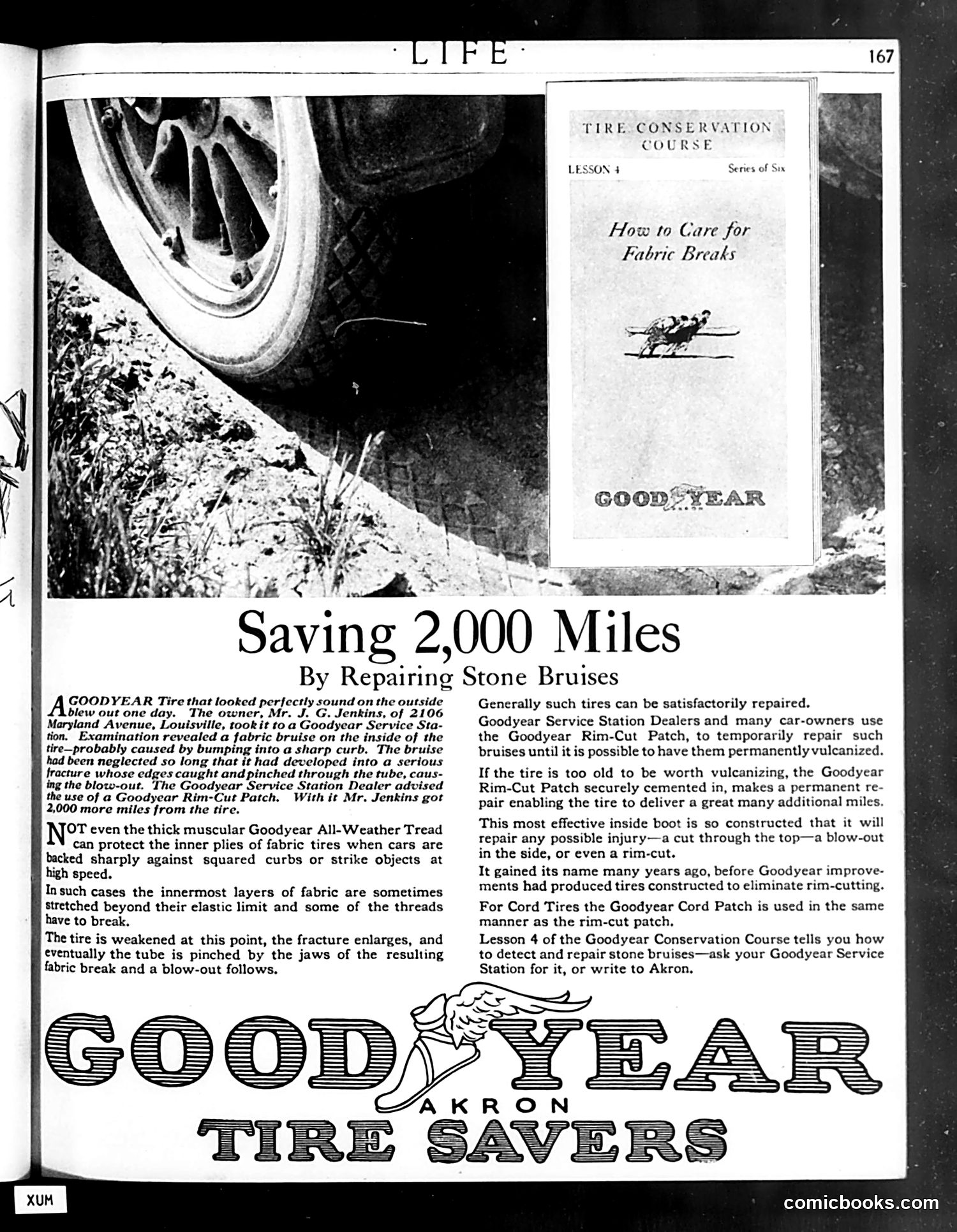
This is a **Goodyear tire advertisement**, not political satire or a cartoon. It appears in *Life* magazine's advertising section (page 167). The content is a practical instructional piece disguised as consumer education—"Lesson 4" of a "Tire Conservation Course." It describes how a Louisville man's Goodyear tire developed an internal fabric bruise from hitting a curb, which eventually caused a blowout. The solution: Goodyear's Rim-Cut Patch repair kit, which allegedly extended the tire's life by 2,000 additional miles. The "satire" here is subtle marketing: framing tire damage as preventable through Goodyear products, while emphasizing durability and value. The accompanying tire photograph and conservation-course framing lend credibility to what is essentially a sales pitch targeting cost-conscious Depression-era drivers concerned about tire longevity and repair costs.
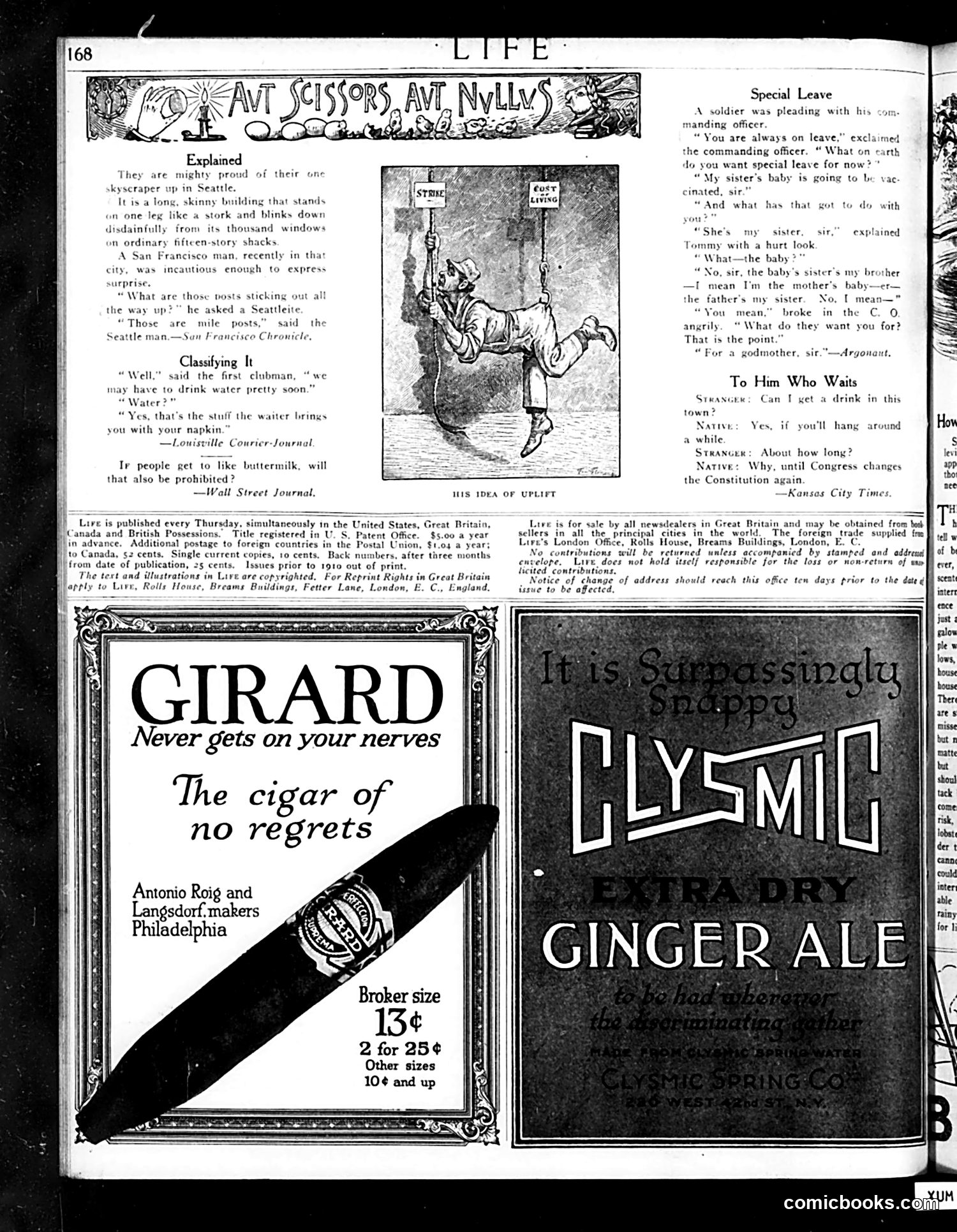
This page contains **multiple brief satirical jokes** rather than a single unified cartoon: 1. **"At Scissors, At Nullus"**: Satirizes Seattle's famous Smith Tower, a tall, thin skyscraper locals were proud of. The joke mocks the city's defensiveness about its architectural achievement—a San Francisco visitor's surprise at the building prompts locals to boast about it. 2. **"Special Leave"**: A soldier seeks leave because his sister's baby will be vaccinated. The joke plays on the soldier's confused family relationships (claiming the baby is his "mother's baby" and "father's sister"), absurdly justifying his need for time off. 3. **"Classifying It"**: Two club members joke about prohibition—one warns they'll "have to drink water pretty soon," the other quips that water is what waiters bring "with your napkin" (implying it's just a condiment, not a beverage). 4. **"To Him Who Waits"**: A stranger asks when he can get a drink; locals say he must "wait until Congress changes the Constitution again"—referencing Prohibition's unpopularity and hope for repeal. The page is primarily **advertising** (Girard cigars, Elysinc Ginger Ale).
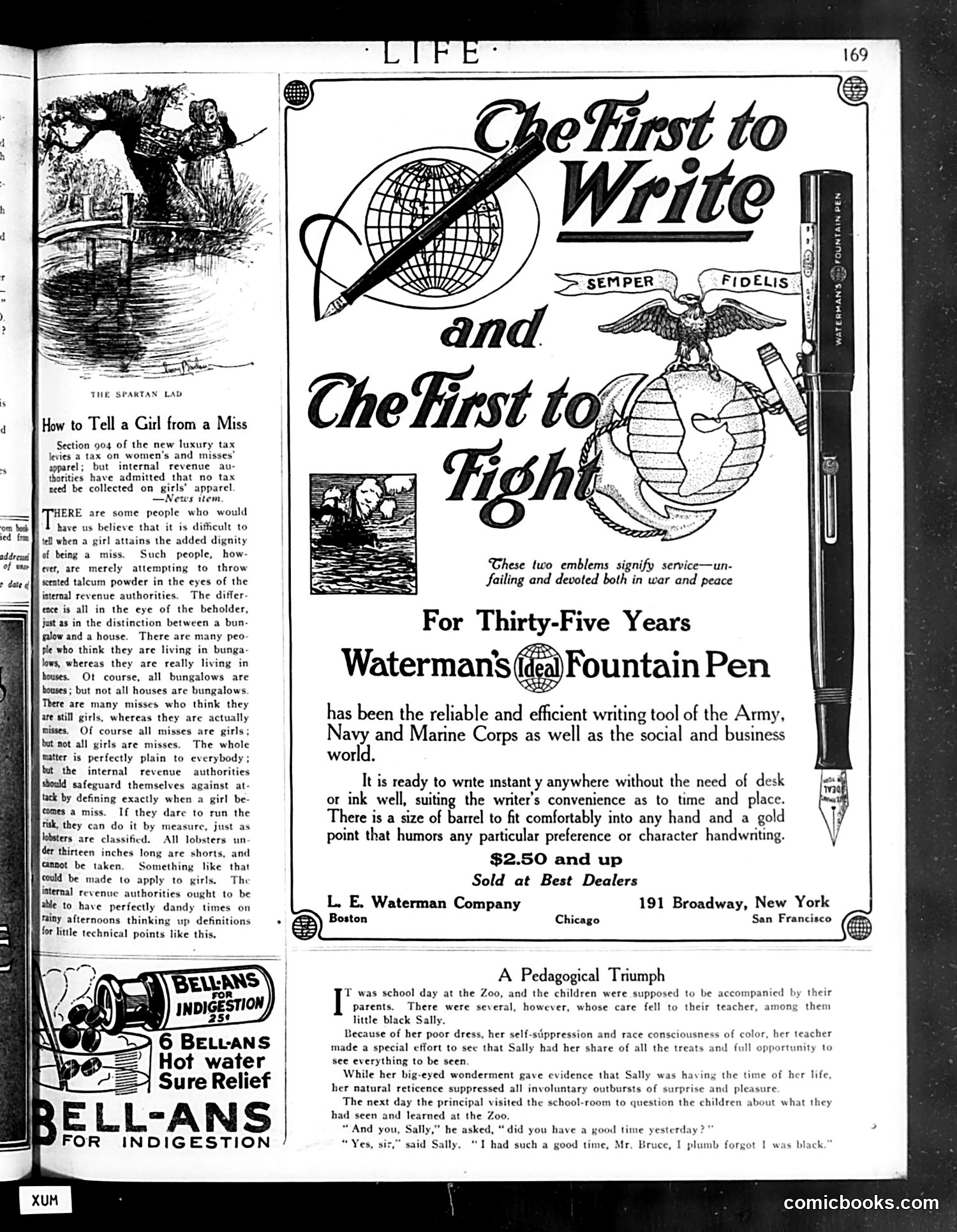
This satirical article mocks the new luxury tax distinction between "women's" and "misses'" apparel. The government was attempting to tax adult women's clothing differently from young girls' clothing, but revenue authorities admitted no tax could be collected on "girls' apparel." The piece absurdly compares the girl-to-miss distinction to the difference between a bungalow and a house—logically pedantic categories that don't actually map to reality. The satire suggests that defining when a girl becomes a "miss" (an unmarried woman) is both impossible and ridiculous, making the tax unenforceable without arbitrary, laughable measurements (comparing girls to lobster classifications). The implicit critique: the government created a tax with an unworkable definition, revealing bureaucratic incompetence. --- **"A Pedagogical Triumph"**: This concluding anecdote presents a teacher taking special care with an underprivileged Black student at a zoo. The title's intended irony is unclear—whether celebrating teacher kindness or satirizing the student's closing statement ("I plumb forgot I was black"), which suggests internalized racial consciousness.
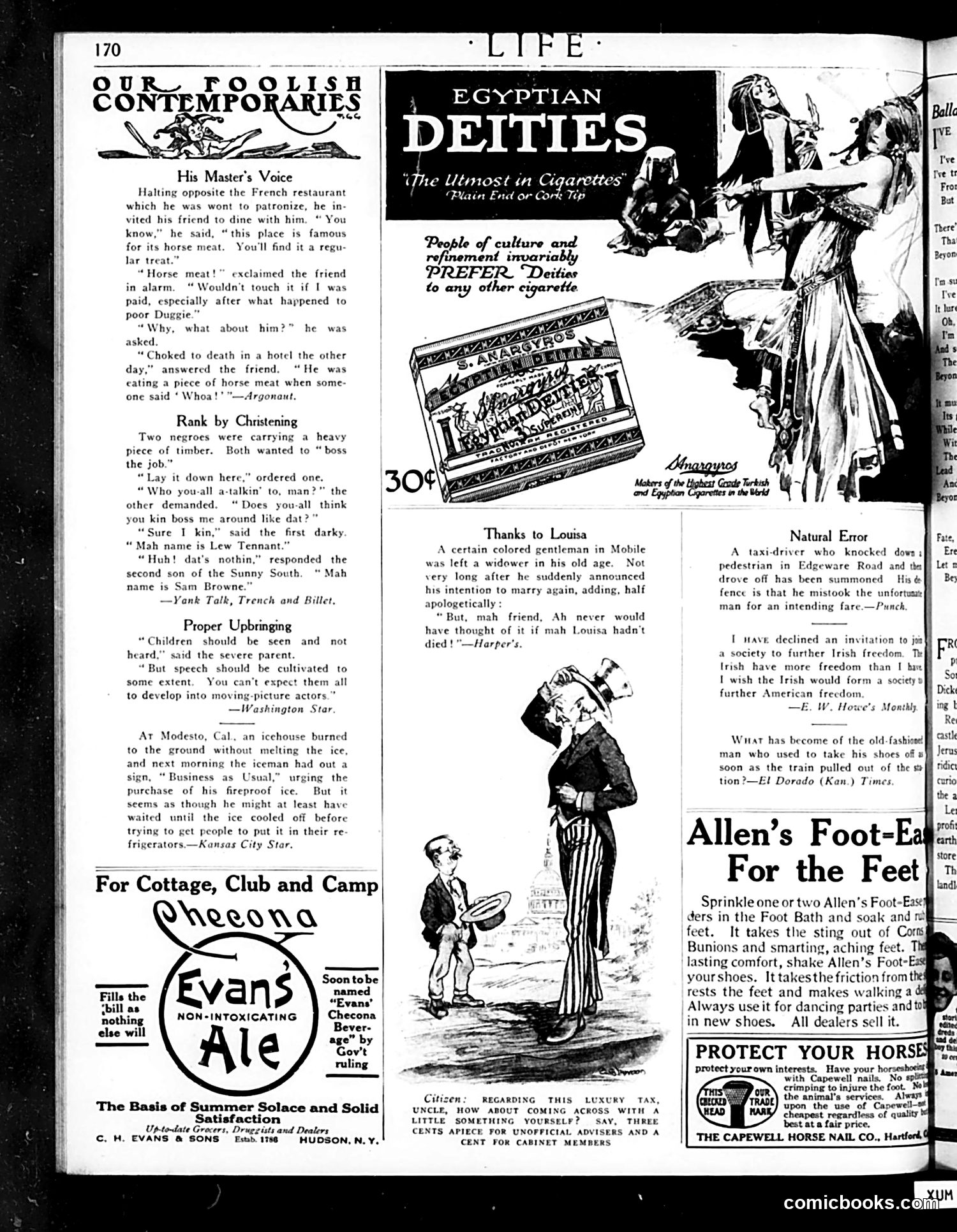
This page from *Life* magazine contains several short humorous anecdotes and advertisements typical of early 20th-century American humor. **Key Content:** The cartoons and jokes mock various social situations: a Frenchman's enthusiasm for horse meat (dark humor about an accidental death), racial stereotypes in a dialogue between two Black workers arguing over authority, and a widower's remarriage announcement. These reflect period attitudes—some offensive by modern standards. **Notable Advertisement:** The "Egyptian Deities" cigarette ad features an orientalist design common to the era, appealing to notions of exotic luxury and refinement. The tagline claims superiority over competitors. **Other Ads:** "Evans' Ale" and "Allen's Foot-Ease" represent typical commercial products, while the "Capewell Horse Nail" ad reflects the still-significant role of horses in transportation and commerce. **Context:** The brief jokes often involve wordplay and situation comedy rather than political satire. The *Life* magazine format mixed humor, advertisements, and social commentary for educated middle-class readers.
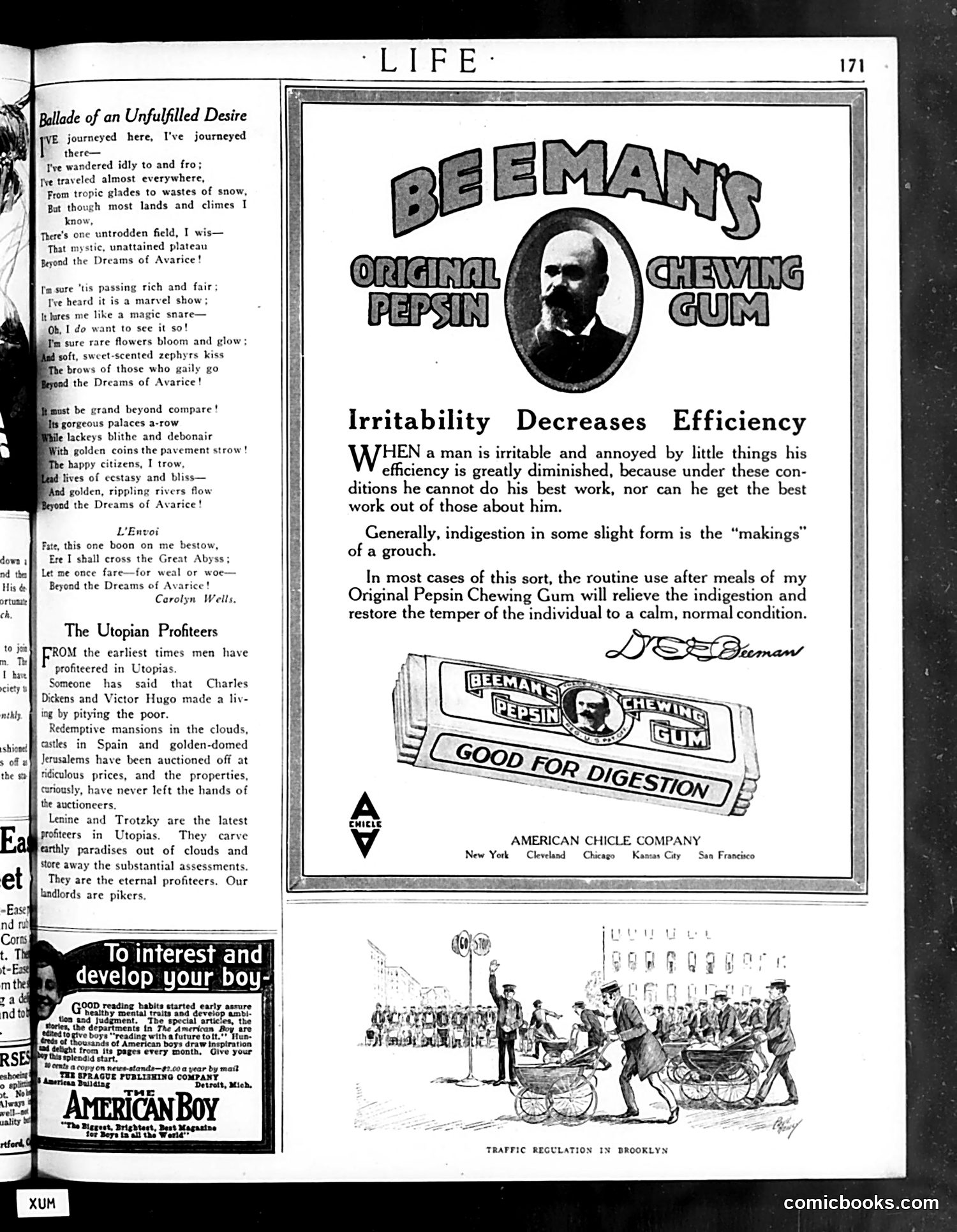
This page contains primarily **advertising and poetry**, with one small cartoon. The main advertisement is **Beeman's Original Pepsin Chewing Gum**, which claims to cure irritability by relieving indigestion—a common early 20th-century patent medicine pitch linking digestion to temperament and workplace efficiency. The poetry includes "Ballade of an Unfulfilled Desire" by Carolyn Wells, a whimsical piece about longing for an unattainable paradise "Beyond the Dreams of Avarice." "The Utopian Profiteers" essay satirizes political figures who exploit idealistic visions: it references **Lenin and Trotsky** (Russian Revolution leaders) as modern examples of those who profit from utopian promises while delivering nothing, comparing them unfavorably even to Dickens and Hugo, who at least genuinely sympathized with the poor. The small cartoon at page bottom, "Traffic Regulation in Brooklyn," appears to be a humorous street scene but lacks sufficient detail to interpret specifically.
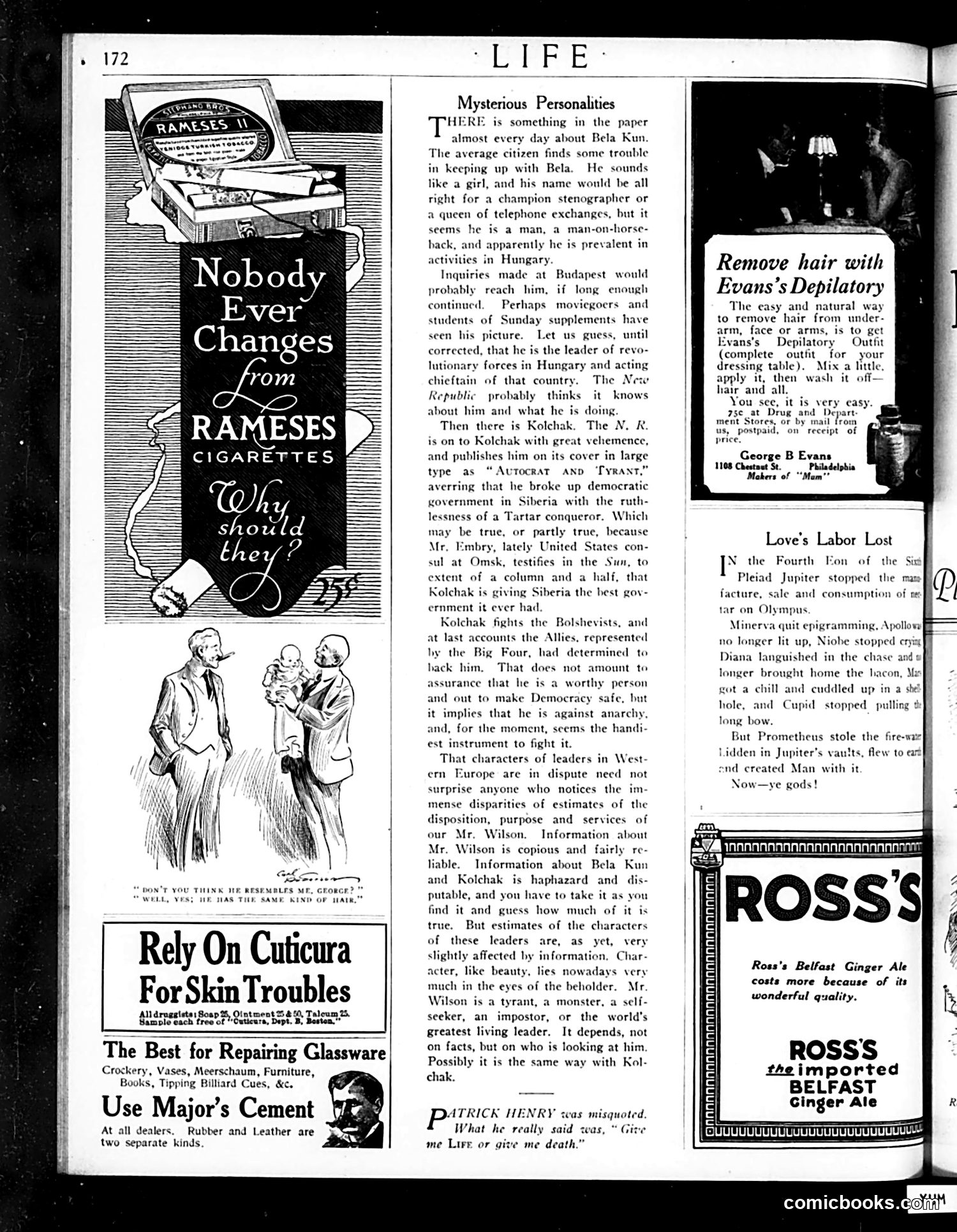
This page primarily contains **advertisements and satirical commentary on post-WWI political figures**, rather than a single cartoon. The main cartoon (bottom left) depicts two men examining a cigar box labeled "Rameses II," with one saying the face resembles the other—both having the same "kind of hair." This is a visual pun: the historical Egyptian pharaoh's image on the cigarette package humorously resembles an ordinary person. The substantial article "Mysterious Personalities" discusses **Béla Kun** (Hungarian communist revolutionary leader) and **Kolchak** (Russian anti-Bolshevik general), noting that Americans receive contradictory information about these figures. The author observes that character judgments of leaders depend less on facts than on the viewer's bias—comparing this to how Wilson is simultaneously praised and condemned depending on one's perspective. The page includes typical period advertisements (Cuticura, Major's Cement, Evans's Depilatory, Ross's Ginger Ale) alongside this political commentary, reflecting Life's format of mixing commerce with satire.
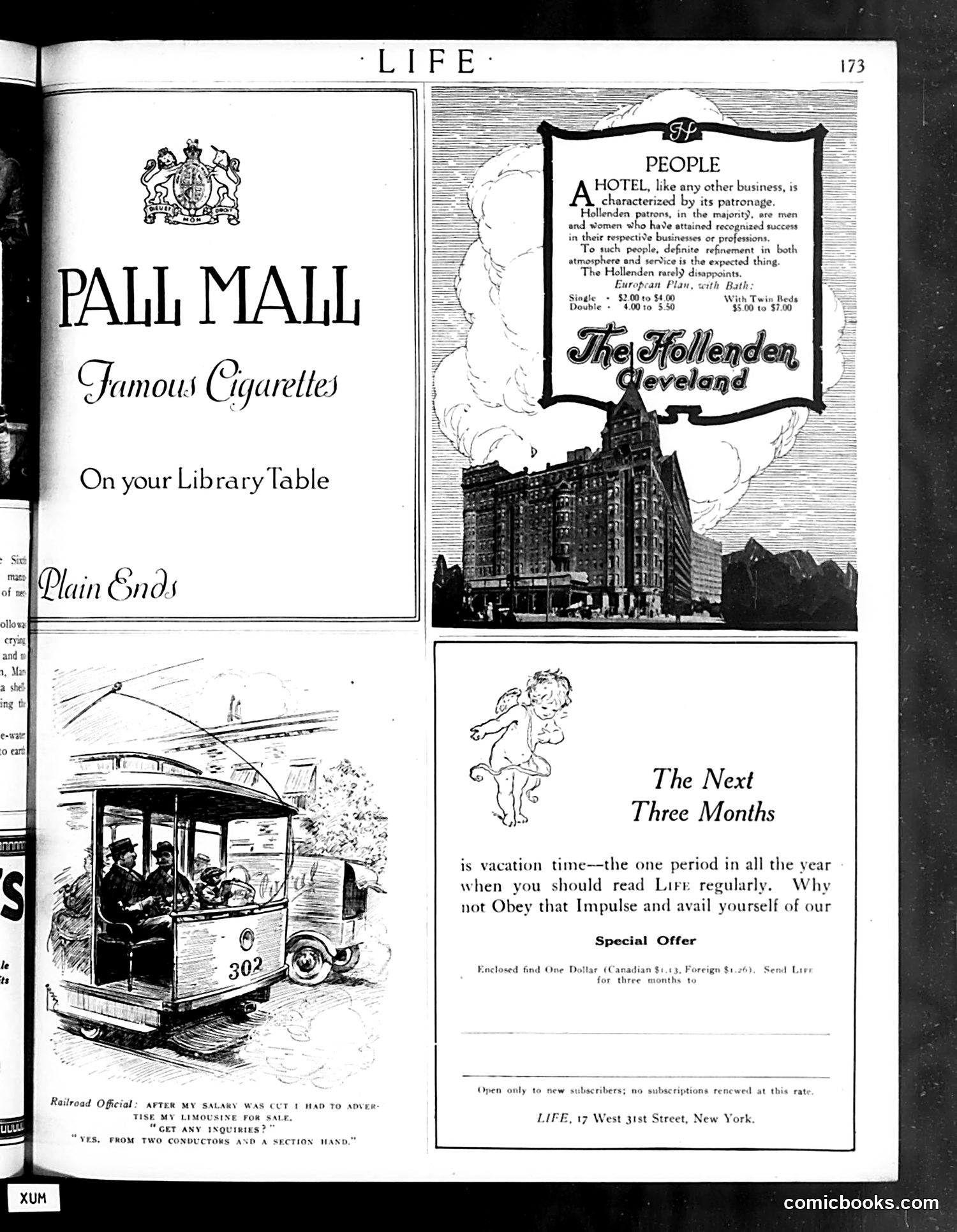
This page from *Life* magazine contains advertisements and one satirical cartoon. **The Main Cartoon (lower left):** Shows a railroad official in a limousine with conductor and section hand inquiring about selling it. The joke plays on economic hardship: after his salary was cut, he advertised his luxury car for sale—but only railroad workers (conductors and section hands) inquired, likely unable to afford it. The satire mocks the irony of a struggling executive still owning a limousine while needing to sell it, and the absurdity that only fellow working-class railroad employees showed interest. **The Advertisements:** Include Pall Mall cigarettes, *The Hollenden* hotel in Cleveland (marketing to successful businesspeople), and *Life* magazine's own subscription offer for three months at a special rate. The cartoon reflects Depression-era or post-recession economic anxiety about white-collar job losses and reduced circumstances.
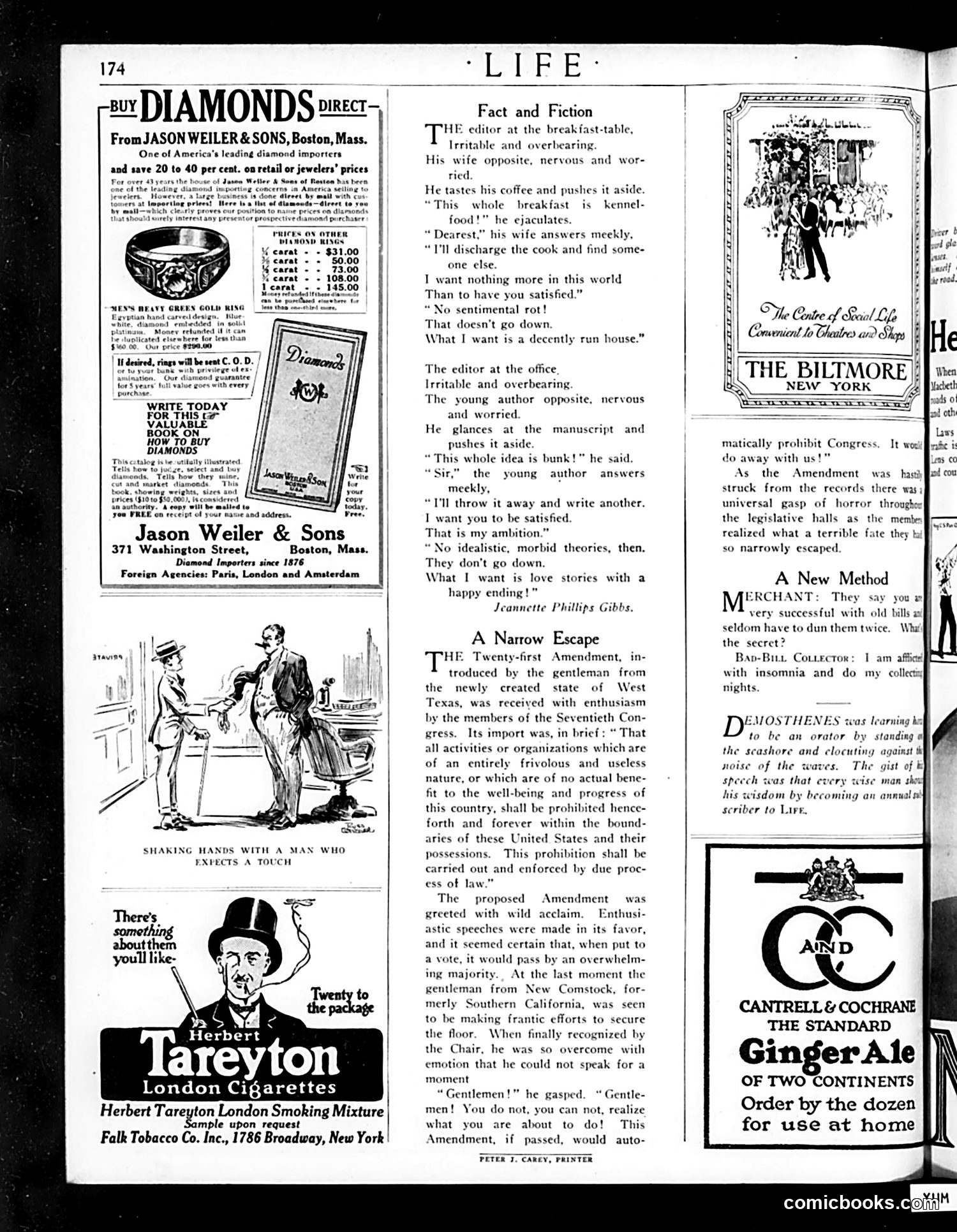
This page contains several unrelated items typical of early 20th-century Life magazine: **"Fact and Fiction"** presents a satirical parallel: an irritable newspaper editor tyrannizes his cook at home, then his young author at the office, demanding practical results over artistic merit. Both subordinates respond with meek compliance. The satire critiques authoritarian bosses who lack self-awareness—the editor fails to recognize his own unreasonable behavior mirrors across contexts. **"A Narrow Escape"** satirizes Congress itself through mock-legislative drama. A proposed amendment banning all "frivolous and useless" activities nearly passes until a congressman realizes it would prohibit Congress itself—"it would do away with us!" The humor attacks congressional self-importance and uselessness. The remaining content is advertising (diamonds, cigarettes, ginger ale) and filler pieces ("A New Method," "Demosthenes"). The cartoons use visual irony: the editor "shaking hands with a man who expects a touch" depicts the awkward moment when someone anticipates a loan request.
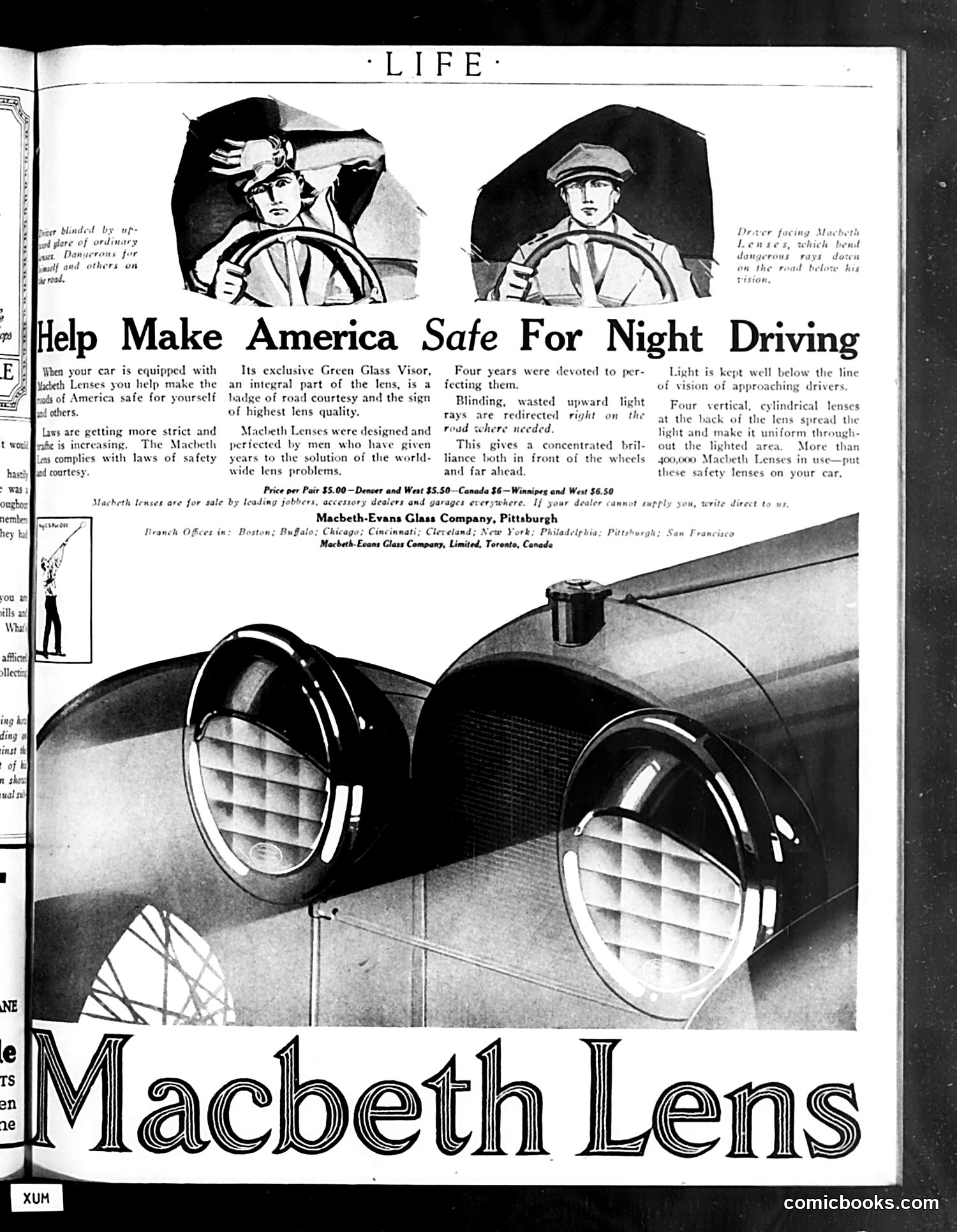
This is **not a cartoon or satire, but a straightforward advertisement** for automobile safety equipment from the Macbeth-Evans Glass Company. The page promotes "Macbeth Lenses"—special green-tinted glass headlight covers designed to improve nighttime driving safety. The two illustrated figures at top show drivers demonstrating correct vs. incorrect headlight positioning (one blinded by upward light rays, one facing safely ahead). The advertisement addresses a genuine public concern of the era: increasingly strict traffic laws and safety regulations requiring vehicles to avoid blinding oncoming drivers with high-beam glare. Macbeth Lenses redirected light downward while maintaining visibility, marketed as a solution making "America Safe For Night Driving." This reflects early automobile safety advocacy, when headlight technology and road etiquette were still developing concerns in American society.
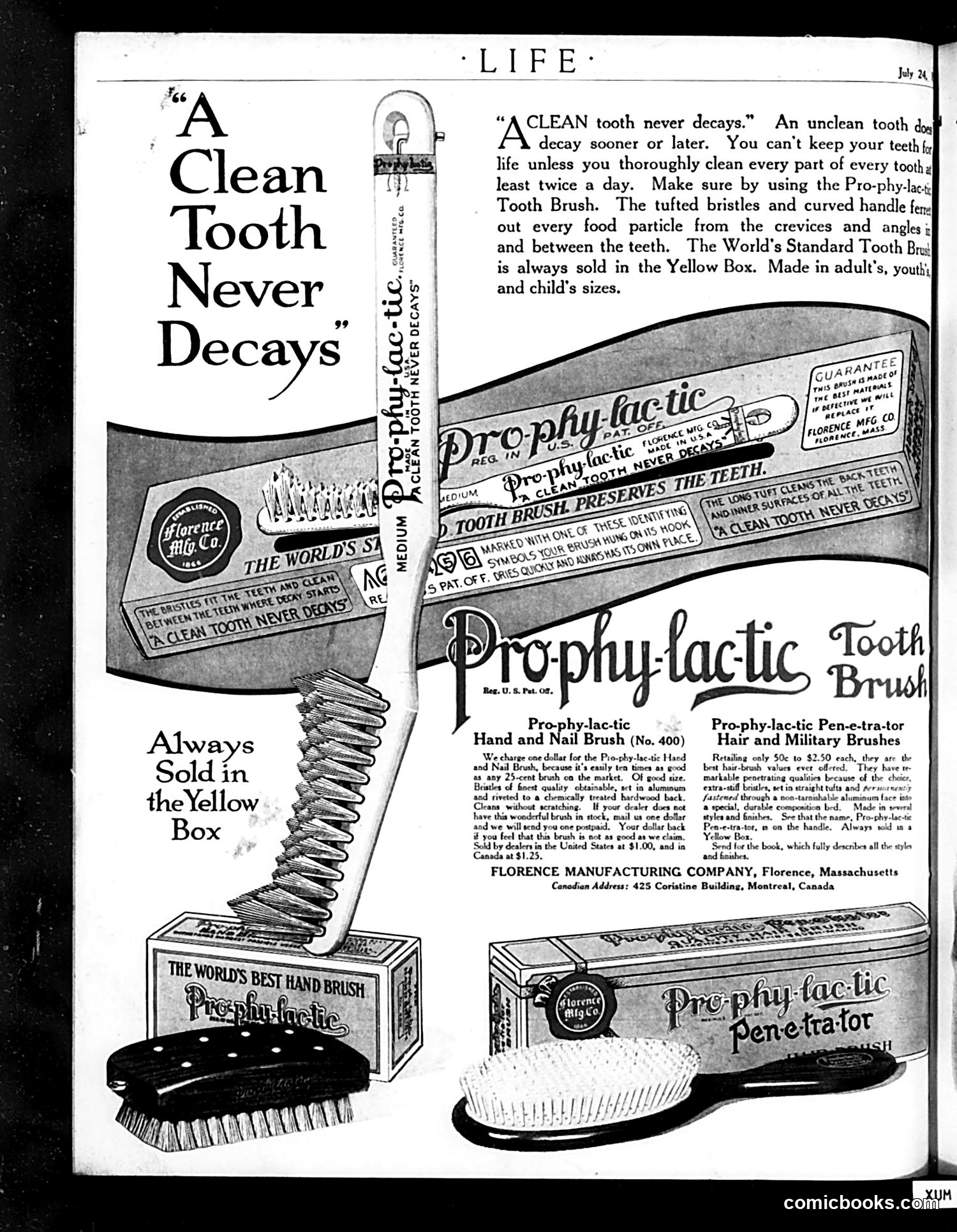
This page is **entirely an advertisement**, not a political cartoon. It promotes Pro-phy-lac-tic brand oral hygiene products made by the Florence Manufacturing Company. The ad uses the slogan "A Clean Tooth Never Decays" to market toothbrushes, hand-and-nail brushes, and a "Pen-e-tra-tor" hair brush. The language emphasizes product superiority—claiming their toothbrush is "ten times as good" as cheaper alternatives and costs one dollar (expensive for the era). For modern readers: this represents early 20th-century advertising that combined health claims with brand promotion. The emphasis on thorough cleaning and specific brush design reflects growing awareness of dental hygiene. The "Yellow Box" packaging and multiple product variants show how companies used branding and product lines similar to modern marketing. The guarantee ("your dollar back if unsatisfied") was a common sales tactic of the period.