
Life, 1919-07-24 · page 33 of 40
Life — July 24, 1919 — page 33: what you’re looking at
What you’re looking at
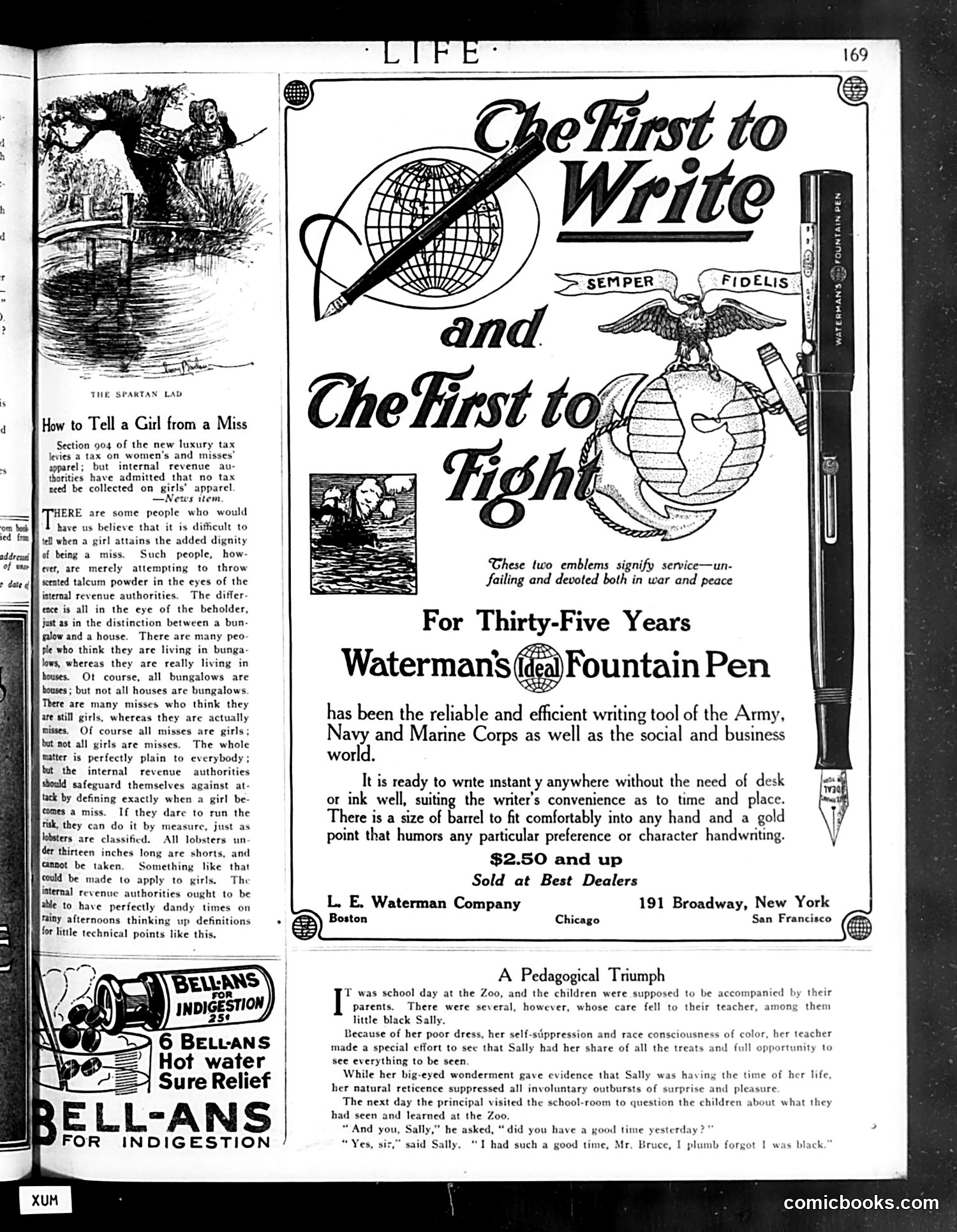
This satirical article mocks the new luxury tax distinction between "women's" and "misses'" apparel. The government was attempting to tax adult women's clothing differently from young girls' clothing, but revenue authorities admitted no tax could be collected on "girls' apparel." The piece absurdly compares the girl-to-miss distinction to the difference between a bungalow and a house—logically pedantic categories that don't actually map to reality. The satire suggests that defining when a girl becomes a "miss" (an unmarried woman) is both impossible and ridiculous, making the tax unenforceable without arbitrary, laughable measurements (comparing girls to lobster classifications). The implicit critique: the government created a tax with an unworkable definition, revealing bureaucratic incompetence. --- **"A Pedagogical Triumph"**: This concluding anecdote presents a teacher taking special care with an underprivileged Black student at a zoo. The title's intended irony is unclear—whether celebrating teacher kindness or satirizing the student's closing statement ("I plumb forgot I was black"), which suggests internalized racial consciousness.
📄 Transcribed text from this page (OCR, searchable)
Machine-transcribed from the original scan — historical spelling and the odd misread are preserved.
How to Tell a Girl from a Miss Section 904 of the new luxury tax levies a tax on women’s and misses’ agparel; but internal revenue au- thorities have admitted that no tax seed be collected on girls’ apparel os item ERE are some people who would have us believe that it is difficult to when a girl attains the added dignity of being a miss. Such people, how- ever, are merely attempting to throw seated talcum powder in the eyes of the internal revenue authorities. The differ exce is all in the eye of the beholder, jest as in the distinction between a bun- glow and a house. There are many peo: ple who think they are living in bunga- lows, whereas they are really living in houses. Ot course, all bungalows are houses ; but not all houses are bungalows. There are many misses who think they we still girls, whereas they are actually misses. Of course all misses are girls; but not all girls are misses. The whole matter is perfectly plain to everybody; but the internal revenue authorities should safeguard themselves against at- tatk by defining exactly when a girl be- comes a miss. If they dare to run the tisk, they can do it by measure, just as lobsters are classified. All lobsters un der thirteen inches long are shorts, and Ganpot be taken. Something like that could be made to apply to girls, The iatemal revenue authorities ought to be able to have perfectly dandy times on rainy afternoons thinking up definitions for little technical points like this. FE Tans FOR INDIGESTION WN, SUZ These two emblems signify service—un- failing and devoted both in war and peace For Thirty-Five Years Waterman's (é:)Fountain Pen has been the reliable and efficient writing tool of the Army, pal and Marine Corps as well as the social and business world, It is ready to wnte instant y anywhere without the need of desk or ink well, suiting the writer's convenience as to time and place. There is a size of barrel to fit comfortably into any hand and a gold point that humors any particular preference or character handwniing. $2.50 and up Sold at Best Dealers L. E. Waterman Company Boston 191 Broadway, New York Chicago San Francisco A Pedagogical Triumph T was school day at the Zoo, and the children were supposed to be accompanied by their parents. There were several, however, whose care fell to their teacher, among them little black Sally. Because of her poor dress, her self-siippression and race consciousness of color, her teacher made a special effort to see that Sally had her share of all the treats and full opportunity to see everything to be seen While her big-eyed wonderment gave evidence that Sally was having the time of her life her natural reticence suppressed all involuntary outbursts of surprise and pleasure The next day the principal visited the school-room to question the children about what they had seen and learned at the Zoo. nd you, Sally,” he asked, “did you have a good time yesterday?” “Yes, siz,” said Sally, “I had such a good time, Mr. Bruce, I plumb forgot I was black.” comicbooks.com WATERMAN'S,