
Life, 1919-07-24 · page 31 of 40
Life — July 24, 1919 — page 31: what you’re looking at
What you’re looking at
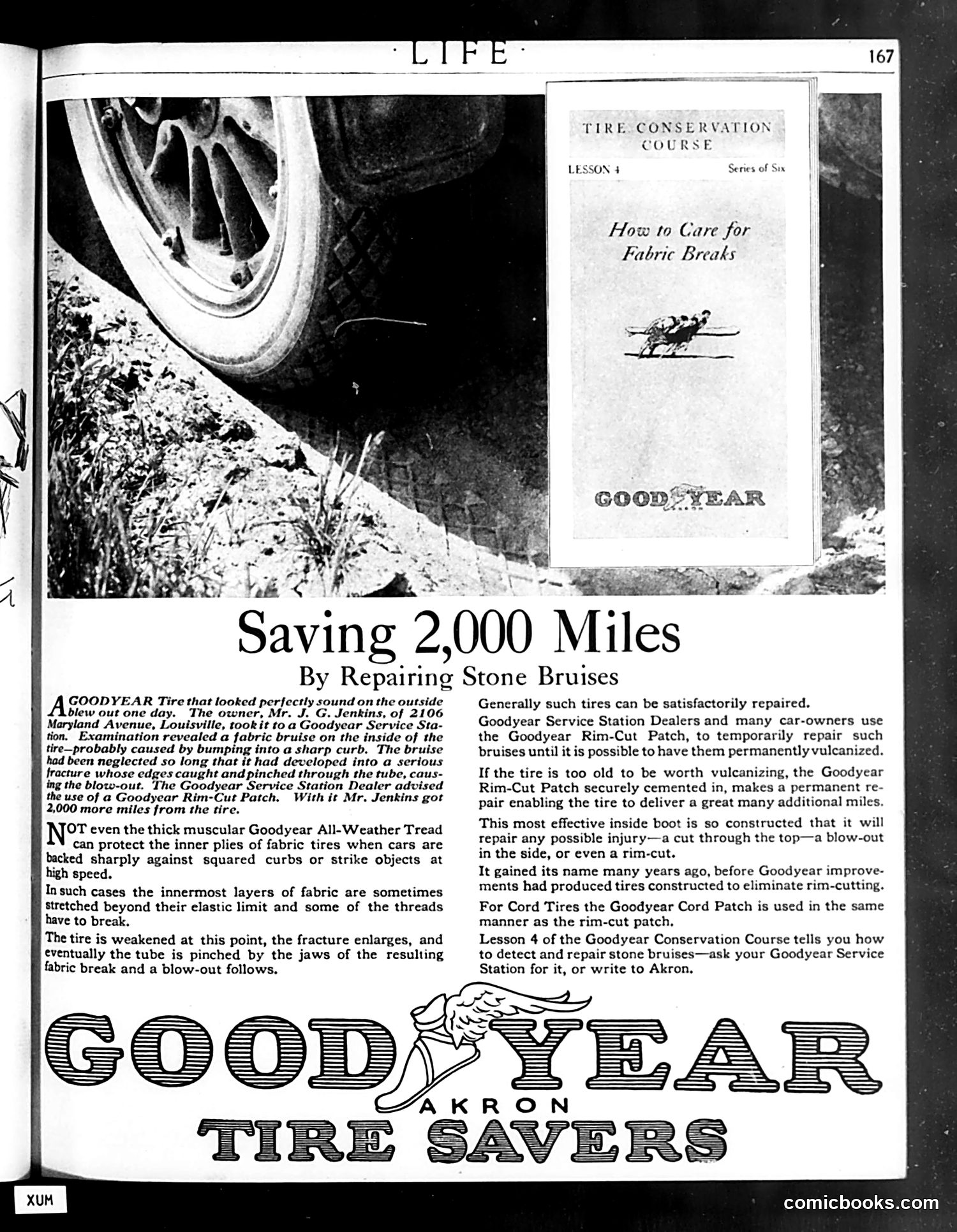
This is a **Goodyear tire advertisement**, not political satire or a cartoon. It appears in *Life* magazine's advertising section (page 167). The content is a practical instructional piece disguised as consumer education—"Lesson 4" of a "Tire Conservation Course." It describes how a Louisville man's Goodyear tire developed an internal fabric bruise from hitting a curb, which eventually caused a blowout. The solution: Goodyear's Rim-Cut Patch repair kit, which allegedly extended the tire's life by 2,000 additional miles. The "satire" here is subtle marketing: framing tire damage as preventable through Goodyear products, while emphasizing durability and value. The accompanying tire photograph and conservation-course framing lend credibility to what is essentially a sales pitch targeting cost-conscious Depression-era drivers concerned about tire longevity and repair costs.
📄 Transcribed text from this page (OCR, searchable)
Machine-transcribed from the original scan — historical spelling and the odd misread are preserved.
TIRE CONSERVATION COURSE LESSON 4 Series of Six How to Care for Fabric Breaks “Saying 2 000 Miles By Re Stone Bruises A GOODYEAR Tire that looked perfectly sound on the outside blew out one day. The owner, Mr. J. G. Jenkins, of 2106 Maryland Avenue, Louisville, tookit to a Goodyear Service Sta- tion, Examination revealed a fabric bruise on the inside of the tire-probably caused by bumping into a sharp curb. The bruise had been neglected so long that it had developed into a serious fracture whose edges caught and pinched through the tube, caus- ing the blow-out. The Goodyear Service Station Dealer advised the use of a Goodyear Rim-Cut Patch, With it Mr. Jenkins got 2,000 more miles from the tire. OT even the thick muscular Goodyear All-Weather Tread can protect the inner plies of fabric tires when cars are backed sharply against squared curbs or strike objects at high speed. Insuch cases the innermost layers of fabric are sometimes Stretched beyond their elastic limit and some of the threads have to break. The tire is weakened at this point, the fracture enlarges, and eventually the tube is pinched by the jaws of the resulting fabric break and a blow-out follows. Generally such tires can be satisfactorily repaired. Goodyear Service Station Dealers and many car-owners use the Goodyear Rim-Cut Patch, to temporarily repair such bruises until it is possible to have them permanently vulcanized. If the tire is too old to be worth vulcanizing, the Goodyear Rim-Cut Patch securely cemented in, makes a permanent re- pair enabling the tire to deliver a great many additional miles. This most effective inside boot is so constructed that it will repair any possible injury—a cut through the top—a blow-out in the side, or even a rim-cut. It gained its name many years ago, before Goodyear improve- ments had produced tires constructed to eliminate rim-cutting. For Cord Tires the Goodyear Cord Patch is used in the same manner as the rim-cut patch, Lesson 4 of the Goodyear Conservation Course tells you how to detect and repair stone bruises—ask your Goodyear Service Station for it, or write to Akron. comicbooks.com