
Life, 1919-07-24 · page 15 of 40
Life — July 24, 1919 — page 15: what you’re looking at
What you’re looking at
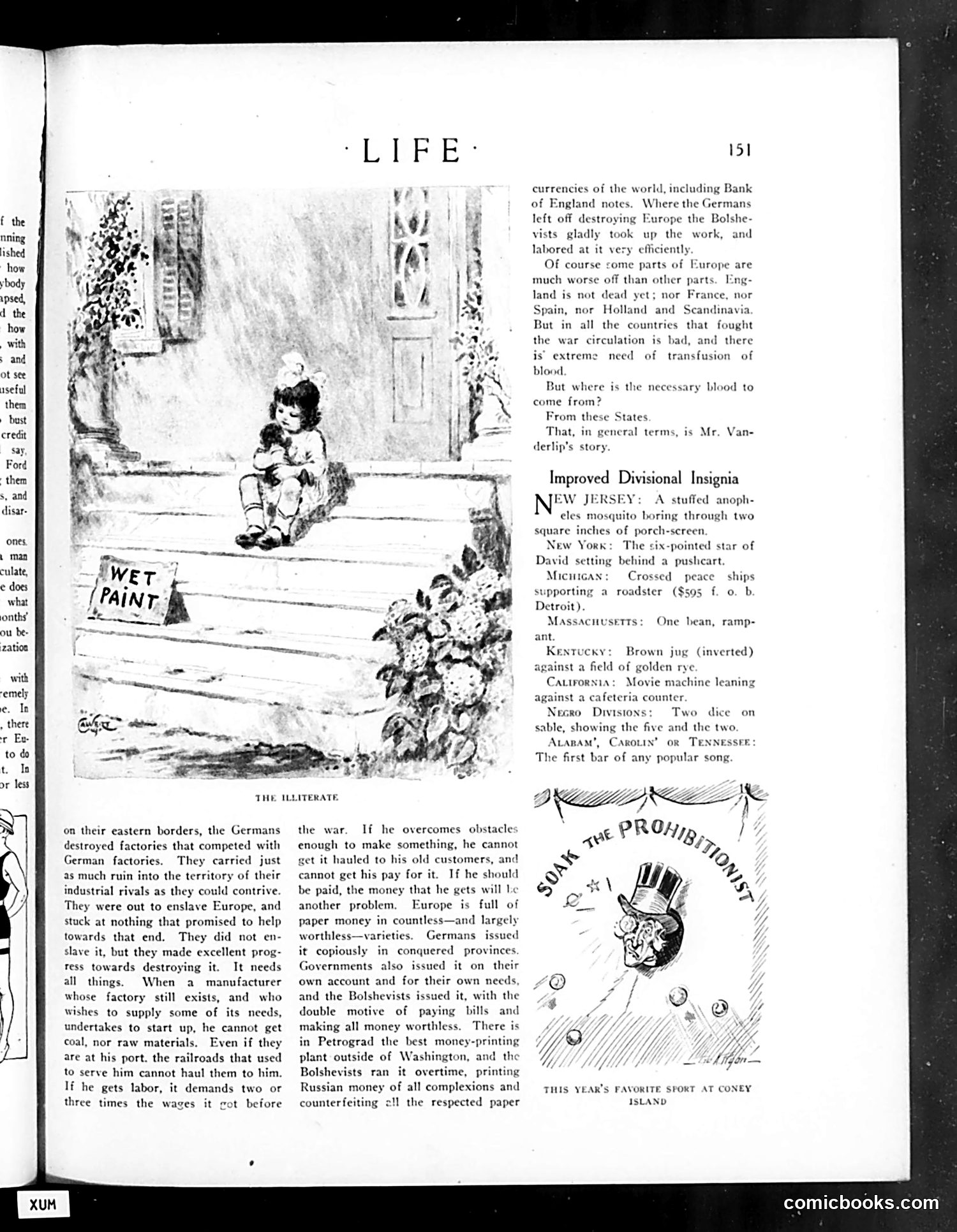
The main illustration shows a child sitting on steps marked "WET PAINT," appearing to be illiterate or unable to read the warning sign. This cartoon satirizes illiteracy in America—the inability of some citizens to read basic written warnings or instructions. The surrounding text discusses post-WWI Europe's economic chaos: destroyed factories, worthless paper currencies, counterfeiting, and wage inflation. The "Improved Divisional Insignia" section lists absurd military unit identifications (mosquitoes, pusscarts, roadsters, etc.). The "Soak the Prohibitions" illustration mocks Prohibition-era bootlegging with a caricatured Uncle Sam figure surrounded by bottles, satirizing the difficulty of enforcing alcohol bans. Together, these pieces critique American social problems—illiteracy, economic disruption, and failed legislation—during the post-war period.
📄 Transcribed text from this page (OCR, searchable)
Machine-transcribed from the original scan — historical spelling and the odd misread are preserved.
f the nning ished how ybody ipsed, d the how , with + and ot see useful them bust credit say Ford ; them s, and disar- ones. . man culate, ¢ does what jonths’ ou be- zation with -emely e. In , there t Ex. to do t. In or less y] Fup ye oe. THE ILLITERATE on their eastern borders, the Germans destroyed factories that competed with German factories. They carried just as much ruin into the territory of their industrial rivals as they could contrive. They were out to enslave Europe, and stuck at nothing that promised to help towards that end. They did not en- slave it, but they made excellent prog- ress towards destroying it. It needs all things. When a manufacturer whose factory still exists, and who wishes to supply some of its needs, undertakes to start up, he cannot get coal, nor raw materials. Even if they are at his port. the railroads that used to serve him cannot haul them to him. lf he gets labor, it demands two or three times the wages it got before the war. If he overcomes obstacles enough to make something, he cannot get it hauled to his old customers, and cannot get his pay for it. If he should be paid, the money that he gets will lc another problem, Europe is full of paper money in countless—and largely worthless—varieties. Germans issued it copiously in conquered provinces Governments also issued it on their own account and for their own needs, and the Bolshevists issued it, with the double motive of paying bills and making all money worthless. There is in Petrograd the best money-printing plant outside of Washington, and the Bolshevists ran it overtime, printing Russian money of all complexions and counterfeiting c!l the respected paper 51 currencies of the world, including Bank of gland notes. left off destroying Europe the Bolshe- vists gladly took up the labored at it very efficiently Where the Germans work, and Of course some parts of Europe are much worse off than other parts. Eng- land is not dead yet; nor France, nor Spain, nor Holland and Scandinavia. But in all the countries that fought the war circulation is bad, and there is’ extreme blood. But where is the necessary blood to come from? From these States. That, in general terms, is Mr. Van- derlip's story. need of transfusion of Improved Divisional Insignia ZW JERSE eles mosquito boring through two square inches of porch-screen New York: The six-pointed star of David setting behind a pushceart. Micuican: Crossed peace ships supporting a roadster ($505 f. b. Detroit). MASSACHUSETTS : ant Kentucky: A stuffed anoph- One bean, ramp- Brown jug (inverted) against a field of golden rye Catirorsia: Movie machine leaning inst a cafeteria counter Necro Divisions: Two dice on sable, showing the five and the two. ALABAM’, CAROLIN’ OR TENNESSEE: The first bar of any popular song. 2 Vy OM fon — THIS YEAR'S FAVORITE SPORT AT CONEY ISLAND comicbooks.com