
Life, 1919-07-24 · page 8 of 40
Life — July 24, 1919 — page 8: what you’re looking at
What you’re looking at
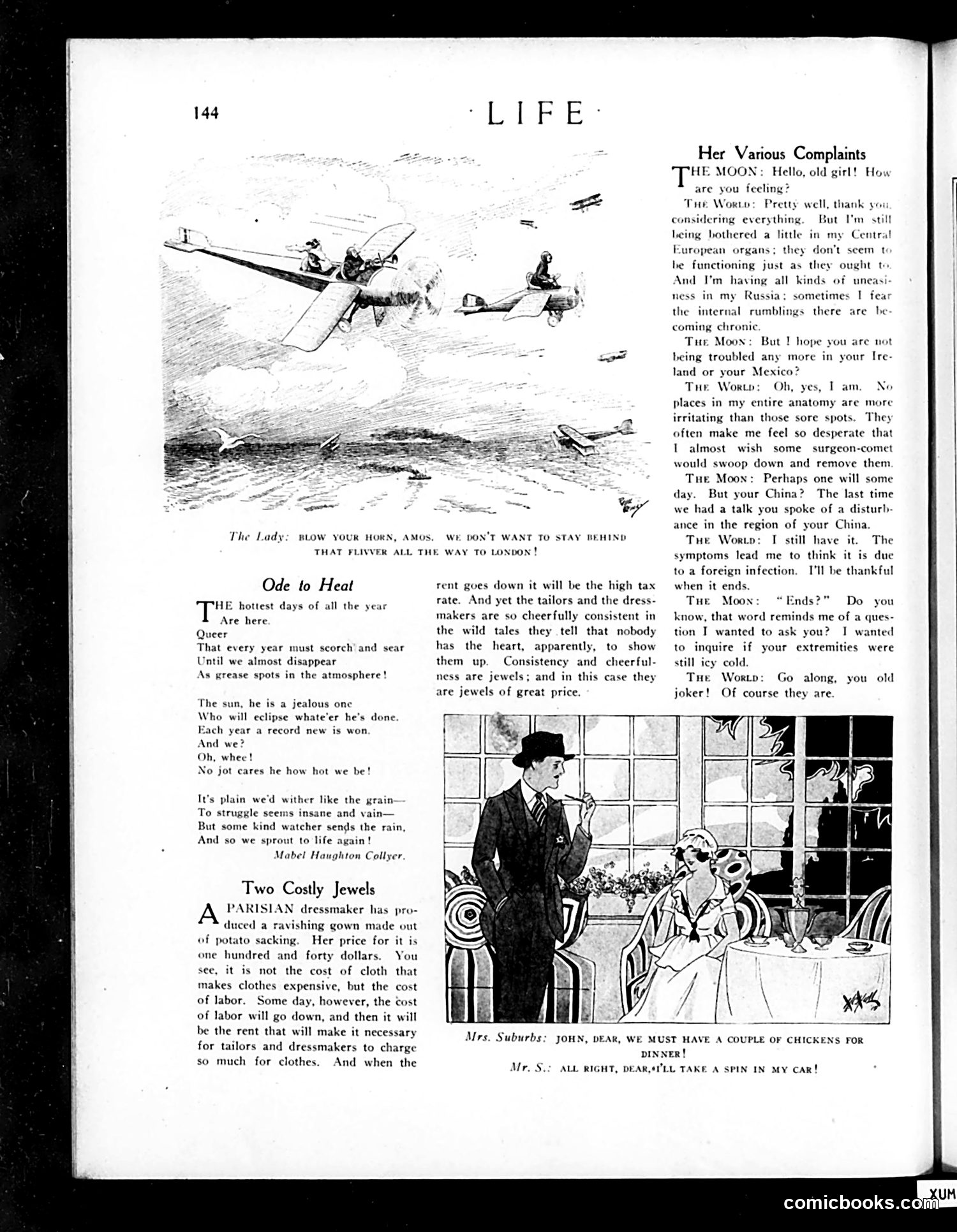
This page contains satirical poetry and social commentary typical of early 20th-century Life magazine. **"Ode to Heat"** mocks summer's brutal temperatures, personifying the sun as a "jealous one" competing with records. The poem complaints about atmospheric heat spots—likely referencing pollution or urban conditions—and suggests rain as relief. **"Two Costly Jewels"** critiques labor economics: a Parisian dressmaker charges $140 for a potato-sack gown. The satirist argues that while fabric costs are low, *labor* is expensive. The point: as workers' wages rise, clothing prices will inevitably increase—a commentary on post-war labor negotiations and inflation concerns. **"Her Various Complaints"** (right panel) is a humorous dialogue between the Moon and World, with the World listing bodily ailments (digestive issues, sore spots, possible foreign infection). The joke equates Earth's problems to human physical complaints.
📄 Transcribed text from this page (OCR, searchable)
Machine-transcribed from the original scan — historical spelling and the odd misread are preserved.
The Lady: wow Your Hor, THAT FLIVVER AL Ode to Heat HE hottest days of all the year Are here. Queer That every year must scorch’ and sear Until we almost disappear As grease spots in the atmosphere! The sun, he is a jea Who will eclipse whate'er he's done. Each year a record new is won. And we? Oh, whee! No jot cares he how hot we be! lous one It's plain we'd wither like the grain To struggle seems insane and vain— But some kind watcher sends the rain, And so we sprout to life again! Mabel Haughton Collyer Two Costly Jewels PARISIAN dressmaker has pre duced a ravishing gown made out of potato sacking. Her price for it is one hundred and forty dollars. You see, it is not the cost of cloth that makes clothes expensive, but the cost of labor. Some day, however, the cost of labor will go down, and then it will be the rent that will make it necessary for tailors and dressmakers to charge so much for clothes. And when the AMOS. WE DON'T WANT TO STAY BEHIND |. THE WAY TO LONDON! rent goes down it will be the high tax rate. And yet the tailors and the dress- makers are so cheerfully consistent in the wild tales they tell that nobody has the heart, apparently, to show up. Consistency and cheerful- ness are jewels; and in this case they are jewels of great price. them Her Various Complaints HE MOON: Hello, old girl! How ¢ you feeling Tue Worn: Pretty well, thank yeu considering everything. But I'm still being bothered a little in my Central I'm European organs; they don't seem t he functioning just as they ought to And I'm having all kinds of uneasi- ness in my Russia: sometimes [ fi the internal rumblings there are be coming chronic. Tur Moon: being troubled any more in your Ire- land or your Mexico? Tuer Wort: ces in my entire anatomy are more ating than those sore spots. They often make me feel so desperate that I almost wish some would swoop down and remove them. Tue Moon: Perhaps one will some But your China? The last time we had a talk you spoke of a disturh. ance in the region of your China. Tue Wortn: IT still eit. The symptoms lead me to think it is due to a foreign infection. I'll be thankful when it ends. Tue Moon inds?” Do know, that word reminds me of a ques- tion I wanted to ask you? anted to inquire if your extremities were still icy cold. Tue Wortv: Go along, you old joker! Of course they are. But ! hope you are not Oh, yes, T am. surgeon-comet da; you Iw Mrs, Suburbs; JOHN, DEAR, WE MUST HAVE A COUPLE OF CHICKENS FOR DINNER! Mr. S. ALL RIGHT, DEAR,*I'LL TAKE A SPIN IN MY CAR! comicbooks.com