
Life, 1919-07-24 · page 18 of 40
Life — July 24, 1919 — page 18: what you’re looking at
What you’re looking at
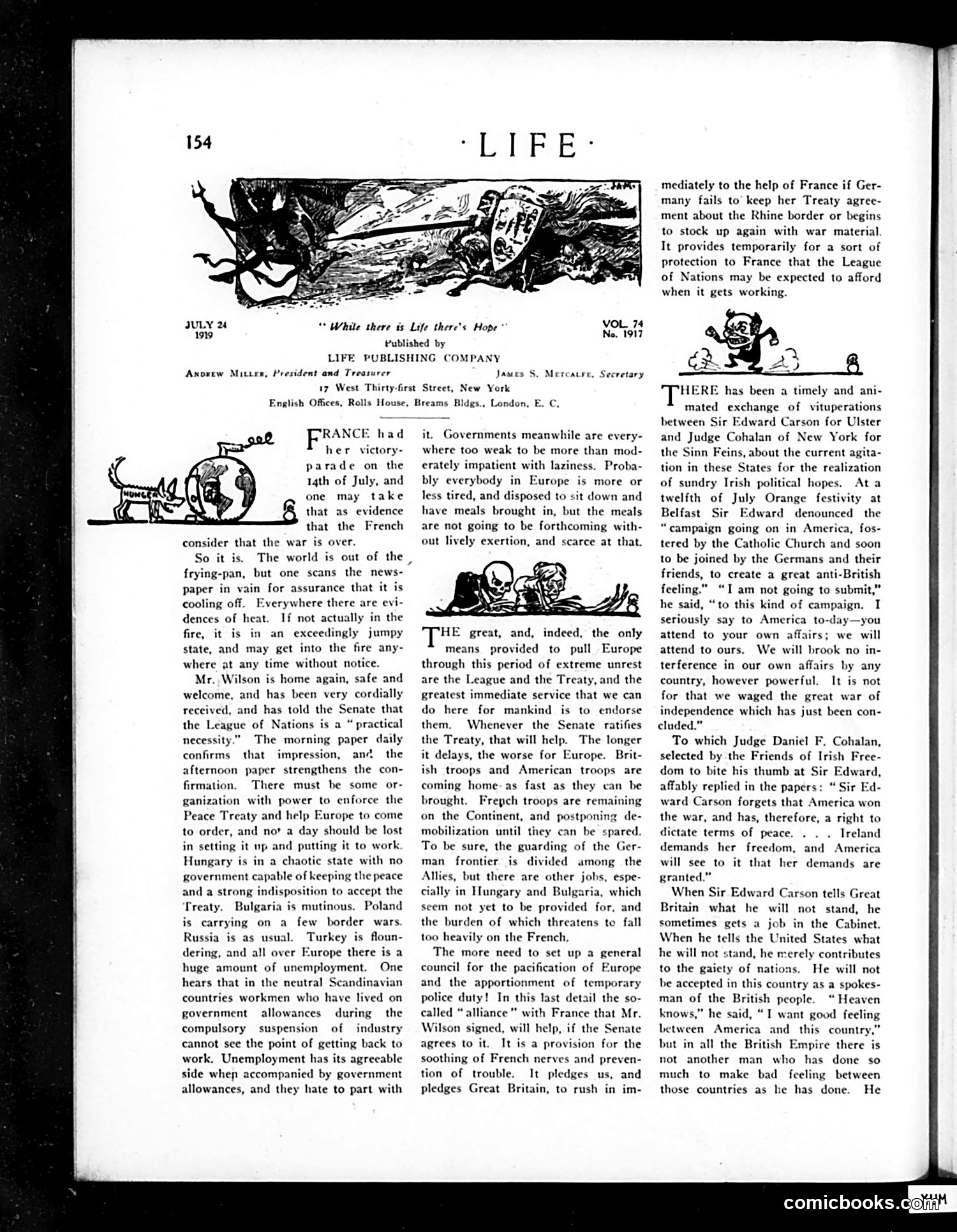
This July 1919 *Life* magazine editorial addresses post-WWI instability. The cartoons (small decorative illustrations with figures) appear to be generic satirical vignettes rather than identifiable caricatures of specific political figures. The article's main argument: Europe remains chaotic despite France's victory parade on Bastille Day. The writer warns that while the war officially ended, genuine peace hasn't arrived—Hungary is unstable, Poland and Russia are fighting, Bulgaria is rebellious, and unemployment is widespread. The solution, the author argues, is ratification of the League of Nations Treaty and a U.S.-France military alliance that President Wilson negotiated. Without swift Senate approval and enforcement mechanisms, Europe will descend further into disorder. The piece essentially urges American political action to stabilize a fragile, exhausted continent.
📄 Transcribed text from this page (OCR, searchable)
Machine-transcribed from the original scan — historical spelling and the odd misread are preserved.
JULY 24 1919 “* While there ts Life there's Hope’ Published by LIFE Anoxew Mitire, President and Treasurer PUBLISHING COMPANY Jaurs S. Mercatre, Secretary 17 West Thirty-first Street, New York English Offices, Rolls House, Breams Bldgs., London, E. C. RANCE had her victory- parade on the 14th of July, and one may take that as evidence that the French consider that the war is over. So it is. The world is out of the frying-pan, but one scans the news- paper in vain for assurance that it is cooling off. Everywhere there are evi dences of heat. If not actually in the fire, it is in an exceedingly jumpy state, and may get into the fire any- where at any time without notice. Mr. Wilson is home again, safe and welcome, and has been very cordially received, and has told the Senate that the League of Nations is a “ practical necessity.” The morning paper daily confirms that impression, an¢@ the afternoon paper strengthens the con- firmation. There must be some or- ganization with power to enforce the Peace Treaty and help Europe to come to order, and not a day should be lost in setting it up and putting it to work Hungary is in a chaotic state with no government capable of keeping the peace and a strong indisposition to accept the Treaty. Bulgaria is mutinous. Poland is carrying on a few border wars. Russia is as usual. Turkey is floun- dering, and all over Europe there is a huge amount of unemployment. One hears that in the neutral Scandinavian countries workmen who have lived on government allowances during the compulsory suspension of industry cannot see the point of getting back to work. Unemployment has its agreeable side whep accompanied by government allowances, and they hate to part with it. Governments meanwhile are every- where too weak to be more than mod- erately impatient with laziness. Proba- bly everybody in Europe is more or less tired, and disposed to sit down and have meals brought in, but the meals are not going to be forthcoming with- out lively exertion, and scarce at that. HE great, and, indeed, the only means provided to pull Europe through this period of extreme unrest are the League and the Treaty, and the greatest immediate service that we can do here for mankind is to endorse them. Whenever the Senate ratifies the Treaty, that will help. The longer it delays, the worse for Europe. Brit- ish troops and American troops are coming home-as fast as they can be brought. Frepch troops are remaining on the Continent, and postponing de- mobilization until they can be spared. To be sure, the guarding of the Ger- man frontier is divided among the Allies, but there are other jobs, espe- cially in Hungary and Bulgaria, which not yet to be provided for, and the burden of which threatens to fall too heavily on the French. The more need to set up a general council for the pacification of Europe and the apportionment of temporary police duty! In this last detail the so- called “alliance” with France that Mr. Wilson signed, will help, if the Senate agrees to it. It is a provision for the soothing of French nerves and preven- tion of trouble. It pledges us, and pledges Great Britain, to rush in im- seem mediately to the help of France if Ger- many fails to keep her Treaty agree- ment about the Rhine border or begins to stock up again with war material It provides temporarily for a sort of protection to France that the League of Nations may be expected to afford when it gets working. HERE has been a timely and ani- mated exchange of vituperations between Sir Edward Carson for Ulster and Judge Cohalan of New York for the Sinn Feins, about the current agita- tion in these States for the realization of sundry Irish political hopes. Ata twelfth of July Orange festivity at Belfast Sir Edward denounced the “campaign going on in America, fos- tered by the Catholic Church and soon to be joined by the Germans and their friends, to create a great anti-British feeling.” “I am not going to submit,” he said, “to this kind of campaign. I seriously say to America to-day—you attend to your own affairs; we will attend to ours. We will brook no in- terference in our own affairs by any country, however powerful. It is not for that we waged the great war of independence which has just been con- cluded.” To which Judge Daniel F, Cohalan, selected by the Friends of Irish Free- dom to bite his thumb at Sir Edward, affably replied in the papers: “ Sir E ward Carson forgets that America won the war, and has, therefore, a right to dictate terms of peace. Ireland demands her freedom, and America will see to it that her demands are granted.” When Sir Edward Carson tells Great Britain what he will not stand, he sometimes gets a job in the Cabinet. When he tells the United States what he will not stand, he merely contributes to the gaiety of nations. He will not be accepted in this country as a spokes- man of the British people. “Heaven knows,” he said, “I want good feeling between America and this country but in all the British Empire there is not another man who has done so much to make bad feeling between those countries as he has done. He comicbooks. coma