
A complete issue · 34 pages · 1918
Life — November 28, 1918
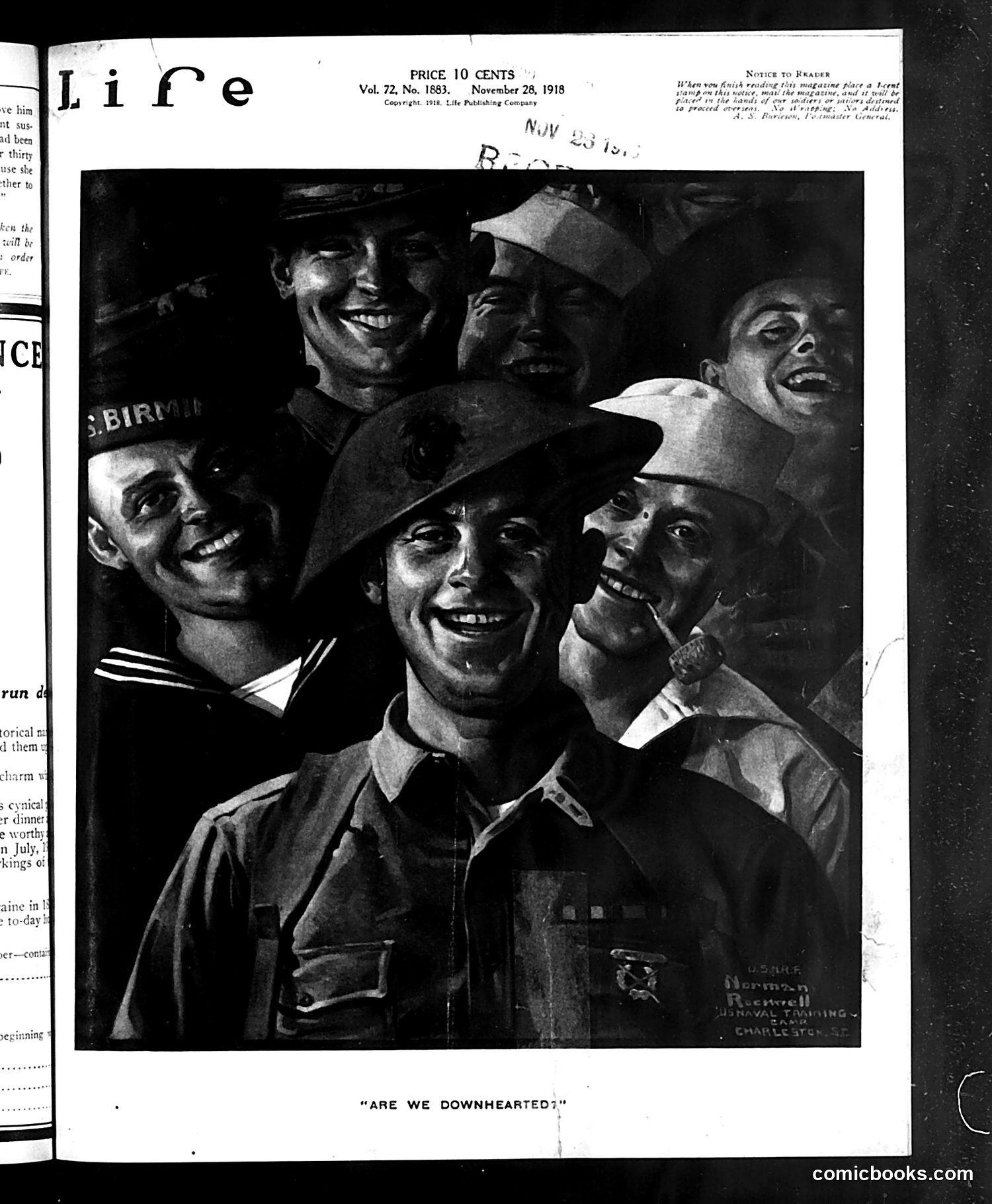
This photograph shows six servicemen in military uniforms displaying cheerful expressions beneath the caption "ARE WE DOWNHEARTED?" The timing is significant: November 28, 1918—just seventeen days after the Armistice ending World War I (November 11, 1918). The rhetorical question and the men's broad smiles suggest morale remained high despite the war's conclusion. The phrase "are we downhearted?" was a popular wartime refrain, typically answered with emphatic "No!" This image appears intended to showcase American soldiers' spirits and resilience, likely celebrating the successful end to the conflict. The photograph serves as patriotic content affirming public confidence in the military at the war's conclusion.
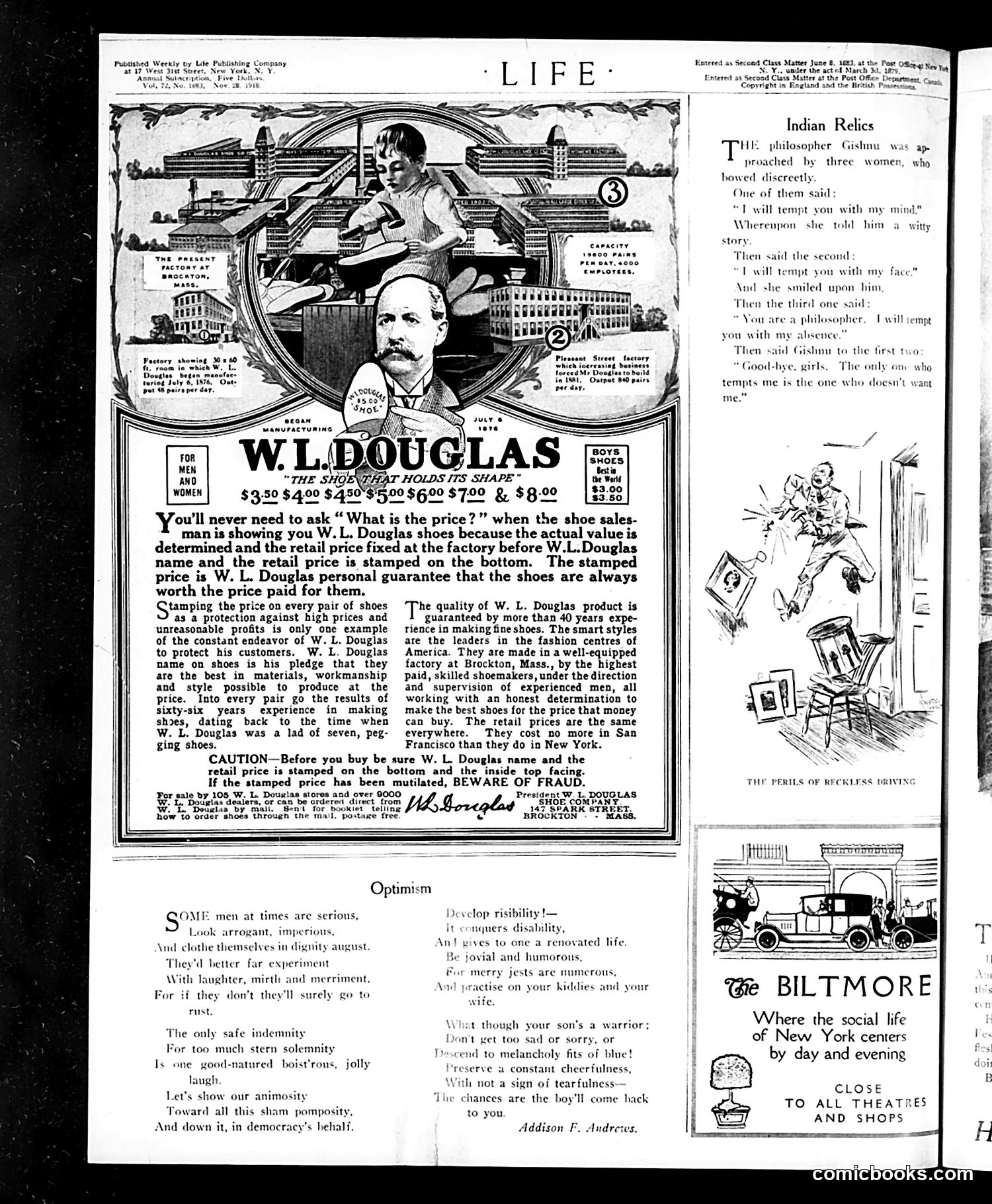
This page is primarily **advertising for W.L. Douglas shoes**, occupying the left half. The central image shows a factory manager or owner (the man with the mustache) overseeing shoe manufacturing, with the slogan "The Shoe That Holds Its Shape." The ad emphasizes that Douglas stamps the retail price on shoe bottoms to prevent markup fraud—a consumer protection pitch. The right side contains unrelated content: "Indian Relics," a philosophical anecdote about tempting women; "Optimism," a poem about developing cheerfulness; and advertisements for the Biltmore Hotel and theater district. **This is not political satire.** It's a standard issue of *Life* magazine functioning primarily as an advertising vehicle, with filler content. The Douglas shoe ad is the dominant editorial element.
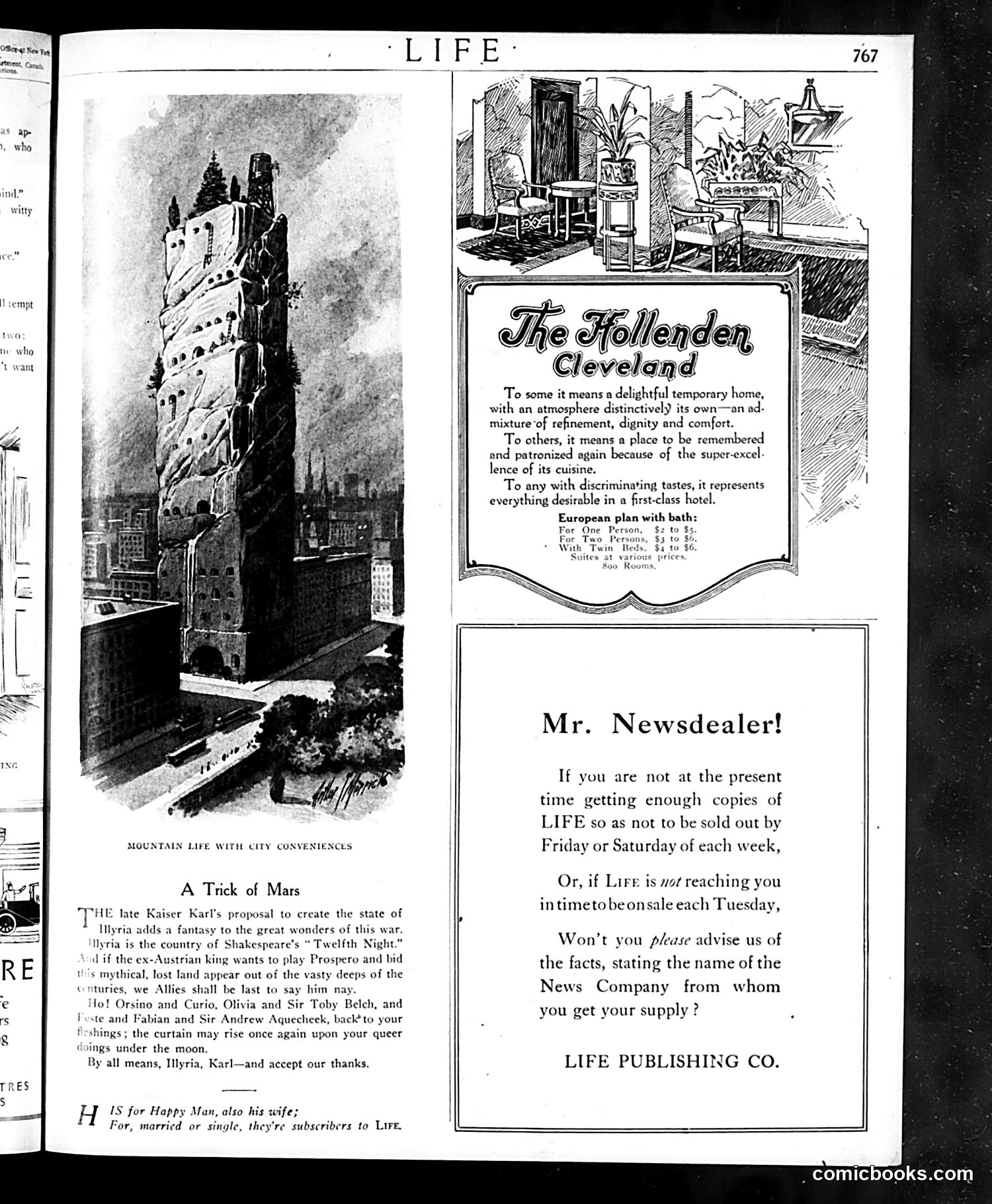
This page is primarily **advertising and administrative content** rather than political satire. The left side features "A Trick of Mars," a brief satirical piece referencing **Kaiser Karl's proposal to create the state of Illyria**—a fantasy territory during WWI. The text humorously imagines Illyria as a Shakespearean kingdom, suggesting the Austrian king's territorial ambitions are as fantastical as Shakespeare's invented lands. It's gentle wartime satire mocking Habsburg expansionism. The right side contains two advertisements: one for the Hollenden Hotel in Cleveland (describing its amenities and rates), and another from **Life Publishing Co.** directed at newsdealer requesting they ensure adequate magazine supply each Tuesday to prevent sellouts. The page reflects both wartime humor and early 20th-century magazine distribution concerns.
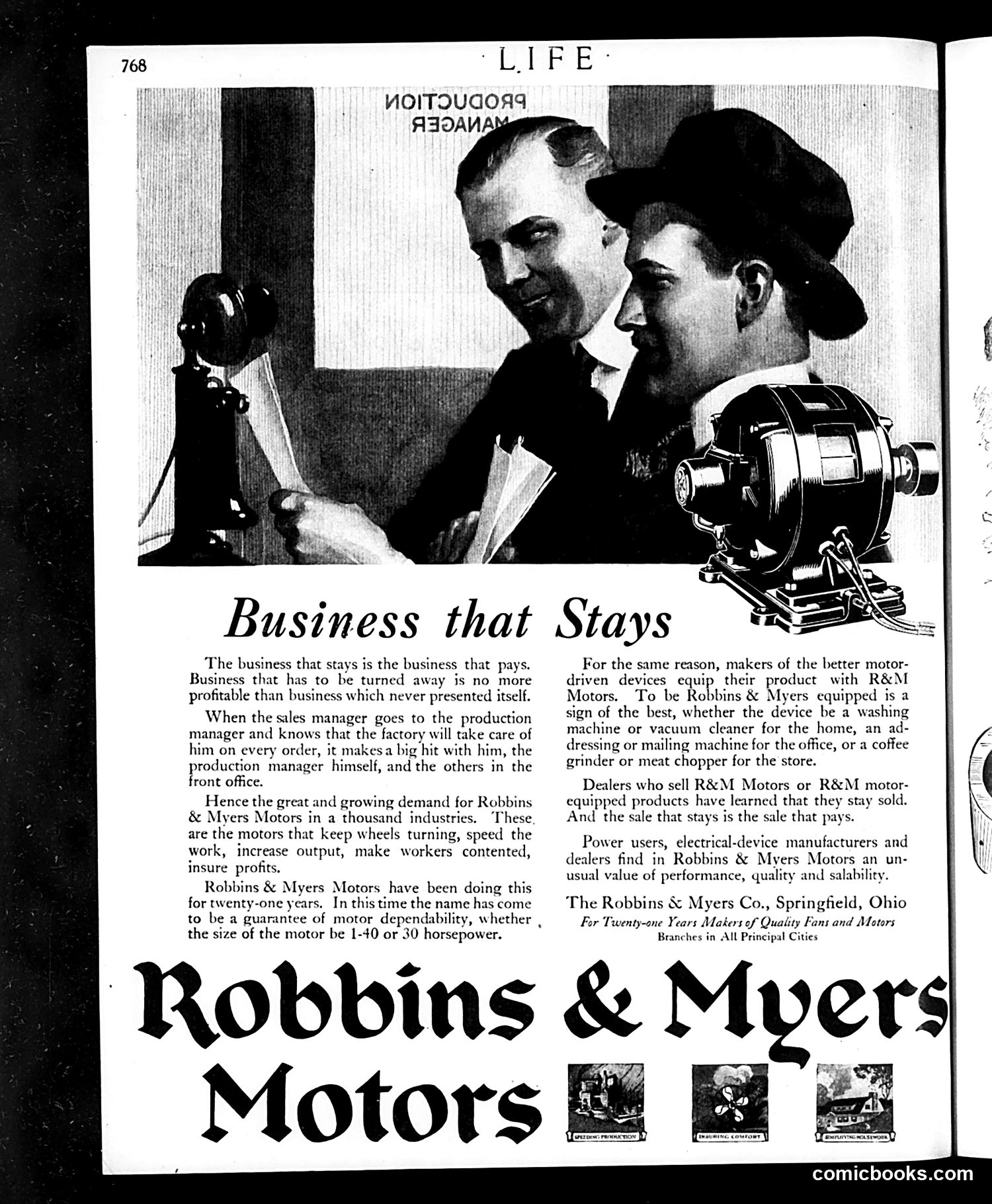
This is **not a satirical cartoon** but rather a **straightforward advertisement** for Robbins & Myers Motors, placed in Life magazine (page 768). The image shows two businessmen examining industrial motors and equipment. The ad's message is purely commercial: it argues that reliable, quality motors—specifically R&M Motors—help businesses succeed by improving efficiency and worker satisfaction. The "business that stays" refers to companies that invest in dependable equipment, positioning R&M Motors as essential to industrial success. The company emphasizes twenty-one years of manufacturing experience and claims their motors are used across multiple industries (washing machines, grinders, vacuum cleaners, etc.). There is **no satire or political commentary**—this is period industrial advertising targeting factory managers and business owners.
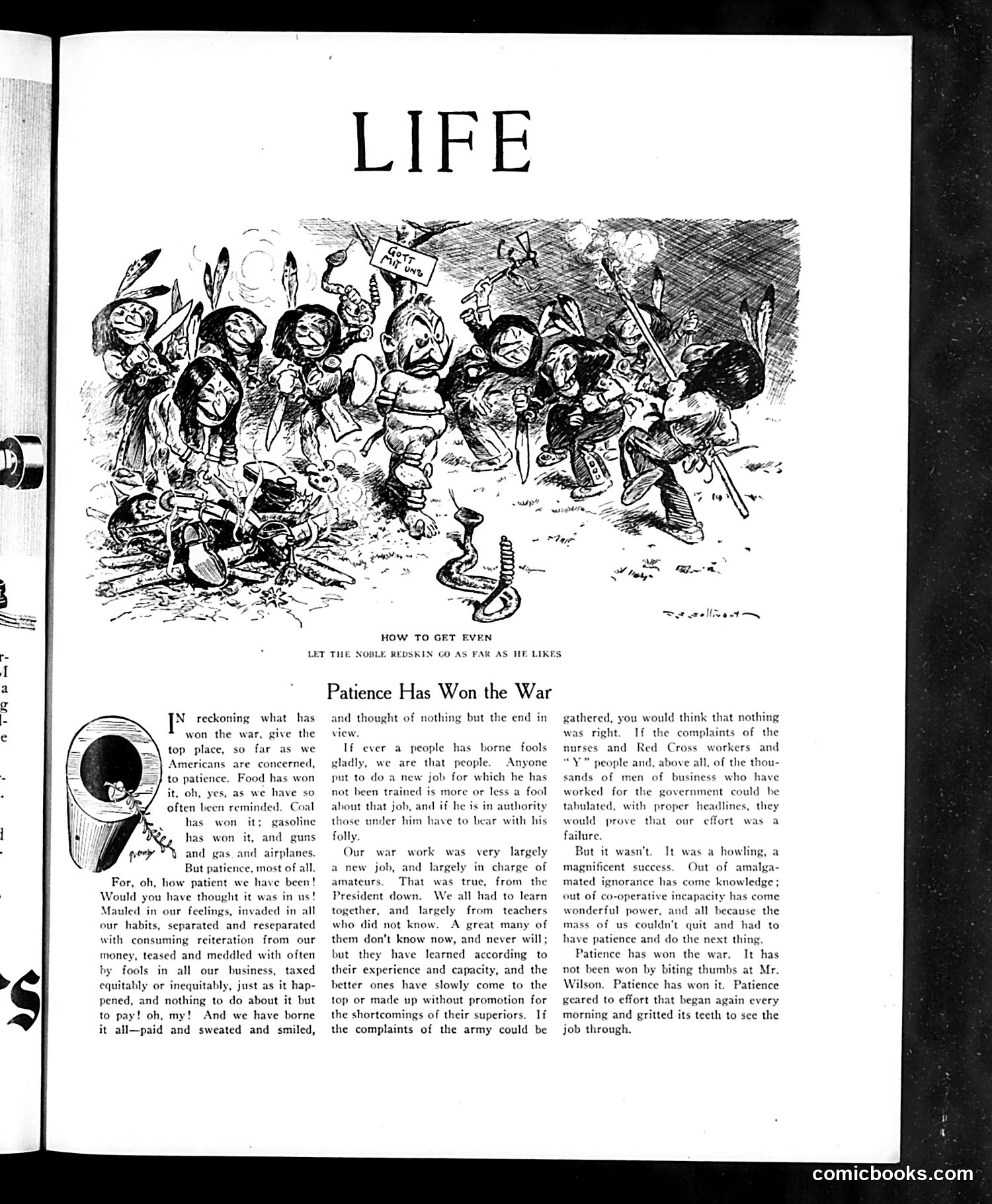
This page from *Life* magazine satirizes American war efforts and labor management. The headline "Patience Has Won the War" accompanies an editorial discussing wartime industrial production and worker discipline. The chaotic cartoon above depicts various caricatured figures—appearing to represent different worker types, government officials, and possibly profiteers—in disorderly celebration or conflict. The drawing style suggests satirical commentary on how diverse groups supposedly contributed to (or hindered) the war effort. The text criticizes amateur management of war production and praises workers' patience despite poor conditions, unfair treatment, and lack of advancement. It argues patience rather than strikes or complaints ultimately won the war, though with veiled criticism of government inefficiency and worker exploitation. The overall message appears tongue-in-cheek—praising patience while implicitly acknowledging legitimate grievances were ignored.
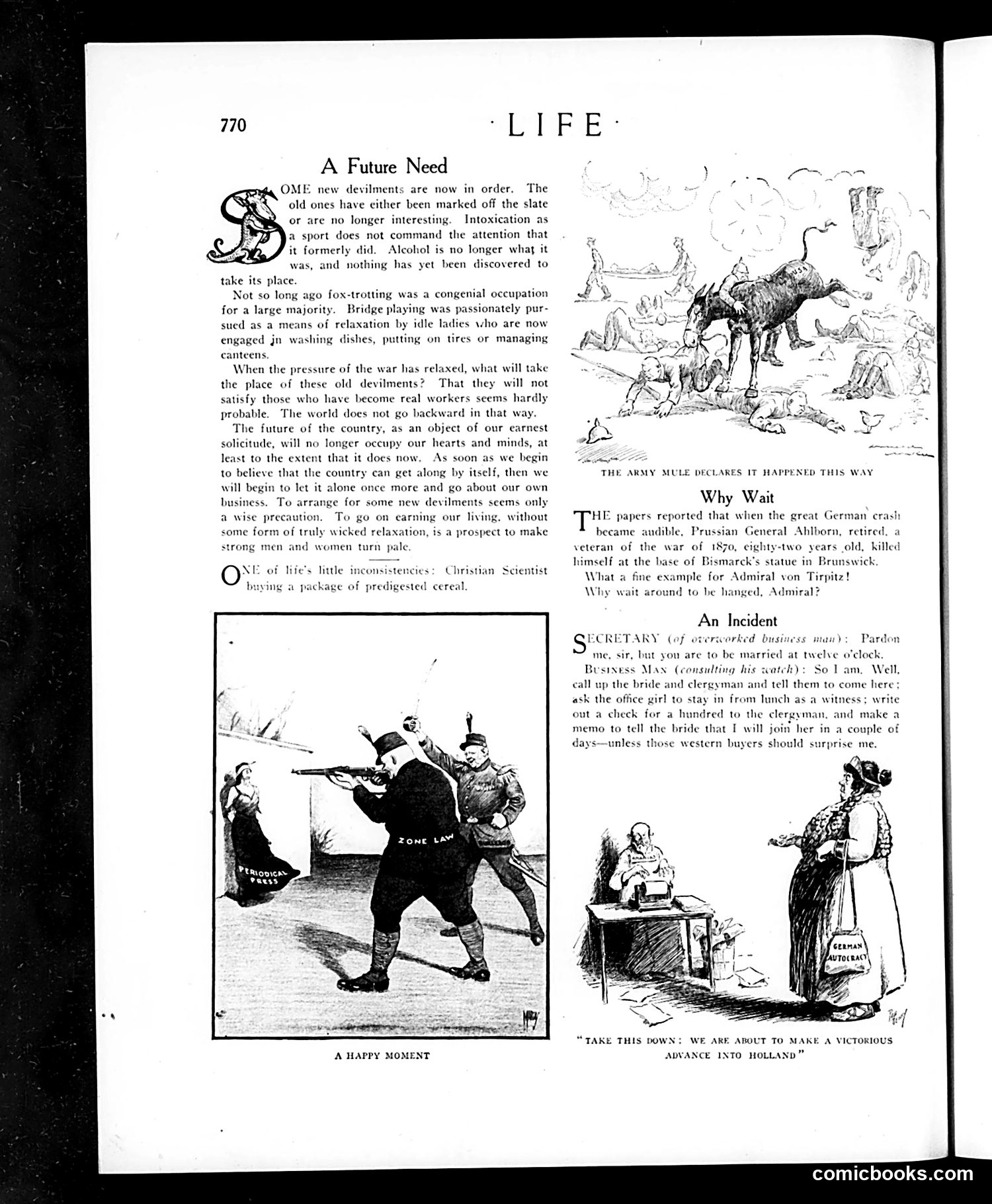
This page contains WWI-era satirical content. "A Future Need" discusses post-war social challenges—how idle pursuits like bridge and foot-trotting won't satisfy those who became "real workers" during wartime, and society must create meaningful new developments. "Why Wait" mocks General Hindenburg's retirement to Bismarck's statue after Germany's military collapse, sarcastically asking why he waits to be hanged instead. "An Incident" depicts a farcical business conversation where a man attempts to marry at noon while conducting commerce, with the cartoon titled "Take This Down: We Are About to Make a Victorious Advance Into Holland"—likely satirizing confused wartime priorities or German military overconfidence. The cartoons collectively mock German leadership and post-war societal disorientation.
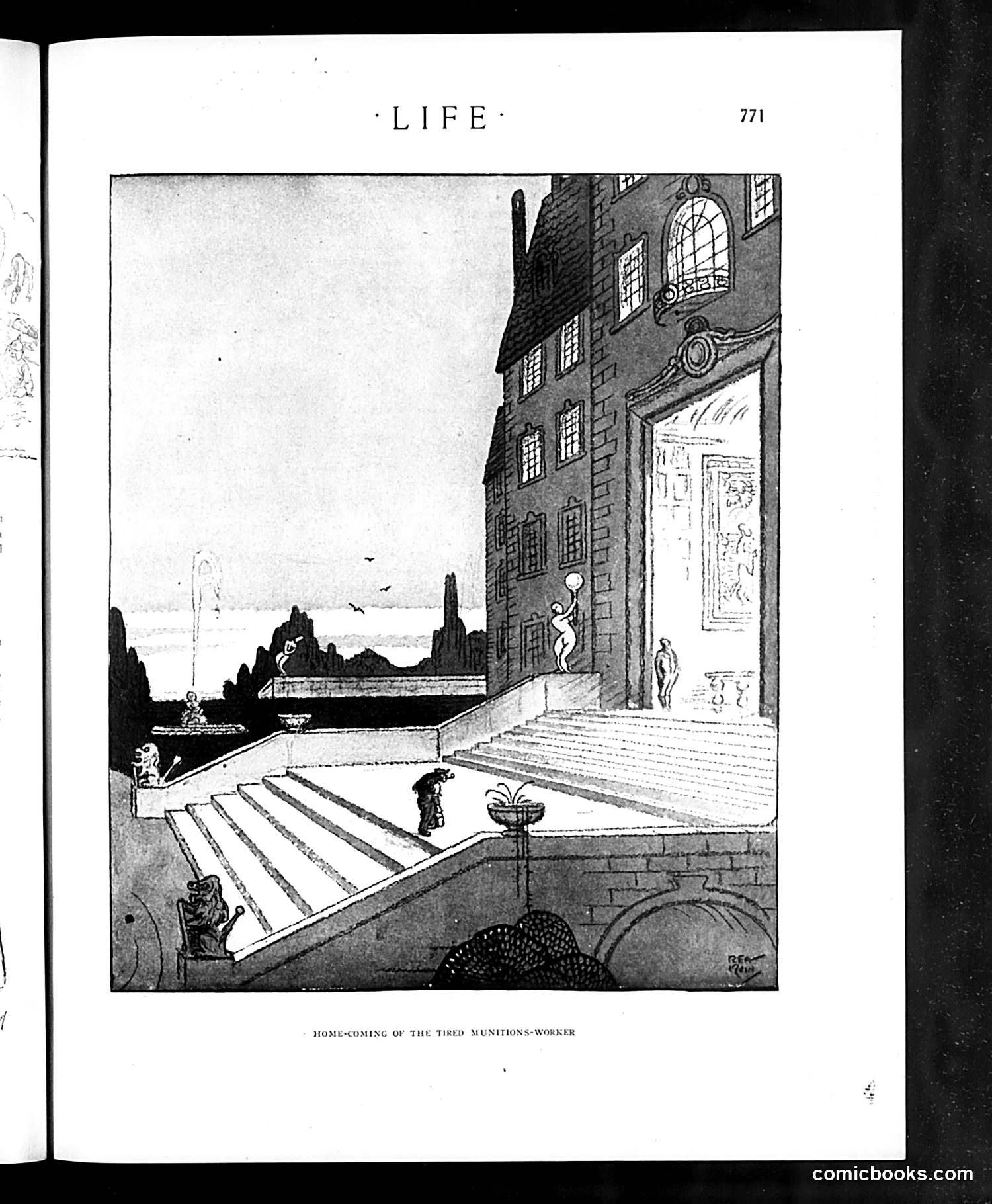
This illustration depicts a weary industrial worker returning home to a grand, imposing mansion. The contrast is stark: the exhausted laborer approaches massive steps leading to an ornate building with classical architecture, while fountains and manicured grounds surround the estate. The satire critiques the disparity between munitions workers (who produced weapons during WWI era) and wealthy industrialists who profited from their labor. The "tired" worker appears diminished against the palatial architecture, suggesting exploitation—workers physically exhausted from dangerous factory conditions while owners accumulated wealth in luxury homes. This reflects early 20th-century labor criticism and class tensions, satirizing how wartime industrial profits enriched capitalists while workers remained economically vulnerable despite essential contributions.
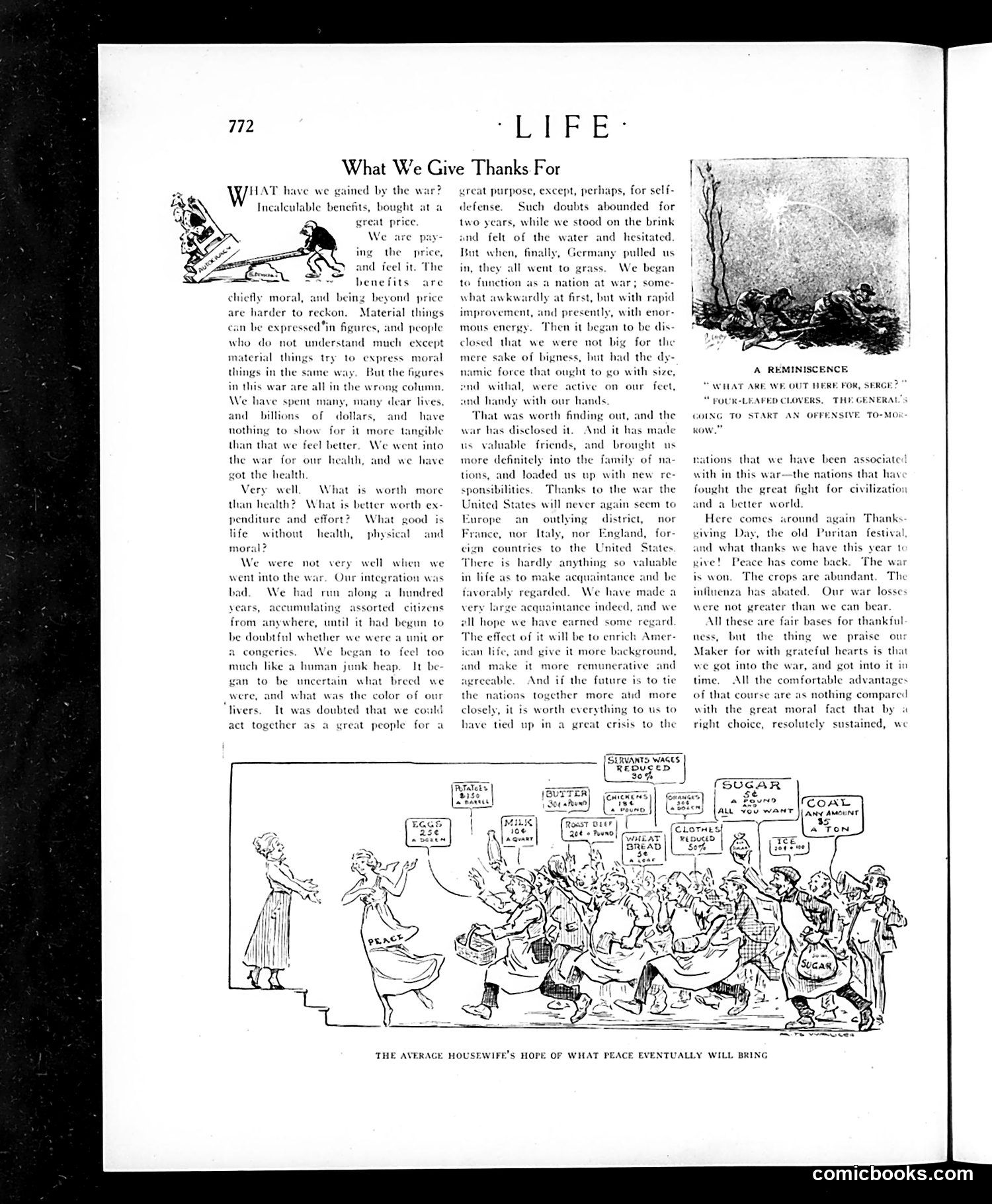
This page presents post-WWI reflections on American gains from the war. The main article discusses intangible benefits—moral growth, national unity, and restored international relationships—despite material costs. The cartoon below satirizes domestic expectations for peacetime. Labeled "The Average Housewife's Hope of What Peace Eventually Will Bring," it depicts a woman (representing civilian desires) surrounded by people offering goods: food, milk, butter, bread, clothing, sugar, and coal. The labels reference wartime rationing and scarcity that Americans endured. The satire's point: while politicians celebrated moral victories and international alliances, ordinary Americans—particularly housewives managing household supplies—simply wanted basic consumer goods restored. The cartoon captures the gap between grand national rhetoric and everyday material hardships that citizens experienced.
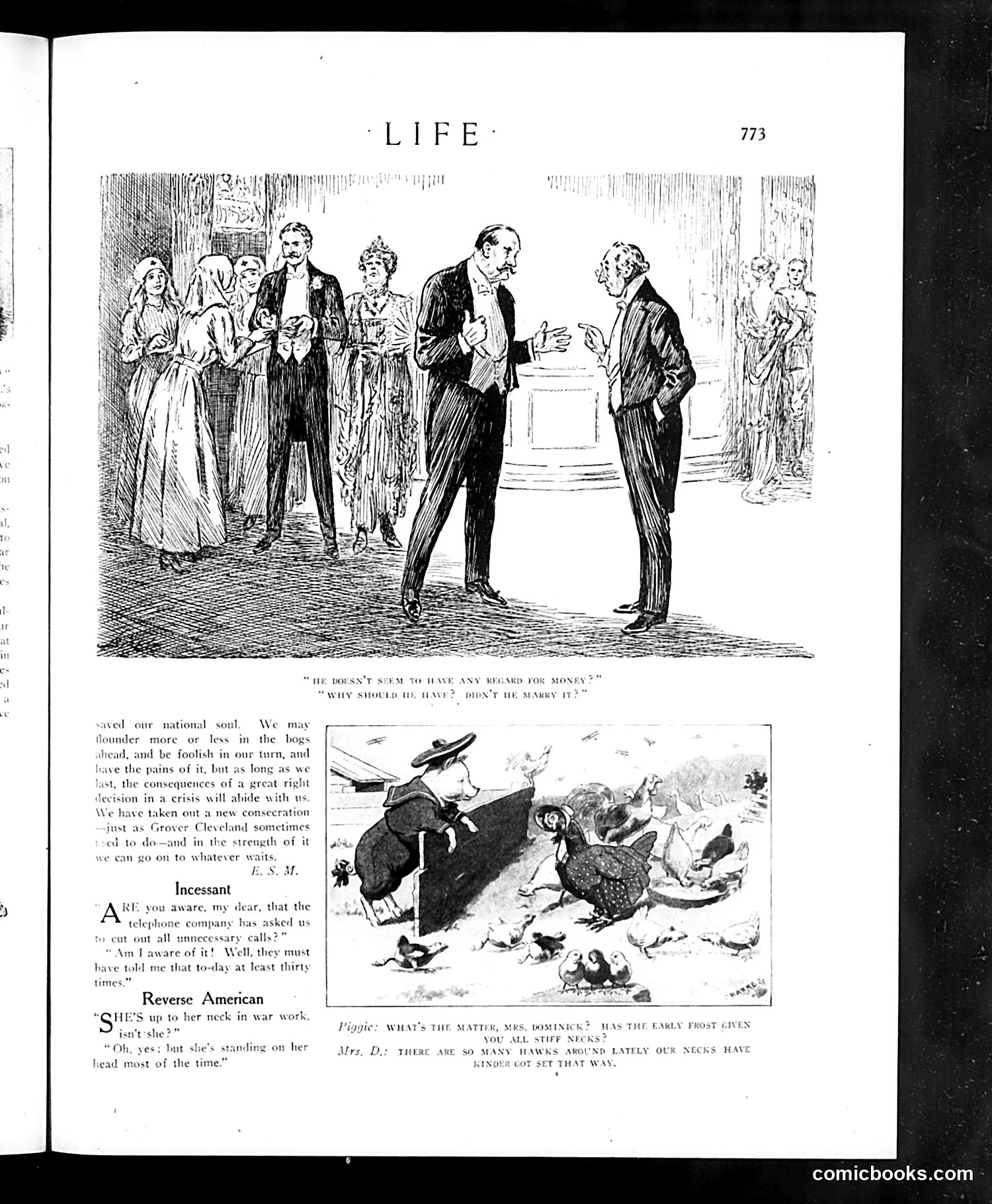
**Top Cartoon:** Shows two men in formal dress debating while a group observes. The caption reads: "HE DOESN'T SEEM TO HAVE ANY REGARD FOR MONEY." "WHY SHOULD HE HAVE? DIDN'T HE MARRY IT?" This satirizes a wealthy marriage of convenience, likely referencing society scandals of the era where men married women for their family fortunes rather than love. **Bottom Section:** Contains two brief humor pieces titled "Incessant" and "Reverse American," followed by an illustration showing people in winter clothing with the caption about Mrs. Dominick and early frost, discussing hawks and stiff necks. The specific historical references and identities of the figures remain unclear without additional context about Life magazine's publication date.
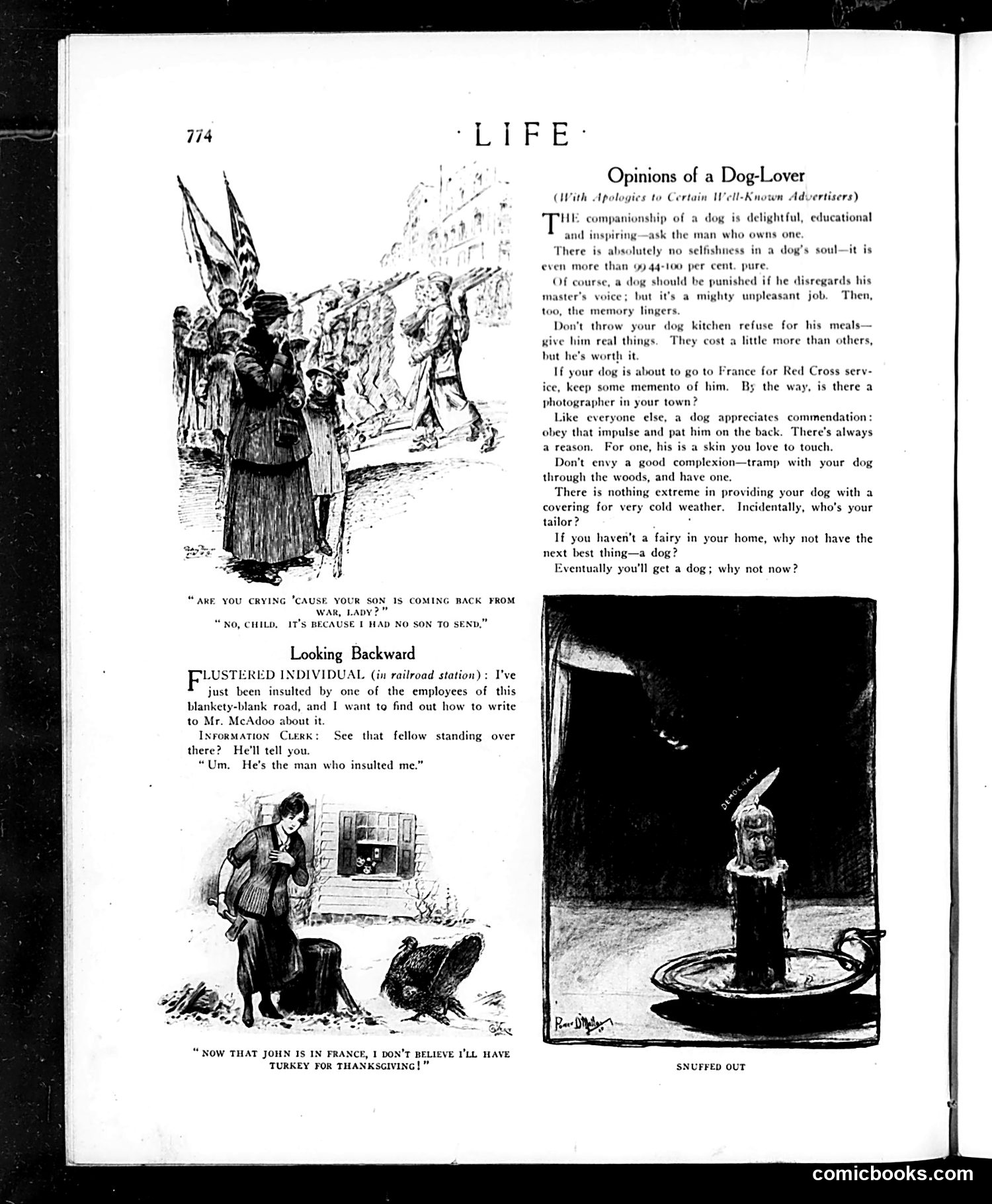
This page contains two unrelated humor pieces: **"Opinions of a Dog-Lover"** is an advice column humorously presenting pro-dog arguments, including recommendations to feed dogs well, provide winter coverings, and acquire a dog as a substitute for a fairy godmother. The tone is lighthearted advocacy. **"Looking Backward"** depicts a railroad station scene where a flustured individual seeks to file a complaint against an employee who insulted him. An information clerk points out the offender. Below, a separate cartoon shows a woman with luggage saying "Now that John is in France, I don't believe I'll have turkey for Thanksgiving!"—likely referencing soldiers serving in World War I. The "Snuffed Out" illustration (right) shows a candle being extinguished, its meaning unclear from this page alone.
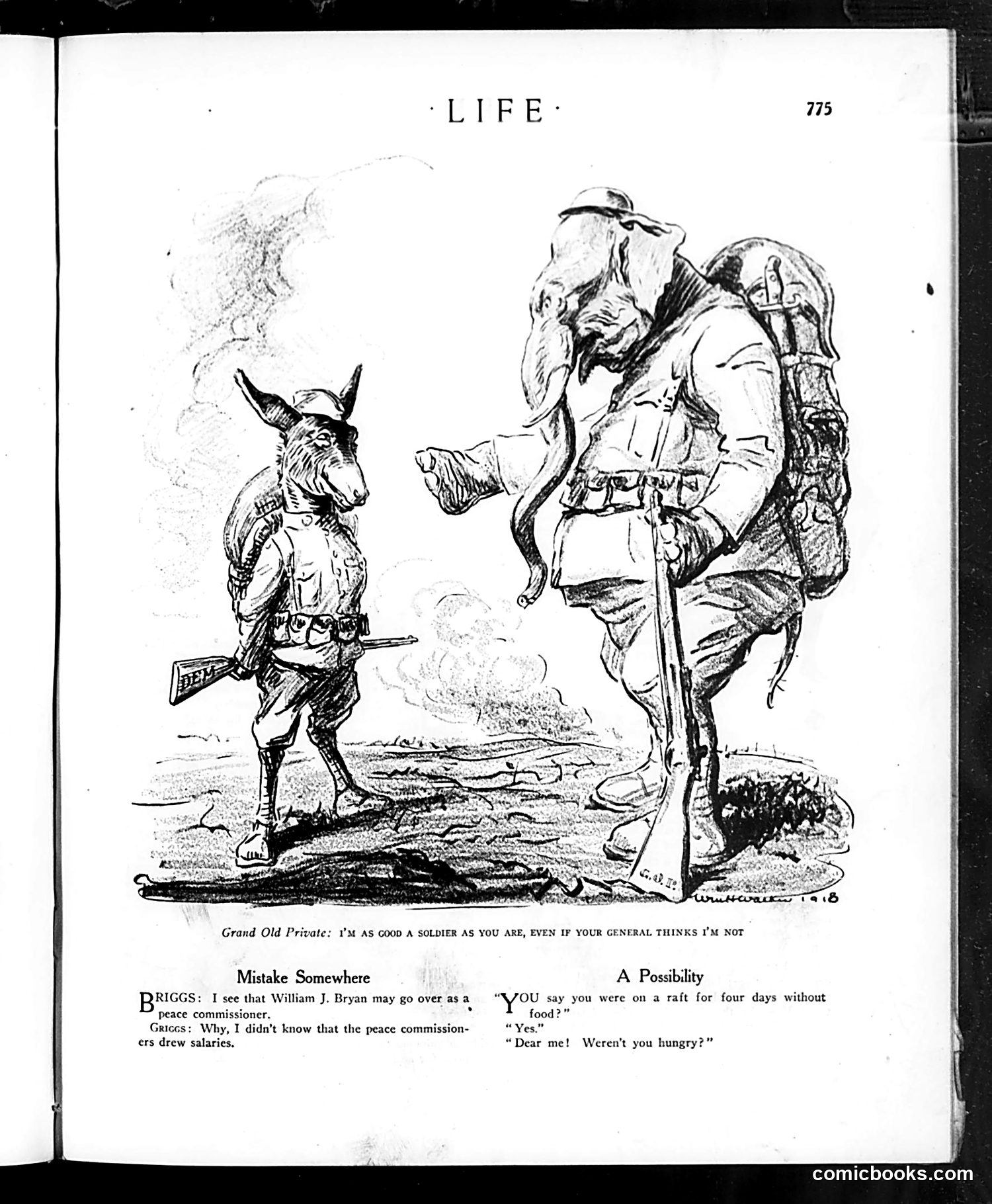
This page contains satirical commentary on American politics during World War I era. The main cartoon depicts an anthropomorphized goat (representing a soldier) confronting a tall military officer, with the caption "Grand Old Private: I'M AS GOOD A SOLDIER AS YOU ARE, EVEN IF YOUR GENERAL THINKS I'M NOT." Below are two brief satirical pieces: "Mistake Somewhere" mocks William Jennings Bryan's possible appointment as peace commissioner, joking that peace commissioners apparently drew salaries—suggesting Bryan pursued the unpaid role for financial gain. "A Possibility" is a brief comedic dialogue about someone who survived four days without food, questioning whether hunger would affect them. The cartoon likely critiques military hierarchy and favoritism during wartime.
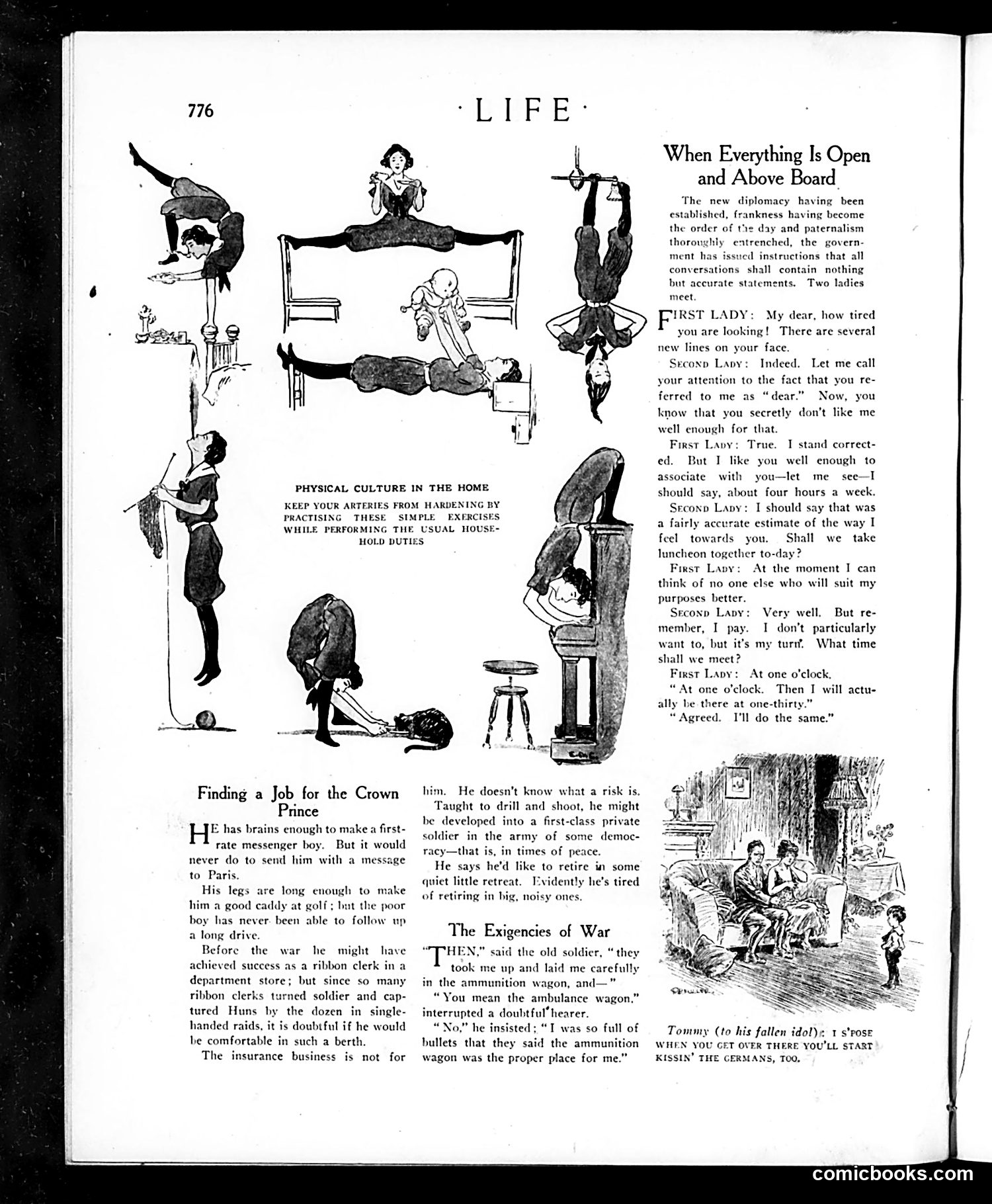
This page contains three satirical pieces from the post-WWI era: **"Physical Culture in the Home"** (left) mocks the exercise craze of the 1920s, showing exaggerated gymnastics that appear absurd and impractical for domestic spaces. **"When Everything Is Open and Above Board"** (top right) satirizes post-war "new diplomacy" through a conversation between two society ladies. The Second Lady pointedly mentions the First Lady's "dear," implying infidelity while discussing lunch plans—mocking how polite society conducts gossip under a veneer of propriety and honesty. **"Finding a Job for the Crown Prince"** and **"The Exigencies of War"** (bottom) appear to reference post-war unemployment and veterans' difficulties adjusting to civilian life, with darkly comic observations about military experience.
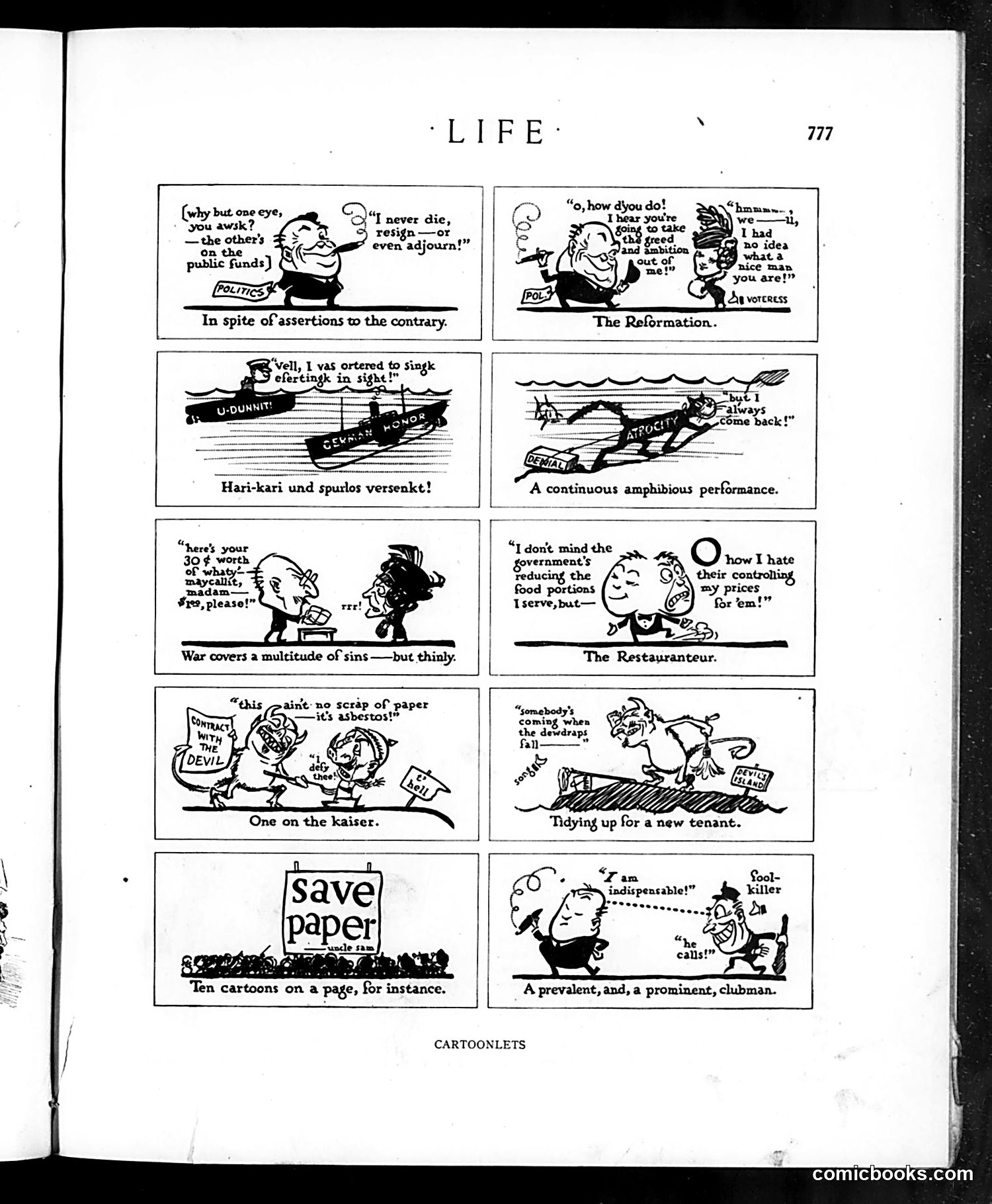
This page collects ten brief satirical cartoons addressing WWI-era politics and social conditions: **Political/Social Targets:** - Politicians denying resignation despite public pressure ("In spite of assertions to the contrary") - German military reversals ("Hari-kari und spurlos verseckt!"—suggesting German defeat) - Government food rationing and restaurateurs' price-gouging during wartime - Wartime corruption and profiteering ("War covers a multitude of sins") - Paper conservation efforts ("Save paper" campaign) - A prominent public figure's contradictory statements ("A prevalent, and a prominent, clubman") **Style:** The cartoons use exaggerated caricature and visual metaphor typical of 1910s satirical cartooning. The humor relies on recognizing current events and public figures of the period, though specific identities aren't labeled. Overall, the page critiques wartime government incompetence, black-market profiteering, and political hypocrisy.
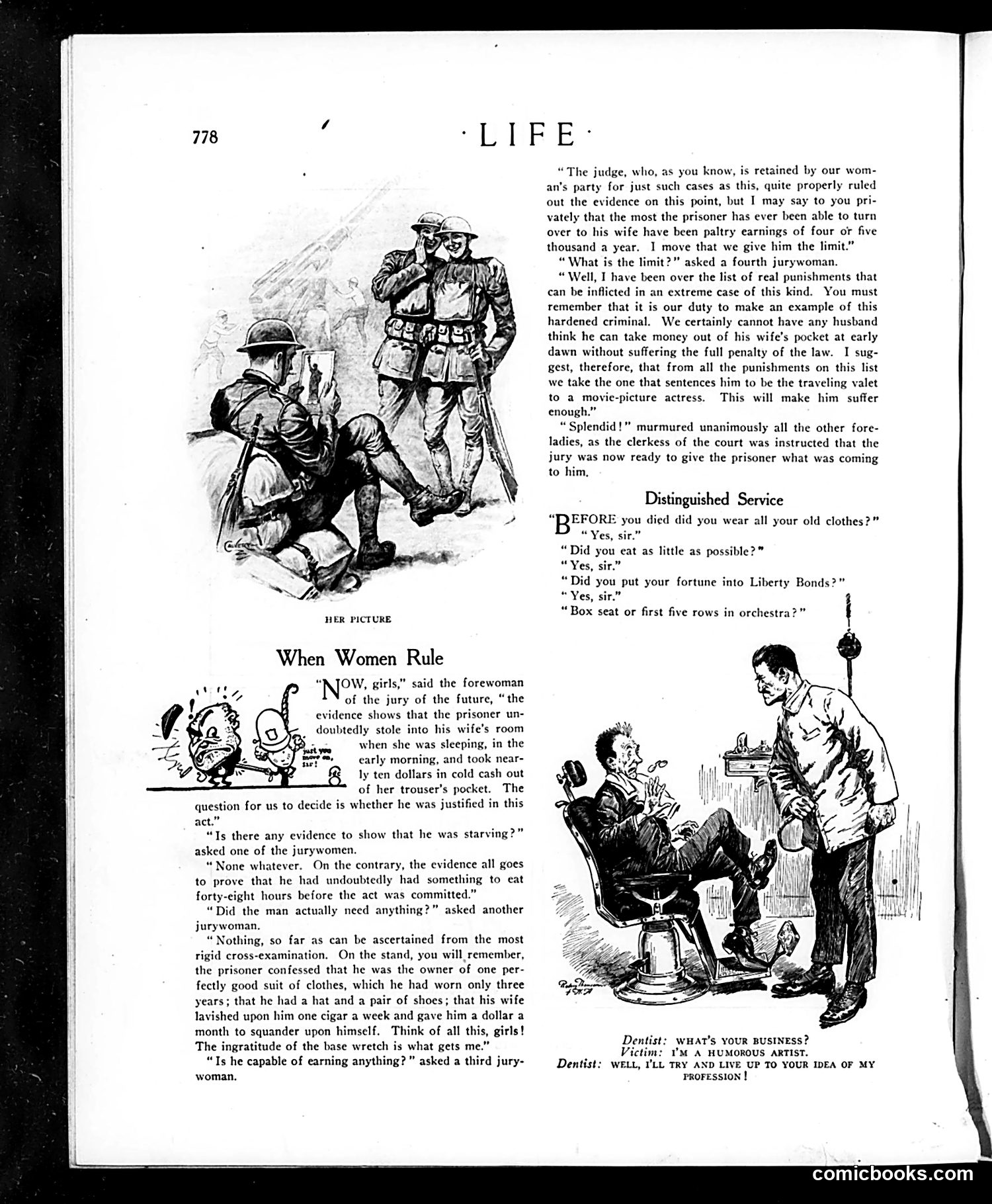
This page satirizes a court case where a woman's jury decides a man's punishment. The top section shows soldiers, relating to World War I-era "Liberty Bonds" references in the dialogue. The main cartoon "When Women Rule" depicts a jury trial where women jurors determine a defendant's sentence. The prisoner allegedly stole money from his wife's pocket while she slept. The satire mocks the potential severity of female jurors toward a man who financially exploited his wife—suggesting women might impose harsh punishment (sentencing him to be a "valet to a movie-picture actress"). The bottom cartoon "Distinguished Service" depicts a dentist interrogating a patient about wartime sacrifices (wearing old clothes, eating little, buying Liberty Bonds, attending orchestra). The joke criticizes the dentist's pretentious moralizing while performing routine dental work. Both cartoons satirize post-WWI American social attitudes and gender dynamics.
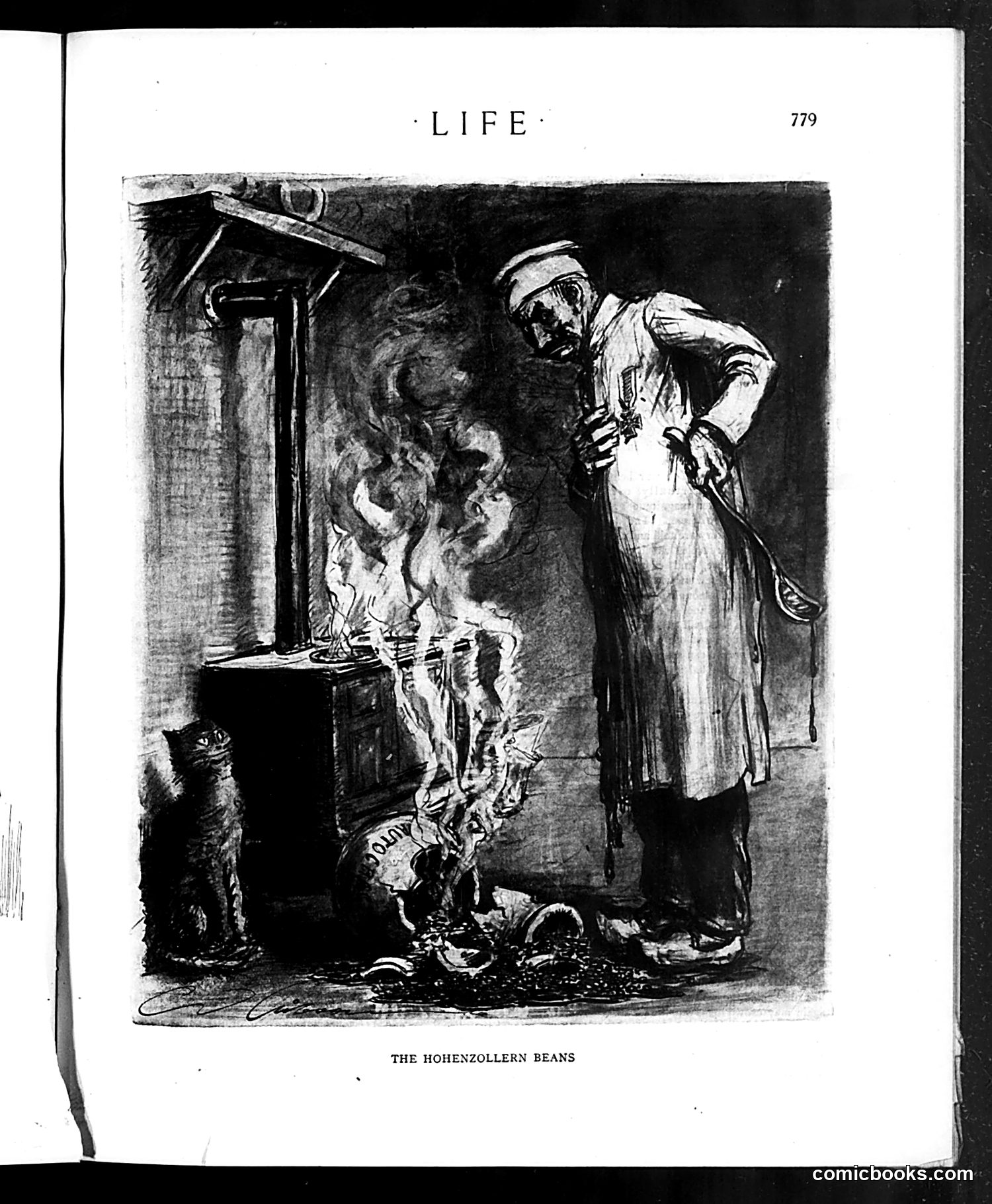
This satirical illustration depicts a cook or chef (right) tending to a pot on a stove, where flames and smoke emerge. The caption "The Hohenzollern Beans" references the German royal family, the House of Hohenzollern, which ruled Prussia and the German Empire. The cartoon appears to be World War I-era satire, using the metaphor of "cooking" or "heating up" Hohenzollern beans to mock German leadership and military actions. The dramatic flames suggest destruction or conflict. The chef's attentive posture implies careful management of this dangerous situation. The exact historical moment is unclear without additional context, but the image likely satirizes German imperial ambitions or military conduct during WWI through this culinary metaphor.
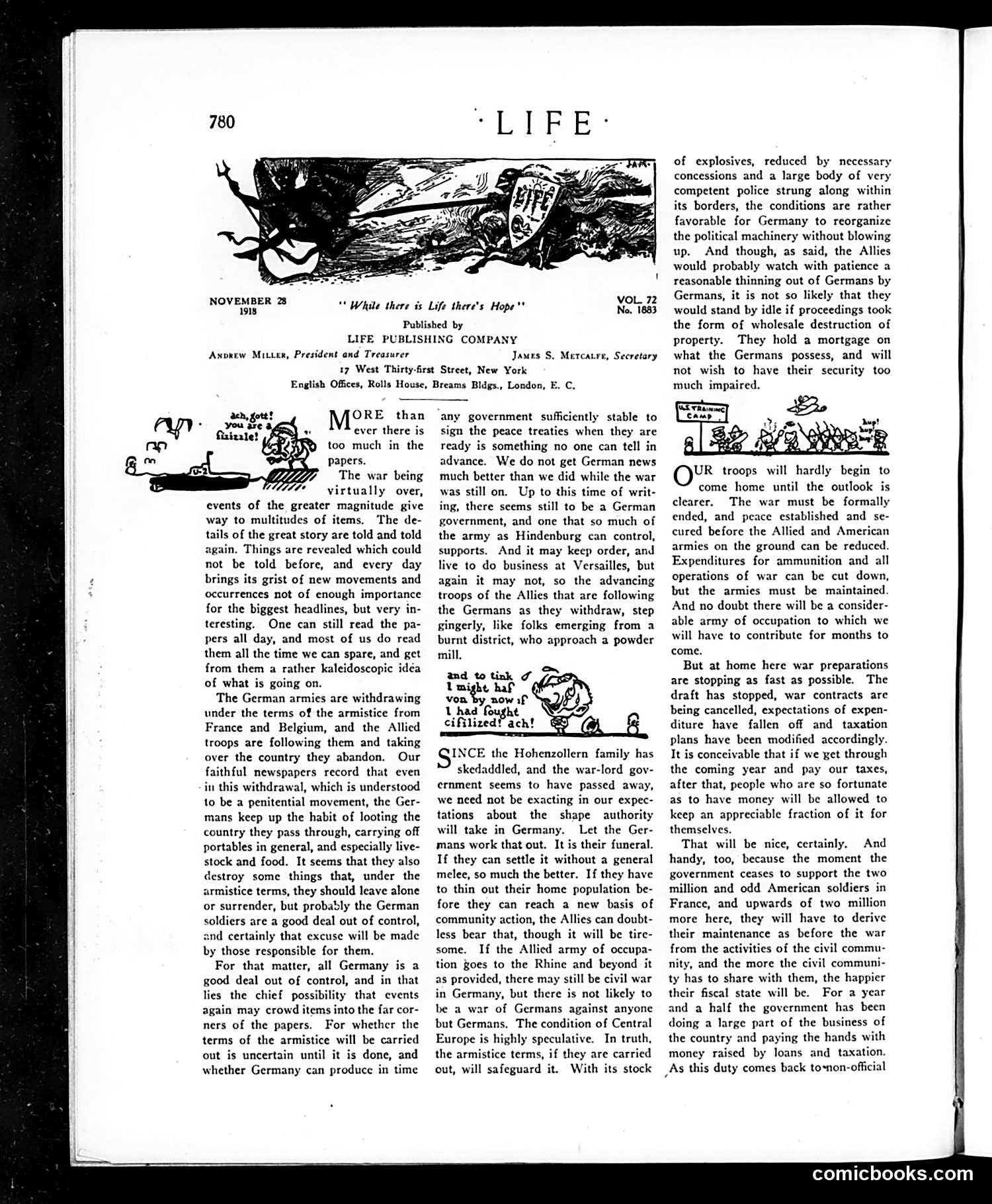
This page comments on Germany's uncertain political future following the November 11, 1918 armistice ending World War I. The editorial warns that Germany remains unstable and "out of control"—the Kaiser's government has fallen, but it's unclear what authority will replace it. The small cartoon (bottom left) depicts a German soldier lamenting lost plunder: "and to tink I might haf von fort / I had fought / 'cifilized' ach!"—mocking German claims to civilization while noting Allied reports that withdrawing German troops continued looting France and Belgium despite armistice terms. The main concern is whether Germany can produce a stable government to negotiate peace treaties, or whether internal chaos—even civil war—might erupt. The text compares Allied forces cautiously following Germans to people "emerging from a burnt district, who approach a powder mill"—suggesting volatile danger ahead.
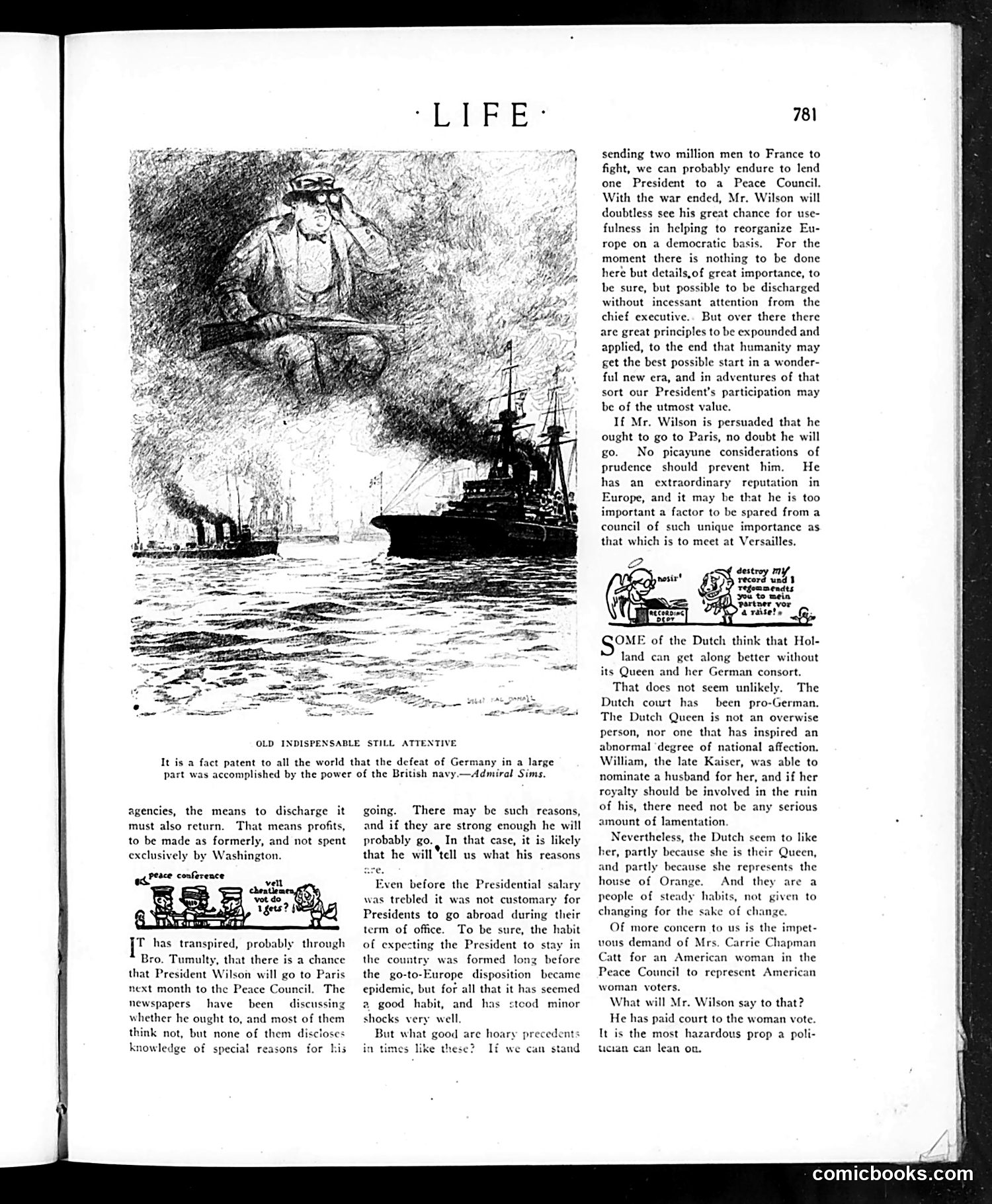
This page contains editorial commentary on post-WWI politics, not traditional cartoons. **Main Topics:** 1. **Wilson at the Peace Council**: The article debates whether President Wilson should attend the Paris Peace Conference (Versailles). It argues he should go, claiming his European reputation makes him valuable despite breaking precedent of Presidents staying home during their term. 2. **The Dutch Queen**: Commentary suggests Holland might benefit from removing its Queen and her "German consort" (husband), given the Dutch court's pro-German sympathies during the war. However, the Dutch people's loyalty to the Orange dynasty likely prevents this. 3. **Women's Representation**: The article addresses activist Carrie Chapman Catt's demand that an American woman represent female voters at the Peace Council. It characterizes this as a political liability Wilson must navigate, calling women's votes "the most hazardous prop a politician can lean on"—reflecting contemporary anxiety about newly enfranchised female voters. The small illustration shows a British warship, supporting Admiral Sims's quote crediting the British Navy with Germany's defeat.
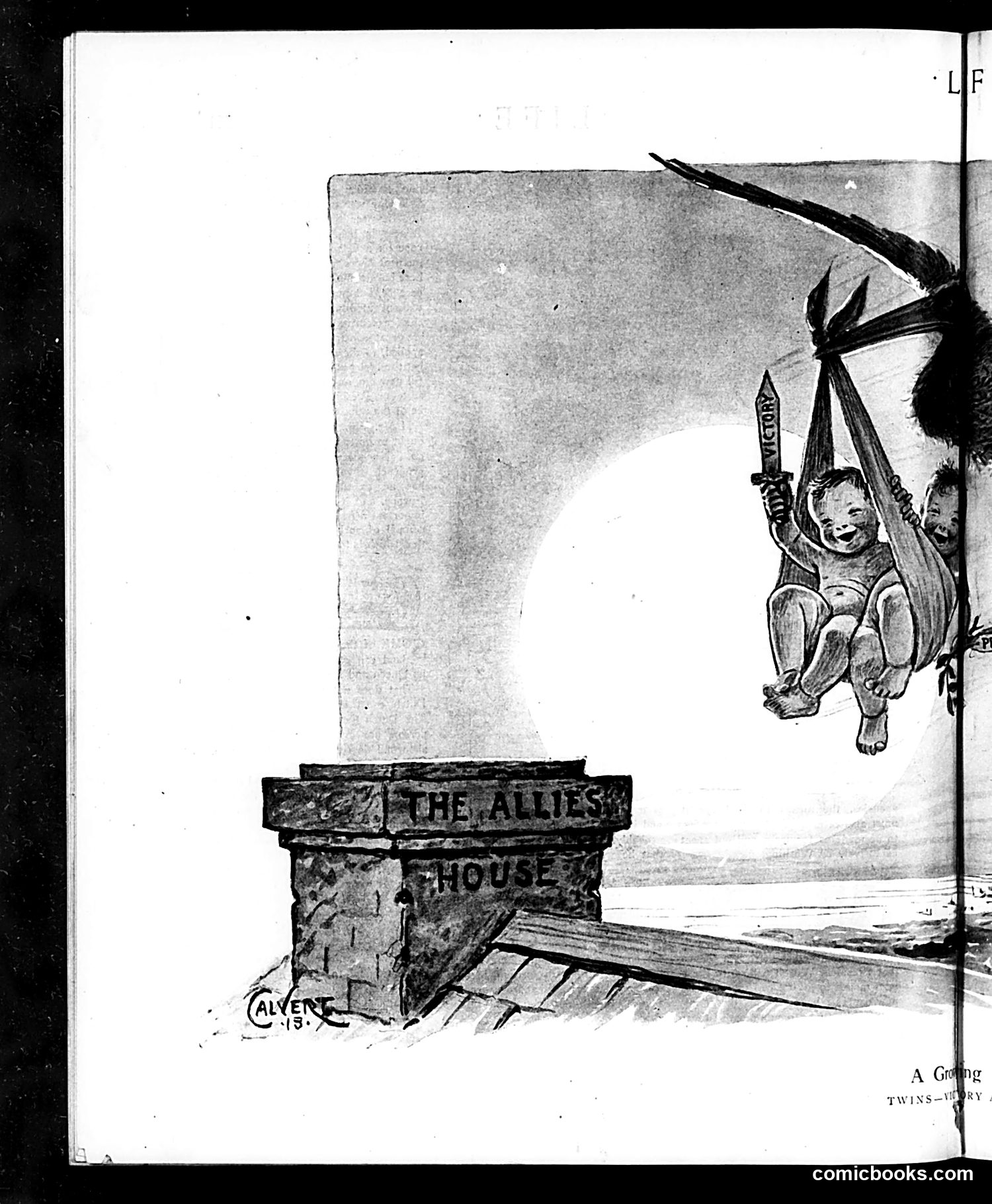
This appears to be a title page or illustration from *Life* magazine (a satirical publication). The artwork, signed "Calvere" and dated 1913, depicts cherubic figures (possibly representing Allied nations or allies) suspended in a hot air balloon or airship basket against a large moon. One figure wields a sword or dagger. The prominent text reads "THE ALLIES HOUSE," suggesting this relates to World War I era politics—likely satirizing the Allied powers (primarily Britain, France, and Russia at that time). The celestial setting and martial imagery appear to comment on the ambitions or precarious position of the Allied coalition. The exact satirical point remains somewhat unclear without additional context, but it likely critiques allied war aims or unity.
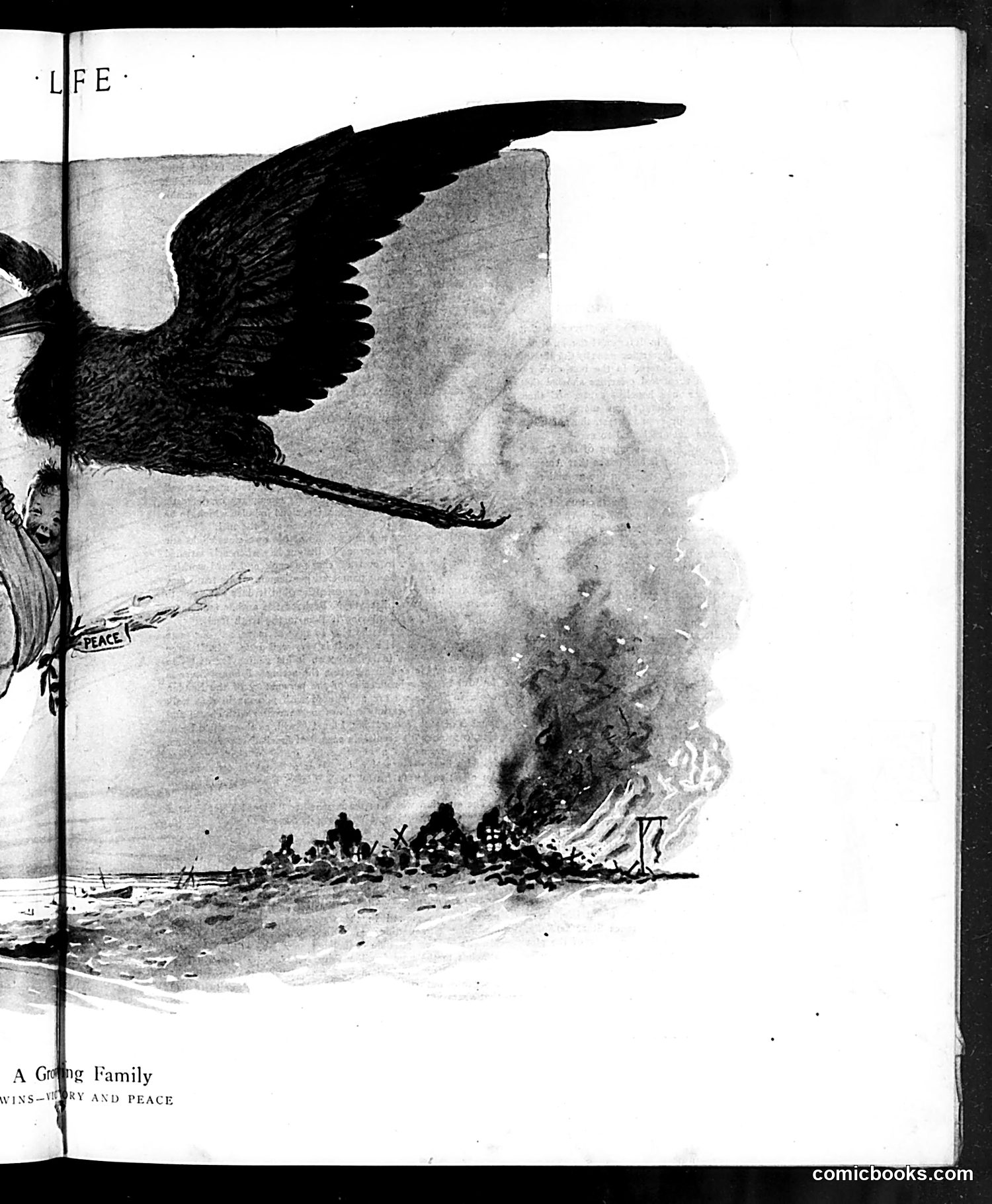
This appears to be a political cartoon from *Life* magazine satirizing militarism and war profiteering. The image shows a large bird (likely an eagle, symbol of America) with an olive branch labeled "PEACE" in its beak, hovering over a scene of destruction—burning buildings and refugees or casualties below. The title "A Glowing Family" combined with the subtitle "WINS—GLORY AND PEACE" suggests bitter irony: the cartoon critiques how war is marketed as bringing glory and peace while actually delivering death and devastation. The "glowing" family appears to reference those who profit from or celebrate warfare, indifferent to human suffering depicted in the burning wreckage below. This reflects anti-war sentiment, likely from the World War I era or its aftermath.
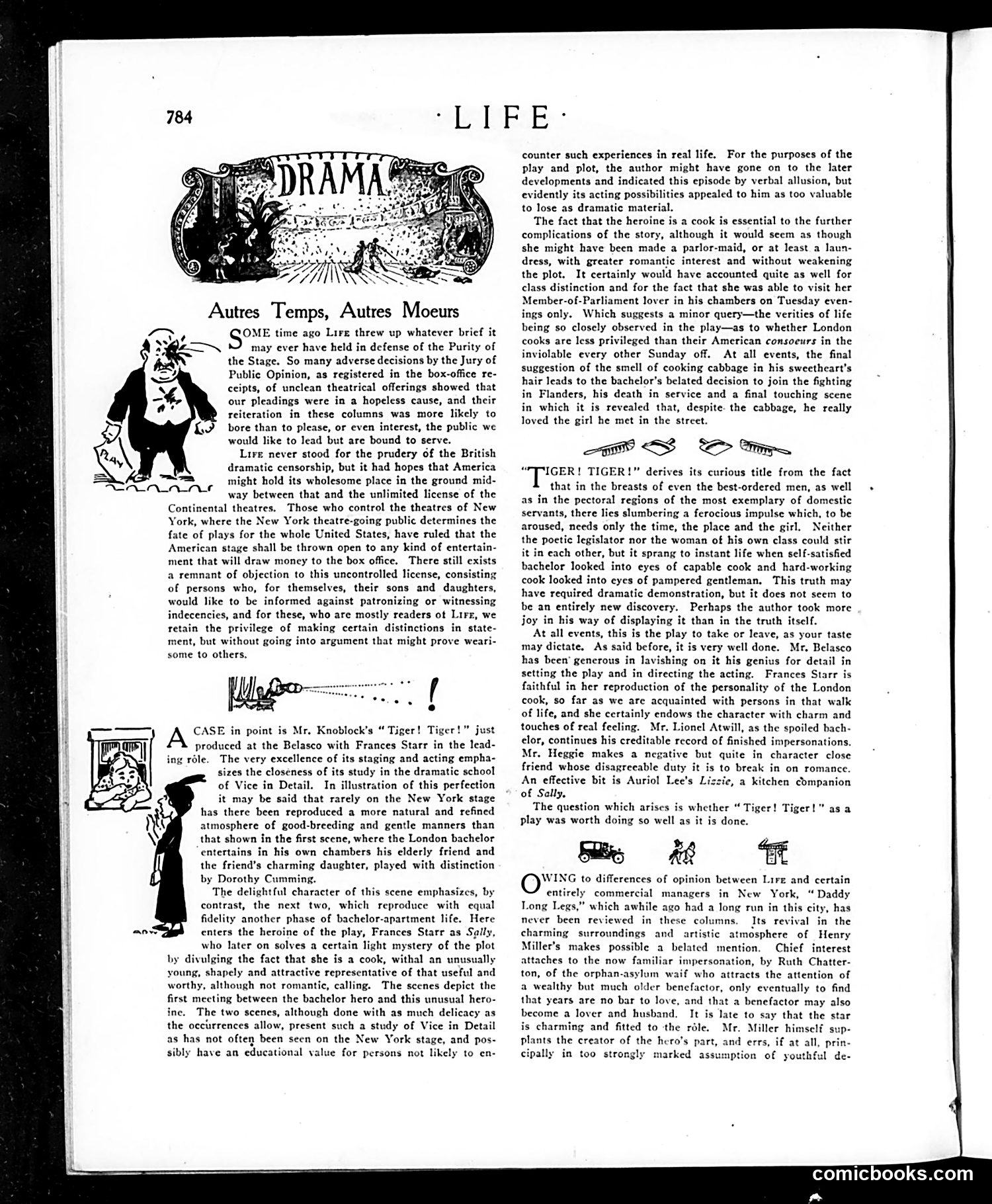
This page reviews Mr. Knoblock's play "Tiger! Tiger!" starring Frances Starr at the Belasco Theatre. The cartoon (top left) depicts a disheveled figure, likely representing theatrical "vice" or moral looseness. **The satire's target:** Life critiques the American theater's abandonment of decency standards. The magazine notes it once defended "purity of the stage" but surrenders, observing that box-office receipts show audiences prefer "unclean theatrical offerings." **The specific complaint:** The play depicts a London bachelor entertaining a young cook in his chambers across multiple scenes. While Life acknowledges the sophisticated staging, it objects that the heroine's profession as a cook seems unnecessarily chosen—a parlor-maid or laundress would serve the plot while carrying less suggestive implications about her presence in his private rooms. **The irony:** Life sarcastically notes the scenes have "educational value for persons not likely to encounter such experiences in real life"—mocking how theaters justify morally questionable content as dramatically essential rather than gratuitously sensational.
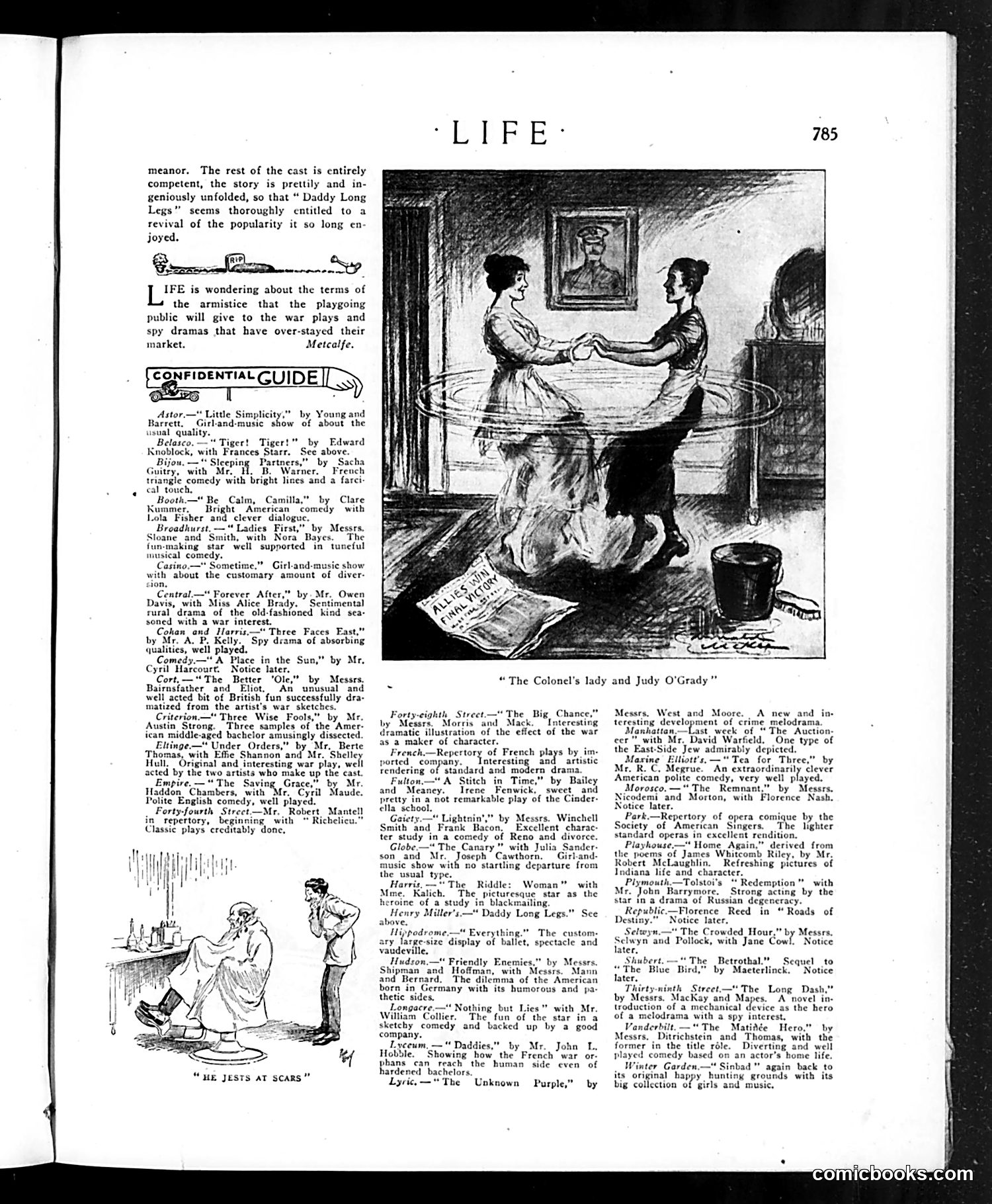
This is a theater review section from Life magazine's "Confidential Guide" to Broadway shows. The two illustrations satirize wartime theater audiences and romantic melodrama. The upper cartoon, captioned "The Colonel's lady and Judy O'Grady," depicts two women in a domestic interior—likely a scene from a play—emphasizing sentimental drama. The lower cartoon, "He Jests at Scars," shows a man and woman in what appears to be a comedic domestic moment, probably illustrating theatrical farce or romantic comedy. The text's opening comment is key: Life's editor wonders what "armistice" or truce the theater-going public will grant to "war plays and spy dramas that have over-stayed their market"—suggesting audiences are exhausted by the glut of wartime-themed productions. The reviews list numerous shows, many explicitly about war, espionage, or soldiers, indicating how thoroughly World War I had saturated American theater by this period.
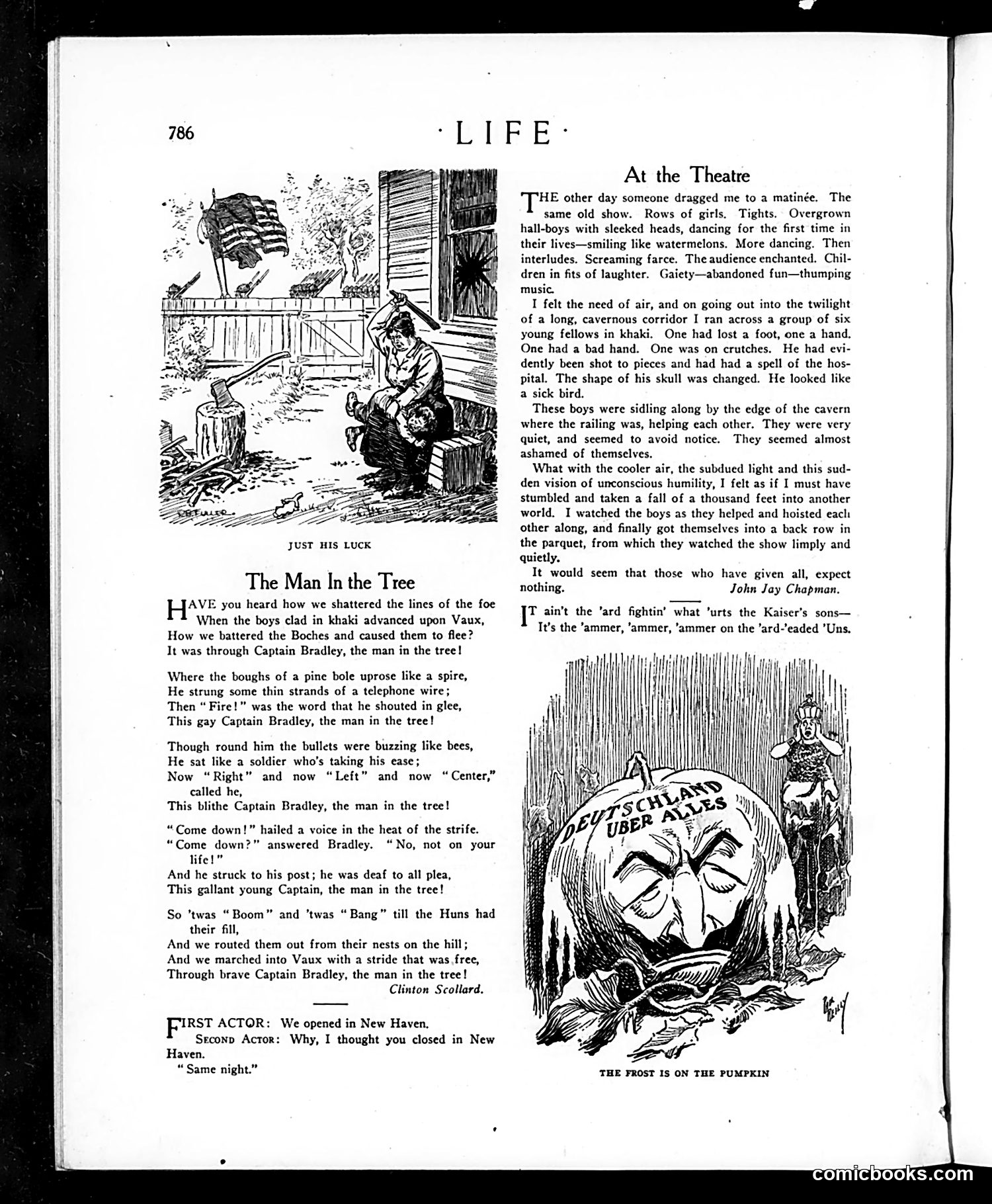
**"The Man in the Tree"** is a patriotic WWI poem celebrating Captain Bradley's heroism during the Battle of Vaux (1918). He directs artillery fire from a tree using telephone wire, refusing to abandon his post despite enemy fire. The poem glorifies his sacrifice and courage. **"At the Theatre"** offers sharp social satire. The narrator attends a frivolous theatrical matinee, then encounters six wounded soldiers in the corridor—amputees and shell-shocked veterans, visibly damaged and humble. The contrast is devastating: while civilians enjoy mindless entertainment, these men have sacrificed everything and ask for nothing. The piece indicts wartime society's disconnect between comfortable home-front life and the actual cost of combat. **The cartoon** "The Frost is on the Pumpkin" appears to be anti-German propaganda, showing a grotesque caricatured German face labeled "Deutschland Über Alles" (Germany Above All). It suggests German ambitions are withering or dying—"frost" suggests decay. Together, these pieces reflect 1918 wartime messaging: celebrating military heroism while subtly criticizing civilian indifference to veterans' suffering.
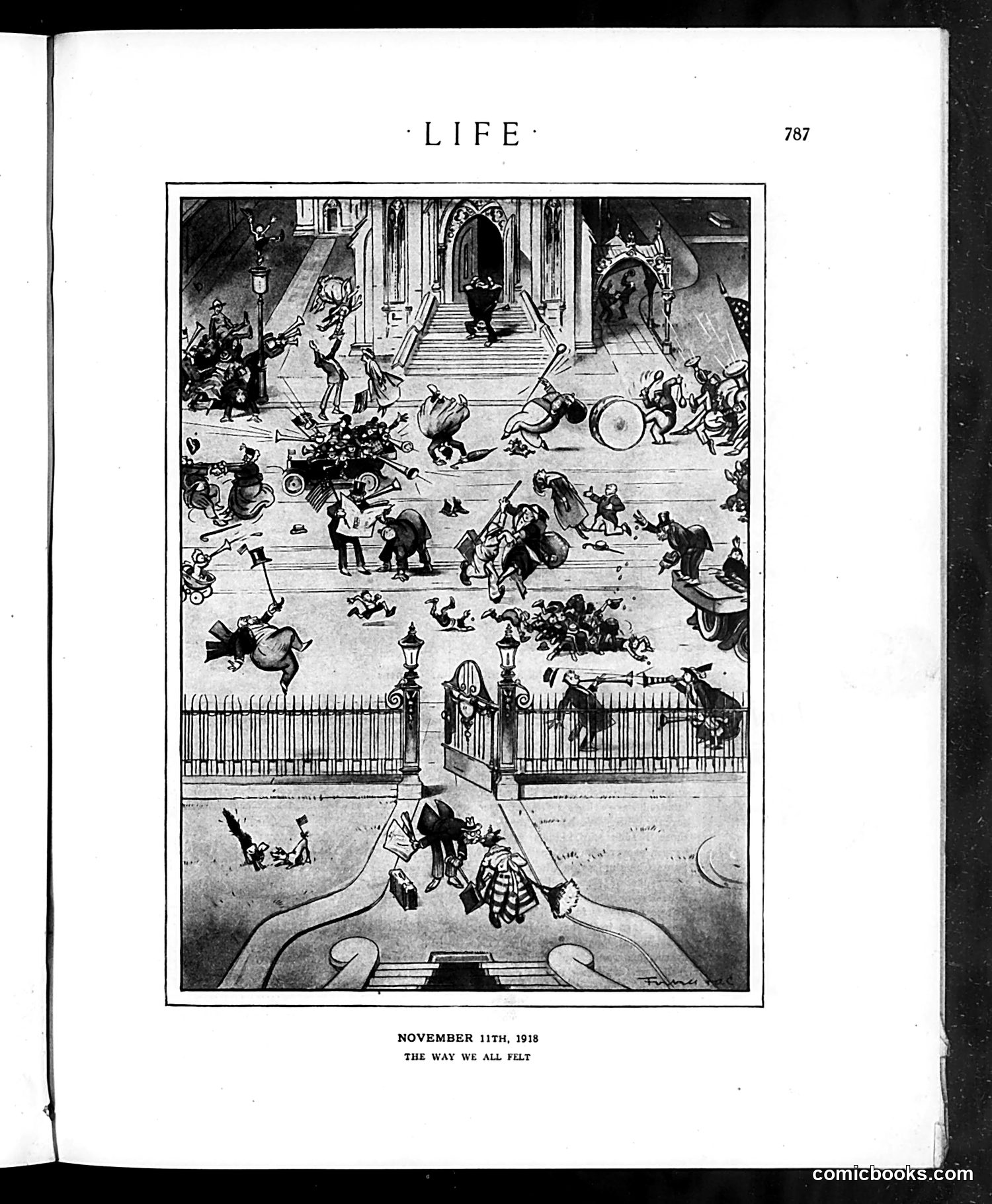
This Life magazine cartoon celebrates Armistice Day, marking the end of World War I. The image depicts chaotic public jubilation in what appears to be a grand plaza or public square—crowds of people dancing, celebrating, and generally abandoning decorum in wild celebration. The cartoon satirizes the explosive emotional release that swept America and Allied nations when fighting ceased. The architectural setting suggests an official or dignified space now overrun by uninhibited revelry. The composition's busy, frenzied nature—with figures tumbling, leaping, and gesticulating wildly—visually conveys the abandonment of normal social restraint. The caption "The Way We All Felt" indicates this captures the universal national mood of joy and relief at war's end, making the cartoon a document of genuine historical emotion rather than political critique. It's celebratory rather than satirical, reflecting the era's optimism about the war's conclusion.
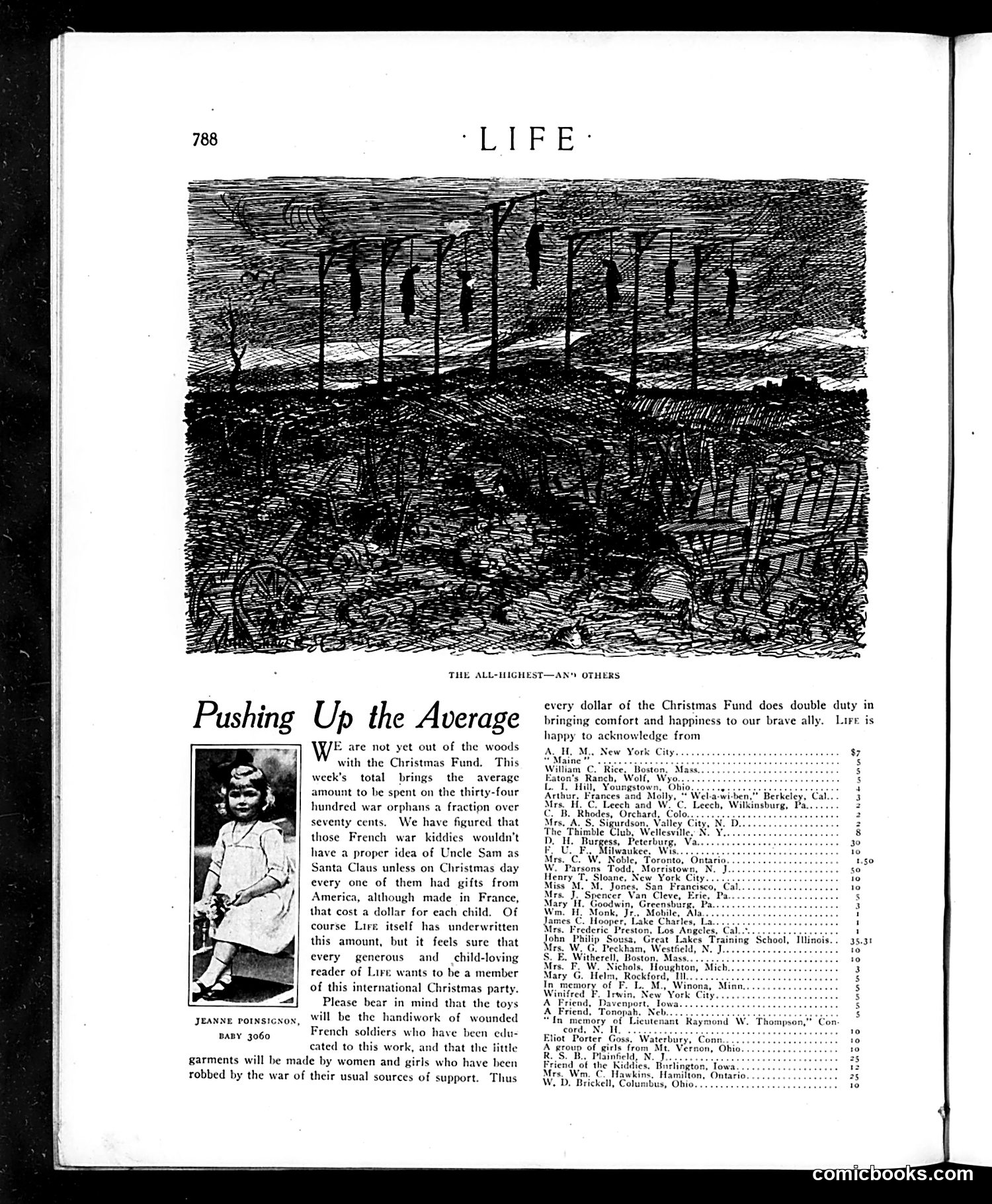
This page solicits donations for a Christmas Fund supporting French war orphans from WWI. The headline references the "All-Highest" (Kaiser Wilhelm II), sarcastically suggesting Americans should help children victimized by his war. The article states the goal: one dollar per child for 3,400 French orphans, currently averaging only seventy cents. Life appeals to readers' patriotism and generosity by emphasizing that toys will be handmade by wounded French soldiers and garments by war-widowed women—adding moral purpose to donations. The image shows a French war orphan (labeled "Baby 3060"), making the need concrete and personal. The accompanying list documents hundreds of contributors, using social pressure and gratitude acknowledgment to encourage further giving. This reflects post-WWI American philanthropic efforts and Life magazine's role as both satirist and advocate for international relief causes.
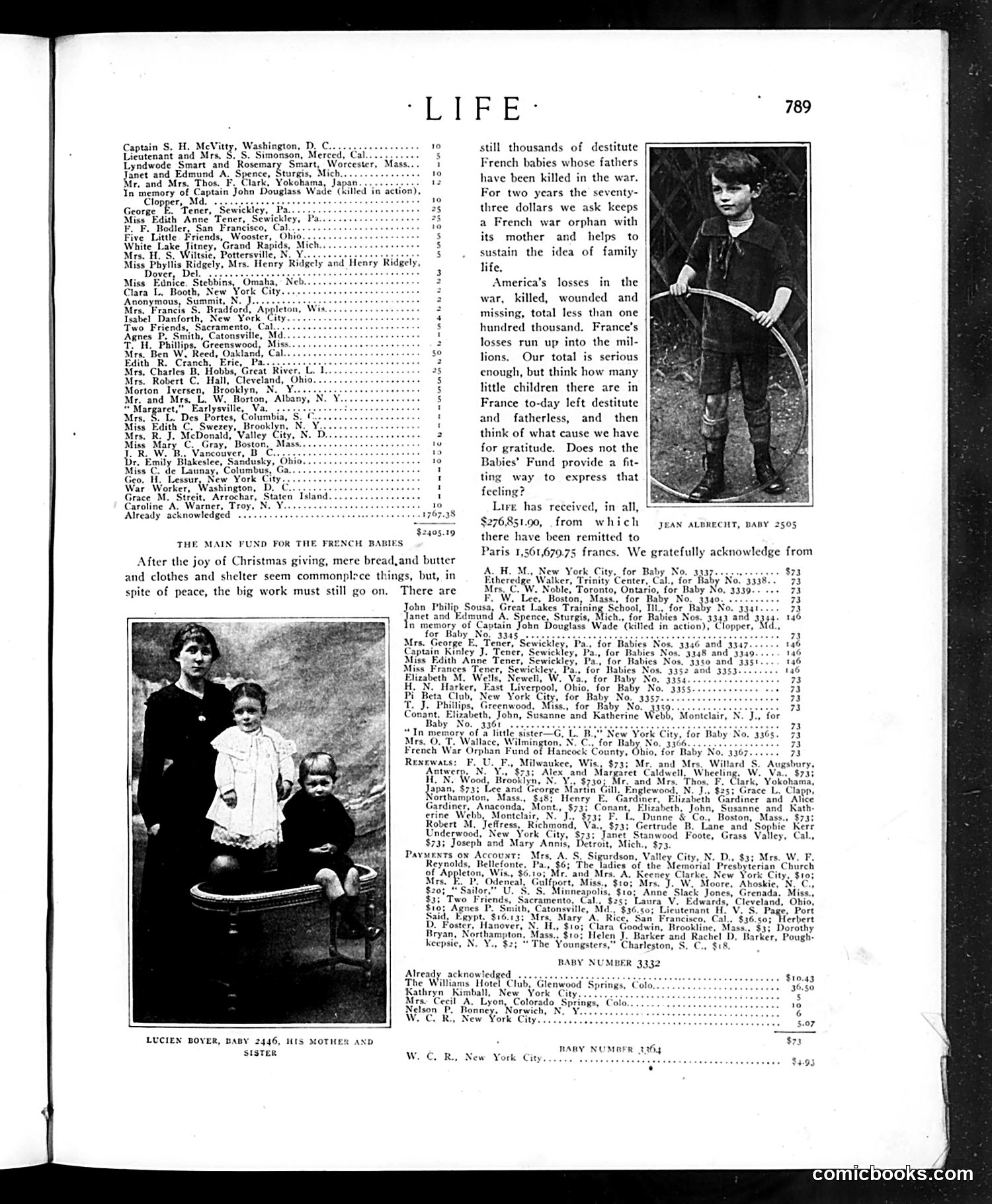
This page documents donations to a charity fund supporting French war orphans during or shortly after World War I. The bulk of the content is a list of donors' names and amounts contributed. The two photographs illustrate the fund's purpose: images of young children—identified as "Lucien Boyer, Baby 2446, his mother and sister" and "Jean Albrecht, Baby 2505"—represent the French war orphans being helped. The accompanying text explains that thousands of French children lost fathers in the war, and that seventy-three dollars annually sustains one orphan with its mother. The passage contrasts America's war losses ("less than one hundred thousand") with France's losses running "into the millions," arguing this disparity makes American donors morally obligated to support French orphans as an expression of gratitude for America's relatively lighter sacrifice. This is essentially a fundraising appeal dressed in patriotic and humanitarian language.
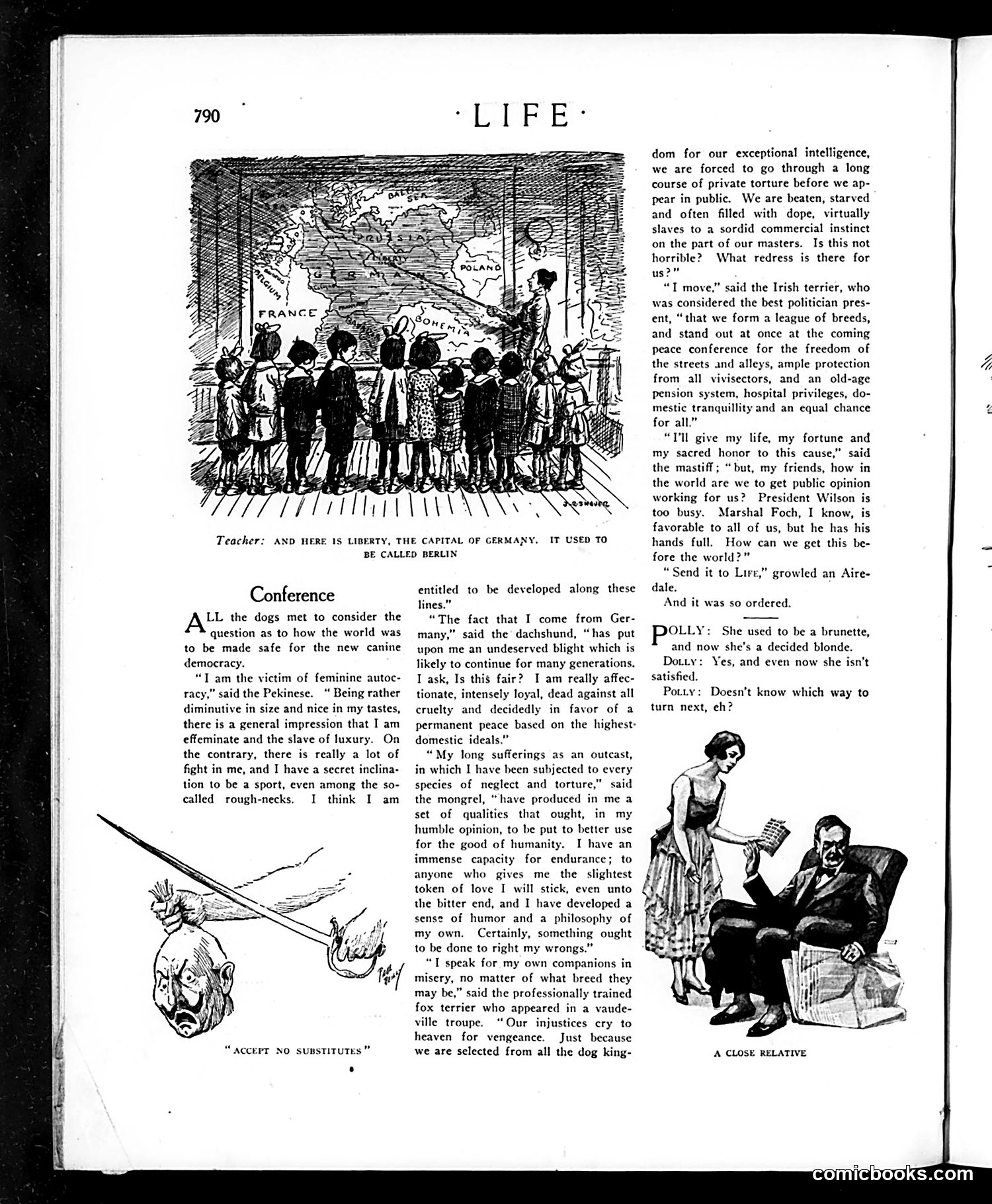
This page satirizes post-World War I peace negotiations through an allegorical "dog conference." Dogs of different breeds represent nations negotiating at what appears to be the Paris Peace Conference (circa 1919). **Key figures/references:** - The dachshund represents Germany, suffering "undeserved blight" from its nationality despite claiming peaceful intentions - The mongrel represents oppressed populations generally - The trained fox terrier speaks for exploited laborers/colonized peoples subjected to "torture" - The Irish terrier acts as pragmatic politician proposing a "league of breeds" (likely referencing the League of Nations) - References to "President Wilson" and "Marshal Foch" anchor this to actual WWI peace negotiations **The satire's point:** The dogs naively believe they can appeal to world leaders busy with actual war aftermath. The final panel joke ("Send it to Life") is meta-satirical—even satirical magazines can't influence major powers. The top cartoon mocking renamed "Liberty" (formerly Berlin) emphasizes Allied propaganda renaming German concepts as "freedom."
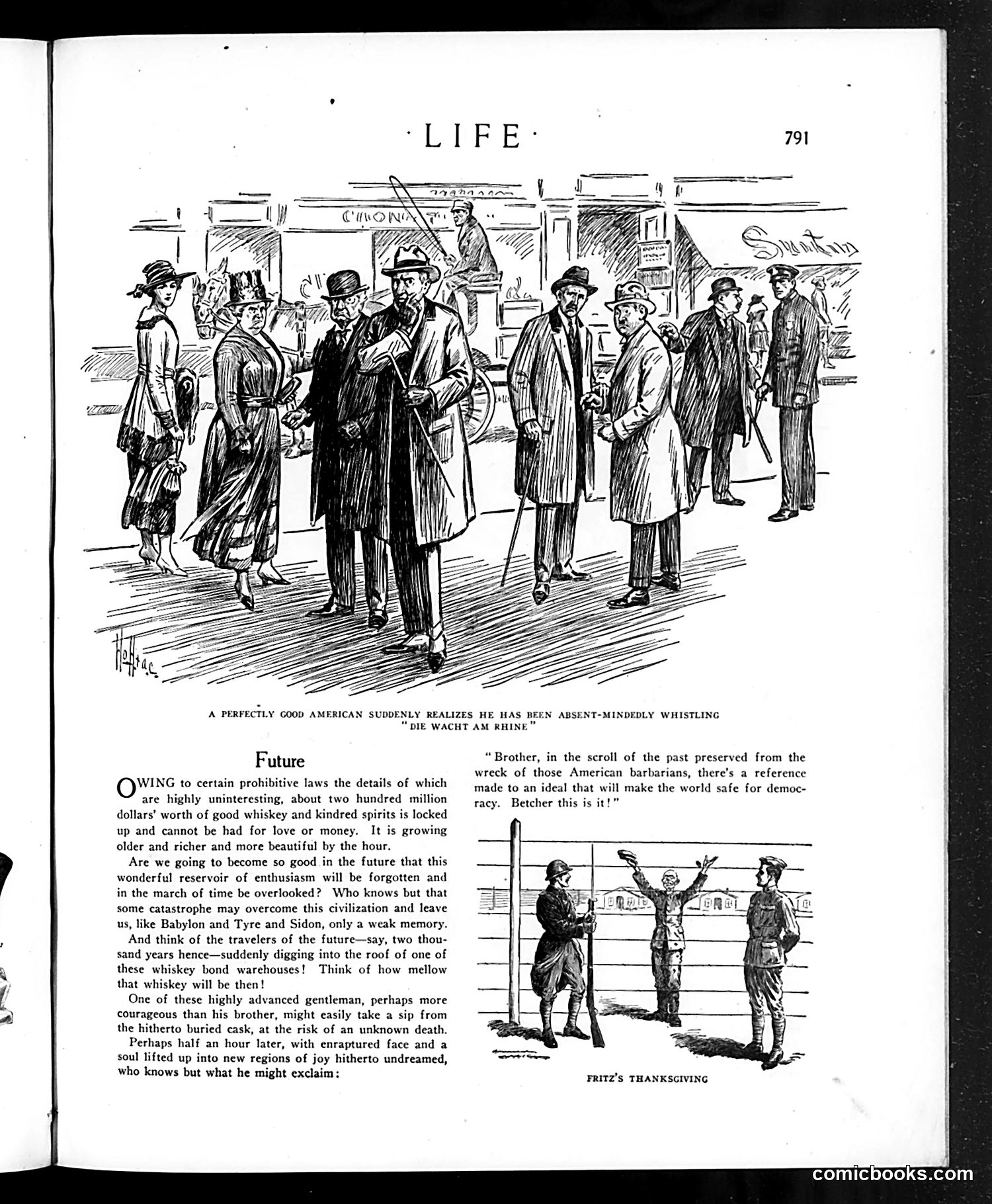
This 1920s Life magazine page satirizes Prohibition and German-American identity during the post-WWI era. **Top cartoon:** A man realizes he's been absent-mindedly whistling "Die Wacht am Rhein" (a German patriotic song). The joke targets German-Americans who, despite Prohibition's passage and post-war anti-German sentiment, unconsciously retain German cultural habits—presenting them as absurdly un-American. **"Future" essay:** Dark satire imagining future archaeologists discovering hidden whiskey caches from Prohibition warehouses. The final illustration labeled "Fritz's Thanksgiving" appears to show a German character celebrating with the discovery, reinforcing the stereotype. The essay sarcastically suggests future civilization might worship recovered whiskey as sacred—mocking both Prohibition's "barbaric" suppression of alcohol and the era's German-American othering by naming the character "Fritz," a common German name stereotype. The page reflects 1920s anxieties about immigrant assimilation and the ongoing cultural suspicion of German-Americans following World War I.
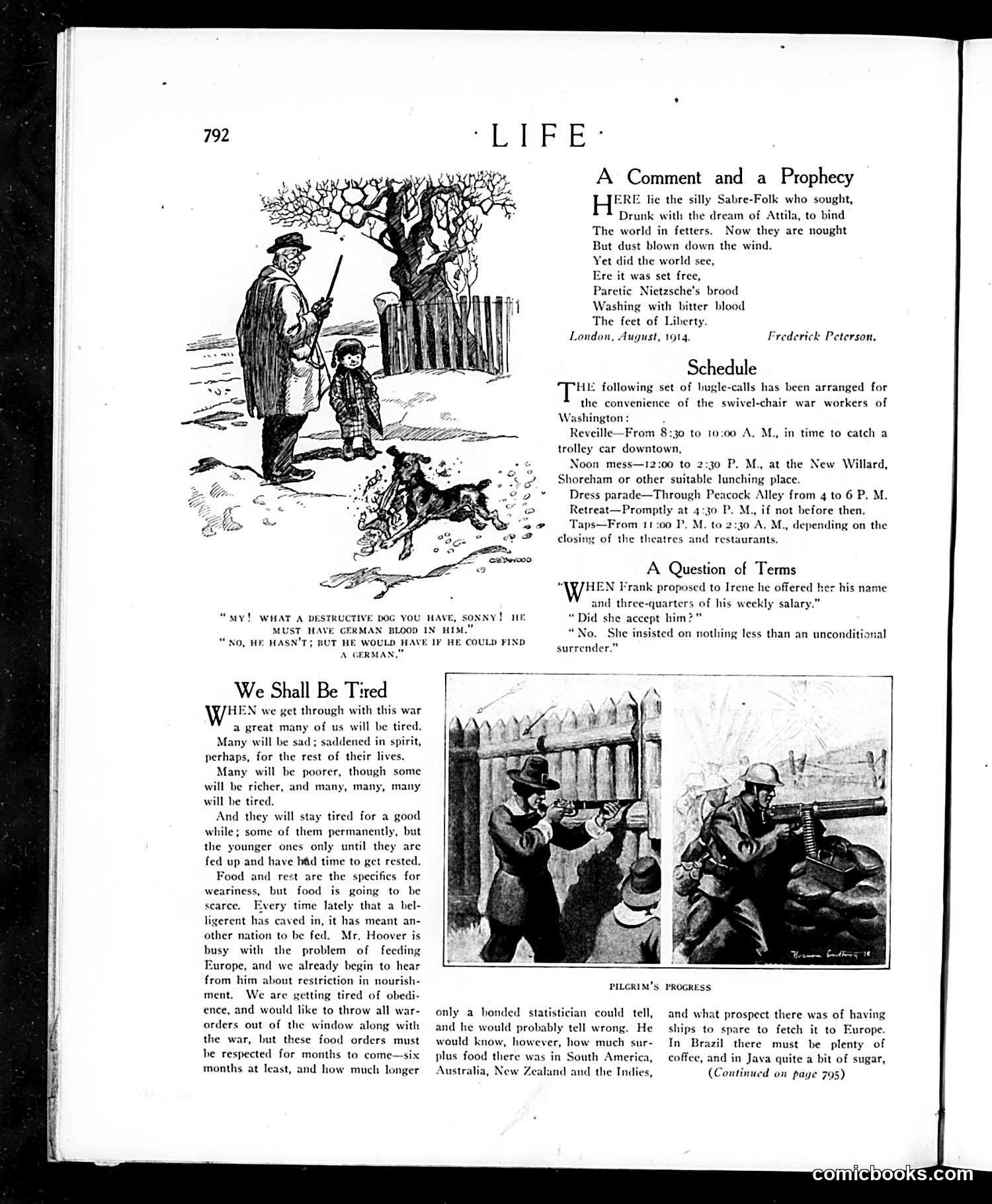
This page contains anti-German satire responding to World War I's outbreak. The opening poem mocks German militarism and Nietzschean philosophy ("Paretic Nietzsche's brood"), celebrating that Germany's imperial ambitions ("dream of Attila") have been defeated, leaving only "dust blown down the wind." The dog cartoon ridicules a German character claiming his dog has "German blood" and thus superior qualities—satirizing Nazi-era racial ideology before it had that name, mocking contemporary German claims of racial superiority. The "Schedule" section sarcastically lampoons Washington bureaucrats as "swivel-chair war workers" living comfortable lives (lunching at the Willard, theater-going) while soldiers sacrifice—typical WWI-era criticism of home-front privilege. "We Shall Be Tired" seriously warns that postwar exhaustion and food scarcity will plague civilians and soldiers alike, predicting Mr. Hoover's role in food rationing—prescient about the war's grinding toll and coming hardship.
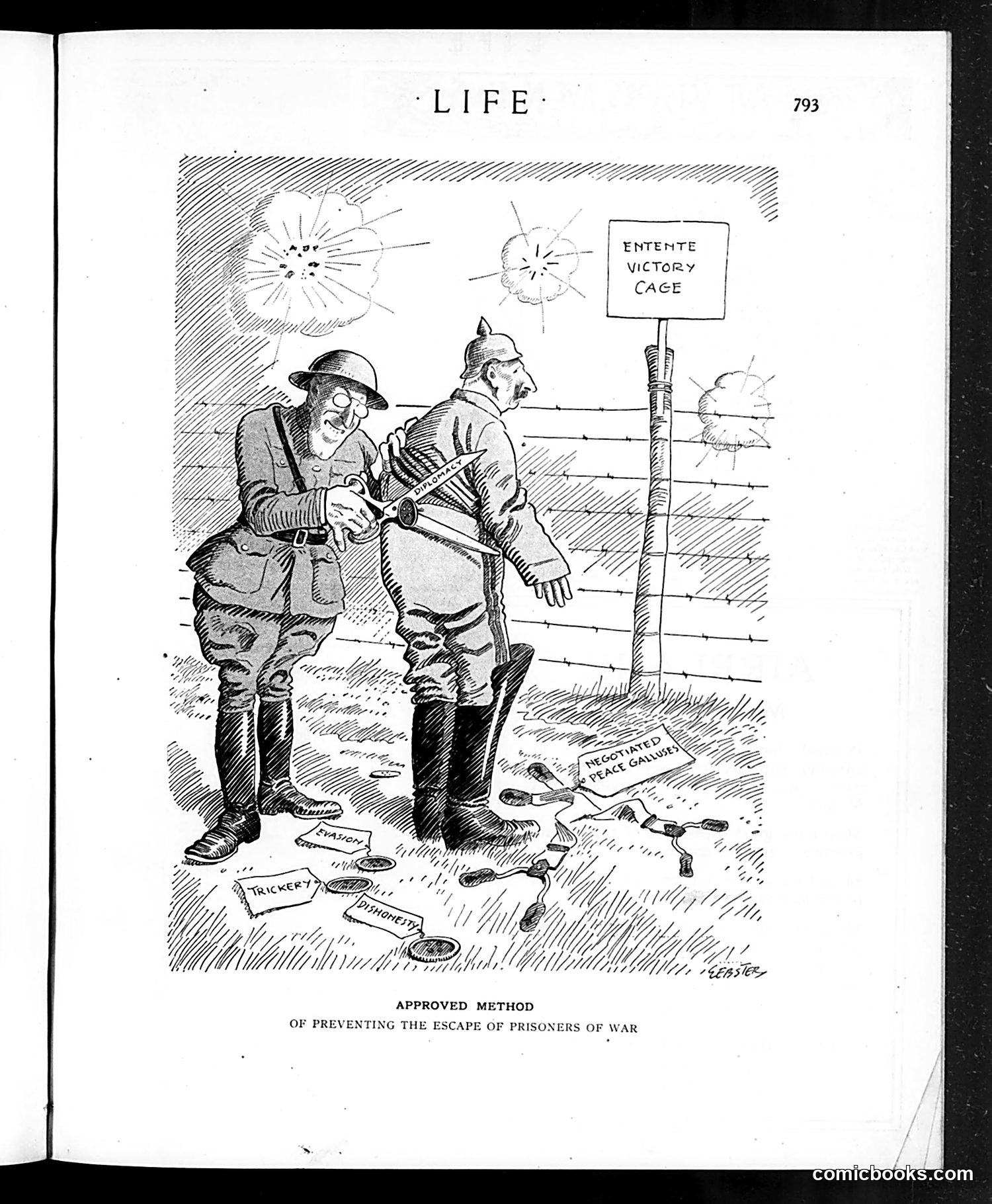
This political cartoon satirizes WWI prisoner-of-war security measures. Two military officers stand before an "Entente Victory Cage"—a barbed-wire enclosure surrounded by explosions. The ground is littered with labeled obstacles: "Trickery," "Intrigue," and "Unscrupulous Foe Caught." The satire mocks the complexity of the approved security method, suggesting the Entente (Allied powers) are relying on elaborate, questionable tactics—trickery and intrigue—to prevent prisoner escapes rather than straightforward, ethical detention practices. The explosions and chaos surrounding the cage underscore how chaotic and dangerous such methods appear. The cartoon critiques both the necessity for such extreme measures and implies skepticism about their actual effectiveness or morality. The humor derives from presenting dubious practices as officially "approved."
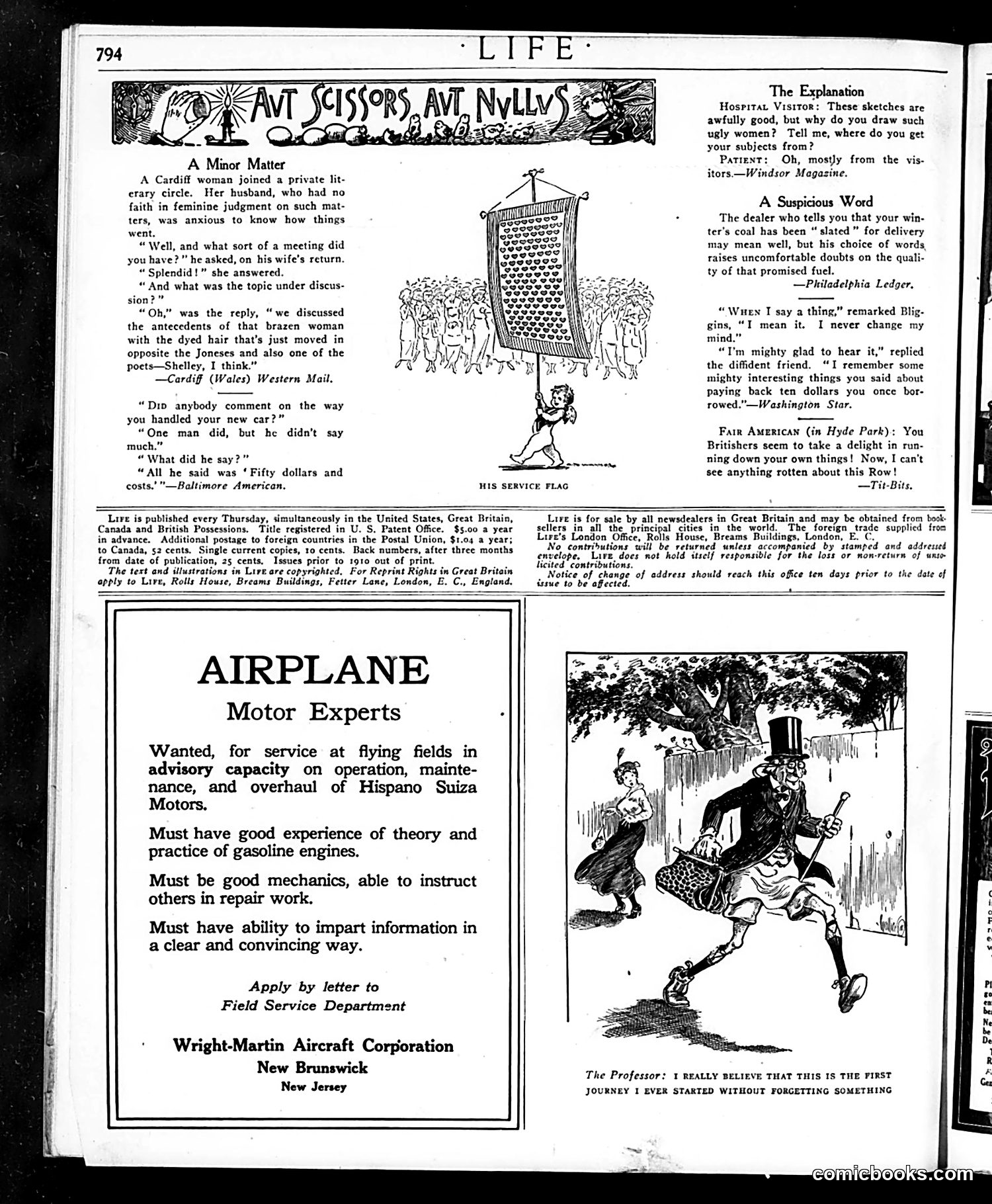
This page contains brief satirical anecdotes and advertisements typical of early 20th-century Life magazine humor. **The humor pieces** mock everyday human foibles: a wife's literary circle gossiping about neighbors rather than discussing serious literature; a man sued for car damages; a hospital artist drawing ugly patients; a coal dealer's suspicious language about "slated" delivery (implying the coal might be deliberately withheld); and a friend's broken promise about repaying borrowed money. **The cartoon** (bottom right) shows a forgetful professor embarking on a journey, realizing mid-trip he's forgotten something—a universal comedic scenario about absent-minded academics. **The job advertisement** for Wright-Martin Aircraft seeks airplane motor experts, reflecting the era's emerging aviation industry (likely WWI-era). The satire targets petty domestic situations, dishonest merchants, and human absent-mindedness—gentle, class-based humor aimed at middle-class readers. No specific political figures or major events are referenced.
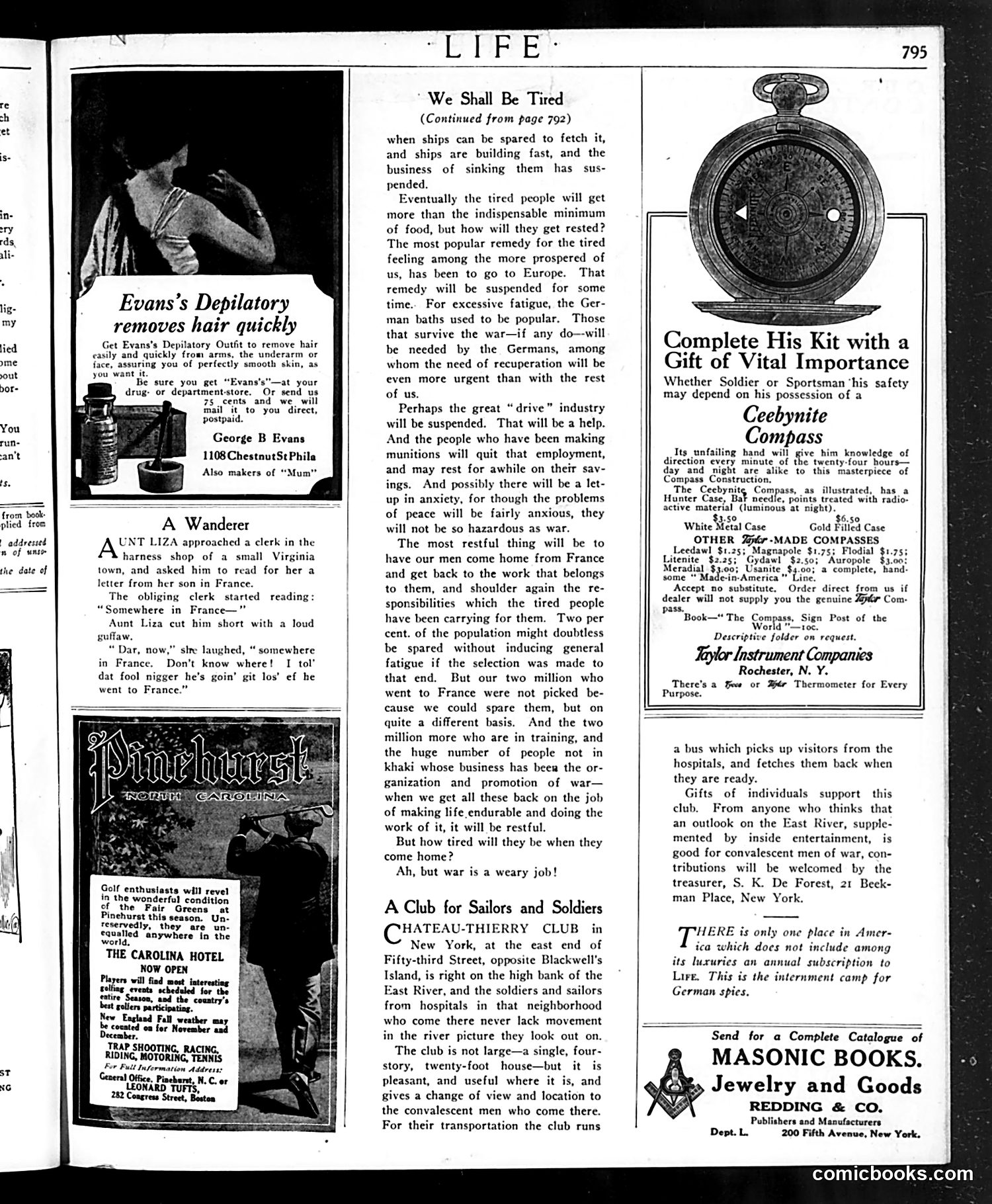
This page mixes advertisements with satirical commentary on post-WWI exhaustion. **Main Satire: "We Shall Be Tired"** Written during or shortly after World War I, this essay argues that American soldiers and war workers will return home exhausted. The author notes that popular pre-war remedies for fatigue (European travel, German spas) will be unavailable. However, the piece argues the *truly* restorative solution is having soldiers return home and resume their normal work—implying that war work itself is what has depleted the nation, and only resuming civilian productivity will provide relief. **"A Wanderer" Anecdote** A brief racist joke depicting an elderly Black woman ("Aunt Liza") misunderstanding her son's letter from France, confusing "Somewhere in France" with literal geographic confusion. This reflects period stereotypes and casual racism in American humor. **"A Club for Sailors and Soldiers"** Describes the Château-Thierry Club in New York offering recuperation space for hospitalized servicemen—a practical charitable response to veteran needs. The surrounding advertisements (hair removal, compass gifts, hotel promotions) are standard commercial content of the era.
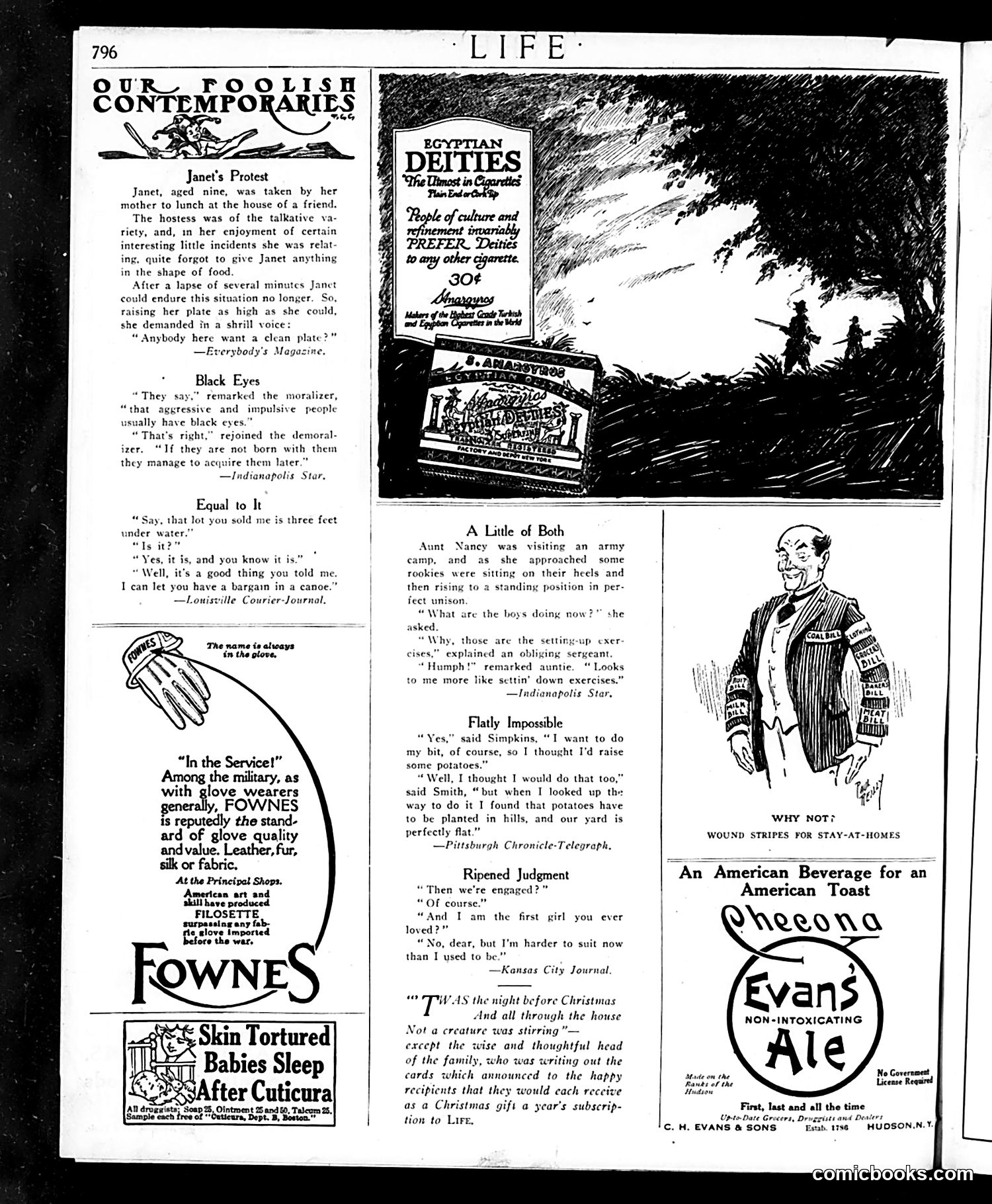
This page contains several brief satirical anecdotes typical of early 20th-century American humor magazines. The main pieces include: **"Janet's Protest"**: A child humorously demands food after being ignored by a talkative hostess—gentle satire on adults' self-absorption. **"Black Eyes" and other short jokes**: Quick satirical quips about character traits and human behavior, sourced from various newspapers. **"A Little of Both"**: Wordplay humor where an aunt misinterprets military "setting-up exercises" as "sitting down exercises"—gentle comedy on generational misunderstanding. **"Flatly Impossible"**: A wartime-era joke about a man wanting to farm potatoes but unable to because his yard is flat (unclear if this is absurdist humor or references actual WWI victory garden propaganda). The page is primarily **advertising-driven**, with prominent ads for Fownes gloves ("standard of glove quality"), Phocoana Evans Ale, and Cuticura products. The humor is mild, family-friendly, and apolitical—typical of Life's comedic formula during this period.
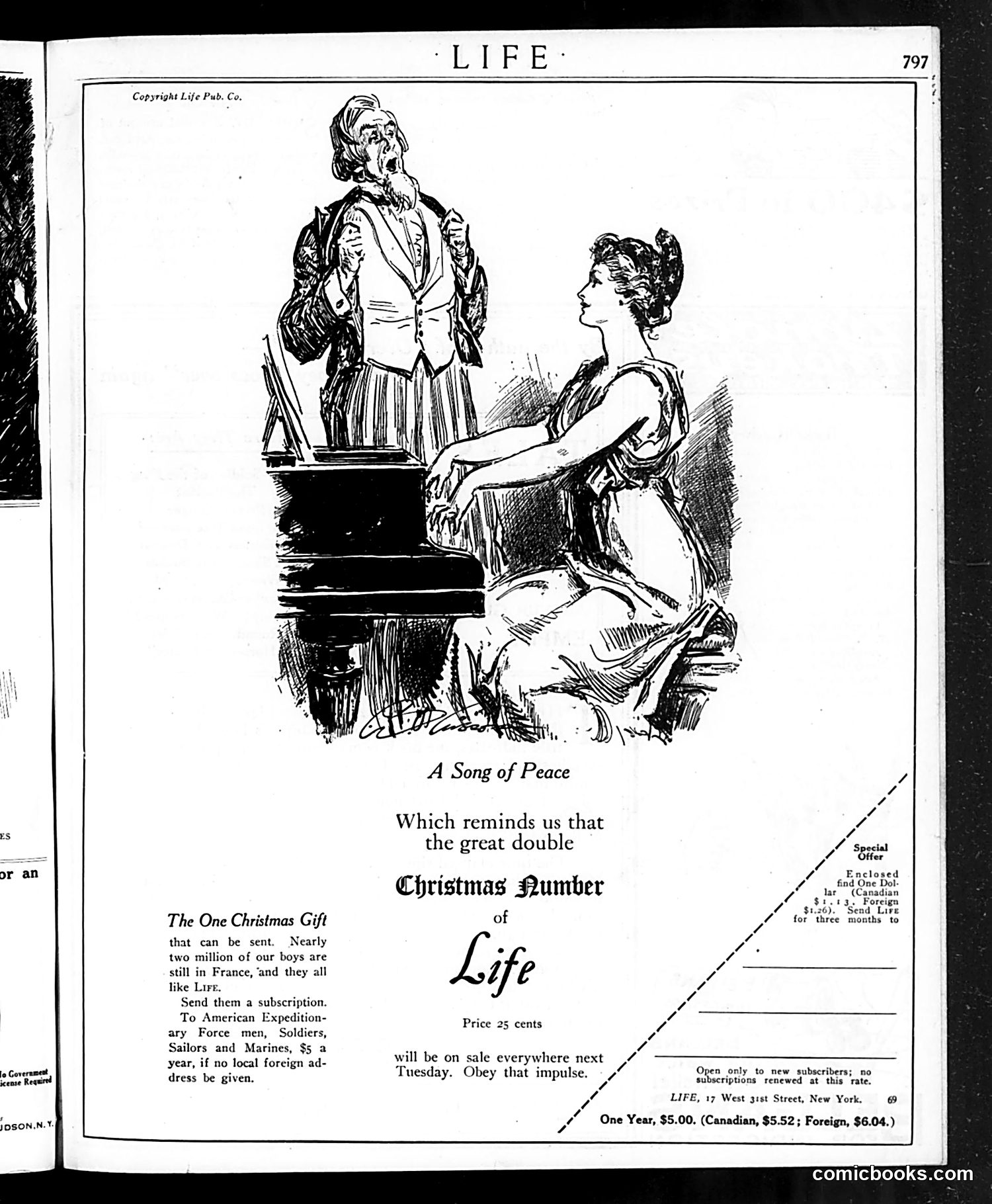
This page advertises Life's Christmas issue during World War I, when American troops remained stationed in France. The illustration titled "A Song of Peace" depicts a man at a piano and a woman listening—presumably evoking domestic tranquility and the Christmas spirit. The satirical point emerges in the adjacent text: Life uses the sentimental holiday imagery to pitch subscriptions to soldiers overseas. The advertisement claims "The One Christmas Gift that can be sent" to the nearly two million American boys still in France is a Life magazine subscription ($5/year, or $1 for three months). The dark humor lies in the disconnect between the cozy domestic scene and the reality of soldiers in wartime. Life frames a magazine subscription as an appropriate morale-booster for men in active combat zones—implying that reading satirical commentary about home is somehow comparable to actual peace or domestic comfort. The page reflects how American magazines marketed to soldiers during WWI, using sentimentality to encourage subscriptions while acknowledging the prolonged absence of troops from home.
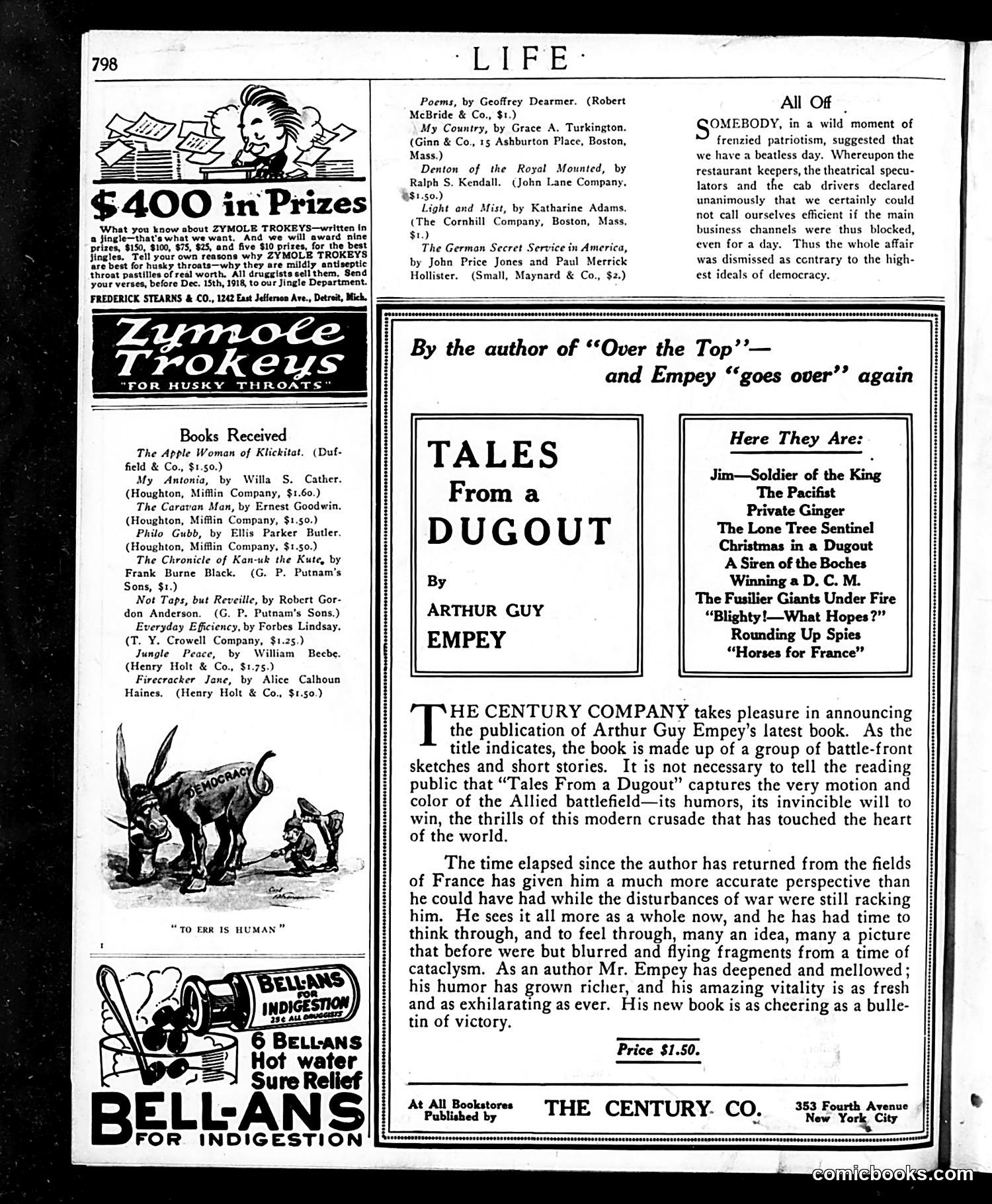
This page is primarily **advertising and book notices** from a 1918 *Life* magazine. The main content includes: **"All Of" Editorial**: A brief satirical piece mocking patriotic fervor. Someone suggested a "beatless day" (likely a no-work day for WWI support), but restaurant owners, theatrical producers, and cab drivers objected, claiming it would harm efficiency. The satire criticizes how these business interests framed profit-seeking as "democratic ideals." **Arthur Guy Empey Advertisement**: Promotes *Tales From a Dugout*, a WWI collection by a soldier-author. Empey had recently returned from the Western Front; the ad emphasizes his firsthand perspective on combat's "humors" and "thrills." **Other Content**: Standard book listings and a throat lozenge advertisement. The page reflects 1918 concerns: WWI patriotism, profiteering during wartime, and soldier literature's popularity. The satirical tone targets civilian exploitation of wartime conditions.