
Life, 1918-11-28 · page 22 of 34
Life — November 28, 1918 — page 22: what you’re looking at
What you’re looking at
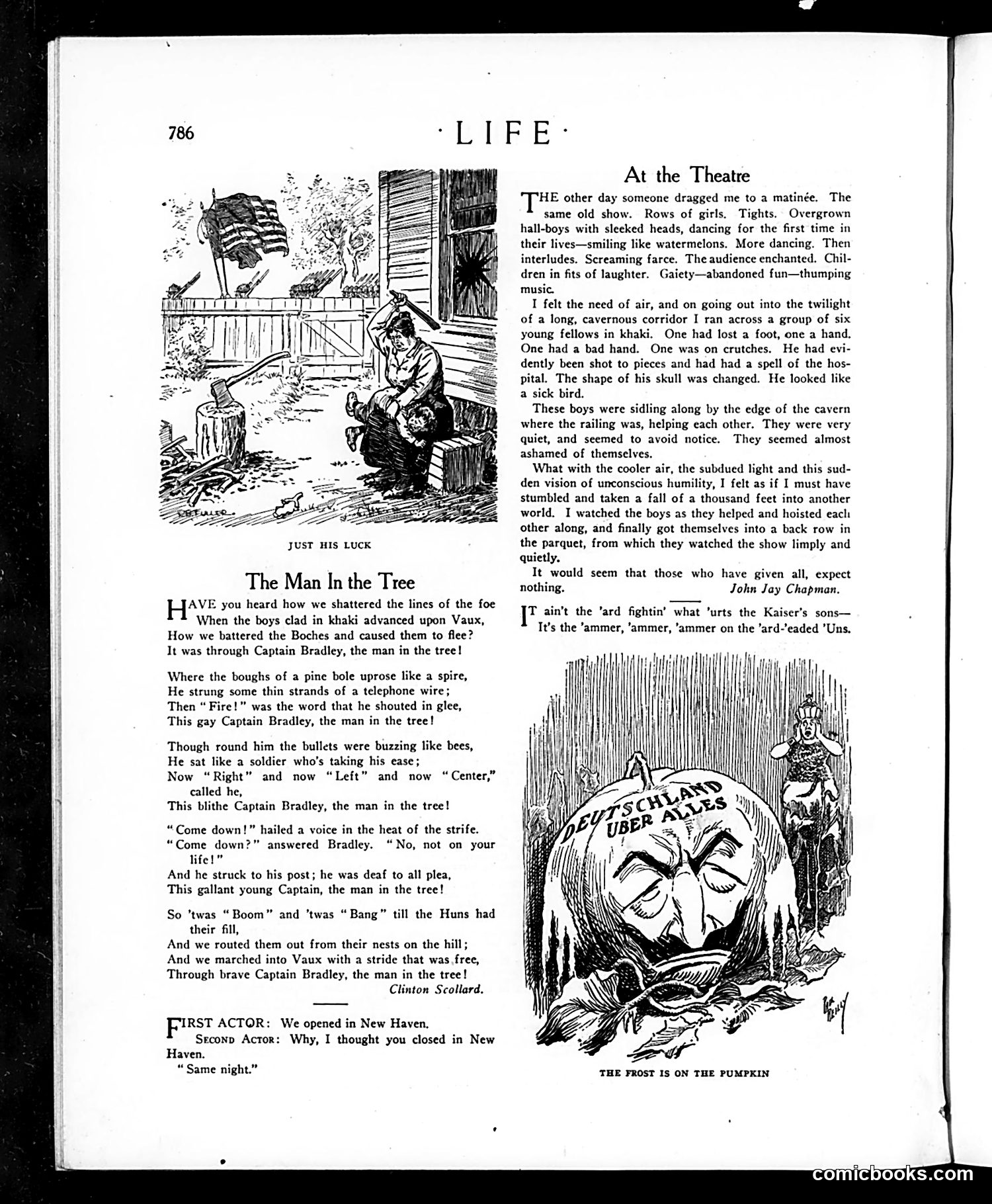
**"The Man in the Tree"** is a patriotic WWI poem celebrating Captain Bradley's heroism during the Battle of Vaux (1918). He directs artillery fire from a tree using telephone wire, refusing to abandon his post despite enemy fire. The poem glorifies his sacrifice and courage. **"At the Theatre"** offers sharp social satire. The narrator attends a frivolous theatrical matinee, then encounters six wounded soldiers in the corridor—amputees and shell-shocked veterans, visibly damaged and humble. The contrast is devastating: while civilians enjoy mindless entertainment, these men have sacrificed everything and ask for nothing. The piece indicts wartime society's disconnect between comfortable home-front life and the actual cost of combat. **The cartoon** "The Frost is on the Pumpkin" appears to be anti-German propaganda, showing a grotesque caricatured German face labeled "Deutschland Über Alles" (Germany Above All). It suggests German ambitions are withering or dying—"frost" suggests decay. Together, these pieces reflect 1918 wartime messaging: celebrating military heroism while subtly criticizing civilian indifference to veterans' suffering.
📄 Transcribed text from this page (OCR, searchable)
Machine-transcribed from the original scan — historical spelling and the odd misread are preserved.
JUST HIS LUCK The Man In the Tree H4vE you heard how we shattered the lines of the foe When the boys clad in khaki advanced upon Vaux, How we battered the Boches and caused them to flee? It was through Captain Bradley, the man in the tree! Where the boughs of a pine bole uprose like a spire, He strung some thin strands of a telephone wire; Then “ Fire!" was the word that he shouted in glee, This gay Captain Bradley, the man in the tree! Though round him the bullets were buzzing like bees, He sat like a soldier who's taking his ease; Now “Right” and now “Left” and now “Center,” called he, This blithe Captain Bradley, the man in the tree! “Come down!” hailed a voice in the heat of the strife. “Come down?” answered Bradley. “No, not on your life!” And he struck to his post; he was deaf to all plea, This gallant young Captain, the man in the tree! So ’twas “Boom” and ’twas “Bang” till the Huns had their fill, And we routed them out from their nests on the hill; And we marched into Vaux with a stride that was free, Through brave Captain Bradley, the man in the tree! Clinton Scollard. RST ACTOR: We opened in New Haven, Seconp Actor: Why, I thought you closed in New Haven. “Same night.” At the Theatre 'HE other day someone dragged me to a matinée. The same old show. Rows of girls. Tights. Overgrown hall-boys with sleeked heads, dancing for the first time in their lives—smiling like watermelons. More dancing. Then interludes. Screaming farce. The audience enchanted. Chil- dren in fits of laughter. Gaiety—abandoned fun—thumping music. I felt the need of air, and on going out into the twilight of a long, cavernous corridor I ran across a group of six young fellows in khaki. One had lost a foot, one a hand, One had a bad hand. One was on crutches. He had evi- dently been shot to pieces and had had a spell of the hos- pital. The shape of his skull was changed. He looked like a sick bird. These boys were sidling along by the edge of the cavern where the railing was, helping each other. They were very quiet, and seemed to avoid notice. They seemed almost ashamed of themselves. What with the cooler air, the subdued light and this sud- den vision of unconscious humility, I felt as if I must have stumbled and taken a fall of a thousand feet into another world. I watched the boys as they helped and hoisted eacli other along, and finally got themselves into a back row in the parquet, from which they watched the show limply and quietly. It would seem that those who have given all, expect nothing. John Jay Chapman, T ain't the 'ard fightin’ what ’urts the Kaiser’s sons— It’s the ’ammer, ‘ammer, ‘ammer on the ’ard-’eaded ’Uns. | i i i i) i i) i THE FROST IS ON THE PUMPKIN