
Life, 1918-11-28 · page 21 of 34
Life — November 28, 1918 — page 21: what you’re looking at
What you’re looking at
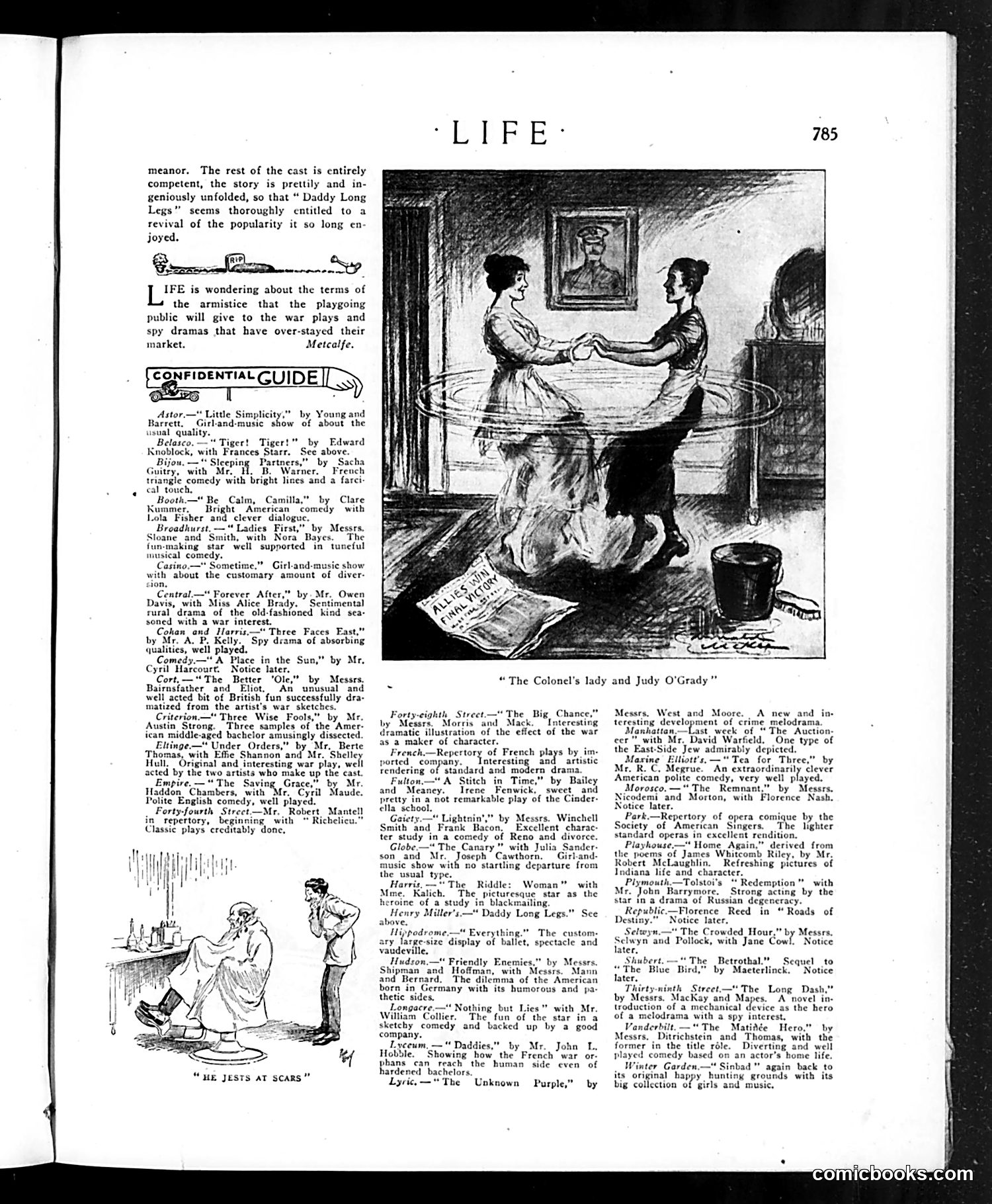
This is a theater review section from Life magazine's "Confidential Guide" to Broadway shows. The two illustrations satirize wartime theater audiences and romantic melodrama. The upper cartoon, captioned "The Colonel's lady and Judy O'Grady," depicts two women in a domestic interior—likely a scene from a play—emphasizing sentimental drama. The lower cartoon, "He Jests at Scars," shows a man and woman in what appears to be a comedic domestic moment, probably illustrating theatrical farce or romantic comedy. The text's opening comment is key: Life's editor wonders what "armistice" or truce the theater-going public will grant to "war plays and spy dramas that have over-stayed their market"—suggesting audiences are exhausted by the glut of wartime-themed productions. The reviews list numerous shows, many explicitly about war, espionage, or soldiers, indicating how thoroughly World War I had saturated American theater by this period.
📄 Transcribed text from this page (OCR, searchable)
Machine-transcribed from the original scan — historical spelling and the odd misread are preserved.
meanor. The rest of the cast is entirely competent, the story is prettily and in- geniously unfolded, so that “ Daddy Long Legs” seems thoroughly entitled to a revival of the popularity it so long en- joyed. IFE is wondering about the terms of the armistice that the playgoing public will give to the war plays and spy dramas that have over-stayed their market. Metcalfe. CONFIDENTIALCUIDE | Astor.—"* Little Simplicity,” Barrett. Girland-music show usual quality. Belasco. —“ Tiger! Tiger! Knoblock, with Frances Starr. See above. Bijou. — Sleeping Partners," by | Sacha Guitzy, with Mr. H, 'B. Warner, | French triangle comedy with bright lines and a far cal touch, Booth.—" Be Calm, Camilla," by Clare Kumme: Bright’ American comedy with Lola Fisher and clever dialogu Broadhurst. —" Ladies First,” by Messrs. Sloane and Smith, with Nora’ Bayes. The fun-making star well supported in tuneful musical comedy. Casino,—" Sometime.” Girl-and-music show with about the customary amount of diver- tion, Central —" Forever After,” by Mr. Owen Davis, with Miss Alice Brady. Sentimental rural’ drama of the old-fashioned kind sea- soned with a war interest. Cohan and Harris,—" Three Faces East by Mr. A. P, Kelly. “Spy drama of absorbing qualities, well played. _ Comedy.—" A Place in the Sun,” by Mr. Cyril Harcourt. Notice later. Cort, —“The Better ‘Ole,” by Messrs. Bairnsfather and Eliot. An unusual and well acted bit of British fun successfully dra- matized from the artist's war sketches. * by Mr. Austin Strong. Three samples of the Amer- ican middle-aged bachelor amusingly dissected Under Orders," by Mr. h Effie Shannon’ and Mr. 'S Original and interesting war play, wel acted by the two artists who make up the cast. Empire —“ The Saving Grace,” by Mr. Haddon Chambers, with Mr. Cyril Maude. Polite English comedy, well played. _ Forty-fourth Strect—Mr. Robert. Mantell in repertory, beginning with “ Richelieu.” Classic plays’ ereditably done, by Young and Of about’ the by Edward “ME JESTS AT SCARS” & Santee Sons “ The Colonel's lady and Judy O'Grady” th Street.—* The Big Chance,” by Me: Morris and. Mack. Interesting dramatic illustration of the effect of the war asa maker of character. French.—Repertory of French plays by im- ported. company. Tateresting and. artistic rendering of standard and modern drama. Fulton.—" A Stitch in Time,” by Bailey and Meaney. Trene Fenwick. sweet and pretty in a not remarkable play of the Cinder- ella school. Gaiety.—" Lightnin’,” by Messrs. Winchell Smith and Frank Baton, Excellent charac- ter_study in a comedy of Reno and divorce. Globe.—“ The Canary" with J) Sander son and Mr. Joseph Cawthorn. Girl-and- music show with no startling departure from the usual type. Harris. —* The Riddle: Woman” with Mme. Kalich. The picturesque star as the heroine of a study in blackmailing. cnr Miller's —" Daddy Long Legs." See above. Hippodrome.—" Everything.” The custom- ary large-size display of ballet, spectacle and vaudeville, Hudson.—"' Friendly Enemies,” by Messrs. Shipman and Hoffman, with Messrs. Ma and Bernard, The dilemma of the American born in Germany with its humorous and pa thetic sides. Longacre—“ Nothing but Lies" with Mr. William Collier. The fun of the star in a sketchy comedy and backed up by a good company. Lyceum, —“ Daddies," by Mr. John L, Hobble. Showing how ne’ French Jee or: pbans can reach the human side even of hardened bachelors. Lyric, —" The Unknown Purple,” — by Messrs. West and Moore. A new and ine teresting development of crime melodrama. Manhattan.—Last. week of “The Auction: cer with Mr. David Warfield. One type of the East-Side Jew admirably depicted. Maxine Elliott's, —" Tea for Three,” by Mr. R. C. Megrue.’ An extraordinarily clever American polite comedy, very well played. Morosco.—“ The Remnant,” by Messrs. Nicodemi and Morton, with Florence Nash. Notice later. Park.—Repertory of opera comique by the Society of American Singers. The lighter Standard operas in excellent rendition. Playhouse.—" Home Again,” derived from the poems of James Whitcomb Riley, by Mr. Robert McLaughlin. Refreshing pictures of Indiana life and character. Plymouth.—Tolstoi's ‘ Redemption” with Mr. John Barrymore. Strong acting by the star ina drama of Russian degeneracy. Republic.— in “Roads of Destiny. Selwyn.—" The Crowded Hour,” by Messrs. Selwyn and Pollock, with Jane Cowl. Notice later. Shubert. —* The “The Blue Bird,” later Betrothal.” Sequel to by Maeterlinck. Notice Thirty-ninth by Messrs. Mac’ troduction of a of a melodrama with a spy Vanderbilt. —“ The Matidée Hero,” by Messrs, Ditrichstein and Thomas, with the former in the title réle. Diverting and well played comedy based on an actor's home life. ., Winter Garden.—“ Sinbad" again back to its original happy hunting grounds with its big collection of girls musi Long Dash, d Mapes. A novel in: device as the hero rest