
Life, 1918-11-28 · page 28 of 34
Life — November 28, 1918 — page 28: what you’re looking at
What you’re looking at
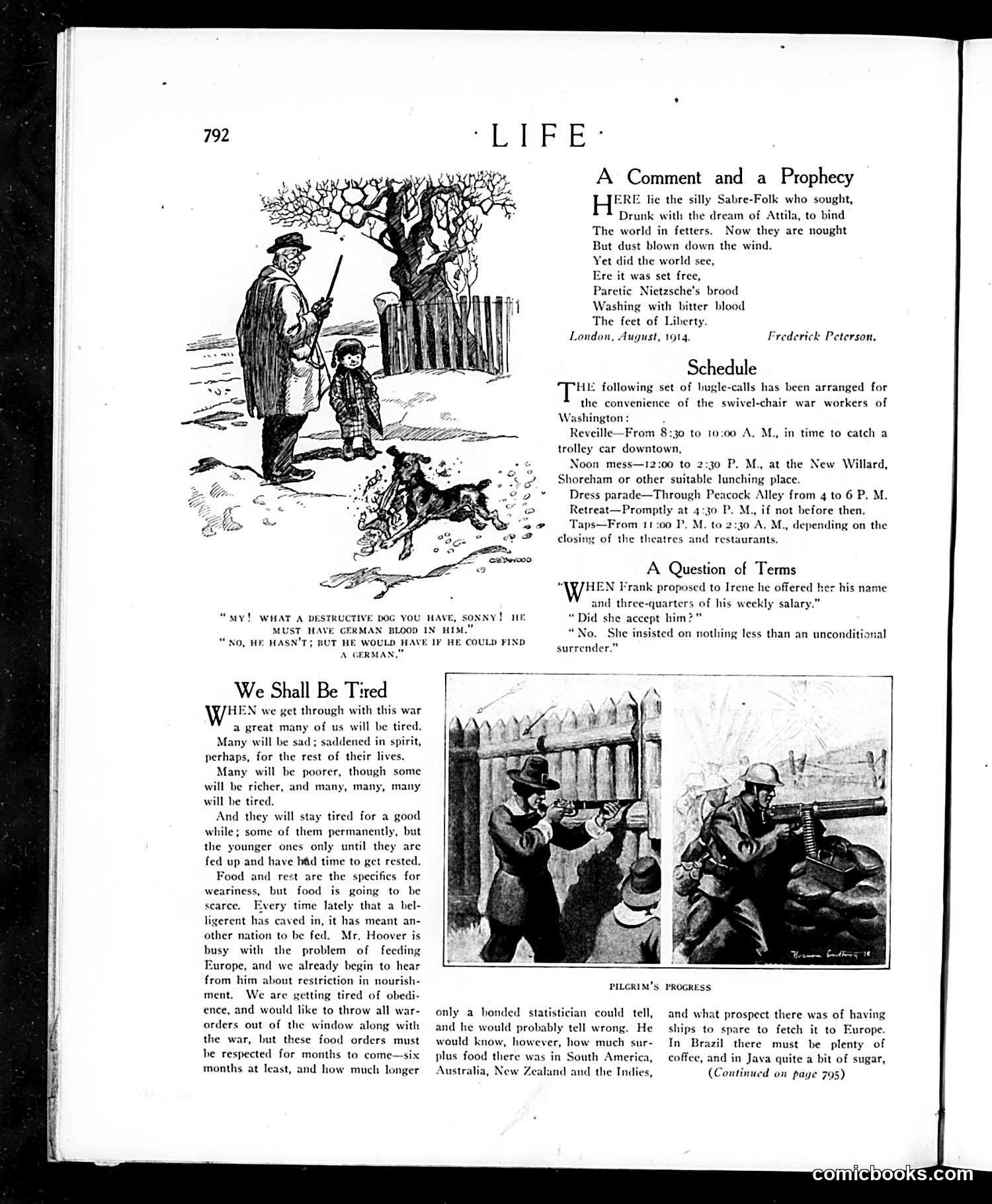
This page contains anti-German satire responding to World War I's outbreak. The opening poem mocks German militarism and Nietzschean philosophy ("Paretic Nietzsche's brood"), celebrating that Germany's imperial ambitions ("dream of Attila") have been defeated, leaving only "dust blown down the wind." The dog cartoon ridicules a German character claiming his dog has "German blood" and thus superior qualities—satirizing Nazi-era racial ideology before it had that name, mocking contemporary German claims of racial superiority. The "Schedule" section sarcastically lampoons Washington bureaucrats as "swivel-chair war workers" living comfortable lives (lunching at the Willard, theater-going) while soldiers sacrifice—typical WWI-era criticism of home-front privilege. "We Shall Be Tired" seriously warns that postwar exhaustion and food scarcity will plague civilians and soldiers alike, predicting Mr. Hoover's role in food rationing—prescient about the war's grinding toll and coming hardship.
📄 Transcribed text from this page (OCR, searchable)
Machine-transcribed from the original scan — historical spelling and the odd misread are preserved.
A DESTRUCTIVE DOG YOU GERMAN BLOOD IN } BUT HE WOULD HAVE I A GERMAN,” “sy! WHAT M “ONO, HE HAS: We Shall Be Tired HEN we get through with this war a great many of us will be tired. Many will be sad; saddened in spirit, perhaps, for the rest of their lives. Many will be poorer, though some will be richer, and many, many, many will be tired. And they will stay tired for a good while; some of them permanently, but the younger ones only until they are fed up and have had time to get rested. Food and rest are the specifics for weariness, but food is going to be scarce. Every time lately that a hel- ligerent has caved in, it has meant an- other nation to be fed. Mr. Hoover is busy with the problem of feeding Europe, and we already begin to hear from him about restriction in nourish- ment. We are getting tired of obedi- ence, and would like to throw all war- orders out of the window along with the war, but these food orders must be respected for months to come—six months at least, and how much longer HA "LIFE: A Comment and a Prophecy ERE lie the silly Sabre-Folk who sought, Drunk with the dream of Attila, to bind The world in fetters. Now they are nought But dust blown down the wind, Yet did the world see, Ere it was set free, Paretic Nietzsche's brood Washing with bitter blood The feet of Liberty. London, August, 1914. Schedule HE following set of bugle-calls has been arranged for the convenience of the swivel-chair war workers of Washington: 5 Reveille—From 8:30 to 10:00 A, M., in time to catch a trolley car downtown, Noon mess—12:00 to 2:30 P, M., at the New Willard, Shoreham or other suitable lunching place. Dress parade—Through Peacock Alley from 4 to 6 P. M. Retreat—Promptly at 4:30 P. M., if not before then. Taps—From 11:00 P. M. to 2:30 A. M., depending on the closing of the theatres and restaurants. A Question of Terms “\Y/HEN Frank proposed to Irene he offered of his weekly salary Frederick Peterson, her his name and three-quarte “Did she accept him? he insisted on nothing less than an unconditional AVE, SONNY! HIM,’ F HE COULD FIND yee surrender. PILGRIM'S PROGRESS. only a honded statistician could tell, and he would probably tell wrong. He would know, however, how much sur- plus food there was in South America, Australia, New Zealand and the Indies, and what prospect there was of having ships to spare to fetch it to Europe. In Brazil there must be plenty of coffee, and in Java quite a bit of sugar, (Continued on page 705)