
Life, 1918-11-28 · page 16 of 34
Life — November 28, 1918 — page 16: what you’re looking at
What you’re looking at
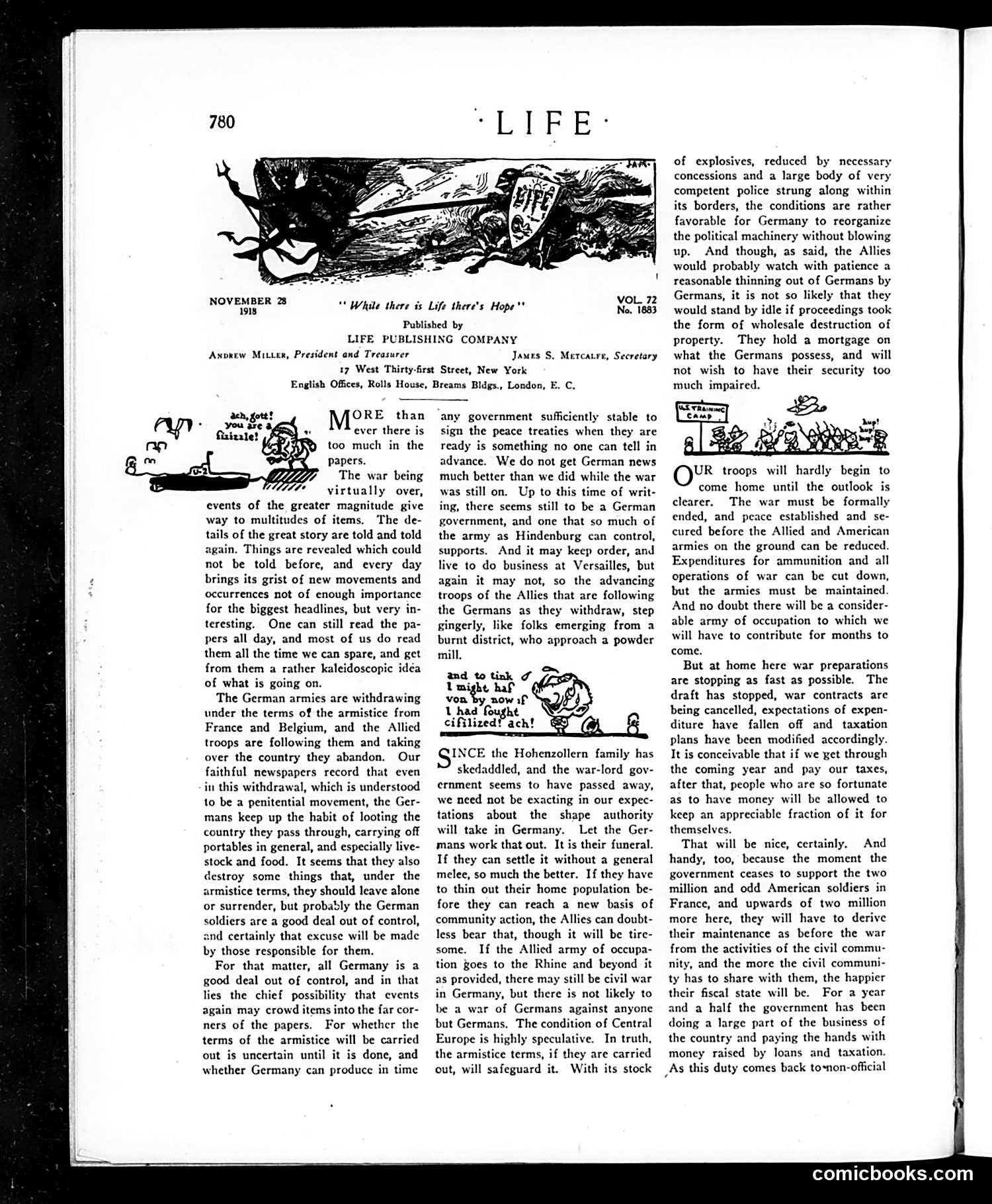
This page comments on Germany's uncertain political future following the November 11, 1918 armistice ending World War I. The editorial warns that Germany remains unstable and "out of control"—the Kaiser's government has fallen, but it's unclear what authority will replace it. The small cartoon (bottom left) depicts a German soldier lamenting lost plunder: "and to tink I might haf von fort / I had fought / 'cifilized' ach!"—mocking German claims to civilization while noting Allied reports that withdrawing German troops continued looting France and Belgium despite armistice terms. The main concern is whether Germany can produce a stable government to negotiate peace treaties, or whether internal chaos—even civil war—might erupt. The text compares Allied forces cautiously following Germans to people "emerging from a burnt district, who approach a powder mill"—suggesting volatile danger ahead.
📄 Transcribed text from this page (OCR, searchable)
Machine-transcribed from the original scan — historical spelling and the odd misread are preserved.
NOVEMBER 28 1918, me SS “* Whale there is Life there's Hope'* Published by LIFE Anprew Miter, President and Treasurer PUBLISHING COMPANY James S, Metcatre, Secretary 17 West Thirty-first Street, New York English Offices, Rolls House, Breams Bldgs., London, E. C. ORE than ever there is too much in the papers. The war being virtually over, events of the greater magnitude give way to multitudes of items. The de- tails of the great story are told and told again, Things are revealed which could not be told before, and every day brings its grist of new movements and occurrences not of enough importance for the biggest headlines, but very in- teresting. One can still read the pa- pers all day, and most of us do read them all the time we can spare, and get from them a rather kaleidoscopic idéa of what is going on. The German armies are withdrawing under the terms of the armistice from France and Belgium, and the Allied troops are following them and taking over the country they abandon. Our faithful newspapers record that even in this withdrawal, which is understood to be a penitential movement, the Ger- mans keep up the habit of looting the country they pass through, carrying off portables in general, and especially live- stock and food. It seems that they also destroy some things that, under the armistice terms, they should leave alone or surrender, but probably the German soldiers are a good deal out of control, and certainly that excuse will be made by those responsible for them. For that matter, all Germany is a good deal out of control, and in that lies the chief possibility that events again may crowd items into the far cor- ners of the papers. For whether the terms of the armistice will be carried out is uncertain until it is done, and whether Germany can produce in time 117779 any government sufficiently stable to sign the peace treaties when they are ready is something no one can tell in advance. We do not get German news much better than we did while the war was still on. Up to this time of writ- ing, there seems still to be a German government, and one that so much of the army as Hindenburg can control, supports, And it may keep order, and live to do business at Versailles, but again it may not, so the advancing troops of the Allies that are following the Germans as they withdraw, step gingerly, like folks emerging from a burnt district, who approach a powder mill, and to tink J Umighe haf von fot Lhad it cifilized ach! a SINCE the Hohenzollern family has skedaddled, and the war-lord gov- ernment seems to have passed away, we need not be exacting in our expec- tations about the shape authority will take in Germany. Let the Ger- mans work that out. It is their funeral. If they can settle it without a general melee, so much the better. If they have to thin out their home population be- fore they can reach a new basis of community action, the Allies can doubt- less bear that, though it will be tire- some. If the Allied army of occupa- tion goes to the Rhine and beyond it as provided, there may still be civil war in Germany, but there is not likely to be a war of Germans against anyone but Germans. The condition of Central Europe is highly speculative. In truth, the armistice terms, if they are carried out, will safeguard it. With its stock of explosives, reduced by necessary concessions and a large body of very competent police strung along within its borders, the conditions are rather favorable for Germany to reorganize the political machinery without blowing up. And though, as said, the Allies would probably watch with patience a reasonable thinning out of Germans by Germans, it is not so likely that they would stand by idle if proceedings took the form of wholesale destruction of property. They hold a mortgage on what the Germans possess, and will not wish to have their security too much impaired. UR troops will hardly begin to come home until the outlook is clearer, The war must be formally ended, and peace established and se- cured before the Allied and American armies on the ground can be reduced. Expenditures for ammunition and all operations of war can be cut down, but the armies must be maintained And no doubt there will be a consider- able army of occupation to which we will have to contribute for months to come, But at home here war preparations are stopping as fast as possible. The draft has stopped, war contracts are being cancelled, expectations of expen- diture have fallen off and taxation plans have been modified accordingly. It is conceivable that if we get through the coming year and pay our taxes, after that, people who are so fortunate as to have money will be allowed to keep an appreciable fraction of it for themselves. That will be nice, certainly, And handy, too, because the moment the government ceases to support the two million and odd American soldiers in France, and upwards of two million more here, they will have to derive their maintenance as before the war from the activities of the civil commu- nity, and the more the civil communi- ty has to share with them, the happier their fiscal state will be. For a year and a half the government has been doing a large part of the business of the country and paying the hands with money raised by loans and taxation. As this duty comes back to-non-official comicbooks.com