
Life, 1918-11-28 · page 17 of 34
Life — November 28, 1918 — page 17: what you’re looking at
What you’re looking at
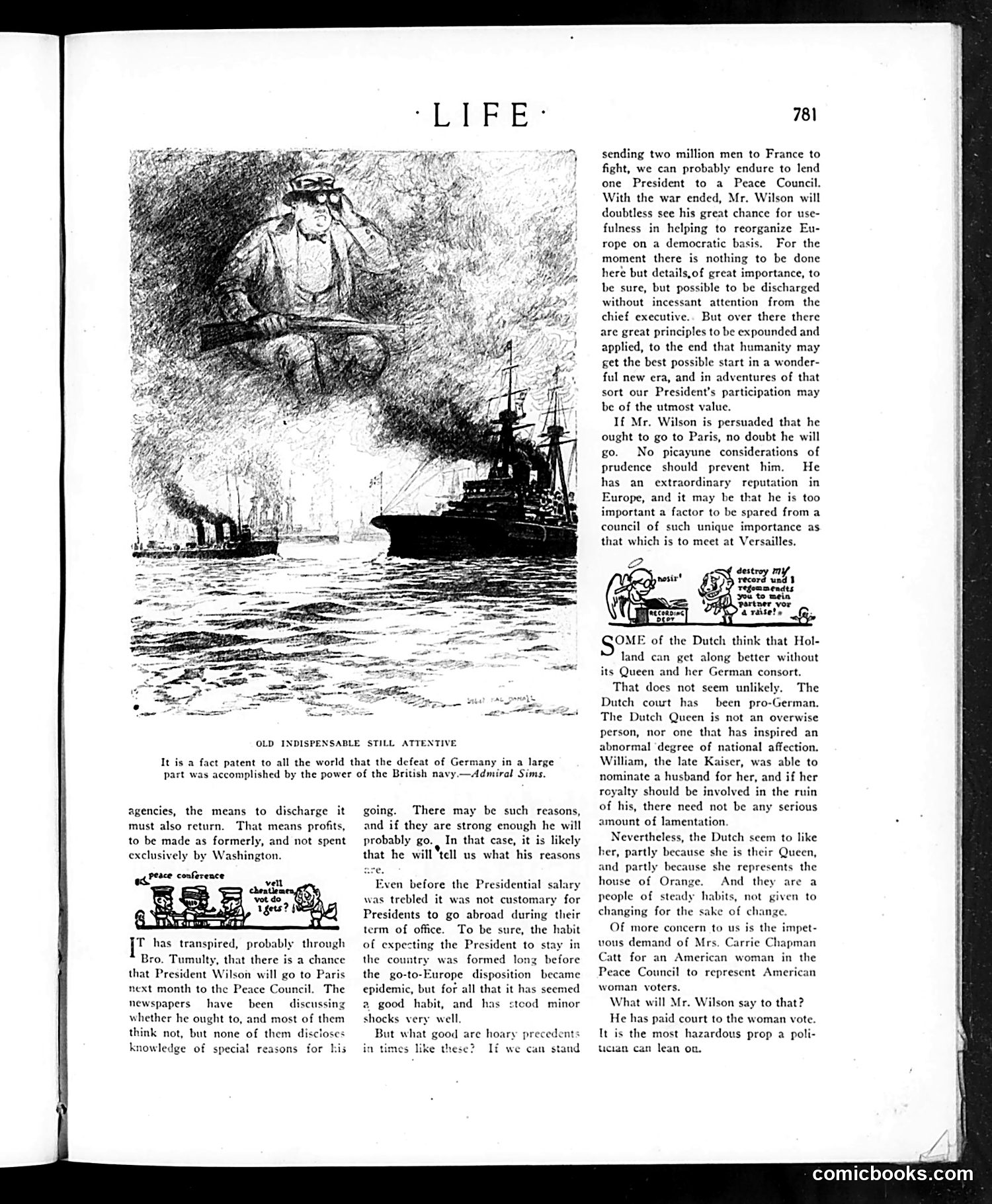
This page contains editorial commentary on post-WWI politics, not traditional cartoons. **Main Topics:** 1. **Wilson at the Peace Council**: The article debates whether President Wilson should attend the Paris Peace Conference (Versailles). It argues he should go, claiming his European reputation makes him valuable despite breaking precedent of Presidents staying home during their term. 2. **The Dutch Queen**: Commentary suggests Holland might benefit from removing its Queen and her "German consort" (husband), given the Dutch court's pro-German sympathies during the war. However, the Dutch people's loyalty to the Orange dynasty likely prevents this. 3. **Women's Representation**: The article addresses activist Carrie Chapman Catt's demand that an American woman represent female voters at the Peace Council. It characterizes this as a political liability Wilson must navigate, calling women's votes "the most hazardous prop a politician can lean on"—reflecting contemporary anxiety about newly enfranchised female voters. The small illustration shows a British warship, supporting Admiral Sims's quote crediting the British Navy with Germany's defeat.
📄 Transcribed text from this page (OCR, searchable)
Machine-transcribed from the original scan — historical spelling and the odd misread are preserved.
OLD INDISPENSABLE STILL ATTENTIVE It is a fact patent to all the world that the defeat of Germany in a large part was accomplished by the power of the British navy.—Admiral Sims. agencies, the means to discharge it must also return. That means profits, to be made as formerly, and not spent exclusively by Washington. eqrence conference Ty transpired, probably through Bro. Tumulty, that there is a chance that President Wilson will go to Paris next month to the Peace Council. The newspapers have been discussing whether he ought to, and most of them think not, but none of them discloses knowledge of special reasons for his going. There may be such reason: and if they are strong enough he will probably go. In that case, it is likely that he will ‘tell us what his reasons re. Even before the Presidential sa was trebled it was not customai Presidents to go abroad during their term of office. To be sure, the habit of expecting the President to stay in the country was formed long before the go-to-Europe disposition became epidemic, but for all that it has seemed a good habit, and has stcod minor shocks very well But what good are hoary precedents in times like these? If we can stand 781 sending two million men to France to fight, we can probably endure to lend one President to a Peace Council. With the war ended, Mr. Wilson will doubtless see his great chance for use- fulness in helping to reorganize Eu- rope on a democratic basis. For the moment there is nothing to be done here but details,of great importance, to be sure, but possible to be discharged without incessant attention from the chief executive.. But over there there are great principles to be expounded and applied, to the end that humanity may get the best possible start in a wonder- ful new era, and in adventures of that sort our President’s participation may be of the utmost value. If Mr. Wilson is persuaded that he ought to go to Paris, no doubt he will go. No picayune considerations of prudence should prevent him. He has an extraordinary reputation in Europe, and it may be that he is too important a factor to be spared from a council of such unique importance as. that which is to meet at Versailles. OME of the Dutch think that Hol- land can get along better without its Queen and her German consort. That does not seem unlikely, The Dutch court has been pro-German. The Dutch Queen is not an overwise person, nor one that has inspired an abnormal ‘degree of national affection. William, the late Kaiser, was able to nominate a husband for her, and if her royalty should be involved in the ruin of his, there need not be any serious amount of lamentation. Nevertheless, the Dutch seem to like her, partly because she is their Queen, and partly because she represents the house of Orange. And they are a people of steady habits, not given to changing for the sake of change. Of more concern to us is the impet- vous demand of Mrs. Carrie Chapman Catt for an American woman in the Peace Council to represent American woman voters. What will Mr. Wilson say to that? He has paid court to the woman vote. It is the most hazardous prop a poli- ucian can lean on. i comicbooks.com