
Life, 1918-11-28 · page 20 of 34
Life — November 28, 1918 — page 20: what you’re looking at
What you’re looking at
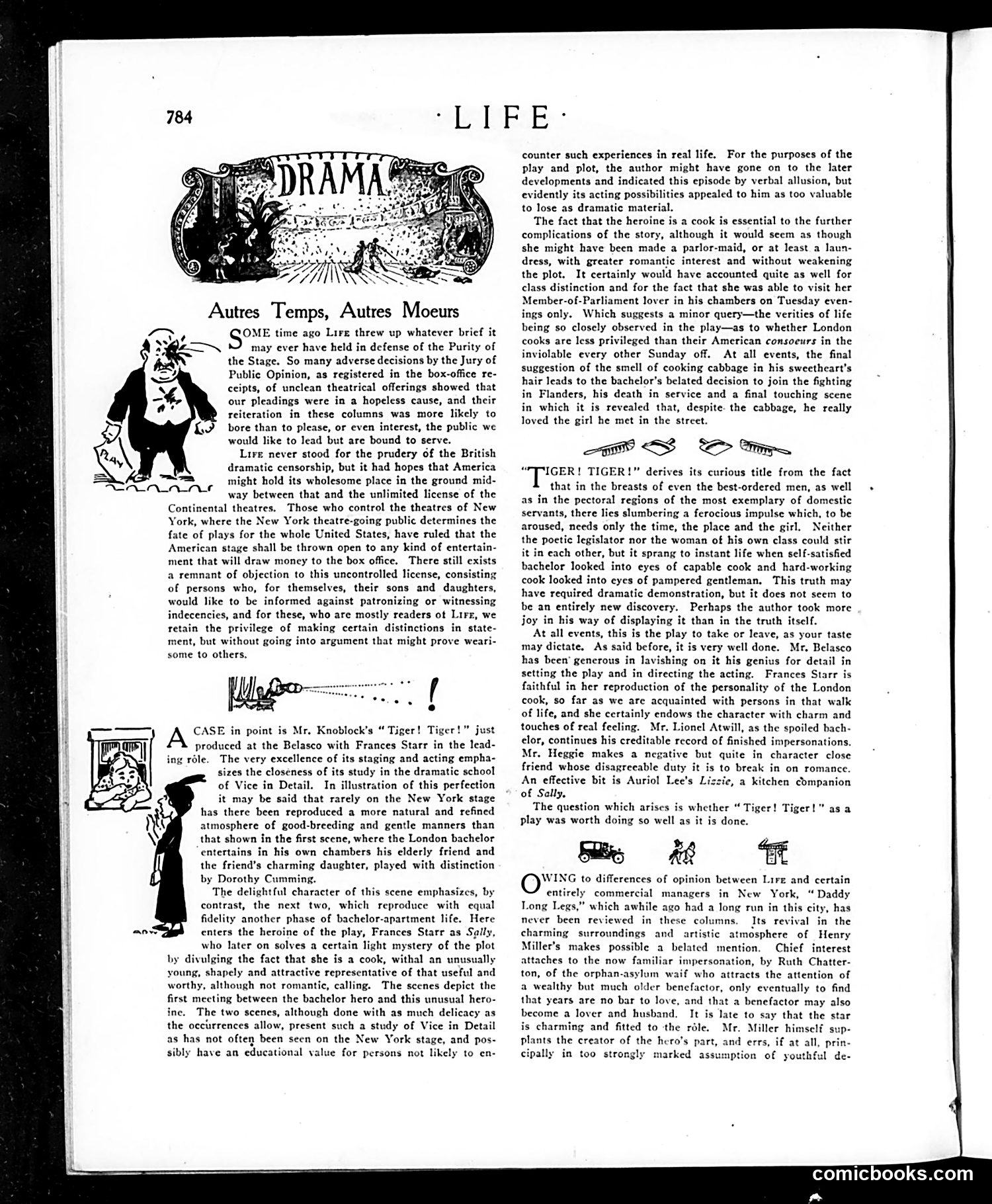
This page reviews Mr. Knoblock's play "Tiger! Tiger!" starring Frances Starr at the Belasco Theatre. The cartoon (top left) depicts a disheveled figure, likely representing theatrical "vice" or moral looseness. **The satire's target:** Life critiques the American theater's abandonment of decency standards. The magazine notes it once defended "purity of the stage" but surrenders, observing that box-office receipts show audiences prefer "unclean theatrical offerings." **The specific complaint:** The play depicts a London bachelor entertaining a young cook in his chambers across multiple scenes. While Life acknowledges the sophisticated staging, it objects that the heroine's profession as a cook seems unnecessarily chosen—a parlor-maid or laundress would serve the plot while carrying less suggestive implications about her presence in his private rooms. **The irony:** Life sarcastically notes the scenes have "educational value for persons not likely to encounter such experiences in real life"—mocking how theaters justify morally questionable content as dramatically essential rather than gratuitously sensational.
📄 Transcribed text from this page (OCR, searchable)
Machine-transcribed from the original scan — historical spelling and the odd misread are preserved.
“SESE Autres Temps, Autres Moeurs OME time ago Lire threw up whatever brief it may ever have held in defense of the Purity of the Stage. So many adverse decisions by the Jury of Public Opinion, as registered in the box-office re- ceipts, of unclean theatrical offerings showed that our pleadings were in a hopeless cause, and their reiteration in these columns was more likely to bore than to please, or even interest, the public we would like to lead but are bound to serve. Lire never stood for the prudery of the British dramatic censorship, but it had hopes that America might hold its wholesome place in the ground mid- way between that and the unlimited license of the Continental theatres. Those who control the theatres of New York, where the New York theatre-going public determines the fate of plays for the whole United States, have ruled that the American stage shall be thrown open to any kind of entertain- ment that will draw moncy to the box office. There still exists a remnant of objection to this uncontrolled license, consisting of persons who, for themselves, their sons and daughters, would like to be informed against patronizing or witnessing indecencies, and for these, who are mostly readers ot Lirr, we retain the privilege of making certain distinctions in state- ment, but without going into argument that might prove weari- some to others, [dba CASE in point is Mr. Knoblock’s “ Tiger! Tiger!” just produced at the Belasco with Frances Starr in the lead- ing role. The very excellence of its staging and acting empha- sizes the closeness of its study in the dramatic school of Vice in Deta In illustration of this perfection it may be said that rarely on the New York stage has there been reproduced a more natural and refined atmosphere of good-breeding and gentle manners than that shown in the first scene, where the London bachelor entertains in his own chambers his elderly friend and the friend’s charming daughter, played with distinction by Dorothy Cumming. The delightful character of this scene emphasizes, by contrast, the next two, which reproduce with equal fidelity another phase of bachelor-apartment life. Here enters the heroine of the play, Frances Starr as Sally, who later on solves a certain light mystery of the plot by divulging the fact that she is a cook, withal an unusually young, shapely and attractive representative of that useful and worthy, although not romantic, calling. The scenes depict the first mecting between the bachelor hero and this unusual hero- ine. The two scenes, although done with as much delicacy as the occurrences allow, present such a study of Vice in Detail as has not often been seen on the New York stage, and pos- sibly have an educational value for persons not likely to en- counter such experiences in real life. For the purposes of the play and plot, the author might have gone on to the later developments and indicated this episode by verbal allusion, but evidently its acting possibilities appealed to him as too valuable to lose as dramatic material. The fact that the heroine is a cook is essential to the further complications of the story, although it would seem as though she might have been made a parlor-maid, or at least a laun- dress, with greater romantic interest and without weakening the plot. It certainly would have accounted quite as well for class distinction and for the fact that she was able to visit her Member-of-Parliament lover in his chambers on Tuesday even- ings only. Which suggests a minor query—the verities of life being so closely observed in the play—as to whether London cooks are less privileged than their American consoeurs in the inviolable every other Sunday off. At all events, the final suggestion of the smell of cooking cabbage in his sweetheart’s hair leads to the bachelor’s belated decision to join the fighting in Flanders, his death in service and a final touching scene in which it is revealed that, despite. the cabbage, he really loved the girl he met in the street. “"TIGER! TIGER!” derives its curious title from the fact that in the breasts of even the best-ordered men, as well as in the pectoral regions of the most exemplary of domestic servants, there lies slumbering a ferocious impulse which, to be aroused, needs only the time, the place and the girl. Neither the poetic legislator nor the woman of his own class could stir it in each other, but it sprang to instant life when self-satisfied bachelor looked into eyes of capable cook and hard-working cook looked into eyes of pampered gentleman, This truth may have required dramatic demonstration, but it does not seem to be an entirely new discovery. Perhaps the author took more joy in his way of displaying it than in the truth itself. At all events, this is the play to take or leave, as your taste may dictate. As said before, it is very well done. Mr, Belasco has been’ generous in lavishing on it his genius for detail in setting the play and in directing the acting. Frances Starr is faithful in her reproduction of the personality of the London cook, so far as we are acquainted with persons in that walk of life, and she certainly endows the character with charm and touches of real feeling. Mr. Lionel Atwill, as the spoiled bach- elor, continues his creditable record of finished impersonations. Mr. Heggie makes a negative but quite in character close friend whose disagreeable duty it is to break in on romance. An effective bit is Auriol Lee's Lizcie, a kitchen companion of Sally, The question which arises is whether “ Tiger! Tiger!" asa play was worth doing so well as it is done. Silis RG WING to differences of opinion between Lire and cert entirely commercial managers in New York, “Daddy Long Legs," which awhile ago had a long run in this city, has never been reviewed in these columns. Its revival in the charming surroundings and artistic atmosphere of Henry Miller’s makes possible a belated mention. Chief interest attaches to the now familiar impersonation, by Ruth Chatter- ton, of the orphan. f who attracts the attention of a wealthy but much older benefactor, only eventually to find that years are no bar to love, and that a benefactor may also become a lover and husband. It is late to say that the star is charming and fitted to the réle. Mr. Miller himself sup- plants the creator of the hero's part, and errs, if at all, pri cipally in too strongly marked assumption of youthful de- ra comicbooks.com