
A complete issue · 40 pages · 1918
Life — May 16, 1918
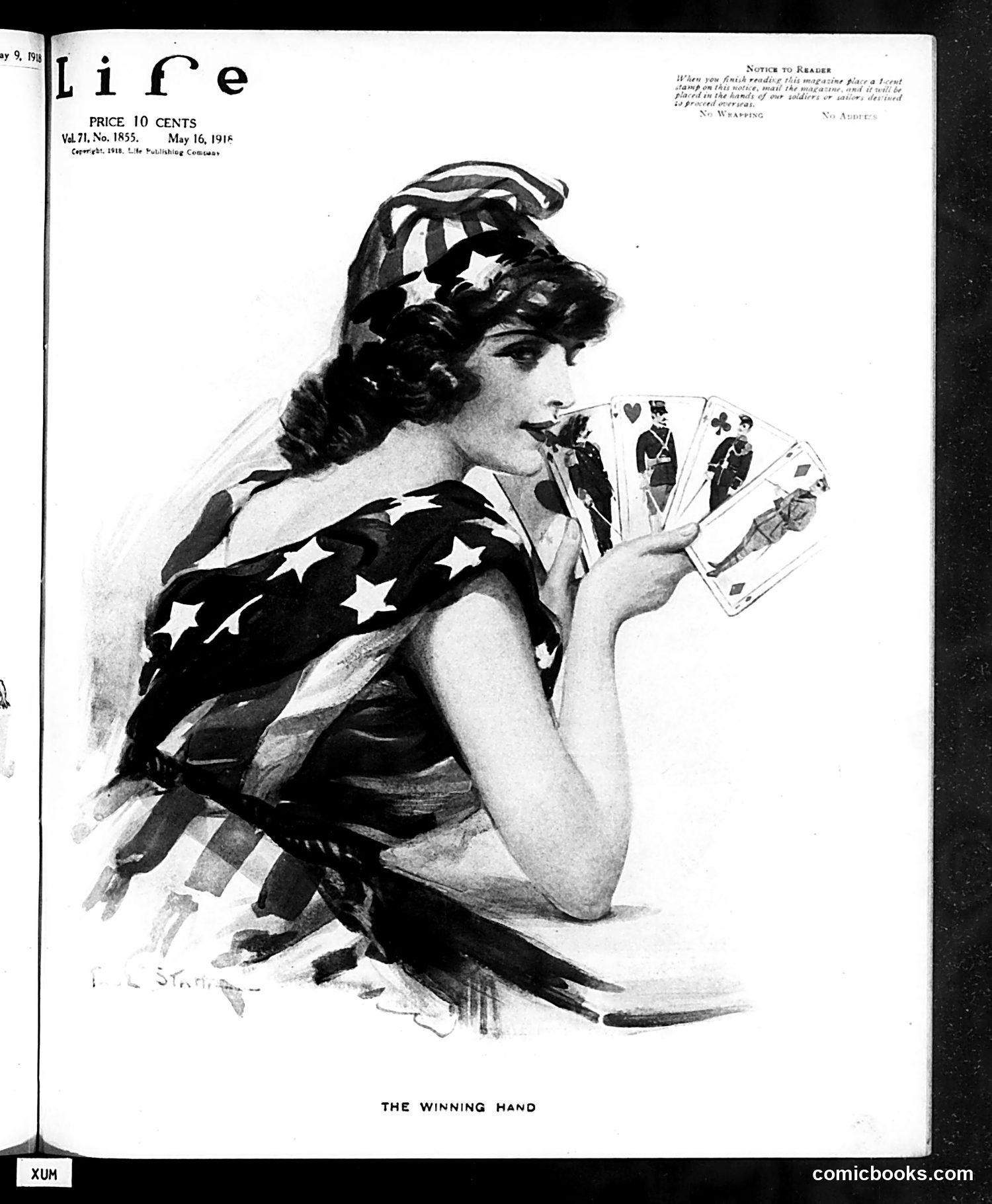
This illustration depicts a woman dressed in patriotic American imagery (stars and stripes) holding playing cards featuring military officers. The title "The Winning Hand" suggests a political metaphor. Given the 1916 date, this likely references the U.S. presidential election or debates about military preparedness during World War I. The woman appears to represent America or the American electorate, strategically "playing" military/political figures to achieve her desired outcome—suggesting women's political influence, whether through voting rights activism or their role in shaping national policy. The card motif implies calculated choice and advantage, positioning feminine political agency as decisive in national affairs.
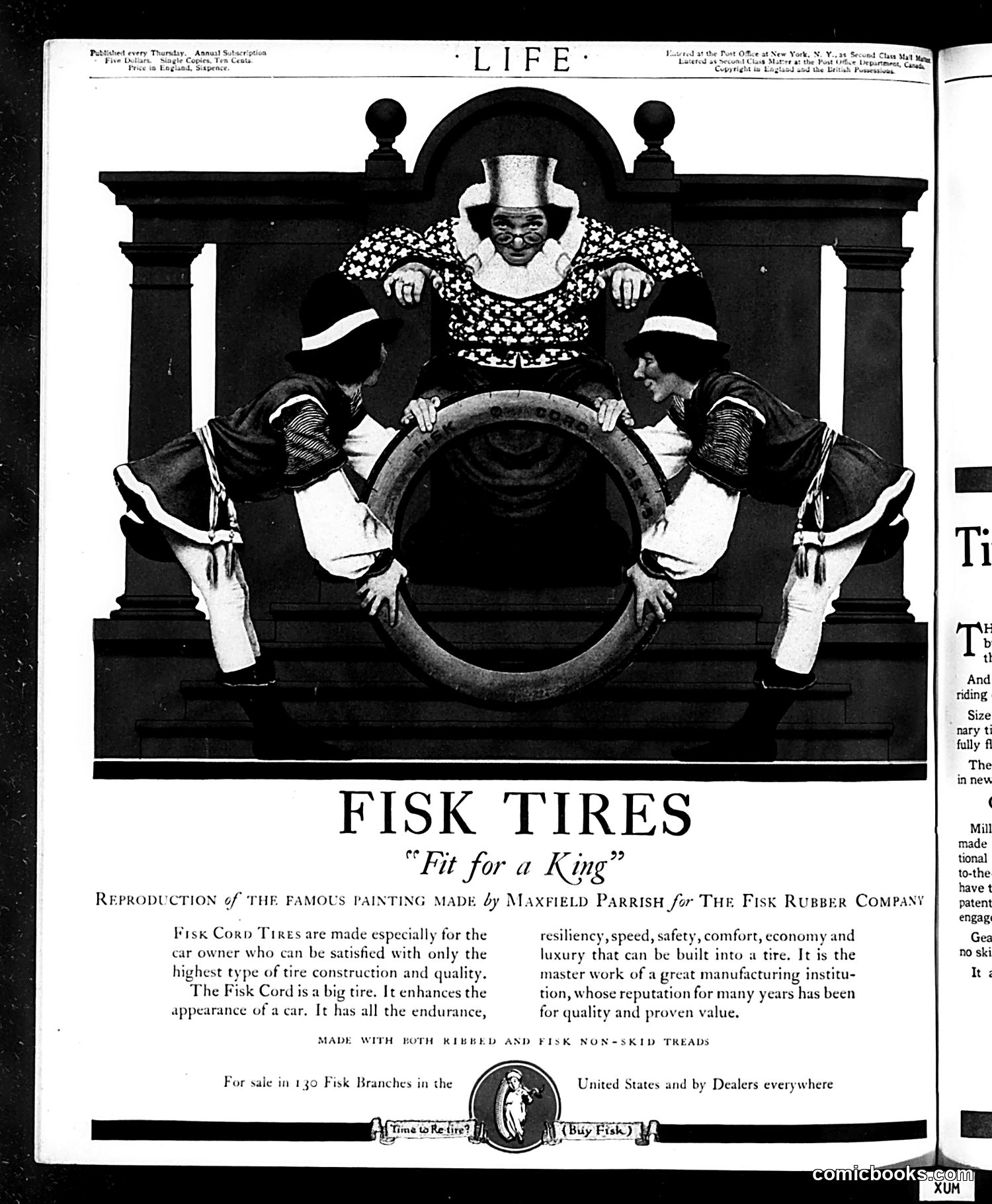
This is primarily a **Fisk Rubber Company advertisement**, not political satire. The central image is a parody of Maxfield Parrish's famous painting style, depicting an exaggerated caricatured figure (appearing to represent a wealthy or powerful man) seated on a throne with two attendants holding an enormous tire. The tagline **"Fit for a King"** is the advertisement's central conceit—claiming Fisk Cord Tires are luxurious and high-quality enough for the most discerning customers. The theatrical, absurdist presentation emphasizes superiority and exclusivity. The Fisk company logo at bottom includes their mascot (a figure in period dress), and text notes availability at "140 Fisk Branches" nationwide. This is commercial advertising exploiting humorous visual exaggeration to promote tire quality and prestige.
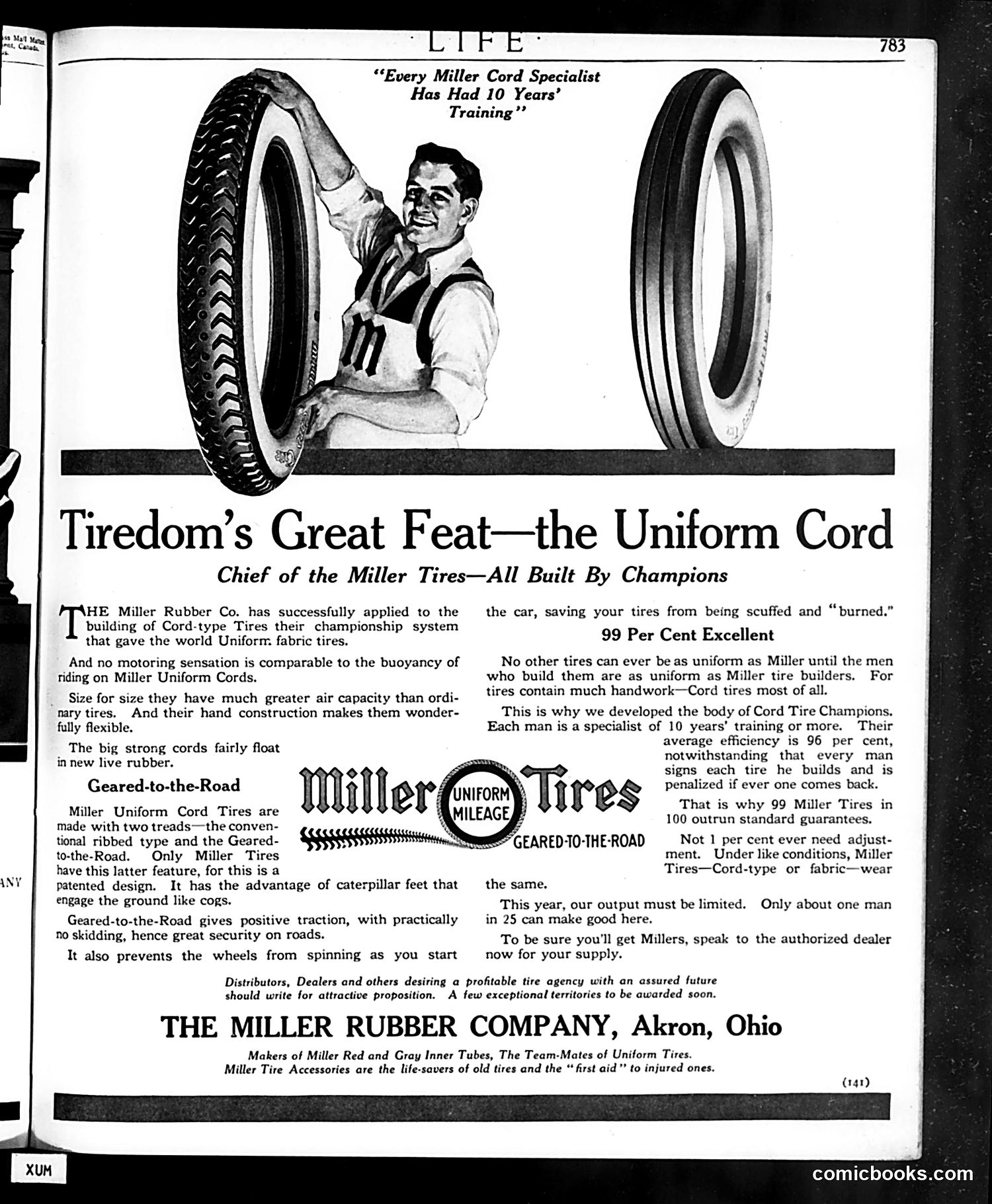
This is **not satire or a political cartoon**—it's a straightforward advertisement for Miller Uniform Cord Tires, published in Life magazine (page 783). The ad features a smiling workman holding an oversized tire, illustrating Miller's marketing claim that their tires are built by highly trained specialists ("Every Miller Cord Specialist Has Had 10 Years' Training"). The accompanying text emphasizes uniformity, quality control, and durability. The "Geared-to-the-Road" feature is described as a caterpillar-like tread pattern providing traction and security. The ad promotes their "Uniform Mileage" guarantee and notes limited production that year. This represents early 20th-century automotive advertising emphasizing craftsmanship and worker expertise as selling points—a contrast to later mass-production messaging.
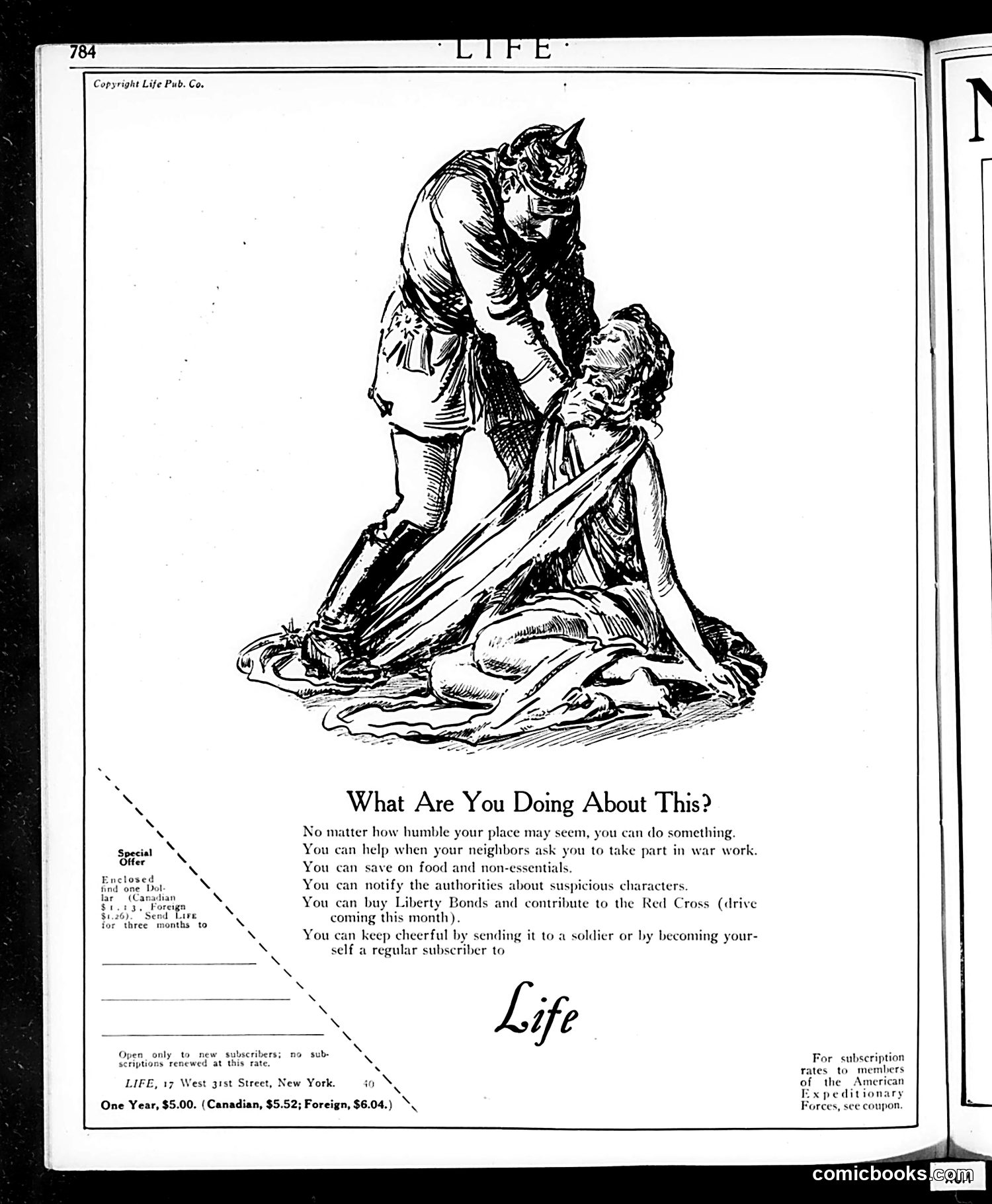
This is a **World War I recruitment advertisement** from Life magazine, not a satirical cartoon. The image depicts an adult (likely representing a soldier or authority figure) lifting a child, illustrating the headline "What Are You Doing About This?" The advertisement appeals to American civilians to support the war effort through various means: volunteering for war work, conserving food, reporting suspicious individuals, purchasing Liberty Bonds, donating to the Red Cross, and subscribing to Life magazine itself. The child symbolizes America's future and vulnerability, creating emotional pressure on readers to participate in the war effort. This reflects the propaganda approach common during WWI, when publications mobilized public support for military and civilian contributions to the war.
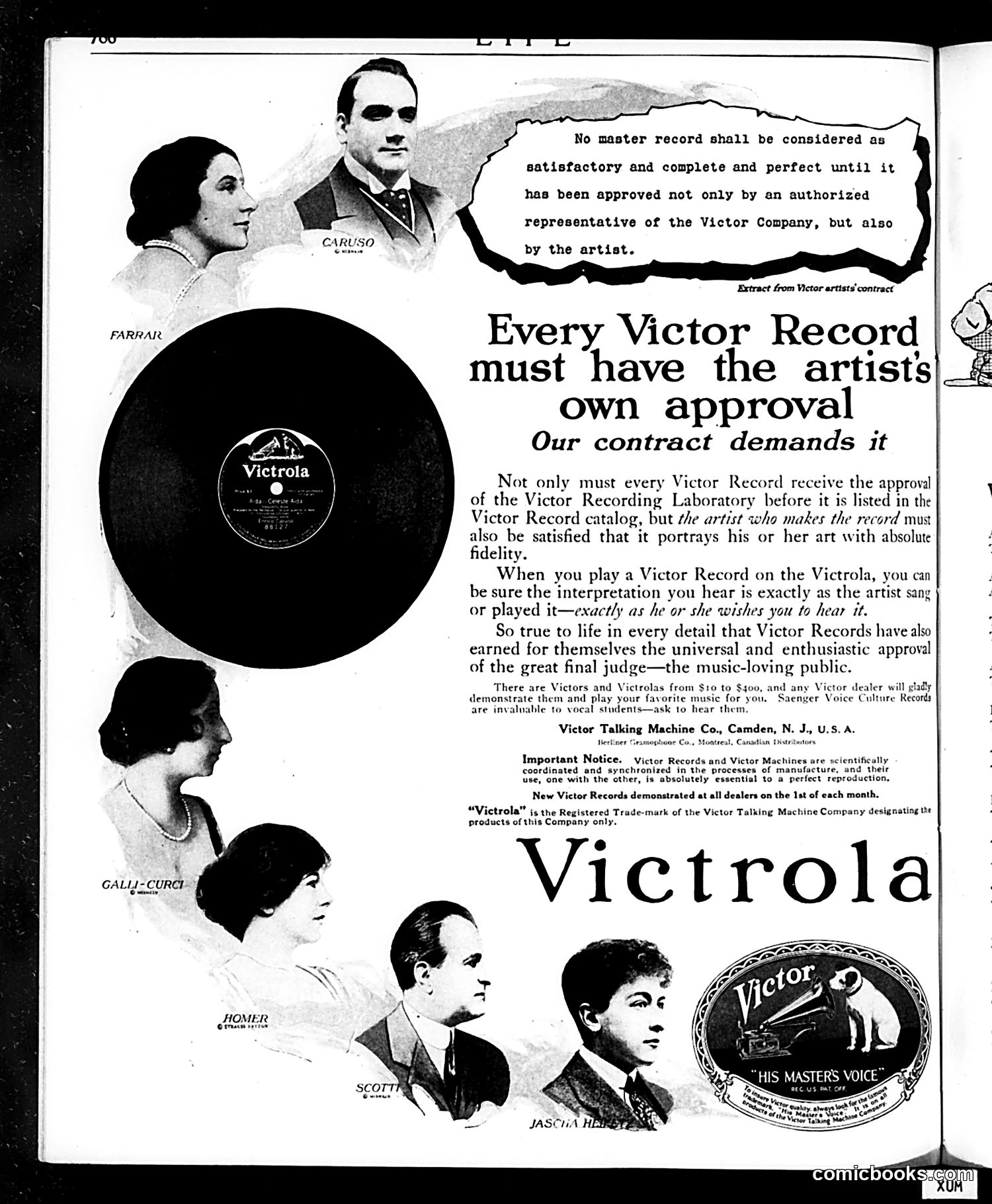
This page is primarily **advertising**, not satire or political commentary. It's a Victor Talking Machine Company advertisement promoting Victrola record players and Victor Records. The page features portraits of famous opera singers—identified by names like "CARUSO," "FARRAR," "GALLI-CURCI," "HOMER," and "JASCHA HEIFETZ"—to demonstrate that Victor Records feature renowned artists. The advertisement emphasizes that every recording receives artist approval for quality and fidelity. The central claim is that Victor Records preserve performances "exactly as he or she sings you to hear it," making them trustworthy reproductions. This was a significant marketing point in early phonograph advertising, assuring consumers of authenticity and quality. The "His Master's Voice" logo (dog and gramophone) appears at bottom right, Victor's iconic trademark.
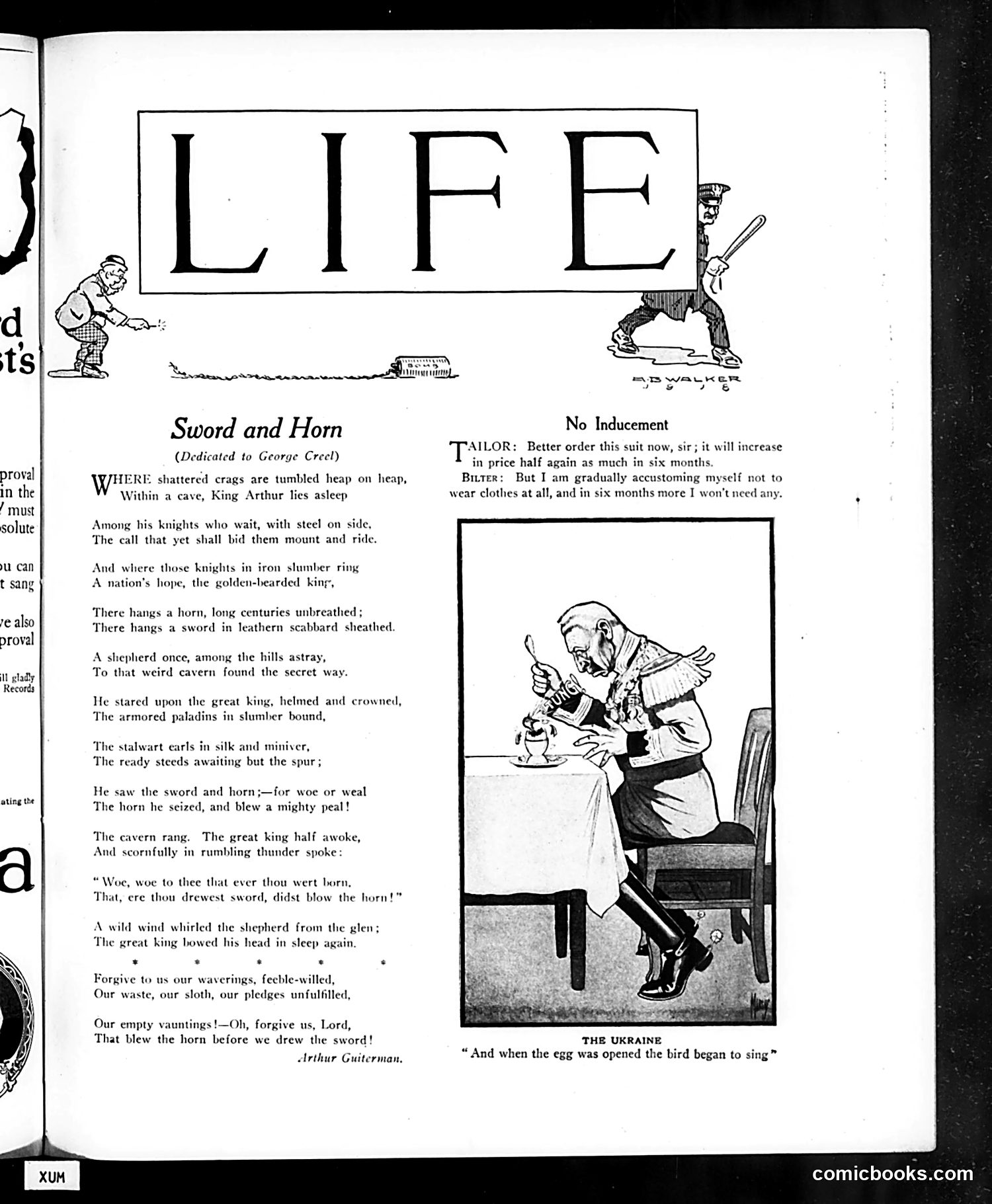
This page contains two distinct pieces: **"Sword and Horn"** (left): A poem by Arthur Guiterman dedicated to George Creel, depicting King Arthur's knights waiting in a cave for a magical call to action. The imagery of dormant warriors and a horn-blast likely references World War I mobilization efforts—Creel headed the U.S. Committee on Public Information during WWI, so the poem appears to be patriotic verse about rallying the nation. **"No Inducement"** (right): A cartoon satirizing wartime clothing rationing or price inflation. A tailor pressures a customer to buy a suit now, claiming it will cost "half again as much in six months." The customer resists, saying he'll simply stop buying clothes. The joke mocks both inflation and consumer resistance during economic constraints—likely WWI-era scarcity.
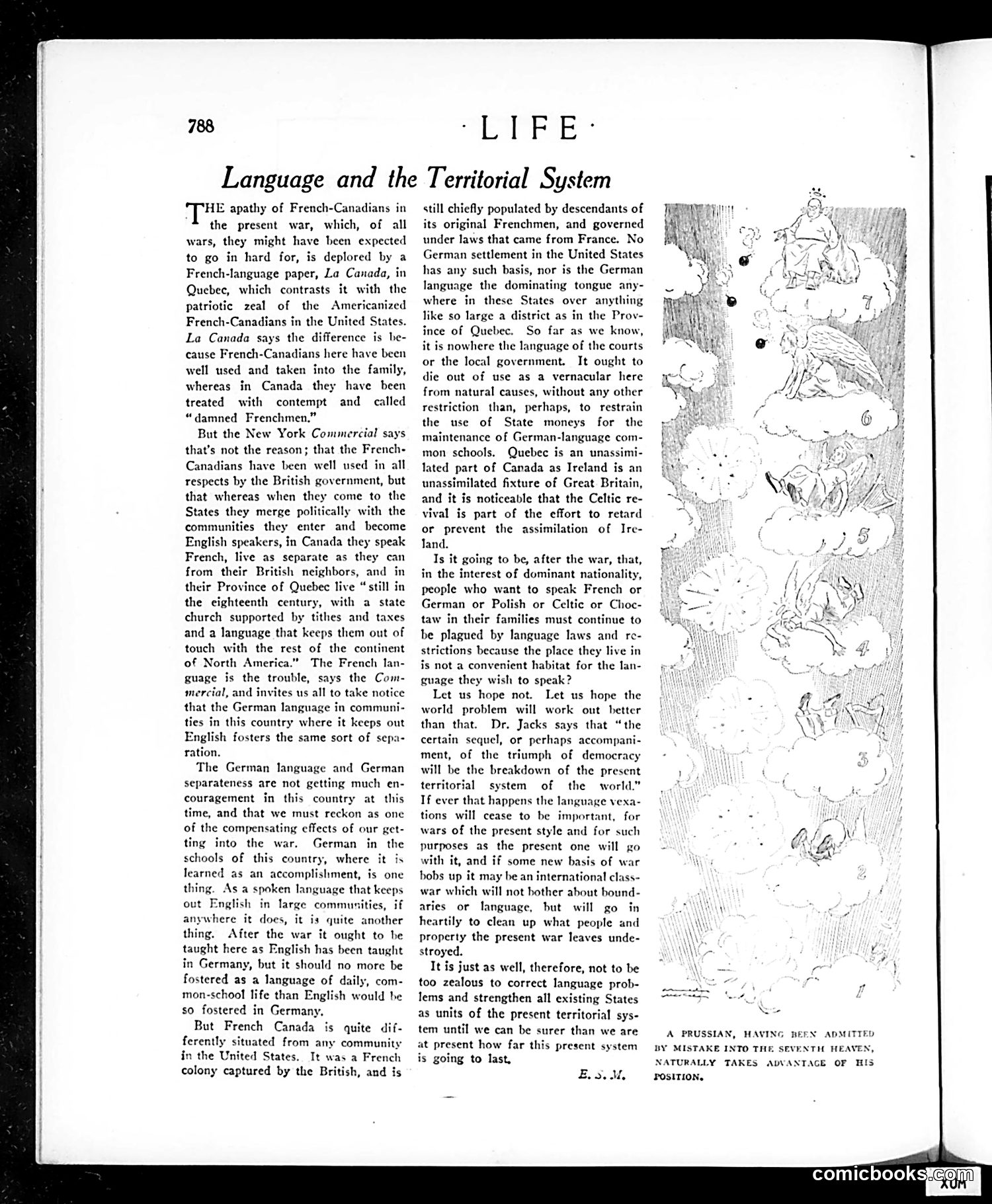
This page discusses French-Canadian language politics during World War I. The article argues that French-Canadians in Quebec should be allowed to maintain their language and cultural identity, contrasting their situation with how German-language communities in the U.S. faced suppression and discrimination. The cartoon depicts a Prussian soldier who has "blundered into the seventh heaven" by mistake—humorously suggesting the soldier has accidentally stumbled into a fortunate position. The caption's ironic tone mocks German military overconfidence while illustrating the article's broader point about how language and territorial identity issues will persist after the war, regardless of military outcomes. The piece advocates for respecting linguistic minorities' rights rather than forcibly assimilating them into dominant cultures.
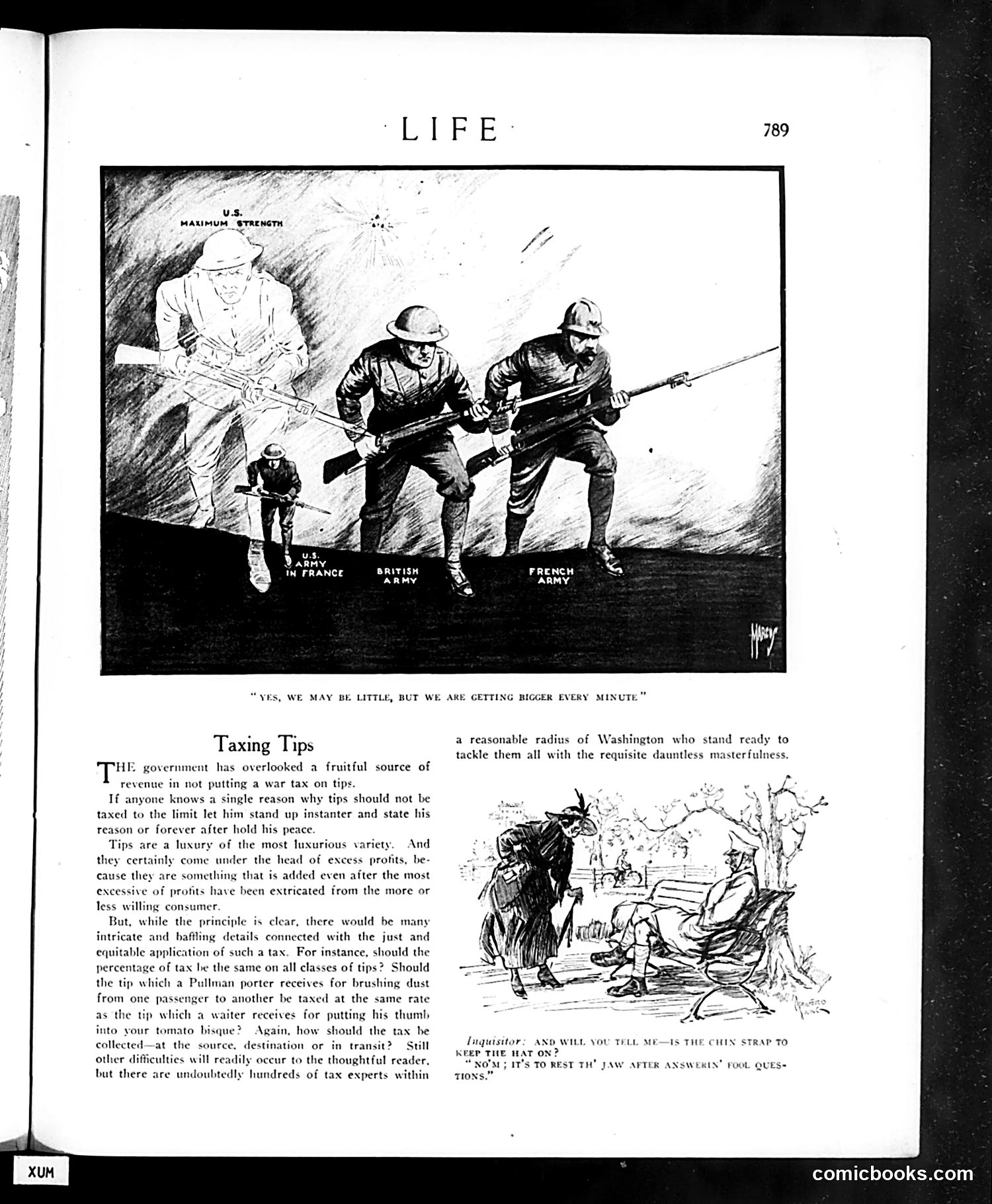
**Top Cartoon:** This depicts U.S. military strength ("U.S. Maximum Strength") as a large figure emerging from darkness, while three allied armies—labeled "U.S. Army in France," "British Army," and "French Army"—stand ready with rifles. The caption reads: "Yes, we may be little, but we are getting bigger every minute." This appears to satirize American military growth during World War I, suggesting the U.S. contribution was initially modest but rapidly expanding, bolstering Allied forces. **"Taxing Tips" Article:** Below is a humorous editorial proposing war taxes on gratuities (tips)—a luxury item. The author argues the government overlooks this revenue source and debates implementation details, questioning whether taxi tips should be taxed identically to restaurant tips. The accompanying sketch illustrates this absurdist suggestion through a conversation about maintaining tipping customs during wartime.
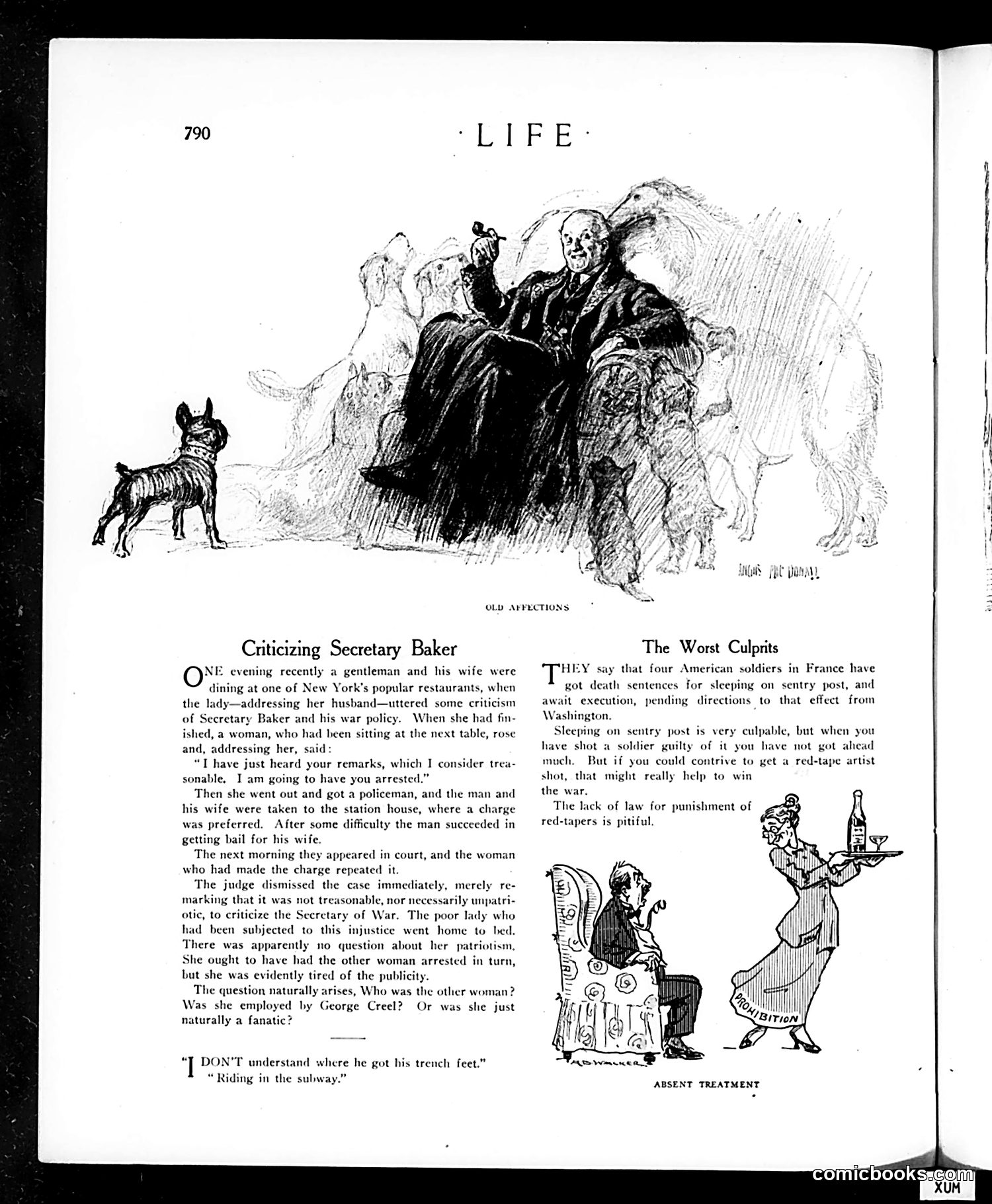
This page contains three distinct satirical pieces from WWI-era Life magazine: **"Criticizing Secretary Baker"** (left): A anecdote mocking Newton Baker, Secretary of War, whose policies apparently drew public criticism. The joke centers on a woman arrested for criticizing Baker at a restaurant, while the actual critic (possibly someone influential) faced no consequences. The satire suggests unfair selective enforcement of patriotic speech during wartime. **"The Worst Culprits"** (upper right): Criticizes executing American soldiers for sleeping on sentry duty while awaiting orders. The cartoon contrasts military justice severity with artistic incompetence, sarcastically suggesting a "red-tape artist" would help the war effort more than executing soldiers. **"Absent Treatment"** (lower right): An untitled cartoon showing what appears to be medical or bureaucratic incompetence regarding absent soldiers or shirkers. The overall theme addresses wartime injustices and inconsistent military discipline.
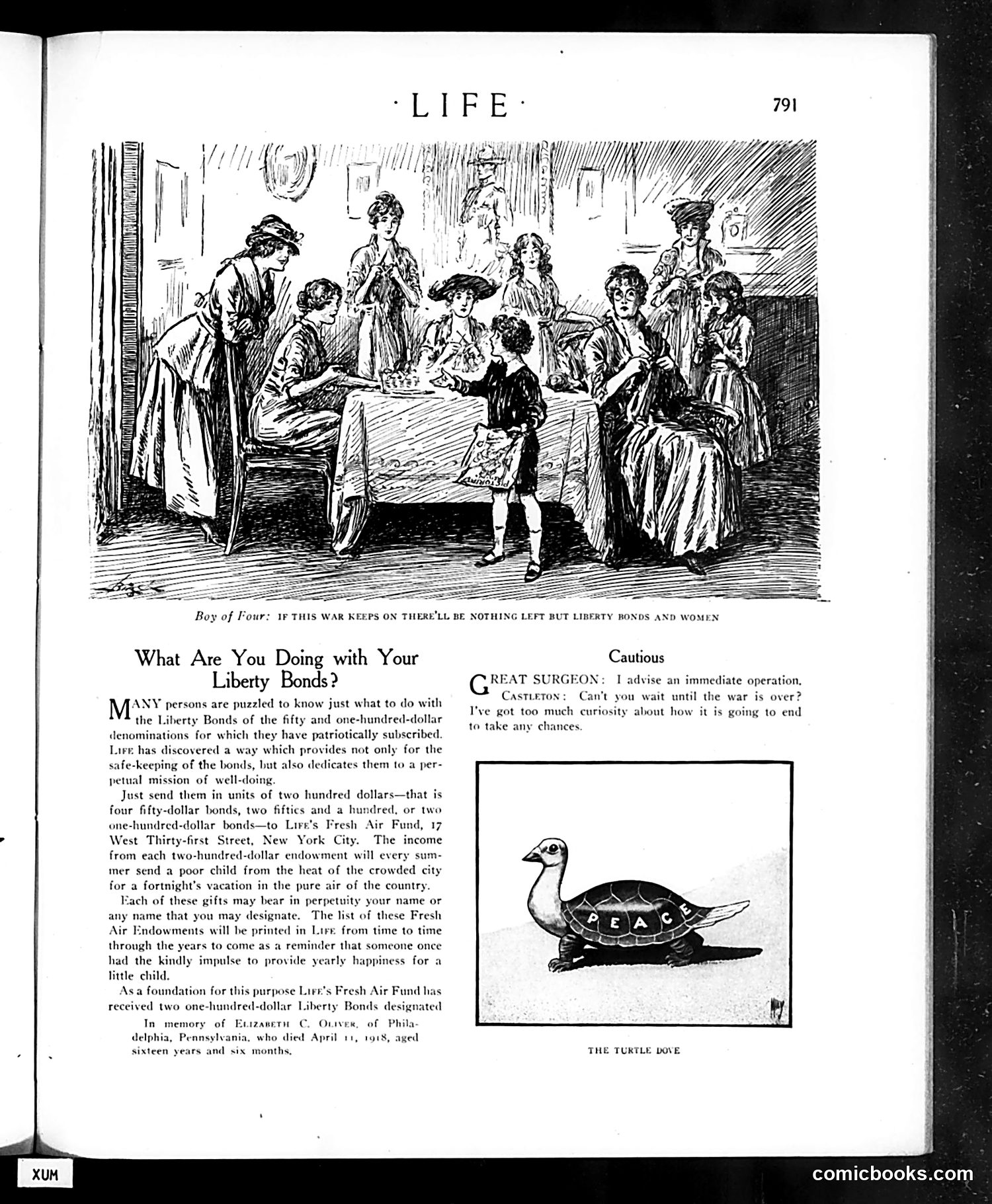
This page contains a public service article about Liberty Bonds rather than political satire. The top illustration shows a young boy surrounded by women at a table, captioned "Boy of Four: If This War Keeps on There'll Be Nothing Left but Liberty Bonds and Women" — a joke about WWI's impact on society, suggesting the war will consume all resources and men. The main article, "What Are You Doing with Your Liberty Bonds?", explains how donors can dedicate their bond investments to Lirr's Fresh Air Fund, which sends poor city children to the countryside. The text mentions a specific $200 bond donation made in memory of Elizabeth C. Oliver of Philadelphia (died April 11, 1918). The small illustration of a turtle is unrelated editorial content titled "The Turtle Dove."
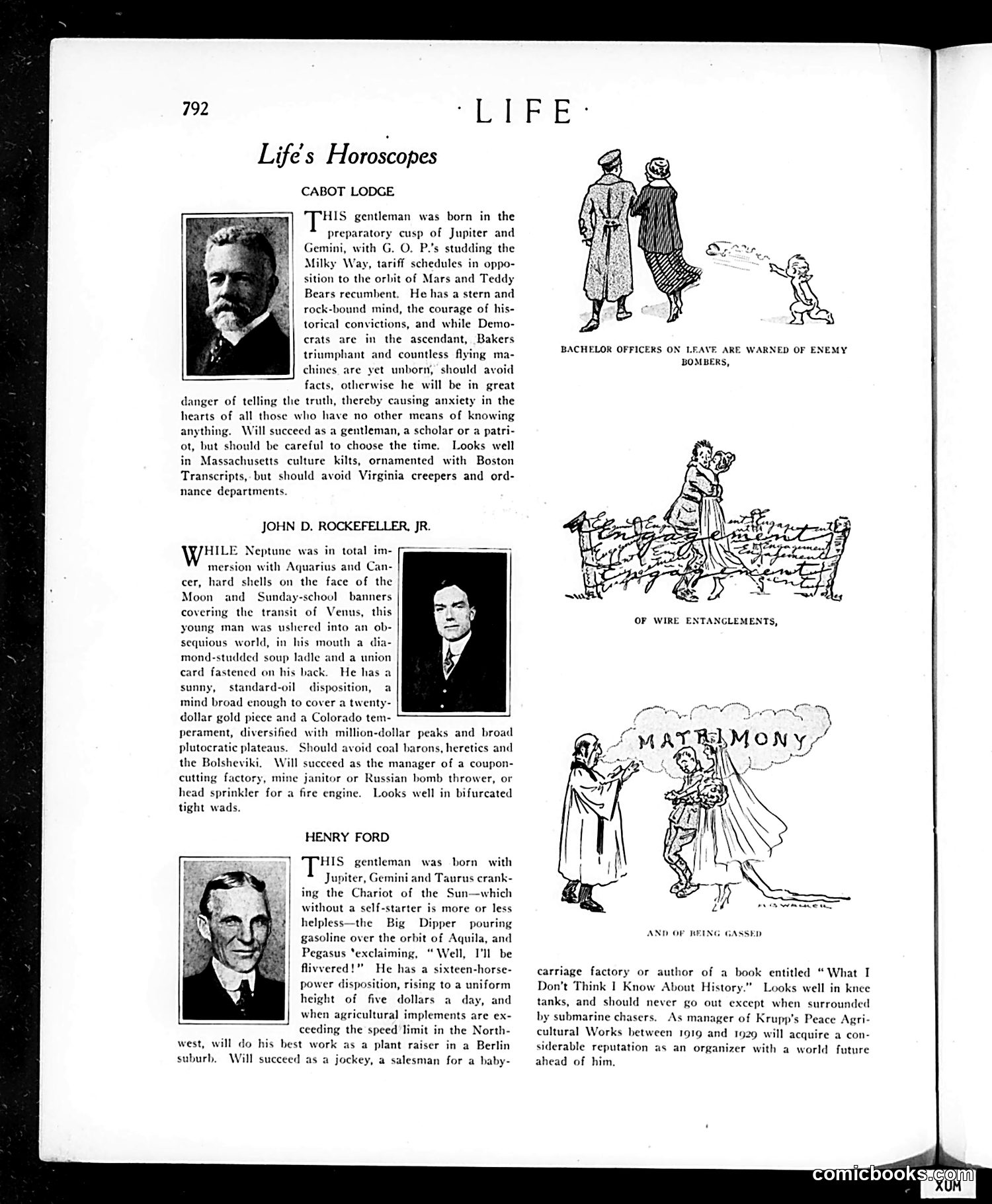
This page presents satirical "horoscopes" for three prominent men based on their astrological signs. Each entry pairs a photograph with a personality reading and tongue-in-cheek prediction. **Cabot Lodge** (Jupiter placement): Described as stern and rock-bound, warned against telling uncomfortable truths that might cause anxiety. The accompanying cartoons humorously illustrate potential social disasters—bachelor officers warned of enemy bombers, wire entanglements, and matrimonial complications. **John D. Rockefeller Jr.** (Neptune/Aquarius): Characterized as having a "sunny, standard-oil disposition" suitable for managing factories or bomb-throwing operations. **Henry Ford** (Jupiter/Gemini/Taurus): Depicted as a stiff-starter with potential as a jockey or salesman. The satire mocks these wealthy, powerful men through mock-astrological personality typing.
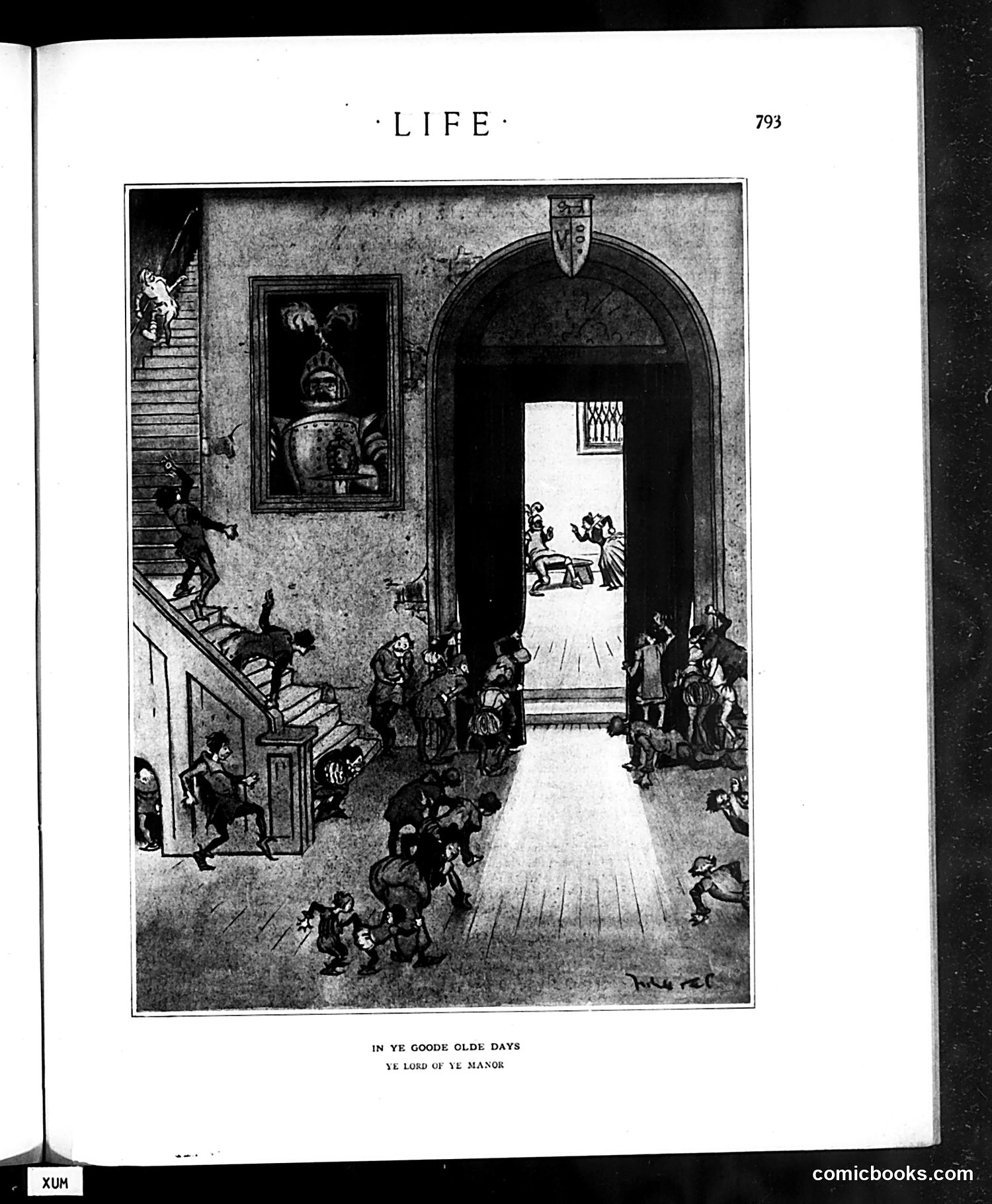
This illustration depicts a medieval manor hall scene titled "In Ye Goode Olde Days / Ye Lord of Ye Manor." The cartoon satirizes romanticized nostalgia for the feudal past. The image shows a lord or nobleman presiding over a crowded hall filled with commoners, servants, and peasants. The architectural details—the arched doorway, heraldic shield, and portrait on the wall—establish the aristocratic setting. The satire likely mocks the sentimental idealization of "the good old days" that was popular in late 19th/early 20th-century culture. The crowded, chaotic scene of lower-class figures suggests the actual disorder and subordination of feudalism, contrasting sharply with genteel fantasy versions. The cartoon critiques this nostalgic myth-making about hierarchical medieval society.
This page is primarily **text, not a cartoon**—a political editorial addressed "To the People of the South and West" opposing the Postal Zoning Law. The author argues the law: - Penalizes people living far from publishing centers - Violates the government's historical postal mission to unite the nation - Creates sectionalism by disadvantaging remote communities - Was promoted by Postmaster-General Burleson, criticized as inefficient The editorial urges readers to contact their senators and representatives to demand repeal, claiming the law is "un-American" because it separates rather than connects communities. **Context**: This appears to address Progressive-era postal policy debates over mail rates and regional economic disparities.
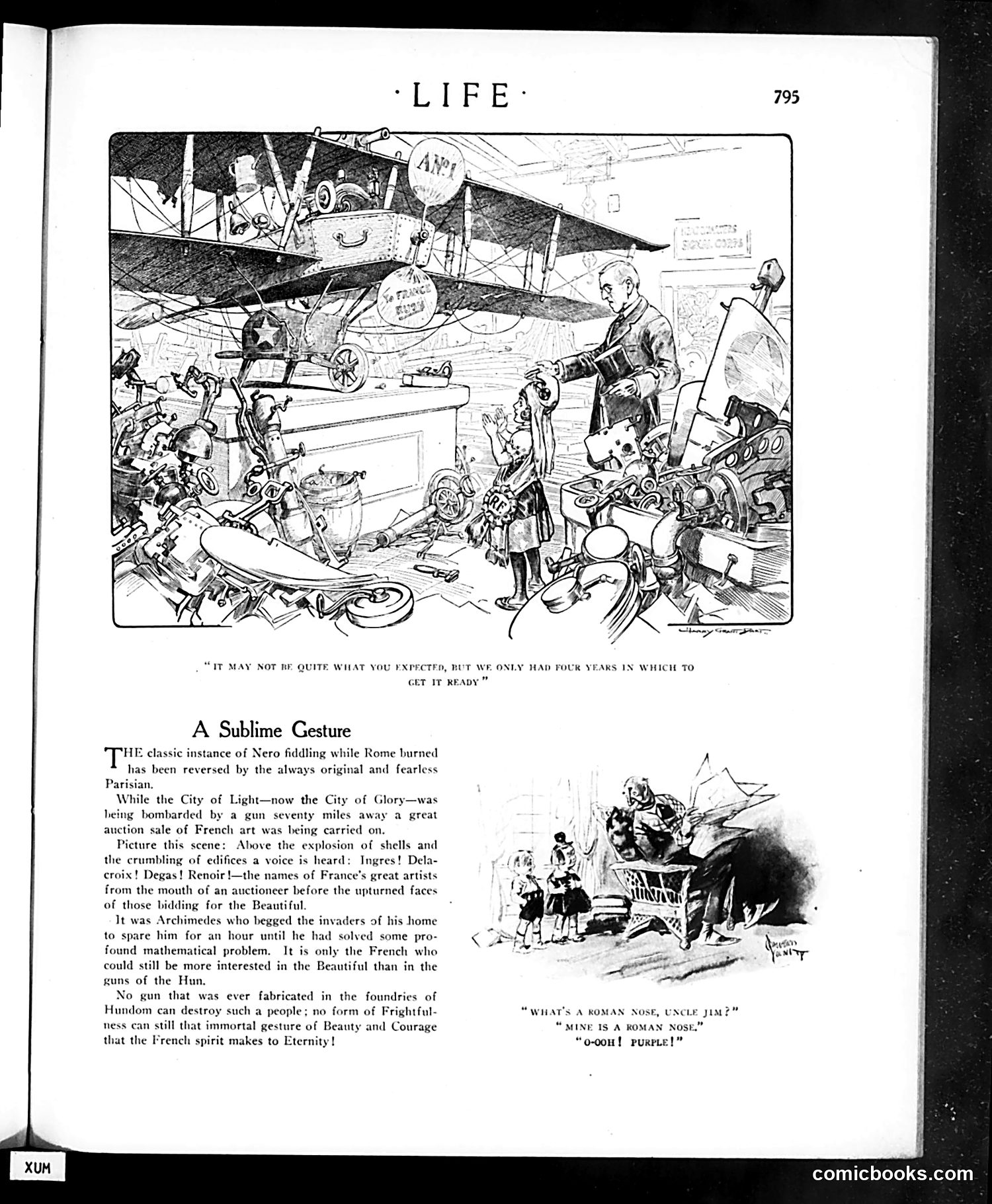
The top cartoon depicts an aircraft factory during World War I, with the caption quoting someone saying they had only four years to get aircraft ready. This appears to satirize the rushed American aircraft production effort during WWI. The bottom illustration shows a woman asking "What's a Roman nose, Uncle Jim?" with the punchline "Mine is a Roman nose—O-oh! Purple!" This is a visual pun: a "Roman nose" (meaning a prominent, curved nose) becomes funny when the speaker literally means her nose is purple from being hit. The humor relies on wordplay and physical comedy rather than political satire. Both pieces reflect wartime and domestic American humor circa 1917-1918.
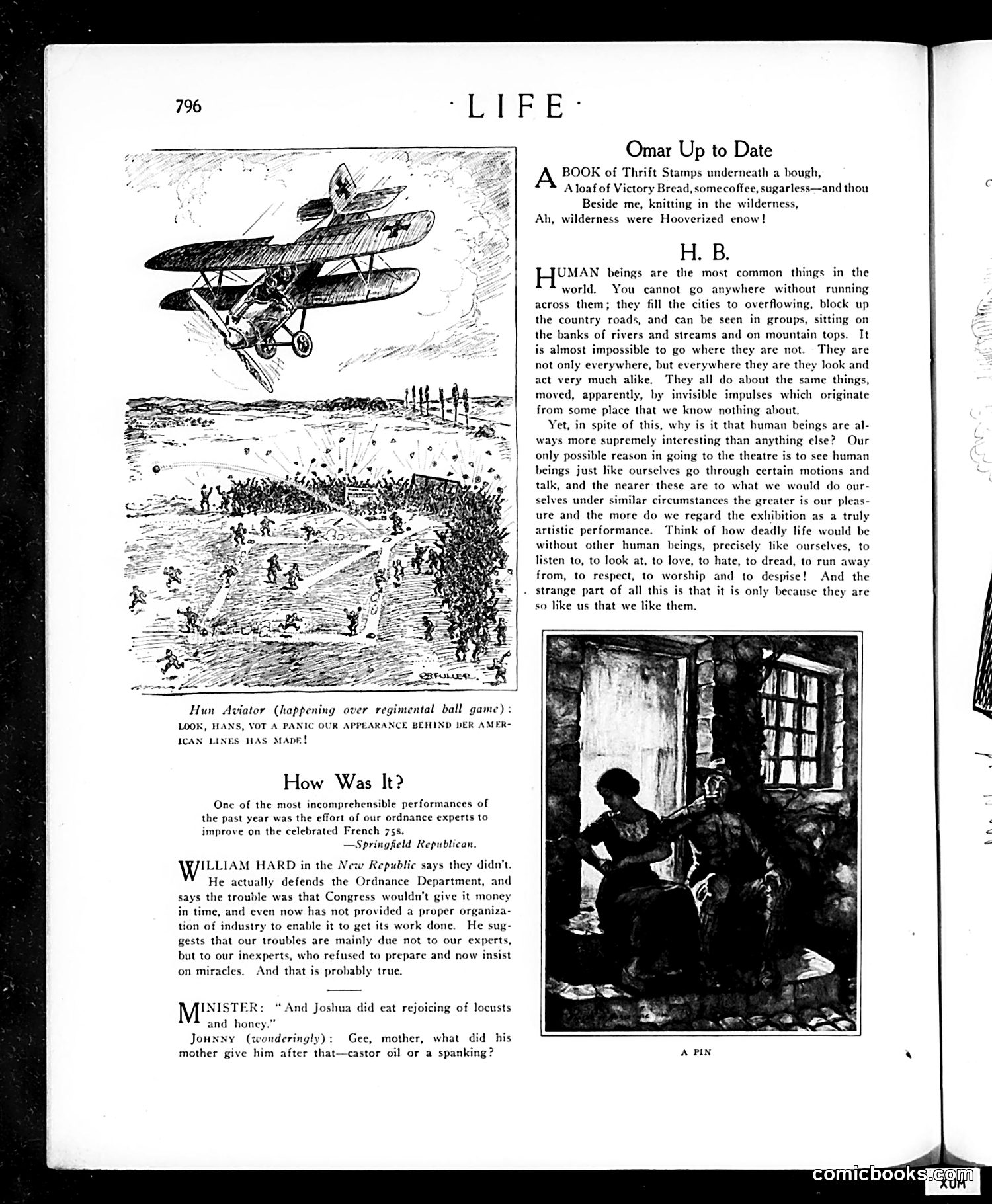
**"Omar Up to Date"** is a satirical poem parodying the famous *Rubaiyat of Omar Khayyam*. It mocks American wartime rationing and austerity measures (likely WWI-era), replacing romantic imagery with references to "Thrift Stamps," "Victory Bread," and "Hooverized" conditions—Herbert Hoover being associated with food conservation programs. The joke: romance is dead when replaced by rationing. **"Hun Aviator"** cartoon depicts a German pilot flying over an American baseball game, expecting panic but seeing none. The satire comments on American complacency or confidence during WWI—the Germans expected fear, but Americans continue their leisure activities undisturbed. The airplane illustration above shows early aviation technology; the ground scene shows the baseball game's scale and crowd. **"How Was It?"** discusses military ordnance procurement failures, defending the Ordnance Department and blaming Congress for inadequate funding and poor industrial organization rather than expert failure. The remaining humor items are unrelated vignettes.
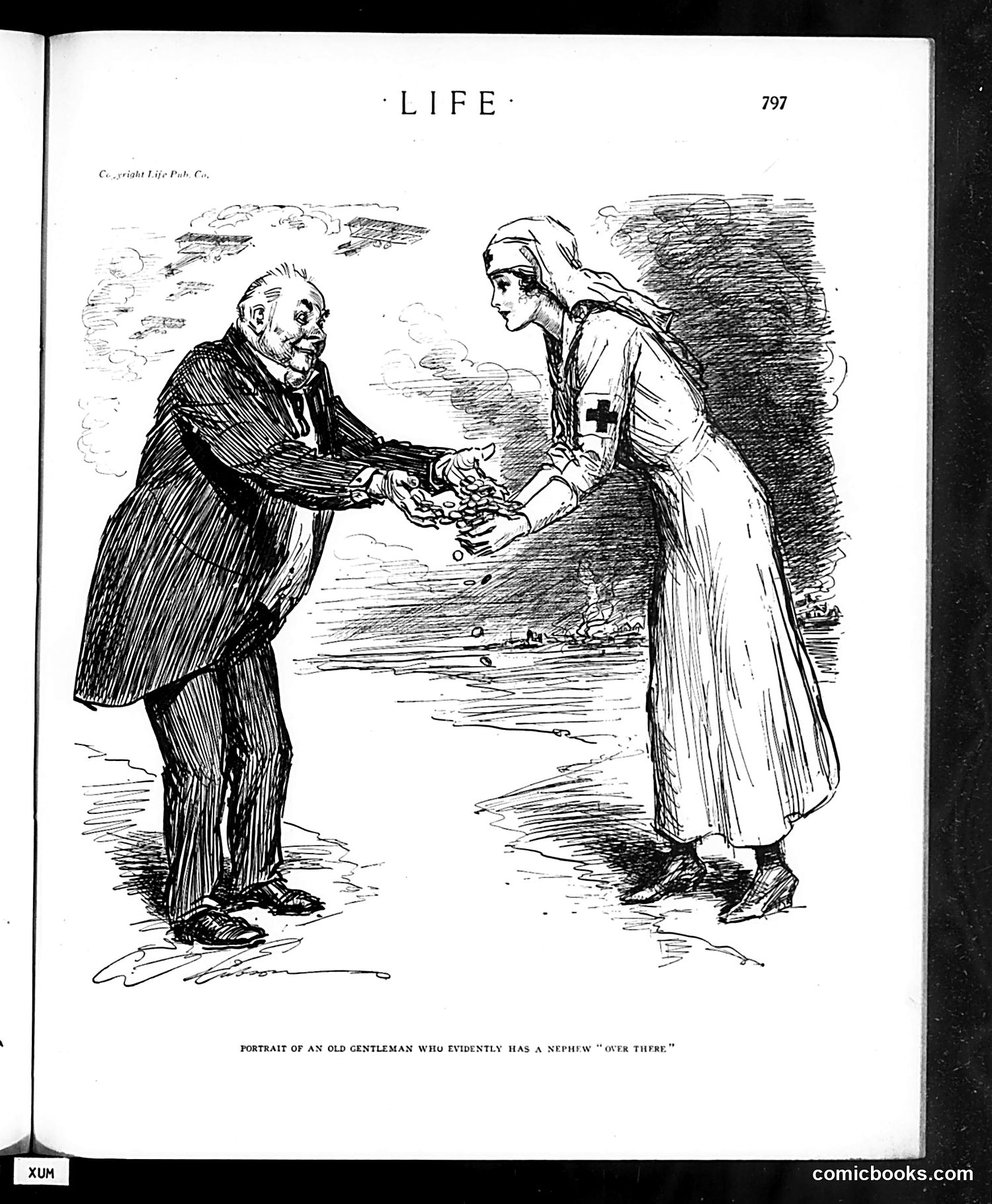
This cartoon depicts an elderly gentleman in formal dress shaking hands with a nurse wearing a Red Cross armband and head covering. The caption indicates he has a nephew "over there"—a common WWI-era phrase referring to soldiers fighting in Europe. The satire likely mocks wealthy or well-connected older men who leveraged family connections to secure favorable military assignments or roles for younger relatives, rather than having them serve in dangerous frontline combat. The gentleman's pleased expression and the nurse's professional demeanor suggest he's obtained some advantageous wartime position for his nephew, possibly through influence or wealth—a common criticism of privilege during the war years.
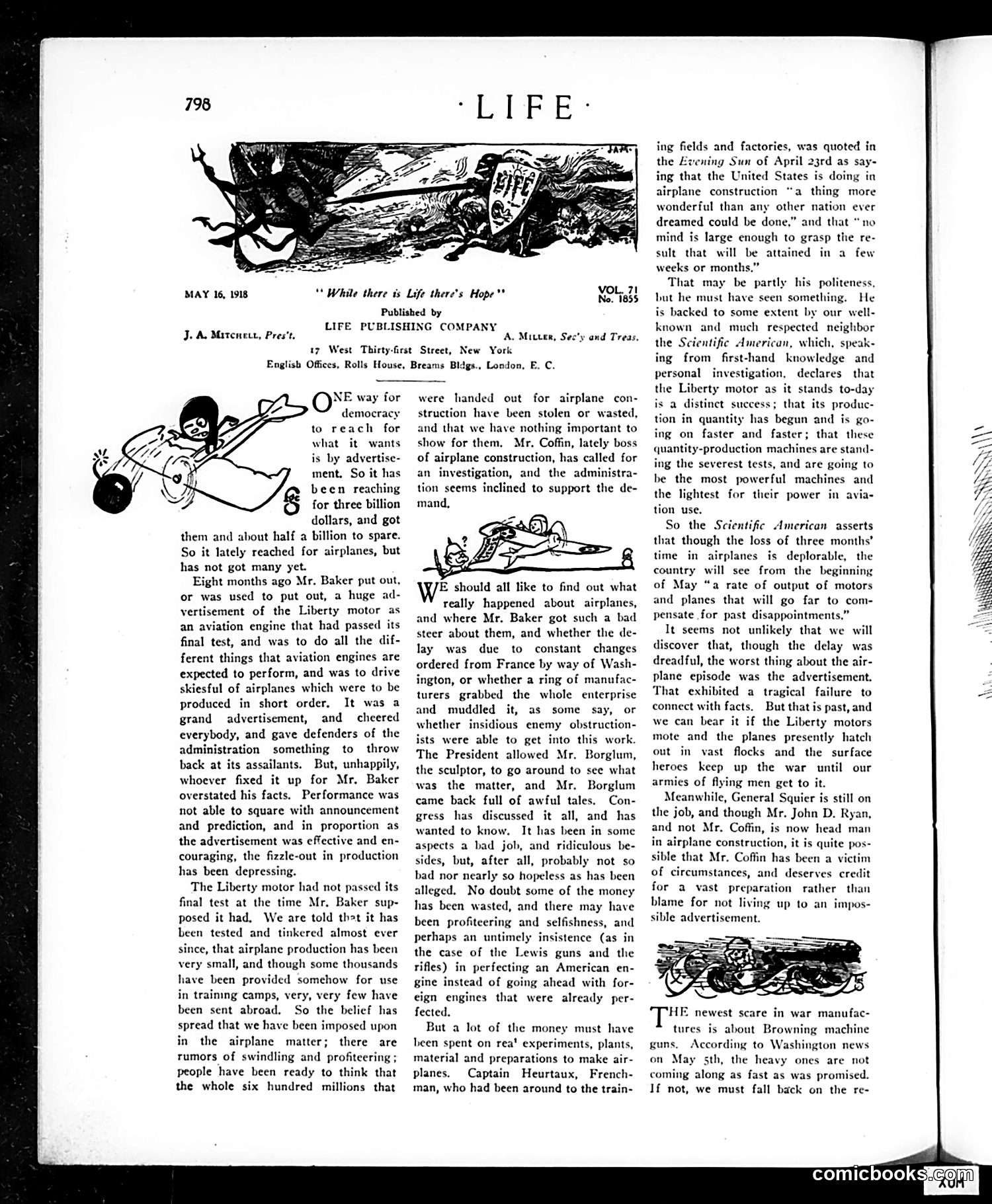
This editorial addresses the widely-publicized failure of the **Liberty aircraft engine**, a major WWI-era procurement scandal. Secretary of War Baker had advertised the engine as complete and ready for mass production, but it repeatedly failed tests and airplane output remained minimal—fueling public suspicion of waste, profiteering, and incompetence. The cartoons (showing a crashed plane) visually reinforce the text's critique: an overpromising government advertisement failed to deliver results. The piece acknowledges legitimate problems—overstated claims, production delays—but argues against conspiracy theories, attributing delays partly to design changes from France and partly to building American engines rather than adopting foreign ones. The editorial cites French captain Heurtaux's contrary assessment that U.S. airplane construction efforts were unprecedented, suggesting eventual success despite current disappointments. The satire's target is official mismanagement and premature boasting rather than the administration's fundamental competence.
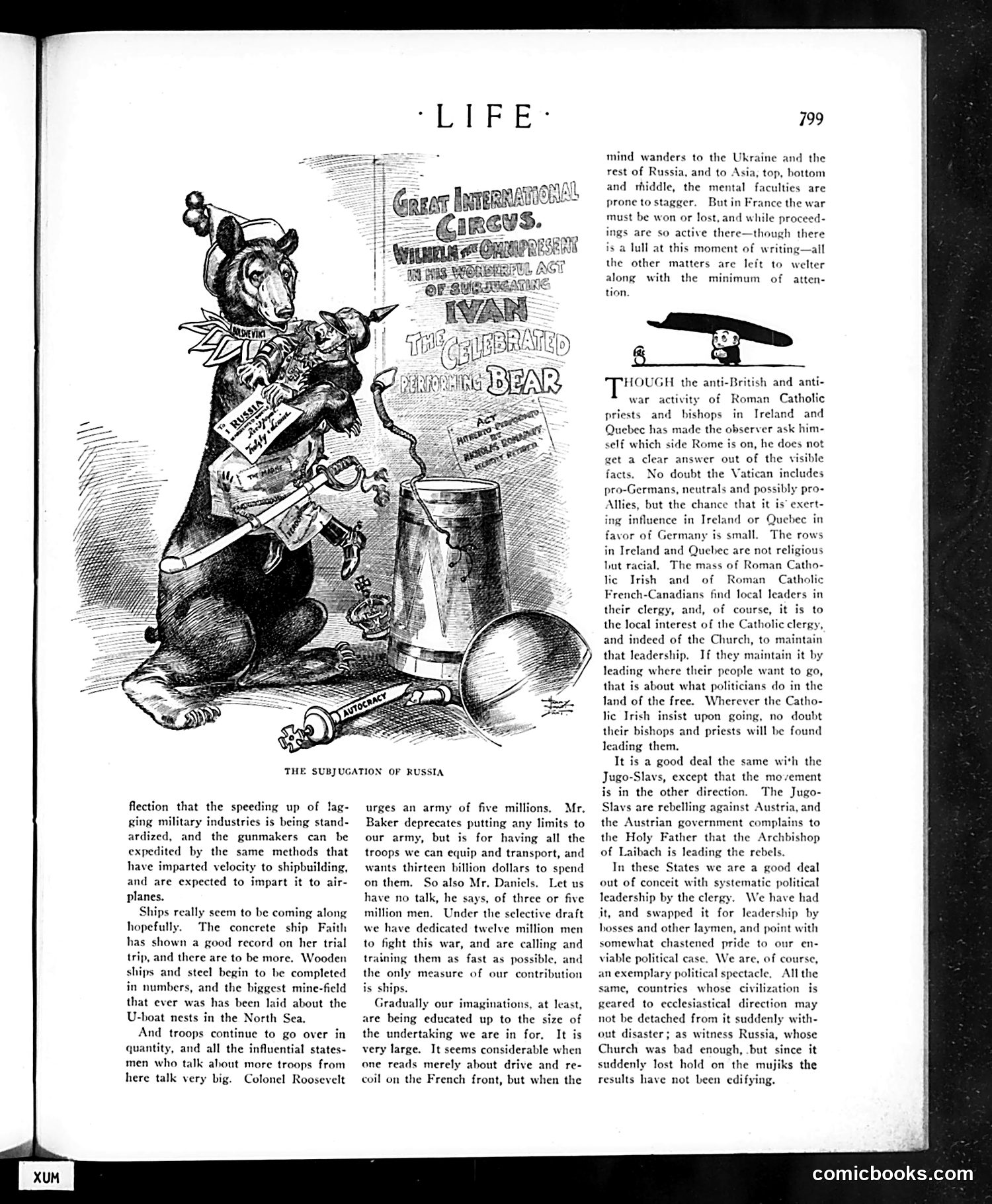
The cartoon depicts a bear (representing Russia) being controlled like a circus performer by a ringmaster holding a whip and chair. The bear wears a collar labeled "I AM A BEAR" and juggles various implements of war. This satirizes Russia's military collapse and Germany's dominance over Russian forces during World War I. By 1918 (when this appears), Russia had suffered catastrophic defeats and was negotiating the Treaty of Brest-Litovsk, effectively withdrawing from the war. The "circus" imagery suggests Russia has become a conquered territory, controlled and humiliated by German power—performing at Germany's command rather than acting independently. The accompanying text discusses American military mobilization, troop deployment, and war production, contextualizing Russia's subjugation as a cautionary example of what unchecked German military might could accomplish.
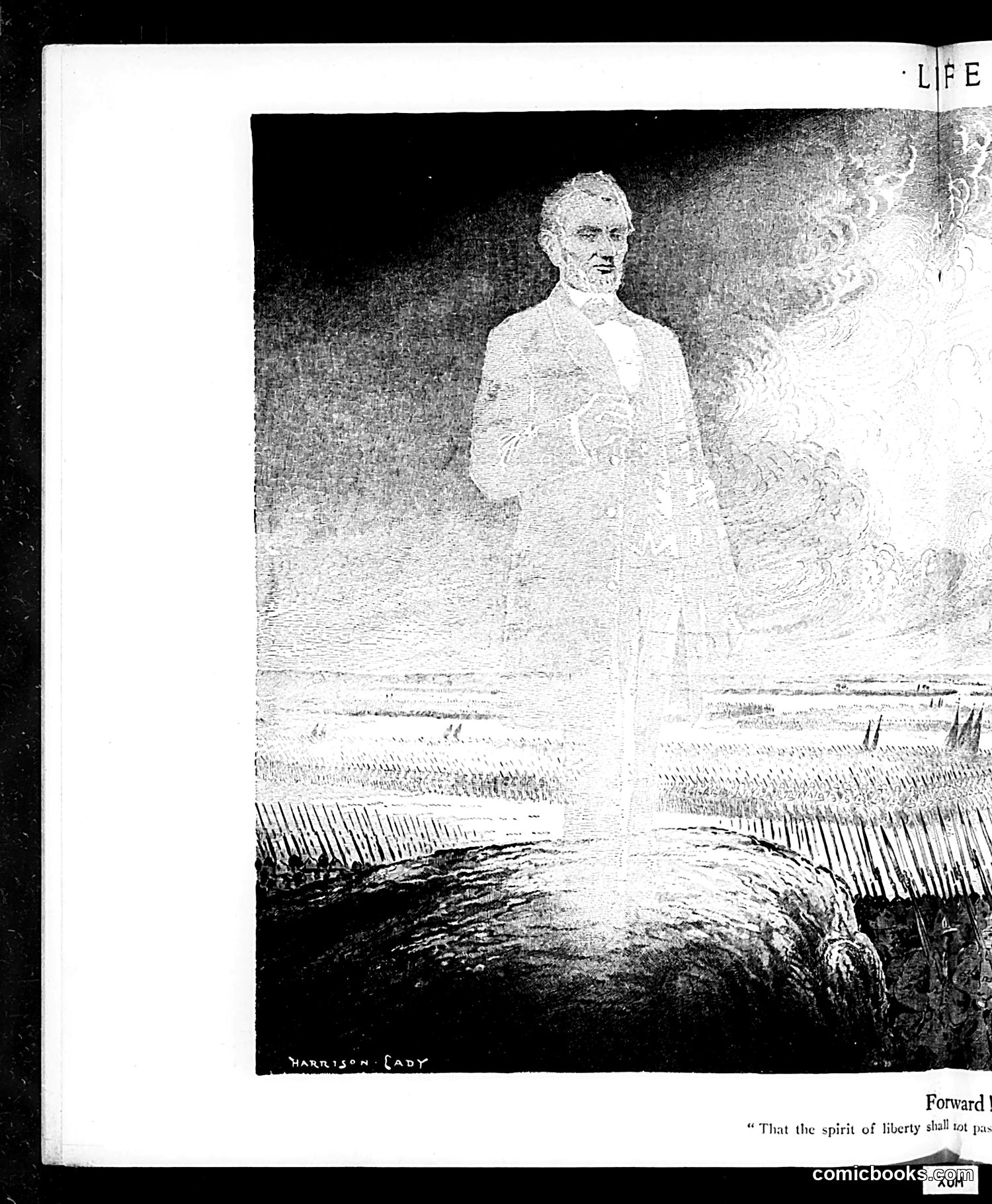
This page shows an illustration credited to "Harrison Cady" depicting a tall, solitary figure standing in a vast agricultural landscape with fields and wooden fences. The figure appears ghostly or ethereal in rendering. The partial caption reads: "Forward! 'That the spirit of liberty shall not pas[s]'" (text is cut off). Without the complete caption and full context, the exact satirical meaning is unclear. However, the imagery suggests **allegorical commentary on American ideals or patriotism**—the lone, spectral figure likely represents Liberty or Freedom itself. The agricultural setting may reference American values or progress. The fragmented text prevents definitive interpretation of what specific political situation or event is being referenced. This appears to be from an early-to-mid 20th century Life Magazine issue, but identifying the precise target requires the full article context.
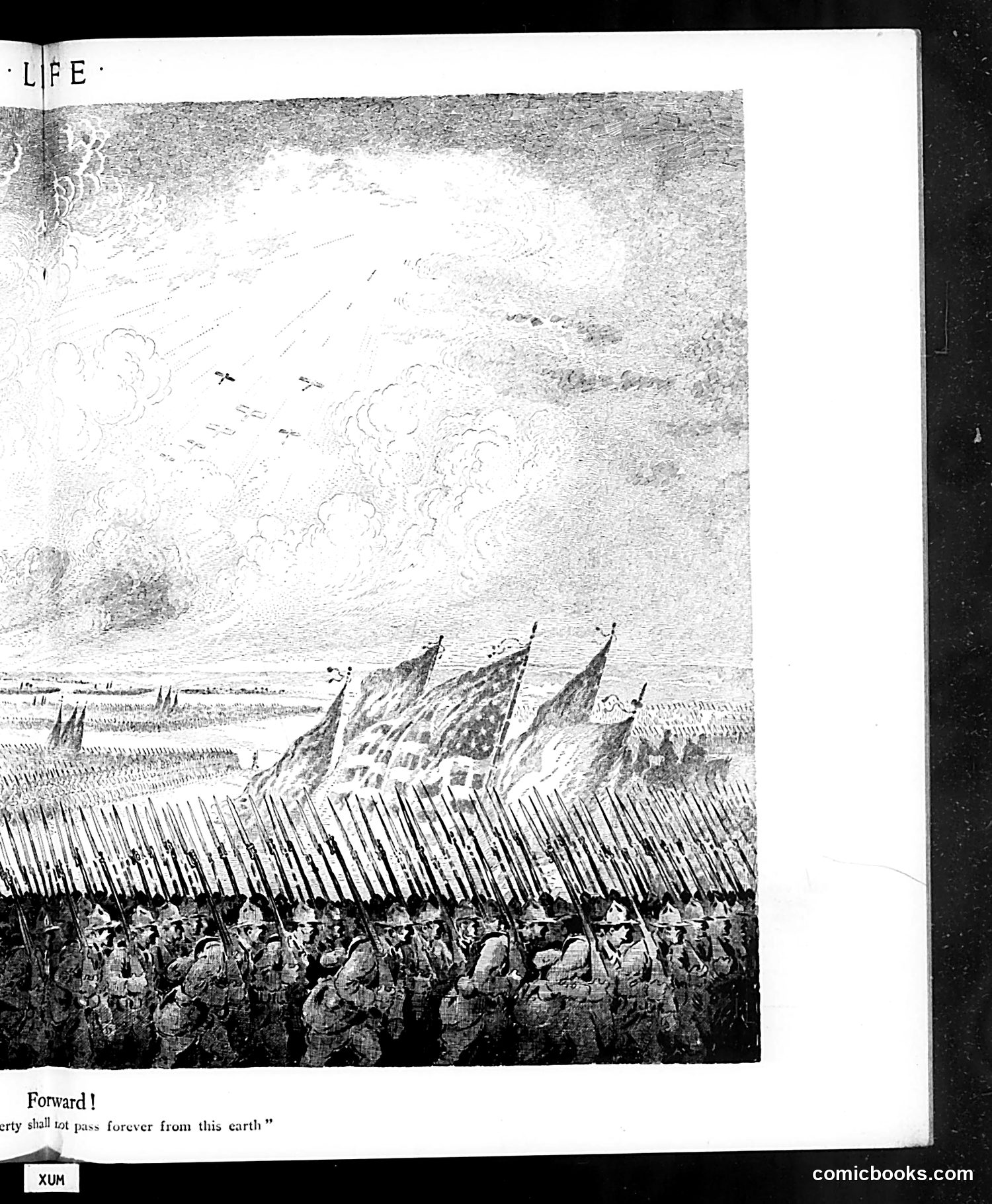
This appears to be a WWI-era military illustration from *Life* magazine, showing a large formation of soldiers in uniform holding rifles with bayonets fixed, marching beneath flags. The sky contains what appear to be aircraft or birds in flight. The visible text fragment—"erty shall not pass forever from this earth"—likely reads "Liberty shall not pass forever from this earth," suggesting a patriotic, pro-war message common to American propaganda during the First World War. The image appears to celebrate or promote military mobilization and national resolve. Without seeing the full caption or article context, the exact satirical intent is unclear, though the dramatic composition and mass formation emphasize themes of national strength and collective military purpose during wartime.
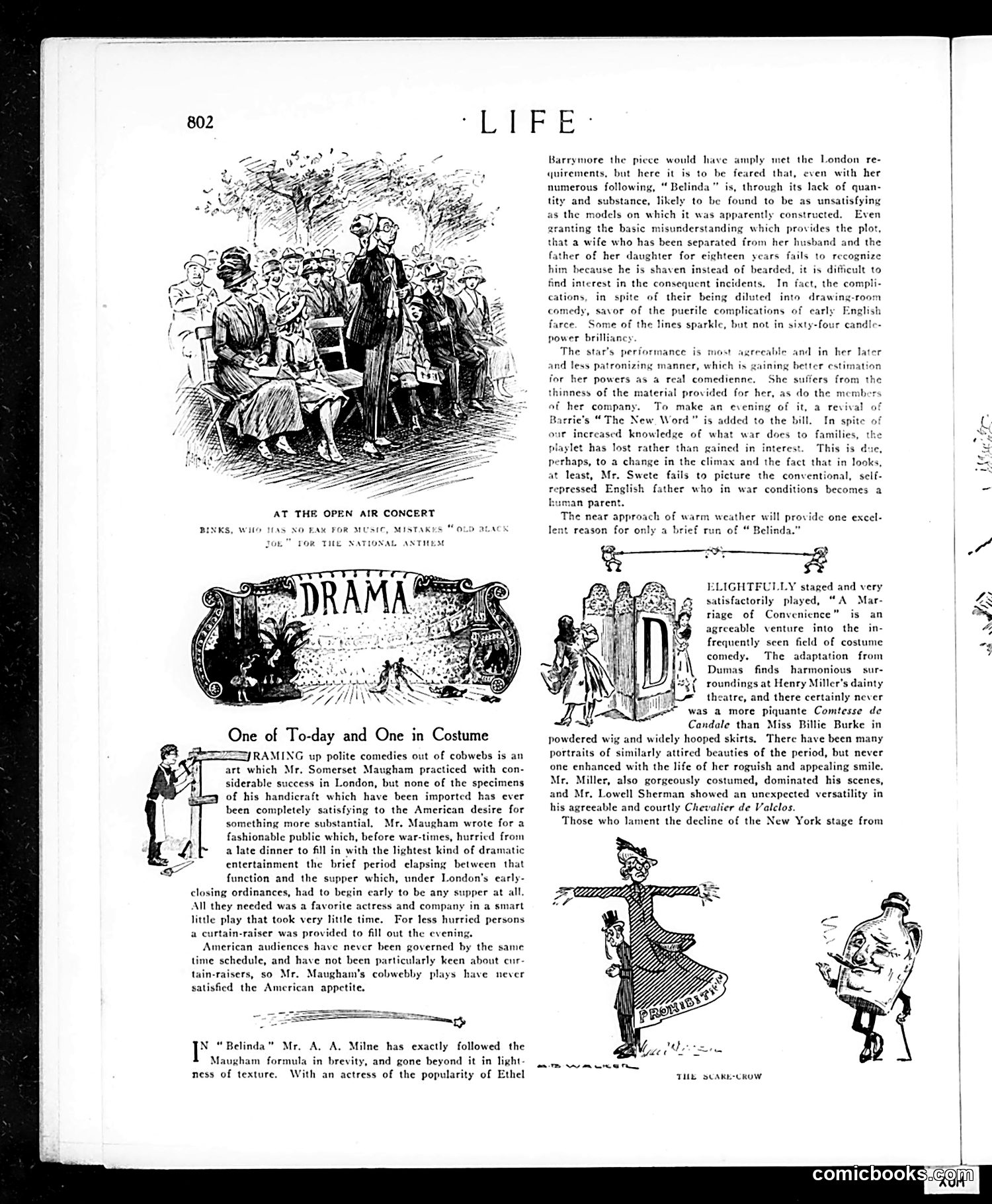
This page reviews three theatrical productions from early 20th-century New York. **The cartoon at top** satirizes an audience member named Binks who is musically tone-deaf—he mistakes "Job" (likely a musical piece) for the national anthem, a visual joke about his complete lack of musical discernment. **The main reviews** critique Somerset Maugham-style British comedies adapted for American audiences. The piece argues these lightweight drawing-room plays, designed for London's early-closing dinner schedules, fail to satisfy American theatergoers who want more substantial entertainment. **"Belinda"** (by A.A. Milne with Ethel Barrymore) is criticized as too thin and insubstantial, with plot holes (a woman can't recognize her estranged husband because he's shaved his beard). The small illustration labeled "The Scare-Crow" appears related to this production. **"A Marriage of Convenience"** receives positive coverage, praising Billie Burke in a costume comedy and calling Henry Miller's theater an elegant venue. The satire targets the mismatch between British theatrical conventions and American audience expectations.
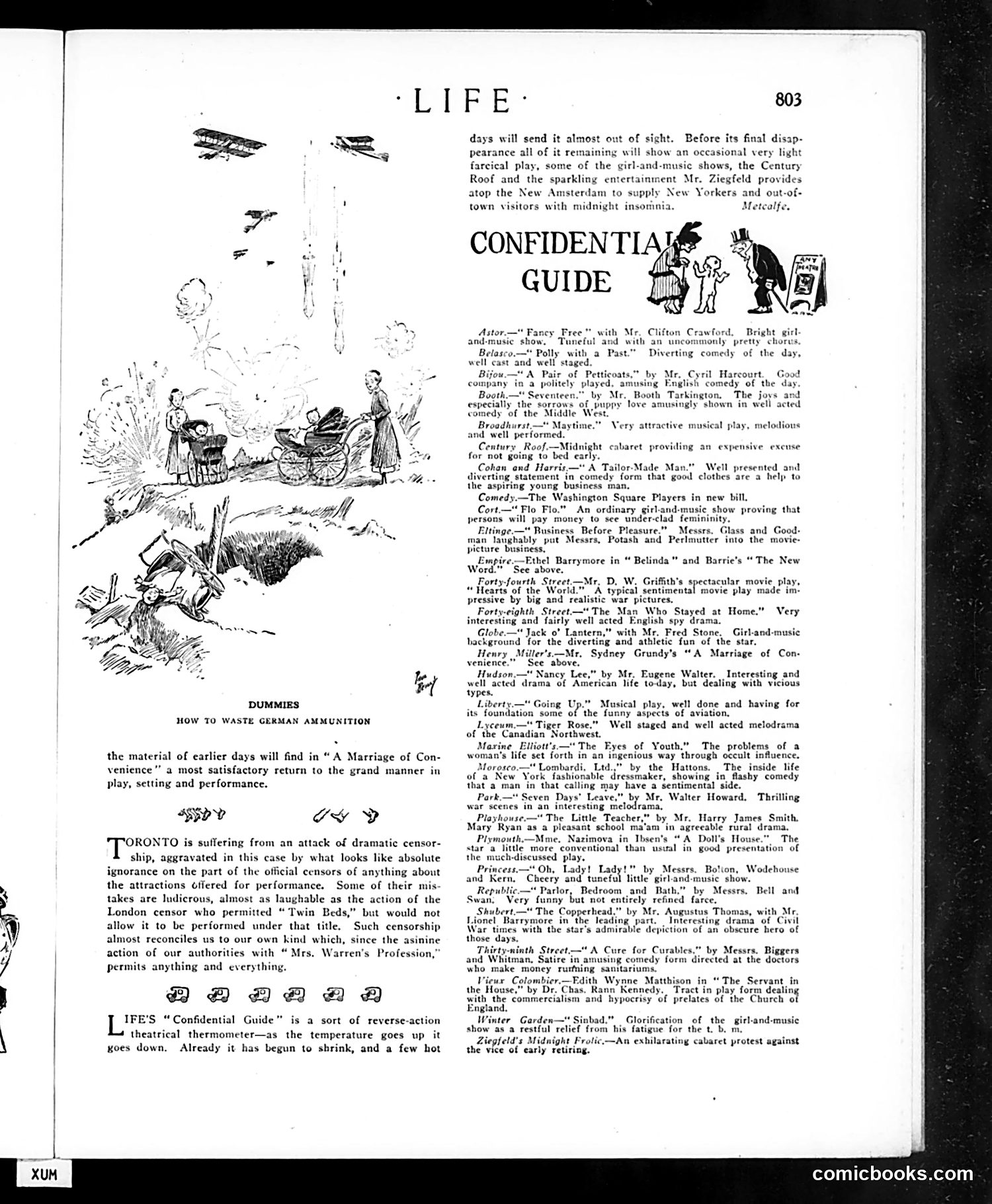
This page from *Life* magazine contains a satirical section titled "DUMMIES: HOW TO WASTE GERMAN AMMUNITION." The cartoon illustrates civilians engaged in mundane peacetime activities (children playing, adults lounging) while shells explode around them—the satire being that such "dummies" are wasting German military resources by simply continuing normal life despite bombardment. The context is World War I, when German artillery threatened Allied positions. The joke mocks civilians' indifference to danger, suggesting they're so oblivious they inadvertently frustrate the enemy's efforts. The remainder of the page is a "Confidential Guide" to New York theatrical productions, offering brief, often caustic reviews of current Broadway shows. The guide's conceit—that it "shrinks" as summer heat arrives and audiences abandon theaters—provides framework for dismissing many productions as forgettable summer fare or mediocre entertainment.
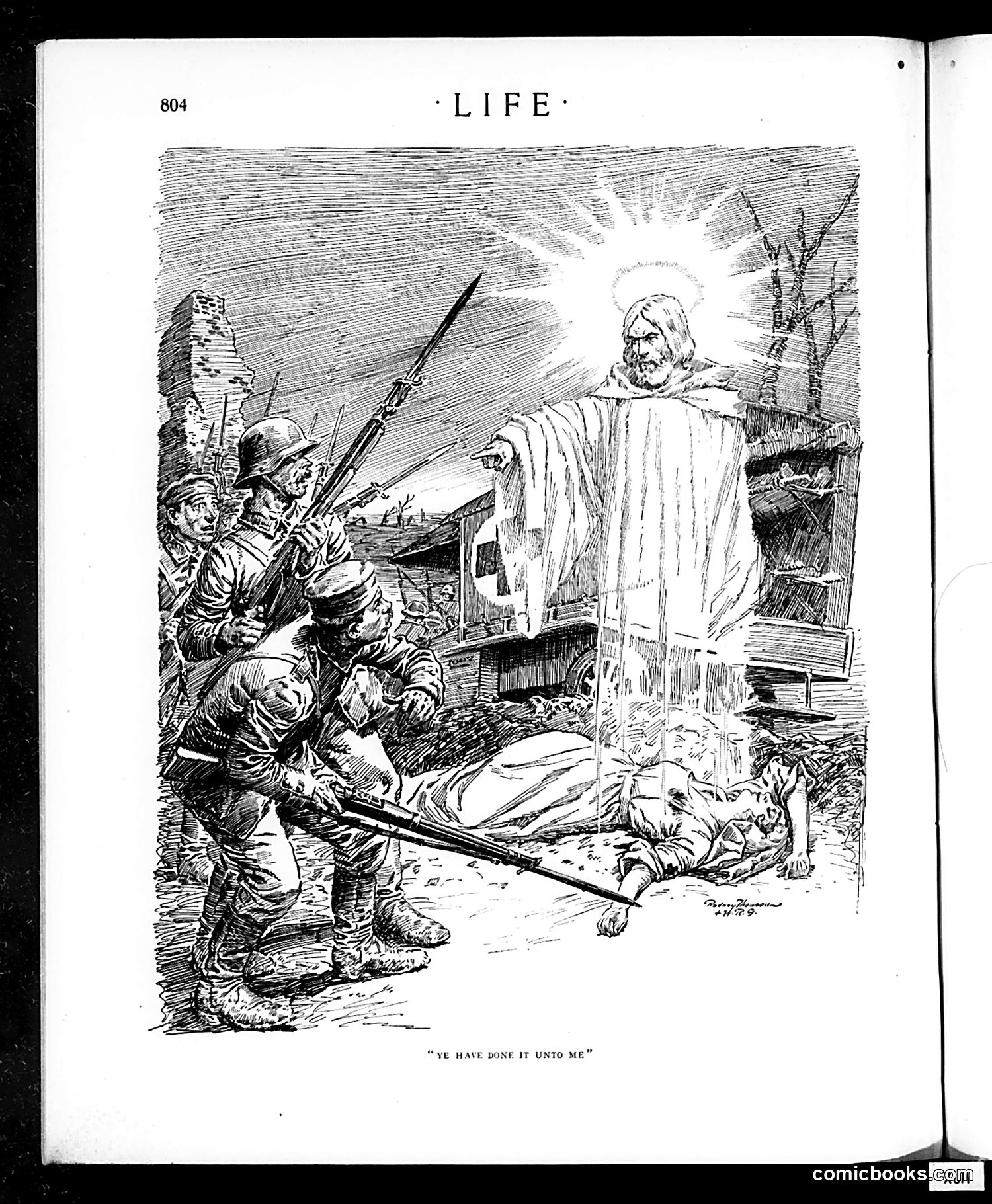
This is a religious allegory cartoon depicting soldiers at the crucifixion. The caption "Ye Have Done It Unto Me" quotes Matthew 25:31-46, where Jesus teaches that cruelty to the vulnerable is cruelty to him. The image shows armed soldiers (appearing to wear World War I-era military uniforms) standing before a glowing, Christ-like figure. A body lies on the ground; a dog is also present, suggesting suffering of the innocent. The satire appears to critique military violence and warfare as inherently sinful—equating soldiers' actions with betraying Christian principles. Without visible publication date context, this likely comments on WWI-era military conduct or promotes anti-war sentiment through Christian moral teaching. The work uses religious symbolism to condemn violence as fundamentally un-Christian.
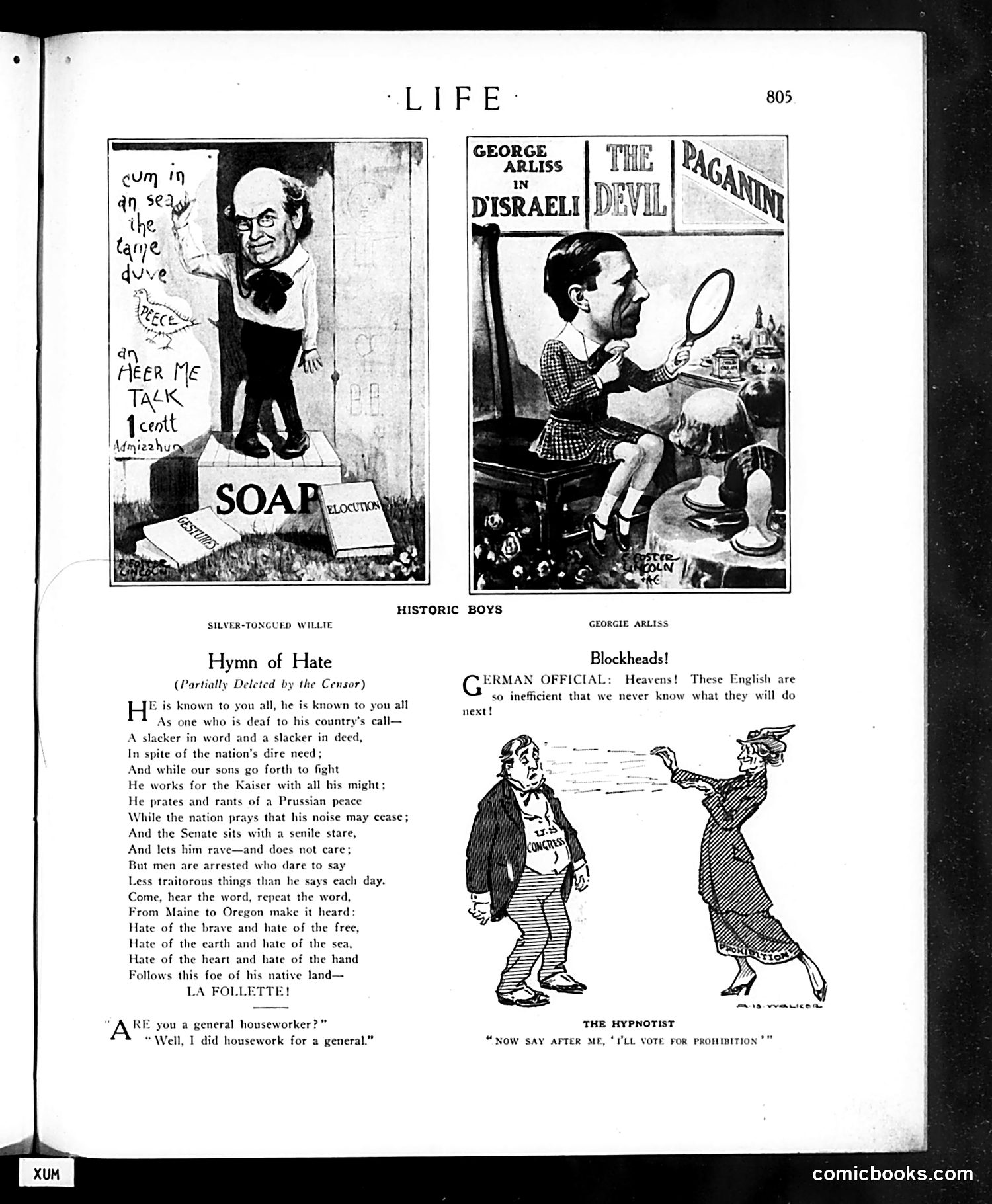
This page contains three distinct satirical pieces, likely from around World War I: **Top left:** "Silver-Tongued Willie" depicts a caricatured figure (likely a U.S. politician or pacifist) standing on soap, labeled a "slacker" for opposing the war effort while the nation fights. The accompanying "Hymn of Hate" poem denounces him as working "for the Kaiser" despite his rhetoric. **Top right:** George Arliss appears in film promotion for *The Devil* and *Paganini*—separate entertainment content. **Bottom:** "Blockheads!" shows a German official alarmed by English unpredictability. "The Hypnotist" depicts propaganda manipulation—a figure hypnotizing another to "vote for prohibition," satirizing how public opinion is manufactured through persuasion rather than genuine conviction. The overall page reflects WWI-era American anxieties: suspicion of war opponents, contempt for perceived disloyalty, and cynicism about propaganda and political manipulation.
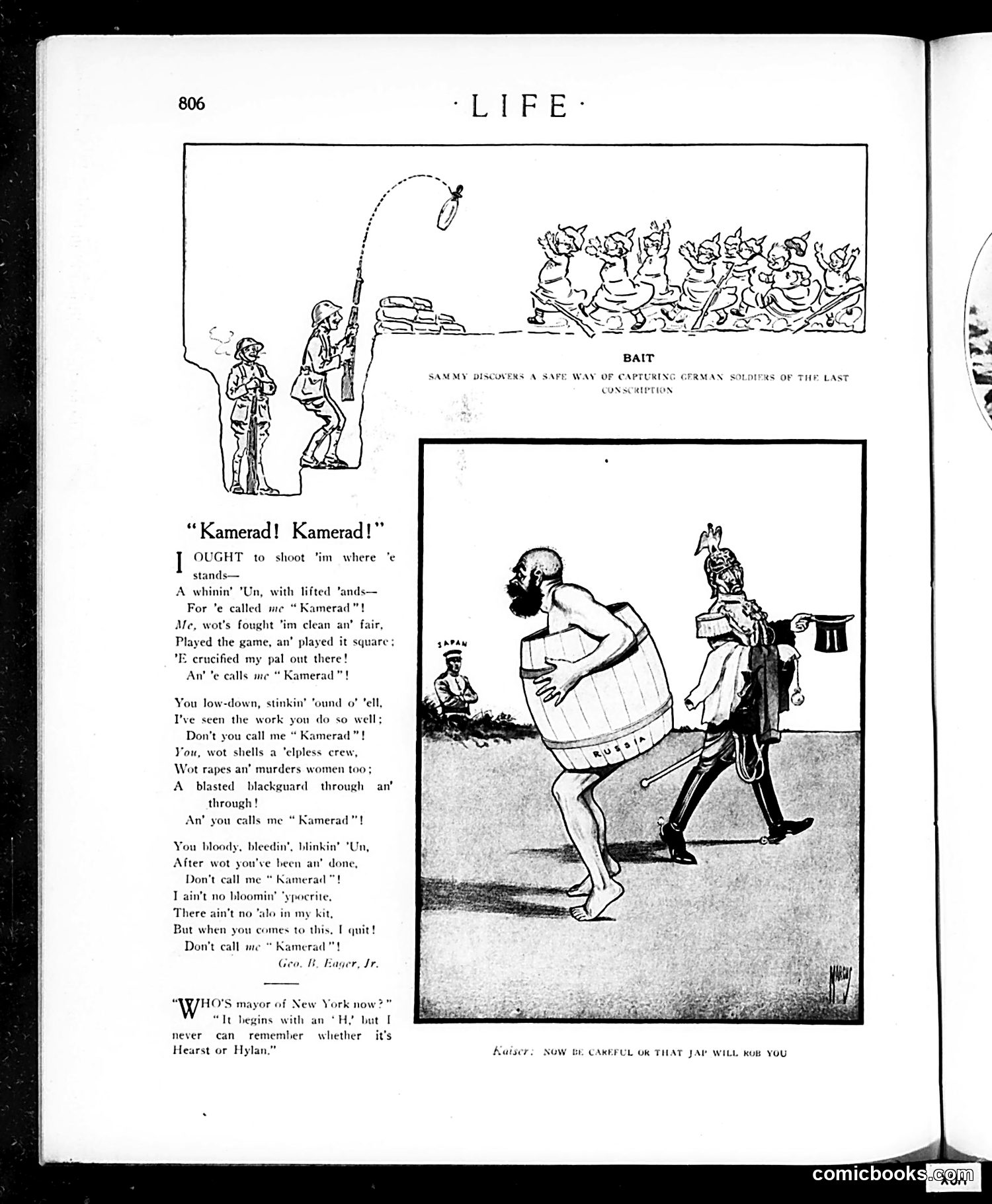
This page satirizes WWI soldiers' moral outrage at German surrender. The poem, attributed to Geo. B. Eager Jr., depicts a British soldier confronting a surrendering German soldier who calls out "Kamerad!" (German for "comrade"—the traditional surrender cry). The satire's point: The British fighter is enraged that a German soldier—whom he accuses of atrocities ("rapes an' murders women," crucifying his comrade)—would dare claim brotherhood or equal treatment through the surrender convention. The soldier refuses this false camaraderie, declaring himself unwilling to play hypocrite. The top cartoon labeled "BAIT" shows American soldiers (Sammy) luring German soldiers with what appears to be seductive figures—satirizing the "safe way of capturing" enemies through temptation rather than combat. The bottom joke about New York's mayor (beginning with 'H'—either Hearst or Hylan) is unrelated political humor about municipal politics. Context: The page reflects wartime anti-German sentiment and questions about honor between combatants.
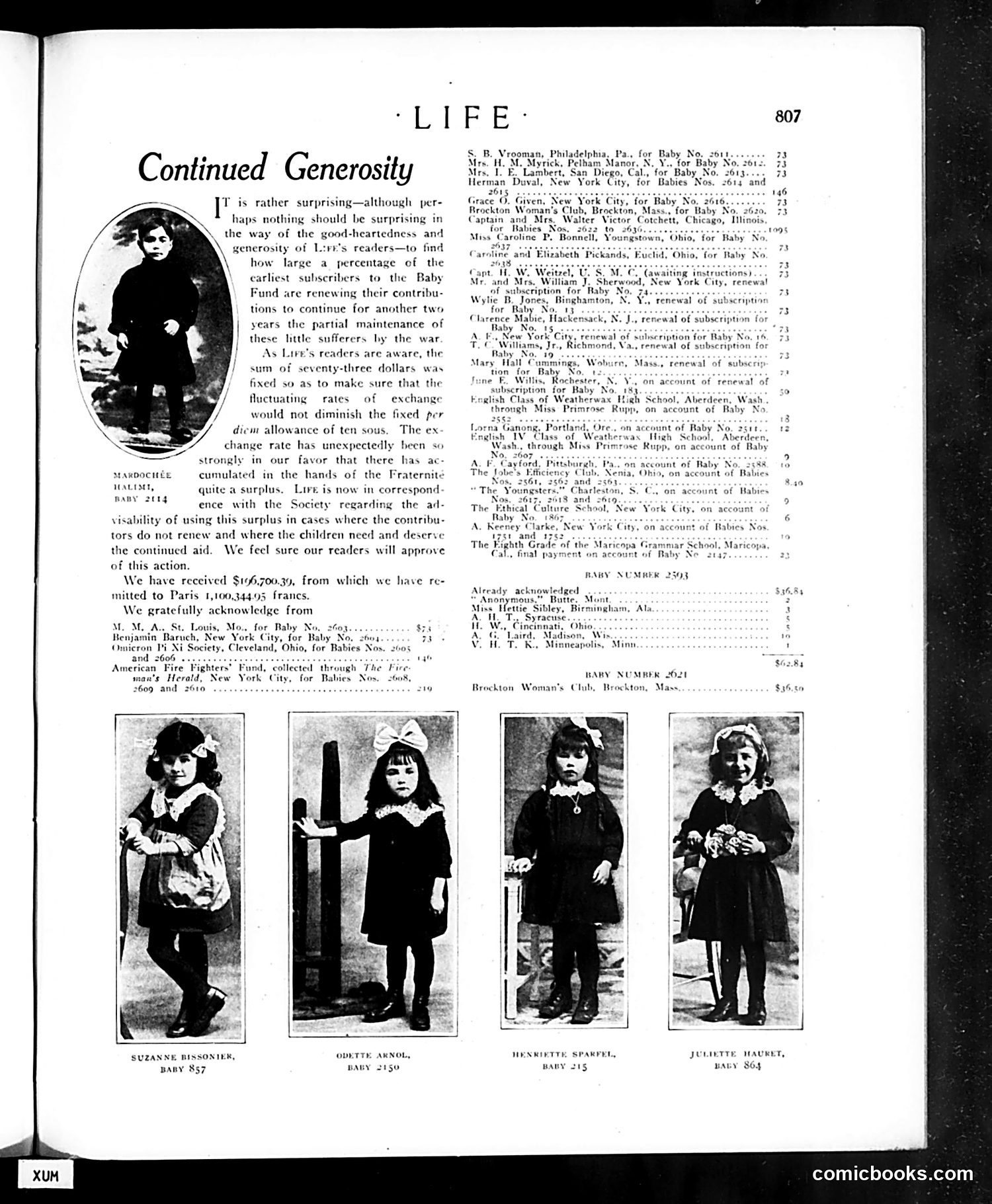
This page documents Life magazine's charitable "Baby Fund," established to support French children orphaned or displaced by World War I. The main article celebrates subscribers renewing their contributions—a modest fixed sum (ten sous daily) to maintain support for two additional years. The text notes that favorable exchange rates created an unexpected surplus, which Life proposes using to help children whose original sponsors cannot renew support. Four photographs at the bottom show actual beneficiary children: Suzanne Bissonnier, Odette Arnold, Henriette Sparpel, and Juliette Mauret, identified by baby fund numbers. The page lists donors' names and amounts contributed, demonstrating widespread American charitable response to European war casualties. This represents Life's role as both satirical publication and serious civic advocate—using its platform to encourage readers' ongoing humanitarian support for war-affected children.
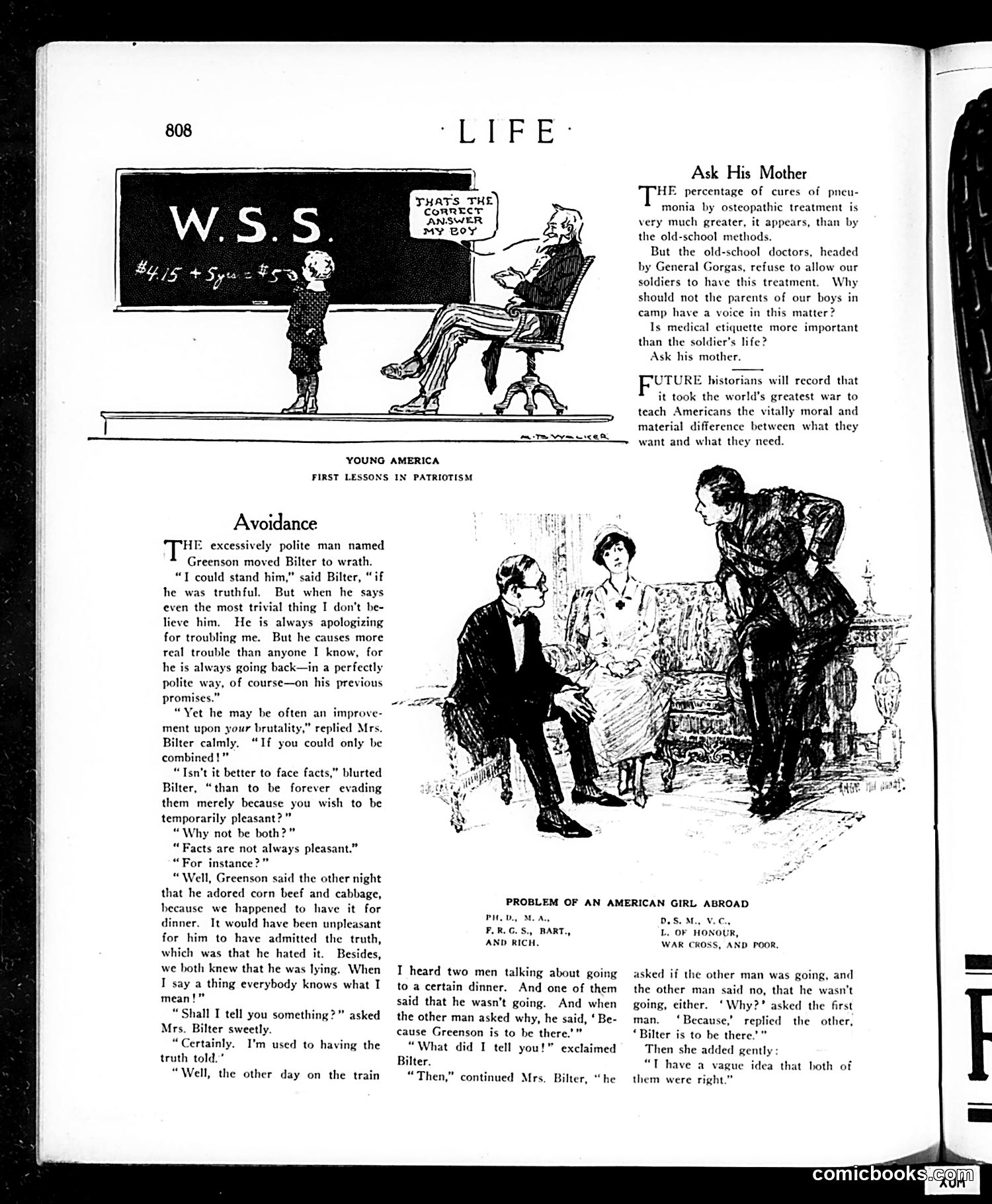
**Top cartoon ("W.S.S.")**: A teacher instructs a student on basic arithmetic during wartime, captioned "Young America: First Lessons in Patriotism." The joke satirizes how even elementary education is being framed through a patriotic/military lens during World War I. **"Avoidance" story**: A domestic dispute between Mr. and Mrs. Bilter debates whether it's better to be brutally honest (Bilter's position) or politely evasive (Greenson's approach). Mrs. Bilter's conclusion—that both men avoid Greenson's dinner for opposite reasons, proving each man's philosophy self-defeating—suggests neither extreme works well. This appears to be gentle social satire about civility versus authenticity. **"Ask His Mother"**: Advocates for osteopathic treatment of pneumonia in soldiers against military doctors' opposition, appealing to parents' authority over medical establishment hierarchy—a commentary on institutional gatekeeping during wartime. **Lower illustration**: Depicts an American girl abroad encountering social complications, though specific context is unclear from this excerpt.
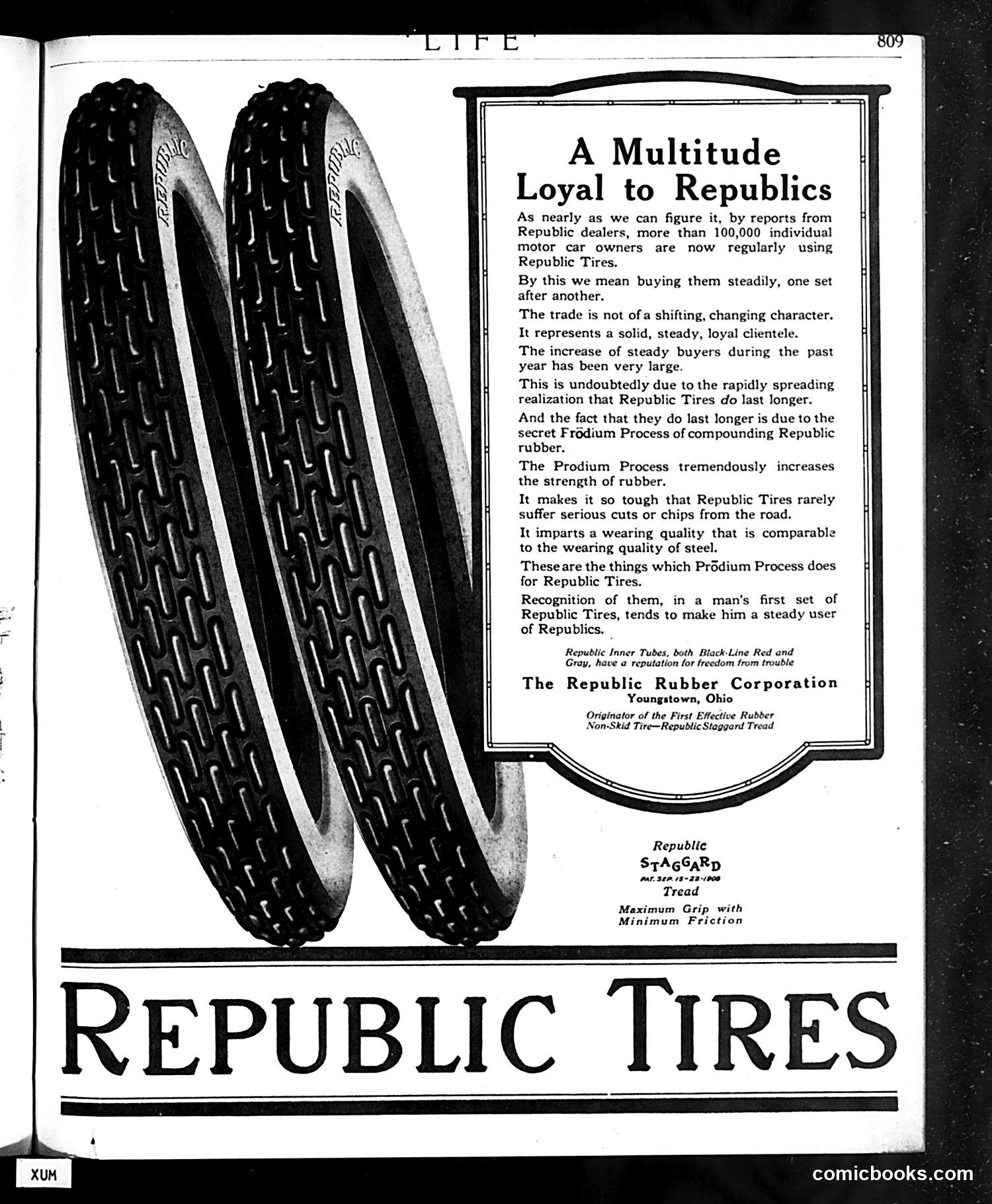
This is **not a cartoon or satire**—it's a straightforward **automobile tire advertisement** from Life magazine (page 809). The Republic Rubber Corporation of Youngstown, Ohio presents their tire product through earnest marketing claims rather than humor. The ad claims over 100,000 loyal customers and attributes durability to a proprietary "Prodium Process" that strengthens rubber, making tires resistant to cuts and chips with steel-like wearing quality. The visual shows two tires displaying the "Staggard Tread" pattern with "Maximum Grip with Minimum Friction." The ad emphasizes customer loyalty and repeat purchases as evidence of product superiority. While Life was a satirical magazine, **this particular page is commercial advertising**—common in publications of this era. There is no political commentary, caricature, or satire present; it's simply period product marketing using durability and reliability as selling points.
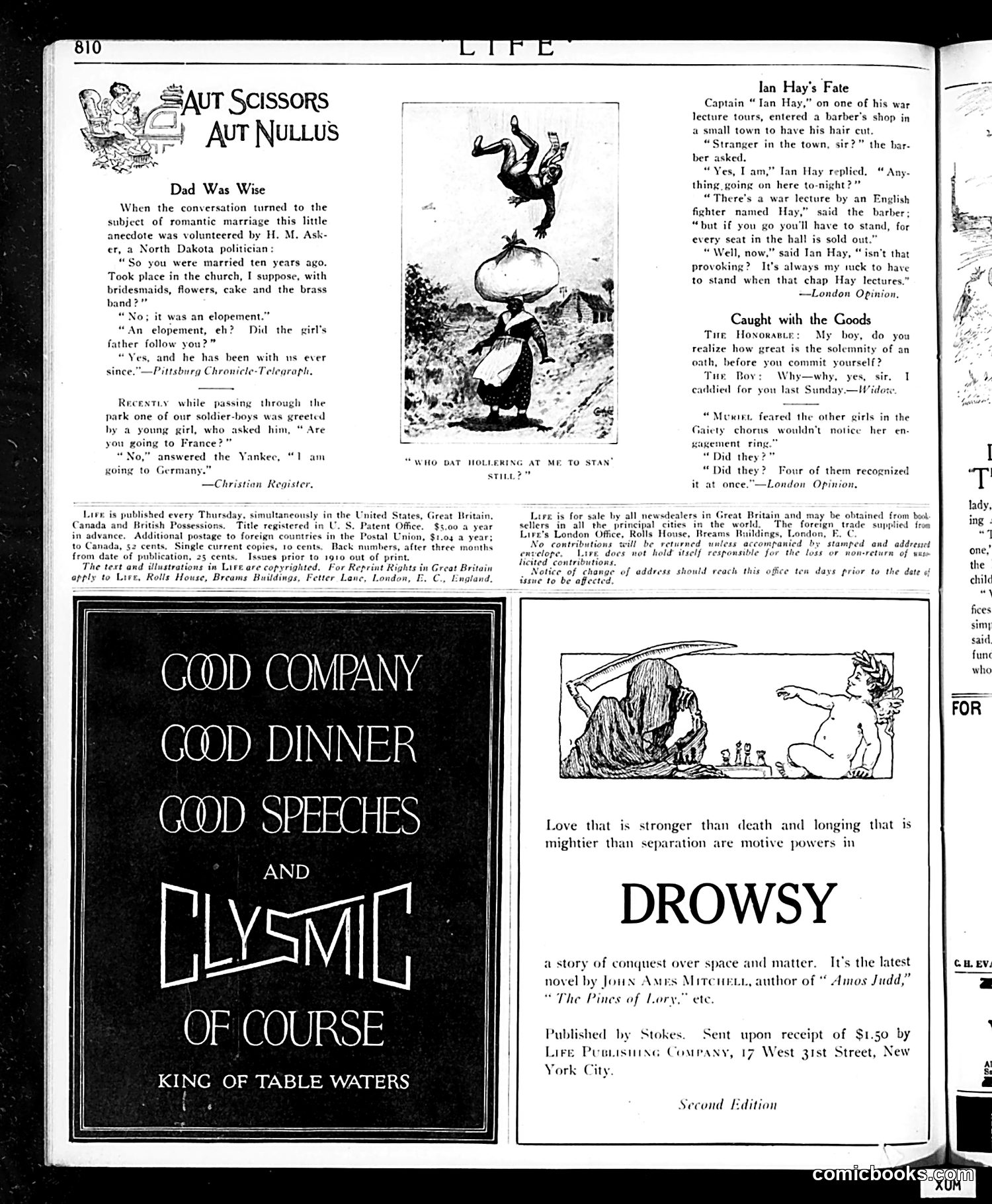
This page contains three brief humorous anecdotes typical of early 20th-century satirical magazines: **"Dad Was Wise"**: A politician describes eloping rather than having a traditional church wedding—yet his wife's father has "been with us ever since," suggesting the father followed them anyway, making the elopement pointless. **"Tan Hay's Fate"**: Captain Ian Hay, a war lecturer, enters a barber shop and asks what's happening locally. The barber mentions a war lecture by "an Englishman named Hay" that's sold out. Hay replies that he always has bad luck attending his own lectures because he must stand. The joke: the captain doesn't reveal his identity, so the barber unknowingly insults him. **"Caught with the Goods"**: A boy admits to caddying (working as a golf caddy) on Sunday, which was apparently considered improper. His fiancée worries other chorus girls won't notice her engagement ring, but four of them did—suggesting they're more interested in judging her choices than congratulating her. All three jokes rely on ironic reversals and social embarrassment typical of the era's humor.
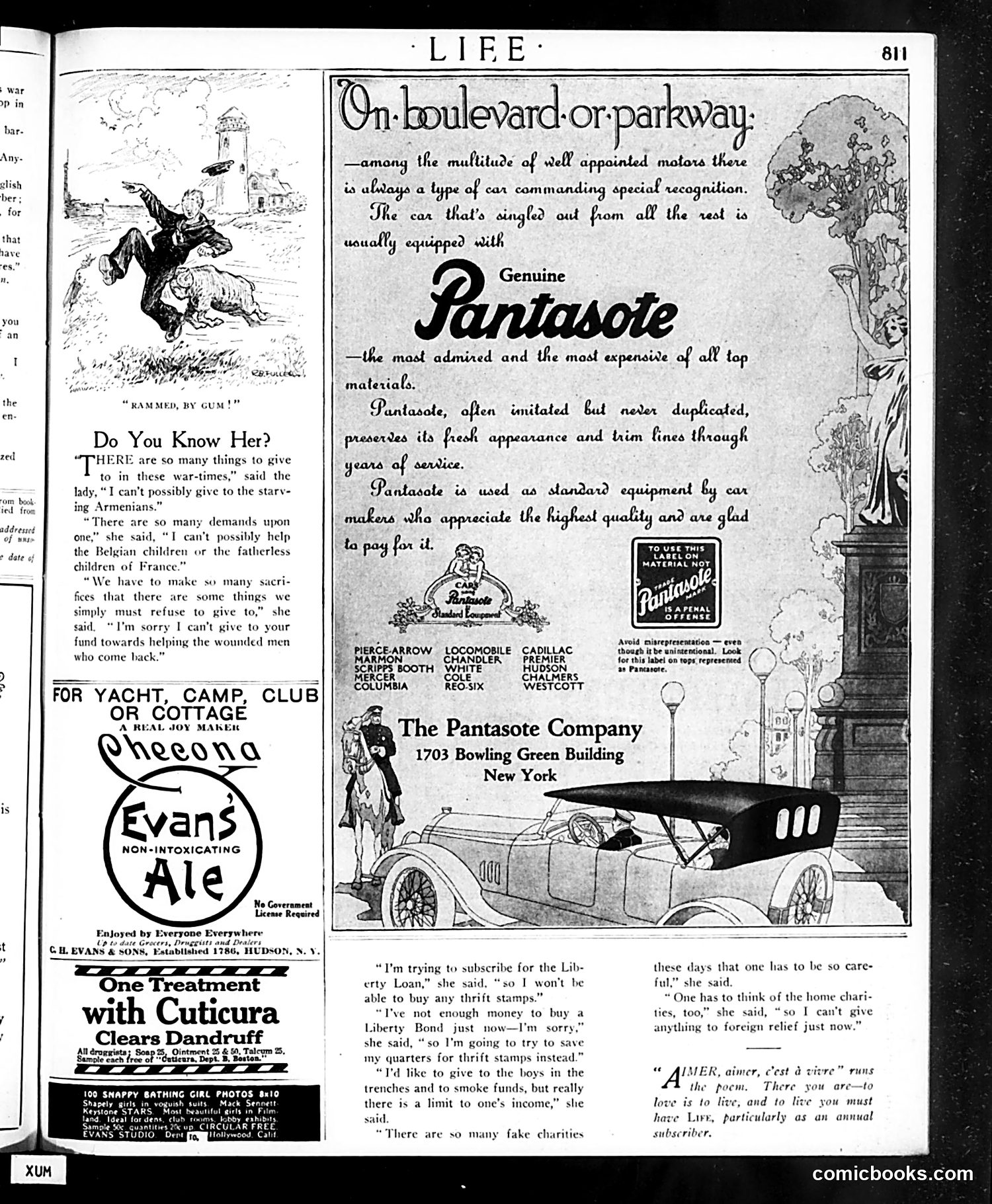
This page features a political cartoon satirizing wealthy women's selective charity during World War I. The central figure is a society lady who repeatedly claims poverty while refusing to donate to various causes: Armenian relief, Belgian children, French orphans, wounded soldiers, the Liberty Loan, and thrift stamps. The satire's point is clear: she simultaneously claims insufficient funds *and* makes excuses about "too many demands" and "fake charities"—revealing that her refusals stem not from genuine hardship but from indifference or selfishness. During WWI, such public pressure on the wealthy to support relief efforts was intense, making her evasions appear particularly hypocritical. The cartoon mocks a specific social type: the comfortable American woman who acknowledges wartime suffering but prioritizes her own comfort over patriotic duty. It's a sharp critique of wartime charity-dodging and privilege. The remainder of the page contains advertisements, including one for Pantasote automobile upholstery—itself a luxury item, subtly reinforcing the cartoon's class commentary.
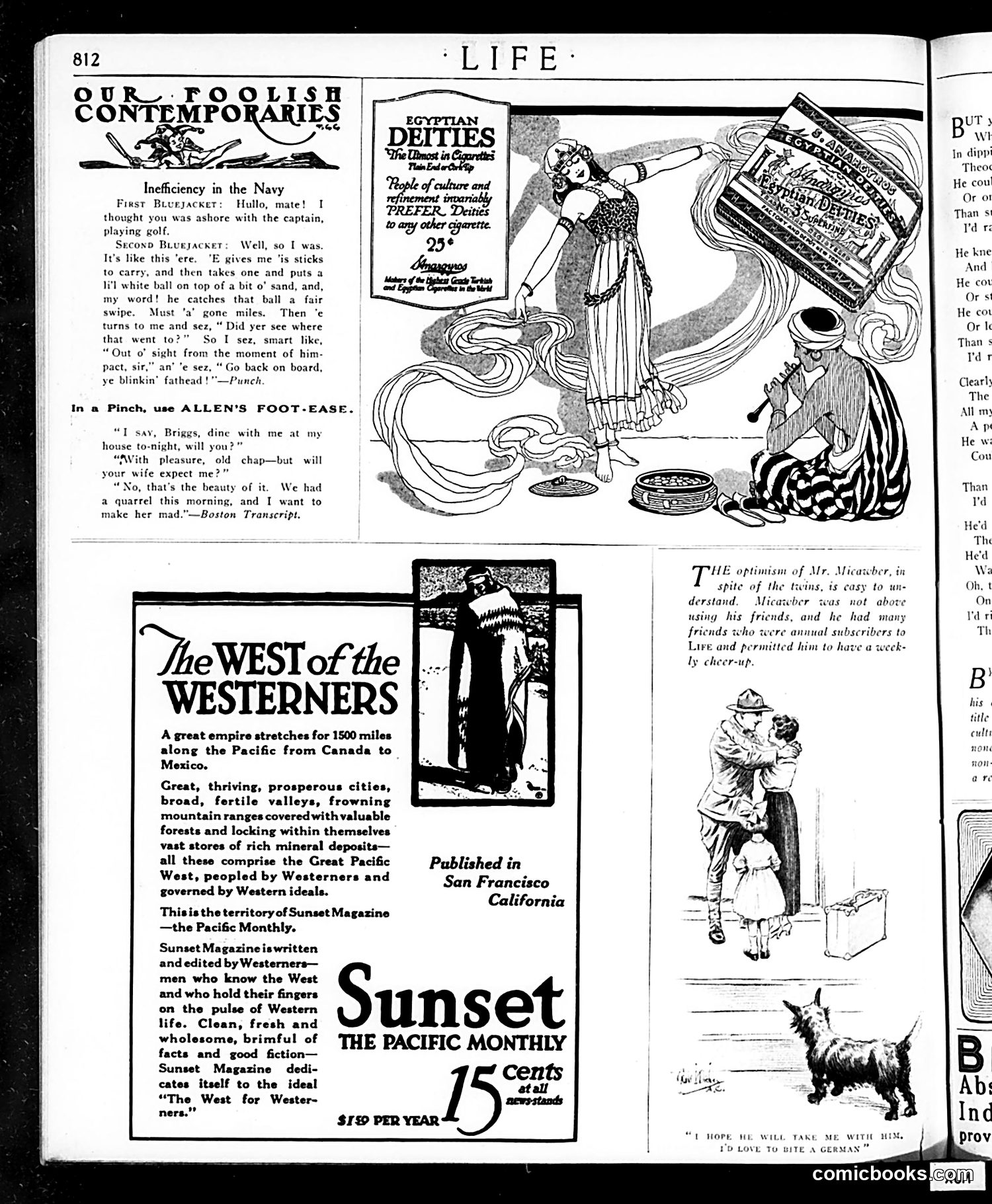
This page contains three distinct humor pieces: **"Our Foolish Contemporaries"** presents two brief comedic dialogues mocking social pretension. The first depicts navy sailors confused by golf—a sport associated with upper-class leisure—with one sailor sarcastically claiming ignorance of where the ball went. The second joke satirizes marital discord, with a man inviting a friend to dinner specifically *because* he's quarreled with his wife, wanting to make her angry. **"Egyptian Deities"** is a cigarette advertisement featuring classical imagery of a reclining figure with Egyptian iconography, promoting product superiority. **"The West of the Westerners"** is a substantial advertisement for *Sunset Magazine* (The Pacific Monthly), emphasizing Western prosperity, natural resources, and regional pride. It positions the magazine as written by and for people who understand Western life and values. The page is primarily **advertising and light humor**—typical of Life magazine's blend of satire and commercial content. The references reflect early 20th-century American attitudes toward class distinctions (golf as elite), domestic relationships, and Western regional identity.
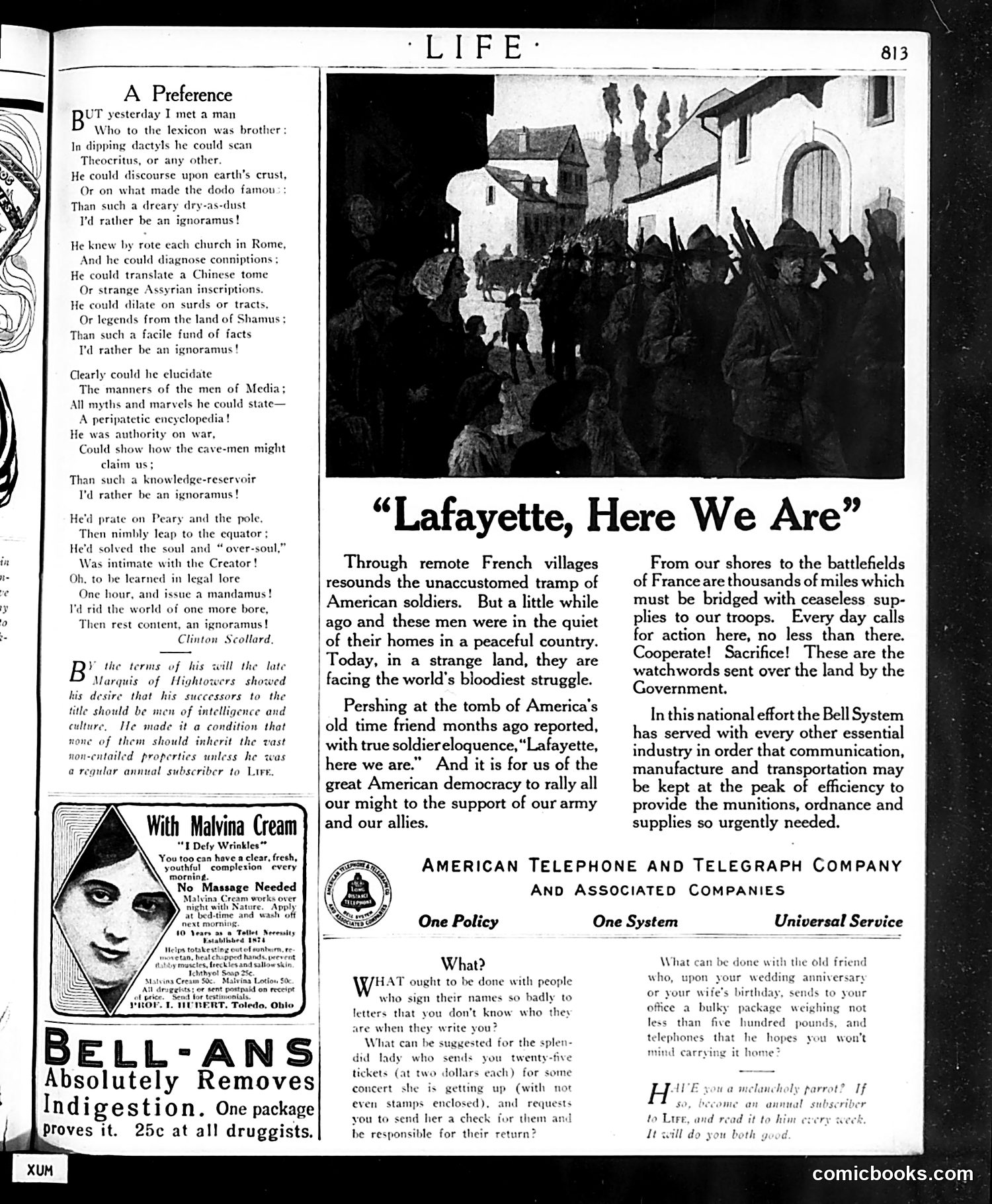
**Left Page - Poetry & Ads:** The page opens with "A Preference," a humorous poem by Clinton Scollard mocking pedantic over-education. The speaker repeatedly declares he'd "rather be an ignoramus" than know useless facts about ancient Rome, Chinese literature, mythology, and obscure historical figures. It's satire on intellectual pretension and impractical knowledge. Below is a small fictional anecdote about a British marquis requiring his heirs to subscribe to *Life* magazine as a condition of inheritance—a playful advertisement. Two product ads follow: Malvina Cream (wrinkle removal) and Bell-Ans (indigestion remedy). **Right Page - War Propaganda:** The main feature celebrates American soldiers in France during World War I, invoking General Pershing's famous 1917 words at Lafayette's tomb: "Lafayette, here we are." The accompanying photograph shows a crowd of soldiers in a French village. The text urges American sacrifice and cooperation on the home front. The final section is advertising copy from AT&T, claiming the Bell System telephone/telegraph network serves the war effort by maintaining communication and supply efficiency for troops.
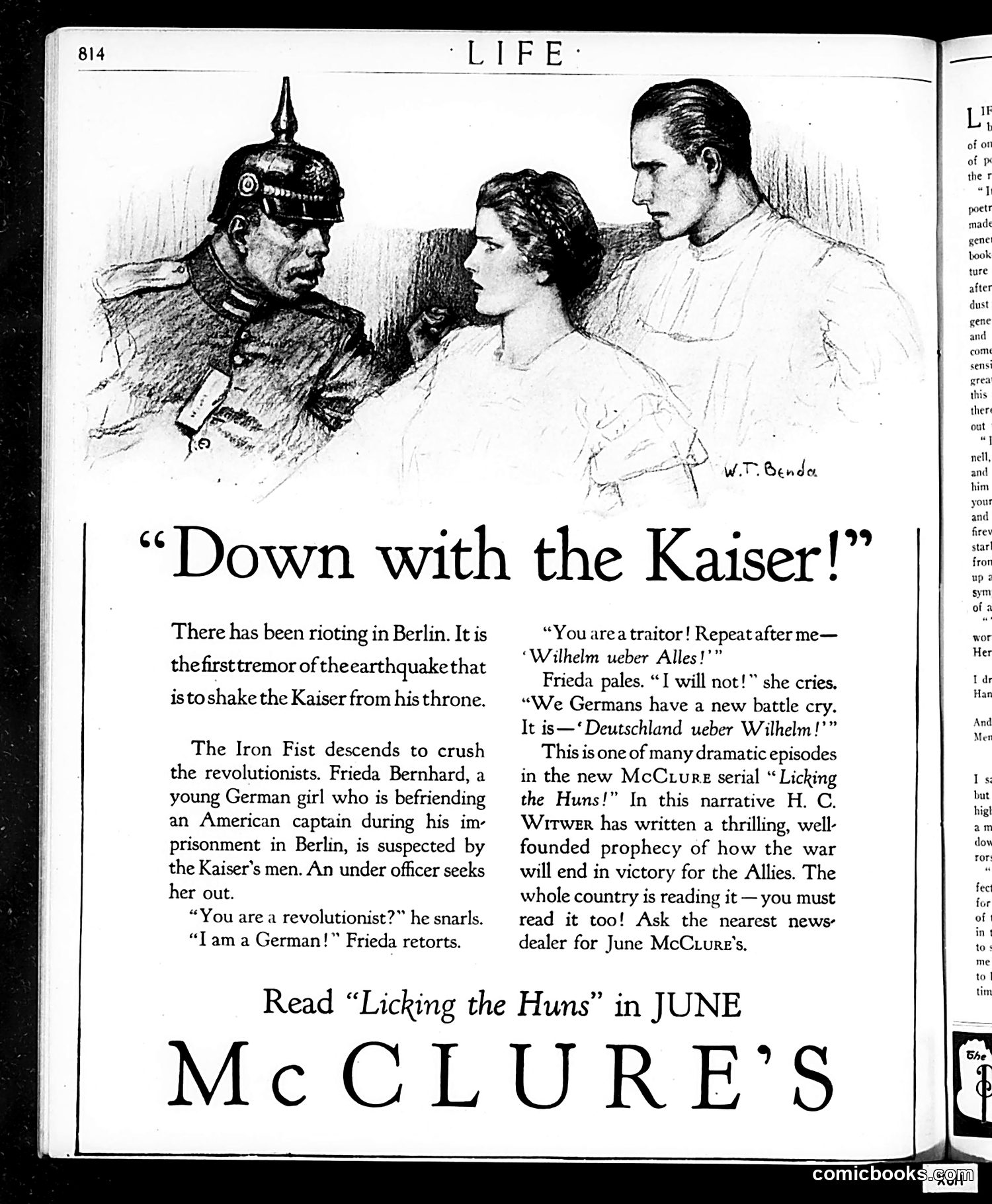
This is a **advertisement for McClure's magazine**, promoting a serialized story called "Licking the Huns!" set during World War I. The illustration depicts a confrontation in Berlin during anti-Kaiser riots. A German military officer (identifiable by his spiked Prussian helmet) interrogates a young woman, Frieda Bernhard, who is helping an imprisoned American captain. When forced to pledge loyalty to Kaiser Wilhelm, Frieda defies him, declaring instead: "Deutschland ueber Wilhelm!"—inverting the nationalist slogan "Deutschland ueber Alles" (Germany Above All) to mean "Germany Above Wilhelm." The ad frames this as patriotic resistance to German militarism. The text promises readers H.C. Witter's "thrilling, well-founded prophecy" of Allied victory. **Context**: Published during or shortly after WWI, this reflects American anti-German propaganda and popular appetite for stories depicting Germans questioning their own regime's authority—suggesting internal collapse of enemy morale.
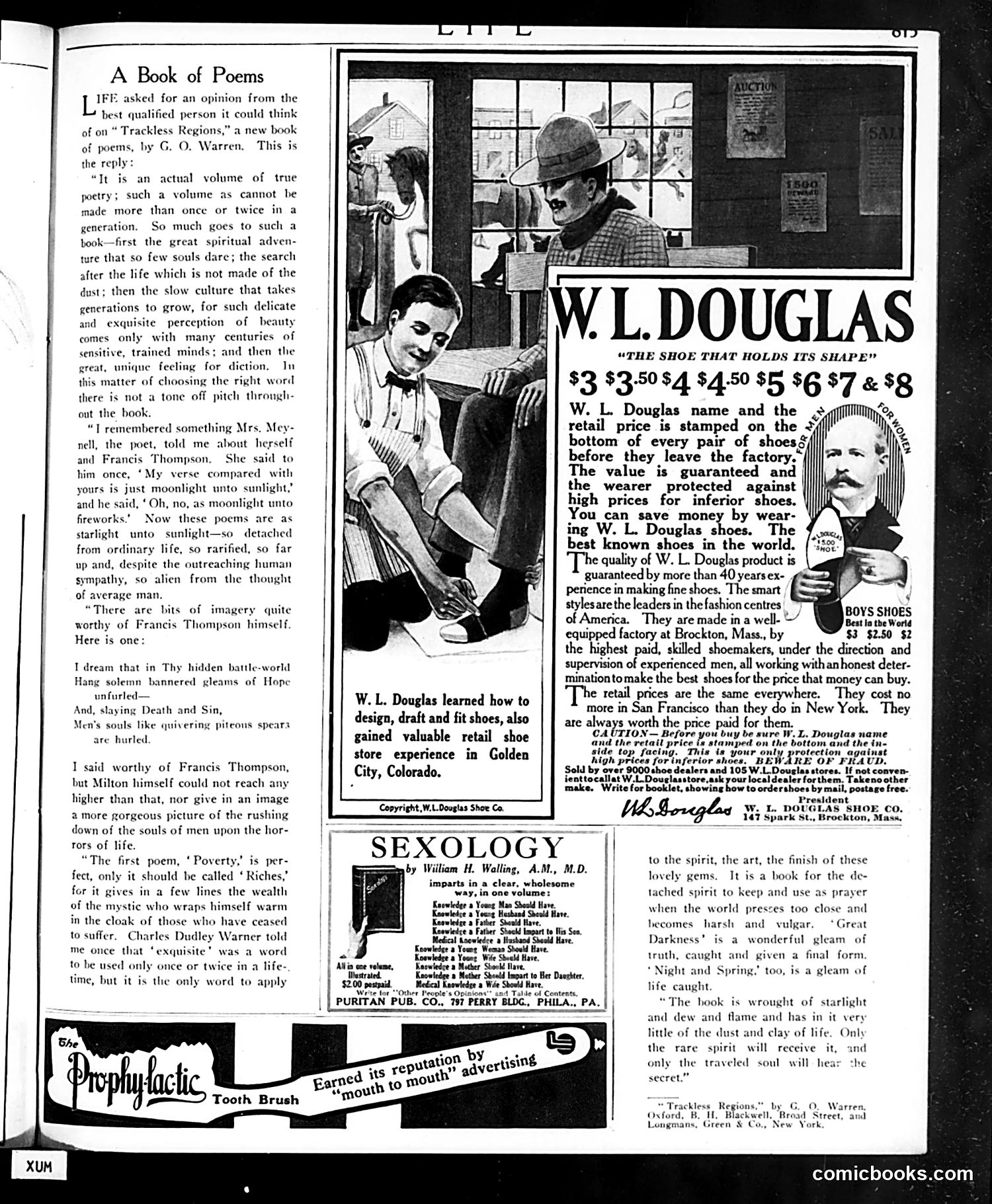
This page is primarily **advertising and literary criticism**, not political satire. The main content critiques G.O. Warren's poetry book "Trackless Regions," praising it as genuinely exceptional work—comparing passages favorably to Francis Thompson and even Milton. The critic uses flowery language ("starlight unto sunlight") to establish the poems' spiritual and aesthetic elevation. The large **W.L. Douglas shoe advertisement** dominates the right side, emphasizing quality, fair pricing ($3-$8), and factory-direct guarantees against fraud. The ad targets middle-class consumers concerned about value. Below appears a **"Sexology" book advertisement** by William H. Walling, and at bottom, a **Prophylactic Toothbrush ad**. There is **no political cartoon or satire visible**. This is a typical Life magazine page mixing cultural commentary with commercial advertising—the juxtaposition itself (lofty poetry criticism alongside shoe and hygiene ads) reflects early 20th-century magazine layout conventions rather than deliberate satirical commentary.
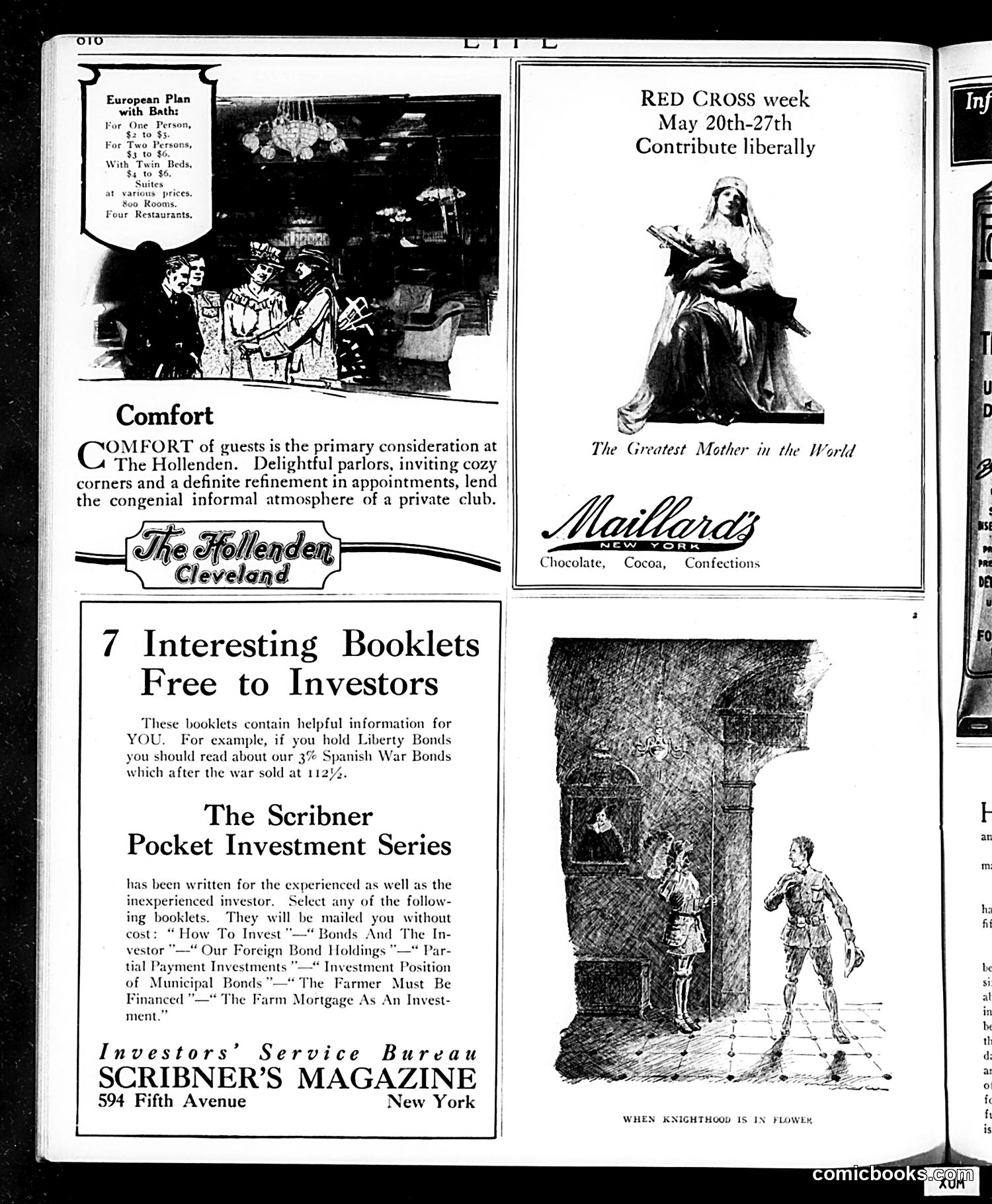
This page is primarily **advertising**, not satire. It contains four distinct ads: 1. **The Hollenden (Cleveland hotel)** — promotes comfort and amenities for travelers 2. **Mailliard's chocolates** — uses a maternal "Greatest Mother in the World" image tied to Red Cross Week (May 20-27), encouraging charitable donations 3. **Scribner's Investment Series** — offers free financial booklets, notably referencing Liberty Bonds and Spanish War Bonds (suggesting post-WWI era) 4. **"When Knighthood Is in Flower"** — an illustration of a knight/medieval figure, likely advertising a literary work or theatrical production The page reflects early 20th-century concerns: investment education for average citizens, wartime charitable giving, and nostalgic entertainment references. The Red Cross appeal and Liberty Bond mentions date this to the WWI period or shortly after.
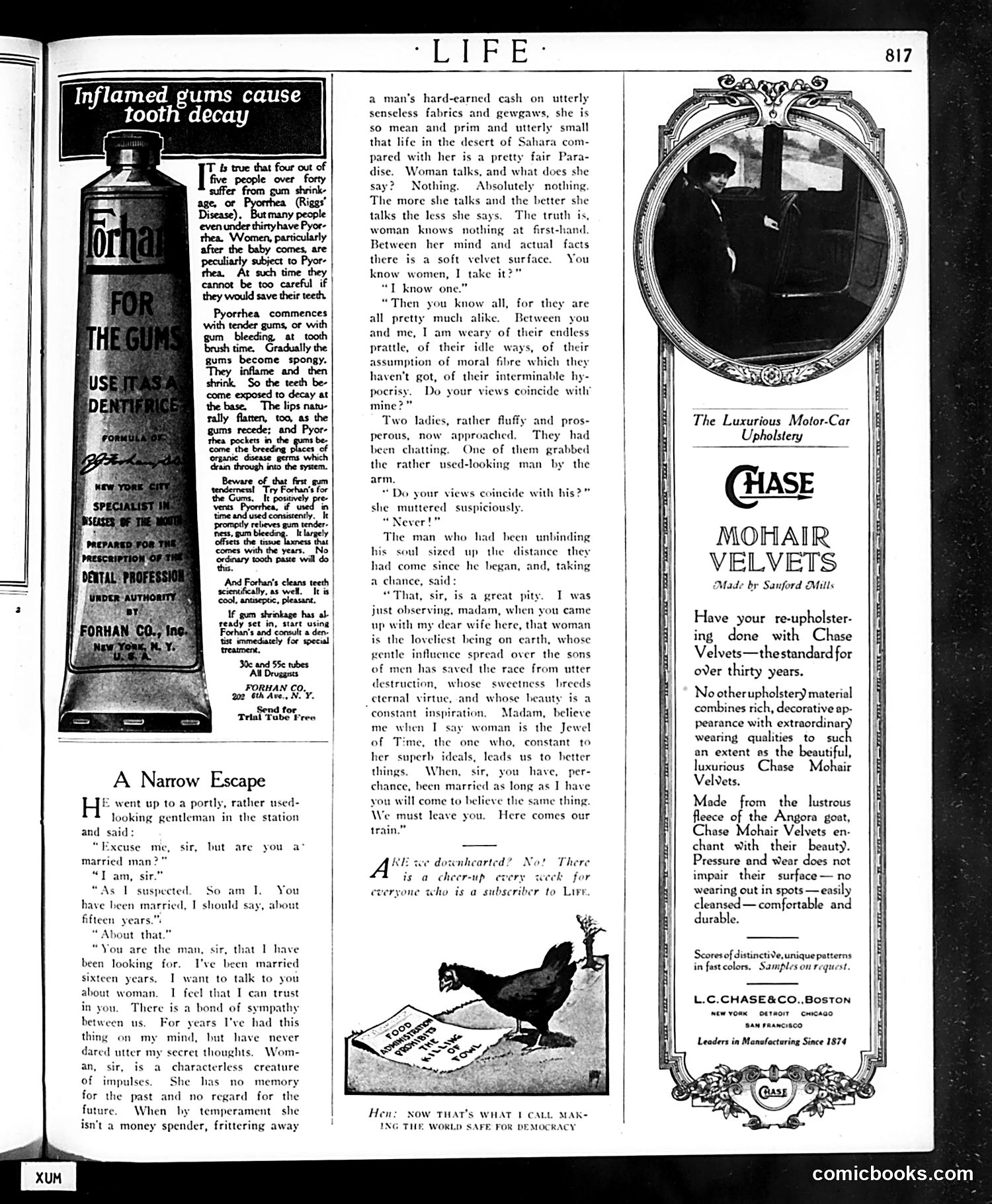
This comic sketch mocks misogynistic attitudes toward women. A married man corners a stranger at a station and delivers a bitter tirade: women are characterless, spend money foolishly, talk without saying anything, and lack genuine knowledge or moral fiber. The punchline relies on dramatic irony—when two women approach and one asks if his views match the stranger's, he performs a complete reversal, suddenly praising women as "the Jewel of Time" and the salvation of civilization. The satire targets men who hold contradictory, hypocritical views about women depending on social circumstance. The title "Narrow Escape" suggests the man narrowly avoids his wife discovering his true opinions. The caption's reference to "making the world safe for democracy" (likely WWI-era phrasing) implies the irony: democracy rings hollow when half the population is dismissed with such contempt and lies.
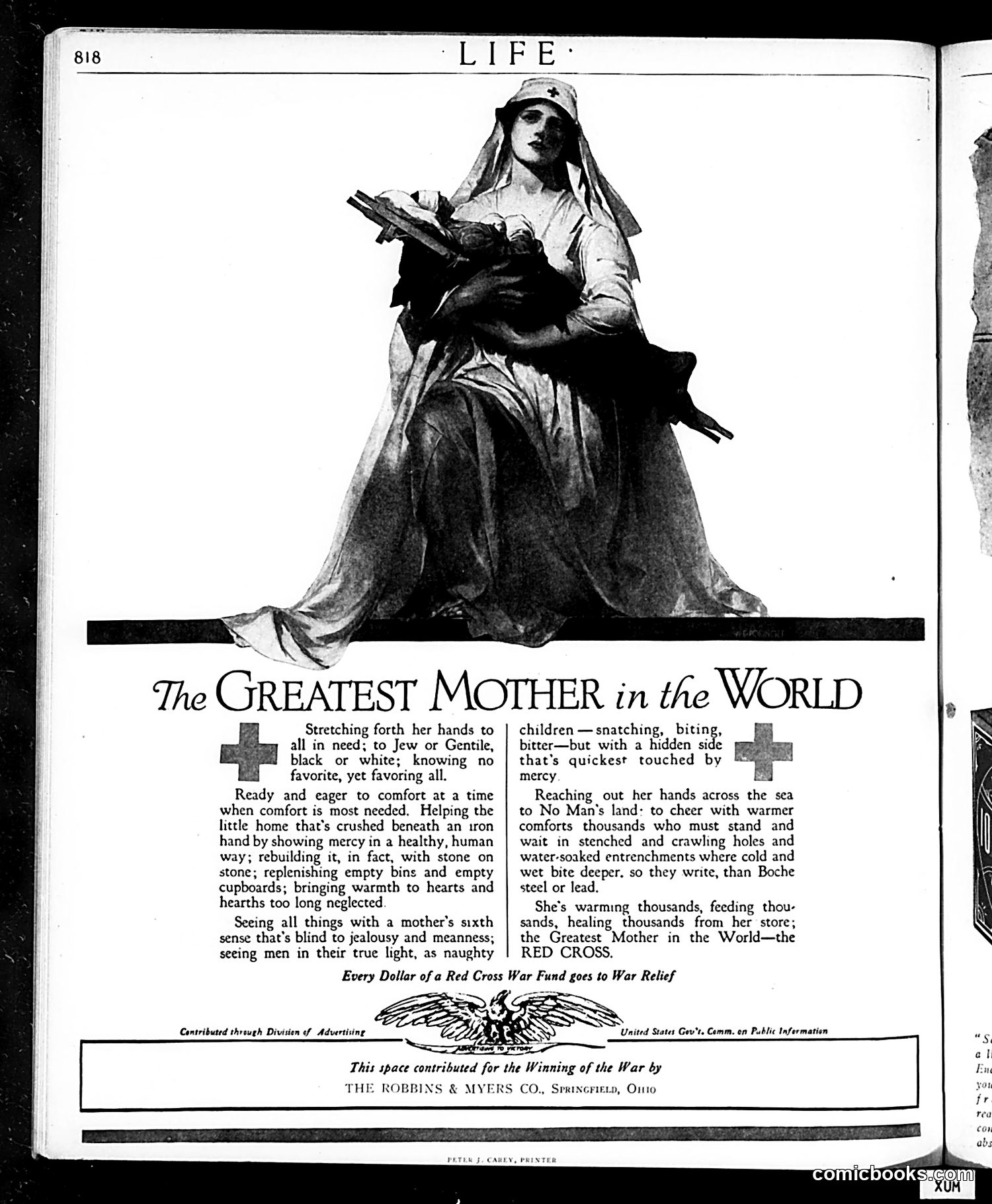
This is a **wartime fundraising advertisement** for the American Red Cross during World War I (indicated by references to "Boche steel," trench warfare, and "No Man's land"). The "Greatest Mother" is an allegorical figure—not a specific person—representing the Red Cross itself as a nurturing, impartial force. The image shows a robed, veiled woman cradling supplies and comfort items, symbolizing maternal care extended universally ("to Jew or Gentile, black or white"). The text emphasizes the Red Cross's humanitarian mission: providing relief to soldiers in trenches, comforting the home front, feeding the hungry, and healing the wounded. The phrase "Every Dollar of a Red Cross War Fund goes to War Relief" serves as the fundraising pitch. This appears in *Life* magazine as a **patriotic advertisement** contributed by the Robbins & Myers Company and the U.S. government's Committee on Public Information—typical of American WWI-era propaganda blending commerce with civic duty.
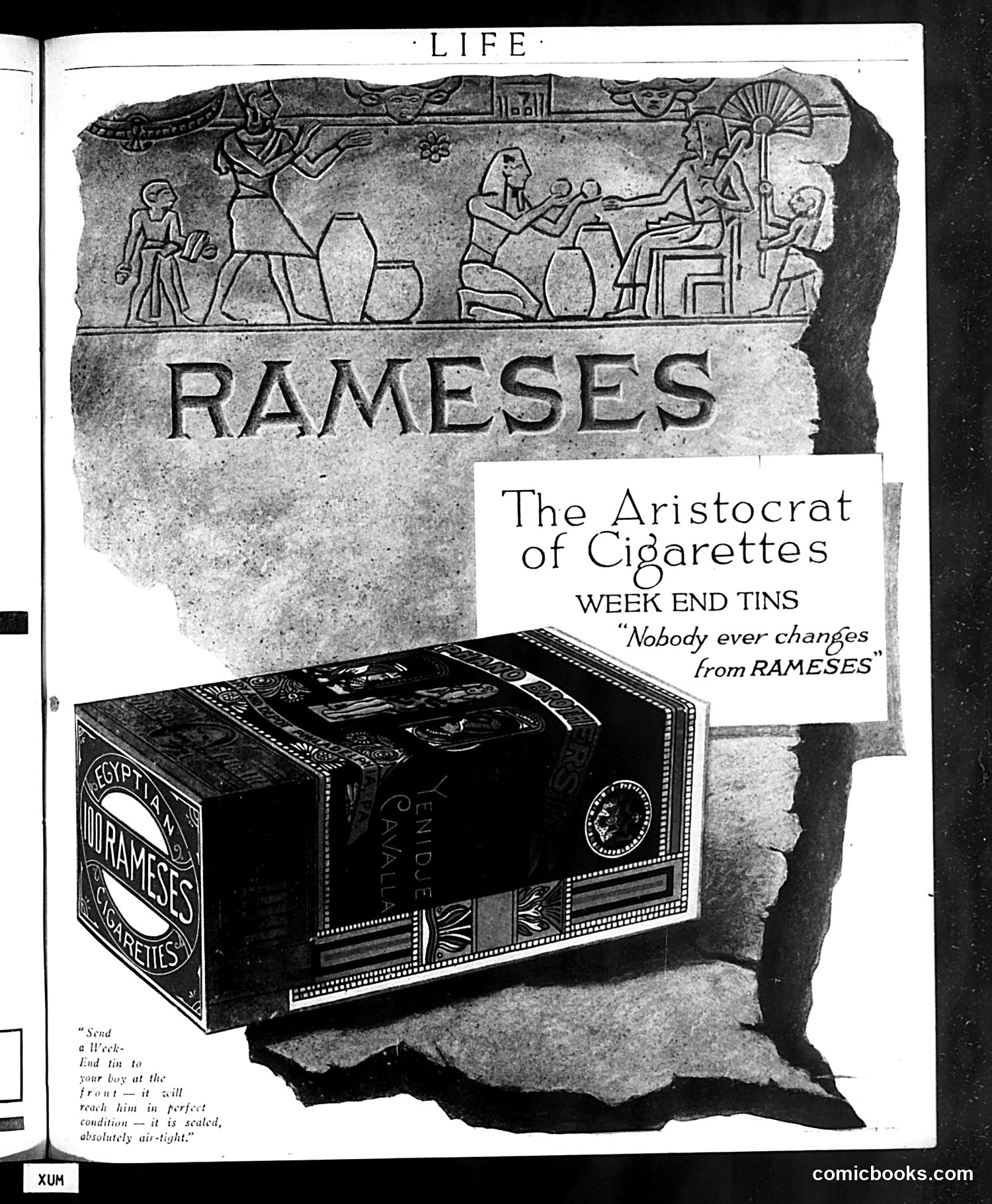
This is primarily a **cigarette advertisement**, not political satire. The ad for "Rameses" cigarettes uses Egyptian imagery—an ancient relief carving at the top depicting Ramses II—to suggest luxury and timelessness. The tagline "Nobody ever changes from RAMESES" implies brand loyalty and superiority (positioning the product as "The Aristocrat of Cigarettes"). The "Week End Tins" are promotional packaging, sealed "air-tight" for freshness. The small text suggests sending these tins as gifts to soldiers or loved ones. This reflects early 20th-century advertising that associated consumer products with historical prestige and exotic imagery. There is no political cartoon or satire here—it's a straightforward commercial pitch from Life magazine's advertising section.
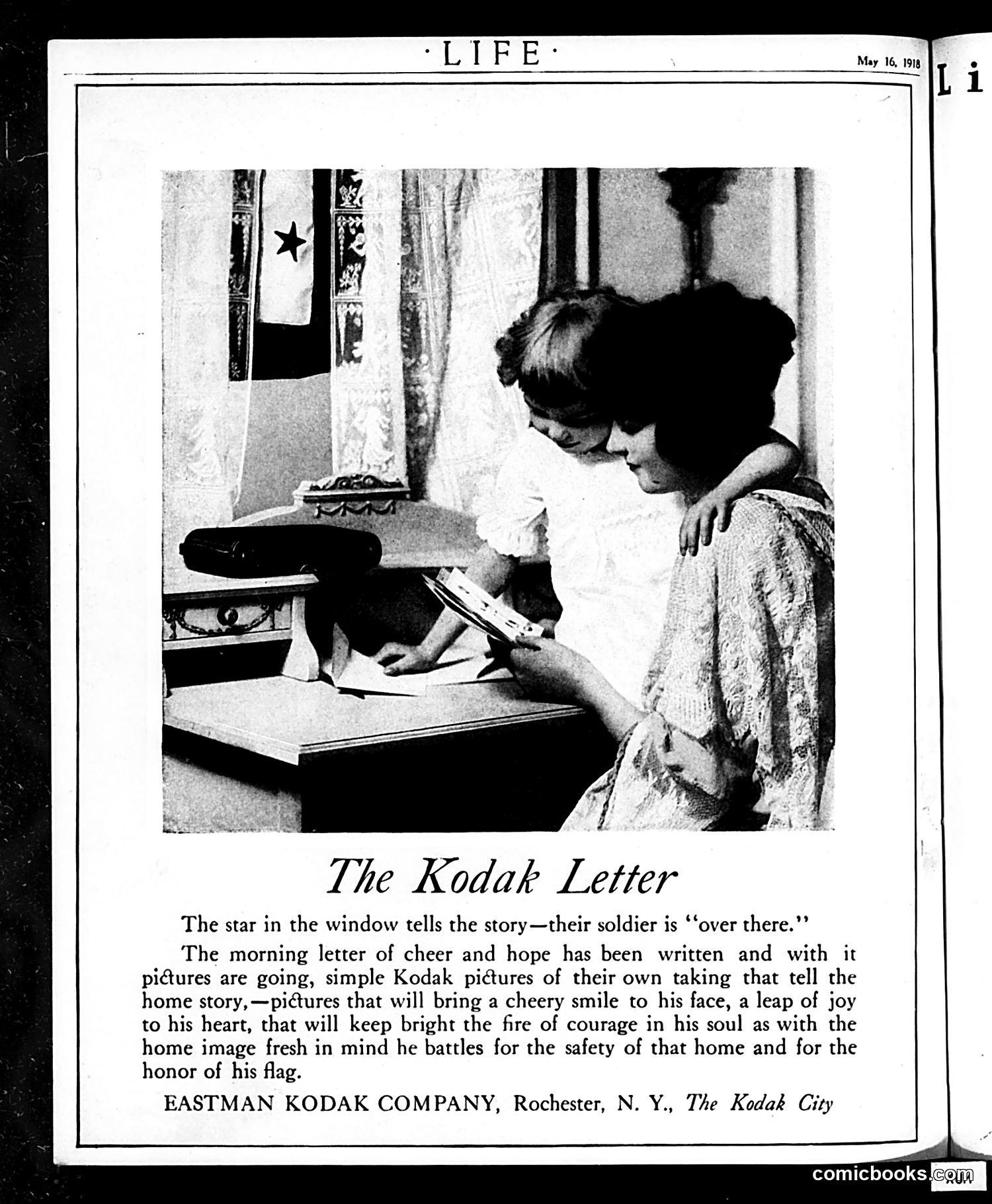
This is a World War I–era advertisement, not a political cartoon. It shows a woman writing a letter and preparing photographs to send to a soldier fighting overseas (indicated by the gold star in the window—a symbol meaning a family member was serving in the war). The ad appeals to wartime sentiment by positioning Kodak cameras as tools for maintaining morale. Simple family photographs would supposedly sustain soldiers' courage by keeping them emotionally connected to home. The "star in the window" reference is significant: gold stars signified active soldiers; black stars marked those killed in action. This represents how American corporations marketed products during WWI by tying them to patriotic duty and emotional support for troops—a common advertising strategy of the period.