
Life, 1918-05-16 · page 16 of 40
Life — May 16, 1918 — page 16: what you’re looking at
What you’re looking at
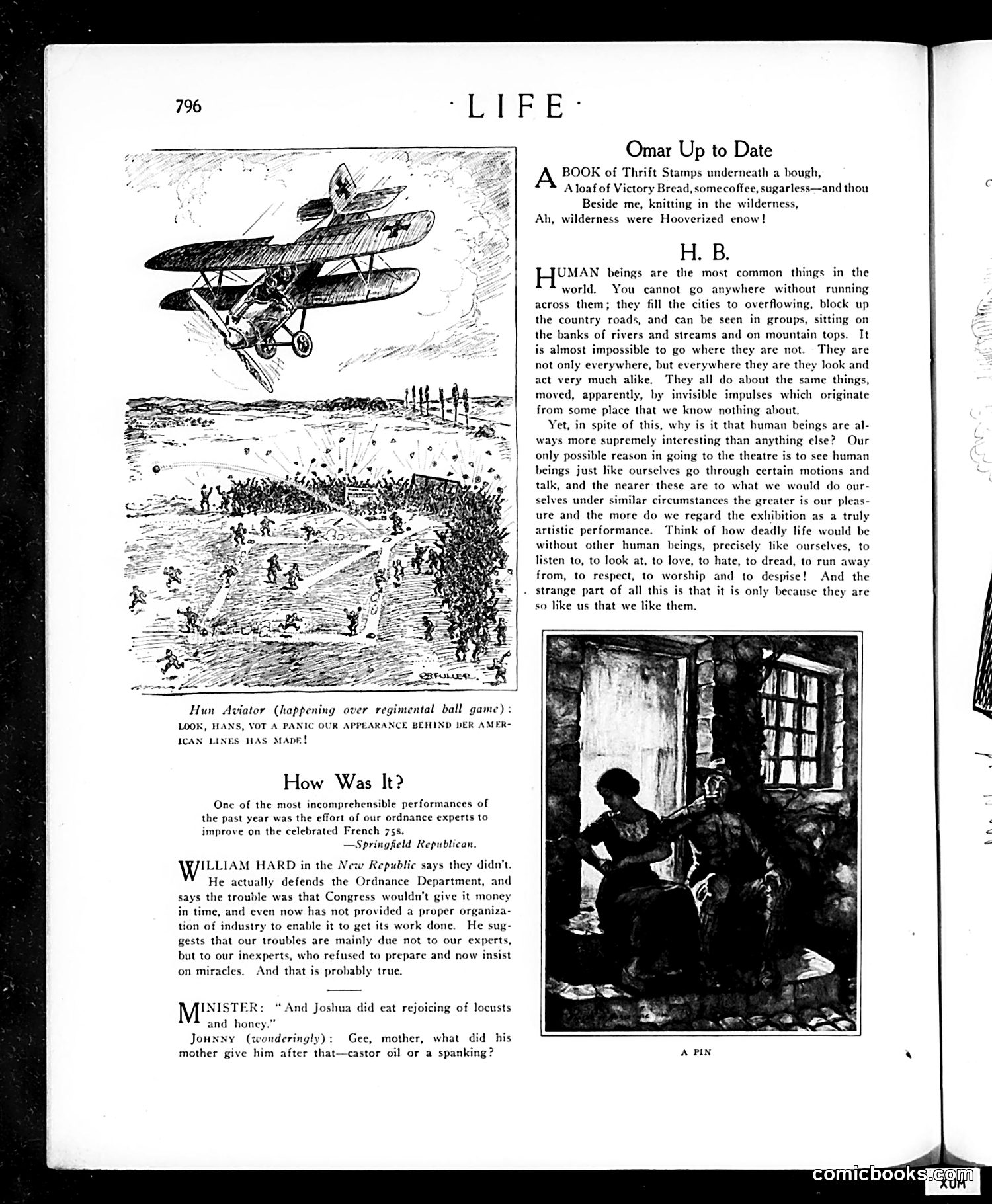
**"Omar Up to Date"** is a satirical poem parodying the famous *Rubaiyat of Omar Khayyam*. It mocks American wartime rationing and austerity measures (likely WWI-era), replacing romantic imagery with references to "Thrift Stamps," "Victory Bread," and "Hooverized" conditions—Herbert Hoover being associated with food conservation programs. The joke: romance is dead when replaced by rationing. **"Hun Aviator"** cartoon depicts a German pilot flying over an American baseball game, expecting panic but seeing none. The satire comments on American complacency or confidence during WWI—the Germans expected fear, but Americans continue their leisure activities undisturbed. The airplane illustration above shows early aviation technology; the ground scene shows the baseball game's scale and crowd. **"How Was It?"** discusses military ordnance procurement failures, defending the Ordnance Department and blaming Congress for inadequate funding and poor industrial organization rather than expert failure. The remaining humor items are unrelated vignettes.
📄 Transcribed text from this page (OCR, searchable)
Machine-transcribed from the original scan — historical spelling and the odd misread are preserved.
Omar Up to Date A BOOK of Thrift Stamps underneath a bough, A loaf of Victory Bread, some coffee, sugarless—and thou Beside me, knitting in the wilderness, Ah, wilderness were Hooverized enow! H. B. H JMAN beings are the most common things in the world. You cannot go anywhere without running across them; they fill the cities to overflowing, block up the country roads, and can be seen in groups, sitting on the banks of rivers and streams and on mountain tops. It is almost impossible to go where they are not. They are not only everywhere, but everywhere they are they look and act very much alike, They all do about the same things, moved, apparently, by invisible impulses which originate from some place that we know nothing about. Yet, in spite of this, why is it that human beings are al- ways more supremely interesting than anything else? Our only possible reason in going to the theatre is to see human beings just like ourselves go through certain motions and talk, and the nearer these are to wi we would do our- selves under similar circumstances the greater is our pleas- ure and the more do we regard the exhibition as a truly artistic performance. Think of how deadly life would be without other human beings, precisely like ourselves, to listen to, to look at, to love, to hate, to dread, to run away from, to respect, to worship and to despise! And the strange part of all this is that it is only because they are so like us that we like them. Hun Aviator (happening over regimental ball game): LOOK, HANS, VOT A PANIC OUR APPEARANCE BEHIND DER AMER~ ICAN LINES HAS MADE! How Was It? One of the most incomprehensible performances of the past year was the effort of our ordnance experts to improve on the celebrated French 758. —Springfield Republican. ILLIAM HARD in the New Republic says they didn’t. He actually defends the Ordnance Department, and says the trouble was that Congress wouldn't give it money in time, and even now has not provided a proper organiza- tion of industry to enable it to get its work done. He sug- gests that our troubles are mainly due not to our experts, but to our inexperts, who refused to prepare and now insist on miracles. And that is probably true. INISTER: “And Joshua did eat rejoicing of locusts and hone Jouxxy (qwonderingly): Gee, mother, what did his mother give him after that—castor oil or a spanking? comicbookseamay