
Life, 1918-05-16 · page 28 of 40
Life — May 16, 1918 — page 28: what you’re looking at
What you’re looking at
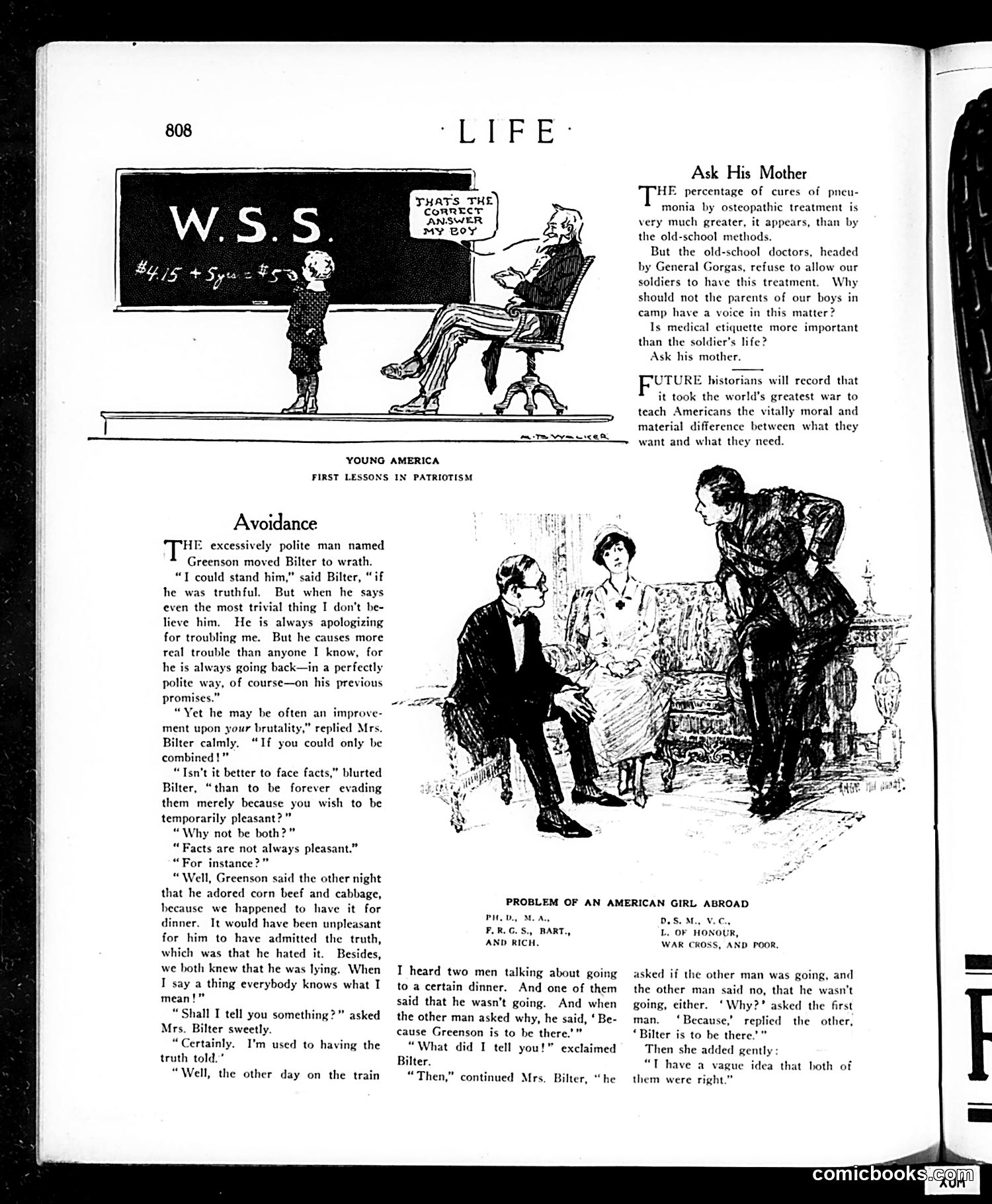
**Top cartoon ("W.S.S.")**: A teacher instructs a student on basic arithmetic during wartime, captioned "Young America: First Lessons in Patriotism." The joke satirizes how even elementary education is being framed through a patriotic/military lens during World War I. **"Avoidance" story**: A domestic dispute between Mr. and Mrs. Bilter debates whether it's better to be brutally honest (Bilter's position) or politely evasive (Greenson's approach). Mrs. Bilter's conclusion—that both men avoid Greenson's dinner for opposite reasons, proving each man's philosophy self-defeating—suggests neither extreme works well. This appears to be gentle social satire about civility versus authenticity. **"Ask His Mother"**: Advocates for osteopathic treatment of pneumonia in soldiers against military doctors' opposition, appealing to parents' authority over medical establishment hierarchy—a commentary on institutional gatekeeping during wartime. **Lower illustration**: Depicts an American girl abroad encountering social complications, though specific context is unclear from this excerpt.
📄 Transcribed text from this page (OCR, searchable)
Machine-transcribed from the original scan — historical spelling and the odd misread are preserved.
THATS THE CORRECT ANSWER MY BOY YOUNG AMERICA FIRST LESSONS IN PATRIOTISM Avoidance HE excessively polite man named Greenson moved Bilter to wrath. “TI could stand him,” said Bilter, “if he was truthful. But when he says even the most trivial thing I don’t be- lieve him. He is always apologizing for troubling me. But he causes more real trouble than anyone I know, for he is always going back—in a perfectly polite way, of course—on his previous promises.” “Yet he may be often an improve- ment upon your brutality,” replied Mrs. Bilter calmly, “If you could only be “Isn't it better to face facts,” blurted Bilter, “than to be forever evading them merely because you wish to be temporarily pleasant?” “Why not be both?” “Facts are not alwa: “For instance?” “Well, Greenson said the other night that he adored corn beef and cabbage, hecause we happened to have it for dinner. It would have been unpleasant for him to have admitted the truth, which was that he hated it. Besides, we both knew that he was lying. When I say a thing everybody knows what I mean!" “Shall I tell you something?” asked Mrs. Bilter sweetly. “Certainly. I'm used to having the truth told.” “Well, the other day on the train s pleasant.” Ask His Mother HE percentage of cures of pneu- monia by osteopathic treatment is very much greater, it appears, than by the old-school methods. But the old-school doctors, headed by General Gorgas, refuse to allow our soldiers to have this treatment. Why should not the parents of our boys in camp have a voice in this matter? Is medical etiquette more important than the soldier's life? Ask his mother. UTURE historians will record that it took the world’s greatest war to teach Americans the vitally moral and material difference between what they want and what they need. PROBLEM OF AN AMERICAN GIRL ABROAD PHD, MA PLR.G.S., BART., AND RICH. T heard two men talking about going to a certain dinner. And one of them said that he wasn’t going. And when the other man asked why, he said, ‘ Be- cause Greenson is to be there.’ “What did I tell you!” exclaimed Bilter. “Then,” continued Mrs. Bilter, L. OUR, WAR CROSS, AND POOR, asked if the other man was going, and the other man said no, that he wasn’t going, either. ‘Why?’ asked the first man. ‘Because,’ replied the other, ‘Bilter is to be there.” Then she added gently: “T have a vague idea that both of them were right.” comicbooksieray