
Life, 1918-05-16 · page 14 of 40
Life — May 16, 1918 — page 14: what you’re looking at
What you’re looking at
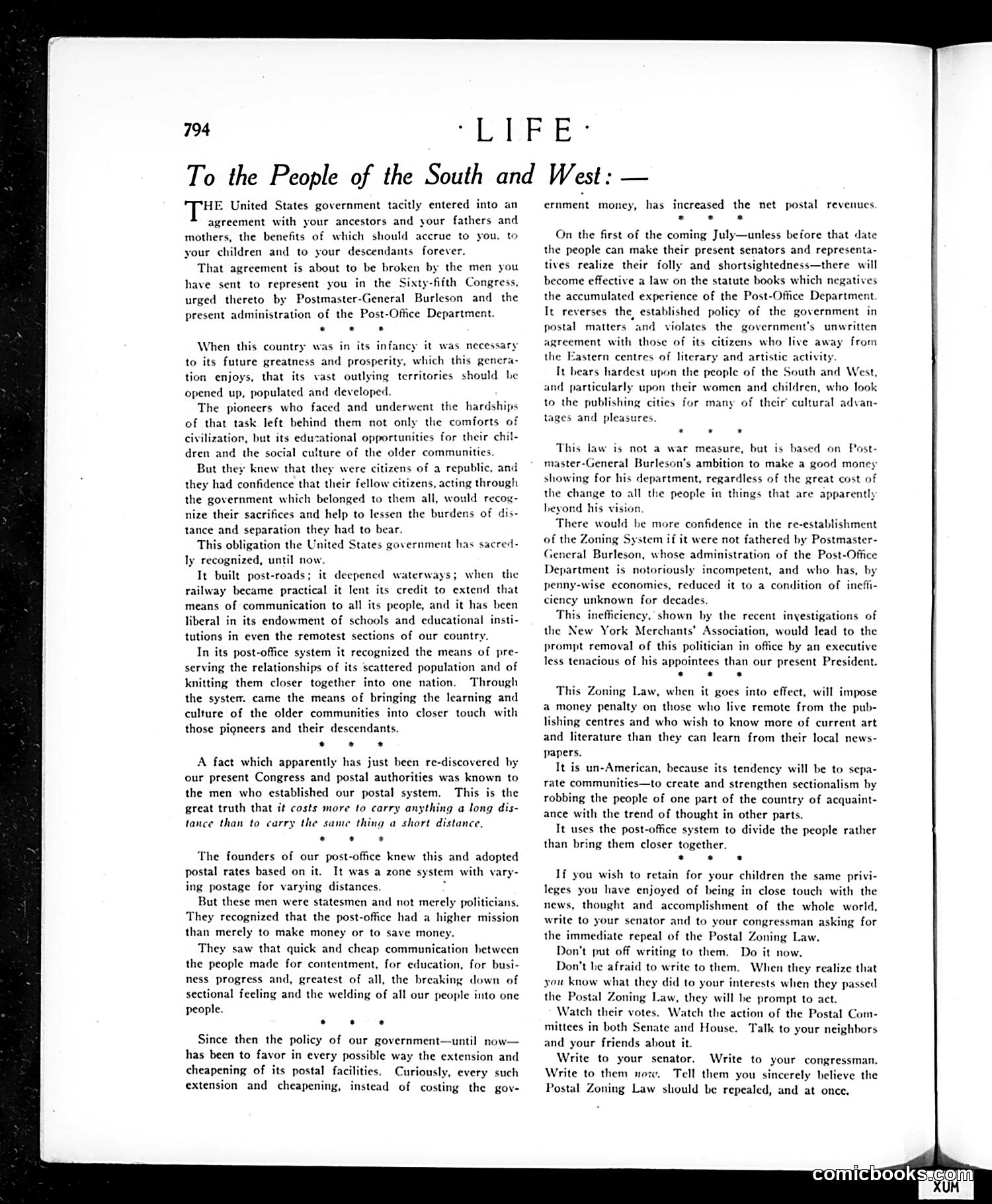
This page is primarily **text, not a cartoon**—a political editorial addressed "To the People of the South and West" opposing the Postal Zoning Law. The author argues the law: - Penalizes people living far from publishing centers - Violates the government's historical postal mission to unite the nation - Creates sectionalism by disadvantaging remote communities - Was promoted by Postmaster-General Burleson, criticized as inefficient The editorial urges readers to contact their senators and representatives to demand repeal, claiming the law is "un-American" because it separates rather than connects communities. **Context**: This appears to address Progressive-era postal policy debates over mail rates and regional economic disparities.
📄 Transcribed text from this page (OCR, searchable)
Machine-transcribed from the original scan — historical spelling and the odd misread are preserved.
794 “LEE * To the People of the South and West: — HE United States government tacitly entered into an agreement with your ancestors and your fathers and mothers, the benefits of which should accrue to you, to your children and to your descendants forever. That agreement is about to be broken by the men you have sent to represent you in the Sixty-fifth Congress, urged thereto by Postmaster-General Burleson and the present administration of the Post-Office Department. * 2 8 When this country was in its infancy it was necessary to its future greatness and prosperity, which this genera- tion enjoys, that its vast outlying territories should be opened up, populated and developed. The pioneers who faced and underwent the hardships of that task left behind them not only the comforts of civilization, but its educational opportunities for their chil- dren and the social culture of the older communities. But they knew that they were citizens of a republic, and they had confidence that their fellow citizens, acting through the government which belonged to them all, would recog- nize their sacrifices and help to lessen the burdens of dis- tance and separation they had to bear. This obligation the United States government ly recognized, until now, It built post-roads; it deepened waterways; when the railway became practical it lent its credit to extend that means of communication to all its people, and it has been liberal in its endowment of schools and educational insti- tutions in even the remotest sections of our country. sacred- In its post-office system it recognized the means of pre- serving the relationships of its scattered population and of knitting them closer together into one nation. Through the system. came the means of bringing the learning and culture of the older communities into closer touch with those pioneers and their descendants. s 8 6 A fact which apparently has just been re-discovered by our present Congress and postal authorities was known to the men who established our postal system. This is the great truth that if costs more to carry anything a long dis- tance than to carry the same thing a short distance, * 8 8 The founders of our post-office knew this and adopted postal rates based on it. It was a zone system with vary- ing postage for varying distances. . But these men were statesmen and not merely politicians. They recognized that the post-office had a higher mission than merely to make money or to save money. They saw that quick and cheap communication hetween the people made for contentment, for education, for busi- ness progress and, greatest of all, the breaking down of sectional feeling and the welding of all our people into one people. o 8 Since then the policy of our government—until now— has been to favor in every possible way the extension and cheapening of its postal facilities. Curiously, every such extension and cheapening, instead of costing the gov- ernment money, has increased the net postal revenues. . 8 8 On the first of the coming July—unless before that date the people can make their present senators and representa- tives realize their folly and shortsightedness—there will become effective a law on the statute books which negatives the accumulated experience of the Post-Office Department. It reverses the, established policy of the government in postal matters and violates the government's unwritten agreement with those of its citizens who live away from the Eastern centres of literary and artistic activity. It bears hardest upon the people of the South and West, and particularly upon their women and children, who look to the publishing cities for many of their’ cultural advan- tages and pleasures. This law is not a war measure, but is based on Post- master-General Burleson’s ambition to make a good moncy showing for his department, regardless of the great cost of the change to all the people in things that are apparently heyond his vision. There would be more confidence in the re-establishment of the Zoning System if it were not fathered by Postmaster- General Burleson, whose administration of the Post-Office Department is notoriously incompetent, and who has, by penny-wise economies, reduced it to a condition of ineffi- ciency unknown for decades. This inefficiency, shown by the recent inyestigations of the New York Merchants’ Association, would lead to the prompt removal of this politician in office by an executive less tenacious of his appointees than our present President. * © This Zoning Law, when it goes into effect, will impose a money penalty on those who live remote from the pub- lishing centres and who wish to know more of current art and literature than they can learn from their local news- papers. It is un-American, because its tendency will be to sepa- rate communities—to create and strengthen sectionalism by robbing the people of one part of the country of acquaint- ance with the trend of thought in other parts. It uses the post-office system to divide the people rather than bring them closer together. s 8 «8 If you wish to retain for your children the same privi- leges you have enjoyed of being in close touch with the news, thought and accomplishment of the whole world, write to your senator and to your congressman asking for the immediate repeal of the Postal Zoning Law. Don't put off writing to them. Do it now. Don’t he afraid to write to them. When they realize that you know what they did to your interests when they passed the Postal Zoning Law, they will be prompt to act. Watch their votes. Watch the action of the Postal Com- mittees in both Senate and House. Talk to your neighbors and your friends about it. Write to your senator. Write to your congressman. Write to them now. Tell them you sincerely believe the Postal Zoning Law should be repealed, and at once. Comicbooksscoag