
Life, 1918-05-16 · page 8 of 40
Life — May 16, 1918 — page 8: what you’re looking at
What you’re looking at
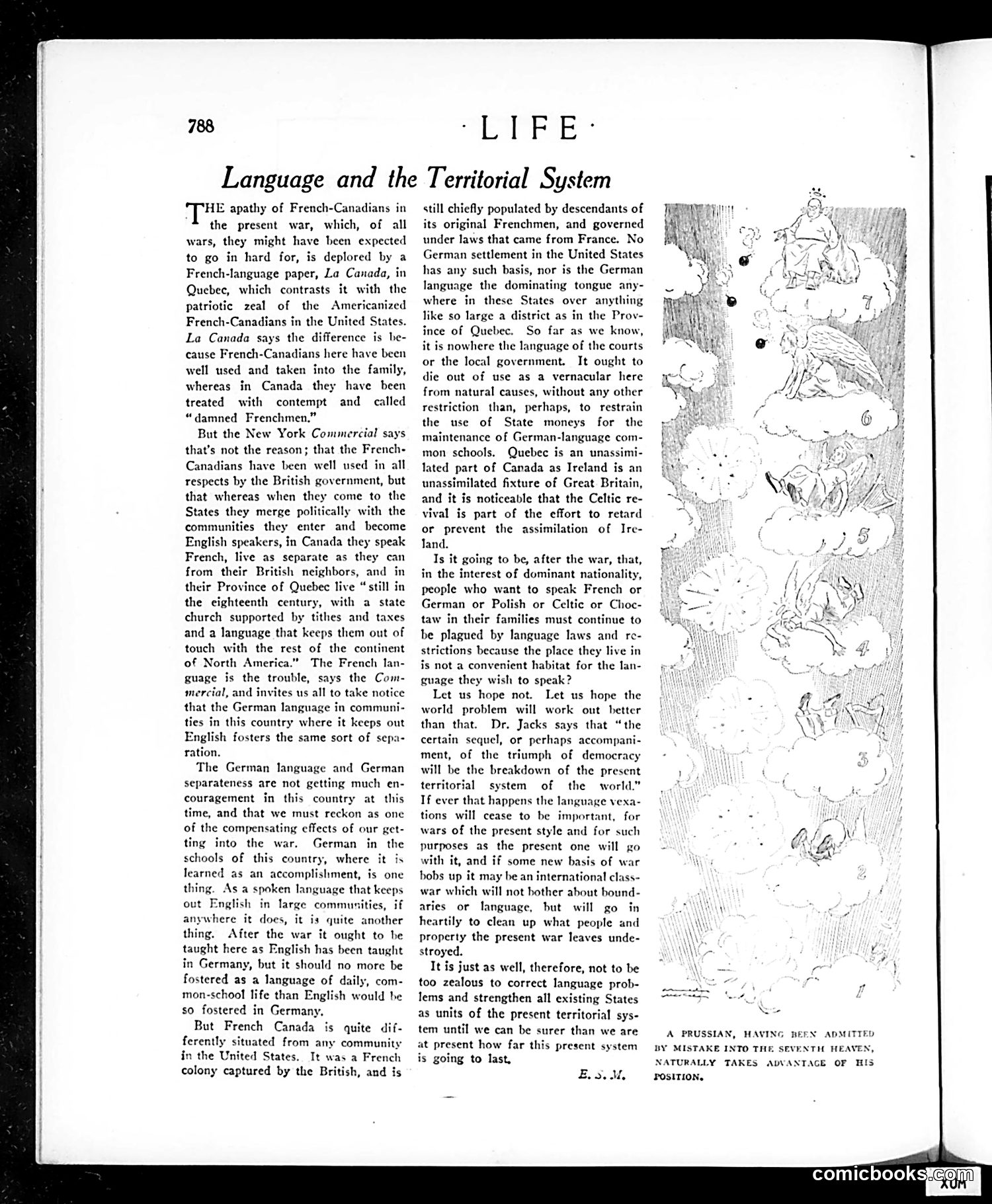
This page discusses French-Canadian language politics during World War I. The article argues that French-Canadians in Quebec should be allowed to maintain their language and cultural identity, contrasting their situation with how German-language communities in the U.S. faced suppression and discrimination. The cartoon depicts a Prussian soldier who has "blundered into the seventh heaven" by mistake—humorously suggesting the soldier has accidentally stumbled into a fortunate position. The caption's ironic tone mocks German military overconfidence while illustrating the article's broader point about how language and territorial identity issues will persist after the war, regardless of military outcomes. The piece advocates for respecting linguistic minorities' rights rather than forcibly assimilating them into dominant cultures.
📄 Transcribed text from this page (OCR, searchable)
Machine-transcribed from the original scan — historical spelling and the odd misread are preserved.
788 EAE OE * Language and the Territorial System HE apathy of French-Canadians in the present war, which, of all wars, they might have been expected to go in hard for, is deplored by a French-language paper, La Canada, in Quebec, which contrasts it with the patriotic zeal of the Americanized French-Canadians in the United States. La Canada says the difference is be- cause French-Canadians here have been well used and taken into the family, whereas in Canada they have been treated with contempt and called “damned Frenchmen.” But the New York Commercial says that’s not the reason; that the French- Canadians have been well used in all respects by the British government, but that whereas when they come to the States they merge politically with the communities they enter and become English speakers, in Canada they speak French, live as separate as they can from their British neighbors, and in their Province of Quebec live “ still in the eighteenth century, with a state church supported by tithes and taxes and a language that keeps them out of touch with the rest of the continent of North America.” The French lan- guage is the trouble, says the Com- mercial, and invites us all to take notice that the German language in communi- ties in this country where it keeps out English fosters the same sort of sepa- ration. The German language and German separateness are not getting much en- couragement in this country at this time, and that we must reckon as one of the compensating effects of our get- ting into the war. German in the schools of this country, where learned as an accomplishment, is one thing. As a spoken language that keeps out English in large communities, if anywhere it does, it is quite another thing. After the war it ought to he taught here as English has been taught in Germany, but it should no more be fostered as a language of daily, com- mon-school life than English would be so fostered in Germany. But French Canada is quite dif- ferently situated from any community in the United States. It was a French colony captured by the British, and is still chiefly populated by descendants of its original Frenchmen, and governed under laws that came from France. No German settlement in the United States has any such basis, nor is the German language the dominating tongue any- where in these States over anything like so large a district as in the Prov- ince of Quebec. So far as we know, it is nowhere the language of the courts or the local government. It ought to die out of use as a vernacular here from natural causes, without any other restriction than, perhaps, to restrain the use of State moneys for the maintenance of German-language com- mon schools. Quebec is an unassimi- lated part of Canada as Ireland is an unassimilated fixture of Great Britain, and it is noticeable that the Celtic re- vival is part of the effort to retard or prevent the assimilation of Ire- Tand. Is it going to be, after the war, that, in the interest of dominant nationality, people who want to speak French or German or Polish or Celtic or Choc- taw in their families must continue to be plagued by language laws and re- strictions because the place they live in is not a convenient habitat for the lan- guage they wish to speak? Let us hope not. Let us hope the world problem will work out better than that. Dr. Jacks says that “the certain sequel, or perhaps accompani- ment, of the triumph of democracy will be the breakdown of the present territorial system of the world.” Tf ever that happens the language vexa- tions will cease to be important, for wars of the present style and for such purposes as the present one will go with it, and if some new basis of war bobs up it may be an international class- war which will not bother about bound- aries or language, but will go in heartily to clean up what people and property the present war leaves unde- stroyed. It is just as well, therefore, not to be too zealous to correct language prob- lems and strengthen all existing States as units of the present territorial sys- tem until we can be surer than we are at present how far this present system is going to last, E.o.M, A PRUSSIAN, BY MISTAKE INTO THE NATURALLY TAKES. POSITION, HAVING HEEN ADMITTED SEVENTH HEAVEN, ADVANTAGE OF HIS comicbooksieeny