
Life, 1918-05-16 · page 18 of 40
Life — May 16, 1918 — page 18: what you’re looking at
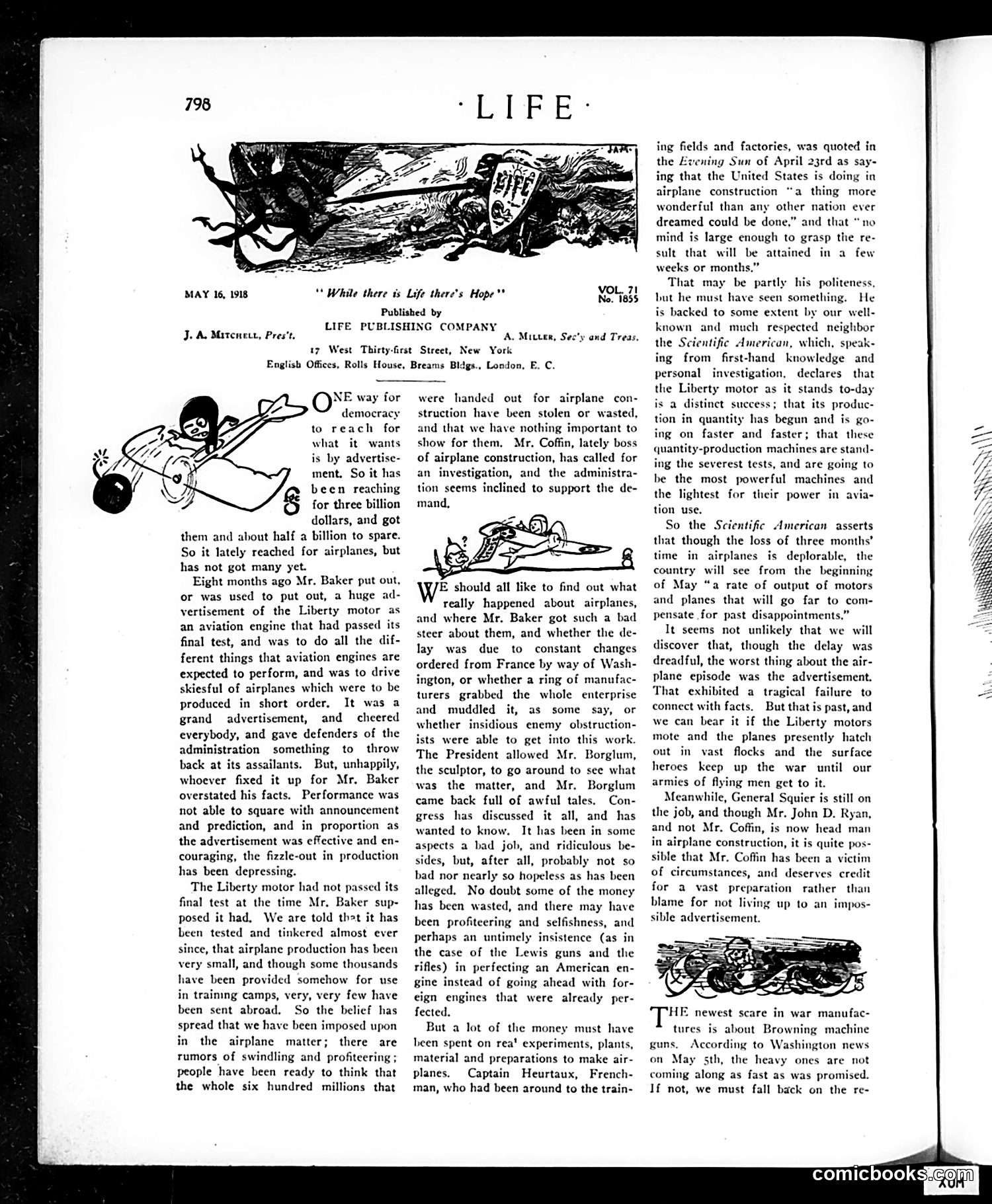
What you’re looking at
This editorial addresses the widely-publicized failure of the **Liberty aircraft engine**, a major WWI-era procurement scandal. Secretary of War Baker had advertised the engine as complete and ready for mass production, but it repeatedly failed tests and airplane output remained minimal—fueling public suspicion of waste, profiteering, and incompetence. The cartoons (showing a crashed plane) visually reinforce the text's critique: an overpromising government advertisement failed to deliver results. The piece acknowledges legitimate problems—overstated claims, production delays—but argues against conspiracy theories, attributing delays partly to design changes from France and partly to building American engines rather than adopting foreign ones. The editorial cites French captain Heurtaux's contrary assessment that U.S. airplane construction efforts were unprecedented, suggesting eventual success despite current disappointments. The satire's target is official mismanagement and premature boasting rather than the administration's fundamental competence.
📄 Transcribed text from this page (OCR, searchable)
Machine-transcribed from the original scan — historical spelling and the odd misread are preserved.
MAY 16, 1918 “* While there is Life there’s Hope’* Published by LIFE PUBLISHING COMPANY J. A. Mitenent, Pres't, A. Minter, Si and Treas, 17 West Thirty-first Street, New York English Offices, Rolls House, Breams Bldgs., London, E. C. NE way for democracy to reach for what it wants is by adverti: ment. So it has been reaching for three billion dollars, and got them and about half a billion to spare. So it lately reached for airplanes, but has not got many yet. Eight months ago Mr. Baker put out, or was used to put out, a huge ad- vertisement of the Liberty motor as an aviation engine that had passed its final test, and was to do all the dif- ferent things that aviation engines are expected to perform, and was to drive skiesful of airplanes which were to be produced in short order, It was a grand advertisement, and cheered everybody, and gave defenders of the administration something to throw back at its assailants. But, unhappily, whoever fixed it up for Mr. Baker overstated his facts. Performance was not able to square with announcement and prediction, and in proportion as the advertisement was effective and en- couraging, the fizzle-out in production has been depressing. The Liberty motor had not passed its final test at the time Mr. Baker sup- posed it had, We are told thet it has been tested and tinkered almost ever since, that airplane production has been very small, and though some thousands have been provided somehow for use in training camps, very, very few have been sent abroad. So the belief has spread that we have been imposed upon in the airplane matter; there are rumors of swindling and profiteering ; people have been ready to think that the whole six hundred millions that were handed out for airplane con- struction have been stolen or wasted, and that we have nothing important to show for them. Mr. Coffin, lately boss of airplane construction, has called for an investigation, and the administra- tion seems inclined to support the de- E should all like to find out what really happened about airplanes, and where Mr. Baker got such a bad steer about them, and whether the de- lay was due to constant changes ordered from France by way of Wash- ington, or whether a ring of manufac- turers grabbed the whole enterprise and muddled it, as some say, or whether insidious enemy obstruction- ists were able to get into this work. The President allowed Mr. Borglum, the sculptor, to go around to see what was the matter, and Mr. Borglum came back full of awful tales. Con- gress has discussed it all, and has wanted to know, It has beer some aspects a bad job, and ridiculous be- sides, but, after all, probably not so bad nor nearly so hopeless as has been alleged. No doubt some of the money has been wasted, and there may have been profiteering and selfishness, and perhaps an untimely insistence (as in the case of the Lewis guns and the rifles) in perfecting an American en- gine instead of going ahead with for- eign engines that were already per- fected. But a lot of the money must have heen spent on reat experiments, plants, material and preparations to make air- planes. Captain Heurtaux, French- man, who had been around to the train- ing fields and factories, was quoted in the Evening Sun of April 23rd as say- ing that the United States is doing in airplane construction “a thing more wonderful than any other nation ever dreamed could be done,” and that “no mind is large enough to grasp the re- sult that will be attained in a few weeks or months,” That may be partly his politeness, but he must have seen something. He is backed to some extent by our well- known and much respected neighbor the Scientific American, which, speak- ing from first-hand knowledge and personal investigation, declares that the Liberty motor as it stands to-day is a distinct success; that its produc- tion in quantity has begun and is go- ing on faster and faster; that these quantity-production machines are stand- ing the severest tests, and are going to be the most powerful machines and the lightest for their power in avia- tion use. So the Scientific American asserts that though the loss of three months’ time in airplanes is deplorable, the country will see from the beginning of May “a rate of output of motors and planes that will go far to com- pensate for past disappointments. It seems not unlikely that we will discover that, though the delay was dreadful, the worst thing about the air- plane episode was the advertisement. That exhibited a tragical failure to connect with facts. But that is past, and we can bear it if the Liberty motors mote and the planes presently hatch out in vast flocks and the surface heroes keep up the war until our armies of flying men get to it. Meanwhile, General Squier is still on the job, and though Mr. John D. Ryan, and not Mr. Coffin, is now head man in airplane construction, it is quite pos- sible that Mr. Coffin has been a vic of circumstances, and deserves credit for a vast preparation rather than blame for not living up to an impos- sible advertisement. newest scare in war manufac- is about Browning machine guns. According to Washington news on May 5th, the heavy ones are not coming along as fast as was promised. If not, we must fall back on the re- THe ture: comicbookseri}