
Life, 1918-05-16 · page 22 of 40
Life — May 16, 1918 — page 22: what you’re looking at
What you’re looking at
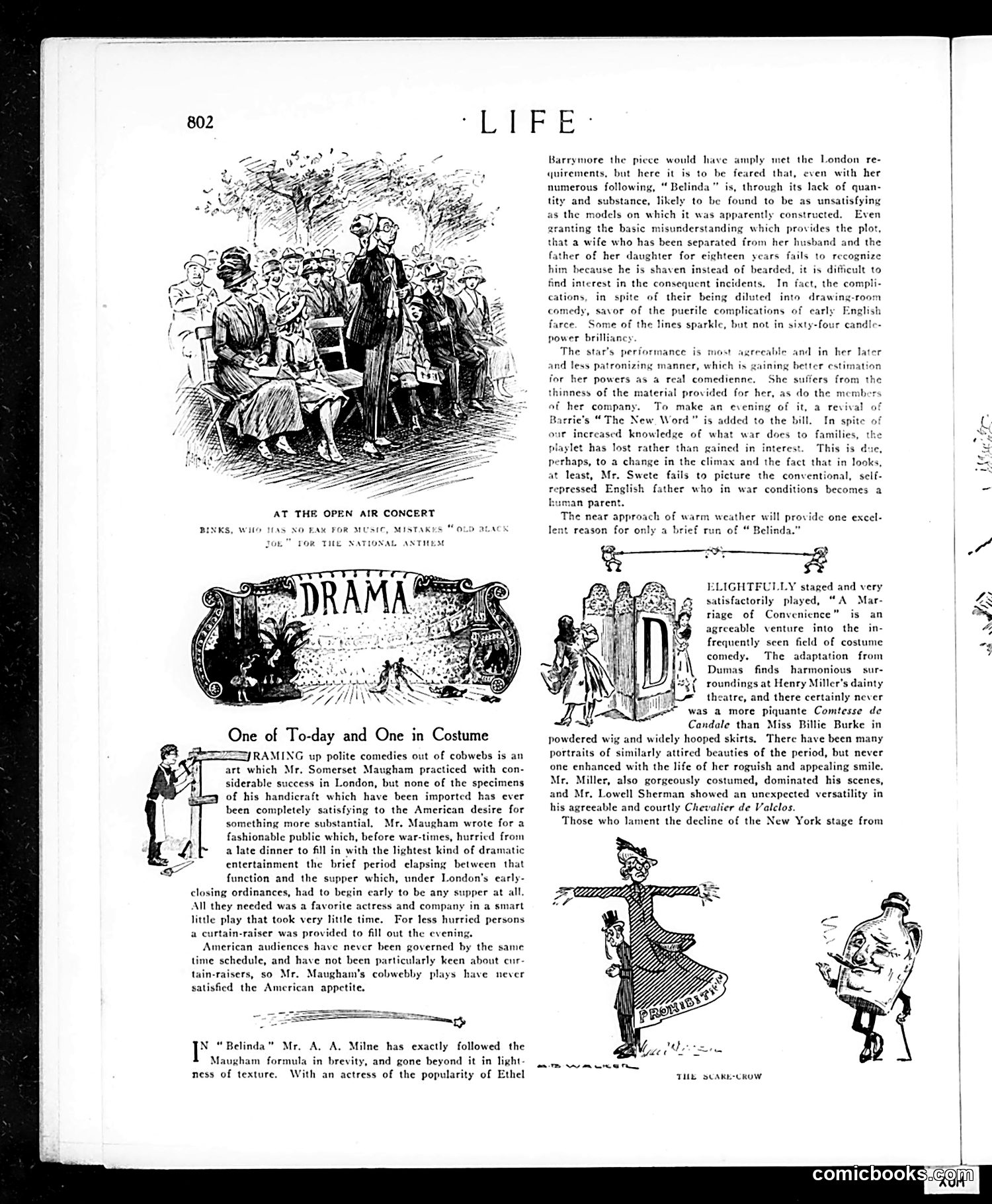
This page reviews three theatrical productions from early 20th-century New York. **The cartoon at top** satirizes an audience member named Binks who is musically tone-deaf—he mistakes "Job" (likely a musical piece) for the national anthem, a visual joke about his complete lack of musical discernment. **The main reviews** critique Somerset Maugham-style British comedies adapted for American audiences. The piece argues these lightweight drawing-room plays, designed for London's early-closing dinner schedules, fail to satisfy American theatergoers who want more substantial entertainment. **"Belinda"** (by A.A. Milne with Ethel Barrymore) is criticized as too thin and insubstantial, with plot holes (a woman can't recognize her estranged husband because he's shaved his beard). The small illustration labeled "The Scare-Crow" appears related to this production. **"A Marriage of Convenience"** receives positive coverage, praising Billie Burke in a costume comedy and calling Henry Miller's theater an elegant venue. The satire targets the mismatch between British theatrical conventions and American audience expectations.
📄 Transcribed text from this page (OCR, searchable)
Machine-transcribed from the original scan — historical spelling and the odd misread are preserved.
AT THE OPEN AIR CONCERT BINKS, WHO I1\S NO FAK FOR MUSIC, MISTAKES “ Job" POR THE NATIONAL ANTHESt One of To-day and One in Costume GE=ZZ=IRAMING up polite comedies out of cobwebs is an art which Mr, Somerset Maugham practiced with con- siderable success in London, but none of the specimens of his handicraft which have been imported has ever been completely satisfying to the American desire for something more substantial, Mr. Maugham wrote for a fashionable public which, before war-times, hurried from a late dinner to fill in with the lightest kind of dramatic entertainment the brief period clapsing between that function and the supper which, under London's early- closing ordinances, had to begin carly to be any supper at all, All they needed was a favorite actress and company in a smart little play that took very little time. For less hurried persons a curtain-raiser was provided to fill out the evening. American audiences have never been governed by the same time schedule, and have not been pa ly keen tain-raisers, so Mr. Maugham’s cobwebby plays have never satisfied the Amet out cure ican appetite. ry [Si Belinda” Mr. A. A, Milne has exactly followed the Maugham formula in brevity, and gone beyond it in light- ness of texture. With an actress of the popularity of Ethel “iL ‘PF E - Barrymore the picce would have amply met the London re- quirements, but here it is to be feared that, even with her numerous following, “Belinda” is, through its lack of quan- tity and substance, likely to be found to be as unsatisfying as the models on which it was apparently constructed. Even granting the ba les the plot, that a wife who has been separated from her husband and the father of her daughter for eighteen years fails to recognize him because he is shaven instead of bearded, it is difficult to find interest in the consequent incidents, In fact, the compli- cations, in spite of th comedy, savor of the puerile complications of carly farce. Some of the lines sparkle, but not in sixty-four candle power brillis The star’s perforn and less patronizing manner, which is gaining be jor her powers as a real comedienne, She suffers from the thinness of the material provided for her, as do the members of her company. To make an evening of it, a revival of Barrie's “The New Word” is added to the bill. In spite of our increased knowledge of what playlet has lost rather perhaps, to a change in the climax and the fact that in looks, at least, Mr. Swete fails to picture the conventional, self- repressed English father who in war conditions becomes a n pare! The near approach of warm weather will provide one excel- reason for only a brief run of “ Belinda.” ic misunderstanding which prox r being diluted into drawing-room nglish nce is mo. reeable and in her later f estimation war does to families, t ined in interest. This is due, ELIGHTFULLY staged and very satisfactorily played, “A Mar- riage of Convenience” is an agreeable venture into the frequently scen field of costume comedy, The adaptation from Dumas finds harmonious sur- roundings at Henry Miller's dainty theatre, and there certainly never Candale than Miss Billie Burke in powdered wig and widely hooped skirts, There have been many portraits of similarly attired beauties of the period, but never one enhanced with the life of her roguish and appealing smile. Mr. Miller, also gorgeously costumed, dominated his scenes, and Mr, Lowell Sherman showed an unexpected versatility in his agreeable and courtly Chevalier de Valclos. Those who lament the decline of the New York stage from THE SCAKE-CROW comicbooks} = Omn eon